





Introduction
Listeria infection, while rare, is typically caused by consuming food contaminated with Listeria monocytogenes (Lm). Populations at highest risk for invasive listeriosis are people aged 65 and older, pregnant women and their newborns, and immunocompromised individuals [Reference Cartwright1]. The incubation period is documented as early as the same day of exposure up to 70 days (median 11 days) after exposure to contaminated food [Reference Angelo2]. Pregnant women may experience a longer incubation period with a median of 19 days [Reference Angelo2].
Before 2022, six listeriosis outbreaks were linked to commercially produced ice cream products, and the associated illnesses occurred among older or immunocompromised patients in institutions like long-term care facilities (LTCFs) and hospitals [Reference Rietberg3–5]. Among those, five were linked to smaller ice cream manufacturers with limited geographic product distribution and few associated illnesses [Reference Rietberg3, 5–8]. This paper describes the largest reported listeriosis outbreak linked to ice cream, and the first known travel-associated listeriosis outbreak in the United States. Patients included those not residing in an institution and those outside the risk groups seen in previous ice cream outbreaks.
Methods
Outbreak identification
PulseNet, the national molecular subtyping and surveillance network coordinated by the Centers for Disease Control and Prevention (CDC), uses Lm cluster detection criteria of three clinical isolates related within 0–25 allele differences by whole genome multi-locus sequence typing (wgMLST) analysis, occurring within a 120-day period [Reference Tolar9]. Sequencing results were analyzed using BioNumerics version 7.6.3. All sequenced isolates were uploaded to the National Center for Biotechnology Information (NCBI).
Case definition
A case was defined as a patient with invasive listeriosis whose specimen was collected between 24 January 2021 and 19 August 2022 and was highly related to clinical and non-clinical specimens within 0–12 allele differences by wgMLST.
Hypothesis generation
The CDC Listeria Initiative (LI) national surveillance system collects clinical, demographic, and food exposure data for the 28 days prior to illness onset for cases of invasive Lm infections. State and local health departments attempt to interview patients using the standardized LI form, which includes questions about specific food items, such as ice cream, restaurant exposures, and travel to another state or country before illness [10]. Dates of travel are only requested for international travel [11]. In addition, CDC conducted open-ended interviews to capture general food habits and preferences of patients. Incubation periods were calculated for patients with exact or estimated consumption dates. Twelve patients had confirmed consumption dates, and one patient had an estimated consumption date based on travel dates.
CDC conducts case–case analyses using SAS version 9.4 to compare data from patients included in the outbreak to other Lm patients not associated with an outbreak from the same states. This activity was consistent with applicable federal law and CDC policy.
Traceback investigation and firm inspection
The Florida Department of Health (FDOH) requested invoices for suspected food items from restaurants, suppliers, and grocery store chains reported by patients in addition to available consumer purchase history information. Records were shared with the Florida Department of Agriculture and Consumer Services (FDACS) and the U.S. Food and Drug Administration (FDA). The FDA conducted traceback investigations using methods described by Irvin et al. [Reference Irvin12].
A joint environmental assessment was conducted by FDOH and FDACS at Creamery A. FDACS reviewed processes and procedures and conducted environmental and product sampling. Samples were tested by FDACS Bureau of Food Laboratories using FL Method 690: Detection of Lm using Food Safety and Inspection Service (FSIS) laboratory methods. FDA also conducted a recall-related product reconciliation investigation and a Preventive Controls for Human Food inspection (PCHF) of Creamery A [13].
Results
Description of the outbreak
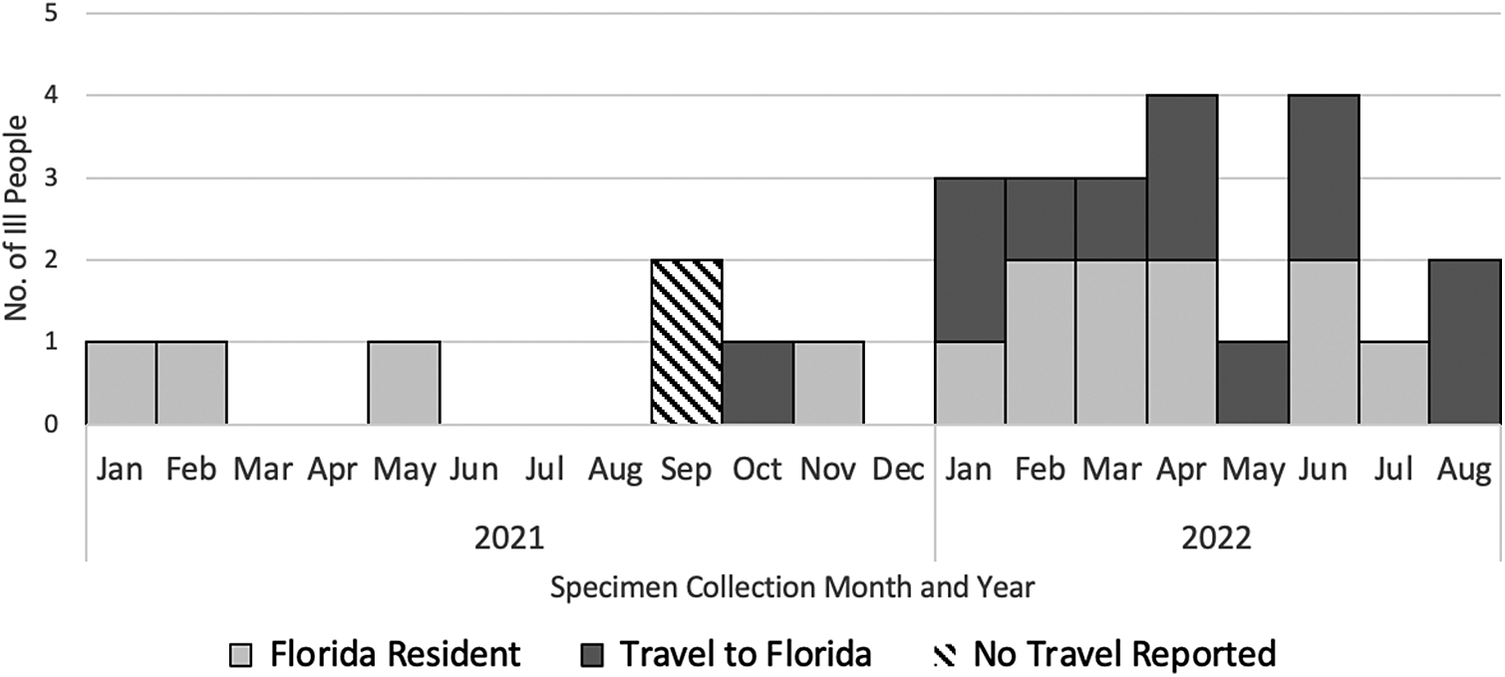
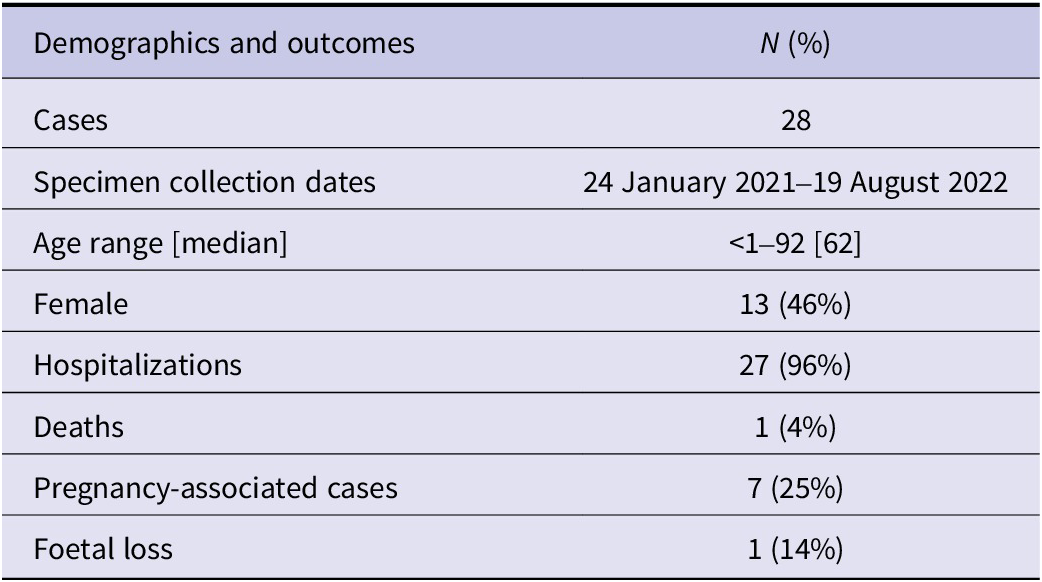
In total, this investigation included 28 cases from 11 states (CO, FL (14), GA, IL, KS, MA (2), MN, NE, NJ, NY (4), and PA). Specimen collection dates ranged from 24 January 2021 to 19 August 2022 (Figure 1). Ages ranged from less than 1 to 92 years, with a median of 62 years; 46% of patients were female. Of 28 patients with outcome information, 27 (96%) were hospitalized and one death was reported. Seven illnesses (25%) were associated with pregnancy, including one mother-infant pair. One pregnancy-associated illness resulted in foetal loss (Table 1). Of 28 patients with information, 25 (89%) reported living in or travelling to Florida prior to becoming ill (Figure 1).
People infected with the outbreak strain of Listeria monocytogenes by specimen collection date and travel status, 24 January 2021–19 August 2022 (n = 28).

Figure 1. Long description
Specimen collection dates for 28 outbreak patients are shown in a bar chart with the y-axis showing the number of ill people and the x-axis showing the month and year of specimen collection. The bars are shaded to differentiate travel status. Seven patients had specimen collection dates in 2021, and 21 patients had specimen collection dates in 2022. Travel to Florida was reported among 12 patients. Fourteen patients were residents of Florida. Two patients reported no travel.
Demographic and outcome data for people infected with the outbreak strain of Listeria monocytogenes

Table 1. Long description
Demographic and outcome data are shown in the table with the following information: number of cases, specimen collection dates, age range and median age, number of female patients, hospitalizations, deaths, pregnancy-associated cases, and number of fetal losses. There were 28 cases in this outbreak with specimen collection dates ranging from January 24, 2021 to August 19, 2022. Ages ranged from <1–92 years with a median age of 62 years and 13 patients (46%) were female. Hospitalizations were reported in 27 patients (96%) and there was one reported death (4%). Seven patients were associated with pregnancy (25%) with one resulting in a fetal loss (14%).
Hypothesis generation
On 29 June 2021, CDC identified a single state cluster of Lm, which included three patients who resided in southwest Florida. FDOH reviewed the LI forms and found that all reported exposure to pet food and two reported pineapple, cherries, and guacamole. Only one patient reported consuming ice cream. After additional interviews with two patients, no commonalities were identified.
On 27 October 2021, CDC initiated a multistate investigation when two additional cases were detected by PulseNet from Georgia and New York. At the time, the patient from Georgia could not be reached for interview, and the patient from New York reported no travel to Florida in the 28 days prior to illness onset.
By March 2022, there were 11 cases reported from five states, including six Florida residents and five non-Florida residents, three of whom reported travel to Florida prior to illness. Eight of nine patients with food exposure data reported consuming fresh strawberries. In April 2022, FDA, state, and local partners initiated a traceback investigation focusing on fresh strawberries supplied to 13 points-of-service (POS) associated with nine patients across five states. The traceback investigation did not identify any significant commonalities. FDACS sampled four brands of fresh strawberries from five retail locations, and all samples were negative for Lm. Cases continued to be identified, and investigators explored other foods commonly reported by patients, including pre-cut fruit, seafood, and fresh mozzarella.
By late June, there were 22 cases from 10 states, with 20 (91%) patients reporting living in or travelling to Florida prior to illness. On 30 June 2022, FDOH identified Creamery A as an ice cream supplier to two locations reported by patients. FDOH determined that Creamery A supplied various independently owned franchises throughout Florida in areas where patients resided or visited. Reviewing interviews, two patients who travelled to Florida at different times ate ice cream from the same local ice cream shop supplied by Creamery A in Clearwater, Florida, solidifying the hypothesis of Creamery A as the source of infections. To collect more information on exposures to Creamery A, CDC and FDOH rapidly conducted re-interviews of patients, and by 1 July identified six patients that reported consuming ice cream produced by Creamery A. CDC and FDOH continued to collect exposure information on ice cream and Creamery A.
By the end of the investigation, of 23 patients with information, all (100%) reported eating ice cream and 16 (70%) specifically reported eating ice cream from shops supplied by Creamery A. Case–case analysis showed cases in the outbreak were more likely to consume ice cream compared to listeriosis cases not included in any outbreak from the same states (odds ratio 15.15, 95% confidence interval 2.36–634.3, p value: 0.0003).
Unique attributes
There were notable attributes among patients included in this outbreak. Three illnesses were among teenagers between 15 and 16 years old. Two teenagers had underlying medical conditions – one with primary immunodeficiency and another with leukaemia – while the third did not have any underlying medical conditions. Contrary to previous listeriosis ice cream-associated outbreaks, only one patient was a full-time resident of a LTCF, and no patients were hospitalized prior to their illness. Six patients, five of whom were pregnancy-associated, reported incubation periods over 28 days (Figure 2). Notably, two pregnant women travelled to Florida from New York and Colorado and reported incubation periods of 69 and 128 days, respectively. The pregnancy-associated patient with the 128-day (4.5 months) incubation period was a 37-year-old woman from Colorado. This patient travelled to Florida between 14 November 2021 and 21 November 2021 and reported eating Creamery A ice cream one time during the trip. On 4 April 2022, this patient suffered preterm labour at 34 weeks and underwent a caesarean delivery. The only symptom the mother had was a fever. The infant did not have an illness attributed to listeriosis and survived. Lm was isolated from an abscess in the mother’s placenta. The infant was not a confirmed case in the investigation.
Incubation periods for people infected with the outbreak strain of Listeria monocytogenes with available exposure dates by pregnancy status (n = 13).

Figure 2. Long description
Incubation periods for 13 patients are shown on a bar chart with the y-axis showing WGS IDs of ill people and the x-axis showing the number of days. The exposure window used on the LI form is marked with a dark black line and a star at day 28. Bars are shaded to differentiate pregnancy-associated illnesses from non-pregnancy associated illnesses. Six patients had reported incubation periods longer than the 28-day exposure window. All five pregnancy-associated patients with consumption dates had incubation periods longer than 28 days, with two pregnancy-associated patients having incubation periods of 69 days and 128 days.
Creamery A and customers
On 1 July 2022, FDOH and FDACS contacted Creamery A and recommended they immediately stop selling ice cream. Creamery A agreed, contacted customers, and provided a list of all customers, ingredient suppliers, and invoices. By 3 July, FDOH and the Florida Department of Business and Professional Regulation (DBPR) contacted 24 of Creamery A’s 28 customers to ensure recommendations were received during the holiday weekend. However, without a publicly issued recall, it was unclear if any shops continued to sell products.
State environmental assessment and inspection of Creamery A
On 5 July, FDOH and FDACS conducted an environmental assessment and inspection at Creamery A. Creamery A had stopped production, and investigators were unable to observe practices but were given a walk-through of the facility. After the initial assessment, FDACS conducted site visits for environmental and product sampling. FDACS collected three subsamples from 14 pints and six samples from 2.5-gal tubs for a total of 48 product samples; FDACS also collected 92 environmental samples. On 8 July, Creamery A verbally agreed to a voluntary recall of ice cream products, with a recall notice for all flavours, lots, codes, and all expiration dates through 30 June 2022. However, the recall was not issued until 13 July.
Laboratory results
Ten of 92 environmental samples (11%), including three from food contact surfaces, and 44 of 48 product samples (92%) yielded Lm. Sixteen of the 17 flavours (94%) produced by Creamery A were contaminated with Lm. In total, 54 food and environmental samples yielded Lm and 30 were sequenced (10 environmental and 20 food samples). The 58 clinical, food, and environmental isolates were all related to one another within 12 allele differences by wgMLST (Figure 3). Enumeration studies were not conducted.
Whole genome multi-locus sequence typing tree for the outbreak strain of Listeria monocytogenes.

Figure 3. Long description
This image shows a whole genome multi-locus sequence typing tree with WGS IDs in one column, source type in the middle column, and specimen collection date in the last column. Lines connecting each WGS IDs show the genetic relationship between isolates. All isolates in this outbreak are related within 0–12 alleles.
Regulatory enforcement and recall follow-up
On 15 July, FDACS issued Stop Sale and Stop Use Orders to Creamery A. In addition, FDACS visited all known stores that sold Creamery A ice cream and verified the recalled product was no longer on-site. Three citations were issued to Creamery A based on nine environmental samples (three from food contact surfaces) and 44 product samples that yielded Lm. These citations resulted in a Stop Sale Order of individual flavours and a Stop Use Order in the entire processing room, including all associated equipment used in the production of ice cream.
In response to the voluntary recall, FDA investigated Creamery A in mid-July to facilitate product reconciliation/inventory and destruction of all returned and non-distributed product. In August, FDA and FDACS witnessed the destruction of over 5000 gal of ingredients and finished product. FDA also initiated a Preventive Controls for Human Food (21 CFR Part 117) inspection of Creamery A. Manufacturing operations were not documented by Creamery A through production monitoring records, and the producer did not use lot coding or establish a traceability system for finished product distribution. As a result, no monitoring or production records were available for review. Observations during FDA’s inspection noted no written food safety plan with any required elements, as specified in the PCHF regulation, and that individuals were not qualified to perform their assigned duties and did not have records documenting food hygiene and food safety training. A Warning Letter was subsequently issued to Creamery A in December 2022 for serious violations of the PCHF regulation [14].
After the voluntary recall on 13 July, a third-party laboratory contracted by Creamery A detected Lm on multiple pieces of equipment used to manufacture ice cream products as well as on finished product ice cream buckets associated with positive environmental samples collected on two separate occasions, indicating continued failures in cleaning and sanitizing [14].
Public advisories
On 2 July, CDC released communications to advise consumers who had Creamery A ice cream at home to discard it and advised businesses to not serve or sell Creamery A ice cream. CDC and FDA issued additional public communications to provide advice to consumers and businesses and share recall and testing updates.
Discussion
We describe the largest reported outbreak of listeriosis linked to ice cream, from a small ice cream producer, and the first known outbreak of listeriosis linked to interstate travel in the United States. While there are travel-related illnesses reported in other multistate outbreaks of listeriosis, the high proportion of travel-related illnesses with a locally distributed product is a novel feature of this outbreak. Residents and travellers to Florida consumed ice cream at local ice cream shops, unlike previous ice cream outbreaks, which affected residents of institutional settings. Several patients in this outbreak had notable demographic characteristics, and some experienced unusually long incubation periods.
Creamery A ice cream was a local speciality product; therefore, patients or their surrogates often remembered the exposure once asked directly. The uniqueness of Creamery A ice cream enhanced the ability for ill people to remember specific exposure dates, which is particularly rare in listeriosis outbreaks where incubation periods are long. Although most patients in this outbreak had incubation periods typical for listeriosis, six patients had incubation periods beyond the 28-day period covered in the food history on the LI form; one patient had an incubation period that exceeded 4 months (Figure 2).
Compared to previous outbreaks of listeriosis linked to ice cream, this is the first reported outbreak where almost all patients consumed ice cream outside of an institutional setting. Only one Florida patient was likely exposed to Creamery A in an LTCF where they were a full-time resident; review of records showed that Creamery A ice cream was supplied to the facility in February and March 2022. However, all other patients were exposed by visiting retail locations. Although it is well-documented that invasive listeriosis can affect pregnant women and those with weakened immune systems, this outbreak is novel in that it is the first reported outbreak of listeriosis linked to ice cream to affect pregnant women and teenagers. While enumeration was not conducted to quantify contamination levels, we theorize that these unique epidemiological features of this outbreak might be explained by high levels of Lm contamination of Creamery A products.
Outbreaks of listeriosis linked to regional ice cream producers have been previously reported [Reference Allard15, Reference Mazengia16]. Those outbreaks were small (three or fewer cases), and patients did not include pregnant women or teenagers. Additionally, there were no illnesses outside of the states where the firms were located. This was the largest reported listeriosis outbreak linked to ice cream across all types of producers. Similar to previous listeriosis outbreaks linked to ice cream, Lm was identified in a high proportion of tested Creamery A ice cream products [Reference Conrad4, Reference Pouillot17]. Laboratory results showed that Lm was detected in nearly all sampled products; 44 out of 48 samples across 16 of 17 ice cream flavours yielded Lm. The prevalence of Lm contamination across samples underscores the importance of establishing effective cleaning and sanitizing programmes for food manufacturing equipment and food production areas, as well as other necessary food safety management practices.
Establishments covered by the PCHF rule, such as Creamery A, are required to have a written food safety plan, which includes the identification and evaluation of known or reasonably foreseeable hazards to determine which hazards require preventive controls and written preventive control procedures to address those hazards. Lm is an example of a hazard for ice cream operations that should be identified in a food safety plan as requiring a preventive control, along with needed controls to significantly minimize and prevent this hazard, including verification that these controls are working. While finished ice cream products are not expected to support the growth of Lm when they are frozen, it is essential to identify areas of the processing environment where this pathogen is able to survive and grow and to apply appropriate controls as necessary to eradicate the organism [Reference Chen18, 19]. The use of an environmental monitoring programme, including testing of the production area, product contact surfaces, and finished product, could have provided an early indication of the problems with the food safety programme that could have been addressed to prevent product contamination at Creamery A.
Investigation challenges
As with all listeriosis investigations, there were challenges gathering exposure information from patients. The number of patients who were residents of or who travelled to Florida was an early clue that the source of contamination was occurring primarily in southwest Florida. The identification of patients from other states travelling to southwest Florida, illness dates, and epidemiological evidence available at the time supported the initial hypothesis of fresh strawberries. Southwest Florida is one of the largest growers of strawberries during winter months, and many patients who travelled reported eating strawberries while visiting Florida [20]. However, as illnesses continued to occur outside of winter months, this hypothesis became less plausible.
Another challenge arose from the combination of unusually lengthy incubation periods coupled with exposure during domestic travel. The LI form asks about food exposures and travel 28 days prior to illness onset. We found this did not capture the exposure of interest because it omitted travel to Florida or dates of ice cream exposures that occurred 29 days or more before illness. This was evidenced by five patients whose exposures occurred during pregnancy that had incubation periods >28 days (Figure 2). Notably, two pregnancy-associated illnesses had particularly long incubation periods of 69 and 128 days. Investigators should consider a wider exposure time frame when conducting follow-up interviews with pregnant women during listeriosis outbreak investigations [Reference Angelo2].
Public warnings to consumers and retailers were complicated and urgently needed due to the identification of the source immediately before a national summer holiday when many people travel and consume ice cream. It was also unclear whether consumers could easily identify ice cream coming from Creamery A because it was sold to independently owned franchises, some of which did not specify or advertise carrying Creamery A ice cream. As previously noted, Creamery A had stopped production as of 1 July; therefore, there were limitations to conducting inspectional activities as well as observation of firm practices.
Conclusion
This is the first known travel-related multistate listeriosis outbreak in the United States and the first outbreak linked to ice cream that affected pregnant women and teenagers. Although Creamery A only supplied ice cream to locations in Florida, this outbreak resulted in serious illness among 28 people from 11 states, with severe outcomes including foetal loss and death. In recent years, more outbreaks of listeriosis linked to ice cream have been associated with small, local producers. This outbreak underscores the importance of Lm control in ice cream operations, especially when considering hygienic design of facilities and equipment, design and execution of cleaning and sanitation activities, supplier management, and personnel practices. Some operations may not be aware of risks, controls, and focus areas needed to ensure the organism is controlled in their facility. Continued education and outreach to ice cream producers by industry, academic, and regulatory stakeholders is critical to provide information and support to prevent Listeria contamination of ice cream products and future outbreaks, illnesses, and deaths.
Data availability statement
Data are available on reasonable request to the authors. Restrictions may apply to the availability of personal data linked to patient information.
Acknowledgements
The authors thank the Florida Department of Agriculture and Consumer Services, the Colorado Department of Public Health and Environment, the Georgia Department of Health, the Illinois Department of Health, the Kansas Department of Health and Environment, the Massachusetts Department of Public Health, the Minnesota Department of Health, the Nebraska Department of Health and Human Services, the New Jersey Department of Health, the New York Department of Health, the New York City Department of Health and Mental Hygiene, and the Pennsylvania Department of Public Health.
Author contributions
Data curation: A.P., K.S., A.C., N.S., T.G., L.P., P.R., A.S., J.H., K.T., L.G., A.C.; Formal analysis: A.P., K.S., A.C., N.S., A.M., T.G., B.W., T.J., T.G., L.P., P.R., A.S., J.H., L.G., A.C.; Investigation: A.P., K.S., A.C., N.S., S.M., A.M., T.G., B.W., T.J., T.G., L.P., P.R., A.S., J.H., K.T., L.W., L.G., M.W., A.C., C.B.; Methodology: A.P., K.S., A.C., N.S., A.M., T.G., B.W., T.J., T.G., L.G., M.W., A.C., C.B.; Project administration: A.P., K.S., L.W., L.G., M.W., A.C.; Validation: A.P., K.S., A.C., N.S., T.G., B.W., T.J., T.G., L.G., A.C., C.B.; Visualization: A.P., T.G., B.W., T.J., T.G., J.H., L.G., A.C.; Writing - original draft: A.P., K.S., A.C., N.S., S.M., A.M., T.G., L.G., A.C.; Writing - review & editing: A.P., K.S., A.C., N.S., S.M., A.M., T.G., B.W., T.J., T.G., L.P., P.R., A.S., J.H., K.T., L.W., L.G., M.W., A.C., C.B.; Supervision: L.W., L.G., M.W., A.C., C.B.
Funding statement
This research received no specific grant from any funding agency, commercial or not-for-profit sectors.
Competing interests
The authors declare no conflicts of interest.


 Open access

