INTRODUCTION
Repetition clearly helps amnesic individuals learn new information (e.g., Huppert & Piercy, Reference Huppert and Piercy1978). Consequently, it plays a fundamental role in most if not all forms of memory rehabilitation (see Wilson, Reference Wilson2009, for discussion). Several forms of repetition, such as errorless learning (Baddeley & Wilson, Reference Baddeley and Wilson1994) and spaced practice (Hopper et al., Reference Hopper, Mahendra, Kim, Azuma, Bayles and Cleary2005), are known to be particularly beneficial, but the effects of other kinds of repetition are not as well understood.
Some evidence suggests that varied repetition, that is, alteration of the to-be-remembered item or its encoding context, might confer certain benefits. In a single-case study, Stark, Stark, and Gordon (Reference Stark, Stark and Gordon2005) assessed memory for items that had been presented under fixed- or varied-context repetition conditions. Varied-context repetition led to better performance on recall and recognition tests; it also led to a greater ability to generalize the learned information to new stimuli and new situations. In a follow-up study of the same patient (Stark, Gordon, & Stark, Reference Stark, Gordon and Stark2008), the authors observed the most generalization when variation was introduced late in the learning process. They concluded that varied-context repetition facilitated learning and generalization of new knowledge in amnesia.
Both of these studies used a large number of repetitions, and both assessed the patient’s ability to acquire new semantic knowledge. Little is known about the ways in which fixed and varied-context repetition affect the acquisition of new episodic memories, that is, memory for events from a specific spatiotemporal context, such as the fact that a word had been presented in a previous list. In a previous study (Verfaellie, Rajaram, Fossum, & Williams, Reference Verfaellie, Rajaram, Fossum and Williams2008), we addressed this question by examining the effects of fixed- and varied-context repetition on item memory in amnesia. Participants were shown a series of target words, each of which was presented with both a semantic associate and an unrelated word as context. They were asked to select the word that was semantically associated with the target. The target words were assigned to one of three conditions. Stimuli in the single-presentation condition were shown only once. Those in the varied-context repetition condition were shown three times, and the semantic associate was different each time. Those in the fixed-context repetition condition were also shown three times, but the semantic associate remained constant. At test, participants performed a yes/no recognition task on a set of target words and distractors; they also performed Remember/Know judgments for words they identified as old.Footnote 1 In controls, fixed- and varied-context repetition equally enhanced overall recognition (that is, Remember and Know responses combined) relative to the single-presentation condition. The source of the benefit differed between the two repetition conditions, however, in that varied-context repetition enhanced recollection more than fixed-context repetition did. In amnesic participants, the two forms of repetition also had equal benefits on overall recognition relative to the single-presentation condition. In their case, however, the source of the benefit did not differ between conditions: Fixed- and varied-context repetition enhanced familiarity to equal degrees, and neither had any significant effect on recollection.
These results indicated that repetition enhances episodic memory in individuals with memory disorders. They also showed that different forms of repetition had different effects in amnesic participants and controls: Varied-context repetition enhanced recollection in controls but had no significant effect on recollection in amnesic participants. The reasons for this difference are unclear, however. On the one hand, these results might indicate that the recollection impairment in amnesia is severe and refractory—that it cannot be ameliorated by manipulations that enhance recollection in controls. On the other hand, the results might tell us nothing about the amnesic participants’ recollection abilities. After all, amnesic participants could fall back on familiarity to perform the task, because familiarity is sufficient to support item memory (e.g., Yonelinas, Reference Yonelinas1994). Therefore, the results might instead indicate that varied-context repetition exerts its effects on a cognitive process that these participants simply were not using.
In the present study, we attempted to distinguish between these possibilities by testing the effects of fixed- and varied-context repetition on an associative-recognition task. For this experiment, the key feature of the associative-recognition task is that successful performance depends on recollection (Wixted, Reference Wixted2007). In associative-recognition paradigms, participants are presented with pairs of items (e.g., BOOK-TREE, BEAR-APRICOT, CAR-TEA), and are subsequently asked to distinguish between intact pairs (BOOK-TREE) and recombined pairs (BEAR-TEA). Thus, instead of being asked about individual items (as in item-recognition tasks), they are asked about the relation or association between items, and accuracy depends on the ability to recollect whether the two items were in fact presented together. Note that the enhancement in recollection due to repetition can affect performance in two ways: It can increase the hit rate by enabling participants to correctly endorse the intact pairs (in this case, by recollecting that BOOK was in fact presented with TREE), but it can also reduce the false-alarm rate by allowing participants to reject the recombined lures (by recollecting that BEAR was presented with APRICOT instead), a phenomenon sometimes called “recalling to reject” (Clark & Gronlund, Reference Clark and Gronlund1996). Measures such as corrected recognition (hits – false alarms) or d’ are generally used to assess performance because they capture both of these effects.
Although the repetition of an individual item can increase its familiarity, as in our previous study (Verfaellie et al., Reference Verfaellie, Rajaram, Fossum and Williams2008), this increase does not improve performance on associative-recognition tasks. By design, all of the individual items have been presented an equal number of times, so they are all equally familiar, and participants cannot distinguish between intact and recombined pairs by relying on the familiarity of the individual components. Repetition-induced increases in familiarity can lead to both enhanced hit and false alarm rates (Leding & Lampinen, Reference Leding and Lampinen2009; Xu & Malmberg, Reference Xu and Malmberg2007), but they do not yield enhanced discrimination.
The associative-recognition paradigm provides a second benefit. In our previous study, recollection was assessed using subjective remember/know judgments, but some evidence indicates that amnesic participants do not make these judgments in the same way that controls do (Rajaram, Hamilton, & Bolton, Reference Rajaram, Hamilton and Bolton2002). The associative-recognition paradigm, however, uses no subjective judgments; recollection is measured simply by looking at overall recognition performance. In this way, it permits us to avoid introspective measures and assess recollection in a more objective manner.
Recollection is generally thought to be severely impaired in amnesia; consistent with this view, individuals with memory disorders generally perform poorly on associative recognition tasks (e.g., Eichenbaum & Cohen, Reference Eichenbaum and Cohen2001). Some evidence suggests that associative recognition is more severely affected than item memory is (e.g., Konkel, Warren, Duff, Tranel, & Cohen, Reference Konkel, Warren, Duff, Tranel and Cohen2008; Mayes et al., Reference Mayes, Holdstock, Isaac, Montaldi, Grigor and Gummer2004; but see Gold, Hopkins, & Squire, Reference Gold, Hopkins and Squire2006, for an alternative view). An associative impairment is seen across a range of stimulus types, including unimodal item pairs (Giovanello, Verfaellie, & Keane, Reference Giovanello, Verfaellie and Keane2003), cross-modal item pairs (Turriziani, Fadda, Caltagirone, & Carlesimo, Reference Turriziani, Fadda, Caltagirone and Carlesimo2004), and pairings between items and contexts (Hannula, Tranel, & Cohen, Reference Hannula, Tranel and Cohen2006). So far, however, no studies have examined the effects of fixed- and varied-context repetition on associative recognition in amnesic participants and controls.
Overall, then, the associative-recognition paradigm allows us to isolate the effects of different forms of repetition on recollection in amnesia. We compared the effects of fixed- and varied-context repetition on associative recognition in healthy controls and participants with medial temporal lobe (MTL) amnesia. We predicted that control performance would be better in the varied-context than the fixed-context condition, in accordance with previous work (Glenberg, Reference Glenberg1979; Paivio, Reference Paivio1974; Verfaellie et al., Reference Verfaellie, Rajaram, Fossum and Williams2008). For the amnesic participants, we considered two possibilities. On the one hand, if they do have a refractory impairment of recollection, then their performance should be the same in both conditions. On the other hand, if varied-context repetition can enhance recollection but failed to do so in the previous study because the amnesic participants were relying on familiarity, then this form of repetition should enhance performance on a recollection-dependent task.
METHOD
Participants
Participants consisted of eight individuals (five male, three female) with amnesia resulting from anoxia (n = 5) or encephalitis (n = 3) and 12 controls matched on age, verbal IQ, and education. The amnesic participants had a mean age of 58.9 (SD = 14.9), an average of 14.9 years of education (SD = 2.2), and an average verbal IQ of 107.1 (SD = 19.9). The controls had an average age of 57.5 (SD = 13.1), an average of 15.2 years of education (SD = 2.5), and an average verbal IQ of 107.7 (SD = 15.5). These variables did not significantly differ between groups (all p > .7).
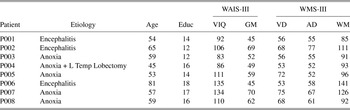
Controls had no history of neurological conditions affecting the central nervous system. Patients were considered amnesic if they had a Wechsler Memory Scale-III (WMS-III) General Memory score 20 or more points below their Wechsler Adult Intelligence Scale Verbal IQ score. Their attentional abilities were in the normal range as evidenced by their WMS-III working memory scores. All had damage to the medial temporal lobe (MTL). For six of the eight amnesic participants (P001–P006), MTL damage was confirmed with magnetic resonance imaging (MRI) or computed tomography (CT) scan. Volumetric analysis was also available for four of these patients (P001, P002, P004, P005; see Kan, Giovanello, Schnyer, Makris, & Verfaellie, Reference Kan, Giovanello, Schnyer, Makris and Verfaellie2007, for details of the methods used). The other two amnesic participants (P007 and P008) were not able to be scanned because they have pacemakers; their damage was inferred from the anoxic etiology. Table 1 presents the demographics and neuropsychological test results for each amnesic participant.
Demographic and neuropsychological characteristics of the amnesic patients

Note
L = left; Temp = temporal lobe; WAIS-III = Wechsler Adult Intelligence Test-III; WMS-III = Wechsler Memory Scale-III; VIQ = Verbal IQ; GM = General Memory; VD = Visual Delay; AD = Auditory Delay; WM = Working Memory.
P001 (encephalitis)
Volumetric analysis revealed bilateral damage to the hippocampal formation, the amygdala, the entorhinal cortex, and the perirhinal cortex; the left temporal pole was also severely affected, as was the posterior portion of the left parahippocampal cortex. The left insula was significantly reduced in size, as was the left cingulate. Inspection of the MRI scan also suggested bilateral damage to the fusiform gyrus and some involvement of the right temporal pole.
P002 (encephalitis)
Volumetric analysis indicated bilateral damage to the hippocampus, amygdala, entorhinal cortex, and perirhinal cortex. The right temporal pole was significantly damaged, as was the posterior portion of the right parahippocampal cortex. In addition, the left and right insula were significantly reduced in size along with the right planum polare. The anterior portions of the middle temporal gyrus, inferior temporal gyrus, and fusiform gyrus were damaged in both hemispheres. Inspection of the MRI scan also indicated damage to the septal region and the anterior cingulate.
P003 (anoxia)
CT scan revealed significant damage to the right hippocampal formation and possible involvement of the right amygdala and perirhinal regions. No other brain regions appeared to be damaged.
P004 (anoxia; left temporal lobectomy secondary to epilepsy)
Volumetric analysis indicated significant bilateral atrophy of the hippocampal formation. In the left hemisphere, the temporal pole, the amygdala, the perirhinal cortex, and the entorhinal cortex were also significantly affected. In addition, in the lateral portions of the left temporal lobe, the anterior aspects of the fusiform and the superior temporal gyrus are reduced in size, as are the entire middle and inferior temporal gyri.
P005 (anoxia)
Volumetric analysis revealed significant damage to the right hippocampal formation, and examination of the MRI scan indicated some atrophy of the left hippocampal formation as well. The scan also revealed a small incidental lesion to the posterior left putamen.
P006 (encephalitis)
Examination of the CT scan revealed extensive bilateral damage to the temporal pole, the perirhinal and entorhinal cortex, the hippocampal formation, and the amygdala. In the left hemisphere, the insula, the inferior parahippocampal gyrus, the basal forebrain, the septum, and the deep white matter of the frontal lobes were also affected.
Design and Procedure
The stimuli consisted of 48 noun-verb-noun sentences that established a link between two items (for example, ARMY invades CITY). The sentences were designed to be plausible, but the subject and object were not close semantic associates; for both forward and backward associations, the mean associative strength was less than 0.002 according to the University of South Florida Free Association Norms (Nelson, McEvoy, & Schreiber, Reference Nelson, McEvoy and Schreiber1998). The experiment was divided into two study-test blocks that were administered in a single session. Half of the sentences were randomly assigned to each block. During the study phase, sentences were presented for 2 s with a 0.5-s intertrial interval, and participants were asked to read them aloud and remember them for a later test. The set of 48 sentences was repeated three times, each time in a different random order. For half of the sentences, the verb varied with each presentation (ARMY invades CITY, ARMY flees CITY, ARMY patrols CITY); for the other half, the verb remained constant. The assignment of sentences to repetition conditions was counterbalanced across participants. The study phase concluded with three filler sentences, which were shown only once.
A test phase immediately followed each study phase. Participants were presented with pairs of words from the study phase—one subject and one object—and were asked whether they had appeared in the same sentence; they were asked to guess if unsure. Half of the pairs had indeed appeared in the same sentence, while the other half had been recombined by pairing the subject of one sentence with the object of another. In the recombined condition, both words always came from the same repetition condition—that is, if the subject had appeared in the fixed condition, so had the object. The assignment of sentences to test conditions (intact or recombined) was counterbalanced across participants. The first three trials tested memory for the filler sentences; they were intended to orient participants to the task and prevent them from relying on working memory. The remaining trials were pseudorandomized with the constraint that no more than three trials from one study or test condition could appear in a row.
All stimuli were presented on a Macintosh Powerbook G3. Stimuli in both phases were presented in 36-point Geneva font in black letters on a white background. In the study phase, the first and last words of each sentence were in capital letters while the verb was in lowercase; in the test phase, both words were in capital letters. Participants were seated approximately 18 inches from the computer screen, and the experimenter recorded answers using the keyboard. All procedures were reviewed and approved by the Institutional Review Boards of Boston University and the Boston VAMC.
RESULTS
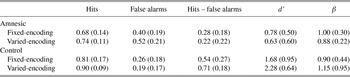
The data were analyzed using mixed-models analysis as implemented in SAS 9.1’s PROC MIXED. Follow-up analyses were conducted with paired or independent-samples t tests as appropriate. All statistical tests were two-tailed and used an alpha level of 0.05. Table 2 shows the results broken down by participant group and condition.
Mean endorsement rates for old pairs (hits), recombined pairs (false alarms), and corrected associative recognition (hits – false alarms); means for d’ and β

Note
Data broken down by participant group and encoding condition. Standard deviations are indicated between parentheses.
The first analysis examined the hit rates, using participant group (controls vs. amnesic participants) as a between-subjects variable and repetition type (fixed-context vs. varied-context) as the within-subjects variable. This analysis revealed a main effect of participant group (F(1,18) = 10.08; p = .0052), a trend toward an effect of repetition type (F(1,18) = 3.94; p = .0625), and no evidence of an interaction (F(1,18) = 0.17; p = .6826). For the control group, a paired t test suggested a trend toward higher hit rates in the varied-context condition than in the fixed-context condition (t(11) = −2.14; p = .0555); for the amnesic group, however, we found no evidence of a difference in hit rates between conditions (t(7) = −0.88; p = .4096).
A second analysis was performed on the false alarm rates, again using participant group as a between-subjects variable and repetition type as a within-subjects variable. This analysis revealed a main effect of participant group (F(1,18) = 8.44; p = .0094) but no effect of repetition type (F(1,18) = 0.82; p = .3779); it also revealed a Participant Group × Repetition Type interaction (F(1,18) = 10.27; p = .0049). The controls had higher false-alarm rates in the fixed-context condition than in the varied-context condition (t(11) = 2.47; p = .0314). For the amnesic group, however, there was a trend toward lower false-alarm rates in the fixed-context condition (t(7) = −2.02; p = .0825).
Further analyses were conducted using corrected recognition (hits – false alarms) as the dependent variable. As expected, the patients performed more poorly than the controls, as shown by a main effect of participant group (F(1,18) = 19.92; p = .0003), although the amnesic group’s performance was above floor in both conditions, as shown by one-sample t tests against 0 (both t > 3.15; both p < .006). There was no main effect of repetition type (F(1,18) = 0.93), but the Participant Group × Repetition Type interaction was significant (F(1,18) = 4.44; p = .0495), suggesting that the two forms of repetition affected the patients and controls in different ways. Paired t tests showed that the controls performed better in the varied-context condition than in the fixed-context condition (t(11) = −3.32; p = .0069), while patient performance did not significantly differ between conditions (t(7) = 0.56; p = .59).
We also calculated d’ as described in Macmillan & Creelman (Reference Macmillan and Creelman2005), and these data were analyzed using mixed-models analysis as described above. The effect of group was significant (F(1,18) = 20.38; p = .0003), indicating that, as expected, the control group’s d’ scores were higher than the patient group’s. The effect of condition was not significant (F(1,18) = 1.75; p = .20). The Group × Condition interaction was significant (F(1,18) = 4.95; p = .04); follow-up paired t tests showed that, in accordance with the results presented above, the control group had higher d’ scores in the varied condition than the fixed condition (t(11) = −3.39; p = .006), but there was no evidence of a difference between conditions in the patient group (t(7) = 0.48; p = .65). There was no evidence for differences in β, a measure of response criterion, as a function of group or condition (all F < 0.83, all p > .37).
DISCUSSION
Amnesic participants and normal controls were asked to study a series of noun-verb-noun phrases. Half of the phrases were presented under varied-context conditions (in which the verb changed with each presentation), and half were presented under fixed-context conditions (in which the verb remained constant). Participants then performed an associative recognition test that asked them to recollect whether pairs of nouns had appeared in the same phrase. Controls were better able to recollect material that had been presented in the varied-context condition. The performance of participants with memory impairments, although above floor, did not significantly differ between conditions. Thus, varied-context repetition enhanced the episodic recollection of associations in controls, but there was no evidence of such an effect in participants with amnesia.
These results add to our understanding of the effects of fixed- and varied-context repetition in amnesia. Stark and colleagues (Reference Stark, Stark and Gordon2005, Reference Stark, Gordon and Stark2008) had previously shown that varied-context repetition enhanced an amnesic participant’s ability to learn and generalize new semantic information. Both our previous results (Verfaellie et al., Reference Verfaellie, Rajaram, Fossum and Williams2008) and our present results suggest that varied-context repetition has a different effect on episodic memory: In both studies, varied-context repetition enhanced recognition in controls but had no significant effect on amnesic participants. Moreover, our present findings expand upon our previous work by demonstrating that this finding cannot be attributed to the possibility that amnesic participants simply have difficulty making remember/know judgments; our present study used no such judgments, showing that varied-context repetition fails to enhance episodic recognition even when objective measures are used.
In addition, the present study allowed us to pinpoint the effects of repetition on recollection. Our previous study used an item-memory task that could be solved using either recollection or familiarity (Yonelinas, Reference Yonelinas1994), leaving open the possibility that varied-context repetition failed to enhance recollection in amnesia because the amnesic participants were relying on familiarity instead. In this study, we used an associative-recognition task on which performance relies on recollection. Thus, the results showed that varied-context repetition fails to enhance recollection even when amnesic participants cannot fall back on familiarity for accurate task performance.
Why does varied-context repetition facilitate new learning in controls, and why does it have different effects in amnesia? Several cognitive and neuropsychological theories suggest an answer. Glenberg (Reference Glenberg1979), for instance, proposed that the effectiveness of a particular form of repetition depends on the extent to which it facilitates the binding of additional contextual components into the memory trace. These components can take a variety of forms, including structural components, which he defines as components that represent how individual items are grouped or chunked together. These additional components increase the likelihood of retrieval because they increase the chances of a match between the retrieval cue and the memory trace. In terms of our experiment, the structural components consist of the relations between the two nouns on each trial and the verb or verbs with which they are presented. In the fixed-context repetition condition, the structural components are always the same, whereas in the varied-context repetition condition, the structural components change each time. In accordance with Glenberg’s (Reference Glenberg1979) view, the controls were able to benefit from the additional structural components that the varied-context condition provided. The amnesic participants’ failure to benefit from varied-context repetition might indicate that they cannot bind these structural components into the memory trace.
Bjork (Reference Bjork, Metcalfe and Shimamura1994) framed this issue in a different way. He proposed that varied-context repetition is an example of a “desirable difficulty”—a manipulation that makes initial learning more difficult but facilitates learning in the long term. According to this view, both the difficulty and the desirability arise from the kinds of cues that are associated with the to-be-remembered information. In the fixed-repetition condition, the to-be-remembered information is presented with the same cue each time, making the previous repetitions easier to retrieve during initial learning. In the varied-context condition, stimuli are presented with a new and different cue each time, making retrieval more difficult. As in Glenberg’s (Reference Glenberg1979) view, however, varied-context repetition ultimately provides a benefit because it leads to the establishment of a wider range of cues, thus facilitating later retrieval (Bjork & Bjork, Reference Bjork, Bjork, Nilsson and Ohta2006). While studies of varied-context repetition in controls have yielded mixed results (e.g., Glenberg, Reference Glenberg1979; Paivio, Reference Paivio1974; Postman & Knecht, Reference Postman and Knecht1983; Smith et al., Reference Smith, Glenberg and Bjork1978; Soraci et al., Reference Soraci, Carlin, Chechile, Franks, Wills and Watanbe1999; Verkoeijen et al., Reference Verkoeijen, Rikers and Schmidt2004; Young & Bellezza, Reference Young and Bellezza1982), varied-context repetition does appear to be a desirable difficulty under some circumstances. Nevertheless, it does not necessarily improve memory in amnesic individuals—even under circumstances in which it clearly helps controls. In both the current study and our previous study (Verfaellie et al., Reference Verfaellie, Rajaram, Fossum and Williams2008), for example, controls were more likely to recollect items that had been presented in the varied-context condition; in the amnesic group, however, varied-context repetition provided no advantage over fixed-context repetition. In fact, varied-context repetition sometimes has a harmful effect in amnesia: Cermak, Verfaellie, Lanzoni, Mather, and Chase (Reference Cermak, Verfaellie, Lanzoni, Mather and Chase1996) showed that varied semantic elaboration eliminated the benefit of repetition in a group of amnesic participants. Thus, the available evidence indicates that varied-context repetition is not a desirable difficulty when amnesic participants are attempting to acquire new episodic memories, possibly because they cannot benefit from the additional cues that the varied-encoding condition provides.
Neuropsychological theories provide further insight into the neural mechanisms that underlie this effect. These theories generally maintain that the MTL, specifically the hippocampus, is involved in the establishment of novel associations between items (Davachi, Reference Davachi2006; Eichenbaum & Cohen, Reference Eichenbaum and Cohen2001; Konkel et al., Reference Konkel, Warren, Duff, Tranel and Cohen2008; Squire, Wixted, & Clark, Reference Squire, Wixted and Clark2007; Troyer, Murphy, Anderson, Hayman-Abello, Craik, & Moscovitch, Reference Troyer, Murphy, Anderson, Hayman-Abello, Craik and Moscovitch2008; Yonelinas, Reference Yonelinas2002). The amnesic participants’ MTL damage may therefore prevent them from establishing the multiple cues that the varied condition provides. This idea is consistent with our previous report showing that amnesic participants cannot use contextual cues to enhance recognition memory (Kan et al., Reference Kan, Giovanello, Schnyer, Makris and Verfaellie2007). As for the findings of Stark and colleagues (Reference Stark, Stark and Gordon2005, Reference Stark, Gordon and Stark2008), the large number of repetitions presumably allowed for the establishment of cortico-cortical connections, which can support new learning without the involvement of the MTL (McClelland, McNaughton, & O’Reilly, Reference McClelland, McNaughton and O’Reilly1995).
These results have implications for the development of therapeutic approaches for individuals with severe memory impairments. For instance, several authors have maintained that introducing stimulus variability into the training session facilitates generalization and reduces the risk of hyperspecific learning (Ehlhardt et al., Reference Ehlhardt, Sohlberg, Kennedy, Coelho, Ylvisaker and Turkstra2008; Stark et al., Reference Stark, Stark and Gordon2005, Reference Stark, Gordon and Stark2008). The present results suggest that, at least for the acquisition of verbal episodic information, this strategy may be unnecessary. Furthermore, they expand upon previous work by showing that this result holds true not only for item memory but also for the more ecologically relevant task of associative memory. Finally, the results demonstrate that the recollection deficit in severe amnesia is resistant to amelioration, thus providing additional evidence that the principles of memory that were developed through studies of healthy controls do not necessarily generalize to individuals with amnesia.
ACKNOWLEDGMENTS
This research was supported by NIH grant MH71783 and the Office of Research and Development, Medical Research Service, Department of Veterans Affairs. The authors have no financial or other relationships that could be interpreted as a conflict of interest affecting this manuscript.