

I. INTRODUCTION
Conditionality is a long-standing EU policy tool. It refers to the adoption of a prescribed behaviour by state governments or private actors because the said behaviour is a condition for accessing a promised EU benefit. Conditionality first emerged in EU external policies where it has been actively developed since the late 1980s.Footnote 1
Today, the EU is the world’s largest trade power and development aid donor.Footnote 2 Together with its Member States, the EU spends about $74 billion in development and humanitarian aid across the globe.Footnote 3 To ensure that trade and aid are consistent with the EU’s founding values, the EU typically attaches a human rights conditionality to its international agreements.Footnote 4
The EU is also open to accession for all European states.Footnote 5 European states may join the EU if they so desire and only if they prove a functioning market economy, a successful reception of the EU acquis and stable institutions guaranteeing democracy, rule of law and human rights – in short, if they fulfil the Copenhagen conditionality.Footnote 6
In 2003, the EU launched its European Neighbourhood Policy, aiming to create a ‘ring of friends’ around the EU’s eastern and southern borders.Footnote 7 The better the friends perform on their Neighbourhood Action Plans conditions, the more financial incentives they get, including aid, free trade and visa free regimes – referred to as the neighbourhood policy conditionality.Footnote 8
In 2005, the EU established a new approach to cooperation with third countries in the field of migration – the Global Approach to Migration and Mobility – substantially reformed in 2016 to answer the unprecedented migratory pressure faced by the EU.Footnote 9 The better the third countries deliver under their migration compacts, the more support they receive, including diplomatic, technical and financial support – a practice known as migration conditionality.Footnote 10
Finally, in 2008, the EU was hit by the most severe economic crisis since its creation, which shortly evolved into the European sovereign debt crisis (or the Euro crisis).Footnote 11 Seven Member States entered into full (and one into partial) bailouts, largely outside the EU treaty framework, subject to comprehensive conditions, also known as the sovereign debt conditionality.Footnote 12
This article does not speak to the above-identified conditionality packages. It introduces a new conditionality type, which has tremendously developed in the aftermath of EU 2014–20 budgetary reform: EU spending conditionality.Footnote 13 EU spending conditionality is a condition attached to EU financial benefits with the aim of advancing broader EU policy objectives at the Member State level. A spending conditionality may ask funding beneficiaries to adopt an active conduct – for instance, by requiring Member States to implement EU civil rights legislation – or to abstain from a given conduct – for instance, by prohibiting EU farmers from engaging in environmentally unfriendly practices. However, in all instances, conditionality aims to alter Member State or individual conduct in exchange for EU spending resources, subject to funds’ withdrawal in case of failure to comply.
In this contribution, I argue that the analysis of this novel EU conditionality type provides valuable insights into the nature, operation and functioning of EU conditionality in general. At the same time, it suggests that the rise of EU spending conditionality internally points towards deeper transformations within the EU, with potential strong implications for the relationship between the EU, its Member States and the EU citizens.
The current discourse on conditionality in the EU legal scholarship is based on four dominant narratives:
-
∙ Conditionality is mainly a tool of EU external policy and is largely used outside the EU treaty framework: hence, it is not an EU internal matterFootnote 14
-
∙ Conditionality has a soft-law nature, being inserted into action plans, recommendations, memoranda of understanding and similar political instruments: hence, it is not EU lawFootnote 15
-
∙ Conditionality generally shows poor compliance, as states systematically fail to fulfil its requirements: hence, it is not complied withFootnote 16
-
∙ As a rule, conditionality is not enforced; enforcement is politically inconvenient and highly undesirable even in case of systematic poor performance: hence, it is not enforced.Footnote 17
This article shows that EU spending conditionality as introduced in the 2014–20 budgetary framework challenges all of the four accounts above. Firstly, the study shows that EU spending conditionality is a purely internal EU matter. It applies exclusively to EU Member States and EU private beneficiaries, directly linking over 80% of EU internal budget to a vast array of EU internal policies. Secondly, spending conditionality has a hard EU law nature, being firmly rooted in binding EU norms of spending regulations. Thirdly, spending conditionality is largely complied with in all Member States, with more than three quarters of conditions fulfilled by the end of 2016. Lastly, in comparison to other types of EU conditionality, spending conditionality is enforced against Member States and may credibly lead to EU budgetary resource suspension or cut-off. At the same time, spending conditionality is frequently enforced against private beneficiaries of EU budgetary resources who are important subjects of conditionality in EU internal spending.
These findings are important as they suggest an ongoing transformation in the relationship between the EU and Member States. Namely, the findings above seriously challenge our widespread ideological belief that post-accession, the relationship between the EU and its Member States is non-conditional but rather guided by common values and pure solidarity.Footnote 18 The influx of conditionality in the EU internal budgetary process suggests a paradigm shift towards a conditional solidarity, contingent upon Member States’ continuous performance under the treaties. This shift towards governance by conditionality internally raises significant questions with high potential implications for the EU constitutional architecture.Footnote 19 The most important ones relate to the opportunity of promoting a permanent conditionality culture inside the EU, and the donor–recipient, transactional discourse it inevitably brings with it. While in the short-term conditionality may prove an effective governance tool to promote compliance and advance broader EU interests at the national level, in the long-term it is worth reflecting upon the cost of a generalised conditionality culture inside the EU and its potential impact on a reformed Europe of tomorrow.Footnote 20
This article starts by conceptualising the EU spending and spending conditionality as an EU governance tool (Part II). Subsequently, it maps the new spending conditionality packages of 2014–20 budget reform (Part III). Finally, it returns to the four dominant narratives presented above and shows why, in light of the novel EU spending conditionality, they must be revisited (Part IV).
II. EU SPENDING AND SPENDING CONDITIONALITY
A. EU spending
The EU budget is agreed on a multiannual basis.Footnote 21 Its overall allocation for 2014–20 financial period is about €900 billion (€145 billion annually) amounting to one per cent of Member States’ GDP.Footnote 22 Even if considerably lower than the EU-28 average domestic expenditure (which amounted to 47% of the EU-28 GDP in 2015),Footnote 23 EU spending has a significant positive impact on national economies.Footnote 24 This is so, as EU spending is primarily a capital (long-term) investment tool, as opposed to national budgets which are allocated almost entirely to operational (on-going) expenditures. On average, more than two thirds of Member States’ budgets are pre-allocated to healthcare, education and social protection expenditure.Footnote 25 In contrast, the EU budget is largely dedicated to rural development, transport and infrastructure, environment, regional development, research, innovation and human capacity investment. Of course, the EU budget share of national capital investment rates will vary from state to state. In 2015, EU spending represented on average 20% of the total national capital expenditure, ranging from 0.2% in Luxemburg to 68% in Hungary.Footnote 26 Hence, even if modest in some Member States, EU spending is in no way marginal in its average impact, and is beyond any doubt crucial in at least 13 net beneficiary Member States.Footnote 27
The EU budget is shaped around seven main items of expenditure. In the 2014–20 financial period, the largest EU spending envelope goes to direct and structural agricultural aid (38% of EU budget), followed by: economic, social and territorial cohesion aid for less developed regions and strategic investment (34%); EU-wide infrastructure, research and cultural projects (13%); external relations (6%); justice and home affairs (2%), fisheries (1%) and running costs (6%).Footnote 28
As the EU lacks the administrative capacity to implement its budget, about 75% of EU spending is channelled at the national level and is primarily managed by national authorities, under the close supervision of the European Commission (Commission).Footnote 29 It is precisely in these shared management areas that spending conditionality was first introduced and has been dramatically expanded in the aftermath of the 2014 reform.
The expansion of spending conditionality came at a time when the EU public sphere was dominated by the Euro crisis conditionality, which was subsequently internalised by the European economic governance reform.Footnote 30 It also came in a context of increased concern regarding the failure of certain Member States to uphold core EU treaty commitments and rule of law principles.Footnote 31 These developments stirred a generalised discourse on governance efficiency and conditionality during the negotiations on the EU budget, promoted by the ‘EU North’ and reluctantly accepted by the ‘EU South’.Footnote 32
Currently, massive packages of spending conditionality are linked to EU agricultural, cohesion, home affairs and fisheries funds (EU Funds), representing by far the largest EU spending envelopes in the 2014–20 financial period. This contribution will explain the specificity of each spending conditionality type in Part II. First, however, the concept of spending conditionality will be explained.
B. Spending conditionality
In the context of EU internal spending, a spending conditionality is generally defined as a condition attached by the EU to an agreement on disbursement of EU Funds used to coerce the conduct of Member States or final beneficiaries. A few clarification points are needed here on the tool’s nature, types, subjects and functions.
As to the tool’s nature, a spending conditionality is always a condition. However, not all conditions are spending conditionalities. Two core elements distinguish a condition from a spending conditionality: the conduct prescribed and the financial sanction or additional benefit attached.
First, the conduct prescribed by a conditionality must pursue a policy objective which goes beyond the primary purpose of spending. For instance, a spending conditionality may ask Member States receiving highway funds to adopt appropriate legislation on protection of people with disabilities and to show a national plan on accessibility for people with disabilities in all national infrastructure planning. Such a spending conditionality goes beyond the primary goal of spending (the highway) and brings under the umbrella of infrastructure development an additional policy goal: the integration of people with disabilities. Given this specificity of spending conditionality, multiple other spending conditions of administrative nature (ie planning, reporting, monitoring, evaluation, audit) do not behave as spending conditionalities, as they do not pursue a conceptually different policy objective.
The second element of a spending conditionality is the financial sanction or additional financial incentive attached. The sanction may consist in postponement, suspension or permanent withdrawal of funds (negative conditionality). In limited cases, a conditionality may provide for additional financial benefits (positive conditionality). Similarly, both financial sanctions and additional benefits may be attached (carrot-and-stick conditionality).
This last distinction anticipates our discussion on conditionality types, but certainly does not exhaust it.Footnote 33 For the purpose of this article we shall add three additional classifications. First, based on the temporal scope, we may distinguish between an ex ante and ex post conditionality. If the required conduct is to be fulfilled before the disbursement of EU funds, the conditionality is ex ante. If, however, the condition is binding after the disbursement of funds we speak of an ex post conditionality type. Second, based on their thematic link to spending we shall distinguish between same-sector, cross-cutting, cross-over and generic conditionality. Where the conditionality requirements and funding correspond to the same thematic area we are in the presence of a same-sector conditionality. On the contrary, where the conditions are specific to a distinct thematic area they are cross-cutting. When a spending conditionality links spending to other conditionality packages from distinct EU spending programmes or distinct EU policies, the conditionality is cross-over. Lastly, where the conditions prescribe generically for respect of EU law or policy, these shall be labelled generic. Take for instance the highway example above. If the EU requires that Member States put in place a national strategic policy on land transportation development before or after the disbursement of the highway funds, the conditionality is same-sector. If the EU requires that a Member State show compliance on EU law on accessibility for people with disabilities as a condition for highway funds release, the condition is cross-sector. If the EU asks Member States to prove that their sovereign debt conditionality packages are complied with to proceed with highway funds payments, the conditionality is cross-over. If the EU specifies generally that at all stages the highway project shall comply with all applicable EU law and policy, the conditionality is generic. Third and finally, from the point of enforcement we distinguish between compulsory and optional conditionality. A compulsory conditionality leaves no enforcement discretion in case of poor compliance, usually recognised by the use of the verb ‘shall’ (eg Commission shall suspend payments). An optional conditionality leaves important enforcement discretion recognised by the use of the modal verb ‘may’ (eg Commission may suspend payments).
In all instances, the active subject of spending conditionality is the EU, acting largely through the Commission. In a limited number of cases the EU acts through the EU Council, the European Parliament, or its Member States. The passive subjects of spending conditionality are mainly the Member States, followed by private recipients of EU Funds.
The functions of conditionality are essential for getting conditionality right. To date, the most emphasised function of spending conditionality has been its legal enforcement function (EU law enforcement function).Footnote 34 Based on theories of compliance and regime efficiency, it has been argued that compliance with EU law is essential for the very subsistence of the EU as a supranational regime, and that conditionality is a tool increasingly employed to enforce EU law and hence promote compliance at the national level.Footnote 35
However, presenting spending conditionality exclusively as a legal enforcement tool tells only part of the story. In practice, spending conditionality may be additionally ingeniously designed to pursue legislative, regulatory, policy implementing and/or structural functions. Therefore, a spending conditionality may check not only whether a particular EU law is complied with before or after the disbursement of EU Funds, but also whether specific EU policies or soft law recommendations are in place at the national level (EU policy enforcement function). It may also effectively ask a state to adopt a law (legislative function) or regulate a particular conduct (regulatory function). A spending conditionality may additionally aim to implement a new policy line (policy implementing function) or require institutional reforms and capacity building (structural function). One should note that the above functions are not mutually exclusive and that a spending conditionality may successfully pursue all of the above functions at once. The only limit to what conditionality can do is the imagination and talent of legislators to carefully tailor spending conditionality criteria.
These specific functions lead us to the conclusion that spending conditionality is a highly flexible EU governance device that may be designed to pursue various policy ends, including, but not limited to, law enforcement. Daintith referred to this technique of governance as ‘government by dominium’ whereby a government chooses to pursue a policy objective by deploying conditional financial resources alternatively, or complementary to, enacting binding norms backed by sanctions – ‘government by imperium’ technique.Footnote 36 In other words, instead of adopting a law backed by sanctions, the government may find it more suitable to grant public resources and attach conditions deemed necessary to attain the aimed policy result, under the pressure of funding withdrawal.
Having in mind these specific features of EU spending conditionality, this article shall now turn to a mapping exercise of the 2014–20 spending conditionality packages attached to EU Funds. Particular attention shall be paid to their nature, type, subjects, functions, link to EU internal policies, fulfilment and actual enforcement.
III. MAPPING THE EU SPENDING CONDITIONALITY
The 2014–20 budgetary period has brought an enormous influx of spending conditionality in EU Funds committed to support EU internal policy matters. As of 2014, the prior localised and incidental use of spending conditionality became generalised and systemic.Footnote 37 Conditionality has actively spread and intensified across the spectrum of all EU Funds implemented under shared management procedures between the Commission and the Member States.Footnote 38 In this sense, it is worth noting that in the 2014–20 financial period, over 75% of the EU budget is endowed with new spending conditionality arrangements.Footnote 39
The EU Funds bound by spending conditionality may be clustered around four broad policy areas: Cohesion Funds (European Regional and Development Fund (ERDF), European Social Fund (ESF), European Cohesion Fund (ECF));Footnote 40 Agricultural Funds (European Agricultural Guarantee Fund (EAGF) first pillar and European Agricultural Fund for Rural Development (EAFRD) second pillar);Footnote 41 Fisheries Funds (European Maritime and Fisheries Fund (EMFF); Footnote 42 and Home Affairs Funds (Asylum and Migration and Integration Fund (AMIF) and Internal Security Fund (ISF)).Footnote 43 The Cohesion Funds, together with the second pillar Agricultural Funds and the Fisheries Fund are partially regulated under a single legal framework and are commonly referred to as European Structural and Investment Funds in 2014–20 (ESI Funds).Footnote 44
I shall briefly present each conditionality package below.
A. ESI Funds spending conditionality
In the 2014–20 financial period, ESI Funds are endowed with 57 spending conditionalities, carrying by far the heaviest conditionality load of the EU internal expenditure. The spending conditionalities are further classified into: 7 general ex ante conditionalities;Footnote 45 39 thematic ex ante conditionalities, sub-classified into 27 applicable only to Cohesion Funds, 8 applicable to the Rural Development Fund, 4 attached to the Fisheries Fund;Footnote 46 10 ex ante and ex post macroeconomic conditionalities;Footnote 47 and 1 ex post EU law conditionality.Footnote 48
All the above spending conditionality packages are expressly inserted in the legally binding text of the ESI Funds common regulation and the subsequent fund-specific regulations.Footnote 49
1. General ex ante conditionality
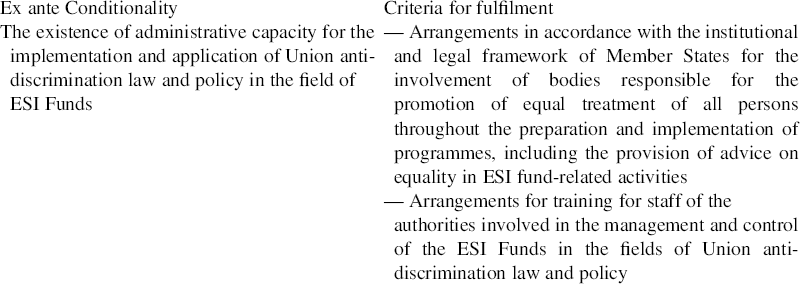
The general ex ante conditionality attaches seven cross-cutting policy requirements to all five ESI Funds. It asks Member States to prove that specific legal, policy and administrative capacity requirements are in place in the area of non-discrimination, gender equality, disability, public procurement, state aid, environment and statistical systems, before the disbursement of spending.Footnote 50
As suggested by their name, the conditionalities are ex ante meaning that, in principle they should be fulfilled before the disbursement of EU financial resources, and in exceptional cases, before the end of 2016.Footnote 51 The conditionalities are also negative as the failure to meet the prescribed requirements attracts suspension of affected payments.Footnote 52 In addition, the conditionality is cross-cutting as it reaches out to thematically distinct EU policy areas such as equality or statistics and brings them into all ESI Funds spending action. Finally, the enforcement of conditionality is optional as the Commission ‘may’ order suspension of funds before the start of the operations, whereas non-fulfilment by the end of 2016 ‘shall’ constitute a ground for suspension.Footnote 53
From the point of view of its subjects, the general ex ante conditionality addresses all EU Member States. It applies each time a sufficiently direct link and beneficial impact on Member States planned spending is present.Footnote 54 In practice, however, the overwhelming majority of Member States found all general ex ante conditionalities applicable to their planned expenditure.Footnote 55 The Commission is the active subject of conditionality.Footnote 56 It monitors the fulfilment of conditionality requirements and also decides on funds suspension as appropriate.Footnote 57 In both instances, the Commission enjoys broad decisional discretion.
The general ex ante conditionality pursues mainly structural and enforcement functions. First, its criteria ask for training, institutional reform and detailed administrative arrangements in all seven of the thematic areas mentioned above (structural function).Footnote 58 Second, they check for correct implementation and application of relevant EU law and policy (enforcement function).Footnote 59
The general ex ante conditionality shows a high rate of compliance with almost 70% of conditions already fulfilled in 2015, before the start of 2014–20 expenditure.Footnote 60
As to the conditionality’s enforcement, there are no formal suspension of payments ordered by the Commission to date.Footnote 61 Nevertheless, an informal self-suspension mechanism was put in place at the initiative of Member States to avoid the politically sensitive suspension of funds.Footnote 62 This means that, where the Commission declared itself ready to suspend funding, Member States offered instead not to draw any payments until the conditions are properly fulfilled. As a result, no funds are disbursed to states until the policy requirements are in place. This mechanism appears satisfactory to be from the point of view of enforcement. However, from a legality point of view, questions may be legitimately asked.Footnote 63 We shall not enter into legality and legitimacy debates here. For the purpose of this contribution, it suffices to establish that the general ex ante conditionality is largely fulfilled and on a number of occasions credibly self-enforced.
2. Thematic ex ante conditionality
The thematic ex ante conditionality follows closely the characteristics of the general ex ante conditionality presented above. It is a negative, ex ante conditionality type, binding on Member States and optionally enforced by the Commission according to the same rules.Footnote 64 The main difference however is that the thematic ex ante conditionality is a same-sector conditionality, matching the policy requirements from policy areas closely connected to the area of investment. The conditionality is also the most numerous one (39 conditionalities) and hence was responsible for most of the ESI Funds policy load in the current financial period.Footnote 65
The thematic ex ante conditionalities are clustered around each fund and within the fund around specific investment priorities.Footnote 66 Hence, the conditionality is applicable to ESI Funds investment priorities chosen by the Member States in close consultation with the Commission.Footnote 67
The three Cohesion Funds have 27 thematic conditionalities attached, ranging from smart regional specialisation, small and medium enterprise, energy efficiency, digital growth, research and infrastructure; to labour market institutions, educational systems, active ageing, smart energy infrastructure, institutional capacity and many more.Footnote 68 The Rural Development Fund counts 8 conditionalities in the area of energy efficiency, green energy, environment, animal welfare, risk prevention and good agricultural conditions, water and high speed internet networks.Footnote 69 Finally the Fisheries Fund brings 4 more conditionalities in the area of fishing capacity, aquaculture, data collection and control and inspection capacity.Footnote 70
The functions of the thematic ex ante conditionality are extremely diverse. The criteria for fulfilment pursue most often a regulatory function, an EU law and policy implementing function, an EU law and policy enforcement function, a structural function and to a lesser extent a legislative function.Footnote 71
Similar to the general ex ante conditionality, the thematic ex ante conditionality is largely complied with.Footnote 72 By mid-2016, over 75% of thematic ex ante conditionalities had been fulfilled, leaving around a quarter of conditions unfulfilled.Footnote 73 For the unfulfilled conditionalities, detailed action plans are in place, indicating for each unfulfilled criteria the actions sought, a deadline for fulfilment and the responsible national authorities.Footnote 74
The thematic ex ante conditionality has been also self-enforced. Similar to the general ex ante conditionality funding has been informally suspended in case of at least three Member States based on the self-suspension mechanism.Footnote 75 As such, Member States opted for self-suspension of EU Funds until outstanding ex ante conditionalities are fulfilled.Footnote 76
3. Macroeconomic conditionality
The ESI Funds macroeconomic conditionality package introduced in 2014 builds on the 1994 macroeconomic conditionality of the European Cohesion Fund.Footnote 77 The 1994 macroeconomic conditionality was the first EU spending conditionality, tasked to support the achievement of the European Monetary Union established by the 1992 Maastricht Treaty.Footnote 78 It conditioned access to Cohesion Fund resources of less developed Member States (then Greece, Ireland, Spain and Portugal) on adoption of economic convergence plans and compliance with the treaty deficit rules.Footnote 79
In 2014–20, the macroeconomic conditionality is quantitatively updated to a set of ten conditionalities split into one negative and ex ante, eight negative and ex post, and one positive and ex post.Footnote 80 The macroeconomic conditionality is also qualitatively updated to support the post-crisis EU economic governance rules. Moreover, the conditionality scope of application has been extended to cover all ESI Funds and all Member States.
Therefore, ex ante the conditionality asks all Member States to align their spending priorities with the Country Specific Recommendations adopted in the framework of the European Semester.Footnote 81 Ex post, the Commission may ask only Member States under financial assistance to adapt their expenditure to subsequent European Semester recommendations, to correct eventual cases of excessive deficit or macroeconomic imbalances;Footnote 82 or to help implement financial assistance economic adjustment programmes.Footnote 83 The failure to comply with the prescribed macroeconomic behaviour may lead to suspension of funding.Footnote 84 Good compliance entitles Member States under financial assistance to a modest benefit of ten percent increase in the EU co-financing rate.Footnote 85
The active subject of conditionality differs in case of each conditionality type. The ex ante negative conditionality is enforced by the Commission.Footnote 86 The negative ex post conditionalities are formally enforced by the Council which shall decide on suspension by reverse qualified majority voting, leaving de facto the decision on enforcement to the Commission.Footnote 87 The positive ex post conditionality is enforced by the Council together with the European Parliament, on a proposal from the Commission preceded by a formal request of the Member State.Footnote 88
The new macroeconomic conditionality keeps its cross-sector nature, linking extensive EU economic policy requirements to EU spending. The new macroeconomic conditionality is also cross-over as it links EU spending to heavy conditionality packages of EU economic governance policy as well as to the sovereign debt conditionality packages of bailed out states.Footnote 89 Based on enforcement, conditionality is both compulsory and optional.Footnote 90
As to its functions, macroeconomic conditionality pursues mainly an EU law and policy enforcement function, as it asks for compliance with EU economic governance legal rules and soft-law recommendations. However, given its cross-over nature, depending on the subsequent economic governance conditionality package of each Member State, it may also pursue legislative, policy implementing and structural functions.
The macroeconomic conditionality has been enforced only once since its first establishment, against Hungary in 2011, without leading to actual funding cut-off.Footnote 91 The current macroeconomic conditionality remains unenforced and, insofar as its negative types are concerned, its enforcement remains highly unlikely. This pathology of macroeconomic conditionality has its origins in the pathologies of the European economic governance, where conditionalities (soft or strong), as well as sanctions (automatic or not) remain generally unenforced.Footnote 92 An eventual enforcement of the negative macroeconomic conditionality is also likely to encounter strong contestation from the European Parliament, which heavily opposed the macroeconomic conditionality during negotiations and is likely to exert high political pressure in case of enforcement.Footnote 93
4. EU law conditionality
The EU law conditionality is another spending conditionality arrangement attached in principle to all ESI Funds.Footnote 94 The conditionality is ex post, negative, generic and optional. It is enforced by the Commission and addresses both Member States and private beneficiaries. As such, all operations financed from ESI Funds must comply with ‘applicable EU law and the national law relating to its application’.Footnote 95 Subsequent specific provisions allow the Commission to impose corrections and exclude from financing ‘expenditure which is in breach of EU law’.Footnote 96
The conditionality pursues an EU law enforcement function. However, even if the text of EU law conditionality suggests a broad application, subsequent rules limit its scope from all breaches of EU law to breaches of EU law that affect the selection of an operation or imply a prejudice to the EU budget.Footnote 97 Hence, an actual financial prejudice or selection error must be proven first, which leaves in all the cases a high discretion to the Commission.
As to enforcement, the EU law conditionality has never been enforced in the 2014–20 financial period. Nevertheless, it was enforced in the previous 2007–2013 financial period in the case of Member States that faced infringement proceedings for breach of EU law in areas closely connected to EU Funds investment.Footnote 98
B. Agricultural Funds spending conditionality
The Agricultural Funds spending conditionality is almost entirely dedicated to advancement of EU environmental policy objectives, in the attempt to ‘green’ the Common Agricultural Policy. It includes two main conditionality packages: 20 cross-compliance conditionalities and 1 green conditionality. The latter complements the conditionalities applicable to agricultural policy via the Rural Development Fund discussed above.Footnote 99 However, contrary to spending conditionalities discussed in Part A above, these remaining conditionalities address exclusively private beneficiaries – hence, farmers. Another notable distinction is that the Agricultural Funds spending conditionality packages discussed here are enforced by Member States (not by the EU) under the close supervision of the Commission.
The cross-compliance conditionality is an ex post, negative and largely cross-cutting conditionality type, which builds on the cross-compliance rules developed in previous financial periods.Footnote 100 It asks EU Member States to comply with certain minimum environmental conditions and EU law on farming, irrigation management, animal and plant health, food safety, land management, preservation of wild bird species or protection of natural habitats.Footnote 101 The cross-compliance conditionality is subsequently split in two conditionality groups. On the one hand, aid beneficiaries accessing structural funding are conditioned to comply with 13 EU law statutory requirements (SMRs).Footnote 102 On the other hand, farmers must ensure that all agricultural activities respect seven ‘good agricultural and environmental conditions’ (GAEC) in line with the standards set at the national level following the EU guidelines.Footnote 103 Failure to comply with the cross-compliance conditionality entails reductions or exclusion from agricultural support, depending on the severity of infringement.Footnote 104
The ‘green’ conditionality is a novel ‘carrot-and-stick’ (positive and negative) and ex post conditionality type in the Agricultural Funds in 2014–20.Footnote 105 It binds ex post farmers receiving aid to respect several compulsory practices beneficial to climate and environment in exchange of an additional ‘green’ payment on the top of Agricultural Funds basic payments.Footnote 106 In case of non-compliance, the farmers lose the green payments, as of 2017.Footnote 107
Overall, the Agricultural Funds spending conditionality reveals a strong cross-cutting nature, especially strongly connected to the EU agenda on environmental protection and sustainable development. On several occasions, the conditions are same-sector, being closely linked to EU agricultural policy. The conditionality in the area exposes a strong EU law and policy enforcement function aiming to support the advancement of EU environmental law and policy through agricultural spending. A legislative and policy implementing function is also observed.
Enforcement is the defining feature of Agricultural Funds spending conditionality. According to ex post evaluation reports, the conditionality is a genuine example of a frequently-enforced spending conditionality on private recipients.Footnote 108 Evaluation data of prior financial periods show that the cross-compliance conditionality is well functioning in most of the Member States, checks are conducted regularly and corrections applied.Footnote 109 This finding is in high contrast with spending conditionalities systems addressed to Member States, which, as seen above, are enforced much more rarely. As the green conditionality is fully operational from 2017, its enforcement is still to be observed in practice.
C. Fisheries Fund spending conditionality
The Fisheries Fund takes less than 1% of the EU budget. It was established to support the EU Common Fisheries Policy (CFP) which has as its primary goal prevention of overexploitation of fishing resources and promotion of sustainable fishing in EU waters.Footnote 110 The spending conditionality of the Fisheries Fund reinforces this goal linking strongly any funding measure to full compliance with all CFP rules.
In addition to the ESI Funds conditionalities applicable to Fisheries Fund fisheries spending is bound by two generic CFP conditionalities: one addressed to Member States and one to private beneficiaries.Footnote 111 Both conditionalities are same-sector, requiring states and private recipients to fully comply with all CFP rules.
The CFP conditionality addressed to Member States is ex post and negative. It is enforced by the Commission, which is endowed with a sophisticated set of sanctioning tools to guard the compliance of Member States with all CFP rules, ranging from interruption of payments deadlines for a period of up to six months to suspension of payments and financial corrections.Footnote 112 To ensure clarity, subsequent implementing rules have been adopted by the Commission limiting the situations of non-compliance to a list of 30 comprehensive conditionalities.Footnote 113
The CFP conditionality addressing private operators is negative, ex ante and ex post.Footnote 114 Similar to Agricultural Funds conditionality above, CFP conditionality is enforced by Member States under the close supervision of the Commission.Footnote 115 In practice, fishermen in breach of EU fisheries rules are sanctioned and are banned from EU aid, according to an EU point system.Footnote 116
Overall, the Fisheries Fund spending conditionalities have a strong EU law and policy enforcement function. This is so, as their design is primarily a response to the serious under-performance of EU fisheries policy reported by the European Court of Auditors.Footnote 117
The CFP generic conditionality is frequently enforced when it addresses private beneficiaries.Footnote 118 As to the Member States, the 2014 CFP conditionality has not yet been enforced.
D. Home Affairs Funds spending conditionality
EU Home Affairs Funds are structured around two funds: the Asylum and Migration Fund (AMIF) and the Internal Security Fund (ISF), supporting border control (IBV pillar) and police cooperation (IPC pillar) operations.Footnote 119 Three spending conditionalities are attached to Home Affairs Funds in the 2014–20 period: the Schengen acquis conditionality, the human rights conditionality and the EU law conditionality. In all cases, the Home Affairs conditionalities are enforced by the Commission and are addressed exclusively to Member States.
The Schengen acquis conditionality is an ex ante and negative conditionality type, which conditions Member States’ access to 40% of border and visa funds (the IBV pillar) on prior good compliance with the EU Schengen acquis.Footnote 120 The conditionality has an interesting enforcement mechanism translated in a declaration of compliance filled in by Member States. In practice, Member States declare that they comply with the EU acquis on visa and borders as well as with the EU common border control standards, including the Schengen Catalogue on external border control, the Handbooks on border guards and visa applications.Footnote 121
The human rights conditionality is ex post, negative and generic. It is restated under both Home Affairs funds and requires that all financed actions are implemented in full compliance with international human rights standards, as well as with the Charter of Fundamental Rights of the European Union (Charter).Footnote 122 In case of serious human rights violations, corrections may be ordered under the general Home Affairs Funds correction clause.Footnote 123
EU law conditionality is ex post and generic. Similar to the EU law conditionality analysed above it requires that all financed actions comply with applicable EU law, subject to corrections in case of failure to do so.Footnote 124
All three Home Affairs Funds conditionalities are optional. As to their function, they largely pursue an EU law and policy enforcement function and are strongly informed by EU policy makers’ interest to promote a high level of compliance with the Union’s Schengen acquis and human rights standards at the EU external borders.
Whilst the very new Schengen conditionality has not been enforced to date, the generic EU law conditionality has been enforced in prior financial periods in case of human rights violations at EU borders.Footnote 125 In this case, funds have been suspended due to serious allegations of degrading and inhuman conditions reported at the EU border detention centres.Footnote 126
IV. REVISITING THE DOMINANT DISCOURSE ON EU CONDITIONALITY
This Part revisits the dominant discourse on EU conditionality in light of the EU spending conditionality findings above. First, I argue that EU conditionality is not only a tool of EU external policy, but also a powerful internal governance device of important significance for the EU internal constitutional architecture (Part IV.A). Second, I highlight that contrary to other EU conditionality arrangements, the EU spending conditionality is governed exclusively by binding EU law norms and is therefore subject to the general principles and rules of the EU internal legal order, including judicial review (Part IV.B). Third, contrary to other EU conditionality types, the evaluations of EU spending conditionality show that it tends to be largely complied with internally in a record amount of time (Part IV.C). Lastly, enforcement data suggest that internally spending conditionality is likely to be enforced against Member States. Highly important, spending conditionality is frequently enforced against private individuals, who are also direct subjects of EU law internally (Part IV.D).
A. Spending conditionality is a purely EU internal matter
In sharp contrast with other EU conditionality types, the EU spending conditionality is a purely EU internal matter. The conditionality is designed exclusively by the EU, explicitly for EU Member States and individuals, entirely on EU internal law and policy objectives and concerning over three-quarters of EU internal budgetary expenditure. As of the 2014–20 financial period conditionality emerges as a substantially strengthened internal governance device used to enforce internal EU law and soft-law provisions, to advance numerous regulatory frameworks, implement EU policy objectives, encourage structural reforms, foster a higher level of compliance and ultimately assert the authority of the EU level of governance at the national level. EU spending conditionality prescribes for hundreds of requirements running from areas of exclusive, shared and coordinative competences of the EU such as: green energy, energy efficiency, environmental protection, risk prevention, digital markets, fisheries, plant and animal welfare, regional smart specialisation, small and medium enterprises, internet and technology, research and development, gender equality, non-discrimination, disability, human rights, integration of minorities, poverty reduction, employment, economic policy, education, social market institutions, Schengen acquis, and many more.
With regard to the current thematic breadth of spending conditionality, its impressive numbers, its link to three-quarters of the EU budget and applicability to all Member States, the 2014–20 EU spending conditionality is a significant presence in EU internal policies. Moreover, upcoming reforms are expected to further consolidate this trend. In this sense one should note that EU institutions have already started the policy thinking on post-2020 EU spending conditionalities, with new proposals of negative spending conditionalities already in the pipeline.Footnote 127 Here one should mention the envisaged EU values conditionality, meant to discipline the recent systemic deviations of certain Member States from the EU’s foundational values of democracy, rule of law and human rights.Footnote 128 It has also been repeatedly argued that negative conditionality may be introduced to encourage Member States’ compliance with the EU migration and asylum acquis, and in particular with the refugee quotas.Footnote 129
Against this backdrop, it appears not only unproductive, but also inaccurate to continue the scholarly debates on EU conditionality exclusively in the area of EU external affairs.
Discussing internal EU conditionality is even more important as its increased use announces a shift towards a generalised conditionality culture in the relationship between the EU and its Member States. The current expansion of EU conditionality contrasts with the long-standing EU practice of conditioning primarily third countries, neighbourhood partners and acceding countries. It also contrasts with the prior EU practice of conditioning Member States only in exceptional circumstances, such as in cases of economic emergency.
This paradigm shift is in no way insignificant. It is of tremendous importance as it constitutes the strongest proof of a radical change in the normative underlying assumption on the relationship between the EU and its Member States: solidarity.Footnote 130 As Marise Cremona noted in the aftermath of the 2004 enlargement, the general assumption that the EU’s external policy is governed by conditionality, whereas its internal affairs are governed by solidarity does not hold true anymore in the case of the ‘new’ Member States.Footnote 131 The analysis of spending conditionality strongly reinforces this conclusion, this time, however, concerning all Member States.
In EU internal affairs, solidarity in its vertical dimension finds its most intimate expression in the duty of loyal cooperation between the EU and Member States and in the non-reciprocal nature of EU obligations.Footnote 132 This is a core aspect that differentiates EU internal relationships from EU external relationships.Footnote 133 As explained by Cremona in detail, internally, in the case of a breach of EU obligations, solidarity is the cornerstone value that does not allow for Member States’ retaliation or withdrawal of EU benefits.Footnote 134 Compliant Member States must continue to comply in solidarity with EU obligations, whereas non-compliant states are taken to court and risk financial sanctions, not withdrawal of EU membership benefits.Footnote 135
The present contribution shall not dwell too much on the regrettable recent cracks in the EU’s underlying solidarity principle.Footnote 136 Rather, the key argument brought forward is that the initial normative standard of pure solidarity between the EU and Member States is now effectively changing towards a de facto conditional solidarity. Hence the message is: EU Funds, which are essential EU solidarity instruments, are disbursed in full solidarity by the EU only if Member States prove the same solidarity stance by continuously upholding and respecting key EU treaty commitments. Should Member States fail to comply, EU Funds – core membership benefits – may be withdrawn. This development introduces an instrumental, quid pro quo aspect to the relationship between the EU and its Member States, the latter being rewarded or punished based on their performance. The synergy of this conditional relationship becomes even more powerful when spending conditionality links to pre-accession conditionality narrative in the ‘younger’ Member States, or to heavy sovereign debt conditionality packages in bailed-out Member States, or both.Footnote 137
From this point of view, the influx of conditionality in EU internal policy not only constitutes a departure from the prior EU practice, but may also mark a point of profound transformation in the EU inner structure. The potential constitutional implications of the conditionality phenomenon are too broad to examine here.Footnote 138 For the purpose of this contribution I shall nevertheless note that the conditionality logic strongly departs from the most intimate ethical convictions of the European construction which was meant to be built – in Schuman’s words – through the common and sincere efforts of all Member States, and lead to common achievements that would create in time a ‘de facto solidarity’ (not conditionality).Footnote 139
B. Spending conditionality is EU law
Spending conditionality is in all cases EU law. Contrary to other EU conditionality types, spending conditionality is always rooted in binding EU law rules. All conditionalities are defined and their specific criteria are detailed in the black letter law of the EU funding regulations. Equally, EU law fully governs their applicability, fulfilment and enforcement in each area of EU spending.
The explicit consecration in binding EU law rules is the major qualitative improvement of spending conditionalities in the 2014–20 financial period. As opposed to the general principles of consistency and legality mentioned in prior funding regulations, the 2014–20 funding regulations explicitly state: what is the conduct to be observed, when, how, by whom and at what price. Equally important, the funding regulations detail the procedural rules of enforcement for each conditionality type, making it much easier to claim compliance and order funding cuts. This clarity of the legal framework and enforcement is especially valuable for the Commission who found it much more difficult previously to claim compliance.Footnote 140
There are also other significant consequences of the EU legal nature of spending conditionality. First, as an EU law construct, spending conditionality is subject to the applicable rules and general principles of the EU legal order. Second, and most importantly, spending conditionality is subject to judicial review in national, and above all, EU courts. This is a major departure from the recent EU sovereign debt conditionality, which proved virtually immune to legal challenges at the EU level, stirring serious legal criticism and a generalised public outcry.Footnote 141
While the 2014–20 spending conditionality has not yet made it to EU courts, the Court of Justice of the EU has already had the chance to speak on spending conditionality in prior financial periods. In Italy v Commission, the Court endorsed the enforcement of a generic EU law conditionality and held that the Commission could order funds withdrawal where a ‘sufficiently direct link’ was present between the financed measure and the alleged breach of EU (waste management) law.Footnote 142 The Court has additionally held that funding withdrawal for breach of EU law is an autonomous procedure with no consequences for eventual infringement procedures based on Article 258 TFEU.Footnote 143 The Court also upheld on numerous occasions the Commission’s subsequent enforcement of Agricultural Funds conditionality where Member States failed to correctly enforce the conditionality on farmers.Footnote 144 Very importantly, the Court has reviewed the consistency of spending conditionalities with the Charter and struck them down where fundamental rights were not observed.Footnote 145
While acknowledging the qualitative legal improvements, one should stress that similar to other areas of EU action, the applicability of the Charter and especially the justiciability of its social principles remains problematic.Footnote 146 At the same time, individual standing in front of EU courts may also prove difficult for actors seeking enforcement of a particular conditionality.Footnote 147 For instance, a person with disabilities seeking the annulment of a Commission’s decision on EU funds disbursement may not be successful in proving standing in front of EU courts in a case where a public highway is not accessible to her. However, it is important to note that internally other legal remedies are available to individuals, including legal challenges in domestic courts, the preliminary reference procedure in interpretation or legality, as well as the administrative avenue of complaints in front of national authorities, the Commission and the European Ombudsman.Footnote 148 In future financial periods the opportunity of decentralised judicial enforcement, which could grant individuals the right to hold non-compliant Member States to account may be further examined.
C. Spending conditionality is complied with
The EU spending conditionalities discussed in this contribution are largely complied with. Compliance with 2014–20 ex post conditionalities is very hard to assess in absence of infringement procedures or fund suspensions. However, based on the early data available on ex ante conditionalities, and data available from prior financial periods, the overall compliance rates appear high.
Internally, Member States have a higher tendency to comply with conditionality attached to EU budgetary resources, especially since the vast majority of actions required have already been agreed upon at the EU level as a matter of soft-law policy or hard law. Moreover, internally, Member States themselves determine to a large extent the substance of conditionality wearing the hat of EU Council representatives during the legislative procedure. In this context, it is not surprising that the compliance rates tend to be higher than in other areas where EU conditionality is traditionally prescribed in a top-down fashion.
The ex ante conditionalities attached to ESI Funds were complied with in 75% of cases before the start of spending operations.Footnote 149 The compliance rate is impressive if one considers that this represents by far the most numerous and burdensome conditionality package of the financial period. The ex ante conditions imported an enormous EU law, policy, regulatory and structural load to EU spending in the current financial period.Footnote 150 The finding that three quarters of conditionalities have been complied with within two years is in no way a small achievement.Footnote 151 Moreover, first evaluations also report that ex ante conditionalities have served as strong leverage for Member States to put in place national wide reforms, pass laws, transpose EU rules, adopt strategic policies or establish completely new national institutions.Footnote 152 As such, the finding of compliance must also be assessed with regard to the highly burdensome and intrusive requirements Member States were asked to deliver.
Prior evaluations of agricultural and fisheries spending conditionality addressed to private recipients also reveal a high level of compliance.Footnote 153
As for the case of macroeconomic conditionality, the internal compliance problems of the EU economic governance framework do not allow for an accurate evaluation.Footnote 154 The macroeconomic conditionality is cross-over. This means that compliance with conditionality implies prior compliance with the corresponding economic governance rules, which is by far not yet the case.Footnote 155
Lastly, one must mention that full formal compliance with a conditionality does not mean effective achievement of the policy result sought. In other words, the fact that a conditionality is complied with does not mean that its policy objective has been achieved. Let us return to our early example of highway funds and disability conditionality. Even if Member States show full and correct implementation of EU law on accessibility for people with disabilities, this is no guarantee that people with disabilities are actively included in that particular Member State. Much more is needed to ensure that the policy objective of conditionality is reached. As such, people with disabilities may encounter administrative barriers to obtaining driving licenses, suffer from systemic exclusion from the labour market or face particularly acute discrimination in all sectors of public life. If that is the case, even if the highway facilities are fully fit for use for people with disabilities, these would most probably not be used by the latter. As a result, the policy goal of integrating the people with disabilities will most probably not be attained.
The latter yardstick of effectiveness should be subject to a much broader and complex inquiry. From a formal compliance point of view however and based on the data available, it is worth noting that the major spending conditionality packages of EU Funds tend to be largely complied with. Having regards to the immense regulatory burden of these conditionality packages, the extremely short time available for fulfilment, as well as the monumental effort required at the national level, the above finding of compliance is in no way an insignificant achievement.
D. Spending conditionality is enforced
All spending conditionality types attached to EU Funds have been enforced against Member States at least once in the current or previous financial frameworks.Footnote 156 The general and thematic ex ante conditionalities of ESI Funds have been self-enforced and led to informal suspension of funds already before the start of spending operations on more than ten occasions.Footnote 157 Future enforcement may be reasonably expected by the end of 2017 if outstanding ex ante conditionalities are not fulfilled.Footnote 158 Home Affairs Funds have been previously successfully withheld on at least one occasion.Footnote 159 Even the highly contested macroeconomic conditionality has been enforced once in the previous financial framework.Footnote 160
Most importantly however the novelty brought by spending conditionally is that it is enforced frequently in the case of private beneficiaries.Footnote 161 This finding radically changes the core narrative on EU conditionality which has been understood to date as a non-enforceable tool, having at large a mere suasion role.
The difficulty of enforcing spending conditionalities in case of Member States has several explanations. Firstly, spending conditionality is constantly balanced against the primary objective of budgetary execution: simply put, the pressure of spending EU money.Footnote 162 In this context it is important to stress that conditionality is a by-product of spending, not its inner essential part. Hence, its implementation and – above all – enforcement necessarily leaves a large scope for negotiations, bargaining, concessions and a high discretion to the Commission for an effective implementation of the EU budget. As a consequence, enforcement against Member States is generally ordered only as a last resort solution, when no other compliance tools, such as negotiations, notification or pre-enforcement notice proved effective. To put it in the words of a high-level EU official: ‘when conditionality is enforced, something went terribly wrong.’Footnote 163 Secondly, the Member States’ strong bargaining power and the multiple externalities involved also explain why enforcement is much more rarely encountered in the case of Member States. As opposed to private beneficiaries, the Commission currently heavily relies on the good will of Member State administrations to assist it with the implementation of almost 80% of the EU budget. This considerably strengthens the Member States’ bargaining position in cases of enforcement. At the same time, in the case of Member States the Commission is faced with multiple concurrent externalities of social, political and economic (hence, non-legal) nature which make the decision on enforcement much more difficult altogether.
Let us take a hypothetical case of macroeconomic conditionality to illustrate the enforcement difficulty in case of Member States. Suppose Greece has failed to fulfil the conditionality criteria. Should the Commission suspend EU Funds? In this case any decision taken by the Commission shall not be a simple ‘yes’ or ‘no’ exercise on compliance. An enforcement decision will involve what Fuller called a ‘polycentric difficulty’; that is, a polycentric judgment on multiple subsequent scenarios and ramifications which a ‘yes’ or ‘no’ decision may ultimately cause.Footnote 164 All these scenarios shall ultimately feed back into the Commission’s judgment and shall decisively influence the final enforcement decision. As such, before deciding to withdraw or not withdraw EU funds, the Commission may or may not remember that Greece is in desperate need of liquidities and that suspension of EU Funds will have a tremendous negative impact (which may not be the case for other Member States). The Commission may or may not consider that Greece is already under strict EU and non-EU economic, financial and fiscal supervision. It may or may not consider that Greece has been subject to heavy austerity policies for almost a decade. Additionally, the Commission may or may not be alerted by the domestic political situation and the rising power of illiberal democratic leaders. The Commission may or may not also be concerned by the EU’s reputational damage and the growing Euro-scepticism in the country. Not least, the Commission may or may not be particularly concerned by the constantly degrading socio-economic conditions of the population and the increased rate of poverty, which EU Funds are primarily tasked to combat. Against this high uncertainly, the Commission may consider it rational to postpone a funding cut. It may also seek to ensure compliance by other means. At the same time, it may seek the advice of a better placed expert body, which could assess more precisely the overall implications of a funding cut-off. In all cases, a decision to cut EU Funds will be a last resort measure.
Yet, even against this hypothetical backdrop, in practice, enforcement was ordered in the case of Greece and funds have been effectively suspended or self-suspended on at list four occasions during the last three years.Footnote 165
Beyond the peculiarity of enforcement against Member States explained above, we stress again that a valuable finding of this contribution is that in the case of private beneficiaries spending conditionality is not only enforced, it is enforced frequently. This finding is important as it suggests that internally EU conditionality has a private enforcement avenue available in cases where state enforcement may prove challenging. Within the EU, private beneficiaries are also subjects of EU law and may enjoy EU conditional rights and bear EU conditional obligations in a similar manner to Member States. Especially in the case of EU policies that target change in private (as opposed to state) behaviour (eg environment protection, energy efficiency, green energy, enterprise or sustainable fishing) the EU may find it easier to vest conditionalities on private parties as opposed to states to avoid the enforcement difficulties underlined above.
V. CONCLUSION
The rise of spending conditionality in EU internal policies is an unprecedented development of EU law. In spite of its novelty and impressive proportions, EU spending conditionality remains under-researched and far too little discussed in scholarly debates. This article has attempted to fill this gap, showing that the study of spending conditionality qualitatively adds to our understanding of EU conditionality in general and usefully broadens our perspective on the potential implications of its active use in the EU internal context.
This contribution has shown that conditionality is increasingly an EU internal governance mechanism, actively used to foster compliance, change domestic regulatory frameworks, implement EU policies, encourage structural reforms and advance a wide array of EU objectives at the national level through the route of EU budget. It has also shown that contrary to other EU conditionality arrangements, spending conditionality is a EU hard law construct, which is subject to rules and principles of EU internal legal order, including the Charter, and is subject to judicial review in EU courts. Moreover, this contribution found that internally Member States generally tend to comply with the prescribed spending conditionality and that even if enforcement is difficult, spending is still credibly withdrawn from Member States. Another interesting finding is that in internal spending, the EU actively vests spending conditionality also on private beneficiaries of EU Funds, who experience funding cuts much more frequently.
This means that internally, spending conditionality may be credibly used to reinforce the authority of EU laws, advance policy objectives and support broader interests at the national level, in the pursuit of effective EU government.
While the pursuit of effectiveness is a legitimate goal of EU government, this article has stressed that the extended use, intensity and most importantly the announced future development of conditionality internally seems to depart from the founding principles and ethical convictions upon which the entire European construction was built. In the view of the EU’s founding fathers, the achievements of a unified Europe were to lead towards an increased solidarity (not conditionality) within the EU. In contrast, what we see today is an increased influx of conditionality in the EU internal affairs which often informs the limits and meaning of solidarity – a de facto conditional solidarity.
This conclusion invites deeper reflections upon the meaning and opportunity of a permanent conditionality culture within the EU. Today, the EU is at the crossroads of deep transformations. Many decisions taken in the next few years will decisively shape the EU of tomorrow. In this context it is crucial to reflect upon the constitutional implications of a generalised governance by conditionality within the EU and the implicit transactional character it gives to the relationship between the EU, its Member States and most importantly the EU citizens.