Background
Recent decades have seen a fundamental change in the age structure of many Western societies. The number of people aged 85 years and older in Europe is projected to rise from 14 million to 19 million by 2020 and to 40 million by 2050 (World Health Organization 2015). In 2011 in the United Kingdom (UK), the percentage of the population aged 65 and over was the highest seen in any census at 16.4 per cent (Office for National Statistics 2011). In addition, the numbers of older people living alone have increased. In the UK in 2009, 60 per cent of women and 36 per cent of men aged 75 and older were living alone (Evandrou, Falkingham and Scott Reference Evandrou, Falkingham and Scott2001; Office for National Statistics 2011). This is mainly as a result of bereavement and moving into an institution, with only a very small proportion moving to live with relatives to receive care (Evandrou, Falkingham and Scott Reference Evandrou, Falkingham and Scott2001). In Europe, the numbers of older people not living within a nuclear family but living with kin (but not their partner) have fallen (Gaymu and Springer Reference Gaymu and Springer2010). These developments have raised concerns for government and local authorities because of the potential increased demand on services. However, older people are a diverse population with many different lifestyles, beliefs and attitudes to ageing, care and living arrangements. Driven by significant changes in welfare state provision (Moffatt et al. Reference Moffatt, Higgs, Rummery and Jones2012), they face consumer choices which in turn are dictated by their mental and physical capacities, and personal and family resources.
Demographic ageing has led to a rise in demand for residential and nursing homes and home care (domiciliary) services for older people. In the UK, long-term care has predominantly been provided by family members, and this has been supported by government policy that prioritises care in the community rather than institutionalised care. In order to promote user choice and control over the care that they receive, a previous UK government provided a system of personalised ‘direct payments’ to older people so that they are able to purchase their own care (Clark, Gough and Macfarlane Reference Clark, Gough and Macfarlane2004). For those older people who do not see themselves as old or frail enough to require such care, and who prefer to maintain their identity as autonomous and independent individuals, other alternatives are available through the development of assistive technologies (Zwijsen, Niemeijer and Hertogh Reference Zwijsen, Niemeijer and Hertogh2011). These range from basic walkers and wheelchairs to more technologically advanced devices such as fall detectors (Philips 2015) and home automation for the elderly or disabled. In the UK, personal and panic alarm systems are also often available through council, voluntary or private providers. Assisted living facilities have been developed to bridge the gap between independent living and residential care or nursing homes. Research on these facilities (Ball et al. Reference Ball, Perkins, Whittington, Hollingsworth, King and Combs2004; Carder Reference Carder2002; Roth and Eckert Reference Roth and Eckert2011; Sheehan and Oakes Reference Sheehan and Oakes2003) has highlighted the importance of older people's interpretations of independence and identity maintenance, autonomy, choice and privacy.
Since 2007, the UK government's Technology Strategy Board has been funding projects on assisted living, with the aim of making telecare and telehealth publicly accessible, financially efficient and viable. The SHel home monitoring system is one such project, designed for older people who live alone and want to continue living independently in their own homes. SHel is an example of ‘ambient assisted living’ which refers to ‘smart’ environments sensitive to the presence of people (Demiris Reference Demiris2008; Hossain and Ahmed Reference Hossain and Ahmed2012; van Hoof et al. Reference van Hoof, Kort, Rutten and Duijnstee2011). Its aim is to provide automated home monitoring of older people's activities in a non-invasive manner. Unlike other home monitoring systems, SHel aims to support people living alone without a specific health problem, instead focusing on alleviating general concern with its low-fidelity capacity to sense general activities and relaying information to nominated monitors. The product will be marketed not only to older people but to adult children who have concerns about their ageing parents living on their own. One group that it is targeted at are those with scattered family networks, for example, geographically mobile adult children who live some distance from their parents.
The system consists of a home hub that communicates with wireless passive infrared (PIR) sensors the size of a light switch placed at the entrance to selected rooms in the home. The PIR detects heat emanating from an individual as they pass in front of the sensor, like a burglar alarm. However, unlike a burglar alarm the sensor aperture is very narrow meaning that it only detects motion in a 14° arc in front of the sensor up to a distance of three to five metres. Upon triggering, the PIR sensor wirelessly communicates this activity to the home hub. Information about the resident's movements is then transmitted over a mobile phone connection to a central database. The information collected is then made available on a secure password-protected Web server, which relatives or ‘monitors’, chosen or nominated by the older person, will be able to access. At the time of the research, the system was at its development stage, with the intention of enabling relatives to be able to sign up to text message alerts on their mobile phones, for example, about any unusual changes to regular activity. The alerts would be generated automatically by an intelligent system that would detect deviations from an individual's typical patterns of behaviour. Due to the flexibility in participants' daily routines, these alerts were not expected to be sent in rapid response to incidents and the system was not a replacement for more immediate services such as community care alarms. However, in the long term, the system aimed to develop the intelligence to identify subtler changes in routine that might indicate the development of long-term health conditions.
Research on ambient home monitoring systems such as this is new and burgeoning. A review of lifestyle monitoring found studies biased towards technical aspects, and the evidence base was limited (Brownsell et al. Reference Brownsell, Bradley, Blackburn, Cardinaux and Hawley2011). Nevertheless, existing research has found that advantages of home monitoring include their acceptance by older people (Alwan et al. Reference Alwan, Dalal, Mack, Kell, Turner, Leachtenauer and Felder2006; Hossain and Ahmed Reference Hossain and Ahmed2012), their ability to generate feelings of safety and security (despite the number of false alerts) (Sixsmith Reference Sixsmith2000; van Hoof et al. Reference van Hoof, Kort, Rutten and Duijnstee2011), and benefits for carers and care co-ordination (Alwan et al. 2006; Hossain and Ahmed Reference Hossain and Ahmed2012; Sixsmith Reference Sixsmith2000). While this could lead to incentives for independent living, such systems are not without their drawbacks. In a study of adults with impaired vision, their concerns about the in-home monitoring system included cost, privacy, security of the information obtained through monitoring, system accuracy and ease of use (Larizza et al. Reference Larizza, Zukerman, Bohnert, Busija, Bentley, Russell and Rees2014). As such, it was recommended in another study that older people and their family members who are considering the purchase of sensor-based monitoring technology should be properly informed about their choices and that decision-making could involve case managers, physicians, nurses and social workers (Bruce Reference Bruce2012). Our paper will consider older people's views of using such technology in their homes, drawing on a sociological framework of trust.
Employing a sociological framework of trust
In her book Trust in Modern Societies, Barbara Misztal (Reference Misztal1996) describes modern societies as increasingly complex and globalised, with a contingency upon a multiplicity of factors that is characterised by uncertainty. She argues that in this context, social order is the key problem in which trust plays an essential role. Trust, initially understood as confidence in the reliability of persons or things, is described as a social mechanism explained by beliefs and motivations. In her view, it is a construct that can be theorised as a prerequisite or a necessary precondition of social order because it provides the conditions for social relationships to thrive. Critically expanding on the definition of trust, she examines its meaning from both interpersonal and institutional levels, and concludes that trust is best understood in terms of its functions in society.
Rather than adopting a behavioural science approach that considers the variable mix of motivations behind trusting behaviour, she adopts a sociological stance in considering the functions of trust as they relate to social order. Reviewing the writings of classical sociologists such as Durkheim, Simmel and Weber, and their contributions to theories of social order, she employs a synthetic approach in outlining a typology of trust, defined as having three distinct social roles. These roles correspond to three kinds of social order that she has identified, i.e. as a stable system, a cohesive system and a collaborative system. The resulting definitions of trust based on their social roles in maintaining social order are described in the following sections.
‘Stability’ – trust as habitus
One of the functions of trust is as routine background or ‘habitus’, which is a set of dispositions and expectations that arise out of the values and lifestyles of a social group. ‘Habitus’ (a term Misztal borrows from Bourdieu Reference Bourdieu1977) is a result of habitual action that is taken for granted and unreflective. Trust through habitus' predictive nature, created through patterns of rules and norms developed from past experience, results in anxiety reduction and can be a protective mechanism through the security of everyday routines. Misztal further describes this broad form of interpersonal habit as being composed of three types of habits: repetitive behaviour towards or in connection with others, taken-for-granted assumptions, and ceremonial habits or rituals. Such habits work to enable people to manage their social environment by ordering and patterning their daily life and hence allowing them to cope better with the unpredictable. Such trust contributes to social order as a stable system.
‘Cohesion’ – trust as passion
Trust that functions as ‘passion’ is based on personal relationships, familiarity and bonds of friendship, and on the affective quality of relationships. These relationships are most often with those closest to us, i.e. family and friends, but could also include those more distally related, e.g. fellow countrymen. In relation to these various relationships, there is a spectrum of feelings ranging from confidence to obligation. In discussing trust as passion, Misztal refers to the agreement among social scientists that family is responsible for much of an individual's self-identity, and the maintenance of such an identity is anchored to a basic sense of trust that enables the individual to cope with change and crisis. Another source of solidarity and self-esteem is friendship. This function of trust as passion is more intuitive than rational and forms a large part of an individual's sense of identity in society, contributing to social order as a cohesive system.
‘Solidarity’ – trust as policy
Finally, trust that has a policy function contributes to social order as a collaborative system. Individual autonomy in modern society has necessitated the re-examination of meanings of community and civil society and the importance of solidarity. In the context of democratic legitimacy, trust is important in engendering co-operation and collaboration. For this reason, public policy may be used to establish structures and procedures as vehicles to promote openness, reciprocity, negotiation and compromise (Misztal Reference Misztal1996: 218), and conditions for shared deliberation and active participation (Misztal Reference Misztal1996: 219). This form of trust functions more at the level of institutions, among collective groupings and structures, in order to deal with diversity and the range of personal freedoms in society and to foster solidarity.
Using the sociological framework of trust developed by Misztal, the aim of this paper is to present findings using a conceptual focus on the results of a qualitative evaluation study of older people using the SHel home monitoring system for the first time. The empirical study explored ideas of safety and privacy, and found that ‘trust’ emerged as a key construct behind participants' perspectives of the home monitoring system that they were testing. Our theoretically driven analysis adds to existing literature on the relationship between trust and safety (Conchie, Donald and Taylor Reference Conchie, Donald and Taylor2006), confirming the role of trust as a prerequisite for social order and as providing the necessary context for the safe home monitoring of older people.
Methods and sample
The team responsible for the qualitative research reported in this paper was part of a multi-agency project team with representatives from industry, government and business. The aim of the evaluation study was to explore views of the acceptability, use and design of the system from the perspective of users of the system. Together with ground-truth data collectionFootnote 1 and participatory workshops, the research consisted of two live field trials (Vines et al. Reference Vines, Lindsay, Pritchard, Lie, Greathead, Olivier and Brittain2013), with two different sets of participants. The first field trial (ten interviewees) encountered technical difficulties, which resulted in a second field trial (11 interviewees). Interviews were carried out pre-trial, during the installation and post-trial in order to capture the views of the participants and, where possible, their ‘monitors’. During the second trial, the monitors were able to view the activity of their elderly relatives on a secure Web server. Altogether 24 interviews were carried out in the first trial, and 43 in the second trial (see Figure 1).
Fieldwork time-line. Note: Figures indicate number of participants involved.

The older people were recruited through a panel of volunteers in the North-East of England set up to involve people in research and policy-making processes which affect their lives.Footnote 2 Participants needed to be aged 65 and above, living alone and be able to nominate a member of their family or a friend as a ‘monitor’ to be interviewed by telephone. Following university ethical review procedures, interviews were carried out a few weeks before the systems were installed, at the time of installation and at the time of de-installation following 6–12 weeks of testing the equipment (see Figure 1).
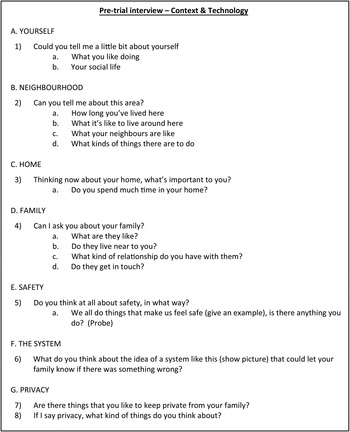
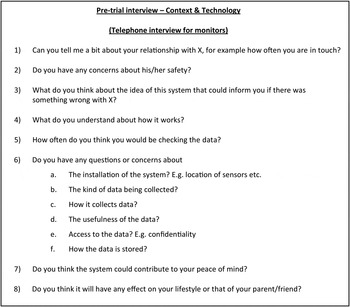
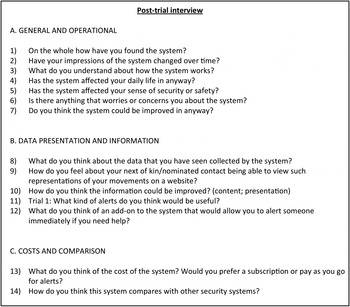
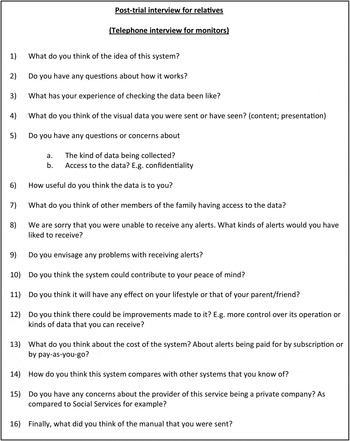
The pre-trial interview guide included questions on participants' neighbourhood, home, family, safety, privacy, and what their initial impressions of the system were, while the post-trial questions explored their experiences and views of having the system installed, and how it has affected their sense of security and safety and their daily lives, and what improvements could be made (see Figures 2–5).
Pre-trial interview topic guide (older participants).

Pre-trial interview topic guide (monitors).

Post-trial interview topic guide (older participants).

Post-trial interview topic guide (monitors).

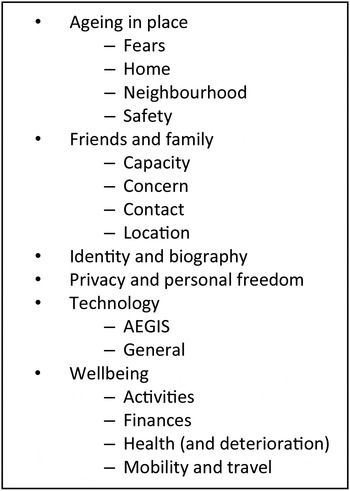
All 67 interviews were recorded with the consent of participants, transcribed, checked and the textual data entered into NVivo qualitative data management software for thematic analysis (Richards Reference Richards1999). After open-coding, reading and re-reading several transcripts, a coding frame agreed between team members was used (see Figure 6).
Coding frame. Note: AEGIS – system name replaced by SHel.

Sample characteristics
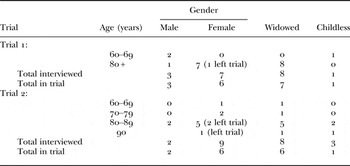
The age and gender profiles of the older participants were different in the two trials (see Table 1), with more men in their sixties in the first trial, and more women in their sixties and seventies in the second trial. The mean age of those in their eighties was 82 ± 1.73 and the range was 80–85. After being interviewed, four participants left the trial due to ill-health or frailty. In Trial 1, participation by relatives was limited to two daughters who were present with their mothers at the time of the pre- and post-trial interviews. In Trial 2, there were nine nominated monitors interviewed by telephone. Five were daughters, two were sons, one a brother and one a close friend. Five daughters, one son and one brother were interviewed after the trial. The older people lived in a range of accommodation that included private residences or rented social housing or sheltered accommodation in urban, suburban and rural areas, and were retired from varied occupations. Typically of this population, they differed from each other in chronic age-related health conditions that included hypertension, hearing impairment, arthritis and macular degeneration. Taken together, the study could be said to have gathered views from a range of older people, including a small number who did not have children to act as monitors in the trial. However, all the participants lived in the North-East of England and were white British, thus perspectives were not gathered of other ethnic groups with different family norms and expectations.
Sample characteristics

Research findings
The notions of safety and privacy
SHel was introduced to the participants in the study as a home safety monitoring system. As such, the main theme of ‘safety’ was the focus of the interviews. Following on from the research literature, ‘privacy’ was a related theme that was explored in interviews. Our research found that the infringement of the older person's privacy was one of the negative impacts of the system for the older person being monitored in their own home. The way in which the two ideas of safety and privacy were constructed by older people in relation to the monitoring system formed the conceptual context for our discussion of trust. We would argue that underpinning safety and privacy, it was ‘trust’ that would eventually determine individuals' acceptance of the system.
We found there could be inherent tensions in maintaining both safety and privacy at the same time, as in some cases, a certain amount of privacy had to be given up for the sake of safety. The ways in which the participants negotiated this consisted mainly in defining those instances or areas that they viewed as ‘private’, and activities that were acceptable or unacceptable. People's understandings of privacy varied from not wanting financial information to be disclosed, to keeping their bodily functions private, which was about their personal dignity being respected. It could also extend to keeping their personal space from being invaded, as a woman described her experience with the smells of the cafe next door impinging on her comfort and neighbours looking into her yard.
I think probably it's not personal privacy I like but maybe my space you know what I mean. (T1D10, female aged 82)Footnote 3
Her quote demonstrates that the notion of privacy needs to be carefully defined, and in this case, what she refers to are her own preferences about privately owned space.
Most participants claimed that they were not particularly private people or self-conscious. Their understandings of privacy were closely linked to self-identity, whether to do with age or lifestyle or other markers of identity. For example, there was a perception that when a certain age is reached there is less of a need for false pretences. The following participant did not feel the need to maintain privacy because she did not feel she had anything to hide from her family and was comfortable for her adult children to view her activities. In response to the question about whether she would prefer to keep things private from her family (see Figure 2: G7), she replied:
no … no I'm an open book [yes] if they don't like it they can lump it … but I tell them the truth … and they know that they know that [yes] and they say Mum is a law unto herself … I'm not really but on the whole but when you get to 83 you've earned the right to be a law unto yourself I think. (T1K2, female aged 83)
Like her, most participants were comfortable with their movements being monitored on the SHel system. However, it was an invasion of privacy for one participant who could see its relevance for those who were in poor health or had mobility problems, but not for those who were active:
if they're crippled with arthritis … I can see how they think, well if people know I'm moving from room to room, they're seeing that I'm still able to move from room to room and so if that happened that they weren't, but I think if you're fit and active … I think it is impinging on, on what you feel is your privacy. (T2M3, female aged 76)
Evidently, this participant was of the opinion that a fit and active person would feel safe enough not to have to trade her privacy for someone to monitor her movements. While much of the literature refers to older people's autonomy and independence, which is implied in her quote, we have chosen a different approach.
We would argue that safety is intimately linked to the notion of trust, for feelings of safety emanate from the belief in the reliability of human activities, interpersonal relations, and established systems and processes. Therefore, using the three main themes that Misztal provides in her social interpretation of trust and its functions as a hermeneutical tool, the rest of this paper will present findings focusing on safety in relation to habitual action, personal relationships and wider institutions. The discussion will then draw these findings together under a sociological framework of trust.
Feeling safe through habitual action
In order to assess what effect SHel would have on older people, we sought to determine what measures our participants were already taking in keeping themselves safe and what safety meant to them (Figure 2: E5). Among the participants, safety was often talked about with regard to the security of the home and the installation of locks and burglar alarms. Thus one idea of safety had to do with the boundary of the home being breached by external agents against the wishes of the home owner. Another was that of safety from accidents within the home. The following participant took precautions against both:
you feel safe in your home because I've got a house alarm and of course they've got the gas, as I said, the gas detectors and fire alarm so I feel safe and secure; that's what safety means to me. Safety and security. (T2M1, female aged 80)
Installation of devices was one aspect; the other was the practical use of these devices or fittings that had to be embedded in an individual's social patterns and daily routines:
I'll often the times that I'm most likely to lock the door is before I go to bed … so that could be 12, one, quarter to two, something like that … and I very rarely forget, it's very unusual for me to forget to do that because it's … in fact I'll check it on the way upstairs, I'm going to bed, check the door. (T1K1, male aged 69)
An experience of a burglary that suddenly disrupts the rhythm of daily life and the trust placed in the relative security of one's environment could sometimes result in more devices being installed for peace of mind, for example:
I have the security system on the doors and the windows, I have the alarm systems of course, I have cameras back and front … because I was burgled … and it made me quite nervous. (T1K2, female aged 83)
With accident prevention there were references to the likelihood of falls and the use of grab rails or handles, and thus the concern was personal bodily safety and the prevention of harm coming to the person rather than about physical or material possessions. According to one participant, it was about being ‘cautious’ and exercising personal responsibility:
Well safety is just being sensible in whatever you're doing, you know. You take care of, that you don't, say you're making tea you take care that you don't do anything stupid, you just watch what you're doing. And safety is em that everything is in working order… (T2M1, female aged 80)
With age and its limitations, participants took precautions such as avoiding the use of ladders, and adapting the home to facilitate mobility, such as installing an extra banister for the stairs, and disabled access whether in the front of the house or down to the back garden. One woman minimised her use of kitchen equipment because of her arthritis. Other precautions included the use of walk-in showers instead of baths. Another aspect of safety had to do with safety when individuals were out and about. Several carried a mobile telephone with them and those with limited mobility took advantage of transport services for the disabled.
Safety also involved habitual action in the context of the neighbourhood. In the past, signs at the boundary of the home that something was untoward included curtains or blinds being left shut, milk bottles, newspapers and post not collected, without prior notice that the resident was going to be away. In many contexts where neighbourliness was absent, these indicators could not be relied upon. Nevertheless, in other neighbourhoods, neighbourhood watches existed or agreements were made about looking out for each other:
…we have an absolutely brilliant system, we don't go anywhere without telling each other. (T1S6, male aged 68)
Even before the advent of newer technologies, phones were used to ensure ‘safety’ and provide reassurance. Regular morning phone calls provided reassurances about safety:
I have a friend that's 81 and we ring each other each morning. (T2M3, female aged 76)
I mean when he [father] was alive I used to work full time but I still used to check in with him every morning. We had a signal he would phone me and he would let the phone ring three times every morning to let me know he was up and about. (T2M2, female aged 70)
Most of the participants were aware of technology that was available to improve their personal safety, such as personal alarms or calling devices that could be attached to the wrist or hung around their necks, or had alarms to call for help that they could press or pull installed in their homes. Several, however, who had these panic alarms only used them when they were feeling unwell, and most felt they were not old or frail enough to need them.
I've got one actually pinned to the bed head, right, and the other one, this is the one I'm supposed to have round my neck, but I reckon I'm not old enough yet. (T2M2, female aged 70)
Some alarm systems require the keying-in of a code or pin number to de-activate the system, which was a problem for older people with memory problems. What was different about SHel as an ambient system was that the older person did not have to activate the alert themself, thus providing a ‘safety net’, although the response time for help to arrive worried them.
if I'd had a heart attack in that time it would already be too late, so at the state they're at at the minute they have a limited a limited benefit. (T22M2, female aged 70)
Feeling safe through relationships with kin and trusted others
Because SHel would require the involvement of the older person's family members, we explored these relationships with the participants (Figure 2: D4). We found that participants were sensitive to the needs of their family, as the following quotes demonstrate:
she's disabled as well see, so she can't just down tools and leave her home sort of thing. (T1S5, female aged 81)
You see in the normal way I'd be loath to involve her, if anything happens to me it's usually the middle of the night. (T21M9, female aged 82)
Many participants knew that they had to take responsibility for their own care:
I think well it's not fair of me to put on to the shoulders of my son or my daughter, my daughter and her husband, who do all sorts of things for me you know. And I think it's up to me to take every safeguard that I can so that they are not bothered. (T2M10, female aged 83)
For the majority of participants, however, they expressed little doubt about help that they would receive from their children. They were also comfortable about their children and even their grandchildren having access to information about their movements in the home. On the other hand, for a small minority of the participants, there was a certain amount of discomfort at anyone, even their family, knowing their movements at all times.
I mean I occasionally do stay overnight and I've got friends in [seaside town] that I stay with like on an ad hoc basis … it just crops up and I'll say right I'm off and … and I certainly wouldn't ring G [daughter] to let her know that I was going to [seaside town], it's none of her business. (T1K1, male aged 69)
After the trial, one of the participants expressed extremely strong views about privacy. She felt that she resented her daughter being able to see her move from room to room as it took away her perception of independence, which seemed a backward step from where she felt she was before the system was installed.
I think it's very intrusive and I think people who are over 70 as I am would find it just one step down from making you dependent on somebody … if you feel you've got your independence … you know … I think it would be one step down … yes I didn't like it… (T22M3, female aged 76)
She valued control over what her daughter did or did not know about her, and was of the strong opinion that information about individuals was too readily available, so that it was important that certain things were kept private.
This contrasted with another woman who felt that for her age (82) she was a little too independent and the system could be helpful:
Well the system might help me to be less independent, and to rely on her more. Whereas I keep things to myself – there are sometimes times when I could alert her and I don't. Well if the system picks up on something, then she will know like how bad a certain thing has been. (T21M9, female)
Decisions about what was kept private from others were often based on pragmatic reasons. One male participant who did not have family displayed a high degree of trust in the two close friends that he had. As his memory was failing him he explained that it helped if his friends knew his private affairs, and that his neighbours had his keys, if he was to lose them.
The importance of relationships with kin was also borne out when one monitor explained why the system was not really relevant to him and his 84-year-old father because of the nature of their family relationships and how they were conducted:
I don't think it will necessarily erm help us because we are probably more … dare I say of like the old-fashioned family set-up whereby we are seeing each other frequently face to face and we still live quite close to each other, so it would tend to be if we thought there was a problem we would call round. (T21RM6)
Feeling safe about relationships with wider institutions
While the participants were initially not asked about what they thought of private companies and other organisations, they often expressed views relating to such institutions, which led to further probing by the interviewer. On the whole, the participants in the research revealed a significant amount of trust and goodwill towards the university in allowing researchers into their homes to conduct the trial and to collect interview data. In a similar vein, the involvement of public bodies in the home monitoring system could bolster individuals' trust:
I think it's very unwise to sort of rely on just a family member being responsible for it, I think if the information goes into a central place, a bit like the police or the ambulance or that [mmhm] somebody professionally should have hold of that information and I would say then it's it would be their job to alert somebody. (T22M2, female aged 70)
However, privacy for some individuals took on a particular significance when it had to do with the state and the collection of personal information, e.g. one male participant would not have the council ‘interfering’ in his home, and for this reason he spoke about tearing down the personal alarms provided in his rented accommodation.
Many of the participants who were interviewed were aware of or had experience of call alarm monitoring systems that were either provided by local authority social services or by their housing provider. There was thus an expectation in the minds of some participants that SHel was going to be developed as a similar sort of service. However, there were other systems being tried by the participants. For example, one participant had a call alarm system that she was trying out for a year, which she would have to pay for if she wanted to continue having it. Participants were asked how they felt about such systems being provided commercially as opposed to by the National Health Service or local authority social services.
It depends how which way you think, if you feel that you're safe because you've got it, you don't think em about other people profiting from it, do you. Well I wouldn't. (T2M2, female aged 70)
Another participant felt that private companies had a tendency to persuade customers to sign up to services that they did not necessarily need, and to charge exorbitant amounts for them. She believed that older people were likely to fall prey to these salesmen or women, who could easily take advantage of their vulnerability. On the other hand, there was also the view that competition in the private and commercial sector would ensure that prices would be kept low. From the point of view of one of the monitors, the fact that the university was conducting research on behalf of a commercial company provided a form of endorsement of the company.
In relation to data security, participants were concerned that their addresses were not available over the internet in case there was a breach in the security systems and someone would know when they were not at home and take advantage of that:
you know if a private company was had access to this I'd also eh, be concerned as well that if you've got someone that wasn't eh, a rogue person you know a, somebody who had burglary in mind could, could maybe's use that data for, for bad purposes you know possibly I don't know. You know if they see, they've got access to lots of people who live alone …, if, if the data got into the wrong hands it would be an issue wouldn't it, slight concern. (T1D9R, daughter)
Needless to say, developers of the system would have to instil confidence in consumers that the system worked properly and that the service provider could be trusted to maintain data security. At the same time, participants were willing for more than one person to have access to the data, as long as they were trusted individuals such as other relatives or a public institution like the local authority.
However, among several participants, there was an acknowledgement that in the current economic environment of decreased government spending and austerity programmes, state and voluntary sectors were under pressure to cut costs and hence they, as consumers, were prepared to pay for such services out of their own pockets. For other participants, there was a certain amount of ambivalence regarding who should be providing these services:
I do think it's a social care issue I think it is a Social Services issue em, because if you look at, if you look at elderly people who have the em, eh, help cords around their wrist or their neck you know they wear a buzzer or a bell or something em, I mean that's, that's you know that can be provided by Social Services so you think well maybe this should be along the lines of Social Services provision em, it shouldn't just be if you can afford to have this kind of system that you can have it. Em, but there is only a finite amount of money so you know. (T2RM3, daughter)
Discussion
Applying the theoretical framework that Misztal provides to our findings from the evaluation study on safety and privacy in relation to the SHel home monitoring system, we found that the underlying issue of trust appears to resonate with her description of the functions of trust that contribute to social order. With respect to trust as ‘habitus’, we have shown that older people rely on established habits and norms which enable them to maintain a sense of safety and security. Utilising a range of security devices and simple technologies, they admit to habits which they adopt in caring for themselves or others. Their regular pattern of behaviour can enable an ‘intelligent’ system such as SHel using behaviour modelling techniques to identify warning signs. The implications of trust as ‘habitus’ are that any new technology introduced into the lives of older people has to take into consideration this aspect of older people's lives. Portable call alarms require older people to remember to put them on, and require the older person to activate the system, whereas an ambient system may be more appropriate because such actions do not need to be embedded into the older person's daily lives in the same way. While Misztal's framework takes into account behaviours and actions, there appears to be an oversight in considering the role of the material objects that are increasingly depended upon by individuals. The daily interaction of humans with devices from simple locks to sophisticated new technologies is ubiquitous and our study uncovers this active relationship with technology for trust to function as routine background.
Our study also established that older people had routines where they would check on each other, or their relatives would call in on them or ring up on a regular basis, reducing the need for a monitoring system. While it has been argued that the presence of the system could work to replace such established routines, and as such jeopardise social contracts, studies have concluded that it could be used to promote more social interaction rather than less (Birnholtz and Jones-Rounds Reference Birnholtz and Jones-Rounds2010; Demiris Reference Demiris2008; Riche and Mackay Reference Riche and Mackay2010). However, new routines would need to be developed and incorporated into the habitus of monitors, who may or may not appreciate such changes in their lives (Mort et al. Reference Mort, Roberts, Pols, Domenech and Moser2015; Vines et al. Reference Vines, Lindsay, Pritchard, Lie, Greathead, Olivier and Brittain2013).
As we have sought to demonstrate, older people's sense of safety and security is constructed in relation to their personal relationships with their relatives, friends and neighbours. These emotional or affective bonds are what Misztal refers to as the cohesive function of trust. We would argue that any success of the SHel system lies squarely on the willingness and abilities of the ‘monitor’ to observe the older person's movements on a regular basis, and to receive and respond to the text messages alerting them to any deviations from the norm. If such trusting relationships are unreliable or non-existent, as in the case of one potential participant who could not recruit anyone she knew to do this ‘work’, the system fails. An older person's sense of self is a product of his or her personal relationships. If the older person wishes to maintain this constructed identity as ‘independent’ and ‘not frail’, and to keep aspects of his or her life private from the monitor, this will limit the scope of the system to provide reliable monitoring. Alternatively, if the system is adopted and the older person finds that his or her privacy has been infringed, the technology can be said to have led to an erosion of trust, with the result of a negative impact on personal relationships. The invasion of privacy has been found to be a barrier to the acceptance of such technology (Mortenson, Sixsmith and Woolrych Reference Mortenson, Sixsmith and Woolrych2015), but as alluded to in our interviews, it has been suggested that this can be resolved with control over the transmission of monitoring data (Caine et al. Reference Caine, Zimmerman, Schall-Zimmerman, Hazlewood, Jean Camp, Connelly, Huber and Shankar2011; Vines et al. Reference Vines, Lindsay, Pritchard, Lie, Greathead, Olivier and Brittain2013). Depending on the age and level of disability of participants (Beach et al. Reference Beach, Schulz, Downs, Matthews, Barron and Seelman2009), research has also found that mobility and safety were valued more highly than privacy. In a study involving laboratory and field tests of an ambient intelligent system, older people felt a sense of greater connectedness with their children (de Ruyter and Pelgrim Reference de Ruyter and Pelgrim2007). Ultimately, the system depends on careful negotiations between the ‘monitor’ and older person based on affective bonds of trust.
Finally, solutions to the shortage of family care for older people are increasingly being found in a mixed economy of care from state, private and voluntary sectors. The ‘turn’ to assistive technologies and more specifically to ambient assisted living as ‘smart’ environments sensitive to the presence of people is seen as a solution to the ‘problem’ of caring for older people who live alone. Policy makers would promote such technology as not only allowing older people to maintain their independence in their own homes but as empowering and beneficial for individuals and society (Mort et al. Reference Mort, Roberts, Pols, Domenech and Moser2015). However, our research, as in other studies, has uncovered ambivalence and some scepticism, if not resistance to the prospect of taking on a consumer role, with its accompanying risks (Moffatt et al. Reference Moffatt, Higgs, Rummery and Jones2012). This system, as in the case of other commercial home monitoring systems, was designed from the perspective of carers, and to our knowledge, without representatives of older people involved at the start of the design phase. It could be argued that the putting of older people's frailty in the public domain through the marketing of these products can serve to either stereotype older people or improve public awareness of their needs. This would constitute an area of emerging research in the future.
Nevertheless, one practical solution to the question of trust can be found in the notion of ‘informed consent’ in that the system should present the data that are collected, show the individual that is being monitored how these data are displayed to others, as well as allow the individual to have control over how their activity is presented to others (Caine et al. Reference Caine, Zimmerman, Schall-Zimmerman, Hazlewood, Jean Camp, Connelly, Huber and Shankar2011; Huber Reference Huber2013; Vines et al. Reference Vines, Lindsay, Pritchard, Lie, Greathead, Olivier and Brittain2013). However, this would require the older person to be au fait with technology, to do this extra ‘work’ as part of their ‘habitus’. Rather than passing the responsibility on to older people as ‘consumers’, the ‘policy’ function of trust requires us to look more carefully at institutional providers of these services, who would do well to establish on-going user/carer engagement in the design and management of these systems (Mort et al. Reference Mort, Roberts, Pols, Domenech and Moser2015). If these institutions do not instil trust in older people, as several participants indicated, they are not likely to achieve their aims of meeting the care deficit. In the present economic climate, where austerity measures have led to governments depending on greater private-sector involvement, trust in the changing landscape of the provision of care services will be a key consideration.
Limitations
Due to the design of the study, the sample size was relatively small, self-selected, limited to the North-East of England, and the participants were all white British, albeit of different ages and socio-economic backgrounds. Our participants were experienced volunteers who had signed up for many studies conducted by the university. They therefore cannot be taken as a representative sample of the general population. Nevertheless, the benefit of this was they were comfortable with being involved in research, which in this project could have felt very intrusive. They needed to be comfortable with the visits involving installating and de-installing the systems in different rooms in their home. As it turned out, this whole process helped the researchers to develop rapport with the participants, which often is not as possible in other types of qualitative research involving one interview. As a result of this, the participants generally gave what was perceived to be open and honest accounts of their lives. Future research could include a larger sample over a wider geographical area, and incorporate observational studies to verify participant accounts.
The data were collected by four different researchers (see the Acknowledgements) because of staff movements, but mainly by MLSL, SL and KB. MLSL conducted the analysis for this paper, in regular consultation with KB. The benefit of interviewing the participants over different time-points was that we could make comparisons between interviews and check the consistency of participants' views over time. Interviewing participants with their monitors often had the effect of confirming or disconfirming the contents of their narratives, or stimulating further thoughts or reflections (Morris Reference Morris2001). Thus, even with the limitation of a small ‘unrepresentative’ sample size, we were able to collect rich narratives from our participants.
Acknowledgements
We would like to acknowledge the contributions of Professor Patrick Olivier and Dr David Greathead of Computing Science at Newcastle University who were involved in the conception and design of the study. David also worked on the remote sensing aspects and initial interviews. We especially would like to thank VOICENorth for helping in the recruitment of volunteer participants and in particular the participants for their commitment to the study.