


Introduction
Patient and community engagement in research is essential in bridging the gap between scientific discovery and cancer care [Reference Marzban, Najafi, Agolli and Ashrafi1,2]. Community Outreach and Engagement (COE) has been a fundamental activity of National Cancer Institute (NCI)-designated Cancer Centers since 1971, when the Cancer Centers program began [3]. Initially an extension of Population Science and Cancer Prevention and Control Research Programs, COE now spans all aspects of the Center’s programming, including basic, clinical, translational, and population research [3]. COE’s function is to identify community needs, communicate them across the entire center, and catalyze activities within the center’s catchment area (CA) [3]. A major expected outcome is examples of research projects that were informed by the community and that led to high-impact science [3]. Furthermore, COE is expected to work with communities to disseminate and implement evidence-based interventions and guidelines, provide public education, and support public health recommendations [3]. This study explores the University of Kansas Cancer Center (KUCC) COE efforts and its position within the Cancer Center. KUCC COE functions as the centralized administrative unit for outreach and engagement at KUCC and serves as an institutional bridge connecting community members, clinicians, and researchers across all oncology disciplines [4].
While translational medicine historically emphasizes bench-to-bedside, modern translational science recognizes that institutional infrastructure dictates the ultimate success of community adoption (T3–T4 translation) [5]. COE operates within translational science by facilitating the organizational mechanisms for bidirectional knowledge exchange. By applying a framework for COE, we systematically assess how COE operationalizes engagement and identify opportunities for future engagement. This evaluation provides generalizable insights into optimizing the final phases of the translational research spectrum [5].
Broadly defined in research, patient and community engagement can include involvement in drug development, clinical trial design and conduct, healthcare delivery, treatment decision-making, and survivorship planning [Reference Marzban, Najafi, Agolli and Ashrafi1,2,Reference Vat, Finlay and Jan Schuitmaker-Warnaar6,Reference Hoos, Anderson and Boutin7]. A review of the evolution of COE at NCI-designated Cancer Centers calls for integrating COE efforts throughout cancer centers and engaging both patients and communities [Reference Pohl, Nelson, Patwary, Amanuel, Benz and Lathan8]. A commentary on COE at Cancer Centers details multi-level opportunities for community-engaged research and strategies for centering community engagement within cancer center structures [Reference Lumpkins, Dibble and Baskin9]. Engaging patients and community members in research has demonstrated benefits, including higher clinical trial enrollment and retention, better treatment adherence, and increased patient satisfaction [Reference Marzban, Najafi, Agolli and Ashrafi1,Reference Vat, Finlay and Robinson10].
Conversely, excluding patients and community members from the research process can create a mismatch between researcher priorities and patient needs, potentially resulting in low-value interventions [Reference Vat, Finlay and Robinson10,Reference Crowe, Fenton, Hall, Cowan and Chalmers11]. Without patient and community input during trial design, research priorities may be misguided, study designs suboptimal, and late-stage failures more likely, leading to costly inefficiencies [Reference Hoos, Anderson and Boutin7]. Moreover, new therapies or healthcare processes may fail to improve survival, quality of life, or implementation barriers if not supported by patients and communities [Reference Hoos, Anderson and Boutin7,Reference Davis, Naci, Gurpinar, Poplavska, Pinto and Aggarwal12]. Patient and community engagement can also reduce research waste, defined as studies that remain unpublished or replicate existing knowledge [Reference Minogue, Cooke, Donskoy, Vicary and Wells13].
Despite these advantages, patient and community engagement requires substantial institutional investment, including time, resources, and leadership support, and may not yield immediate measurable benefits [Reference Vat, Finlay and Jan Schuitmaker-Warnaar6]. Demonstrating a tangible “return on engagement” to patients, community members, researchers, and institutions is critical to fostering broader adoption of patient and community engagement inclusive practices [Reference Vat, Finlay and Jan Schuitmaker-Warnaar6].
Although several frameworks exist to evaluate patient and community engagement, KUCC programs were developed without adoption of a specific framework, making retrospective application challenging. Institutional variability further complicates selecting a suitable framework for a given program. Understanding which frameworks effectively assess patient engagement is essential to ensure meaningful, context-appropriate evaluation. This paper aims to identify existing frameworks and pick one appropriate for evaluating our programs, and map the selected framework(s) to our programming.
Literature review
A quality improvement (QI) project determination was obtained from The University of Kansas Medical Center (KUMC) Institutional Review Board (IRB). First, the authors conducted a narrative review [Reference Sukhera14] using PubMed and Google Scholar, using search terms “patient engagement in research” and “patient and public involvement in research,” to identify existing frameworks. The initial search was conducted from August 1–15, 2025. Then, authors used the related search feature and each identified article’s bibliography to identify more articles. Articles that focused explicitly on pharmaceutical trials, too narrow in scope, or did not include the broader institutional environment were excluded.
The authors chose a narrative style review to capture the broad conceptual landscape of this topic, as supported by Sukhera (2022) [Reference Sukhera14]. The objectives of this work were primarily interpretive and explanatory, rather than an exhaustive mapping of all available evidence [Reference Sukhera14]. Our aim was to synthesize concepts, mechanisms, and contextual factors across heterogeneous sources to build a coherent account of existing frameworks, identify a variety of approaches, and highlight implications for future work at KUCC [Reference Sukhera14]. To mitigate bias, we used a pre-specified search strategy and eligibility criteria, documented selection decisions, and applied reviewer cross-checking procedures. Disagreements were resolved through consensus among Drs. Hamilton-Reeves and Lambart.
Institutional program review
Current KUCC COE programs were reviewed to determine the extent of existing efforts and to formally describe their organizational structure. Particular attention was given to the University of Kansas Cancer Center Patient and Investigator Voices Organizing Together (PIVOT) program, which serves as KUCC’s formal mechanism for patient and community engagement in research [4]. PIVOT includes over 200 cancer survivors and other community members who are trained to serve as research collaborators. As part of internal quality improvement efforts, external reporting on activities for the Cancer Center Support Grant (CCSG) renewal, and efforts for this project, KUCC COE institutional activities, structure, and participant involvement, were collected and documented. COE employs REDCap surveys and Salesforce for tracking researcher feedback sessions, webinars, meetings, conferences, screening events, lab tours, and participant satisfaction.
Framework comparison and selection
The first author identified relevant frameworks from the literature and another co-author reviewed the choices. We compared existing frameworks to current institutional efforts. Frameworks that best matched KUCC’s program activities were selected by two authors for further exploration. Using these frameworks and literature as a guide, areas for improvement were identified to inform future program development.
Overview of frameworks
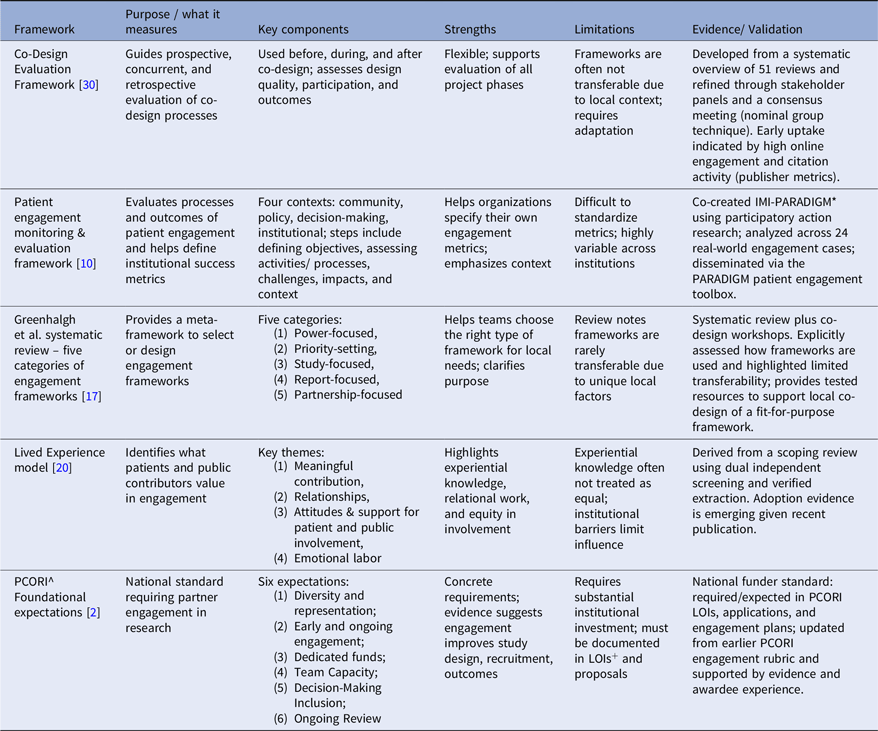
Table 1 summarizes a selection of frameworks to demonstrate the variety of ways to conceptualize patient and community engagement. Here we summarize three frameworks which inform our efforts, The Patient Engagement Monitoring and Evaluation (PEME) framework, the Co-Design Framework, and The Patient-Centered Outcomes Research Institute (PCORI). Two studies of note, that did not make our final mapping were, first, a mixed methods study that developed a framework for building bidirectional engagement [Reference Trapl, Koopman Gonzalez and Austin15]. They identified a variety of needs by engaging with scientists from across the cancer continuum [Reference Trapl, Koopman Gonzalez and Austin15]. Second, The Community-engaged research (CEnR) model combines the principles of community engagement and community-based participatory research [Reference Key, Furr-Holden and Lewis16]. They identified a broad continuum which allows researchers and organizations to identify their location and access points along the continuum, and make progress on the continuum [Reference Key, Furr-Holden and Lewis16].
Comparison of literature-identified frameworks for current mapping

Table 1. Long description
Table 1 summarizes a selection of frameworks to demonstrate the variety of ways to conceptualize patient and community engagement. Here we summarize three frameworks which inform our efforts, The Patient Engagement Monitoring and Evaluation (PEME) framework, the Co-Design Framework, and The Patient-Centered Outcomes Research Institute (PCORI). Notes: *Innovative Medicines Initiative (IMI) – Patients Active in Research and Dialogues for an Improved Generation of Medicines (IMI-PARADIGM) ^Patient-Centered Outcomes Research Institute (PCORI) +LOI = Letter of Intent
* Innovative Medicines Initiative (IMI) – Patients Active in Research and Dialogues for an Improved Generation of Medicines (IMI-PARADIGM).
^Patient-Centered Outcomes Research Institute (PCORI).
+LOI = Letter of Intent.
Patient Engagement Monitoring and Evaluation (PEME)
The PEME has four contexts to frame results, which are community, policy, decision-making, and institutional contexts [Reference Vat, Finlay and Robinson10]. PEME was developed to build and evaluate patient engagement and to define processes for successful engagement programs [Reference Vat, Finlay and Robinson10]. While it is difficult to define or standardize patient engagement metrics uniformly, their framework outlines a process by which organizations can define their own success and how they will measure it [Reference Vat, Finlay and Robinson10].
The Co-Design Framework
One systematic review looked at published frameworks and created The Co-Design Framework for picking or designing your own from existing frameworks [Reference Greenhalgh, Hinton and Finlay17]. Authors noted that developed frameworks are rarely transferable due to unique, local factors [Reference Greenhalgh, Hinton and Finlay17]. When developing a local framework, the co-design framework advised picking a category from the five main categories of frameworks they developed and adapting to local needs [Reference Greenhalgh, Hinton and Finlay17].
The Patient-Centered Outcomes Research Institute (PCORI)
Finally, a national standard produced by PCORI requires investigators to engage patients, clinicians, payers, and other stakeholders in the research process [2,Reference Forsythe, Carman and Szydlowski18]. Applicants for PCORI funding must demonstrate satisfactory engagement with patients and other partners in their Letter of Intent (LOI) and funding application [2]. The six foundational expectations are expanded below [2].
A review of trends noted that trials using PCORI’s evaluation framework to assess the long- and short-term impact of engagement had improved study research questions, design, processes, outcomes, and recruitment and retention in clinical studies [Reference Forsythe, Carman and Szydlowski18,Reference Faulkner, Somers, Boudes, Nafria and Robinson19].
The PCORI foundational expectations were chosen to evaluate KUCC‘s efforts at patient and public involvement in research [2]. While the CCSG guidelines mandate institutional COE, they lack a standardized operational blueprint. To address this gap, we adopted the PCORI framework [2]. PCORI provides a structurally rigorous, federally recognized standard that operationalizes bidirectional engagement [2]. By applying PCORI principles, we ensure that patient engagement metrics are standardized not only within population science outreach but across translational and clinical cancer trial design, shifting the institutional paradigm from research ‘on’ a catchment population to research conducted ‘in partnership with’ them [2].
KUCC COE structure
As an NCI-designated comprehensive cancer center, KUCC strives to provide public education and outreach programs on cancer prevention and screening, with a sharpened focus on the underserved and high-risk populations in our CA. The CA includes all of Kansas and 18 counties in Western Missouri [4].
-
KUCC Community Advisory Board (CAB): Provides cancer center strategic guidance on research and outreach approaches
-
Masonic Cancer Alliance (MCA): Extends clinical trials, health care provider education, and patient programming through a formal research and hospital network
-
MCA’s Partners Advisory Board (PAB): Leverages large research and hospital organizations to guide KUCC’s strategic plan to support NCI designation
-
Catchment Area Steering Committee (CASC): Reviews cancer-relevant CA data and guides overall COE activities, drawing on internal and external members including cancer center leaders, researchers, community members, and state health departments of Kansas and Missouri
-
Kansas Patients and Providers Engaged in Prevention Research (KPPEPR): Collaborates with KUCC on cancer-related outreach, prevention, and research efforts as a rural primary care practice-based research network
-
Patients and Investigator Voices Organizing Together (PIVOT): Engages patients and community members as research partners to better inform research priorities, design, implementation, analysis, and dissemination.
Mapping of KUCC COE patient and public involvement
The mapping evaluates KUCC patient and public involvement using the PCORI six foundational expectations (Figure 1 and Table 2) [Reference Mah, Dobson and Thomson20]. Within the broader context, the Cancer Center’s efforts to build a culture of involvement include input from our catchment-area communities, researchers, patients, and leadership. The overarching goals are to develop relationships and trust, ensure representativeness, and provide training and capacity-building [Reference Greenhalgh, Hinton and Finlay17] to enhance bi-directional communication between cancer center leaders, researchers, and those impacted by cancer.
PCORI expectations – example indicators.

Figure 1. Long description
Figure 1 is an image of PCORI Expectations and Example Indicators. Figure 1 enhances the mapping of KUCC COE Patient and Public Involvement.
Gaps, opportunities, and recommended next steps based on framework mapping

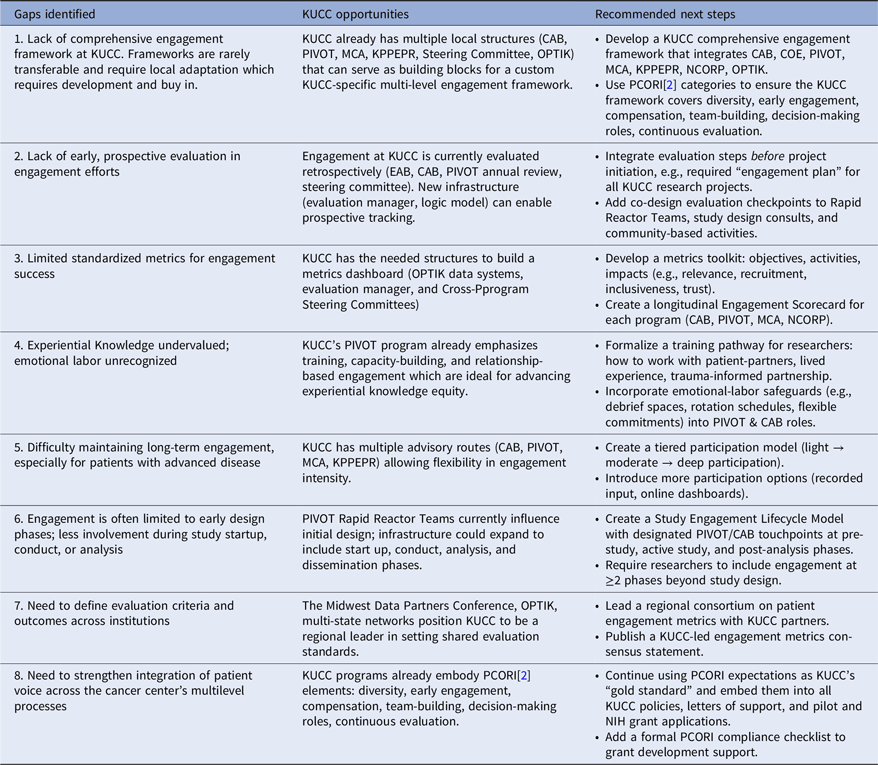
Table 2. Long description
Table 2 summarizes the mapping of KUCC patient and public involvement using the PCORI six foundational expectations. The overarching goals are to develop relationships and trust, ensure representativeness, and provide training and capacity-building to enhance bi-directional communication between cancer center leaders, researchers, and those impacted by cancer.
KUCC = The University of Kansas Cancer Center; CAB = Community Advisory Board; COE = Community Outreach and Engagement; PIVOT = Patient and Investigator Voices Organizing Together; MCA = Masonic Cancer Alliance; KPPEPR = Kansas Patients and Providers Engaged in Prevention Research; NCORP = NCI Community Oncology Research Program; OPTIK = Organize and Prioritize Trends to Inform KU Cancer Center. PCORI = Patient-Centered Outcomes Research Institute; EAB = External Advisory Board; NIH = National Institutes of Health.
Diversity and representation [2]
PCORI expects organizations to reflect the diversity of the populations they serve, with attention to race/ethnicity, geography (including rural/frontier), socioeconomic status, age, and lived cancer experiences.
The Cancer Center leverages multiple COE structures to center diverse voices: the CAB purposefully recruits across the CA and community organizations to address community priorities; the MCA extends reach into rural hospitals and clinics across Kansas and Western Missouri; KPPEPR (a rural practice based research network) brings primary care and rural patient perspectives; and PIVOT intentionally recruits survivors, co-survivors, and high risk individuals with diverse backgrounds and cancer experiences to advise study design via Rapid Reactor Teams (RRTs) [Reference Kimminau, Jernigan and Krebill21].
The Cancer Center falls short on engagement with patients across disease types with over representation of 46% breast cancer and 10% lymphoma versus 0% lung cancer and low percentages of others; skews female with 75% of engaged identifying as female; engagement above and beyond only receiving the newsletter which is 69% of people who sign up; long term retention of partners is challenging (average engaged participation is 1.2 years); KUCC lacks a center-wide, standardized representativeness assessment to track whether partners mirror catchment demographics over time; and partner inclusion outside COE led structures is variable across the institution.
Early and ongoing engagement [2]
Engagement with research should begin as early as topic identification, continue through question refinement, design, implementation, analysis, interpretation, and dissemination. Engagement should be transparent with bidirectional communication throughout.
CAB and the Catchment Area Steering Committee provide quarterly, structured input to leadership, shaping five-year priorities and near term actions; MCA gathers continuous feedback from community clinicians and patients via year round outreach and trial partnerships; PIVOT RRTs solicit patient perspectives at the pre-protocol phase; [Reference Kimminau, Jernigan and Krebill21] and the annual OPTIK reporting cycle brings data driven signals back to leadership, [Reference Mudaranthakam, Harlan-Williams and Jensen22,Reference Nye, Knight and Williams23] CAB, and the Catchment Area Steering Committee for iterative priority setting. Together, these mechanisms create recurring touchpoints across planning and early study development.
The Cancer Center’s patient engagement is strongest before protocols are finalized. For example, PIVOT RRTs are utilized for a small proportion of studies, and less consistently with no formal processes utilized during start up, conduct, analysis, manuscript drafting, and dissemination. Prospective engagement plans are not yet required center wide; and longitudinal tracking of partner involvement varies by program and study team.
Dedicated funds for engagement and partner compensation [2]
Institutions should budget explicitly for partner compensation, travel, childcare, technology support, capacity building, staff time, and infrastructure required to sustain engagement. Compensation should reflect the expertise and labor of engagement partners.
CCSG resources support COE infrastructure; CAB and PIVOT members are paid standardized hourly rates and mileage reimbursement; MCA NCORP funding increases representation and enables community-based research participation; and OPTIK partners are compensated for data contributions.
Several gaps exist in The Cancer Center’s current engagement infrastructure. No center-wide policy requires partner compensation across all studies, and compensation is not tracked or quantified. Budgeting for engagement in grant proposals is inconsistent and dependent on individual researchers. Dedicated resources for late-phase engagement, including analysis, dissemination, and multi-year participation, are not tracked or reported. Finally, supports such as childcare or technology stipends are not uniformly available, which can constrain equitable participation.
Build capacity to work as a team [2]
Teams need training, structures, and facilitation so patients, community partners, clinicians, and investigators can collaborate as equal contributors. Staff and administrative systems are needed to cover research literacy, role clarity, power sharing, communication, and conflict resolution.
The Cancer Center has developed several structures and initiatives to support team-based engagement. KUCC hosts annual External Advisory Board (EAB) reviews and strategic planning retreats, with CAB and PIVOT participation, to align goals and strengthen relationships. PIVOT delivers PIVOT Day, participates in KUCC Research Week, and hosts webinars, advocacy training, and leadership pathways for patient partners. COE has added an evaluation manager and research liaisons linking all Cancer Center Programs (CB, D3ET, CPC, and OMHC) to facilitate collaboration. The Midwest Data Partners Conference and COE trainings foster shared learning, and KUCC’s shared resources (e.g., Biostatistics & Informatics, Biospecimen, Nutrition) scaffold multidisciplinary teamwork. From December 2020 to November 2021, a patient engagement program for researchers was developed and deployed at KUCC [Reference Chen, Krebill and Kennedy24].
Despite these strengths, several gaps remain. The Cancer Center lacks a standardized training pathway for researchers on engagement best practices, such as power sharing, cultural humility, and trauma-informed partnership. In the future, these activities could be integrated into a researcher training module, with PIVOT serving as a key resource. Capacity building is not uniformly required across programs. Teams have variable support for long term collaboration, such as communication infrastructure, facilitation, and decision-making frameworks. Finally, had a one-year program for researchers [Reference Chen, Krebill and Kennedy24], and one currently funded researcher–patient mentorship model for new collaborators.
Meaningful inclusion of partners in decision making to ensure that decisions reflect the perspectives and experiences of multiple team members [2]
Partners should have real influence on institutional and study decisions, not merely consultative roles. Defined pathways should show how partner input shapes priorities, protocols, resource allocation, and dissemination. Transparency about decisions and shared power are essential.
The Cancer Center has established several mechanisms for meaningful partner inclusion in decision-making. Our community contributes to cancer center strategic planning and priority setting through our Community Advisory Board. The Catchment Area Steering Committee blends community, clinical, and leadership voices with OPTIK data to guide decisions. PIVOT meaningfully shapes study design and program direction via RRTs and its leadership team. The MCA represents community hospitals and oncologists in decisions about trial access and outreach.
Despite these strengths, several gaps remain. Decision-making inclusion is uneven across programs outside COE structures. Partner influence during later research phases, including implementation, amendments, analysis/interpretation, manuscripts, dissemination, is neither required nor tracked in any formalized way. Study-level roles and documentation of how input shaped decisions are not standardized. Finally, structural barriers such as health status, caregiving responsibilities, and rural access can dilute whose voices are consistently present.
Ongoing review and assessment of engagement [2]
Institutions should routinely evaluate engagement quality and impact using qualitative and quantitative methods, at project and institutional levels, share findings with partners, and implement changes based on what is learned. Prospective, planned evaluation is preferred over ad hoc or retrospective reviews alone.
The Cancer Center has developed several structures to support ongoing review and assessment of engagement. The annual EAB provides rigorous external review, with findings evaluated and shared with our CAB and the Catchment Area Steering Committee. CAB and the Steering Committee meet quarterly to assess progress and needs. The COE hired an evaluation manager and developed a logic model to formalize assessment. The evaluation manager facilitated a formal, long-term strategic planning process for both CAB and PIVOT. PIVOT conducts annual planning and evaluation of RRTs, webinars, and training. OPTIK’s annual report supplies longitudinal catchment data for leadership, CAB, and the Catchment Area Steering Committee. Finally, the Cancer Center disseminates outcomes via national conferences and institutional channels to support transparency and accountability.
Despite these strengths, there are opportunities for improvement. Evaluations remain program-specific rather than integrated into a center-wide engagement framework, with no formalized process for tracking activities across the center. Prospective evaluation plans are not yet required for all projects. The Cancer Center lacks a standardized dashboard or scorecard to track how partner input is used and its impact on study outcomes. Long-term effects of engagement are not consistently measured. Finally, partner experience, including emotional labor and relationship quality, is not uniformly assessed or co-designed with partners.
Discussion
The results of this mapping show that patients are shaping our research at both the institutional and individual researcher levels. The Cancer Center is disseminating patient engagement practices through publications, presentations, and regional collaborations [Reference Kimminau, Jernigan and Krebill21,Reference Chen, Krebill and Kennedy24–Reference Lambart, Krebill, Lee and Chen28]. Researchers and advocates report that patient engagement strengthens research and enhances researchers’ sense of purpose. By bridging the gap between researchers and patients, patient advocacy enhances the relevance of scientific findings and fosters a patient-centered approach that benefits patients, caregivers, advocates, researchers, and the institution.
A synthesis of existing research emphasizes the need to move beyond descriptive studies within individual organizations to advance patient engagement [Reference Vanstone, Canfield and Evans29]. The authors advocate for broader mapping of impacts, outcomes, and best practices across multiple organizations [Reference Vanstone, Canfield and Evans29]. While numerous studies examine individual efforts, there is still a need to define evaluation criteria and identify key outcomes [Reference Peters, Guccione and Francis30]. Future program development could incorporate metrics from the Patient Engagement Monitoring and Evaluation (PEME) [Reference Vat, Finlay and Robinson10], the Co-Design [Reference Greenhalgh, Hinton and Finlay17], and the PCORI [2] frameworks. These frameworks outline steps such as defining engagement objectives, identifying activities and processes, defining power sharing, partnership structure, team building, capturing learnings and challenges, measuring impacts, and considering context, which would guide engagement efforts at every level of the cancer center [Reference Vat, Finlay and Robinson10]. Applying a multi-layer framework will advance patient/community engagement and grow our engagement efforts towards a multicenter engagement.
Although models and projects exist, there is a lack of synthesized work on patient engagement that addresses impacts, enabling factors, outcomes of patient partnerships in healthcare, and a standard set of metrics or models [Reference Vanstone, Canfield and Evans29,Reference Peters, Guccione and Francis30]. Future opportunities include engaging patient advocates across the research continuum, from agenda setting and study design through recruitment, analysis, and dissemination [Reference Hoos, Anderson and Boutin7].
This study highlights the need for a clear definition or conceptualization of patient and community engagement [Reference Vanstone, Canfield and Evans29]. Currently, the field lacks distinction between patients engaged in short-term, one-way interactions and those involved in integrated, longitudinal partnerships that influence decision-making [Reference Vanstone, Canfield and Evans29]. Engagement often focuses on individual patients or advocacy groups, without broadly including healthcare facilities, physicians, and staff serving cancer center communities.
For research trials, integrated contributions are often limited to one-off RRT participation in the study development phase. Moving towards more frequent, long-term partnership models across all phases of trials is needed.
While COE has been on a multi-year endeavor to increase patient, researcher, and community involvement, efforts were largely program-driven. Future increases in impact will require thoughtful design to integrate involvement at all levels of the cancer research continuum.
A key limitation is the narrative design, which lacks the systematic search, screening, and quality appraisal processes characteristic of systematic reviews and may therefore have missed relevant studies. Additionally, the search strategy focused on patient engagement terminology and did not explicitly include broader concepts such as community outreach, community engagement, or related participatory approaches. Consequently, relevant frameworks and models described outside the patient engagement literature may not have been identified. Future systematic reviews using a broader range of engagement-related terms are warranted to capture the full spectrum of available models.
Conclusions
The Cancer Center is working to engage researchers, patients, and the community in research to advance scientific discovery, increase patient satisfaction, and improve cancer prevention, care, and survivorship. This framework mapping reveals both meaningful progress and clear opportunities for growth. Based on this and other work, KUCC is seeking to expand programming to a multi-level patient, researcher, and community engagement framework that advances scientific discovery and improves outcomes across the cancer care continuum which can serve as a model for other cancer centers to follow.
Author contributions
Leah Lambart: Conceptualization, Data curation, Formal analysis, Investigation, Methodology, Project administration, Writing - original draft, Writing - review & editing; Hope Krebill: Conceptualization, Data curation, Resources, Writing - review & editing; Jill Hamilton-Reeves: Conceptualization, Formal analysis, Project administration, Supervision, Writing – review & editing; Cheryl Jernigan: Writing - review & editing; Tony Carter: Writing - review & editing; Roy Jensen: Resources, Writing - review & editing; Karla Van Goethem: Conceptualization, Data curation, Writing - review & editing; Susan Beckman: Conceptualization, Writing - review & editing; Dinesh Pal Mudaranthakam: Conceptualization, Data curation, Resources, Supervision, Writing - review & editing; Ronald C. Chen: Conceptualization, Data curation, Resources, Supervision, Writing - review & editing.
Funding statement
Funding: Research reported in this publication was supported by the National Cancer Institute under award number 5P30CA168524.
Competing interests
The authors declare none.


 Open access

