More than two centuries ago in England, the newly renamed Richard set sail,Footnote 2 the ship’s fresh coat of paint attempting to efface the memories associated with an incident and case whose notoriety had perhaps just begun to fade from the public’s recollection. Today, the Richard is better known as the Zong, a mistranscription of the Dutch word zorg meaning care;Footnote 3 and the irony underlying the initial naming has been made keener by recent revelations about the facts regarding what is now described as the Zong massacre. James Walvin pronounces the Zong case, an insurance lawsuit stemming from the mass murder, “[t]he most grotesquely bizarre of all slave cases heard in an English court.”Footnote 4 The litigation originated from the 1781 incident in which the crew of an English slave ship bound for Jamaica willfully “destroyed” more than one-third of the “cargo” aboard the vessel—approximately 132 of 442 slaves—by jettisoning them as the ship belatedly approached its port of call, citing necessity to justify their perfidious actions. The massacre may have remained submerged in history because of the mere loss of “cargo,” but it is infamous today because the ship’s owners had the temerity to invoke maritime law in suing for the monetary value of the slain slaves. After a jury ordered the insurers to compensate the ship’s owners, the insurers appealed the jury’s verdict, culminating in the reported decision of Gregson v. Gilbert, the formal title for the Zong case. The case’s very name, legal shorthand for the litigating parties, expunges the victims’ lives from the official record. Even the opinions composed by the judges, who sanctioned a new trial, effectively perpetuated the dehumanization of the drowned slaves.
While the judges and barristers locked themselves within the rigid discourse of the law in evaluating the case’s merits, Marlene NourbeSe Philip, writing more than two hundred years after the 1783 decision, unlocks the legal language in her elegiac counter-narrative, paradoxically telling a “story that cannot be told yet must be told, but only through its un-telling.”Footnote 5 Philip, a lawyer and poet who was born in the Caribbean, but currently resides in Canada, limits herself to the words included in the brief official narrative for her nearly two-hundred-page text. Zong! seeks to humanize slaves like the ones from whom many Caribbeans have descended through the very language earlier used to divest enslaved peoples of their humanity. Moreover, for Philip, as for many others, the Zong case signifies not only the past brutality of the transatlantic slave trade, but the long history of injustices inflicted on Africans by the West.Footnote 6 As Ian Baucom writes in Specters of the Atlantic, “time . . . does not pass, it accumulates,” with “the Atlantic slave trade as a (perhaps the) foundational event in the history of modernity,”Footnote 7 the original middle passage functioning as a “middle-passage into an experience of global modernity.”Footnote 8 Echoing Baucom, Philip has asserted that “the slave ship was a globalized world, a multilingual globalized prison on the seas that was a part of the first globalization,”Footnote 9 the proto-globalization to which contemporary globalization is heavily indebted.
Published a year after the bicentenary commemoration of the English slave trade’s abolition in 1807, Philip’s subversive poetry cycle revivifies history and implicitly questions whether such celebrations inordinately laud the purported liberators or appropriately honor the victims and acknowledge colonialism’s baleful legacy. Yet Zong! seems to admit that such an accounting may remain impossible because of the paucity of the official record. In imaginatively reconstructing the lives of slaves and crew members on the Zong, Philip underscores the lacunae in the foundational text from which her book is composed. Zong!’s contradictory relationship with language—using the diction of Gregson v. Gilbert to assail the amoral, if not immoral, then-mainstream views espoused in the document—further attests to Philip’s vexed relationship with English, indicating that complete cultural autonomy may be impossible for the progeny of slaves living in the New World. However, even while Zong! suggests the inevitability of cultural compromise and unrepresentability of slavery’s horrors in the linguistic framework English colonizers imposed upon people of African heritage, Philip staunchly refuses to concede defeat. She adapts and at times explodes the English language in her formally and substantively audacious poetry collection recasting the Zong atrocity, a book that has been analyzed for its interaction with historical depictions of the incident, trauma theory, and reader-response criticism, as well as for its use of poetic techniques, including voice and the catalogue form.Footnote 10
In this article’s following sections, I glean insight from these approaches but apply a methodology drawn from law and literature scholarship to probe Philip’s text, concentrating on the complex interplay between Zong! and its source, the appellate record in Gregson v. Gilbert. By comparing and contrasting the rhetorical and generic conventions in the two texts, I reveal how Philip approximates the trauma of slavery from an account that avowedly refused to do so and hence crafts a profound elegy for the victims of one of history’s grimmest tragedies—men, women, and children whose lives were sacrificed—alongside those of many other slaves, as the price for European and American capitalism to thrive. After situating the Zong massacre in the context of the flourishing English slave trade of the eighteenth century, my article scrutinizes the carnage’s afterlife in nonfictional and fictional texts, first focusing on the attorneys’ arguments and the appellate judges’ opinions in the Zong case. The Gregson v. Gilbert appellate case report’s evidently logical form and language resist honoring the deceased slaves, who are largely characterized there in terms of disembodied collectivities. Zong! blithely evades such formal and verbal constraints, however, deploying yet critiquing elegy conventions to deconstruct historical legal discourse about slavery and linguistically reconstruct the drowned slaves’ humanity. Philip draws on the lamentation tradition affiliated with women’s mourning to voice the nearly inarticulable, enduring pain arising from the grave loss of her potential ancestors while ruing the moral defilation of all implicated in the massacre. A coda on the contemporary significance of the case and Philip’s book demonstrates how the Zong’s apparitions linger in the present, testifying that language’s complicity with violence is an association elided at our peril.
A Capsule History of the English Slave Trade and the Events Leading to the Zong MassacreFootnote 11
Historians estimate that 12.2 million Africans were loaded on European slave ships in the three and a half centuries before the practice ceased in 1866 and that 13 percent perished during the so-called middle passage, the second leg of the triangular route slave ships followed from Europe to Africa, Africa to the Americas, and the Americas to Europe.Footnote 12 Although the Spanish and Portuguese controlled the European slave trade at its inception in the sixteenth century, the English had entered the market in earnest by the following century. By 1781, the year when the Zong set sail from Cape Coast to Jamaica, Britain had become “the world’s most prolific slave trading nation”; Liverpool, where the syndicate that owned the Zong was based, boasted the Atlantic world’s busiest slave port.Footnote 13 Moral concerns were subordinated to economic ones as commercial opportunities in the New World beckoned English entrepreneurs, and to declare that conditions aboard slave ships appall the conscience today is to understate the magnitude of the depravity that reigned there. Slave ships were paradigmatic “contact zones,”Footnote 14 and Walvin describes how “[o]ppressors and oppressed were inextricably linked in an infernal system” that could degenerate to “a cross between a neglected stable and a slaughterhouse” after storms and could be characterized as a “floating prison” otherwise.Footnote 15 European crew members on vessels like the Zong feared captives, who vastly outnumbered them (probably nineteen crew members including the captain and maybe the first mate on the Zong Footnote 16 to 440 slavesFootnote 17 ); and the crew often manacled slave men and raped slave women. Not only did slaves receive minimal nourishment from cauldrons, but because they were fed communally, forced to discharge feces where they lay, and packed in to maximize profit, diseases spread rapidly in the ship’s hold and frequently developed into epidemics inflicting mass fatalities.Footnote 18
Walvin argues that institutionalized rather than personal brutality fostered this culture of willful neglect and violence, and the slave trade was indeed a vital component of an intricate commercial system that the William Gregson syndicate reaped immense revenues from. The Zong was just one of 152 slave ships Gregson and his colleagues had a stake in,Footnote 19 part of a lucrative business that imploded with the English slave trade’s abolition, perhaps leading to the demise of the bank Gregson had cofounded and the suicide of his son, former Liverpool mayor John Gregson, in 1807.Footnote 20 Yet more than a quarter of a century before their precipitous downfall, the Gregsons were members of a burgeoning English metropolis’s elite, having purchased the Zong following its impoundment off the African coast. A series of mishaps soon thereafter evidently resulted in the calamities killing more than half the slaves originally on the ship: an overloading of the vessel; an inept and ill captain, Luke Collingwood, who suspended first mate James Kelsall and relinquished command to an equally incompetent former colonial governor, Robert Stubbs; and, most crucially, insufficient provisions—food and water—for those aboard once the Zong overshot Jamaica.Footnote 21
Although, to quote Walvin, “it is impossible to be confident about what was happening on board the Zong in the last days of November 1781,”Footnote 22 the crew seemed to unanimously agree to mass murder the ship’s slaves over three nights. They first tossed fifty-four women and children, who would be less monetarily valuable,Footnote 23 from cabin windows; then threw forty-two men overboard from the quarterdeck; and finally drowned a group of thirty-six slaves.Footnote 24 One of those jettisoned by the crew survived,Footnote 25 but ten more captives plunged into the sea of their own volitionFootnote 26 after perhaps hearing their compatriots’ pleas for mercy callously dismissed. The crew would endeavor to eschew culpability for their conduct in subsequent litigation by citing the general average sacrifice principle, that is, sacrificing the few to save the many.Footnote 27 They were, however, likely aware that their “cargo” had been insured for thirty pounds a head in what was then a routine transaction to allocate risks, particularly of insurrections and inclement weather, before a hazardous venture.Footnote 28 The Zong massacre, then, only dramatically exposed the perverse consequences of a “perfectly prudent commercial ‘safety net.’ ”Footnote 29 The crew’s exact motives, utilitarian, venal, or both, may remain immured in history, but their premeditated murders of innocent slaves undoubtedly catalyzed the abolitionist movement in England and generated a panoply of provocative nonfictional and fictional texts dating from the late eighteenth century to the present day with Zong!.
The Zong Tragedy’s Afterlife in Legal and Other Discourses
Referencing Barnor Hesse’s essay “Forgotten Like a Bad Dream: Atlantic Slavery and the Ethics of Postcolonial Memory,” Anita Rupprecht writes that “any historical narrative accounting for the facts of history cannot be easily separated from the factors underlining the form that the historical account takes.”Footnote 30 An attunement to the forms in which early historical renditions of the Zong atrocity were composed discloses divergent perspectives toward what transpired on board the ship before it arrived in Jamaica with 420 gallons of water to spare.Footnote 31 A local newspaper at the time reported that the vessel had entered the port “in great distress” after jettisoning some 130 slaves; a subsequent advertisement offered the survivors, who were purchased for thirty-six pounds each on average, for sale.Footnote 32 Three months later, a London newspaper merely stated: “The following ships from Africa are arrived at Jamaica viz Zong, Collingwood, with 208 ditto [slaves].”Footnote 33 These relatively meager accounts would prove inadequate to satiate the public frenzy for details that ensued when the Gregson syndicate filed a lawsuit against the Zong’s insurers in 1783, seeking to recover the monetary value of the slaves cast off the ship more than a year earlier.
Although the preliminary press reports of the Zong catastrophe and later legal narratives stemming from the incident differed in the depth of their depictions, both fixated on numbers, quantifying the slaves who were then commercially and legally regarded as property, “black ivory,” to quote the title to one of Walvin’s monographs about the transatlantic slave trade.Footnote 34 Paradoxically, even as disclosures about the law’s substance increasingly dismayed the British public, the legal process of a trial and appeal was the means through which slavery’s treachery, papered over in this instance by a façade of technical language, was bared. In legal terms, Gregson v. Gilbert was framed as a dispute over a clause in an insurance contract, not a sweeping challenge to the legality of slavery or a criminal prosecution for murder. These two legal actions could have threatened to undermine highly profitable enterprises buttressed by principles enshrined in English commercial law by the nation’s highest-ranking judge, Lord Chief Justice Mansfield.Footnote 35
No official records of the day-long civil Zong trial are extant, and of those aboard, only a passenger—the unreliable Robert Stubbs—was called to testify, with first mate James Kelsall providing a written account. The surviving slaves were overseas and obviously unavailable, even assuming their testimony would have been found credible. Crucially, the ship’s log, in which Kelsall should have been recording the Zong’s daily happenings, had disappeared by this time.Footnote 36 A recently discovered sworn answer given by Kelsall after the case’s appeal reveals evidentiary discrepancies and recounts a disturbing exchange between Kelsall and one of the drowned slaves who spoke English, a few dozen words from a man who pleaded with futility for life on behalf of all the Zong’s slaves and promised to forego food or water for the duration of the journey, preferring starvation to drowning.Footnote 37 Based on the scant evidence presented, though, a jury of the Gregsons’ peers ordered the insurers to compensate the syndicate for what was deemed destroyed cargo, a verdict expeditiously appealed to England’s highest court. Then, as today, appellate courts considered not only the impact of their rulings on the immediate parties, but the wider ramifications of their decisions.Footnote 38 The procedural posture of a given case could thus give rise to the potential for conflict between justice on different scales and reveal the limits of law in satisfactorily rectifying injustices.
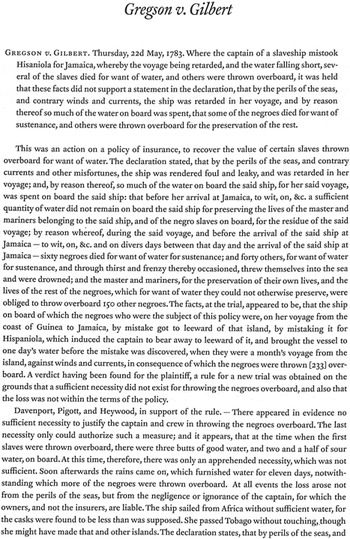
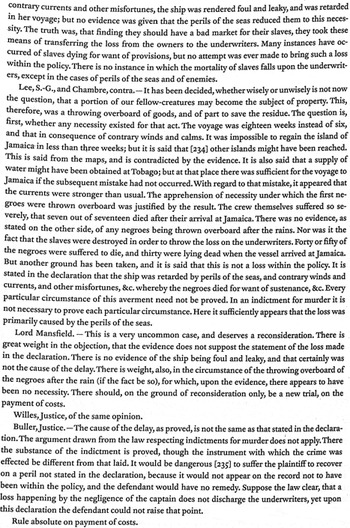
After a two-day hearing whose transcript remains, a Mansfield-led panel of judges on the Court of King’s Bench ruled that because the plaintiff—the Gregson syndicate was never explicitly named in the case report—had failed to present sufficient evidence to support the pleadings, a new trial was mandated. Interestingly, the formal record of the proceedings in Gregson v. Gilbert was published almost half a century after the case was decided and was based on shorthand notes, varying on occasion from earlier unofficial accounts.Footnote 39 As Veronica Austen observes, Philip’s source text is “a summary that is inherently a mere distillation of the trial and the trial a mere distillation of the event,” the distancing removing the aura of facticity from the official legal narrative of the massacre.Footnote 40 Given Zong!’s exclusive reliance on this document, my article will next scrutinize each of the report’s parts, which are reproduced in the appendix—the appellate and procedural summaries, a description of the lawyers’ arguments, and the judicial opinions.Footnote 41
Following a synopsis of the appellate decision, the report begins by crystallizing the issue, a common convention in legal opinions even today, transforming what is fundamentally a profound moral issue in the Zong litigation, what Zong! probes, into a seemingly simple legal one—“This was an action on a policy of insurance to recover the value of certain slaves thrown overboard for want of water.” The gist of the Gregson syndicate’s declaration is then reproduced; and three salient characteristics of the pleading, as stated here, include its emphasis on rationality, its linguistic entrenchment of racial hierarchies, and its omission of significant details. The phrases “by reason thereof” and “by reason whereof” suggest that one event logically, if unfortunately, led to another aboard the ship, culminating in the deaths of hundreds of slaves. The general average sacrifice principle is cited to justify the drownings in a sentence that values slave lives en masse only after those of the white captain and crew—“the master and mariners, for the preservation of their own lives, and the lives of the rest of the negroes . . . were obliged to throw overboard 150 other negroes.” Particularities about the atrocity—such as the killing spree occurring under the cover of night over three days, with the most vulnerable slaves (women and children) jettisoned first—are tellingly absent. This section of the text ends by framing the court’s holding on appeal, its resolution of the legal issue: “a sufficient necessity did not exist for throwing the negroes overboard” and “the loss was not within the terms of the policy.” Although the Zong’s policy has vanished into the ether, it was probably a standard maritime insurance contract providing coverage for losses arising from “perils of the seas.”Footnote 42 In Specters of the Atlantic, Baucom quotes a contemporaneous insurance law treatise that established a three-part test for invoking the necessity justification to obtain compensation for the disposal of cargo:
That what was so condemned to destruction, was in consequence of a deliberate and voluntary consultation, held been the master and men: —2dly. That the ship was in distress, and the sacrificing the things they did was a necessary procedure to save the rest: —and 3dly. That the saving of the ship and the cargo was actually owing to the means with that sole view.Footnote 43
Attorneys for each party vociferously disagreed about whether sufficient legal necessity—as distinguished from ethical necessity, notes BaucomFootnote 44 —existed. Lawyers for the insurers parsed the term necessity, distinguishing between “the last necessity” and “apprehended necessity.” Only the latter could justify the drownings, in their estimation, and they contended that insufficient evidence was presented at trial to establish absolute necessity. They also argued that the negligence or ignorance of the captain was a risk that was allocated to the Gregson syndicate, which they accused of insidiously trying to transfer losses from “a bad market” for slaves to the insurers. Concluding that no legal precedent supported an award for the plaintiff, the lawyers unintentionally demonstrated that another troubling precedent did exist—recovery for slave mortality arising from “perils of the seas and of enemies.”
Attorneys for the Gregson syndicate sought to refute each of these assertions, particularly the imputation of a mercenary motive for the crew’s actions, but what is of greater interest is their statement of the case, which dismissed the essential moral issue at the outset—“It has been decided, whether wisely or unwisely is not the question, that a portion of our fellow-creatures may become the subject of property. This, therefore, was a throwing overboard of goods, and of part to save the residue.” The lawyers evoked sympathy for the crew, who “suffered so severely, that seven out of seventeen died after their arrival in Jamaica.” They also suggested circumstances beyond the crew’s control led to the calamity on board the Zong, with “the apprehension of necessity under which the first negroes were thrown overboard” being “justified by the result.” Bizarrely, the lawyers for the Gregson group referenced the proverbial elephant in the room—the issue of murder—by analogizing their case to a murder indictment not requiring proof “of each circumstance.” Here, they averred in seeking to have the court construe the law flexibly, the loss being primarily, even if not completely, attributable to the perils of the seas was sufficient for recovery.
After considering each side’s arguments, Mansfield rendered his decision, euphemistically calling Gregson v. Gilbert “a very uncommon case”Footnote 45 and emphasizing the insufficient evidence demonstrating necessity. Justice Buller concurred in his separate opinion, underscoring the unfairness of permitting the Gregson syndicate to recover on a basis not stated in the business’s declaration, an outcome that would engender legal instability and upset the delicate allocation of risk the nation’s economy relied upon. Buller also rejected the argument advanced by the Gregson syndicate’s attorneys comparing the laws applying to their case and the liberal rules governing murder indictments.
Despite the judges’ and attorneys’ dissimilar rationales for their positions, their reported remarks share some linguistic and substantive qualities that the article’s following sections will maintain Philip’s text subverts. Overall, the legal accounts notably use abstract, euphemistic, circuitous, and jargon-laden rhetoric. For example, none of the primary actors, such as the captain or crew members, is named, nor are any of the slaves, who are described in terms of numbers or other collectivities (“certain slaves”). Disembodied actors undertake vague actions—throwing the slaves overboard is said to be “such a measure” by the plaintiff’s attorneys. Moreover, blame for the massacre is couched by all in the most anodyne language—a mistake, negligence, or ignorance, as opposed to premeditated murder. The court’s decision apparently turns on a technical legal issue, but the true fulcrum of the case is the judges’ calculation of risk to preserve a complex commercial regime. This approach to the litigation is wholly oblivious to the interests of the slaves on board the Zong but consistent with a high court’s expansive social, political, and economic perspectives at the time. At the appellate hearing, Mansfield had disclosed his commercial allegiances in the words posterity may best remember him for: “The matter left to the jury, was whether it was from necessity: for they had no doubt (though it shocks one very much) that the case of slaves was the same as if horses had been thrown overboard. It is a very shocking case.”Footnote 46 The judges’ failure to compellingly rationalize a decision that mortifies the mind—that is, the holding that an insurance policy may require compensation for the massacre of blameless slaves—is inadvertently demonstrated through Justice Buller’s apparently becoming tangled in his own wording, as in this sentence containing a string of multiple negatives occluding meaning: “It would be dangerous to suffer the plaintiff to recover on a peril not stated in the declaration, because it would not appear on the record not to have been within the policy, and the defendant would have no remedy.”
Abolitionist Granville Sharp, who attended the appellate proceedings and is said to have given “form to the facts insofar as they were first made public,” offering “the first interpretive representation of the Zong in relation to which subsequent re-narrations need to be read,”Footnote 47 siphoned his outrage at the court’s decision into a passionate manuscript unsuccessfully demanding that the crew face murder charges.Footnote 48 Yet even while Sharp’s tireless efforts to secure justice are to be commended, Anita Rupprecht’s argument that Sharp and his fellow abolitionists had their own property interest in slaves—in Baucom’s terms, as “affective property,”Footnote 49 “generalized innocent victims” amenable to sentimental representations—also has force.Footnote 50 The Zong’s appropriation as “a kind of open space for the inscription of abolitionist fantasies,”Footnote 51 with the central signifier (the dead slaves) being absent, may be less morally vexing than judicial decisions classifying slaves as goods under contract or property law. Nonetheless, abolitionist tracts in the Zong’s aftermath that deflected scenes of anguish through authoritative white eyewitness accounts and portrayed a stark binary between rapacious enslavers and their captives problematically consecrated white liberators and reduced “African cultural autonomy or personal agency . . . to the indescribable emotional suffering of the survivors.”Footnote 52 As Philip rhetorically asked in an interview with Patricia Saunders about Zong!, commenting on her discomfort with the idea of emancipation, what “we are, in fact commemorating you realize that it has more to do with Europeans finally understanding and accepting what we, African people, knew all along, that we are first and last Beings, and that we cannot be turned into things?”Footnote 53 Philip’s poetry cycle is one of numerous recently published fictional and nonfictional texts striving to depict the Zong massacre with integrity, reverencing without propagandizing the victims through their carefully calibrated delineations of the incident.Footnote 54 These contemporary authors’ accounts enable the perpetrators of the massacre who escaped with impunity from the courtroomFootnote 55 to be linguistically convicted in absentia while mourning those whose lives have long gone unremarked by history.
Zong!’s Formally Iconoclastic Revisioning of History
Even before Zong!, her most formally innovative text, was published, Philip’s writings embodied her philosophy that “the form of a work is of particular importance . . . and often the form of work is as much the substance of it as the content is.”Footnote 56 Zong! seeks to challenge “western, logical, linear” ways of readingFootnote 57 and fundamentally thinking, which Philip believes have been complicit in the subjugation of Africans and their descendants in the New World.Footnote 58 In Zong!’s “Notanda,” or afterword, Philip writes that “I deeply distrust this tool I work with—language. It is a distrust rooted in certain historical events that are all of a piece with the events that took place on the Zong. The language in which those events took place promulgated the nonbeing of African people, and I distrust its order, which hides its disorder; its logic hiding the illogic and its rationality, which is simultaneously irrational.”Footnote 59 Philip has elsewhere expressed that English is a language she is psychically exiled from and must doubly translate. She conceives that every writer must translate, even in his or her mother tongue, and that she has to translate from a language she recognizes “at some subterranean level” not to be her own.Footnote 60
Yet even while the compositional history of Zong!, which took Philip seven years to write, captures instances when despair stemming from her distraught relationship with English engulfs her,Footnote 61 these moments are counterbalanced by epiphanies when the code she is writing in becomes her own language.Footnote 62 Philip initially experienced guilt at fragmenting words, breaking-and-entering the language of the Zong case report, which she endeavored to lock herself within “in the same way men, women, and children were locked in the holds of the slave ship Zong.”Footnote 63 However, she ultimately celebrated her linguistic breakthrough of devising a “dictionary” listing “‘mother’ words followed by the words contained within that particular word,”Footnote 64 encrypting the text through a method that evokes Édouard Glissant’s theory about the development of Creole languages. Such languages were initially “a mode of communicating and sending messages at various levels that couldn’t be understood by the white colonizers,” to quote Kristin Mahlis’s synopsis of her interview with Philip.Footnote 65 Barbadian poet Kamau Brathwaite, in seeking to develop a “nation language” including West Indian Creole, has also emphasized orality and “use[d] non-Standard English idioms, sounds, and syncopations” to “reclaim linguistic elements that survived the Middle Passage” while “transformative[ly] appropriati[ng] . . . the master’s tools.”Footnote 66 Zong! reflects Philip’s deft manipulation of the ostensibly rational terms of a sordid case report; she inverts grammar and freely mangles the official language to reveal the irrationality underlying Gregson v. Gilbert and the perniciousness of the power structures, corporate, judicial, and otherwise, that would sustain British colonialism for almost two hundred years after the case was decided. Consequently, although Philip argues that the language she employs is “already contaminated, possibly irrevocably and fatally,”Footnote 67 her anti-narrative text’s overall structure and micro-level formal techniques suggest that language also paradoxically offers a potent method of resistance to hegemonic narratives that have historically facilitated oppression.Footnote 68
In writing Zong!, Philip struggled against what she has described as the instinctive human desire to impose meaning, “the generating impulse of, and towards, language.”Footnote 69 Zong!’s form manifests this discomfort,Footnote 70 starting with the book’s organization. After an acknowledgments section that only generally references the Zong massacre, “Os,” the first section of the poetry cycle, begins. Divided into twenty-six numbered poems containing embedded poemsFootnote 71 and a subsection entitled “Dicta” with several unnumbered poems, this section adheres closest to its originary text and is Zong!’s most conventionally poetic.Footnote 72 “Os” is followed by four sections, “Sal,” “Ventus,” “Ratio,” and “Ferrum,” featuring ever-longer poems that progressively disorient the reader, as opposed to narrative texts that build toward a resolution, such as the Gregson v. Gilbert appellate report ending with a succinct recitation of the judges’ decision. “Ferrum,” the section that may most perplex readers who approach Zong! with their standard toolkit of analytical techniques, is the one in which Philip felt that she had come closest to reproducing her aesthetic vision in language.Footnote 73 The book’s next and final poetic section, “Ebora,” with its grayed wording, increasingly congested spacing, and terms layered atop one another, represents the quintessential antinarrative, “a space not so much of non-meaning as anti-meaning,” to quote from “Notanda.”Footnote 74
Zong!’s very section titles may mystify readers unfamiliar with Yoruba and Latin (the “father tongue” whose terms still pervade English and American lawFootnote 75 ), leading some perceptive ones to the glossary of words and phrases heard on board the Zong. This section following “Ebora” reveals that os, sal, ventus, ratio, ferrum, and ebora respectively mean bone, salt, wind, reason or legal rationale, iron, and underwater spirits (in Yoruba). Philip conceives that the “Os” poems fragmenting Gregson v. Gilbert’s text are the “bones” of Zong! whereas the book’s four subsequent sections enflesh the “bones.”Footnote 76 Her description indicates the dual formal and substantive significance of the text’s terminology, with bones also referring to the literally unrecoverable remains of the dead slaves figuratively reclaimed by Zong!, salt referencing a key mineral to sustain human life, wind identifying the factor that apparently precipitated the massacre, reason ironically alluding to the Zong case record, and iron evoking the fetters slaves wore that Zong! seeks to rupture; “Ebora” then liberates the spirit of the slaves from the manacles that once restrained them to close the elegiac poetry collection. Closure may be an inapt term to describe how the reader experiences the text, however, because “Notanda,” in which Philip discusses the theoretical basis for her project, and the reproduced appellate report of Gregson v. Gilbert that ends the book, intimate that Zong! is a cyclical text that necessitates rereading. Traditional readers who perused the text linearly from beginning to end and so only discovered Philip’s code, her mode of deconstructing the official legal report, after finishing the book may be especially inclined to reread the work. Although giving the final word of Zong! to the judges and attorneys involved in the Zong litigation may appear incongruous with Philip’s intent to attack the legal system that conspired with English politicians and entrepreneurs to propagate slavery and other repressive regimes overseas, the book’s organization also reflects the reality “that there is no ‘outside the law,’ since it frames the social and political structures in which we exist.”Footnote 77 Formally mounting a convincing challenge to the basis for these structures through Zong!’s prior two hundred plus pages, though, can be seen as a significant victory.
Within each of Zong!’s sections, Philip utilizes a multitude of formal techniques to destabilize the reader, who wrestles “ ‘to make sense’ of an event that eludes understanding, perhaps permanently,” for Philip.Footnote 78 Sina Queyras’s unease that she was not the right reader for the book may express a sentiment felt by many readers approaching Zong! for the first, or even second or third plus, time.Footnote 79 Much of this disquietude may derive from the poetry cycle’s convoluted optics, its application of Philip’s theory that language is paint she daubs on a canvas,Footnote 80 recalling the fusion between modernist and post-modern poetry and other aesthetic forms. The visuality of Zong! resembles the fin de siècle aesthetics of French Symbolist poet Stéphane Mallarmé, whose experimentation with free verse included typographical innovations in poems like Un Coup de Dés Jamais N’Abolira Le Hasard (A Throw of the Dice Will Never Abolish Chance) (1897).Footnote 81 Although Western readers are trained to read standard narrative texts like Gregson v. Gilbert horizontally, tracing lines that meticulously fill the page, most of the poems in Zong! are fragmented and teeming with fissures, as opposed to words.
This approach, suitable for an elegiac work in which facts about the central figures’ lives are absent from the historical record, may initially perturb readers, but it also stimulates their creativityFootnote 82 to construe not only the language but the visual dimension of Philip’s text. Paradoxically, silence (e.g., in the form of visual lacunae) in Zong! “speaks” more powerfully than language itself. As Philip writes in “Notanda,” “within each silence is the poem, which is revealed only when the text is fragmented and mutilated, mirroring the fragmentation and mutilation that slavery perpetrated on Africans, their customs and ways of life.”Footnote 83 Zong! continues exploring the aesthetic implications of a revelation Philip had while composing an earlier book, Looking for Livingstone, that “Silence [with a capital S] was its own language that one could read, interpret, and even speak.”Footnote 84
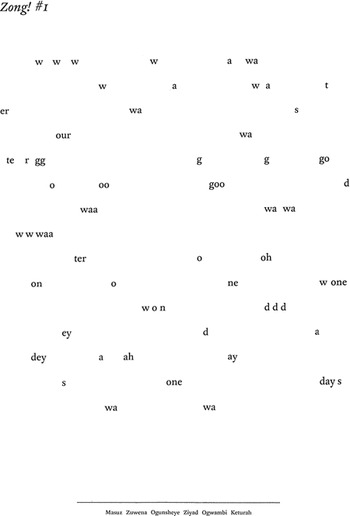
Readers, then, must interpret both words and linguistic gaps and the relative placement of each of these on the page. Philip’s poetry cycle foregrounds linguistic signifiers, being amenable to a structuralist or deconstructionist analysis in which readers must remain keenly attuned “to syntax, spacing, intertextuality, sound, semantics, etymology, and even individual letters.”Footnote 85 Philip’s “governing principle” in Zong! is relationality, with “every word or word cluster . . . seeking a space directly above within which to fit itself,” thus “fall[ing] into relation with others either above, below, or laterally.”Footnote 86 “Zong! #1” in “Os,” the collection’s opening poem, for example, can be read horizontally and diagonally, the latter arrangement evoking the path of the slaves’ bodies as they were thrown from the Zong. Other poems may be perused in a scattershot or cyclical manner (“Zong! #5”) or vertically like a ledger (“Zong! #24”), a graphical allusion to a ship’s manifest listing the crew, passengers, and cargo.Footnote 87 Philip mocks this form in Zong!’s own manifest enumerating items like African groups and languagesFootnote 88 that would decidedly not be recorded in the official manifest.
Zong!’s deep sensory engagement is not only with sight, though, but with sound. The poetry cycle is inspired by longstanding oral traditions in African cultures, and it responds to the rhetorical question, recently posed by Paul Watkins in his introduction to an interview with Philip, “what is there but song when words risk enacting a second violence”Footnote 89 ? Here, too, Zong! shares affinities with several of Mallarmé’s poems, in which recitation discloses meanings not evident from a silent perusal. In 2013, Philip performed Zong! non-linearly, “with over twenty readers improvising the poem’s multiple meanings in discordant unison,” according to Watkins,Footnote 90 enacting modernist poetry’s splintering of the single lyrical voice. The exclamation point in the poetry cycle’s title signifies its being a “song of the untold story” for Philip.Footnote 91
I would thus dub Zong! an experiential text in that it is felt more readily than it is described linguistically, like many lamentations. The reader is often figuratively immersed under the flood of language in the text, only occasionally grasping a life-raft of meaning, and thus vicariously experiencing the dislocation of the slaves on board the Zong. Philip remains sensitive to the position of readers (and herself) as secondary witnesses to this traumatic event, though.Footnote 92 She ventured to Africa for “permission” to tell the untellable tale of the massacreFootnote 93 and channeled an ancestral voice, Setaey Adamu Boateng, to reveal “the submerged stories of all who were on board the Zong.”Footnote 94 By forsaking control over the text, Philip avoids the pitfalls of the appellate case report in Gregson v. Gilbert and abolitionist narratives about the Zong, individualizing the victims of the atrocity in her revisionary elegy.
Zong!: Deconstructing Law, Reconstructing Humanity through the (Anti-)Elegiac Form
Judith Butler’s observation that we perhaps “make a mistake if we take the definition of who we are, legally, to be adequate descriptions of what we are about”Footnote 95 suggests legal language’s limits for identity formation and the importance of alternative discourses, including literary ones, to vivify personalities that have been officially marginalized. “Literature offers the opportunity to interrogate the premises, strategies, and conventions of language and to discern the ways in which ordinary language becomes irresponsible to its greater calling,” thereby permitting “ethical reflectiveness about the limits of our language.”Footnote 96 The modern elegiac form appears primed to fulfill this objective, given that it “throw[s] into relief the inefficacy of language precisely when we need it most.”Footnote 97 “[A] direct correlation [exists] between the textual body and the human body,”Footnote 98 that is, the elegiac poem’s verbal insufficiency when faced with the lost “corporeal existence of the deceased.”Footnote 99 A white sailor in Zong! references these dual disintegrations: “sift the dunes of / tunis for the bones the ruins of my / story their s & y ours.”Footnote 100
Although elegies were once perceived to have a primarily consolatory function,Footnote 101 theorists of the modern elegy, such as Karen Weisman and Jahan Ramazani, argue that the genre’s manifestation today appropriates earlier generic norms but demonstrates modernism’s influence. It is now inflected with self-reflexivity and an “anti-elegiac” strain that “resist[s] the traditional psychology, structure, and imagery of the genre,” even at times devolving into the “anti-literary,”Footnote 102 as Zong!’s source text invites the poetry cycle to do. Stylistically, Zong! employs a panoply of modernist poetic techniques that transformed English poetry in the early twentieth century, including irregularities of meter and rhyme (if present at all), jarring juxtapositions, searing ironies, elisions, fragments, multiple languages and voices, and dense allusions (inherent in elegy’s generic lineage, as discussed below).Footnote 103 The elegy has not only become more formally flexible, but it has substantively expanded in scope beyond loss of life, encompassing the death of “institutions, cultures, forms of authority, and ways of thinking.”Footnote 104 The sobbing oba (Yoruba for “king” or “ruler”), a recurring motif in Zong!, accordingly mourns not only personal but cultural deaths, the latter alluded to when a crew member euphemistically speaks of “cur[ing] the / m [the slaves] of a frica” and the slaves “shed / tears / for ifá / ósun / & ógún / for / efun / for èsú,” which are Yoruba divinities.Footnote 105 Slavery is a site of collective or cultural trauma that disrupts an entire community’s consciousness, “destroying the possibility of a common frame of reference and calling into question our sense of being-in-common.”Footnote 106 “Modern literatures of loss and mourning” like Zong! “have increasingly made their textual bodies out of expelled matter,”Footnote 107 including people and cultural heritages. These works seek to recover—a term evoking the idea of “gain[ing] something by the judgment of a court”—the remains of that previously characterized as waste.Footnote 108
Erin Fehskens notes the dilemma that arises from this endeavor, though, when she asks “[h]ow we can totalize the Zong, make the Zong into a metonymic totality of the long eighteenth century, as Ian Baucom would have it, while also fiercely attending the constitutive loss at the core of its meaning, the loss than remains lost rather than recovered.”Footnote 109 Philip’s response in Zong! is an elegy that critiques the origins, motifs, and implications of the genre even while relying on elegiac conventions. Philip indicates that literary devices characterizing the often disparaged lamentation tradition may come closer to registering the horror of the drownings that her text compulsively replays in individual instances (“we have / thrown him over / board we pray then throw him pray / then throw them pray then / throw pray then / throw”Footnote 110 ) and across sections. The preceding quotation from the ironically titled “Ratio” is echoed in “Ferrum,” where severed words “reflect[] the degradation of language until at times we are only left with grunts and sounds,” according to PhilipFootnote 111 : “to se cure our pro / fit we th row them to res cue our for / tunes we do mur t hey f / all to in sure our pr ofits ov / er & o ver a gain to sec / ure their re scue the y fall o / ver bo ard to pre serve our profit.”Footnote 112 The non-syntactical lines and gap-laden typography here are indicative of the moral fissures and flaws in the crew’s reasoning. Additionally, the ampersand, although derived from Latin, can be suggestive of poetic experimentation, “a desire to tweak the sniffing nose of literary decorum,” in the vivid metaphor of Kevin Nance, creating a “cognitive blip” for some readers.Footnote 113 Yet Philip crucially foregrounds the incident the judicial opinion elides and outrightly assigns blame in her subversive elegy: “the case / is / murder.”Footnote 114
Although elegy has recently been described as a “mode of inquiry,”Footnote 115 much like lamentation is conceived of as a mode that imbues other genres,Footnote 116 elegies are seen as retaining distinctive generic qualities.Footnote 117 The elegy is a literary form dating to ancient GreeceFootnote 118 and steeped in precedent—“a poem made out of other poems”Footnote 119 —not so unlike the common law system in which Gregson v. Gilbert was decided. Indeed, both judicial opinions and elegies, which are said to “construct power,”Footnote 120 may be susceptible to similar critiques of entrenching patriarchal ideologies. The “elegy is historically a form written by men and about men”Footnote 121 in which “the elegist asserts his own poetic skill and becomes part of a pre-existent tradition or lineage of similarly skilled poets”Footnote 122 while at times serving nationalist aims.Footnote 123 Contrastingly, “the lamentation [is] composed by women and expressive of their experience,”Footnote 124 enabling them to “play otherwise masculinized roles: they are revenge seekers, judges, bearers of authority, writers of history,” though outside of male-dominated institutions.Footnote 125 Lamentations were traditionally communal oral rituals but now include “a range of utterances from shrieks and cries to improvised oral performances to formal written texts.”Footnote 126 They often foreground the body and employ antithesis and repetition to articulate the incomprehensibility of corporeal loss and the inadequacy of language to fully palliate bereavement,Footnote 127 ultimately representing the “return of a violence and chaos repressed by social order and law.”Footnote 128 The lyrical voice’s cry in Kamau Brathwaite’s “Stone,” “lawwwwwwwwwwwwwwwwwwwwwwwwwwwwwwwwwwwwwwwd,” upon his murder for clashing with activists supporting the ruling party in Jamaica,Footnote 129 suggests the futility of appeals to religion (the Lord) and law when confronting grave injustices, a theme that also suffuses Zong!.Footnote 130
Philip strikingly proclaims the Zong appellate case report as a “gravestone” that must be “shatter[ed]” to free the voices of the dead slaves,Footnote 131 and Zong! launches simultaneous attacks on the judicial decision and the Western literary tradition. The poetry cycle is permeated by references to pastoral elegy tropes, including conventional settings like the countryside and the sea. Although these spaces often proffer solace to the speakers in pastoral elegies, Philip criticizes this complacent attitude, using juxtaposition to suggest that idyllic pastoral spaces in England have resulted from the despoliation of such regions and their inhabitants elsewhere. A white crew member in Zong! obsessively reminisces about meeting his beloved, Ruth, in scenic locales, including a garden,Footnote 132 a “fen,”Footnote 133 a “dal[e],”Footnote 134 a “glen[],”Footnote 135 a ferny expanse marked by a cairn,Footnote 136 and “dow / ns.”Footnote 137 He expects to receive “gr / ants of l and to gr / ow cane & g row ri ch”Footnote 138 overseas while aspiring to cultivate grain in fields with Ruth upon his stateside return.Footnote 139 In his leisure time, he envisages cavorting with Ruth in a veritable Noah’s ark of a garden replete with “stag /s boar s & / deer carp in / the river doves / there / will be dogs fish & / grouse owls & tit s pea hen s too” but “no pigs he / negroes &she / negroes”Footnote 140 ; the sailor’s most ardent desire is to “b e with y ou i / dle in our e den.”Footnote 141
However, the dreaminess of these scenes of “ease”Footnote 142 is undercut by contrasting nightmarish ones in their immediate vicinity, text-wise; the crew member recalls lush pastures in England as Philip depicts a more ominous fate for the captives in general and one specific African couple, Wale and Sade, a husband and wife from a rural region who function as doppelgangers for the anonymous crew member and Ruth. For example, a passage portraying “visions of l / ace for a queen / my queen” in “Sal” soon degenerates into “dire visions” of hunted slaves, one of whose voices pierces the poem in the italicized text: “de men dem cam for mi / . . . / mi flee / the fields gun bam bam.”Footnote 143 In Ferrum, a similar scene to the edenic ones above—“su ch a grand gard en with stag / s grouse and deer an e den” is followed by the chilling image “the lad la / y dead and a nother & anot / her they a ll lay d / ead.”Footnote 144 This section also tells the fractured story of Wale and Sade (along with their son Ade), whose mutual affection is evident through their exchange of gifts in a touching chiasmus: “sad e makes a ree d mat for w / ale wale mak es a hut of ru / sh and reed for sa de.”Footnote 145 But their humanity fails to immunize them from being pursued like “prey”Footnote 146 across the fields they once freely traversed: “wa / le and sa de run from the / field the river t he raft.”Footnote 147 Slave traders drive them into the woods before apprehending themFootnote 148 —“i have / set a snare for wa le & sade / a trap for h / is feet a sna / re for hers”Footnote 149 —and forcing them to walk on a trail of tears to “the fo / rt at the port o n the river.”Footnote 150 From here, they and their fellow captives journey to the seaside (“the line of negroes wend s / its way to the coast”Footnote 151 ) and depart for the middle passage, during which “they suffer.”Footnote 152 As Zong! summarizes the dastardly pastoral exchange from the crew member’s perspective, “there was ga / in t heir loss,”Footnote 153 namely in the form of seemingly pristine spaces where the sailor could savor products from the New World (e.g., tea, oranges, and sugary éclairsFootnote 154 ) while lavishing luxuries like a “fur”Footnote 155 on his cherished Ruth.Footnote 156
Yet the sailor terrifyingly conceives he has become an “agent of satan” or “slav e[] to sin,” leading God to avenge the deaths he perpetrated and obliterate his splendid visions: “just u / s ruth you and m e in the g / arden our ed en will he / throw u s out as he / has be fore”?Footnote 157 Divine retribution here substitutes for legal retribution,Footnote 158 and the word throw recalls references to the slaves jettisoned from the Zong and connotes dual Falls/falls: “we / fall to our fate they / to the o cean their fate,” “their f / all our f / all.”Footnote 159 Ferrum concludes with Wale’s asking a crew member to transcribe a poignant missive to Sade, which Wale consumes, before this passage of disturbing wordplay in which “weight” morphs into an eternal “wait” underwater: “he fa lls to the we / ight & wa it in w / ater i ca ll his na / me & f / all too.”Footnote 160 Zong! elegizes even the white perpetrators who suffered bodily or psychological deaths, with one of them rhetorically questioning “what pro fit me if mon coeur non est”Footnote 161 (“my heart is not”), without the text’s necessarily implying equivalency between the slaves’ and crew members’ losses.Footnote 162 Philip felt compelled “to acknowledge the existence of those Europeans on board the Zong, those who like many Africans sickened and died, as well as those who were involved in the murder of the Africans, and thus in the murder of their own souls,”Footnote 163 with the sections after “Os” often voiced by an odious white male sailor. Rationalizing this unusual inclusion, Philip has asserted that the character was necessary “to do justice to what had to be told,” with his suicide being “akin to the idea that Columbus must die—for the world to live, that spirit of conquest, destruction, and domination that Columbus represents has to die.”Footnote 164
Zong! humanizes what this character and the judicial opinion dehumanized, transforming the more monodic “dessicated[] legal report into a cacophony of voices—wails, cries, moans, and shouts that had earlier been banned from the text.”Footnote
165
These polyvocal lamentations “bear[] witness to the ‘resurfacing of the drowned and the oppressed,’ ”Footnote
166
like the “she / negroes” who “sin / g sa / d songs”Footnote
167
for the deceased, with an African chant dominating much of one of Ferrum’s closing pages.Footnote
168
The sea where voices of the past resound is a conventional elegiac setting redolent with “the possibility of ‘a sea change’ into a ‘rich and strange’ consolatory apotheosis.”Footnote
169
Yet it is also a “site of seemingly contradictory images and a site which is . . . significantly textual,” “a metaphorical blank page upon which the poet writes a history of trauma” and a space “that the poet interprets through his lyrical power.”Footnote
170
The middle passage has rendered the sea a place fraught with significance—“the image of Empire and of engulfment and of memory”Footnote
171
—for Caribbean people, as encapsulated by several of Derek Walcott’s poems. “The Sea is History” shares Zong!’s castigation of the exploitation abroad that historically enabled Western culture to thrive but similarly ends with a tinge of hope “of History, really beginning.”Footnote
172
The sea’s fluidity, in contrast to the physically contained courtroom, suggests non-narrative and anti-narrative literary capabilities,Footnote
173
as in Zong!. Also, unlike the law, the sea is traditionally coded maternal (life-giving) across languages: “the sea is ma / i is mère i s mer is / mar ema & mater i / s madre is ma is omi.”Footnote
174
Zong! queries whether this maternal sea will “give up its de / ad its bo nes,” “be ar[ing] the t / ruth”Footnote
175
along with the “s / ouls” of the deceased coerced into a cruel bargain: “they ask fo / r water we g ive them s / ea they as / k for bread we / give them se / a they ask for lif e we give them o / nly the sea  .”Footnote
176
Responding with a vociferous no to the white sailor’s ludicrous inquiry in cursive arising from—and intruding into—the print text, Philip’s poetry cycle figuratively seeks to “drown[] the law” that could potentially excuse murder and deem the “sin”Footnote
177
a compensable offense.
Zong!, like many lamentations, refuses “this economic model of justice” premised on “[s]etting prices, determining values, contriving equivalences, exchanging” (of often disparate items), which “preoccupied the earliest thinking of man to so great an extent that in a certain sense [it] constitute[s] thinking as such.”Footnote 178 Quoting Nietzsche, Rebecca Saunders argues that such a model of justice “ ‘treats violence and capricious acts on the part of individuals or entire groups as offenses against the law . . . and thus leads the feelings of its subjects away from the direct injury caused by such offenses.’ This is just the sort of sublimation, displacement, and abstraction that lamentation refuses.”Footnote 179 Although the parties involved in the Zong litigation defended various commercial interests, Zong! “defend[s] the dead.”Footnote 180 “Mourning depends on a hypothesis of defense, howsoever wishful,”Footnote 181 and a failure to mourn those denigrated in the past may have acute implications for the present; “acceptance of one’s own or the other’s death may develop into a cultural ideology that increases the practice and use of death as a cultural weapon.”Footnote 182 Butler has accordingly called for an “insurrection on the level of ontology,” underscoring how dehumanizing discourse can effect dehumanization in reality. She advocates scrutinizing the relationship between “violence and those lives considered as unreal,” asking “[w]ho counts as human? Whose lives count as lives? And, finally, What makes for a grievable life?”Footnote 183
Zong! is an extended exploration of these questions that paradoxically asserts realization of our “common human vulnerability”Footnote 184 may be our savior,, and it is apropos that Philip alludes to an English poetic progenitor, who often wrote in elegiac meter, to convey this urgent message. “Ratio” begins with a white crew member hearing “the / clarion [that] / sounds for / me,” and bells toll at the climax of “Ventus”: “ding ding / dong done.”Footnote 185 These passages, with the pun in the second one, evoke the renowned “for whom the bell tolls” section from John Donne’s “Meditation XVII” (1624):
And when she [the church] buries a man, that action concerns me; all mankind is of one author, and is one volume . . . No man is an island, entire of itself; every man is a piece of the continent, a part of the main; if a clod be washed away by the sea, Europe is the less, as well as if a promontory were, as well as if a manor of thy friend’s or of thine own were; any man's death diminishes me, because I am involved in mankind, and therefore never send to know for whom the bell tolls; it tolls for thee”Footnote 186
for the drowned slaves named below the text’s surface in Zong!,Footnote 187 for the crew members on board the Zong whose appalling deeds cost them their names,Footnote 188 and for all of us haunted by these ineffable losses today.
The Zong’s (and Zong!’s) Legacy
Zong!’s unflinching portrayal of an inexplicably evil event, reinforced by the text’s discombobulated form, demonstrates why the very name Zong “quickly entered the demonology of Atlantic slavery, and came to represent the depravity and heartless violence of the entire slave system.”Footnote 189 The shameful enterprise was propped up by legal institutions that subconsciously, if not consciously, registered the heinousness of the practice without intervening to foreclose it. The appellate record in Gregson v. Gilbert thus memorializes a moment of miscarried justice, a decision with dire ramifications in the immediate term, but one that eventually instigated the crusade to abolish the English slave trade, a preliminary step for many in the West to recognize the humanity of African peoples. Yet for Philip and many other people of color, in the Caribbean and elsewhere, the struggle to retain their identities may persist. When Philip sought to publish her novel Harriet’s Daughter in 1988, she was informed that the text’s black characters rendered it unmarketable.Footnote 190 Philip has also observed that the tourist industry’s expansion in Tobago has been accompanied by a resurgence of the word plantation, and “an old painting of a slave plantation” was even used to advertise a Hilton resort.Footnote 191 Moreover, disclosures that several of England’s—and indeed America’sFootnote 192 —most eminent insurance companies insured slaveownersFootnote 193 suggest that the Zong’s traces may be discerned today. Reparations for slave exploitation remain a divisive issue,Footnote 194 but a recent $10 million donation to help re-create two wooden buildings on Monticello’s Mulberry Row, where earth alone currently marks the place Thomas Jefferson’s slaves would have toiledFootnote 195 (a sight not unlike the cavity in the center of a page of “Zong! #5”Footnote 196 ) indicates that the public perceives value in excavating and rectifying the historical record. Although the “real” story of Monticello may be inaccessible, like the lives of the drowned slaves on board the Zong,Footnote 197 imaginatively reconstructing untold histories that are part of our collective archive remains a vital endeavor, “an ode / to the ne / gro in me in you.”Footnote 198
Appendix
The following appendix contains selections from Zong! referenced in this article, including the full text of Gregson v. Gilbert, the first page of “Zong! #1,” a sample page from “Zong! #5,” and the first page of “Zong! #24.” I thank the English Department at the University of Virginia for assistance with reproducing the excerpts here.
Credit: Marlene NourbeSe Philip, Excerpts from Zong!© 2011 by Marlene NourbeSe Philip and reprinted by permission of Wesleyan University Press.