Introduction
Quitting smoking can be difficult for smokers and it often requires multiple quit attempts. Smoking cues leading to smoking relapse is one of the important causes for failed quit attempts (Zhou, 2009). Craving for cigarettes is frequently experienced by smokers when they attempt to quit smoking and these attempts are associated with cravings throughout the day. Ongoing cravings in a quitter are often associated with acute episodes of more intense craving leading to a lapse to smoking (Shiffman, 1997; Killen & Fortman, Reference Killen and Fortman1997). These episodes of intense craving are typically triggered by environmental smoking cues such as seeing other smokers, being in a place where they used to smoke or images of cigarette advertising (Bliss, 1989; Shiffman, Reference Shiffman1982; Shiffman, 1996). These episodes of cravings are associated with a high risk of relapse. A therapy that could quickly mitigate the intensity of craving episodes provoked by smoking cues may reduce the risk of lapse to smoking.
Nicotine Replacement Therapy (NRT) is widely recommended as a first line of pharmacological therapy for smoking cessation in clinical guidelines (West, 2000; LeFoll, 2005; Fiore, 2008). Multiple NRT products are available in different dosage formats such as skin patch, chewing gum, lozenge, sub-lingual tablet, nasal spray, and oral spray. These different dosage formats have varied pharmacokinetic properties and are intended to meet different consumer needs. Some NRT products are conceptualised to have more rapid delivery of nicotine, so to relieve craving quickly. For example, a recently developed NRT product, nicotine mouth spray, can deliver nicotine more quickly (Kraiczi, 2011) and relieves craving faster than nicotine lozenge (Hansson, 2011). A rapid release nicotine gum was also shown to reduce smoking cue-provoked craving more rapidly than the regular nicotine gum (Niaura, 2005).
GlaxoSmithKline (GSK) has developed a new dosage form of NRT, 2.5 mg nicotine oral soluble film (or nicotine strip). It has been approved in Europe as a quit smoking aid for low dependence smokers based on its equivalent systemic bioavailability to the marketed reference products for low dependence smokers, e.g. 2 mg nicotine gum and 2 mg nicotine lozenge. The formulation of the nicotine film is based on a water soluble polymer matrix and dissolves in the human mouth in 2 to 3 minutes to release the full dose of 2.5 mg nicotine. The speed of nicotine release from nicotine film is faster than nicotine lozenge, which takes 20 to 30 minutes to fully dissolve in the mouth, and nicotine gum, which needs to be chewed for 30 minutes to release most of its nicotine content.
The purpose of this pilot study was to assess and compare the efficacy of 2.5 mg nicotine oral soluble film with 2 mg nicotine lozenge and 2 mg nicotine gum on relieving provoked craving in low dependence smokers. The cues used to provoke a craving episode were the sight and smell of a lit cigarette and the manipulations required to light a cigarette, which have been described in a previous study (Shiffman, 2003). The smoking cue is considered to be one of the strongest triggers leading to lapse to smoking.
Methods
Study subjects
A total of 140 healthy low dependence smoker volunteers were screened and 120 subjects (48 males and 72 females) were randomised to one of the three treatment groups in a 1:1:1 ratio. The low dependence smokers were defined as those who smoked their first cigarette more than 30 minutes after waking up and smoked regularly on a daily basis for at least a year. The study was conducted in accordance with the ethical principles of Declaration of Helsinki, ICH Guideline for Good Clinical Practice, and other applicable regulations. The study was approved by a qualified independent ethics committee. All study subjects were consented prior to study participation and were recruited from a database maintained by the study site or through local advertising.
The subjects who met the following criteria were included in the study: low dependence smokers; were at least 18 years old; had a Body Mass Index (BMI) within the range of 19–35 kg/m2 with good general health; understood, and were willing to comply with all study procedures and restrictions. Females with childbearing potential who practiced a reliable method of contraception were also included in the study.
The exclusion criteria for the study were: subjects who were pregnant, or breast feeding; had known or suspected intolerance or hypersensitivity to nicotine or any ingredients in formulation; had current or recent history (within the last year) of alcohol or other substance abuse; had consumed any alcoholic beverage within 24 hours of the craving provocation visit; had been treated with known enzyme altering agents or any NRT or any other treatment for smoking cessation within 30 days of the provocation visit; had used any prescription psychiatric drug within 14 days of the provocation visit; had used medication that affects central nervous system such as sedating antihistamines within 24 hours of the provocation visit; had used any nicotine containing products during the provocation visit; had used any product which could jeopardise the safety of the participant or impact the validity of the study results; and had any diseases that may interfere with the absorption, metabolism or excretion of the study product. In addition, any subject with higher level of expired carbon monoxide (CO) than the previous CO assessment was excluded from the study.
Study Design
This study was a single centre, randomised, open label, active comparators controlled, parallel group in design and conducted in the US.
The participants had two study related visits, a Screening visit and a Provocation/Treatment visit. At the Provocation/Treatment visit, the eligible subjects were abstinent from smoking for 4 hours, then exposed to smoking cues for provocation. The craving was assessed using a 0 to 100 millimeter Visual Analogue Scale (VAS). Study subjects were randomised to take a single dose of one of the following three treatments: 2.5 mg nicotine film, 2 mg nicotine lozenge, or 2 mg nicotine gum. A time point of 50 seconds after drug administration was chosen as the first feasible time point in order to fully characterise the early phase dynamics of craving relief.
Subjects screening
During the screening visit, a number of tests including urine pregnancy, urine drug tests and breath alcohol screen were conducted. All consented subjects were screened in accordance with inclusion and exclusion criteria as defined previously. The subject's demographics, blood pressure, heart rate, oral body temperature, height, and body weight were collected during the physical examination. BMI was calculated based on body weight and height. Smoking history was collected and Fagerström Test for Nicotine Dependence (FTND) (Heatherton, 1991) was conducted.
Craving provocation and study treatment
After meeting the study criteria at the screening visit, subjects reported to the study clinic within 1 to 14 days of initiating screening visit. During this visit, current day smoking history was collected and expired CO measurements were performed. Subjects were also trained on proper use of study drug treatments and craving assessment procedures. These were then followed by a 4 hours sequestration period, provoked craving session, a single dose of study drug treatment, and craving assessments at different time points.
Subjects were sequestered in a group setting during the 4 hours sequestration period. The television or videos and books or magazines in the room were previously screened to avoid tobacco or smoking related information. During the last hour of the 4 hours sequestration, subjects could not eat, but could drink water.
The smoking cue-provoked craving has been used before in other clinical studies and described in detail (Shiffman et al., Reference Shiffman, Shadel, Niaura, Khayrallah, Jorenby, Ryan and Ferguson2003). Briefly, the following procedures were performed during the craving provocation: study subjects were seated in a well-lit, temperature controlled, well ventilated, sound attenuated room. Each subject stayed alone in the room and all study instructions were delivered via a pre-recorded audio recording. All of the study procedures were monitored via closed circuit television system by study staff located in other room. After 5 minutes of acclimatisation, the provoked craving session began. Subjects started the session by completing a baseline craving assessment questionnaire. Subjects then opened an opaque box in front of them to reveal a pack of their first or second preferred brand of cigarettes, two cigarette lighters and an ashtray. The subjects were instructed to unwrap and open the pack of cigarettes; remove one cigarette; hold the cigarette in their hand and light it without placing it in their mouth; hold the lit cigarette directly in front of them without smoking it. Subjects were instructed to look at the lit cigarette for 60 seconds and then extinguish it in the ashtray. The total duration of this period was 90 seconds. Immediately after extinguishing the cigarette, the subject was instructed to complete the next craving assessment questionnaire (pre-treatment post-provocation craving assessment), remain in the room, self-administrate one of the three study treatments, and then conduct craving assessments at various time points through instructions from a programmed audio recording. Any subject who smoked the cigarette during the provoked craving session was withdrawn from the study.
Craving assessment procedure
A set of five items was selected from the brief questionnaire of smoking urges (QSU-brief) and was used with minor modifications for assessment of smoking craving intensity (Cox, 2001). The five items were: ‘I have a desire for a cigarette right now’, ‘If it were possible I would smoke right now’, ‘All I want right now is a cigarette’, ‘I have an urge for a cigarette’, ‘I crave a cigarette right now’. For each of these items, the participant indicated his or her craving intensity on a pre-drawn 100 mm VAS ranging from 0 (disagree) to 100 (agree) by drawing a perpendicular line to the scale that bisected the scale. The average of the VAS scores from the five items was the craving intensity. The assessments were completed immediately before the craving provocation, immediately after craving provocation, and at 50 seconds, 3, 5, 7, 15, 20, 25 and 30 minutes after study drug administration.
Study medications and instructions of use
Three different NRT dosage forms were administered in the study. The 2.5 mg nicotine oral soluble film was manufactured by GSK under the guidance of cGMP. Both 2 mg nicotine lozenge and 2 mg nicotine gum are under the trade name of Nicorette® and were purchased in US market. The use instructions for these three treatments were consistent with what have been approved by relevant regulatory agencies for the products.
Subjects who were assigned to the 2.5 mg nicotine film treatment group were instructed to place one nicotine film on top of their tongue, close their mouth, and then press the tongue gently to the roof of the mouth until the nicotine film dissolved, which takes approximately 2 to 3 minutes. Instructions were given that the nicotine film was not to be chewed or swallowed.
The use instructions for nicotine lozenge and nicotine gum followed what are described in corresponding product labels. Subjects who received the nicotine gum were advised to chew the gum slowly until the taste became strong then to stop chewing and rest the gum against their cheek. When the taste had faded, the gum should be chewed a few times until the taste got strong, before stopping and resting again. After about 30 minutes of such use, the gum was discarded.
Subjects who received the nicotine lozenge were instructed to place one lozenge in their mouth, periodically move the lozenge from one side of the mouth to the other until the lozenge was completely dissolved (approximately 20–30 minutes). Subjects were also instructed not to swallow or chew the lozenge. If the lozenge was not fully dissolved by the time the final craving assessment had been completed, participants were instructed to discard the lozenge.
Safety monitoring
Spontaneously reported adverse events (AEs) from study subjects were collected and evaluated by study investigator during the study and up to 5 days after the drug treatment.
Statistical analysis methods
A formal sample size calculation was not conducted for this study because there was no information available for the primary endpoint (craving scores at 50 seconds after drug administration). It was planned that a sufficient number of participants should be screened and randomised to enable 120 participants (40 in each study treatment group) to complete the study.
In this study, the Intent-to-Treat (ITT) population included subjects who were randomised to one of the three study treatments, took one dose of the treatment, and provided at least one evaluable craving score while on-treatment. The provocation responders were subjects who were in ITT population and responded to smoking cue with at least one unit increase in craving score from pre-provocation. Safety population included all randomised subjects who took study treatment and were evaluated for AEs.
The primary efficacy variable was craving score change from pre-treatment post-provocation baseline. Analysis of Covariance (ANCOVA) was conducted to calculate the adjusted means of the primary efficacy variable for the three treatment groups for each time point separately (50 seconds, 3, 5, 7, 10, 15, 20, 25 and 30 minutes post-treatment). For each time point, pair wise comparisons of the treatment groups were conducted and the 95% Confidence Intervals (CIs) of differences between pairs of treatment groups were calculated. The pair-wise comparisons were made at two-sided 5% significance level. No adjustment of the significance level was applied for multiplicity in comparing the treatment groups at each time point. The ANCOVA model contained the pre-provocation and pre-treatment post-provocation craving scores as covariates, and the treatment group as a fixed term.
A sensitivity analysis based on Analysis of Variance (ANOVA) was conducted to evaluate the robustness of the results from primary ANCOVA analysis. ANOVA was conducted to calculate the adjusted means of the primary efficacy variable for the three treatment groups for each time point separately (50 seconds, 3, 5, 7, 10, 15, 20, 25 and 30 minutes). The rest of the statistical analyses were the same as those conducted in the primary ANCOVA analysis.
While checking ANCOVA assumptions, it was found that the normality and the homogeneity of variance were not fully met. Therefore, a non-parametric Bootstrapping analysis was conducted (Efron & Tibshirani, Reference Efron, Tibshirani, Efron and Tibshirani1993) to calculate the 95% CI of the difference between treatments. The Bootstrapping statistical analysis results confirmed the results from the initially planned ANCOVA analysis.
Results
Study subject demographics and baseline characteristics
A total of 140 subjects were screened and 120 subjects were randomised into three treatment groups with 40 subjects in each treatment group. All randomised subjects took study treatment and completed the study.
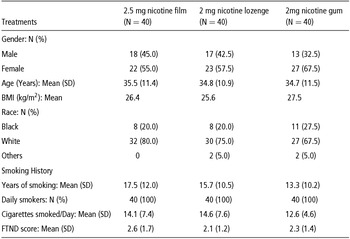
Table 1 presents the demographics and smoking characteristics of the ITT population. All three treatment groups had similar demographics. The majority of subjects were white, ranging from 67% to 80% across the three treatment groups.
Demographics and smoking characteristics of study subjects at baseline

Most of subjects were in the three lowest levels (very low, low and medium) of nicotine dependence as defined in the FTND. There were 38 (95.0%), 40 (100%) and 39 (97.5%) subjects in these three lowest levels of nicotine dependence for the 2.5 mg nicotine film, 2 mg nicotine lozenge and 2 mg nicotine gum groups, respectively. The mean FTND scores in the three treatment groups ranged from 2.1 to 2.6. The average Cigarette per Day (CPD) smoked by study subjects was <15 CPD across all three treatment groups. Only 7 of the 120 subjects (5.8%) smoked more than 20 CPD.
Provocation response rate to smoking cues
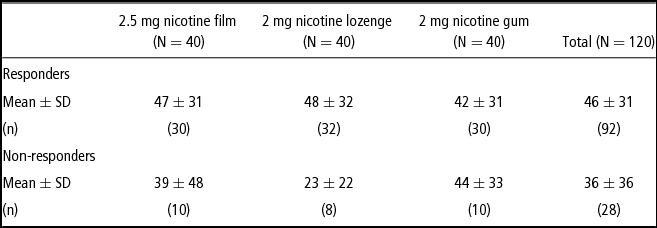
The percentage of provocation responders, defined as subjects who had at least 1 unit increase in craving score after provocation, was 75% in 2.5 mg nicotine film group, 80% in 2 mg nicotine lozenge group and 75% in 2 mg nicotine gum treatment group. Table 2 presents the craving relief at 30 minutes after NRT administration in provocation responders and non-responders. The provocation responders had an average of 46 units reduction in craving scores verse 36 units reduction in non-responders though there was no statistical significance.
Craving relief in provocation responders and non-responders*
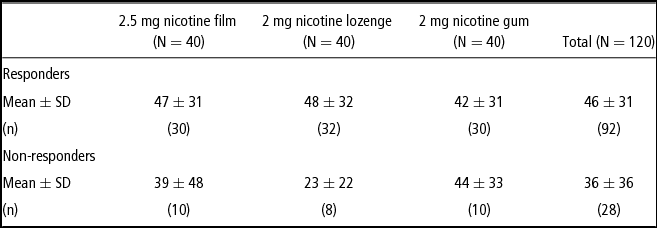
*The craving relief was the craving score change from the pre-treatment post-provocation.
Efficacy in relieving smoking cue-provoked craving
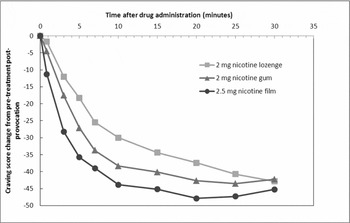
The mean score of craving relief from pre-treatment post-provocation over time for the three treatment groups (in ITT population) are presented in Figure 1. It shows that the provoked craving intensity decreased over time after the NRT treatments. For the 2.5 mg nicotine film treatment, the maximum craving relief was achieved at 10 minutes.
Craving relief over time after a single dose of NRT administration in low dependence smokers

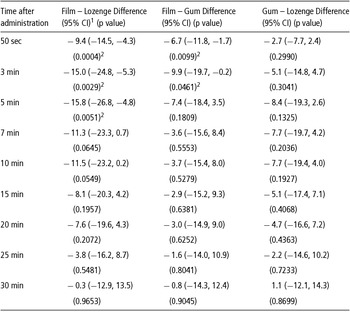
The difference of craving relief between the 2.5 mg nicotine film and the reference product 2 mg nicotine lozenge was −9.4, −15.0 and −15.8 at 50 seconds, 3 and 5 minutes, respectively. The craving relief from the 2.5 mg nicotine film was significantly higher than the 2 mg nicotine lozenge at 50 seconds (p = 0.0004), 3 minutes (p = 0.0029) and 5 minutes (p = 0.0051).
A similar trend was observed between the 2.5 mg nicotine film and 2 mg nicotine gum. The difference of craving relief between the 2.5 mg nicotine film and 2 mg nicotine gum was −6.7, −9.9 and −7.4 at 50 seconds, 3 and 5 minutes, respectively. There was a statistical significance between the two treatments at 50 seconds (p = 0.0099) and 3 minutes (p = 0.0461).
There was no statistical significance in craving relief at any time point between the 2 mg nicotine lozenge and the 2 mg nicotine gum treatments. All three treatments had similar maximum craving relief during 20 to 30 minutes (p > 0.05). The difference of craving relief between treatments are presented in Table 3.
Differences of craving relief between treatments after a single dose of NRT administration

1. The difference was calculated based on the least square mean of each treatment in ITT population.
2. The statistical significant level was set at p < 0.05.
These results suggest that the 2.5 mg nicotine film treatment lead to faster craving relief than the 2 mg nicotine lozenge and gum. There was no significant difference in the maximum craving relief caused by the three NRT treatments.
Safety profiles
There was a total of six AEs reported in five subjects in the study. Five out of six AEs were mild in severity and one AE was moderate in severity. One subject (2.5%) in the 2.5 mg nicotine film group experienced an AE of throat irritation. Four subjects (10.0%) in the 2 mg nicotine lozenge group reported nausea (in three subjects) and hiccups (in one subject). No AEs were reported from the 2 mg nicotine gum group. All AEs were regarded as treatment related. There were no SAEs or deaths reported in this study.
Discussion
This study was focused on the low dependence smokers because the three NRT products used are only indicated for them. Time to first cigarette (TTFC) was used as the criterion to classify smokers into low and high levels of smoking dependency. All of the subjects in this study were low dependence smokers (TTFC > 30 minutes after waking up). Only 7 of 120 subjects reported smoking more than 20 CPD. These results demonstrated that there is a good agreement between TTFC > 30 min and CPD < 20 as the criteria to classify low dependence or light smokers.
A previous study (Shiffman, 2003) showed that the rates of provocation responders were 56.2% and 56.8% in light and heavy smokers, respectively. In the current study, the provocation responder rate was 77% in low dependence smokers. Though the identical five items for craving assessment and cue-provocation procedures were used in both studies, subject's intention to quit smoking was not used as an entry criterion in the current study. Majority of the subjects in this study were active smokers. However, all of the subjects in Shiffman study (2003) were enrolled in a smoking cessation programme and the light smokers were classified as 11–24 CPD. The difference in the smoker's intention to quit smoking and the criteria used in classifying light smokers possibly contributed to the difference in provocation responder rates observed between the two studies. The active smokers enrolled in the current study may be more likely to respond to smoking cues than the committed quitters. It was also observed that a very high percentage of subjects in the current study smoked cigarettes (approximately 90% in the three treatment groups) before the 4 hours of sequestration. However, 77% of subjects still responded to the provocation. This suggests that a period of 4 hours of smoking-free sequestration is long enough to generate a good response to smoking cues in low dependence smokers.
The primary goal of the study was to compare the 2.5 mg nicotine film to two reference products, 2 mg nicotine lozenge and 2 mg nicotine gum, on relief of cue-provoked craving. A parallel group design was used to minimise the impact of repeated exposure to provocation cues in a short period of time, which may lead to diminished provocation response. An open label study design was chosen for practical consideration. If the placebo controlled study design were used, three different matched-placebo controls would have been required for blinding.
In a previous pharmacokinetic (PK) study conducted by GSK (data on file at GSK), it was concluded that 2.5 mg nicotine film has equivalent systemic bioavailability compared to 2 mg nicotine lozenge and 2 mg nicotine gum as determined by maximum blood nicotine concentration (Cmax) and nicotine concentration area under the curve (AUC0-t). This suggests that 2.5 mg nicotine film should have similar safety and efficacy profiles to 2 mg nicotine lozenge and 2 mg nicotine gum. The results from this study showed that all three treatments had similar maximum craving relief efficacy during the 20 to 30 minutes and is consistent with the conclusion of equivalent bioavailability among the three different oral NRT forms.
In the PK study, the blood nicotine concentration at 5 minutes after drug administration was in the range of 0.2 to 0.3 ng/ml for the three treatments, which were close to the limit of quantification for the bioanalytical method used (0.2 ng/ml). The PK results that all three NRT products had very low blood nicotine concentration at 5 minutes cannot explain the fast craving relief associated with the 2.5 mg nicotine film shown in the current study. It is well known that craving can be affected by both physiological and psychological factors. The NRT format, the speed of nicotine release from the products, the chemosensory responses to nicotine and/or non-nicotine ingredients in the formulations (e.g. flavour), and the trigeminal nerve responses to nicotine and/or flavour can all potentially contribute to craving relief. The faster nicotine release from the nicotine film (in 2 to 3 minutes) than nicotine lozenge and nicotine gum correlates with the observation of faster craving relief associated with the nicotine film.
One study conducted by Oliveira-Maia et al. (Reference Oliveira-Maia, Stapleton-Kotloski, Lyall, Phan, Mummalaneni, Melone, DeSimone, Nicolelis and Simon2009) indicated that nicotine can elicit its unique taste by acting on the nicotine receptors within the taste buds in oral tissue. In addicted smokers, a close association between the unique nicotine taste sensation and craving relief may be established from long term smoking. The faster release of nicotine from nicotine film may produce the unique nicotine taste sensation in the mouth more quickly, thus providing faster craving relief.
The relationship between blood nicotine concentration and craving has been studied by other investigators. One study found that there was a significant correlation between increased blood nicotine concentration and decreased craving for cigarettes in smokers (Jarvik, 2000). This finding was based on information from relatively later time points after smoking: the first time point of blood nicotine measurements took place at 8 to 22 minutes after smoking and the craving was assessed hourly. The relationship between the blood nicotine concentration and craving relief at early time points, e.g. within the first 5 minutes of nicotine intake from either NRT products or smoking, has not been well studied. The current study measured craving relief at 50 seconds, 3 and 5 minutes after NRT administration. It was found that a significant portion of the craving relief occurred within 5 minutes, ranging from 45% to 80% of maximum reduction for the three tested NRT products. The available blood nicotine PK data for the three NRT products (data on file at GSK) showed that the blood nicotine concentration was very low at 5 minutes after drug administration. This suggests that the early stage of craving relief associated with oral NRT treatment (e.g. craving relief within the first 5 minutes) is possibly related to nicotine taste sensation in the mouth instead of the effects of nicotine on the brain.
Non-nicotine related flavours, such as menthol and citric acid, were found to be useful to modify smoking behaviours. A clinical study reported that the menthol flavour alone can substitute cigarettes for smokers and reduced the craving for cigarettes (Levin, 1990). It was also found that sensory effects with citric acid aerosol significantly reduced craving for cigarettes and enhanced smoking reduction and cessation for people who were trying to quit smoking (Behm, 1993). All of the three NRTs used in this study contain mint flavour in their formulations with different speed of flavour release. The nicotine lozenge typically takes 20 to 30 minutes to fully dissolve in the mouth and nicotine gum needs to be chewed periodically for 30 minutes according to the usage instructions. On the other hand, nicotine film completely dissolves in the mouth in 2 to 3 minutes. Therefore, the speed of flavour release from the nicotine film is faster than the flavour release from nicotine lozenge and gum. This could contribute to the relatively faster craving relief associated with the nicotine film.
To compare the relative efficacy of three NRT products, it was practical to compare them directly in a study without placebo controls. However, this was also the main limitation of the study. The possible preference for a particular NRT form by study subjects may have contributed to the differences in craving relief for the three NRT products. The lack of placebo control also made it difficult to assess the extent of contribution from nicotine to the total craving relief.
The three study treatments were well tolerated and the AE profiles were similar to the established safety profiles of oral NRT products. Most of the AEs were mild in nature and were generally gastrointestinal side effects, e.g. hiccups and nausea.
In summary, the results of this study showed that the 2.5 mg nicotine film causes a faster craving relief than 2 mg nicotine lozenge and 2 mg nicotine gum. The three products have similar maximum efficacy on relieving the provoked craving. The nicotine film may be particularly useful to provide quick craving relief. The mechanism of faster craving relief associated with nicotine film needs to be further investigated.
Acknowledgment
The authors thank Professor Saul Shiffman, Dr Ming Ding, Bill Becker, Dr Mitchell Kotler for their critical discussion and review of the manuscript. We also appreciate the initial help on preparation of the manuscript and support of the study by Priyanka Tiwari and Amanda Bishop.
Conflict of Interest
This study is sponsored by GlaxoSmithKline Consumer Healthcare. Authors Daniel Du, Alex Selmani, and William Waverczak are affiliated with GSK Consumer Healthcare.
Ethical Standards
The authors assert that all procedures contributing to this work comply with the ethical standards of the relevant national and institutional committees on human experimentation and with the Helsinki Declaration of 1975, as revised in 2008. The study (identifier: NCT01476202) was listed on www.clinicaltrials.gov