Introduction
The abundance of any species in any habitat varies over time. Environmental factors such as temperature and precipitation drive abundance in many organisms (Pollard et al., Reference Pollard, Omelon, Andersen and McKay1999; White et al., Reference White, Campbell, Kemp and Hunt2000), and so do biological interactions (Woodin, Reference Woodin1974; Martins and Haimovici, Reference Martins and Haimovici1997). For example, the density of prey and predators in the habitat (Arditi and Ginzburg, Reference Arditi and Ginzburg1989), competition for resources (Robertson, Reference Robertson1996) and parasites and diseases can all contribute to shape the abundance and dynamics of animal populations (Scott and Dobson, Reference Scott and Dobson1989; Poulin, Reference Poulin1999). The prevalence of parasites themselves is also governed by various factors. During free-living stages, the prevalence of parasites can be largely influenced by abiotic factors similar to other free-living organisms (Altizer et al., Reference Altizer, Dobson, Hosseini, Hudson, Pascual and Rohani2006). In addition, because parasites are highly dependent on their host for survival at least for part of their life cycle, all environmental and biological factors that influence host abundance can, directly and indirectly, also affect the prevalence of their parasites (Arneberg et al., Reference Arneberg, Skorping, Grenfell and Read1998). More specifically, changes in host behaviour, host immune response and fluctuating host births and deaths (i.e. changes in host density) themselves can alter the prevalence of parasites in a host population (Grassly and Fraser, Reference Grassly and Fraser2006).
Another important factor that determines the prevalence of parasites is the interaction among parasites that use the same hosts; depending on their mode of transmission, virulence and their ability to manipulate the hosts, various outcomes are possible (Haine et al., Reference Haine, Boucansaud and Rigaud2005; Rigaud et al., Reference Rigaud, Perrot-Minnot and Brown2010; Poulin, Reference Poulin2011). For example, vertically transmitted parasites ( = parasites that are transmitted from a mother to offspring) often have little or no effect on their host's fitness because the hosts' reproductive success is crucial for the parasite as well (Dunn and Smith, Reference Dunn and Smith2001). On the other hand, horizontally transmitted parasites ( = parasites that are transmitted between different individuals) are generally involved with severe pathology (Dunn and Smith, Reference Dunn and Smith2001). Some trophically ( = horizontally) transmitted parasites are capable of changing host behaviour, which ultimately leads to predation of the intermediate host by the final host (Thomas and Poulin, Reference Thomas and Poulin1998). Parasites with these contrasting modes of transmission sharing the same host are therefore in conflict. For example, in an amphipod host, the coinfection of vertically transmitted microsporidia has been shown to weaken the behavioural alteration induced by trophically transmitted acanthocephalans (Haine et al., Reference Haine, Boucansaud and Rigaud2005). In contrast, parasites with the same transmission mode that share the same host may have interests that are well aligned. For instance, in an amphipod host, two vertically transmitted parasites, one microsporidian and one paramyxean, were shown to co-occur more frequently than expected by chance; since feminization of male hosts is necessary for successful vertical transmission of the parasites, this suggested that one parasite was hitchhiking with another capable of feminizing the host (Short et al., Reference Short, Guler, Yang, Kille and Ford2012), or that both can feminize their hosts (Arundell et al., Reference Arundell, Dunn, Alexander, Shearman, Archer and Ironside2015; Pickup and Ironside, Reference Pickup and Ironside2018).
Amphipods host diverse macroparasites (trematodes, acanthocephalans and nematodes) as well as diverse microparasites (viruses, bacteria and protists) (Bethel and Holmes, Reference Bethel and Holmes1977; Poulin and Latham, Reference Poulin and Latham2002; Bojko and Ovcharenko, Reference Bojko and Ovcharenko2019; Friesen et al., Reference Friesen, Goellner, Poulin and Lagrue2019). Amphipods are used as intermediate hosts by many parasites (Dezfuli et al., Reference Dezfuli, Giari and Poulin2000), and a single amphipod individual can be infected by several different groups of parasites at the same time (Haine et al., Reference Haine, Boucansaud and Rigaud2005; Short et al., Reference Short, Guler, Yang, Kille and Ford2012). Recently, some lineages of microsporidians including three dictyocoelan species (Dictyocoela sp. NZ1-3), as well as Torix group of Rickettsia were shown to be widespread in multiple New Zealand populations of Paracalliope fluviatilis amphipods (Park and Poulin, Reference Park and Poulin2020; Park et al., Reference Park, Jorge and Poulin2020). Dictyocoela is so far the most common microsporidian genus in amphipod hosts in both Northern and Southern Hemispheres and at least 17 species-level taxa are known (Bacela-Spychalska et al., Reference Bacela-Spychalska, Wróblewski, Mamos, Grabowski, Rigaud, Wattier, Rewicz, Konopacka and Ovcharenko2018; Park et al., Reference Park, Jorge and Poulin2020). While horizontal transmission is the most common mode of transmission among microsporidians, vertical transmission is also known to occur in multiple species of Dictyocoela (Terry et al., Reference Terry, Smith, Sharpe, Rigaud, Timothy, Littlewood, Ironside, Rollinson, Bouchon, Macneil, Dick and Dunn2004). It is believed that Dictyocoela can be transmitted mainly vertically, horizontally, or both. However, which is the primary mode of transmission in each species is poorly understood (Quiles et al., Reference Quiles, Wattier, Bacela-Spychalska, Grabowski and Rigaud2020). Torix Rickettsia are known to be common in aquatic invertebrate hosts but their presence in amphipod hosts was only recently documented (Park and Poulin, Reference Park and Poulin2020). Rickettsia in general are believed to be transmitted vertically (Weinert et al., Reference Weinert, Werren, Aebi, Stone and Jiggins2009), and strong evidence for vertical transmission (the presence of Rickettsia in the oocytes and developing embryos) has been reported in some insects and leeches (Kikuchi and Fukatsu, Reference Kikuchi and Fukatsu2005; Küchler et al., Reference Küchler, Kehl and Dettner2009; Pilgrim et al., Reference Pilgrim, Ander, Garros, Baylis, Hurst and Siozios2017). However, basic biology including the mode of transmission of these recently discovered microsporidians and Rickettsia in New Zealand amphipod hosts remains largely unknown.
The two parasites often coexist in the same host population, however, whether they interact with each other is unknown. If they are both vertically transmitted, they may compete for space within the same individual host (e.g. within gonadal cells to be transmitted to offspring via gametes), which could lead to the prior infection by one parasite causing the exclusion of the other parasite from the same individual host. On the other hand, they may also be positively associated. For example, since some microsporidians can feminize their amphipod host (Dunn et al., Reference Dunn, Terry and Smith2001) and therefore could improve their chances of transmission to the next generation (vertical transmission is only possible from female hosts to their offspring), Rickettsia may benefit from associating with microsporidian-infected host individuals. The question is then, do they tend to coinfect the same individual amphipod more frequently than expected by chance, avoid each other, or are there no associations between them?
Both microsporidians and Rickettsia include species of economic importance and serious pathogens in humans, livestock and companion animals, and the seasonal dynamics of these pathogens have received more attention. For example, microsporidian keratitis peaks during the rainy season in several countries (Reddy et al., Reference Reddy, Balne, Garg and Krishnaiah2011; Tham and Sanjay, Reference Tham and Sanjay2012). Rocky Mountain spotted fever caused by Rickettsia rickettsia peaks during seasons when vector species (i.e. ticks) are abundant (Walker, Reference Walker1995). However, the prevalence of parasites follows different temporal trends in different host systems. A recent meta-analysis showed that there is no universal pattern in the seasonal dynamics of aquatic metazoan parasites; instead seasonal variation in infection levels depends on taxa and habitat (Poulin, Reference Poulin2020). Microsporidians also show various temporal trends driven by different factors. For example, Octosporea bayeri in Daphnia hosts showed clear cyclic prevalence patterns increasing in summer and decreasing in winter. This was related to the host lifecycle (i.e. diapause) rather than external temperature (Lass and Ebert, Reference Lass and Ebert2006). Other microsporidians, also in Daphnia but in different locations, showed more-or-less constant prevalence over space and time (Wolinska et al., Reference Wolinska, Seda, Koerner, Smilauer and Petrusek2011). Microsporidian species in Artemia displayed a clear pattern of seasonality although this was affected by the presence of other host species (Lievens et al., Reference Lievens, Rode, Landes, Segard, Jabbour-Zahab, Michalakis and Lenormand2019). Therefore, different host−parasite associations can be characterized by various patterns of temporal prevalence fluctuations.
Here, we investigate patterns of temporal variations in prevalence and in the co-occurrence of Microsporidia and Rickettsia in P. fluviatilis host individuals and populations. We ask several specific questions: Does the prevalence of Microsporidia and Rickettsia change throughout the year? If so, do they have similar temporal patterns in different locations? Are their temporal variations in prevalence associated with host population dynamics? Do microsporidians and Rickettsia tend to co-infect the same individual hosts, or not? In order to answer these questions, we sampled P. fluviatilis specimens across an entire annual cycle from three different locations. We use molecular tools to quantify seasonal infection dynamics of both parasites as well as seasonal changes in host demographic parameters, and we test whether the co-occurrence of the two parasites among individual hosts departs from random.
Materials and methods
Field sampling
Three sampling sites on the South Island of New Zealand (S34, S37, S40; Fig. 1) were chosen among sites with both Microsporidia and Rickettsia based on the screening results from previous studies (Park and Poulin, Reference Park and Poulin2020; Park et al., Reference Park, Jorge and Poulin2020). These sites were visited every two months between February 2019 and February 2020 (a total of seven sampling times). Individuals of P. fluviatilis were collected with dipnets and fine sieve nets; samples were collected among littoral macrophytes, in a standardized manner across localities and sampling times. Samples were stored in containers with 96% ethanol upon collection and then brought to the lab.
Map of New Zealand's South Island showing sampling locations. Paracalliope fluviatilis specimens were collected from the three sites in the Otago and Southland regions within one-year span.

Sample preparation
For each population and for each sampling time, 24 individuals were randomly chosen for molecular screening for parasite detection. They were sexed under a microscope and then were photographed using a DP25 camera mounted on a microscope and the Olympus DP2-BSW application software. These photos were later used to measure the body size of each amphipod individual. The distance from the base of the first antennal segment to the base of the telson (Asochakov, Reference Asochakov1994) was recorded as a measure of body size using ImageJ software (http://imagej.nih.gov/ij/). The brood size ( = number of eggs in a brood pouch) was recorded for each mature female. After being washed with distilled water, the whole body was used for DNA extraction for each individual amphipod.
Parasite detection by PCR
The presence of Microsporidia and Rickettsia for each amphipod individual was detected by PCR, For Microsporidia, a primer pair of V1f (CACCAGGTTGATTCTGCCTGAC) and MC3R (GATAACGA CGGGCGGTGTGTACAA) targeting a partial small ribosomal RNA region were used (Zhu et al., Reference Zhu, Wittner, Tanowitz, Kotler, Cali and Weiss1993; Ovcharenko et al., Reference Ovcharenko, Bacela, Wilkinson, Ironside, Rigaud and Wattier2010). For Rickettsia, a primer pair of Ri170_F (GGGCTTGCTCTAAATTAGTTAGT) and Ri1500_R (ACGTTAGCTCACCACCTTCAGG) also for a partial small ribosomal RNA region (Küchler et al., Reference Küchler, Kehl and Dettner2009). PCR reactions were conducted following conditions described in Park et al. (Reference Park, Jorge and Poulin2020) and Park and Poulin (Reference Park and Poulin2020) for microsporidians and Rickettsia, respectively. For each set of PCR reactions, both negative and positive controls were included. 1–2 PCR products per population were sent to Genetic Analysis Services at the University of Otago, New Zealand for sequencing, and all were confirmed as Dictyocoela spp. (the most dominant microsporidian group in amphipod hosts) for Microsporidia and Torix group for Rickettsia.
Data analysis
The temporal fluctuations in the prevalence of each parasite and their co-occurrence in three different locations were visually represented as stacked bar graphs (Fig. 2A), whereas temporal variations in amphipod body sizes (males and females separately) and the brood size of females were plotted as boxplots (Fig. 2B–D). All plots were generated using the ggplots2 package (Wickham, Reference Wickham2011) in R environment (version 3.5.2; R Core Team, Reference R Core Team2021).
The temporal variations of (A) parasite prevalence in three locations, (B) and the brood size (=number of eggs) of amphipod females, the body size (μm) of (C) males and (D) females. For box plots, medians (central lines), 25–75 percentiles (boxes), non-outliers (whiskers) and outliers (dots) are shown. All these traits are aligned together (with dashed lines) for better comparison of the temporal trends.

We used two generalized linear models (GLM), one for microsporidians and one for Rickettsia, to evaluate the influence of several factors on the occurrence of each parasite in individual amphipods. The presence of the parasite was used as response variable (binomial distribution: uninfected = 0, infected = 1). We assessed several fixed factors: presence of the other parasite in the amphipod (absent = 0, present = 1), sampling time, location, sex and amphipod body size for their effects on the focal parasite's occurrence. ‘Sampling time’ had seven levels (19 Feb, 19 Apr, 19 Jun, 19 Aug, 19 Oct, 19 Dec and 20 Feb), ‘location’ had three levels (S34, S37 and S40) and ‘sex’ had two levels (female and male). None of the data was transformed. The GLMs were conducted using ‘glm’ function in the ‘lme4’ package (Bates et al., Reference Bates, Mächler, Bolker and Walker2015). Pairwise comparisons across different ‘locations’ and ‘sampling times’ were performed using the glht function in the multcomp package (Hothorn et al., Reference Hothorn, Bretz and Westfall2008). All statistical analyses were conducted in the R environment (version 3.5.2; R Core Team, Reference R Core Team2021).
Results
Host population dynamics
P. fluviatilis populations persisted throughout the year in all three locations (Fig. 1), although we failed to collect specimens in the S34 population from one sampling time (19 Dec). Amphipod demographic parameters, i.e. body size and brood size, showed clear temporal variations in all locations (Fig. 2B–D). It seems that P. fluviatilis is most productive during the austral spring (September−November), based on our observation of the highest brood size in females from the October samples, across all three populations. Brood sizes appear to decrease during the summer and early winter (December–June). In June, females harbouring eggs were very rare in all locations (Fig. 2B). The body size of the females and males also varied greatly throughout the year, showing similar patterns with that of brood size. It seems that mature females and males are mostly found during the late winter to spring (August–October). During autumn to winter (February–June), the populations consisted mostly of small, immature individuals (Fig. 2C–D).
Spatiotemporal variations in parasite prevalence
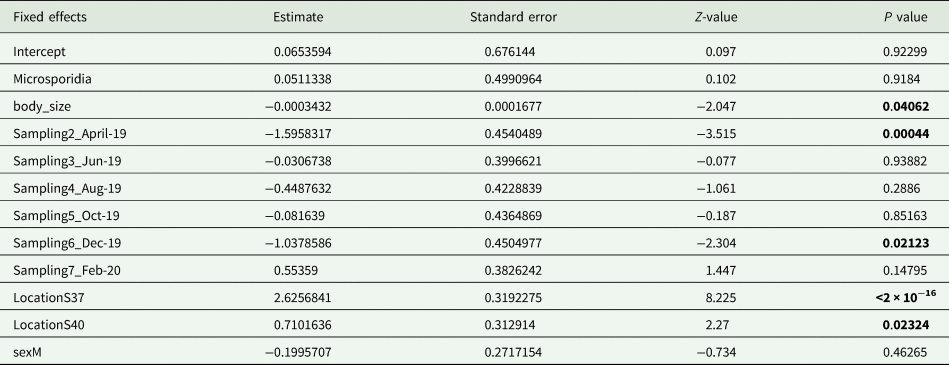
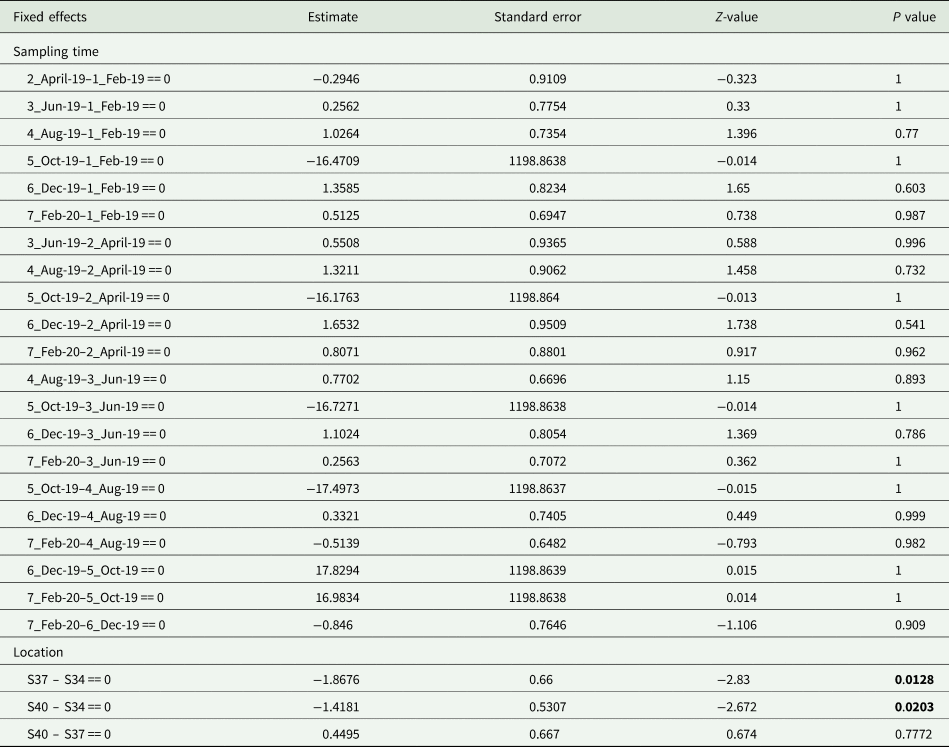
Both Microsporidia and Rickettsia were found from all three locations, but their prevalence changed throughout the year (Fig. 2A). Rickettsia was found in all locations at all sampling times, but Microsporidia were not found at some sampling times. The prevalence of Rickettsia showed ranges of 8.3–37.5%, 16.7–95.8% and 4.2–41.7% in the S34, S37 and S40 populations, respectively. On the other hand, the prevalence of Microsporidia was generally low, i.e. 0–8.3% and 0–12.5% in the S37 and S40 populations, respectively, although its prevalence reached up to 25% in winter at the S34 population. The GLM results supported the lack of temporal variation in the prevalence of Microsporidia (Table 1). On the other hand, the effect of sampling time (temporal effect) on Rickettsia infections was supported by GLM results (Table 2). Compared to the first sampling time (February), the April samples showed a significantly lower prevalence of Rickettsia. Also, locations had effects on the prevalence of both Microsporidia and Rickettsia, indicating that different host populations tend to have a different prevalence of both parasites. The S37 population has the highest prevalence of Rickettsia (z = 8.23, P < 2 × 10⁻¹⁶). The pairwise comparisons of the effects of different sampling times and locations, respectively, on infections by each parasite, are shown in Tables 3 and 4.
Glm result showing the effects of various factors on Microsporidia infections in Paracalliope fluviatilis amphipods. P values less than 0.05 are highlighted in bold.

Glm result showing the effects of various factors on Rickettsia infections in Paracalliope fluviatilis amphipods. P values less than 0.05 are highlighted in bold.

The pairwise comparisons of the effects between ‘sampling time’ ‘location’ on Microsporidia infections in Paracalliope fluviatilis amphipods from the GLM results. P values less than 0.05 are highlighted in bold.

Pairwise comparisons of the effects between ‘sampling time’ ‘location’ on Rickettsia infections in Paracalliope fluviatilis amphipods from the GLM results. P values less than 0.05 are highlighted in bold.

Co-occurrence of the two parasites
Individuals simultaneously harbouring both Microsporidia and Rickettsia were found in all locations and from several different sampling times (Fig. 2A). According to the GLM results, there was no effect of the infection by one parasite on the presence or absence of the other parasite (Tables 1 and 2). In other words, the presence of Microsporidia did not predict the presence of Rickettsia at the individual host level (z = 0.10, P = 0.92), and vice versa (z = 0.22, P = 0.82).
Discussion
We investigated the spatiotemporal variations in the prevalence of two parasites, Microsporidia and Rickettsia, sharing the same P. fluviatilis amphipod host species. There was no clear temporal variation in the prevalence of Microsporidia, but Rickettsia showed some temporal variations in prevalence among different sampling times. The prevalence of both parasites varied across locations, however, the patterns were different: Microsporidia were more common in the S34 population, and Rickettsia was more common in the S37 and S40 populations (Fig. 2 and Tables 1–4). Here, we discuss whether the observed temporal variation in the prevalence of Rickettsia may be associated with host population dynamics. Then, we discuss various factors that influence the temporal infection patterns within a population as well as spatial patterns at a larger scale. We also discuss the possible causes for the lack of co-occurrence of the two parasites at the individual host level.
Although clear temporal variations in the prevalence of Rickettsia along with seasonal changes were not seen, the April samples showed low prevalence in all populations compared to that of the previous sampling time (i.e. February). The difference in the prevalence of Rickettsia between the April and February samples is also supported by the pairwise comparison of means (Table 2). Because we only have data for one year, we do not know if the same patterns are consistent across years. The decrease in the prevalence in April could have been due to seasonal environmental change, stochastic processes, or it may be related to the change of the amphipod cohort. It may also be the product of the relatively modest sample sizes used in the analyses. The body size of both females and males was lowest during April, which means that the previous cohorts probably died and most individuals in the population at that time were a new, young cohort. As an obligate parasite, the strong dependence of Rickettsia on the host is assumed (Sibley, Reference Sibley2004), but more long-term data will be needed to better understand if there are indeed seasonal fluctuations in infection prevalence, and if so, what factors drive those patterns.
Host−parasite associations are shaped by various biotic and abiotic factors (Anderson and Sukhdeo, Reference Anderson and Sukhdeo2010). These factors are not the same among localities. The compositions of potential host and parasite species differ among localities, as do climatic and other environmental factors. Therefore, the absence of general temporal patterns may be due to biotic and abiotic heterogeneity among habitats. Although we did not find any evidence of non-random coinfection (or avoidance) patterns between Microsporidia and Rickettsia at the individual level in our three study sites, it is still possible that their distributions on a larger spatial scale are not mutually independent. Indeed, there is a difference in the spatial distribution of the two parasites across New Zealand. Although Microsporidia have been found throughout the country, Rickettsia was found only in the southern part of North Island and the southern part of the South Island (Park and Poulin, Reference Park and Poulin2020; Park et al., Reference Park, Jorge and Poulin2020). The reason for the absence of Rickettsia in the northern parts of both Islands is not understood yet but could be due to phylogeographic or environmental processes; this remains to be studied.
If and how microsporidians and Rickettsia interact with each other within the same host individual is not understood, but their interaction and co-occurrence can be largely shaped by their mode of transmission, and this could affect our interpretation. For example, even if both microsporidians and Rickettsia infect the same individual, the exact host organs and tissues they target (i.e. tissue tropism) and how they interact with the host cell may be different (Sahni and Rydkina, Reference Sahni and Rydkina2009; Tamim El Jarkass and Reinke, Reference Tamim El Jarkass and Reinke2020). If one is transmitted horizontally and the other is transmitted vertically, they are likely to be located in different tissues and organs and might not need to compete for the same resources. For instance, horizontally transmitted parasites are often found in the gut epithelium. On the other hand, vertically transmitted parasites are found from gonadal tissues (Dunn et al., Reference Dunn, Terry and Smith2001). If both parasites are mainly transmitted vertically, they may cause little or no pathogenic effects on the host and there would be no obvious conflict between them (Rigaud et al., Reference Rigaud, Perrot-Minnot and Brown2010). Intracellular endosymbionts have generally shown low virulence to their hosts (Dunn et al., Reference Dunn, Terry and Smith2001), therefore they may be able to coexist in the same individual host without strong conflicts. Elucidating mode of transmission in these newly found parasites would be needed to better understand their interactions.
Although evidence for strong conflicts between microsporidians and Rickettsia has not been seen, these endosymbionts may have conflicts of interests with other horizontally (including trophically) transmitted parasites. P. fluviatilis is an important prey item for fishes in New Zealand and is used as intermediate host by several different helminth parasites including trematodes and acanthocephalans (Lagrue et al., Reference Lagrue, Joannes, Poulin and Blasco-Costa2016; Friesen et al., Reference Friesen, Goellner, Poulin and Lagrue2019). While dissecting amphipods, we found a trematode species, Coitocaecum parvum with varying prevalence across sampling times and locations, but they did not show any positive or negative co-occurrence patterns with Microsporidia or Rickettsia (data not shown). However, still, complex interactions, on both ecological and evolutionary time scales, may exist between Microsporidia, Rickettsia and other macro- and microparasites, and these may be involved in generating observed patterns in the spatial distribution of the two focal parasites in this study. There are other factors that could also influence the co-occurrence patterns (e.g. demographic structure of hosts and uneven distribution of parasites within a habitat). More information about host and parasite biology would be valuable to disentangle various factors that shape complex interactions among them.
It also should be noted that different species or different strains of the same species of the parasites may have different pathogenicity and interact with other parasites and hosts differently. Among microsporidians, six species of Dictyocoela were detected in New Zealand so far, and three of them (D. sp. NZ1-3) were exclusively found from Paracalliope spp. showing evidence for host fidelity (Park et al., Reference Park, Jorge and Poulin2020). In this study, D. sp. NZ2 was detected in the S37 population and D. sp. NZ3 was detected from the S34 and S40 populations. Also, several strains of Rickettsia were detected, but if they have different pathogenicity has not been shown yet (Park and Poulin, Reference Park and Poulin2020).
From an evolutionary perspective, the coexistence of Microsporidia and Rickettsia in amphipod hosts is interesting. Canonical Microsporidia have several unique characteristics that make them different from their relatives (Park and Poulin, Reference Park and Poulin2021). One of the unique characteristics is the presence of ADP/ATP translocators (Dean et al., Reference Dean, Hirt and Embley2016), which allows microsporidians to effectively ‘steal’ energy from the host cell. These translocators are highly similar to those of Rickettsia or Chlamydia, and therefore it is believed that these translocators were horizontally obtained from these bacteria or their ancestors (Dean et al., Reference Dean, Hirt and Embley2016). Physical proximity must be a requirement for horizontal gene transfer. Therefore, it is likely that the ancestors of long-branch microsporidia and Rickettsia shared the same host cell. Their coexistence within the same host cell may have provided the evolutionary novelty which has led their joint evolutionary success.
Acknowledgements
We appreciate Jean-François Doherty for assisting in fieldwork. We are grateful to two anonymous reviewers for their helpful comments.
Author contribution
EP and RP conceived and designed the study. EP collected specimens, generated data and performed statistical analyses. EP and RP interpreted the results and wrote the article.
Financial support
This research was supported by a University of Otago Doctoral Scholarship to EP and also partly by Hutton Fund from Royal Society Te Apārangi to EP.
Conflict of interest
The authors declare there are no conflicts of interest.
Ethical standards
Not applicable.