Increasing ethnic and cultural diversity in populations worldwide and especially in immigrant countries such as Australia poses challenges for psychologists and counsellors in schools and other practice settings. According to the 2011 Australian census (Australian Bureau of Statistics, 2012), 24.6% of Australia's resident population was born overseas and 43.1% of people have at least one overseas-born parent. Since 2011, there has been an annual immigration intake of around 190,000 people from diverse birth countries (Department of Immigration and Border Protection, 2015). Also, according to the Organisation of Economic Co-operation and Development (2014), over 18% of Australian onshore tertiary students were international students, among whom 82% were Asian-born. In 2013, Australia hosted over half a million international students, with close to 18,000 in the school sector (Australian Education International, 2015).
In multicultural societies such as in Australia, it is vital for mental health professionals to be culturally aware and sensitive, and be effective in working with students and stakeholders from diverse backgrounds and those who have only recently arrived in the country (Goh, Reference Goh2005). In this article, we will use the terms clinicians, practitioners, and counsellors interchangeably to refer to the intended readership of this article, which includes school psychologists and counsellors, youth workers and other mental health professionals who work with people in cross-cultural contexts in educational or community settings.
Challenges for Counsellors and CALD Clients in a Multicultural Population
Australian psychologists and counsellors may find it challenging to interact and communicate effectively with culturally and linguistically diverse (CALD) clients, such as clients from non-English-speaking backgrounds (Pelling, Reference Pelling2007) and Asian-born international students (Barletta & Kobayashi, Reference Barletta and Kobayashi2007). Practitioners should be aware that CALD clients themselves may be experiencing similar and often more pronounced difficulties in everyday interactions as they navigate in an unfamiliar culture. Berry (Reference Berry, Sam and Berry2006) maintains that the changes that occur as a result of intercultural contact, known as acculturation, can lead to acculturative stress in immigrants, refugees and international students in adjusting to living in a new culture (see also Smith & Khawaja, Reference Smith and Khawaja2011).
Studies have examined concerns faced by specific CALD populations in Australia, including immigrants, refugees and international students. For example, Australian studies of Muslim immigrants suggest that this population may experience discrimination and a reduced sense of belongingness and wellbeing (Kalek, Mak, & Khawaja, Reference Kalek, Mak and Khawaja2010; Poynting & Mason, Reference Poynting and Mason2007). Investigations have shown that refugee populations in Australia may face difficulties adjusting to relocation, overcoming previous threats to safety, and adjusting to a new social environment (Murray, Davidson, & Schweitzer, Reference Murray, Davidson and Schweitzer2008). Furthermore, there is Australian research evidence that CALD international students may experience social disconnectedness and depressive symptoms during their sojourn (Mak & Kim, Reference Mak and Kim2011), and display more adjustment issues than their domestic student counterparts (Khawaja & Dempsey, Reference Khawaja and Dempsey2008). This implies a need for culturally appropriate counselling and guidance services for CALD individuals.
Harrison and Turner's (Reference Harrison and Turner2011) exploratory study with Australian social workers has noted views of cultural competence as a murky concept in practice. While some social workers doubted if it would be feasible to teach cultural competence without perpetuation of cultural stereotypes, all research participants endorsed the importance of individual experiential learning in developing cultural competence as part of their professional education. According to Sue and Sue (Reference Sue and Sue2012), becoming culturally competent in counselling diverse populations is a complex interaction of many dimensions that includes conceptual, affective, practice and training issues; this is a journey requiring an emotional awakening related to one's knowledge, beliefs, attitudes and behaviours related to ethnicity and culture.
The Psychology Board of Australia (2013) requires provisional psychologists to have demonstrated competence in working within a cross-cultural context, prior to their admission to full psychologist registration. However, there are no dedicated Australian Psychological Society guidelines for the provision of psychological services for CALD clients. This casts doubt on Australian psychologists’ readiness and competence for working with CALD clients (see also Pelling, Reference Pelling2007), and supervising psychologists’ capability to help intern or provisional psychologists develop the knowledge, skills and attitudes required of culturally competent practitioners.
The ethical requirement of providing culturally competent psychological and counselling services calls for research on Australian clinicians’ experiences with working with CALD clients, and indeed the intercultural communication challenges inherent in working with culturally different others. This includes communication with interns and health professionals from cultural and linguistic backgrounds different from one's own. A better understanding of (1) the intercultural social challenges observed in clinical practice and (2) what constitutes key intercultural communication skills can inform training of and professional development for psychologists, counsellors and other mental health professionals. Ultimately, this can contribute to reflections on and debates around the provision of ethical and high quality psychological and counselling services for Australia's increasing CALD populations in schools and community settings. This may also contribute to more effective communication between supervising clinicians and interns (or more junior clinicians), and among members of multicultural work teams, as an increasing number of Australian health professionals, teachers and interns are themselves from CALD backgrounds.
Sociocultural Competence and the EXCELL Program
There are various approaches to cultivating intercultural competence in human service professionals and, in turn, that in their clients (e.g., Collins & Pieterse, Reference Collins and Pieterse2007; Johnson, Reference Johnson2001; Sue, Reference Sue2006; Sue, Arredondo, & McDavis, Reference Sue, Arredondo and McDavis1992). Behavioural models of intercultural competence development that incorporate Bandura's (Reference Bandura1978, Reference Bandura1986) concepts of reciprocal determinism, social cognitive learning and self-efficacy are the most promising when the focus is on cultural learning or sociocultural adaptation (Ward, Bochner, & Furnham, Reference Ward, Bochner and Furham2001). According to Bandura (Reference Bandura1978), a person's functioning is determined by a continual interaction between cognitive, behavioural and environmental factors. This suggests that effective behavioural changes (e.g., in adapting to a novel cultural environment) may in turn lead to cognitive changes (such as a better self-concept) and a more congenial immediate social environment (e.g., increased social acceptance).
In applying Bandura's (Reference Bandura1986) social cognitive learning theory to optimising conditions for developing sociocultural competence, Mak, Westwood, Ishiyama, and Barker (Reference Mak, Westwood, Ishiyama and Barker1999) argue that the acquisition of skills for behaving appropriately within a new culture occurs through observing social role models and attempting to replicate their behaviour. When an individual is reinforced for replicating modelled behaviour, the frequency of that behaviour increases. Moreover, sociocultural competence requires not only skills, but also self-efficacy or a belief that one is able to carry out those skills. Counselling and training approaches underpinned by applying Bandura's concepts and emphasising extension (rather than replacement) of social skills to adapt to an increasingly globalised and complex world are likely to be effective in facilitating CALD clients’ development of sociocultural competence while respecting their original cultural identity (Mak et al., Reference Mak, Westwood, Ishiyama and Barker1999; Westwood, Mak, Barker, & Ishiyama, Reference Westwood, Mak, Barker and Ishiyama2000).
Neville and Mobley (Reference Neville and Mobley2001) discuss the notion of multicultural counselling competence and maintain that practitioners who understand the culturally appropriate way to behave with CALD clients may feel more confident in their intercultural social ability. The behavioural model of intercultural competence has promoted the development of intercultural training programs for enhancing intercultural social skills and increasing intercultural social self-efficacy (Bennett, Aston, & Colquhoun, Reference Bennett, Aston and Colquhoun2000; Mak & Buckingham, Reference Mak and Buckingham2007).
One such program is the EXCELL (Excellence in Cultural Experiential Learning and Leadership) program, a skills-based, practice-focused program that aims to increase intercultural social confidence and skills in academic and occupational settings (Mak et al., Reference Mak, Westwood, Barker and Ishiyama1998). Initially developed to help international students gain the skills necessary for quick adaptation to university life and to facilitate everyday intercultural interactions (Mak, Reference Mak2011), EXCELL training provides explicit teaching of six generic or key sociocultural competencies that are considered necessary for success in social integration in educational, work and community settings (Westwood et al., Reference Westwood, Mak, Barker and Ishiyama2000). These include the access competencies of participating in a group or team setting, seeking help or information, making social contact or conversations; and the negotiation competencies of refusing a request, expressing disagreement, and giving feedback.
Applied psychological and educational research (e.g., Barker & Mak, Reference Barker and Mak2013) and practice of the EXCELL co-developers have suggested that key social competencies can provide the building blocks for a range of culturally effective social behaviours as circumstances arise. Further, generic sociocultural competence development could be beneficial to not only CALD international students and immigrants, but also pre-service and in-service professionals, such as teachers, psychologists and counsellors. EXCELL's key sociocultural competencies framework acknowledges how crossing into cultures with different values, norms and practices can introduce challenges in understanding and executing what constitutes culturally appropriate behaviours in some of the most common types of social encounters.
The Present Study
The present study aimed to identify qualitative themes in supervising, practising and intern psychologists’ perceptions of challenging intercultural social scenarios in clinical practice, and then to compare these themes with EXCELL's existing framework of key sociocultural competencies (Mak et al., Reference Mak, Westwood, Barker and Ishiyama1998; Westwood et al., Reference Westwood, Mak, Barker and Ishiyama2000). We planned to conduct the thematic analyses in two stages. First, we would identify common themes through open coding. Second, we would compare these themes with the EXCELL key competencies to determine areas of difference and similarity.
This study was the first investigation of supervising, practising and intern psychologists’ perceptions of intercultural social challenges, and also the first to compare these to an existing (the EXCELL) framework of sociocultural competencies. Identifying areas of difficulty may uncover: (a) intercultural challenges beyond those inherent in the development of generic sociocultural competencies, and (b) key sociocultural competencies additional to those indicated in the EXCELL framework. Such knowledge derived from critical incident analysis — in this case analysis of the challenging intercultural scenarios in psychological practice — would be useful for developing intercultural training resources (see Collins & Pieterse, Reference Collins and Pieterse2007), to meet the professional education needs for psychologists and counsellors in schools and other practice contexts. This study could represent the first step toward advancing intercultural training for clinicians at all levels of experience and improving counselling and guidance services for CALD clients.
Method
Participants
Participants were 13 psychologists at various levels of qualifications. They comprised six clinical psychology interns and three supervising psychologists recruited from a mid-sized university, and four practising psychologists recruited from a large private practice in clinical and forensic psychology, in a small metropolitan capital city in Australia.
Of the sample, 10 were female (76.9%) and 3 were male (23.1%). Six were intern psychologists (46.2%), 4 were practising psychologists (30.8%), and 3 were supervising psychologists (23.1%). Participants had a mean of 4.7 years of practical experience (SD = 5.17), 1.5 years of experience supervising (SD = 3.07), and 1.4 years of experience teaching (SD = 3.10). One focus group session was run for intern psychologists (six participants), two for supervisors (two participants and one participant, respectively), and two for other practising psychologists (three participants and one participant, respectively). The two single-participant sessions were effectively conducted as interviews.
Measures
Prior to each focus group, participants were invited to complete a brief survey that contained a small section on demographic background. This section assessed whether the participant was an intern psychologist, a supervisor of practicum placements or an industry professional, and whether male or female. This section also asked participants to report the number of years they had been involved in their current role.
An open-ended item in the survey asked participants to provide examples of one or more challenging intercultural social scenarios experienced in their practice of psychology. Participants were prompted to use and share their responses to this section of the survey, if they so chose, for the subsequent focus group discussion on the topic of challenging intercultural social scenarios in psychological practice.
Procedure
Approval was obtained from the university's Committee of Human Research Ethics prior to the conduct of this research. Intern and supervising psychologist participants were recruited using purposive sampling, via email invitations sent to relevant clinical psychology students and staff members at the university. Private practice psychologists were recruited via first obtaining consent from the chief psychologist of the practice.
Five focus group sessions were organised around participant availability, and these sessions were then facilitated by one or both of the authors. Three focus group sessions — an intern psychologist session and two supervising psychologist sessions — were held in the university psychology clinic. Two sessions for practising psychologists were offered at the private psychology practice.
Focus group participants were welcomed and provided with light refreshments after settling into the research room. At the start of each session, the facilitator explained the purpose of the study and sought informed consent from participants to participate on a voluntary basis. Participants were then invited to complete a brief survey that took 5 to 10 minutes. They were encouraged to participate in the subsequent focus group discussion by referring to or reflecting on their responses to the survey item on challenging intercultural social scenarios experienced in their practice. As participants shared and discussed their experiences, the facilitator aimed to adopt a non-judgmental stance and to avoid interruptions to the discussion. Each focus group session lasted for approximately an hour. The discussion was audio recorded and professionally transcribed.
Results
Following Braun and Clarke's (Reference Braun and Clarke2006) recommended procedure for conducting thematic analysis using a bottom-up approach, we initially conducted analyses of the qualitative data transcripts using the open coding method, with the second author actively searching for common themes in the data without referring to a theoretical framework. Each transcript was open coded on four occasions, a week apart, beginning in the fortnight after the focus group. The four sets of codes for each transcript were then compared to identify the most accurate overarching themes. A final set of themes was identified and then compared with the existing EXCELL framework of sociocultural competencies. The codes were also checked by the first author on two occasions and refined following discussion among the researchers, prior to the final extraction of themes. In our coding, we noted whether the intercultural challenge identified: (a) was a challenge for the client, the psychologist or both; and (b) had emerged in a focus group session with interns, supervising psychologists or other practising psychologists.
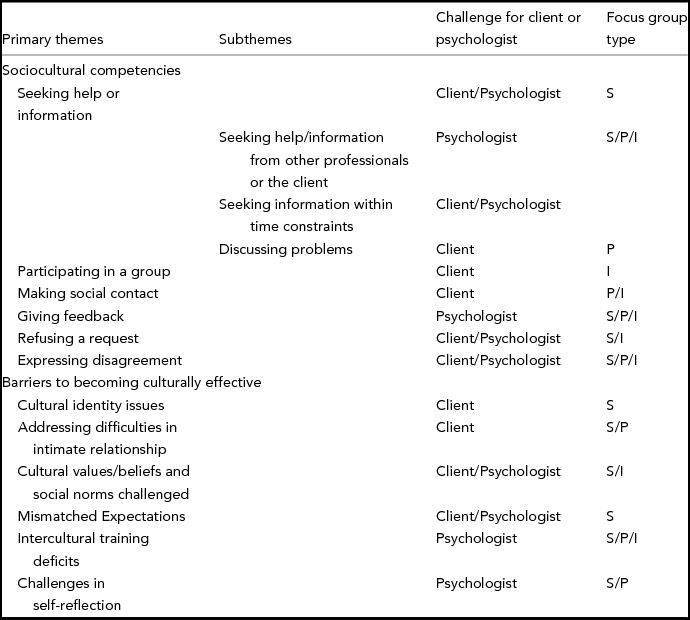
Table 1 lists the 12 primary themes of challenging intercultural social scenarios identified in the analysis, the classification of client or psychologist challenges, and the type of focus group. Six of these themes corroborated with EXCELL's six key sociocultural competencies — seeking help or information, participating in a group, making social contact, giving feedback, refusing a request, and expressing disagreement. Within seeking help or information, we identified three subthemes: seeking help or information from other professionals or the client, seeking help or information within time constraints, and discussing problems.
Themes of Challenging Intercultural Social Scenarios in Clinical Practice

Note: S = Supervisor, P = Psychologist, I = Intern.
The other six themes identified could be labelled as barriers to becoming culturally competent. These barriers included: cultural identity issues; having to address difficulties in intimate relationships; challenges to cultural values, beliefs and social norms; mismatched expectations; intercultural training deficits; and challenges in self-reflection.
Challenges Due to Underdeveloped Sociocultural Competencies
Seeking help or information
All focus groups identified scenarios involving seeking help or information as posing difficulties for clients and psychologists. Focus groups revealed that actively seeking information from CALD clients and sometimes from relevant cultural informants and professionals in external agencies was vital for psychological evaluation and therapy. However, the process of establishing trust and seeking sensitive information around mental health and other personal experiences was often challenging for psychologists. Such difficulties were compounded for some clients who were from cultural backgrounds that did not encourage seeking help from mental health professionals, and such clients also found it hard to have to discuss their problems in a second language. This was particularly challenging when the psychologists were working in schools or other time-pressured settings with high workloads, or in practices that bulk bill:
It's a lot to cover when you’re in therapy with someone for six sessions, to do a sensitive intercultural assessment. I think that's actually hard to do in the time frame, and then get onto treatment. (Psychologist challenge; Psychologist focus group)
Participating in a group
A primary theme involving the sociocultural competency of participating in a group was identified by the intern focus group. Focus group participants identified that some CALD clients had reported difficulty participating in a group setting:
The other one is participating in a group. It would be important for him to do that in order to feel like he belonged in that group rather than an alienated outsider. (Client challenge; Intern focus group)
Making social contact
Making social contact was identified as a key area of challenge for clients by the psychologist and intern focus groups:
Because people are really isolated. With these clients, they’ve come from overseas and are away from a lot of their networks. (Client challenge; Psychologist focus group)
Giving feedback
All focus groups identified that, although giving feedback is useful in a therapeutic relationship, doing so is particularly challenging when working with CALD clients:
I’m saying to someone, look it doesn't quite work like that; I can't do that for you, that's not my job, the university can't do that, but we can do this. There's this sense that there's a cultural expectation that you’ll fix it, which is a bit different to the Western idea of a psychologist. (Psychologist challenge; Intern focus group)
Refusing a request
Supervisor and intern focus groups revealed that refusing a request was challenging for clients and psychologists alike:
In one of the families, they are in a family business and the wife hates it. She's seen as being difficult by the rest of the family because she's constantly challenging things. And then she's brought her husband in and they immediately want him in the family business too. And they want to move away. What they recognise is that they will probably not be able to do that effectively unless they actually leave this city altogether and that will be their exit. (Client challenge; Supervisor focus group)
Expressing disagreement
Participants from all three types of focus groups identified the sociocultural competency of expressing disagreement to be difficult for clients and psychologists alike:
For instance, if you take something like female circumcision that is accepted in some places, [well], in Australia we don't accept it. Even though people come from a different culture, we don't accept it. (Psychologist challenge; Supervisor focus group)
Combinations of sociocultural competencies
Participants’ responses indicated that some challenges required the use of combinations of the basic competencies in the EXCELL framework. For example, negotiation — a reported challenge for CALD clients — could involve a combination of giving feedback, expressing disagreement, and sometimes refusing a request or making social contact.
Barriers to Becoming Culturally Competent
Our analysis identified six further challenges. As shown in Table 1, we describe these barriers as challenges that affect communication and the provision of psychological services to CALD clients.
Cultural identity issues
The supervisor focus groups identified that some CALD clients experience difficulties due to competing cultural identities:
Yeah, I dealt with a person who was adopted into an Australian family and although the person was Asian, they were offended if you related to them as an Asian. It was kind of like a nuisance that their Asian identity was so obvious. (Client challenge; Supervisor focus group)
Addressing difficulties in intimate relationships
Supervisor and psychologist focus groups discussed client difficulty in intercultural romantic and family relationships:
She presented with relationship difficulties. They’ve moved in together which is causing a whole bunch of issues, never really having lived with anyone [sic]. The biggest thing is that she moved over here on the assumption that they would get married within, maybe, a month of her being here. She has that belief because in Mexico the minute you move in with someone, that is in itself the level of commitment of a marriage. (Client challenge; Psychologist focus group)
Cultural values, beliefs and social norms challenged
The supervisor and intern focus groups identified that intercultural interactions would become more challenging for both clients and psychologists when faced with differences in cultural values, beliefs and social norms.
The wives had little education, but had been used to being in a violent home. In one case, the wife was virtually being kept captive within the house. Then they had come to Australia and realised that wasn't the norm. So the practice was being challenged. (Client challenge; Supervisor focus group)
Mismatched expectations
All groups identified that expectations could interfere with intercultural relationships. Psychologists found it more challenging to manage assumptions when working with culturally different clients. Clients found the relationship challenging when their expectations were not met:
We had one guy I’ll never forget. I said, ‘Would you like to have an elder present? Would you like to relate to this special agency?’ and he says, ‘No, not at all. I don't need a black fella telling me what to do. I prefer a white fella telling me what to do.’ (Psychologist challenge; Supervisor focus group)
Intercultural training deficits
All focus groups raised the fact that there is a lack of training and resources for psychologists to work with culturally different clients:
So the reality is that if you are working with someone from a different background, there are very limited resources that you can draw on. (Psychologist challenge; Psychologist focus group)
Challenges in self-reflection
Supervisor and psychologist focus groups identified that although a psychologist's self-reflection is an important skill, it is more difficult to use this when working with culturally different clients:
If I was a French psychologist, would I be worried? It's about norms. What is the norm in that culture and therefore where are they? Are they straying from the norm or is it just unusual from your culture? (Psychologist challenge; Psychologist focus group)
Model of Culturally Competent Counselling Practice
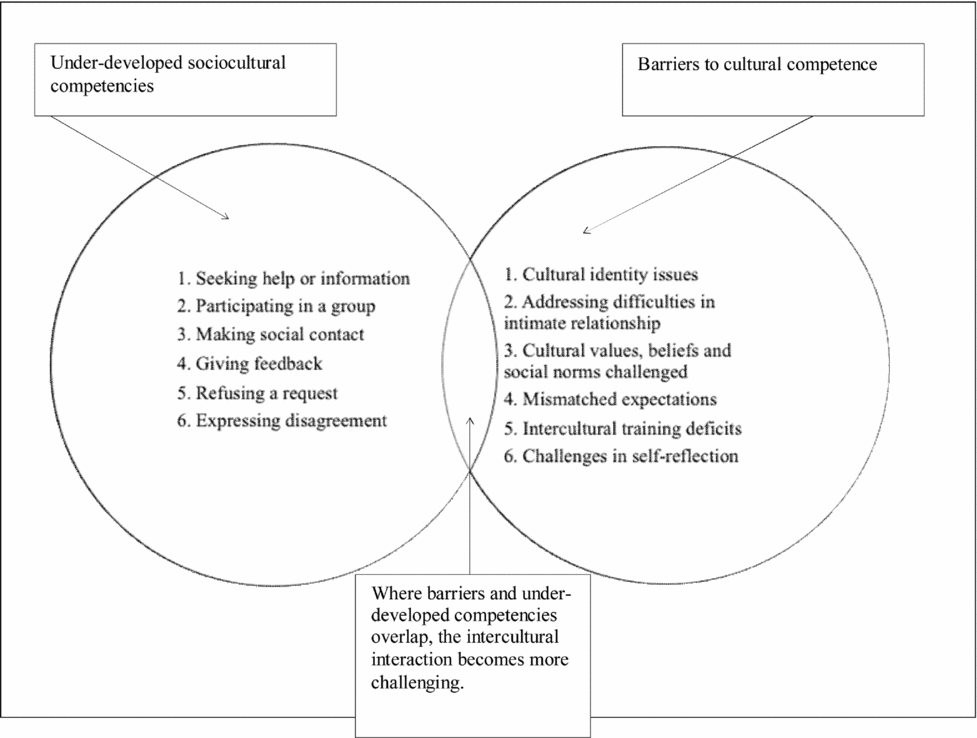
Figure 1 depicts a model of Culturally Competent Counselling Practice derived from the current findings in a Venn diagram. It displays all 12 identified themes listed under the frameworks of (1) underdeveloped sociocultural competencies and (2) barriers to cultural competence, with the overlap area suggesting that intercultural social interactions could become particularly challenging in the presence of both underdeveloped sociocultural competencies and barriers to cultural competence.
Model of culturally competent counselling practice comprising the identified themes.
Discussion
We have found that perceptions of challenging intercultural social scenarios in clinical practice can be classified into two main categories, and depict how they may overlap in a proposed model of Cultural Competence for Counselling Practice in Figure 1. Intercultural interactions are challenging when key sociocultural competencies are underdeveloped in one or both parties involved in the client–psychologist communication. Interactions can also be challenging when there are other barriers to cultural competence; these can be due to either client or psychologist characteristics or both. Interactions appear to be most challenging when both underdeveloped competencies and barriers are present in an intercultural therapeutic relationship.
Consistent with Mak et al. (Reference Mak, Westwood, Barker and Ishiyama1998) and Westwood et al.'s (Reference Westwood, Mak, Barker and Ishiyama2000) EXCELL framework, we found that many of the challenging situations — often for clients and psychologists alike — could be classified as those requiring the key or generic sociocultural competencies of seeking information or help, participating in a group, making social contact, giving feedback, refusing a request and expressing disagreement. Focus group participants provided examples of how both clients and psychologists could be challenged, while crossing cultures, in seeking information or help, refusing a request or expressing disagreement. CALD clients were further observed to find it challenging to participate in a group and make social contact.
Moreover, both intern and registered psychologists (in supervisory or psychology practice roles) came up with similar themes of challenging intercultural social scenarios, in what they had observed in themselves and cultural others in their psychological practice. Both the less experienced interns and the experienced psychologists quoted psychologist challenges in seeking information, giving feedback, refusing a request and expressing disagreement. This finding suggests the universal or generic nature of basic sociocultural competencies is relevant for practitioners at all levels of experience.
Present results also demonstrated that some challenging cross-cultural encounters, such as those involving negotiations, required a combination of social competencies. This suggests that the provision of EXCELL-type intercultural training to clients could follow a graded approach, where facilitators would first of all help clients master the individual generic competencies before assisting clients to tackle more complex intercultural social situations that call for the utilisation of combinations of competencies (see also Mak et al., Reference Mak, Westwood, Ishiyama and Barker1999).
Notably, we found that there are various barriers in intercultural therapeutic communication that can hinder culturally competent practice, and make it difficult to implement sociocultural competencies. Barriers due to differences in cultural values/beliefs/norms and mismatched expectations can be challenging to clients and practitioners alike. Interestingly, more of these barriers in communication were brought up in the registered psychologist focus groups, compared with the intern focus groups. This is likely to reflect the greater clinical experience among the supervisors and other practitioners.
We found that cultural identity issues represent one of the barriers to cultural competence. Such issues have also been found to be pertinent in studies of bicultural individuals and sojourners (Hoerstring & Jenkins, Reference Hoerstring and Jenkins2011). People may become defensive and anxious if they sense that their cherished cultural identity is under threat. It is important that counsellors build rapport and therapeutic alliance with their clients that involves respect for and validation of their cultural identities, especially in the initial stage of the individual or group counselling sessions.
Having to address difficulties in intimate intercultural relationships was identified as representing another barrier to cultural competence. Previous research also suggests that cultural differences in intimate relationships may exacerbate relationship stressors (Beiver, Bobele, & North, Reference Biever, Bobele and North1998). It is possible that applying sociocultural competencies such as expressing disagreement or giving feedback becomes more difficult when the intercultural relationship is romantic or involves family members, owing to the intensely emotional nature of such relationships.
Another identified barrier — for both clients and psychologists — was when cultural values, beliefs and social norms were challenged. Consistent with this, Galchenko and Van de Vijver (Reference Galchenko and Van de Vijver2007) suggest that interactions with members of another culture become more challenging as cultural distance increases. Practitioners who acknowledge this barrier could potentially create reciprocal cultural learning opportunities for themselves and the clients. It is often useful to ask the client, in a non-judgmental manner, how things are usually done in his/her original culture, and discuss the underlying values; this can also demonstrate respect for the client's original culture. Diverse social norms for appropriate behaviours (e.g., to maintain or divert eye contact) may in fact reflect identical (and sometimes universal) values such as respect. Also, as clients (and clinicians) become aware of the implicit values underlying certain social behaviours, their anxiety about cultural distance may be ‘normalised’ and alleviated, while their motivation for cultural learning (e.g., in relation to the key sociocultural competencies) could in fact increase.
We found that mismatched expectations represent yet another barrier to intercultural effectiveness. This corroborates with Caligiuri, Phillips, Lazarova, Tarique, and Burgi's (Reference Caligiuri, Phillips, Lazarova, Tarique and Burgi2001) finding that sojourner positive adjustment to a new culture was predicted by realistic expectations of the stay prior to departure. Again, acknowledging the frustrations with disconfirmed expectations could provide mutual intercultural learning opportunities. There is emerging research evidence that expectancy disconfirmation in cross-cultural contact could be beneficial for the development of cultural intelligence (Rosenblatt, Worthley, & MacNab, Reference Rosenblatt, Worthley and MacNab2013).
All focus groups identified that the lack of intercultural training for psychologists would be a barrier to culturally competent practice. Compounding this concern, there is a general lack of cultural diversity in models of psychology theory and research that inform psychological practice (Arnett, Reference Arnett2008). Cognitive counselling methods involving judgment of the appropriateness (e.g., rationality) of thoughts could be particularly problematic in working with CALD clients. The authors contend that cultural validation and a focus on cultural learning of key social competencies (such as in the EXCELL experiential cultural learning model) could work well in preparing counsellors for practice in cross-cultural contexts. Counsellors who have experienced these methods first hand are better placed to help their CALD clients to develop their intercultural social skills using similar experiential learning approaches.
Current results further reveal that clinician self-reflection can be challenging when working with culturally different clients and that poor self-reflection can impede intercultural effectiveness in working with cultural others. Bennett-Levy and Thwaites (Reference Bennett-Levy, Thwaites, Gilbert and Leahy2007) maintain that self-reflection is a challenging but an important skill that must be constantly practised to manage the impact of assumptions on the therapeutic relationship. It would be even more important for counsellors to practise self-reflection in working with clients and stakeholders in cross-cultural contexts, owing to differences in cultural beliefs, values, attitudes and social behaviours (Sue & Sue, Reference Sue and Sue2012). Working with cultural mentors could facilitate that process.
Implications for Practice in Schools
This study has several implications for counselling practice in cross-cultural contexts in schools. Present findings demonstrate the complexity of intercultural relationships, especially those that are therapeutic, intimate, or between family members. Such complexity often amplifies the acculturative stress experienced by CALD students, and presents additional obstacles when they have to access and engage with guidance and mental health care services. The utilisation and delivery of psychological and counselling services are undermined by a lack of interpersonal empathy and trust. This, along with Australia's growing multicultural population, highlights the importance of improving intercultural sensitivity and skills training for psychologists, counsellors and mental health professionals at all levels of experience.
The present study found that many of the challenges experienced by intern and registered psychologists are consistent with Westwood et al.'s (Reference Westwood, Mak, Barker and Ishiyama2000) EXCELL sociocultural competencies framework. It could be beneficial to provide interns with training in teaching their clients some or all of EXCELL's key competencies (participating in a group, seeking help or information, making social contact, refusing a request, expressing disagreement and giving feedback). It would also be appropriate to embed intercultural competence development in the undergraduate curriculum in order to better prepare them for working in multicultural and international environments (see Barker & Mak, Reference Barker and Mak2013; Knott, Mak, & Neill, Reference Knott, Mak and Neill2013).
Professional development in the form of facilitator training courses can equip psychologists, counsellors and teachers with the skills to offer intercultural social skills and communication training (such as all of part of the EXCELL program) to individual and groups of students (Mak, Reference Mak2011; Mak et al., Reference Mak, Westwood, Barker and Ishiyama1998). In the full EXCELL program, prior to the teaching of each of the key sociocultural competencies, counsellors build alliance with and validate the original culture of the clients (Mak, Reference Mak2011; Westwood et al., Reference Westwood, Mak, Barker and Ishiyama2000). The subsequent EXCELL stages involved in the teaching of a sociocultural competency are: development of a cultural map, coaching that includes demonstration/practice/feedback, goal setting/contracting, and transfer of learning to real life. Cultural mapping provides a schematic representation of a sequence of verbal and non-verbal behaviours that makes explicit the unwritten social rules for a commonly occurring scenario. Program evaluation research has found EXCELL to be beneficial for developing tertiary students’ development of social skills, cultural learning and intercultural social self-efficacy (Ho, Holmes, & Cooper, Reference Ho, Holmes and Cooper2004; Mak & Buckingham, Reference Mak and Buckingham2007; Mak, Daly, & Barker, Reference Mak, Daly and Barker2014).
Limitations and Implications for Future Research
The present preliminary qualitative research has several limitations. First, all of the focus group participants were Australian-born, meaning that the opinions expressed may not truly reflect multicultural Australia. Future research could use a larger sample and examine a more culturally diverse population of psychologists, counsellors and other mental health professionals.
While it has been an original feature to examine clinicians’ perceptions of intercultural relationships in the current research, it would also have been useful to examine client perceptions. For instance, what are CALD students’ perceptions of challenging intercultural interactions in relating to school psychologists, teachers and local students? And in what ways would their national/ethnic/religious backgrounds and the educational environment (e.g., cultural inclusiveness as part of the school's ethos) contribute to those challenges? Future studies could also explore clinician and client perceptions of intercultural challenges in varied counselling contexts, such as in organisational, health and community settings.
We acknowledge that the use of thematic analysis may have rendered results that have been influenced by researcher bias or pre-existing knowledge. We tried to minimise this bias by following Braun and Clarke's (Reference Braun and Clarke2006) recommended procedure in conducting thematic analysis by initially open coding the data over several weeks, and by involving two researchers in the coding process. Future investigations could build on the current research and use other research methods such as semi-structured interviews for more in-depth exploration of psychologist and client experiences and change processes.
The conduct of quantitative studies using the proposed model, which incorporates the key competencies and the barriers to cultural competence framework, would enable a better understanding of the relative importance and frequency of occurrence of the themes identified in the current focus group study. Studies taking into consideration both organisational factors (such as school climate and resources) and cross-cultural attitudes of various stakeholder groups (such as parents, teachers, CALD students and Australian students from the majority Anglo-Celtic heritage group) would be valuable in identifying the counselling and support needs of CALD students.
Goh (Reference Goh2005) has argued that highly developed cultural competence is integral to the mastery of mental health counselling. Future research could investigate the efficacy of the EXCELL program for training of school psychologists and counsellors, as well as its efficacy when implemented in various educational and clinical applications. Further investigations could also focus on counsellors’ self-reflections of their own cultural selves, as well as their perceptions, skills and attitudes towards working with cultural others.
Conclusion
The qualitative study reported was the first investigation to examine Australian psychologists’ perceptions of challenging intercultural social scenarios. Focus group discussion suggests recurrent themes in clinicians’ (regardless of their levels of experience in practice) perceptions of challenging intercultural social scenarios, for both practitioners and clients. These themes are broadly congruent with the generic sociocultural competencies framework as specified in the EXCELL intercultural training system. Results also reveal several barriers to cultural competence. In a proposed model of Culturally Competent Counselling Practice that captures these findings, we observe that intercultural social interactions appear to become increasingly challenging when sociocultural competencies are underdeveloped, and when other barriers impacting on the intercultural therapeutic relationship are also present. This model could be incorporated into improved training and professional development for psychologists and counsellors. This can ultimately increase student access to culturally appropriate guidance and mental health services. More research in this area, including testing and refinement of the proposed model of Culturally Competent Counselling Practice in schools and other practice settings, is vital to ensure the ongoing success of psychological and counselling services in increasingly multicultural societies.