Introduction
Several factors make Central Asia uniquely important to the study of world history.Footnote 1 The region is by definition a frontier zone at the heart of Eurasia, known to most through its role on the Silk Road, or as the home to such conquerors as Chinggis (Genghis) Khan (c. 1167–1227) and Tamerlane (1336–1405). As a region that encompasses both pastoral-nomadic steppe and sedentary agricultural zones, its history is also extraordinarily complex. Over the past thousand years the traditionally Persian (or more precisely, Tajik) local populations have been joined, and in many places subsumed, by successive waves of Turco-Mongol nomadic tribes migrating from the northern steppe. This has resulted in a complicated ethnic landscape. In terms of law and legitimacy, it has also made the region a locus of tension and negotiation between pastoral-nomadic steppe traditions and sedentary Perso-Islamic ones. During the eighteenth and nineteenth centuries, as participants in Islamic reform movements from Senegal to Indonesia debated the merits and validity of shari’a (Islamic law), qanun (statute) and ‘ada (custom), similar debates were carried out across Central Asia.
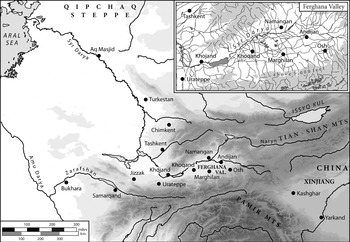
Situated in the southeast corner of modern Uzbekistan and surrounded by the snow-capped peaks of the Tian Shan and Pamir mountain ranges, the Ferghana Valley (see Figure 1) has been a crossroads of civilizations and one of the most densely populated regions of Central Asia for more than two thousand years. In an arid zone, the Ferghana Valley offers fertile soil and a rare abundance of water, drawn primarily from the annual snowmelt that feeds the Syr Darya river, and from the hundreds of kilometres of canals that irrigate nearly every corner of the valley. Combined with long summers of plentiful sunshine, this has enabled farmers to produce a surplus of rice and wheat, as well as apricots, peaches, apples, grapes and melons legendary for their size and sweetness. The valley enjoys an extra measure of commercial importance, as it lies on the caravan route that most directly connects Bukhara, Samarqand and other urban centres west of the Tian Shan Mountains with Kashghar, Yarkand and further east. As a result, prior to the establishment of the modern political boundaries, the Ferghana Valley was considerably less remote than it seems today.
Map of the Ferghana Valley

The present study focuses on the Khanate of Khoqand, a short-lived but dynamic state that arose in the Ferghana Valley in the eighteenth century, flourished in the early decades of the nineteenth century, and then collapsed on the eve of Russian colonial conquest.Footnote 2 While the Khanate is generally considered to have begun during the reign of ‘Alim Khan (r. 1799–1811), its early history can be traced to the first decade of the eighteenth century, when the Uzbek Ming tribal aristocracy began to emerge as a significant power in the region.Footnote 3 The Uzbek Ming tribe expanded its position substantially over the next few decades, but remained merely the most successful of a number of tribal and religious groups vying for political authority in the valley. Its transformation into a major power in Central Asia began only in mid-century, when armies of the Qing (Manchu) dynasty expanded the Chinese empire westwards, and, according to Chinese sources, the ruler of Khoqand began sending tribute missions to Beijing. Contrary to long-held notions of Central Asian isolation and decline in this period, Khoqand maintained a policy of deliberate engagement with both China and Russia, promoting economic growth, urbanization, the expansion of irrigated agriculture, and the development of an impressive Islamic religious landscape in the valley.
Khoqand had emerged dominant by the end of the eighteenth century, but politically it remained a loose confederation of city-states. It is for this reason that the Khanate of Khoqand is generally considered to have officially begun when the Uzbek Ming ruler ‘Alim Khan ascended the throne of Khoqand and successfully asserted centralized regal authority over the entire Ferghana Valley. During his twelve-year reign, ‘Alim Khan instituted a revolutionary and bloody purge of the entrenched religious elite and tribal aristocracy which he followed with successful campaigns of military expansion. By the time of his assassination in 1811, he had led his army to victory over the neighbouring Bukharan Khanate, annexed Tashkent, and begun to extend his control over steppe territory to the north. Since the mid-eighteenth century, rulers of Khoqand had demonstrated an appreciation for the value of controlling trade routes as a means to strengthen their military and political position in the valley. At the beginning of the nineteenth century, with a lucrative relationship in place with China to the east, and a growing control over the trade routes that led toward the Russian commercial outposts in the north, the Ferghana Valley was ideally positioned at a crossroads of Eurasian trade. This had profound political and economic implications, and laid the foundations for an impressive Islamic cultural efflorescence during the celebrated reign of ‘Alim’s brother and successor, ‘Umar Khan (r. 1811–22).
Despite the historical relevance of this region and its importance to modern Central Asian Islam, scholars have devoted few pages to the history of Khoqand.Footnote 4 The seminal study remains the one Vladimir Nalivkin produced some 120 years ago, just a decade after the Khanate was dissolved and incorporated into the Russian Empire.Footnote 5 Nalivkin’s work was an impressive example of Orientalist scholarship, drawing heavily on Central Asian sources to craft a detailed political narrative of the rise and fall of Khoqand. As one might expect given scholarly traditions popular in the late nineteenth century and the embryonic state of the field at the time, his work suffers from errors, misperceptions, and a rather myopic perspective. In subsequent years scholars have directed considerably more attention to Central Asian historical subjects, but the history of Khoqand has been dogged by a longstanding philological tradition in the study of Central Asian history, privileging the mastery of ‘Oriental’ texts over historical analysis. To be sure, scholars working within this tradition have produced a valuable body of translations and scholarship, rich in detail and critical for the study of Central Asian history. But they have also tended to approach Central Asia in isolation from its neighbours and from larger world historical processes, and this has resulted in a skewed perception of early modern Central Asia as an unimportant, even irrelevant, backwater.
This essay revisits the early development of the Khanate of Khoqand with the aim of reaching an improved understanding of the factors that precipitated its rise and maturity. It employs a methodology substantially different from those previously used. While remaining firmly grounded in the Islamic primary sources, the discussion endeavours to transcend their inherent limitations in perspective and scope by interpreting them with a much broader historical lens. By juxtaposing the local with the global, this study aims to illuminate some of the ways in which the Ferghana Valley, and indeed the whole of Central Asia, remained interactively engaged with world historical processes throughout the early modern era. Ideally, this approach will lead to a better understanding of how larger historical processes unfolding across the globe informed local conditions in Central Asia, and how Central Asians’ responses to these developments impacted on their neighbours. This is especially relevant to ongoing discussions of Russian colonial expansion into the region.Footnote 6 The purpose here is thus to elucidate: first, the larger context in which the Uzbek Ming tribe was able to establish control over the Ferghana Valley; second, the specific methods that ‘Alim Khan (r. 1799–1811) used to transform his inherited realm from a decentralized state confined to the Ferghana Valley into the more centralized and powerful Khanate of Khoqand; and third, the means by which ‘Alim Khan’s brother and successor, ‘Umar, managed to construct an Islamic regime that, while brief, was capable of launching a successful bid for religious legitimacy in the region vis-à-vis Bukhara, in ways which continue to inform the religious life of people in the valley today.
Putting Khoqand in perspective
Efforts to explain the rise of Khoqand have generally pointed to two local factors, a brutal purge by ‘Alim Khan of political and religious figures in the valley, addressed below, and the marked economic and political decline of Khoqand’s western neighbour, Bukhara, which could not retain authority over the valley’s recalcitrant tribal chieftains (‘feudal lords’ in Soviet-era literature). This Bukharan decline has been attributed to several factors, notably a deterioration of the Central Asian caravan trade, stemming from the rise of European trade in the Indian Ocean. In the eighteenth century, if not before, the Central Asian Silk Road societies were unwittingly pushed to the margins of the emerging global economy. There they remained, passive, disengaged and despotic, until the onset of Russian colonization.
In recent years this argument has come under close scrutiny and it is gradually being challenged and revised.Footnote 7 A growing body of literature in multiple fields of history demonstrates that Central Asians remained very much engaged with the wider world in this period, thus chipping away at entrenched notions of stagnation, isolation and decline.Footnote 8 Perhaps most importantly, while there is a general acceptance that Europeans played an important and increasingly dominant role in Indian Ocean commerce from the onset of the sixteenth century, the Asian commercial arena as a whole was by no means defined by European market demand. As Europeans were flourishing, portfolio capitalist firms in China and India developed heavily capitalized, influential and impressive commercial networks (or trading diasporas) of their own. Furthermore, competition between overland and maritime trade routes was not a ‘zero sum game’, for an increase in maritime trade, even a dramatic one, did not necessarily precipitate a decline in caravan trade.
Tectonic shifts in the commercial landscape have led world historians to explore the global economic ramifications of the Spanish conquests in the Americas, and the fervour with which Spanish conquistadors and colonists exploited the rich bullion reserves of the Americas. Estimates regarding the amount of silver exported from the Americas in the years 1565–1685 place the figure as high as 25,000 to 35,000 tons per year. This impressive sum increased further, possibly doubling in the years 1685–1810.Footnote 9 As ships loaded with specie sailed both east and west from the Americas, much of this wealth circulated around the globe and found its way into the Chinese and Indian Ocean economies. From the eighteenth century, this was augmented by a dramatic increase in the productivity of silver mining in various locations across Russia.Footnote 10 World historians have directed some attention to the effects of the injection of specie on a number of core regions in the global economy, especially China, India, Southeast Asia, and, last but not least, Europe.Footnote 11
Considerably less attention has been directed to the ramifications of growing global trade in more distant markets, such as those in Central Asia, but some evidence suggests that it actually fuelled an increase in overland trade, along both latitudinal and longitudinal routes. As the Chinese economy absorbed immense amounts of New World silver through its eastern seaboard, Chinese firms rapidly expanded their interests across the empire and beyond, so that the growth and transformation of the Chinese economy was felt far to the west. While some areas of Central Asia did indeed suffer de-urbanization and decline, other local economies became more closely linked to those of China, India and Russia, enjoying considerable growth in commercial activity, agricultural production, population size and military strength.Footnote 12 Central Asians themselves were anything but passive in these developments.
Early modern Central Asian trade included a wide variety of commodities, some produced within the region, and many, such as cotton, tea and rhubarb, available as a part of a long-distance transit trade connecting suppliers and markets across Eurasia. From a Central Asian perspective, no commodity in this trade was more important than livestock. Horses especially constituted Central Asia’s single greatest export commodity. The figures involved in the horse trade were truly remarkable, reflecting the fact that the pastoral-nomadic steppe was home to tribal confederations of several million individuals, whose lives, fortunes and futures were dependent on breeding and raising horses. They produced a steady surplus to deliver to sedentary states, in exchange for grains, other foodstuffs, manufactured goods and luxury commodities, many of which were traded further on. Although India, China and Russia maintained large populations of horses into the twentieth century, they all exhibited a sustained demand for fresh stock, from as early as the mid-seventh century in the case of China.Footnote 13 Widespread death, due to disease, drought and battle losses, ensured steady demand.
Much the same can be said for India and Russia. Focusing on the eighteenth century, Jos Gommans has conservatively estimated the total number of horses stabled for the Indian cavalry to have been between 400,000 and 800,000.Footnote 14 Considering mortality rates due to warfare and the Indian breeders’ difficulties in maintaining their own stock, attributed to India’s lack of adequate pastureland and other nutritional and climatic problems that led to dwarfing and infertility in mares, Gommans argues that India suffered a constant turnover in its horse population. His calculation that it was necessary to replace the entire Indian horse population every seven to ten years lends credence to reports estimating the number of Central Asian horses annually transported overland to Indian markets to have been as high as 100,000 in the seventeenth century, and 50,000 as late as the 1770s.Footnote 15 Similarly, in the seventeenth century, Moscow was reputed to have been the centre of a very active Russian horse trade, with one observer in the 1660s placing sales in that market alone at some 30,000 head per year.Footnote 16 Given a proportionate demand across Russia that lasted even into the twentieth century, and a substantial demand in markets further to the west, the Central Asian horse trade with Russia was probably greater than it was with India. Shifting the focus to consider all livestock, an estimated 3.5 million animals (horses, sheep, cattle and other livestock) were transported each year from the southern steppe to the growing population in the north in the early nineteenth century.Footnote 17
This commercial dynamic was important for Central Asia as a whole. Bukharan merchants profited as mediators in the movement of horses southward to markets in Iran and India, and, in the seventeenth century, to Siberia and China as well.Footnote 18 At least in terms of China and Russia, however, the primary participants in the livestock trade were not merchants attached to small agrarian states, but pastoral nomads who bred and traded animals themselves. Mongolian pastoralists had long been important suppliers to Chinese markets, and Qalmaq (Kalmyk) nomads were the principle suppliers to Russia during the seventeenth century. As Russia pushed its commercial frontier further into the steppe, and Qalmaq herds became depleted, from the 1730s that role shifted to another pastoral group, the Kazakhs.Footnote 19 From the mid-eighteenth century, as Qing China’s demand for horses decreased following the ‘pacification’ of the west, the Kazakhs embraced a new role as important suppliers of all varieties of livestock and animal products for the increasing number of urban consumers, Chinese and others, in the region.Footnote 20
The sources indicate that Khoqandi merchants traded with nearby pastoralists, and that they moved livestock, including the famed argamak horses of the valley, across the mountain passes to Chinese commercial centres in Xinjiang, and to commercial outposts along Russia’s Orenburg Line. Although the sedentary merchants’ sales of animals were smaller than the trade conducted by the pastoralists, the livestock trade was profitable, and it was significant in other ways that are relevant in an analysis of the rise of Khoqand. Perhaps most importantly, this trade added an element of vitality to the pastoral economy in the eighteenth century. From the perspective of the rulers of Khoqand, an agricultural state located close to several potentially disruptive pastoral groups, this may have allowed a sufficiently peaceful environment in which to consolidate their control over the valley.
The livestock trade does not define all Central Asian commerce in this period, but it represents one important way in which Central Asians remained engaged with their neighbours. Already from the middle of the eighteenth century, the rulers of Khoqand recognized that establishing control over the trade routes was the most effective way to improve their military and political position in the valley, and soon thereafter merchant communities centred in the Ferghana Valley began to exploit emerging opportunities in neighbouring China and Russia. This reinforces a world historical vision, recently articulated by Peter Perdue, in which early modern Central Eurasia ‘was not a remote, isolated region but the crossroads of the Eurasian continent, and it had a decisive impact on all the settled societies around it’.Footnote 21 In terms of Central Asia’s relations with China, this notion is further supported, directly and forcefully, by Laura Newby’s recent analysis of Qing political relations with Khoqand, and the impact of these relations on Qing foreign policy from the late 1750s to the 1860s.Footnote 22 Rather than existing in stagnant isolation on the margins of world history, from the middle of the eighteenth century the image emerges of the Ferghana Valley strategically positioned at its crossroads.
The volumes by Perdue and Newby represent important contributions to the field of Qing frontier studies. Like other trans-regional studies that touch upon Central Asia, they expand a general understanding of the region’s position in the Eurasian arena, and open new and important avenues of research.Footnote 23 Given this study’s primary concern, Newby’s work is especially notable in that her thorough research in the Chinese sources sheds new light on many important and previously unknown aspects of the history of Khoqand. However, the primary objective of her study is to examine Qing foreign policy, not to construct a critical analysis of the history of Khoqand. As she herself is careful to state, ‘the full extent of the gulf between the Qing understanding of Central Asia and the reality of the aspirations, frustrations and designs of the regional powers, specifically Khoqand, will only become evident as further researches based on Islamic sources are carried out’.Footnote 24
Research in the Islamic sources of Central Asia has provided the present study with a unique perspective, absent in Chinese and Russian sources. But it must also be recognized that accessing the early history of the Khanate of Khoqand presents difficulties, not the least of which is that contemporary accounts are for the most part lacking, for nearly all of the official records of the government of Khoqand are lost.Footnote 25 The material employed here is drawn primarily from five histories of the Khanate of Khoqand.Footnote 26 The Muntakhab al-tawarikh was completed in 1844 by Muhammad Hakim Khan Tura, a nephew of ‘Alim Khan, whose father served in a high government post. The Tarikh-i jahan-numa-i, by Mulla Avaz Muhammad ‘Attar-i Khoqandi, was finished in 1869, roughly two years before Niyaz Muhammad (Niyazi) completed the first edition of his better-known Tarikh-i Shahrukhi. Also of interest are Muhammad Salih’s Tarikh-i jadida-i Tashkand, begun in 1862 and finished in 1886–87, and Muhammad Fazil Bek’s Mukammal-i tarikh-i Farghana, written at the request of a Russian general in 1941. It must be acknowledged that these are all official histories, created for specific purposes, and drawing on oral traditions that cannot be corroborated. A comparative textual analysis reveals varying degrees of harmony in many areas, but also equally important lacunae, biases, rifts and contradictions, necessitating a critical perspective. Still, these sources include nearly a thousand pages of valuable information about the history of Khoqand, and they have been used to establish an improved understanding of the early history of the Khanate.
The emerging state in the eighteenth-century Ferghana Valley
During the two centuries prior to the rise of Khoqand, the Ferghana Valley generally failed to continue to reap the benefits of a central position in Eurasian trade. Central Asia’s trade with India in this period, while elevated, was generally carried out through Afghanistan, not southern Xinjiang, Khoqand’s neighbour to the east.Footnote 27 Moreover, the Chinese Ming Empire (1368–1644) at no time annexed Xinjiang, and in general embraced economic policies that, while not bypassing western neighbours completely, did not emphasize commercial relations with them. The Ferghana Valley’s importance to Eurasian trade began to change, however, as the Qing swept away their Ming predecessors and expanded much further into Central Asia. In 1758–59, Qing armies conquered Xinjiang and asserted their authority even beyond the Tian Shan, into the Ferghana Valley. This had a direct and profound impact on the history of Khoqand.
During the several decades that preceded this event, political power in the valley became localized in the hands of several nomadic, or semi-nomadic, Turkic tribes, and a network of theocratic Naqshbandi Sufis (called Khojas), centred in Chadak, near Namangan, in the northern part of the valley. While a number of these tribes, including the Uzbek Ming, were relatively recent arrivals, the tension between the pastoral-nomadic tribes and the Islamic religious establishment was nothing new. Across western Central Asia, Naqshbandi Sufis had engaged in the political arena since the fifteenth-century Timurid era.Footnote 28 In nearby Kashghar, to the east, political authority had recently been placed in the hands of two rival lineages of Naqshbandi Khojas, both descended from Makhdum-i A‘zam (1461/2–1542/3), a famous and influential Sufi from Samarqand, and both of Sayyid status, tracing their ancestry to the Prophet Muhammad. Already in the late sixteenth century, the Khojas of Kashghar began to usurp authority from the nomadic Chaghataids, descendants of Chinggis Khan.Footnote 29 By the late seventeenth century, the Khojas had effectively replaced longstanding concepts of legitimacy based on steppe traditions with a more theocratic notion based on a rigid adherence to Islamic law. In 1679, Galdan Khan (r. 1676–97), a Buddhist ruler, united the western Mongols, defeated the Chaghataids, conquered Xinjiang, and installed the leaders of the Afaqiyya (also known as the Aqtaghlik, or White Mountain, Khojas) as his subordinate governors of Xinjiang.Footnote 30 For the next eight decades, political and religious authority in Xinjiang was bound together in the hands of the Khojas of Kashghar. The evidence, while scanty, suggests that, following the Bukharan withdrawal from the Ferghana Valley in the late seventeenth century, the Khojas of Chadak were following in the footsteps of their eastern counterparts, aspiring to establish a similar theocracy in the Ferghana Valley. After some early successes, their efforts were thwarted by a tribal confederation led by the Uzbek Ming in the first decade of the eighteenth century.
There are no contemporary written accounts of Shah Rukh (r. 1709–21/22), the Turkic tribal leader who was the progenitor of the Uzbek Ming ruling dynasty that later produced the Khans of Khoqand, but several divergent oral versions of the rise of his lineage survive. According to these traditions, the elders of several Uzbek tribes in the valley assembled in the early eighteenth century to assess their growing conflict with the Chadak Khojas.Footnote 31 The Uzbek council reportedly decided to unite under Shah Rukh’s leadership to rebel against Chadak and usurp political authority from the Khojas. After a hard-won victory, the Uzbeks went on to conquer a number of other cities in the vicinity. Gifts were distributed to the populations of those cities that submitted without resistance, and Shah Rukh appointed hākims (governors). Shah Rukh next initiated a search for an appropriate location to establish a political seat.Footnote 32 He sent scouts into the valley and chose for his capital the site of a ruined fortress near the junction of two rivers, about 100 kilometres west of Andijan.Footnote 33 He had a wall built around the city, with gates on all four sides. When construction was completed in 1709, Shah Rukh was formally installed as Khan by the traditional oq kigiz (white felt) ceremony.
The elimination of the Khojas was clearly a momentous event, paving the way for his descendants, but the chroniclers implausibly inflate Shah Rukh’s success. The claim that he was installed as Khan is almost certainly an invention of a later period. The Shahrukhids had no legitimate tradition of Chinggisid ancestry, and it is much more likely that Shah Rukh merely emerged as the most successful regional ruler, or biy, in the Ferghana Valley. There is no reason to challenge the accepted story that Shah Rukh’s great-great grandson, ‘Alim, was the first of his lineage to claim the title of Khan. The chroniclers also assert that Shah Rukh maintained a firm hold over a vast stretch of the Ferghana Valley. He did successfully extend his control over much of the central and western portions of the Ferghana Valley, but the sources do not address the degree of autonomy his hākims enjoyed, and the centralization of his administration was most certainly nominal. Additionally, while the chronicles attest to the Shahrukhids’ impressive early military victories, many of these were temporary. The Shahrukhids did not bring the entire Ferghana Valley under their control in any sustained way until much later in the eighteenth century. Finally, the Khojas retained considerable influence in Khoqand, as evidenced by their effective launching of multiple jihads against the Qing in Kashghar in the 1820s and 1830s.Footnote 34
Shah Rukh ruled for twelve years and left three sons and at least one daughter when he died in 1721/22. His mantle passed to his eldest son, ‘Abd al-Rahim (r. 1721/22–1734), who quickly proved to be a stout ruler whose early military campaigns reached as far as Samarqand. To be sure, many of his victories were temporary, and Samarqand had recently suffered a debilitating Kazakh invasion from the steppe. Still, his victories drew considerable support and he was able to establish a firm hold over the only entrance into the valley not naturally protected by mountains.
Following ‘Abd al-Rahim’s assassination in the year 1734, authority passed to his brother ‘Abd al-Karim (1734–51/52), who, in 1740, ordered a new fortress to be constructed as his capital, some distance to the west at Khoqand (Khawaqand). Within a few years it had become a substantial city.Footnote 35 This example of urbanization may have been exceptional, but the population of the entire valley appears to have increased in this period. The chroniclers report that people emigrated from various regions, including the Pamirs, Xinjiang and Samarqand.Footnote 36 The precise factors precipitating these movements remain obscure, but, in the light of claims of de-urbanization in parts of Central Asia (especially Samarqand), it is worth emphasizing that the Ferghana Valley was the recipient of many of these migrants. Our sources also indicate that ‘Abd al-Karim directed considerable support to strengthening Islamic institutions. During his reign numerous mosques, madrasas and khanaqas (Sufi lodges) were built in his new capital, and across the valley.Footnote 37
The second defining feature of ‘Abd al-Karim’s reign was the rise of Chinese power. The Qalmaqs, a pastoral and nomadic group who had earlier split from the Oirot confederation of non-Chinggisid ‘Western’ Mongols, laid siege to his new capital.Footnote 38 According to one chronicler, ‘the Chinese pushed the Qalmaqs onto the head of Ferghana’.Footnote 39 Two others confirm that, while the city was still young, a Qalmaq army invaded the Ferghana Valley and laid siege to Khoqand.Footnote 40 Khoqand soon learned that the distant Qing had become substantially stronger than their nomadic neighbours. Just a few years later, in 1758–59, the armies of the Qianlong emperor (r. 1736–95) defeated the Mongol Jungars, and went on to conquer Altishahr, or southern Xinjiang. Rulers in both the Ferghana Valley and Tashkent to the west accepted nominally subordinate positions to the Qianlong emperor, an achievement that no Chinese empire had been able to accomplish since the Tang (618–970). The Ferghana Valley was once again poised to become a crossroads of Eurasian trade.
‘Abd al-Karim’s successor, Irdana Biy (r. 1751/52–63), is best known for having accepted Qing suzerainty. While this might seem to indicate an early Chinese colonial foothold in the Ferghana Valley, as in neighbouring Xinjiang, Newby’s research confirms that Khoqand’s alliance with the Chinese had no real implications in terms of autonomy. There were no new taxes imposed on Khoqand, and the relationship was in actuality quite vague and open for negotiation.Footnote 41 As a result, Irdana Biy deliberately and strategically used his relationship with the Qing to improve Khoqand’s access to Chinese markets and reap the benefits of taxing a more active transit trade between China and markets to the west.Footnote 42 Access to these resources enabled Khoqand substantially to augment its military power and political position in the valley, and also to challenge Bukhara’s commercial and regional dominance.
The inhabitants of the valley benefited greatly from these developments. Khoqand dispatched as many official ambassadorial and extraordinarily profitable tribute missions to China as the Qing would allow, a total of forty-eight between 1762 and 1821.Footnote 43 As was customary, the gifts that the Qing sent back to Ferghana always far exceeded the value of the tribute sent to China. Furthermore, merchants attached to the formal tribute missions were permitted, at least some of the time, to trade tax-free in Qing markets, and their Manchu patrons even paid for their lodging and transport costs.Footnote 44 Newby’s information from the Qing archival records demonstrates that the official trade–tribute exchange was substantial and highly profitable.
Private trade was also very significant, growing to become considerably greater than tribute trade in value. To the fore were growing communities of ‘Andijanis’, primarily Turkic merchants from the Ferghana Valley, many of whom travelled through Andijan on their journeys to Xinjiang. There were also Uighur (Turkic) locals, Hindu Indians, and Chinese private merchants in the urban centres of Xinjiang. For their part, the Andijanis used their relationship with China to develop a commercial network with hundreds, or thousands, of individuals occupying communities in urban centres across Xinjiang.Footnote 45 Not only was the Andijanis’ trade very profitable for Khoqand, but the sustained presence of their commercial network in Xinjiang, even into the Russian colonial era, represents another way in which Central Asia remained connected to the Chinese empire.
Some commodities traded between Khoqand and Xinjiang in this period were locally produced and consumed, but the overwhelming majority were part of a vast trans-regional trade, connecting producers and markets in China, Russia, India, and beyond. Goods produced in the Ferghana Valley included the ancient staples of fruit and silk. From China came precious silks and porcelains, but these were overshadowed by large amounts of rhubarb, valued for its medicinal properties and as a dye, and tea. The tea trade, already substantial in the late eighteenth century, grew to be considerably more so as it became increasingly popular in Russia.Footnote 46 Although there were several means by which tea reached Russian markets, Khoqandi merchants took an aggressive role as mediators in a trade that amounted to millions of kilos of tea per year in the nineteenth century. These commodities also enjoyed great demand in markets further west, and the Andijanis’ trade in them was, to no small extent, ‘fuelling the Khoqandi economy’.Footnote 47 As some of the resources retrieved from this trade were directed to pious foundations and religious endowments (waqfs, awqāf) across the valley, one might suggest that it also fuelled the Khanate’s growing religious infrastructure.
The chroniclers refer to Irdana’s twelve-year reign as one characterized by growth and prosperity, and when he died in 1763, he left a somewhat larger state, five daughters, and no sons.Footnote 48 After a brief three-month interlude under the ineffective leadership of Irdana Biy’s cousin Sulayman Biy, the Uzbek tribal aristocracy had Sulayman Biy killed and then summoned, and finally coaxed, Narbuta Biy, the fourteen-year-old grandson of ‘Abd al-Karim, to come to Khoqand and take his place on the throne.Footnote 49 Due to his tender age, for the first seven years of Narbuta Biy’s long reign (r. 1763–99), his power-hungry older brother Hajji Biy ruled in his stead.Footnote 50 Even after Narbuta Biy managed to wrench regal authority from Hajji Biy, the early years of his reign were largely occupied with putting down rebellions, orchestrated by Hajji Biy and other powerful people. Narbuta Biy’s greatest achievement was to overcome many of these divisions and, for the first time, bring all of the disparate provinces of the valley under the umbrella of Khoqand in a lasting way.
Moreover, the relationship between the Uzbek tribal aristocracy and the religious elite (both sufis and the ‘ulāma) had remained fraught with tensions, and Narbuta Biy worked to stabilize his regime by improving this situation through patronage and marriage alliances. Whether motivated by genuine piety, or by an effort to appear pious in the eyes of the religious, his most notable construction project was the grand, and still operational, Madrasa-i Mir in Khoqand. In addition, each of his five daughters was betrothed to important religious figures.Footnote 51
In remarkable contrast to perceptions that Central Asia was isolated and declining, the chronicles report that, under Narbuta Biy, Khoqand continued to enjoy unprecedented growth and prosperity. Khoqand’s commercial relationship with China persisted at an elevated level, the communities of Andijani merchants in Xinjiang grew in number and influence, and there began a marked increase in caravan traffic along the trade routes leading across the steppe northward toward Russia. The chroniclers report that food was abundant and affordable: in later years it was fondly recalled that one could buy an entire sheep for just one fulūs (a small copper coin).Footnote 52 While the latter is certainly an exaggeration, a rebellion staged by his older brother Hajji Biy, which had the support of the hākim of Andijan and other elite figures, failed specifically because the general population refused to rebel against Narbuta’s just and prosperous rule.Footnote 53
While Khoqand maintained steady relations with China in this period, the Khanate’s economic engagement with Russia rapidly grew closer, and it is here that the importance of the valley’s position between the expanding empires of China and Russia became most apparent. From the middle of the eighteenth century, increasing amounts of Russian goods (chiefly silver, treated leather, furs and manufactured goods) reached Central Asian markets, including those in the valley. Some of these items were destined for consumption in the Khanate while others were further transported to Andijani merchant communities in Xinjiang, where they were sold for local consumption, or carried onwards to other markets in China and India. Russian consumers also developed a growing demand for commodities available in Central Asia, especially raw cotton. According to figures presented by the authors of the Istoriia Uzbekistana, from 1758 to 1853 the import-export trade of Russia and Khoqand increased by well over ten times, most notably in cotton.Footnote 54 The farmers of Khoqand were in a good position to take advantage of the dramatic increase in Russian demand by investing income from the transit trade in new irrigation projects in the Ferghana Valley, which stimulated cotton cultivation for export as a cash crop to Russian markets.Footnote 55 From the early nineteenth century, the construction of major irrigation channels throughout the valley progressively increased, spurring agricultural production and population growth alongside it.Footnote 56 By 1867, the city of Khoqand had grown to an urban centre of more than 80,000 people.Footnote 57
It was Narbuta Biy’s son ‘Alim who endeavoured to take state-formation to the next level. After the initial power struggle following his father’s death in 1799, and with much assistance from his mother, an influential member of the Ming nobility, ‘Alim successfully assumed leadership. His was a decentralized state, restricted to the boundaries of the Ferghana Valley and nominally placed under Qing suzerainty.Footnote 58 More than his father, ‘Alim recognized the opportunities afforded by his state’s expanding population and Khoqand’s growing trade with Russia. He was also acutely aware of a number of signifi cant challenges. Tashkent was Khoqand’s gateway into the steppe and the Kazakh hākim of Tashkent, Yunus Khoja, remained an immediate threat. Even more pressing was the danger posed by the entrenched tribal aristocracy, religious elite, military officials and others, who had grown powerful in his father’s administration.
Almost from his ascension to the throne in 1799, ‘Alim focused on consolidating his power and elevating his position from that of ‘greatest among equals’, as his father had been, to one akin to an absolute monarch. This included exploiting (and very likely creating) the Altun Beshik legend, an oral history of the Shahrukhid lineage that exists today in multiple versions, each of which traces the origins of his dynasty back, in one way or another, to Babur. The legend appears to have been a deliberate effort by ‘Alim Khan to claim for his lineage a Timurid ancestry, and an association with the grandeur of Babur’s Mughal Empire in India (1526–1707). In terms of political legitimacy, the value of such an association should not be underestimated, as Babur was born in the Ferghana Valley and governed it in his youth. Indeed, ‘Alim is not only reported to have been the first of the Shahrukhids to claim the title of Khan, he was also the first to identify himself as a ‘Baburi’.Footnote 59
Equally important were ‘Alim Khan’s concerted efforts to consolidate his authority by eradicating entrenched loyalties, so that he could firmly establish himself at the head of a powerful and more centralized state. To this end, he followed a pattern set by many absolute monarchs before him, initiating a brief, but widespread and efficient, series of purges. He executed many of his late father’s officials, including both religious leaders (‘ulāma) and military commanders (amīrs), and he expelled many more of the past nobility to Bukhara.Footnote 60 ‘Alim Khan’s decision to nurture Sufi networks at the expense of the ‘ulāma can perhaps partly be attributed to his personal association with the Yasavi Sufi order, although it seems more likely to have stemmed from the threat posed by religious orthodoxy, which had grown influential in Khoqand under his father’s regime.Footnote 61 ‘Alim Khan’s brutality paled in comparison to that of Tsar Ivan IV (‘the Terrible’, 1530–84), and he was far less manipulative than King Louis XIV (1638–1715), but his purges were sufficient to earn him the ignominious nickname ‘Alim Zalim (‘Alim the Tyrant).
Once he was confident that he had removed those who might impede centralization, ‘Alim ended the purges.Footnote 62 He reassigned the positions of loyal administrators, and began transforming his military forces. Under Narbuta Biy, the army of Khoqand, referred to as the Qarakazan (Black Scorpion), had grown to between 20,000 and 30,000 Uzbek troops, and had been paid predominantly by rights of pillage.Footnote 63 This force had generally proved effective, but ‘Alim Khan recognized that his father’s patronage-based military institutions would hinder his own efforts to assume greater authority. Furthermore, Khoqand’s interactions with the Qing had made clear that military technology had improved dramatically in recent years. If he was to lay the foundation for Khoqand to achieve the legendary grandeur of the early modern ‘gunpowder empires’, ‘Alim needed resources. Stretching the limits of Islamic law, he imposed a new tax on the population to finance a military transformation. ‘Alim established a new standing army comprised of professional soldiers and conscripts. They were armed with, and trained to use, improved gunpowder weapons, including muskets and a variety of siege cannons. This new army actually consisted of three separate forces, a standing army of Uzbek tribesmen known as the Galla Bahadur, and two corps of conscripted Tajik mountain troops, referred to in the chronicles as the Ghalcha. The latter numbered nearly 6,000 men, and, far from their homes, were utterly dependent upon ‘Alim Khan and loyal directly to him.Footnote 64 The chronicles make much of ‘Alim Khan’s doting paternalism and the favour he bestowed upon his Ghalcha troops, primarily farmers taken from their mountain villages in the Pamirs. This was a revolutionary move indeed, for the Ghalcha were Tajiks, not Turks, and thus lacked the Uzbeks’ proud military tradition. Because of their agricultural background, and despite their year of military training, the Uzbek Galla Bahadur mocked the Ghalcha as ‘donkey jockeys’ and ‘mountaineers unfamiliar with the work of horses’; until, that is, the Tajiks proved their worth in battle by taking the fortress of Urateppe from its Bukharan defenders.Footnote 65
Over the next few years ‘Alim Khan further consolidated his authority. He cautiously returned patronage to the ‘ulāma, whom he hoped to appease with the construction of a new madrasa in Khoqand, known as the Madrasa-i ‘Ali.Footnote 66 Militarily, he suppressed rebellions, maintained control over all of the provinces of the valley, and, after taking Urateppe, forced the Bukharan ruler Amir Hydar (r. 1800–26) to flee back to Bukhara.Footnote 67 ‘Alim Khan then successfully repelled a massive invasion of the valley staged by Yunus Khoja, the Kazakh hākim of Tashkent, and his territory was, briefly, at peace.Footnote 68
It was at this moment that the trajectory of Khoqand’s expansion abruptly turned to the north. In 1805, ‘Alim Khan received news that Yunus Khoja had died, and that his son, Sultan Khoja, was serving as hākim in his place in Tashkent.Footnote 69 Wedged between Khoqand and Bukhara, Tashkent was the gateway to the steppe and it had grown to represent an important independent power in the region. Previous Shahrukhid rulers had directed their chief interests eastward toward China, but ‘Alim Khan’s political relations with Beijing faltered for several years.Footnote 70 Indeed, his attention appears to have been directed elsewhere. In 1807 ‘Alim broke with precedent and dispatched an army under the command of his younger brother ‘Umar to take Tashkent. After a celebrated victory, ‘Umar returned to Khoqand where his brother installed him as hākim of Marghilan, the post customarily assigned to the heir apparent, and arranged for his marriage to Mahlar Oyim, the daughter of the hākim of Andijan, who would later earn fame as the celebrated Uzbek poetess Nadira (1792–1842).
Tashkent was a great prize, but ‘Alim Khan perceived even greater opportunities further north. Khoqand’s growing trade with Russia had become a critical aspect of the state economy, and ‘Alim Khan recognized that this relationship could be significantly improved if he could assert control over the trade routes north of Tashkent. Before long, he sent his newly appointed hākim of Tashkent, a Kazakh named Salimsaq Tura, into the steppe, where he conquered the city of Turkestan (historically known as Yasi) and the southern steppe. This formed the basis of a new province that would eventually stretch from the border with Kashghar in the east, to Tashkent in the south, and to the city of Aq Masjid (Aq Meshit, Kyzyl Orda) in the west. In 1809 Salimsaq Tura sent ninety camels laden with gifts to Khoqand. In response, ‘Alim confirmed Salimsaq’s right to rule over the Qipchaq Steppe and, across this vast area, the khu⃛ba (Friday sermon) was read in the name of ‘Alim Khan.Footnote 71 Khoqand had grown to rival Bukhara in population, and exceeded it in size.
Soon thereafter ‘Alim Khan’s ambition outgrew the willingness of his nobility and even his most loyal troops to follow him. As the winter of 1810–11 was already upon him, ‘Alim Khan grew determined to assert his direct authority over his new steppe territory. Ignoring his advisors, he assembled a caravan of 300 camels with gifts to deliver to his new Russian neighbours and ordered his army to march to Tashkent.Footnote 72 When the army of Khoqand reached Tashkent, ‘Alim Khan ordered them to continue on into the wintry steppe and he ordered his Ghalcha corps to Chimkent, which they besieged for twenty long, cold days, while he stayed safely behind in Tashkent.
‘Alim Khan had overplayed his hand. With his Ghalcha corps out of reach, several of his amīrs, along with his younger brother ‘Umar, began to plot a coup. The rebels announced that ‘Alim Khan was dead and that ‘Umar would replace him as Khan. The troops fled in the middle of the night, many heading back to Khoqand along with ‘Umar, leaving ‘Alim in Tashkent with his Ghalcha corps two days away. The ruler watched his popularity deteriorate as his frozen Tajik soldiers plodded their way back into Tashkent, many having lost hands and feet to frostbite.Footnote 73 Two days later, those who remained loyal began the long march to Khoqand. ‘Alim’s reign came to an end while he was crossing the cold mountain passes southeast of Tashkent, as every night another thousand troops deserted and fled to Khoqand to join ‘Umar.Footnote 74 Recognizing defeat, ‘Alim Khan decided to make his way to Khoqand and place himself at his brother’s mercy in the hope of receiving permission to go on the Hajj to Mecca and live out his days in a Sufi lodge.Footnote 75 But as ‘Alim neared the city in January 1811, he was ambushed and killed.Footnote 76 ‘Umar ordered that his brother’s bloody clothes be put on display in the bazaar, so that all could see that ‘Alim was dead. His body was brought into the city and placed to rest in the Dakhm-i Shahan, the mausoleum of the Shahrukhid royal family, where it remains today.Footnote 77
It was during the reign of ‘Umar Khan (r. 1811–22) that the Khanate of Khoqand reached its zenith. ‘Umar was an established military commander, and he was a more astute politician than his brother. Contrasting with ‘Alim Khan’s tyranny, ‘Umar’s charm and charisma earned him abundant good will. ‘Umar allowed the Tajik conscripts to return to their homes in the mountains, and he improved the position of his Uzbek troops. The Uzbek tribal aristocracy rewarded him with their determined loyalty, and they maintained the momentum of ‘Alim’s conquests by expanding Khoqand’s territory further to the west, at the expense of Bukhara, and northward into the steppe to the Ili river in Kazakhstan.Footnote 78 ‘Umar’s early successes in the north may be partly attributed to the fact that, in 1812, Russia was fully occupied with Napoleon’s invasion. Khoqand’s relations with China also improved, and during his reign there was a significant increase in the number of Khoqandi envoys travelling to Xinjiang.Footnote 79
These were significant achievements, but more lasting were ‘Umar’s contributions to literary and religious developments in Ferghana. Islamic culture reached new heights in Khoqand, as ‘Umar Khan deliberately transformed the government from his brother’s military enterprise into a more urbane institution that fully rehabilitated the ‘ulāma, and deliberately promoted Perso-Islamic high-culture. In direct contrast to his brother, ‘Umar appears to have early on de-emphasized the Turco-Mongol title of Khan, in favor of the Perso-Islamic title of Padishah. Indeed, after his victories in the north in 1815, he assumed the decidedly Islamic title of amīr al-muslimīn.Footnote 80 This contributed to his larger efforts to draw legitimacy both from his Shahrukhid Turkic heritage and from a carefully assembled reputation as a just and pious Islamic ruler who, as protector of Islamic law, was worthy of regal authority in the eyes of the ‘ulāma. To this end, ‘Umar mollified the religiously orthodox by eliminating ‘Alim Khan’s non-Islamic taxes, returning the ‘ulāma to positions of real authority in his administration, and financing the construction of many Islamic institutions, including the Madrasa-i Jami‘ in the city of Khoqand (1817/18). He appointed the austere Ma’sum Khan, father of the chronicler Muhammad Hakim Khan, to serve as his Shaykh al-Islam, spiritual adviser and moral compass for the Khanate. Moreover, ‘Umar extended patronage to artists, poets, historians, educators and other scholars, who flocked to the Khanate in large numbers. He himself earned a reputation as a gifted poet, under the pen name of Amīrīy.Footnote 81
One should be careful not to overstate ‘Umar’s role in the development of Islamic culture in the valley. Rulers across Central Asia in the eighteenth and nineteenth centuries attracted religious scholars and literati to their courts, and they also directed substantial patronage towards mosques and other Islamic institutions. Furthermore, investment in religious institutions in the Ferghana Valley had already been common during the reign of ‘Umar’s father, Narbuta Biy. Also, Timur Beisembiev has observed that there were important religious connections between Muslims in the Ferghana Valley and those in India well before, and long after, ‘Umar.Footnote 82
Still, ‘Umar Khan’s reign has deservedly come to represent the all-too-brief golden age in the history of the Khanate of Khoqand. One visitor, present in 1829, reported that there were one hundred mosques in the capital city alone, and a total of some four hundred across the Khanate.Footnote 83 Government officials, the growing community of Andijani merchants in Xinjiang, and other individuals financed the construction and operation of many hundreds of mosques, madrasas, Sufi lodges, and other pious foundations across the valley. In many instances these institutions prospered for generations, and today, even after seven decades of Soviet religious repression, they continue to inform the religious identity of the people who live in the Ferghana Valley.
Conclusion
Focusing solely on the information presented in the Khoqand chronicles, it is not difficult to understand how such sources have been interpreted to suggest that pre-colonial Central Asia suffered from near perpetual conflict brought on by the short-sighted aspirations of despotic feudal lords. Such notions have long been supported by the argument that in the eighteenth century, if not before, the region was dislocated from global trade patterns and pushed to the margins of world history, where it remained, isolated and stagnant, until the onset of the Russian colonial period. Indeed there is irrefutable evidence for political decentralization, nomadic incursions, de-urbanization, and even decreases in artistic and creative achievements at certain times and in specific locations across Central Asia. But the application of this notion to the totality of Central Asia in the eighteenth and nineteenth centuries is a gross exaggeration.
Focusing attention on the Ferghana Valley, this essay has combined original research in the Khoqand chronicles with a more global perspective, in an effort to rethink how historical processes unfolding across Eurasia and the world helped shape the emergence of the Khanate of Khoqand. The evidence suggests that the rise of Khoqand was to a considerable extent a product of deliberate and sustained efforts to increase engagement with the region’s powerful neighbours. This fuelled economic growth in the Ferghana Valley, as well as urbanization, the development of religious institutions, and substantial literary and artistic production.
The roots of this process can be traced to the early decades of the eighteenth century, when the Uzbek Ming tribal aristocracy overcame efforts to redefine political legitimacy in the Ferghana Valley in religious terms. During the first half of the century, the Shahrukhids emerged as the most successful of a number of regional powers in the valley. From the middle of the eighteenth century, the sources present a clearer image of prosperity, largely based on a lucrative commercial relationship with China. Irdana Biy and Narbuta Biy used their relationship with China to great benefit, and used the proceeds to enable their fledgling state to grow stronger. Improved trade with China brought opportunities and people to the Ferghana Valley, Andijani merchants developed an impressive commercial network in Xinjiang, irrigation expanded the agricultural tax base, and the religious infrastructure grew in both size and influence. By the end of Narbuta Biy’s reign, Khoqand had emerged as the dominant political power in the Ferghana Valley.
These achievements paved the way for ‘Alim Khan’s revolutionary efforts at political centralization. ‘Alim is renowned as a repressive tyrant, but he can also be credited with exploiting his strategic position on the frontier of both Qing China and Tsarist Russia, and establishing a more modern and effective standing army. Once ‘Alim enjoyed undisputed authority in the Ferghana Valley, he unleashed his troops to the north, toward Russia. ‘Alim’s campaign into the steppe led to the annexation of what became the province of Turkestan, with a fortress built at Aq Masjid to protect Khoqand’s quickly growing trade with Russia. Within a few decades, the Khanate of Khoqand had doubled in size, and the Ferghana Valley had become a crossroads of Eurasian caravan routes. By the time of his death in 1811, ‘Alim Khan had also repaired his relationship with Beijing.
‘Alim Khan’s legacy chiefly benefited his brother, for it was ‘Umar and his wife Nadira who ruled Khoqand during the Khanate’s golden age. Challenging Bukharan religious supremacy and political dominance in the region, ‘Umar’s religious and cultural patronage earned him a reputation as much for his piety as for his poetry, while he managed to expand the boundaries of the Khanate even further into the steppe. In the early decades of the nineteenth century, the future of the Khanate looked bright indeed.
In subsequent decades, however, rising internal political tensions fatally undermined indigenous political authority in Khoqand. Indeed, political instability in the Khanate reached chronic proportions even before Russian troops entered Tashkent in 1865. One might argue that the causal factors underlying these tensions, which ultimately led the Russians to conquer Khoqand in 1868 and completely extinguish the Khanate in 1876, stemmed from Russian expansion into the region. Indeed, both Russian and Chinese expansion displaced nomads and provoked them to take a more intrusive role in the politics of Khoqand, and this eventually contributed to the Khanate’s undoing. But during the early stages of Chinese and Russian expansion into Central Asia, Khoqand’s interactions with its neighbours brought new opportunities for prosperity and for growth. Shifting the focus to Africa, India and Southeast Asia in the eighteenth and nineteenth centuries, one can perceive a similar pattern among numerous other small Islamic states that emerged and flourished on the frontier of expanding imperial powers, only to fall into decline and, ultimately, lose their autonomy.