BACKGROUND
Writing interventions have shown a great deal of promise for a wide range of patient populations. After a randomized controlled trial (Smyth et al., Reference Smyth, Stone and Hurewitz1999) demonstrated that writing about stressful experiences improved health status among individuals with rheumatoid arthritis and asthma, Spiegel (Reference Spiegel1999) questioned the medical community's hesitancy about fully embracing emotionally expressive writing exercises as they would an efficacious pharmaceutical intervention, concluding, “It is not simply mind over matter, but it is clear that mind matters” (p. 1329). Since then, further research has expanded our understanding of the complex, multifaceted impact of writing for medical and psychological populations. On the whole, subjective reports about participation in writing programs have been extremely positive. Study participants with cancer from children and adolescents to the elderly have, respectively, expressed satisfaction with attending writing workshops and engaging in solitary reminiscence writing, citing the ability of writing to build confidence and its cathartic nature (Elford et al., Reference Elford, Wilson and McKee2005; Oppenheim et al., Reference Oppenheim, Pittolo and Gericot2008). Other research has delved into the nature of writing itself, illustrating the importance of self-affirmation and affective language for breast cancer patients, from survivors of early-stage breast cancer to women coping with metastatic disease (Creswell et al., Reference Creswell, Lam and Stanton2007; Laccetti, Reference Laccetti2007).
Although a great deal of research on this topic has targeted breast cancer patients as recipients of expressive writing interventions, writing has produced desirable outcomes in a number of other patient populations with a wide array of diagnoses and afflictions. For example, an expressive writing intervention for traumatic injury patients at risk for posttraumatic stress disorder lowered depression and anxiety and produced high subjective ratings of the writing's usefulness (Bugg et al., Reference Bugg, Turpin and Mason2009). Similarly, a single expressive writing session significantly reduced negative emotions related to the recall of a traumatic terrorist attack (Fernández & Páez, Reference Fernández and Páez2008). Manzoni and colleagues (Reference Manzoni, Castelnuovo and Molinari2011) are currently conducting a randomized controlled trial to determine the effectiveness of a two-week disease-related expressive writing protocol for Italian patients with coronary heart disease. Other studies have shown the crosscultural applicability of writing interventions for patients, demonstrating their ability to improve health outcomes for Chinese women with breast cancer (Lu et al., Reference Lu, Zheng, Young and Kagawa-Singer2012). Expressive writing has also been studied with palliative care patients and partners of women with ovarian cancer (Arden-Close et al., Reference Arden-Close, Gidron and Bayne2013; Bruera et al., Reference Bruera, Willey and Cohen2008). In the former case, rapid uptake of the intervention indicated interest among patients in utilizing a writing program, although the inherent difficulties in working with a palliative care population prevented adequate follow-up. Ultimately, the diversity of medical and psychological populations for whom writing interventions have shown promise speaks to the flexibility of this modality and its potential for being used with individuals with differing diagnoses, prognoses, and backgrounds.
In addition, writing has been tied to a panoply of favorable health outcomes, which indicates its usefulness for patients dealing with a variety of physical and psychological symptoms as well as those desiring help with specific life- or treatment-related challenges. Outcomes that have been studied vary from measurements of quality of life to a physiological response to an emotionally charged memory as indicated by salivary cortisol levels (Craft et al., Reference Craft, Davis and Paulson2013; Tamagawa et al., Reference Tamagawa, Moss-Morris and Martin2012). One study showed that an expressive writing intervention with renal cell carcinoma patients in which participants were instructed to write about their cancer had a significant impact on sleep-related functioning, leading to less disturbance while sleeping, better overall quality of sleep, longer sleep duration, and less daytime dysfunction (de Moor et al., Reference de Moor, Sterner and Hall2002). Other research has examined the impact of writing interventions on the use of mental health services by the terminally ill and the effectiveness of these services for psychotherapy clients. Mosher et al. (Reference Mosher, DuHamel and Lam2012) demonstrated that a four-session expressive writing program for patients with metastatic breast cancer produced greater increases in uptake of mental health services than a control writing condition over the course of their intervention, and Graf and coworkers (Reference Graf, Gaudiano and Geller2008) showed that emotional-disclosure writing homework positively impacted progress in outpatient psychotherapy while reducing anxiety and depressive symptoms.
However, the body of research on writing interventions also suggests that patients may respond to these programs in different ways depending on the specific disease-related difficulties they are facing and their own personal characteristics. For instance, while Baikie (Reference Baikie2008) demonstrated that writing is more beneficial for people who generally express their emotions, lower depression after participating in an expressive writing intervention has also been associated with above-average suppression (Gortner et al., Reference Gortner, Rude and Pennebaker2006). Similarly, although the aforementioned study by Mosher et al. (Reference Mosher, DuHamel and Lam2012) showed increased uptake of mental health services, a previous study found no significant impact of writing exercises on health service utilization (Danoff-Burg et al., Reference Danoff-Burg, Mosher and Seawell2010). These discrepancies can be largely attributed to differences in study populations (i.e., students with a history of depression vs. a random sample of students and metastatic breast cancer patients vs. undergraduate students), and they suggest the specificity of writing's usefulness and the way in which individuals' characteristics can impact writing's ultimate outcomes. In another study, Tabolli et al. (Reference Tabolli, Naldi and Pagliarello2012) only found significant effects from a three-session writing program for psoriasis patients when examining certain subgroups (women, overweight individuals, and patients under treatment with biological drugs). In the same vein, Low and colleagues (Reference Low, Stanton and Bower2010) demonstrated that women with metastatic breast cancer participating in a writing intervention had significantly fewer intrusive thoughts only when reporting a lack of social support. This finding is supported by other studies with breast cancer patients showing an increase in perceptions of emotional support when receiving an expressive writing intervention and the importance of high feelings of social constraint in determining a writing program's effectiveness (de Moor et al., Reference de Moor, Moyé and Low2008; Gellaitry et al., Reference Gellaitry, Peters and Bloomfield2010).
Just as the writer's characteristics play a role in the impact of a writing intervention, so does the nature of the writing. This includes both topic and content. When writing about issues other than cancer, Danish women treated for early-stage breast cancer showed greater reductions in cancer-related avoidance but more depressive symptoms and lower levels of positive mood than those writing about their cancer (Jensen-Johansen et al., Reference Jensen-Johansen, Christensen and Valdimarsdottir2012). Likewise, relative to talking about past experiences, writing about negative experiences leads to greater improvements in life satisfaction and mental and physical health, while writing about positive experiences leads to comparably reduced improvements in well-being and physical health (Lyubomirsky et al., Reference Lyubomirsky, Sousa and Dickerhoof2006). Other studies stress the importance of writing's content, demonstrating the beneficial impact of using positive emotion words on depression and stress, the negative impact when using cognitive processing words on mood, and the increased efficacy of an intervention in which participants write about thoughts and emotions together rather than either individually (Barclay & Skarlicki, Reference Barclay and Skarlicki2009; Lyubomirsky et al., Reference Lyubomirsky, Sousa and Dickerhoof2006). Writing programs that facilitate shifts in pronoun use or repeated writings about the same event have also been shown to be effective (Seih et al., Reference Seih, Lin and Huang2008; Sloan et al., Reference Sloan, Marx and Epstein2005).
Much like these potential variations in topic and content, work produced by patients in a writing program can also differ in terms of general approach. For instance, expressive writing can be in the form of poetry or even a blog post, and although most studies focus on writing with the goal of emotional disclosure, the impact of narrative writing has been studied as well. Danoff-Burg and colleagues (Reference Danoff-Burg, Mosher and Seawell2010) found that a higher level of narrative, compared to emotionality, is associated with greater mental health gains, and just as with emotional writing, narrative writing can lower perceived stress and depressive symptoms. With regard to blogging, Atkinson and coworkers (Reference Atkinson, Hare and Merriman2009) posited that the beneficial outcomes associated with expressive writing combined with the increased prominence of online social networking presents a promising opportunity for future research and clinical work. A recent study of blogging for cancer patients found that the process enabled patients to reconstruct their life story and fostered feelings of closure and an expectation that they would be remembered after their death (Chiu & Hsieh, Reference Chiu and Hsieh2012). Finally, the writing of poetry has shown promise in subjective reports by both caregivers of dementia patients and patients with serious illnesses (Kidd et al., Reference Kidd, Zauszniewski and Morris2011; Rickett et al., Reference Rickett, Greive and Gordon2011).
The research discussed above demonstrates the complex relationship between writing's format, content, author, and outcomes. Given this complexity, an ideal writing program may need to be tailored specifically for the individual patient, focusing on flexibility rather than consistency across patient experiences. This enables those administering the program to work closely with its participants to develop a writing plan that targets their desired outcomes with their desired format, content, and style, utilizing the importance of personal characteristics and preferences rather than forcing patients to conform to specific writing expectations. The present paper examines a program at Memorial Sloan-Kettering Cancer Center (MSKCC) that follows this model, allowing participants to craft their own experience based on their writing preferences. While most studies on writing interventions design and implement a strictly defined program for research, this is the only study to the authors' knowledge that examines a preexisting writing program with this degree of flexibility for its participants.
OVERVIEW OF VISIBLE INK
Visible Ink was established in April 2008 by writer Judith Kelman with the support of the Department of Volunteer Services at MSKCC. The purpose of the program is to provide cancer patients and survivors with a secure, supportive environment in which they can pursue their writing goals. Even for those with no concrete goals or ambitions, the program gives individuals who choose to participate an outlet they may or may not have employed in the past to explore and express their thoughts and feelings. The program requires complete respect for patient privacy and regard for the widely varying needs and abilities of the participants. Visible Ink currently relies on support from grants and private donations. Major funding for this program has come from the Rona Jaffe Foundation, the United Hospital Fund, the Skirball Foundation, and the Society of Memorial Sloan-Kettering, and Visible Ink continues to pursue additional funding sources.
The program was first introduced on the Bone Marrow Transplantation Unit, where patients undergo treatment while remaining in isolation for extended periods of time. After a one-month trial, Visible Ink advertised their program throughout the hospital, as well as at other MSKCC outpatient facilities. Referrals can be made by physicians, MSKCC staff, and patient to patient. Interested patients contact the program director and team leader of Visible Ink by phone or email. If the patient wishes to proceed with participation in the program, a preliminary writing session is arranged. Each participant is paired with a one-on-one volunteer writing coach. These writing coaches must have a strong writing background and a desire to work within the writing program and the MSKCC community. In addition, teaching and mentoring experience is valuable though not mandatory for coaches. Being a Visible Ink coach does not require a regular or minimum time commitment.
Visible Ink writing coaches undergo orientation and training. Training consists of seminars, brainstorming sessions, and meetings with experts in various aspects of patient care and aims to both educate the coaches and enhance their personal experience as a part of the program. Visible Ink has also sponsored several narrative medicine workshops for coaches, led by the core narrative medicine faculty at Columbia University. These workshops include lectures and small-group work with close reading and prompt-driven writing. If coaches have questions or concerns about participants or any aspect of the program that are beyond the scope of the team's expertise, outside experts in bereavement, psychiatry, social work, legal matters, or patient representatives can be consulted.
The Visible Ink program is constantly expanding and is open to all MSKCC patients, whether they are currently undergoing treatment or posttreatment, and program participants can be inpatients or outpatients of any age or background. The program also accommodates participants who live distantly or are unable to meet in person. These patients can interact with their coach by phone, email, regular mail, or online chat. Participants have the choice of whether or not to write about their illness. Writing generated in the program includes personal-experience essays, short stories, memoirs, poetry, journals, blogs, stageplays, and screenplays. A small number of the pieces submitted by participants are performed at an annual staged reading. In addition, many of the participants who submit work are published in Visible Ink's annual anthology. Pieces by participants have been published by The New York Times, Newsweek, The Huffington Post, and MSKCC's newsletter, Bridges: Connecting Cancer Survivors. Further, Visible Ink holds an annual writing festival, which offers workshops and a chance for participants to write communally.
METHODS
Brief surveys assessing the effectiveness of the Visible Ink program were presented at the First Fall Writing Festival at MSKCC in November of 2012. Twenty-nine participants filled out the survey, equal to a response rate of 38.7% among the 75 attendees. The survey was developed by members of the MSKCC Department of Psychiatry and Behavioral Sciences and members of the Visible Ink program.
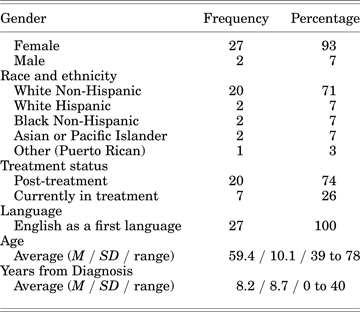
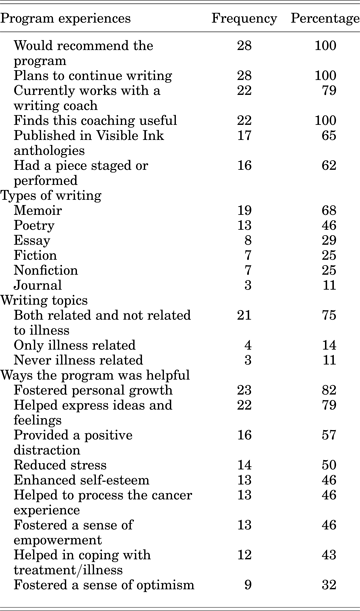
The survey responses were entered into an SPSS (version 21) database, and frequencies were run on all questions to capture quantitative data (Tables 1 and 2). In the content analysis of most open-ended survey items, the research team reviewed participants' answers together and identified salient or noteworthy cases that represented a rich and meaningful response to the Visible Ink program.
Survey respondent demographics (N = 29, some responses missing)

Writing characteristics (N = 29, some responses missing)
For items asking about experiences with a writing coach and recommendations for or comments about the program, open-ended responses were analyzed by members of the research team using open coding to obtain a quantitative sense of recurrent themes. After independent review of participants' answers, the team met to synthesize their findings and reach a consensus on the identified codes.
RESULTS
Quantitative Findings
Participant demographics are shown in Table 1, and writing characteristics and outcomes are presented in Table 2. The majority of participants (75%) wrote about topics both related and not related to their illnesses while in Visible Ink. Some of the main positive outcomes of the program demonstrated by survey results are that writing: enabled participants to express their ideas and feelings, fostered personal growth, provided a positive distraction, and reduced stress. In addition, 43% of participants found that writing had an effect on their ability to tolerate treatment, await results, cope with their illness, and/or deal with illness-related anxiety. All of the participants who were currently working with an individual writing mentor indicated that this help was useful to them, and all of the participants who filled out the survey stated they would recommend Visible Ink to others.
Qualitative Findings
How the Program Was Helpful
In addition to the options provided for survey respondents to indicate the ways in which the program was helpful, some individuals identified other benefits of their writing. One participant wrote that Visible Ink “made [her] feel alive,” while another felt that her writing “evoked things [she] did not know existed.” On the whole, responses demonstrate that Visible Ink can mean different things to different people, but the program generally has a powerful and profoundly helpful impact on participants' lives.
Difficulties or Anxiety Experienced During the Program
In addition to the positive impact of the program, some respondents indicated they experienced anxiety or difficulties over the course of their participation. A good deal of this anxiety was, as one answer put it, “self-inflicted”—the desire to write well or better in the face of limited skill or experience occasionally led to distress. One participant indicated that “at first, [she] did not feel [her] writing was good enough.” Another initially “wanted [her writing] to be perfect, so that caused some stress, but [she] learned that even if it's not ‘perfect,’ it is.” This speaks to the importance of time in participation, particularly for people with less writing background. Another relevant theme in people's answers was the challenge of confronting illness. One respondent wrote that “it's difficult to say the word cancer, let alone talk about it,” while another believed that the writing made her “relive some [times during her illness] that were hazy before, but it helped to record them down on paper to see what really happened.” In a way, this supports the value of enabling participants to choose their own writing topics, but it also suggests that the process of exploring illness and illness-related events, while evocative and occasionally painful, may have therapeutic value.
Helping Participants Fulfill Their Personal Goals
Many participants were grateful for the opportunity to accomplish writing-related goals, proud to “see [their] work in print,” develop “a body of work,” or “start (. . .) writing again after many years.” For one individual, “writing was a goal [she] was not aware of; now it is automatic,” and for another it gave “inspiration and direction.” However, even people without a strong connection to writing going into the program were able to accomplish personal goals through their participation. Visible Ink gave one participant “a ‘safe’ place to write and think about cancer without distressing [her] family and friends.” Others expressed altruistic benefits to their writing, being able to “spread words of hope” or “pay forward some of [their] experience so others may feel cancer is not an end but may be a beginning.”
Helping Participants Cope with Their Treatment or Illness
For many Visible Ink participants, writing presents an opportunity to cognitively process their cancer experience, which in turn may be helpful for tolerating treatment, waiting for test results, or dealing with illness-related anxiety. One respondent in particular “found that the essay [she] wrote began to have an underlying sense of humor,” which surprised her. As a result, she felt more “stoical (. . .) about [her] continuing treatment.” For others, writing provided a distraction rather than a forum through which to process thoughts and emotions: “I write through the stress; it takes my mind off the waiting.”
The Impact of a Writing Coach
Two primary themes emerged in responses about Visible Ink writing coaches: (1) the importance of providing encouragement, compassion, and inspiration, and (2) the value of teaching and technical guidance. Out of 26 respondents, 9 (35%) indicated that their writing coach was encouraging, compassionate, or inspiring, and 10 (38%) believed that their coach taught them how to write better. Overall, the respondents enthusiastically endorsed the value of a writing coach in a program like this and gave examples of the ways in which their Visible Ink mentors had been helpful. Noteworthy comments include:
I'd always dreamt that if only I had a mentor, someone to guide and help me focus, I could finally write (. . .) my story. I adore my current writing coach—she is warm and compassionate and sympathetic to my limitations.
I have found [my coach] to be so available and helpful. Her encouragement has made the difference between giving it up and keeping with it.
Sometimes you just need a “writing hug”—comments make me feel better.
[My coach provides] total acceptance and knowledge of structural form and rules needed for editing.
Comments and Recommendations
Responses to items asking for recommended changes to or additional comments about Visible Ink generally fell into one of two categories: (1) overall satisfaction with the program with no suggested changes, or (2) additions that would involve expanding the program. Out of 23 respondents, 5 (22%) were satisfied with the program and had no recommendations for ways in which it could be changed, and 11 (48%) expressed a desire for further expansion of the program. Noteworthy comments articulating the incredible value participants derived from their writing include:
This program has helped me be able to put to paper thoughts, memories, emotions, stories, and prose that I felt but did not know how to channel. Thank you.
Thank you for creating this wonderful program. I did not know I wanted to write poetry until I blurted it out one day. Really! So, thank you for giving me a chance to find out how I want to talk. It has changed me for the better.
Recommended additions to the program include “more classes,” “additional workshops,” and “a Visible Ink website.” Notably, despite effusive praise of the writing coaches, some individuals expressed a desire to be matched up with an expert of a particular genre or style, which could be more easily accomplished with more available coaches. Ultimately, these comments suggest that, even with the current value of the Visible Ink program demonstrated by responses to this survey, there is room for improvement with additional funding and resources.
DISCUSSION
In all, the results from this survey strongly support the value of MSKCC's Visible Ink program. All respondents indicated that they plan to continue writing and would recommend the program to others, and all participants who currently work with a writing coach responded that they find this mentoring to be helpful. In half or more of the responses, Visible Ink was said to foster personal growth, help with the expression of thoughts and feelings, provide a positive distraction, and reduce stress. Overall, the specific types of positive impacts reported varied by individual, which supports the body of research on writing interventions indicating that participants experience a wide range of beneficial outcomes. Further, participants write in a number of different genres and cover topics both related and not related to their illness. The program itself encourages this individuality, and the flexibility at the core of the Visible Ink mission makes it unique among the writing programs most commonly researched and likely contributes to its effectiveness and participants' satisfaction with their experience.
In addition to the aforementioned positive impressions of the program that were communicated in responses to this survey, Visible Ink participants used this opportunity to identify a number of ways in which the program can still improve. These suggestions include developing more writing classes, having additional workshops, and having a Visible Ink website. Participants also voiced their desire to be matched up with an expert writing coach of a specific genre or style. These sentiments demonstrate the potential and desire for program expansion should the resources to support such advances become available.
Although these results are encouraging, there were a number of limitations we faced in the administration of the survey. Most notably, our sample was very small, comprising only 29 Visible Ink participants. In a program that had served over 635 individuals at the time of the survey, 29 responses may or may not represent its overall impact and participants' most common impressions. Furthermore, we conducted this survey at Visible Ink's First Fall Writing Festival, which was attended by 75 participants. Our response rate of 38.7% is low, and we may have a biased sample in that both those responding to the survey and those in attendance at the event could have the most positive opinions about the Visible Ink program. Finally, this survey collects only one-time subjective impressions of the program's impact and overall satisfaction with the experience. It could be beneficial and informative to collect pre- and post-participation data, measuring a number of psychosocial outcomes (e.g., anxiety, quality of life) over time.
Visible Ink is a unique program that has the demonstrated potential of having a significant positive impact on a wide range of patients who are coping with the experience of cancer. Although more systematic research is needed to expand on these findings, our survey was a successful preliminary exploration of the Visible Ink program and illustrates that it has a great deal of promise as an intervention. It is our hope that, with the dissemination of the principles and procedures of Visible Ink, along with additional evidence supporting its effectiveness, other cancer centers may be able to implement similar flexible writing programs to supplement the care they provide.
ACKNOWLEDGMENTS
This research received no specific grant from any funding agency in the public, commercial, and not-for-profit sectors. The authors wish to thank the Visible Ink participants who agreed to fill out our survey and the organizations and groups responsible for funding the Visible Ink program, which include the Rona Jaffe Foundation, the United Hospital Fund, the Skirball Foundation, and the Society of Memorial Sloan-Kettering. If you have any questions about the Visible Ink program, please feel free to contact its founder and team leader, Judith Kelman, at judith.kelman@gmail.com or 212-535-3985.