





Nomenclature
- AI
-
Artificial Intelligence
- ALPA
-
Air Line Pilots Association
- COG
-
cognitive
- CRM
-
Crew Resource Management
- DLR
-
German Aviation Center
- DP
-
dual pilot
- DPO
-
dual pilot operation
- EASA
-
European Union Aviation Safety Agency
- ECA
-
European Cockpit Association
- EICAS
-
Engine Indicating and Crew Alerting System
- FAA
-
Federal Aviation Administration
- F-JAS
-
Fleishman Job Analysis Survey
- FMS
-
Flight Management System
- IAS
-
interactive/social skills and abilities
- NICo
-
Next Generation Intelligence Cockpit
- OBP
-
onboard pilot
- PHY
-
physical
- PSM
-
psychomotor
- RP
-
remote pilot
- SEN
-
sensory/perceptual
- SP
-
single pilot
- SPO
-
single pilot operation
- VCP
-
virtual copilot
1.0 Introduction
1.1 Towards single pilot operation in future commercial aviation
The annual accident rates in commercial aviation continue to decline to historic lows [1]. Many factors have contributed to this increase in flight safety, for example advances in design, materials and sensors, improvement in Crew Resource Management (CRM), progressions in operational management, procedures and regulations as well as improvements in navigation aids [Reference Schutte and Harris2]. Significant improvements in automation over the last few decades and especially its introduction into the flight decks of modern aircraft might be very important in this context. Automation aims to reduce pilots’ workload and the quantity of (monotonous monitoring) tasks and consequently the risk of human errors; handling routines in the cockpit supposedly gain in efficiency [Reference Thomas Martins, Thomas Martins and Márcio Soaresa3], which is an important research topic also in other areas of transportation [Reference Stapel, Mullakkal-Babu and Happee4, Reference Wang, Mehrotra, Wong, Parker, Roberts, Kim, Romo and Horrey5].
In the 1980s, advancements in automation, such as the introduction of the Flight Management System (FMS) and the Engine Indicating and Crew Alerting System (EICAS), contributed to the removal of the flight engineer from the cockpit crew, together with other technological developments, for example, glass cockpits and more reliable aircraft systems.
Recent achievements in automation and the emergence of AI seem to open up new opportunities for reducing crew operations in commercial aviation. Whereas in small aircraft with a maximum of 19 passengers and maximum take-off weight of 8,618 kg (19,000 lbs), single pilot operation (SPO) is already authorised by the European Union Aviation Safety Agency [6], the implementation of SPO in commercial aviation is predictable for the near future [Reference Carretta and King7–Reference Kirwan, Charles, Jones, Li, Page, Tutton and Bettignies-Thiebaux9]. Manufacturers are working on extending SPO. Airbus and Dassault advocate for one-pilot operations during the majority of long-haul flights [10] while authorities remain cautious for the moment: the European Union Aviation Safety Agency (EASA) stated that SPO for commercial airline operations are much further off than 2027, if they ever happen [Reference Broderick, Flottau and Dubois11]. In 2025, EASA announced that it will refocus on current dual pilot operations (DPO) until necessary technical advances have been implemented in the cockpit and an equivalent level of safety between SPO and DPO can be demonstrated [12, 13]. Also, various issues of consumer acceptance of automation are to be solved before [Reference Hughes, Rice, Trafimow and Clayton14].
The driving forces behind the endeavor to establish SPO in commercial aviation for complex aircraft are obvious. The expenses associated with piloting personnel make up a significant part of airline operating costs. Introducing SPO to commercial airlines might be one way of reducing these costs [Reference Li, Wang, Ding and Wang15, Reference Myers and Starr16]. In connection with a growth in global air transportation, an upcoming shortage of pilots also seems very likely in the next few years [Reference Li, Wang, Ding and Wang15]. This shortage could result again in increased personnel costs for airlines. As a response, a reduction in the amount of cockpit personnel required could be helpful for the satisfaction of demands [Reference Comerford, Brandt, Lachter, Wu, Mogford, Battiste and Johnson17].
There has also been some criticism on automation in commercial aviation [Reference Jazzar, Alharasees and Kale18–Reference Vakil and John Hansman21] and now the ambition to establish SPO is accompanied by concerns about its safety [Reference Myers and Starr16, Reference Lachter, Brandt, Battiste, Matessa and Johnson22–24]. There is the fear that with the implementation of SPO, human errors, technical failures and pilot incapacitation could no longer be mitigated by a second pilot aboard. An evaluation study amongst airline pilots on the potential risks of SPO by Zinn et al. showed that lack of redundancy and incapacitation or fatigue of a single pilot (SP) were perceived as some of the highest risks by pilots within SPO [Reference Zinn, Della Guardia, Albers, Harris and Li23]. The Air Line Pilots Association (ALPA) and the European Cockpit Association (ECA) also argue against SPO [Reference Broderick, Flottau and Dubois11]. If airlines and manufacturers want to introduce SPO at some point, it must be proven that the future SPO safety standards correspond to or even exceed today’s safety standards [Reference Harris8, Reference Li, Wang, Ding and Wang15, Reference Myers and Starr16, Reference Lachter, Brandt, Battiste, Matessa and Johnson22, Reference Zinn, Della Guardia, Albers, Harris and Li23].
Not all questions regarding the conceptual design of SPO have been answered yet, and there is still no standardised SPO concept that is accepted by the various interest groups and roughly regulated by the authorities. Still, an implementation of SPO in commercial aviation would change the working environment (e.g. the cockpit design) and the basic concept of how the work is done to a vast extent. Flight task allocation, that is, which actor is responsible for or exerts which tasks, would have to be excogitated from scratch [Reference Harris8, Reference Sprengart, Neis and Schiefele25, Reference Zinn, Ebrecht, Albers, Wies, Niedermeier, Harris and Li26]. Many variants of SPO are conceivable [Reference Asokan and Cameron27–Reference Vu, Lachter, Battiste and Strybel30], differing in their demands on safety and involved agents. Whatever concept is introduced, it is foreseeable that large parts of the existing aviation system would have to undergo far-reaching modulations to adapt to the changes in operation. With these fundamental changes in mind, it is reasonable to assume that the requirements – skills and abilities – for pilots, in a new form of operation with new task allocations and new interaction patterns, will not be totally congruent with the requirements necessary for pilots today.
In this contribution, we would therefore like to present a profound job requirement analysis for two possible future pilot positions. Both job profiles were compared with the current DPO workplace.
As part of the Next Generation Intelligence Cockpit project (NICo) of the German Aviation Center (DLR), a safety-centred SPO concept was developed by aviation psychologists, flight engineers and airline pilots. The concept consists of three main cooperators: a human onboard pilot (OBP), a virtual copilot (VCP) and a human remote pilot (RP). The OBP is accompanied onboard an aircraft by the VCP, an assistance system based on AI methods and algorithms, which has a high environmental awareness, performs complex monitoring tasks, signals anomalies and provides evidence-based solutions. The human RP is located in a flight control centre and starts to get into individual support mode (dedicated mode) in abnormal situations and if demanded by the OBP. The concept and its detailed task allocation were positively evaluated by pilots [Reference Zinn, Ebrecht, Albers, Wies, Niedermeier, Harris and Li26].
1.2 Job requirements for DP operators in aviation
The selection of cockpit personnel is crucial for meeting the safety criteria of aviation authorities and airlines. Certain cognitive and interpersonal skills and abilities are essential for flying a commercial aircraft and managing aircrews [Reference Zinn, Ebrecht, Albers, Wies, Niedermeier, Harris and Li26]. A high-quality selection process is based on a systematic job analysis that identifies the requirements: relevant attributes of job holders required to perform the job successfully [Reference Flanagan31]. The Fleishman Job Analysis Survey (F-JAS [Reference Fleishman32]) is such a systematically developed survey tool with which the required skills and abilities can be assessed.Footnote 1 In 1997, a vast job analysis for DPO airline cockpits was conducted at the DLR, engaging 141 airline pilots and using an extended version of the F-JAS [Reference Goeters, Maschke, Eisseldt and Goeters33]. The results showed that interactive, cognitive and psychomotor abilities and skills are most required, followed by sensory abilities; none of the physical skills and abilities were considered necessary for the dual pilot (DP) cockpit [Reference Goeters, Maschke, Eisseldt and Goeters33, Reference Maschke and Goeters34].
Stahl [Reference Stahl35] repeated the job analysis with the F-JAS, and despite a greatly changed work environment (flight assistance systems and ergonomics advanced, automation and air traffic increased), the requirements remained virtually unchanged over a period of 25 years.
However, SPO will entail a far-reaching restructuring of pilots’ tasks, with human colleagues collaborating remotely and working with AI. These changes in the accessibility and handling of information as well as human-machine teaming [Reference Dormoy, André and Pagani36, Reference Stowers, Brady, MacLellan, Wohleber and Salas37] could lead to more far-reaching changes in job requirements.
1.3 Aim of the study
It is expected that SPO will make its way into commercial aviation in the relatively near future. The concept by Zinn et al. [Reference Zinn, Ebrecht, Albers, Wies, Niedermeier, Harris and Li26] seeks to ensure the same safety standards as the current DPO. It can be seen as a sound and at the same time generic concept that served as the basic principle for our study. As stated, the selection of suitable personnel will also be a crucial part of the future of commercial aviation. As a prerequisite for this, studies on job requirements for SPO are needed. This is essential to carry out adjustments to the pilot selection for future SPO.
Some requirements will likely differ from current DPO, as SPO would bring disruptive changes to the work environment of pilots and other operators. With the RP in the concept of Zinn et al. [Reference Zinn, Ebrecht, Albers, Wies, Niedermeier, Harris and Li26], there is even a position that does not exist in the present work environment. Thus, the requirements for that job position have to be initially described.
Professional pilots were asked to evaluate the importance of various skills and abilities required for OBP and RP (in the proposed new SPO system) compared to DPs using the F-JAS for requirement ratings.
2.0 Method
2.1 Sample
The study was conducted with 40 professional pilots working for a major European airline group as participants: 37 (92.5%) of them were male, 3 (7.5%) female. The mean age was 43.6 years (SD = 10.76). The sample consisted of 19 captains, 1 senior first officer and 20 first officers. Work experience as a pilot in DPO was on average 17.4 years (SD = 10.64) and consisted of 8,897.5 total flight hours (SD = 6,063.74). The airline transport pilot license was held for an average of 18.3 years (SD = 10.79), with a minimum of 5 and a maximum of 44 years. All participants were piloting wide-body aircraft, the majority of the sample (62.5%) was active on the Airbus 320 family (A319/320/321), the rest of the sample was dispersed among the types A330/A340, A350, A380, Boeing 747 and 777 and the Bombardier CRJ900.
The participants were recruited partially via the authors’ professional network and partially via the German Air Line Pilots’ Association (Vereinigung Cockpit e.V.).
The SPO concept applied in this study [Reference Zinn, Ebrecht, Albers, Wies, Niedermeier, Harris and Li26] comprises a detailed task allocation and uses a vast range of aviation tasks that are already part of DPO in modern aviation. Compared to DPO, in SPO these tasks are assigned differently to the participating entities. Nevertheless, it can be assumed that nowadays pilots (in DPO) are the best experts for rating requirements for these future jobs. Each participant was compensated with 75€ for taking part in the study.
2.2 Procedure
Some weeks before the scheduled date for data collection, the participants received the SPO concept with elaborate explanations and a detailed task allocation matrix (aviation tasks allocated to the three different operators: OBP, RP, VCP; [cf. Reference Zinn, Ebrecht, Albers, Wies, Niedermeier, Harris and Li26]. They were asked to thoroughly familiarise themselves with the concept and the associated job. By this, the job experts should become experts for the future workplaces in SPO as best as possible.
We conducted the requirement surveys as one-to-one interviews via Zoom. One online interview lasted for approximately two hours. At the beginning of an online interview, each participant got an elaborate introduction to the course of events. Questions regarding the SPO concept and the different job positions could be asked and were answered. After that, the test administrator presented the 75 F-JAS scales (see Section 2.3) one by one and the requirement assessments were collected. Following the introduction of each scale, the participant had to rate the level of the respective skill/ability required for the job of a pilot in today’s DPO and the positions in future SPO (OBP and RP). As specified in the test manual, it was pointed out that the assessments of each requirement should be made considering the totality of all tasks in everyday working life (of the job in question). The participants were asked to assess the requirements according to their demanded level of ability, not according to the time required or the importance [Reference Fleishman and Reilly38, Reference Kleinmann, Manzey, Schumacher and Fleishman39].
After the requirement assessment of all scales of the F-JAS, the participants were asked to evaluate the SPO concept. Results of this evaluation have been published elsewhere [Reference Zinn, Ebrecht, Albers, Wies, Niedermeier, Harris and Li26].
2.3 Instruments
The study was conducted with the F-JAS [Reference Fleishman32, Reference Fleishman and Reilly38], a well-established and widely used instrument for job analyses. We used the German version of the instrument [Reference Kleinmann, Manzey, Schumacher and Fleishman39] consisting of 73 requirement scales (items), supplemented by two additional scales (vigilance and operational monitoring) for analyses in the field of aviation [Reference Eißfeldt, Grasshoff, Hasse, Hörmann, Schulze-Kissing, Stern, Wenzel and Zierke40].
The F-JAS is used to determine the abilities, respectively skills required for a target occupation by job holders or job experts assessing the extent to which each of them is needed [Reference Fleishman and Reilly41]. In the F-JAS, each of the 75 potential job requirements is briefly defined and differentiated from similar or related requirements to ensure the same evaluation basis for each job expert. The rating is performed on a 7-point rating scale ranging from 1 (not required) to 7 (high level required). The F-JAS can be administered in groups; we used online one-to-one interviews (cf. Section 2.2).
Each of the 75 requirement scales belongs to one of five domains of skills and abilities. The original F-JAS examines 21 cognitive (COG), 10 psychomotor (PSM), 9 physical (PHY), 12 sensory/perceptual (SEN) and 21 interactive/social skills and abilities (IAS). The two additional requirements subjoined by Eißfeldt et al. [Reference Eißfeldt, Grasshoff, Hasse, Hörmann, Schulze-Kissing, Stern, Wenzel and Zierke40] were assigned to the cognitive area; therefore, in our study, the cognitive domain consisted of 23 scales.
3.0 Results
The data were analysed at three different levels. First, we conducted inferential analyses at the domain level using repeated-measurement ANOVAs. Differences between the pilot types are presented. Subsequently, we focused on the single requirements within each of the four remaining domains using multivariate tests; the requirement-specific differences between the pilot types are presented domain-wise. Eventually, we highlighted the requirement profiles of the three pilot workplaces (top 20) regardless of the domain affiliation and the absolute level of the required skill.
We restricted our analyses to the domains and requirements identified as relevant to the target occupations. Following the classification of Goeters [Reference Goeters42], only requirements with a scale value of 5 or higher are considered relevant. As none of the scales of the physical domain even comes close to the scale value of 5 for any of the pilot types, this domain is excluded from further analyses due to irrelevance.
For all statistical analyses, the software IBM SPSS Statistics 26 was used. Effect sizes are reported for ANOVAs using partial
 $ \eta $
2
(
 $ \eta $
2
P), where
 $ \eta $
2
P
≥ 0.01 indicates a small effect,
 $ \eta $
2
P
≥ 0.06 indicates a moderate effect and
 $ \eta $
2
P
≥ 0.14 indicates a large effect. Partial
 $ \eta $
2
indicates the proportion of total variance in a dependent variable that is associated with an independent variable, while controlling for the effects of other variables. Effect sizes for pairwise comparisons are reported using Cohen’s d, where |d| ≥ 0.20 indicates a small effect, |d| ≥ 0.50 indicates a moderate effect and |d| ≥ 0.80 indicates a large effect.
To determine the required sample for the described analyses, an a priori power analysis was conducted using G * Power (v3.1.9.7) [Reference Faul, Erdfelder, Lang and Buchner43]. A conservative medium effect size (partial
 $ \eta $
2
= 0.06) and a robust target power of 0.90 were specified across all models. To control for Type I error inflation across the four domains, a Bonferroni correction was applied to all tests, adjusting the alpha level to α = 0.0125. For the planned repeated measures ANOVAs (pilot type x requirement), the largest minimum required sample size was N = 23 (based on the 10-item psychomotor domain yielding 30 measurements). For the corresponding within-subject multivariate tests, the most restrictive bottleneck occurred within the 23 variable cognitive domain, demanding a baseline of N = 35. Consequently, N = 35 was established as the absolute mathematical threshold to achieve a power of ≥ 0.90 across all tests. Our final sample size of N = 40 fully satisfies these statistical requirements.
Since our sample size was sufficiently large (N = 40), robustness against a violation of the normal distributions of dependent variables residuals could be assumed; testing for normal distribution was not necessary [c.f. Reference Blanca, Alarcón, Arnau, Bono and Bendayan44, Reference Schmider, Ziegler, Danay, Beyer and Bühner45]. The Greenhouse-Geisser adjustment was used to correct for violations of sphericity.
3.1 Analysis on domain level
For each of the remaining four domains, Ms and SDs across all associated requirements for each pilot type (see Fig. 1) were analysed. Repeated measurements ANOVAs with two within-subject factors (pilot type, requirement scale) were conducted for each of the four domains. As the main effects of requirements (differences between requirements independently of pilot type) were not of interest for our study, these results are not discussed further. The interaction effects are reported in the section about analysis on the requirement level (below).
Domain means for pilot types.
Note: DP = dual pilot, OBP = onboard pilot, RP = remote pilot. For each requirement domain Ms are displayed for DP, OBP and RP. Exact values are presented inside the bars. Error bars indicate SDs of the aggregated requirement ratings for each domain and pilot type. Double-sided arrows indicate significant differences, where red indicates a strong effect and yellow a small or medium effect.

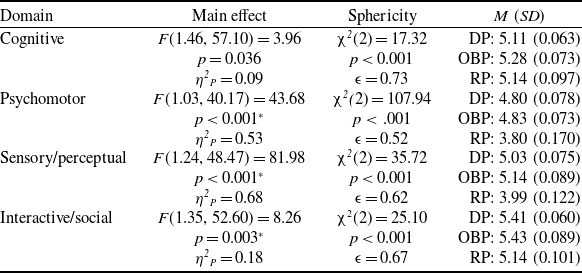
Significant differences between the pilot types were found in three of the four domains (see Table 1). Only in the cognitive domain did the pilot types not differ significantly from each other; effect sizes for the other three domains were large.
Comparison of pilot types in requirement domains – results of the two-factor repeated measurements ANOVA

Table 1. Long description
A table comparing pilot types in requirement domains using ANOVA results. The table has four rows and five columns. Column headers are Domain, Main effect, Sphericity, and M (SD). Row labels are Cognitive, Psychomotor, Sensory/perceptual, and Interactive/social. The table compares the main effect, sphericity, and mean (standard deviation) for different pilot types across various domains. Significant differences are noted in the psychomotor, sensory/perceptual, and interactive/social domains. Row 1: Cognitive, F(1.46, 57.10) = 3.96, χ2(2) = 17.32, DP: 5.11 (0.063), p = 0.036, p < 0.001, OBP: 5.28 (0.073), η2p = 0.09, ε = 0.73, RP: 5.14 (0.097). Row 2: Psychomotor, F(1.03, 40.17) = 43.68, χ2(2) = 107.94, DP: 4.80 (0.078), p < 0.001*, p < 0.001, OBP: 4.83 (0.073), η2p = 0.53, ε = 0.52, RP: 3.80 (0.170). Row 3: Sensory/perceptual, F(1.24, 48.47) = 81.98, χ2(2) = 35.72, DP: 5.03 (0.075), p < 0.001*, p < 0.001, OBP: 5.14 (0.089), η2p = 0.68, ε = 0.62, RP: 3.99 (0.122). Row 4: Interactive/social, F(1.35, 52.60) = 8.26, χ2(2) = 25.10, DP: 5.41 (0.060), p = 0.003*, p < 0.001, OBP: 5.43 (0.089), η2p = 0.18, ε = 0.67, RP: 5.14 (0.101).
Note: DP = dual pilot, OBP = onboard pilot, RP = remote pilot. All p-values are calculated based on Greenhouse-Geisser correction for degrees of freedom due to violations of sphericity. Given that four repeated measures ANOVAs were conducted, the significance level was adjusted using the Bonferroni adjustment to α = 0.0125 for each test to control for Type I error, lower p-values are indicated with *.
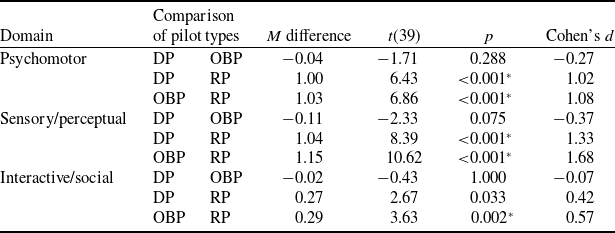
To determine which of the pilot types differ within the requirement domains, according to the reported main effects, pairwise comparisons between DP, OBP and RP were conducted for the three domains for which differences were detected. Results of the pairwise comparisons are reported in Table 2. Fig. 1 shows the mean values of the domains.
Results of pairwise comparisons between dual pilot, onboard pilot and remote pilot for requirement domains

Table 2. Long description
A table comparing pilot types across different requirement domains. The table has four rows and six columns. The columns are labeled Comparison, Domain, of pilot types, M difference, t(39), p, and Cohen’s d. The rows are labeled with different comparisons between dual pilot (DP), onboard pilot (OBP), and remote pilot (RP) across psychomotor, sensory/perceptual, and interactive/social domains. Row 1: Psychomotor, DP, OBP, 0.04, 1.71, 0.288, 0.27. Row 2: Psychomotor, DP, RP, 1.00, 6.43, 0.001&, 1.02. Row 3: Psychomotor, OBP, RP, 1.03, 6.86, 0.001&, 1.08. Row 4: Sensory/perceptual, DP, OBP, 0.11, 2.33, 0.075, 0.37. Row 5: Sensory/perceptual, DP, RP, 1.04, 8.39, 0.001&, 1.33. Row 6: Sensory/perceptual, OBP, RP, 1.15, 10.62, 0.001&, 1.68. Row 7: Interactive/social, DP, OBP, 0.02, 0.43, 1.000, 0.07. Row 8: Interactive/social, DP, RP, 0.27, 2.67, 0.033, 0.42. Row 9: Interactive/social, OBP, RP, 0.29, 3.63, 0.002&, 0.57. The table includes a note indicating that Bonferroni correction for multiple comparisons was applied, with a significance level of 0.017, and lower p-values are indicated with an asterisk.
Note: DP = dual pilot, OBP = onboard pilot, RP = remote pilot. Bonferroni correction for multiple comparisons was applied: α = 0.017, lower p-values are indicated with *.
Pairwise comparisons revealed large effect sizes between DP and RP as well as OBP and RP for the psychomotor domain and the sensory/perceptual domain. In the interactive/social domain, we saw medium-sized effects for the same pairs; however, only the effect of OBP and RP was significant in that domain, according to Bonferroni correction (Table 2).
In summary, it can be said that in three out of the four relevant domains, the RP-position demanded a lower level of requirements compared to the two jobs located inside the aircraft cockpit (except DP vs. RP in the interactive/social domain). There were no differences in the cognitive domain between the three pilot types (see Table 2 and Fig. 1).
3.2 Analysis on requirement level – domain-wise
The previous analysis of the main effects gave us information about the differences between the pilot types for each requirement domain as a whole. The following analysis should show us whether all requirements of a domain differ equally between the pilot types or whether it is that certain requirements cause the main effects, while other requirements do not differ between the pilot types or even show an opposite effect.
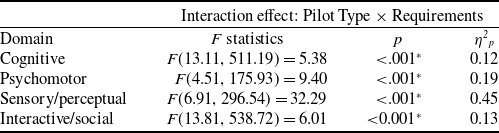
The interaction effects of the repeated-measurements ANOVAs with two within-subject factors (pilot type, requirement scales) for each of the four relevant domains were analysed. Mauchly’s test for sphericity does not provide an assessment for interaction effects; however, Greenhouse-Geisser adjustments were applied to ensure the robustness of the results. Significant interaction effects were found for each domain (see Table 3). Effect sizes for the cognitive and the interactive/social domains were of medium size, and of large size for the psychomotor and the sensory/perceptual domains. These clear interaction effects call for a closer look at the individual requirements.
Results of the interaction effects for each requirement domain

Table 3. Long description
A table comparing interaction effects of pilot type and requirements across four domains. The table has four rows and three columns. Column headers are F statistics, p, and 2p. Row labels are Cognitive, Psychomotor, Sensory/perceptual, and Interactive/social. The table presents F statistics, p-values, and effect sizes for each domain, indicating significant interaction effects across all domains. The p-values are adjusted using the Greenhouse-Geisser correction and the Bonferroni correction for significance level Row 1: Cognitive, F(13.11, 511.19) = 5.38, .001&, 0.12. Row 2: Psychomotor, F(4.51, 175.93) = 9.40, .001&, 0.19. Row 3: Sensory/perceptual, F(6.91, 296.54) = 32.29, .001&, 0.45. Row 4: Interactive/social, F(13.81, 538.72) = 6.01, 0.001&, 0.13.
Note: All p-values are calculated based on Greenhouse-Geisser correction for degrees of freedom. Given that four repeated measures ANOVAs were conducted, the significance level was adjusted using the Bonferroni correction to α = 0.0125 for each test to control for Type I error, lower p-values are indicated with *.
To assess effects of pilot type on single requirements, multivariate tests were carried out for each domain. Pairwise comparisons were performed post hoc to identify which of the pilot types (DP, OBP, RP) differ on these significant requirements. Again, requirements that are not relevant for any three pilot types (M
 $ \lt $
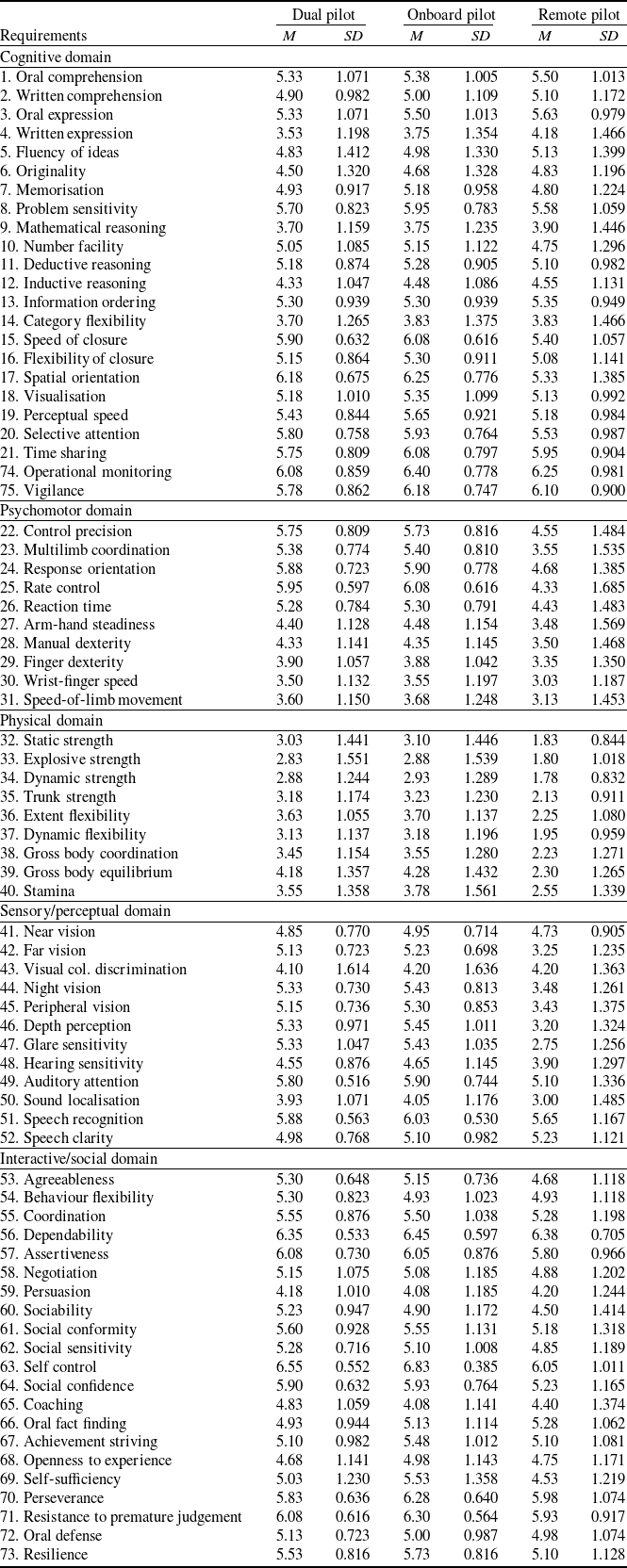
5) are not presented in the following tables or commented on below. Results are presented domain-wise in Tables 4 to 7. For significant differences, Ms are presented in the text if it is conducive to clarity, and for all requirements Ms and SDs are presented in Table A2 in Appendix A.
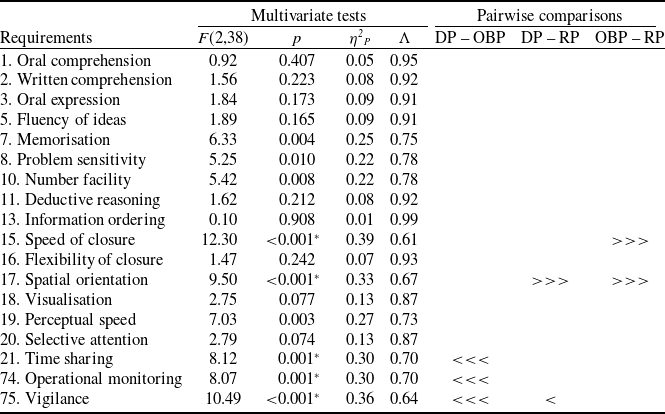
Results of multivariate tests and pairwise comparisons with pilot type as factor for the requirements of the cognitive domain

Table 4. Long description
A table comparing multivariate tests and pairwise comparisons for cognitive domain requirements across different pilot types. The table has 25 rows and 7 columns. The columns are labeled as Requirements, F(2,38), p, η²p, Λ, DP – OBP, DP – RP, and OBP – RP. The rows list various cognitive requirements and their corresponding values in the columns. The requirements include oral comprehension, written comprehension, oral expression, fluency of ideas, memorisation, problem sensitivity, number facility, deductive reasoning, information ordering, speed of closure, flexibility of closure, spatial orientation, visualisation, perceptual speed, selective attention, time sharing, operational monitoring, and vigilance. Each requirement has associated values for F(2,38), p, η²p, Λ, DP – OBP, DP – RP, and OBP – RP. Notable trends include significant p-values for memorisation, speed of closure, spatial orientation, time sharing, operational monitoring, and vigilance, indicating differences between pilot types.
Note: DP = dual pilot, OBP = onboard pilot, RP = remote pilot. Bonferroni correction was applied for the multivariate tests to control for Type I error: Differences between pilot types below the adjusted α = 0.002 are indicated with *. For pairwise comparisons, Bonferroni correction was applied during calculation, so the α-level did not need to be adjusted. The arithmetic signs ‘
 $ \gt $
’ and ‘
 $ \lt $
’ were used to clarify the orientation; the number of signs reflect the level of significance (
 $ \gt $
,
 $ \lt $
p
 $ \lt $
0.05;
 $ \gt $
 $ \gt $
,
 $ \lt $
 $ \lt $
p
 $ \lt $
0.01;
 $ \gt $
 $ \gt $
 $ \gt $
,
 $ \lt $
 $ \lt $
 $ \lt $
p
 $ \lt $
0.001).
In the cognitive domain, significant differences between pilot types resulted in 5 out of 23 requirements. All corresponding effect sizes were
 $ \eta $
2
P
 $ \gt $
0.14, indicating large effects of the factor pilot type (see Table 4). Significant differences between DP and OBP were observed for 3 of the 10 differentiating requirements (see Table 4): in all cases the required level was rated higher for OBP, especially for time sharing (DP: M = 5.75, OBP: M = 6.08, RP: M = 5.95), operational monitoring (DP: M = 6.08, OBP: M = 6.40, RP: M = 6.25) and vigilance (DP: M = 5.78, OBP: M = 6.18, RP: M = 6.10). There were two requirements in which the OBP seemed to be exposed to significantly higher demands than the RP: speed of closure (DP: M = 5.90, OBP: M = 6.08, RP: M = 5.40) and spatial orientation (DP: M = 6.18, OBP: M = 6.25, RP: M = 5.33). The latter also had the same clear direction of effect for the comparison DP vs. RP (cf. Table A2, Appendix A).
Results of multivariate tests and pairwise comparisons with pilot type as factor for the psychomotor domain

Table 5. Long description
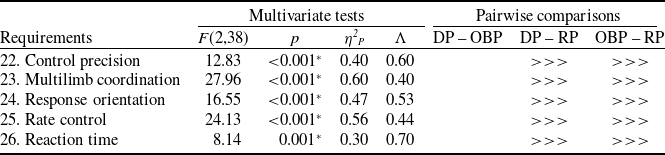
A table with six rows and seven columns comparing multivariate tests and pairwise comparisons for psychomotor domain requirements. The columns are labeled as Requirements, F(2,38), p, η²p, Λ, DP – OBP, and DP – RP, OBP – RP. The rows are labeled with specific requirements: Control precision, Multilimb coordination, Response orientation, Rate control, and Reaction time. Each row contains values for the respective columns. For example, Control precision has F(2,38) value of 12.83, p value of 0.001&, η²p value of 0.40, Λ value of 0.60, and pairwise comparison values of >>>, >>>. Multilimb coordination has F(2,38) value of 27.96, p value of 0.001&, η²p value of 0.60, Λ value of 0.40, and pairwise comparison values of >>>, >>>. Response orientation has F(2,38) value of 16.55, p value of 0.001&, η²p value of 0.47, Λ value of 0.53, and pairwise comparison values of >>>, >>>. Rate control has F(2,38) value of 24.13, p value of 0.001&, η²p value of 0.56, Λ value of 0.44, and pairwise comparison values of >>>, >>>. Reaction time has F(2,38) value of 8.14, p value of 0.001&, η²p value of 0.30, Λ value of 0.70, and pairwise comparison values of >>>, >>>. The table notes that DP stands for dual pilot, OBP for onboard pilot, and RP for remote pilot. Bonferroni correction was applied for the multivariate tests to control for Type I error, with differences between pilot types below the adjusted p-value of 0.005 indicated with &. For pairwise comparisons, Bonferroni correction was enclosed during calculation, so the p-value did not need to be adjusted. The arithmetic signs and were used to clarify the orientation; the number of signs reflect the level of significance (, p < 0.05; , p < 0.01; , p < 0.001).
Note: DP = dual pilot, OBP = onboard pilot, RP = remote pilot. Bonferroni correction was applied for the multivariate tests to control for Type I error: differences between pilot types below the adjusted α = 0.005 are indicated with *. For pairwise comparisons, Bonferroni correction was enclosed during calculation, so the α-level did not need to be adjusted. The arithmetic signs ‘
 $ \gt $
’ and ‘
 $ \lt $
’ were used to clarify the orientation; the number of signs reflect the level of significance (
 $ \gt $
,
 $ \lt $
p
 $ \lt $
0.05;
 $ \gt $
 $ \gt $
,
 $ \lt $
 $ \lt $
p
 $ \lt $
0.01;
 $ \gt $
 $ \gt $
 $ \gt $
,
 $ \lt $
 $ \lt $
 $ \lt $
p
 $ \lt $
0.001).
In the psychomotor domain, significant differences between pilot types resulted in all five relevant requirements. All effect sizes for these requirements were markedly
 $ \eta $
2
P
 $ \gt $
0.14, indicating large effects (Table 5). Descriptive means (cf. Table A2, Appendix A) were lowest for RP compared to DP and OBP on all requirements. For RP, none of the scales exceeded the value of 5, meaning none of the competencies was critical for the job-performance.
Results of multivariate tests and pairwise comparisons with pilot type as factor for the sensory/perceptual domain

Table 6. Long description
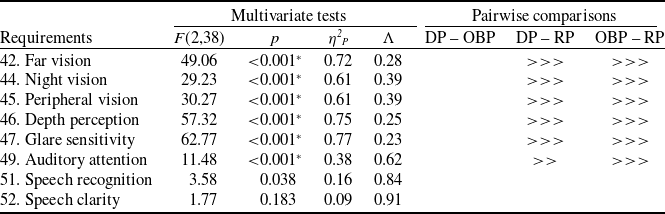
A table comparing multivariate tests and pairwise comparisons for sensory/perceptual domain requirements. The table has 10 rows and 7 columns. The columns are labeled as Requirements, Multivariate tests (F(2,38), p, η²p, Λ), and Pairwise comparisons (DP – OBP, DP – RP, OBP – RP). The rows list different requirements and their corresponding values.The table presents the results of multivariate tests and pairwise comparisons for different sensory/perceptual requirements across three pilot types (DP, OBP, RP). Significant differences are indicated by asterisks and arrows. Row 1: Far vision, 49.06, <0.001&, 0.72, 0.28, >>>, >>, >>>. Row 2: Night vision, 29.23, <0.001&, 0.61, 0.39, >>>, >>, >>>. Row 3: Peripheral vision, 30.27, <0.001&, 0.61, 0.39, >>>, >>, >>>. Row 4: Depth perception, 57.32, <0.001&, 0.75, 0.25, >>>, >>, >>>. Row 5: Glare sensitivity, 62.77, <0.001&, 0.77, 0.23, >>>, >>, >>>. Row 6: Auditory attention, 11.48, <0.001&, 0.38, 0.62, >>, >>, >>>. Row 7: Speech recognition, 3.58, 0.038, 0.16, 0.84, >>, >, >>. Row 8: Speech clarity, 1.77, 0.183, 0.09, 0.91, >, >, >.
Note: DP = dual pilot, OBP = onboard pilot, RP = remote pilot. Bonferroni correction was applied for the multivariate tests to control for Type I error: Differences between pilot types below the adjusted α = 0.004 are indicated with *. For pairwise comparisons, Bonferroni correction was enclosed during calculation, so the α-level did not need to be adjusted. The arithmetic signs ‘
 $ \gt $
’ and ‘
 $ \lt $
’ signs were used to clarify the orientation; the number of signs reflect the level of significance (
 $ \gt $
,
 $ \lt $
p
 $ \lt $
0.05;
 $ \gt $
 $ \gt $
,
 $ \lt $
 $ \lt $
p
 $ \lt $
0.01;
 $ \gt $
 $ \gt $
 $ \gt $
,
 $ \lt $
 $ \lt $
 $ \lt $
p
 $ \lt $
0.001).
In the sensory/perceptual domain, significant differences between pilot types resulted in six out of eight relevant requirements. Effect sizes for these differences were all
 $ \eta $
2
P
 $ \gt $
0.14, indicating large effects (see Table 6). For these six requirements, the descriptive means were lowest for RP compared to DP and OBP (cf. Table A2, Appendix A), as pairwise comparisons showed.
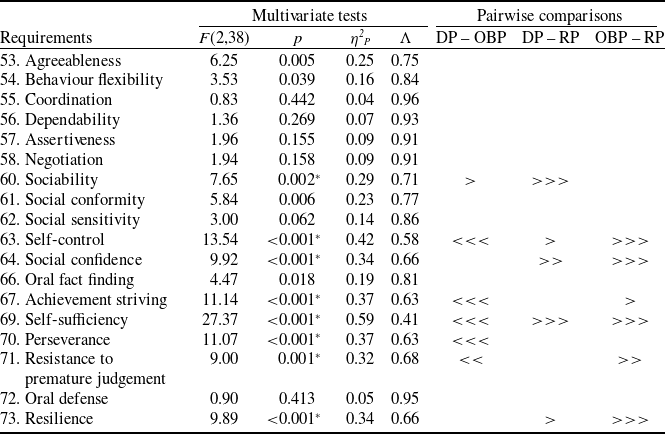
In the interactive/social domain, significant differences between pilot types resulted in 8 out of 18 relevant requirements. Effect sizes for these differences were all
 $ \eta $
2
P
 $ \gt $
0.14, indicating large effects (see Table 7). On four scales, the descriptive mean value was significantly lower for RP compared to DP and to OBP: self-control (DP: M = 6.55, OBP: M = 6.83, RP: M = 6.05), social confidence (DP: M = 5.90, OBP: M = 5.93, RP: M = 5.23), self-sufficiency (DP: M = 5.03, OBP: M = 5.53, RP: M = 4.53), and resilience (DP: M = 5.53, OBP: M = 5.73, RP: M = 5.10), while OBP and DP did not differ regarding social confidence and resilience. Regarding self-control and self-sufficiency, all three pilot types differed significantly from each other, with the pattern that the competencies were most relevant for the OBP, followed by the DP and the RP.
Results of multivariate tests and pairwise comparisons with pilot type as factor for the interactive/social domain

Table 7. Long description
A table with 18 rows and 7 columns comparing multivariate tests and pairwise comparisons for interactive/social domain requirements. The columns are labeled as Requirements, F(2,38), p, η²P, Λ, DP – OBP, DP – RP, and OBP – RP. The table lists various requirements such as Agreeableness, Behaviour flexibility, Coordination, Dependability, Assertiveness, Negotiation, Sociability, Social conformity, Social sensitivity, Self-control, Social confidence, Oral fact finding, Achievement striving, Self-sufficiency, Perseverance, Resistance to premature judgement, Oral defense, and Resilience. Each requirement has corresponding values for F(2,38), p, η²P, Λ, and pairwise comparisons. Notable trends include significant differences in Self-control, Social confidence, Self-sufficiency, and Resilience between pilot types, with effect sizes indicating large effects.
Note: DP = dual pilot, OBP = onboard pilot, RP = remote pilot. Bonferroni correction was applied for the multivariate tests to control for Type I error: differences between pilot types below the adjusted α = 0.002 are indicated with *. For pairwise comparisons, Bonferroni correction was enclosed during calculation, so the α-level did not need to be adjusted. The arithmetic signs ‘
 $ \gt $
’ and ‘
 $ \lt $
’ were used to clarify the orientation; the number of signs reflect the level of significance (
 $ \gt $
,
 $ \lt $
p
 $ \lt $
0.05;
 $ \gt $
 $ \gt $
,
 $ \lt $
 $ \lt $
p
 $ \lt $
0.01;
 $ \gt $
 $ \gt $
 $ \gt $
,
 $ \lt $
 $ \lt $
 $ \lt $
p
 $ \lt $
0.001).
The two competencies – achievement striving (DP: M = 5.10, OBP: M = 5.48, RP: M = 5.10) and resistance to premature judgement (DP: M = 6.08, OBP: M = 6.30, RP: M = 5.93) – were significantly more important for the OBP compared to the other two pilot types, which did not differ from each other. With regard to sociability (DP: M = 5.23, OBP: M = 4.90, RP: M = 4.50), the requirements for the DP workplace were seen as higher than those for the OBP workplace. On the other hand, the OBP was assumed to have a much more pronounced perseverance than the DP (DP: M = 5.83, OBP: M = 6.28, RP: M = 5.98); the other two type comparisons remained insignificant (see Table 7).
3.3 Requirement profiles and top requirements
For each of the 75 requirements, Ms and SDs were calculated across all subject ratings for each pilot type separately. The corresponding list is shown in Table A1 in the appendix.
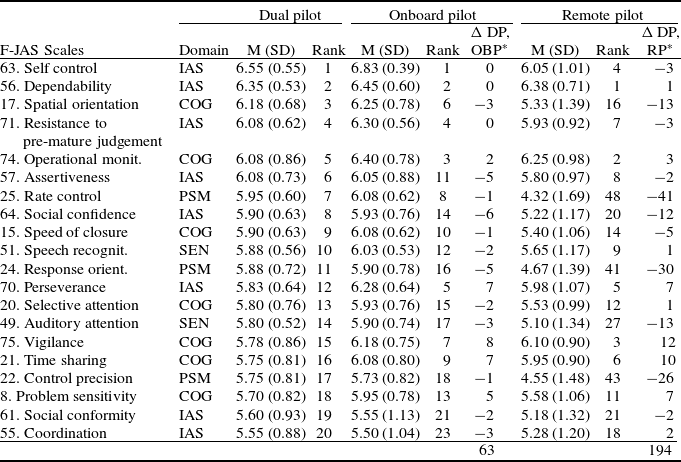
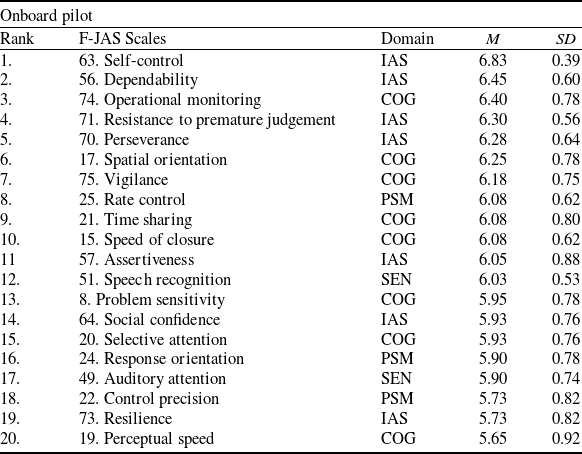
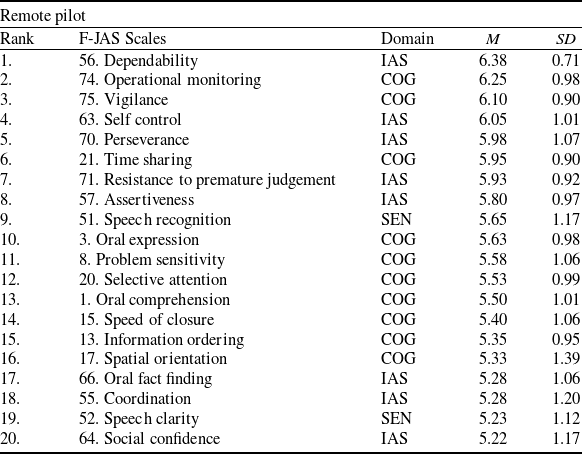
Since the overall ratings for RP’s requirements were, as already stated, clearly lower than for the other two pilot types, we now want to focus on the differences in the most important requirements (top 20) between the pilot types (see Table 8). To do so, we ranked the requirements regarding their assigned level (M) for each pilot type. To get a good impression to what extent the patterns of the requirements differed between the pilot types, we took the top 20 requirements for the DP as a starting point and analysed how distant these requirements rank for OBP and RP (calculated as the rank difference, Table 8; top 20 for OBP and RP see Table A2 in the appendix).
Top 20 requirements for dual pilot and rank differences for onboard pilot and remote pilot

Table 8. Long description
A table comparing top 20 requirements for dual pilot and rank differences for onboard pilot and remote pilot. The table has 20 rows and 12 columns. Column headers are: F-JAS Scales, Domain, Dual pilot M (SD), Dual pilot Rank, Onboard pilot M (SD), Onboard pilot Rank, DP, Remote pilot M (SD), Remote pilot Rank, RP. Row labels are: 63. Self control, 56. Dependability, 17. Spatial orientation, 71. Resistance to pre-mature judgement, 74. Operational monit., 57. Assertiveness, 25. Rate control, 64. Social confidence, 15. Speed of closure, 51. Speech recognit., 24. Response orient., 70. Perseverance, 20. Selective attention, 49. Auditory attention, 75. Vigilance, 21. Time sharing, 22. Control precision, 8. Problem sensitivity, 61. Social conformity, 55. Coordination. Row 1: 63. Self control, IAS, 6.55 (0.55), 1, 6.83 (0.39), 1, 0, 6.05 (1.01), 4, 3. Row 2: 56. Dependability, IAS, 6.35 (0.53), 2, 6.45 (0.60), 2, 0, 6.38 (0.71), 1, 1. Row 3: 17. Spatial orientation, COG, 6.18 (0.68), 3, 6.25 (0.78), 6, 3, 5.33 (1.39), 16, 13. Row 4: 71. Resistance to pre-mature judgement, IAS, 6.08 (0.62), 4, 6.30 (0.56), 4, 0, 5.93 (0.92), 7, 3. Row 5: 74. Operational monit., COG, 6.08 (0.86), 5, 6.40 (0.78), 3, 2, 6.25 (0.98), 2, 3. Row 6: 57. Assertiveness, IAS, 6.08 (0.73), 6, 6.05 (0.88), 11, 5, 5.80 (0.97), 8, 2. Row 7: 25. Rate control, PSM, 5.95 (0.60), 7, 6.08 (0.62), 8, 1, 4.32 (1.69), 48, 41. Row 8: 64. Social confidence, IAS, 5.90 (0.63), 8, 5.93 (0.76), 14, 6, 5.22 (1.17), 20, 12. Row 9: 15. Speed of closure, COG, 5.90 (0.63), 9, 6.08 (0.62), 10, 1, 5.40 (1.06), 14, 5. Row 10: 51. Speech recognit., SEN, 5.88 (0.56), 10, 6.03 (0.53), 12, 2, 5.65 (1.17), 9, 1. Row 11: 24. Response orient., PSM, 5.88 (0.72), 11, 5.90 (0.78), 16, 5, 4.67 (1.39), 41, 30. Row 12: 70. Perseverance, IAS, 5.83 (0.64), 12, 6.28 (0.64), 5, 7, 5.98 (1.07), 5, 7. Row 13: 20. Selective attention, COG, 5.80 (0.76), 13, 5.93 (0.76), 15, 2, 5.53 (0.99), 12, 1. Row 14: 49. Auditory attention, SEN, 5.80 (0.52), 14, 5.90 (0.74), 17, 3, 5.10 (1.34), 27, 13. Row 15: 75. Vigilance, COG, 5.78 (0.86), 15, 6.18 (0.75), 7, 8, 6.10 (0.90), 3, 12. Row 16: 21. Time sharing, COG, 5.75 (0.81), 16, 6.08 (0.80), 9, 7, 5.95 (0.90), 6, 10. Row 17: 22. Control precision, PSM, 5.75 (0.81), 17, 5.73 (0.82), 18, 1, 4.55 (1.48), 43, 26. Row 18: 8. Problem sensitivity, COG, 5.70 (0.82), 18, 5.95 (0.78), 13, 5, 5.58 (1.06), 11, 7. Row 19: 61. Social conformity, IAS, 5.60 (0.93), 19, 5.55 (1.13), 21, 2, 5.18 (1.32), 21, 2. Row 20: 55. Coordination, IAS, 5.55 (0.88), 20, 5.50 (1.04), 23, 3, 5.28 (1.20), 18, 2.
Note: DP = dual pilot, OBP = onboard pilot, RP = Remote pilot, * = difference of ranks.
The profile of OBP and DP appeared to be very similar: the sum of the rank differences within the top 20 was 63, and the maximum single difference was 8 rank positions. Vigilance (COG), time sharing (COG) and perseverance (IAS) seemed to be somewhat more necessary for OBP; the other rank differences were even smaller. The results were different for the DP-RP comparison: the sum of the ranking differences within the top 20 was 194, and the maximum deviation was 41 ranks. For the RP, vigilance and time sharing were ranked higher than for the DP. Other requirements, which must be pronounced for the DP (and also for OBP), however, played a clearly subordinate role for the RP-workplace: Especially the three for DP and OBP highly ranked requirements from the psychomotor domain – rate control, control precision and response orientation – were judged to be much less necessary for RP, relatively and absolutely. Spatial orientation (COG), social confidence (IAS) and auditory attention (SEN) were also clearly less in demand.
Among the top requirements that were similarly ranked and important for all three pilot types were the four interactive/social competencies – self-control, dependability, resistance to premature judgement and assertiveness. It also included the two cognitive requirements – operational monitoring and speed of closure – together with the requirement of speech recognition from the domain of sensory requirements.
4.0 Discussion
Based on the well-developed, albeit at this point still hypothetical, concept of future pilot operation, we performed a job requirement analysis with active airline pilots as subject matter experts. They rated the requirements of their present job and the different positions in the outlined SPO concept.
4.1 Main results
If we compare the top 20 requirements for each pilot type across all domains, it can be seen that DP and OBP are similar in terms of their requirement profile, while the RP has a rather different one. In particular, the essential requirements for DP and OBP from the psychomotor domain, which are not among the top 20 for RP, are rate control, response orientation and control precision.
Looking at each requirement domain as an aggregate, it can be seen that in none of the domains DP and OBP differ significantly from each other, and for the cognitive domain the same level of demand is required even for all three pilot types. In the other three analysed domains, DP and OBP on the one hand and RP on the other differ to varying degrees. However, there are some important individual requirements within the cognitive and the interactive domains in which DP and OBP also differ significantly. In the following, we will discuss these differences between the pilot types and attempt to construe the divergences. Again, only those competencies will be discussed that are fundamental for at least one of the pilot types (F-JAS score: M
 $ \gt $
5). The starting point should be the requirement profile of the DP, which reflects the current standard in aviation. The scale definitions presented in the following sections are based on the F-JAS rating scale booklet [Reference Fleishman32], unless otherwise stated.
Within the cognitive domain, 18 out of 23 requirements are considered important for at least one of the target positions and remain in the following presentation. There are three significant differences between DP and OBP: time sharing, operational monitoring and vigilance. It is assumed that these competencies are more important for the OBP than for the DP. For all three requirements, the demanded level for RP lies between the ones for the other two pilot types and does not reach significance on either side. All three requirements are among the top 20 for each of the pilot types. Time sharing is the ability to switch back and forth between two or more sources of information (speech, signals, sounds or other sources). Operational monitoring is the ability to responsibly track meaningful information from various sources about a system without direct need for action, with full control of the system at all times [Reference Eißfeldt, Grasshoff, Hasse, Hörmann, Schulze-Kissing, Stern, Wenzel and Zierke40, Reference Eißfeldt46]. Vigilance is the ability to pay close and continuous attention to uniform information over a longer period of time, whereby active action is rarely required [Reference Eißfeldt, Grasshoff, Hasse, Hörmann, Schulze-Kissing, Stern, Wenzel and Zierke40]. Compared to the other requirements of this domain, these three requirements focus more on the amount of information or the amount of time to be spent in a given situation and less on the difficulty of the task itself. One can assume that tasks with a continuous information load or time-critical tasks might place a higher demand on an OBP, since the OBP has to master these tasks alone and cannot share them with a second pair of (human) eyes. These are situations in which the perceived workload on one person is judged to be higher than on two. And higher workload might lead to less situational awareness, and both are perceived as two of the major problems of SPO [Reference Zinn, Della Guardia, Albers, Harris and Li23]. The VCP, based on AI methods and algorithms, is designed for the reduction of the workload of an OBP. It supports the OBP in all tasks, for example, continuously performing complex monitoring tasks, signaling detected anomalies, cross-checking or applying the standard operating procedures (SOPs). Therefore, this reduction in workload can lead to a reduction in demands for certain cognitive requirements on the OBP. Although our subjects consider the task allocation for the OBP to be sensible [Reference Zinn, Ebrecht, Albers, Wies, Niedermeier, Harris and Li26], the demands are rated higher in these three requirements (time sharing, operational monitoring, vigilance). In any case, when developing a VCP, care should be taken in particular to ensure that the workload aspect is focused on, and that it will be a trustworthy counterpart for the OBP. For the sake of completeness, it should also be mentioned that, to a much lesser extent, for vigilance the same direction of difference could be observed between RP and DP. This is to be interpreted in the same way.
Spatial orientation, another requirement in the cognitive domain, is the ability to indicate where you are in relation to the position of an object or where the object is in relation to your own position. This ability allows you to remain orientated when changing the location or direction of your own vehicle. It is therefore easy to conclude that the two pilot types working within the aircraft (OBP and DP) must have this ability to a much greater extent than a pilot assisting from the ground (RP).
The cognitive requirement speed of closure is the ability to quickly recognise the meaning of information that initially appears to be without meaning or order. This includes the extent to which certain pieces of information can be quickly put together and organised into a meaningful pattern. The results of our study suggest that it can be assumed that the OBP’s cockpit demands this to a greater extent than the RP’s workstation, where information is already processed to a higher degree. The cockpit is where all first-hand information comes together, including visual and olfactory stimuli that would have to be transmitted to an RP (or could be mapped via sensors). The OBP therefore sits ‘in the middle of the action’ and presumably has a greater information load from which conclusions have to be drawn quickly. On the other hand, it should again be precisely the task of a supporting AI (VCP) to detect patterns within a huge amount of information and preprocess it to reduce workload for the OBP. The VCP’s task would also include pointing out consequences and presenting possible solutions to the OBP. So, if a reliable and well-trained AI is on board as a VCP, the high demands of the job in terms of speed of closure should be mitigated.
In the psychomotor domain, the results are clear, unambiguous and unsurprising. There are 5 (out of 10) important requirements for the DP and the OBP but none for the RP: Control precision (ability to make precise movements of the control of a machine), multilimb coordination (ability to coordinate movements of two or more limbs together), response orientation (ability to choose between two or more movements quickly and accurately when different signals are given), rate control (ability to adjust an equipment control in response to changes in the speed or direction of a moving object) and reaction time (ability to give one fast response to one signal). No differences were recorded between DP and OBP for any of these requirements. However, both pilot types are required to meet all five abilities to a significantly higher degree than the RP on the ground, for whom all psychomotor requirements are below the level of importance (M
 $ \lt $
5, see Appendix Table A1 for means). When assessing the psychomotor requirements, the focus of our subjects was supposedly on manual flying. Commercial flying is increasingly automated, but even the best automation can fail. In this case, it is still essential that the pilots who are supposed to operate the controls inside an aircraft have the appropriate psychomotor skills. The Federal Aviation Administration (FAA) stated in 2022 that manual flying skills are extremely important for flight safety and that it is not a choice between automated and manual flying [47]. Especially younger generations of pilots are addressed, since they did not grow up with manual flying necessary in most flying situations in training and job practice.
In the sensory/perceptual domain, there are some essential requirements, above all speech recognition and auditory attention for all three pilot types. There are no differences between DP and OBP for all eight important sensory/perceptual requirements. For six of the eight important requirements, there are differences between DP and OBP on the one hand and RP on the other (Tables 6 and A1). These include auditory attention, which is the ability to focus on a single source of auditory information in the presence of other irrelevant sounds. It can be assumed that the subjects consider that for the OBP and the DP, whose workplace is the cockpit, information is more unfiltered, more original and less processed and overall, less auditory information is relevant for the RP. For the other five sensory/perceptual abilities, a lower requirement for the RP is not surprising: it is evident that a computer workstation in an illuminated room has different demands on visual perceptive requirements.
The interactive/social requirements, in turn, are to a large extent (18 out of 21) a prerequisite for good pilot performance, led by self-control (ability to remain calm and levelheaded in difficult and stressful situations and keep the emotions in check, [cf. Reference Salazar and Khandelwal48] and dependability (ability to be reliable, trustworthy, responsible and disciplined). There is a total of five interactive requirements for which it can be assumed that they should be significantly more pronounced for an OBP than for a DP: (1) self-control, (2) achievement striving is the ability to set high standards to do the best possible job, (3) self-sufficiency is the ability to work in an unstructured environment with little direction or supervision as well as making decisions without consulting others, (4) perseverance is the ability to maintain an optimal level of effort (for a long period of time) until tasks are successfully completed, having the mental energy despite obstacles like fatigue or distractions and (5) the difference between OBP and DP in resistance to premature judgement (ability to withhold making final decisions until all important facts have been evaluated), which was not quite as strong but still significant. In summary, it can be said that an OBP is expected even more than a DP to do the best possible job even under difficult conditions without the intervention of third parties, while remaining calm and not making any rash decisions. The requirements relate to self-regulatory and controlling aspects that are crucial for minimising errors and essential for situational awareness. Again, the VCP is an important and necessary support system that must significantly improve situational awareness [Reference Zinn, Della Guardia, Albers, Harris and Li23], help with decision-making and supervise the OBP. With such well-designed VCP entities, the job requirements on the human actors (OBPs) could be reduced. Once more, it is clear that the possibilities offered by an assistant controlled by algorithms and AI do not (yet) have the same level of familiarity and trust as a second pilot on board. Future developments will show what capabilities a VCP in the cockpit is able to bring into the interaction with the OBP and whether trust will grow and, if so, whether future job assessments will be put into perspective.
Compared to the RP, it is also assumed that the OBP should have significantly more self-control and self-sufficiency and, to a lesser extent, achievement striving and resistance to premature judgement. In addition, social confidence, which involves communicating, an appropriate level of assurance and optimism as well as resilience, which is the ability to rapidly recover normal energy and enthusiasm following a discouraging situation, should be more pronounced for the OBP. For four of these six requirements, the same differences also apply to the comparison of DP vs. RP, although the differences are generally smaller. Only in the case of one requirement is the DP considered to have a more pronounced need compared to RP and – to a lesser extent – also to the OBP. Sociability is the ability to be outgoing and participative in social situations; it involves desire and willingness to interact with others. It is not surprising that this ability is less pronounced in a workplace that, at first glance, requires only one person. The extent to which the RP will later cooperate in a team will also depend on the design of the workplace, which determines the extend of necessary sociability.
The results presented must be taken into account when developing the VCP: the presumably higher amount and density of information for the OBP, as well as the time available for processing them, can be identified as the core problem of SPO. The VCP must therefore become a specialist for monitoring (systems and flying environment) and drawing conclusions (recognising risks and proposing solutions). Only then can it support the OBP and perhaps lower the demands on some requirements that are still assumed higher for the OBP to at least the level necessary for a DP.
4.2 Implication for selection
The bottom line of our job analysis with a survey that consists of a very large number of different requirements is that, even at the level of the individual requirements, most requirement demands are assessed as being equal between the current DP and the future OBP. If differences are predicted, the position of the OBP is generally the one that requires a higher level of the respective ability. However, in no case is an ability required for the OBP that is unimportant for the DP and has not previously played a role in the selection context. Rather, it can be assumed that in existing selection portfolios, some adjustments might be made with regard to the listed requirements. No new instruments need to be included to test completely new requirements. No new selection programme will be necessary for a transition phase either. This is good news for practitioners who might have had the assumption that a disruptive change in the operation and job descriptions would also necessitate disruptive changes in personnel selection. Most probably every person who was selected (and trained) to be a pilot in DPO can also be a pilot in the OBP position. No further selection steps, only training, will be necessary for the already existing workforce.
For the RP, the majority of the cognitive and interactive requirements are also comparable to those of the DP and OBP. Where differences occurred, it was always the RP position that made fewer demands on future job owners. The requirements for spatial orientation could be slightly reduced. And psychomotor abilities do not appear to be essential for the RP (all
 $ \lt $
5) and could therefore be excluded from the selection process, if a selection is to be made specifically for this pilot type. For the RP, the selection process might then be less extensive and less expensive. It can also be assumed that the training costs would be lower for the RP. In addition, due to the lower requirements, particularly in the psychomotor area, this would result in an increase in positive candidates. Should a DP or OBP become unfit to fly for medical reasons, the different requirements of the RP workplace may allow a (temporary) transfer to this position. Maybe only an abridged additional training would be required. Eventually, it can be stated that every pilot who fulfills the requirements for an OBP and DP can also act as an RP.
4.3 Limitations
When evaluating all the results of our present job analysis, which provides a foundation for understanding SPO, it should be noted that only the DP position already exists and therefore only for this position experience-based statements could be made by the job owners. The other two pilot types are components of a well-considered and relatively detailed laid out theoretical concept. However, there are still limits to the level of detail, leaving room for interpretation and uncertainty.
And it must be considered that the context of future SPO still provides significant operational constraints and limitations. Key concerns have already been recognised and are mentioned in the literature. They include the elevated risk of incapacitation, the lack of redundancy, the inability to cross-check critical information, the absence of collaboration, fatigue-related issues, the risk of skills erosion and cybersecurity vulnerabilities [cf. Reference Harris8, Reference Zinn, Della Guardia, Albers, Harris and Li23, Reference Simons, Maher, Vermeiren and Wagstaff49]. Some of these topics also might have implications for the requirements of future SPO pilots. Addressing the inherent operational constraints and limitations of SPO (e.g. by enhanced automation, improved monitoring systems, AI- supported assistance systems) is a prerequisite for its implementation, and the resulting adaptations of the flight deck and flight operations should be incorporated into future requirement analyses.
It has to be noted that the introduction of SPO can also be carried out differently in parts, so that job analysis surveys should continue to be carried out. After the introduction of the first SPO concepts in reality, the requirements of the different positions should be thoroughly analysed and closely observed.
4.4 Outlook
Whether SPO is implemented depends primarily on whether the level of security currently required by the authorities can be maintained. We are convinced that further technical research and development on the engineering side is needed. However, at least for a concept such as the one presented here, the concerns could be smaller than for a more narrowly based concept. In this case, the changes to the personnel selection concepts would also remain manageable. Of course, job analysis surveys should be repeated at regular intervals, especially in the case of rapidly changing conditions, to check whether changes should be made to the selection at some point. Validity studies of selection systems are then just as necessary to check their success and fit from the top down.
Appendix A
Descriptives for all requirements according to pilot type

Table A1. Long description
Table A1 presents descriptive statistics for 75 requirements across different pilot types. Each requirement is listed with corresponding mean (Ms) and standard deviation (SDs) values calculated from subject ratings. The table is organized into columns for requirement identifiers and statistical measures, providing a comprehensive overview of the data distribution for each pilot type.
Top 20 – F-JAS scales-ratings for onboard pilot

Table A2. Long description
The table presents a comparison of ratings for various requirements across different domains for three pilot types: Dual pilot, Onboard pilot, and Remote pilot. The table is divided into five main domains: Cognitive domain, Psychomotor domain, Physical domain, Sensory/perceptual domain, and Interactive/social domain. Each domain lists specific requirements with their corresponding mean (M) and standard deviation (SD) values for each pilot type. The Cognitive domain includes requirements such as Oral comprehension, Written comprehension, Oral expression, Written expression, Fluency of ideas, Originality, Inductive reasoning, Deductive reasoning, Information ordering, Category flexibility, Speed of closure, Flexibility of closure, Originality, Visualization, Perceptual speed, Selective attention, Time sharing, Operational monitoring, and Vigilance. The Psychomotor domain includes requirements like Control precision, Multilimb coordination, Response orientation, Rate control, Reaction time, Arm-hand steadiness, Manual dexterity, Finger dexterity, Wrist-finger speed, and Speed-of-limb movement. The Physical domain includes Static strength, Explosive strength, Dynamic strength, Trunk strength, Extent flexibility, Dynamic flexibility, Gross body coordination, Gross body equilibrium, and Stamina. The Sensory/perceptual domain includes Near vision, Far vision, Depth perception, Glare sensitivity, Hearing sensitivity, Auditory attention, Sound localization, Speech clarity, and Night vision. The Interactive/social domain includes Agreeableness, Behavioral flexibility, Coordination, Dependability, Assertiveness, Negotiation, Persuasion, Social conformity, Social sensitivity, Self-control, Social confidence, Coaching, Oral communication, Achievement striving, Openness to experience, Perceptiveness, Resistance to premature judgment, Oral defense, and Resilience. Each requirement is rated with mean and standard deviation values for Dual pilot, Onboard pilot, and Remote pilot.
Note: Table shows the top 20 for the onboard pilot. For the top 20 for dual pilot, see Table8.
Top 20 – F-JAS scales-ratings for remote pilot

Table A3. Long description
A table titled ’Top 20 F-JAS scales-ratings for remote pilot’ with 20 rows and 4 columns. The columns are labeled ’Rank’, ’F-JAS Scales’, ’Domain’, ’M’, and ’SD’. The table lists the top 20 F-JAS scales for remote pilots, including their corresponding domains, mean (M) ratings, and standard deviations (SD). The rows are as follows: Row 1: Rank 1, F-JAS Scales 56, Dependability, Domain IAS, M 6.38, SD 0.71. Row 2: Rank 2, F-JAS Scales 74, Operational monitoring, Domain COG, M 6.25, SD 0.98. Row 3: Rank 3, F-JAS Scales 75, Vigilance, Domain COG, M 6.10, SD 0.90. Row 4: Rank 4, F-JAS Scales 63, Self control, Domain IAS, M 6.05, SD 1.01. Row 5: Rank 5, F-JAS Scales 70, Perseverance, Domain IAS, M 5.98, SD 1.07. Row 6: Rank 6, F-JAS Scales 21, Time sharing, Domain COG, M 5.95, SD 0.90. Row 7: Rank 7, F-JAS Scales 71, Resistance to premature judgement, Domain IAS, M 5.93, SD 0.92. Row 8: Rank 8, F-JAS Scales 57, Assertiveness, Domain IAS, M 5.80, SD 0.97. Row 9: Rank 9, F-JAS Scales 51, Speech recognition, Domain SEN, M 5.65, SD 1.17. Row 10: Rank 10, F-JAS Scales 3, Oral expression, Domain COG, M 5.63, SD 0.98. Row 11: Rank 11, F-JAS Scales 8, Problem sensitivity, Domain COG, M 5.58, SD 1.06. Row 12: Rank 12, F-JAS Scales 20, Selective attention, Domain COG, M 5.53, SD 0.99. Row 13: Rank 13, F-JAS Scales 1, Oral comprehension, Domain COG, M 5.50, SD 1.01. Row 14: Rank 14, F-JAS Scales 15, Speed of closure, Domain COG, M 5.40, SD 1.06. Row 15: Rank 15, F-JAS Scales 13, Information ordering, Domain COG, M 5.35, SD 0.95. Row 16: Rank 16, F-JAS Scales 17, Spatial orientation, Domain COG, M 5.33, SD 1.39. Row 17: Rank 17, F-JAS Scales 66, Oral fact finding, Domain IAS, M 5.28, SD 1.06. Row 18: Rank 18, F-JAS Scales 55, Coordination, Domain IAS, M 5.28, SD 1.20. Row 19: Rank 19, F-JAS Scales 52, Speech clarity, Domain SEN, M 5.23, SD 1.12. Row 20: Rank 20, F-JAS Scales 64, Social confidence, Domain IAS, M 5.22, SD 1.17.
Note: Table shows the top 20 for the remote pilot. For the top 20 for dual pilot, see Table8.


 Open access

