On 2 January 2012, a mass demonstration took place in Budapest in front of the Opera House. The rally was the culminating event in a series of street protests that had shaken Hungary during the previous months when many inhabitants of the Hungarian capital, along with their co-nationals elsewhere, felt increasingly uneasy with the symbolic politics initiated by the government of Viktor Orbán and his center-right FIDESZ Party. In particular, the crowd that collected in front of what is still Hungary's most representative institution of culture, on the main boulevard Andrássy út, protested against the inauguration of the new constitution that had come into force the previous day. Despite opposition inside and outside of Hungary, the ruling political elite comprising the prime minister and his political entourage celebrated the new constitution—and themselves—at a gala event in the opera house. A number of other celebratory events in connection with Hungary's new constitution were also staged, among them a controversial exhibition of paintings in the National Gallery, located to date in the Buda Palace, meant to highlight the most important events in recent Hungarian history. Inside the opera house, Orbán and his political supporters listened to a collection of works by, among others, Franz Liszt, Ferenc Erkel, and Béla Bartók, but the composition of the program was a matter of minor importance on that day. Instead, as he and his government representatives congratulated each other that night on their party's achievements in power, the crowd outside the opera house jeered in reference to Hungary's fall in international economic rankings and the methods of rule that they saw as authoritarian, if not dictatorial, and appealed to a wider international community, for example, with slogans such as, “Hey Europe, sorry about my Prime Minister.”
Time will show the greater historical significance of this event, the new Hungarian constitution, and Viktor Orbán's second term in office. Opinions remain polarized: Three weeks later, an even larger pro-government demonstration was held in a different location, the iconic Heroes Square. However, at least some of those who had trouble getting to the epicenter of the demonstration in front of the opera house on 2 January because of traffic jams and the density of the crowd, who were aware that a special police cordon surrounded the building in order to protect the Hungarian politicians from the protesters and that the prime minister himself needed to leave the opera house through the back door, could not but get a feeling of a déjà vu.
Over a century earlier, on 27 September 1884, on the occasion of the inauguration of the opera house itself, a similar scandal shocked the public of the booming Hungarian metropolis. The gala opening of the opera house was an occasion significant enough to warrant a visit to Budapest by the Emperor-King Francis Joseph and a number of other distinguished guests. The audience collected in the splendid auditorium that night consisted of the cream of local society who, apart from attending a music premier, came to see and be seen. This audience included the leading Hungarian politicians of the time, among them Prime Minister Kálmán Tisza and his supporters from the ruling Liberal Party, who would rule Hungary with a strong hand for another two decades, ignoring the voices of dissatisfaction. On 27 September 1884, Tisza and his political supporters attempted to claim the opera house as their own achievement. The inauguration date became remembered, however, for an angry crowd that clashed with the police in its attempt to enter the auditorium. Having failed in that, the crowd disrupted the performance by shouting “Éljen!” (Hail!) just outside the opera house, allegedly in honor of the Austrian emperor cum Hungarian king—yet it would be difficult to assess this with certainty. It took time before the police could restore order. A number of people were hurt and at least one died as consequence of these events, and the reputations of the Hungarian government, the Budapest police, and the current opera administration were severely damaged.
It is not my intention in this article to make a comprehensive comparison between the two seemingly unrelated events from two different periods in the history of Hungary and its capital city. However, the obvious parallels point toward several larger issues I do intend to address. First, the significance of an opera house in a particular urban setting continues to be far greater and more complex than music historians often tend to acknowledge. Even if the works performed on that night in 1884, by Erkel and Richard Wagner, provoked a wider press debate and became, as I intend to show, signifiers of distinct political programs, they remained secondary to the crowd's fury. More importantly, the opera house as an institution functioned in a highly politicized public space that included major political actors, a critical urban press, and the dissatisfied crowds on the street. Focusing on the 1884 inauguration ceremony and using the press reports of the time as a source, I will demonstrate that the discussion that preceded and followed the opening scandal touched upon issues of greater social and political significance that maintain their relevance today. More importantly, the presence of the political elites in the auditorium, juxtaposed with the roaring crowds in the street that were excluded from this experience, showed how fragile the limits in this carefully orchestrated political experiment actually were.
Established, as one journalist noted a decade later, “following the example of large and medium-sized cities of the cultured world” (a mívelt világ nagyobb és középszerű városainak példájára),Footnote 2 with imperial support and under the watchful eye of the ruling political elite, who used it to display itself at premiers, the Royal Hungarian Opera House was plagued from the start with identity problems and inadequate attendance. These shortcomings, by no means untypical for the opera houses of the time, would have placed its very survival in question had not Budapest and Vienna subsidized and supported it in many different ways. However, and again similar to many other European theaters at the time, the attempts of different political actors to shape the opera house into an institution with a particular artistic, cultural, political, or commercial agenda had failed altogether.Footnote 3
The discussion of the institution of the opera house is meaningless out of the urban context of the burgeoning young Hungarian capital that aspired to put itself on par with imperial Vienna in matters related to politics as well as culture and, at the same time, looked for inspiration elsewhere. It is by no means accidental that the “beautification” of Pest—one of the three towns to merge officially under the name Budapest in 1873—is explicitly mentioned in many celebratory newspaper articles on the inauguration of the opera house. The establishment of a separate opera house was part of yet another, official narrative of urban improvement that involved actors as diverse as local and national politicians, as well as public activists, but the scope of which was certainly not limited to Budapest or, for that matter, historical Hungary. A large body of literature on Hungarian music and Budapest musical stages tended to disregard the deeper social implications of scandals such as the opera house inauguration in 1884.Footnote 4 A number of recent studies, such as Judit Frigyesi's Béla Bartók and Turn-of-the-Century Budapest, Alice Freifeld's Nationalism and the Crowd in Liberal Hungary, 1848–1914, and Mary Gluck's work on the Budapest music halls, the so-called Orpheums, have attempted to integrate, respectively, theater and music history into larger historical developments in the city and the region.Footnote 5 Yet much remains to be done in regard to the history of Budapest's major cultural institution, the opera house. This article is a contribution to this scholarship, as well as to the booming historical research on the nature of the urban public space in Hungary and East Central Europe, especially the works by Gábor Gyáni and András Gerő.Footnote 6 However, it does not aim to cover the modern metropolitan experience of Budapest in its totality, but rather concerns itself with the multiplicity of local identities inasmuch as they were reflected in the press reports on the 1884 inauguration.
It is important, of course, to keep a critical eye on press criticism as a source for academic research and analysis. In fact, the diversity of voices and attitudes in this realm is so great that it would be misleading to try to present them as one unified force. The liberal and generally sympathetic mainstream newspapers such as the German-language Pester Lloyd, Neues Pester Journal, and Neues Politisches Volksblatt and the Hungarian-language Budapesti Napló (Budapest Daily) were, therefore, a very different voice than, for example, the conservative political magazines Fővárosi Lapok (Metropolitan Papers), Pesti Hírlap (Pest Newspaper), and Pesti Napló (Pest Daily), which in turn differed from the nationalist Budapesti Hírlap (Budapest Newspaper), the radical Egyetértés (Consensus), the anti-Semitic Függetlenség (Independence), the populist illustrated Vasárnapi Újság (Sunday News) and, finally, the satirical Borsszem Jankó and Bolond Istók.Footnote 7 While anti-Semitic commentary on cultural affairs is the central feature of the time,Footnote 8 the picture of Hungarian society as seen through the eyes of Borsszem Jankó's satirists and draftsmen and their colleagues in other papers is broader and should therefore be integrated into a larger discussion on Budapest's emerging public culture and press criticism.Footnote 9 Furthermore, the multiplicity of messages delivered in a single newspaper article may relate to the musicological discussion of the time, the current politics in the city, the region, the empire, and the world, but it also often involves humor, sarcasm, satirical commentary, and invented and exaggerated descriptions. It is therefore central to the integrity of my argument that those nuances are clearly distinguished and understood as such.
The second half of the nineteenth century, and in particular the period after the 1867 Compromise, is commonly referred to in Hungary as a period of unprecedented growth.Footnote 10 This generalization is valid for Budapest, the second metropolis of the monarchy in which cities were assigned strictly defined status and received financial support corresponding to this rigid urban hierarchy. The urbanization phenomenon would have hardly taken shape the way it did and Budapest would have hardly become one of the fastest growing cities in Europe had the 1867 events not taken place. The Compromise, a constitutional rearrangement of the empire that now became a dual monarchy, brought into force a number of purely symbolic arrangements. For example, thirty-six year-old Francis Joseph allowed himself to be crowned Apostolic King of Hungary—and subsequently became an active figure in local politics even though he himself was not so committed to the extensive use of his image and symbolic acts as to deserve such a prominent role in Hungarian public life. A number of attempts to employ imperial symbolism and the personality of Francis Joseph and his monarchy in particular political projects would characterize the public image of the future opera house, too. While Budapest, from 1873 officially one city, was soon to be given the status of the second capital city and that of a royal seat,Footnote 11 it was ironic and certainly not unintentional, for instance, that the Buda Palace rose on a hill that bore marks of the Hungarian revolutionaries' fight against General Heinrich Hentzi's imperial army in 1849 and became Francis Joseph's second official residence.Footnote 12 Symbolic politics were eagerly played by all involved, and particular buildings such as the Buda Palace and the Parliament became part of this game in many invigorating ways.
Urbanization in Budapest brought to the city its distinct metropolitan character. Not only did its regulated growth include the explosion of building activity and increased congestion of the city center, which was now expanded to the limits of the outer ring, the Nagykörút, accompanied by an upward rise in the height of the buildings, but it also included a concentration of representative buildings of power and culture along the main boulevard, the Sugárút (now Andrássy út). Miklós Ybl, the eminent Hungarian architect of the period, supervised the planning of the boulevard, which resulted in a stylistically harmonious Historicist architectural ensemble. As Péter Hanák correctly stated, “the main consideration behind the design and execution of the Sugárút was that it should be imposing, a broad, spacious promenade expressive of Budapest's status of a great city.”Footnote 13 Budapest's two main arteries, the circular Nagykörút and the radial Sugárút, “were strongly influenced by the fact that the [Hungarian] government and the Council for Public Works had promoted their construction and had imposed their own notions of urban development on their appearance.”Footnote 14 To become a world city or a true metropolis, Budapest needed clear signatory cultural institutions in its emerging urban landscape, in addition to institutions of imperial power and parliamentary democracy. Above all, while the Buda Palace and the Parliament building visibly stressed Budapest's new functions as a capital city and center of parliamentarism, there was no opera house.
The city's population was expanding at an unprecedented pace, growing from over two hundred thousand in 1869 to a million in 1910.Footnote 15 Yet all too often a direct link is drawn between the city's expansion and the need for a separate opera house.Footnote 16 In making such a link, it is often forgotten that rather than an immediate requirement of urbanization, the erection of a new, dedicated opera house was a matter of symbolic importance that involved issues of prestige, nationalism, and local politics. The theater-going public did not drastically increase as a consequence of the Compromise or of urbanization but was, still in the 1880s, a relatively small and highly heterogeneous entity that included the aristocracy, the urban upper class, prominent cultural figures who more often than not came from these two social groups, emerging nationalist activists of lower social standing, and the press. In fact, the urbanization argument does not even preclude the possibility that the quantity and variety of the musical entertainment on offer might in fact have far exceeded the capacity of this same public to grace it with its presence—or that the majority of this public would prefer to listen to music elsewhere or would continue to frequent other theaters altogether. And yet this might be exactly why several theaters of Pest and Buda entered, for divergent reasons and to varying degrees, a period of crisis once the idea of a separate opera house was declared and gained momentum.
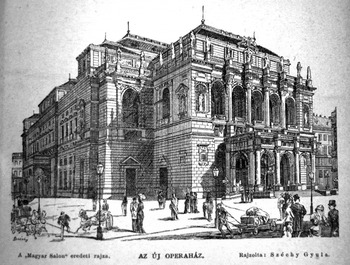
The public budget had its restrictions, and the building of the opera house, inaugurated in 1884, displayed a splendor made possible only by a number of important steps to arrange special treatment for this project in the face of building regulations, Vienna's restrictions, and the land market. Significantly smaller than its Viennese counterpart, the magnificent chamber building exuded modernity and adherence to the greater musical tradition, yet segregated the public according to income and status in the interests of safety (see Figure 1).Footnote 17 Before this became reality, however, several decades were spent in musings and negotiations as to whether, in what shape, and exactly where in the city the new opera building would be constructed. This discussion was a consequence of, and inherently intertwined with, a wider discourse on the nature of national culture, the role of the capital city, and the functions of the local and foreign elites in the shaping of public life, a discussion that also drew in several theaters and their legacy. Furthermore, this discussion had its roots in the earlier history of Hungarian musical theater, and of specific theaters of Buda and Pest and the connotations they carried among the greater public. These connotations strongly influenced the events behind the opera house's closed doors, as well as the subsequent public image of this institution in the eyes of the wider community.
The new Hungarian Royal Opera House on Sugárút Boulevard. Source: Vasárnapi Ujság, 28 September 1884. Image courtesy of the National Széchényi Library of Hungary.

“It is not an ordinary day when the king inaugurates the Hungarian Royal Opera House,” wrote the journalist of the popular illustrated weekly Vasárnapi Ujság on 28 September 1884, a day after the opening ceremony. The king, the title the Hungarians preferred to give Emperor Francis Joseph, the journalist stressed:
had built it from his own [royal] budget. Neither is it an ordinary event when a long established permanent opera [troupe] moves into a new [building] only from one of the old palaces [of music culture]. Because [opera] is an extremely expensive plant that needs to be nurtured for years and costs hundreds of thousands [of florins]. On the other hand, it certainly represents the main station on the road of cultural progress here, on the intersection of several interlocking branches of art. Because this is the first Hungarian permanent music theater, that luxurious, nobly spirited work of fine arts (fényűző, előkelően magas szépművészeti czikk) that will be inaugurated in this building in our capital city, which with this celebration will join the rank of today's great cities.Footnote 18
The newspaper thus summarized the main symbolic meaning behind the inauguration ceremony, that of Budapest's aspiration to join—with the help of Austrian emperor's cum Hungarian king's money—the rank and file of greater European metropolises, to stand on a par with Paris and London, Dresden and Milan, but above all with Vienna, on their path toward progress. The journalist's tone was jubilant, and yet further justification was necessary for this particular arrangement, when indeed only one of the city's theaters would be moved into a more prestigious location and have the privilege of becoming the opera venue at the expense of others, and when it itself received sharp criticism even before it opened its doors for the first time.Footnote 19
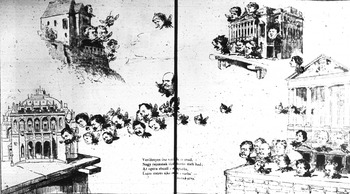
The three main theaters of Budapest of the time, the Castle Theater (Várszínház), the Pest German Theater (Pesti Német Színház), and the Hungarian National Theater (Magyar Nemzeti Színház) were affected by the establishment of the Opera House in different ways. The new opera troupe was in fact composed of the members of the opera section of the National Theater, while the Hungarian government's subsidies—or the lack thereof—strongly influenced the existence of the other two institutions of “high culture.” The fact that prominent Tisza supporter and Liberal politician Frigyes Podmaniczky, known today mostly because of his involvement in the Council of Public Works, was simultaneously the intendant of both the National Theater and the new Opera House illustrates clearly the political implications of the troupe transfer. With the passing of time, increasingly more commercial stages in the immediate vicinity of these institutions challenged their economic survival. They included not only the Popular Theater (Népszínház, alternatively called Operetta Theater), which housed the National Theater's troupe for a number of decades at the turn of the century, but also the Comedy Theater (Vígszínház) and a great number of music halls. The irony of the situation was succinctly sketched by satirical newspaper Borsszem Jankó, which showed the winged troupe of the National Theater flying over into the new Opera House, while the Buda Castle Theater's and the Pest German Theater's directors and staff could merely watch (see Figure 2).
“Autumn swarming.” Source: Borsszem Jankó, 28 September 1884. Image courtesy of the National Széchényi Library of Hungary.

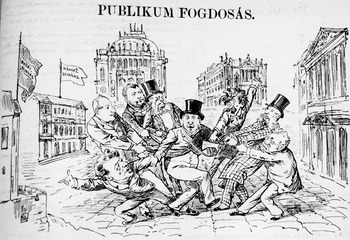
In consequence, in its attempt to spend its leisure time on music, the public was in fact torn between the offers of several permanent theaters, not to mention other, smaller stages all around the city and even in the vicinity of the new Opera House (see Figure 3).
“Grabbing the public.” Source: Borsszem Jankó, 2 November 1884. Image courtesy of the National Széchényi Library of Hungary. The caricature shows the directors of the Buda Castle Theater, the German Theater, the Opera House, the Popular Theater, and the National Theater—with Frigyes Podmaniczky, the intendant of both the National Theater and the Opera House depicted twice—pulling the coat of a respectable gentleman each in the direction of their institution.

“The king has done his part, now it is the turn of the capital city and the public society to show what [his] beautiful, special present is worthy of,” concluded the article in Vasárnapi Újság, echoed by a number of papers loyal to the current government in both imperial capitals.Footnote 20Neues Politisches Volksblatt bluntly published the portrait of young Francis Joseph on the cover of its 27 September edition, whereas writer Emil Ábrányi's ode on the occasion of the inauguration decorated the front page of Pesti Napló, which in turn called the emperor “the foremost Hungarian man, the crowned king” (a legelső magyar ember, a koronás király).Footnote 21 And indeed, the scandal at the opening ceremony very soon proved that establishing a good reputation for the new institution and thereby joining the ranks of European cultural metropolises of the time would prove an extremely difficult business—much to the disadvantage of their political experiment.
The design, the location, and the repertoire of the new opera house had long since become tools in the hands of its initiators to achieve their aims of self-legitimation during the decades preceding the inauguration. The building's display of splendor and modernity, though typical of the time, contrasted with the atmosphere of restricted exclusivity that reigned behind its closed doors in late September 1884 and during the subsequent decades. The predominance of the aristocracy and their values would remain one of the new institution's fundamental features in the years to come. In fact, the very same 1884 issue of Vasárnapi Újság, among several other local papers, dedicated more space to the personality of Podmaniczky than to the report on the new opera building, let alone an account of the inauguration ceremony.Footnote 22 As head of the Public Works Council, Podmaniczky was a significant public figure, and his portrait, which decorated the cover page of the 28 September issue, was clearly more significant than that of the opera house's architect, who came second, and the composers Ferenc and Sándor Erkel, who trailed behind.
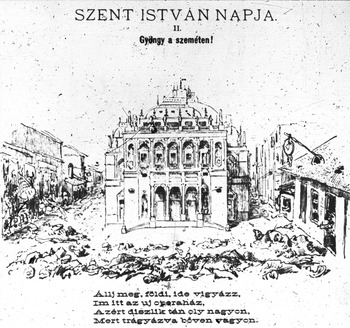
Naturally, others who were excluded from such a prestigious event or found it inadequate in some other way would use the inauguration as a convenient occasion for critique and satire of what concerned the greater public. Days before the inauguration, it still remained unclear whether the construction work would be completed on time. The surrounding streets were still dug up and were not expected to be paved until as late as 21 September, one week before the inauguration. Two days before the premier, the opera house was to undergo the final review by the building commission, which would finally confirm whether or not the building was fit and safe to host performances.Footnote 23 As the sphinx statues by Alajos Stróbl were installed in front of the main facade and the busts of Liszt and Erkel were not yet there, satirical comments were bound to spring up.Footnote 24 Thus, while the mainstream press published celebratory articles dedicated to the opera house inauguration—including photographs of the emperor and the institute's administration and staff, along with engravings of the facade and the audience in the auditorium—the critical press did not fail to pinpoint major drawbacks of the project in an infinite variety of ways. In fact, the clear symbolic significance of the construction of the opera house on the city's main avenue, in striking contrast with the lack of attention to some of the nearby areas, and the city's neglect of the emerging public space, was a perfect occasion for satire. The design of the building, its architectural decoration, its connection to broader issues of street and building regulations, as well as the unbecoming street activity that took place just outside the doors, became targets of criticism. The fact that a week prior to the inauguration ceremony the city did not seem to have decided what to do about the prostitution thriving next to the new magnificent temple of all arts did not exactly add legitimacy to Podmaniczky and others with the power to change the situation.Footnote 25 Perhaps the most apt cartoon came from Borsszem Jankó on 21 August, a month before the inauguration ceremony. “Pearl on the garbage” depicted the new building surrounded by urban filth and hinted at the initial function of the market on Hermina tér, the nature of the city's attention to this particular project, the public behavior in urban spaces during major holidays,Footnote 26 as well as a variety of internal disputes lurking beneath its magnificent facade (see Figure 4).
“St. Stephen's Day II: Pearl on the garbage!” Source: Borsszem Jankó, 24 August 1884. Image courtesy of the National Széchényi Library of Hungary. “Halt, fellow countryman, look here / Here is the new Opera House / It may sparkle so very much / Because it is manured so profusely.” Note a prostitute is in the window on the right-hand side.

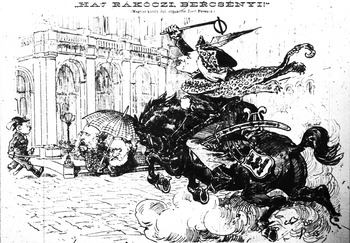
The works to be included in the inaugural program also became a matter of debate. Erkel's opera István király (King Stephen), to be written specifically for the occasion, was not ready and could not be performed. A major debate, however, exploded in the public realm weeks before the inauguration, caused by Podmaniczky's refusal to include Franz Liszt's adaptation of the old Hungarian revolutionary song “Haj, Rákóczi, Bercsényi” as the royal hymn in the inaugural concert on the grounds that it might offend imperial sensitivities.Footnote 27Függetlenség and other opposition papers proudly reported that a certain union of university students would hold a public demonstration on the occasion of the inauguration ceremony. The demonstration would be directed personally against Podmaniczky and the others who, according to the paper, “attempted to be more loyal than the king himself to the Hungarian nation. This would be an imposing demonstration of the spirited youth in a patriotic protest against the omission of a hymn by the great composer.”Footnote 28 Others joined the dispute and, in their rhetorical attempt to talk the organizers out of holding this demonstration, argued that it would darken the celebratory mood of the inauguration ceremony and could easily provoke a scandal, something that they thought would only damage the good reputation of the Hungarians in the eyes of the wider world. To this the representatives of the “university youth” answered that their opponents had nothing to fear as they would be greeting the emperor with “ceremonial, solemn ovations”—thus marking their presence and visibility in the new urban space of the Hungarian capital and emphasizing that, in their view, much of the public disagreed with the politics of the city administration.Footnote 29 Podmaniczky's official letter to Liszt in which he laid his arguments against including this work in the program, as well as the composer's answer, in which he assured Podmaniczky that the original text had been strongly revised and posed no threat to the imperial sensitivities, were subsequently published in the city's daily press, provoking further discussion and caricatures in the satirical press.Footnote 30 Numerous cartoons depicted Hungarian-styled Liszt—who was otherwise repeatedly mocked by the press for never learning Hungarian, let alone never having resided in Hungary—in his futile attempts to enter the Opera House (see Figure 5).
“Haj Rákóczi, Bercsényi: A Hungarian royal song composed by Franz Liszt.” Source: Borsszem Jankó, 5 October 1884. Image courtesy of the National Széchényi Library of Hungary.

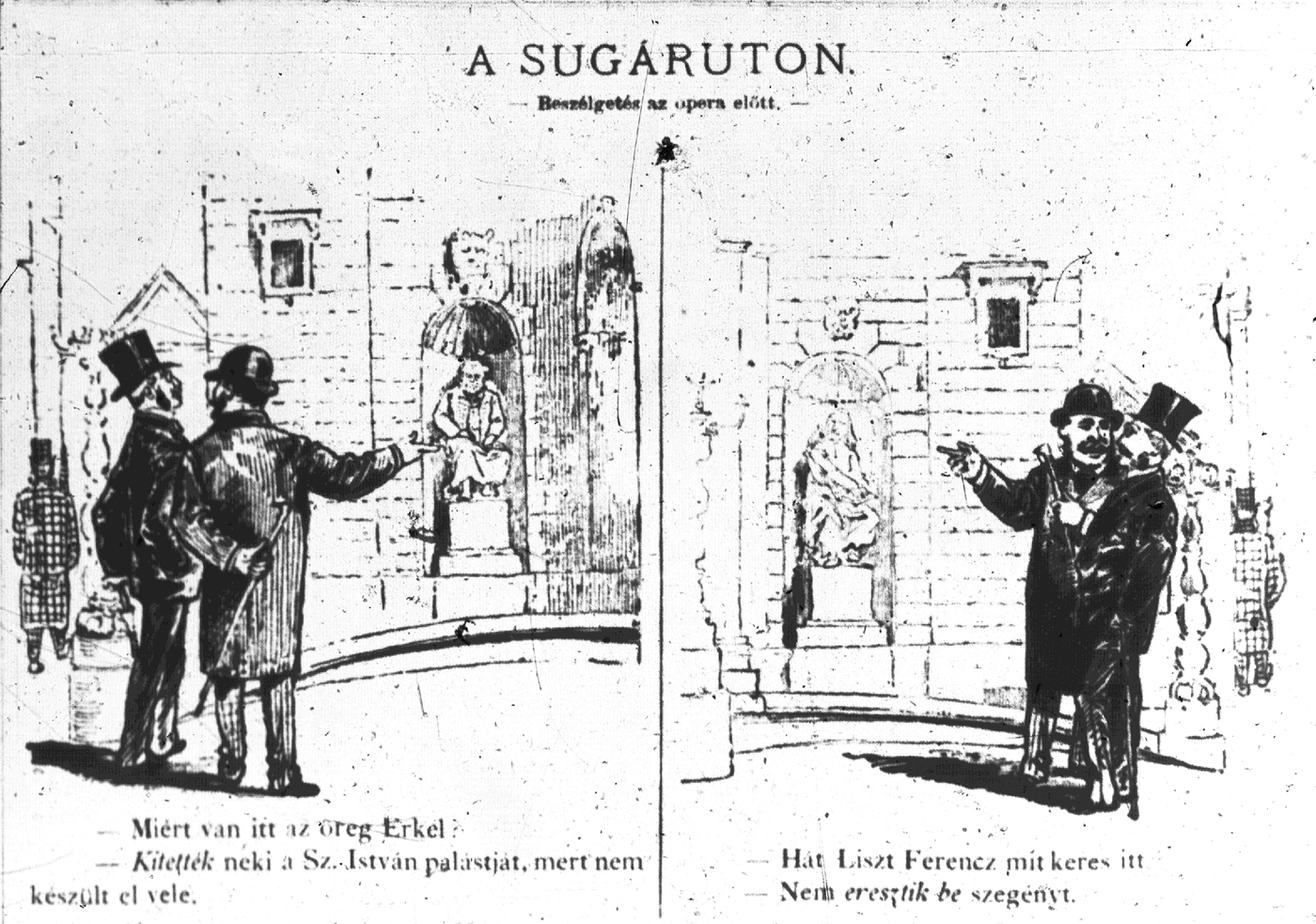
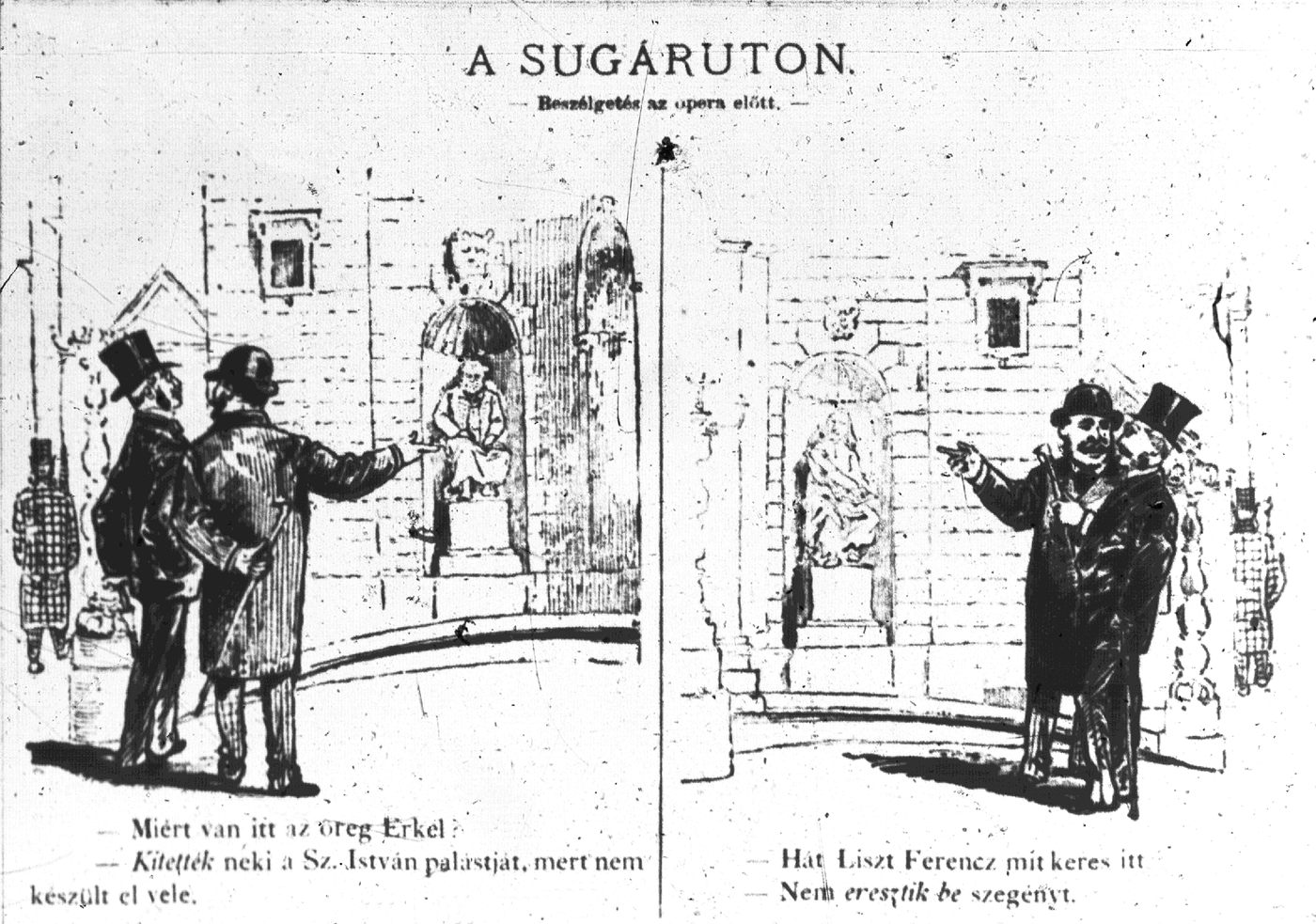
In a subtle comment on the forthcoming inauguration's program, the imperial presence, and what was perceived by some as the relatively insignificant placing of the statues of Erkel and Liszt on the facade of the opera house, for example, Borsszem Jankó, echoed the heated press discussion of the time and ironically suggested that Erkel's head was not inside because he had not finished his István király opera that the opera house had explicitly commissioned for the inauguration ceremony, while Liszt was simply not allowed entry (see Figure 6).
“On Sugárút: Conversation in front of the Opera House.” Source: Borsszem Jankó, 21 September 1884. Image courtesy of the National Széchényi Library of Hungary. “—Why is old Erkel here?—They took away St. Stephen's coronation garb from him because he was not ready with it—And what is Franz Liszt doing here?—He is not let in, the poor thing.”
Pesti Napló assured its readers that Liszt's anthem would indeed be performed at the opera house at a later date, and more specifically at the premiere of István király—that premier, however, would need to wait yet another year, and in fact even then the Royal Anthem would not be performed—whereas on that special day in September 1884, the program would be what Pester Lloyd's journalist called a “medley combination” (potrourriartige Zusammenstellung). Pesti Napló also noted, with patriotic emphasis, that “the Master” would soon be visiting Budapest and proceeded to elaborate the details of the Liszt-Podmaniczky correspondence.Footnote 31Függetlenség, conversely, published a strongly anti-Semitic statement on 26 September stating that, “according to reliable sources,” the removal of the Royal Anthem from the inauguration program was due to the Jews, who made up a “too great number among the opera house's box lodgers” and concluded that it was a “dangerous power with which the Jewry now threatens the arts, too.”Footnote 32 Anti-Semitic comments about the opera house's new audience would continue to characterize public discussion of the institution in the subsequent decades.
All of the seats were reserved weeks before the premier, due to a combination of factors. Fővárosi lapok noted on 23 September that “all tickets issued so far have already been booked, the opera administration therefore can in no case make any further bookings.” Interested parties were requested to pick up pre-booked tickets as soon as possible. The newspapers specifically advised their readers that the dress rehearsals would take place on 23 September, exclusively for members of the building commission, and on 25 September, limited to the representatives of the press, and that only those would be allowed entry who had previously received a special invitation.Footnote 33 This only contributed to the atmosphere of unnecessary and unwanted exclusivity and secrecy. It did not help that on both occasions a large number of other guests filled the auditorium despite the opera house administration's requests to the contrary. The final dress rehearsal on 26 September, again for a highly restricted audience, took place in a situation of extreme excitement and tension, even rehearsing the inauguration itself, with all formal protocol observed to the last letter. The public was requested to wear formal dress: Men were to wear either a frock coat or a “Hungarian gala costume,” whereas women were to show up in evening gowns.Footnote 34 The opera house, which some called “a beautiful, glorifying monument to the art of our motherland” (ein schönes, ehrendes Denkmal vaterländischer Kunst)Footnote 35 and others “a fairy-tale palace” (tündérpalota)Footnote 36 shone in all its splendor, seducing the passerby with its beauty. The facade was fully illuminated with gas lamps from early afternoon, causing a significant disruption of everyday routine in the area: In front of the opera house, wrote Pesti Napló, carriage transport almost completely stopped, in the side streets people were tumbling over one another. The doors were almost under siege, everybody wanted to get in and the police on the site were letting in only those who had brought their special invitations.Footnote 37 The auditorium was completely full, to the surprise of the local papers.Footnote 38 The newspapers found it particularly comical that, given the situation, even though the theater troupe was officially restricted from this final dress rehearsal, “not just the theater members, but also their relatives were present.”Footnote 39 The tension in the city was obviously growing, which required the opera administration to issue press statements to prevent their doors from being bombarded by the enthusiastic public.
In fact when the capacity of the luxury boxes, as opposed to the galleries, as well as the ticket prices, are taken into account, it is no surprise all seats in the relatively small building were quickly sold out to the city's wealthy. The opera house was intentionally built for the exclusive presentation of those who were able to afford to reserve a separate box: The number of seats in the boxes greatly exceeded that in the parterre and the third-floor gallery.Footnote 40 At the time of the premier, the price for the boxes on the ground and first floors, 11 florins, was an enormous sum, approximating the cost of a silver watch; whereas boxes on the second floor were just slightly cheaper, 9 florins, and the cheapest tickets in the last rows of the third floor gallery cost 1 florin, still a considerable amount of money to pay, especially when it became clear that, as many duly complained, one could see only a fraction of the stage from some of the seats in the upper gallery.Footnote 41 Moreover, the boxes on the lower levels would traditionally be reserved for the local elite, which brought complaints from the artists of the younger generation.Footnote 42 During the subsequent years, the administration made it a matter of principle on a number of special occasions that boxes should be reserved directly with the intendant, whereas other reservations could be requested at the cashier's desk in the building of the opera house.Footnote 43 Furthermore, whereas one would expect that pressure to lower the price of tickets would force the opera house administration to give in finally, as was the case in many opera houses in Europe at the time, in fact the opposite was the case. Already in the days before the inauguration, the administration warned the public through several city newspapers that ticket prices for some forthcoming premieres would be even higher, a practice that would continue at the theater in the following decades.Footnote 44
All these preceding incidents taken into account, it was no wonder that the air smelled of fire in Budapest on the day of the opera house inauguration. “The great new house of the muses of song and dance sparkled from the inside out. Naturally, much more so on the inside than from the outside,” reported Fővárosi lapok with a hint of irony on 28 September. Despite the fact that in the days preceding the inauguration the opera house administration announced the strict protocol of the program, including the arrival regulations, great crowds collected on the avenue and in the adjacent streets, and omnibus traffic stopped. Public transportation was blocked by private carriages as far as the Chain Bridge on the Danube. The nearby cafes were totally packed, as were the balconies of the buildings facing Hermina tér, which were used as improvised viewing spots.Footnote 45
The citizens of the capital showed such an acute interest in the inauguration that four hours after the event the police still kept close ranks; carriages and even more so pedestrians would have had great difficulty reaching the opera house. Around seven o'clock great crowds infested the mouth of the avenue and even the smaller streets nearby. Carriages that arrived from Váci Körút needed to stand in a long queue until they could proceed further.Footnote 46
The imperial welcoming ceremony, as well as the interior arrangement of the public in the auditorium during the premier, allowed a perfect mirror representation of contemporary high society in miniature. Tisza, dressed in Hungarian ceremonial dress (díszmagyarban), Podmaniczky, in honvéd major uniform (honvéd őrnagyi egyenruhában), and Ybl, together with the entire building commission, waited for the emperor-king and the accompanying court representatives to arrive at the luxuriously illuminated vestibule. All protocol followed to the letter, the crème de la crèmeFootnote 47 of society settled in their boxes: on the right side on the first floor, Tisza, Foreign Minister Gustav Kálnoky, and other government representatives and notable Hungarian aristocrats; on the left side in their respective boxes, Gyula Andrássy and Mihály Munkácsy, among others; and in the boxes in the parterre, aristocratic politicians Géza Szapáry and Ferenc Zichy clustered with some others. Only in the boxes on the second floor would one see important women of the time, first of all the leading staff of the National Theater. Conversely, the city representatives, together with the chief of municipal police, sat in the proscenium box. Finally, a few officers, writers, and the press collected in the parterre.Footnote 48
Once the emperor-king was seated in the royal box, the organizers attempted to proceed with the original program—which did not, however, start with the traditional singing of the imperial anthem “Gott erhalte.” Even within the opera house's closed doors, the tensions remained high. The text of Erkel's Bánk bán in the fragment included in the program was intentionally changed to accommodate Francis Joseph's presence: Instead of hail to the Hungarian military heroes (“Éljenek a magyar hadak!”), hail to the king was sung (“Éljen a magyar király!”). Although this modification was previously rehearsed and the local public who read the news knew about it, the effect must have been stunning to everybody in the auditorium. In a society so heavily regulated by protocol, the audience rose to their feet on impulse and greeted the emperor-king with a thunderous “Éljen!”Footnote 49 During the incident, as reported the next day by the oppositional Függetlenség, the emperor-king remained seated—a fact that the newspaper found scandalous and for which Vienna later needed to issue a special apologetic explanation.Footnote 50
While the official ceremony of the inauguration proceeded as if unimpressed by the crowds outside, the street crowd did not dissolve. After the event, it appeared that at least one person suffered a violent death in his attempt to enter the opera house. The demise of the imperial pastry maker (udvari czukrász) Pál Kheren was reported to his wife who turned up in the opera house earlier.Footnote 51 Chaos ruled the street, and several papers blamed the police for being weak and incompetent in dealing with the situation. It would be a mistake, however, to blame everything on the force, as the opera administration had their share of responsibility for the situation. As the crowds stood in front of the closed doors of the opera house and the performance was about to begin, it turned out that some members of the orchestra and the ballet troupe were also absent—and it soon became clear that no one had issued special invitations for them, so the police would not let them in, assuming they were among the crowd that was not allowed entry. A representative of the administration eventually appeared in front of the public and asked the crowd in as loud a voice as he could muster whether any members of the orchestra were among them, which provoked an animated reaction.Footnote 52 The exclusive public was witness to the discontent on the street when some went out to the terrace during the interval:
After the first act of Bánk bán many went out to the illuminated staircase, between the columns, into the foyer and to the outside terrace. An immense crowd stood on the street, which caused great concern to the police. During the performance, part of the crowd managed to break in to the outlying stairs and the hallway [and] it was not an easy job to expel the invaders. Because of this, discontent ruled on the street. Equestrian policemen drew ironic cheers and guffaws as they attempted to push back the crowd, using a saber here and there. Whether there was enough cause for this it would have been impossible to judge from the terrace.Footnote 53
This concise description carefully censored several crucial incidents that took place both inside and outside the building that emphasized the subversive character of the whole episode, which in turn threatened the successful completion of the local elite's political experiment. Other papers were much more outspoken about what had taken place before the unprepared and incompetent police forces were able to restore order:
Barely had the King entered the interior of the Opera House as the masses approached the Opera. … Next to an elegant gentleman who led a lady on his arm, dressed after the latest fashion, one saw bareheaded and barefoot orphans (Schusterjungen) walk the carpets. Even the first and second floors, the wardrobe and the foyer were not immune to this invasion. A few curious (einzelne Verwegene) came in immediate proximity to the Royal Box, where the police commissioner Paul Nagy arrested the two invaders, one a student and the other an employee of the railway.”Footnote 54
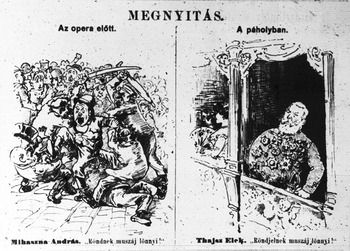
The exact duration of the incident was reported differently in various local papers the next day, but it was clear that at least twenty minutes and drastic measures on the part of the police were needed to restore order. Some aristocrats, including Podmaniczky himself, used their sabers against the intruders. The noise was so loud that there were concerns and suggestions that the performance be stopped.Footnote 55Pesti Napló reported that mere minutes separated those arrested from gaining access to the key of the royal box.Footnote 56 Meanwhile, it appears that about a dozen women “dressed not exactly for a soirée” approached Podmaniczky and tried to get his permission to see the emperor-king “just for one minute” and were promptly and rudely told to clear out. Apart from the sudden death of Mr. Kheren, eight people were run over by carriagesFootnote 57 (see Figure 7).Footnote 58
“Inauguration: In front of the Opera—And in the box.” Source: Borsszem Jankó, 5 October 1884. Image courtesy of the National Széchényi Library of Hungary. András Mihaszna: “There must be order!” Elek Thaisz: “There must be order!”

Surely, the university students, who only a week earlier had threatened to make a public demonstration against the exclusion of Liszt's anthem from the program, were among the intruders—but there are reasons to believe there were many others who were unhappy with the way the inauguration was appropriated by the city's and the country's powerful, even if for different reasons. No wonder that when the emperor-king and Prince Albrecht who accompanied him left the opera house after the first notes of Hunyadi László rang in the orchestra pit, the crowd again started to shout “Éljen!”, and only after a good few hours did the cheers finally fadeFootnote 59—there is no way of knowing how many of them were ironic, either as intended by the university students, or as addressed to the municipal police dispersing the crowd a little earlier.
Summing up the day and the two spectacular openings, of the opera house and previously of the Hungarian Parliament, Borsszem Jankó published a long verse in its 5 October edition that succinctly finished with the following phrase: “Two such openings! Theater and Parliament, / And such patriotic zeal possesses us / That we ask reflectively: Indeed, the [dear] Son of God, / Where else would you find more and greater comedy?”Footnote 60
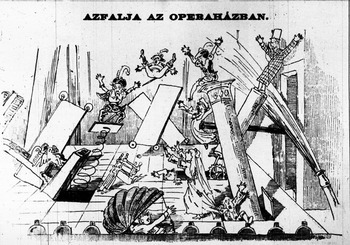
Two further events in the aftermath of the inauguration ceremony shone further light on the condition of the opera house affairs. First, on 29 September the inauguration program was repeated with a slight modification for a much sparser audience. While the reception was joyful and enthusiastic, even the moderate Fővárosi lapok could not help but note that the show was sparsely attended and that numerous boxes and entire rows in the parterre remained empty. This, the paper noted, was surprising, as the news had spread around noon that no more tickets were available.Footnote 61 During the interval, the crowd hurried to the café downstairs and the auditorium became even emptier after the performance resumed—another feature that would remain characteristic of opera house audiences in subsequent decades.Footnote 62 On that occasion, too, the crowd broke into the building from the street despite police efforts to prevent an inauguration déjà vu, which prompted several papers to suggest that the excited public should be given a chance to see the theater when no performances were taking place, just like, it was reasoned, was done in Paris. Whereas the performance went undisturbed by the incident, another accident certainly had an effect and was widely reported: A candelabra fell onto the stage from the ceiling immediately before the performance.Footnote 63 This incident, combined with jokes about the effectiveness of the “Asphaleia” safety systemFootnote 64 that would reappear on several later occasions, turned into a symbol of the state of affairs within the Opera House (see Figure 8).
“Asphaleia at the Opera House,” Source: Bolond Istók, 16 November 1884. Image courtesy of the National Széchényi Library of Hungary. One of the persons catapulted by the malfunctioning Asphaleia system is, once again, Frigyes Podmaniczky.

And second, as laconically summarized by Függetlenség on 1 October, by the exclamation “Az operaház ég!“ (“The Opera House is on fire!”), the institution's affairs remained a matter of burning interest to the local public in the subsequent decades.Footnote 65 Accounts of this event are contradictory. According to Fővárosi lapok, the fire originated in one of the nearby buildings on Hajós utca, and the sparks reached the opera house building only sparsely and were promptly extinguished by firemen. The performance was not disturbed by this incident, except when the audience witnessed the alarming scene when they entered the gallery during one of the intervals, and the interval lasted longer than usual. The majority of the distinguished guests, however, remained in the auditorium and did not even know about what was happening outside.Footnote 66 The exact degree of damage became apparent later and was limited to the nearby houses where the fire had started, and specifically the flats of several members of the opera troupe, including prima donna Zsófia Coppini. However, word of the fire spread quickly and, once again, a huge crowd gathered in the streets neighboring the building, preventing the fire brigade from doing their work—hence, as Podmaniczky later argued, the intervention by gendarmes aimed at restoring order and emptying the streets was unavoidable.Footnote 67
Despite this and many other later anecdotal evidence, the opera house survived, thrived, and accumulated the symbolic capital until today. The clashes of 1884 were the last station in a chain of events that preceded the inauguration for at least a decade and determined much of the controversial reception of the opera house during the decades to come. Such an event involved the active participation of the whole spectrum of politicians, from the emperor-king and the leading aristocracy to local activists and youths, who attempted to legitimize their actions before, during, and after the opening ceremony. The opening also engaged the “respectable” public to represent itself within the walls of the new building, while attracting interest from a larger population who had no access to this representational space and drawing critical commentary of the local press. The construction of the new theater was itself part of a larger “beautification” project of the new Hungarian capital, and diverse attempts to advance particular representation agendas by these and other actors before the larger public were bound to carry greater significance. The exact composition and spatial stratification within the audience represented a microcosm of local high society, with, as a rule, no name of social significance absent from the auditorium. Conversely, the diverse ways in which this event was disrupted by those who were excluded from the ceremony demonstrated the ruling elite's profound inability to control the situation.
The contrast between the interior and the street, the building's architecture, the composition of the program, the segregation within the already privileged public and especially the threats to the carefully orchestrated political project within the opera house from outside forces would remain features of this institution during the late nineteenth and early twentieth centuries and, ironically, continue to speak to us today. In the second decade of the second millennium, the Opera House continues to function as an institution of great symbolic significance and is used by the ruling political elite and the opposition societal forces to foster their divergent goals in the traditions of the 1884 inauguration ceremony. In their political projects, the twenty-first-century descendants of Tisza and Podmaniczky showed their profound lack of interest in accommodating the opinion of their sizable opponents or in listening to the voices of discontent and dissent. The political elite continued to show itself as incapable of organizing its own promotional events adequately as its peers during the inauguration ceremony over a century earlier, though admittedly Tisza did not need to leave the opera house through the back door. Like all political rulers, the current Hungarian political elite continues to rely strongly on the police forces in its attempt to shield itself from the view of the public, though fortunately history has until now spared the FIDESZ leaders a chance to demonstrate their skill in handling a saber. Functioning in a public space that remains no less political than it was during the times of its inauguration, the opera house thus means much more than what is, and was, going on its stage. The presence of works by Erkel in both programs is another irony that should by no means be disregarded, but music historians much too often tend to forget that the main points of debate might not always have been the musical works in the program, but greater social and political issues.
What the 1884 inauguration tells us is that it was only when the musical works became signifiers of such greater issues that they generated a greater public debate. Ironically, at a time when Hungary is undergoing yet another political, economic, and constitutional crisis and when the press needs to function in a legal framework that makes the good old Austria-Hungary appear in a favorable light, the lesson to learn from the 1884 inauguration scandal in front of the opera house is that methods of rule with a heavy hand, accompanied by self-celebratory events such as the gala concerts in the opera, only tend to accelerate existing social conflicts, not to resolve them.