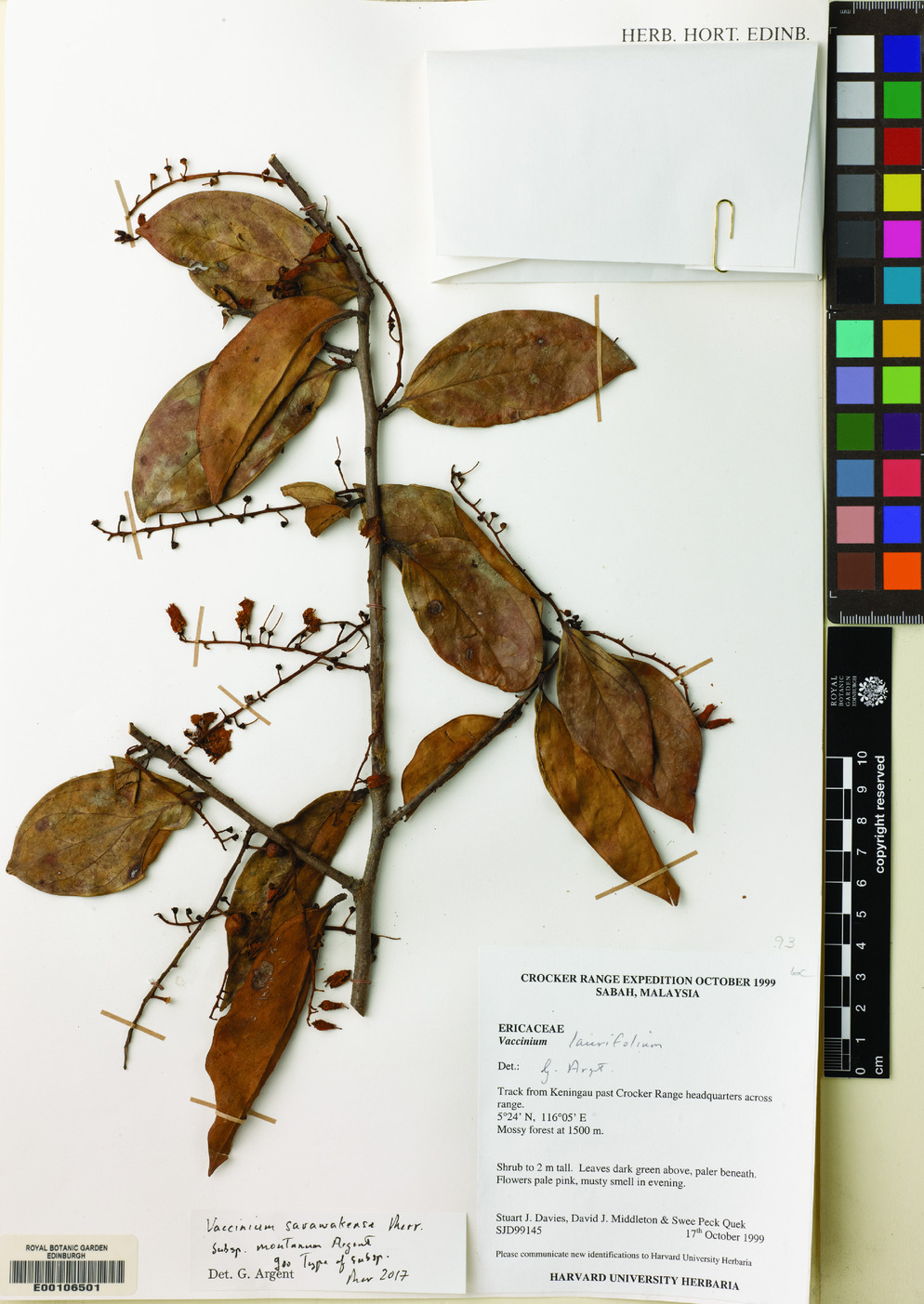
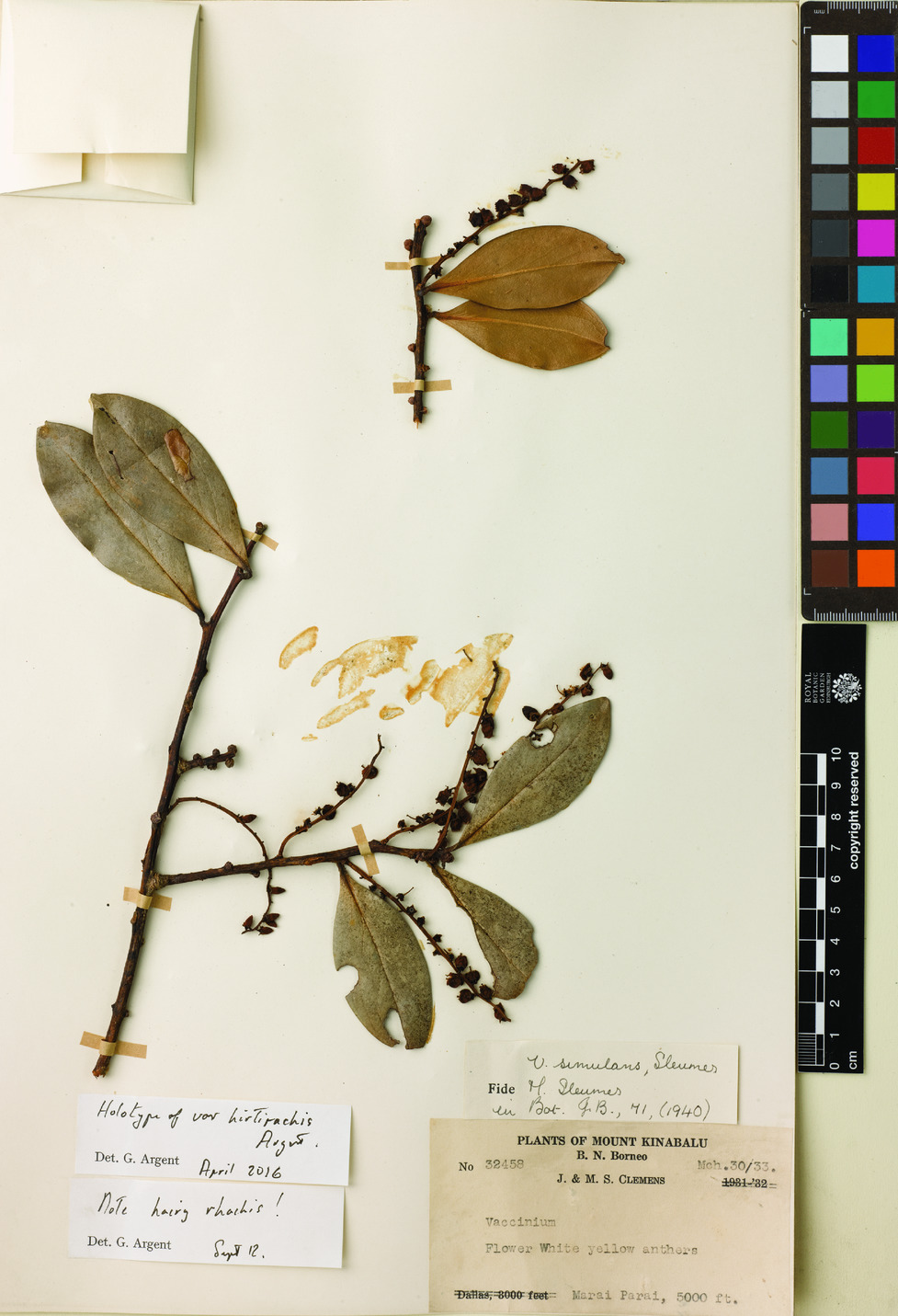
Introduction
Tropical Vaccinium L. (Ericaceae: tribe Vaccinieae), in common with much of the Ericaceae in the tropics, is largely montane with a high degree of endemicity. Sleumer's account of the Ericaceae in the Flora Malesiana (Sleumer, Reference Sleumer and Van Steenis1966–1967) is a classic work which in many respects has stood the test of time and is still an invaluable tool in the identification of Malesian Ericaceae. In the 50 years which have elapsed since it was published, however, much fieldwork has taken place and many new collections added to our herbaria, adding significantly to our knowledge. There is now a greater demand to make rapid assessments of the biodiversity of areas when development projects threaten the vegetation, and it is for this reason that it is felt useful to provide keys to groups covering more limited geographical areas than that of Malesia. It is hoped that the present keys to 42 species in two genera will be less daunting than that to the 239 species of Vaccinium in the Flora Malesiana account, and that the use given here to vegetative characters will allow identification of many specimens which cannot be tackled with the Flora Malesiana key, particularly for fruiting or sterile specimens, which are often the only material available in ecological and survey work. It must, however, be emphasised that, for reliable identification, flowers are often still needed and that identities should always be checked against the full descriptions.
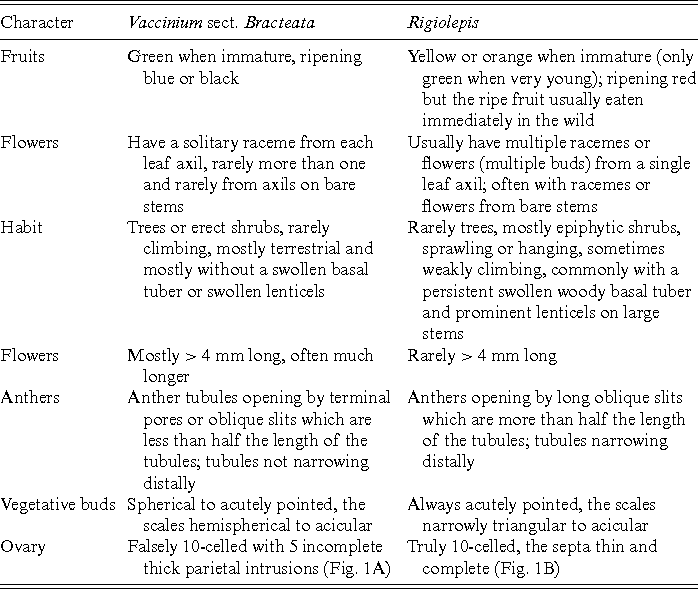
Only two sections of the genus Vaccinium are recorded from Borneo in Flora Malesiana (Sleumer, Reference Sleumer and Van Steenis1966–1967): sect. Bracteata Nakai and sect. Rigiolepis (Hook.f.) Sleumer. In Borneo, species of Rigiolepis can easily be distinguished from species of Vaccinium by their morphology (Table 1). All the Bornean species sampled cytologically are diploid, 2n = 24, although few species have been investigated (Atkinson et al., Reference Atkinson, Jong and Argent1995). Polyploidy, which is a significant feature of Vaccinium in North America (Camp, Reference Camp1942), has so far not been reported.
Differences between Vaccinium sect. Bracteata and Rigiolepis in Borneo

Diplycosia Blume (tribe Gaultherieae) species are commonly confused with Vaccinium. The best field character for distinguishing Diplycosia species is the old pedicels which usually have the two bracteoles remaining as a persistent cupule-like structure. The bracteoles of Vaccinium are rarely closely paired and never form a similar cupule-like structure. The ovary of Diplycosia is superior, not inferior as in Vaccinium, although, because the calyx is accrescent and grows up round the ovary in Diplycosia, care should be taken in observing this character. Costera J.J.Sm. species are occasionally confused with Vaccinium. They can easily be told from Vaccinium when in flower or fruit, as the pedicel is continuous with the calyx, lacking the line of articulation found in all Vaccinium species recorded from Borneo. Costera species also lack the minute glands on the underside of leaves which Vaccinium and Rigiolepis species characteristically possess, at least when young.
Smith (Reference Smith1935) argued for generic status of Rigiolepis but Vander Kloet (Reference Vander Kloet2005) argued against it. Smith quite rightly rejected the arguments of Ridley (Reference Ridley1922) that Rigiolepis was distinct “in its epiphytic habit, extra-axillary racemes, and very small flowers” but pointed out two other significant features, namely that “They differ in the tubes [anther tubules] tapering towards the apex, somewhat in the way of Dimorphanthera, and open by a long, longitudinal, cleftlike, introrse pore. The ovary is 10-celled, with the septa similar, complete and thin”. It is unfortunate that he did not illustrate the ovary structure. Vander Kloet (Reference Vander Kloet2005) referred back to Ridley's (Reference Ridley1922) already discredited features of Rigiolepis and failed to interpret the ovary structure correctly or indeed make proper comparisons with regard to the anthers. Sleumer (Reference Sleumer1961) maintained Rigiolepis as a section, commenting, “I cannot follow Hooker f. [Reference Hooker1873], Ridley [Reference Ridley1922] and J.J. Smith [Reference Smith1935] in regarding Rigiolepis as a proper genus next to Vaccinium, as not a single character would separate these genera”. Sleumer also failed to observe the details of the ovary structure in Rigiolepis.
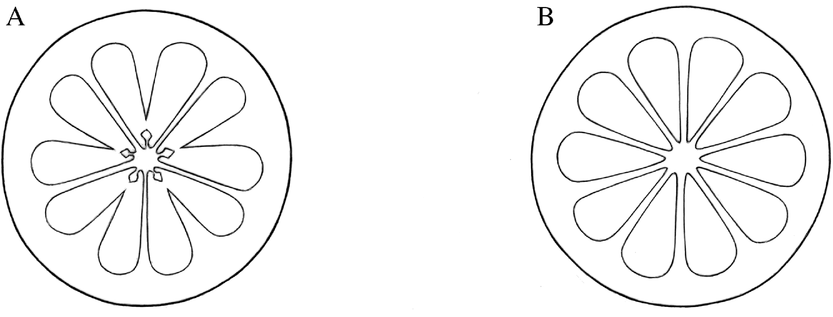
I have followed Hooker (Reference Hooker1873), Ridley (Reference Ridley1922) and Smith (Reference Smith1935) in recognising Rigiolepis as a genus distinct from Vaccinium. Sleumer (Reference Sleumer and Van Steenis1966–1967) was mistaken in stating that the ovary in sect. Rigiolepis was “(4–)5 (or falsely 8–10)-celled”. It is distinctly 10-celled (Fig. 1B) with thin septa walls as Smith (Reference Smith1935) described them, in contrast to the thick, intrusive, parietal partial walls of Vaccinium sect. Bracteata which give to that section the superficial appearance of a 10-celled ovary. This 10-celled character was used by Sleumer himself in his monograph of the New World genus Gaylussacia Kunth (Sleumer, Reference Sleumer1967), to separate it from Vaccinium. Smith (Reference Smith1935) was correct in selecting the 10-celled ovary and anther structure as the key characters at generic rank. Vander Kloet (Reference Vander Kloet2005) was incorrect in claiming that Vaccinium oldhamii Miq. (Vaccinium sect. Ciliata Nakai) has a 10-celled ovary. This species also has intrusive parietal placentas which make it appear 10-celled, but fresh material examined in Edinburgh shows this species to be clearly 5-celled on careful examination, identical to the structure of the ovaries of Vaccinium sect. Bracteata in Borneo. This also agrees with the description in the Flora of China (Fang & Stevens, Reference Fang, Stevens, Wu, Raven and Hong2005). The fruit ripening red as opposed to blue or black in Vaccinium sect. Bracteata in Borneo would appear to be a weak character, as Vaccinium species with red fruit are common elsewhere (Fang & Stevens, Reference Fang, Stevens, Wu, Raven and Hong2005; Hitchcock et al., Reference Hitchcock, Cronquist, Ownbey and Thompson1959). By contrast, the immature fruit in Rigiolepis is a distinctive yellow or orange, a feature not apparently recorded elsewhere in Vaccinium. In Borneo, this immature fruit colour is a good ‘spot’ character for the genus, as the fruits are long persistent in this state. The stamen structure is also distinct in Malesia when tubule shape is taken in conjunction with the relatively small, erect awns. These awns are quite different from those of Vaccinium sect. Galeopetalum (J.J.Sm.) Sleumer (a Malesian and Southeast Asian section not recorded in Borneo), in which the anther tubules similarly taper distally but in which the awns are longer with erect and horizontal pairs alternating in a distinct interlocking pattern. Kron et al. (Reference Kron, Powell and Luteyn2002), although with very limited sampling, show Rigiolepis species (Vaccinium filiforme [Rigiolepis leptantha] and V. lanceolatum [R. lobbii var. lanceifolia]) as forming a monophyletic group within a larger Agapetes clade (a comparison Smith, Reference Smith1935, made and highlighted by the fact that many of the Agapetes species in the Himalayan region also have basal woody tubers derived from the hypocotyl), in contrast to the one species of Bracteata sampled (Vaccinium cercidifolium J.J.Sm.), which is placed in a Bracteata–Oarianthe clade. This may not in itself support recognition of Rigiolepis as a genus distinct from Vaccinium sect. Bracteata, but it does emphasise the difference between these two groups in Borneo and certainly does not negate the concept of separate genera. When all the contrasting characters are taken together (see Table 1), Rigiolepis is sufficiently distinct to stand as a genus and rarely is it difficult to separate Vaccinium sect. Bracteata from Rigiolepis specimens even when sterile in Borneo.
Transverse section of young fruit, showing ovary structure. A, Vaccinium cercidifolium, RBGE accession number 19820845; B, Rigiolepis uniflora var. monantha, RBGE accession number 19773328. (Illustration: Claire Banks.)

Materials and Methods
Leaf measurements are of the blade only, without the petiole, and the petiole is measured separately. Twigs are described as the ultimate branches where the leaves are still attached. The term lanceolate I have used in the Linnaean sense (see Stearn, Reference Stearn1973), which is also Sleumer's usage. It is a very narrowly ovate shape, slightly broader in the proximal half, with a length:breadth ratio of approximately 6:1. Leaf blade measurements should be made from those on mature stems, preferably that are flowering or show signs of having flowered, not seedlings or sucker shoots. A good lens should be used to examine the indumentum and marginal leaf glands. It is imperative to look at young stems for indumentum, as this can be quickly lost with age.
Data for this paper have been collected over many years, and records of the herbaria containing individual specimens have not been kept. With the exception of those marked ‘n.v.’, all the specimens cited have been seen in at least one of the following herbaria: BM, BO, E, FRIM, K, KUCH, L, SAN and SING. Sleumer (Reference Sleumer1961, Reference Sleumer1963, Reference Sleumer1964) and Beaman et al. (Reference Beaman, Anderson and Beaman2001) cite numerous specimens from Mount Kinabalu which are not repeated here except in a few cases where taxa have been transferred. Under the heading Conservation assessment, I have given notes from my knowledge of these plants in the field. It is hoped that these notes will stimulate new observations on the vulnerability of these species. Formal conservation assessments following IUCN Red List guidelines must be carried out urgently.
Systematic Treatment
Key to the genera in Borneo
1a. Fruits yellow or orange finally ripening red, not blue or black; plants with basal woody tubers; flowers < 4 mm, anthers opening by longitudinal slits___________________________Rigiolepis
1b. Fruits green, ripening to blue or black, never yellow, orange or red; plants without basal woody tubers; flowers > 4 mm, anthers opening by terminal pores___________________________Vaccinium
Rigiolepis Hook.f., Hooker's Icon. Pl. 12: 54, t. 1160 (Reference Hooker1873). – Vaccinium sect. Rigiolepis (Hook.f.) Sleumer, Notizbl. Bot. Gart. Berlin-Dahlem 13: 115 (1936). – Type species: Rigiolepis borneensis Hook.f.
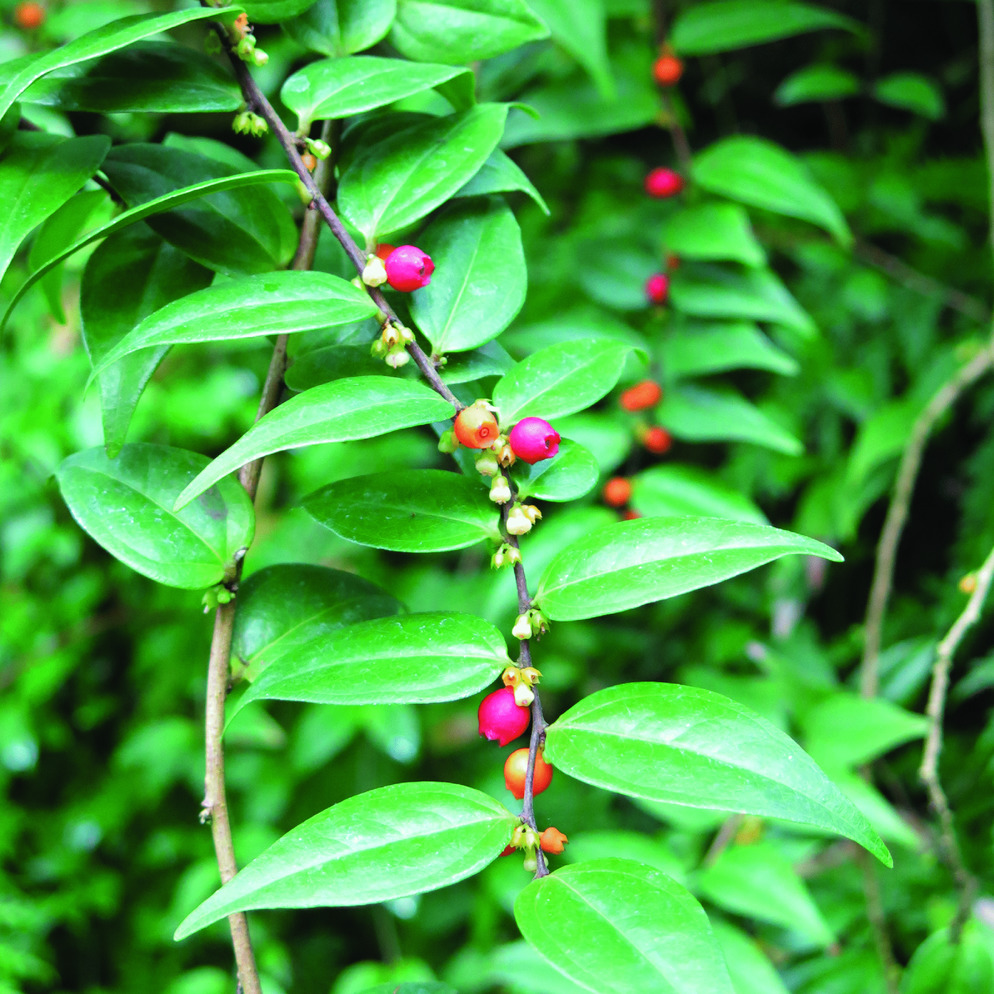
Predominantly epiphytic, with a persistent woody basal tuber, stems mostly with conspicuous lenticels on the larger branches, lateral buds narrowly pointed, usually conspicuous with acicular scales. Leaf blade margins entire, occasionally with irregular indentations. Commonly producing multiple racemes or solitary flowers from multiple buds in the axils of individual leaves, these inflorescences also frequently appearing from defoliate axils. Flowers: 5-merous with 10 stamens. Anthers isomorphous, the tubules narrowed distally, with long introrse pores which are at least half the length of the tubules and with 2 short erect awns. Ovary 10-locular (see Fig. 1B) with thin dividing walls, each locule containing 1 (or 2?) seeds. Fruit a spherical berry which soon changes from green to yellow or orange and is probably finally red in all species. The submature orange berries persist for a long time as the fruit develops, whereas the ripe fruit tends to be taken very quickly in the wild which means the labels on most collections describe immature fruit (see Figs 17, 22, 25). In addition to Borneo, Rigiolepis is known from Vietnam, Peninsular Malaysia, Java, Sumatra and Sulawesi (see discussion below relating to Sulawesi and Vietnam). In Borneo, 23 species are recognised in this account.
The authorship of both Vaccinium sect. Rigiolepis and Vaccinium borneense is complex. Sleumer (Reference Sleumer1936) made the combination Vaccinium sect. Rigiolepis in a key to the infrageneric taxa of Vaccinium as follows:
Sect. 13. Rigiolepis (Hook.f. 1876 pro gen.) Sleumer comb. nov. (Leitart V. borneense W.W.Sm.).
Although the reference to the basionym of the section is somewhat indirect, this combination was made before 1 January 1953, so it is valid (McNeill et al., Reference McNeill, Barrie, Buck, Demoulin, Greuter, Hawksworth, Herendeen, Knapp, Marhold, Prado, Prud'homme van Reine, Smith, Wiersema and Turland2012, Article 41.3).
Rigiolepis borneensis Hook.f. was the only species of Rigiolepis when the genus was erected in 1873, so it must be the type species. The type specimen of Rigiolepis borneensis is Lobb s.n. (K).
When Rigiolepis is considered to be a section of Vaccinium, then a new combination must be made in this genus for R. borneensis. Here, much confusion has arisen because the earliest valid publication of the combination Vaccinium borneense is not based on Rigiolepis borneensis. Vaccinium borneense W.W.Sm. was published in 1915 with no reference to Rigiolepis borneensis Hook.f., nor to Lobb s.n. (K). The type of Vaccinium borneense W.W.Sm. is, in fact, Native collector 66 (E). Sleumer's citation of Vaccinium borneense (Hook.f.) W.W.Sm. (Sleumer, Reference Sleumer1941) is incorrect because Rigiolepis borneensis Hook.f. and Vaccinium borneense W.W.Sm. are heterotypic names.
The work of Vander Kloet (Reference Vander Kloet2005) in reference to this species needs to be clarified. First, he could not find the type of Vaccinium borneense W.W.Sm. at E so he claimed that the name was a nomen nudum. This shows a misunderstanding of nomenclature which is compounded by the fact that he then selected a lectotype, entirely unnecessarily. A neotype would have been needed if the type had really been lost but it is at E to this day. Second, Vander Kloet made the taxonomic determination that Lobb s.n. (K), the type of Rigiolepis borneensis Hook.f., was Vaccinium acuminatissimum Miq. I do not accept this determination and thus I cannot accept Vander Kloet's citation of Vaccinium acuminatissimum Miq. as the type of sect. Rigiolepis. Ridley (Reference Ridley1922) had already commented “By some curious error Merrill (Reference Merrill1921) has reduced Rigiolepis borneensis to Vaccinium acuminatissimum Miq. with which it has nothing in common”. Vaccinium acuminatissimum and Rigiolepis borneensis are certainly very different.
Specific distinctions within Rigiolepis are not always morphologically definitive. Sleumer (Reference Sleumer and Van Steenis1966–1967) commented that the group was “not sufficiently known and [its species are] difficult to distinguish”. Vander Kloet (Reference Vander Kloet2005) also states “Only a long study in the field will yield a robust taxonomy”, but this did not deter him from making extensive changes to the taxonomy with no field knowledge of the group. This ‘section’ (in contrast to the only other section of Vaccinium recorded in Borneo, sect. Bracteata Nakai) appears to have evolved rapidly in recent times in Borneo, which is probably why the species appear less distinct in Rigiolepis than in Vaccinium sect. Bracteata. The variation, especially in leaf shape, size and venation, and the range and distribution of hair types, makes it more difficult to distinguish discrete entities.
I have followed Vander Kloet (Reference Vander Kloet2005) in uniting Rigiolepis monanthum (Ridl.) Argent with Vaccinium uniflorum (J.J.Sm.) J.J.Sm., although retaining them as varieties of Rigiolepis uniflora (J.J.Sm.) J.J.Sm., and also in uniting Vaccinium lanceifolium (Ridl.) Sleumer with Rigiolepis lobbii Ridl., although again I have maintained these names as varieties of R. lobbii because plants grown since 1982 at the Royal Botanic Garden Edinburgh have maintained their different leaf shapes, even though their inflorescences are identical. Herbarium specimens can usually be placed unambiguously in their respective varieties even when showing a range of leaf shapes.
I follow Vander Kloet's (Reference Vander Kloet2005) reduction of Vaccinium flagellatifolium H.F.Copel. to Rigiolepis leptantha (Miq.) J.J.Sm. There seems to be little difference in the vegetative characters as described for these species. Conversely, Vander Kloet's reduction of Vaccinium capillipes Sleumer (Rigiolepis salicifolia J.J.Sm.) into Rigiolepis leptantha (Miq.) J.J.Sm. (Reference Vander Kloet2005) does not appear sound. Rigiolepis salicifolia has flowers twice the size of those described for R. leptantha and the elevational range of these species is quite different. It would appear more logical to reduce Vaccinium capillipes to Rigiolepis salicifolia J.J.Sm., which I have done in the present account. These two species are only separated on leaf size in Sleumer's (Reference Sleumer and Van Steenis1966–1967) key, with a degree of overlap. Vaccinium capillipes was collected on the presumably exposed summit of Mount Kemul, which no doubt accounts for the smaller leaves; flower size and other measurements are very similar and the montane ecology of the two species fits.
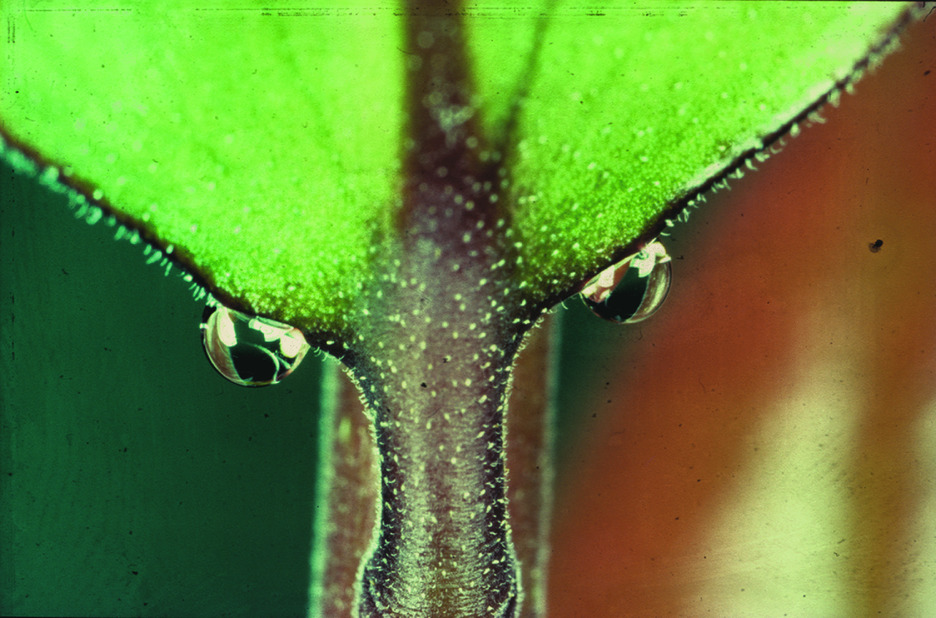
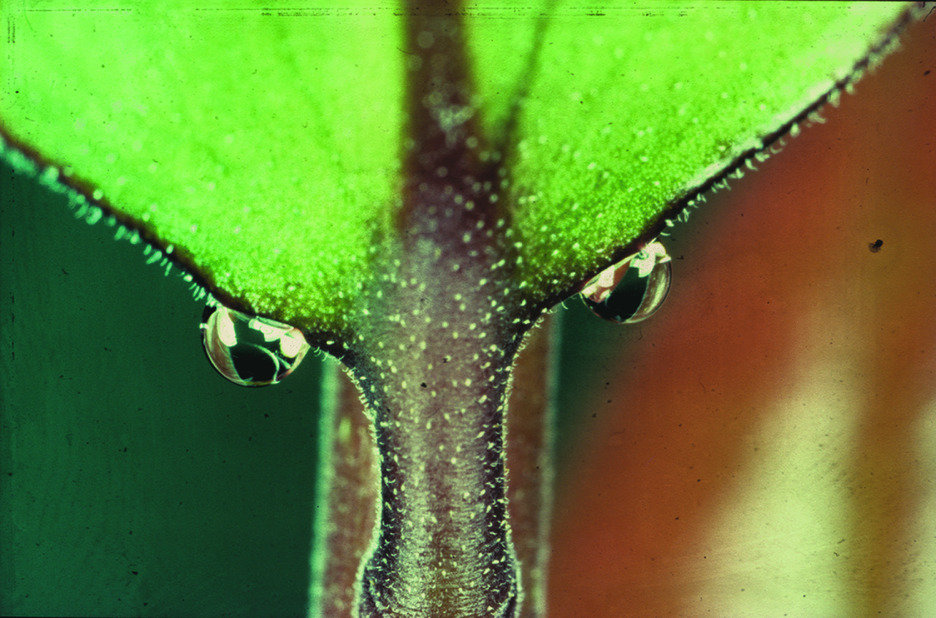
Vander Kloet (Reference Vander Kloet2005) placed seven species in synonymy under Vaccinium acuminatissimum Miq., without recognising them as varieties. These reductions appear to serve little purpose because various characters, such as the presence, position and structure of the marginal glands on the leaves and indumentum, would still appear to be useful characters in delimiting species. Until we have much better information on variation, distribution and ecology, I have followed Sleumer (Reference Sleumer and Van Steenis1966–1967) in giving these characters a degree of importance. These marginal leaf glands appear to be extrafloral nectaries and secrete sugar solution when the leaves are young, which has been observed in greenhouse cultivation (Fig. 2) where the exudate is not quickly removed by ants or other insects as is no doubt usual in the wild.
Rigiolepis leptantha var. leptantha. RBGE accession number 19801411, in cultivation in RBGE. Leaf showing glands exuding sugar solution. (Photograph: Lyndsey Wilson.)
Vaccinium borneense is quite distinct from V. acuminatissimum in having impressed (not protruding) marginal glands, 7–8 mm from the petiole on the type specimen (not the 5 mm that Sleumer describes, although in other specimens determined to this species they are only c.5 mm from the petiole), quite apart from its highly condensed inflorescence (the one complete rachis on the type sheet is only 12 mm long). Vaccinium borneense belongs to the group of related taxa which, in addition to having strongly ridged bracts, bracteoles and calyx lobes (most easily seen) when dry, have bracts which are much longer than the pedicels that they subtend and relatively long (up to 3 mm) calyx lobes. They are also remarkably lacking in glandular hairs which are such a common feature of most other species.
Vaccinium acuminatissimum Miq. was not recorded by Sleumer (Reference Sleumer and Van Steenis1966–1967) in Borneo, although it has a widespread distribution from West Java (Mount Salak is the type locality) to Sumatra and Peninsular Malaysia (Sleumer, Reference Sleumer and Van Steenis1966–1967). The sweeping reductions of Vander Kloet (Reference Vander Kloet2005) are rejected here, and Vaccinium acuminatissimum does not appear to be represented in Borneo. I have maintained Rigiolepis bigibba (J.J.Sm.) J.J.Sm. as distinct, although Vander Kloet put it in synonymy under Vaccinium acuminatissimum. The marginal leaf glands are quite different in the two species. Rigiolepis sulcata (Ridl.) J.J.Sm., with similar but smaller marginal glands than those of R. bigibba, which was also reduced to Vaccinium acuminatissimum by Vander Kloet, is maintained not just on its much hairier leaves but also because it has very short bracts in relation to the slender pedicels they subtend. I have reduced Rigiolepis filiformis J.J.Sm. to R. leptantha, not Vaccinium moultonii Merr. as did Vander Kloet, because I attach more weight to the form of the basal glands. Rigiolepis filiformis is described with larger leaves but they have the same general shape and venation. I have synonymised Rigiolepis (Vaccinium) dipladenium Sleumer with Rigiolepis moultonii Merr. because, despite the incomplete type description of Vaccinium dipladenium, the characters are in good agreement.
In several of the species examined, the position of the two bracteoles is very variable, often in the same inflorescence, tending to be in the basal half in the proximal part of the raceme but close to the flower in the distal part, and often halfway up in the middle. Thus, bracteole position has not always been included in the descriptions in the present account and, where given elsewhere in the literature, must be suspect, as many disappear during flowering or at least processing of specimens. The bracts subtending the flowers sometimes provide a useful character, being consistently long or short relative to the pedicel. Buds and bud scales do not appear to vary as much in this genus as they do in Vaccinium sect. Bracteata. The lateral bud scales in Rigiolepis are invariably narrow and acutely pointed; they do vary in length, but the points are often eroded to give a deceptive view of their length and some care is needed in assessing them accurately. The woody basal tubers, which apparently develop from the hypocotyl and are probably always present in young plants, and the mature stems, with their often distinctive corky bark and prominent lenticels, have not been included in the species descriptions. These characters are a feature of the genus but not considered here to be useful in species delimitation. Tubers and prominent lenticels as seen on old stems are rarely present on herbarium specimens and not always recorded on labels. The indumentum on the twigs is described from very young shoots. It invariably disappears quickly with age, and this must be allowed for in specimens which do not have young growth in good condition. The indumentum appears to vary widely in the species considered to have a broad distribution, such as Rigiolepis uroglossa (Sleumer) Argent and Rigiolepis uniflora var. monantha (Ridl.) Argent. More observations are needed, however, because the indumentum can be very distinctive.
The fruit has also not been described consistently enough in the prior literature to be useful in discriminating species. It is often not clear whether published measurements have been taken in the fresh or dried state or whether mature or submature. As noted above, the ripe fruit colour does appear to be a useful generic character in Borneo, although red fruits occur in Vaccinium elsewhere. Vaccinium vitis-idaea L. in sect. Vitis-idaea (Moench) L.K.A.Koch and many Chinese species (Fang & Stevens, Reference Fang, Stevens, Wu, Raven and Hong2005) have red fruit but none appear to pass through the yellow-orange submature stage of Rigiolepis. Most red-fruited Vaccinium species are temperate or boreal.
Vander Kloet (Reference Vander Kloet2005) suggested, without providing good reasons, that Vaccinium henrici Sleumer from Sulawesi was misplaced in sect. Rigiolepis and should be placed in sect. Bracteata. I feel that it is premature to exclude Vaccinium henrici from Rigiolepis, because the floral characters, particularly the stamens “poro introrso elongato dehiscenibus” (Sleumer, Reference Sleumer1940), are in good agreement. At L, there are other undescribed species of Rigiolepis collected in Sulawesi: de Vogel 5607 from Sopu Valley, Minahasa, North Sulawesi, of which I have seen only material without flowers, although they are described on the label. The material seen is too poor to describe, but there is little doubt that this plant belongs in Rigiolepis and was annotated as such by Sleumer at L. This specimen has pinnately veined leaves which look very similar to Rigiolepis salicifolia. Hennipman 6053 (L) from Soroako, in South Sulawesi is another incomplete specimen which is a related species. There are, in addition, some intriguing collections from Vietnam at K, again seen only in fruit [Vu Xuan et al. HNK 267, Lao Cai Province, Sapa District on the track to Fansifan peak from Ton station, 22°20′3′′E, 103°46′84.8′′, 2020 m elevation, high mountain evergreen primary forest. Climbing on a Magnolia tree 8–10 m long], which also appear to be a species of Rigiolepis.
Rigiolepis gives the impression of rapid evolution in Borneo and a remarkable exploitation of a wide range of habitats from mangrove and dipterocarp forests at sea level through montane forest to ridge and mountain tops, and from limestone lithophytes to heath forest bogs and forest epiphytes. They are a characteristic feature of riverside trees, where they grow epiphytically and often hang in long festoons from branches overhanging the water.
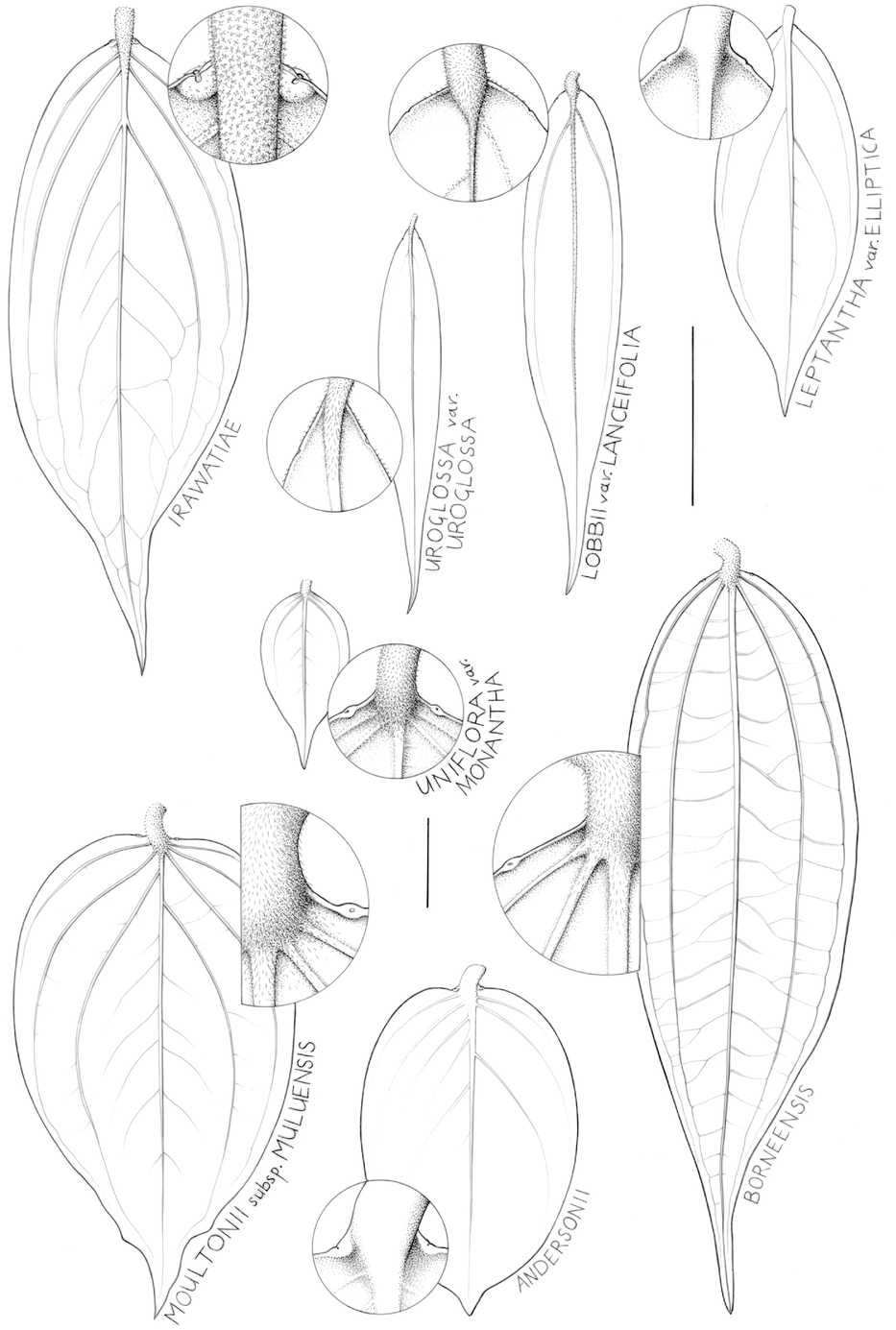
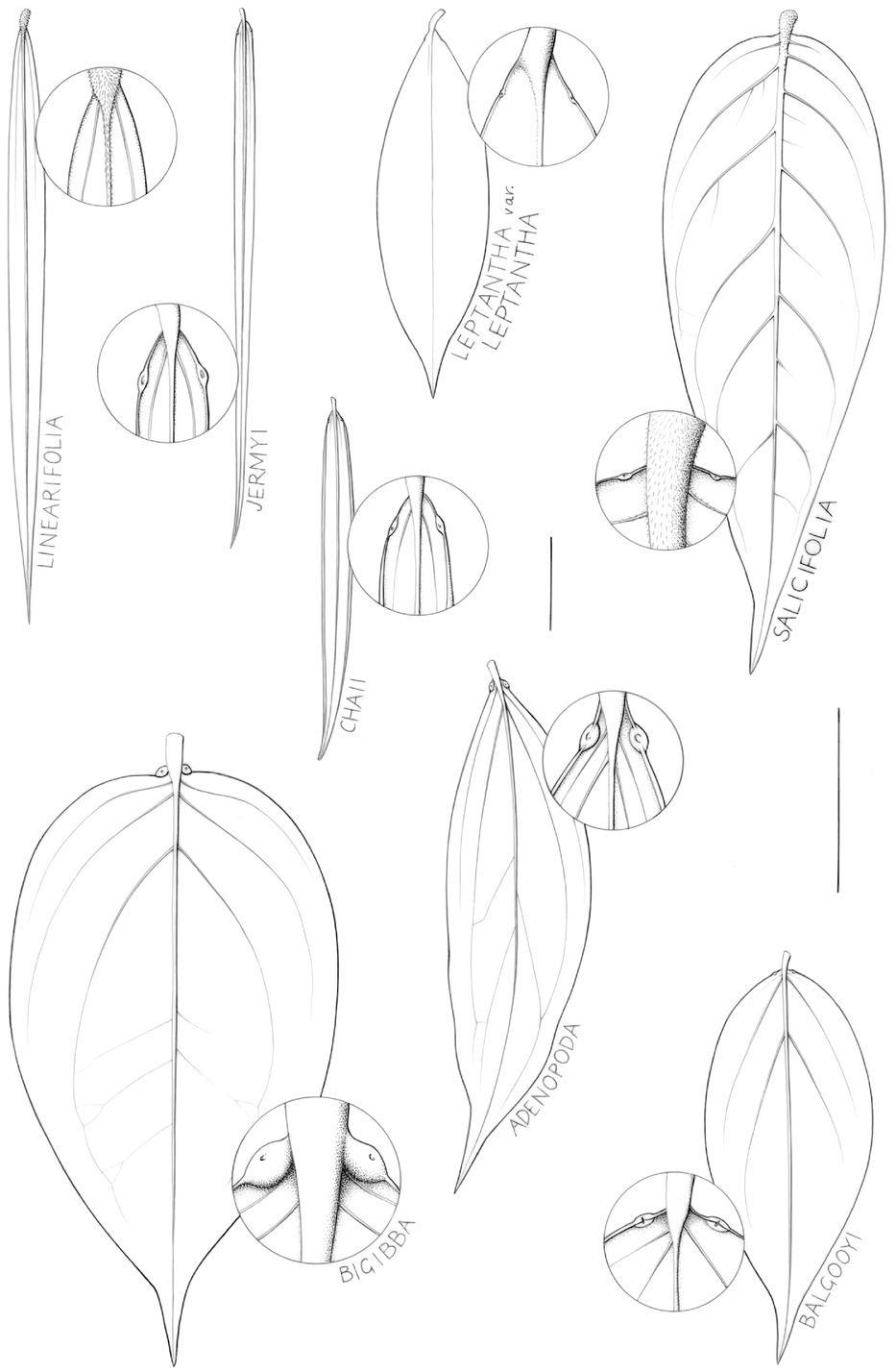
Figures 3 and 4 show leaf shapes, depicting venation and the basal glands of selected species.
Leaves of selected Rigiolepis species, showing marginal glands: R. irawatiae, type; R. uroglossa var. uroglossa, type; R. lobbii var. lanceifolia, Burtt & Woods 1937; R. leptantha var. elliptica, type; R. uniflora var. monantha, Argent, RBGE accession number 19781741; R. moultonii subsp. muluensis, type; R. andersonii, Argent, RBGE accession number 19781702; R. borneensis, RBGE accession number 19943021. Scale bars: all leaves, 4 cm; leaf bases with glands, 5 mm. (Illustrations: Claire Banks.)

Leaves of selected Rigiolepis species, showing marginal glands: R. linearifolia, type; R. jermyi, type; R. leptantha var. leptantha, Argent, RBGE accession number 19801411; R. chaii, type; R. salicifolia, Anderson S.28384; R. bigibba, Paie S.28442; R. adenopoda, type; R. balgooyi, type. Scale bars: all leaves, 4 cm; leaf bases with glands, 5 mm. (Illustrations: Claire Banks.)

Key to the species in Borneo
1a. Leaves linear, < 10 mm wide, > 10 times as long as wide___________________________2
1b. Leaves of other shape, the largest > 15 mm wide or < 5 times as long as wide_________________________________5
2a. Leaves < 4 mm wide, rachis < 2 mm, flowers appearing sessile____________8. jermyi
2b. Leaves > 6 mm wide, rachis variable, flowers sessile or with elongate rachises_______________________________________3
3a. Extreme leaf apex acute, narrowing to c.1 mm wide 1 mm from apex, flowers in elongate racemes > 30 mm long___________________________10. linearifolia
3b. Extreme leaf apex rounded, narrowing to c.2 mm wide 1 mm from apex, flowers sessile, rachis absent or < 10 mm long___________________________4
4a. Calyx lobes c.3 mm long, strongly ribbed, young stems with straight white hairs___________________________11b. lobbii var. lanceifolia
4b. Calyx lobes c.1 mm long, not ribbed, young stems with appressed curled hairs___________________________6. chaii
5a. Basal leaf glands distinctly protruding either from leaf margin or petiole________________________________________6
5b. Basal leaf glands impressed within leaf margin or obscure or absent_________________10
6a. Thick (c.2 mm) protruding glands on decurrent leaf base appearing as small auricles on petiole, bracts more than half length of pedicel_________________4. bigibba
6b. Protruding glands smaller c.1 mm or less, close to but not decurrent on petiole, bracts less than half length of pedicel___________________________7
7a. Largest leaves > 60 mm wide, with multicellular glands appearing as scurfy granules on the abaxial leaf surface, rachis > 60 mm long____________________8
7b. Largest leaves < 60 mm wide, with only simple glands on the abaxial leaf surface, rachis < 40 mm long___________________________9
8a. Multicellular hairs on leaves dendroid with tooth-like points, corolla covered with glandular hairs outside___________________________7. irawatiae
8b. Multicellular hairs on leaves with lateral flat branches, corollas with simple hairs outside___________________________19. sulcata
9a. Leaves < 40 mm long___________________________3. balgooyi
9b. Leaves > 100 mm long___________________________1. adenopoda
10a. Flowers solitary or in condensed clusters, rachis ≤ 10 mm or absent__________11
10b. Flowers in elongate racemes, rachis > 10 mm____________________17
11a. Rachises absent, flowers mostly solitary, leaves up to 20 mm wide, calyx lobes not ribbed when dry___________________________21. uniflora
11b. Rachises sometimes very short (2–4 mm), or leaves larger > 40 mm wide, calyx lobes distinctly ribbed longitudinally when dry___________________________12
12a. Rachis < 10 mm long___________________________13
12b. Rachis > 10 mm long___________________________5. borneensis
13a. Largest leaves < 25 mm wide, lateral veins weak (disappearing in basal half) or absent________________________________________14
13b. Largest leaves > 30 mm wide, with 2–4 strong lateral veins distinct in upper half of leaf________________________________________15
14a. Rachis 0–10 mm long___________________________11a. lobbii var. lobbii
14b. Rachis 20–60 mm long___________________________16. poiana
15a. Rachis < 4 mm long, inflorescence of 1–4 flowers___________________________16
15b. Rachis > 10 mm long, inflorescence of > 6 flowers___________________________5. borneensis
16a. Leaves with distinct scalariform pattern of tertiary veins, calyx lobes c.3 mm long___________________________18. suberosa
16b. Leaves lacking a distinct scalariform pattern of tertiary veins, calyx lobes c.1 mm long___________________________20. tenax
17a. Largest leaves > 60 mm wide___________________________18
17b. Largest leaves < 60 mm wide___________________________20
18a. Largest leaves < 150 mm long___________________________14. moultonii
18b. Largest leaves > 170 mm long___________________________19
19a. Leaves strongly palmately veined, upper veins much less distinct, disc laxly pubescent________________________________________15. piperifolia
19b. Leaves weakly palmately veined, upper pinnate veins strong and distinct, disc glabrous________________________________________12. macrophylla
20a. Inflorescence densely patently white-hairy with simple hairs throughout (simple hairs on stems to 0.5 mm), calyx lobes c.3 mm long____________16. poiana
20b. Inflorescence, if hairy, then not on all parts, or glandular hairy, calyx lobes < 2.5 mm long___________________________21
21a. Bracts bracteoles and calyx lobes strongly ribbed when dry, with simple hairs, basal glands on leaf margins often 5–7 mm from petiole______________5. borneensis
21b. Bracts bracteoles and calyx lobes not ribbed when dry or, if ribbed, with long-stalked glandular hairs, basal glands on leaf margins 1–4 mm from petiole________________________________________22
22a. Lateral veins distinct, pinnate without strong basal arching veins___________________________17. salicifolia
22b. Lateral basal veins, high arching and distinctly stronger than any pinnate veins, or without distinctive lateral veins___________________________23
23a. Leaves elliptic, broadest at middle___________________________24
23b. Leaves ovate, or narrowly ovate, broadest in proximal half____________________26
24a. Leaves smooth underneath without prominent raised minor lateral veins, mostly narrowly tapering at base, completely lacking long-stalked glands
9a. leptantha var. leptantha
24b. Leaves with prominent raised minor lateral veins underneath, with long-stalked glands especially on inflorescence___________________________25
25a. Leaves and inflorescence with long-stalked glandular hairs overtopping any simple hairs___________________________23. winkleri
25b. Leaves and inflorescence with long simple hairs overtopping any much smaller glandular hairs___________________________14c. moultonii subsp. murudensis
26a. Inflorescence densely covered in long-stalked glands, which are longer than any simple hairs, some of which can also be seen along the midvein abaxially________27
26b. Inflorescence predominantly with simple hairs, any glandular hairs on the leaves not on long stalks, shorter than any simple hairs________________________29
27a. Leaf acumen to 15 mm, filaments longer than the anthers, lowland_________28
27b. Leaf acumen 20–30 mm, filaments shorter than the anthers, montane___________________________23. winkleri
28a. Leaves with 1 pair of faint veins, leaf surface smooth, extreme leaf tip rounded___________________________9b. leptantha var. elliptica
28b. Leaves with 2 pairs of distinct veins, leaf surface sulcate, extreme leaf tip acute________________________________________3. balgooyi
29a. Leaves mostly > 30 mm wide___________________________30
29b. Leaves mostly < 25 mm wide___________________________33
30a. Basal glands at petiole blade junction, leaves < 2 times as long as broad, very shortly acuminate___________________________2. andersonii
30b. Basal glands > 2 mm from the petiole, leaves > 2 times as long as broad, apex variable________________________________________31
31a. Petiole 2–5 mm long, corolla < 4 mm long, disc hairy or glabrous___________32
31b. Petiole 6–8 mm long, corolla > 5 mm long, disc densely hairy___________________________14b. moultonii subsp. muluensis
32a. Leaves 3-veined, lowland forest___________________________9b. leptantha var. elliptica
32b. Leaves 5- to 7-veined, montane forest___________14a. moultonii subsp. moultonii
33a. Pedicels 1–3 × c.05 mm, very slender, corolla c.3 mm_______________13. minimiflora
33b. Pedicels 3–4 × c.1 mm, more robust, corolla c.4 mm_________________22. uroglossa
1. Rigiolepis adenopoda (Sleumer) Argent, comb. nov. – Vaccinium adenopodum Sleumer, Blumea 11: 21 (1961). – Type: Indonesia, West Kalimantan, Kapuas Lakes, D. Luar, Pulao Sepandan, 8 x 1949, Main (expedition Polak) 1892 (holo L, iso BO). Fig. 4.
Vaccinium megaphyllum Sleumer var. adenophorum Sleumer, Blumea 11: 17 (1961). – Type: Indonesia, West Kalimantan, Sungai Semitau, upper course of the Kapuas River, 3 xii 1893, Hallier 1281 (holo U; iso BO, K, L).
Shrub. Twigs slender, with a short, dense pubescence of simple hairs; lateral buds to c.3 mm, much shorter than subtending petioles, covered in simple hairs. Leaves: petiole c.6 × 2 mm, semiterete, persistently and densely pubescent; blade 120– 190 × 25–55 mm, elliptic, sometimes slightly broader in proximal half, base narrowly attenuate, apex long and gradually, or subcaudate-acuminate, acumen 15–20 mm, finely acute, margin entire, narrowly but distinctly revolute almost to apex, basal glands 2, thick, protruding to c.0.5 mm, inserted on margin within 1 mm of petiole, young leaves shining above, pubescent along veins, beneath with simple brown glandular hairs and a minutely papillose surface, with 2 high arching lateral veins, from or a little above base, all major veins slightly raised within shallow grooves above, sharply prominent beneath, other shorter pinnate veins much less conspicuous, reticulation mostly dense and slightly raised above, obscure beneath. Inflorescences racemose, solitary or paired, suberect, lax, 12- to 20-flowered; rachis 25–35 mm, slender, with short, patent eglandular and thicker, less abundant glandular hairs; bracts ovate-acuminate, as long as pedicels; bracteoles 1–1.5 mm, subulate, inserted above base up to middle of pedicel. Flowers: pedicels 2–4 mm, thick, indumentum as on rachis; calyx tube 0.6–0.8 mm, campanulate, lobes 0.7–1 mm, ovate-acuminate with a minute apical gland; corolla c.2 × 1.5 mm, short, subcylindrical-urceolate, slightly 5-angular, laxly pubescent at angles, otherwise glabrous, yellow, shortly 5-lobed; stamens: filaments linear, subdensely hairy, c.1 mm; anther cells obloid, papillose, 0.3–0.4 mm, tubules c.0.5 mm; disc hairy; style glabrous, c.2.5 mm. Fruit not seen.
Distribution
Indonesia: West and South Kalimantan.
Ecology
Lakeside rain forest Flowering: October.
Additional specimen. Indonesia. Kalimantan: South, Doesoen (Barito) River, 20 viii 1836, Korthals s.n.
The type specimen of Vaccinium adenopodum was not seen by Vander Kloet (Reference Vander Kloet2005), who excluded it from his treatment. Examination of the type specimen shows that the basal glands are clearly (to c.1 mm) although not strongly prominent. Sleumer had described them as “generally not properly prominent” (Sleumer, Reference Sleumer and Van Steenis1966–1967). The disc is densely hairy, not glabrous as Sleumer described it. I could not see any corollas, so my description of the flowers follows that of Sleumer (Reference Sleumer and Van Steenis1966–1967). I have moved Vaccinium megaphyllum Sleumer var. adenophorum Sleumer into synonymy with Rigiolepis adenopoda. Vaccinium megaphyllum is a poorly known taxon, as the flowers have not been described. The vegetative description fits well, and the locality is close. Giesen 65 (L) agrees reasonably well except that the bracts are minute (c.1 mm) and much shorter than the pedicels. Another Leiden specimen without locality, accession number 951 304 380, agrees well vegetatively but has much longer, laxer inflorescences.
This species perhaps comes closest of the Bornean material to the widespread Vaccinium acuminatissimum Miq., with its protruberant marginal leaf glands. It has larger, shinier leaves than is usual in Vaccinium acuminatissimum, however, and only laxly distributed simple glands on the undersides of the leaves, unlike the usually dense, complex glands of V. acuminatissimum.
2. Rigiolepis andersonii (Sleumer) Argent, comb. nov. – Vaccinium andersonii Sleumer, Blumea 12: 124 (Reference Sleumer1963). – Type: Malaysia, Sarawak, Miri division, Baram District, Mt Api, 915 m, 11 vii 61, Anderson J.A.R. 4704 (holo SAR; iso L [fragment]). Figs 3, 5, 6.
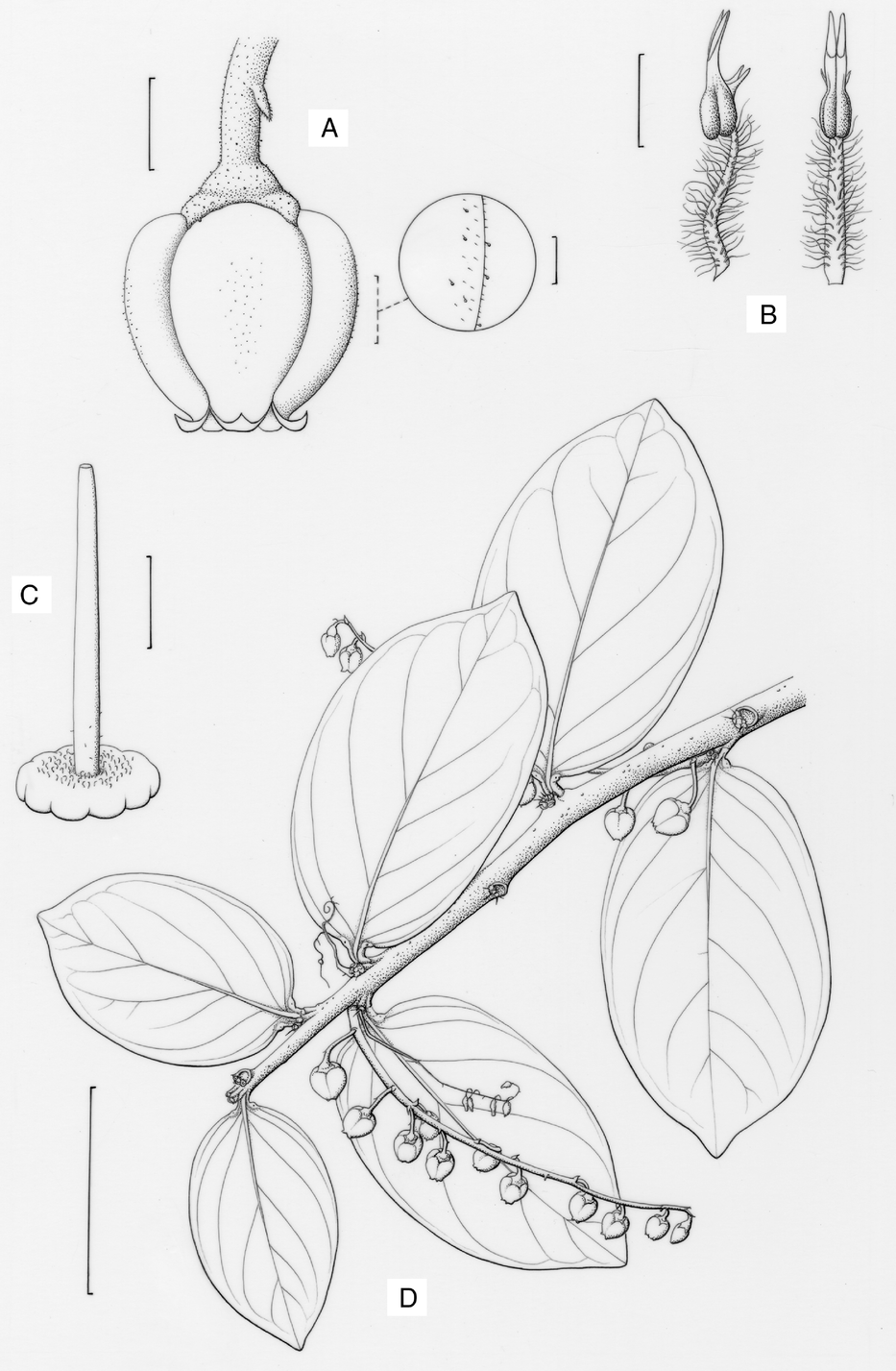
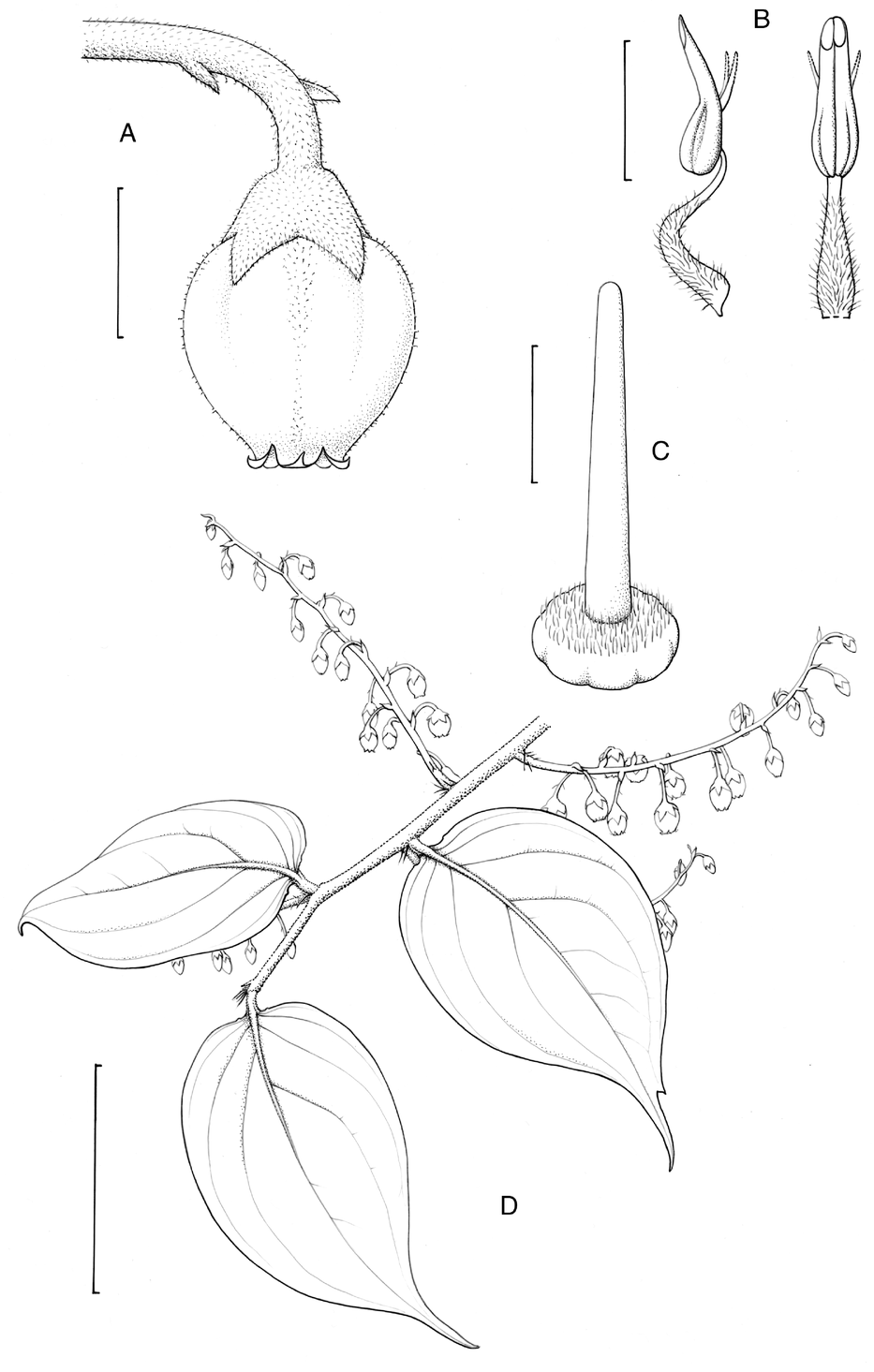
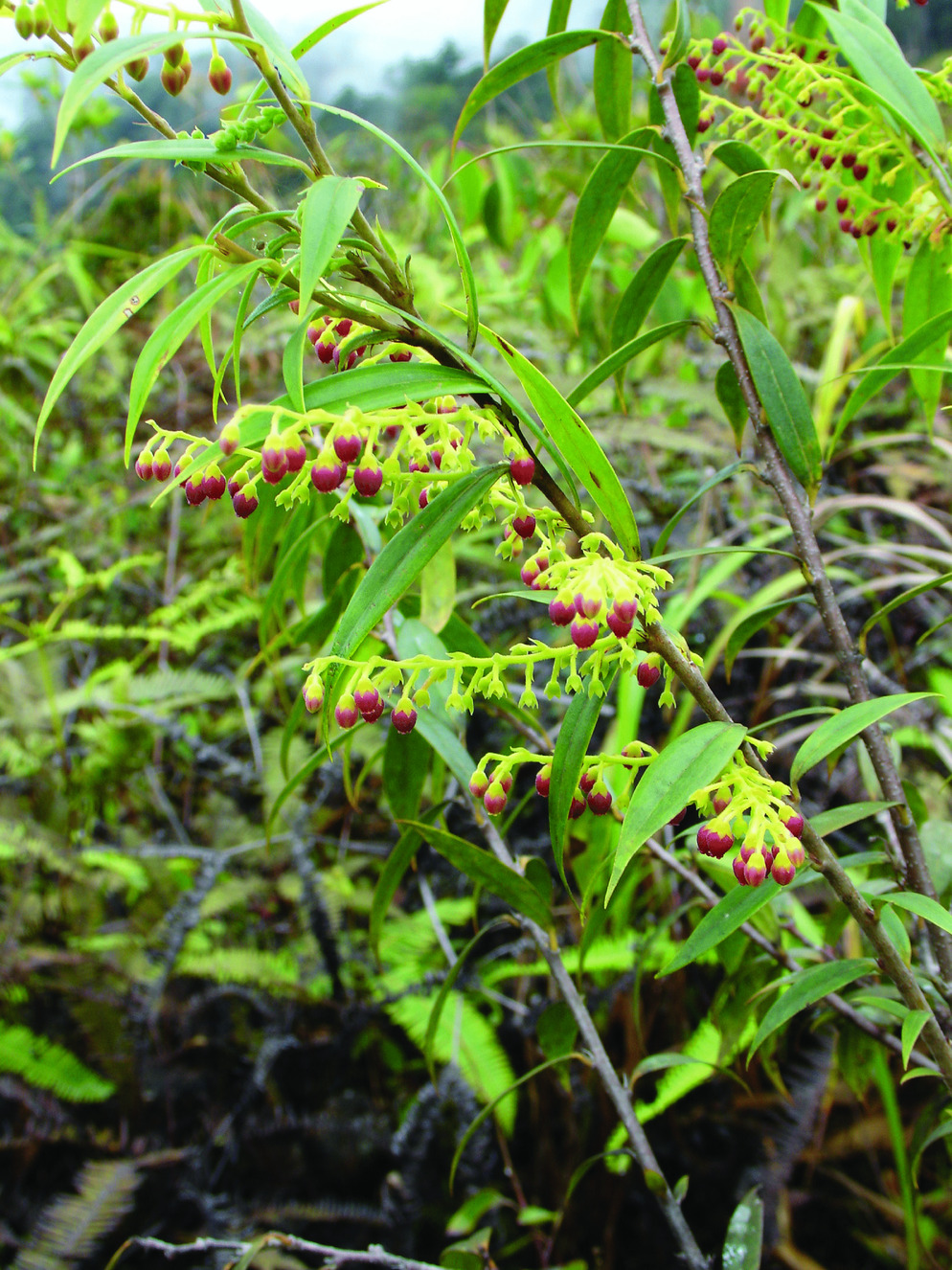
Rigiolepis andersonii (Sleumer) Argent. RBGE accession number 19781702; from G. Api, Sarawak, the type locality. A, Flower (scale bar, 2 mm), with inset showing surface detail (scale bar, 0.5 mm); B, stamens (scale bar, 1 mm); C, style with disc (scale bar, 1 mm); D, habit (scale bar, 3 cm). (Illustration: Claire Banks.)

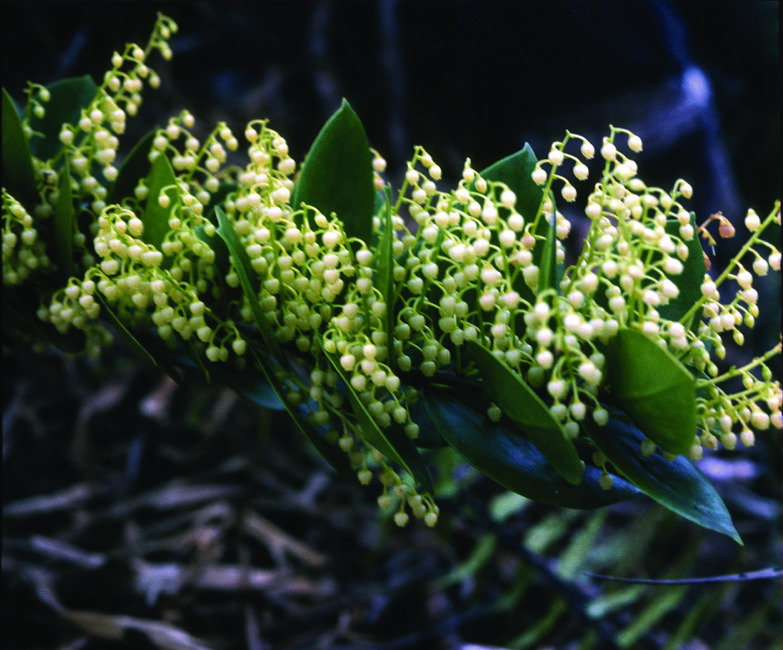
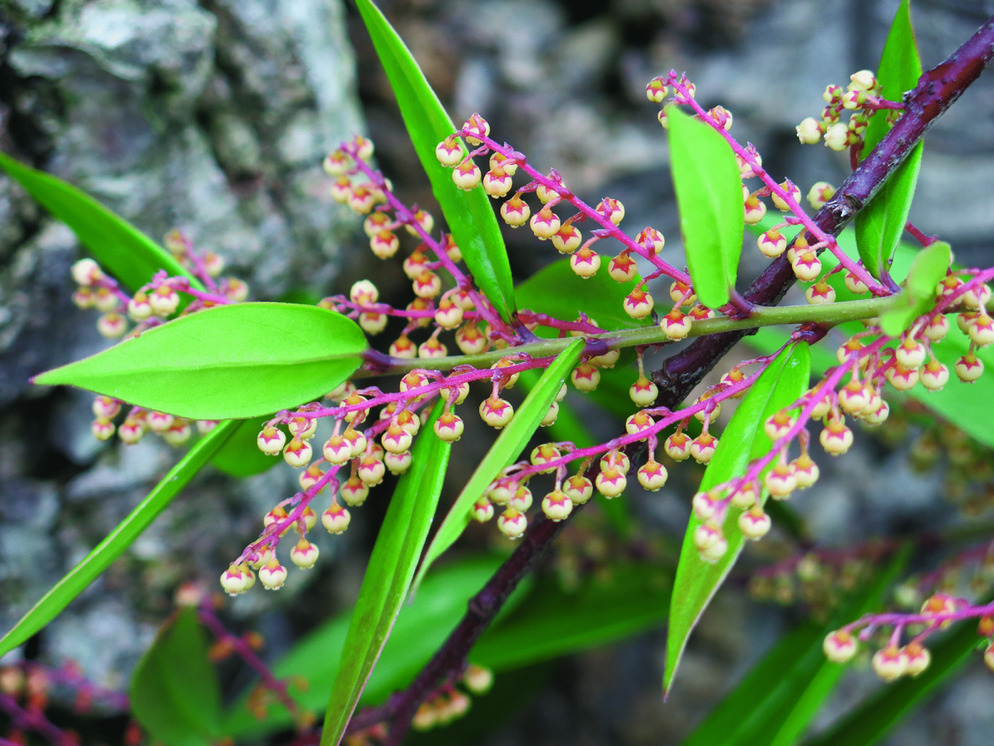
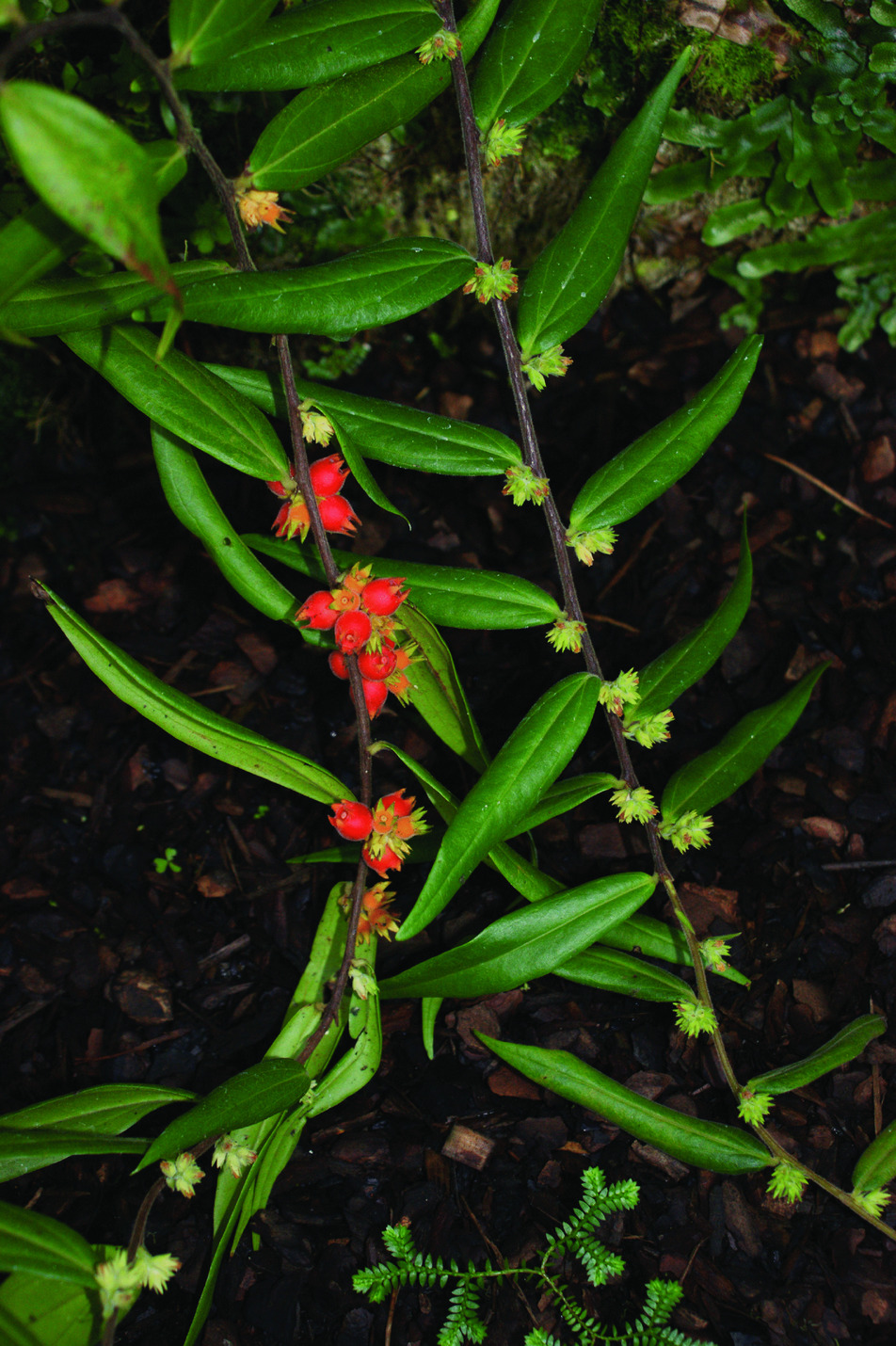
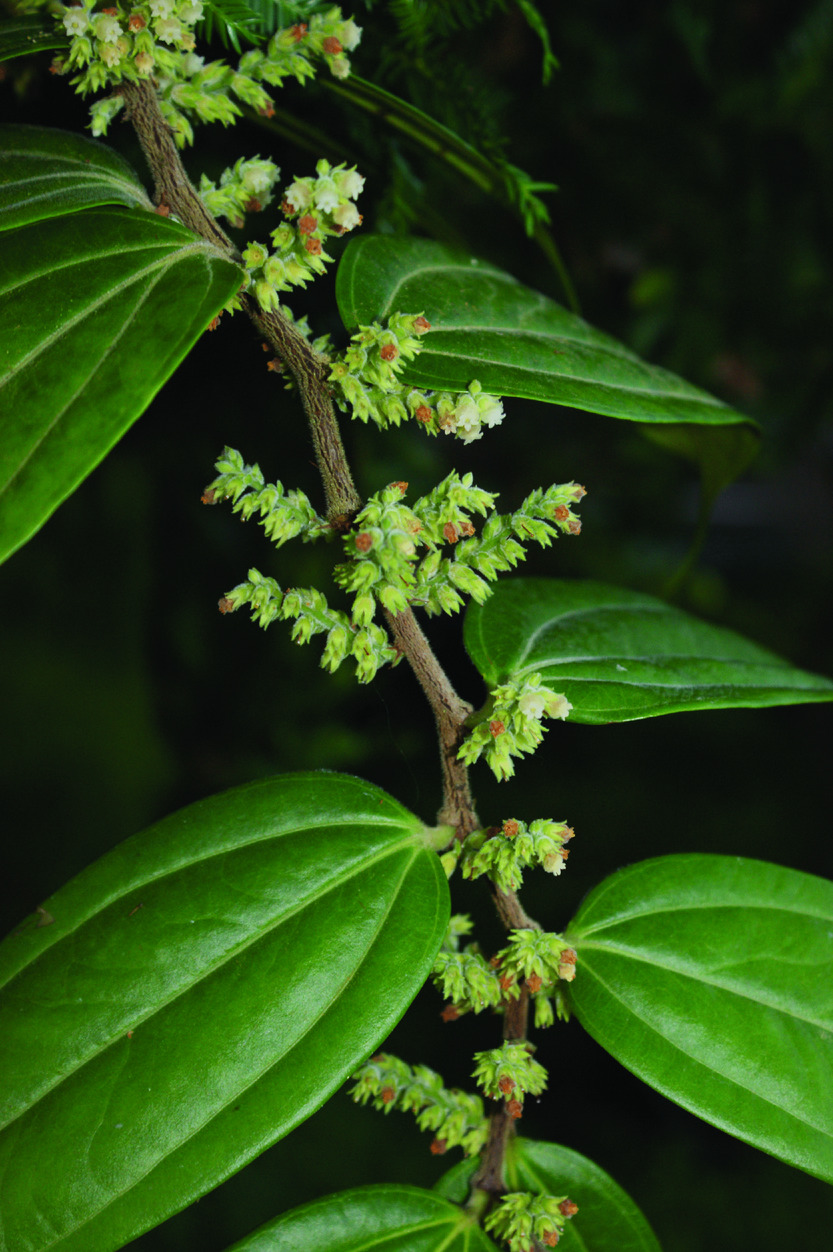
Rigiolepis andersonii (Sleumer) Argent. Flowering plant, Gunung Api, Sarawak. (Photograph: G. Argent.)
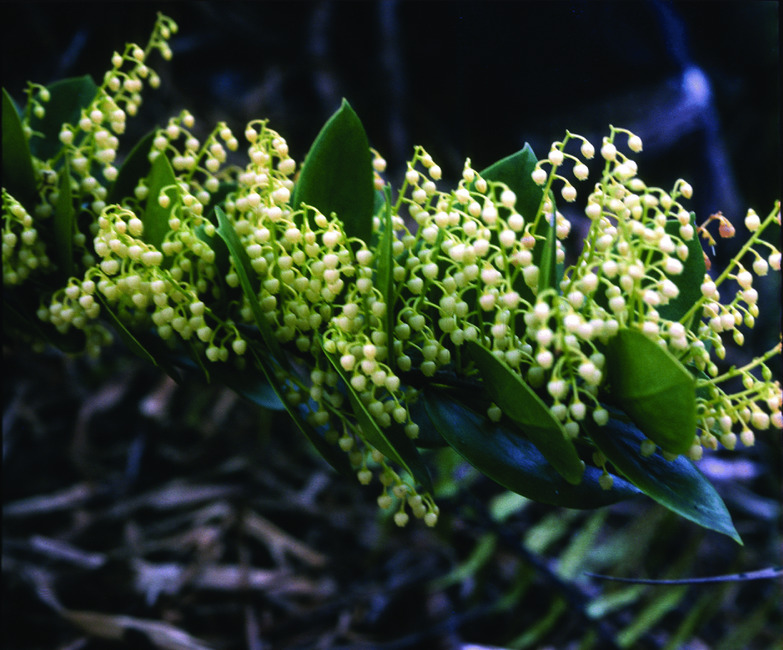
Epiphytic shrub to 1 m. Twigs minutely puberulous; lateral buds 2 × 1 mm, mostly less than half the length of the petiole, arising distinctly above the leaf axil, the scales covered with curly hairs. Leaves: petiole 4–5 × 4–5 mm, shallowly grooved, minutely puberulous; blade 50–80 × 30–45 mm, ovate to ovate-elliptic, base truncate, rounded, to subcordate, margin entire, flat, basal glands impressed next to petiole, smooth and glossy above, glabrous except for minute glandular hairs beneath, with 6–8 arching lateral veins, a basal pair and progressively more pinnate ones distally, slightly prominent above, more distinctly so beneath when dry, midvein depressed for its whole length above in dry specimens, prominent beneath, reticulation densely prominent, especially beneath, apex obtusely acuminate for 5–10 mm. Inflorescence: the racemes laxly many-flowered; rachis 50–80 mm, slender, puberulous and with brown glands; bracts small c.1 mm long, acicular; bracteoles to c.1 mm long, glandular hairy, one basal, one about halfway up the pedicel. Flowers: pedicels 5–6 mm, slender, puberulous and glandular hairy; calyx 1–1.5 × c.2 mm, cup-shaped, tube subtruncate at base, covered in brown glandular hairs, lobes acutely triangular, glandular, fimbriate and ciliolate; corolla c.4 × 4.5 mm, urceolate, pale yellow, strongly scented, pubescent and glandular muriculate especially at angles outside, nearly glabrous inside, lobes c.1 mm, reflexed; stamens: filaments 1.5 mm, linear, densely hairy; anther cells c.0.5 mm, ovoid, echinulate; tubules 1 mm, narrow; disc subdensely short-hairy; style slender, laxly short-hairy in proximal 3/4 or nearly glabrous. Fruit globose, c.5 mm in diameter.
Distribution
Malaysia: Sarawak. Known only from the environs of Mount Api, but this species is likely to occur on Mount Benarat and other associated limestone peaks in the Mount Mulu National Park.
Ecology
In submontane forest, epiphytic and on peat overlying limestone 915– 1220 m. Flowering: July, probably at other times as the plants in cultivation flower several times a year.
Conservation assessment
LC. This species is common on Mount Api in the Gunung Mulu National Park, which is a protected area. Although the summit area is prone to droughts (and fire, to judge by the name of the mountain), the deep grikes afford a variety of habitats and protection from the worst effects of desiccation.
Additional specimens. Malaysia. Sarawak: Miri Division, Gunung Mulu N.P., Gunung Api, 24 viii 1981, Argent s.n., cultivated RBGE accession number 19781702; Gunung Api, 14 iv 1978, Argent & Jermy, 974.
Very similar to Rigiolepis salicifolia but with shorter broader leaves. Vander Kloet (Reference Vander Kloet2005) says [leaf] “blade glabrous underneath”, while Sleumer (Reference Sleumer and Van Steenis1966–1967) says “glabrous except for fine, hardly visible setular hairs beneath”. In fact, the leaves are minutely glandular hairy when very young, leaving only a very indistinct punctate surface. Cultivated from plants growing in the type locality (Mount Api) at the Royal Botanic Garden Edinburgh, where it maintains its distinctively shaped leaves. The original description is modified from observations of the cultivated specimens.
3. Rigiolepis balgooyi Argent, sp. nov.
Rigiolepis balgooyi is similar to Rigiolepis winkleri in having long glandular hairs which overtop the simple hairs on the inflorescence but differs in its lowland habitat, protruding marginal leaf glands, shorter acuminate leaf apices and larger stamens with filaments much longer than the anthers. – Type: Indonesia, West Kalimantan, c.100 km south of Pontianak, Gunung Palung Nature Reserve, 14 vi 1986, Balgooy & Setten 5433 (holo BO, iso L). Figs 4, 7.
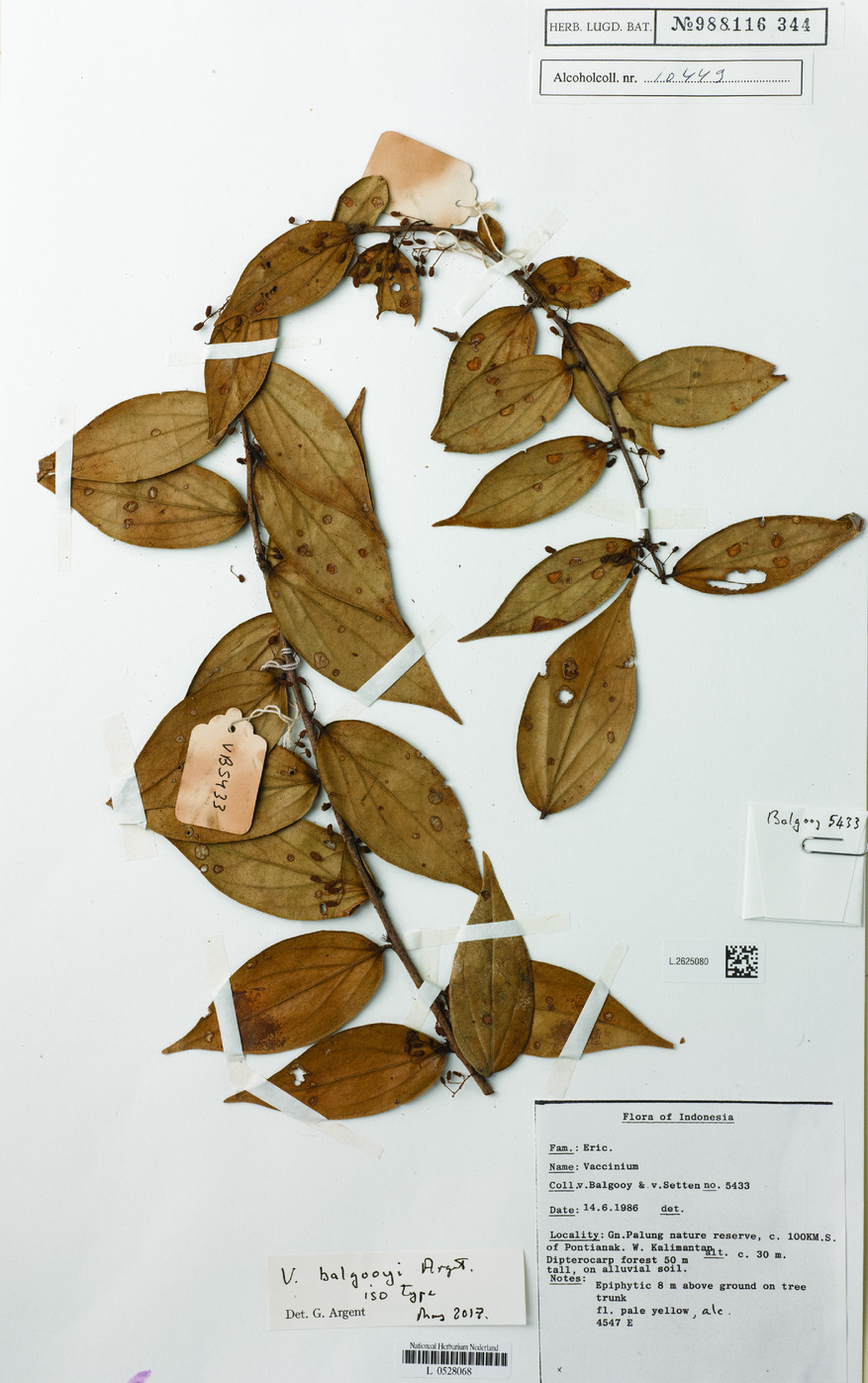
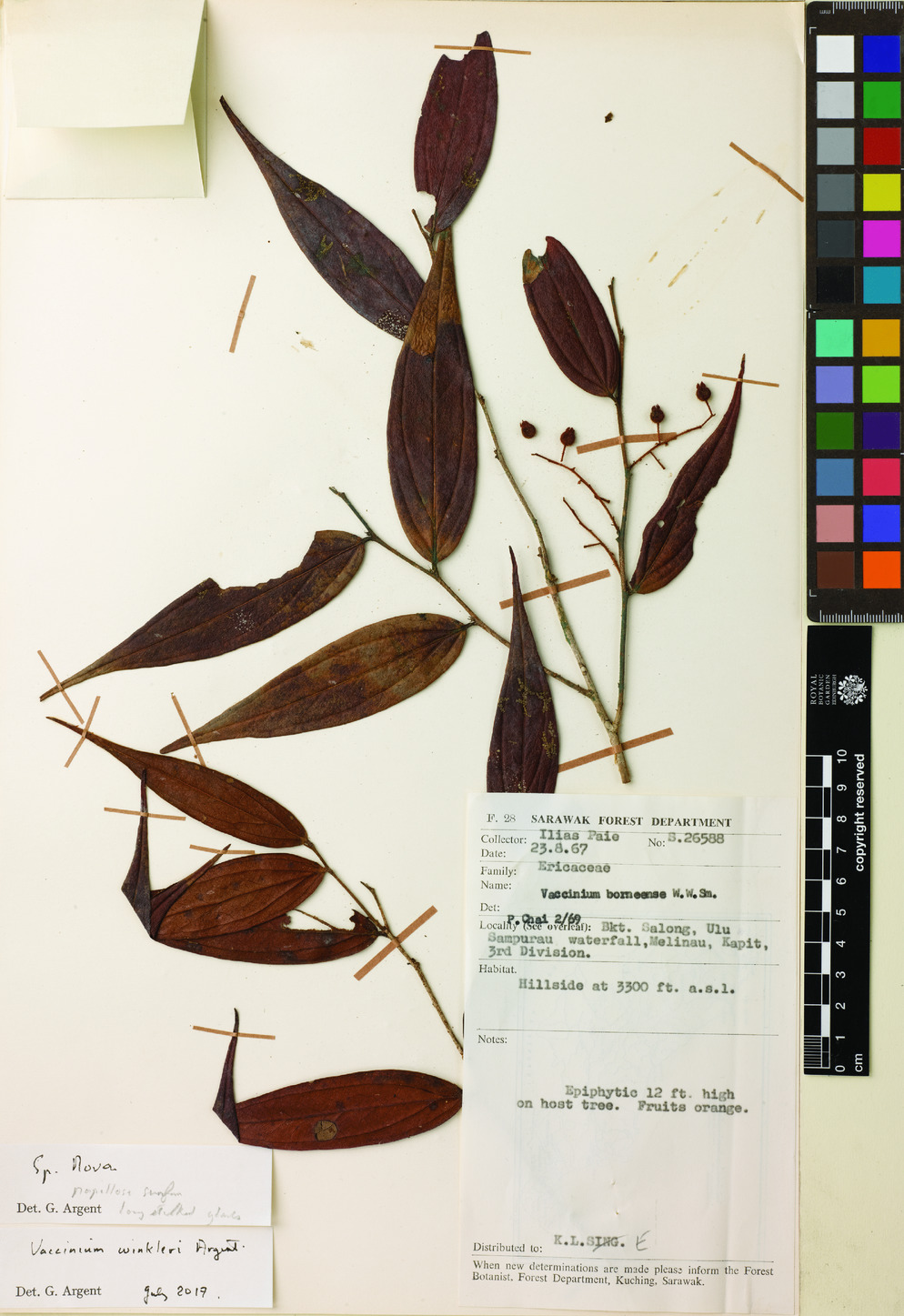
Rigiolepis balgooyi Argent. Isotype, Balgooy & Setten 5433, Gunung Palung, West Kalimantan. (Scan: Robyn Drinkwater.)
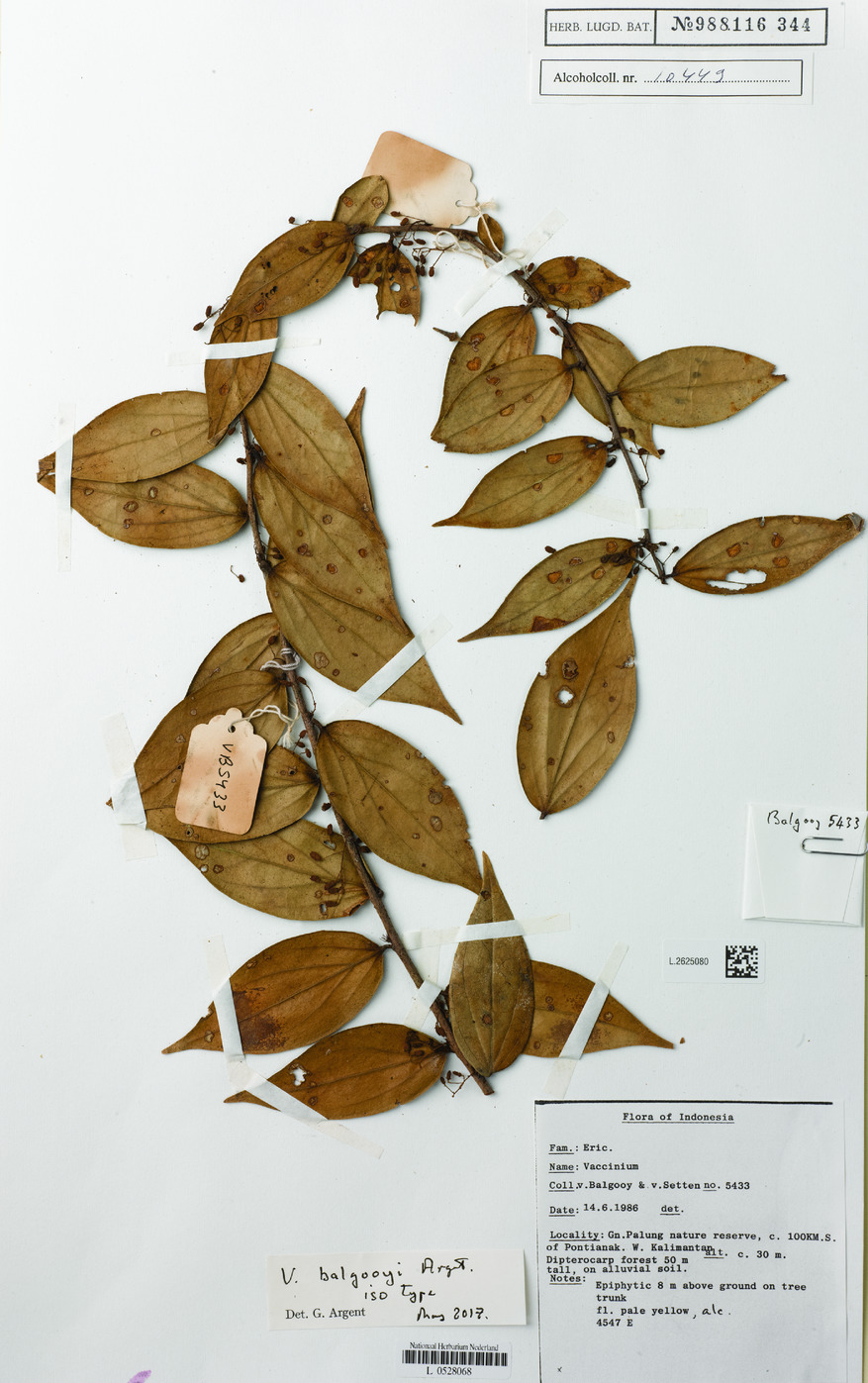
Epiphytic shrub. Twigs very shortly patently hairy and with some short brown glandular hairs, leaves laxly complanate; lateral buds c.5 × 3 mm, broadly subulate, about as long as petiole, densely hairy. Leaves: petiole 5–6 × c.1 mm rugose, puberulous; blade 55–85 × 20–35 mm, sulcate, narrowly ovate to elliptic, base rounded, margin slightly recurved, with a distinctly protruding gland on each side c.1.5 mm from petiole, lamina glabrous above, with simple glandular hairs beneath, with 2 lateral veins on each side, the first from the base disappearing about mid-leaf, the second emerging a few millimetres above base, arching and ascending to well above mid-leaf, main veins impressed above, prominent beneath, reticulation obscure, apex shortly acuminate (1–1.5 mm). Inflorescences mostly of solitary racemes, sometimes paired; rachis slender, 10–15 mm, with several triangular to subulate stipule-like bracts at base, moderately densely hairy with curled simple hairs and scattered long-stalked glandular hairs overtopping simple hairs; bracts c.1 mm, ovate-acuminate, with both simple and glandular hairs; bracteoles minute, subulate, with both simple and glandular hairs. Flowers: pedicels slender, 6–9 mm with simple and glandular hairs similar to those on rachis; calyx tube very short, 0.5 × 0.7 mm, densely shortly pubescent with both simple and glandular hairs, lobes c.0.6 mm, narrow-triangular; corolla c.4 × 2.5 mm, urceolate, pale yellow, with a few short simple and glandular hairs, mostly at angles, glabrous inside, lobes c.0.3 mm, reflexed; stamens: filaments 2.2 mm, wavy, linear, hairy; anthers cells 1.5 mm, oblongoid, papillose, 0.8 mm; tubules slender, erect, introrsely slit almost their entire length, 0.9 mm; disc laxly hairy on top; style 3.2 mm, slender, glabrous. Fruit not seen.
Distribution
Indonesia: West Kalimantan. Known only from the type specimen.
Ecology
Epiphytic in lowland dipterocarp forest on alluvial soil at c.30 m elevation. Flowering: June.
Etymology
Named after Max Michael Josephus van Balgooy, for his outstanding contribution to Southeast Asian botany.
Conservation assessment
LC. This species occurs in Gunung Palung Nature Reserve, which should afford it some protection.
Similar to Rigiolepis leptantha var. elliptica (f. elliptica of Sleumer, Reference Sleumer and Van Steenis1966–1967) in its lowland habitat and general leaf shape, but that taxon has smoother leaves, only a single pair of faint lateral veins, and impressed not protruding marginal leaf glands, and it does not have the long-stalked glandular hairs on the inflorescence.
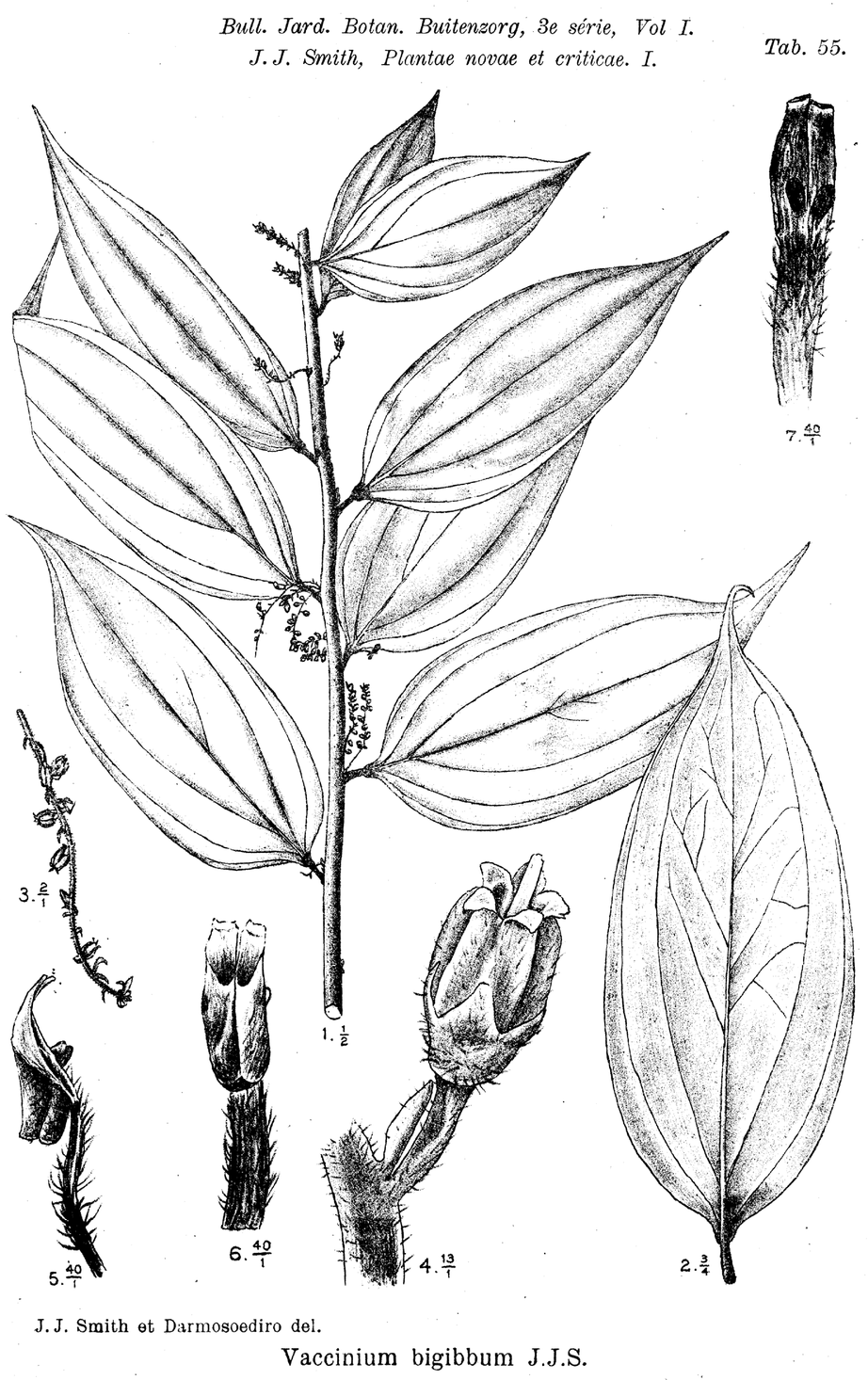
4. Rigiolepis bigibba (J.J.Sm.) J.J.Sm., Blumea 1: 336 (1935). – Vaccinium bigibbum J.J.Sm., Bull. Jard. Bot. Buitenzorg, ser. 3, 1: 408, t. 55 (1920). – Type: Indonesia, West Kalimantan, Lanjak, P. Pandjang, 18 vii 1874, J.E.Teysmann 7966 (lecto BO, designated by Sleumer, Reference Sleumer1961; isolecto FI, L). Figs 4, 8.
Vaccinium bigibbum (≡ Rigiolepis bigibba). Type plate: Tab. 55., reproduced from the Bulletin du Jardin Botanique de Buitenzorg, series 3e, volume I.

Shrub to 5 m. Twigs puberulous, the leaves laxly complanately arranged; lateral buds 3–4 × c.2 mm, broad, scales about half as long as petiole, densely hairy. Leaves: petiole 6–8 × 2–3 mm rugose, puberulous; blade 75–21 × 30–80 mm, ovate to ovate-elliptic, base obtuse to rounded, margin slightly recurved; contracted and decurrent in distal 1/3 of petiole for c.2 mm where there is a thick protruding gland on each side, lamina glabrous except for some puberulence at base and with dense minute early caducous glands beneath, with 4–8 strong high-arching lateral veins from and from somewhat above base (outer pair of veins less distinct), main veins impressed although raised within a shallow depression above, sharply prominent beneath, other shorter veins from upper part of midvein in several pairs, irregular and much less distinct on both sides, reticulation lax, sometimes slightly impressed, but mostly prominent on both sides, occasionally less visible beneath, apex longer (to 30 mm) or more shortly caudate-acuminate, subacute. Inflorescence of 2 or 3 racemes in axillary fascicles, or solitary; rachis 20–35 mm, robust, with several triangular to subulate stipule-like bracts at the base, laxly or densely shortly pubescent and finely glandular hairy; bracts c.2 × 1 mm, ovate-acuminate, with simple and glandular hairs, more than half the length of pedicels; bracteoles minute, subulate, with both simple and glandular hairs. Flowers: pedicels thick, 2–3 × 1.5–2 mm; calyx tube very short, c.0.7 mm long, densely shortly pubescent and finely glandular hairy, lobes c.0.6 mm, narrow-triangular, tips red; corolla c.4 × 2.5 mm, urceolate, cream or yellow, 5-angular, slightly puberulous with simple hairs outside, glabrous inside, lobes c.0.3 mm, reflexed; stamens: filaments 2 mm, wavy, linear, hairy; anther cells c.1 × 1 mm, papillose; tubules c.1 mm, slender, erect, introrsely slit almost their entire length; disc densely hairy; style 4 mm, slender, glabrous. Fruit not seen.
Distribution
Brunei. Indonesia: West and Central Kalimantan. Malaysia: Sarawak.
Ecology
On boulders in a forested ravine, epiphytic in peat-swamp and Dipterocarpus forest, mostly at low elevation but up to 1700 m. Flowering: May to August.
Additional specimens. Malaysia. Sarawak: Kuching Division, Padawan, Bukit Woen, 2 x 1987, Yii S.61422; Sibu Division, Sibu District, Lassa, 19 v 1961, Anderson R16; Miri Division, Bintulu, Ulu Sungai Segan, 23 viii 1968, Wright S.27165; Gunung Mulu N.P., Hidden Valley, 6 iv 1978, Argent et al. 919; Luba Selumit, Sungai Mut, Rajang F.R., 15 vi 1980, Othman et al. S.42328; Limbang Division, Route from Bakelalan to Gunung Murud, SW of camp III, 30 ix 1967, Burtt and Martin 5326A; Lawas district, path to Gunung Murud, Belaban, 27 ix 1967, Paie S.26310; S.26433; Kapit Division, Kapit District, Ulu Sungai Balleh, On ridge of Balang/Balleh, 6 vii 1967, Paie S.28442; S.28403; Kapit Division, Belaga District, Batang Balui, Batu Laga plateau, 17 iii 1989, Yii S.56866; Belaga, Linau Balui, Nawai, 15 v 1981, Lee S.39996; Kapit Division, Mujong, Sungai Temiai, Hose Mt, 6 xii 1991, Lai et al. S.64088; Kapit, Batu Laga, 29 viii 1984, Mohtar S.48065.
This species is somewhat problematic taxonomically, and I have restricted it to forms with relatively short rachises and pedicels (as in the original description of Smith, Reference Smith1920) and with relatively long subtending bracts which are over half as long and often as long as the rather robust pedicels (not slender as Sleumer, Reference Sleumer and Van Steenis1966–1967, describes them). This better distinguishes Rigiolepis bigibba from R. sulcata rather than the relative hairiness of the leaves, as did Sleumer (Reference Sleumer and Van Steenis1966–1967). Rigiolepis sulcata possesses longer, slender pedicels with the subtending bracts much less than half the length of the pedicels, as does R. irawatiae, which has even smaller bracts. Rigiolepis irawatiae also has glandular hairs overtopping any simple hairs on the inflorescence and much smaller basal leaf glands which do not form auricles as they do in the present species and R. sulcata. Nevertheless, Rigiolepis bigibba, R. sulcata and R. irawatiae form a group of species with complex variation of leaf shape, degree to which they are sulcate or smooth, and the multicellular hairs which usually can be seen only with a lens as a yellowish, mealy indumentum.
Smith (Reference Smith1935), in a comment on the illustration of the type (see Fig. 8), says: “It seems that the flower described. . . was somewhat disturbed. In other flowers I found the anther tubules tapering and the spurs well-developed and subulate”. This illustration does, however, nicely show the relative lengths of bract and pedicel.
5. Rigiolepis borneensis Hook.f., Icon. Pl. 54, t. 1160 (1876). – Type: Malaysia, Sarawak, Lobb s.n. (holo K). Figs 3, 9, 10.
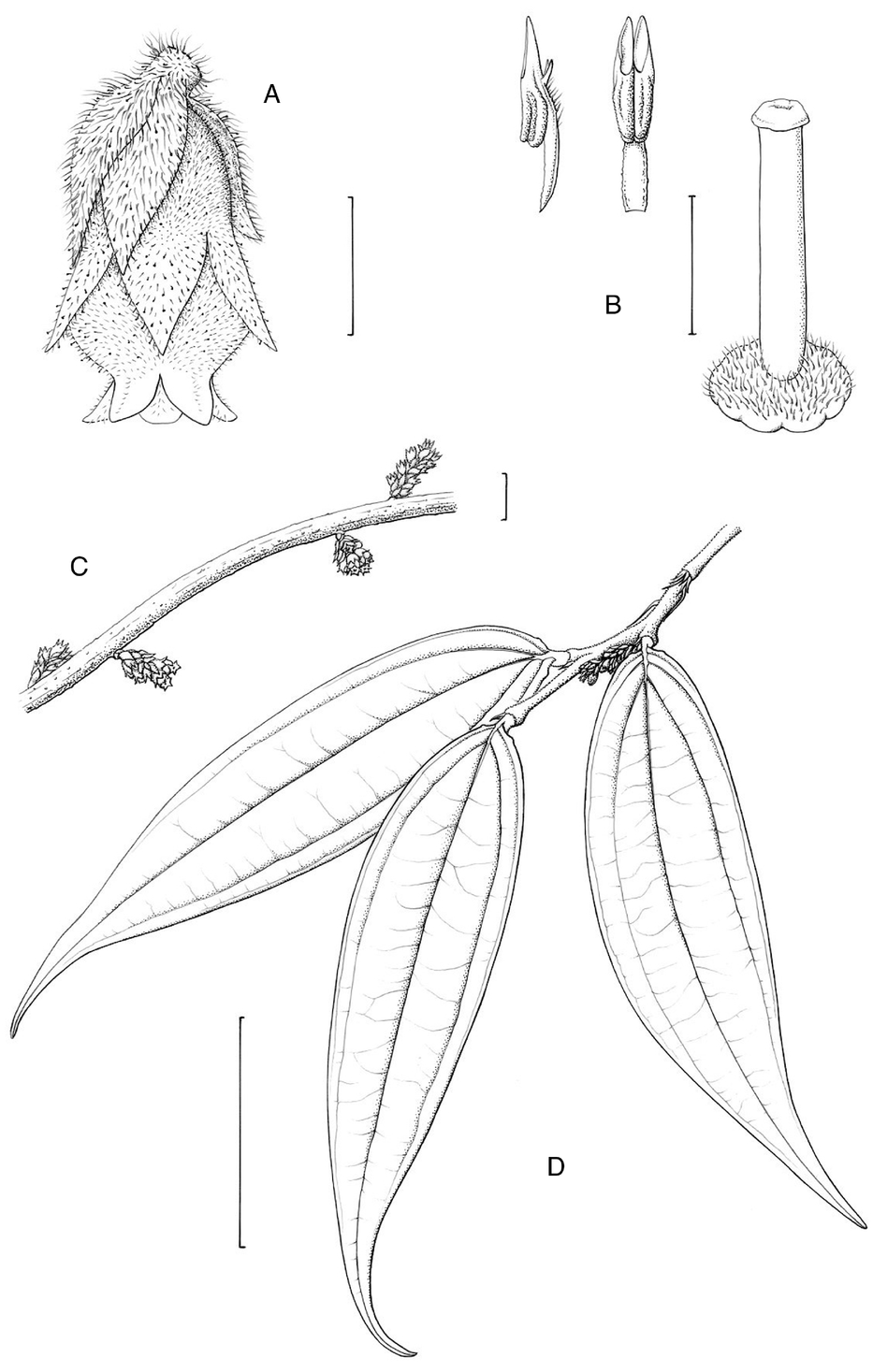
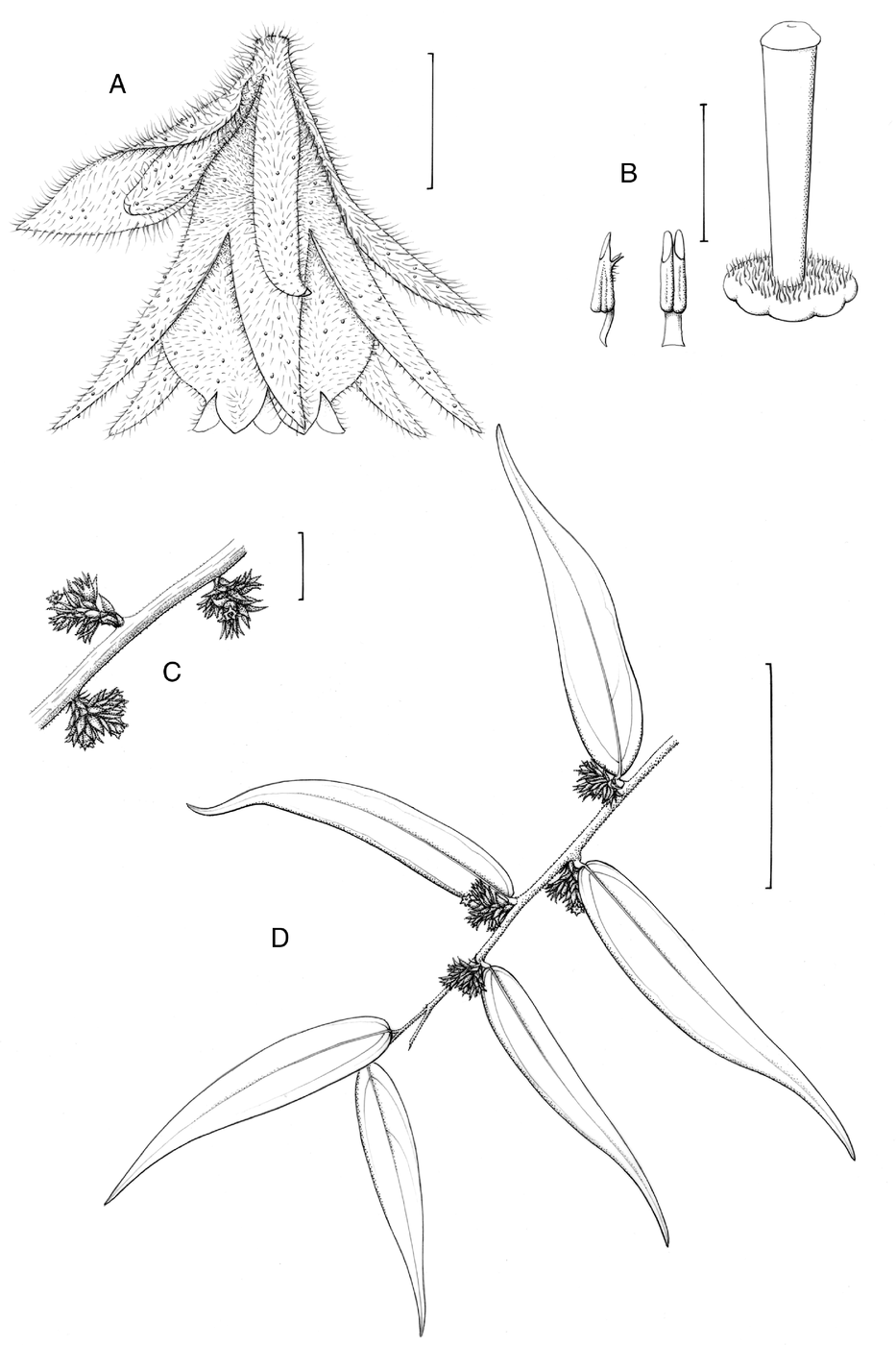
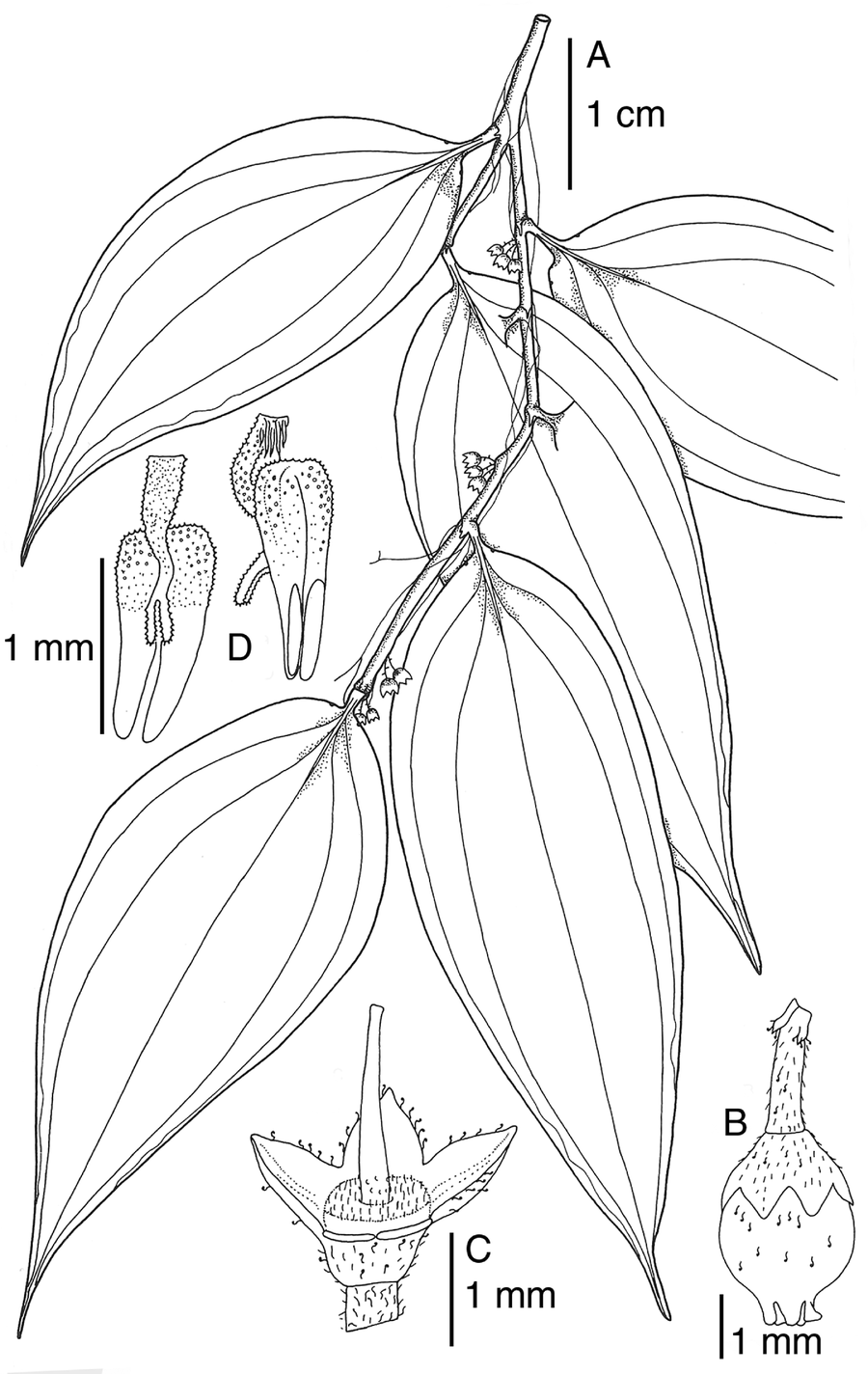
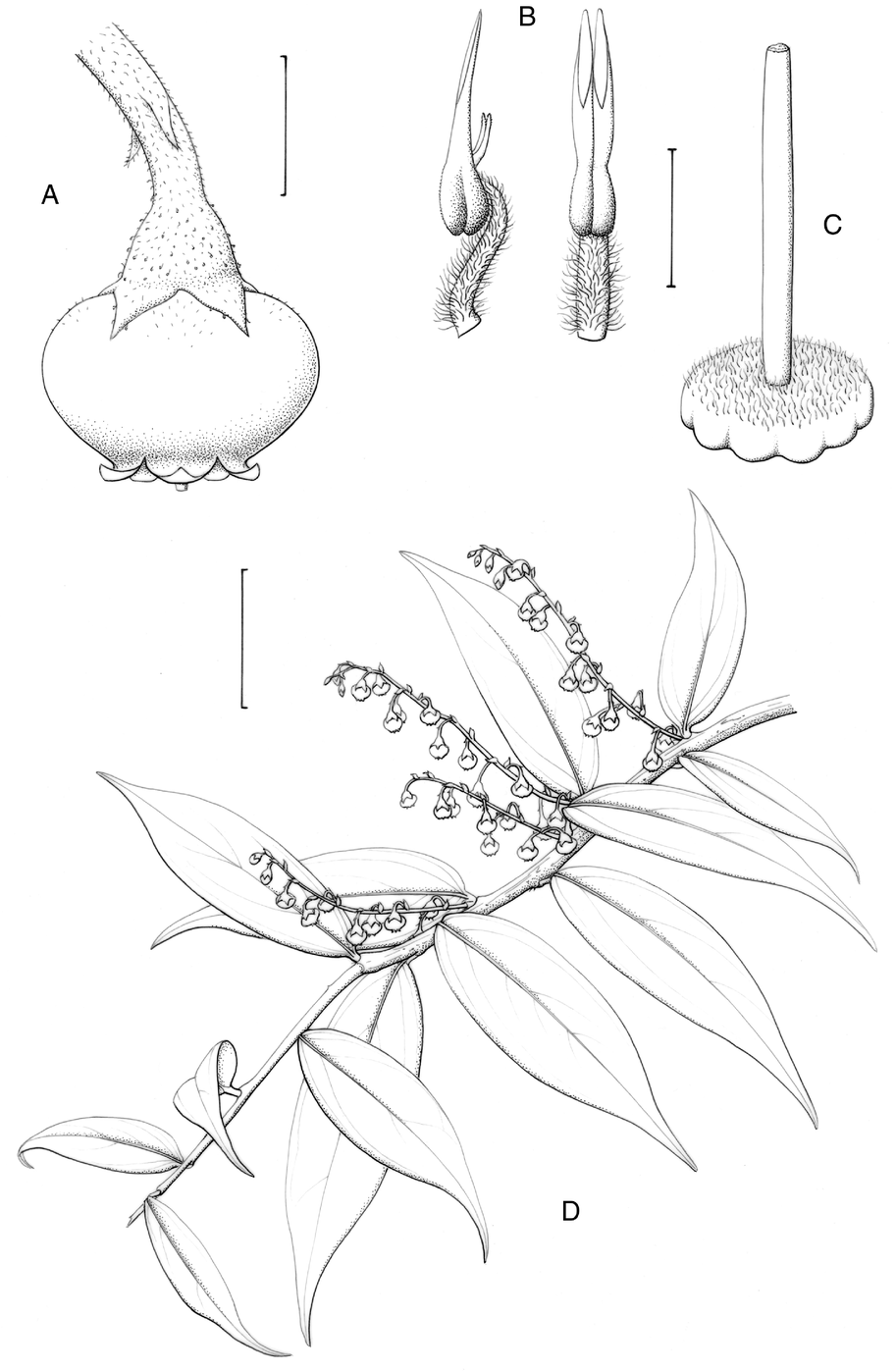
Rigiolepis borneensis. RBGE accession number 19910076. A, Flower (scale bar, 2 mm); B, stamens and style with disc (scale bar, 1 mm); C, bare branch with inflorescences (scale bar, 1 cm); D, habit (scale bar, 5 cm). (Illustration: Claire Banks.)

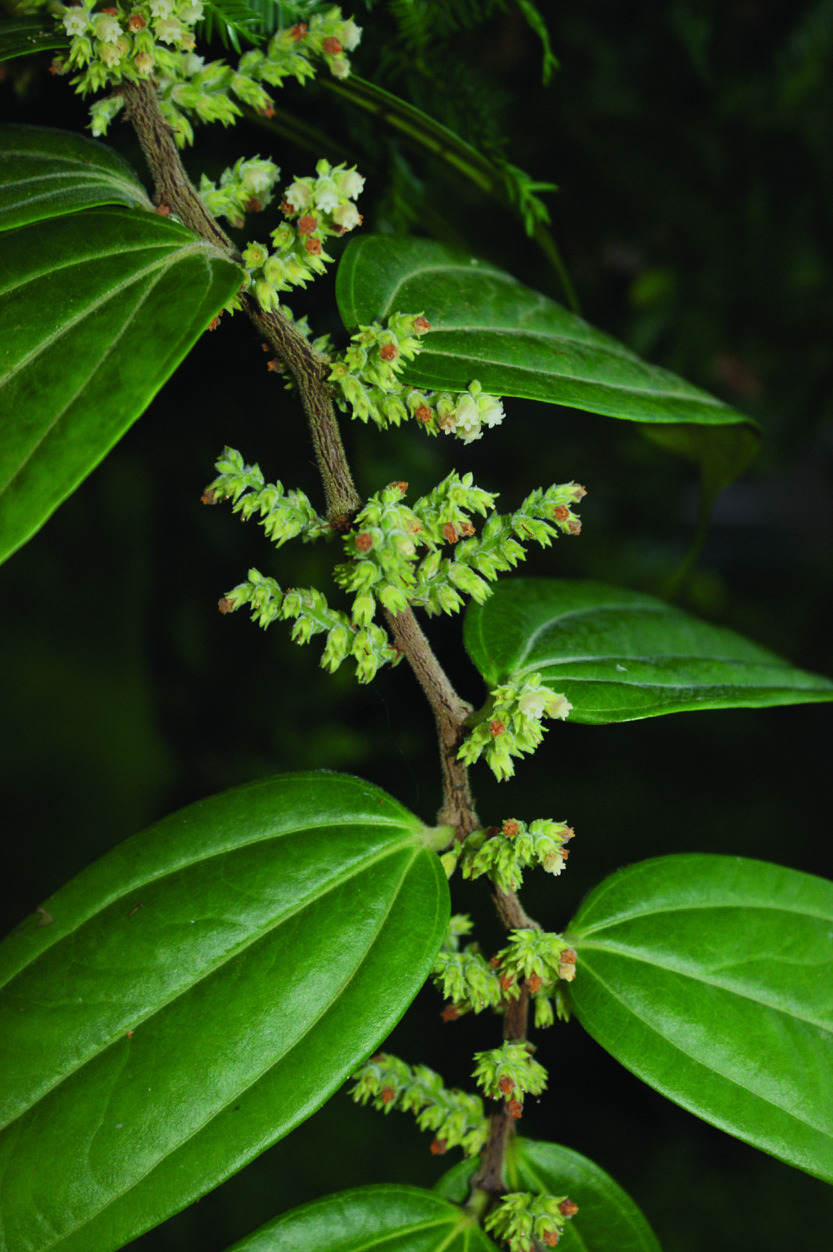
Rigiolepis borneensis. RBGE accession number 19943021; in cultivation at RBGE, collected from Gunung Serapi, Sarawak. (Photograph: G. Argent.)
Vaccinium borneense W.W.Sm., Notes Roy. Bot. Gard. Edinburgh 8: 329 (1915). – Type: Malaysia, Sarawak, 4 xi 1913, Native collector 66 (lecto E E00412436; isolecto E E00412437, K, SAR).
Climbing or twining shrub to 4 m, with swollen woody base. Twigs thick, covered with long white hairs to 0.4 mm; lateral buds to 3.5 mm, narrowly pointed, mostly as long as petiole, excluding decurrent leaf base. Leaves: petiole, 3–5 × 1–1.5 mm, pubescent with simple white hairs; blade 100–160 × 20–50 mm, elliptic to subovate-elliptic, base acute to obtuse, with decurrent flanges, margin entire, weakly revolute, impressed marginal glands 5–8 mm from petiole, apex acuminate to subcaudate-acuminate, acute, acumen 10–20 mm long, distinct, glabrescent on both sides except for major veins which have long white hairs particularly adaxially, midvein and inner pair of veins deeply impressed above and prominent beneath, with 2 or 4 high-arching lateral veins, other transverse veins numerous, anastomosing, forming a dense reticulation on both sides and often a characteristic scalariform pattern. Inflorescence of racemes from upper axils, many-flowered; rachis 10–25 mm, thick, laxly glandular hairy bracts ovate-acuminate, prominently many ridged lengthwise (costulate) at back, glandular hairy, 2.5–3 × 1.5–2 mm; bracteoles inserted in middle of pedicel, elliptic, prominently ribbed, 1.5–2 × 1 mm. Flowers: pedicels slender, 2–3 mm long, laxly glandular hairy; calyx glandular hairy, deeply 5-lobed, tube densely long hairy, with simple hairs, becoming subglobose, lobes 1.7–2.5 × c.1 mm, ovate-triangular to oblong-ovate, very prominently parallel ribbed when dry; corolla 2.5–3.5 × 1.5–2 mm, subovoid-urceolate, contracted at both ends, white sometimes greenish-white or cream, 5-angled, laxly pubescent outside, lobes 0.5 mm, spreading; stamens: filaments linear, papillose, 0.7–1.2 mm; anther cells ovate-oblong, echinulate, 0.4–0.6 mm; tubules 0.4–0.6 mm, cylindrical, erect; disc pubescent; style glabrous, 2–3 mm. Fruit not seen.
Chromosome number
2n = 24 (Atkinson et al., Reference Atkinson, Jong and Argent1995).
Distribution
Indonesia: West Kalimantan. Malaysia: Sarawak.
Ecology
In low wet forest, or kerangas (heath forest); also recorded from a ridge top, 300–1065 m. Flowering: October to January, mostly from February to March in cultivation, probably irregular in the wild.
Conservation assessment
The low-elevational distribution of this species makes habitat destruction a distinct threat.
Additional specimens. Malaysia. Sarawak: Kuching Division, Kuching District, Gunung Santubong, 30 xi 2000, Argent & Sinclair s.n. (RBGE accession numbers 19910076, 19820838); 15 iii 1982, Argent 8279; Bako National Park, 12 viii 1960, Sinclair 10323; Sinclair & Argent 110 (RBGE accession number 19820809); Gunung Serapi (Matang), 1 iii 1982, Sinclair & Argent 28 (RBGE accession number 19820728); 28 (RBGE accession number 19943021); Gunung Serapi, 28 x 1929, Clemens 20992; Four Peaks, Gunung Bungo Range, 1982, Sinclair & Argent 72 (RBGE accession number 19820771); Gunung Penrissen; Serian District, SE of Serian, Km. 105 on Kuching/Sri Aman highway, 8 I 1996, Beaman et al. 11833; Simanggang District, Bukit Menti, 19 i 1958, Yajup 6531; Sarawak/Kalimantan border, 25 ix 1987, Yii S.61316; Sri Aman Division, Sri Aman District, Lingga, Bukit Senyandang, 1 xii 1981, Lee S.44043.
See discussion under Rigiolepis above. This is the oldest name in the group of species characterised by distinctively costate bracts and bracteoles, best seen when dry, bracts as long as or longer than the pedicels, and relatively long calyx lobes. The type specimen has a pencil note appended to it, stating “flowers red”. All the associated material has white to pale green flowers which sometimes turn reddish in old age. Truly red flowers in this species would seem doubtful.
6. Rigiolepis chaii Argent, sp. nov.
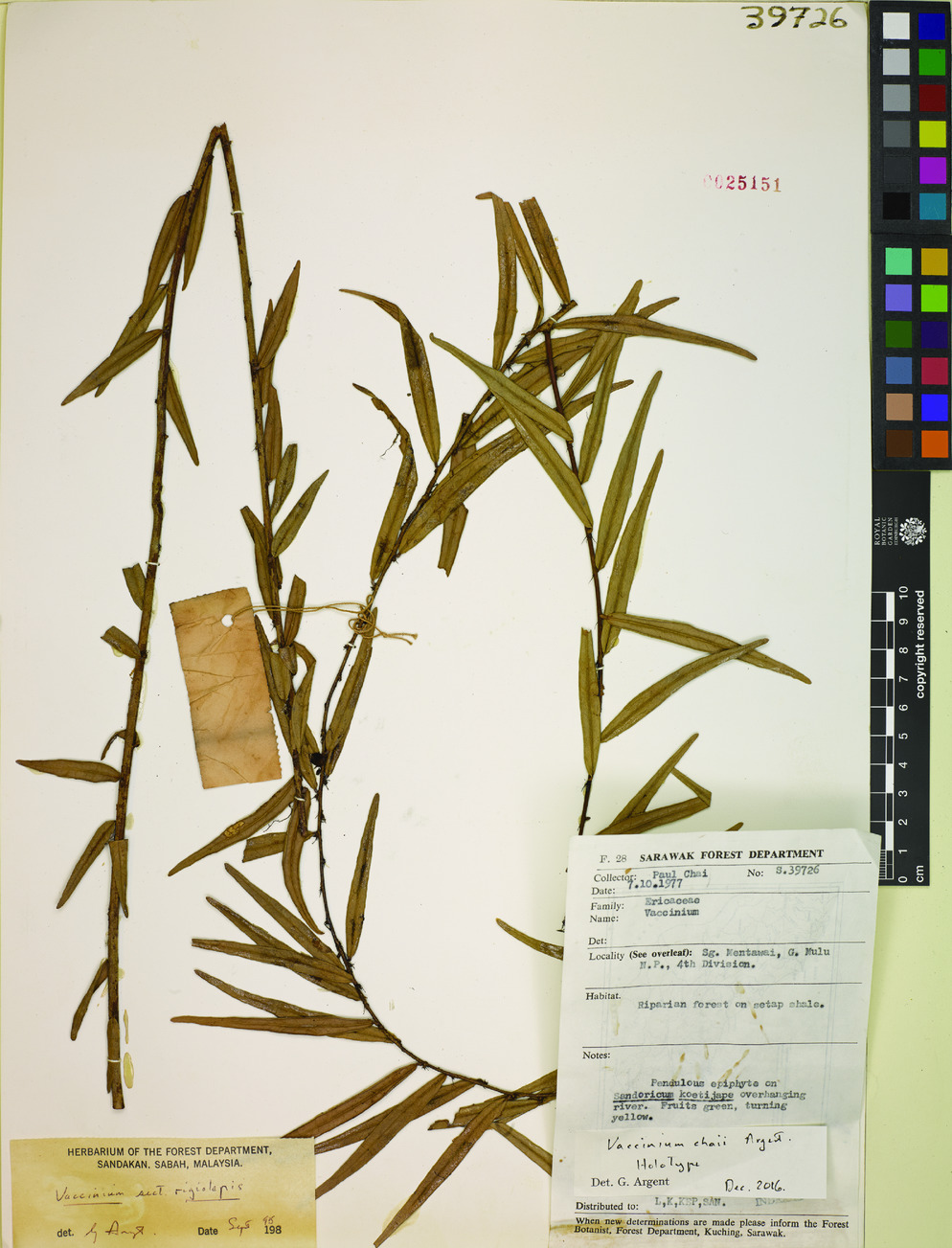
Most similar to Rigiolepis lobbii var. lanceifolia but differing by calyx lobes c.1 mm long (versus > 2 mm long), calyx lobes and bracts smooth (not costate when dry), and stem indumentum of minute, strongly appressed, curled hairs to 0.1 mm long (not the longer, straight, irregularly patent hairs to 0.4 mm long of R. lobbii var. lanceifolia). – Type: Malaysia, Sarawak, Miri Division, Gunung Mulu N.P., Mentawai, 7 x 1977, Chai S.39726 (holo SAR, iso K). Figs 4, 11.
Rigiolepis chaii Argent. Holotype, Mulu N.P., Chai S.39726. (Scan: Robyn Drinkwater.)
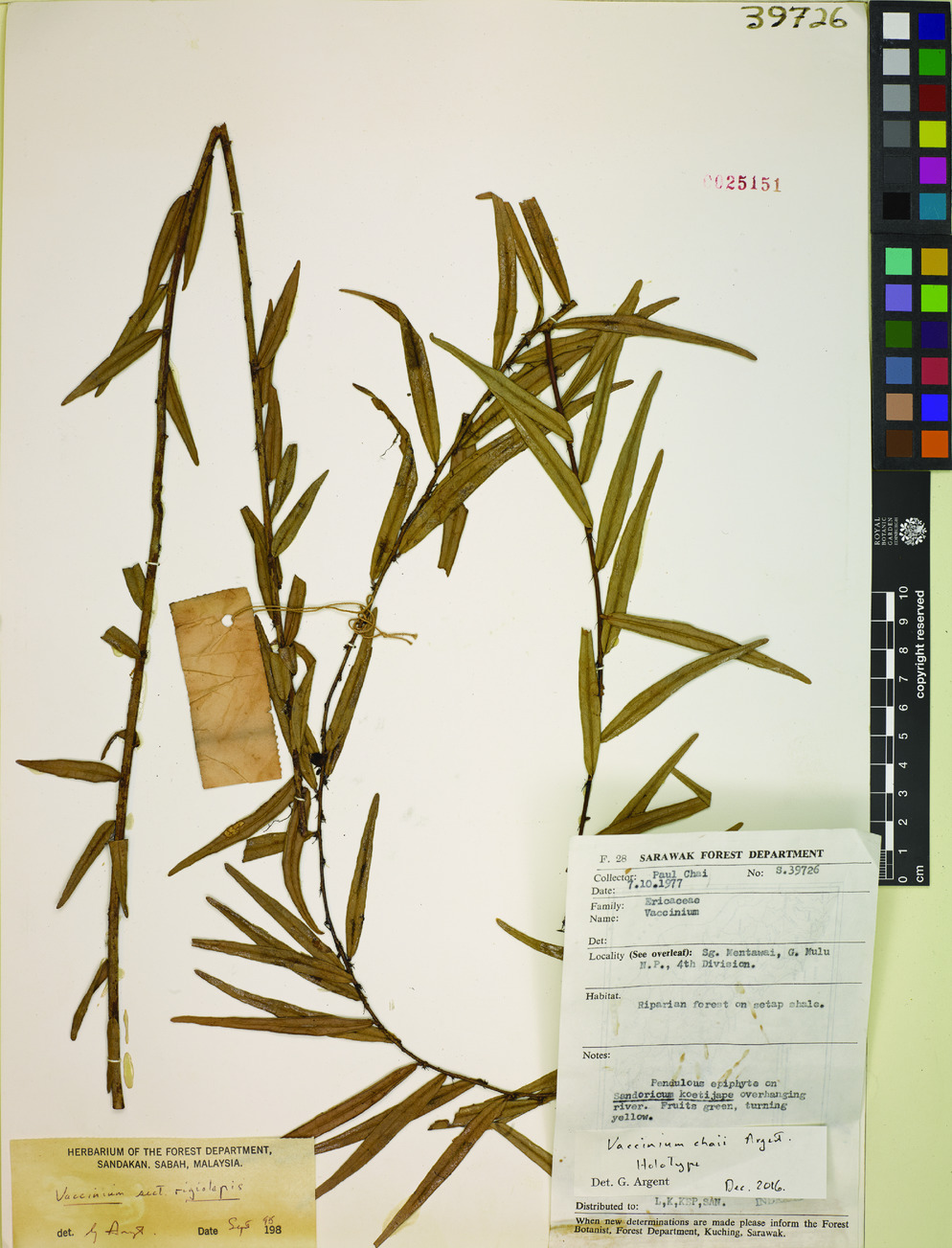
Pendulous epiphyte. Twigs densely covered with short, curled, matted hairs to 0.1 mm long; lateral buds to 5 mm long, scales finely acicular, much longer than petioles, patently long-hairy. Leaves: petiole 1–1.5 × 0.5 mm, pubescent with curled hairs similar to those on stems; blade 35–80 × 5–10 mm, linear to linear-lanceolate; base rounded, margin entire, strongly inrolled, basal marginal glands distinct and impressed, c.2 mm from petiole, extreme apex rounded, lamina convex, with scattered brown, clavate, glandular hairs beneath, midvein impressed above, strongly raised beneath, and with numerous, inconspicuous lateral veins, but lacking prominent arching lateral veins, upper surface finely and distinctly reticulate. Inflorescence of solitary, axillary flowers. Flowers: pedicels to 2 mm long from a few small, hairy acicular basal bracts; calyx lobes c.1 × 1.5 mm, with a distinct gland subapically outside; corolla not seen; disc densely hairy with short semi-appressed hairs. Fruit (immature) subspherical, scabrid, c.4 × 4 mm.
Distribution
Malaysia: Sarawak, Miri Division, Mount Mulu National Park. Known only from the type collection.
Ecology
Epiphyte hanging over the river from Sandoricum koetjape (Burm.f.) Merr., in the Setap Shale area. The elevation is not recorded but will be low, probably c.300 m. Flowering time not recorded.
Etymology
Named after Paul Piang Kong Chai, collector of this plant and for his contribution to Southeast Asian botany, particularly for his support for the Royal Geographical–Forest Department Kuching expedition to Mount Mulu, 1977–1978.
Conservation assessment
LC. This species has the protection of occurring in a designated national park.
This species is very distinct despite not being collected in flower, with its long very narrow linear leaves, which are broader than those of the other linear-leaved species and possessing subsessile flowers lacking rachises. The specimen at K has floral remnants glued to it which do not belong to this species!
The new species is superficially similar to some specimens of Rigiolepis lobbii but lacking the straight hairs, costate bracts and calyx lobes (when dry) of that species.
7. Rigiolepis irawatiae Argent, sp. nov.
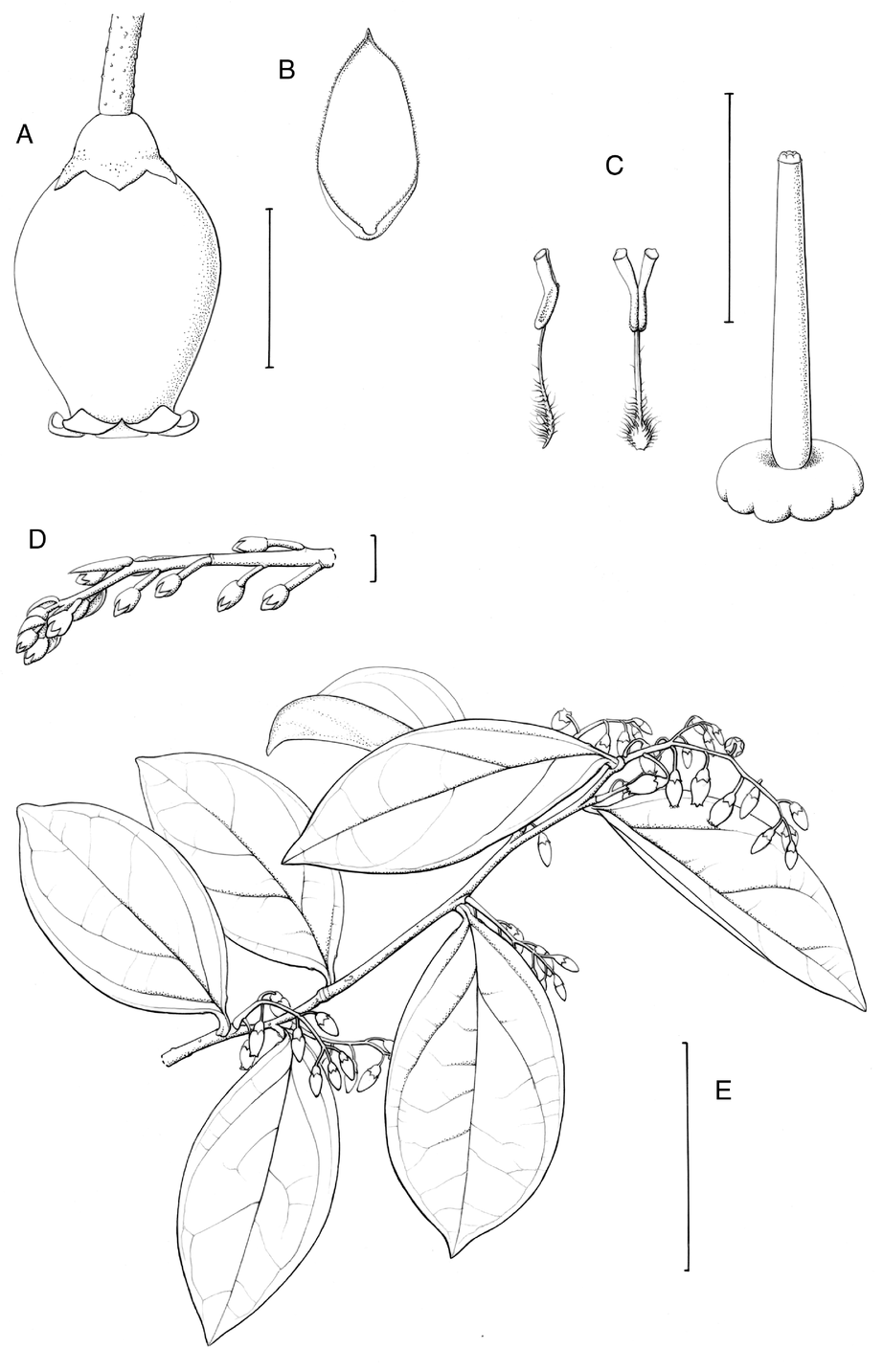
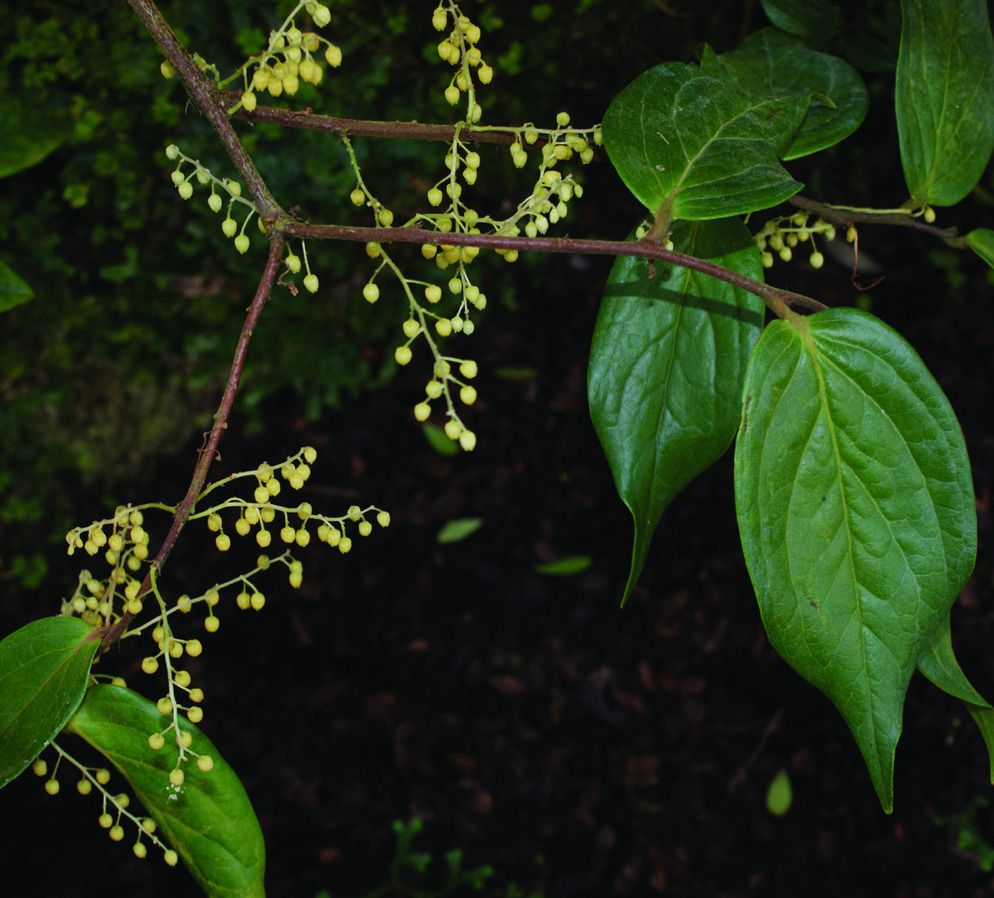
Most similar to Rigiolepis sulcata but with the dendroid hairs on the leaves being filamentous and scabrous (not lamellar) and the leaves almost smooth, with only a slightly protruding pair of basal glands (to c.1 mm), these at the precise junction between the non-decurrent lamina and petiole; petiole and leaves hairy with multicellular and simple hairs. The rachis is slender, elongate, 60–110 mm (versus up to 50 mm long in Rigiolepis sulcata), and the corollas are densely and completely glandular hairy outside without the simple hairs found in R. sulcata. – Type: Indonesia, Central Kalimantan, Ulu Sungai Mentaya, c.100 m, 30 xi 2000, Argent s.n. (holo BO, iso E), made from RBGE accession number 19942467, originally collected by Baillie G., 21 vi 1993. Figs 3, 12, 13, 14A,B.
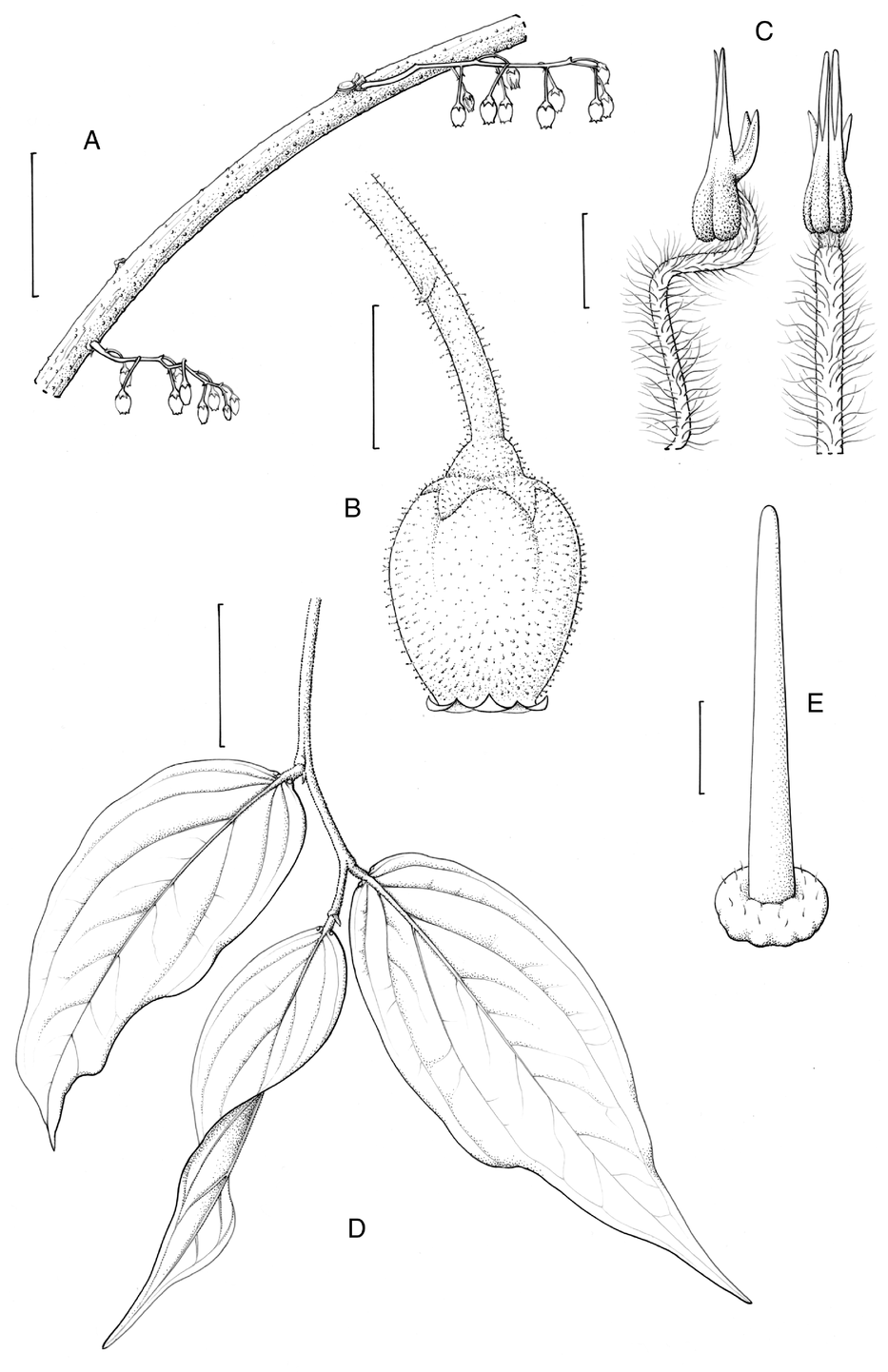
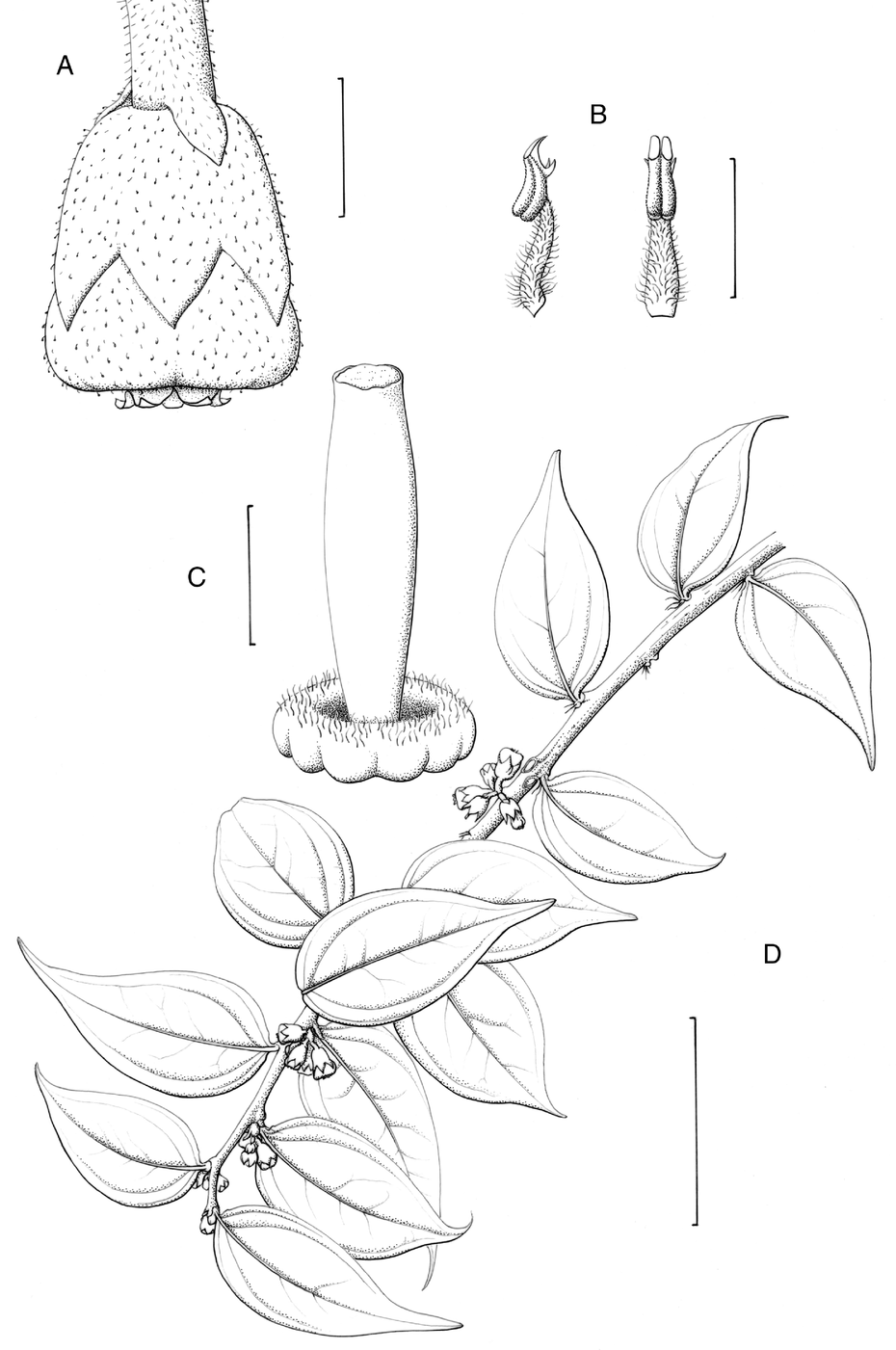
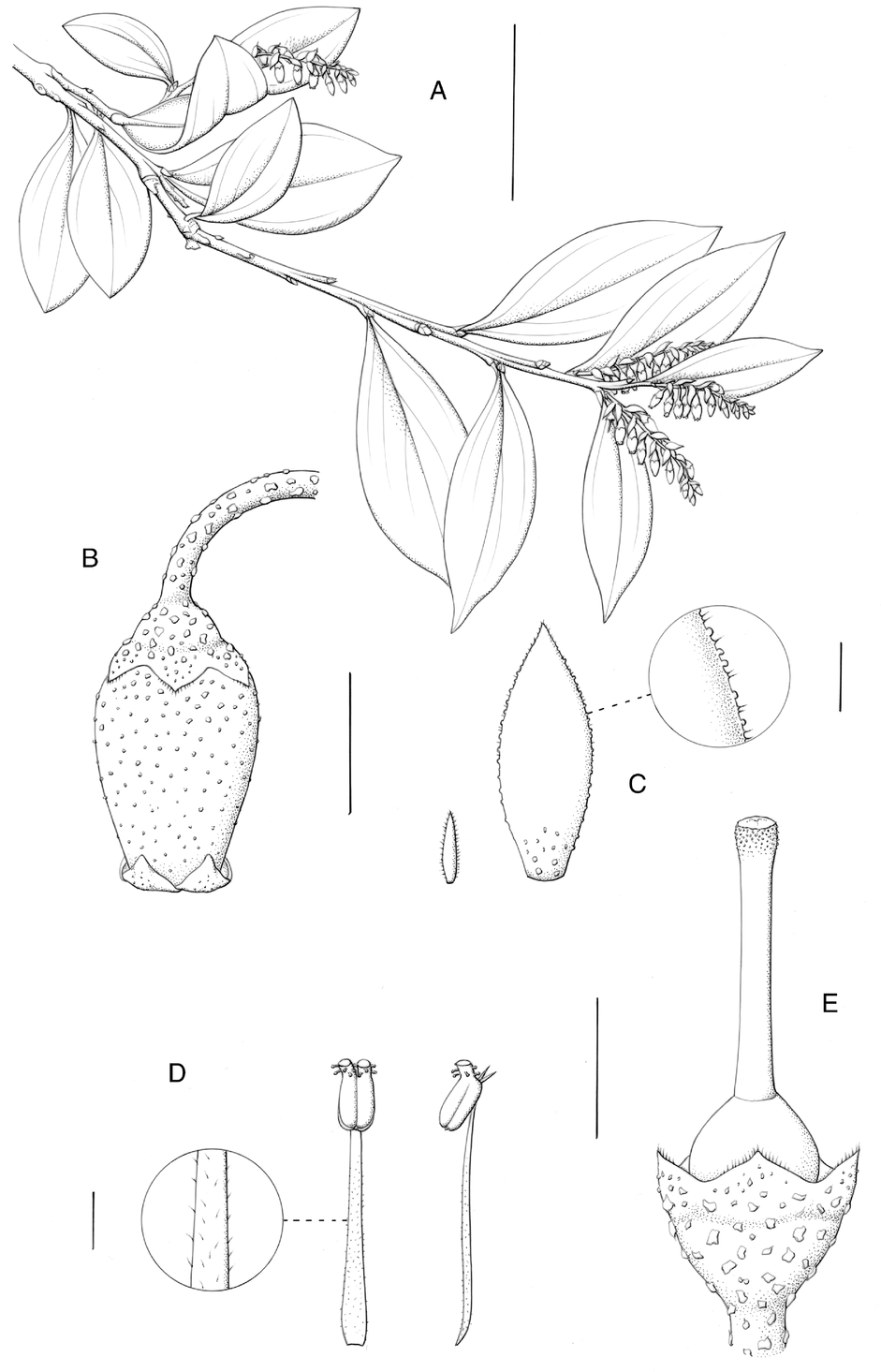
Rigiolepis irawatiae Argent. Type, RBGE accession number 19942467. A, Branch with inflorescences (scale bar, 3 cm); B, flower (scale bar, 3 mm); C, stamens (scale bar, 1 mm); D, habit (scale bar, 3 cm); E, style with disc (scale bar, 1 mm). (Illustration: Claire Banks.)

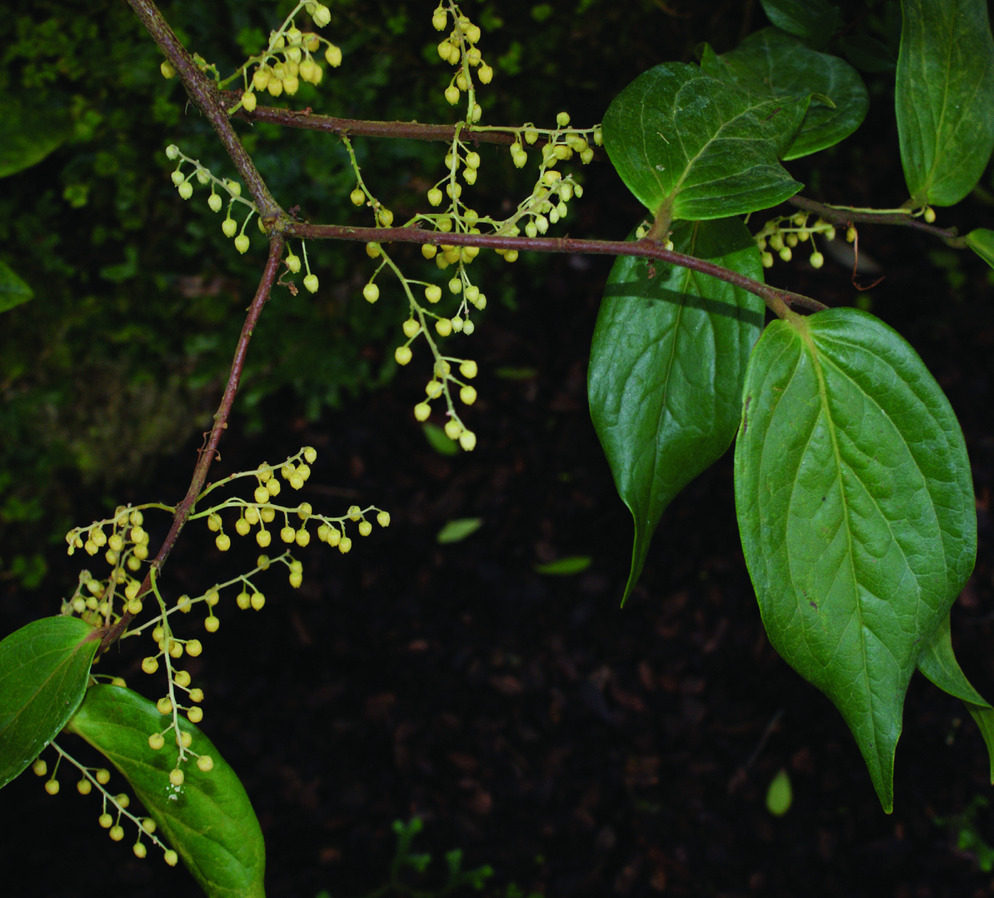
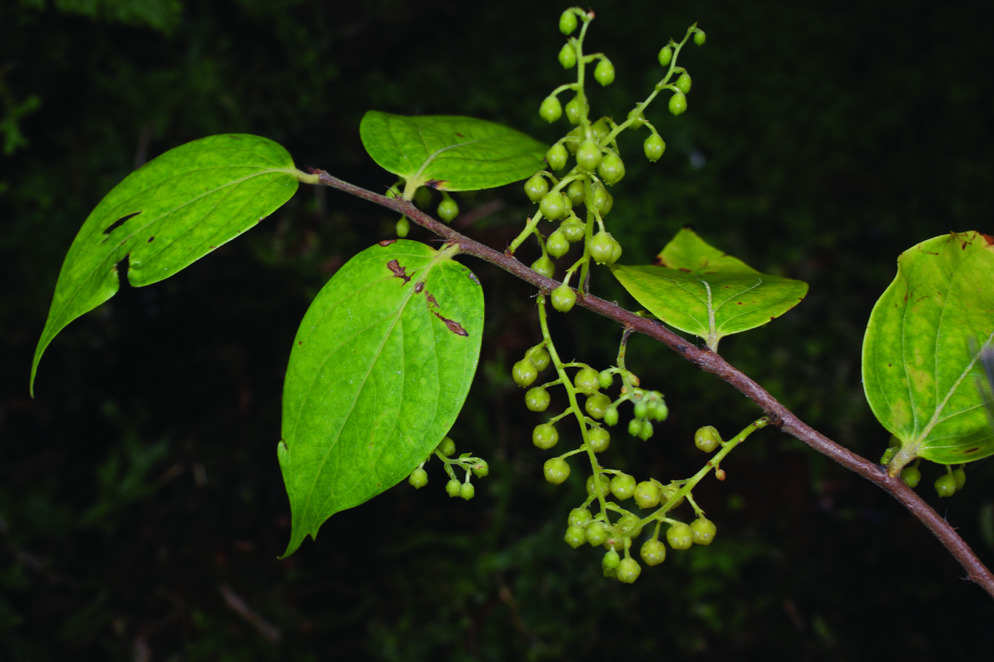
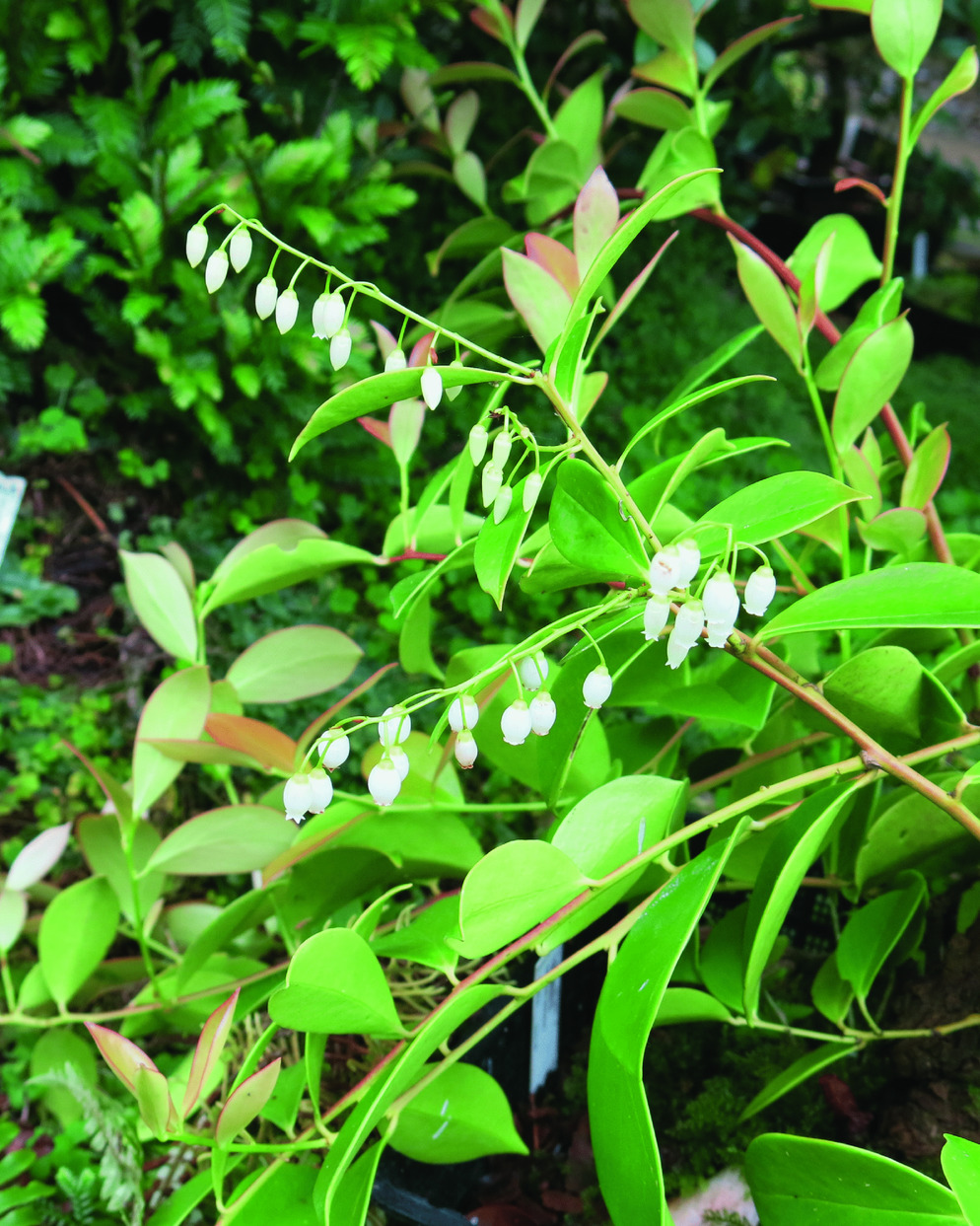
Rigiolepis irawatiae Argent. Cultivated, RBGE accession number 19942467. (Photograph: G. Argent.)
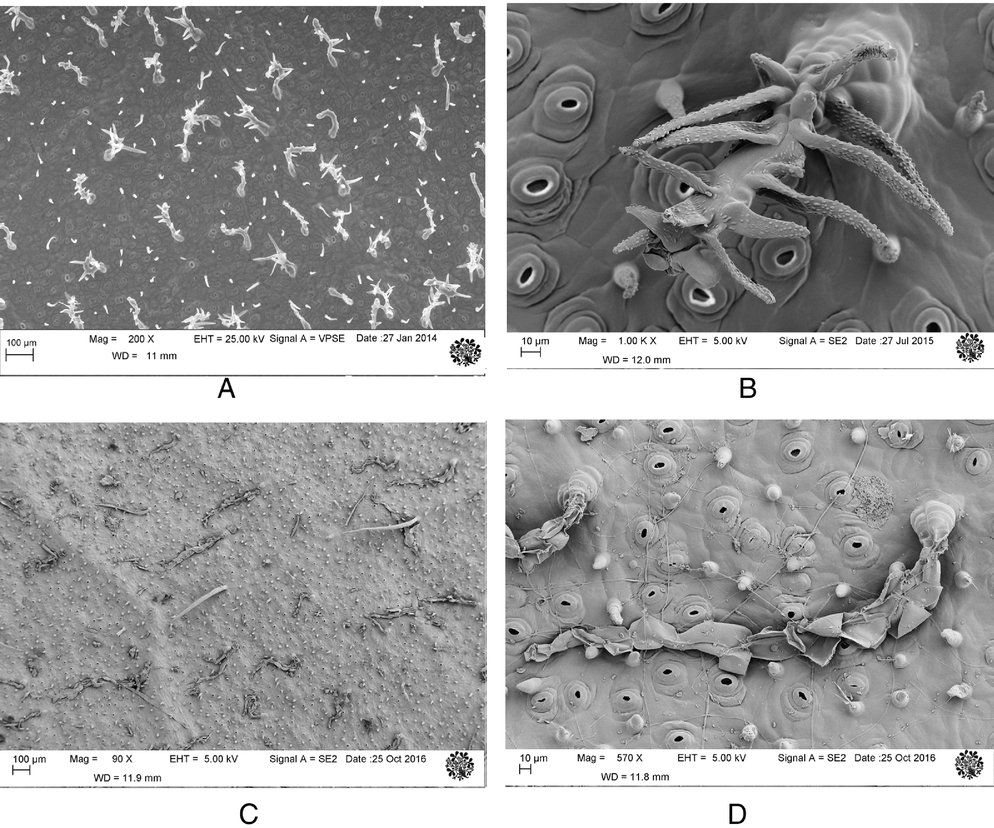
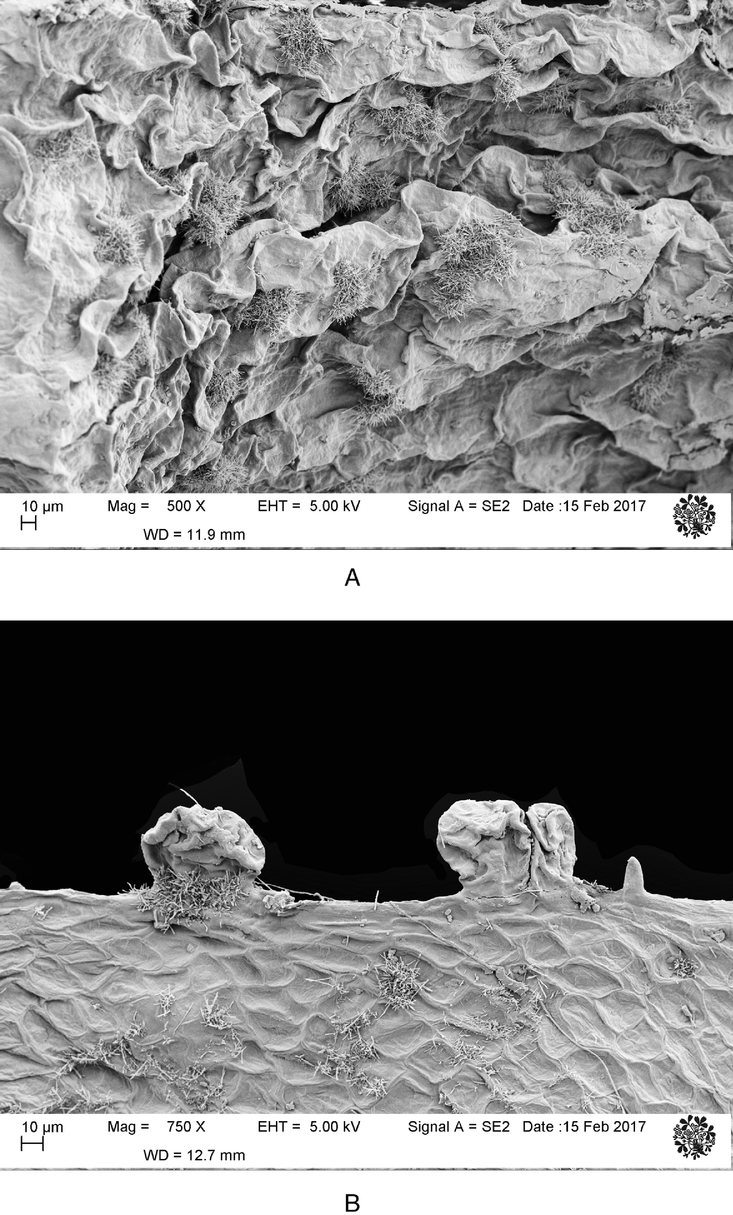
Micrographic comparison of Rigiolepis irawatiae (A and B) and R. sulcata (C and D). Rigiolepis irawatiae, type: A, abaxial leaf surface, showing distribution of hairs; B, single dendroid hair. Rigiolepis sulcata, Paie S.45136: C, abaxial leaf surface, showing hairs; D, single multicellular hair. (Scanning electron micrographs: Frieda Christie.)

Epiphytic shrub to 2 m. Twigs with a short dense covering of simple tomentose hairs and some dendroid hairs (no brown glandular hairs), leaves lax, lenticels rounded, raised, reddish brown, prominent on older stems; lateral buds 5–7 mm long, acicular, conspicuous almost as long as petioles, scales hairy. Leaves: petiole 5–7 × c.5 mm, densely covered with both simple and dendroid hairs; blades 110–160 × 40–60 mm, ovate, narrowly ovate, elliptic to narrowly elliptic, thin, dull pale green above and below, base broadly tapering to truncate, margin entire, basal glands slightly protruding when dry at the precise junction with petiole; densely hairy with both simple and dendroid hairs below, with a similar but sparser covering above but quickly glabrescent there, 4–6 ascending veins, proximal veins arising from base and disappearing distally at about halfway up leaf, upper main lateral veins arising 20–40 mm from base and disappearing close to base of acumen, other pinnate veins from upper part of leaf less conspicuous, midvein prominent above in basal half, then impressed in a narrow channel as are lateral veins abaxially, all major veins raised, apex acuminate (to c.30 mm), extreme point acute. Inflorescence of spreading racemes from upper foliate and defoliate axils, solitary or 2 or 3 together, laxly 12- to 16-flowered, flowers pendent; basal bracts few, very small, subulate; rachis 60–110 mm, covered in curled, more or less appressed, simple hairs, dendroid hairs and occasional pale glandular hairs; bracts c.1.5 × 1 mm, ovate, concave, acute, densely covered with mainly curled simple hairs but with a few brown glandular hairs intermixed; bracteoles to c.0.9 mm long, small, subulate, variable in position but mostly subopposite and near middle of pedicel. Flowers: pedicels 7–12 × c.0.5 mm, densely covered with mainly pale long-stalked glandular hairs but with a few less conspicuous simple hairs; calyx cup-shaped, tube c.0.7 × c.1.7 mm, densely glandular hairy; lobes triangular, c.1 × c.1 mm, densely glandular hairy outside, glabrous within; corolla ovoid, slightly constricted distally, 4–4.5 × c.4 mm, pale yellow, densely glandular hairy outside, glabrous inside; lobes triangular, c.1. × 1 mm, reflexed; stamens: filaments sigmoid, c.2.5 mm, densely hairy throughout; anther cells c.0.5 mm, tubules c.0.5 mm, dorsal spurs c.0.3 mm; style glabrous, c.4 mm; disc sparsely hairy on upper side. Fruit not seen.
Description augmented from living material cultivated at Royal Botanic Garden Edinburgh.
Distribution
Indonesia: Central and West Kalimantan. Malaysia: Sarawak.
Ecology
Epiphytic in lowland dipterocarp forest at 35–200 m elevation on trees overhanging streams. Flowering: June, July, November and December, probably irregularly throughout the year.
Etymology
Named in honour of Ibu Dr Irawati, formerly director of the Kebun Raya, Bogor, who has always been helpful in promoting the taxonomy of Indonesian plants and fostering links between taxonomists and institutions.
Conservation assessment
This species has only been collected in lowland forest which is being destroyed at a very rapid rate, so it is under severe threat.
Additional specimens. Indonesia. Central Kalimantan: Ulu Sungai Mentaya, cultivated from RBGE accession 19942467, 30 xi 2000, Maxwell, 102; Kotawaringin Timor, (Sungai. Mentaya), Km 92 from Sangai, 1994, Argent G699; Km 48 from Sangai, 26 ix 1996, Argent et al. 9622. West Kalimantan: Kapuas Hulu Regency, Danau Sentarum Wildlife Reserve, Bekuan River, between Lake Bekuan and Belitung River, 3 vii 1986, Giesen 65; ibid., Giesen 43; Lebang Hara, 30 xii 1924, Winkler 1141.
Malaysia. Sarawak: Kuching Division, Simunjan, Sabal F.R., Ulu Sungai Sabal, Aping, 9 ix 1997, Paie S.38594; Kapit Division, Kapit District, Pelagus Bukit Raya, 13 viii 1961, Anderson 14739.
This new species is similar to Rigiolepis moultonii but differs in its extreme lowland versus montane ecology. The twigs of Rigiolepis moultonii have patently erect instead of tomentose hairs, and the leaves and inflorescences lack the dendroid hairs of this species. The basal glands protrude slightly at the junction between lamina and petiole in Rigiolepis irawatiae (not at some distance from the petiole as in R. moultonii); the flowers are densely and completely glandular hairy outside and the disc is sparsely hairy. In Rigiolepis moultonii the corolla always has some simple hairs. The new species differs from Rigiolepis bigibba and R. sulcata in the longer, laxer inflorescences (> 60 mm versus < 50 mm), the smoother leaves, which are less sulcate, the marginal leaf glands smaller, not located on a decurrent leaf base, and having a dense covering of exclusively glandular hairs on the calyx and corollas. Rigiolepis irawatiae shares with R. bigibba and R. sulcata the possession of multicellular hairs on the leaves but they are structurally different in R. irawatiae, having scabrid branches instead of smooth lamella branches (see Fig. 14).
Other than in Rhododendron, dendroid hairs are apparently unknown in Malesian Ericaceae. They have apparently not been recorded previously in Vaccinium in Malesia (Balgooy, Reference Balgooy1997). In Rigiolepis irawatiae, the hairs are of various irregular forms standing up to 220 µm high above the surfaces on which they are found. They appear under a relatively low–powered binocular microscope as a farinaceous indumentum on the lower surface of the leaves mixed with simple filamentous and glandular hairs. Each dendroid hair consists of two cells which occur side by side from a slightly bulbous base and which divide distally and branch irregularly. The two-celled nature of the stem of these hairs parallels the double nature of the stalk of dendroid Rhododendron scales in Southeast Asia. Although most similar to Rigiolepis moultonii, plants of the new species would key to Vaccinium sulcatum in Sleumer (Reference Sleumer and Van Steenis1966–1967) (now R. sulcata) on the basis of the simple hairs all over the undersurface of the leaf. As well as by the unique dendroid hairs, the new species differs from Rigiolepis sulcata by the less-bullate leaves, the much smaller basal glands and the corolla completely covered only in glandular hairs.
This species flowers regularly in cultivation in Edinburgh but fails to produce fruit, perhaps indicating that it is self-incompatible.
8. Rigiolepis jermyi Argent, sp. nov.
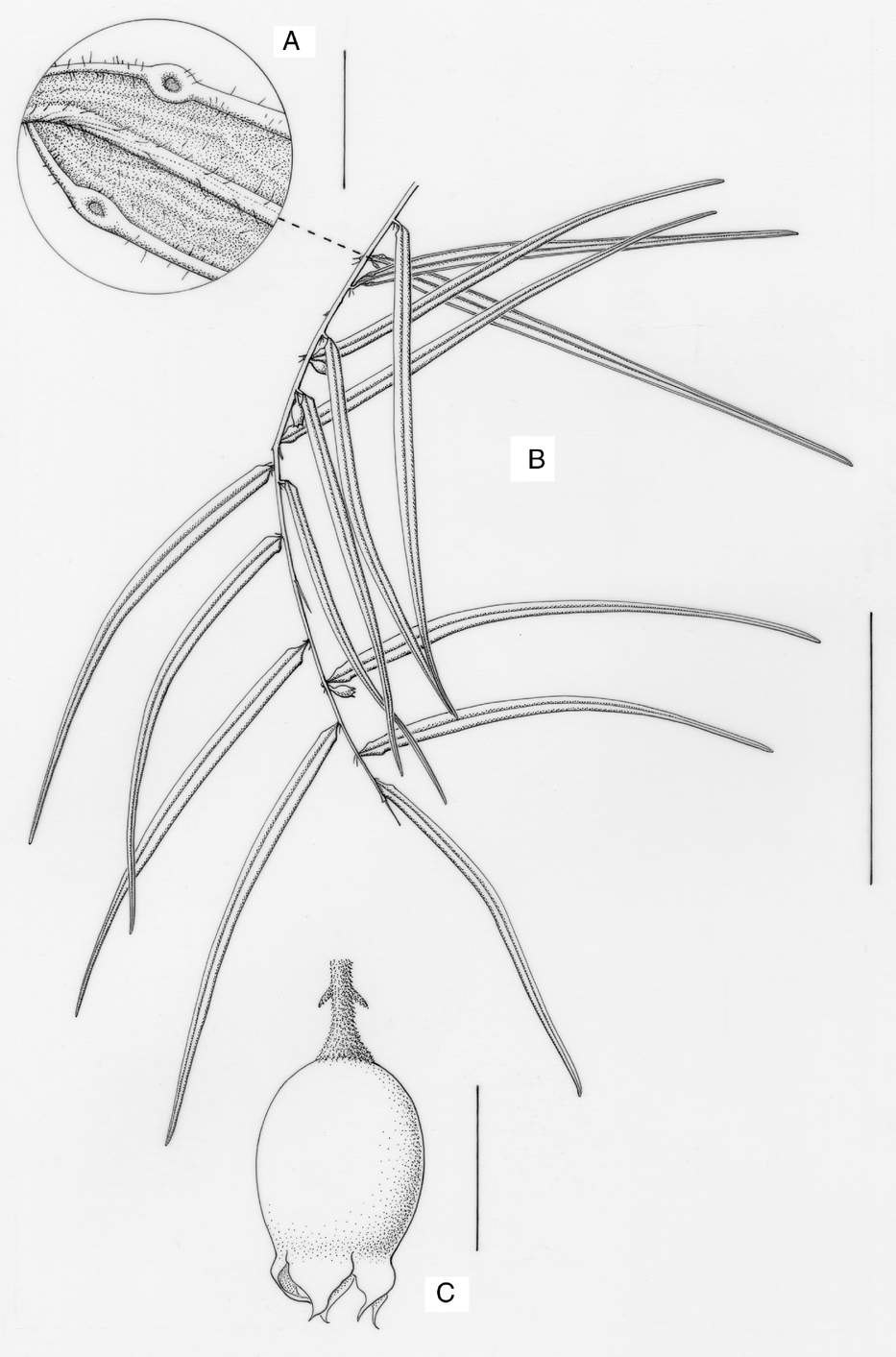
Most similar to Rigiolepis chaii but leaves linear, to 4 mm wide (versus 5–10 mm wide) and more strongly acute at apex. Inflorescence lacking a rachis, pedicels to 1 mm long, with impressed marginal glands 1–2 mm from the petiole. – Type: Malaysia, Sarawak, Miri District, Niah, 22 ix 1960, c.100 m elevation, Brunig S.8861 (holo SAR; iso K, L). Figs 4, 15.
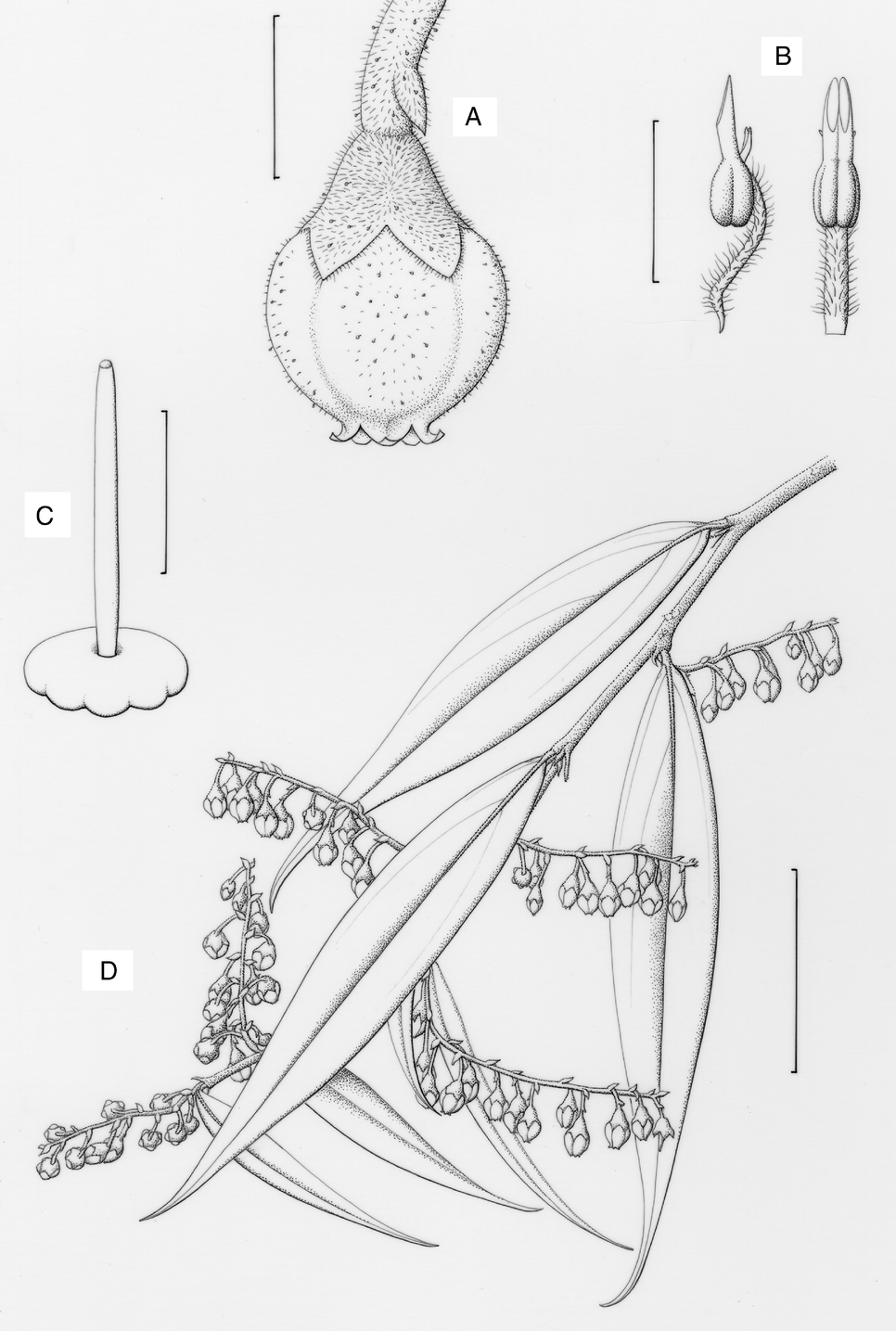
Rigiolepis jermyi Argent. Type; Niah, Sarawak. A, Leaf base, showing marginal glands (scale bar, 2 mm); B, habit (scale bar, 6 cm); C, immature fruit (scale bar, 3 mm). (Illustration: Claire Banks.)

Small epiphyte. Twigs densely hairy with short semi-appressed grey hairs; lateral buds to 3 mm, much longer than subtending petioles, bud scales finely acicular. Leaves: petiole 1–1.5 × 0.5 mm, pubescent; blade 80–110 × 2–4 mm, linear, base broadly tapering, basal marginal glands distinct and impressed, 1–2 mm from petiole, apex acute; midvein impressed above, strongly raised beneath, convex with strongly recurved margins when dry with a few simple hairs beneath, without conspicuous lateral veins. Inflorescence of solitary flowers, or in 2-flowered fascicles, in leafy axils; bracteoles minute, acicular. Flowers: pedicels to 1 mm, from a few small acicular basal bracts, with semi-appressed hairs; corolla not seen. Fruit (immature) c.1.2 × 1 mm, spherical, with erect triangular calyx lobes.
Distribution
Malaysia: Sarawak, Miri Division, Niah, protected forest. Known only from the type collection.
Ecology
Epiphyte in lowland rain forest at c.100 m elevation. Flowering time not known.
Etymology
Named after Dr Anthony Clive Jermy for his contribution to Southeast Asian botany, particularly that of Sarawak, and for the inspiration he gave to many botanists.
This species is very distinct, despite not being collected in flower, with its long linear leaves with acute apex, presence of basal marginal glands and sessile flowers.
9. Rigiolepis leptantha (Miq.) J.J.Sm., Blumea 1: 338 (1935). – Vaccinium leptanthum Miq., Ann. Mus. Bot. Lugd Bat. 1: 37 (1863). – Agapetes leptantha (Miq.) Niedenzu, Bot. Jahrb. Syst. 11: 201 (1889). – Vaccinium acuminatissimum Miq. f. leptanthum (Miq.) Vuyck in Boerl. Handl. 2, 1: 263 (1891). – Type: Indonesia, Java, Preanger, Papandayan, without date, Korthals s.n. (lecto L, designated by Sleumer, Reference Sleumer1961,? K).
Vaccinium flagellatifolium H.F.Copel., Philipp. J. Sci. 42: 567 (1930). – Type: Malaysia, Sarawak, without locality, Native collector 1679 (holo K).
Rigiolepis filiformis J.J.Sm., Blumea 1: 340, f. 8a–e (1935). – Vaccinium filiforme (J.J.Sm.) Sleumer, Bot. Jahrb. Syst. 71: 168 (Reference Sleumer1940). – Type: Indonesia; East Kalimantan, West Kutai, Bolset, Endert 4041 (holo L; iso A, BM).
Vaccinium myrianthum Sleumer, Bot. Jahrb. Syst. 71: 162 (Reference Sleumer1940). – Type: Malaysia, Sarawak, Dulit Trail, 20 viii 1932, Richards 1461 (K).
9a. Rigiolepis leptantha var. leptantha. Figs 2, 4, 16, 17.
Rigiolepis leptantha var. leptantha. RBGE accession number 19801411; Gunung Lumarku, Sabah. A, Flower (scale bar, 2 mm); B, stamens (scale bar, 1 mm); C, style with disc (scale bar, 1 mm); D, habit (scale bar, 3 cm). (Illustration: Claire Banks.)

Rigiolepis leptantha var. leptantha. Cultivated, RBGE accession number 19801411; Gunung Lumarku, Sabah. (Photograph: G. Argent.)
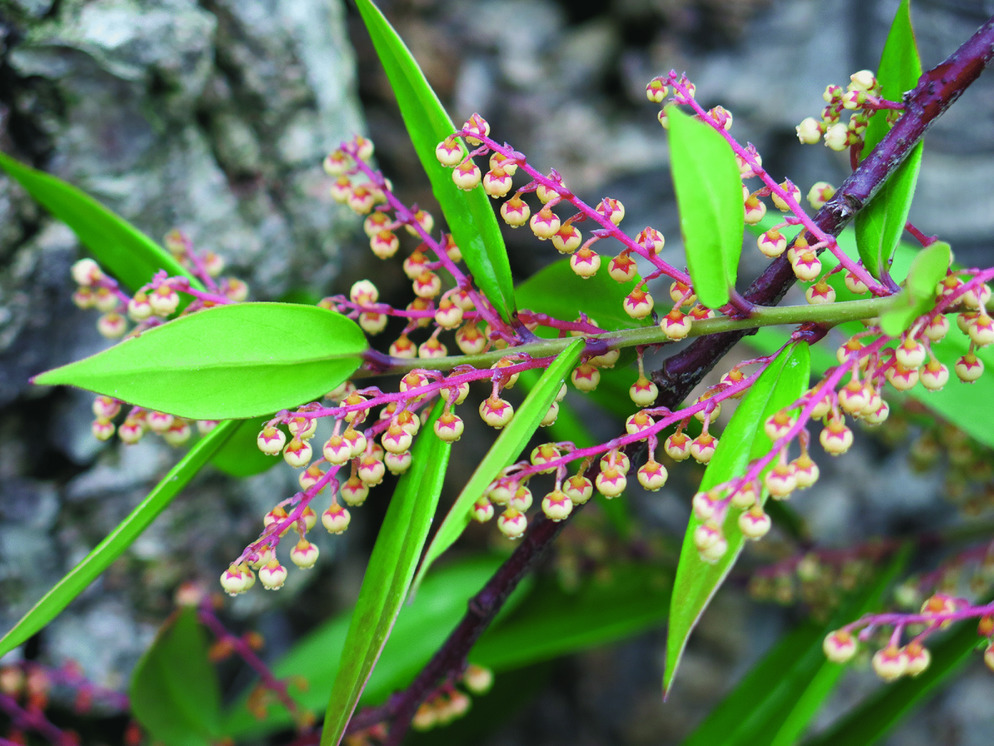
Small shrub to 4 m, often with a woody subglobular tuber. Twigs pendent, slender, densely puberulous with simple hairs, laxly leaved; lateral buds to c.2 mm, mostly shorter than subtending petiole, bud scales subulate and hairy. Leaves: petiole 2–5 × c.1 mm, densely puberulous; blade 45–150 × 13–40 mm, narrowly ovate to elliptic-ovate, base cuneate, margin entire, subrevolute in dry specimens, basal glands 1 or 2 on each side, small impressed on margin, c.2 mm distant from petiole, somewhat shining above, mostly dull beneath, slightly puberulent proximally beneath especially on midvein when young and with sparse, appressed glandular hairs on both sides, 3- or 5-plinerved from base, midvein deeply impressed, but prominent within depression above, obtusely raised beneath, main veins high ascending and slightly raised above, often quite obscure beneath, other shorter veins numerous, irregularly pinnate, forming a subdense, slightly prominent network above in young leaves, becoming less visible in older, dull leaves, reticulation in general inconspicuous, entire undersurface smooth, apex abruptly acuminate or subcaudate to 20 mm, often subfalcate, acute. Inflorescence a solitary raceme or 2 or 3 in a fascicle, laxly 10- to 15-flowered, faintly sweetly scented; rachis 30–55 mm, bright red, slender, with several (3–4 mm) subulate, acuminate bracts at base, densely covered with minute puberulence of very short eglandular and glandular hairs; bracts c.1.5 mm, ovate-acuminate, concave, ciliolate; bracteoles c.1 mm, subulate, inserted in lower part of pedicel. Flowers: pedicels slender to filiform, 4–8 mm at flowering, red, densely covered with minute puberulence of very short eglandular and glandular hairs, slightly accrescent in fruit; calyx tube 0.5 mm, campanulate, more densely puberulous or glandular than calyx lobes, lobes triangular, 0.6 mm, acute, ciliate; corolla 2–2.5 mm, urceolate or ovoid-subglobose, yellow or cream, puberulous in lower, glabrescent in upper half outside, lobes c.0.4 mm; stamens: filaments c.1 mm, linear, long hairy; anther cells 0.5 mm, broadly oblongoid, granular or papillose; tubules c.0.8 mm, narrow; disc pubescent, or with few hairs close to style; style 2 mm, glabrous. Fruit (immature) bright orange.
Distribution
Brunei. Indonesia: South Sumatra (possibly also in central Sumatra), Lingga Archipelago (Pulau Lingga, Pulau Sebangka), West Java, East (West Kutei) and West Kalimantan. Malaysia: Johore, Sabah and Sarawak. Singapore: Bukit Mandi.
Ecology
Generally epiphytic on tall trees, occasionally also terrestrial (in Sarawak on limestone), 10–700 m elevation. Flowering: throughout the year.
Conservation assessment
LC. This is a widespread, common species which, although it will be adversely affected by general forest clearance, will gain some protection from the fact that it often occurs on riverside trees which are valued for shade and defence against erosion.
Additional specimens. Malaysia. Sabah: Gunung Lumarku, 18 vii 2012, Argent s.n. (RBGE accession number 19801411). Sarawak: Kuching Division, Jalan Padwan, Gunung Siruruh, Palog, 24 ix 1987, Ching S.55300; Serian District, Bukit Selabor, Lobang Mawang, Tebakang road, 26 ix 1968, Paie S.28057; Lundu District, Samunsam, Belinsa, 10 iii 1989, Ismawi et al. S. 62276; Miri Division, Bintulu, Segan F.R., Nanga Sepulau, 20 viii 1968, Paie S.27047; Bario, foot of Bukit Lawi, 17 viii 1985, Awa & Lee S.50908; Bintulu, Ulu Sungai Segan, 23 viii 1968, Paie S.27202; Kapit Division, Belaga District, Linau at Long Jakah, 22 viii 1978, Burtt 11281; Kapit District, Ulu Sungai Balleh/Sungai Balang, 17 vii 1969, Anderson & Paie S28887; Kapit District, Nanga Balang, Ulu Sungai Batang Balleh, 29 vi 1969, Anderson S.28315; Kapit District, Baleh, Mengiong/Entulu, 20 vii 1987, Lee S.54673; Kapit District, 8 vii 1969, Anderson S.28514; Samarahan Division, Lundu District, 10 iii 1989, Othman et al. S.62276; Serian District, Tebakang road, Lobang Mawang, Bukit Selabor, 26 ix 1968, Paie S.28057.
Vaccinium flagellatifolium was reduced to a synonym of V. leptanthum by Vander Kloet (Reference Vander Kloet2005), while Sleumer distinguished V. flagellatifolium in his key by the leaves “hardly or not reticulate”, which appears to be a taxonomically trivial character. Florally and ecologically they are extremely similar, although the descriptions of the habits (“Small . . . much branched shrub” versus “shrub or small tree up to 5 m”; Sleumer, Reference Sleumer and Van Steenis1966–1967) appear to refer to very different plants. These annotations, presumably from collectors’ labels, are likely to be misleading as many collectors wrote notes long after making their collections. The Korthals specimen at K has been annotated “? part of the lectotype” by Sleumer.
9b. Rigiolepis leptantha var. elliptica (J.J.Sm.) Masam., Enum. Phanerog. Born. 575 (1943). – Rigiolepis leptantha (Miq.) J.J.Sm. f. elliptica J.J.Sm., Blumea 1: 338 (1935). – Vaccinium leptanthum Miq. f. ellipticum (J.J.Sm.) Sleumer, Bot. Jahrb. Syst. 71: 168 (Reference Sleumer1940). – Type: Indonesia, West Kalimantan, Gunung Semedum, 1893–1895, Hallier 711 (lecto BO n.v., designated by Sleumer, Reference Sleumer1961; iso L).
Leaves: 45–100 × 15–25 mm, elliptic or ovate-elliptic, base broadly tapering to rounded, apex long acuminate or more or less abruptly acuminate, often with 2 high-ascending lateral veins arising very near base of leaf, reticulation obscure. Inflorescences with larger bracts 2–2.5 mm long and thicker (shorter) pedicels, 2–4 mm long, compared with the type.
Distribution
Indonesia: West Kalimantan. Malaysia: Sarawak.
Ecology
Reported to grow epiphytically on mangrove near Kuching also epiphytic in dipterocarp forest on alluvial soil at 50 m elevation. Flowering: not recorded.
Additional specimens. Malaysia. Sarawak: Kuching Division, near Kuching, 16–31 ii? 1889, Litarm, Haviland 236; Kuching Division, Bako National Park, Telok Tajor path, 5 vi 1963, Ashton S.17935.
Sleumer (Reference Sleumer1961, Reference Sleumer and Van Steenis1966–1967) distinguished Vaccinium leptanthum f. ellipticum from f. leptanthum on “the ovate-elliptic or elliptic leaves, the base broadly attenuate; pedicels thicker, (2–)3–4 mm long at anthesis”. I have modified the description with features of the Haviland specimen which is best included here, but this specimen has larger leaves, much longer attenuate leaf apices and more distinct lateral veins than the type collection. This taxon could be confused with Rigiolepis moultonii but would appear to occur in lowland habitats and lacks the distinct reticulation characteristic of the leaves of that species. Further collections and critical observations are needed to establish the taxonomic boundaries clearly. This taxon was described by J.J.Smith (Reference Smith1935) without flowers.
10. Rigiolepis linearifolia (Kloet) Argent, comb. nov. – Vaccinium linearifolium Kloet, Blumea 50: 491, f. 6 (Reference Vander Kloet2005). – Type: Malaysia, Sarawak, Miri Division (4th Div.), Kelabit, Pa Litan, Apad Runan, 1580 m, 6 v 1988, Yii Puan Ching S.55984 (holo L; iso E, K, KEP, SAN). Figs 4, 18.
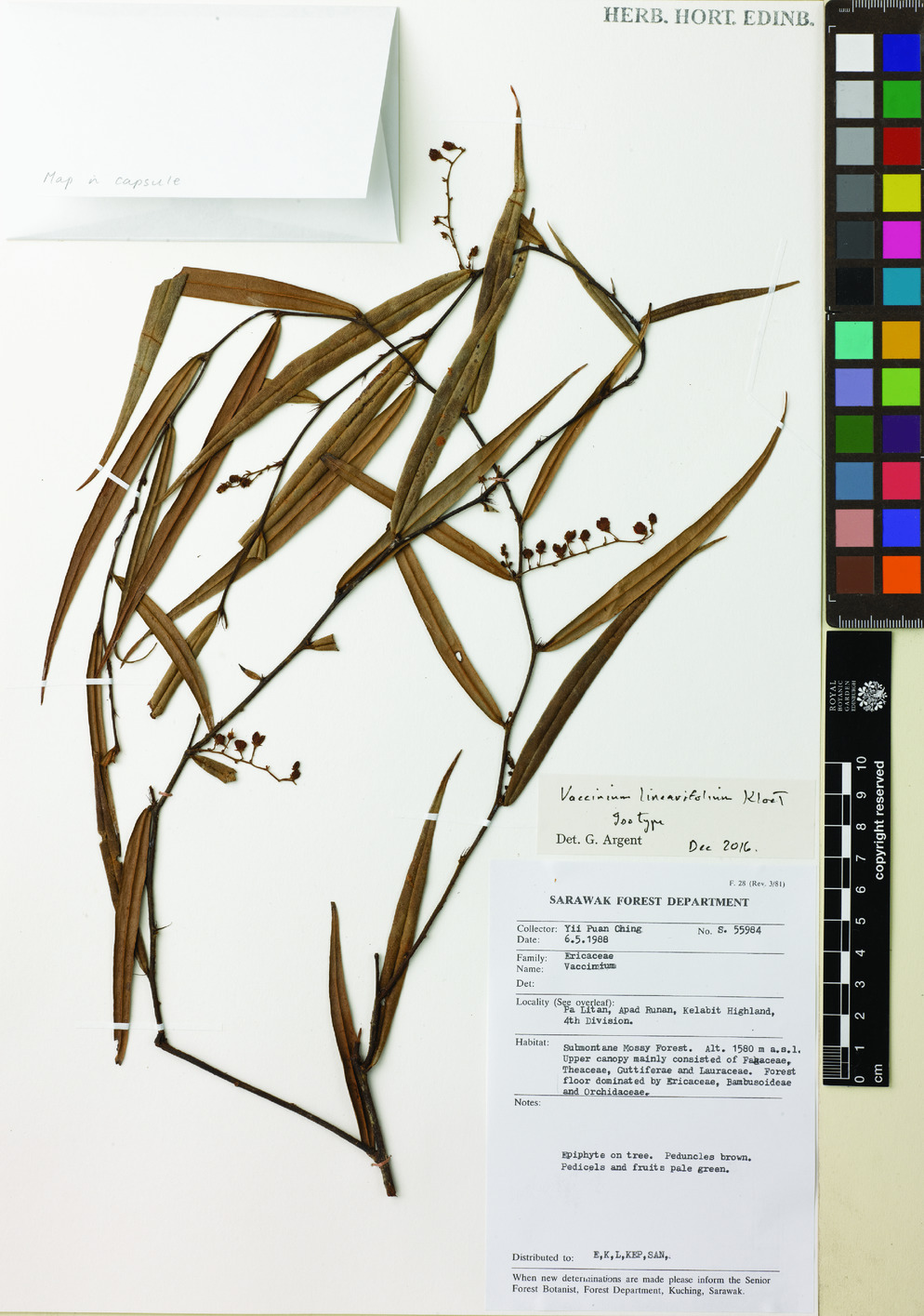
Rigiolepis linearifolia (Kloet) Argent. Isotype, Kelabit, Yii Puan Ching S.55984 (E). (Scan: Robyn Drinkwater.)
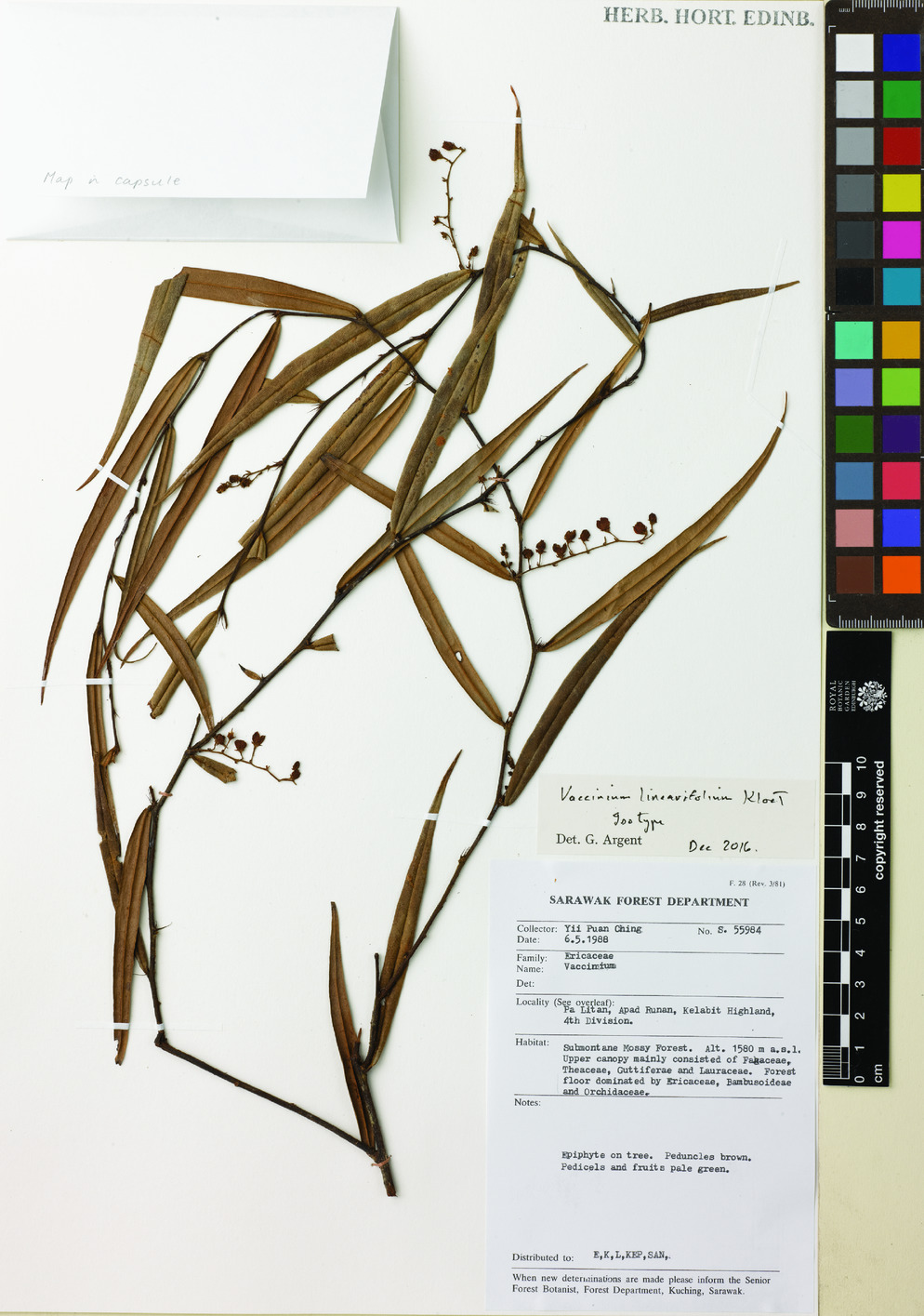
Shrub. Twigs slender, pubescent; lateral buds to 5 mm long, narrowly acicular, much longer than petioles, scales sparsely patently hairy. Leaves: petiole 1 mm long, thick, hairy; blade 110–130 × 7–9 mm, linear, base broadly tapering, without lateral glands, margin entire, recurved, with long simple hairs along strongly keeled midvein underneath and scattered simple brown glandular hairs over abaxial surface, without conspicuous lateral veins, apex narrowly acute. Inflorescence of solitary, 7- to 11-flowered racemes; rachis slender, 30–50 mm long, sparsely pilose, bearing many small, caducous bracts. Flowers: pedicels c.3 mm long at flowering with a pair of bracts inserted towards base of pedicel, sparsely pilose; calyx tube small, densely hairy, calyx lobes c.1 mm long, sparingly hairy except along margins where there are also some thick brown glands; corolla globose, 3 × 4–5 mm, white, with few hairs, mostly at angles outside, lobes c.0.5 × 0.75 mm with minutely crenate margin; stamens c.2 mm long, filaments c.1 mm long, pilose; anthers c.1 mm long, oblongoid, tubules opening with an oval pore; disc glabrous; style slender, glabrous, or with a few short hairs at base, c.4 mm long. Fruit not seen.
Distribution
Malaysia: Sarawak, Miri Division, Kelabit. Known only from the type collection.
Ecology
Epiphyte, on trees in submontane mossy forest, recorded at 1580 m. Flowering: May.
The type description has been augmented from the original (Vander Kloet, Reference Vander Kloet2005) after examination of the holotype at L and isotype at E. There are no paired glands embedded on the margin of the petiole as originally described (but not illustrated), nor are there any on the margin of the leaf base. The leaves are not “± glabrous” but distinctly laxly hairy with simple hairs along the midvein underneath and with simple brown glandular hairs all over the undersurface.
11. Rigiolepis lobbii Ridl., Bull. Misc. Inform. Kew 107 (Reference Ridley1922). – Vaccinium lobbii (Ridl.) Sleumer, Biol. Jahrb. Syst. 71: 168 (Reference Sleumer1940). – Type: Malaysia, Sarawak, without locality, without date, 900 m, Lobb s.n. (holo K).
11a. Rigiolepis lobbii var. lobbii
Straggling or climbing shrub, to 1.5 m. Twigs at first covered with white spreading hairs; lateral buds 1–2 mm, acicular, about as long as petiole, scales with long white hairs. Leaves: petiole 1–2 × 0.5 mm, pubescent initially; blade 20–50 × 8–20 mm, 2–4 times as long as broad, narrowly to broadly ovate, base broadly attenuate to rounded, margin entire, revolute, basal marginal glands 1–2 mm from petiole, obscure, laxly hairy above but quickly glabrescent, glabrous below except for some hairs on midvein, glossy dark green above, paler and dull green beneath, slightly convex above and with a recurved margin in dry specimens, midvein strongly impressed above, prominent beneath, with 0–4 arching lateral veins, other veins from midvein irregular and numerous, forming a fine dense network or obscure, apex short or long acuminate, obtuse at extreme point. Inflorescence of one to several short, 2- to 8-flowered racemes or clusters in the upper axils; rachis 0–10 mm with several small basal bracts, shortly pubescent; bracts narrowly ovate; bracteoles narrowly ovate immediately below calyx, c.2 mm, ribbed lengthwise when dry, shortly pubescent. Flowers: pedicels to 1 mm; calyx tube obconical, c.1 mm, lobes c.2 × 0.5 mm, narrowly ovate, distinctly ribbed lengthwise when dry, shortly pubescent, terminating in a gland which is brown when dry; corolla c.2.5 × 2 mm, subglobose-urceolate, slightly 5-angled, white, shortly pubescent outside; stamens: filaments linear, sparsely hairy, 0.5–0.7 mm; anthers cells oblongoid, c.0.5 mm, tubules c.0.5 mm, cleft nearly to base; disc hairy; style papillose, c.2 mm long. Fruit 6–7 mm in diameter, hairy, with persistent calyx lobes.
Chromosome number
2n = 24 (Atkinson et al., Reference Atkinson, Jong and Argent1995).
Distribution
Malaysia: Sarawak.
Ecology
On limestone ridge, 450–900 m. Flowering: August.
Conservation assessment
Although of unknown size, populations of this species are likely to be vulnerable to deforestation and El Niño droughts because of their lowland habitat.
Additional specimens. Malaysia. Sarawak: Kuching Division, Bau limestone, Lobang Angin, 18 xi 1985, Ismawi S.51253; Gunung Serapi 17 iii 1982, Argent & Sinclair 8297; Gunung Santubong, 15 iii 1982, Sinclair & Argent 139, (RBGE accession number 19820838); Gunung Mentawa, Tiang Bekop, 26 vii 1963, Chew Wee-Lek 700; Gunung Mentawa, Pedawan road, 6 vi 1960, Anderson 12524; N slopes of Gunung Penrissen, 6 viii 1958, Jacobs 5092; Kuching/Sri Aman Division boundary, Ulu Sungai Simunjan, Gunung Buri, 18 ix 1975, Martin & Othman S.36839; Serian District, Tebakang road, Bukit Selabor, lobang Mawang, 26 ix 1968, Paie S.28062; Samarahan District, Gunung Buri, 28 ii 1982, Sinclair & Argent 162 (RBGE accession number 19820861); Gunung Buri, 28 ii 1982, Sinclair & Argent 154.
11b. Rigiolepis lobbii var. lanceifolia (Ridl.) Argent, stat. nov. – Rigiolepis lanceifolia Ridl., Bull. Misc. Inform. Kew 106 (1922). – Vaccinium lanceifolium (Ridl.) Sleumer, Biol. Jahrb. Syst. 71: 168 (Reference Sleumer1940) (‘lancifolium’). – Type: Malaysia, Sarawak, near Quop, without date, Haviland 619 (lecto K, designated by Sleumer, Reference Sleumer1961, p. 16; isolecto SAR). Figs 3, 19, 20.
Rigiolepis lobbii var. lanceifolia (Ridl.) Argent. RBGE accession number 19820748; Gunung Bungo Range, Sarawak. A, Flower with bracts (scale bar, 2 mm); B, stamens and style with disc (scale, bar, 1 mm); C, bare branch with inflorescences (scale bar, 1 cm); D, habit (scale bar, 5 cm). (Illustration: Claire Banks.)

Rigiolepis lobbii var. lanceifolia (Ridl.) Argent. Cultivated plant with ripening fruit and flowers, RBGE accession number 19820748; Gunung Bungo Range, Sarawak. (Photograph: G. Argent.)
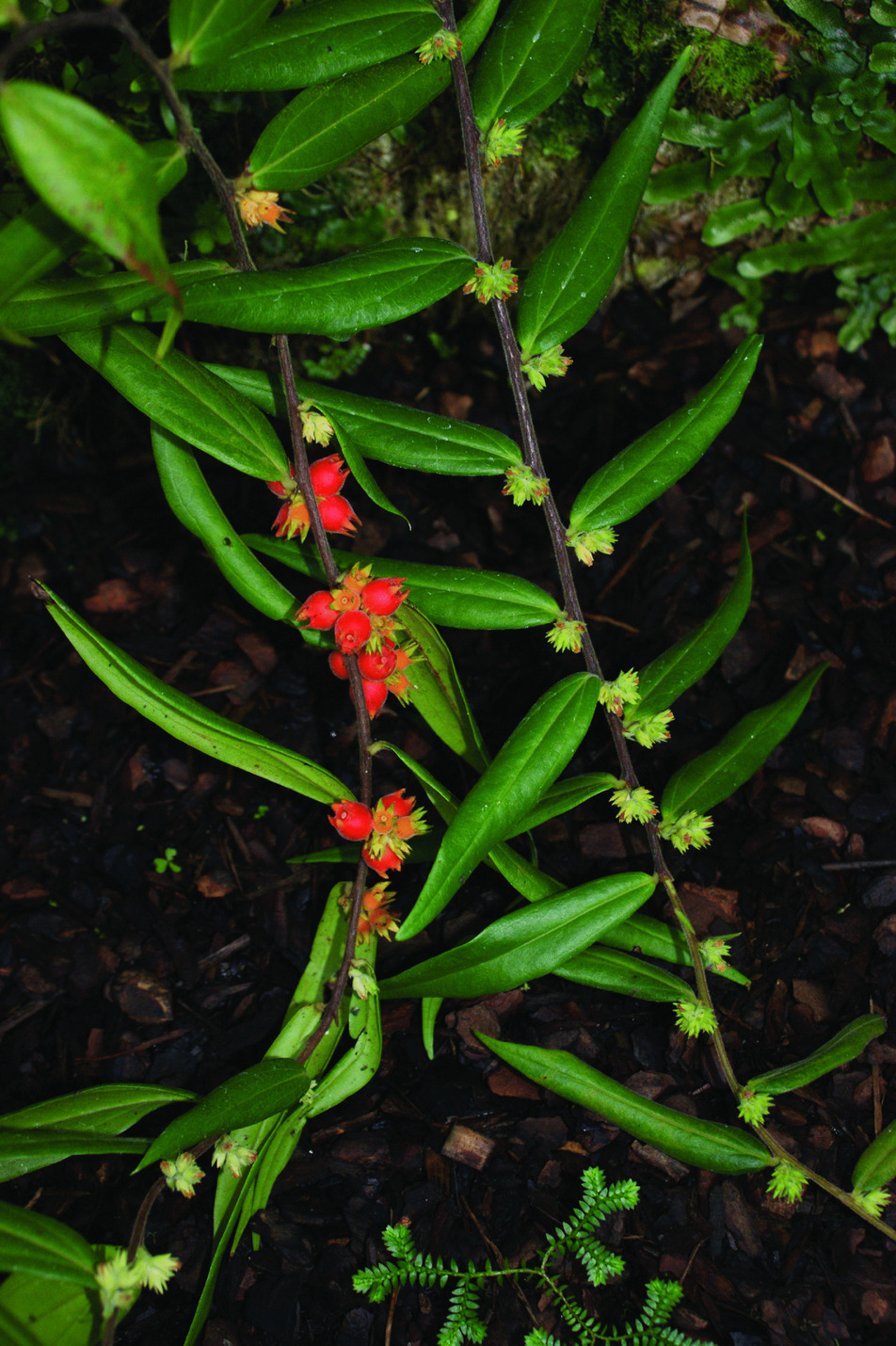
Spreading shrub, to 1.5 m. Twigs at first covered with white spreading hairs; lateral buds 1–2 mm, acicular, about as long as petiole, scales with long white hairs. Leaves: petiole 1–2 × 0.5 mm, pubescent initially; blade 50–80 × 6–15 mm, 5–8 times as long as broad, lanceolate to narrowly elliptic, base broadly attenuate to rounded; margin entire, weakly to strongly recurved, basal glands marginal, 1–2 mm from petiole, obscure, laxly hairy above but quickly glabrescent, glabrous below except for some hairs on midvein, glossy dark green above, paler and dull green beneath, slightly convex above, midvein strongly impressed above, prominent beneath, with one pair of intramarginal veins which are often obscure, and smaller pinnate veins from upper part of leaf. Inflorescence as for var. lobbii.
Chromosome number
2n = 24 (Atkinson et al., Reference Atkinson, Jong and Argent1995).
Distribution
Malaysia: Sarawak.
Additional specimens. Malaysia. Sarawak: Kuching Division, Gunung Bungo Range, S. of Bau, 4 iii 1982, Sinclair & Argent 49 (RBGE accession number 19820748); Bau District, Gunung Staat, 25 v 1962, Burtt & Woods 1937; Samarahan Division, Samarahan District, Gunung Buri, 18 iii 1982, Sinclair & Argent 162 (RBGE accession number 19820861).
Specimens cultivated in Edinburgh retain their distinctive leaf shapes, var. lanceifolia having much larger, especially longer leaves than var. lobbii. Both taxa were collected on Gunung Buri and are are nearly devoid of glandular hairs.
12. Rigiolepis macrophylla J.J.Sm., Blumea 1: 335 (1935). – Vaccinium macrophyllum (J.J.Sm.) Sleumer, Bot. Jahrb. Syst. 71: 168 (Reference Sleumer1940). – Vaccinium megaphyllum Sleumer, Blumea 11: 17 (1961). – Type: Indonesia, Central Kalimantan, Gunung Batu Lesong, i 1899, Amdjah 480 (holo BO, iso L).
Shrub to 5 m. Twigs minutely, shortly hairy; lateral buds with acicular scales as long as subtending petioles but eroding to short tufts. Leaves: petiole 4–10 × c.2 mm, grooved above, pubescent; blade 200–300 × 60–100 mm, elliptic-ovate, base rounded, margin entire, more or less flat, basal glands impressed on margin at some distance from petiole, without hairs except for midvein and main lateral veins which are shortly pubescent basally, laxly covered with simple brown glandular hairs beneath, with 4–6 strongly high-arching veins and with 7 or 8 distinct pinnate veins from each side, which are a little decurrent along midvein, main veins prominent in a pronounced depression above, strongly raised beneath, apex long-acuminate, the narrow acumen (30–50 mm) obtuse, reticulation conspicuous and dense, slightly raised on both sides. Inflorescence a solitary raceme or commonly a fascicle of racemes, 10- to 30-flowered; rachis 20–60 mm, puberulous; bracts 1.5 mm long, ovate, concave; bracteoles not seen. Flowers: pedicels 2–4 mm; calyx small, pubescent, lobes inflexed; corolla urceolate, 2–3 mm long, white or cream; stamens c.2 mm long, filaments not seen; style glabrous, 2–3 mm long; disc glabrous. Fruit (immature) c.3 mm in diameter, subglobose, laxly pubescent, calyx lobes inflexed.
Distribution
Indonesia: Central Kalimantan, Mount Batu Lesong.
Ecology
Epiphytic on tree, summit vegetation. Flowering: January.
Additional specimens. Malaysia. Sarawak: Kapit Division, Melinau, Bukit Pantu, 9 viii 1967, Paie S.25725; Batang Ballah, Sungai Kui, 24 iv 1991, Runi et al. S.62939.
I have taken the very brief floral description from Vander Kloet (Reference Vander Kloet2005). Nooteboom & Chai 1692, collected on 25 iii 1970 at Bintulu Division, Bario, Kelabit Highlands, is tentatively placed here. It has no corollas but small (c.1 mm) styles and both very large (to 170 × 80 mm) and small leaves (c.70 × 20 mm), both with infloresences in their axils. This specimen keys to Rigiolepis macrophylla with the large leaves, but if only the small leaves were present on the specimen, it would be similar to R. minimiflora although it has a glabrous disc. It might represent an undescribed species.
13. Rigiolepis minimiflora (Sleumer) Argent, comb. nov. – Vaccinium minimiflorum Sleumer, Bot. Jahrb. Syst. 71: 162 (Reference Sleumer1940). – Type: Malaysia, Sarawak, Ulu Sungai Koyan, c.1000 m, 3 x 1932, Richards P.W. 2103 (holo K, iso L [fragment]).
Shrub or climber c.1.5 m. Twigs shortly pubescent when young; lateral buds 2–2.5 mm, as long as or slightly longer than petioles. Leaves: petiole 1–2 mm, pubescent; blade 30–60 × 10–20 mm, narrowly ovate to ovate, base rounded; margin entire, slightly revolute when dry, basal pair of glands small, c.1.5 mm distant from petiole, puberulous at midvein and ciliate initially, some pubescence remaining at base of older leaves, laxly glandular punctate beneath, glossy on both sides, with 2 or 3 pairs of high-ascending main veins, with several shorter, less conspicuous veins from upper part of midvein, inconspicuous above except midvein and lowest pair of veins which are slightly raised; reticulation dense and slightly raised beneath; apex subcaudate-acuminate, extreme tip obtuse or acute. Inflorescence: lax, axillary racemes, solitary, many-flowered; rachis 25–40 mm, slender, shortly pubescent and with a few stalked glands; bracts 0.7 mm, subulate; bracteoles subulate, inserted close below calyx. Flowers: pedicels 1.5–2 × 0.5 mm, shortly pubescent, with simple hairs and a few brown glandular hairs; calyx tube 0.8 mm, campanulate, densely hairy, lobes 1–2 mm, deltoid, sparsely hairy, acute; corolla c.3 mm, urceolate, contracted distally, whitish green or red, laxly covered with very short, rufescent, glandular hairs at base, glabrous apically; stamens: filaments c.1 mm, hairy; anther cells c.1 mm, with 2 long dorsal spurs; tubules 1 mm; disc shortly hairy; style 3 mm, glabrous. Fruit: not seen.
Distribution
Malaysia: Sarawak, Ulu Sungai Koyan, Bukit Dulit.
Ecology
Mossy forest, c.1000 m. Flowering: March to August.
Additional specimens. Malaysia. Sarawak: Miri Division, Baram District, Ulu Sungai Tinjar, Bukit Dulit, 16 viii 1974, Tong S.34892; Kapit Division, Batang Ballah, Mengiong/Entulu, 15 vii 1987, Lee S.54556 (anomalous with large leaves).
Vander Kloet (Reference Vander Kloet2005) says “except for the presence of a rachis and multiple flowers, similar to Vaccinium uniflorum”. This may well be so but there are far too few collections to evaluate this species properly. Vander Kloet (Reference Vander Kloet2005) expands the leaf size from Sleumer's (Reference Sleumer and Van Steenis1966–1967) description (30–70 × 10–20 mm versus 30–40 × 10–15 mm). Lee S.54556 has even larger leaves, to 140 × 30 mm.
14. Rigiolepis moultonii (Merr.) J.J.Sm., Blumea 1: 336 (1935). – Vaccinium moultonii Merr., J. Straits Branch Roy. Asiat. Soc. 87: 22 (1923). – Type: Malaysia, Sarawak, upper Baram River, Gunung Temabo (Lemabok), 1220 m, 1914, Moulton SF6676 (holo SING; iso BO, K).
Vaccinium korthalsii (J.J.Sm.) Masam., Enum. Phanerog. Born. 575 (1943), nom. illeg., non Miq. (1863). – Vaccinium acuminatissimum Miq. f. borneense Miq., Ann. Mus. Bot. Lugd. Bat. 1: 36 (1863). – Vaccinium dipladenium Sleumer, Bot. Jahrb. Syst. 71: 168 (Reference Sleumer1940). – Type: Indonesia, South Kalimantan, Gunung Sakumbang (now Gunung Salamban) summit area, SE of Bandjermasin, 950 m, 1836, Korthals s.n. (holo L, iso K).
Key to the subspecies
1a. Flowers 4 × 2.5 mm, disc glabrous__________________________14a. moultonii
1b. Flowers 5–7 × 5 mm, disc hairy__________________________2
2a. Leaves mostly > 50 mm wide, simple white hairs on calyx tube more prominent than glandular hairs__________________________14b. muluensis
2b. Leaves mostly < 40 mm wide, glandular hairs on calyx tube more prominent than simple hairs__________________________14c. murudensis
14a. Rigiolepis moultonii subsp. moultonii
Shrub to 1.5 m. Twigs slender, shortly subpatently pubescent with a few short glandular hairs; lateral buds to 5 mm, as long as petiole, scales acicular, pubescent. Leaves: petiole 2–5 × 1–2 mm, pubescent, base expanded and slightly decurrent on stem; blade 40–150 × 30–65 mm, ovate to broadly ovate or more rarely almost elliptic, base broadly attenuate to nearly rounded, extreme base slightly contracted or decurrent, margin entire, slightly or not revolute, impressed basal glands on leaf margin distinctly separate (c.3 mm) from petiole, glabrous except for some short pubescence on lower part of midvein, laxly appressed glandular setulose or hairy, finally laxly punctate beneath, with 4–6 high-arching lateral veins, midvein and lateral veins strongly impressed above and prominent beneath, other upper veins from midvein numerous, weakly raised above, less so beneath, reticulation fine, dense; apex caudate-acuminate (20–40 mm), acute. Inflorescence of solitary, or paired racemes, laxly covered with numerous flowers; rachis 10–60 mm, slender, angular, shortly and patently non-glandular-pubescent or with shorter brown glandular hairs; bracts 1.5–2.5 mm, ovate, subacuminate; bracteoles 1–1.5 mm, narrowly subulate, inserted near middle of pedicel or sometimes just under calyx. Flowers: pedicels 3–7 mm, slender, shortly and patently pubescent, often also with glandular hairs; calyx tube 0.8 mm, shortly campanulate, lobes 1.2–1.5 mm, narrowly ovate-acuminate, both tube and lobes shortly and patently pubescent outside, sometimes densely glandular hairy; corolla 3–4 × 2.5–2.7 mm (see note below) urceolate, pale cream to greenish white (recorded as dark red on Bukit Raya), glabrous or sparsely hairy with simple hairs outside, lobes to 0.5 mm; stamens: filaments 1.2–1.5 mm, filiform, laxly pubescent; anther cells 0.5–1 mm, ovoid-oblongoid, tubules 0.6–1 mm, slender; disc glabrous, style c.3.5 mm, filiform, glabrous. Fruit a spherical, slightly pubescent berry with inflexed calyx lobes, ripening red.
Distribution
Indonesia: East Kalimantan. Malaysia: Sabah and Sarawak.
Ecology
Epiphytic in submontane forest at c.600–1250 m. Flowering: November.
Conservation assessment
LC. Widespread with some populations in protected forest (Mount Murud), but the situation at the type locality is unknown.
Additional specimens. Malaysia. Sabah: Ranau District, Poring, above hot springs, 29 vi 61, Meijer SAN.26455. Sarawak: Miri Division, Baram District, Gunung Mulu N.P., 15 vi 1962, Chew Wee-Lek CWL376; Kapit Division, Balleh, Mujong, Ulu Sungai Tiau, Tatai Memuas, 26 iii 1964, Unyong S.21181; Bintulu Division, Tatau District, Ulu Sungai Anap, Bukit Naoung (Kana) trig. point, 11 x 1963, Nyudong S.19408; Tatau District, Balingian, Bukit Penarih, 18 x 1963, Ashton S.19444.
This is still a somewhat problematic species taxonomically. J.J.Smith (Reference Smith1935) did not describe the flowers of Rigiolepis dipladenium, but Sleumer (Reference Sleumer and Van Steenis1966–1967) added a partial description from what he described as “rests adhering to a young fruit”. I have included Vaccinium dipladenium as a synonym of Rigiolepis moultonii because the key characters used by Sleumer (Reference Sleumer and Van Steenis1966–1967) to distinguish these species are the reticulation of the leaf veins, a character which is somewhat subjective, and a difference in the pedicel length (2–4 mm in V. moultonii versus 4–7 mm in V. dipladenium). Because the pedicel elongates as the fruit develops and Vaccinium dipladenium was described from “young fruit”, the difference in length would appear to be insignificant; neither would the apparent difference that the racemes of V. dipladenium were described without glandular hairs. I have thus also included Vaccinium dipladenium in as a synonym. The montane ecology and other features agree well.
Rigiolepis moultonii has been confused with R. salicifolia. Rigiolepis moultonii mostly has broader, ovate leaves with conspicuously high-arching basal veins and slender pedicels while R. salicifolia has more narrowly ovate or elliptic leaves with dominant pinnate venation, the basal veins being much less conspicuous. The pedicels are also shorter and thicker in that species. As conceived here, Rigiolepis moultonii is a widespread but variable species. A better evaluation awaits new collections from the type locality and other localities.
14b. Rigiolepis moultonii subsp. muluensis Argent, subsp. nov.
Differing from subspecies moultonii in the broader leaves with longer, broader petioles, the larger flowers, style longer 5–5.5 mm (versus 3.5–4 mm), sometimes hairy near the base and the hairy disc. From subspecies murudensis in the smoother leaves, the veins only weakly raised abaxially and the calyx tube with simple hairs more prominent than the small glandular hairs. – Type: Sarawak, Miri Division, Gunung Mulu National Park, 10 iii 2017, Argent s.n. (RBGE accession number 19773554). Cultivated material Kerby, 297 (holo SAR, iso E). Figs 3, 21–23.
Rigiolepis moultonii subsp. muluensis Argent. RBGE accession number 19773554. A, Flower (scale bar, 5 mm); B, stamens (scale bar, 2 mm); C, style with disc (scale bar, 2 mm); D, habit (scale bar, 5 cm). (Illustration: Claire Banks).

Rigiolepis moultonii subsp. muluensis Argent. Flowering plant, RBGE accession number 19773554; Gunung Mulu, Sarawak. (Photograph: G. Argent.)
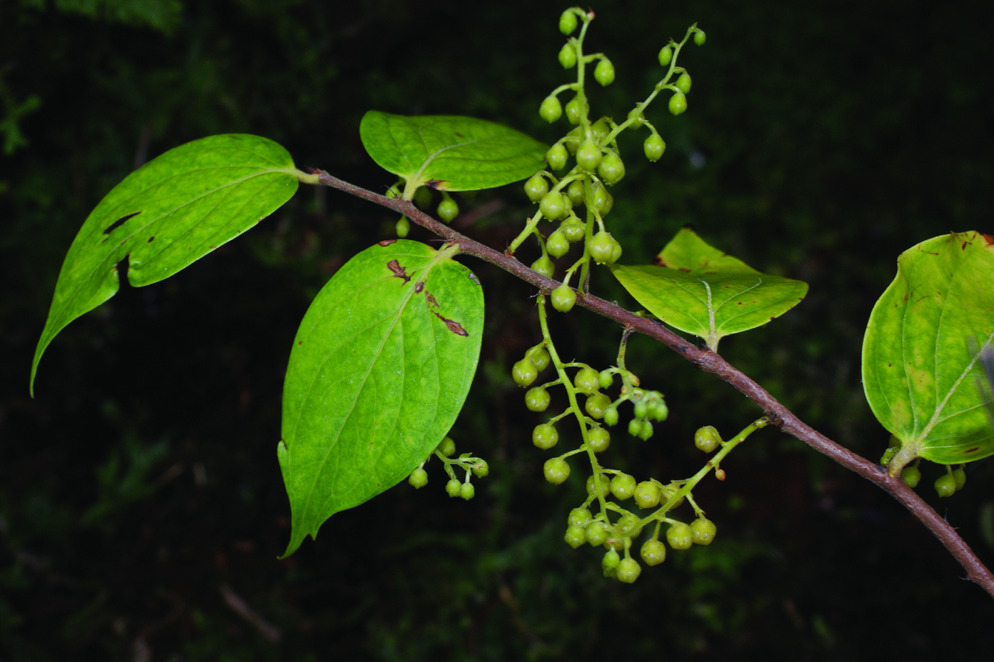
Rigiolepis moultonii subsp. muluensis Argent. Plant with ripe and immature fruit, RBGE accession number 19773554; Gunung Mulu, Sarawak. (Photograph: G. Argent.)
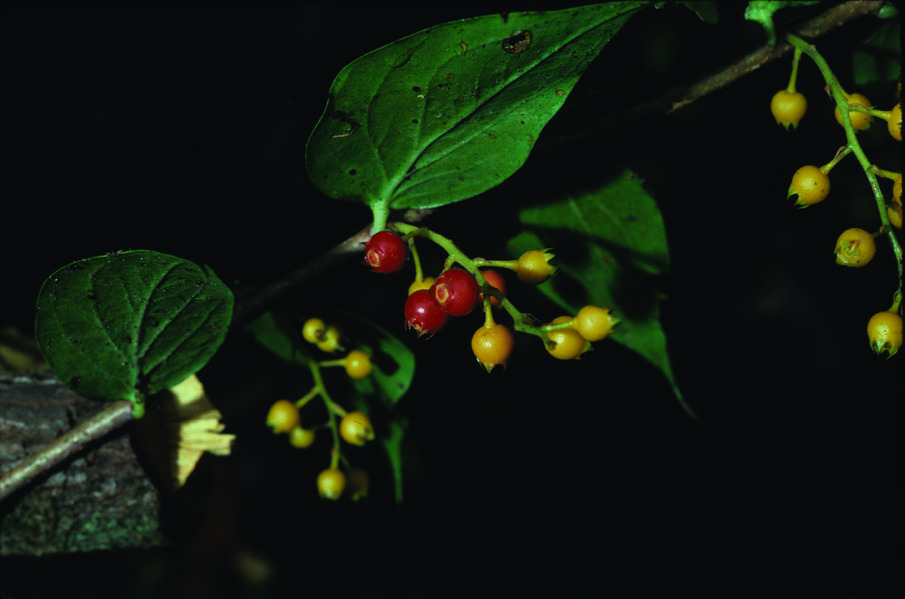
Distribution
Malaysia: Sarawak, known from the type locality, Mount Mulu.
Ecology
Montane mossy forest epiphytic and terrestrial on peaty ground, 1800–2300 m elevation. Flowering: November, in cultivation February to March.
Conservation assessment
LC. There is a good population on Mount Mulu which is in a well-protected national park.
Additional specimens. Malaysia. Sarawak: Miri Division, Baram District, Gunung Mulu, 24 xi 1977, Argent & Kerby 828; Gunung Mulu, 26 iv 1978, Argent & Coppins 1092; Gunung Mulu, 14 iii 1990, Yii & Talib S.58526.
The most significant difference between this subspecies and both the other subspecies is that the disc is densely hairy, not glabrous and the larger flowers reflected by the longer styles. There are small vegetative differences, the petiole being mostly longer and much broader and the reticulation being much less conspicuous.
14c. Rigiolepis moultonii subsp. murudensis Argent, subsp. nov.
Differing from subspecies moultonii in the hairy not glabrous disc, from both other subspecies in the densely glandular hairy calyx tube, these glandular hairs more prominent than any simple hairs and the narrower sulcate leaves with very prominent venation abaxially. – Type: Sarawak, Limbang Division, Limbang District Gunung Murud, 27 ix 1967, Burtt & Martin 5240 (holo SAR, iso E).
Distribution
Malaysia: Sarawak, Mount Murud.
Ecology
Montane forest and shrubberies.
Additional specimens. Malaysia. Sarawak: Miri Division, Baram District, Gunung Mulu National Park, Gunung Tamacu, NW ridge, 8 v 1978, Argent & Coppins 1200a; Limbang Division, Limbang Lawas District, Gunung Murut path to 2nd summit, 4 x 1967, Paie S.26420; Kelabit Highlands, Gunung Murud, path to top, 5 iv 1970, Nooteboom & Chai 1944; Gunung Murud, route from Bakelalan, 2 x 1967, Burtt & Martin 5349.
This is a distinctive subspecies in its narrow sulcate leaves, mostly from Mount Murud.
15. Rigiolepis piperifolia (Sleumer) Argent, comb. nov. – Vaccinium piperifolium Sleumer, Blumea 11: 20 (1961). – Type: Malaysia, Sarawak, Upper Rejan River, 1929, J. & M.S. Clemens 21696 (holo L; iso A n.v., BM, BO, K, SAR).
Shrub to c.3 m. Twigs with both simple and glandular hairs, laxly leaved; lateral buds 4–8 mm long, narrow with subulate scales which are almost as long as petiole. Leaves: petiole 5–10 × 2–3 mm rugose, glabrous, or hairy; blade 180–300 × 50–100 mm, large, narrowly ovate to elliptic, base broadly tapering to rounded, margin entire, shortly revolute, basal glands distinct but not protruding beyond leaf margin and inserted 1–3 mm from petiole, puberulous in basal part of midvein, otherwise glabrous except for some sparse glandular hairs abaxially, with 4–6 high-arching lateral veins from and from a little above base, midvein and inner two pairs of veins prominent above within a shallow depression, strongly prominent beneath, outer pair of veins much less distinct, numerous shorter veins pinnate from distal part of midvein, irregular, slightly impressed above, a little raised beneath, veins forming a dense, fine prominent network on both sides; apex subcaudate to long acuminate, acute. Inflorescence of solitary racemes, laxly c.10-flowered, with several subulate, very acute bracts (4–6 mm) at base, which also occur in sterile axils; rachis slender, 20–60 mm, puberulous and minutely glandular hairy; bracts 1.5–2 mm, ovate-acuminate; bracteoles minute, subulate. Flowers: pedicels 2–3 mm, slender, indumentum as on rachis; calyx laxly to densely hairy, with some glandular hairs, tube semiglobose, c.0.5 mm, lobes ovate acuminate, subacute, c.1 mm; corolla c.3 mm, ovoid urceolate, thin, green or white?, laxly covered with short muriculate glandular, and sometimes simple, white hairs; stamens: filaments 0.5 mm long, hairy; anther cells broad oblongoid, papillose, c.0.7 mm; tubules 0.7 mm, disc laxly pubescent; style 2.5 mm, glabrous. Fruit: not seen.
Distribution
Malaysia: Sarawak, Gat, Upper Rejang River, Kapit Division, Belaga District, Bukit Dema.
Ecology
On large trees overhanging rivers at 900–1100 m elevation. Flowering: July to September.
Additional specimens. Malaysia. Sarawak: Kapit Division, Kapit, Bukit Baleh, Entul, Mengiong, 18 vii 1987, Lee S.54644; Kapit, Baleh, Entuluh, 12 ix 1989, Othman & Rantai S.57493; Kapit, Baleh, Ulu Sungai Entuloh, Nanga Seringin, 18 ix 1989, Othman S.57750; Belaga District, Bukit Dema, 28 viii 1978, Burtt 11340.
The bracteoles vary in position within an inflorescence from alternate in the proximal half of the rachis, to alternate about the middle of the rachis or subopposite at the distal end of the rachis (the uppermost flower) (Burtt 11340). Vander Kloet (Reference Vander Kloet2005) reduces this species to Vaccinium acuminatissimum Miq., but based on the small non-protruding glands, it would appear to be better maintained or possibly amalgamated with Rigiolepis macrophylla.
16. Rigiolepis poiana J.J.Sm., Blumea 1: 327 (1935). – Vaccinium poianum (J.J.Sm.) Sleumer, Bot. Jahrb. Syst. 71: 168 (Reference Sleumer1940). – Vaccinium borneense W.W.Sm., var. poianum (J.J.Sm.) Sleumer, Blumea 11: 16 (1961). – Type: Malaysia, Sarawak, Kuching Division, Mt Poi, vi 1908, Foxworthy 395 (holo PNH ?† n.v.).
Vaccinium crinigerum Kloet, Blumea 50: 491 f. 5 (p. 490) (Reference Vander Kloet2005). – Type: Sarawak, Kuching Division, Gunung Berumput, Poi Range, 12 viii 1962, Burtt & Woods 2781 (holo L, iso E).
Shrub straggling or climbing to 1.5 m. Twigs densely white pilose, bud scales long and pointed, pilose; lateral buds to 3 mm, longer than adjacent petiole, densely white hairy. Leaves: petiole 1–2 × c.1 mm, pilose initially; blade 50–100 × 15–20 mm, very narrowly ovate, base broadly tapering to rounded, margin entire, narrowly revolute, basal glands strictly marginal, 1.5–2 mm from petiole, apex long acuminate and narrowly acute, midvein impressed above throughout its length, strongly raised below and there densely hairy, mostly with 2 weak arching veins which disappear just beyond mid-leaf, lamina laxly pilose both above and below. Inflorescence: 1–3 racemes bearing 8–15 flowers; rachis slender, 40–60 mm long, densely white pilose (hairs to 0.6 mm); bracts 4–5 mm, ovate, concave, exceeding the pedicels, densely pilose; bracteoles narrowly ovate, c.2 mm, pilose. Flowers: pedicels 1–2 mm long at flowering, pilose; calyx tube 0.7–0.8 mm, lobes c.3 mm long, ribbed when dry, terminating in a brown gland; corolla 2.8 × 2.5 mm, broadly ovoid, hairy outside, glabrous inside; lobes 0.8 mm, broadly triangular, densely hairy outside; stamens: filaments 1 mm, glabrous, anthers cells c.1 mm long; tubules c.0.7 mm long, opening with an elongated slit; style 3.2 mm, glabrous, narrowly club-shaped; disc hairy. Fruit: not seen.
Distribution
Malaysia: Sarawak, Kuching Division, Berumput, Mount Poi Range, Mount Serapi (Matang).
Ecology
Commonly epiphytic in low open forest, and rocky summits, 1000–1700 m elevation. Flowering: May to August.
Additional specimens. Malaysia. Sarawak: Lundu District, Gunung Pueh (Poi) Forest Reserve, Tembaga ridge, 5 xi 1961, Smythies 15664; Gunung Serapi (Mattang), vii 1988, Hallett 740; ibid., 2 ix 1961, Collenette 827.
This species represents the more slender-leaved forms of Rigiolepis with costate bracts and calyx lobes. It has dense long white hairs and long inflorescences. Plants of this group cultivated in Edinburgh over many years show leaf size and inflorescence length to be genetically fixed and remain constant under identical growing conditions. There are considerable discrepancies between the protologue of Vaccinium crinigerum (Vander Kloet, Reference Vander Kloet2005) and the holotype specimen in Leiden. The pedicels are shorter than in the type description and the position of the bracteoles is not “immediately below the calyx” but extremely variable in position as observed in other species. The calyx lobes do not end in a pair of bristles but mostly terminate in a prominent brown gland (as in the related Rigiolepis lobbii). The corolla is described by Vander Kloet as red but the colour is not recorded on the field label and there is no mention of the hairs in the type description which are a prominent feature on the outside of the corolla (well described in the type of Rigiolepis poiana by J.J.Smith, Reference Smith1935), although these are illustrated by Vander Kloet. Vaccinium crinigerum is completely consistent with Rigiolepis poiana as described by J.J. Smith and thus reduced to synonymy.
I have followed Sleumer (Reference Sleumer1961) in using Foxworthy 395 as the type despite the fact that it is almost certainly destroyed in PNH. Sleumer clearly designates the Clemens specimens that he has not seen but by implication he has seen Clemens 20043 n.v. and 22589 n.v., both cited in the protologue and from which a lectotype could be selected if it can indeed be demonstrated that the Foxworthy specimen has been destroyed.
17. Rigiolepis salicifolia J.J.Sm., Blumea 1: 336, f. 6a–k (1935). – Vaccinium capillipes Sleumer, Bot. Jahrb. Syst. 71: 168 (Reference Sleumer1940). – Type: East Kalimantan, West Kutei, Mt Kemul, 1800 m, 20 x 1925, Endert 4425 (holo L; iso A n.v., BO, SING n.v.). Fig. 4.
Rigiolepis endertii J.J.Sm., Blumea 1: 339, f. 7a–f (1935). – Vaccinium kemulense Sleumer, Bot. Jahrb. Syst. 71: 168 (Reference Sleumer1940). – Type. East Kalimantan, West Kutei, Mt Kemul, 1500–1800 m, 12 ix 1925, Endert 3883 (holo BO; iso L, P, n.v.).
Shrub to 4 m. Twigs slender, shortly pubescent; lateral buds to 2 mm long, densely hairy, mostly shorter than subtending petiole, bracts acicular from a broad base. Leaves: petiole 1.5–5 × 1–2 mm, somewhat flattened, grooved above; blade 48–160 × 8–45 mm, ovate-elliptic to narrowly ovate-elliptic, base broadly attenuate to rounded, slightly decurrent at upper part of petiole, margin entire, broadly revolute when dry, basal glands marginal, distinct, impressed, at junction of lamina and petiole or up to 2 mm distant from petiole, glabrescent except for some hairs on proximal part of midvein, very laxly covered with appressed glandular hairs abaxially, with 4–6 high-arching main veins and with 2–4 pairs of pinnate nerves from midvein, which are as distinct as basal ones, these a little decurrent along midvein, steeply high ascending, anastomosing; main veins slightly raised within a shallow depression above, sharply prominent beneath, apex short- to long-acuminate or subcaudate, acute or nearly so, reticulation dense, finely prominent on both sides. Inflorescence: solitary racemes or several in a fascicle, drooping laxly, 7- to 18-flowered, flowers described as fragrant; rachis slender, 25–50 mm, finely pubescent and glandular muriculate; bracts c.2.5 × 1 mm, oblong, ciliolate; bracteoles c.1 mm long, narrowly triangular, fringed with glands. Flowers: pedicels 1.5–6 mm, variable in thickness, finely pubescent and glandular muriculate; calyx tube c.1 mm, obconical, becoming subglobose, finely pubescent and glandular hairy; lobes 1 mm long, triangular, acute, pubescent; corolla c.4 × 3 mm subglobose-urceolate, 5-angular, light green becoming red, glabrous or laxly glandular hairy, lobes c.0.6 mm; filaments 1.5–2 mm linear, wavy, patently hairy; stamens c.3 mm, anthers 1.1 mm long, oblongoid, tubules 0.6 mm; disc minutely hairy or nearly glabrous; style 3.5 mm, glabrous. Fruit spherical, c.5 mm in diameter, passing through yellow to red.
Distribution
Indonesia: East Kalimantan, West Kutei, Mount Kemul and Mount Palimasan. Malaysia: Sarawak, Miri Division, Mount Mulu; Batu Lawi.
Ecology
Mostly epiphytic in submontane mossy forest, also on white acid sands and on rocky mountain ridges, 800–1800 m. Flowering: June to October.
Conservation assessment
LC. Common and widespread.
Additional specimens. Brunei. Temburong District, Bukit, Belalong, 27 ii 1991, Argent & Pendry 91146.
Indonesia. West Kalimantan: Bukit Raja, 16 xii 1924, Winkler 889.
Malaysia. Sabah: Sipitang District, Long Pa Sia, 25 x 1985, Argent 25108517A; Sipitang, Meligan Forest Reserve, 14 vii 1991, Madani SAN.132727; Ranau District, Poring, above hot springs, 29 vi 1961, Meijer SAN.26455; Tawau District, Apas road, mile 24, 2 vii 1959, Meijer SAN.19433. Sarawak: Miri Division, Baram District, Kelabit Highland, 6 xi 1974, Chai S.35395; Miri Division, Baram District, Gunung Mulu National Park, 15 xi 1977, Argent et al. 737; Gunung Mulu, 7 v 1978, Argent & Coppins 1179a; Gunung Api, Gunung Mulu National Park, 28 ix 1971, Anderson S.30794; Miri Division, Ulu Sungai Baram, Bario, 30 vi 1964, Anderson S.20205; Bario, Ulu Sungai Baram, 26 vi 1964, Anderson S.20117; Bario, Bukit Lawi, 17 viii 1985, Awa & Lee S.50908; Limbang Division, Limbang District, Gunung Murud, Route from Bakelalan, 30 ix 1967, Burtt & Martin 5323; Lawas District, Gunung Murut (4th camp), Ulu Sungai Belaban, 5 x 1967, Paie S.26433; Kapit Division, Baleh, Ulu Sungai Entuluh, Nanga Sungai Nasang, vi 1991, Othman et al. S.57854; Kapit District, Balang/Balleh Ulu Sungai Balleh, 5 vii 1969, Paie S.28420; Kapit District, Ulu Sungai Balleh, Balleh/Balang watershed, 5 vii 1969, Anderson S.28384; S.28382; Kapit, Melinau, Ulu Sungai Sampurau, Bukit Salong, 20 viii 1967, Paie S.25878; Kapit Division, Ulu Sungai Balleh, Bukit Batu Tiban, 19 iv 1986, Yii et al. S.52131; Melinau, Ulu Sungai Sampurau, Bukit Salong, 20 viii 1967, Paie S.25878; Limbang Division, Lawas, Gunung Murut, Ulu Sungai Belaban, 5 x 1967, Paie S.26433.
This species is usually distinctive in its narrowly ovate leaves, prominent pinnate venation and relatively large flowers on robust rachis and pedicels. It is sometimes confused with Rigiolepis moultonii (see notes under that species).
18. Rigiolepis suberosa (Kloet) Argent, comb. nov. – Vaccinium suberosum Kloet, Blumea 50: 486, f. 4 (Reference Vander Kloet2005). – Type: Indonesia, West Kalimantan, Ketapang, Gunung Palung N.P., Cabang Panti Research Site, 29 x 1996, Laman et al. TL198 (holo L; iso A, n.v. BO, E).
Semi-epiphytic shrub. Twigs slender, densely floccose hairy; lateral buds 3–5 mm long, acicular, hairy, as long as petioles. Leaves: petiole 3–5 × c.1.25 mm, densely floccose hairy; blade elliptic to subovate, 120–140 × 30–50 mm, base broadly tapering, margin entire, narrowly revolute, basal marginal glands small, impressed, 6–8 mm from base of blade, apex acute from a 10–20 mm acumen; glabrous above or with a few hairs on main veins initially, sparsely glandular hairy below; main veins 3, high ascending, laterals disappearing at base of acumen, deeply impressed above and strongly raised below, with distinct scalariform pattern of tertiary veins visible beneath; Inflorescence of very short lateral racemes; rachis 1–4 mm long, hairy, 1- to 3-flowered; bracts c.3 mm, narrowly ovate, distinctly ribbed when dry; bracteoles c.1.5 mm, ribbed. Flowers: pedicels c.1 mm, hairy; calyx tube c.3 mm, densely hairy, lobes c.3 mm long, distinctly ribbed lengthwise, fringed with both simple and glandular hairs; corolla, style and stamens not seen. Fruit hairy, orange (immature), 4–5 mm in diameter.
Distribution
Indonesia: West Kalimantan. Known only from the type collection.
Ecology
Not described but collected at only 10 m elevation. Flowering: not known.
Conservation assessment
Likely to be vulnerable due to large-scale forest destruction at low elevation, even though the type locality is in a national park.
This species is superficially similar to Rigiolepis tenax but differs by a distinctive scalariform tertiary leaf venation, marginal glands on the leaves 6–8 mm from the petiole (versus 2–3 mm) and the calyx lobes c.3 mm long with distinct multiple ribs (versus c.1 mm with usually a single prominent midrib). It is probably most closely related to Rigiolepis borneensis, which differs in having a much stronger inflorescence with more flowers and a rachis at least 10 mm long.
19. Rigiolepis sulcata (Ridl.) J.J.Sm., Blumea 1: 336 (1935). – Vaccinium sulcatum Ridl., Bull. Misc. Inform. Kew 107 (1922). – Type: Malaysia, Sarawak, Sungai Mohon near Kuching, 1865–1868, Beccari P.B. 3580 (lecto K, designated by Sleumer, Reference Sleumer1961; isolecto FI). Fig. 14C,D.
Epiphytic shrub to 5 m. Twigs pubescent, covered in tomentose grey hairs and yellowish or brownish dendroid hairs; lateral buds 3–5 mm, long, to just over half the length of petiole, densely covered in short hairs. Leaves: petiole 5–8 × 2–3 mm, thick, pubescent; blade 100–280 × 35–65 mm; ovate, narrowly ovate or elliptic, base rounded to broadly tapering, apex caudate-acuminate (20–30 mm), margin entire, revolute, with a small decurrent auricle at base on which are 2 prominent marginal glands, remaining laxly hairy with simple hairs all over the underside, with or without glandular hairs and with multicellular hairs, leathery, mostly sulcate with distinct reticulation at least on upper side, initially hairy with simple hairs especially on main veins beneath, also with multicellular hairs that give a yellowish scurfy appearance, quickly glabrescent above, with usually 5 main veins, laterals arching upwards to base of acumen, occasionally subpinnate, arching veins disappearing at about mid-leaf, with much smaller veins in upper part of leaf. Inflorescence of 2–4 racemes in axillary fascicles, slender, subdensely covered with simple pale hairs and much shorter, darker glandular hairs; rachis slender, 30–50 mm long; bracts c.1.5–2 mm long; bracteoles subulate, mostly around middle of pedicel. Flowers: pedicels slender 5–10 mm long; calyx tube 0.5 mm, broadly obconical, covered with short glandular hairs and longer simple hairs, lobes 1–1.5 mm long, triangular; corolla 4–4.5 × 2.5–3 mm, urceolate, slightly contracted distally, pale yellow, laxly hairy with simple hairs especially at longitudinal angles, glabrous between, lobes c.0.5 mm; filaments 2.5 mm, linear, densely hairy; anther cells 1 mm, oblongoid, echinulate, dorsal spurs c.0.5 mm, tubules c.1 mm; disc hairy; style 4 mm, glabrous. Fruit c.4 mm, hairy.
Distribution
Indonesia: West Kalimantan. Malaysia: Sarawak.
Ecology
In primary and secondary forest at low to moderate elevations, also on limestone. Flowering: June.
Additional specimens. Malaysia. Sabah: Sandakan District, Mile 87.5, Telupid, 14 vii 1976, Tarodop SAN.83624. Sarawak: Sri Aman division, Simanggang, Sekarang, Ng Entalau, 27 x 1982, Paie S.45136; Bukit Sadok, base camp, 14 x 1982, Banyeng & Paie S.45056; Sibu Division, SE end of Hose Mts, above Sungai Simpunai, 15 viii 1967, Burtt & Martin 4930; Kapit Division, Melinau, Ulu Sungai Sampurau, Bukit Salong, 20 viii 1967, Paie S.25878.
There appears to be considerable variation in the indumentum on the underside of the leaves. The type collection has branched hairs with flat lamellar extremities from a double-celled base. Some collections have a low, densely glandular surface. More observations are needed to see if the variations in indumentum are taxonomically significant.
20. Rigiolepis tenax (Argent) Argent, comb. nov. – Vaccinium tenax Argent, Bot. J. Linn. Soc. 85: 6, f. 2 (1982). – Type: Malaysia, Sarawak, Kapit Division, Melinau Community forest near Nanga Tutuh, 3 viii 1967, Burtt & Martin B4765 (holo E, iso SAR). Fig. 24.
Rigiolepis tenax (Argent) Argent. Type, Burtt & Martin B4765. A, Habit; B, flower; C, pistil with calyx; D, stamens. (Illustration: Dorothy Brunton.)

Epiphytic shrub, to 2 m, climbing by adventitious roots. Twigs pubescent with short glandular hairs and less dense, longer simple hairs; lateral buds narrowly pyramidal, scales acicular about half as long as petiole, often eroding to much shorter points. Leaves: petiole c.5 × 2 mm, for the most part winged with decurrent lamina margins; blade 130–200 × 30–95 mm; ovate-acuminate to elliptic, base rounded, decurrent at very base in narrow wings down petiole, margin entire, very narrowly revolute, glabrous above, sparsely glandular hairy below and with a few non-glandular hairs on veins, apex acute, or acuminate to c.20 mm, main veins 3–5, high ascending, slightly raised in lower half above, strongly raised below, basal glands small, on rounded margin, 2–3 mm from petiole. Inflorescence of solitary flowers or two to several in a fascicle or short raceme; rachis 0–2 mm long; bracts c.0.5 mm, small; bracteoles 0.8 mm, narrowly triangular, fringed with simple hairs. Flowers: pedicels 2–3 mm long with semi-appressed or patent, whitish and a few brown glandular hairs; calyx tube c.0.7 mm, lobes c.0.5 mm, glandular hairy or with simple white hairs, costate with a single midvein when dry; corolla urceolate, somewhat 5-angled, c.2 mm long with scattered glandular hairs outside, greenish-cream; stamens: filaments c.0.5 mm, glabrous except for a tuft of hairs adaxially at base; anthers c.1.25 mm long, glabrous but slightly papillose at base; disc pilose with erect hairs; style 1.5 mm long, glabrous but slightly papillose at base. Fruit (immature) spherical, orange.
Distribution
Brunei: Belait, Ulu Sungai Ingei. Indonesia: West Kalimantan. Malaysia: Sarawak, Miri Division, Mount Mulu National Park, Melinau terraces.
Ecology
Heath and peat swamp forest, 25–202 m elevation. Flowering: August to September, probably at other times.
Conservation assessment
LC. Widespread in occurrence with several records from well-protected areas.
Additional specimens. Brunei. Belait, Melilas, Ulu Sungai Ingei, 24 vii 1993, Cowley et al. 130; Belait, Sukanghabi Hill F.R., 22 viii 1997, Kalatet et al. 18647.
Indonesia. West Kalimantan: Ketapang, Gunung Palung N. P., 29 x 1996, Laman et al. TL198.
Malaysia. Sarawak: Sibu Division, Melinau Community Forest, Nanga Tunoh, 3 viii 1967, Burtt & Martin 4765; SE end of Hose Mts, 20 viii 1967, Burtt & Martin 4987; Cliffs below Bukit Nibong, 8 viii 1967, Burtt & Martin 4852; Miri Division, Baram District, Melinau Terraces, N of Gunung Benarat, 14 vii 1961, Anderson 4612; Mulu N.P., 7 ii 1978, Hansen 297; Gunung Mulu N.P. camp 5, 7 ii 1978, Hansen 291; Bintulu Division, Bintulu, route from Mah to Shinonok, Ulu Sungai Minah, 23 x 1963, Hotta 14105; Mulu N.P. between Medalam and Terikan Rivers, 18 x 1977, Anderson S.39994; Limbang Division, Limbang District, Bako, Bindang forest, ix 1959, Brunig S.18664; Limbang District, Medamit terrace, 25 viii 1958, Brunig S.4411; Bintulu Division, Bintulu, Sungai Penyilam, Penghalan Kerupak, 2 x 2006, Tan et al. S.97177; Bintulu, Lumut Range, 22 ix 1992, Mohtar & Yii S.65863.
This species was overlooked by Vander Kloet (Reference Vander Kloet2005) and therefore not considered in his account. It is superficially similar to his Vaccinium suberosum; for differences, see under this species.
Argent & Sinclair 8219, 4 iii 1982, collected in Sarawak, Kuching Division, Gunung Bunga Range, Seropak village, is a sterile collection which may be referable to this species. The ecology of this specimen (8219) is somewhat different from that described above for the species, being from a summit ridge in pole forest at c.800 m. The leaves are very similar to those of Rigiolepis suberosum, where the inflorescences are described as short but are not present on the holotype.
21. Rigiolepis uniflora (J.J.Sm.) J.J.Sm., Blumea 1: 330 (1935). – Vaccinium uniflorum J.J.Sm., Icon. Bogor. 4: 67, t. 320 (1910). – Type: Indonesia, Central Kalimantan, Müller Mts, Amai Ambit, 15 v 1894, Hallier 3296 (lecto BO, designated by Sleumer, Reference Sleumer1961, p. 17; isolecto L [fragment]).
Key to the varieties
1a. Pedicels 4–6 mm long, leaves typically 4–6 times as long as wide__________________________________________21c. pedicellata
1b. Pedicels to 3 mm long, leaves typically c.3 times as long as wide_____________________2
2a. Corolla with long patent hairs outside__________________________21a. uniflora
2b. Corolla glabrous or with sparse glandular hairs outside_______________21b. monantha
21a. Rigiolepis uniflora var. uniflora
Shrub to 3 m, often with a persistent, swollen, woody tuber. Twigs slender, patently pubescent; lateral buds 2–4 mm long, broadly rosulate, outer bracts subulate, as long as or sometimes twice as long as subtending petioles. Leaves: petiole 1–2 mm, hairy; blade 20–58 × 8–17 mm, narrowly ovate to ovate, base broadly attenuate to nearly rounded, margin entire, narrowly to broadly revolute, glabrous above, sparsely appressed-puberulous both between and on veins beneath and initially at margin, apex long subcaudate-acuminate, tip obtuse, midvein impressed above, prominent beneath, 1 or 2 pairs of basal veins curved, ascending along edge to apex of lamina, with several other shorter pinnate veins, all finely prominent on both sides, reticulation finely prominent. Inflorescence of solitary flowers, more rarely in fascicles of 2 or 3 in upper axils, arising from a tuft of minute triangular pubescent bracts; rachis absent; bracts to 2 mm, subulate; bracteoles c.0.5 mm, subopposite, ciliate. Flowers: pedicels shortly pubescent to patently long-hairy, c.3 mm long; calyx 3 × 2 mm, campanulate, densely hairy, lobed to halfway, lobes 0.7–1.3 mm, triangular, acute with prominent terminal gland; corolla 2–3.2 mm, white turning pink before falling, urceolate-globose, lobes c.0.5 mm, long patent hairy outside, pubescent inside; stamens: filaments 0.7–1.2 mm, sigmoid, linear, pubescent, anther cells broadly oblongoid, 0.7 mm, granular; tubules 0.7 mm, with wide introrse slits almost to their base; disc hairy; style 2–2.5 mm, glabrous. Fruit spherical, to 7 mm in diameter, submature, orange in colour, ripening red.
Distribution
Indonesia: Kalimantan, Central, Amai Ambit. Malaysia: Sarawak, Ulu Sungai Mayeng, Kakus.
Ecology
Epiphyte in submontane heath forest or terrestrial on limestone, 600–900 m. Flowering: May, August, November, probably intermittently throughout the year.
Additional specimens. Malaysia. Sarawak: Sibu Division, Mukah District, Mukah hills, 18 vii 1987, Yahud & Enjah S.77381; Limbang Division, Limbang, Gunung Pagon, 15 viii 1984, Awa & Lee S.47897; Kapit Division, Kapit District, Ulu Sungai Balleh, 5 vii 1969, Paie S.28430; Kapit Division, Belaga, Sepaku, 5 xi 1981, Othman et al. S.43848; Ulu Sungai Belaga, Semawat, 15 x 1981, Othman et al. S.43628; Semawat, 22 x 1981, Hansen 783; Kapit, Batu Laga 29 viii 1984, Mohtar S.48069; Bintulu Division, Bintulu, Pandan, Ulu Sungai Lalang, Lumut range, 12 v 1999, Julaihi et al. S. 80818.
21b. Rigiolepis uniflora var. monantha (Ridl.) Argent, comb. and stat. nov. – Vaccinium monanthum Ridl., Bull. Misc. Inform. Kew 108 (1922). – Type: Malaysia, Sarawak, Miri division, Niah, vi 1894, Haviland & Hose 3465 (lecto K, designated by Sleumer, Reference Sleumer1961, p. 17; isolecto SAR). Figs 1B, 3, 25, 26.
Rigiolepis uniflora var. monantha (Ridl.) Argent. RBGE accession number 19773328; Gunung Mulu, Sarawak. A, Flower (scale bar, 2 mm); B, stamens (scale bar, 1 mm); C, style with disc (scale bar, 1 mm); D, habit (scale bar, 3 cm). (Illustration: Claire Banks.)

Rigiolepis uniflora var. monantha (Ridl.) Argent. Plant with flowers and fruit, in cultivation, RBGE accession number 19773329; Gunung Mulu, Sarawak. (Photograph: G. Argent.)
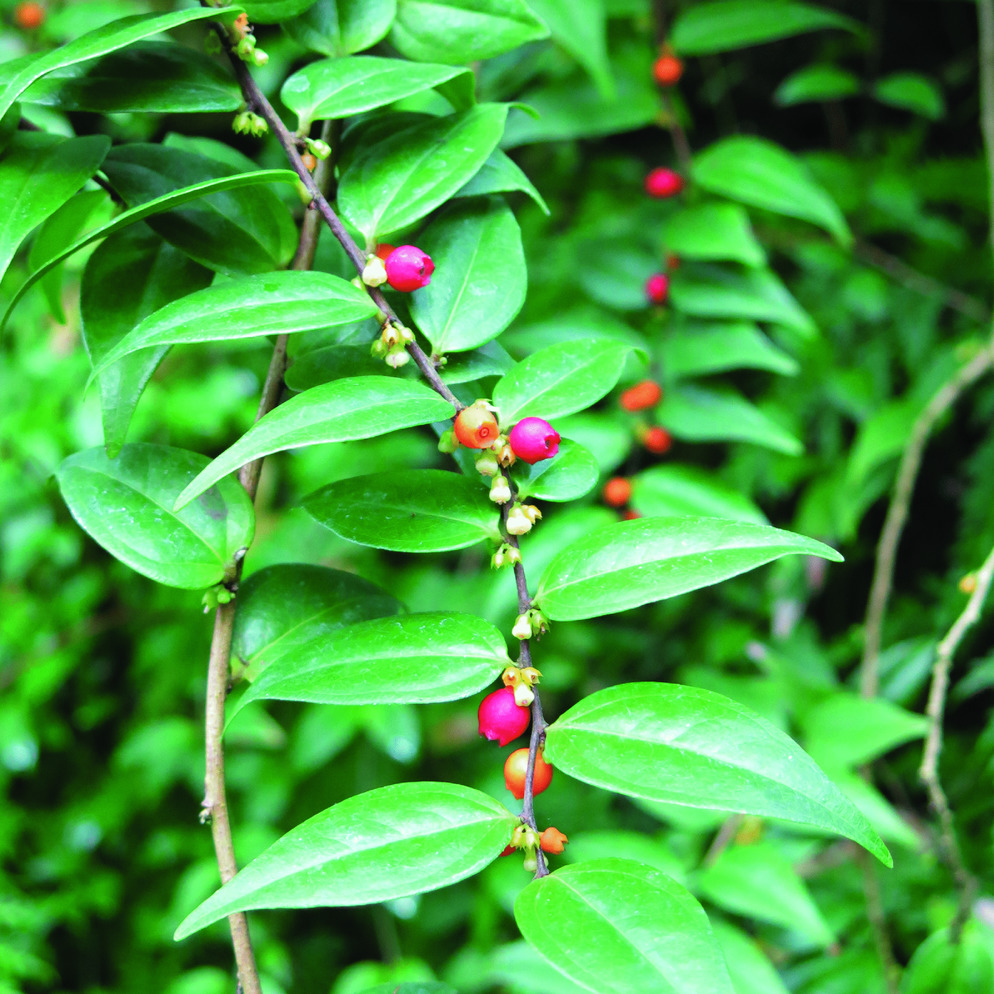
Flowers: with the calyx and corolla glabrous or with sparse glandular hairs only, otherwise as in the nominate variety.
Distribution
Malaysia: Sarawak, Miri Division, Niah; Baram District, Mount Trekan, Mount Mulu.
Ecology
Epiphytic in lowland to submontane heath forest or sometimes terrestrial on limestone, 100–1100 m elevation. Flowering: throughout the year.
Conservation assessment
LC. Widespread with several localities in well-protected areas.
Additional specimens. Malaysia. Sarawak: Sri Aman Division, Simanggang, Ulu Sugai Sekarang, Bukit Sadok, 3 i 1985, Othman S.44950; Bintulu Division, Tubau, Sungai Mujau, 29 viii 1985, Mohtar et al. S.51469, S.51440; Tawau Division, Kakus, Ulu Sungai Mayeng, 24 vii 1964, Luang S.21783; Miri Division, Gunung Mulu, xi 1977, Kerby 9 (RBGE accession number 19773325); Gunung Mulu, Pantu Ridge, x 1994, Mohtar & Othman S.49794; Gunung Mulu, near Pantu Ridge, 5 v 1978, Argent & Coppins 1158; Gunung Mulu, Hidden Valley, 28 viii 1981, Argent s.n., (RBGE accession number 19781741); Hidden Valley, 4 iv 1978, Argent et al. 902; Gunung Mulu National Park, 7 v 1985, Mohtar et al. S.49640; Gunung Mulu National Park, Gunung Api, NE flank of mountain, 29 ix 1971, Anderson S.29874; Gunung Api, 30 xi 2000, Kerby & Ross 15 (RBGE accession number 19773328); Gunung Api, north ridge, 1 xi 1977, Argent et al. 645; Argent 709; Gunung Api, 17 vi 1995, Beaman 11718; Kapit Division, Kapit District, Ulu Sungai Balleh, Ballang/Balleh, 5 vii 1969, Paie S.28430.
I have followed Vander Kloet (Reference Vander Kloet2005) in uniting Vaccinium monanthum Ridl. with Vaccinium uniflorum J.J.Sm. although retaining them as varieties. They are often common forest epiphytes but there is too little information on the variation of the indumentum to be confident of their status.
21c. Rigiolepis uniflora var. pedicellata Argent, var. nov. Differing from the other varieties in possessing long pedicels, 5–7 mm long. – Type: Malaysia, Sarawak, Bintulu Division, Tatau District, Kakus, Ulu Sungai Mayeng, 24 vii 1964, Luang S.21783 (holo SAR; iso K, L, SING).
Distribution
Malaysia: Sarawak.
Ecology
Epiphytic on a tree, elevation unknown. Flowering: May to October, probably throughout the year.
Additional specimens. Malaysia. Sarawak: Miri Division, Niah, 30 ix 1960, Brunig S.8876 (somewhat doubtful owing to the lack of pedicels on the specimen); Mulu N.P., Gunung Mulu, Pantu Ridge, 14 v 1985, Mohtar & Othman S.49794; Gunung Api, 5 ix 1970, Chai S.30074; Bintulu Division, Tubau, Sungai Mujau, 29 viii 1985, Mohtar et al. S.51469; 28 viii 1986, Mohtar et al. S.51440; Segan F.R., Nanga Sepulau, 4 x 1967, Paie S.27047; Tatau District, Kakus, Ulu Sungai Maneng, Simpang Tiga, 5 x 1963, Paie S.19253; Ulu Sungai Mayeng, 7 x 1963, Ashton S.19294; ulu Sungai Mayeng, Sungai Bunut, 24 x 1985, Paie S.48601; Kapit Division, Ulu Sungai Belaga, Sungai Iban, 7 xi 1982, Lee S.45461.
This variety is distinguished from the other varieties of Rigiolepis uniflora by its more slender leaves, long pedicels and occasional short rachis surmounted by a solitary flower. The flowers are covered with glandular hairs, as is common in Rigiolepis uniflora var. monantha. Leaf size and shape are most similar to Rigiolepis lobbii var. lobbii but the indumentum of abundant glandular hairs intermixed with simple hairs on the stems is quite different and R. uniflora var. pedicellata lacks the large costate bracts and calyx lobes of R. lobbii.
Additional specimens not determinable to variety. Malaysia. Sarawak: Sri Aman Division, Sri Aman District, Simmanggang, Ulu Sungai Sekarang, below Bukit Sadok, 18 x 1982, Paie S.44950; Miri Division, Gunung Mulu, 12 viii 1977, Chai S.39494; Bukit Berar, 28 ix 1977, Chai S.39555; Dataran Tingi Merurong Tubau, Sungai Ma'au, 25 x 1986, Yii et al. S.49070; Kait Division, Belaga District, Sungai Sepaku, 5 xi 1981, Othman et al. S.43848; Sungai Somawat, 15 x 1981, Othman et al. S.43682; Ulu Sungai Belaga, Sungai Iban, 7 xi 1982, Lee S.45461.
22. Rigiolepis uroglossa (Sleumer) Argent, comb. nov. – Vaccinium uroglossum Sleumer, Bot. Jahrb. Syst. 71: 166 (1940). – Type: Malaysia, Sabah, Mt Kinabalu, Tenompok, 5000 ft, 10 vi 1932, Clemens 29854 (lecto BM, designated by Sleumer, Reference Sleumer1961, p. 18; isolecto BO, G, K, L, NY).
Rigiolepis uroglossa var. uroglossa. RBGE accession number 20080419A; Gunung Alab, Sabah. A, Flower (scale bar, 3 mm); B, stamens (scale bar, 1.5 mm); C, style with disc (scale bar, 1.5 mm); D, habit (scale bar, 3 cm). (Illustration: Claire Banks.)

Rigiolepis uroglossa var. uroglossa. Flowering plant, Gunung Alab, Sabah. (Photograph: G. Argent.)
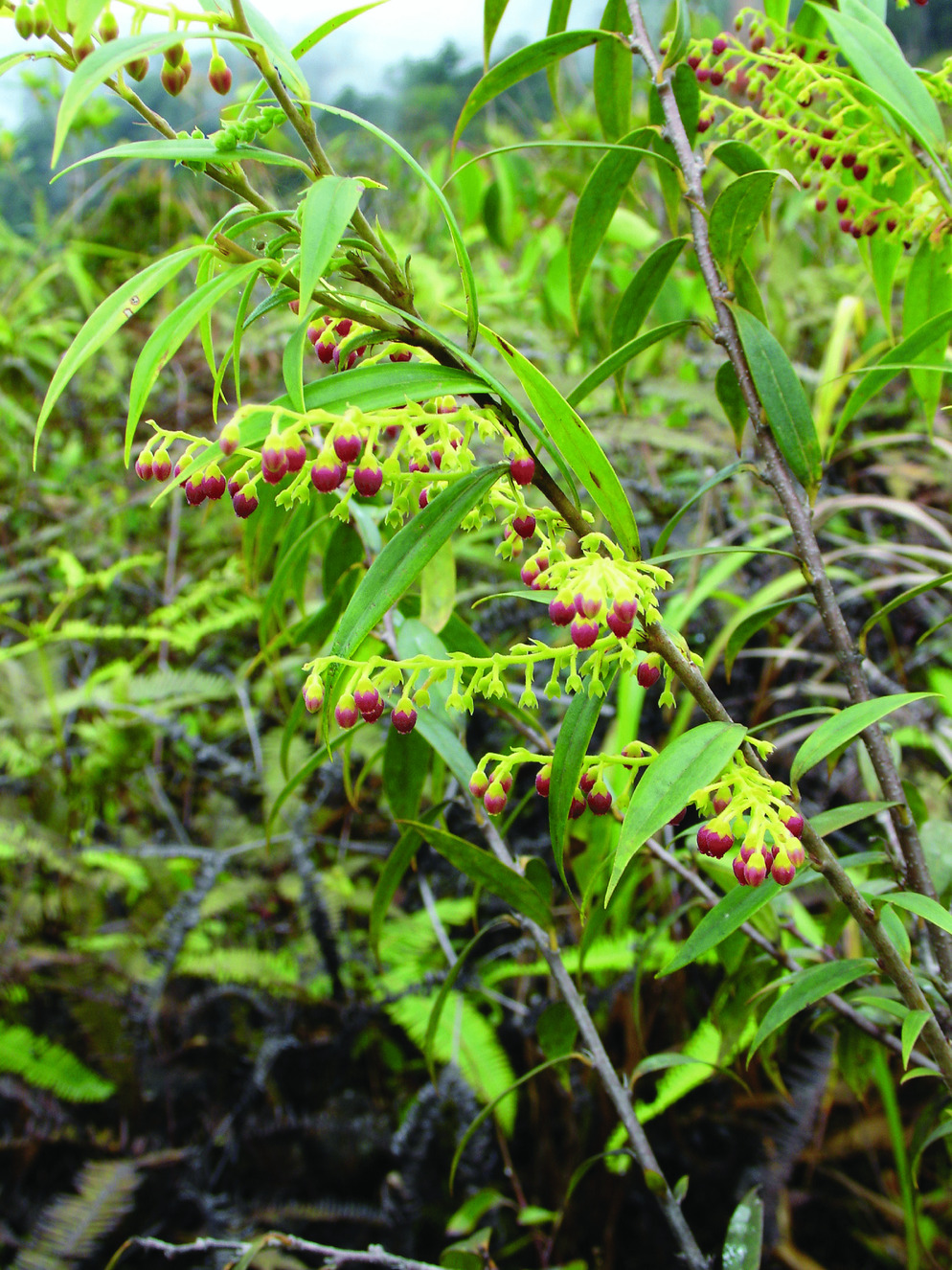
22a. Rigiolepis uroglossa var. uroglossa. Figs 3, 27, 28.
Epiphytic or semiclimbing shrub or small tree, to 5 m, often with a globose tuber. Twigs densely grey-hairy with subpatent simple hairs and a few brown-tipped glandular hairs, leaves densely to laxly arranged; lateral buds 3–4 × 1.5–2 mm, outer scales finely subulate, much longer than subtending petioles. Leaves: petiole 1.5–2.5 × 1 mm, densely hairy; blade 30–65 × 14–22 mm, ovate to narrowly ovate, base rounded, margin entire, narrowly revolute, ciliate initially; basal pair of marginal glands small, c.2–3 mm from petiole but not always present, pubescent, glabrescent with age although retaining some indumentum at base and lower part of main veins, subdensely to laxly covered with fine appressed, club-shaped, glandular hairs on both sides, often persisting beneath, finally glabrescent, flat, with 2 or 3 high-arching veins from base and from somewhat above base, several other upper veins irregular, and spreading, less distinctly raised than mid- and basal veins, reticulation dense and minutely prominent on both sides, apex acuminate to subcaudate, extreme tip obtuse. Inflorescence: of solitary, secund, racemes, densely 10- to 20-flowered; rachis slender, 40–60 mm, subdensely covered with white, short hairs mixed with slender glandular hairs, with several subulate, stipule-like bracts (2–4 mm) at base; bracts ovate, subulate, nearly as long as pedicel; bracteoles subulate, inserted near base or in lower half of pedicel, 1–1.5 mm. Flowers: pedicels slender, 2–4 mm, with hairs similar to those on rachis; calyx tube, c.1 mm, campanulate, densely white, hairy and with brown-tipped glandular hairs, lobes 0.8 mm ovate-triangular, more sparsely hairy than tube; corolla 4–4.5 mm, urceolate, slightly 5-angular, greenish to cream or yellow turning pink with age, laxly covered with subclavate, glandular and rarely some simple hairs at angles of tube, lobes 0.5 mm; stamens: filaments 1.5 mm, slightly wavy, linear, densely hairy; anther cells 0.8 mm, granular, tubules c.1.5 mm; disc densely pubescent; style 3.5 mm, glabrous. Fruit c.8 mm in diameter, initially green, turning orange and finally red when fully ripe.
Distribution
Brunei: Mount Pagon Ridge. Malaysia: Sabah, Mount Kinabalu, Crocker Range, Mount Alab; Sarawak.
Ecology
Often common as an epiphyte in montane mossy forest, occasionally terrestrial in open disturbed sites, 900–1830 m elevation. Flowering: January to December.
Conservation assessment
LC. A widespread species growing in relatively undisturbed habitats, several of which have protected status.
Additional specimens. Malaysia. Sabah, Gunung Alab, 21 x 1999, Davies et al. SJD.99264; Tambunan District, Gunung Trus Madi, 13 iv 1990, Kulip et al. SAN.130177; Crocker Range, Kimanis to Keningau road, 20 ii 1980, Argent 1327; Ranau, Bambangan River, 21 v 1986, Amin & Francis SAN.114360; Kimanis road, viii 1979, Collenette 11/79; 6 x 1960, without collector, S.8883; Kimanis to Keningau road, mile 15, 27 iii 1980, Argent 1564; Sipitang district, Long Pa Sia, Sungai Rekong waterfall, 29 vi 1997, Lamb 455; Sipitang, Long Pa Sia, north of Long Miau, 29 vi 1997, Lamb 67; Gunung Kinabalu, Pinosok Plateau, 14 vii 1984, Beaman 10661; Tambunan, Ulu Sungai Sensuron, 10 iii 1991, Phillipps ALED 309/9. Sarawak: Limbang Division, Pulong Tau N.P. Batu Lawi, 6 v 2002, Mahmud et al. S.88296.
See discussion of varietal status below. Plants of this species in flower on Mount Alab were thronged by small bees.
In the protologue, Sleumer (Reference Sleumer1940) cited Clemens 29854 at B and BM as the type collection without indicating which was holotype. Later, he cited only the duplicate at BM as type (Sleumer, Reference Sleumer1961), so this is an effective lectotypification.
22b. Rigiolepis uroglossa var. tenerella (Sleumer) Argent, stat. nov. – Vaccinium tenerellum Sleumer, Blumea 11: 18 (1961). – Type: Brunei, Gunung Pagon Ridge, iv 1958, Ashton BRUN 2300 (holo L, iso K).
Differing from the type variety in the laxer disposition of broader leaves (to 30 mm wide), the frequent lack of marginal leaf glands and a southern distribution.
Distribution
Brunei. Malaysia: Sabah and Sarawak.
Ecology
Epiphytic in submontane, mossy forest, 950–1800 m elevation. Flowering: January to December.
Conservation assessment
LC. Widespread and well protected in conservation areas.
Additional specimens. Malaysia. Sabah. Sipitang District, Long Pa Sia, 25 x 1995, Argent 25108517; Gunung Lumarku, Near Sipitang, 22 iii 1980, Argent & Lamb 1521. Sarawak. Miri Division, Route from Bakelalan to Gunung Murud, 6 x 1967, Burtt & Martin 5411, 5424, 5323; Baram District, Gunung Mulu, 24 xi 1977, Argent et al. 835a; Gunung Mulu, 8 v 1978, Argent & Coppins 1185a; 1086; Kerby 395 (RBGE accession number 19773625); Gunung Mulu N.P., x 1994, Yii & Talib S.58522; Gunung Mulu N.P., Gunung Api, 16 iv 1978, Argent & Jermy 1036; Limbang Division, Limban District, Bukit Pagon Kecil, 9 viii 1984, Awa & Lee S.47775; Kapit Division, Batang Balui, Ulu Sungai Benalui, Batu Laga Plateau, 26 iii 1989, Yii S.56990; Kapit, Balleh, Ulu Sungai Mengiong, x 1994, Othman & Jawa S.55785; Banang Balui, Ulu Sungai Elyak, Batu Laga Plateau, x 1994, Ching S.56791, S.56990; Balleh, Menyiong, Entuluh, Bukit Nangang, 14 xi 1979, Othman et al. S.41417.
I have included Vaccinium tenerellum within Rigiolepis uroglossa. Vander Kloet (Reference Vander Kloet2005) suggested that they should be amalgamated. The distinction Sleumer makes in his key (Reference Sleumer and Van Steenis1966–1967) of “calyx densely hairy vs. calyx sparsely glandular, epilose” breaks down. There is great variation in the indumentum of the calyx from densely covered with simple white hairs, as in the classic locality on Kinabalu, to glandular hairs, as on the type of Vaccinium tenerellum from Brunei, and various mixtures of simple and glandular hairs commonly occur. In the northern part of the distribution (Sabah), the leaves have conspicuous marginal glands and are densely overlapping. Further south, in Sarawak, the plants are mostly without or have very inconspicuous marginal glands, and have a lax arrangement of broader leaves, but the distribution of these forms is not sufficiently consistent to be used to separate Vaccinium tenerellum from V. uroglossum at the species level.
A specimen from Mount Besar, South Kalimantan (Kato & Mogea 3459 BO!) is in fruit only. It has impressed basal glands some distance from the petiole and is similar to Rigiolepis uroglossa but a very long way from other locations of this species which are otherwise all to the northwest of Borneo. A specimen from the Hose Mountains (Ashton S.19097) has both simple and glandular hairs on both calyx and corolla, and the glandular hairs are on long stalks, which gives a very distinctive appearance to this collection. The calyx lobes are also more distinctly ribbed than is usual in this species, leading Sleumer to comment on the sheet “prob. n.sp.” which may well be true.
23. Rigiolepis winkleri Argent, sp. nov.
Leaves narrowly ovate, 90–135 × 15–40 mm. Similar to Rigiolepis moultonii but differing in its smaller, narrower leaves; by having long-stalked glandular hairs which overtop dense simple hairs on the inflorescence, these also being found on young leaves, and a hairy disc. – Type: Indonesia, West Kalimantan, Bukit Raja, c.1400 m, 21 xii 1924, H. Winkler s.n. (holo HBG, iso L). Fig. 29.
Rigiolepis winkleri Argent. I. Paie S.26588, Bukit Salong, Sarawak. (Scan: Robyn Drinkwater.)
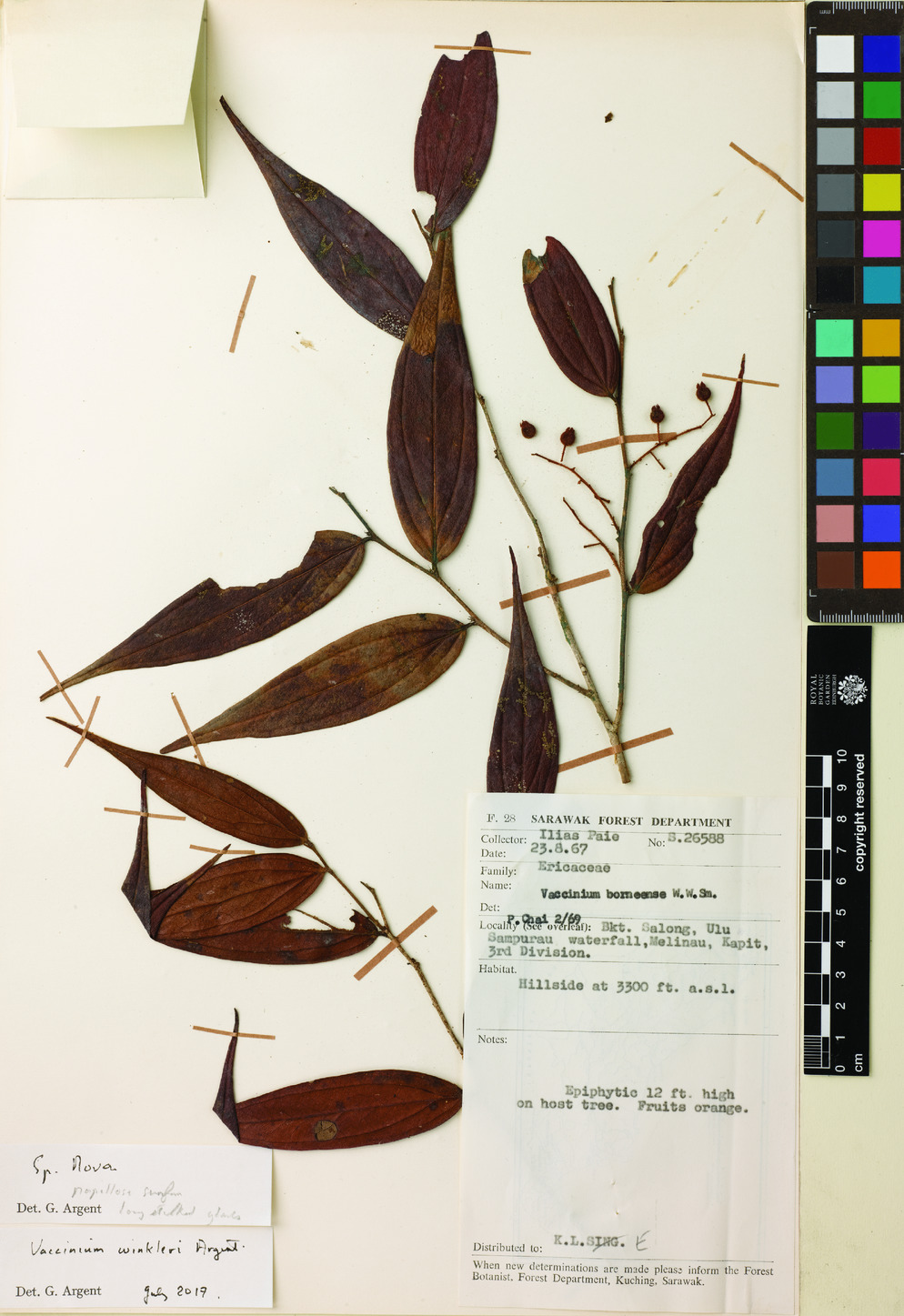
Epiphytic shrub. Twigs with a short dense indumentum of simple grey hairs which are overtopped by much longer brown glandular hairs, leaves complanately arranged; lateral buds 2–3 mm long, acicular, almost as long as petioles, scales covered with simple and long glandular hairs. Leaves: petiole 2–4 × c.1 mm, densely covered with both simple and glandular hairs; blade 80–135 × 15–40 mm, narrowly ovate, base broadly tapering to rounded, margin entire, flat to narrowly recurved, basal glands impressed, 2–3 mm distant from petiole, apex long acuminate (to 4 cm), narrowly acute, thin papery in texture, with simple glandular hairs below and with simple and long-stalked glandular hairs alongside mid- and main veins, glabrescent above but with a few hairs persisting on and near main veins, mostly tripliveined, these arising from just above base, other veins much less conspicuous, a pair of weaker veins sometimes from near base and a few short pinnate veins distally; midvein prominent above within a groove, distally totally impressed as are main lateral veins, all major veins prominently raised below, reticulation distinct, especially below. Inflorescence: of spreading racemes from upper foliate axils, solitary, laxly 5- to 6-flowered; basal bracts few, very small, subulate; rachis 20–40 mm, densely hairy with short, patent simple white hairs and much longer, more conspicuous, stalked brown glands; bracts c.1.5 × c.0.75 mm, ovate, acuminate, covered with simple and long-stalked glandular hairs; bracteoles c.0.5 × 0.25 mm, minute, ovate, attached about halfway along pedicel. Flowers: pedicels 4–6 × c.0.5 mm, densely covered with short simple hairs and much longer brown glandular hairs; calyx tube to c.1 mm, hemispherical, densely glandular hairy, lobes 1.5–2 × c.1 mm, weakly costate or smooth, broadly triangular, densely glandular hairy outside, more sparsely hairy within; corolla 3.5 × 2 mm, barrel-shaped, with a few simple hairs outside; stamens to 2.5 mm, filaments 0.7 mm with long hairs throughout, anthers cells 0.8 mm, echinulate, tubules 1 mm; style 2.7 mm, glabrous; disc densely hairy with erect hairs on upper side. Fruit (described from I. Paie S.26588) orange (immature), spherical c.5 mm in diameter.
Distribution
Indonesia: South Kalimantan. Malaysia: Sarawak.
Ecology
Epiphytic shrub 4 m high on host tree, in montane forest on hillside at c.(50–)800–1400 m elevation. Flowering: December.
Etymology
Named after Hans Winkler (1877–1945), collector of the type specimen and eminent German botanist.
Additional specimens. Indonesia. South Kalimantan: Tanah Laut District, 20 km N of Kintap, 16 iv 1985, Leeuwenberg & Rudjiman 13414.
Malaysia. Sarawak: Sibu Division, Kapit, Melinau, ulu Sungai Sampurau waterfall, Bukit Salong, 23 viii 1967, I. Paie S.26588; Limbang Division, Limbang District, Gunung Murud, 2 x 1967, Burtt & Martin 5349; Lawas District, Path to Gunung Murut (2nd Summit), 4 x 1967, Paie S.26420; Pulong Tau N.P. Gunung Murud, 7 viii 2005, Pearce et al. S.95189; Kapit Division, Belaga, Linau Balui, Sungai Abang, 16 v 1981, Lee S.40003; Belaga, Linau Balui, Sungai Abang, 16 v 1981, Yii S.40003; Kapit, Melinau, Ulu Sampurau, Bukit Sampaudai, 10 v 1981, Yii S.40908.
Distinctive with narrower leaves than is usual in Rigiolepis moultonii and the possession of both simple and long-stalked glandular hairs on stems, young leaves and especially on the inflorescence. Argent & Coppins 1200a, from Gunung Mulu National Park, 8 v 1978, agrees well but has no inflorescence and cannot be determined with certainty. Argent & Saridan 9323 from Central Kalimantan, Kotawaringin Timur, Sungai Mentaya, Km 54 N of Sangai, 31 i 1993, is anomalous in being recorded at only 50 m elevation in what is otherwise a montane species. It is in fruit only and thus remains doubtful taxonomically.
Vaccinium sect. Bracteata Nakai, Trees Shrubs Japan, Revis. Ed. 1: 241 (1927). –Type species: Vaccinium bracteatum Thunb., in Murray, Syst. Veg. ed. 14: 363 (1784).
Evergreen shrubs or trees lacking a woody basal tuber, although occasionally thickened at base, mostly with inconspicuous lenticels on larger branches, lateral buds various, conspicuous to inconspicuous, scales rounded to acicular. Leaves entire or crenulate. Inflorescences of solitary racemes, mostly from leafy axils, few- to many-flowered. Flowers 5-merous with 10 stamens, anthers with tubules opening by introrse oblique or terminal pores which do not taper distally. Ovary 5-celled, but with thick intrusive parietal partial septa which give the appearance of a 10-locular ovary, each chamber containing several ovules. Fruit a spherical berry passing from green to blue or black when fully ripe.
The characters in Nakai's (1927) diagnosis have been greatly modified in the definition of this section used by Sleumer in his Vaccinioideen-Studien (Reference Sleumer1941). The bracts are described as often foliaceous and quite persistent in Nakai & Koidzumi (Reference Nakai and Koidzumi1927), whereas in the Flora Malesiana account (Reference Sleumer and Van Steenis1966–1967), they are described as “whether or not foliaceous or persistent”. Furthermore, Sleumer reduces sect. Euepigynium Schltr. with early deciduous bracts into synonymy in Flora Malesiana. Many of the Malesian species included in sect. Bracteata have bracts which vary from leaf-like and fully persistent to those which are minute, extremely reduced and very early caducous. In many cases, the bracts fall while the buds are very young and so have not always been described. Nakai's (1927) “biennial leaves” may be interpreted as perennial or evergreen which describes all the Bornean species. The lack of spurs on the anthers (Nakai, 1927) cannot be used to diagnose the section because the type species is described as often having two short spurs (Sleumer, Reference Sleumer and Van Steenis1966–1967). Similarly, the 10-celled ovary of Nakai (1927) is in fact a 5-locular ovary with five intrusive partial parietal septa (see Fig. 1A). Nakai does define the fruit colour as black (including blue here) which, as the ripe fruit colour, is considered a useful character in distinguishing this section from Rigiolepis in Borneo although red fruits do commonly occur in Vaccinium elsewhere. Vaccinium bracteatum in cultivation at the Royal Botanic Garden Edinburgh very occasionally produces two racemes from one leaf axil but this would appear to be a very rare occurrence in other species of Vaccinium sect. Bracteata. In Borneo, the anther tubules in this section do not significantly taper distally although in some other species in this section elsewhere (e.g. Vaccinium caudatum Warb.) they do. Vander Kloet & Dickinson (2009) have divided sect. Bracteata sensu Sleumer (Reference Sleumer and Van Steenis1966–1967) into several sections. No Bornean material was used in their analysis and the utility of this for identification purposes appears very limited. The species recorded here would occur at the end of their key (couplet 28) where only Vaccinium cercidifolium would fit their combination of characters of sect. Euepigynium Schltr. They place non-Bornean material of Vaccinium bancanum into sect. Eococcus Sleumer, but this species does not fit their key characters. A more detailed molecular analysis of the sections of Vaccinium is still awaited.
Key to the species in Borneo
Emphasis has been placed on vegetative characters as far as possible.
There is still no information on possible hybridisation between Vaccinium species in Borneo such as has been reported in Rhododendron (Argent, Reference Argent2015). In several cases in this section, there appears to be some overlap of characters between species in which case hybridisation is a strong possibility.
1a. Leaf blades < 15 mm wide__________________________2
1b. Leaf blades > 15 mm wide__________________________6
2a. Leaf blades < 20 mm long__________________________3
2b. Leaf blades > 20 mm long__________________________4
3a. Leaves mostly without marginal glands, inflorescence 1- or 2-flowered, rachis < 5 mm long________________________________11. leptocladum
3b. Leaves usually with at least a pair of marginal glands, inflorescence > 3-flowered, rachis > 15 mm long__________________________7. coriaceum
4a. Leaf apex subcaudately acuminate for at least 1/4 of length of blade, midvein deeply impressed when fresh__________________________15. phillyreoides
4b. Leaf apex obtusely tapering to rounded, if acuminate, to much less than 1/4 of length of blade, then midvein hardly impressed above when fresh________________5
5a. Leaf apex sharply acute, anther tubules longer than cells_______14. phillippsiae
5b. Leaf apex rounded, anther tubules much shorter than cells__________5. clementis
6a. Leaf base cordate__________________________7
6b. Leaf base tapering to rounded__________________________9
7a. Leaves ovate, broadest in basal half__________________________6. cordifolium
7b. Leaves elliptic to obovate, broadest at middle or in upper half__________________8
8a. Petiole ± as long as wide__________________________3. cercidifolium
8b. Petiole more than twice as long as wide__________________________10. endertii
9a. Petiole > 10 mm long__________________________10
9b. Petiole < 10 mm long__________________________13
10a. Leaf apex rounded or obtuse__________________________11
10b. Leaf apex acuminate or acute__________________________12
11a. Young stems glabrous, lateral veins of leaves not raised below when dry, often obscure, pedicels < 3.5 mm__________________________18. simulans
11b. Young stems hairy, lateral veins of leaves prominently raised and distinct below when dry, pedicels > 5 mm__________________________13. pachydermum
12a. Leaf apex shortly acuminate to rounded, petiole rarely to 10 mm 17b. sarawakense subsp. montanum
12b. Leaf apex long acuminate, petiole 10–20 mm___________________16. retivenium
13a. Largest leaves < 20 mm wide__________________________14
13b. Largest leaves > 20 mm wide__________________________19
14a. Stems coarsely hairy, leaf apex mostly retuse, calyx lobes erect in fruit (occurring on ultramafic)__________________________9. elliptifolium
14b. Stems glabrous or very finely hairy, leaf apex broadly to narrowly pointed, calyx lobes variable____________________________________15
15a. Pedicels < 4 mm long, bracts persistent to flowering, with prominent sessile glands on margins, inflorescence with scurfy grey waxy covering_______2. ceraceum
15b. Pedicels > 5 mm long, bracts disappearing before flowers open, with simple or only inconspicuous glandular hairs on margins, inflorescence without scurfy grey waxy covering__________________________16
16a. Leaf apex abruptly and narrowly pointed, acumen about 1/6 length of blade; anther tubules much longer than cells__________________________14. phillippsiae
16b. Leaf apex obtusely attenuate to rounded or, if long acuminate, then acumen 1/4 or more of length of blade; anther tubules shorter than cells__________________________17
17a. Leaf apex obtusely attenuate to rounded, midvein hardly impressed above when fresh____________________________________________18
17b. Leaf apex acuminate, midvein deeply impressed above when fresh 15. phillyreoides
18a. Axillary buds to c.1 mm, much shorter than subtending petioles 19. stenanthum
18b. Axillary buds to c.2 mm, as long as or longer than subtending petioles 5. clementis
19a. Young stems puberulous with non-glandular hairs (lens!)_______________________20
19b. Young stems glabrous or with glandular hairs only______________________23
20a. Lowland swampy areas below 500 m, vegetative buds inconspicuous (South Kalimantan)__________________________8. costerifolium
20b. Montane forest above 1000 m, vegetative buds conspicuous__________________________21
21a. Lateral buds acute 3–4 mm, scales subulate, leaves minutely retuse (Kinabalu and Tambuyukon only)__________________________9. elliptifolium
21b. Lateral buds 2–3 mm, scales broadly ovate________________________22
22a. Petiole 3–4 mm, pedicels < 2 mm (Central Kalimantan)__________________________12. mjoebergii
22b. Petiole 5–8 mm, pedicels > 6 mm, (Sabah, Brunei, Sarawak)__________________________13. pachydermum
23a. Vegetative (resting) buds prominent, blunt, spherical__________________________24
23b. Vegetative (resting) buds obscure or pointed__________________________26
24a. Leaves with midvein raised above in basal (proximal) half of leaf, petioles 3–6 mm wide, lateral veins distinct, red when live, strongly raised beneath 4. claoxylon
24b. Leaves with midvein level or impressed in basal (proximal) half of leaf above, petioles 1–2 mm wide, lateral veins obscure, green when live, hardly raised beneath_____________________________________________25
25a. Erect tree or shrub, lateral buds prominent, 2–3 mm in diameter, abaxial lateral leaf veins obscure or disappearing close to midvein__________________________18. simulans
25b. Climber, lateral buds small, c.1 mm in diameter, abaxial lateral leaf veins disappearing close to margin of leaf_____________17a. sarawakense subsp. sarawakense
26a. Rachis and pedicels densely covered in fine brown glandular hairs, without simple hairs____________________________________________________27
26b. Rachis and pedicels glabrous or shortly pubescent with non-glandular hairs [any glandular hairs sparse and shorter than simple hairs]________________28
27a. Climber or climbing epiphyte, lateral buds spherical to c.1 mm long, lowland below 1000 m__________________________17a. sarawakense subsp. sarawakense
27b. Erect tree or shrub, sometime epiphytic, lateral buds narrowly pointed 2–3 mm long, montane, above 1000 m__________________________17b. sarawakense subsp. montanum
28a. Lateral buds conspicuous, pointed, scales acute__________________________29
28b. Lateral buds small and inconspicuous, scales obtuse to rounded_________________30
29a. Leaves > 25 mm wide, petioles 4–5 mm__________________________31
29b. Leaves < 20 mm wide, petioles 1–2 mm_______________________5. clementis
30a. Calyx densely and coarsely hairy outside, style hairy almost to stigma, anther tubules distinctly shorter than cells__________________________19. stenanthum
30b. Calyx glabrous or finely puberulous, style glabrous in distal 1/3, anther tubules as long as cells__________________________1. bancanum
31a. Leaves obtusely pointed to rounded__________________________10. endertii
31b. Leaves shortly to long caudately pointed __________17b. sarawakense subsp. montanum
1. Vaccinium bancanum Miq., Fl. Ned. Ind., Eerste Bijv. 587 (1861). – Type: Indonesia, Sumatra, Bangka Island, near Plangas, J.E.Teijsmann 1189 (lecto U, designated by Sleumer, Reference Sleumer1961: p. 75; isolecto BO, BRI, K?, MEL).
Vaccinium suluense H.F.Copel., Philipp. J. Sci. 42: 568 (1930). – Type: Malaysia, Sabah, Balambangan Is., D.D.Wood 1731 (holo UC; iso A, BM, BO, K, NY).
Vaccinium adenurum C.E.C.Fisch., Bull. Misc. Inform. Kew, 293 (1932). – Type: Malaysia, Sabah, Sandakan, Pascual s.n., For. Dept. Brit. North Borneo 1219 (holo K).
This is a widespread species, occurring in Malesia from Java, Sumatra and Peninsular Malaysia to Borneo. Of the four varieties described by Sleumer (Reference Sleumer and Van Steenis1966–1967), only var. kunstleri (King & Gamble) Sleumer is not represented in Borneo. Vaccinium bancanum var. keumulense J.J.Sm. is raised to specific rank as V. phillippsiae below (species 14).
Key to the varieties in Borneo
1a. Calyx lobes without marginal glands or with only one on each side; leaves broadly attenuate____________________________________________1a. bancanum
1b. Calyx lobes with a row of sessile glands on each side; leaves subcaudate-acuminate__________________________________________1b. tenuinervium
1a. Vaccinium bancanum var. bancanum. Fig. 30.
Vaccinium bancanum var. bancanum. Cultivated plant, RBGE accession number 19773334. (Photograph: G. Argent.)
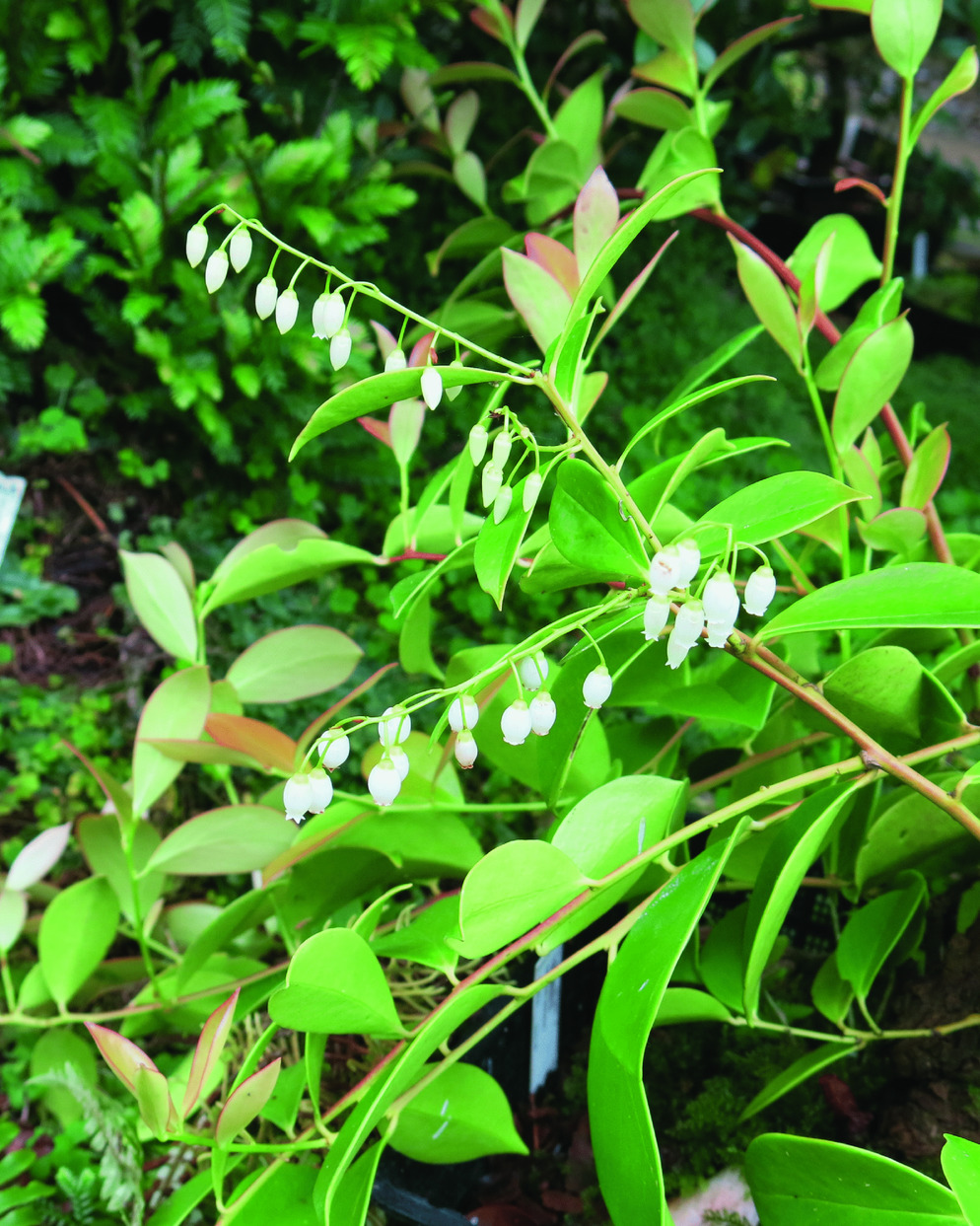
Shrub or small tree to 6 m. Twigs angular, glabrous or with sparse glandular hairs, leaves laxly arranged; lateral buds 1–2 × 1–2 mm, shortly conical, variable in size but mostly about half length of and usually shorter than petiole. Leaves: petiole 2–4 × 1.5–2 mm, glabrous or hairy, semicircular in cross-section, grooved above; blade 40–70 × 25–40 mm, elliptic, broadly elliptic or sometimes subobovate or subovate, base broadly tapering, apex broadly attenuate and obtuse, margin slightly revolute especially towards base, with 1 or 2 minute, impressed marginal glands on each side just above petiole, glabrous except for lax glandular hairs beneath when young, leaving a punctate surface in older leaves, midvein weakly impressed above, obtusely prominent beneath, lateral veins 5–7, arching from base and a little above base, some shorter spreading veins in upper part of leaf, reticulation lax, slightly raised on both sides, often obscure. Inflorescences racemose, in distal axils, suberect with numerous subsecund flowers; rachis 40–80 mm, slender, angular, glabrous or laxly pubescent; bracts 8 × c.2 mm, oblong, concave, apex broadly acute, minutely patently hairy outside and with minute marginal glands, fully deciduous before anthesis; bracteoles 1.5 mm, borne just above base, subulate, quickly deciduous. Flowers: pedicels 4–10 mm, glabrous or sparsely and minutely hairy; calyx tube 1–1.5 mm, hemispherical, grey, glabrous to densely very shortly hairy, limb c.1.5 mm, deeply divided, lobes triangular, subacute to obtuse, sometimes terminated by a minute gland, mostly lacking lateral glands but with ciliate margin; corolla cylindrical-urceolate, 5–8 × 2.5–3 mm, white, greenish white or white with a red flush, more rarely pink or red, fragrant, glabrous outside, subdensely shortly hairy proximally inside, lobes c.1 mm, obtuse, becoming reflexed; stamens: filaments 2–3 mm, linear, densely hairy throughout, anther cells 0.8–1 mm, broadly oblongoid, base broadly apiculate, with or without short dorsal spurs, sometimes with a few simple hairs abaxially, tubules 0.8–1 mm, cylindrical, as wide as cells and held at a slight angle to cells, with several stalked or subsessile gland-tipped hairs, pores round, transverse; disc glabrous or laxly hairy; style 8–10 mm, hairy in basal 1/3 to 1/2, becoming slightly exserted. Fruit c.4 mm in diameter, globose, glabrous or glabrescent, with persistent, erect, subacute calyx lobes, purple when ripe.
Chromosome number
2n = 24 (Atkinson et al., Reference Atkinson, Jong and Argent1995).
Distribution
Brunei. Indonesia: West Java, Sumatra, Anambas Islands, Banka, Billiton, Lingga, Kalimantan. Malaysia: Peninsula, Sabah and Sarawak.
Ecology
Common at sea level, possibly occurring to 1500 m. In sandy acid habitats, mostly terrestrial or occasionally epiphytic. Flowering: throughout the year but probably with seasonal flushes.
Conservation assessment
LC. A widespread and very common species.
Additional specimens. Brunei. Belait District, Labi road from Sungai Liang Junction, 4 vi 1989, Dransfield et al. JD.6526; Temburong, Batu Apoi, Bukit Gelagas, 24 x 1991, Simpson & Marsh 2249.
Malaysia. Sabah: Tambunan District, Crocker Range, Gunung Alab, 3 iii 1995, Wong WKM 2610; Keningau District, Keningau road, S. of Nabawan, ix 1979, Collenette 55/79; Sipitang District, Maromtaman Mengalong National Park, 24 iii 1980, Argent 1557; Bukit Sebuboh, 29 ii 1984, Beaman 8719; Long Pa Sia, v 1981, Phillipps SAN.93173. Sarawak: Kuching Division, Bau/Lundu road, Gunung Raya, 13 iii 1984, Ching S.45984; Berumput Range, Kanyie, Bukit Batu, 12 x 1993, Argent 4; Bako National Park, 20 v 1962, Burtt & Woods 1870; Sibu Division, Kapit, Ulu Sungai Balleh, Ng Mengiong, 14 ix 1969, Haron S.29176; Miri Division, Gunung Mulu National Park, W. of Gua Rusa, 20 iv 1978, Argent et al. 1055; Kapit Division, Kapit District, Bukit Tibang, E end of Balleh/Balang ridge, 9 vii 1969, Paie S.28432; Belaga District, Linau, Sungai Iban, 29 x 1982, Lee S.45354; Balleh, Mujong, Amau, Ulu Sungai Chenaning, 29 iii 1964, Paie S.21165.
Vaccinium bancanum Miq. and Vaccinium clementis Merr. appear to form a cline from lowland to montane habitats. Lowland forms with large leaves are easily placed in Vaccinium bancanum and montane forms with small leaves in V. clementis. The best distinguishing character appears to be the relative appearance of the resting lateral buds. In Vaccinium bancanum, they are mostly ovate to pyramidal, with broad scales, and are shorter than the subtending petioles (often only half the length). In Vaccinium clementis, they are very narrowly pyramidal with acicular, acutely pointed scales and are as long as or longer than the petioles that subtend them. This character may break down outside Borneo where material of Vaccinium bancanum var. kunstleri (King & Gamble) Sleumer from Peninsular Malaysia has been observed with narrowly pointed resting buds, but V. clementis is not known from this region and so is unlikely to cause confusion. Both species are very common and widespread in Borneo, and further observations are needed to see if this character works in all situations. Sleumer (Reference Sleumer and Van Steenis1966–1967, p. 796, couplet 97) uses confusing leaf shape characters and leaf length to distinguish the two species (more or less than 4 cm long). The leaf length will undoubtedly distinguish the lowland from the montane plants but does not help with intermediate specimens. Sleumer also gives a difference in rachis length in his descriptions: 3–10 cm in Vaccinium bancanum versus 1.5–4 cm in V. clementis. This nearly provides separation between these species but again probably represents the results of extremes of elevation. Further study is needed to see if these two species hybridise and whether any other characters can be used to separate them. There are some low-elevation specimens previously regarded as Vaccinium bancanum from kerangas (heath forest) with small leaves similar to those typical of V. clementis. These are now considered to be Vaccinium stenanthum Sleumer. A specimen from Mount Berumput in Sarawak, Argent 19942998, is unusual in having double spurs on the anthers, two pointing up and two pointing down. The glands on the anthers and the simple hairs inside the corolla are often very difficult to see; they lack contrast and the glands in some cases disappear with age. A specimen at Kew (Teijsmann s.n., K000780712), is cited as a doubtful isolectotype above, following Sleumer's annotation, “possibly part of the type coll.”
1b. Vaccinium bancanum var. tenuinervium J.J.Sm., in Koord. & Valeton, Bijdr. Boomsoort. Java 13: 157, 159 (1914). – Type: Indonesia, Java, Preanger/Jakarta, Tjigenteng, 1500–1700 m, S.H.Koorders 24219 (lecto BO, designated by Sleumer, Reference Sleumer1961, p. 76; isolecto A, K, L, P, U). (Partly distributed as 24217; see Sleumer Reference Sleumer1961, p. 76).
Vaccinium micrantherum Stapf, Trans. Linn. Soc. London, ser. 2 Bot. 4: 190 (1894). – Type: Malaysia, Sabah, Mt Kinabalu, Haviland 1296 (lecto K, designated by Sleumer, Reference Sleumer1961, p. 76; isolecto L, SAR, SING).
Vaccinium ardisioides Ridl., J. Fed. Malay States Mus. 6: 156 (1915). – Type: Malaysia, Penang, Gunung Mengkuang, Lebah, Robinson s.n. (lecto K, designated by Sleumer, Reference Sleumer1961, p. 76).
Vaccinium eburneum Ridl., J. Fed. Malay States Mus. 7: 45 (1916). – Type: Malaysia, Kedah, Gunung Jerai, Kedah Peak, Robinson & Kloss 5986 (lecto K, designated by Sleumer, Reference Sleumer1961, p. 76; isolecto SING).
Vaccinium wrayi Ridl., J. Straits Branch Roy. Asiat. Soc. 79: 92 (1918). – Type: Malaysia, Penang, Gunung Mengkuang, Lebah, Wray 1528 (lecto K, designated by Sleumer, Reference Sleumer1961, p. 76).
Vaccinium bancanum var. tenuinervium differs chiefly from the nominate variety in that the calyx lobes have several sessile, subpersistent lateral glands, and by the generally narrower, elliptic or oblong-lanceolate, more distinctly acuminate or subcaudate, often thinner leaves.
Distribution
Indonesia: Sumatra, West Java, Central Kalimantan. Malaysia: Peninsula and Sarawak.
Ecology
As for Vaccinium bancanum var. bancanum, Sleumer (Reference Sleumer and Van Steenis1966–1967) records this growing possibly as high as 2050 m. It is doubtful if it really occurs as high as this, because many specimens have been misidentified in the past. Flowering: January to December.
Conservation assessment
LC. A very common and widespread variety.
Additional specimen. Malaysia. Sarawak: Miri Division, Mulu National Park, ridge between Sungai Tapin and Sungai Ubong, 5 ii 1978, Nielsen 253.
2. Vaccinium ceraceum Argent, sp. nov.
Vaccinium ceraceum is distinct in the following combination of characters: having the inflorescence covered with tufts of filamentous wax which appear as grey scurfy patches when dry, and the persistent bracts having prominent sessile glands on the margins. Superficially similar to Vaccinium simulans but the leaves are smaller, with the venation more pronounced abaxially rather than adaxially. Also differing from Vaccinium simulans and other similar species in having only minute patent hairs on the filaments, unlike the much longer semi-appressed hairs on the filaments of those species, and a style which is glabrous except for a papillose area near the apex. – Type: Indonesia, East Kalimantan, Krayan, Long Bawan, en route from Long Bawan to Long Umung, 15 ix 1990, M. Kato, H. Okada, J. Murata, D. Darnaedi, H. Akiyama, Y. Watano & D. Komara 23426 (holo BO; iso E, L, TI). Figs 31, 32.
Vaccinium ceraceum Argent. Kato et al. 23426. A, Habit (scale bar, 3 cm); B, flower (scale bar, 2 mm); C, bract and bracteole (scale bar, 2 mm), with inset showing bract margin (scale bar, 0.5 mm); D, stamens (scale bar, 1 mm), with inset showing hairs on filament (scale bar, 0.2 mm); E, pistil with calyx (scale bar, 1 mm). (Illustration: Claire Banks.)

Vaccinium ceraceum. Type specimen, Kato et al. 23426. A, Leaf surface, showing tufts of wax; B, bract margin, showing large glands. (Scanning electron micrographs: Frieda Christie.)

Terrestrial small tree, c.4 m. Twigs minutely patently pubescent, quickly glabrescent, leaves subdensely arranged; lateral buds c.2 × 1 mm, broadly conical moderately conspicuous, almost as long as subtending petioles, scales subtriangular caudate, hairy especially on margins. Leaves: petiole c.2 × 1 mm, minutely hairy, flattened; blades 25–45 × 14–18 mm, elliptic, base tapering and narrowly decurrent into petiole, margin entire, narrowly cartilaginous, flat or weakly revolute, with 1 or 2 marginal glands on each side, 1–3 mm from petiole, lamina with brown glandular hair bases beneath, apex shortly (3–5 mm) apiculate, extreme tip obtuse; midvein narrowly and weakly impressed above, very weakly raised below; lateral veins 2–4 each side, 2 or 3 high-arching from near base, often with one from well above base, faint, reticulation inconspicuous. Inflorescence of solitary racemes, in upper axils, 6- to 8-flowered, flowers secund, rachis c.20 mm, glabrous proximally but with lax covering of patches of grey, scurfy indumentum distally, bracts to 35 × 1.25 mm, elliptic, often with short acuminate scaly point, mostly persisting to anthesis, with distinct globose glands, unlike the more usual club-shaped glands where these occur in other species, and some short simple hairs on margins; bracteoles basal, minute, subulate, persisting to anthesis, fringed with simple white hairs. Flowers: pedicels 2–3 × c.0.4 mm, scaly with pale grey wax; calyx densely covered with tufts of filamentous wax, tube campanulate, 0.75 × 1.25 mm, lobes triangular, c.0.5 × 1 mm, fringed with some short simple hairs but lacking both apical and marginal glands; corolla c.4 × 2.5 mm, barrel-shaped, pink, glabrous outside but covered with tufts of filamentous wax, laxly hairy proximally inside, lobes c.0.7 mm, reflexed; stamens: filaments 2 mm, glabrous, anther cells c.0.5 mm, with short awns, tubules c.0.2 mm, at right angles to cells, with small glandular hairs when young, pores circular; disc glabrous; style c.2 mm, cylindrical, glabrous but papillose near apex. Fruit not seen.
Distribution
Indonesia: East Kalimantan. Known only from the type collection.
Ecology
Collected at 900 m, but the vegetation type not recorded. Flowering: September.
Etymology
From the Latin – ceraceus – waxy. An allusion to the distinctive waxy patches on the inflorescences of this species.
This is a curious and very distinctive species with tufts of filamentous wax on the inflorescences which appear to the naked eye as a grey scurfy indumentum. Filamentous wax has been recorded elsewhere on the fruits of Vaccinium (Chu et al., Reference Chu, Gao, Cao, Fang, Chen and Xiao2017) but does not appear to have been recorded from any other of the Southeast Asian species. This feature disappears on boiling with detergent and will also probably disappear when collections are made into alcohol. A more permanent feature is the appearance of the bracts, which have large sessile glands on the margins similar to those often described from the margins of the calyx lobes of several other Southeast Asian Vaccinium species.
This new species looks superficially similar to Vaccinium simulans, but the leaves are smaller with the venation more pronounced abaxially rather than adaxially (the opposite of the situation in V. simulans). It differs also from Vaccinium simulans and most other similar species in having minute hairs that are very difficult to see on the filaments rather than being glabrous or with distinct long hairs. In addition, apart from papillae near the stigma, the style is glabrous. Vaccinium elliptifolium differs in from V. ceraceum in its prostrate shrubby habit (versus tree) and having more distinct lateral veins and longer pedicels.
3. Vaccinium cercidifolium J.J.Sm., Bull. Jard. Bot. Buitenzorg, ser. 3, 13: 463 (1935). – Type: Indonesia, East Kalimantan, Bukit Batu Tiban, x–xii 1925, 1700 m elevation, E. Mjoberg 59 (lecto L, designated by Sleumer, Reference Sleumer1961; isolecto BO). Figs 1A, 33.
Vaccinium cercidifolium. RBGE accession number 19820845; Gunung Bungo Range, Sarawak. (Photograph: G. Argent.)
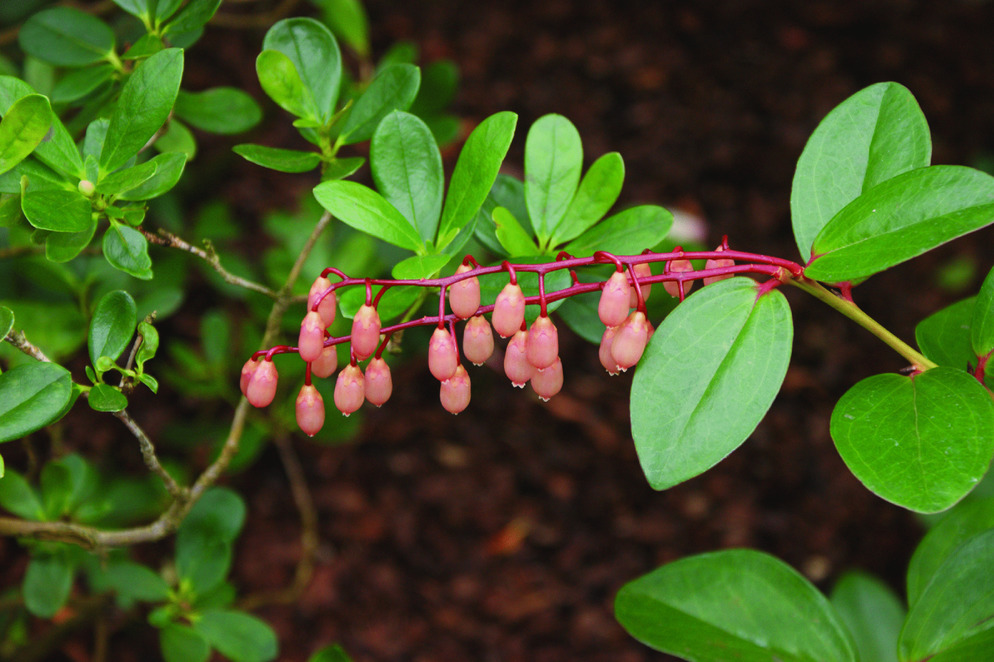
Terrestrial or occasionally epiphytic shrub to 2 m. Twigs glabrous, or (? see comment below) patently short pubescent, rounded, green often flushed with red, leaves arranged in lax spirals, lateral buds up to 7 × 2 mm, conspicuous, narrowly conical, as long as or slightly longer than petioles. Leaves: petiole up to 5 × 3 mm, strongly flushed red when fresh, rugulose, not or only weakly grooved above, initially covered with brown glandular hairs, blade 35–85 × 25–55 mm, broadly elliptic to subcircular; base rounded to cordate, margin entire, flat or narrowly revolute when dry, narrowly cartilaginous, with 2 marginal glands c.1 mm from petiole, apex very broadly pointed to rounded, minutely brown glandular hairy on both sides when young, quickly glabrescent, midvein adaxially, broadly raised for up to 10 mm, red and triangular for up to 10 mm, then impressed distally for remainder of length of leaf, abaxially broadly raised for most of length of leaf, lateral veins 1–3 pairs, basal pair short, disappearing within 10–20 mm, second pair arising close to base, strong, curving upwards and disappearing in upper part of leaf, a further pair or pairs arising from basal half of leaf, curving upwards and disappearing before margin: reticulation obscure in fresh leaves, prominent on both sides when dry. Inflorescence of racemes from upper axils, with 10–20 secund flowers; rachis 80–100 mm, glabrous; bracts up to 20 × 8 mm, elliptic to elliptic-obovate, distinctly apiculate, entire, glabrous, pale green, falling very early, often even before inflorescence has elongated; bracteoles minute, up to 1 mm, filamentous, glabrous, withering and disappearing as bracts fall. Flowers: pedicels 10–12 × c.1 mm, glabrous; calyx hemispherical, glabrous, tube to 2 mm long, limb slightly spreading to c.1 mm, lobed nearly to base, lobes ovate-triangular, obtuse, lacking or with only a minute terminal gland, without marginal glands; corolla 14 × 9 mm, ellipsoid, red, pale pink, or pale brownish cream; scented with heavy honey scent; lobes c.2.5 × 1.2 mm, broadly triangular, minutely papillose and with a few long white hairs, reflexed; stamens: filaments from a broad densely hairy base (c.0.9 mm wide) becoming very slender distally (c.0.1 mm) and less hairy, c.5 mm long; anthers with tubules bent at right angles to cells; cells 1.2 mm, with a pair of distinct awns at apex, tubules with several conspicuous glands 0.9 mm, widely diverging, pores truncate, circular; disc laxly hairy; style 10–12 mm, with dense appressed hairs in proximal 3/4, glabrous distally. Fruit not recorded.
Distribution
Indonesia: Central Kalimantan. Malaysia: Sarawak, Mount Dulit, Mount Buri. Widespread and probably under-recorded.
Ecology
Lower montane forest, often on ridges at 600–1700 m. Flowering: March, September to December.
Additional specimens. Malaysia. Sabah: Sipitang, Ulu Sungai Meligan, Taman Sumaki, John et al. SAN.144706; Sipitang, Sungai Rekong waterfall, 29 vi 1997, Lamb 454. Sarawak: Kuching Division, Gunung Bunga Range, 1 iii 1982, Argent & Sinclair 8223; 8289; 8298; 9 x 1957, Brunig S. 7634; Kuching/Sri Aman Divisions boundary, Gunung Buri, 19 ix 1975, Martin & Ismawi S.36868; Sri Aman Division, Lubok Antu District, Lanjack Entimau P.F. Bukit Peninjau, 14 iii 1974, Chai S.33898; Miri Division, Mulu National Park, Ulu Sungai Mong, 14 xi 1990, Yii & Runi S.60560; S. 60562; 20 iii 1978, Hansen 513; iv 1978, Argent & Jermy 972a; 1043; Gunung Mulu, 21 iv 1977, Lee S.38807; Gunung Mulu, 27 ii 1976, Martin S.37083; 29 ii 1976, Martin S.36554; S.37104; Bintulu Division, Merurong plateau, 27 iv 1959, Brunig 8724; Limbang Division, Bukit Pagon Periuk, summit of Bukit Pagon Kecil, 9 viii 1984, Awa & Lee S.47762; Bario, Ulu Sungai Limbang, Sungai Pa Mario, 9 viii 1985, Awa & Lee S.50740; Kapit Division, Belaga District, Sungai Linau, Bukit Dema, 15 v 1981, Lee S.39304; Belaga District Batu Laga plateau, 16 vi 1995, Yii et al. S.71791; Ulu Sungai Belaga, Ulu Sungai Danum, hill next to Bukit Robertson, 8 viii 1999, Julaihi et al. S.80682; Kapit Division, Sungai Yong, Bukit Bakar, 12 iii 1975, Paie S.36307; Kapit, Melinau, Bukit Pantu, 9 viii 1967, Paie S.25743; Kapit Division, Mujong, Sungai Temiai, 2 xii 1991, Lai et al. S.64010.
A distinctive species with prominent fan-like leaf venation and rounded to cordate leaf bases which are dark red when fresh and dry dark brown. The two original collections were said to have “blood red flowers”. The specimen cultivated in Edinburgh (RBGE accession number 19820845) from the Gunung Bungo Range, Sarawak has creamy brown flowers (see Fig. 33). Sleumer (Reference Sleumer and Van Steenis1966–1967) describes the twigs as “patently short pubescent”, while the cultivated material in Edinburgh and most of the specimens examined have glabrous twigs.
4. Vaccinium claoxylon J.J.Sm., Icon. Bogor. 4: 71, t. 321 (1910). – Type: Indonesia, West Kalimantan, Gunung Kenepai, xii 1893–i 1894, Hallier 1690 (lecto BO, designated by Sleumer, Reference Sleumer1961, p. 89; isolecto L). Fig. 34.
Vaccinium claoxylon. RBGE accession number 19801232; Mount Kinabalu, Sabah. (Photograph: G. Argent.)

Terrestrial shrub or occasionally small tree to 10 m, rarely epiphytic. Twigs glabrous, red when young with prominent pale lenticels, leaves in clusters separated by bare stems from which deciduous scale leaves have fallen, older stems with conspicuous, distinctly raised, subcircular leaf scars, lateral buds very prominent, hemispherical, up to 4 × 4 mm with tightly appressed rounded scales. Leaves: petiole very short, almost obsolete on Kinabalu, 0–1 × 4–5 mm (up to 6 mm long in East Kalimantan), bright red; blade 70–140 × 40–60 mm, elliptic, broadly elliptic to obovate, base narrowly tapering, often decurrent, margin entire, narrowly cartilaginous, flat or weakly revolute, with a marginal gland on each side at base which protrudes beyond margin, lamina glabrous above, laxly glandular hairy beneath when young, apex obtuse, rounded, very shortly and broadly acuminate or rarely weakly retuse, midvein red near base, raised in proximal half above, then impressed distally, raised throughout beneath, as broad as petiole at base, tapering gradually upwards; lateral veins 4–8 per side, pinnate, emerging from midvein at an acute angle, curving distally and disappearing before the margin, reticulation dense and prominent when dry. Inflorescence of racemes, mostly emerging below leaves from defoliate axils, stiffly semi-erect, flowers secund, rachis 60–130 mm, glabrous, bracts c.6 × 2 mm, narrowly ovate, with a few irregular marginal glands, minutely punctate abaxially, deciduous well before flowers open; bracteoles 1 × 0.5 mm, with prominent sessile glands all round margin, inserted just below calyx. Flowers: pedicels 1–2 mm long, thick, glabrous: calyx tube hemispherical 1–1.5 mm, limb erect, lobes ovate-triangular 1.2–1.5 mm, with numerous small thick, sessile glands and some fine ciliate hairs along margin; corolla 6–8 × 2.5 mm, narrowly tubular-urceolate, glabrous on both sides or hairy proximally within, pale to dark pink, often paler proximally, strongly almond scented, lobes ovate, becoming reflexed, 1 mm, pale pink to almost white; stamens c.4 mm, becoming slightly exserted after corolla lobes reflex, slightly unequal; filaments dilated just above base, becoming slender distally, long-hairy in proximal 1/3 to 2/3, glabrous distally; anther cells c.1.3 mm including very short tubules, diverging from base, oblongoid, slightly granular, without spurs; tubules as wide as cells, with oblique pores; disc prominent, glabrous, style 7–10 mm, columnar, broadened at base, densely covered with long distally pointing appressed hairs in proximal 2/3, glabrous distally, becoming exserted from corolla. Fruit spherical, green often with a red or purplish flush when immature, ripening black.
Distribution
Brunei. Indonesia: Kalimantan. Malaysia: Sabah and Sarawak. Widespread on mountains in Borneo.
Ecology
Submontane mossy forest and shrubberies 700–3000 m. Flowering: January to September.
Conservation assessment
LC. Common on many mountains in Borneo, several of which have protected status.
Additional specimens. Brunei. Temburong, Amo subdistrict, NE of Gunung Retak, 9 iii 1991, Sands et al. 5252; N ridge of Gunung Retak, ii 1983, Anderson 83/1.
Malaysia. Sabah: Kota Belud District, Gunung Kinabalu, 18 v 2009, Argent s.n. (RBGE accession number 19801232); W route from park HQ. 26 ii 1980, Argent et al. 1375; Mesilau Spur, i 1980, Lamb s.n.; above Mesilau E River, 3 iv 1980, Argent 1630; Marai Parai, Meng et al. SAN.134894; Maliau Basin, Gunung Lotung, 26 iii 1982, Argent 13/82; Keningau District, Gunung Trusmadi, 4 ix 1971, Leopold SAN.71922; Gunung Trus Madi, 20 iii 1984, Argent 62. Sarawak: Kuching Division, Gunung Bungo Range, from Seropak village, 4 iii 1982, Argent & Sinclair 8220; Sibu Division, Kapit, Melinau, Ulu Sungai Sampurau, Paie S.26581; Miri Division, Baram District, Gunung Mulu, 28 iv 1978, Argent & Coppins 1118; Gunung Tamacu, 8 v 1978, Argent & Coppins 1198a; Bario, Bukit Buli, 27 iv 2002, Lai et al. S.74729; Bario, Bukit Buli; Kelabit Highland, Summit of Apad Runan, 10 v 1988, Yii S.56220; Gunung Murud, 12 x 1967, Burtt & Martin 5491; Gunung Murud, 27 iv 2002, Mahmud et al. S.88329; Gunung Murud, 2nd summit, 21 iii 1999, Julaihi et al. S.80144; Limbang Division, Lawas District, Belaban, Paie 28 ix 1967; Gunung Murud, Lawas, 3 i 1982, Yii S.44437; Gunung Murud, 27 iv 2002, Mahmud S.88329; Lawas, path to Gunung Murut, 3 x 1967, Paie S.26393; Sarikei Division, Julau District, Bario, Bukit Buli, 29 ix 1996, Lai & Saleh S.74729; Kapit Division, Belaga, Linau-Balui, Sungai. Jelini, 3 ix 1978, Lee S.39969.
This species is distinct with its prominent, pinnate, translucent venation, twigs with very conspicuous lenticels (unusual in this section) and raised leaf scars. The inflorescences also arise from the axils of fallen scale leaves, thus mostly from bare stems below or between the foliage leaves, which is also unusual for species in sect. Bracteata. It is unlikely to be mistaken for a member of Rigiolepis, however, because of its rigid, erect, usually terrestrial habit and relatively large flowers. The extremely divergent anther cells are quite unlike those of any other Bornean species.
5. Vaccinium clementis Merr., J. Straits Branch Roy. Asiat. Soc. 76: 102 (1917). – Type: Malaysia, Sarawak, Mt Santubong, without date, native collector 2235 (PNH†; lecto K, designated here). Fig. 35.
Vaccinium clementis. Cultivated, RBGE accession number 19801294; Mount Kinabalu, Sabah. (Photograph: G. Argent.)
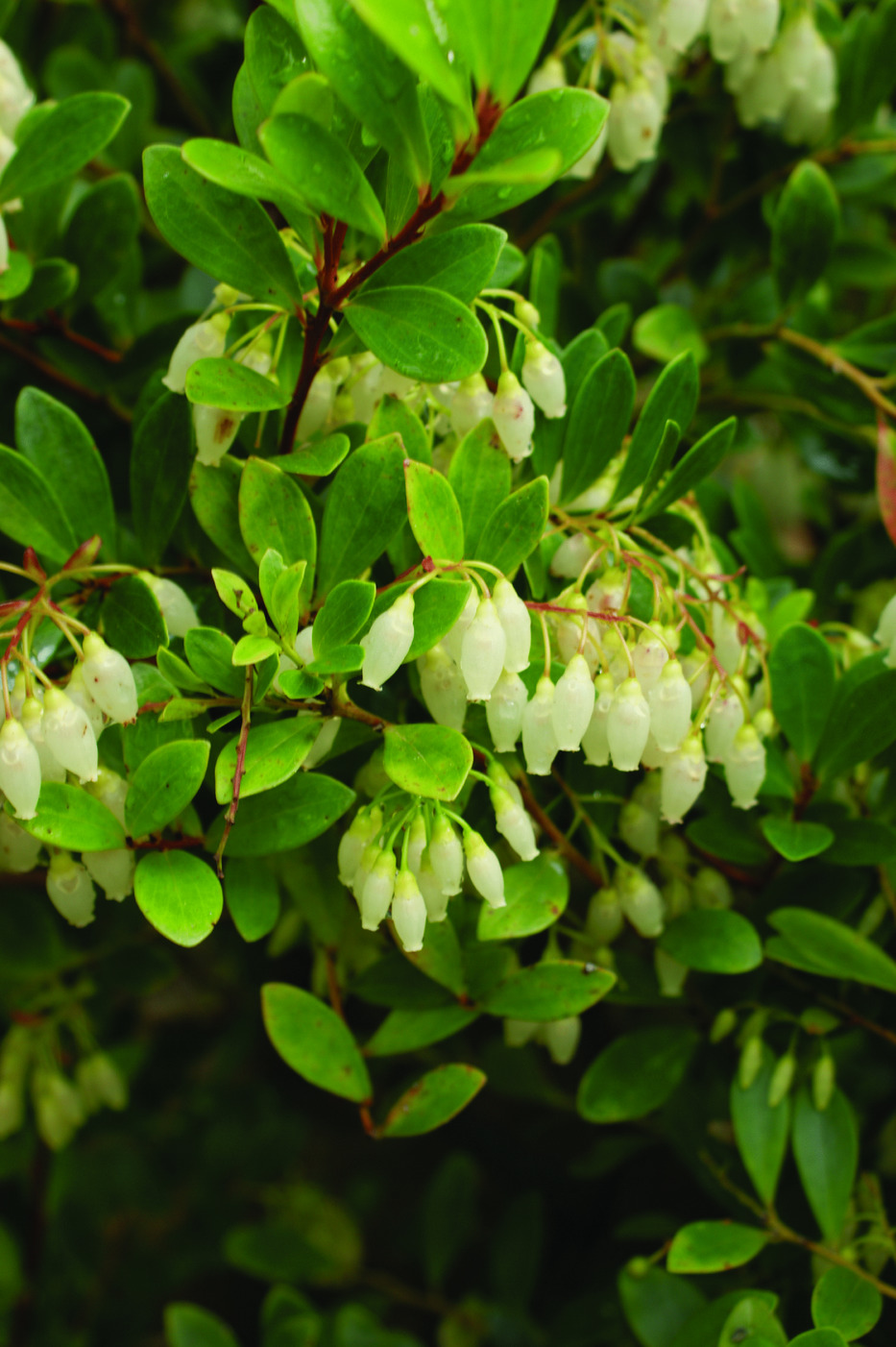
Terrestrial shrub or small tree up to 12 m, occasionally epiphytic. Twigs minutely patently pubescent, or glabrous, with occasional brown glandular hairs, leaves subdensely arranged, lateral buds 1.5–3 mm, very narrowly conical, conspicuous to obscure, mostly as long as or longer than subtending petioles, scales subulate. Leaves: petiole 1–2 × 1–1.5 mm, minutely hairy, without a groove, blades 20–30 × 7–15 mm, elliptic to weakly obovate, base tapering, with 1 or 2 marginal glands on each side, 2–3 mm from petiole, margin entire, narrowly cartilaginous, flat or weakly revolute, lamina with brown glandular hairs beneath when young, apex rounded to obtuse, sometimes broadly contracted apically, midvein smooth to weakly impressed above, smooth to very weakly raised below; lateral veins 1 or 2, each side high-arching from near base, faint, reticulation inconspicuous. Inflorescence of solitary racemes, in upper axils, with 6–12 secund flowers; rachis 20–50 mm, minutely hairy, bracts up to 10 × 5 mm, curling back and mostly falling well before flowers open; bracteoles minute, subulate, withering and falling early. Flowers: pedicels 5–8 mm, minutely hairy; calyx glabrous, or shortly hairy, tube subglobose, base 2.5–3 mm in diameter, lobes triangular, c.1 mm, with an apical gland and some marginal sessile glands; corolla 7–8 × 5–6 mm, barrel-shaped or weakly conical, white, through pink to red, faintly scented, glabrous outside, laxly hairy proximally inside, lobes c.1 mm, reflexed; stamens 3–4 mm, filaments 2.5–3 mm, broad at base, narrowing upwards to become very slender, densely hairy in proximal 2/3; anthers 0.8–1 mm, cells 0.6–0.8 mm, mostly with 2 short awns, tubules c.0.2 mm, with small glandular hairs when young, these disappearing often by anthesis, pores circular, opening slightly obliquely; disc densely hairy; style 7–8 mm, densely hairy in proximal 3/4. Fruit c.5 mm in diameter, spherical, shiny black when ripe.
Distribution
Brunei. Indonesia: Kalimantan, less common in the east. Malaysia: widespread in both Sabah and Sarawak.
Ecology
Mostly terrestrial in submontane and montane mossy forest, 600–2400 m. Flowering: January to December but with seasonal flushes.
Conservation assessment
LC. Widespread and common, its montane habitat being less threatened at present from disturbance.
Additional specimens. Brunei. Temburong District, N ridge Bukit Retak, ii 1983, Anderson 14.
Indonesia. West Kalimantan: Serawai, summit of Bukit Raya, 21 x 1995, Church et al. 2611.
Malaysia. Sabah: Kota Belud District, Gunung Kinabalu, Mesilau River, 6 xii 1933, Clemens 51648; NE junction of Sungei Kidukaruk, 27 i 1992, Kulip et al. SAN.133184; Tambunan/Penampang, 21 viii 1989, Fidilis SAN.127852; Gunung Trus Madi, 20 iii 1984, Argent 43/84; Papar District, Kimanis to Kenigau road, 27 iii 1980, Argent 1562; Pensiangan District, Kuamut Highlands, S Meliau Basin, 25 iv 2004, Campbell s.n.; Maliau Basin, E rim, 18 iv 1996, Wong WKM.2734; Maliau Basin, 4 v 2000, Edwards & Azlan MB.330; Gunung Lotung, Maliau Basin, 26 iii 1982, Argent 14/82; Sipitang District, Long Miau, 24 iii 1999, Ibrahim and Kiew AI.404. Sarawak: Kuching Division, Lundu, Gunung Kanyi, 25 x 1986, Awa & Paie S.45880; 22 iv 1984, Awa & Paie S.45899; Gunung Santubong, 23 iii 1983, Yii et al. S.44768; 18 i 1984, Othman & Yii S.46320; 15 iii 1982, Argent & Sinclair 8275; Gunung Serapi, 24 iii 1988, Sinclair & Argent 4696; Sri Aman Division, Bukit Sadok, 13 iii 1984, Paie S.45055; Engkiliki, Saran, Bukit Tangga, 5 v 1982, Lee S.44520; Sibu Division, Kapit, Melinau, Bukit Pantu, 9 viii 1967, Paie S.25740; Miri Division, Gunung Mulu N.P., S summit, 28 iv 1978, Argent & Coppins 1123a; summit area, 20 iii 1978, Hansen 533; 526; Summit ridge, 26 i 1978, Nielsen 115; W ridge, 24 iii 1978, Nielsen 844; Gunung Api, 16 iv 1978, Argent & Jermy 1043; 972a; Gunung Api, 2 x 1971, Anderson S.30933; S.30883; Gunung Tamacu, 8 v 1978, Argent & Coppins 1206a; 1208a; Gunung Murud, 12 ix 1982, Yii S.44436; Lawas, Mt Murut, Belaban, 1 x 1967, Paie S.26364; Path to Mt Murut, 4 x 1967, Paie S.26410; Kapit Division, Belaga, Batang Balui, Batu Laga plateau, x 1994, Yii S.56830; 20 iii 1989, Yii S.56929; Linau, Bukit Dema, 28 viii 1978, George S.39845; Bukit Tibang, Ulu Balleh, 12 vii 1969; Anderson & Paie S.28672.
Vaccinium clementis is a common montane species which is very variable owing to the broad range of habitats which it can occupy. At the upper end of its elevational range, it has been confused with Vaccinium coriaceum. This species usually has smaller less obovate leaves than Vaccinium clementis but there is little florally to separate these two species. Occasionally, the racemes terminate in a peloric flower with up to double the usual number of parts.
At the lower end of its range, it can be difficult to tell from Vaccinium bancanum (see under that species), but V. bancanum usually has more acuminately attenuate leaf apices and conical lateral buds which are much shorter than the petioles, at least in Borneo. Vaccinium elliptifolium Merr. can also be difficult to separate from V. clementis (see notes under Vaccinium elliptifolium). Clemens 51648 from the Mesilau River in Kinabalu is a poor specimen without flowers and apparently not seen by Sleumer. Although the leaves do not have any marginal glands (contrary to the information on the label), the size and shape of the leaves agree with Vaccinium clementis.
6. Vaccinium cordifolium Stapf, Trans. Linn. Soc. London, Bot. 4: 189, t. 15, f. D 7–11 (1894). – Type: Malaysia, Sabah, Mt Kinabalu, iii–iv 1892, G. Haviland 1148 (lecto K, designated by Sleumer, Reference Sleumer1961, p. 68). Fig. 36.
Vaccinium cordifolium. Mount Kinabalu, Sabah. (Photograph: G. Argent.)
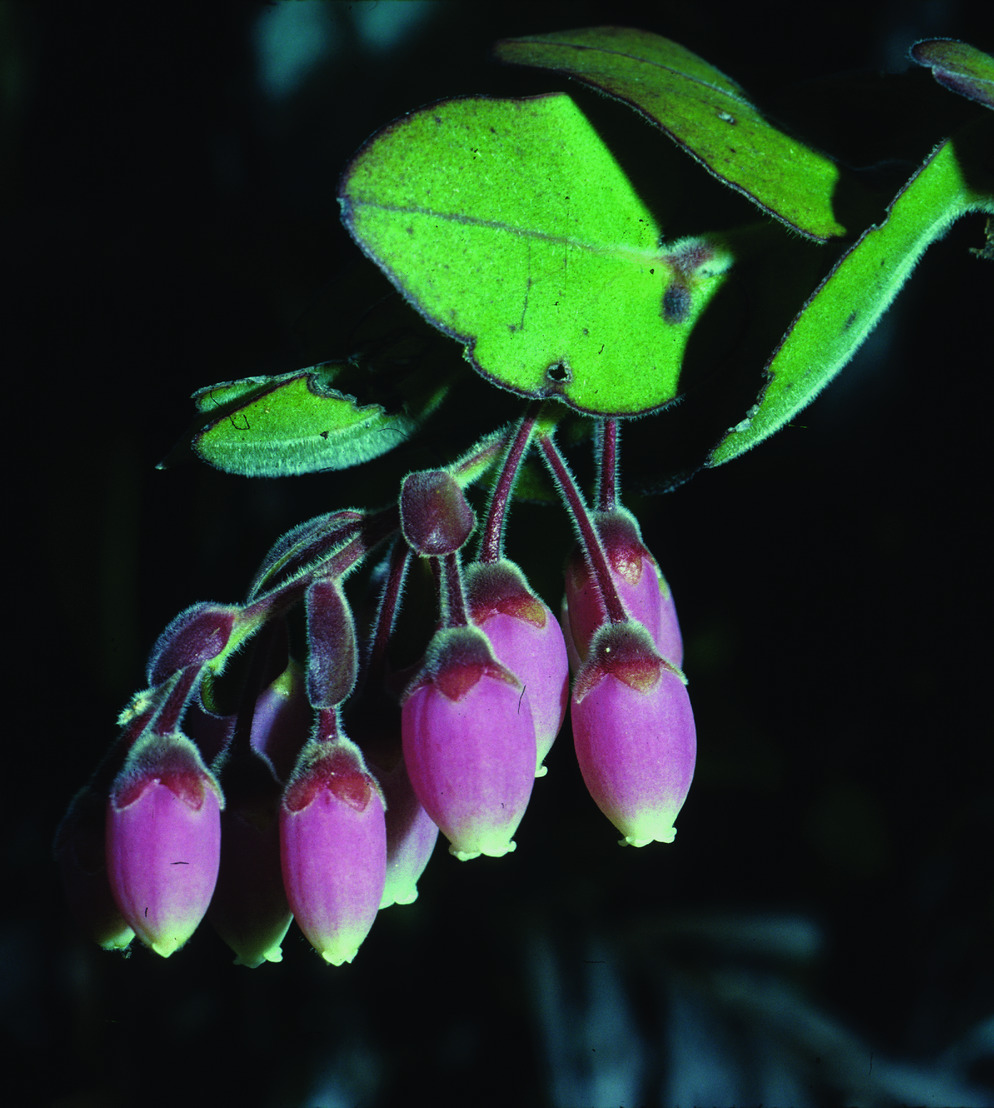
Shrub 1–2 m, branches arching and often becoming pendent. Twigs densely patently grey or brown hairy when young becoming glabrescent; leaves crowded, dense and overlapping at tips of branches, lateral buds 2.5–3 × 0.5–0.8 mm, narrowly conical, scales acicular. Leaves: petiole 2–3 × 1.5–2 mm, hairy, blade 24–45 × 15–30 mm, ovate, subsessile, base auriculate, often slightly amplexicaul, margin flat, entire, or very slightly revolute, marginal glands small, a single pair on the auricles, c.2 mm from petiole, apex bluntly attenuate, dark green and glossy above, paler beneath, patently shortly pubescent on both sides when young, quickly glabrescent except on basal part of lamina and midvein beneath, midvein level above, prominent beneath, lateral veins 6 or 7 per side, 2 or 3 basal, distal ones from midvein, curved, ascending towards margin, slightly raised above, more conspicuously so below, reticulation dense, finely prominent beneath. Inflorescence of racemes from uppermost axils, solitary or rarely in pairs, laxly 5- to 12-flowered, flowers secund; rachis 20–60 mm, densely white pubescent, bracts up to 8 × 2 mm, ovate, leafy, falling before anthesis; bracteoles not seen. Flowers: pedicels 8–12 mm, slender, densely white pubescent: calyx 1–1.5 mm, reddish or purplish, tube widely campanulate, tomentose, limb erectopatent, 5-lobed nearly to base, lobes ovate-acuminate, with conspicuous subparallel dorsal veins, laxly pubescent and with a ciliate margin, c.3 × 2 mm, without distinct apical gland; corolla 12–15 × 5–6 mm, tubular-urceolate, white usually strongly flushed with pink, or pink with white lobes, glabrous on both sides, lobes 1.5 mm, ovate, obtuse, reflexing; stamens subequal, often incompletely developed, filaments 6–7 mm, linear-subulate, slightly dilated just above base, densely long hairy except just above base, anther cells oblongoid, c.2 mm, with 2 very short dorsal spurs, tubules cylindrical, much narrower than cells, c.1.5 mm, divergent, laxly covered with short gland-tipped hairs, pore subcircular, flaring; disc densely covered with long erect hairs; style red, columnar, densely subappressed hairy in lower 2/3, 10–11 mm. Fruit up to c.12 mm in diameter, a globose berry, greenish, often flushed with red on one side, ripening purplish-black with persistent, leathery calyx lobes.
Distribution
Malaysia: Sabah, Mount Kinabalu and Mount Trus Madi. Common on both mountains but yet to be recorded elsewhere in Borneo.
Ecology
In dwarf subalpine forest and submontane shrubberies on open ridges, 2400–2900 m, on peat overlying granite and ultramafic rocks. Flowering: January to December.
Conservation assessment
LC. Both known localities have good protection. It is a common species along the main trail up Mount Kinabalu, occurring in abundance.
Additional specimens. Malaysia. Sabah: Gunung Kinabalu, Ridge above Mesilau E River, 2 iv 1980, Argent 1619; 4 iv 1980, Argent 1642; Gunung Kinabalu, W route from park headquarters, 29 ii 1980, Argent et al. 1422; Kinabalu main trail, 29 iii 1982, Sinclair 241; Ranau District, Pig Hill, E side of Kinabalu, 25 v 1984, Beaman et al. 9874; Interior Residency, Gunung Trus Madi, Kaintano ridge, 23–30 viii 1977, Gardner 47; Gunung Trus Madi, 20 iii 1984, Argent 64, Gunung Trus Madi, 21 i 1992, Kulip et al. SAN.133224.
A very distinctive species with its conspicuously white hairy stems and strongly auriculate leaf bases.
7. Vaccinium coriaceum Hook.f., Icon. Pl. t. 892 (1852). – Type: Malaysia, Sabah, Mt Kinabalu, iii 1851, 8000 ft, Low s.n. (holo K).
Key to the varieties
1a. Leaves subcrenulate with many impressed glands on margin, these extending to distal half of leaf__________________________7a. coriaceum
1b. Leaves with mostly a single pair of impressed glands on margin near base_____________2
2a. Calyx hairy with simple white hairs 7b. hirsuticalyx
2b. Calyx glabrous or with a few glandular hairs only_____________________3
3a. Mostly epiphytic, leaves laxly arranged, corollas 2.5–3 mm long_________7c. minus
3b. Mostly terrestrial, leaves densely arranged, corollas 3–6 mm long 7d. stapfianum
7a. Vaccinium coriaceum var. coriaceum
Terrestrial shrub or small tree to 2 m, rarely epiphytic, sometimes prostrate. Twigs pubescent, with short, stiff, white hairs and sessile, brown glands, densely leaved, older branches with conspicuous protruding leaf scars, lateral buds small, rounded, up to 0.4 mm in diameter. Leaves: petiole: 1.5–3 × 0.5–1 mm, sparsely to densely hairy, grooved above, supported on a protruding base which is decurrent down stem; blade 6–13 × 3–5 mm, elliptic to obovate, to subcircular, base broadly tapering to almost rounded, margin slightly recurved, subcrenulate with impressed marginal glands (4–10) reaching distal half of leaf, apex rounded. Inflorescence of racemes from upper leaf axils, many-flowered, flowers secund; rachis 20–50 mm, shortly patently hairy; bracts leafy, smaller than foliage leaves, mostly falling before anthesis, occasionally subpersistent; bracteoles 1 mm, subulate, falling early. Flowers: pedicels 2–4 mm, shortly patently hairy; calyx tube c.1 mm, glabrous, cup-shaped, limb suberect, lobes c.1.3 mm, ovate, obtuse to rounded, margin with scattered yellowish glands but without a single thick apical gland; corolla very variable in size, 3–6 × 3–6 mm, broadly urceolate, white to deep pink, scented, glabrous outside, hairy proximally inside, lobes c.1 mm, reflexed; stamens: filaments c.1.8 mm, linear, densely hairy; anther cells 1 mm, broadly oblongoid, with 2 short dorsal spurs and a few small gland-tipped hairs; tubules c.1 mm, much narrower than cells, erect, opening transversely, pore somewhat flaring; disc with short erect hairs; style c.4 mm, laxly hairy at base or glabrous. Fruit c.4 mm in diameter, ripening black.
Chromosome number
2n = 24 (Atkinson et al., Reference Atkinson, Jong and Argent1995).
Distribution
Malaysia: Sabah, Mount Kinabalu.
Ecology
Montane forest and shrubberies and open granite rocky areas, 2000–3400 m. Flowering: January to December.
Conservation assessment
LC. Substantial populations in Gunung Kinabalu National Park.
Additional specimens. Malaysia. Sabah: Kota Belud District, Gunung Kinabalu, Mesilau River, vi 1933, Clemens 51648; Ranau District, Pig Hill, 25 v 1984, Beaman 9850; Above Kambaranga, 12 vi 1957, Sinclair 9099; 9109; W route from park HQ, 26 ii 1980, Argent et al. 1378; 1401; Kambaranga, 7 ii 1962, Bogle & Bogle 390; 26 iii 1982, Sinclair 206.
See discussion following the account of var. stapfianum.
7b. Vaccinium coriaceum var. hirsuticalyx Argent, Bot. J. Linn. Soc. 85: 5 (1982). – Type: Malaysia, Sarawak, Gunung Mulu, 24 xi 1977, Argent 822 (holo SAR).
Differing in the hairy calyx from the type variety.
Distribution
Indonesia: East (?) Kalimantan. Malaysia: Sarawak. First described from Gunung Mulu in Sarawak and subsequently found to be widespread on mountains in Borneo.
Ecology
Montane forest, 1500–2500 m elevation. Flowering: January to December.
Conservation assessment
LC. Its widespread distribution and occurrence in several national parks would indicate that there are abundant, well-protected populations.
Additional specimens. Brunei. Subdistrict Amo, NE of Gunung Retak, 14 iii 1991, Sands 5405; 5 iii 1991, Sands & Johns 5220.
Indonesia. East Kalimantan: Peak of Balikpapan (Gunung Beratus) 15 vii 1952, Kostermans 7548 (doubtful, fruit only).
Malaysia. Sarawak: Miri Division, Gunung Mulu National Park, 14 iii 1990, Lii & Talib S.58530; 15 iv 1978, W ridge, Argent & Jermy 1013; 24 xi 1977, Argent et al. 822; Limbang Division, Bukit Pagon Periuk, summit Bukit Pagon Kecil, 9 viii 1984, Awa & Lee S.47750; Lawas District, path to Gunung Murut, 3 x 1967, Paie S.26398; cf. var. hirsuticalyx.
7c. Vaccinium coriaceum var. minus (Sleumer) Argent, comb. nov. – Vaccinium stapfianum Sleumer var. minus Sleumer, Blumea 11: 74 (1961). – Type: Malaysia, Sabah, Mt Kinabalu, Kinataki R., 25 iv 1933, Clemens 32915 (holo L; iso A, BO, NY).
Distinctly epiphytic, with laxer leaf disposition than the type and with shorter, smaller flowers, 2.5–3 mm long.
Distribution
Malaysia: Sabah, Mount Kinabalu only.
Ecology
Epiphytic in mossy montane forest, 1500–2700 m. Flowering: February to July, probably during other months.
Conservation assessment
LC. Although recorded only from Gunung Kinabalu, it is widespread on this mountain, which is well-protected.
Additional specimens. Malaysia. Sabah: Kota Belud District, Gunung Kinabalu, 25 iv 1933, Clemens 32932; Gunung Kinabalu, Penataran River, 14 vi 1933, Clemens 32508; Gunung Kinabalu, Marai Parai, 8 v 1933, Clemens 33143; Gunung Kinabalu, upper Kinataki River, 24 ii 1933, Clemens 31772; Gunung Kinabalu, Colombon River, 12 vii 1933, Clemens 33913.
The taxonomic value of recognising var. minus is doubtful because, as has already been noted, the flowers of this species are very variable in size. The differences in the leaves and flower size are no doubt due to less exposure in the shady epiphytic habitat. It would be interesting to see if the differences were maintained in cultivation experiments.
7d. Vaccinium coriaceum var. stapfianum (Sleumer) Argent, comb. nov. – Vaccinium buxifolium Hook.f., Icon. Pl. t. 891 (1852), (non Salisb. 1805). – Vaccinium stapfianum Sleumer, Bot. Jahrb. Syst. 71: 168 (1940). – Type: Malaysia, Sabah, Mt Kinabalu, 1851, Low s.n. (holo K). Fig. 37.
Vaccinium coriaceum var. stapfianum (Sleumer) Argent. RBGE accession number 19801165; Mount Kinabalu, Sabah. (Photograph: G. Argent.)
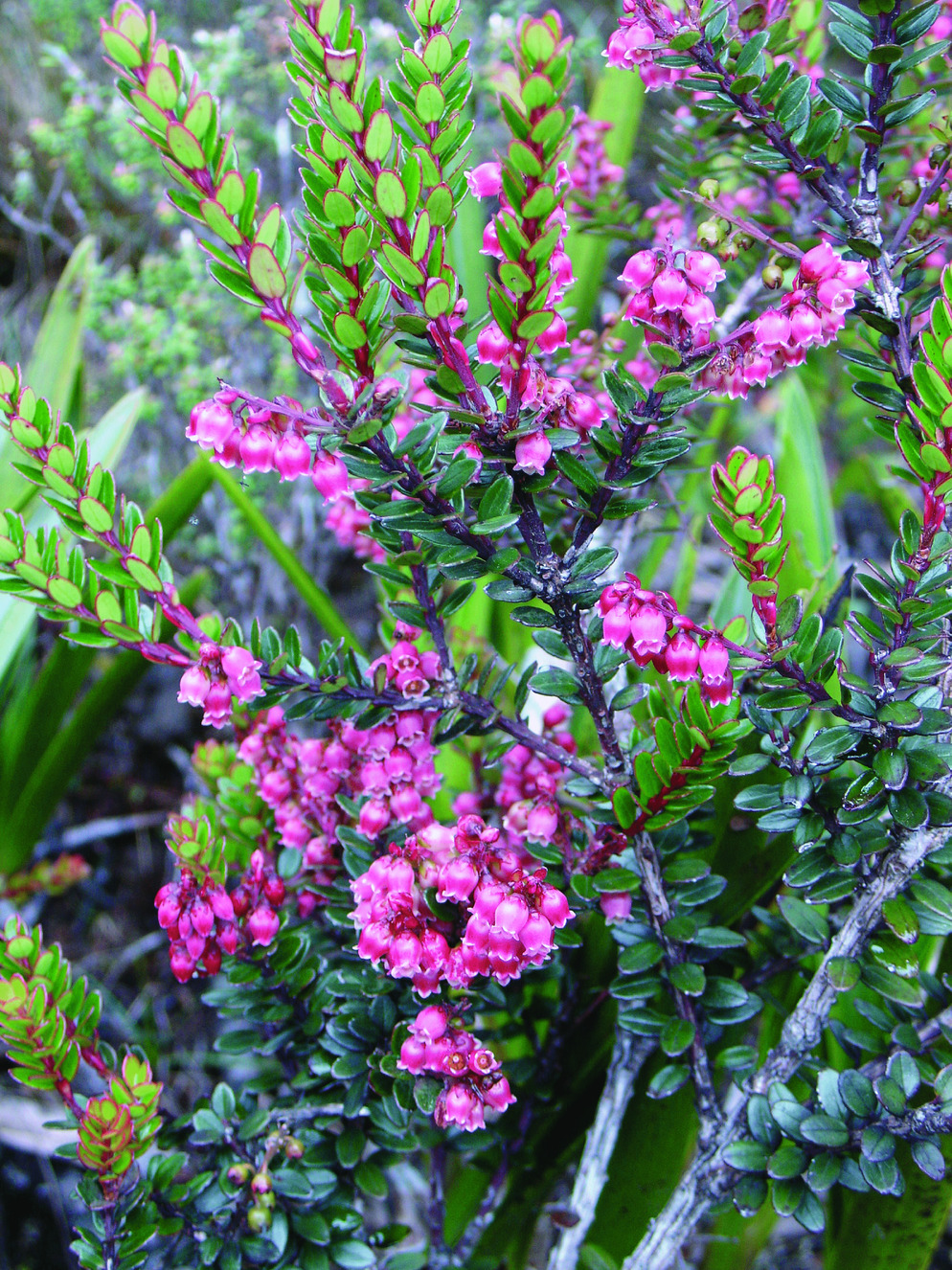
Differing from the previous varieties in having an entire leaf margin with only a single pair of impressed glands (more rarely 2 or 3 pairs of glands) in the proximal half of the leaf and a glabrous or only very laxly hairy calyx.
Distribution
Malaysia: Sabah, Mount Kinabalu and the Crocker Range.
Ecology
Terrestrial on both ultramafic and granite areas of Gunung Kinabalu, 2000–3600 m elevation. Flowering: throughout the year.
Conservation assessment
LC. An abundant species in Gunung Kinabalu National Park, where it is protected.
Additional specimens. Malaysia. Sabah: Tambunan District, Gunung Alab, 14 ix 1997, Madani & Pereira SAN.140074; Kota Belud District, Gunung Kinabalu, 27 ii 1980, Argent et al. 1393; 20 ii 1980, Argent 1401; Gunung Kinabalu, 27 iii 1982, Sinclair 217; Gunung Kinabalu, Paka, 24 iii 1932, Clemens 27116, 28906, 29957.
Vaccinium stapfianum Sleumer is here recognised as a variety within Vaccinium coriaceum Hook.f. (which has four varieties in Borneo). There is great variation in the number and distribution of marginal leaf glands in Vaccinium coriaceum although these may be constant within local populations. In the absence of other differentiating characters, Vaccinium stapfianum would appear better at varietal rank. Vaccinium coriaceum var. hirsuticalyx Argent, with a densely hairy calyx, is the common variety away from Kinabalu, mostly having just one pair of glands on the leaf margin, slightly proximal to the middle of the leaf. The specimen SAN.141808 from Long Miau, Meligan, Sipitang District, Sabah has the densely hairy calyx but the corolla is glabrous inside.
Vaccinium coriaceum is very similar to the widespread Vaccinium lucidum (Blume) Miq., not yet recorded in Borneo. Vaccinium coriaceum is the older name if these species were to be united. Vaccinium timorense Fawc., with similar small leaves, is widespread further to the east. It is a curious anomaly that Sleumer (Reference Sleumer1966–1967) included Vaccinium timorense var. denticulatum Fawc. [subcrenulate with glands all round the leaf margin] within V. timorense [with a single pair of basal glands], not recognising it at even varietal rank, whereas V. coriaceum and V. stapfianum were separated on just this character. Other records of what are here considered to be Vaccinium coriaceum have been collected from widespread localities in Borneo. Most of these have been previously identified as Vaccinium clementis. The variation accorded here to the presence and number of the marginal glands in Vaccinium stapfianum casts some doubt on the validity of Vaccinium leptocladum Sleumer as a good species. See discussion under that species.
8. Vaccinium costerifolium Sleumer, Blumea 11: 77 (1961). – Type: Indonesia, Central Kalimantan, 12 km E of Sampit, near sea level, 21 i 1954, A.H.G. Alston 13143 (holo BM). Fig. 38.
Vaccinium costerifolium. Argent et al. 9661; Nyaru Menteng, Kalimantan. (Photograph: G. Argent.)
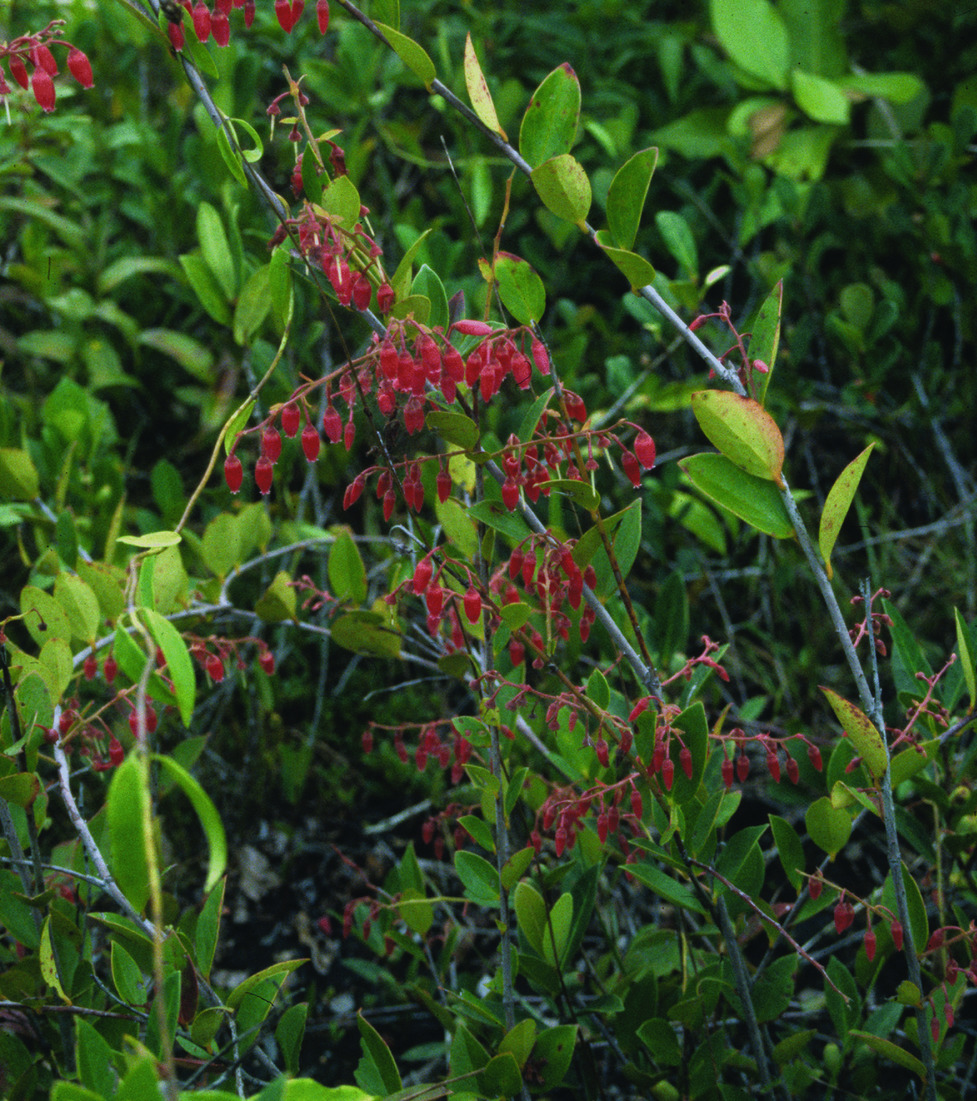
Trailing or scrambling shrub with arching stems to 2 m. Twigs rounded, sparsely covered with lenticels, minutely patently hairy, laxly leaved, lateral buds to 2 mm, ovoid-conical with acute apex, inconspicuous. Leaves: petiole 2–3 mm, slender, rugulose, minutely hairy, blade 25–60 × 12–30 mm, elliptic, base broadly attenuate into slender petiole, margin entire, slightly revolute, distinctly so when dry, with 1 or 2 small marginal glands, a little above base on each side, sometimes with a few additional upper ones, glabrous minutely laxly glandular hairy underneath, apex shortly gradually and obtusely attenuate, midvein impressed above, prominent beneath, lateral veins 2 pairs, curving upwards from or near the base, 1 or 2 upper shorter curving veins, all impressed above, prominent beneath, reticulation slightly raised on both sides or obscure. Inflorescence of racemes from axils in younger part of twigs, 8- to 12-flowered, flowers secund, rachis slender, angular, minutely patently hairy, bracts sometimes persisting until anthesis, bracts ovate, 3–6 × c.2 mm, with distinct veins, fringed with minute hairs and punctate underneath; bracteoles subulate, basal, to 1.8 mm, minutely hairy. Flowers: pedicels slender, 3–6 mm, minutely and sparsely patently hairy; calyx tube rounded, 1–1.5 mm, shortly densely hairy and laxly glandular hairy, limb suberect, deeply divided, lobes triangular, 2–2.5 mm, less densely hairy than calyx tube, without apical gland: corolla 8–10 × c.4 mm, tubular, slightly contracted distally, with distinct angles in bud, membranous, pink to red to deep purple, with white tips to the lobes, sweetly scented, minutely hairy outside with both simple and glandular hairs and at base inside, lobes c.1 mm, obtuse, suberect; stamens: filaments c.3 mm, base broad, hairy, tapering rapidly to slender apical part which is glabrous distally; anther cells 1.2–1.3 mm, oblongoid, granular, shortly obtusely 2-spurred dorsally; tubules cylindrical, narrower than cells, very slightly dilated upwards, held at right angles to cells, c.1.4 mm, subobliquely opening apically, back of each tubule extended into 1 or 2 short recurved teeth; disc prominent, glabrous or laxly hairy; style 9–10 mm, columnar, glabrous becoming exserted as flower ages. Fruit subglobose, c.6 mm in diameter, laxly hairy, green, flushed red, turning black.
Distribution
Indonesia: South and Central Kalimantan.
Ecology
Near sea level in swampy or open heath forest on acid sandy or peaty soil. Locally common. Flowering: January and October. Fruiting: September.
Conservation assessment
LC. Although this species is not known from many localities, the recent collection (Argent et al. 9661) from Nyaru Menteng was in poor swampy ground unlikely to be developed for agriculture and was collected from a substantial population. Kessler 1587, however, was growing among pineapples in a cultivated area.
Additional specimens. Indonesia. Central Kalimantan: Kotawaringin Timur, Nyaru Menteng, Km 27 from Palangkaraya arboretum, 10 x 1996, Argent et al. 9661; near Nyaru Menteng Arboretum, 30 x 1996, Keßler 1587.
The original description is here amplified from Argent et al. 9661.
9. Vaccinium elliptifolium Merr., J. Straits Branch Roy. Asiat. Soc. 76: 104 (1917). – Type: Malaysia, Sabah, Mt Kinabalu, Marai Parai Spur, flowering 22 xi 1915, Clemens 10894 (lecto PNH†, designated by Sleumer, Reference Sleumer1961, p. 72); ibid., young fruit 2 xii 1915, Clemens 11099 (syn PNH†).
Erect shrub or small tree. Twigs rounded, densely covered with subpatent hairs, densely to laxly leaved, lateral buds obscure to prominent, up to 4 mm, slender, scales subulate, hairy abaxially. Leaves: petiole 2–3 × 1–1.8 mm, densely hairy; blade 20–32 × 12–24 mm, elliptic to broadly elliptic, base broadly attenuate to rounded, margin subcartilaginous, entire, narrowly revolute, marginal glands a single pair at 2–5 mm from petiole, hairy at base and lower half of midvein below and laxly glandular punctate, apex retuse, sometimes rounded, then usually with small central cleft which may have an indentation either side of it (? glands), midvein impressed above and prominent below, lateral veins mostly 2 pairs at an acute angle; one pair from base ascending into upper part of leaf but disappearing before margin, upper pair shorter but similar, reticulation mostly obscure. Inflorescence of racemes from upper axils, flowers 6–10, secund; rachis 20–25 mm, rounded, densely white-hairy; bracts 3–4 mm, narrowly cordate, glabrous except for a fringe of white hairs; bracteoles 1.5–2 mm, subulate, basal, subpersistent, white-hairy especially towards the base. Flowers: pedicels 3–5 mm, densely white-hairy; calyx tube globose, densely hairy, limb erect, deeply lobed, lobes triangular, ovate to acute, glabrous or very sparsely hairy abaxially, with a dense fringe of white hairs on margin, mostly without conspicuous marginal or terminal glands; corolla urceolate 7–9 × 3 mm, glabrous outside, long-hairy inside, red; lobes c.1 mm, ovate, recurved with minutely denticulate margin; stamens: filaments 1.5 mm, subulate, long-hairy; anther cells 0.5 mm, oblongoid, without spurs, tubules up to 0.3 mm, as wide as cells, truncate, pore round margin reflexing and with a few gland-tipped hairs; disc densely hairy; style 8–9 mm long-hairy in proximal 1/2 to 2/3. Fruit (immature) globose, remaining densely hairy and with persistent erect calyx lobes.
Distribution
Malaysia: Sabah, Mount Kinabalu.
Ecology
In submontane forest in ultramafic areas, 1200–2300 m elevation. Flowering: May to July.
Conservation assessment
LC. Although known only from a single mountain, there are good populations of this species in several different localities on Gunung Kinabalu, where it grows in well-protected forest sites. It is common alongside the recently developed alternative trail up the mountain from the Mesilau rest house.
Additional specimen. Malaysia. Sabah: Mt Kinabalu, Ranau District, Pig Hill, 25 v 1984, Beaman et al. 9876.
This species is superficially similar to Vaccinium clementis but the hairs on the stems and inflorescences are much more obvious, being longer and coarser than those on the stems of V. clementis, which has glabrous or very finely and shortly tomentose stems and inflorescences. The leaf apices are characteristically rounded with a retuse tip and sometimes with two characteristic depressions on either side of the apex, whereas Vaccinium clementis has leaves that are mostly broadly acuminate with a rounded but not retuse apex. The calyx lobes on the fruit are also different, being erect in Vaccinium elliptifolium and normally appressed to the disc in V. clementis. Material of Vaccinium elliptifolium usually dries darker than specimens of V. clementis, and V. elliptifolium would appear to be restricted to ultramafic habitats on Mount Kinabalu and its environs whereas V. clementis grows in the more usual acid habitats of this family.
The two Clemens collections cited by Merrill in the protologue of this species, 10894 and 11099, are presumed to have been destroyed in Manila in the Second World War. Sleumer (Reference Sleumer1961) saw neither collection but still selected Clemens 10894 (PNH) as the lectotype. No duplicates of these collections, which are the original material, have been located. Three other Clemens collections were made in the type locality, namely 31063, 31404 and 40194. None of these has been seen but duplicates may well turn up in other herbaria and would then be candidates for neotypification.
10. Vaccinium endertii J.J.Sm., Bull. Jard. Bot. Buitenzorg, ser. 3, 13: 462 (1935). – Type: Indonesia, East Kalimantan, Mt Kemul, ix 1925, Endert 3886 (lecto BO, designated by Sleumer, Reference Sleumer1961, p. 72; isolecto A, BM, L, P, SING).
Non Vaccinium endertii (J.J.Sm.) Masam. = Rigiolepis endertii J.J.Sm.
Shrub to 6 m, mostly epiphytic. Twigs thick, at first angular, glabrous, leaves lax, lateral buds 5–6 mm, ovoid-oblongoid, scales ovate, acute. Leaves: petiole 4–5 × c.1.5 mm, glabrous, blade 45–95 × 25–43 mm, obovate to elliptic, base rounded to subcordate, marginal glands at a short distance from petiole, glabrous except for lax glandular hairs below which disappear leaving surface punctate, margin entire, apex broadly attenuate, obtuse to rounded, midvein impressed above, strongly prominent beneath, lateral veins 3 or 4 from base and slightly above base, curving upwards and with a few shorter ones from distal part of leaf, reticulation lax, inconspicuous, slightly raised beneath. Inflorescence of 8- to 15-flowered racemes with laxly secund flowers; rachis 50–83 mm, angular, glabrous; bracts and bracteoles not recorded. Flowers: pedicels 9–12 mm, glabrous; calyx tube cup-shaped, rugulose, 2 mm in diameter, limb spreading, deeply lobed, lobes 1.5 mm, subtriangular, sometimes obscurely ciliate, apex obtuse with a thick gland; corolla 10–12 × 3–4 mm, tubular-urceolate, greenish white with red base, glabrous outside, subdensely hairy in proximal half inside; lobes 1.5 mm, obtuse, becoming reflexed; stamens: filaments 3–4 mm, linear with base dilated, long hairy; anther cells 1.5 mm, oblongoid, echinulate, distinctly 2-spurred dorsally; tubules c.1 mm, with a few gland-tipped hairs, cylindrical, narrower than cells and at a wide angle to them, opening transversely; disc hairy; style 9–10 mm, columnar, densely hairy with simple white hairs in basal 3/4. Fruit globose, c.8 mm in diameter (dry).
Distribution
Indonesia: Central Kalimantan, Amai Ambit and Mount Kemel. Malaysia: Sarawak, Upper Mujong area.
Ecology
In primary ridge forest, at c.1000 m. Flowering: October.
This is a poorly known species that requires further collection.
11. Vaccinium leptocladum Sleumer, Blumea 11: 90 (1961). – Type: Indonesia, East Kalimantan, Mt Kemul, 1600 m elevation, 16 x 1925, Endert 4220 (holo L; iso A, BO, K?, P, SING).
Slender epiphytic shrub to 1.5 m. Twigs slender, up to 2 mm in diameter, angular, patently very shortly hairy, laxly to subdensely leafy, lateral buds inconspicuous. Leaves: petiole c.1 mm long, slender; blade 7–10 × 2.5–3 mm, narrowly obovate to elliptic, base tapering, margin entire, revolute, with only an occasional marginal gland c.1 mm from pedicel, lamina with relatively large, dark gland bases abaxially; apex rounded; midvein slightly raised on both side, lateral veins 2 or 3 arising from base or slightly above base, ascending to upper part of leaf, slightly raised on both sides, reticulation dense, only slightly raised on both sides. Inflorescence of racemes from upper axils, 1- or 2-flowered; rachis 2–5 mm long, glabrous; bracts and bracteoles not recorded. Flowers: pedicels 5–7 mm, glabrous; calyx tube 0.5 mm, broadly campanulate, densely pubescent, limb suberect, deeply 5-lobed, lobes 1 mm, triangular with obtuse apex, margins ciliate and with several thick, subsessile glands; corolla 3.5–4 × c.2.5 mm, red, ovoid-urceolate, inflated below, abruptly contracted distally, glabrous outside, shortly hairy towards base inside; lobes up to 1 mm; stamens: filaments 1.5 mm, linear, long-hairy; anthers c.0.8 mm, cells broadly oblongoid, without spurs, tubules very short, as wide as cells, opening by oblique pores; disc laxly hairy; style 4 mm, filiform, hairy in proximal half. Fruit not seen.
Distribution
Indonesia: East, Kalimantan, West Kutei, Mount Kemul.
Ecology
Montane forest, 1600 m. Flowering: October.
This species is known only from the type collection. It is very similar to Vaccinium coriaceum but described with a much shorter inflorescence which is only 1- or 2-flowered. Contrary to the original description, there are occasional marginal glands on a few leaves, although on most they are completely lacking. Further collections of this species from the type locality are very desirable.
12. Vaccinium mjoebergii J.J.Sm., Bull. Jard. Bot. Buitenzorg, ser. 3, 13: 461 (1935). – Type: Indonesia, Central Kalimantan, Bt Batu Tiban, ix 1925, Mjöberg 54 (lecto BO, designated by Sleumer, Reference Sleumer1961, p. 72; isolecto L).
Epiphytic climbing shrub. Twigs angular, densely shortly pubescent when young, subdensely spirally leaved, lateral buds subglobular, 2–3 mm in diameter, scales broadly ovate and obtuse. Leaves: petiole 3–4 × 1–1.5 mm, somewhat flattened, grooved above, shortly hairy when young, blade 50–72 × 20–32 mm, elliptic or obovate-elliptic, base tapering, apex obtuse to rounded, margin entire, somewhat revolute, the pair of marginal glands obscure, shortly pubescent and laxly glandular hairy when young beneath, midvein narrowly impressed especially towards base above, strongly obtusely prominent beneath, lateral veins 1 or 2 basal and 5 or 6 upper pinnate, suberect to widely spreading pairs, a little raised on both sides, reticulation lax and faintly visible. Inflorescence of 15- to 25-flowered racemes from upper axils; rachis 30–35 mm, slender, densely shortly pubescent; bracts up to 5 × 4 mm, subcircular to ovate; bracteoles not seen. Flowers: pedicels c.1.5 mm, curved, densely shortly pubescent: calyx tube c.1 mm, campanulate, laxly hairy at base, limb spreading, c.1 mm, lobes triangular, with thick apical gland; corolla c.4–5 × 2 mm, thin, glabrous outside, laxly hairy in lower half inside, lobes recurved, very short; filaments 1.8 mm, from a broad base becoming linear, subdensely hairy; anther cells 0.5 mm, oblongoid, with 2 short dorsal spurs; tubules cylindrical, as wide as and as long or a little longer than cells, with a few short gland-tipped hairs, opening transversely and sometimes with back wall produced into a minute tooth; disc hairy; style c.2.5 mm, hairy in proximal half. Fruit not seen.
Distribution
Indonesia: Central Kalimantan, Mount Batu Tiban, East Mount Kemel.
Ecology
Epiphytic, climbing shrub in primary forest, 1700–1850 m.
Additional specimen. Indonesia. Central Kalimantan: Gunung Batu Tiban, 15 x 1925, Endert s.n.
This species is apparently known from only two collections. Endert s.n. (SING), from the type locality, was collected soon after the type collection and is similar. The flower colour is not recorded, and the indication of a climbing habit may be doubtful because epiphytes are often mistaken for climbers.
13. Vaccinium pachydermum Stapf, Trans. Linn. Soc. London, Bot. 4: 189 (1894). – Type: Malaysia, Sabah, Mt Kinabalu, 3 iv 1892, Haviland 1140 (lecto K, designated by Sleumer, Reference Sleumer1961; isolecto SAR, SING). Fig. 39.
Vaccinium pachydermum. Gunung Mulu, Sarawak. (Photograph: G. Argent.)

Erect shrub or small tree, up to 6 m. Twigs thick, shortly densely hairy becoming glabrescent, laxly to subdensely leaved; lateral buds ovoid to spherical, obtuse, scales ovate, up to 2 mm. Leaves: petiole 5–10 × 2–4 mm, densely pubescent; blade 35–100 × 25–70 mm, elliptic, broadly elliptic, obovate-elliptic to subcircular, base tapering and decurrent, margin entire, recurved when dry especially towards the base, usually with a pair of marginal glands 1–1.5 mm from petiole, glabrous above, laxly glandular hairy beneath when young, abaxial glands leaving a punctate surface when gone; apex mostly rounded or broadly obtuse, occasionally broadly acuminate; midvein impressed above, very prominent beneath, lateral veins 2 or 3 basal and somewhat above base, and additionally 2 or 3 upper pairs all ascending or with all lateral veins inconspicuous, reticulation obscure. Inflorescence of lax many-flowered racemes from upper leafy axils, flowers secund; rachis 40–80 mm, densely hairy; bracts up to 8 × 3 mm, narrowly cordate to elliptic, glabrous, falling early; bracteoles minute, slightly suprabasal, subulate. Flowers: pedicels 6–12 mm (to 20 mm in fruit), densely hairy, curved; calyx tube hemispherical, 2 mm, limb spreading, 2–2.5 mm, 5-lobed almost to base; lobes ovate-triangular, less pubescent than calyx tube, ciliate, with a small apical gland and often several sessile marginal glands; corolla 8–9 × 4–6 mm, broadly tubular-urceolate, pink or white, sweetly scented, glabrous to laxly hairy outside, laxly hairy at base and near opening inside; lobes 1.5 mm, recurved, often flushed pink; stamens: filaments c.3 mm, linear, densely hairy; anther cells 1.5 mm, oblongoid, echinulate with 2 dorsal spurs; tubules c.1 mm, cylindrical, as wide as cells, erect, opening transversely and with several gland-tipped hairs; disc densely hairy; style c.8 mm, slender, hairy in proximal 3/4. Fruit 6–8 mm in diameter, globose with a flat top, ripening blue, remaining pubescent with erect calyx lobes and a prominent disc.
Distribution
Brunei: Mount Pagon. Malaysia: Sabah, Mount Kinabalu; Sarawak, Mount Kalulong, Mount Dulit, Mount Mulu and Mount Murud.
Ecology
Mostly in montane mossy forest but extending to open ridges, 1500–3500 m. Flowering: throughout the year.
Conservation assessment
LC. This species is widespread on the mountains of western Borneo, some of which have protected status. This is a common species on both Gunung Kinabalu and Gunung Mulu.
Additional specimens. Brunei. Temburong District, Gunung Pagon, 30 iii 1993, Coode 7428; N ridge, Bukit Retak, 17 ix 1988, Wong WKM 417.
Malaysia. Sabah: Kota Belud District, Gunung Kinabalu, 13 vi 1957, Sinclair et al. 9131A; Sinclair 9131; 12 vi 1957, Sinclair 9114; Gunung Kinabalu, Penibukan, 11 x 1933, Clemens 40676; Kinabatangan District, Maliau Basin, 19 iv 1996, Pereira et al. JTP 380. Sarawak: Sibu Division, Kapit, Melinau, Bukit Pantu, 9 viii 1967, Paie S.25743; Limbang Division, Lawas, Gunung Murut, 2 x 1967, Paie S.26378; 4 x 1967, Paie S.26414; 10 x 1967, Paie S.26482; Gunung Murud, 10 ix 1982, Yii S.44476; Gunung Murud, 27 iv 1902, Mahmud et al. S.88324; Gunung Murud, route from Bakelalan, 7 x 1967, Burtt & Martin 5420; Miri Division, Gunung Mulu National Park, 12 iii 1990, Yii & Talib S.58453; S.58457; 26 i 1978, Nielsen 114; 22 iii 1978, Nielsen 791; Gunung Mulu, west ridge, 24 xi 1977, Argent et al. 827; 8 v 1978, Argent & Coppins 1192a; 26 iv 1978, Argent & Coppins 1098; 1 x 1976, Jermy 13177; Gunung Mulu, 16 vi 1962. Chew Wee-Lek 393; 22 iii 1978, Hansen 550.
For comments on the differences between this species and Vaccinium simulans, see under the description of the latter.
14. Vaccinium phillippsiae Argent, nom. nov. – Vaccinium bancanum var. kemulense J.J.Sm. ex Sleumer, Blumea 11: 76 (1961). – Type: Indonesia, East Kalimantan, Mt Kemul, Endert 4356 (holo L; iso A, BO). Fig. 40.
Vaccinium phillippsiae Argent. Lamb & Phillipps 2205; Crocker Range, Sabah. (Scan: Robyn Drinkwater.)

Terrestrial shrub. Twigs minutely patently pubescent, leaves laxly arranged, lateral buds c.2 × 1.5 mm, very narrowly conical, inconspicuous, as long as or longer than subtending petioles, scales subulate, hairy. Leaves: petiole 1–2 × c.0.75 mm, minutely hairy, without a groove; blades 25–40 × 13–20 mm, elliptic to weakly obovate; base tapering, margin entire, narrowly revolute, fringed with minute hairs when young, with 1 or 2 marginal glands on each side 2–3 mm from petiole; lamina with brown glandular hairs beneath when young, minutely greyish pubescent above, apex shortly acuminate, tip narrowly acute, midvein smooth to weakly raised above, minutely but distinctly raised below, lateral veins 1 or 2, each side high-arching from near base and with several smaller veins arising distally, reticulation conspicuous on both sides. Inflorescence of solitary racemes in upper axils, flowers 4–7, secund; rachis 12–25 mm, laxly hairy with simple patent hairs; bracts and bracteoles, not seen. Flowers: pedicels 6–8 × 0.4 mm, minutely laxly patently hairy with simple hairs; calyx covered all over with long (to 0.2 mm), simple patent hairs, tube cup-shaped, c.12 × 20 mm, lobes triangular, c.1.2 × 1.2 mm, with an apical gland and several sessile marginal glands; corolla 8–10 × c.4 mm, narrowly conical, pink, glabrous outside, but spotted with grey wax outside when dry, laxly hairy proximally inside, lobes c.1 mm reflexed; stamens: filaments 2.5–4 mm, broad at base, narrowing upwards to become very slender, densely hairy to apex; anther cells c.0.6 mm, oblongoid, with 2 distinct awns, muriculate with short points, tubules c.1 mm, with small glandular hairs, pores circular, opening slightly obliquely; disc glabrous at base, densely long hairy in upper part; style c.9 mm, densely hairy in proximal 3/4, with distally pointing hairs, slightly expanded distally. Fruit not recorded.
Distribution
Indonesia: East Kalimantan, Mount Kemul. Malaysia: Sabah, Mount Kinabalu, Crocker Range, northern Sarawak.
Ecology
Montane forest, 1300–1770 m. Flowering: August to September.
Etymology
Named after the late Mrs Susan Mary Phillipps, keen naturalist and long-standing resident of Sabah, for her hospitality and help over many years.
Additional specimens. Malaysia. Sabah: Kota Belud District, Gunung Kinabalu, 10 vi 1932, Clemens 29856, (paratype of Vaccinium bancanum var. kemulense); Gunung Kinabalu, road to Kamborangah, 23 viii 1963, Mikil SAN.38633; Kinabalu, 13 ix 1971, Aban & Saikeh SAN.71862; Tambunan District, Gunung Alab, 21 viii 1987, Crispinus SAN121813; Penampang District, Central Crocker Range, Sinsuron road, 29 ix 2011, Lamb & Phillipps AL 2205; Pensiangan District, Sapulut F.R., Batu Saap, without date, Sugau SAN153071; Sipitang District, ulu Meligan, 11 iv 2002, Diwol et al. SAN 144443. Sarawak: Miri Division, Bario, Bukit Lawi, Ulu Sungai Limbang, 12 viii 1985, Awa & Lee S.50782; Sungai Limbang, 28 x 1989, Awa & Lee S.50783; Kapit Division, Belaga District, Usun Apau plateau, 11 x 1984, Lai et al. S.69891 (material too poor for definite identification).
Vaccinium phillippsiae is very distinctive with its small (to c.10 mm) leaves with acute apex, rigidly patent hairs on stems, inflorescence with muriculate anther cells and anther tubules as long as or longer than the cells. This species also occurs at higher elevation than Vaccinium bancanum. The description has been augmented from the Lamb & Phillipps specimen (see Fig. 40) which is excellent flowering material. The name ‘kemulense’ was pre-dated at specific rank and so, if used, would create a later homonym.
15. Vaccinium phillyreoides Sleumer, Bot. Jahrb. Syst. 71: 163 (1940). – Type: Malaysia, Sarawak, Mt Dulit, Ulu Koyan, near Long Kapa, 950 m elevation, 8 xi 1932, Richards 2510 (holo K; iso A, L, SING). Fig. 41.
Vaccinium phillyreoides. Cultivated RBGE accession number 19801159; Crocker Range, Sabah. (Photograph: G. Argent.)
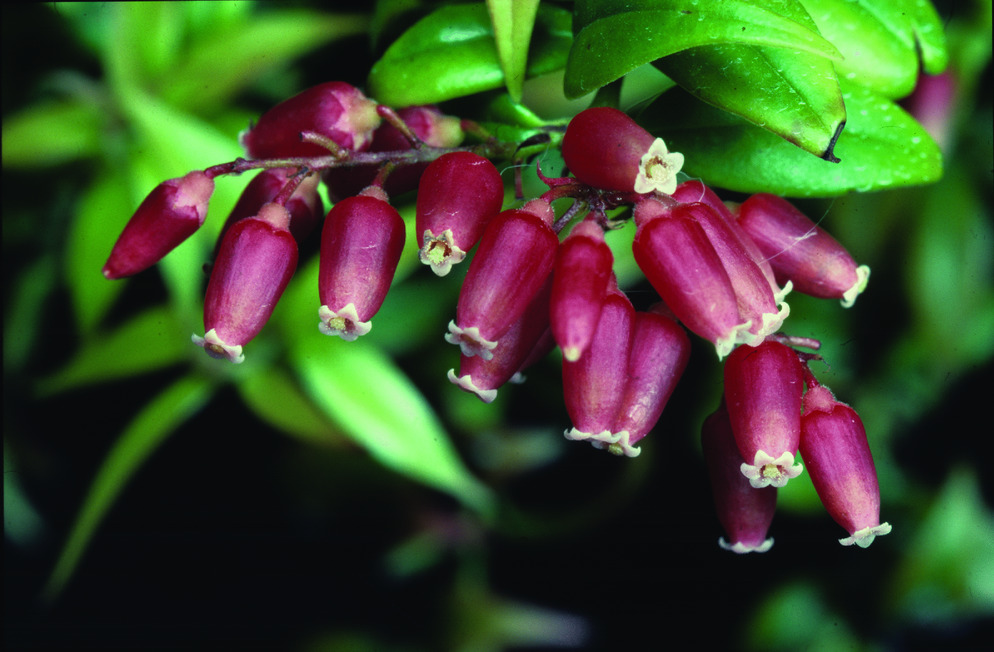
Mostly epiphytic, occasionally terrestrial shrub to 2 m. Twigs spreading, minutely hairy, subdensely to laxly leaved; lateral buds inconspicuous but present even on very young stems, up to 2 mm long, as long as or slightly longer than petioles, narrowly conical, scales with subulate points. Leaves: petiole c. 2 × 0.7 mm, puberulous, clearly grooved above, usually red when fresh; blade 22–30 × 5–10 mm, base broadly tapering to rounded, margin entire or weakly revolute, fringed with minute hairs when very young with one small marginal gland each side 2–3 mm above petiole, lamina minutely and sparsely glandular hairy beneath, otherwise glabrous, midvein strongly impressed above and raised beneath throughout its length, lateral veins and reticulation mostly obscure when fresh, 1–3 lateral veins per side visible when dry, proximal veins high-arching, distal ones short and straight, narrowly ovate to elliptic, apex long acuminate, extreme tip acute to rounded. Inflorescence of racemes from upper axils, sometimes terminal, flowers 4–12, secund; rachis 20–40 mm, red, shortly white-hairy; bracts up to 4 × 1.5 mm, elliptic, acuminate, fringed with small glands and a few simple hairs withering and falling well before anthesis; bracteoles to 1.5 × 0.3 mm, narrowly triangular, inserted just above slightly swollen base of pedicel, minutely hairy. Flowers: pedicels 5–7 mm, red, white-hairy; calyx tube, 1–1.5 mm, globose, hairy, limb spreading, lobes 1–1.5 mm, hairy along a broad middle line outside, with a marginal rows of small sessile glands and with a small or only slightly larger terminal gland; corolla 8–9 × c.2.5 mm, tubular-urceolate, slightly contracted distally, red to pink, scented of almonds, glabrous both outside and inside or with some hairs proximally inside; lobes c.1 mm, pale pink to almost white, reflexing; stamens: filaments slightly dimorphic, alternately 6 and 7 mm, filiform, with lax, long white hairs; anther cells 1 mm, oblongoid, without spurs; tubules 0.2–0.3 mm, as wide as cells, opening obliquely; disc densely white-hairy; style c.8 mm, columnar, densely hairy proximally, glabrous distally. Fruit c.5 mm in diameter, shortly pubescent, with incurved calyx lobes, ripening black.
Distribution
Brunei. Indonesia. Malaysia: Sabah and Sarawak. Widespread on mountains in Borneo.
Ecology
In montane rain forest, 700–1830 m. Flowering: October to March, probably occasionally throughout the year. In cultivation in Scotland, flowering in late spring with occasional flowers at other times of the year.
Conservation assessment
LC. Common on many mountains, some with protected status.
Additional specimens. Brunei. Belait District, Batu Patam, 8 vi 1989, Wong 1045.
Malaysia. Sabah: Sipitang, Meligan F.R., 11 vii 199, Madani SAN.132772; Keningau District, Kimanis road, Crocker Range, 15 i 1984, Argent s.n. (RBGE accession number 19801159); Kimanis to Keningau road, top of pass, 22 ii 1980, Argent 1347; Tambunan District, Gunung Trus Madi F.R., 9 viii 2009, Joel et al. S.150751; Sipitang District, 26 x 1985, Argent 2610854. Sarawak: Samarahan District, Gunung Buri, 17 iii 1982, Argent & Sinclair 82107; Miri Division, Kelabit Highland, Apad Keruma, 2 v 1988, Yii S.55882; Tinjar, Dulit Range, Bukit Dulit, 3 i 1985, Awa & Yii S.46877; Limbang Division, Lawas District, Sungai Belaban, 27 ix 1967, Ilias Paie S.26311; Kapit Division, Balleh, Mengiong, Nanga Entemu, 22 x 1988, Othman et al. S.61781; Kapit, Melinau, Ulu Sungai Sampurau, Bukit Salong, 20 viii 1967, Paie S.25881; 22 x 1998, Othman et al. S.61777; Kapit Division, Belaga, Batang Balui, Batu laga plateau, 15 iii 1989, Yii S.56841; Belaga District, Ulu Sungai Danum, Bukit Robertson, 11 viii 1999 Yii et al. S.81222.
A pretty and distinctive species with small leaves which have a deeply impressed midvein, obscure lateral veins when fresh, and long-acuminate apices.
16. Vaccinium retivenium Sleumer, Bot. Jahrb. Syst. 71: 164 (1940). – Type: Malaysia, Sabah, Mt Kinabalu, 27 vi 1933, Clemens 33711 (holo B†; lecto E, designated here; isolecto A, BO, G, L, NY). Fig. 42.
Vaccinium retivenium. Mount Kinabalu, Sabah. (Photograph: G. Argent.)
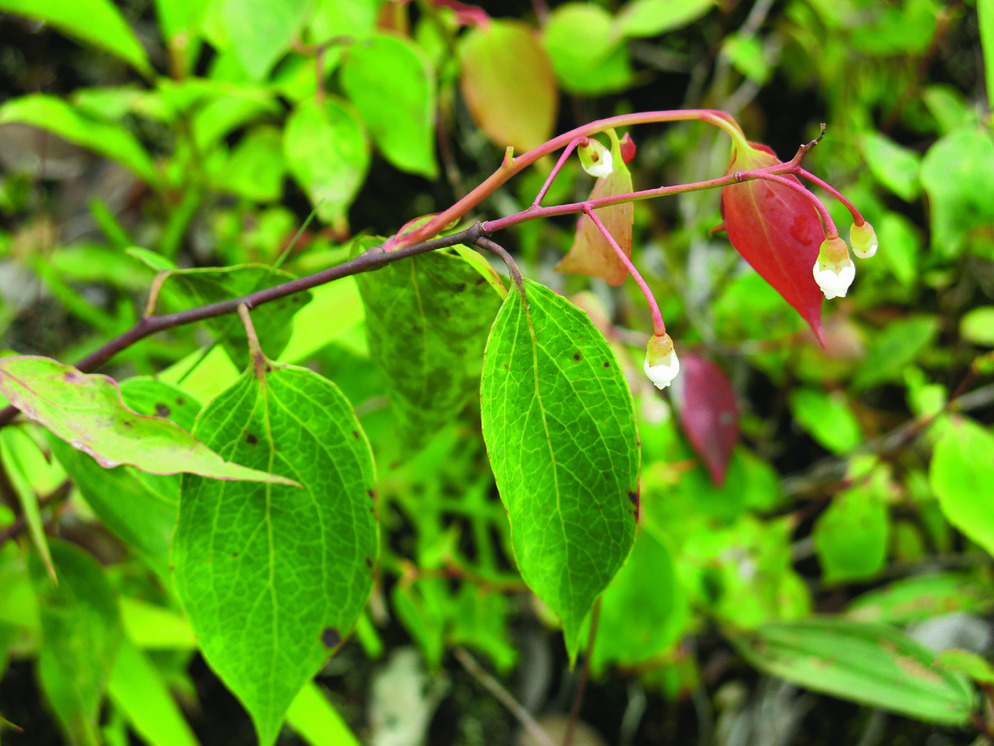
Shrub or small tree to 8 m. Twigs glabrous with lax leaf arrangement; lateral buds up to 1.3 × 1.5 mm, often obscure, hemispherical, glabrous except for a minute fringe of hairs on scale margins. Leaves: petiole 10–20 × 1.5–2 mm, flattened and grooved above; blade 80–140 × 30–70 mm, ovate-elliptic; base broadly attenuate to rounded, extreme base shortly and abruptly contracted, margin flat, entire, with 2–4 marginal glands distributed along proximal half of blade, apex for 15–30 mm caudate-acuminate, acutely pointed; midvein prominent on both sides, with 3 or 4 prominent ascending veins also raised on both sides. Inflorescence of racemes from upper leaf axils, laxly 6- to 10-flowered, the flowers secund; rachis 50–100 mm, without bracts at flowering, glabrous, bracts and bracteoles not seen or recorded. Flowers: pedicels 13–20 × c.1 mm, often curved and swollen distally, glabrous (longer and thicker in fruit); calyx tube 4–5 × 4 mm, narrowly cup-shaped to cylindrical with rounded base, lobes c.1 mm, broadly triangular, obtuse with thick apical gland; corolla c.6 × 5 mm, broadly urceolate to subcampanulate, white, thick and fleshy, glabrous on both sides; lobes c.2 mm, suberect; stamens: filaments c.1.8 mm, linear, densely hairy; anther cells 1.5 mm, oblongoid, shortly 2-spurred dorsally or without spurs; tubules 0.5 mm, nearly as wide as cells, a little incurved, pores oblique; disc low, glabrous; style c.5 mm, glabrous. Fruit subovoid-globose, apex truncate, calyx lobes inflexed, ripening black.
Distribution
Malaysia: Sabah, Mount Kinabalu, Mount Alab, Mount Trus Madi and Mount Lotung; Sarawak, Mount Kalulong and Mount Pagon.
Ecology
In montane mossy forest, 1000–2500 m. Flowering and fruiting: throughout the year.
Conservation assessment
LC. Although not known to be widely distributed, it is locally abundant and growing in protected areas.
Additional specimens. Malaysia. Sabah: Ranau District, Mamut Copper Mine, 30 v 1984, Beaman et al. 9963; Mamut, 11 iv 1988, Amin et al. SAN.125151; Kota Belud district, Gunung Kinabalu, 20–27 ix 1977, Gardner 134; Kinabalu, 30 iii 1980, Argent 1577; Kinabalu, Mesilau Cave, 25 ii 1980, Argent 1400a; Crocker range, Tambunan road, Km 55; Gunung Alab, 18 ix 1987, Madani & Majawa SAN.119255; Gunung Alab, 21 x 1999, Davies et al. SJD.99254; Tambunan District, 25 vi 2012, Leong et al. PL436a; Alab, 29 iii 1980, Argent 1589; Crocker Range, 4 ix 1983, Beaman et al. 6886; 8056; Gunung Trus Madi, 5 viii 2009, Pius & Posta S.146438. Sarawak: Limbang Division, Limbang, summit of Bukit Pagon, 17 viii 1984, Awa & Lee S.47933; Miri Division, Bario, Ulu Baram path to Pa'Ukat, 1 vii 1964, Anderson S.20224.
This is a distinctive species with its long petioles and pedicels displaying a very lax habit. The bracts and bracteoles have not been described, as they are totally lacking from the herbarium specimens examined and apparently wither and fall extremely early in development of the inflorescence. A record of this species from East Kalimantan (Beaman et al., Reference Beaman, Anderson and Beaman2001) remains very doubtful, since the collection was made far from its otherwise restricted northwesterly distribution.
17. Vaccinium sarawakense Merr., J. Straits Branch Roy. Asiat. Soc. 76: 105 (1917). – Vaccinium laurifolium (Blume) Miq. var. sarawakense (Merr.) Sleumer, Blumea 11: 102 (1961). – Type: Malaysia, Sarawak, near Kuching, ii–vi 1914, Native Collector B.S. 2177 (lecto PNH†, designated by Sleumer, Reference Sleumer1961, p. 102; isolecto A, n.v. K).
Vaccinium hosei Merr., J. Straits Branch Roy. Asiat. Soc. 76: 106 (1917). – Type: Malaysia, Sarawak, Baram, Hose 236 (lecto PNH†, designated by Sleumer Reference Sleumer1961, p. 102; isolecto BM, K).
17a. Vaccinium sarawakense subsp. sarawakense. Figs 43, 44.
Vaccinium sarawakense subsp. sarawakense. RBGE accession number 19851909. A, Flower (scale bar, 5 mm); B, bract (scale bar, 5 mm); C, stamens and style with disc (scale bar, 5 mm); D, young inflorescence (scale bar, 5 mm); E, habit (scale bar, 5 cm). (Illustration: Claire Banks.)

Vaccinium sarawakense subsp. sarawakense. Cultivated RBGE accession number 19851908; Nabawan, Sabah. (Photograph: G. Argent.)
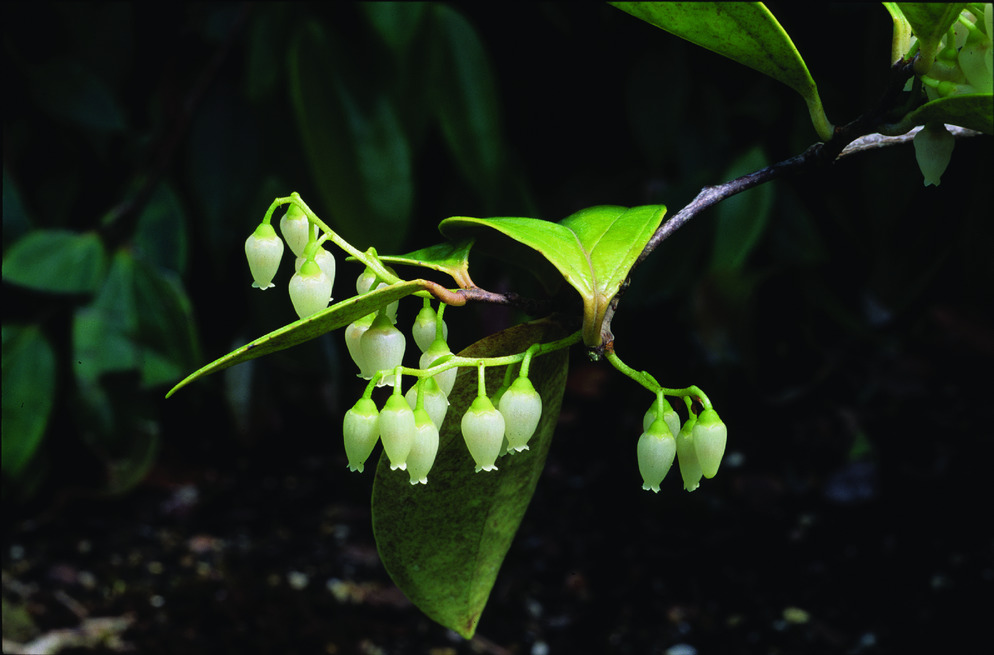
Shrub, climbing to c.7 m. Twigs rounded, densely covered with appressed glandular hairs which are at first transparent, later turning brown, also with minute patent hairs, becoming glabrescent, laxly leaved; lateral buds mostly obscure, occasionally prominent, projecting from defoliate axils, hemispherical, up to 1 mm in diameter, scales broader than long with a few glandular hairs abaxially and with a minute glandular fringe on margins. Leaves: petiole 4–6 × c.2 mm, shallowly grooved, glandular hairy when young; blade 70–110 × 25–50 mm, elliptic to broadly elliptic, occasionally ovate, base broadly to narrowly attenuate, margin narrowly cartilaginous, entire, flat, marginal glands a single pair at c.1 mm from petiole, often slightly protruding, when young, lamina with appressed glandular hairs both above and below, midvein impressed above and prominent below, lateral veins 2 or 3 per side spreading at an acute angle, one pair from just above base ascending into upper part of leaf but disappearing before margin, upper pair shorter but similar, reticulation obscure, apex shortly attenuate, acute, extreme tip sometimes rounded. Inflorescence of racemes from upper axils, occasionally from defoliate axils, flowers 6–12, secund; rachis 25–50 mm, rounded, densely appressed glandular-hairy; bracts 6 × 2.5 mm, glabrous with indistinct midvein and cucullate apex; bracteoles minute, c.0.4 mm, broadly ovate with terminal gland. Flowers: pedicels 2.5–4 mm, less densely brown glandular-hairy than rachis; calyx tube c.1 × 2.4 mm, hemispherical, with just a few glandular hairs, limb erect, deeply lobed, lobes 1.5 × 1.6 mm, triangular, glabrous with no marginal glands or hairs but a faint translucent cartilaginous border, with a conspicuous but small, terminal gland; corolla tubular-urceolate 7–8 × 4–5 mm, glabrous outside, sparsely hairy inside, white or pink, scented; lobes c.1 × 1.5 mm, ovate, recurved; stamens: filaments c.2.3 mm, subulate, glabrous distally, long-hairy and broadening at base where adherent to disc; anther cells 0.8 × 0.6 mm, oblongoid, with short spurs, tubules c.1.2 mm, slightly narrower than cells, truncate, pore circular, margin reflexing, without gland-tipped hairs; disc glabrous; style c.6.5 mm, glabrous. Fruit not seen.
Distribution
Malaysia: Sabah, Nabawan; Sarawak, Kuching Division, near Kuching, Miri Division, Kelabit Highlands.
Ecology
Epiphytic in kerangas (heath forest) and along rivers, 300–600 m. This subspecies is a weak climber with arching stems rooting freely wherever they strike a suitable substrate. Flowering: March and May in the wild, March, December and January in cultivation at the Royal Botanic Garden Edinburgh.
Conservation assessment
It is suspected that the habitat of this species near Kuching has already been destroyed. In the Nabawan forest, it is not a common plant and this area may also be under threat of development, although the poor, acid nature of the soil may protect it.
Additional specimens. Malaysia. Sabah: Keningau, district, Nabawan, 16 ii 1996, Argent s.n. (RBGE accession number 19851908); Nabawan, 25 v 1987, Krispinas S.119381. Sarawak: Bintulu Division, Bintulu, Bukit Urang, 23 ii 1961, Brunig S.8693.
This subspecies is the only member of Vaccinium sect. Bracteata which might be mistaken for a species of Rigiolepis due to its climbing habit. It has not been reported with a basal woody tuber, however, nor does it have large lenticels and the flowers are completely consistent with Vaccinium sect. Bracteata. See further discussion of this species below.
17b. Vaccinium sarawakense subsp. montanum Argent, subsp. nov. This differs from the type subspecies in the erect habit, not climbing, the lack of glands on the apex of the calyx lobes, the styles becoming exserted from the corolla and the montane habitat. – Type: Sabah, Keningau District, track from Keningau past Crocker Range headquarters across range, 17 x 1999, Davies et al. SJD.99145 (holo SAN; iso A, E, KEP). Fig. 45.
Vaccinium sarawakense subsp. montanum Argent. Type, Davies et al. 99145. Crocker Range, Sabah. (Scan: Robyn Drinkwater.)
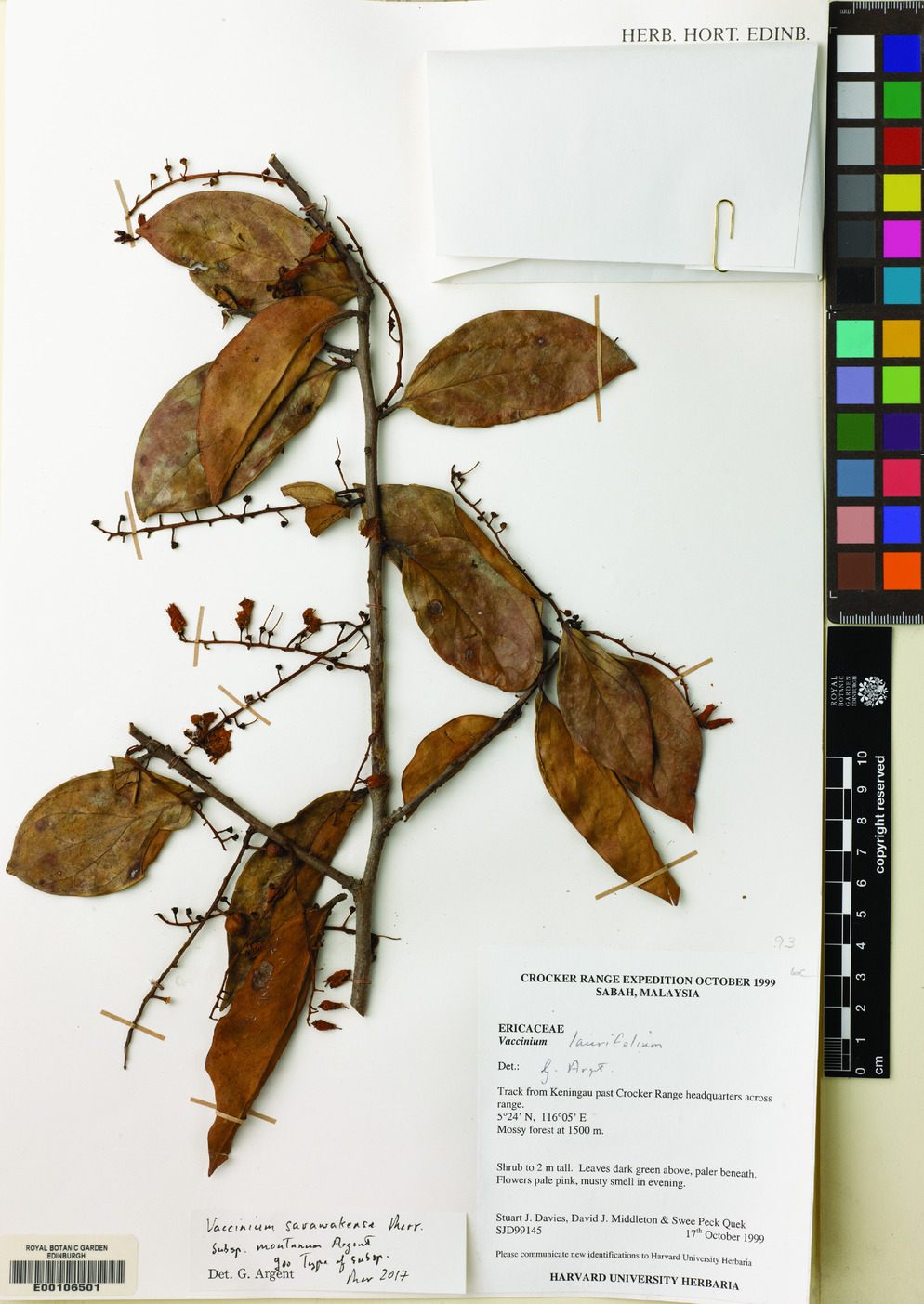
Free-standing shrub to 2 m or small tree. Twigs robust, 3–5 mm in diameter, rounded or angular, indumentum of short, curved, brown glandular hairs which are quickly eroded, stems then glabrescent, laxly leafy; lateral buds 2–3 mm, rounded on young stems, sometimes narrowly pointed, often standing out at right angles on older, leafless portions. Leaves: petiole c.5–6 × 2 mm, scabrous, at first with glandular hairs, grooved when dry; blade 70–120 × 40–50 mm, elliptic, base tapering and shortly decurrent, midvein impressed above, strongly raised beneath, lateral veins 3–5, arising in proximal half of leaf, ascending to upper part of leaf, slightly raised above, reticulation obscure or somewhat distinct above, margin, entire, flat or only narrowly revolute, apex acute. Inflorescence of racemes from leafy axils, 7- to 20-flowered; rachis 60–80 mm long, at first densely covered in short brown curved glands, without simple hairs; bracts and bracteoles not recorded. Flowers: pedicels 2–3 mm, glandular hairy; calyx tube c.1 × 1 mm, hemispherical, densely covered with brown glandular hairs, 5-lobed, lobes c.1 × 1 mm, triangular, glandular hairy abaxially, and ciliate along margins, with simple hairs, lacking both lateral and terminal glands; corolla c.10 × 3 mm, pale pink, musty smelling in the evening, ovoid-urceolate, inflated below, somewhat contracted distally, glabrous outside and inside; lobes up to 1 mm, becoming reflexed; stamens: filaments 3 mm, linear, long-hairy at base; anthers c.0.8 mm, cells broadly oblongoid, echinulate, with distinct spurs to 0.3 mm, tubules 10 mm, narrower than cells, opening by slightly oblique, round pores, without teeth; disc glabrous; style to 8.5 mm, filiform, glabrous. Fruit not recorded.
Distribution
Malaysia: Sabah and Sarawak.
Ecology
Submontane forests recorded both terrestrial and epiphytic. (900–)1200– 1500 m. Flowering: October to November.
Conservation assessment
LC. Although there are no data on the specimens indicating abundance or frequency, this subspecies has been collected from well-protected forests on Kinabalu and the Crocker Range.
Additional specimens. Malaysia. Sabah: Kota Belud District, Gunung Kinabalu, Tinompok, 7 xi 1931, Clemens 27123; Kinabalu, Penibukan, 7 ii 1933, Clemens 31525: Penibukan 13 iii 1933, Clemens 32129; Lahad Datu District, Gunung Danum, east ridge, 18 iii 1987, Argent et al. 1987146. Sarawak: Miri/Limbang Division, Kelabit Highland, Apad Keruma, 4 v 1988, Ching S.55944; Limbang Division, Gunung Murud, Sungai Rabatek, 1 v 2002, Mahmud et al. S.88259; Miri Division, Lawi, Bario, Ulu Sungai Limbang, 12 viii 1985, Awa & Lee S.50783; Bario, Batu Lawi, 17 viii 1985, Awa & Lee S.50908; Gunung Murud, Lepo Bunga, 26 iii 1999, Julaihi et al. S.70802.
The essential differences between Vaccinium laurifolium var. laurifolium and V. laurifolium var. sarawakense, according to Sleumer (Reference Sleumer1966–1967), are the presence of numerous short brown glandular hairs on the rachis (and sometimes on the pedicels) and the presence of glands on the apices of the calyx lobes. These glands are consistently present in the Nabawan plant but can also be found on the Javan specimens (they are not mentioned in Sleumer's description), although their absence is used in his key to the varieties (Sleumer, Reference Sleumer1966–1967). As far as can be told from the specimens examined, subspecies sarawakense has apical glands on the calyx lobes and subspecies montanum does not. The biggest difference noticed both in the wild and in cultivation is that the Nabawan plant is a slender climber, as opposed to both the Javan plants, and apparently subspecies montanum, which are rigidly robust erect shrubs or trees. There are minor differences in the leaves, subspecies sarawakense having leaves tapering to an attenuate base with a pair of glands on the margin just above the junction with the petiole. The Javan specimens have decurrent bases to the leaves with the basal glands on the decurrent portions of the leaf blades and so these appear almost as if on the petioles, and this structure is very similar to that which occurs in subspecies montanum. The petioles themselves are about twice as long as broad in the Nabawan specimens but often more than 3 times as long as broad in the Javan specimens which is again similar to subspecies montanum. The axillary resting buds (not described by Sleumer, Reference Sleumer1966–1967) are quite different in the geographical forms, the Javan plants (Javan Vaccinium laurifolium) having shortly conical buds to c.2 mm long with acute apices and the Nabawan plant having rounded, hemispherical buds less than 1 mm long, while subspecies montanum has mostly rounded buds on young stems occurring on the older leafless portions, but the buds can be narrowly pointed, often characteristically standing out at right angles in sterile specimens. The anthers of Vaccinium sarawakense and V. laurifolium also differ, the tubules being shorter than the cells in V. laurifolium (cells 1–1.5 mm, tubules 0.5–0.8 mm; Sleumer, Reference Sleumer1966–1967) versus cells 0.9 mm, tubules 1.2 mm (RBGE accession number 19851909), i.e. distinctly longer than the cells; they also only flare at the extreme apex and have not been observed with the tooth-like extensions so common in V. laurifolium on other islands. There would also appear to be a distinct difference in the ecology of taxa in this complex, Vaccinium laurifolium being a montane plant “flowering abundantly between 2000 and 3000 m” (Sleumer, Reference Sleumer1966–1967) although recorded sterile as low as 800 m. The Nabawan plant (subspecies sarawakense) was fully fertile in the podzol forest at 600 m, and this is considered to be a lowland subspecies, whereas subspecies montanum has been collected flowering at around 1500 m and would appear to be a montane plant like Javan Vaccinium laurifolium.
It is felt that both Bornean forms are best kept separate from Vaccinium laurifolium and maintained as subspecies at least until much more is known about this complex. The Bornean subspecies share the brown glandular indumentum on the inflorescences and very similar anther structure. The status of other varieties of Vaccinium laurifolium which are outside the scope of this study are open to question, and I have presently excluded Vaccinium laurifolium (Blume) Miq. var. glanduligerum Sleumer as a Sumatran form of this complex, the type (Steenis 9962; BO, K, L), having been collected in Aceh Province at the confluence of the rivers Kapi and Aunan. There are still problems in interpreting what may be termed the Vaccinium laurifolium complex, and further observations are certainly needed. Merrill's name Vaccinium sarawakense has been resurrected after comparing herbarium specimens and especially the living material growing at the Royal Botanic Garden Edinburgh, where we have V. laurifolium var. laurifolium cultivated from Javan material (RBGE accession numbers 19680822 and 19680858) and a collection that keyed in Sleumer (Reference Sleumer1966–1967) to V. laurifolium var. glanduligerum from Nabawan in Sabah (RBGE accession number 19851909).
18. Vaccinium simulans Sleumer, Biol. Jahrb. Syst. 71: 165 (1940). – Type: Malaysia, Sabah, Mt Kinabalu, above Tenompok, 25 iv 1932, Clemens 29387 (lecto B†, designated by Sleumer, Reference Sleumer1961, p. 72; isolecto A, BO, E, K, L, NY, SING).
Key to the varieties
1a. Rachis glabrous___________________________________2
1b. Rachis hairy_______________________________18b. hirtirachis
2a. Pedicels 1–3 mm, at flowering__________________________18a. simulans
2b. Pedicels 3–6 mm, at flowering__________________________18c. leptopodum
18a. Vaccinium simulans var. simulans
Tree to 15 m, terrestrial shrub or occasionally epiphytic. Twigs thick, glabrous, young parts angular, laxly leaved; lateral buds globular, 2–3 mm in diameter, scales ovate to subcircular, with rounded, obtuse apex, when very young covered with glandular hairs and subpersistently fringed with short white hairs. Leaves: petiole 4–8 × 1.5–2 mm, flattened, grooved above; blades 40–80 × 25–45 mm, oblong-elliptic or subobovate; base tapering, apex very broadly attenuate and obtuse or rounded, margin entire, subrevolute, the pair of basal marginal glands remote from petiole and subinconspicuous, lamina stiff, glabrous except for sparse glandular hairs on underside, which disappear leaving small punctate spots in mature leaves, midvein impressed above, thick and prominent beneath, proximally as wide as petiole, gradually tapering and becoming less prominent distally, lateral veins 1 or 2 basal per side, at a wide angle, with 4–6 widely spreading, pinnately arranged, all veins ascending distally and a little raised above, obscure beneath, reticulation hardly visible. Inflorescence of racemes from upper leafy axils, spreading, subdensely many-flowered, flowers secund; rachis 40–100 mm, thick, angular, glabrous without bracts; bracts and bracteoles not seen or reported. Flowers: pedicels 1.5–3 mm, thick, glabrous; calyx tube hemispherical, 1–1.5 mm, limb spreading, deeply 5-lobed, lobes triangular, obtuse, 1 mm, with a small apical gland and a row of 2 or 3 smaller sessile marginal glands on each side which tend to disappear as flower ages; corolla urceolate, fleshy, white or pink sometimes tinged with green, glabrous outside, shortly hairy proximally inside, 4–5 × 2.5 mm; lobes to c.1 mm, obtuse, reflexed; stamens: filaments 1.8 mm, subulate, long-hairy; anther cells oblongoid, very granular, 0.6 mm, with 2 short dorsal spurs; tubules divergent, cylindrical, with short, dark, gland-tipped hairs, 0.5 mm, narrower than cells, pores suboblique apically; disc hairy to glabrescent; style to 4 mm, thick, densely subpatently hairy in proximal half. Fruit not seen.
Distribution
Indonesia, West Kalimantan. Malaysia: Sabah, Mount Kinabalu.
Ecology
In primary ridge forest, terrestrial or epiphytic, sometimes recorded as a strangling climber, 1220–2000 m elevation. Common. Flowering: March to June.
Conservation assessment
LC. Well protected in the montane forests of Gunung Kinabalu National Park.
Additional specimens. Indonesia. West Kalimantan: Serawai, SW foothills of Bukit Raya, 22 x 1995, Church 3/96; east Gunung Meratus Plateau, 10 iv 2009, Keßler et al. PK 2851 (vel aff.).
Malaysia. Sabah: Gunung Kinabalu, Mesilau River, near Mesilau cave. 14 vii 1984, Beaman et al. 10680; West Mesilau River, v 1995, Clausing 59; Kinabalu, 25 iii 1982, Sinclair 197; Ranau district, East Mesilau River, Mesilau Cave, 14 vii 1984, Beaman et al. 10680.
A distinctive species with the abaxial surface of the leaves smooth and only the midvein raised, in contrast to Vaccinium pachydermum, which has both midvein and lateral veins distinctly raised abaxially. See further comments below under Vaccinium simulans var. hirtirachis. In Flora Malesiana (Sleumer, Reference Sleumer1966–1967), this species is described as a Kinabalu endemic. It is now known to be much more widely distributed. A sterile specimen Keßler et al. PK 2851 (E) from East Kalimantan, plateau of Mount Meratus, agrees well but is very isolated from other localities and needs better material for reliable evaluation. This Keßler specimen could also be another record of Vaccinium ceraceum, although the leaves are larger. There are also specimens collected on the peak of Balikpapan (East Kalimantan) (Kostermans 7335 and 7605) which agree well vegetatively, but there are no flowers and the fruits are galled. Descriptions on herbarium sheets reporting this species as a ‘strangler’ are highly doubtful. It is unlikely to be truly strangling when growing epiphytically.
18b. Vaccinium simulans var. hirtirachis Argent, var. nov. Differing from the other varieties in having a distinctly hairy rachis and scattered or abundant hairs also on the pedicels. – Type: Malaysia, Sabah, Gunung Kinabalu, Marai Parai, 30 iii 1933, Clemens 32458 (holo E, iso SAN). Fig. 46.
Vaccinium simulans var. hirtirachis Argent. Type; Marai Parai, Mount Kinabalu, Sabah. (Scan: Robyn Drinkwater.)
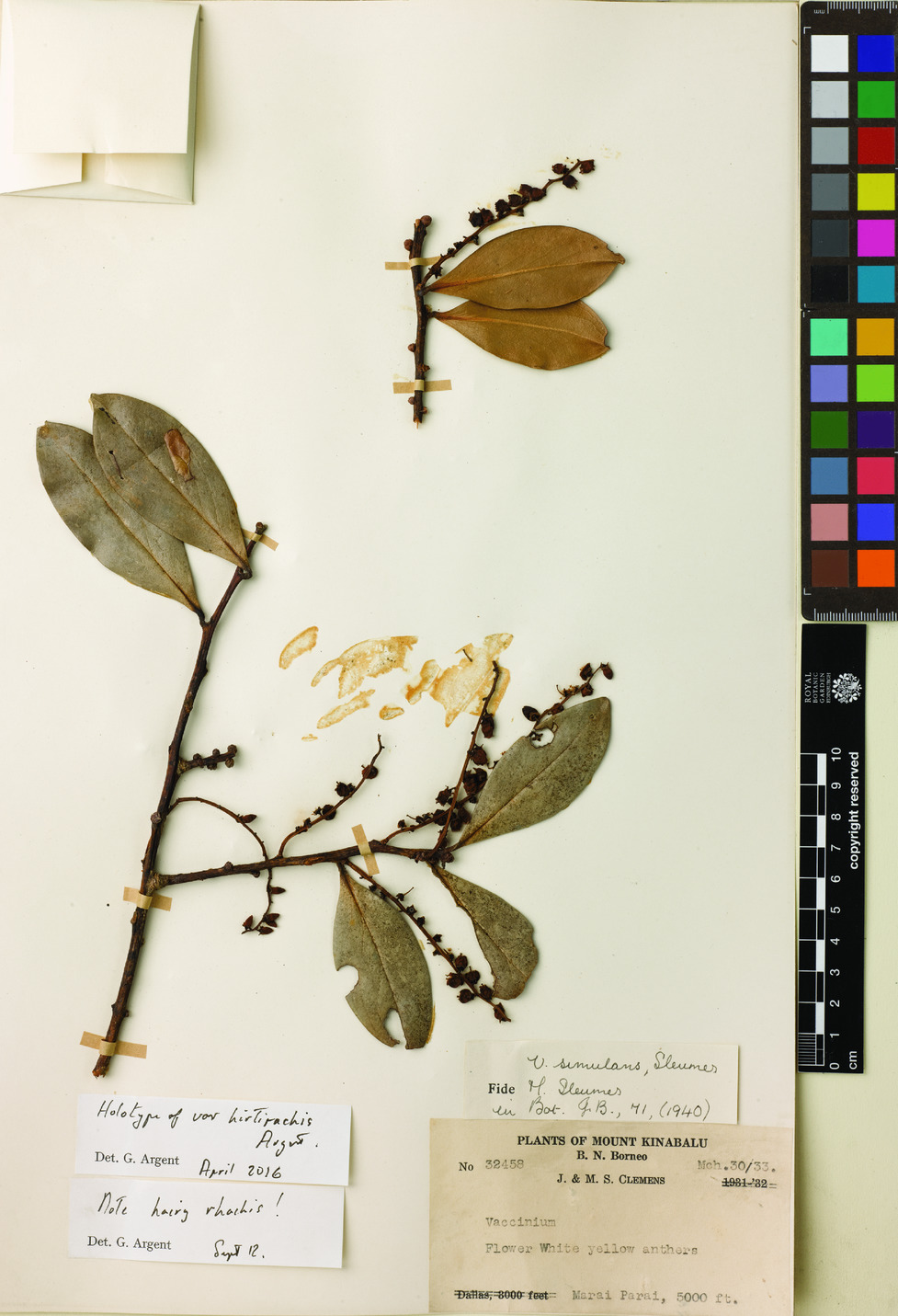
Bracts green, elliptic, concave, up to 10 × 4 mm, with appressed brown glandular hairs abaxially and a fringe of short white hairs near the apex, otherwise glabrous. Rachis distinctly hairy; pedicels to 15 mm, laxly to densely hairy.
Distribution
Malaysia: Sabah, Gunung Kinabalu only; Sarawak.
Ecology
Growing together with the type variety. Flowering: February and March.
Additional specimens. Malaysia. Sarawak: Limbang District, Gunung Murud, 28 ii 1983, Burtt & Martin s.n. (RBGE accession number 19762031); Kapit Division, Mujong, Ulu Sungai Temalad, Hose Mts, Summit of Dacite Mountain, 22 iii 1964, Banying ak Nyudong S.17649.
On morphological grounds, Vaccinium simulans would appear to be closely related to Vaccinium loranthifolium Ridl. from Peninsular Malaysia. It is somewhat doubtful whether this is really a strangling climber rather than just an epiphyte as recorded on some specimens. Vaccinium simulans Sleumer and Vaccinium pachydermum Stapf can be difficult to distinguish. In Vaccinium simulans, the pedicels are rarely > 3 mm long (except for var. leptopodum and var. hirtirachis known from Gunung Kinabalu and Sarawak), the lateral veins viewed from the underside of the leaf are hardly raised and often obscure, and the young stems are glabrous. In Vaccinium pachydermum, the pedicels are > 5 mm long, the lateral veins viewed from the underside of the leaf are distinct and clearly raised, and the young stems are pubescent, this pubescence often turning black with contamination of other organisms.
18c. Vaccinium simulans var. leptopodum Sleumer, Blumea 11: 72 (1961). – Type: Malaysia, Sabah, Mt Kinabalu, Tenompok, 10 vi 1932, Clemens 29787 (holo B†; lecto E designated here; isolecto A, BO, K, L, NY, SING).
Flowers: pedicels more slender than in the type, 3–6 mm at flowering; calyx smaller than in the type variety, the limb lower more shortly 5-lobed or merely undulate; corolla 5 mm long.
Distribution
Malaysia: Sabah, Gunung Kinabalu only, growing with the type variety from 1065–1585 m.
Ecology
As for the type variety. Flowering: June.
Conservation assessment
LC. Protected as for the type variety.
19. Vaccinium stenanthum Sleumer, Blumea 12: 129 (Reference Sleumer1963). – Type: Brunei, Batu Ketam, Ulu Sungai Ingei, 19 vi 1959, Ashton BRUN 5603 (holo L, iso SAR).
Shrub or small tree up to 5 m. Twigs slender, glabrous or minutely hairy, leaves laxly arranged; lateral buds minute, up to c.1 mm, conical, less than half the length of subtending petioles. Leaves: petiole 2–3 × c.1 mm, rugulose, glabrous; blade 35–60 × 15–40 mm, obovate to elliptic, base broadly tapering, margin slightly revolute especially towards base, with 1 or 2 minute impressed marginal glands on each side just above petiole, lamina glabrous except for lax glandular hairs underneath, apex broadly obtuse to rounded, midvein weakly impressed above in proximal half and minutely raised below throughout its length, with 2 pairs of high-arching veins from near base and often a further pair emanating from above middle of leaf, all veins slightly raised above, more prominently so beneath, reticulation finely distinct, minutely raised on both sides when dry. Inflorescence of lax racemes from distal axils, flowers 4–8; rachis 20–40 mm, slender, angular, laxly patently hairy and with minute globular brown glands; bracts and bracteoles not seen or described, deciduous before flowering. Flowers: pedicels 3–4 mm, with patent hairs and glands as on rachis; calyx densely hairy and with a few subspherical brown glands, tube 1.5–2 mm, hemispherical, lobes ovate-triangular, subacute to obtuse, terminated by a thick apical gland and with several lateral glands on each side in addition to ciliate hairs; corolla narrowly tubular, 6–8 × 2.5–3 mm, white, fragrant, glabrous outside, densely hairy proximally inside; lobes c.1 mm, obtuse, becoming reflexed; stamens: filaments c.1 mm, linear, densely hairy throughout; anther cells c.0.4 mm, broadly oblongoid, echinulate, with dorsal spurs to 0.2 mm; tubules c.0.2 mm, cylindrical, slightly narrower than cells, and held at an angle to them, with several stalked or subsessile gland-tipped hairs, pores round, transverse; disc densely appressed hairy; style c.8 mm, hairy almost to apex. Fruit globose, c.5–6 mm in diameter.
Distribution
Brunei. Malaysia: Sarawak.
Ecology
Occurring at low elevation from 180 m to possibly 1000 m. In sandy, acid habitats, mostly terrestrial. Flowering: January and June.
Additional specimen. Malaysia. Sarawak: Kuching Division, Bako National Park, 4 i 1959, Brunig S.10410.
Sleumer (Reference Sleumer1963) lists several specimens which have not been checked. I have modified the description with characters from Brunig S.10410, which has good flowers but agrees in most respects with the species as described by Sleumer (Reference Sleumer1966–1967). Apart from the obviously erroneous measurements of the anthers, the main difference from the type description is the dense hairs inside the corolla. Superficially Brunig S.10410 looks similar to Vaccinium clementis but the lowland habitat is quite different to that montane species and the axillary buds are much shorter than the petioles subtending them, as in V. bancanum. From Vaccinium bancanum, this species differs in the coarsely hairy calyx tube, style hairy almost to the stigma and the shorter anther tubules.
Addendum
Only one new combination is required to recognise Rigiolepis outside Borneo and encompass the total number of species at present recognised.
Rigiolepis henrici (Sleumer) Argent, comb. nov. – Vaccinium henrici Sleumer, Bot. Jahrb. Syst. 71(1): 161 (1940) – Type: Indonesia, South Sulawesi, Lombasang, 1100 m, 4 ix 1931, G. Heinrich 68 (holo B).
When Vaccinium acuminatissimum Miq. is treated as a species of Rigiolepis, it must be called Rigiolepis lanceolata (Blume) J.J.Sm., Blumea 1: 300. 1935.
Acknowledgements
The Royal Botanic Garden Edinburgh is supported by the Scottish Government's Rural and Environment Science and Analytical Services Division. The author is grateful to the RBGE for continued research facilities and to Dr Toby Pennington for his support. I am indebted to the Sibbald Trust for funding some herbarium visits on which this work is based. I thank the curators of all the herbaria visited in conjunction with this work (BM, BO, FRIM, K, KUCH, L, SAN and SING). I am grateful to Professor Chris Jeffree for advice on interpreting the scanning electron micrographs, and Professor John McNeill for valuable nomenclatural advice. Thanks go to Peter Wilkie for help in interpreting some of the old herbarium labels and Mark Newman for his expert advice given freely whenever needed. Special thanks go to Claire Banks for providing most of the beautiful pen-and-ink illustrations, these funded by the James and Eve Bennett Trust and RBGE, also to Frieda Christie for the scanning electron micrographs and Robyn Drinkwater for scanning images. The library staff are always especially helpful, and I am particularly indebted to Graham Hardy. I will always be especially grateful to Tony Lamb and Anthea Phillipps, who have organised and accompanied me on many field visits, as also to the many local foresters and villagers who have accompanied me in the field. A final thank you to the Garden staff, especially Tony Conlon, Paulina Maciejewska-Daruk and Helen Yeats for skilfully growing plants which are not always the most rewarding horticulturally, and for drawing my attention to features which I might otherwise have missed.