The distribution of power in the US House of Representatives has continually ebbed and flowed between parties and their leaders and committees and their chairs (Bensel Reference Bensel2000). Most recently, the leadership hierarchy shifted from committee to party leadership that coincided with the 1970s legislative reforms (Rohde Reference Rohde1991). The 1920s through 1970s were known as the prereform or committee government era. Committees and their chairs controlled the legislative process so much that “baron” and “czar”—once reserved to describe domineering Speakers—resurfaced to describe the extent of control wielded by some chairmen (Galloway Reference Galloway1953; Huntington Reference Huntington and Truman1973). Conversely, the 1980s saw centralized party leadership reassert itself at the helm of the legislative process in what is now called the party government era (Rohde Reference Rohde1991; Sinclair Reference Sinclair1983, Reference Sinclair1997). While most agree that a shift in the locus of power from committee chairs to party leaders took place, we know less about how these leaders operated during their reign.
This study examines the behavior of party leaders and committee chairs using six case studies of leadership before and after the 1970s reforms. Drawing from conclusions made by scholars about the changing locus of decision making, the key research question is how have party leaders and committee chairs operated in the public sphere? What sort of tasks illustrates their differences? When is one set of leaders more or less visible? As the locus of power moved from committee leadership to party leadership, I argue that we should expect to observe changes in the behavior of these leaders.
Using an approach developed by David Mayhew, I collect and code leadership “actions” from the front pages of the Washington Post newspaper. Actions are defined as “moves by members of Congress,” or more simply, when members of Congress “do something” (Mayhew Reference Mayhew2000: x, 37), and I use them as indicators of leadership behavior. Examples of actions include introduction of legislation, making a speech, and meeting with the president. Using the Washington Post's reporting on public affairs, six case studies show the types of maneuvers party leaders and committee chairs engaged in and provide evidence consistent with the conventional wisdom that their role changed. Specifically, committee chairs performed more actions relative to party leaders in each of the committee era case studies and party leaders' actions were greater than chairs following the reforms. The data also reveal that committee chairs led by legislating in the prereform Congresses. More recently, party leaders have operated by taking stands. These findings contribute to our knowledge of the reforms by showing a change in the distribution of influence through leadership actions.Footnote 1 Beyond demonstrating leader behavior, this study identifies a unique connection that party leaders have with the president that is found in both eras. While others have recognized this link, it has not been shown in relation to committee chairs. This is especially significant for identifying an area of actions where party leaders lead in the age of strong committees.
These patterns are uncovered with an original data set identifying 3,163 actions performed by party leaders and committee chairs in six Congresses: 1949–50 (81st), 1965–66 (89th), 1981–82 (97th), 1987–88 (100th), 1995–96 (104th), and 2009–10 (111th). These cases cover pre- and postreform periods.Footnote 2 In the analysis that follows, the general “theoretical” consensus of scholars concerning the nature of leadership is tested. If the distribution of influence moved from committee leadership to party leadership, I argue a change in the number and type of actions that these leaders perform should be apparent. An action-based definition of leadership allows me to test the leading perspectives about the nature of congressional leadership. “Actions” provide a systematic and quantifiable method for comparing the behavior of party leaders and committee chairs before and after the reforms.
The next section provides a brief overview of how scholars typically characterize party leaders and committee chairs. My action-based leadership hypotheses are framed by these theoretical perspectives. The third section specifies the methodology for collecting leadership actions. The fourth section presents the data in descriptive fashion and reveals a shift in leadership behavior and level of activity. Finally, the conclusion discusses the importance of this type of research. Namely, this unique data set, coupled with existing theoretical foundations, can enrich our understanding of the impact of reforms for how party leaders and committee chairs operate in their positions and with the president.
Dominant Theoretical Perspectives and Hypotheses
A generation of scholars writing about the post–World War II, prereform era described the strength of committee chairs who ruled the legislative process with near autonomy. Committee chairs controlled the legislative agenda and outcomes because their assignments were essentially guaranteed through the norm of seniority (Polsby et al. Reference Polsby, Gallaher and Rundquist1969: 789). They received the institutional tools to advance legislation they favored or block legislation they opposed (Polsby et al. Reference Polsby, Gallaher and Rundquist1969). Though committee chairmen did not enjoy unlimited authority, the success or failure of the committee's output was largely theirs (Manley Reference Manley1970; Rudder Reference Rudder, Dodd and Oppenheimer1977). Party leaders, including the Speaker (Bolling Reference Bolling1974), found it difficult to pressure chairs to move on bills that advanced party proposals and are typically described as chairs' weaker counterparts operating under decentralized committee government (Galloway Reference Galloway1953; Gross Reference Gross1953). These were classic “textbook” Congress operations and reason to portray chairs as the predominant leaders of the House (Shepsle Reference Shepsle, Chubb and Peterson1989).
Thus, studies typically depicted chairs at the helm of the legislative process in the prereform era until the 1970s reforms when scholars began to reevaluate their theories.Footnote 3 The reforms created a short period of subcommittee government that further decentralized the legislative process (Dodd and Oppenheimer Reference Dodd, Oppenheimer, Dodd and Oppenheimer1981), but the end result was centralized party government and leadership (Rohde Reference Rohde1991; Sinclair Reference Sinclair1983).
Nearly a decade after the reforms were implemented, the center of legislative power shifted away from committee chairs to a centralized party leadership. Meanwhile, reformers centralized the legislative process and enhanced party leaders' powers, both inside and outside of the House, which promoted the majority's agenda (Rohde Reference Rohde1991; Sinclair Reference Sinclair1983; Smith Reference Smith1989). I frame my prereform era expectations from the leading themes in the literature that predicate dominant chairs relative to party leaders and hypothesize: Committee chairs will perform more actions than party leaders in the committee government era.
As party leaders regained influence in the legislative process, studies followed by focusing on these leaders and the resources they utilized to advance their policy agendas (Cox and McCubbins Reference Cox and McCubbins1993; Rohde Reference Rohde1991; Sinclair Reference Sinclair1995). Party leaders responded to the wishes of an internally cohesive Democratic caucus by making committee and chair assignments based on loyalty to the party, not seniority. The party's rank-and-file provided the leadership with a variety of tools needed not only to lead, but also to advance the party's legislative agenda.
Comparatively, as chairs' influence slowly eroded, party leaders' dominance slowly rose. Initial accounts asserted that party leaders exercised caution in using their newly acquired, yet limited, resources amid a fragmented House (Dodd and Oppenheimer Reference Dodd, Oppenheimer, Dodd and Oppenheimer1985); however, there is little disagreement that a strong centralized leadership characterizes the contemporary House (Strahan Reference Strahan, Schickler and Lee2011). Taking the now fully entrenched nature of party government and the diminished powers of chairs into account, I hypothesize the following about the postreform era: Party leaders should perform more actions than committee chairs in the party government era.
Finally, two studies are helpful for understanding why leadership actions are indicative of the leadership's changing role. First, Sinclair (Reference Sinclair1997) documents party leaders adopting new or seldom-used tools such as multiple referrals, omnibus legislation, and task forces. Although her research focuses on changes in the legislative process at the bill level, Sinclair illustrates that leadership roles evolved and, in particular, how party leaders responded to the 1970s institutional reforms and membership demands. My action-based, member-level analysis extends her research by revealing the key maneuvers leaders took that are likely connected to and representative of the change in processes and procedures that she finds. Party leaders also responded to these institutional and membership changes by increasing their visibility in the public, particularly through the media (Harris Reference Harris1998). Speakers in particular welcomed their new role as congressional party spokesmen exhibited by their increased appearances on the nightly news and Sunday political shows, as well as the messages they communicated on those programs (Harris Reference Harris1998). Sinclair and Harris are merely two examples of those who provided the now conventional wisdom that the role and visibility of party leaders has increased. Leadership actions provide evidence that a shift occurred in leadership roles and how they did so.
Action Data and Methods
An original data set of leadership actions illustrates party leader and committee chair behavior. Using a method similar to the one found in David Mayhew's book America's Congress (Reference Mayhew2000), I collect and code leadership actions from the front pages of the Washington Post. Mayhew coded 43 different action categories from historical references to illustrate individual members' legislative maneuvers. I take cues from his approach to collect leadership actions from the Washington Post.Footnote 4
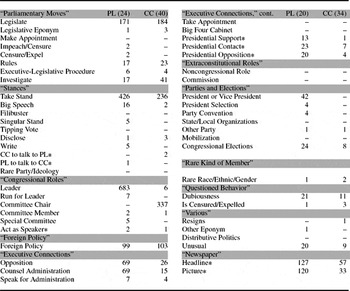
Using Mayhew's book and data set as references for my action coding scheme, once a leader's name is discovered on the front page of the Washington Post, he receives credit for each action that he performs per story because a leader's name may have appeared in multiple and different stories. For example, a leader might try to pass a piece of legislation, speak out in support of a bill, and meet with the president to earn executive support. Each action may be multiply coded. In this case, legislate, take stand, and counsel administration are the actions, and the total action count equals three. This leader could have appeared in another front-page story on the same day and could have received credit for legislating, taking a stand, and counseling the administration again. His action total would be six for that day's news. Table 1 provides a list of the individual actions with party leaders' and committee chairs' total actions performed. The 43 individual actions (in italics throughout) can be differentiated from action categories (in “quotation marks” throughout) introduced in the following text.
Number of each kind of action for party leaders (PL) and committee chairs (CC) for all Congresses combined

Source: Adapted from David Mayhew (Reference Mayhew2000: 67).
Note: Starred (*) actions are my own original actions.
n (actions) = 3,163.
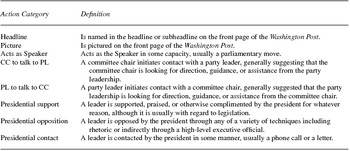
The front page of the Washington Post was examined for leadership actions every day, from the first day of the session to last day of adjournment, spanning six Congresses for a total of 3,882 days. In addition to Mayhew's 43 individual actions, I introduce eight original actions for a total of 51. Table 2 highlights the eight new actions and their conceptualization.Footnote 5 The new actions materialized primarily due to the nature of gathering actions from the newspaper as opposed to the historical accounts used by Mayhew and as a means for comparing leadership positions. I maintain Mayhew's 10 original categories for the actions.Footnote 6 My eight original actions are positioned into his categories, which serve the purpose of classifying and collapsing the 51 actions for analysis. One additional category, “newspaper,” was created to indicate actions associated with collecting these data from the newspaper. Two individual actions, headline and picture, fit into that category for a total of 11 categories.Footnote 7 They are shown shaded in Table 1 and are labeled with quotes throughout this paper: “parliamentary moves,” “stances,” “congressional roles,” “foreign policy,” “executive connections,” “extraconstitutional roles,” “parties and elections,” “rare kind of member,” “questioned behavior,” “various,” and “newspaper.”
Original action categories

An examination of leadership behavior through the lens of print journalists has some limitations. First, the Washington Post's reporting—like that of any newspaper—might be biased ideologically (Farnsworth and Lichter Reference Farnsworth and Robert Lichter2012). While concerned with bias, the journalistic balance of over- or underreporting poses a second and larger issue. Journalists may report on certain leaders as a matter of policy or procedure in accordance with editorial management rather than as a matter of significance or import in the legislative process. Moreover, journalists may cover certain leaders because they are following what academics have reported in their studies.Footnote 8 Nevertheless, one assumption of this study is that journalists are rational in their choices of which leaders to cover and will therefore focus on the most salient actors in the policy process (Sinclair Reference Sinclair1995: 275). In effect, journalists' choices of which leaders to report on may be one signal of leadership shifts. Third, party leaders and chairs typically control different stages of the process and journalists probably do not cover all stages equally. Rational journalists will report on the stages in which leadership plays the most significant role that underpins this and other studies (Sinclair Reference Sinclair1995). Another shortcoming of this study relating to how the Washington Post reports leadership actions is that the data may be skewed because journalists are less apt to report on the policy process in favor of more salacious topics on the behavior of leaders of Congress (Zelizer Reference Zelizer2000). However, less than 1 percent of the 3,163 actions in this study pertain to dubious leadership behavior and others have found that newspapers focus on policy and process more often than scandal (Morris and Clawson Reference Morris and Clawson2005).
A final critique of this approach is that few people read the newspaper and even fewer read the Washington Post. However, it is unnecessary for one to read the paper to be aware of leaders' actions. The source of news is not as important as receiving the information in the first place. This study is concerned with the “attentive stratum” of the population aware of governmental affairs (Mayhew Reference Mayhew2000). That said, legislative maneuvers are not always exercised in the public sphere by which journalists may report on them.Footnote 9 I do not claim to have collected every action a leader performs or every type of maneuver made. Obviously, deals are made and legislation is formulated outside the scrutiny of the American people and the media. Nevertheless, these leadership actions demonstrate a novel way of understanding leadership behavior and signal the changing locus of decision making.
Given these limitations, and with particular emphasis on the possibility that journalists' reports may be colored by academic studies (see note 8), what can we learn from leadership actions found on the front page of the Washington Post? If nothing else, these actions are part of the legislative process that the informed stratum of the public sees and experiences. In the prereform era, attentive citizens saw a decentralized House dominated by committee chairs with diverse ideologies and little discussion of party or a party program. In the postreform era, attentive citizens have witnessed a centralized House dominated by party leaders who are likely to promote a party agenda and discipline members who fall out of line with it. Regardless of whether journalists are reporting on studies that follow from political scientists and historians, or whether their coverage includes other biases, this research shows us how informed members of the citizenry come to understand House leadership. They see legislative politics unfold through the media. It is little wonder why the public, too, have become more partisan (Abramowitz Reference Abramowitz2010; Fiorina et al. Reference Fiorina, Abrams and Pope2005).
Congressional Eras
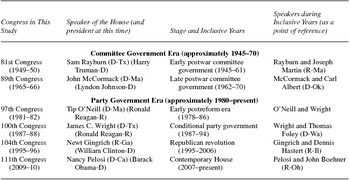
I collected leadership actions from six individual Congresses in the post–World War II era: the 81st, 89th, 97th, 100th, 104th, and 111th. These six Congresses represent six distinct stages within the committee and party government eras. The first two columns of Table 3 show the six Congresses under study, along with the current Speaker and president. The last two columns describe the six stages of the committee or party government era that correspond to each respective Congress. Thus, the 81st Congress represents the early postwar committee stage and the 89th Congress represents the late committee government stage.Footnote 10 In the party government era, the 97th, 100th, 104th, and 111th Congresses represent the postreform era, the conditional party government era, the Republican Revolution, and the contemporary Congress stages, respectively.
Congressional eras and Congresses under study

As a starting point for this research, I selected one Congress in each of the first five stages based on the stage with the highest number of “important enactments” or landmark legislation as delineated in Mayhew (Reference Mayhew2005). Mayhew's landmark legislation lacked the updating to include the post–Republican-Revolution Congresses, thus the 111th Congress was chosen because of the high amount of significant legislation including the Patient Protection and Affordable Care Act. This decision acted as one plausible starting point for a study of leadership actions, but also potentially threatens the generalizability of this study. Those Congresses could be atypical of the types of actions found in each stage, but should be representative of the committee or party government era they lay within. Leadership actions may differ in Congresses with fewer landmark bills, yet this study still provides a glimpse into the evolution of leadership. Also worth noting is that the Congresses selected for the committee era all feature unified Democratic control of government while the party-era Congresses feature a mix of divided and unified government. These contexts may affect the number and type of actions taken. While time and party control of government may become confounded, these data still provide a view of leadership trends at several key moments in these eras.
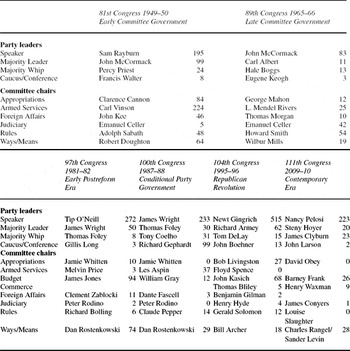
This study examines four party leaders deemed standard in the literature: Speaker, Majority Leader, Majority Whip, and Caucus (Democrats) or Conference (Republicans) Chair. Because the aim of determining whether leadership actions follow the conclusions that scholars drew about the changing locus of power, this study examines chairs of standing prestige, power, or influence committees in light of Fenno's research (Reference Smith and Deering1973). Since then, scholars have designated additional committees as prestige committees, including those that are exclusive as determined by the party caucus (Leighton and Lopez Reference Leighton and Lopez2002; Smith and Deering Reference Smith and Deering1984; Smith and Lawrence Reference Smith, Lawrence, Dodd and Oppenheimer1997; Young and Heitshusen Reference Young and Heitshusen2003). Consequently, the committee chairs examined in this research vary slightly from Congress to Congress based on these determinations and numbers six in the 81st and 89th Congresses, seven in the 97th and 100th, eight in the 104th, and six in the 111th. The number of party leaders remains constant at four. Appendix 1 identifies the prestige committees and their chairs included in this analysis.Footnote 11
Results
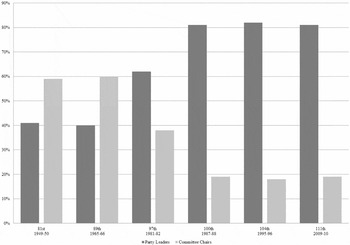
An initial examination of the summary data reveals that leadership actions are numerous and varied. A shift in leadership behavior from the “textbook” era to the postreform era is demonstrated that largely supports my hypotheses and the conventional wisdom. Figure 1 introduces the first piece of evidence of a shift in leadership behavior. The figure displays the overall percentage of actions performed by party leaders and prestigious committee chairs on the front pages of the Washington Post. As hypothesized, chairmen of prestige committees performed the majority of the leadership actions in the committee government era (59 percent of all actions in that era) and party leaders performed most of the leadership actions in the party government era (76 percent of all actions in that era). These data reveal a shift in leadership behavior that fits with conclusions made by previous scholars on the shifting locus of decision making from committee leadership in the prereform to party leadership in the postreform era. Not only do party leaders perform a significantly greater share of actions compared to chairs after the reforms, but committee chairs' actions decreased following the reforms.
Percent of all actions performed by Party Leaders and Committee Chairs

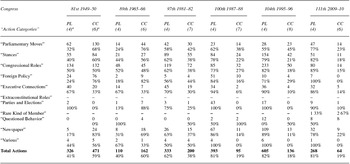
Table 4 presents more evidence of this pattern as a summary of all the action data represented by the 11 categories of actions outlined earlier. The “parliamentary moves,” “stances,” “foreign policy,” and “newspaper” categories reveal an action advantage for committee chairs in the prereform era and an advantage for party leaders in the postreform era, which aligned with my expectations. While collapsing the action data into these categories aided comprehension of the broader picture, individual actions also instructed making comparisons. As one case in point, within the “parliamentary moves” category, committee chairs' legislate actions—in which leaders are legislating, passing bills, or blocking bills—number 86 to the party leaders' 42 in the 81st Congress. In the 89th Congress, chairs' legislate actions total 30 compared to party leaders' 10.Footnote 12 These data reinforce the notion that committee chairs were the predominant leaders in the prereform 81st and 89th Congresses.
Party leader and committee chair actions

Note: Raw numbers of actions performed are displayed. Below the raw score, the percentage of total actions performed by each leadership group is given. Data were collected from first to last day of session and all days in between for each Congress.
aThe total number of party leaders (PL) or prestigious committee chairs (CC) that served in that Congress.
n (actions) = 3,163 with a range of 0–515 and n (leaders) = 64.
In the postreform era, each of the categories—in which data are sufficient to make inferences—reveal an advantage for party leaders over chairs; party leader actions outpace committee leaders in “parliamentary moves,” “stances,” “congressional roles,” “foreign policy,” “executive connections,” “parties and elections,” and “newspaper.” If we consider the individual action legislate, again within “parliamentary moves,” party leaders (PL) legislate more often than committee chairs (CC) in each of the postreform Congresses (in order of Congress: 97th: PL = 41, CC = 29; 100th: PL = 15, CC = 10; 104th PL = 25, CC = 21; 111th PL = 38, CC = 8). This is noteworthy if you consider legislating to be a primary function of committee chairs. Certainly chairs could be performing these tasks behind closed doors, but attentive citizens are increasingly seeing party leaders as the public face of legislating and the legislative process.
The individual action performed most often in each Congress also provides some insight into the debate over institutional context versus individual will/style as determinants of leadership.Footnote 13 In each Congress, the first and second most performed action is either legislate or take stand. This information alone does not denote significance, but when paired with the detail of which leaders are legislating or taking stands, it provides clues as to how the two positions exercise leadership. In the prereform era, the action carried out most often is legislating by chairs. By contrast, the postreform era reveals the action carried out most often is stand taking by party leaders.
The fact that legislating takes place more often before the reforms by chairs and stand taking occurs more often after the reforms by party leaders signifies a shift in the principal centers of leadership in the House. It is also indicative of how leadership is exercised in those leadership positions and lends support to theories that institutional context matters. In the prereform era, leadership was exercised by chairs who were more likely to lead by legislating. This is not surprising because committees are the workhorses of the Congress and committee chairs lead that effort. In the postreform era, party leaders' operate by taking stands to push legislation through the House. This is consistent with the “message politics” strategy that party leaders have taken (Evans Reference Evans, Dodd and Oppenheimer2001; Lee Reference Lee2013). This finding also underpins studies emphasizing the role of “public speaker” following the reforms and ostensibly extends it to other members of the Speaker's leadership team (Harris Reference Harris1998; Sinclair Reference Sinclair1995). For example, Richard Gephardt performed more actions as Caucus Chairman (n = 99) in the 100th Congress than all the other Majority Leaders and Whips in the postreform Congresses (see Appendix 1). However, Gephardt's total action count exceeds higher-ranking party leaders causing us to question if contextual explanations of leadership alone are satisfactory.Footnote 14
Leading Party Leaders in the Prereform Era and Following Chairs in the Postreform Era?
Although the overall action trend demonstrates support for the dominant theoretical perspectives concerning House leadership behavior, some inconsistencies arose where party leaders performed more actions than chairs. Specifically, party leaders equaled or outpaced chairs in “congressional roles” and “executive connections” in both the 81st and 89th prereform Congresses.Footnote 15 Although the differences do not achieve statistical significance in either of the categories (Mann-Whitney U tests), it is still notable how party leaders played an important role during the “textbook” Congresses when the focus has been disproportionately on chairs.
Of particular interest is the connection party leaders have with the president and his administration that traverses both eras. If the primary locus of power resides with chairs in the prereform era and party leaders in the postreform era, then we should expect executives to build relationships with “key power brokers” most likely to help executives reach their legislative goals in the respective era (Conley Reference Conley, Hughes and Hughes2003). In the party government era, activity supported this theory when party leaders met with and counseled the president more often than chairs in all four Congresses. Conversely, party leaders also linked to the president more often than chairs before the reforms. While this is not an entirely new finding (Ripley Reference Ripley1967; Schickler Reference Schickler2001; Truman Reference Truman1959), others have not documented the details of this linkage in this manner or in comparison with committee chairs.Footnote 16 Chairs have half as many ties with presidents as party leaders, which is interesting given their predominant position in the legislature. Eight party leaders performed 67 percent of all the maneuvers linking themselves with the president (“executive connections” in the 81st and 89th) compared with 12 chairs (n = 60). There is also some evidence of chairs' negative committee power, in that they are more likely to oppose the president or his administration (71 percent of all opposition actions) compared to party leaders (29 percent) in the prereform era, but this finding should be viewed with caution as there are only 14 observations.Footnote 17 Although party leaders may have acted as presidential liaisons, chairs higher incidence of challenges to the president reminds us that executive proposals still had to gain support of obstructionist chairs even under unified government.
How did party leaders legislate or pass policy among these “autocratic chieftains” (Cooper and Brady Reference Cooper and Brady1981: 419)? How did they lead? One potential argument—as presented in the previously mentioned literature—is that party leaders played the role of a broker and often found themselves negotiating deals with difficult chairs (Dodd and Oppenheimer Reference Dodd, Oppenheimer, Dodd and Oppenheimer1981; Smith and Deering Reference Smith and Deering1984), but these data also illustrate that party leaders may have used their presidential connections to promote policy. For example, in the 89th Congress, the party leadership, including Speaker John McCormack, Majority Leader Carl Albert, and Majority Whip Hale Boggs invited President Johnson to address both houses of Congress to introduce one bill, the Voting Rights Act (Washington Post, March 15, 1965).Footnote 18 The address was a rare occasion, but engagement with the president was seemingly not. Party leaders may have used the president as a resource to garner support from the citizenry on legislation to ease negotiations with chairs or circumvent them altogether.
Whereas there are several qualifications to the thesis that committee chairs were the predominant leaders in the prereform era, leadership actions in the postreform era are decidedly party leader turf. In every category of action, party leaders performed more actions than committee chairs and their numbers increase over time in many of the categories. In addition, several categories of actions reach significance in the 100th Congress for a test of differences: “stances,” “foreign policy,” “executive connections,” “parties and elections,” and the action total (p = <.05). It is also notable that chairs perform few investigate actions, which is one of their primary responsibilities. In the postreform Congresses, committee chairs only received credit for eight investigate marks on the front page of the Washington Post compared to party leaders' 14. Inclusion of postreform Congresses with a greater number of “high publicity investigations,” such as during Clinton's impeachment (Mayhew Reference Mayhew2005), might yield more investigate actions from chairs.
There are a few individual actions in which committee chairs performed more than party leaders in the postreform Congresses, but only by a raw count of one or two.Footnote 19 They are congressional elections, resigns, CC to talk to PL, and act as Speaker (97th Congress); legislative eponym (100th); and rules (104th). While party leaders' exercise of leadership is not absolute (Rohde Reference Rohde1991), the data for the postreform era lends compelling support to the dominant perspectives in the literature and goes further by illustrating the specific maneuvers made to achieve legislative outcomes.
The primary focus thus far has been on the leaders with the most activity in each era, but what is also interesting is the comparison of the seemingly least active leadership role across eras. The data suggest that party leaders overcame obstacles placed by autocratic chairs in the prereform era, while chairs less successfully asserted themselves after the reforms diminished their standing. Committee chairs' action totals are a smaller percentage of all actions in the postreform era (38 percent, 19 percent, 18 percent, and 19 percent) relative to party leaders' proportion in the prereform era (41 percent and 40 percent) (see Figure 1). Party leaders availed themselves of the opportunities to get involved in the legislative process during the era in which they are deemed subservient to committee chairs, while chairs' activities have been limited (Aldrich and Rohde Reference Aldrich, Rohde, Dodd and Oppenheimer2005; Schickler and Pearson Reference Schickler, Pearson, Dodd and Oppenheimer2005).
In 1995, once Republicans gained the House majority for the first time in 40 years, the membership took further steps to limit the input of committee chairs by limiting their positions to six-year terms. Among the four postreform Congresses examined here, committee chairs' total action share in the 104th was the least (18 percent). Chairs did not fare much better in the 111th Congress. Under Speaker Nancy Pelosi's leadership of the 110th Congress, she led the Democrats to consider six high-priority party bills in the first 100 hours, in which she bypassed committees and Republicans altogether to bring the partisan agenda to a vote (Aldrich and Rohde Reference Aldrich, Rohde, Dodd and Oppenheimer2009). During Pelosi's second term as Speaker, health care reform took center stage and she played an active, if domineering, role in writing and bypassing committees to enact the Patient Protection and Affordable Care Act. Even after Democrats removed the term-limit rule for chairs, they still only performed 19 percent of the actions. Taken as a whole, chairs still play an important, if vital, role in the contemporary legislative process, but that role has clearly changed since Wilbur Mills, Howard “Judge” Smith, and their lot dominated the House. Yet, party leadership dominance has persisted and even been extended under Pelosi (Peters and Rosenthal Reference Peters and Rosenthal2010).
While this research should be viewed as one step toward a comprehensive project on the ebb and flow of House leadership, most signs point toward the continuation of fierce partisanship and the dominance of party leaders' actions in the public sphere. If party leaders have indeed continued to assert their will to the detriment of committee chairs in the contemporary polarized Congress, the question is, to what extent do they act more often than chairs, and how do they act? Put differently, has the party leadership become an institutionalized part of the House (Pearson and Schickler Reference Pearson, Schickler, Dodd and Oppenheimer2009; Schickler and Pearson Reference Schickler, Pearson, Dodd and Oppenheimer2005)? Most signs indicate an affirmative answer.
Conclusion
Leadership in the House has shifted from committee to party leadership since the 1970s reforms and so, too, have the number and type of actions that party leaders and committee chairs perform. The leadership behavior detailed here through actions performed inside and outside the halls of the House and reported in the public sphere using the Washington Post support the conclusions that scholars have drawn about the changing locus of power. Furthermore, the findings present a unique approach for assessing leadership in the context of the reforms and illustrate how these leaders guide the institution. Leadership actions also improve our understanding of the types of maneuvers party leaders took as “unorthodox lawmaking” became the norm (Sinclair Reference Sinclair1997) and party leaders increased their importance in the legislative process (Harris Reference Harris1998). These data underscore the importance of looking beyond roll call votes, floor speeches, formal rules changes, and the like, to the numerous and varied actions leaders make toward advancing legislative and electoral goals.
These findings have broader implications for the study of leadership and the exercise thereof. Legislative leaders are typically studied in their roles inside the institution, while scholars readily assert that executives go outside institutions in favor of appealing to the public directly (Kernell Reference Kernell1997). Yet, congressional leaders increasingly “go public” on a variety of issues and with various goals in mind (Kernell Reference Kernell1997; Sinclair Reference Sinclair1995). Public actions outside the walls of the House should be examined further for clues regarding their impact on legislative outcomes. In addition to demonstrating changes in leadership behavior, this research also reveals a significant role played by party leaders in the committee era, that of “presidential consultant.” Although this is not a new finding, others have not presented this side of the leadership in comparison with chairs. Future research should look closer at the connection between legislative leaders and the executive, a surprisingly understudied relationship.
This research also contributes to our understanding of committee leadership by illustrating how diverse chairmen's maneuvers can be even while operating in a period of diminished powers. Appendix 1 reveals that there are significant differences among even the most influential of committee chairs. The range of actions performed varies from several performing zero actions (Rodino of Judiciary; Whitten of Armed Services; and Spence of National Security) to Carl Vinson of Armed Services, who singlehandedly engaged in 48 percent of all chair actions in the 81st Congress. Individual party leaders, too, exemplify variation in their maneuvers. Although leaders and chairs may be impeded by their powers, resources, and institutional conditions, some individuals will push those restraints to the limits. Newt Gingrich immediately comes to mind. He performed 70 percent of all actions in the 104th Congress, but Pelosi did not fall far behind him with 67 percent in the 111th. Just as Fenno asserted that “committees differ,” it appears that committee chairs and party leaders differ, too.
Finally, while these data lay the groundwork that shifts in leadership have occurred, additional Congresses would need to be included to provide texture to the general patterns found here and consolidate support for the dominant themes and hypotheses herein. Leadership actions from additional Congresses might allow us to pinpoint the specific time shifts occurred and whether the party leadership maintained their newly garnered position or if their activities waxed and waned along the way. This might also clear up some debate on whether increases in party leadership began before the 1970s reforms, after 1980, or rather if the subcommittee government era observed a period of instability, and what that looked like, before party leaders secured their position at the helm of the House.
Party leaders and committee chairs' total action count committee government era