Introduction
Imagine the following: a seventeen year old sits behind a computer in his bedroom in Amsterdam, big grin on his face, signing to the screen. As is turns out, he and some four friends from Denmark, Spain, the Czech Republic, and Germany are chatting together via Oovoo, a video conferencing program. They can all see each other at the same time. The kids met at an international Deaf camp in Finland and now, back in their own countries, chatter away in international sign, not having a shared sign language to use. They communicate, sometimes trying out signs and mouthing words, making certain meaning gets across. They are all young and happy and proud to be Deaf.
This is the reality of Deaf culture, with a capital D, a notion that evolved in the last forty years and to which deaf people from various countries have contributed their ideas.Footnote 1 A core part of Deaf culture is the use of a sign language. Signed languages have been the object of research for some fifty years.Footnote 2 Work of linguists such as Bernard Tervoort and William Stokoe in the 1950s and '60s has been paradigmatic in treating signed languages as real languages instead of primitive ways to exchange simple messages in predictable circumstances and structured settings, as was the current way of thinking (Tervoort Reference Tervoort1953; Stokoe Reference Stokoe1960). Since then, institutionalization of this research has yielded special departments, chairs, and research programs in universities all over the world, and international journals that are rated in academic citation indexes (e.g. Sign Language & Linguistics, Sign Language Studies, Journal of Deaf Studies and Deaf Education). The field has grown up, one could say, and in this process, much attention has been given to the similarities between signed and spoken languages. In all of this, most research has been devoted to the linguistic characteristics, the specifics of lexicon and grammar and their relation to the auditory versus visual modalities of speech and sign, respectively.
Aside from the general use of a signed language within the local or national community, Deaf culture can also be characterized by the possibility of another mode of communication that is used when meeting deaf people who use another sign language. The latter is often referred to as international sign. It is not an established contact language, but a mode of communication that arises on the spot, which combines elements of the sign languages of the people involved, elements of shared spoken languages, and the intensified use of iconic or pantomimic structures that are already inherent to various extents in any sign language (Allsop Reference Allsop, Fischer and Vollhaber1993; Webb & Supalla Reference Webb, Supalla, Ahlgren, Bergman and Brennan1994; Allsop, Woll & Brauti Reference Allsop, Woll, Brauti, Bos and Schermer1995; Supalla & Webb Reference Supalla, Webb, Emmorey and Reilly1995; Monteillard Reference Monteillard2001; Rosenstock Reference Rosenstock2004; Crasborn Reference Crasborn2006). The aim of this article is not to provide empirical evidence on the precise nature of international sign, even though it has been seriously understudied. We realize that some of our arguments are tentative, and we hope that this article will stimulate further research in this area. Our own focus is on the existence of signed and spoken languages together with the possibility of transnational communication in the visual mode and the relation between them.
This broader perspective on sign languages in the world that we aim to sketch in this article arises from a particular characterization of the global linguistic situation among hearing people, who together speak more than 6,000 different languages. Many of these spoken languages are faced with serious endangerment or even extinction in the coming decades, while others grow, typically with the economic impact of their communities (Hale, Krauss, Watahomigie, Yamamoto, Craig, Jeanne & England Reference Hale, Krauss, Watahomigie, Yamamoto, Craig, Jeanne and England1992; Nettle & Romaine Reference Nettle and Romaine2000; Skuttnab-Kangas Reference Skuttnab-Kangas2000; Tsunoda Reference Tsunoda2005). The model we examine in order to get a better grip on the situation of signed languages in the world is that of de Swaan (Reference de Swaan2001), who proposed a global language system with different layers. In sociolinguistics, the attention for growing communication between different speech communities has focused mainly on the (socio)linguistic consequences of increased mobility and global demographic shifts (Trudgill Reference Trudgill1986; Milroy Reference Milroy2002). However, as Blommaert argues, globalization forces sociolinguistics to unthink its classical distinctions in which a focus “on static variation, on local distribution of varieties, on stratified language contact and so on” has been dominant (Blommaert Reference Blommaert2010:1). De Swaan, with a background in political sociology, indeed approaches the global linguistic situation from a different perspective. If we adopt such a perspective, new questions arise: how can transnational communication between deaf people be characterized? Can we simply add various sign languages to de Swaan's global language model, or do we need a separate model for deaf communication?
We begin by introducing the issue of language and globalization and discuss the language model of de Swaan in the next section. We then discuss the situation of deaf communication and sign languages in the world, briefly characterizing the nature of international sign on the basis of the few studies that have been published and our discussions with international sign interpreters and Deaf people who have a lot of international experience. Next we propose a model that characterizes the communication between deaf people in the world on the basis of de Swaan's spoken language model. Finally, we discuss some of the implications of the proposed model and offer concluding remarks.
The study of language in transnational communication
The priority of the role that language plays in the exchange of ideas across borders may seem obvious, but in discussions on globalization, reflections on this subject have been very limited. This is the case even in linguistics, the field that seems most appropriate for studying the role of language, texts, or speech communities in this context. In the host of studies and debates about globalization in the past two decades, work from almost every disciplinary angle and viewpoint has seen the light, but contributions from the side of linguists have been scarce. Nikolas Coupland, referring to the scarce attention to this subject in his field, remarks that “sociolinguists have been late getting to the party” (Coupland Reference Coupland2003:465), and in the same issue of the Journal of Sociolinguistics Jan Blommaert urges his colleagues “to start developing a sociolinguistics of globalization” (Blommaert Reference Blommaert2003:623). In his recent book Blommaert has started this endeavour himself, trying to work out a new theoretical approach towards a “sociolinguistics of mobile resources, framed in terms of trans-contextual networks, flows and movements” (Blommaert Reference Blommaert2010:1). The challenge he feels we face is to contribute to an understanding of society through an understanding of language.Footnote 3
The fact that processes of globalization are bound up with transformations of language and identity in many different ways has been noted in the social sciences, where social theorizing about global changes in modern states began to take shape some twenty years ago.Footnote 4 The considerations of sociologists, however, have been focused foremost on subjects bound up with economic changes and the emergence of global markets, while languages as such have barely figured in the sociological discussions about globalization.
The work of de Swaan is an exception. In his study, Words of the world, he investigates what he calls “the global language system.” Taking a truly global perspective, he conceptualizes a dynamic system in which all of the languages of the world can be ordered. Drawing his theoretical inspiration both from political sociology and political economy, he sees the world's languages as interconnected with one another through multilingual speakers. The groups of interconnected languages thus formed are in unequal competition with one another. At the present day, a hierarchical pattern can be distinguished in the groups of languages, the result of a competition process of centuries intimately bound up with developments in the world's sociopolitical constellation.
With his study of the system of world languages and the ways that they are connected, de Swaan wants to understand the evolving transnational relations between people from a different vantage point than most sociologists. It is through languages in which people communicate across traditional borders of language groups and nations that the circulation of ideas, cultural goods, and practices becomes possible in the first place. For scholars interested in globalization, then, the rise of transnational constellations of languages constitutes an important research area. However, de Swaan concludes that the evolution of these constellations, the rivalry and adaptation between language groups, and the way in which they operate in connecting people in a transnational context, has not been given much theoretical reflection. His study is innovative and his conceptualization of a world system of languages, based on a number of case studies, provides a fresh perspective in a field thus far hardly entered by linguists. His book was deemed “important and deserv[ing] careful attention” by Morris (Reference Morris2004) in Language in Society, and, in general, linguists have been receptive to his ideas.Footnote 5
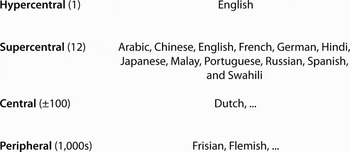
In de Swaan's global language system of today, languages are hierarchically ordered in four categories: peripheral, central, supercentral and hypercentral (see Figure 1).
The global language system consisting of four categories.

The central category includes some one-hundred widely used languages, spoken by about 95% of the people. These are usually the official national languages, which typically have a written form and are taught in primary schools. For example, Dutch is considered a central language, connecting together people speaking Frisian, Flemish, and Lower-Saxon, among others.
There are only twelve different languages in the supercentral category, internationally connecting together people over much larger distances. These languages enable speakers of central languages to connect internationally and over long distances and are spoken by large numbers of people.Footnote 6 In this group we find, for example, English, French, Hindi, and Chinese.
The hypercentral category includes only one language: English. It connects together central languages, but also supercentral languages. Arabic and Malay are supercentral languages, used by speakers of many different languages. But when an Arabic speaker meets a Malay speaker, their communication is likely to be in English. In terms of languages used, de Swaan points out that the transformation of societies through the spectacular growth of international markets, traffic, and media takes place in English.
The last category consists of the peripheral languages, to which all of the thousands of other languages spoken on the globe belong. They hardly, if at all, serve to connect different speech groups and are usually not seen as a useful means of communication in multilingual encounters. For this reason, few people will want to learn these languages as foreign languages.
In addition to the conceptualization of this four-layer hierarchical system, de Swaan developed a means of measuring any language's value in multilingual situations, the so-called Q-value.Footnote 7 He argues that people will be more inclined to learn another language if they perceive a communicative advantage, because, for example, they will be able to speak with many more people than those in their own community. They gain access to a greater and richer pool of language-bound cultural products, such as official documents and literature or theatrical performances and media culture. Thus, people speaking a peripheral language will be inclined to learn a central language, because it offers them more possibilities to get a better education, to find jobs, and so on. Learning a supercentral language will offer such possibilities on a transnational level. English, the only hypercentral language, does this most of all. From a linguistic point of view, the process of globalization is intimately bound up with the spread of English as a lingua franca for people from different parts of the world. The fact that in many communities in the world it is not uncommon to grow up with more than one mother tongue does not alter the overall picture. It is sometimes estimated that the majority of the world's population is bilingual from childhood, speaking more than one language with native proficiency (Romaine Reference Romaine1995; Grosjean Reference Grosjean2010).
In de Swaan's book, signed language receives no attention at all. This is no surprise, since these languages form a relatively new and unknown subject of study even within linguistics, let alone for scholars outside this field. However, as we discuss below, interesting questions can be raised about the role of signed languages in the international communication of deaf people. Do these languages fit a global language system like that of de Swaan, and if so, where would they belong in such a system?
How do deaf people world-wide overcome the problem of communication across community boundaries? Could it be that sign languages form a world sign-language system distinct from that of the spoken languages, with their own peripheral, central, supercentral, and hypercentral languages? Or is there some role for spoken languages in the transnational exchange of ideas between deaf communities? These are the questions that we address in the rest of this article. To best answer these questions, we must first sketch some background on deaf communities, before turning to the nature of signed languages.
Sign language in the world
Background: Deaf people in a historical and cultural perspective
Communities of deaf people have existed in all times and places (Lane Reference Lane1984; Monaghan Reference Monaghan, Monaghan, Schmaling, Nakamura and Turner2003), but until quite recently these communities were typically fairly isolated both from one another and from the hearing world around them. Although deaf people have come together for international activities in the realm of sports and leisure for over a century now (Haualand Reference Haualand, Ingstad and Whyte2007; Murray Reference Murray and Bauman2008), it is only in the course of the last fifty years or so that contact between deaf people from different communities has grown substantially, within as well as between countries. For the deaf too, the world “has become smaller” through growing possibilities for travel and through new communication technologies. Increased contact between communities fostered a growing awareness of transnational group interests resulting in the establishment of a number of international organizations looking after the interests of the deaf. The World Federation of the Deaf (founded in 1951)Footnote 8 and European Union of the Deaf (founded in 1985)Footnote 9 are important marking points in this process. In the present day, various international organizations, be they aimed at sports and leisure or at the furthering of common interests, meet regularly and draw large numbers of deaf people from many different countries.
From a historical point of view, deafness in terms of hearing loss has been the first denominator for deaf people to organize themselves. This is no surprise, since world-wide, deaf people share a history of social exclusion and marginalization as a result of their handicap. In the course of the last decades, however, in some parts of the world the focus on a deficit has made a place for an awareness of positive communalities in backgrounds and experiences, for a more culturally inspired view on deafness. One notion has been accepted as central to this awareness: what brings deaf people together is not merely a handicap—hearing loss—but rather a shared culture in which interaction takes place through one or another sign language (Padden & Humphries Reference Padden and Humphries1988; Ladd Reference Ladd2003; Bahan Reference Bahan and Bauman2008). In this conceptualization of deafness, national communities of deaf people form cultural minorities in their own countries, and, at the same time, shared experiences and a shared mode of communication are taken to be the essence of a global, cultural community of Deaf people. Use of the capital D has become symbolic for this new awareness (since Woodward Reference Woodward1972).
Contrary to what people often think, signed language is not international. The Ethnologue, the world's reference source of languages, currently lists 124 different sign languages (Gordon Reference Gordon2005). We can safely assume this figure to be too low, since research on the existence of different sign languages is scarce, and many parts of the world remain blank spots in this respect. Some of the sign languages in the world are related, but they are not mutually intelligible (Woll, Sutton-Spence, & Elton Reference Woll, Sutton-Spence, Elton and Lucas2001). So how do people at these international gatherings communicate with one another? Are there common languages that serve as a vehicle for exchange of ideas? And does this situation relate to the hypothesized situation for spoken languages in de Swaan's global language system? In order to answer these questions, we must first look into the nature of signed languages.
The nature of signed languages
The sign languages listed in the Ethnologue have not all arisen from a common source, in contrast to the spoken languages of the world that are assumed to stem from a common great-grandparent spoken by early humans. Rather, sign languages are known to arise in communities when there are a sufficient number of deaf people living together. While in the western world, educational situations have played an important role in bringing deaf people together and thus promoting the development of visual communication, sign languages are assumed to most often start their life in a small-scale setting like the family, as soon as two deaf children are growing up together. The home sign systems that can be observed in such cases can develop into rich languages when more and more people participate in the communication, up to the point where new generations of deaf people grow up acquiring the surrounding home sign as a true first language.Footnote 10
In the second half of the twentieth century, linguists presented evidence that sign languages should be seen as “proper” languages in the linguistic sense of the word and not as mere means of instruction in deaf education (Tervoort Reference Tervoort1953; Stokoe Reference Stokoe1960). It was demonstrated that different countries had different sign languages, and more recently linguists started to systematically study the linguistic diversity among signed languages in the world (e.g. Zeshan Reference Zeshan2004a,Reference Zeshanb). Even in the deaf community itself, the idea that their communication in sign was to be seen as a language was novel.
Apart from linguistic similarities, signed languages appeared to behave like spoken languages in terms of their social functioning. Signed languages also slowly develop over time, creating language families—even though the time depth is very limited as far as we know (appr. 250 years for the oldest sign languages), and true linguistic relatedness is hard to establish (see e.g. McKee & Kennedy Reference McKee, Kennedy, Emmorey and Lane2000). Further, there are dialectal variations between regions as well as differences in language use between social groups and age groups; and finally, signed languages are acquired by children in the same way as spoken languages (Morgan & Woll Reference Morgan and Woll2002).
Given this similarity, we believe that the application of de Swaan's model is possible and fruitful, offering a new perspective on the modes of communication between deaf people from different sign language communities,
Signed languages and de Swaan's global system
When trying to characterize signed languages in terms of one of de Swaan's four categories, a position among the world's peripheral languages appears warranted. Our arguments for this claim are outlined below.
In a few western countries the national sign languages may have some characteristics of a central language, for example, in terms of their institutionalization in national educational systems, their standardization by lexicographical institutes, and their being recorded in national dictionaries. However, this is only the case in very few countries. Further, and, most importantly, like most of the peripheral languages, sign languages have no written form. Although there have been efforts to create writing systems for signed languages in the past decades (Thoutenhoofd Reference Thoutenhoofd1992; Miller Reference Miller1994, Reference Miller2001), no system has received wide acclaim in any deaf community at large.Footnote 11 Currently, modern technological possibilities of video recordings and their distribution through websites like YouTube seem to evolve slowly into an alternative video culture for deaf communities that adopts some of the functions of written cultures.
Thus, even though it seems a contradictio in terminis, one could indeed characterize the speech communities of deaf people as oral cultures, because of this fact.Footnote 12 This constitutes a major problem for the wider exchange of language-bound cultural products in any of the sign languages. In the global system of de Swaan, connecting languages in the central, supercentral, and hypercentral categories almost by definition have a written form. Moreover, the presence of multilingual speakers—in this model a prerequisite for the existence of transnational communication—seems problematic where it concerns signed languages.
The role of multilingual signers in making connections between different sign language communities is very limited. Only in the last two decades and in just a few western countries, educational programs in their own national sign language have come off the ground. However, there are very few deaf secondary schools in the world that offer a foreign sign language in their curriculum.Footnote 13 This sharply contrasts with education for hearing people in Western countries, where learning at least one foreign language is the norm. For deaf people, thorough knowledge of a foreign sign language could only be acquired by attending a (deaf) school in another country or by an extensive stay in the community there. In practice, Gallaudet University in the US, the only university for the deaf in the world, has played a role of some importance in this respect, allowing deaf students from all over the world to come and study there and providing them with the possibility to follow courses in American Sign Language (ASL) before entering the program. This is an exceptional situation, which is not paralleled on a similar scale by deaf education programs in universities in Rochester (US) or Bristol (UK), for example, which host programs especially oriented to deaf students.
By contrast, deaf and hearing people have played a key role in spreading languages such as ASL to Africa and other parts of the world, often in an effort to spread the word of the Bible (Nyst Reference Nyst and Brentari2010). In recent decades, missionaries focusing on smaller spoken languages (such as people active for the Summer Institute of Linguistics (SIL) and similar groups) have spent more attention on documenting languages hitherto not described (ultimately with the aim of creating a bible translation). At the same time, missionaries targeting deaf groups typically have not given local sign languages the same attention, not yet recognizing the linguistic and cultural richness embedded in local ways of communicating. Here too, there is little empirical study on the exact nature of the influence of ASL on other signed languages or the use of ASL in other countries: only lexical influences and the use of the ASL hand alphabet are easy to recognize without actual research.
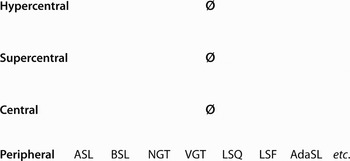
Irrespective of the actual languages used at specific events, the most important point that arises from the above discussion is that until now there has not yet been a single sign language that has functioned as a central language in the sense of de Swaan's model, let alone as a supercentral or hypercentral language. While ASL is clearly learned most often as a second language later in life by deaf foreigners going to study or work in the US, it has not become the automatic language of choice for any kind of international exchange. Moreover, in deaf contacts other than planned academic or other kinds of meetings, it will totally depend on the background of the individuals whether ASL plays any role at all. In addition, the creation of a sign language lexicon with a selection of signs from four different sign languages in the 1970s has not had much of an impact in any country in the world or at any deaf event.Footnote 14
These considerations lead to a signed language version of de Swaan's model, as presented in Figure 2.
A global language system of sign languages.

Given this situation, and given the fact that signed languages are not written down and texts in sign language are virtually nonexistent, and multilingual signers are few, how—under what circumstances and conditions—can ideas travel among sign-language users across the world? Are signed languages mutually intelligible after all? Or is there some role for spoken languages in transnational communication? These questions have been barely touched upon in scholarly work. We believe that any attempt to answer them should take into account important sociolinguistic differences between the average signed language and the average spoken language. These differences lie first of all in the lack of native signers in the environment of many (western) deaf children: often true signed-language input does not start until kindergarten or even later. Moreover, there is the omnipresence of a spoken language for any sign-language user in any part of the world. There are no deaf communities that have developed in isolation from a larger, hearing community around them. This has left its marks in the lexicon and structure of signed languages, and, important for our argument, the high status of the spoken language(s) in any community has contributed to the communicative flexibility and creativity of the average deaf person. We would like to put forward the hypothesis that it is not merely the “bimodal bilingualism” of many deaf people (who master both a signed and a written variant of a spoken language), but also these enhanced communicative skills that contribute to the international communication patterns that we describe below. Of central importance in our argument is the existence of international sign, a phenomenon we further discuss below.
International sign
We use the term international sign for the visual communication between deaf people from different countries who do not have a shared sign language. In this characterization, the functional properties of international sign prevail over specific structural features (cf. Rosenstock Reference Rosenstock2004, who, like many authors on international sign, focuses only on conference interpreting). There has been very little research in this domain, yet it is a natural phenomenon for deaf people to be able to communicate “across national boundaries,” be it with more or less effort depending on various contextual factors, likely including the “distance” between the sign languages and pre-existing knowledge of each other's language and of the subject of conversation. The few studies on this phenomenon include Allsop (Reference Allsop, Fischer and Vollhaber1993), Allsop et al.(Reference Allsop, Woll, Brauti, Bos and Schermer1995), Monteillard (Reference Monteillard2001), McKee & Napier (Reference McKee and Napier2002) and Rosenstock (Reference Rosenstock2004).Footnote 15 Irrespective of language backgrounds, deaf people from different countries typically manage to communicate through a system that is universally accessible. According to Rosenstock, international sign cannot be labelled “a language, pidgin, Creole or koine, … it is a communication system with the purpose to convey meaning, be it by a presenter or through an interpreter” (2004:50). Although deaf people report different levels of satisfaction about the efficacy and communicative depth of international sign, time and again it appears to come about spontaneously and is reasonably effective.Footnote 16 From brief tourist meetings to workshops lasting several days, international sign appears to be a possible mode of interaction.Footnote 17 Although there is of course a likely difference in kind and complexity of the exchange between these extremes, the very use of international sign at conferences and academic gatherings is the “hardest” point in our case, in that it provides a possibility for communication at any level. Although we do not want to define international sign in terms of structural features, research done in this area shows that some characteristics are present in all different exchanges. Iconic or shared lexical items from the source languages are freely combined with mouth articulations of spoken words, pointing to objects in the immediate environment, and pantomime (McKee & Napier Reference McKee and Napier2002; Rosenstock Reference Rosenstock2004).
At a number of international deaf gatherings, linguistic workshops, and broader meetings of Deaf Academics in the last few years, international sign has functioned as the standard code, rather than ASL or the local sign language; the same holds for international meetings of the WFD and EUD.Footnote 18 While some degree of standardization of specialized lexicon typically takes place at such events, such standardization appears to be always restricted to the lexicon (not covering grammar), and does not cover all possible words that might be used during many hours of signing. The basis for the possibility of such cross-language communication lies in three main factors: the presence of a minimal amount of relevant shared contextual knowledge, the optimal use of the iconic resources present in any sign language (including not only lexicon but also constructed action and pantomime), and the shared knowledge of a spoken language, typically English (of course, assuming literacy in some language to begin with). Using these three sources, new lexical forms can also be agreed upon during the interaction. In academic meetings, some shared knowledge of ASL or other sign languages likely plays a further facilitating role, but can rarely be assumed to be shared by all participants (Rosenstock Reference Rosenstock2004). As we hypothesized above, it may also be the case that a general communicative flexibility and creativity of deaf people is an important factor that allows for productive international sign encounters.
Opinions of deaf people on the nature and value of international sign diverge. Some claim that it cannot be taken seriously, arguing that one cannot reach any depth in the interaction if one cannot use a true sign language. For many deaf people, however, international sign appears to be not only a fruitful means of interaction in language-contact situations, but its mere possibility proves to them the visual and communicative strength and creativity that all members of deaf communities possess.
As international sign is what happens when signers of different sign languages communicate, its form will be different every time. This is the reason for not writing it with initial capitals here: it is not a name for a specific variant, but a term that refers to a highly variable phenomenon, defined by its use rather than its structure. The addressee(s) in a given situation will determine how a signer creates a given utterance. International sign is thus unlikely to reach a set of standards due to its infrequent use and variable users from all over the world.
Future research will have to focus on the questions of what level of communication can be reached in international sign, what the strategies are, and whether all deaf people are equally skilled at this type of communication, irrespective of their cultural and language background. For now, we suggest that, in the cases where it does appear to work, the communicative flexibility and creativity of the deaf signers in question forms part of their Deaf identity, which is a unique feature of Deaf culture that is unparalleled by any hearing form of communication, be it the use of the hypercentral English or the use of pidgin languages that have evolved over many years.
Communication at international meetings of deaf people
In the past century, the number of large international deaf events has steadily increased.Footnote 19 For the conferences before the 1980s, there is no good record in the literature on what the official languages of these conferences were. Most likely, there was no official language policy at many meetings, and it was more or less understood among the participants that international sign would be the means of communication.Footnote 20 The possibility of international sign may implicitly have been one of the properties of the international deaf community to celebrate at those meetings. Moreover, deaf people have begun to participate more and more in regular international academic conferences devoted to signed language, deaf education, and the study of deafness. At all of these events, interpreters play a key role in bridging the distance between users of different sign languages.
For the regular meetings, it is important to realize that deaf participation has only slowly been increasing over the years. In general, the possibilities for higher education are still limited for Deaf people in most countries. The low number of deaf participants in scientific conferences is mirrored in the use of conference languages: the conference typically arranges for interpreters to translate between spoken English and the national sign language, individual deaf participants from many countries sometimes bring their own interpreter to translate between spoken English and their own sign language, often leading to the presence of ten or more sign languages at large scientific conferences.Footnote 21 In order to simplify this situation, the use of international sign as a means of communication between deaf people from various countries has grown.
While the use at international meetings appears to imply that international sign is a standardized code or way of communicating, its form is highly variable and remains dependent on the background knowledge and creativity of the participants—interpreters as well as their audience. On some occasions, when deaf or hearing interpreters interpret between a spoken language and international sign, there has been a short preconference meeting to establish some agreements on the lexicon used for specific technical terminology, but such agreements will likely cover only a small part of the lexicon that is used at the meeting
A global language system of sign languages
As argued in the previous sections, there are few deaf people who use multiple sign languages, and international contacts rather take place through international sign. In this section, we propose a new global system for deaf communication, which aims to incorporate both national sign languages, international sign, and the role that spoken (written) languages play for deaf people.
We offer four explanations for the lack of central, supercentral, and hypercentral sign languages. First, most obviously, social and educational limitations have had an important effect. In the Western world, limitations in the education of the deaf have led to a situation where deaf people do not systematically master a foreign sign language, quite unlike the situation for spoken languages. Further, there are no situations known to us where there is a long history of systematic language contact between sign languages on a local scale, so that there are now many multilingual signers and one of the sign languages has slowly gained the status of a central language. Quinto-Pozos (Reference Quinto-Pozos2008) reports on language contact between Mexican Sign Language (LSM) and ASL of Mexican Deaf people who moved to the US. While the Mexican signers in question have acquired ASL, there is no clear sign of systematic contact between two language communities in which bilingual ASL-LSM signers play a clear bridging role.Footnote 22
At Gallaudet University in Washington, DC, a truly international group of deaf people, both from within and from outside the US, live together, and ASL is the language of choice for common use. After completing their education, however, the foreign students return to their own countries where they will return to signing their native local sign language. The group of bilingual students at the Gallaudet campus is thus always fluid and temporary. However, as more and more foreign students pass through Gallaudet in the course of time and take home their knowledge of ASL, its use as a second language is likely to become more wide-spread.
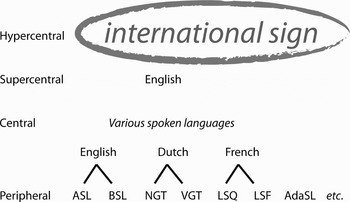
Second, the current absence of a writing system that is commonly taught and widely used for any sign language, together with the absence of dedicated teaching materials, has made it difficult to learn foreign sign languages. The development of video and Internet technology is only slowly reaching a state where people can easily record and share video recordings of sign language use, which would potentially provide an alternative for the use of writing systems. This development, however, is at the moment mostly limited to affluent western countries. The fact that writing systems are commonly acquired by deaf people in many parts of the world in their acquisition of the local spoken language in schools has contributed to the situation where these spoken languages have received most attention in their lives. These spoken languages have thus played an important role in deaf communities, and English has what one might compare to a supercentral role in international contacts between deaf people as de Swaan describes for hearing communities: it transcends local language contact, and plays a role at a wider international level.Footnote 23 Here, too, this characterization certainly does not apply to every part of the world (or perhaps even the majority of signers): in many countries, there is no education for deaf children at all, and they are thus not taught to read and write the spoken language used by people around them. And in other communities, of course, both deaf and hearing people are illiterate and not exposed to education. Thus, in the sense that English only plays a role in the contacts between some deaf communities but not others, its role is more comparable to the supercentral than to the hypercentral level in de Swaan's terminology.
Third, we suggest that neither ASL nor any other sign language has yet widely functioned as a hypercentral language, because international sign fulfilled this role on most occasions. The fact that signed-language users can communicate using this mode of communication has pre-empted the need for a shared language in many cases. Finally, as already noted in passing above, deaf people are quite accustomed to the presence of interpreters. Signed-language interpreters are most often used in interactions between hearing and deaf people, translating between a signed and a spoken language; but in the recent past, we have seen the increasing involvement of deaf interpreters at large international events, translating between a given sign language and international sign. This has made international sign more available as a vehicle for communication to all members of the local deaf community. Moreover, the omnipresence of English as a hypercentral spoken language in international deaf meetings has created many interpreting chains of the type “sign language A > spoken English > sign language B”—two hearing interpreters mediating a translation from one sign language to the other. Thus, presentations in a sign language are not watched directly by users of another sign language.
Altogether, a picture emerges of the language situation of deaf people in the world, given in Figure 3.Footnote 24
A global model of communication strategies used by deaf people.

Just as not every hearing individual in the world is multilingual, there are many deaf people who do not know any spoken language and use no other communication system than their own peripheral sign language. For deaf people who have learned to read and write in a given language, that language may serve as a connecting central language enabling communication beyond their own peripheral (signed) language. International sign, however, is by definition accessible to every deaf signer. Although some signers will have more skill and experience communicating with deaf signers from other communities, sign languages all lend themselves to being creatively adapted to communicate cross-culturally. The smaller the distance between cultures, the larger the chances will be that there are shared norms and metaphors, familiar objects, and so on that can be involved in creating new signs or descriptions on the spot, thus facilitating interaction, and in doing so, generating what is known as international sign.
Discussion
We have proposed in this article that language contact in these global times takes on different forms for hearing people and for deaf people. The global language system that was proposed by de Swaan to characterize power relations and contact between languages cannot be directly transferred to deaf communities and their communication patterns. International communication between deaf people is characterized by a number of properties that call for a parallel version of de Swaan's model. Its key properties are the use of written (and spoken)Footnote 25 versions of spoken languages, and the rich possibilities of international sign.
Not only is the deaf community intimately connected with the hearing world, signed languages are also intimately connected with spoken languages. Through the omnipresence of spoken language, by virtue of the relatively large number of nonnative hearing signers (educators, interpreters) in any given deaf community and because of the high status of spoken languages as compared to the signed ones, signed languages have often undergone influence from the surrounding spoken languages (cf. the papers in Boyes Braem & Sutton-Spence Reference Boyes Braem and Sutton-Spence2001).
Similarly, deaf as well as hearing people have contributed to the spreading of several Western sign languages over the world, either through missionary work or because of the participation in educational programs. Although ASL appears to be slowly acquiring a dominant position in international academic gatherings and, in de Swaan's terms, has a relatively high Q-value among the sign languages in the world, it does not occupy a central (let alone supercentral or hypercentral) position, as it does not serve to connect whole language communities. The apparent rejection of ASL as the sole language of choice by deaf participants at international meetings is one token of this situation; another is the fact that spoken and written English seems to serve a role as a supercentral language similar to that in the realm of spoken languages and hearing people. Note that we by no means want to claim to be exhaustive here: it may well be that other spoken languages similarly serve a supraregional function for deaf people. On a global scale, however, English would appear to have the highest Q-value for deaf people as well.
It is not fruitful simply to fit signed languages into de Swaan's system as a particular set of peripheral languages. The relative scarcity of multilingual signers and the very inaccessibility of spoken languages for the majority of deaf people are indications for this. Signed languages are not only special because of these negative attributions. The creativity and flexibility in communicative skills of deaf people, allowing advanced communication across sign language communities, points in the opposite direction. To us, the most convincing argument to consider the sign languages of the world as forming a different parallel system of languages is the availability of international sign. It appears that the very properties of sign languages, including their young age, their overall similarity, and their intensive use of iconicity in both lexicon and grammar, allow for this form of on-the-spot communication that is unparalleled in the world of spoken languages. In future research, we would therefore like to further explore the implications of modelling interconnected sign languages as separate from, but not independent of, a global system of spoken languages. What do these interconnections entail? What are the forces influencing them? The developments in technologies of visual communication that now seem at hand might rapidly change the constellation proposed here. Other influences, like growing political awareness of deaf communities worldwide or pressures to further integrate deaf people in education, work, and social life into hearing societies, may pull the connections between the languages in our model in one or other, sometimes opposite, directions.
Spoken languages play an important role in the lives of many deaf people. Even in non-Western countries where deaf education has not emphasized spoken languages as much (possibly because of the total absence of education for the deaf), almost any deaf person on the globe has daily interactions with hearing people. This is expressed by the central and supercentral role of spoken languages in the model we propose.Footnote 26
Looking at current developments in globalization and the growth of Internet technologies, we have to consider that a form of international sign will indeed develop into something more systematic than what we currently see at international meetings. While ASL has been relatively dominant among higher-educated Deaf people because of international participation in higher education at institutes like Gallaudet University and the Rochester Technical Institute for the Deaf, the use of webcams and broadband Internet facilitating long distance contacts may well decrease the relative dominance of ASL world-wide in the coming decade, however small this dominance may have been. The enormous popularity of the YouTube video platform and similar technologies can add to such international exchanges and unconsciously promote standardization in international communication. Such developments will not affect the fact that international sign exchanges between any two deaf persons in the world remain possible for people that do not have any knowledge of a particular standard. They may, however, lead to the possibility of a less ad hoc interchange between a certain segment (of especially younger and higher educated members) of deaf communities.
Finally, we would like to emphasize that any concept of a system of languages, whether taking sign languages into account or not, will have to be a dynamic one. Social and economic changes can lead to changes in the roles played by various languages. For the coming decades, we expect to see especially interesting changes in the roles played by different languages in deaf communities, induced by rapidly increasing education level and increasing international contacts in deaf communities, by the rising status of sign languages both inside and outside deaf communities, and by the rapidly evolving medical technologies such as cochlear implants (see e.g. Johnston Reference Johnston2004, Blume Reference Blume2010). Some have expressed their concern about the future existence of sign languages under these growing pressures on deaf communities to engage with the hearing world (Johnston Reference Johnston2004).Footnote 27 In that respect, it is interesting to see how Deaf-studies scholars have started to explore the positive experiences of deafness in a somewhat different way than before. Rather than stressing the use of signed language as an attribute of members of the community, in more recent work the “visuality” of deaf people is emphasized (Baynton, Gannon, & Lindquist Bergey Reference Baynton, Gannon and Bergey2007; Bahan Reference Bahan and Bauman2008; Haualand Reference Haualand and Bauman2008). Naturally, the visual-spatial modality of signed languages is intimately linked to this quality, but there is more to it. The centrality of seeing in this notion of ‘visual people’ tries to do justice to the structural possibilities deaf people have to experience and express meaning in space.
These very possibilities may lead deaf people in quite a different direction when investing in learning a second or third language. In terms of de Swaan's Q-value, prospective signers may be more inclined to learn a second sign language than a spoken language, depending on where they feel they have most to gain. If the hearing world remains relatively inaccessible for or even hostile to people who have different, visual bodies, some deaf people at least may feel more drawn towards the cultural experiences and products that the international deaf community has to offer. While international sign is a flexible medium that can be very efficient if the interlocutors share a lot of general cultural and situation-specific background knowledge, it is not likely that the same communication speed can be obtained as when using a shared sign language. Thus, the acquisition of a foreign sign language would contribute to one's international potential. However, it could very well be that English as a language of choice is a better investment, offering a more interesting language repertoire than the spoken language of the country, again, naturally depending on a person's goals and possibilities. The important role of English in the world, expressed by its hypercentral position in de Swaan's original system and the supercentral position in our proposal for a global view on deaf communication, entails that acquiring knowledge of English is a good investment for anyone, whether for cultural, scientific, or other professional aims.
Whatever the choices of deaf people will be, in our opinion, the possibility of international sign demonstrates the unique potential of deaf people to bridge community gaps and cross language boundaries in a way unseen in spoken languages. In that sense, deaf people can form a true global community, and international sign, however variable it may be, can be its global mode of communication. This situation opens up a wide range of questions for further research that have not been addressed so far in various fields, ranging from its economic potential to psychosocial impact on national deaf communities and to its (socio)linguistic characteristics.