INTRODUCTION
Multiple sclerosis (MS) is a common inflammatory disease with genetic, environmental, and autoimmune causes, which eventually result in the loss of myelin, axons, and cortical atrophy (Bruck & Stadelmann, 2005). Increasing evidence suggests that 40% to 60% of patients with MS show impairments on neuropsychological tests of speed of information processing, attention, short-term memory, verbal declarative memory, cognitive flexibility, and abstraction (Bobholz & Rao, 2003; Wishart & Sharpe, 1997; Zakzanis, 2000). In addition, many patients display emotional problems, including depression, euphoria, pathological laughing and crying, altered personality, and psychosis. Cognitive and emotional disorders seem to be associated and, together with the characteristic physical consequences of the disease (sensory loss, ataxia, weakness and clumsiness of the limbs, urinary dysfunctions), significantly contribute to the psychosocial consequences of MS (Benedict et al., 2004; Feinstein, 2004; Minden & Schiffer, 1990).
The purpose of this study was to gain further insight into cognitive dysfunctions in MS, with a special reference to decision-making cognition. We used the extended version of the Iowa Gambling Test (IGT) (Bechara et al., 2000) and classic neuropsychological tests of speed of information processing, attention, short-term memory, and executive functions (Lezak, 1995). In the IGT, participants are asked to select cards from four decks in order to win as much money as possible. Patients with lesions of the ventromedial prefrontal cortex select cards from disadvantageous decks with high immediate gain but even higher future loss (Bechara et al., 1994, 1998, 1999, 2000). The IGT provides a unique opportunity to investigate special aspects of decision-making problems: hypersensitivity to reward, insensitivity to punishment, and “myopia for the future” when decisions are guided by immediate prospects instead of long-term outcomes of decisions. The classic (ABCD) version of the task investigates the possibility that decision-making abnormality is based on hypersensitivity to reward, that is, when large immediate gain outweighs even larger future loss. In contrast, the modified (EFGH) version of the task investigates the possibility that decision-making problems are due to the failure of high reward to outweigh immediate punishment. In this version, advantageous decks are characterized by high immediate loss but even higher future gain. If decision-making problems are due to insensitivity to long-term outcomes, patients will show impairments in both versions of the IGT (Bechara et al., 2000).
Kleeberg et al. (2004) demonstrated impaired learning in the ABCD task in patients with MS, which was not associated with executive dysfunctions. In contrast, slower learning was associated with impaired emotional reactivity as revealed by abnormal anticipatory skin conductance responses. Given the negative consequences of impaired decision-making on daily life, Kleeberg et al. (2004) suggested that this factor might be associated with altered quality of life in MS. However, the exact mechanism of decision-making impairments is unknown, and the effect of different reward-punishment contingencies was not investigated. Here, we aimed to extend the findings of Kleeberg et al. (2004) by using the EFGH version of the IGT in a young, non-depressed, relatively highly functioning group of patients with MS. If decision-making deficits are present because the behavior of the patients is guided by immediate prospects (gaining reward and avoiding punishment) instead of later outcomes, they will show impaired performances on both ABCD and EFGH tasks. In contrast, if the patients are characterized solely by increased sensitivity to reward, they will show impaired performances on the ABCD task, but they will perform normally on the EFGH task.
METHODS
Participants
Twenty-one outpatients with relapsing-remitting MS (8 men, 13 women; mean age: 31.4 years, SD = 9.8; mean education: 13.6 years, SD = 7.6; mean duration of illness: 3.1 years, SD = 1.1) and 30 healthy control volunteers (9 men, 21 women; mean age: 28.2 years, SD = 8.2; mean years of education: 14.0 years, SD = 9.8) participated in the study. There were no significant differences between the two groups regarding gender distribution, age, and years of education (χ2 and two-tailed t-test, p > .1). Patients were recruited from the multiple sclerosis outpatient unit at the Department of Neurology, University of Szeged. Controls were staff members and their acquaintances. Inclusion criteria were definite diagnosis of MS according to the Poser et al. (1983) criteria. MRI scanning was also performed in each patient. The Expanded Disability Status Scale (EDSS) (Kurtzke, 1983) scores were 0 in the case of 3 patients, 1 in the case of 3 patients, 2 in the case of 13 patients, and 3 in the case of 2 patients (mean: 1.7). The Mini-International Neuropsychiatric Interview (Sheehan et al., 1998) was used to exclude psychiatric disorders, including psychoactive substance-related disorders. Depression also was screened and excluded using the Beck Depression Inventory (BDI) (<10 points) (Steer et al., 1993). The study was approved by the university ethics committee according to the Declaration of Helsinki (1961) and all participants gave their written informed consent.
Background Neuropsychology
Neuropsychological testing included the following procedures: Wisconsin Card Sorting Test (concept formation and attentional set-shifting), Digit Span Forward and Backward (attention and short-term memory), Symbol Digit Modalities Test (speed of information processing and divided attention), Verbal Fluency (selection and retrieval of linguistic material) (Lezak, 1995).
Iowa Gambling Test
The test was administered as described by Bechara et al. (2000) using a personal computer. Participants received standard instructions and were told that the aim of game is to win as much money as possible. Participants were not actually paid the money. In the ABCD version, four decks of cards labeled as A, B, C, and D were presented on the computer screen. Each deck contained 40 cards. The task was to click on a card from any of the decks using the mouse. After picking a card, the amount of money the participant won or lost was depicted on the computer screen, together with a smiley or a sad cartoon face and different sounds. There was a green bar on the top of the screen. Winning and losing money was indicated by an increase and a decrease of the length of the bar, respectively. When the money was added or subtracted, the cartoon face disappeared and the participant could select the next card. The inter-trial interval was 6 sec. The game consisted of 100 trials.
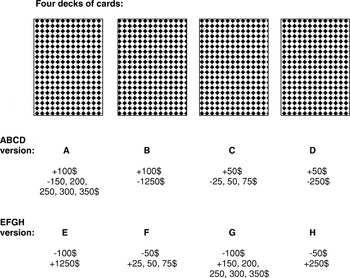
Participants always won $100 if they selected a card from deck A or B and always won $50 if they selected a card from deck C or D. The amount of lost money was $150, 200, 250, 300, or 350 for deck A (50% of the cards), $1250 for deck B (10% of the cards), $25, 50 or 75 for deck C (50% of the cards) and $250 for deck D (10% of the cards). If there was no loss (50% of cards for decks A and C and 90% for decks B and D), a sentence appeared on the computer screen stating that “You won $100 (or $50).” If there was a loss, a sentence appeared on the computer screen stating that “You won $100 (or $50), but you lost $X.” The order of winning and losing cards was randomized and unpredictable. Altogether, decks A and B were associated with high immediate reward but even higher future punishment (Figure 1).

Illustration of the Iowa Gambling Test. In the ABCD version, disadvantageous decks (A and B) yielded high immediate reward but even higher future punishment (+$ and −$ symbolizes winning and losing, respectively). Decks B and D are characterized by less frequent but relatively high amount of loss (10% of the cards), whereas decks A and C are characterized by frequent but relatively small amount of loss (50% of the cards). In the EFGH version, disadvantageous decks (F and H) yielded low immediate punishment but even lower future reward. Decks E and H are characterized by less frequent but relatively high amount of gain (10% of the cards), whereas decks F and G are characterized by frequent but relatively small amount of gain (50% of the cards).
The layout and design of the EFGH version was similar. The four decks were labeled as E, F, G, and H. Participants always lost $100 if they selected a card from deck E or G and always lost $50 if they selected a card from deck F or H. The amount of received money was $1250 for deck E (10% of the cards), $25, 50 or 75 for deck F (50% of the cards), $150, 200, 250, 300, or 350 for deck G (50% of the cards), and $250 for deck H (10% of the cards). If there was no winning (50% of cards for decks F and G and 90% for decks E and H), a sentence appeared on the computer screen stating “You lost $100 (or $50).” If participants won some money, a sentence appeared on the computer screen stating that “You lost $100 (or $50), but you won $X”. Altogether, decks E and G were associated with high immediate punishment but even higher future reward (Figure 1).
For data analysis, the 100 trials were divided into five equal blocks. The dependent measure was the number of cards selected from advantageous minus disadvantageous decks as calculated for each block ([C + D] − [A + B] in the ABCD version and [E + G] − [F + H] in the EFGH version).
Data Analysis
The STATISTICA 6.0 package (StatSoft, Inc., Tulsa, Oklahoma) was used for data analysis. Kolmogorov-Smirnov tests were used to check data distribution. IGT results were analyzed with a group (MS vs. controls) by IGT type (ABCD vs. EFGH) by trials analysis of variance (ANOVA). Two-tailed t-tests were used for post-hoc comparisons. Forward stepwise linear regression analysis was used to determine factors that predicted IGT performance. In this analysis, the dependent variable was the IGT performance after 100 trials and the independent variables were the WCST, digit span, digit symbol, and verbal fluency measures. Pearson's correlations coefficients were calculated between IGT performance and background neuropsychological measures. The level of significance was α < .05. Effects sizes (Cohen's d) were given for each comparison (Cohen, 1988).
RESULTS
Background Neuropsychology
The results are shown in Table 1. The patients with MS displayed impaired performances on tests of executive functions, attention, speed of information processing, and verbal retrieval.
Neuropsychological results

Iowa Gambling Test
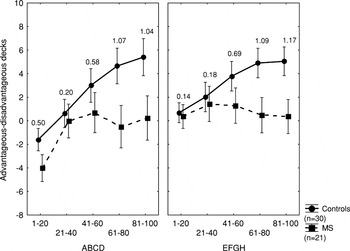
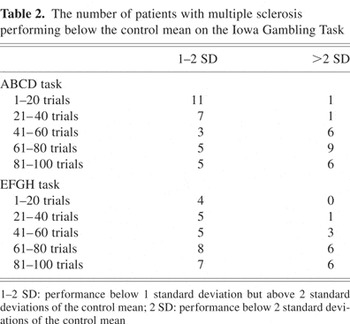
The results are shown in Figure 2. Kolmogorov-Smirnov tests did not indicate deviations from normal distribution in the patient and control groups (p > .2). The ANOVA revealed significant main effects of group [F(1,49) = 22.15, p < .001], IGT type [F(1,49) = 11.41, p < .01] and trials [F(4,196) = 30.02, p < .001]. There were significant interactions between group and trials [F(4,196) = 11.51, p < .001] and between IGT type and trials [F(4,196) = 6.51, p < .001]. The remaining interactions were not significant (p > .5). Student t-tests indicated that the MS patients made significantly less advantageous decisions than the controls in the ABCD task after 1–20 [t(49) = −3.28, p < .01; power = 0.41, Δ = 1.76], 41–60 [t(49) = −2.01, p < .05; power = .51, Δ = 2.04], 61–80 [t(49) = −4.40, p < .001; power > .9, Δ = 3.76], and 81–100 trials [t(49) = −4.22, p < .001; power > .9, Δ = 3.66]. Similar differences were found in the EFGH task after 41–60 [t(49) = −2.57, p < .05; power = .66, Δ = 2.42], 61–80 [t(49) = −4.55, p < .001; power > .9, Δ = 3.83], and 81–100 trials [t(49) = −4.99, p < .001; power > .9, Δ = 4.11] (Figure 2). The number of patients performing below the control mean is shown in Table 2.

Mean number of cards selected from advantageous minus disadvantageous decks. Positive scores reflect advantageous strategy (overall gain), whereas negative scores reflect disadvantageous strategy (overall loss). Numbers represent effect size (d) for each between-group comparison. Error bars indicate 95% confidence intervals.
The number of patients with multiple sclerosis performing below the control mean on the Iowa Gambling Task

Regression Analysis
The linear regression analysis revealed that the WCST perseverative errors, digit span, symbol digit, and verbal fluency scores did not predict ABCD and EFGH task performances after 100 trials (p > .4). There were no significant correlations among ABCD and EFGH task performances and background neuropsychological parameters (r < .3). These results were the same when data from the patients and controls were separately analyzed and when data from the two groups were collapsed.
DISCUSSION
In young, non-depressed, relatively highly functioning patients with MS, we found impaired decision-making on the ABCD and EFGH versions of the IGT. The difference between patients and controls was more pronounced in the later phase of test, which suggests that poor decision-making is a consequence of impaired learning across trials and not of generalized cognitive impairments. Although executive dysfunction is characteristic for MS (Stablum et al., 2004), it was not associated with IGT performances. These findings are consistent with the results of Kleeberg et al. (2004). However, in the Kleeberg et al. (2004) study only the ABCD version of the IGT was used, and therefore it remained undetermined whether the deficit was due to hypersensitivity to reward or to impaired ability to evaluate long-term outcomes of decisions. The finding that the patients also were impaired on the EFGH task, in which advantageous decks are characterized by high immediate loss but even higher future gain, suggests that decision-making problems cannot be entirely explained by increased sensitivity to reward. This is a potentially relevant observation for future cognitive analysis of behavioral disturbances in MS and for related therapeutic interventions. Yechiam et al. (2005) described a cognitive model of the IGT, which takes into consideration the attention paid by patients with different neurological and psychiatric disorders to gain, loss, and recent outcome instead of long-term consequences of decisions. Patients with lesions of the ventromedial prefrontal cortex pay excessive attention to recent outcomes regardless of loss and gain. Patients with Parkinson's disease and Asperger's syndrome are less influenced by gain, whereas patients with cocaine dependence and Huntington's disease pay excessive attention to both gain and recent outcomes. According to our results, patients with MS show a similar performance to that found in patients with ventromedial prefrontal damage: their decisions are guided by recent outcomes irrespective of gain or loss.
However, the specificity of IGT to ventromedial prefrontal damage has been questioned (Clark et al., 2003; Fellows & Farah, 2005; Manes et al., 2002). Disadvantageous decisions in the IGT can be observed in patients with lesions in the right prefrontal cortex and this response style correlates with the volume of damage outside the ventromedial region (Clark et al., 2003). Fellows and Farah (2005) further examined whether poor performance on the IGT was specific for ventromedial prefrontal damage. These authors found that both ventromedial and dorsolateral prefrontal damage led to impaired IGT performances. However, the impairment of patients with ventromedial lesion, but not of patients with dorsolateral lesions, seemed to be explained by a reversal-learning deficit. We did not find correlations and a predictive relationship between IGT scores and performances on tests sensitive to lesions of the dorsolateral prefrontal cortex. Therefore, our data may indicate that decision-making impairment is not a pure consequence of executive dysfunctions.
Another plausible explanation is that executive functions and decision-making, as measured by the IGT, are asymmetrically related (i.e., deficits in decision-making occurs independent of executive deficits) but not vice versa (Bechara et al., 1998). Evans et al. (2004) found that less-well-educated participants tended to achieve lower performances on executive tasks but significantly outperformed university-educated participants on the IGT. The conclusion of this study could be that education positively affects higher-level executive processes but discourages emotional learning. The Evans et al. (2004) data suggest that these processes can be dissociated. This may seem to be a counterintuitive finding, given that some authors classify the IGT as an executive task (Goldberg & Bougakov, 2005). However, the feeling about which decks are good or bad is reminiscent of decision-making based on intuition rather than on conventional executive resources of shifting, updating, and inhibiting of consciously represented information (Bechara et al., 1994, 1998; Miyake et al., 2000). Turnbull et al. (2005) tested this possibility using a dual-task condition. In this study, participants completed the IGT simultaneously with a random number generation task that is known to load executive resources. Results revealed that the random number generation task had no significant effect on the rate of learning in the IGT. This suggests that cognitive resources loaded by traditional executive tasks do not interfere with IGT performance (Turnbull et al., 2005). It is possible, however, that the strategy used during the IGT may differ between individuals and that the task can be solved in different ways. The IGT is a complex procedure including stimulus-reinforcement learning, affective shifting, attending to and remembering reinforcement history, and resolving approach-avoidance conflicts (Clark et al., 2003; Fellows & Farah, 2005). Further studies should take into consideration individual personality style and cognitive, motivational, and response sources which have significant effects on decision-making behavior (Busemeyer & Stout, 2002).
It is of particular interest that decision-making abnormalities were present in patients who did not show psychiatric and psychoactive substance-related disorders, which have been shown to disrupt decision-making cognition (Bechara et al., 2001; Rogers, 2003; Tavares et al., 2003). We may speculate that dysfunctions in the IGT reflect subclinical pathology, which may be a progenitor of later full-blown disorders. Kleeberg et al. (2004) found associations between IGT performance and impaired emotional dimensions of behavior as measured by anticipatory skin conductance responses. At present, however, it is not entirely clear how impaired IGT performances contribute to emotional and behavioral disturbances, given the fact that some healthy volunteers also fail to select the advantageous decks and social factors such as the level of education may affect IGT performances (Evans et al., 2004). Follow-up studies with more extensive test batteries and behavioral assessment are necessary to elucidate this issue. These studies should focus on the relationship among IGT performance, real-life decision-making impairment, and affective symptoms. A critical issue is how therapeutic interventions are able to ameliorate these symptoms and how specific tests can facilitate the monitoring of therapeutic processes.
Although the loss of myelin in deep white matter is considered as the main pathological feature of MS, recent evidence suggests that brain atrophy shows the strongest association with cognitive dysfunctions (for review, see Benedict et al., 2004). Benedict et al. (2002) found that bilateral frontal atrophy accounted for cognitive deficits on tests of conceptual reasoning and attention, even when the effect of demyelinating lesions was taken into consideration. Feinstein et al. (1999) suggested that the prefrontal cortex plays a critical role in emotional disorders in MS via its connections to subcortical structures regulating mood and affect. In their patients with emotional disorders (pathological laughing and crying and depression), executive functions were more severely affected (Feinstein et al., 1999). In our sample, we found decision-making problems in patients who did not show clinically significant affective disorders and our data also indicate that decision-making problems were not pure consequences of executive dysfunctions. According to Bechara et al. (1994, 1998, 1999, 2000), signals from the internal environment of the body are essential for decision-making (the “body loop”). An interesting possibility is that decision-making impairments are due to such peripheral impairments in our patients. This possibility merits further investigation.
The strength of our study is that the patients were young and relatively highly functioning and therefore a generalized impairment was not likely to confound the results. The weakness of the study is the small sample size, which is an important limiting factor in correlation analysis. Further studies should assess larger samples including different types of MS using a more comprehensive neuropsychological battery. The comparison of decision-making cognition in patients with MS with and without emotional disorders is of special relevance.