Introduction
Management practices and Human Resources (HR) have transitioned from viewing employees as passive job performers to encouraging employees to customize their jobs. As a job redesign approach, job crafting is initiated by employees and involves individualized efforts toward reshaping the characteristics of their jobs based on needs, priorities, and abilities. Taking an active role in redesigning one's job increases productivity and improves work outcomes (Berg, Dutton, & Wrzesniewski, Reference Berg, Dutton and Wrzesniewski2008; Rousseau, Hornung, & Kim, Reference Rousseau, Hornung and Kim2009). Job crafting is operationalized through the job demands-resources (JD-R) framework in describing how employees alter aspects of their jobs to meet work demands. The proactive personality trait plays a crucial role in employee crafting behaviors in determining the extent to which employees are successful in altering job content, increasing resources, and reducing demands (Bakker, Tims, & Derks, Reference Bakker, Tims and Derks2012). However, previous studies on job crafting have not considered how other individual characteristics such as skills and abilities might interact with the proactive personality trait to improve work engagement (Rudolph, Katz, Lavigne, & Zacher, Reference Rudolph, Katz, Lavigne and Zacher2017). Recognizing the gap, the current research introduces a model of proactive personality and political skill within the JD-R framework and examines the relationships through the lens of trait activation. By integrating the theoretical perspectives of JD-R and trait activation, the research sheds light on politically skilled proactive employees modifying their situation to reduce job demands and increase resources to excel at work. Furthermore, a multi-study approach utilizing three samples to test the theorized relationships aligns with scholarly calls for advancing management research through replication studies. The current research acknowledges the presence and potential influence of political skill in proactive job crafters, and also investigates the activation of said trait and skill in relevant situations. To that end, perceived supervisor support (PSS) as a potential resource for the job crafting–work engagement relationship was also examined to understand whether politically skilled proactive employees utilize manager assistance to mitigate demanding situations.
The current research appeals to personality and job redesign scholars who are interested in investigating how proactivity employees apply their political savviness to optimize working conditions during difficult situations. Job crafting research has reported consistent findings of positive outcomes for employees across the globe when studied using various country samples (e.g., Bakker, Tims, & Derks, Reference Bakker, Tims and Derks2012; Lyons, Reference Lyons2008). The opportunity for advancing job crafting literature involves incorporating underutilized, but relevant personality variables such as political skill. Future areas to extend previously researched perspectives such as the JD-R theory in job crafting should examine the trait–skill interaction in specific contexts like Hofstede's cultural dimensions.
Theoretical background and literature review
The JD-R theory (Bakker, Demerouti, Taris, Schaufeli & Schreurs, Reference Bakker, Demerouti, Taris, Schaufeli and Schreurs2003) lays out two specific job characteristics, namely job demands and job resources, that contribute to employee outcomes. Although, ‘job demands’ relate to the physical, organizational, and social constraints in the job that require physical and mental effort, ‘job resources’ are the physical, organizational, and social constituents of the job that help employees achieve work goals (Demerouti, Bakker, Nachreiner, & Schaufeli, Reference Demerouti, Bakker, Nachreiner and Schaufeli2001). The premise of JD-R theory is that job demands, such as increased work pressure, lead to stress, and burnout if demands exceed the employee's capability of handling them, but the existence of job resources such as supervisor support help employees meet organizational expectations and cope with the associated psychological costs (Di Marco, Arenas, Giorgi, Arcangeli, & Mucci, Reference Di Marco, Arenas, Giorgi, Arcangeli and Mucci2018). With regard to personality, the presence of neuroticism accentuates psychological and physical strains of job demands on an individual, potentially leading to health impairments (Bakker, Boyd, Dollard, Gillespie, Winefield, & Stough, Reference Bakker, Boyd, Dollard, Gillespie, Winefield and Stough2010). JD-R theory has also been beneficial in understanding how employees utilize career-related competencies, such as newly acquired knowledge, as a personal resource when taking on additional challenges to advance in the organization (Akkermans & Tims, Reference Akkermans and Tims2017).
Proactive personality
Bateman and Crant (Reference Bateman and Crant1993) defined proactive personality as a dispositional tendency for taking initiatives in various situations. Individuals with proactive personalities initiate changes to their circumstances intentionally (Buss, Reference Buss1987) and take actions that often go beyond what is required of them at work. Although people generally respond and adapt to changing situations in their environment, proactive individuals are able to efficiently take initiatives during turbulent situations to achieve positive outcomes for themselves and for the organization. Proactive personality is positively related to individual outcomes such as job satisfaction (Li, Wang, Gao, & You, Reference Li, Wang, Gao and You2017), job performance (Fuller & Marler, Reference Fuller and Marler2009), career success (Yang & Chau, Reference Yang and Chau2016), and work engagement (Tims, Bakker, & Derks, Reference Tims, Bakker and Derks2012). Although meta-analytical reviews reiterate that the proactive trait is related to positive outcomes (Fuller & Marler, Reference Fuller and Marler2009; Spitzmuller, Sin, Howe, & Fatimah, Reference Spitzmuller, Sin, Howe and Fatimah2015), when perceived as a threat by coworkers, proactive employees reacted negatively like displaying envy and undermining coworkers (Sun, Li, Li, Liden, Li, & Zhang, Reference Sun, Li, Li, Liden, Li and Zhang2020).
Political skill
Based on the perspective that organizations are political arenas (Mintzberg, Reference Mintzberg1985), scholars have suggested that along with intelligence and effort, employees must possess the skill to influence and persuade others at work (Luthans, Hodgetts, & Rosenkrantz, Reference Luthans, Hodgetts and Rosenkrantz1988; Mintzberg, Reference Mintzberg1983). Coining the term ‘political skill,’ Pfeffer (Reference Pfeffer1981) argued that organizations must be studied from a political perspective and called for the development of the construct, which Mintzberg (Reference Mintzberg1983) defined as the skill needed to exercise influence over others through persuasion, negotiation, and manipulation. Political skill has four dimensions – namely, networking ability, interpersonal influence, social astuteness, and apparent sincerity (Ferris, Treadway, Brouer, & Munyon, Reference Ferris, Treadway, Brouer and Munyon2012) – and correlates significantly with other personality characteristics such as self-monitoring, conscientiousness, emotional intelligence, and dark personality (Ferris et al., Reference Ferris, Treadway, Kolodinsky, Hochwarter, Kacmar, Douglas and Frink2005; Templer, Reference Templer2018). Political behavior has been studied in contexts such as impression management (Maher, Gallagher, Rossi, Ferris, & Perrewé, Reference Maher, Gallagher, Rossi, Ferris and Perrewé2018), opportunity recognition and capitalization (Wihler, Blickle, Ellen, Hochwarter, & Ferris, & R, Reference Wihler, Blickle, Ellen, Hochwarter and Ferris2017), and organizational politics (Crawford, Lamarre, Kacmar, & Harris, Reference Crawford, Lamarre, Kacmar and Harris2019).
Job crafting
Job crafting is defined in terms of altering three characteristics of the job – changing job task boundaries and job relationship boundaries to navigate job demands and increase social and structural resources, thereby enhancing the meaning of the job itself (Tims & Bakker, Reference Tims and Bakker2010; Wrzesniewski & Dutton, Reference Wrzesniewski and Dutton2001). Crafting behaviors are self-initiated and could involve positive approaches such as problem-solving to improve one's work situation or may entail avoidance-oriented actions such as reducing contact with demanding coworkers (Zhang & Parker, Reference Zhang and Parker2019). Job crafting relates to voluntarily adjusting one's work boundaries without a formal agreement with one's supervisor or organization and sometimes without the knowledge of the supervisor, and differs from other similar constructs such as Idiosyncratic-deals (I-deals) and negotiation.
Empirical literature on job crafting comprises quantitative and qualitative studies. Grounding on JD-R theory, Tims, Bakker, and Derks (Reference Tims, Bakker and Derks2012) empirically described four factors that constitute the ‘overall’ job crafting construct – namely, increasing social job resources, increasing structural job resources, increasing challenging job demands, and decreasing hindering job demands. Challenging job demands is positively associated with higher job performance, decreasing hindering job demands lowers turnover intentions (Rudolph et al., Reference Rudolph, Katz, Lavigne and Zacher2017), and increasing job resources along with challenging job demands are positively related to work engagement and negatively to burnout (Lichtenthaler & Fischbach, Reference Lichtenthaler and Fischbach2019). A review of qualitative studies in job crafting identified a process map of contextual factors that support crafting efforts, which includes social support and strong organizational culture (Lazazzara, Tims, & De Gennaro, Reference Lazazzara, Tims and De Gennaro2020).
Trait activation
Trait activation, derived from trait activation theory, is defined as the process by which people express their personality characteristics when presented with appropriate situational cues (Tett & Burnett, Reference Tett and Burnett2003). Individuals adjust their attitudes and behaviors through the activation of certain traits when faced with trait-relevant situations (McCrae, Reference McCrae2001). Trait-relevant behaviors affect outcomes such as job performance (Blickle, Schütte, & Genau, Reference Blickle, Schütte and Genau2018), turnover intentions (Zagenczyk, Smallfield, Scott, Galloway, & Purvis, Reference Zagenczyk, Smallfield, Scott, Galloway and Purvis2017), and affective commitment (Ozcelik, Reference Ozcelik2017). If traits were considered a resource, then enhancing one's resources by applying inherent trait characteristics in specific situations could help the individual cope better when faced with environmental demands (Judge & Zapata, Reference Judge and Zapata2015). Consistent with the logic, the current research incorporates trait activation into the context of job crafting to examine improved work outcomes.
Hypothesis development
Proactive personality, political skill, and work engagement
Proactive personality is positively associated with work engagement (Jawahar & Liu, Reference Jawahar and Liu2017; Li & Mao, Reference Li and Mao2014). Work engagement, a positive and fulfilling state of mind relating to one's work, is characterized by three aspects – high levels of energy while working (vigor), strong involvement and sense of meaning in work (dedication), and being happily engrossed in work (absorption) (Schaufeli & Salanova, Reference Schaufeli and Salanova2007). When job challenges increase, the presence of social job resources such as coworker assistance, supervisor support, and good working conditions allow employees to remain engaged and excel at their work (Bakker, Tims, & Derks, Reference Bakker, Tims and Derks2012), suggesting that the JD-R framework is applicable when studying work engagement (Bakker & Demerouti, Reference Bakker and Demerouti2007). Employees who proactively seek out resources to mitigate challenging situations, increase work-related knowledge, and expand skillsets tend to be more engaged at their jobs (e.g., Hakanen, Perhoniemi, & Toppinen-Tanner, Reference Hakanen, Perhoniemi and Toppinen-Tanner2008; Hyvönen, Feldt, Salmela-Aro, Kinnunen, & Mäkikangas, Reference Hyvönen, Feldt, Salmela-Aro, Kinnunen and Mäkikangas2009).
Given the effectiveness of proactive initiatives in improving work engagement, political skill could be particularly advantageous when job demands are high. For instance, political skill increases when managers experience high enterprising (interpersonal) job demands such as having to set clear expectations and motivating team members continuously (Gansen-Ammann, Meurs, Wihler, & Blickle, Reference Gansen-Ammann, Meurs, Wihler and Blickle2019). Politically skilled employees tend to capitalize on opportunities to advance their careers more than their counterparts who lack the skill (Russell, Ferris, Thompson, & Sikora, Reference Russell, Ferris, Thompson and Sikora2016). The current research contends that proactive employees could employ their political abilities to continue excelling at work. During tight deadlines, increased workloads, and other turbulent environments, employees who actively seek support resources to stabilize their situation would benefit further by demonstrating astuteness and accurately interpreting the social cues of their manager and coworkers. Thus,
Hypothesis 1a: Political skill strengthens the positive relationship between proactive personality and work engagement.
Proactive personality, political skill, and job crafting
Proactive personality is positively related to job crafting (Plomp, Tims, Akkermans, Khapova, Jansen, & Bakker, Reference Plomp, Tims, Akkermans, Khapova, Jansen and Bakker2016; Rudolph et al., Reference Rudolph, Katz, Lavigne and Zacher2017), in that proactive employees would take initiatives to craft their jobs by increasing structural job resources (such as volunteering for developmental trainings), increasing social job resources (such as seeking feedback from supervisors), and decreasing their hindering job demands (such as avoiding projects or tasks that lead to burnout). Proactive employees who also possess networking and influencing abilities can engage in crafting behaviors that would help them cope with job demands and stressful situations in unique ways. An instance of such intermingled trait and skill display in job crafting would occur when a seasoned employee who is on a project team with multiple time-consuming deliverables would try to improve their condition by proactively creating timelines and To-Do lists for themselves (thereby, decreasing hindering job demands). Beyond such efforts, the employee would utilize their political savviness to enquire with the supervisor if certain tasks could be delegated to newer team members or interns as an opportunity for others to gain relevant experience (thereby, increasing social support), and in return, offering to take on more substantial projects (thereby, increasing their challenging job demands). Although proactive employees might focus on any one dimension of job crafting at a given time like increasing support or reducing demands, when political skill and proactive trait function in congruence, employees could effectively engage in overall job crafting. Political skill can also act as a buffer to strengthen positive relationships between proactive behaviors and work outcomes (e.g., Yin-Mei, Reference Yin-Mei2020; Sun & van Emmerik, Reference Sun and van Emmerik2015). Hence,
Hypothesis 1b: Political skill strengthens the positive relationship between proactive personality and job crafting.
The mediating role of job crafting
Job crafting efforts facilitate engagement because increasing one's structural resources such as skill variety and knowledge to successfully complete difficult tasks would allow employees to feel a sense of accomplishment and help them stay energized and dedicated to the job (Bakker, Tims, & Derks, Reference Bakker, Tims and Derks2012). Employees who increase job resources at the interpersonal-level (e.g., seeking coworker and supervisor support), task-level (e.g., maximizing developmental activities), and job-level (e.g., capitalizing on promotional opportunities) are likely to experience feelings of vigor, motivation, and meaningfulness that foster work engagement. Because proactive individuals take actions to alter negative circumstances and alleviate their discomfort, job crafting behaviors would be a highly effective means to continue remaining engaged at work. Proactive employees actively request assistance and feedback; and in situations where support or structural resources are lacking, they are able to remain focused and stimulated by aligning their own skills and competencies to autonomously meet challenging job demands (Tims & Bakker, Reference Tims and Bakker2010). When there is a healthy balance of high demands and high resources in one's job, engaged employees activate coping mechanisms to deal with those demands (Kwon & Kim, Reference Kwon and Kim2020). The current research suggests that proactive behavior is such a coping strategy. Consistent with trait activation theory's assertion that certain personality traits are expressed when individuals view situational cues, the proactive personality trait becomes activated when employees are faced with increasing challenges at work. Such activation of proactivity enables employees to remain engaged at work through crafting behaviors because proactive employees can seek external resources or self-create a resourceful environment by utilizing their own skillsets when options are limited. Therefore,
Hypothesis 2: Job crafting mediates the positive relationship between proactive personality and work engagement.
Perceived supervisor support, job crafting, and work engagement
According to a meta-analysis conducted by Halbesleben (Reference Halbesleben, Bakker and Leiter2010), the presence of job resources is positively associated with improved work engagement. Supervisor support is a job resource that can take a variety of forms including, allocating equipment needed to accomplish work tasks, providing timely performance appraisals, allowing participation in team decision-making, offering motivation, and dedicating empowerment efforts toward employee learning and professional growth. Such tangible and emotional support displayed by the supervisor enhances an employee's psychological mindset to remain engaged (Swanberg, McKechnie, Ojha, & James, Reference Swanberg, McKechnie, Ojha and James2011), particularly when the employee is involved in crafting efforts that involve increasing their challenging job demands, such as volunteering for new projects (Rudolph et al., 2017). Moreover, a promotive style of supervisory leadership facilitates job crafting and improves work outcomes (Berdicchia & Masino, Reference Berdicchia and Masino2019). Hence, the following hypothesis is formulated.
Hypothesis 3: Perceived supervisor support strengthens the positive relationship between job crafting and work engagement.
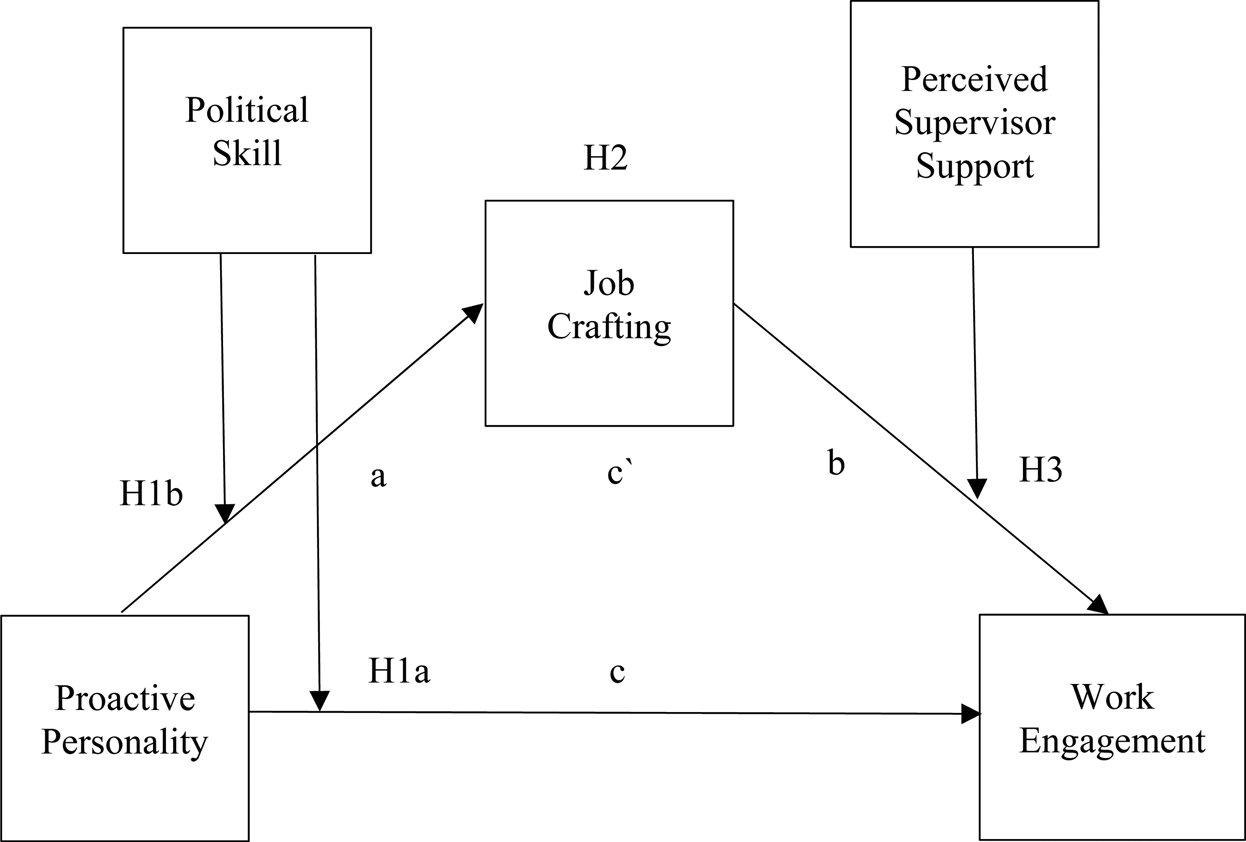
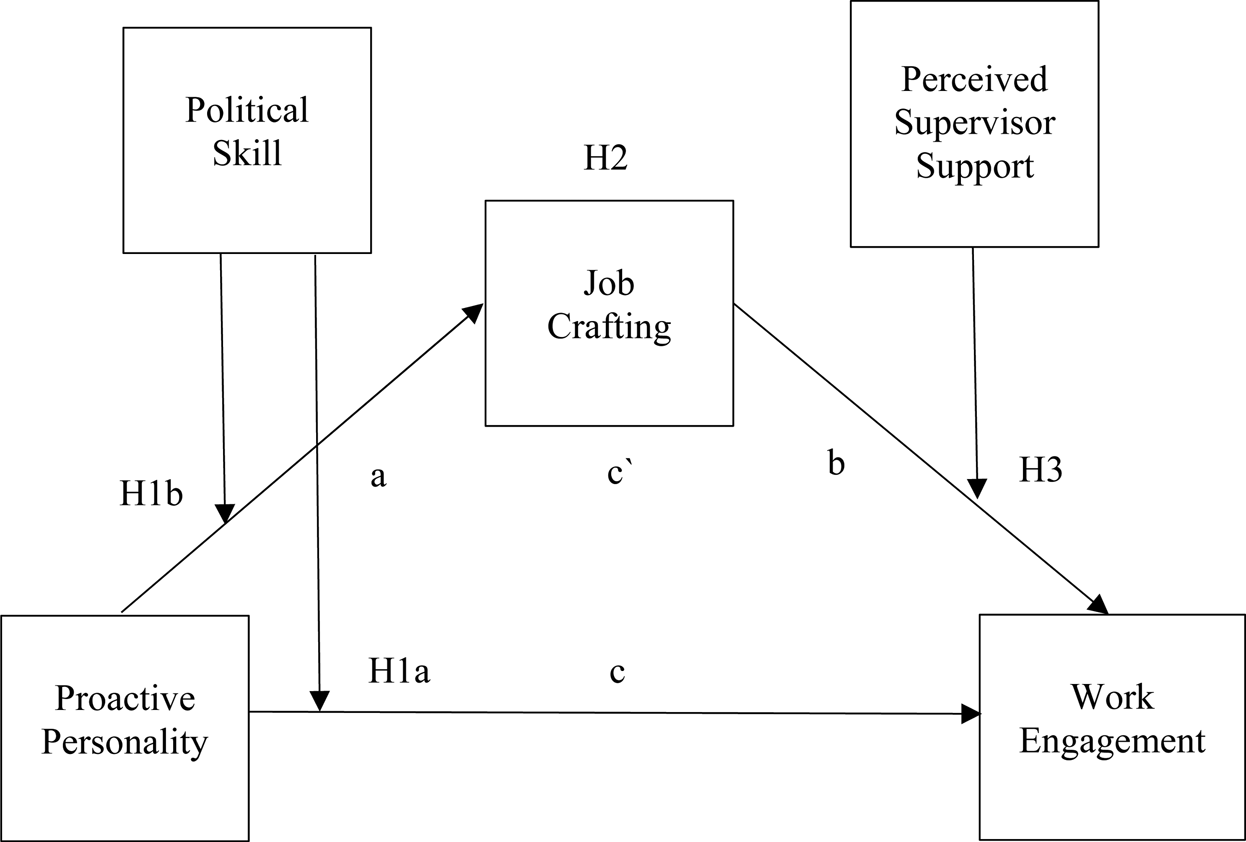
The proposed model is displayed in Figure 1.
Model for proactive personality, political skill, job crafting, and work engagement.
Method
Overview of design and sample
The current research used a three-study design to explore the interplay of proactive personality and political skill in job crafting and work engagement and to improve generalizability of the proposed model. Such a design aligns with the increased appreciation for replication in management research, wherein scholars have suggested analyzing theorized relationships on multiple samples (Anderson & Maxwell, Reference Anderson and Maxwell2016; Köhler & Cortina, Reference Köhler and Cortina2021; Vazire, Reference Vazire2018). Novel approaches, such as multi-level, multi-stage, or multi-genre studies, are also recognized in management journals (e.g., Bryant & Frahm, Reference Bryant and Frahm2011; Lee, Seo, Jeung, & Kim, Reference Lee, Seo, Jeung and Kim2019; Sung, Cho, & Choi, Reference Sung, Cho and Choi2011).
Two types of samples were utilized. The first consisted of university students (study 1), whereas the second and third samples were working adults recruited via Amazon's Mechanical Turk (MTurk) crowdsourcing platform (study 2) and Qualtrics' commercial panel (study 3), respectively. Studies 2 and 3 utilized panel data, in order to maintain the similarity of the working adults’ samples. The Qualtrics study involved a mechanism to activate the proactive personality trait and political skill in respondents.
Mechanical Turk and Qualtrics panel platforms
Crowdsourcing is a commonly acceptable means for data collection in Organizational Behavior and Industrial & Organizational Psychology research due to potential advantages of increased diversity, quick access, and speed of data collection (Crump, McDonnell, & Gureckis, Reference Crump, McDonnell and Gureckis2013; Landers & Behrend, Reference Landers and Behrend2015). MTurk is frequently utilized as a viable sample in behavioral research (Buhrmester, Kwang, & Gosling, Reference Buhrmester, Kwang and Gosling2011; Hauser & Schwarz, Reference Hauser and Schwarz2016). Generally speaking, there are key differences between an MTurk data sample and online panels such as Qualtrics. In employing the two samples for the current research, the attributes of each are highlighted. Although MTurk is considered a low-cost convenience sample for researchers, where workers are easily found and paid directly for task completion, Qualtrics panel, on the other hand, is at least three times more expensive than MTurk, besides being slow and cumbersome for worker recruitment (Chandler, Rosenzweig, Moss, Robinson, & Litman, Reference Chandler, Rosenzweig, Moss, Robinson and Litman2019). Survey takers are hired indirectly through third party panel providers based on specific parameters provided to Qualtrics by the research investigators. Additionally, Qualtrics panel workers are not usually remunerated directly by researchers through cash payments, rather are offered incentives such as gift cards and airline miles by their hiring firms, thus, making it less attractive to the general population of survey takers. MTurk consists of a large population compared to other online panels, with over 100,000 workers available on the platform (Difallah, Filatova, & Ipeirotis, Reference Difallah, Filatova and Ipeirotis2018). The Qualtrics panel is a smaller, diverse sample of better-quality workers specifically recruited using targeted inclusion parameters (Boas, Christenson, & Glick, Reference Boas, Christenson and Glick2020; Briones & Benham, Reference Briones and Benham2017). Qualtrics respondents do not often participate in academic and behavioral science studies (Chandler et al., Reference Chandler, Rosenzweig, Moss, Robinson and Litman2019), and are utilized less frequently than MTurk by academicians.
Participants and procedure
Sample for study 1
Upper-level undergraduate and graduate business students from a large Southwestern university in the USA, with at least an active part-time employment, were invited to participate in an online survey. Consistent with suggested research designs of collecting predictor and criterion variables at different points in time to minimize common method bias (Cheung, Burns, Sinclair, & Sliter, Reference Cheung, Burns, Sinclair and Sliter2017; Podsakoff, MacKenzie, Lee, & Podsakoff, Reference Podsakoff, MacKenzie, Lee and Podsakoff2003), the survey was administered in two time waves with the independent, moderator, and demographic variables (proactive personality, political skill, and PSS) collected at time 1 and the dependent and mediator variables (work engagement and job crafting) captured at time 2 (1 week later). A total of 500 students completed the first wave and 472 respondents completed the second wave. Of these, 363 students had completed both waves, with no missing data and were, therefore, considered the final sample size. Students who completed both waves of the survey were compensated via course credit or gift coupons. Participants were skewed male (52.61%), with ages ranging from 19 to 62 years (M = 27.57, SD = 6.57). The racial composition of the sample was: 57.02% Caucasian, 8.81% African-American, 16.25% Hispanic, 15.42% Asian, and 2.47% other. The sample had an average overall job tenure of 7.54 years and about 40% of them worked in the service industry in entry-level positions.
Sample for study 2
The second study sample consisted of adults with full-time employment in the USA, who participated in the survey through Amazon's MTurk platform. Participants residing in the USA with at least a 95% approval rating on MTurk were given access to the survey. No other pre-screening parameters were enforced. Consistent with MTurk payment rates (Buhrmester, Kwang, & Gosling, Reference Buhrmester, Kwang and Gosling2011), every participant who satisfactorily completed the online survey was paid US $.75. Because the MTurk sample completed the survey in a single wave in study 2, the survey questionnaire was divided into three ‘blocks’ consisting of the independent-moderator variable block, dependent-mediator variable block, and demographics block. Each block contained scale items for the associated variable in the model. Following suggested procedures for strengthening research design and reducing item priming effects (Chambers, Nimon, & Anthony-McMann, Reference Chambers, Nimon and Anthony-McMann2016; Podsakoff et al., Reference Podsakoff, MacKenzie, Lee and Podsakoff2003), participants were first presented with the dependent-mediator block, followed by the independent-moderator variable block, and lastly, the demographics block. All 300 responses (sample size) were retained and no responses were eliminated. Respondents skewed female (52.33%), with ages ranging from 20 to 72 years (M = 37.83, SD = 11.46). The sample comprised of 78.66% Caucasian, 7% African-American, 4% Hispanic, 8.66% Asian, and 1.66% other. The sample had an average overall job tenure of 16.38 years, with 54% participants in managerial positions. About half of the participants were employed in the service industry.
Sample for study 3
The sample for the third study consisted of full-time working adults in the USA recruited through the Qualtrics commercial panel. Unlike MTurk, the Qualtrics panel was made up of a specific sample consisting of individuals with at least 2 years of work experience at their current job with some kind of flexibility and autonomy in their work environment (like the ability to work from home and some freedom for decision-making). Third party recruiters selected workers based on the aforementioned criteria and disqualified those who did not meet eligibility requirements. Qualtrics managers also embedded attention checks in the survey questionnaire to capture poor quality responses. For conducting said recruitment and screening tasks, Qualtrics's negotiated price was US $5 per qualifying participant. Similar to the MTurk sample, Qualtrics participants also completed the entire survey in one sitting and were presented with scale items based on the same block design as study 2. The total sample size was 206 and no responses were deleted. Participants were mostly female (63.10%), with ages ranging from 21 to 64 years (M = 37.43, SD = 10.58). The racial composition was as follows: 72.81% Caucasian, 11.16% African-American, 10.19% Hispanic, 4.36% Asian, and 1.45% other. Although the overall job tenure of the sample averaged 12.17 years, the average tenure at their current job was 9.42 years and about 80% of the participants worked in managerial positions. Finally, the sample had an even representation from industries including retail, manufacturing, technology, and services.
Measures
Proactive personality
Proactive personality was measured using the scale developed by Bateman and Crant (Reference Bateman and Crant1993). All items were based on a 7-point Likert scale (1 = strongly disagree, 7 = strongly agree). The 17-item scale included sample items such as ‘I am constantly on the lookout for new ways to improve my life’ and ‘If I see something I don't like, I fix it.’ The items had a Cronbach's alpha of .91 (sample 1), .94 (sample 2), and .94 (sample 3).
Political skill
Political skill was measured using the scale developed by Ferris et al., (Reference Ferris, Treadway, Kolodinsky, Hochwarter, Kacmar, Douglas and Frink2005). All items were based on a 7-point Likert scale (1 = strongly disagree, 7 = strongly agree). The 18-item scale included sample items such as ‘I spend a lot of time and effort at work networking with others’ and ‘I am good at getting people to like me.’ The items had a Cronbach's alpha of .93 (sample 1), .94 (sample 2), and .96 (sample 3).
Trait activation manipulation
Trait activation was done only for study 3 (Qualtrics panel sample) by making participants think of three separate situations and asking them to describe each situation in a few sentences. The first situation was a time when they: ‘Performed a non-routine task that was outside your job role. (An example could be taking notes during team meetings to circulate to the team post-meeting or volunteering to help a newcomer)’; the second situation was when they: ‘Effectively used your networking skills in order to get something done at work’; and third was when they: ‘Made a work-related decision independently without the involvement of your supervisor. (An example could be offering a discount to a customer who is irate because of a delay in product delivery).’ Each situational question was intended to activate either the proactive personality trait or political skill.
Job crafting
Job crafting was measured using the scale developed by Tims, Bakker, and Derks (Reference Tims, Bakker and Derks2012). All items were based on a 5-point Likert scale (1 = never, 5 = very often). The 21-item scale included sample items such as ‘I try to develop my capabilities’ and ‘I try to ensure that my work is emotionally less intense.’ The items had a Cronbach's alpha of .83 (sample 1), .85 (sample 2), and .92 (sample 3).
Perceived supervisor support
PSS was captured using 16-item scale developed by Eisenberger, Fasolo, and Davis-LaMastro (Reference Eisenberger, Fasolo and Davis-LaMastro1990). The scale can be used to measure supervisor support by replacing the term ‘organization’ with ‘supervisor.’ All items were based on a 7-point Likert scale (1 = strongly disagree, 7 = strongly agree). The scale included sample items such as ‘My supervisor is willing to help me when I need a special favor’ and ‘My supervisor shows very little concern for me’ (reverse-coded). The items had a Cronbach's alpha of .95 (sample 1), .94 (sample 2), and .85 (sample 3).
Work engagement
Work engagement was measured using the Work and Well-Being Survey (UWES) developed by Schaufeli, Bakker, and Salanova (Reference Schaufeli, Bakker and Salanova2006). All items were based on a 6-point Likert scale (1 = never, 5 = everyday). The 17-item scale included sample items such as ‘At my work, I am bursting with energy’ and ‘I am immersed in my work.’ The items had a Cronbach's alpha of .94 (sample 1), .94 (sample 2), and .94 (sample 3).
Control variables
The following variables were used as controls for the current research: race, age, salary, and overall tenure. Age and tenure have shown to significantly correlate with job redesign activities such as I-deals (Lai, Rousseau, & Chang, Reference Lai, Rousseau and Chang2009). Salary has shown to influence job attitudes and job crafting (Leana, Appelbaum, & Shevchuk, Reference Leana, Appelbaum and Shevchuk2009), while respondent's race might affect work-related attitudes (Broschak & Davis-Blake, Reference Broschak and Davis-Blake2006).
Data analysis
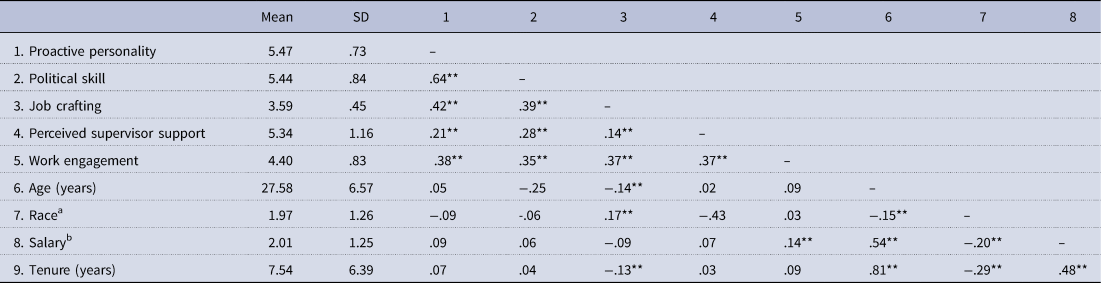
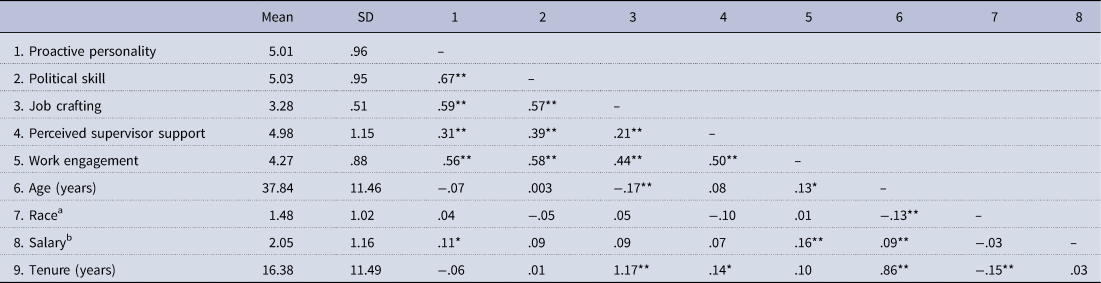
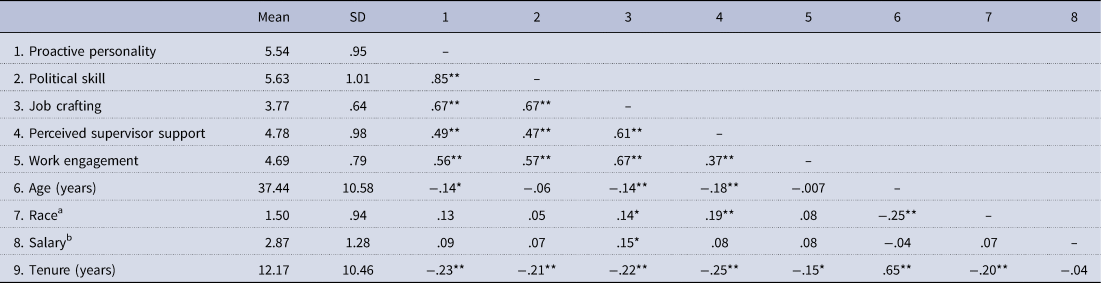
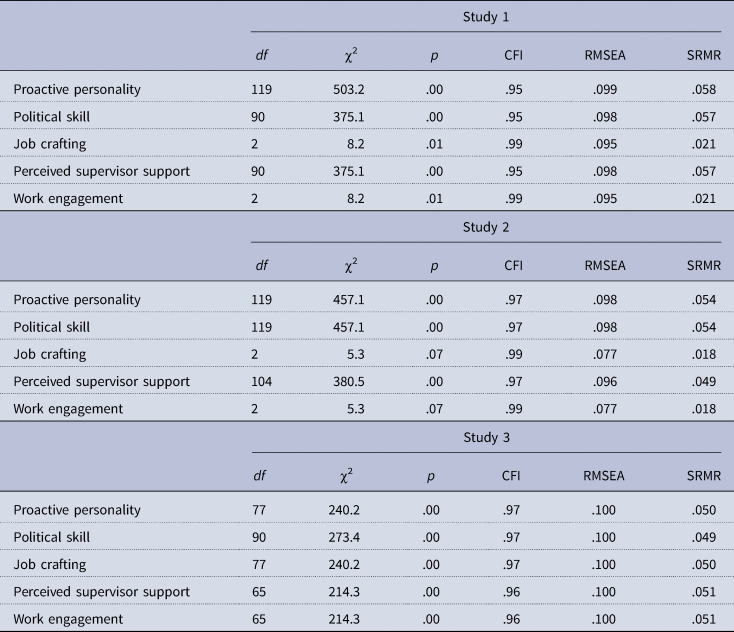
Tables 1, 2, and 3 provide the descriptive statistics and correlations between the study variables for studies 1, 2, and 3, respectively. Prior to testing the hypotheses, a series of confirmatory factor analyses (CFA), with maximum likelihood estimation, were conducted using LISREL v.8.80. Due to the high number of items in all five variables in the research model (89 total items; PSS had the least at 16 items), the sample sizes were deemed insufficient to conduct an overall CFA. Sample size requirements have a tendency to increase as the number of factors and indicators increase (Wolf, Harrington, Clark, & Miller, Reference Wolf, Harrington, Clark and Miller2013). Hence, individual CFA's were conducted to confirm the factor structure of each variable for the three study samples in lieu of an overall CFA. Table 4 displays the fit indices of the CFA's. The CFA's yielded models that fit the factor structure well, with the fit indices being acceptable with conventional standards (cf. Hu & Bentler, Reference Hu and Bentler1999).
Overall descriptive statistics and correlations for study 1
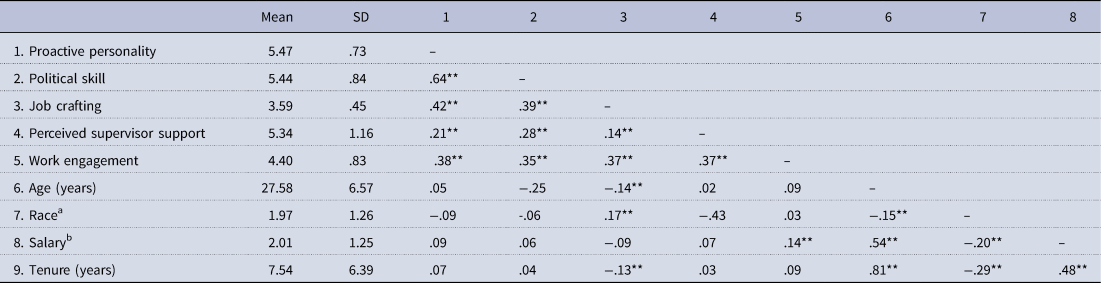
N = 363, **p < .01, two tailed. *p < .05, two tailed.
a Majority respondents were Caucasian (item 1 on Race scale).
b Mean salary ranged from $40,000 to $59,000 (item 2 on Salary scale).
Overall descriptive statistics and correlations for study 2
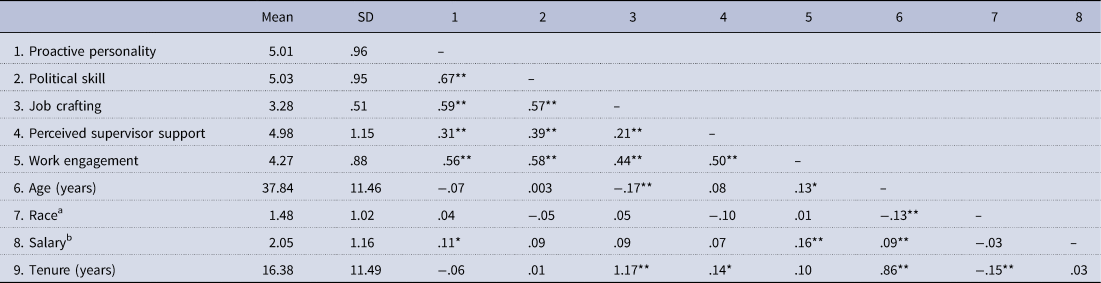
N = 300, **p < .01, two tailed. *p < .05, two tailed.
a Majority respondents were Caucasian (item 1 on Race scale).
b Mean salary ranged from $40,000 to $59,000 (item 2 on Salary scale).
Overall descriptive statistics and correlations for study 3
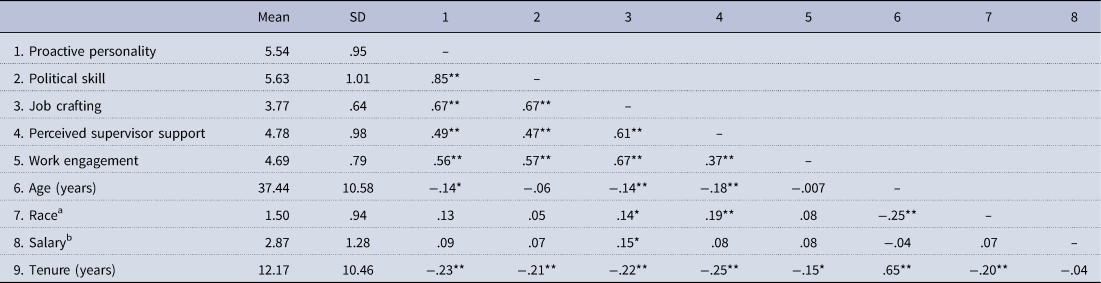
N = 206, **p < .01, two tailed. *p < .05, two tailed.
a Majority respondents were Caucasian (item 1 on Race scale).
b Mean Salary ranged from $40,000 to $59,000 (item 2 on Salary scale).
Fit indices of CFA
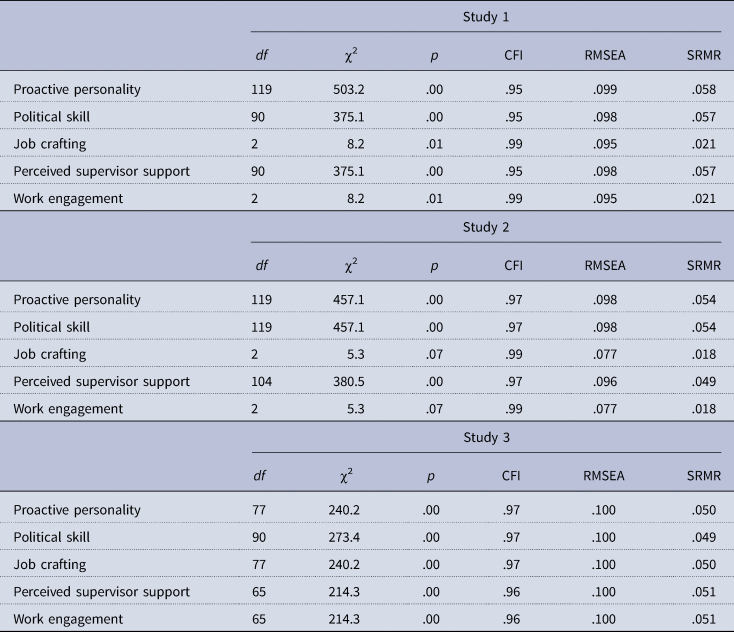
N = 363.
N = 300.
N = 206.
To test the overall mediation analyses – with job crafting mediating the effects of proactive personality on work engagement, political skill moderating the effects of proactive personality on job crafting, and PSS moderating the effects of job crafting on work engagement – a regression-based path analysis and bootstrapping approach was utilized. SPSS PROCESS Model 21 was used for the analysis, as it is capable of generating direct and indirect effects in the presence of a mediator and two moderators (Hayes, Reference Hayes2017). The indirect effects and conditional indirect effects were estimated using unstandardized coefficients at 95% confidence intervals (CIs) and bootstrapping with 5,000 resamples.
Results
Regression analysis
The first hypothesis was tested using moderated regression analysis. Hypothesis 1a posits that political skill strengthens the positive relationship between proactive personality and work engagement. Results revealed that the moderating effect of political skill on proactive personality and work engagement was significant for one of the three studies (study 1: ns; study 2: ns; study 3: p < .001). Hypothesis 1a is supported for study 3 but not for studies 1 and 2.
Mediation analyses
The remaining hypotheses, for the full moderated-mediated-moderation model, were tested using the Preacher and Hayes (Reference Preacher and Hayes2008) mediation analyses. Hypothesis 1b posits that political skill strengthens the positive relationship between proactive personality and job crafting. The unconditional interaction of political skill on proactive personality and job crafting was significant for two of the three studies (study 1: p < .001; study 2: ns; study 3: p < .001). Hypothesis 1b is supported for studies 1 and 3 but not for study 2.
Hypothesis 2 states that job crafting mediates the relationship proactive personality and work engagement. Full mediation is said to be present if zero falls outside of the 95% CI. The significance of paths, a, b, c, and c′, as depicted in Figure 1, are reported ahead for each study. For study 1, the effect of proactive personality on work engagement (path c) was significant (β = .22; p < .001); the conditional effect of proactive personality (moderated by political skill) on job crafting (path a) was significant (β = .11; p < .001); and the conditional effect of job crafting (moderated by PSS) on work engagement (path b) was significant (β = −.15; p < .05). The conditional indirect effect of proactive personality on work engagement (path c′) excluded zero (CI [−.037, −.002]), which indicates full mediation. Hence, hypothesis 2 is supported for study 1 because job crafting completely mediates the proactive personality–work engagement relationship. For study 2, the effect of proactive personality on work engagement (path c) was significant (β = .33; p < .001); the conditional effect of proactive personality (moderated by political skill) on job crafting (path a) was not significant (β = .006; ns); and the conditional effect of job crafting (moderated by PSS) on work engagement (path b) was significant (β = .90; p < .05). The conditional indirect effect of proactive personality on work engagement (path c′) did not exclude zero (CI [−.013, .005]) and was therefore, non-significant. However, an indirect-only mediation exists, because the indirect effect (a × b) can be significant without the presence of path c′ (Zhao, Lynch, & Chen, Reference Zhao, Lynch and Chen2010) and a significant indirect effect exists if one of the paths (a or b) is significant (Hayes, Reference Hayes2017). Therefore, hypothesis 2 is supported for study 2 as job crafting partially mediates the proactive personality–work engagement relationship. Finally, for study 3, the effect of proactive personality on work engagement (path c) was significant (β = .18; p < .01); the conditional effect of proactive personality (moderated by political skill) on job crafting (path a) was significant (β = .076; p < .001); and the conditional effect of job crafting (moderated by PSS) on work engagement (path b) was not significant (β = .43; ns). The conditional indirect effect of proactive personality on work engagement (path c′) did not exclude zero (CI [−.007, .015]) and was non-significant. Again, due to the presence of indirect-only mediation, hypothesis 2 is supported for study 3 because job crafting partially mediates the proactive personality–work engagement relationship.
Hypothesis 3 states that PSS strengthens the positive relationship between job crafting and work engagement. The unconditional interaction of PSS on job crafting and work engagement was significant for two studies (study 1: p < .05; study 2: p < .05; study 3: ns). Hypothesis 3 is supported for studies 1 and 2 but not for study 3.
Discussion
There is growing interest in management scholarship on how employees shape their job roles in various ways and the effects that crafting efforts have on work outcomes (Kooij, Tims, & Kanfer, Reference Kooij, Tims, Kanfer, Bal, Kooij and Rousseau2015; Lazazzara, Tims, & De Gennaro, Reference Lazazzara, Tims and De Gennaro2020). The current research utilized three worker samples to contribute to evolving literature on job crafting. Past studies have tested samples from different countries, including the United States (e.g., Lyons, Reference Lyons2008), The Netherlands (e.g., Bakker, Tims, & Derks, Reference Bakker, Tims and Derks2012), South Africa (e.g., De Beer, Tims, & Bakker, Reference De Beer, Tims and Bakker2016), Germany, and Australia (e.g., Schachler, Epple, Clauss, Hoppe, Slemp, & Ziegler, Reference Schachler, Epple, Clauss, Hoppe, Slemp and Ziegler2019), and China (e.g., Slemp, Zhao, Hou, & Vallerand, Reference Slemp, Zhao, Hou and Vallerand2020) among others, and reported consistent results of job crafters experiencing positive work outcomes. As a three-study approach, the current research is an example of within-paper replications and follows the recommendations of scholars calling out the lack of replicability in behavioral management studies as a constraint to the advancement of scientific research (see Aguinis, Cascio, & Ramani, Reference Aguinis, Cascio and Ramani2017; Banks, Rogelberg, Woznyj, Landis, & Rupp, Reference Banks, Rogelberg, Woznyj, Landis and Rupp2016; Cuervo-Cazurra, Andersson, Brannen, Nielsen, & Reuber, Reference Cuervo-Cazurra, Andersson, Brannen, Nielsen and Reuber2016).
The central goal of the current research was to examine the combined role of proactive personality and political skill in improving work engagement through job crafting. Politically skilled proactive employees modify their work circumstances by reducing hindering job demands and increasing job resources to excel at work. By integrating theoretical perspectives of JD-R and trait activation, the research attempted to examine individual trait and skill working in conjunction in overall job crafting. Individual differences have received attention in the JD-R framework and job crafting literature, but have largely been limited to differences in personality (the five-factor model, proactivity, and self-efficacy) and demographic characteristics (age, gender, education, and tenure) (Rudolph et al., Reference Rudolph, Katz, Lavigne and Zacher2017). The current research added political skill to the list of individual differences employed in studying job crafting through the demands-resources perspective.
Research findings
First, political skill strengthened the relationship between proactive personality and work engagement (hypothesis H1a) for the trait-activated Qualtrics panel sample, but not for the non-activated student and MTurk samples, suggesting that political skill remains inactive when workers take proactive initiatives to stay engrossed at their jobs. However, when individuals are presented with certain situations in their work environment that activate trait and skill, the combined display of such characteristics improves engagement. The finding aligns with trait activation theory, where situation specificity plays a role in the personality–performance relationship (Tett & Burnett, Reference Tett and Burnett2003). Support for hypothesis H1a and its positioning in trait activation theory can be further elaborated using an example. Consider two instances of a hindering task-level demand, one where the employee needs to complete the hard task by the deadline and automatically receives payment upon completion and another, where the employee must not only meet the deadline but also have a higher-up sign off on the completed task in order to get paid. The first instance does not offer as relevant a situational cue for the employee to activate the trait–skill combination as does the second instance. In the latter case, upon completing the task ahead of time through securing the necessary resources, a proactive employee would then utilize their political skill to coax the superior to authorize payment. Such situation specificity enables the individual to continue to remain engaged if future tasks also require approvals.
Next, political skill strengthened the relationship between proactive personality and job crafting (hypothesis H1b) in the student sample and trait-activated Qualtrics sample but not for MTurk workers. For the student sample, political skill may have been operational in job crafting even when no trait-relevant situations were presented because proactive student workers, being in early stages of their careers, would likely display savvy and astute behaviors to receive favorable considerations from management to enhance career prospects. Support for hypothesis H1b implies that job crafters might become successful at various aspects of crafting behavior by applying the trait–skill combination, such as at relational job crafting via networking (by building better rapport with supervisor and co-workers) and at structural job crafting (by influencing decision-makers to give them task autonomy by making effective suggestions). By employing a trait activation mechanism in hypotheses H1a and H1b, the current research extends studies such as those by Sun and van Emmerik (Reference Sun and van Emmerik2015), where employee political skill moderated the relationship between proactive personality and outcomes.
When analyzed under the boundary conditions of political skill and PSS, job crafting mediated the relationship between proactive personality and work engagement (hypothesis H2). As partial support was discovered in each sample, the finding sufficiently narrows and contextualizes the work of Bakker, Tims, and Derks (Reference Bakker, Tims and Derks2012), who proposed this mediation. As a new contribution, the current research employed a specific skill and type of job resource (aka, supervisor support) in replicating the mediating relationship.
Finally, the interaction between PSS and job crafting on work engagement (hypothesis H3) was significant for studies 1 and 2 but not for the trait activated sample (study 3). The significant finding in the student and MTurk samples emphasize supervisor support as a social job resource that is available to workers to utilize in crafting efforts. When workload is attainable, a perception that their manager is supportive would strengthen a proactive employee's efforts to increase other dimensions of job crafting to stay engaged, such as asking for structural resources (e.g., more trainings) and seeking challenging job demands (e.g., additional projects). Establishing the hypothesized relationship offers scholars a future opportunity to apply contexts in which the supervisor–subordinate dynamics are varied, like high and low power distance national cultures. In study 3, when participants experienced an activation of the proactive trait, support from the supervisor did not help improve their job crafting efforts to increase engagement. A scenario presented to study 3 participants in order to activate proactivity was to think about a work-related decision that they had made independently without the involvement of their supervisor. A noteworthy takeaway is that when individuals are put in situations where they are unable to seek managerial assistance (social job resources), proactive workers tended to rely on their own knowledge and decisional abilities (self-resources) to improve outcomes. JD-R researchers might further investigate the utilization of such and other personal resources by proactive employees in job crating.
Theoretical implications
There are three implications for JD-R and trait activation theories. Although proactive employees engage in job crafting by either increasing their social job resources, structural job resources, or challenging job demands, or by decreasing hindering job demands, politically skilled proactive employees are able to successfully engage in overall job crafting. In a stressful work situation, although the individual's proactive disposition focuses on securing resources, their political savviness can help them reduce hindering demands by influencing the right people. Even when the situation is moderately demanding, such trait–skill interplay is effective because proactive employees who naturally like to increase their challenging demands by taking up stimulating work tasks, can employ networking and influence behaviors to secure additional resources for work projects. Therefore, the current research extends JD-R theory to offer a specific trait–skill combination as an individual difference that efficiently facilitates overall job crating.
Next, trait activation was theorized in the JD-R framework to integrate the two perspectives, attesting to the notion that merely the presence of proactive trait in a person does not improve work engagement (Wang, Zhang, Thomas, Yu, & Spitzmueller, Reference Wang, Zhang, Thomas, Yu and Spitzmueller2017), rather that engagement increases when proactive individuals are confronted with difficult work issues and choose to take actions to tackle them. Furthermore, following Judge and Zapata's (Reference Judge and Zapata2015) suggestion, proactive personality trait and political skill may be viewed as personal resources that activate when demands are high and job resources are low. When presented with trait-relevant situational cues, individuals combined their proactive personality characteristics and political skill to improve their job crafting efforts as well as work engagement. Additionally, individuals relied on self-resources to improve engagement rather than seek external (managerial) support when trait activated. Hence, in integrating trait activation theory with JD-R theory, the current research proposes JD-R as a contextual condition for trait activation. In situations with high demands and poor resources, strong displays of personality traits will help mitigate demands either by seeking external resources or utilizing internal abilities depending on situation strength and situation specificity. In other words, a stronger context of JD-R would enhance trait activation and exhibition. Finally, as a third theoretical implication, the study included activation of one's inherent skill, by presenting participants with situational cues intended to enable their political skill. In this regard, there is opportunity to expand the tenets of trait activation theory to incorporate skill activation.
Practical implications
The current research has implications for managerial and organizational practice. Direct supervisors should pay attention to which employees are actively engaged in job crafting efforts and take systematic measures to provide those employees with specific work arrangements and resources based on individual needs. Managers could observe and identify which individuals on their team are outspoken and take initiatives, while also being adaptable and sensitive to recommendations. Proactive employees who fail to read manager cues and continue to pursue self-serving agendas are often perceived by their supervisors as threatening and untrustworthy (Ferris et al., Reference Ferris, Treadway, Kolodinsky, Hochwarter, Kacmar, Douglas and Frink2005). HR should offer awareness trainings to managers in an effort to eliminate conscious or unconscious biases against proactive employees who lack political savviness. Such nuanced understanding of proactive behavior coupled with displays of political ability could be further utilized by HR toward building an open and inclusive organizational culture that values proactivity without employees having to rely too much on political behavior to achieve their professional goals. When work demands increase and resources are scarce, managers could even pair up proactive employees with non-proactive team members, so that the latter may benefit from proactive member tactics. Such a display of managerial support could be further extended by HR as an organization-wide practice toward developing a more proactive workforce.
Limitations and directions for future research
Having tested the theoretical model on three samples in replicated studies, a few limitations with regard to the research design are noted. The studies used a cross-sectional survey design and measured variables using self-reported ratings. Although steps such as collecting variable responses in two time waves and employing a block design were taken, potential concerns of method biases remain. Performing a longitudinal study and utilizing objective measures with temporal stability to capture model constructs would limit such variances. Additionally, researchers could utilize crowdsourcing platforms such as TurkPrime, which integrates with MTurk, for conducting longitudinal studies using panel data (Litman, Robinson, & Abberbock, Reference Litman, Robinson and Abberbock2017). Such initiatives align with job redesign researchers encouraging longitudinal studies, qualitative research, and laboratory designs to address the long-term personal and economic consequences of job crafting (Liao, Wayne, & Rousseau, Reference Liao, Wayne and Rousseau2016; Tims & Bakker, Reference Tims and Bakker2010). With proactive personality being a relatively stable trait over time (Staw, Bell, & Clausen, Reference Staw, Bell and Clausen1986), future studies should consider employing objective measures of job crafting to help draw casual inferences. Another extension of the current study could be to include other job redesign activities such as I-deals in the proposed model to examine the interaction of proactive personality and political skill.
Conclusion
In summary, the current research advances job crafting literature by making two valuable contributions – examining the combined effect of two individual differences variables (proactive personality and political skill) on work engagement, and doing so through trait and skill activation. Results from three study samples reveal that political skill strengthens the relationship between proactive personality and work engagement and between proactive personality and job crafting when trait activated. PSS is explored as a resource for the job crafting–work engagement relationship, revealing that proactive trait-activated individuals tended to rely more on self-resources to improve outcomes. In giving credit to political skill as an individual difference and creating trait–skill activation cues within the JD-R model, such research should interest personality and job redesign scholars to further study which employee characteristics and organizational situations influence job crafting behaviors. More scholarly research in job crafting is needed, even across different cultural contexts, to advance similar research that combine two or more individual difference variables and replicate the study using multiple samples.
Acknowledgement
The author would like to thank editor Dr. Andrei Lux and anonymous reviewers for their constructive feedback comments and suggestions.
Jestine Philip is an Assistant professor of Management in the College of Business at the University of New Haven. She has a PhD in Organizational Behavior and Human Resources from the University of North Texas. Her research interests relate to the increasing pervasiveness of emerging technologies in organizations and their impact on traditional work environments, with a specific focus on individual differences and employee attitudes. She has published in journals such as Knowledge Management Research and Practice, Technology in Society, and Management Teaching Review.