




No CrossRef data available.
The effects of discourse processing with regard to syntactic and semantic cues: A competition model study
Published online by Cambridge University Press: 01 October 2004
Abstract
Based on Bates and MacWhinney's competition model, the present study aims to examine the effects of discourse context on sentence interpretation. In my previous study it was found that both Chinese and English monolinguals paid less attention to context than to intrasentential cues that have been identified as the determinants for Chinese and English sentence processing. The conclusions obtained in that study have to be considered tentative because the contextual sentences were short and might not have been sufficiently biasing toward the intended interpretation. Hence, the present study was undertaken to further examine the context effects by elaborating the contents of the contextual sentences. The results show that English native speakers rely on discourse context in interpreting their native language to a greater extent than the previous research has suggested and that Chinese native speakers make use of context information to a greater degree than do their English counterparts.
Information
- Type
- Articles
- Information
- Copyright
- © 2004 Cambridge University Press
An issue in the study of sentence interpretation is whether the preferred interpretation of surface structurally ambiguous sentences would be altered when sentences are understood in the light of a prior context. Much psycholinguistic research has looked into this issue and found that context has little effect in the processing of structurally ambiguous sentences, and that some privilege is given to information contained within the sentence, particularly syntactic information (e.g., Davison & Lutz, 1985; Ferreira & Clifton, 1986; Fodor, 1983; Holmes, 1984; Liversedge, Pickering, Branigan, & Gompel, 1998; Mitchell, Corley, & Garnham, 1992). Holmes (1984), for example, investigated the influence of prior discourse information on sentence processing. After identifying the syntactic strategies that subjects used in interpreting isolated sentences, the author added context before each ambiguous sentence (e.g., The teacher taught the children to draw

, where the adverbial phrase with care could be attached either to the verb draw or taught.) Results showed that, despite the ambiguity, subjects preferred to link the adverbial phrase with the lowest verb phrase in the surface structure rather than to a higher one (e.g., to draw rather than taught). The meaning of the context was slanted either to the structurally preferred or the structurally nonpreferred reading (preferred: Even though she was rather casual and impatient with some of the children, the teacher managed to teach them to produce quite careful drawings; nonpreferred: Even though the children's drawing were often sloppy and careless, she showed a great deal of patience in teaching them). The results revealed that the contexts were relatively ineffective in modifying the syntactic preferences (e.g., given the nonpreferred context, subjects still interpreted the target sentence according to the syntactic strategy). The author thus concluded that the structure that is assigned to the ambiguous sentence is chosen independently of prior contextual information.
Hargrove and Panagos (1982) tested the comprehension of active and passive sentences by English-speaking children at four different ages (3, 4, 5, and 7 years). The sentences were preceded by matching, mismatching, or no information. Their results showed that as children became older and more familiar with the syntactic structures, they paid less attention to the information provided by context. Although the 3-year-old children responded to active and passive enactment sentences according to preceding context, the 4- and 5-year-olds appeared to be context free when they enacted active sentences, and the 7-year-olds attended to the syntactic rules when enacting both active and passive sentences and showed insensitivity to conflicts between context and syntax. The authors concluded that children make use of contextual information when they do not understand a syntactic structure. As children begin to learn the structure, they depend less on contextual information.
Liversedge et al. (1998) used an eye-tracking methodology to investigate how context influences the interpretation of a by-phrase in passive sentences. The by-phrase may be interpreted as identifying an optional agentive argument in passive, as in The shrubs were planted by the apprentice that morning, or as a locative adjunct, as in The shrubs were planted by the greenhouse that morning. In an off-line sentence-completion task, Liversedge et al. found there was a strong bias toward interpreting the by-phrase as agentive. They then examined whether a discourse context could modify this preference. Participants first read either an agent-supporting contextual sentence (e.g., The gardener wondered who would plant the shrubs.) or a location-supporting context (e.g., The gardener wondered where to plant the shrubs.) followed by either an agentive target sentence or a locative target sentence. Results show that after agentive contexts locative sentences were harder to process than the agentive ones, but after locative contexts both sentences were easy to process. They concluded that context did not provide override because the locative context did not make the locative target sentences easier to process than the agentive ones.
Although studies have shown that context has little effect in overriding the preferred strategies in processing structurally ambiguous sentences, the conclusion has to be considered tentative because the majority of research has so far focused on the English language, which makes it difficult to know whether this is true for all languages. More crosslinguistic data are surely needed before we may reach such a conclusion.
THE COMPETITION MODEL
The competition model, proposed by Bates and colleagues (Bates & MacWhinney, 1989; Bates, McNew, MacWhinney, Devescovi, & Smith, 1982), provides a test ground to probe the influence of prior discourse information on sentence processing vis-à-vis the intrasentential information in a crosslinguistic perspective. The competition model is a functionalist account of language processing, which contends that “the forms of natural language are created, governed, constrained, acquired and used in the service of communicative functions” (Bates & MacWhinney, 1981, p. 192). Sentence processing in the framework of this model refers to how listeners map surface forms onto the underlying meanings or functions of sentences. In particular, the model looks at how listeners of a given language make use of intrasentential cues, such as word order, verb agreement, case marking, noun animacy, and so forth, to determine the agent–patient relationship in a simple declarative sentence.
Studies of the competition model employ a sentence interpretation task in which subjects are required to identify the agents (who does it?) in simple active transitive sentences consisting of two nouns and one verb with certain cues in competing or converging combinations. Cues to the agent–patient relationship are said to converge when they point to a common agent–patient configuration and to compete when they indicate the opposite configurations. For example, in the English sentence The bird pulls the kites, the word order, verb agreement, and noun animacy cues converge to indicate that the bird is the agent of the sentence. However, in the sentence The door bumps the rabbit, the word order cue indicates the door is the agent, but the animacy cue suggests the rabbit is the agent. In this kind of situation, cues are said to compete with each other.
To date, dozens of languages have been investigated within the paradigm of the competition model, including Chinese, Croatian, Dutch, English, French, Hebrew, Hungarian, Turkish, Walpiri, and so forth. These crosslinguistic studies have shown that surface cues are not used equally in a given language and that, across languages, a cue that is strong in one language may be weak in another. For example, MacWhinney, Bates, and Kligel (1984) compared the processing strategies employed by English, German, and Italian monolinguals. They found that English monolinguals relied on the word order cue, followed by verb agreement and animacy; Italian monolinguals depended on the verb agreement cue, followed by animacy and word order, and German monolinguals relied on a combination of animacy and verb agreement. Thus the surface cue that is used most often by English listeners in interpreting English sentences is the least important source of information in Italian sentence processing.
According to the competition model, cross-language variation in reliance on cues can be predicted and accounted for by differences in cue validity, that is, how frequently a cue is both present and indicates the correct interpretation of a sentence. For example, both word order and animacy cues are present in English and Italian, but their validities are different, and so the strength assigned to each cue differs. In English, except in passive sentences, the position of a noun before and after a transitive verb is both a highly available and highly reliable cue to the agent–patient (subject–object) relation, leading English monolinguals to rely on the word order cue in interpreting sentences. However, Italian allows a great deal of word order variation for pragmatic purposes. As a result, word position is not always available or reliable for Italian monolinguals in determining the meaning of a sentence. On the other hand, verb agreement is always available and reliable, because the language has a rich verbal morphological system.
EFFECTS OF DISCOURSE FACTORS IN ASSIGNING SEMANTIC ROLES
The majority of the sentence interpretation research done to date within the framework of the competition model has looked at how people process sentences presented in isolation. One interesting question to ask is whether people's preferred strategies in interpreting isolated sentences would be overridden by discourse information. Few studies have included discourse factors and investigated how those cues come into play in relation to intrasentential cues in people's comprehension of simple sentences. The discourse cues that have been explored are contrastive stress (Bates et al., 1982; MacWhinney et al., 1984) and topicalization (Bates et al., 1982; Gass, 1987). The findings indicated that the discourse cues were ineffective in English monolinguals' processing compared to the syntactic cue. However, for speakers whose first language (L1) allows more possibilities for word order for pragmatic purposes (e.g., Italian, German), the discourse cues did seem to have an impact, but the effect was limited. The effect of the discourse cue was evident only when the preferred grammatical cue (verb agreement in the case of Italian and German) was not available.
The effect of sentential context in sentence processing was examined in Su (2001b). The study investigated the ways L1 and second language (L2) speakers of Chinese and English incorporated sentential context in processing their respective L1 and L2 in relation to the syntactic and semantic cues. Studies in the past have established robust findings that English native speakers (ENSs) overwhelmingly rely on the syntactic cue (i.e., word order) to interpret decontextualized simple declarative sentences, while Chinese native speakers (CNSs) heavily depend on the semantic cue (i.e., noun animacy: Li, Bates, Liu, & MacWhinney, 1993; Liu, Bates, & Li 1992; Su, 2001a). ENSs consistently assign the agent role to the first noun in the canonical noun–verb–noun (NVN) strings, and to the second noun in the noncanonical NNV and VNN strings, regardless of the animacy conditions. CNSs, on the other hand, consistently assign the agent role to the animate noun in the sentence, irrespective of the word order conditions.
When contextual information was provided, results regarding Chinese and English monolinguals were similar to those with stress (MacWhinney et al., 1984) and topicalization (Gass, 1987). That is, both groups paid less attention to context than to intrasentential cues that have been identified as the determinants for Chinese and English sentence processing; nevertheless, context was found to play a bigger role in Chinese than in English. In line with previous studies on context effects on sentence interpretation (e.g., Holmes, 1984; Liversedge et al., 1998), discourse context was found ineffective in English monolinguals' processing vis-à-vis the syntactic cue. The main effect of context did not reach significance in the English monolinguals' interpretation of English. Their preference for word order strategies in interpreting their native tongue did not change in light of prior context or even when context allied with semantic information, particularly for the canonical NVN strings: 96% first-noun choice in the inanimate–verb–animate second-noun (IVA–N2) sentences, where context allied with animacy against the subject–verb–object (SVO) interpretation (e.g., the balloon was chosen as the agent most of the time in the target sentence The monkey is naughty;

.
1Throughout the paper, all target sentences are underscored, in distinction from contextual sentences.
On the other hand, Chinese monolinguals relied on context to a greater extent than their English counterparts; the main effect of context was significant in the Chinese monolinguals' processing of Chinese and accounted for nearly one third of the experimental variance. Because Chinese allows more word order variations, it is not unexpected that native speakers of that language relied on discourse context to some extent. However, concerning the magnitude of each cue, the semantic cue remained dominant; it accounted for 63% of the experimental variance while the context cue 29%. Context did not “win” when it was in conflict with the semantic information or when it was allied with word order against animacy. For example, although both word order and context cues suggest the door is the doer in the target sentence of The door is swinging;

, Chinese subjects picked the tiger as the actor most of the time. The context cue was important for CNSs when there was no animacy contrast in the sentence. As for the L2 learners of Chinese and English, the main effect of context was significant in all groups of learners; nevertheless, the Chinese learners of English as a foreign language relied on context to a greater extent than did the English learners of Chinese as a foreign language when processing their respective L2.
Although the results of the study regarding L1 Chinese and English processing conformed to those of the previous ones in that listeners' preferred interpretation strategies did not change in light of discourse information, albeit Chinese monolinguals relied on context to a greater extent than did their English counterparts, the conclusions have to be considered tentative. Because the study involved beginning L2 learners of Chinese and English, whose vocabulary was limited, the contextual sentence contained only one short clause (3–4 words in the clause) and thus might not have been sufficiently biasing toward the intended interpretation. For example, contextual sentences that favored first-noun and second-noun interpretations of the target sentence

were The boy is mad and The rock is falling, respectively. Britt, Perfetti, Garrod, and Rayner (1992) raised the issue of degree of contextual bias in the studies of context effects on sentence processing. They argued that before conclusions against context effects can be accepted, it is important to assure a high degree of contextual bias. Following their argument, the present study was undertaken to further examine the effect of discourse context vis-à-vis syntactic and semantic information in English and Chinese monolingual sentence processing within the paradigm of the competition model.
METHOD
Subjects
The subjects were CNSs and ENSs, 24 people in each group. Chinese subjects were recruited from a vocational high school in Taipei, Taiwan whose English ability was limited (average age=17 years old). English subjects were college students at the University of California at Santa Barbara, who did not know the Chinese language and were not familiar with any other foreign languages (average age= 20 years old).
Test sentences
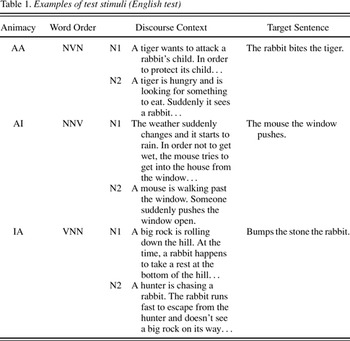
Three cues were tested in the present study. They were word order, noun animacy, and discourse context. There were three different word order types: verb medial (NVN), verb initial (VNN), verb final (NNV). Animacy was varied on three levels: the two nouns were animate–animate (AA), animate–inanimate (AI), and inanimate–animate (IA). The target sentences were composed of two nouns and one transitive verb with the word order and animacy cues in competing or converging combinations, which resulted in nine (3 Word Order×3 Animacy) sentences types: AVA, AAV, VAA, AVI, AIV, VAI, IVA, IAV, and VIA. Three trials were created for each sentence type, resulting in 27 target sentences.2
The target sentences used in the current study are the same as those in Su (2001b).
The contextual sentences were constructed to favor either the first-noun interpretation (N1) or the second-noun interpretation (N2), and they preceded the target sentences. Thus, there were 54 contextual sentences. Different from my previous study (Su, 2001b) where the contextual sentence contained only one short clause with three to four words, the contextual sentences in the current study are more elaborated and consist of two to three clauses on average. For example, contextual sentences that favor first-noun and second-noun interpretations of the target sentence

are A big purple rock is lying on the road. A boy sees the rock and is amazed… and A boy is walking on the street. At this time, a truck loaded with rocks is passing by. A rock falls out of the truck…, respectively. Both Chinese and English stimuli were created, with the English stimuli being translations of the Chinese ones.
3An independent survey was conducted in Chinese and English to evaluate if the context is equally biasing to induce the intended interpretation in both languages. The sentences in the survey are as follows: A tiger is sleeping; a cat walks by and wakes up the tiger; the tiger is upset. So the ——— grabs the ———. Respondents were to fill in the blanks according to the prior context. Fifty people who did not participate in the main study responded to the survey, 25 people for each language. Results show that overall the contextual sentences induced the intended interpretation in both languages, except for three contextual sentences that yielded inconsistent responses in both languages (error rate=12–20%).

Procedures
Each subject was provided with an answer sheet on which the two nouns for each target sentence were written. Then s/he listened to the recorded stimuli and was asked to circle the noun that s/he thought did the action in the sentence. Before the test started, the subject was told that some sentences might sound strange or ungrammatical, but s/he still had to determine which noun performed the action in the sentence. It was stressed that there was no right or wrong answer in the test, and that it was their first impression of the meaning of the sentence that was of interest. Three practice sentences were given to the subjects before the test using lexical items different from those in the test.
Scoring
Following the procedure adopted in the previous studies on the competition model, the dependent variable is “percentage choice of the first noun as agent.” Each subject's response was given a score of 1 if s/he chose the first noun and 0 if s/he chose the second noun. Thus, the percentage approximating 100% means the first noun was consistently chosen, and the percentage approaching 0% means the second noun was consistently selected.
RESULTS AND DISCUSSION
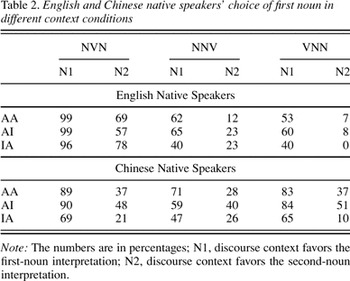
Table 2 presents ENS and CNSs' percentage choice of first noun as the agent in different context conditions across sentence types. A 2×3×3×2 analysis of variance (ANOVA; Group×Animacy×Word Order×Context) with group as a between-subjects factor was first conducted to detect if there are differences in ENS and CNSs' use of semantic, syntactic, and discourse information in assigning the agent role. Afterward, the data of each group of subjects were analyzed in a 3×3×2 (Animacy×Word Order×Context) ANOVA repeated measure to examine the main effects of various cues and their interactions with each other within each language group. The significance level was set at .05. Following MacWhinney et al. (1984), in addition to significance levels for each factor and interaction, the percentage of experimental variance accounted for by each cue is also reported to show the relative strength with which it is used. The percentage of experimental variance for a certain cue is defined as the ratio of the sums of squares for a certain main effect divided by the sums of squares for all main effects and interactions.

The primary interest of the present study is to see if, or to what extent, discourse context affects ENS and CNSs' processing of their respective language, in relation to syntactic and semantic information. Thus, the following report of results focuses on the main effect of context and its interactions with the word order and animacy cues in each language group. The main effects of animacy and word order will be reported only to make a comparison with the effect of context, especially in terms of the percentage of variance each effect accounts for. The interaction between animacy and word order in each group will not be discussed, as it is not of interest in the present study. Readers who are interested in how ENS and CNSs use the syntactic and semantic cues in understanding decontextualized sentences are referred to my earlier study (2001a).
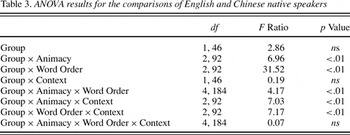
In accordance with many earlier studies, results show that CNSs and ENSs are different in their reliance on the semantic and syntactic cues: Group×Animacy, F (2, 92)=6.96, p<.01; Group×Word Order, F (2, 92)=31.52, p<.01 (see Table 3). However, in contrast to my previous study (Su, 2001b), where the two-way interaction of Group×Context was reliable, the same interaction does not reach statistical significance in the present study, F (1, 46)=0.19, p>.5, ns, which suggests that both Chinese and English monolinguals relied on the context cue to some extent. As we shall see later, context plays a significant role in both Chinese and English sentence processing; nevertheless, the magnitude of the cue compared to the intrasentential cues differs in the two languages. All three-way interactions are also significant, but the four-way interaction is not. Overall, the Chinese monolinguals are more subject to the influence of context in sentence interpretation across either word order or animacy conditions than are the English monolinguals.

Now let us look at the results in each language group separately.
Context effects for ENSs
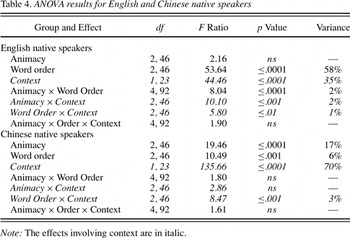
Table 4 presents the results of the ANOVA on the ENS and CNSs' performance in their respective languages. In accordance with many previous studies, results show that the syntactic cue remains the most important cue in ENS processing of English, F (2, 46)=53.64, p<.01, accounting for 58% of variance, and the main effect of animacy is not significant. However, although context was shown to have no impact on English monolinguals' processing of English in my previous study, it seems to play a role in this study, where the contextual sentences are more elaborated. As seen in Table 4, the main effect of context is not only statistically significant, F (1, 23)=44.46, p<.01, but also accounts for one-third of the experimental variance (35%). Across all animacy and word order conditions, the first noun was chosen 68% of the time when context favored the first noun, and 31% of the time when context favored the second noun. The two-way interactions of Word Order×Context, F (2, 46)=5.80, p<.01, and Animacy×Context, F (2, 46)= 10.1, p<.01, are also significant. ENSs are less subject to the influence of context when interpreting the canonical sentences (NVN) than the noncanonical sentences (NNV and VNN). As for the interaction of animacy and context, English monolinguals are less consistent in following the context cue for the IA items.

Looking closer at how English monolinguals incorporate discourse context in sentence interpretation compared to the word order and animacy cues (see Table 2), we found that the differences in percentages of first-noun choice are noticeable in all cell types but more pronounced in noncanonical sentence types. ENSs' preference for first-noun strategy in interpreting NVN strings decreases to some extent when context favors the second-noun interpretation; the percentage of first-noun choice drops to 68%, compared to 99% when sentences are presented in isolation (Su, 2001a). Nevertheless, discourse context does not override the SVO strategy given that the first noun is chosen nearly 70% of the time when the second-noun interpretation is intended. It is interesting to note that discourse context does not “win” even when it allies with the semantic cue against the SVO order (i.e., 77% first-noun choice for the IVA–N2 cell). For example, the balloon was chosen as agent most of the time in the target sentence A balloon falls onto a tree; a monkey happens to be on the tree and wants to play with the balloon…;

. As for the noncanonical NNV and VNN strings, although it has been found in many competition model studies that ENSs prefer to select the second noun as the agent in decontexualized sentences (e.g., 6% first-noun choice for NNV and 5% for VNN in Su, 2001b), the choice of first noun in these two sentence types jumps to 58 and 51%, respectively, across animacy conditions when context favors the first-noun interpretation.
Context effects for CNSs
Now we turn to the CNSs. In my previous study (2001a), the semantic cue (i.e., noun animacy) remained dominant (63% of the experimental variance) in CNSs' processing of Chinese vis-à-vis discourse context; nevertheless, contrary to English processing, the main effect of context was significant and it accounted for 29% of the experimental variance. The context effect was most salient when there was no animacy contrast in a sentence. However, when context conflicted with the animacy cue, CNSs depended more on animacy than context. The scenario changes when contextual information is more elaborated. As seen in Table 4, discourse context has become the most important cue in Chinese monolinguals' processing of contextualized sentences; it is not only statistically significant, F (1, 23)=135.66, p<.0001, but accounts for the most variance among the main effects (70%). Summing all sentence types, the first noun was selected 73% of the time when context favored first-noun interpretation, and 33% of the time when context favored second-noun interpretation. When animacy is in conflict with discourse context, context is slightly preferred to animacy (60% first-noun choice in the IA–N1 cell; 54% second-noun choice in the AI–N2 cell).
Looking closer at CNSs' selection of first noun in contexts favoring the first or second noun across sentence types (see Table 2), we found that the differences in the percentages of first-noun choice under different context conditions are palpable in all cell types, particularly in the reversible AA items. When the animacy cue is in conflict with the context cue, the latter overrides the former (e.g., IVA–N1, VIA–N1). For example, although both animacy and word order suggest that the lion is the doer in the target sentence The door is thrown open by a blast of wind, and a lion happens to be resting at the door;

, the subjects picked the door as the agent most of the time (65%).
CONCLUSION
Based on the competition model, the present study further examines the role of discourse context in sentence processing with regard to the intrasentential cues. The results show that ENSs rely on discourse context in interpreting their native language to a greater extent than the previous research has suggested, and that CNSs make use of context information to a greater degree than do their English counterparts. ENSs' preference for the SVO interpretation for NVN strings decreases to some extent when context favors the second-noun interpretation, and their preference for the second-noun strategy in interpreting noncanonical NNV and VNN orders decreases to a great degree when context favors the first-noun interpretation. This result has contradicted the well-established finding in many empirical studies within the competition model that word order plays a predominant role in English processing even in light of the discourse information. Because the present study is one of the few early attempts to investigate contextual effects on sentence processing within the framework of the competition model, the conclusion has to be considered tentative. More research is surely needed to see whether similar results are also obtained. Future studies should also include languages with other strong grammatical cues such as verb agreement or case and see whether there is context override when context is in conflict with these cues.
Although the present study evidences a strong effect of discourse context in assigning semantic roles vis-à-vis the intrasentential cues in both English and Chinese processing, it is possible that upon hearing the target sentences listeners interpreted the sentences with their preferred intrasentential strategies, but at a later point in time of processing they incorporated the contextual information and selected the actors which are contextually appropriate. Some on-line studies on the contextual effects on sentence processing have suggested that the initial processing decisions are made on syntactic considerations alone without reference to contextual information, and that discourse context plays a role only at the later point in time of sentence processing (e.g., Ferreira & Henderson, 1990; Mitchell et al., 1992). If that is the case, the predictions made by the Competition Model regarding cue validity will still hold. Because the present study employed an off-line measure, it is difficult to see the time course of sentence processing and to see if listeners' preferred intrasentential cue is employed at the very moment when the target sentence is being heard. To further examine when and how context operates during sentence processing in real time within the framework of the competition model, on-line research is clearly needed.
APPENDIX A


ACKNOWLEDGMENTS
The work reported in this article was supported by a grant (89-2411-H-259-008) from the National Science Council of Taiwan. I am grateful for the students who participated in this study. In addition, I thank Dr. John Truscott, Dr. Brian MacWhinney, and an anonymous reviewer for commenting on the early draft of this paper. Any remaining errors are my own.
References
Bates E., &
MacWhinney B.
1981.
Second language acquisition from a functionalist perspective: Pragmatic, semantic, and perceptual strategies.
In H. Winitz (Ed.),
Annals of the New York Academy of Sciences Conference on Native and Foreign Language Acquisition
(pp. 190–
214).
New York:
Academy Press.
Bates E., &
MacWhinney B.
1989.
Functionalism and the competition model.
In B. MacWhinney &
E. Bates (Eds.),
The cross-linguistic study of sentence processing
(pp. 3–
73).
New York:
Cambridge University Press.
Bates E.,
McNew S.,
MacWhinney B.,
Devescovi A., &
Smith S.
1982.
Functional constraints on sentence-processing: A cross-linguistic study.
Cognition,
11,
245–
299.Google Scholar
Britt M.,
Perfetti C.,
Garrod S., &
Rayner K.
1992.
Parsing in discourse: Context effects and their limits.
Journal of Memory and Language,
31,
293–
314.Google Scholar
Davison A. &
Lutz R.
1985.
Measuring syntactic complexity relative to discourse context.
In D. Dowty,
L. Karttunen, &
A. Zwicky (Eds.),
Natural language parsing: Psychological, computational, and theoretical perspectives
(pp. 26–
66).
New York:
Cambridge University Press.
Ferreira F., &
Clifton C.
1986.
The independence of syntactic processing.
Journal of Memory and Language,
25,
248–
368.Google Scholar
Ferreira F., &
Henderson M.
1990.
Use of verb information in syntactic parsing: Evidence from eye movement and word-by-word self-paced reading.
Journal of Experimental Psychology: Learning, Memory, and Cognition,
16,
555–
568.Google Scholar
Gass S.
1987.
The resolution of conflicts among competing systems: A bi-directional perspective.
Applied Psycholinguistics,
8,
329–
350.Google Scholar
Hargrove P., &
Panagos J.
1982.
Role saliency cues and children's sentence comprehension.
Journal of Psycholinguistic Research,
11,
217–
228.Google Scholar
Holmes V. M.
1984.
Parsing strategies and discourse context.
Journal of Psycholinguistic Research,
13,
237–
257.Google Scholar
Li P.,
Bates E.,
Liu H., &
MacWhinney B.
1993.
Processing a language without inflections: A reaction time study of sentence interpretation in Chinese.
Journal of Memory and Language,
32,
169–
192.Google Scholar
Liu H.,
Bates E., &
Li P.
1992.
Sentence interpretation in bilingual speakers of English and Chinese.
Applied Psycholinguistics,
13,
451–
484.Google Scholar
Liversedge S.,
Pickering M.,
Branigan H., &
Gompel R.
1998.
Processing arguments and adjuncts in isolation and context: The case of by-phrase ambiguities in passives.
Journal of Experimental Psychology: Learning, Memory, & Cognition,
24,
461–
475.Google Scholar
MacWhinney B.,
Bates E., &
Kligel R.
1984.
Cue validity and sentence interpretation in English, German and Italian.
Journal of Verbal Learning and Verbal Behavior,
23,
127–
150.Google Scholar
MacWhinney B., &
Bates E.
1987.
Competition, variation, and language learning.
In B. MacWhinney (Ed.),
Mechanism of language acquisition
(pp. 157–
193).
Hillsdale, NJ:
Erlaum.
Mitchell D.,
Corley M., &
Garnham A.
1992.
Effects of context in human sentence parsing: Evidence against a discourse-based proposal mechanism.
Journal of Experimental Psychology: Learning, Memory, and Cognition,
18,
69–
88.Google Scholar
Su I.
2001a.
Transfer of sentence processing strategies: A comparison of L2 learners of Chinese and English.
Applied Psycholinguistics,
22,
83–
112.Google Scholar
Su I.
2001b.
Context effects on sentence processing: A study based on the Competition Model.
Applied Psycholinguistics,
22,
167–
189.Google Scholar
Examples of test stimuli (English test)
English and Chinese native speakers' choice of first noun in different context conditions
ANOVA results for the comparisons of English and Chinese native speakers
ANOVA results for English and Chinese native speakers
 You have
Access
- 5
- Cited by