INTRODUCTION
Species of apicomplexan protozoan parasites within the genus Eimeria typically infect cells of the intestinal epithelium of a large number of hosts and are responsible for the disease coccidiosis. For the poultry industry, coccidiosis is a major problem and prophylactic chemotherapy with specific anticoccidial drugs has for many years been the preferred method of preventing and controlling the disease. However, drug-resistance is a problem that has to be managed constantly; no new drugs have been introduced for many years and legislation increasingly favours the use of an expanding portfolio of vaccines that are almost exclusively live.
Infection of the host with Eimeria spp. leads to strong, species-specific, protective immunity and the earliest studies showed that, in principle, vaccination on a mass scale should be feasible within the intensive poultry industry. About 50 years ago, a live vaccine comprising small numbers of wild-type, naturally virulent, parasites of different species of Eimeria was introduced in the USA and variants of the vaccine are still in use today. A disadvantage of the live, non-attenuated vaccines strains is they offer less margin of safety if the primary administration is not optimal. The use of spray cabinets most recently, however, has improved the uniformity of vaccination and thus reduced the risk and the products. The use in the EU of live vaccines is currently restricted to products comprising attenuated oocysts within a sterile medium.
With the long-term aim of developing a safer vaccine for the control of avian coccidiosis, our work at the Houghton Poultry Research Station (later to become part of the Institute for Animal Health) during the late 1970s and early 1980s focussed on the derivation of attenuated lines of Eimeria from all 7 species from the chicken. From 1980 this research was funded in part by the British Technology Group. A body of earlier work by Peter Long and colleagues showed that one of the most pathogenic species, E. tenella, could be attenuated by serial passage in the chorio-allantoic membrane (CAM) of embryonated eggs, but attenuation was not a stable trait.
Our initial attempts at passage of other species in eggs met with only limited success and our attention moved to a method for the attenuation of E. tenella reported by Tom Jeffers in the mid-1970s. During serial passage of E. tenella in the chicken, Jeffers imposed a repeated selection for early completion of the endogenous development by using for passage only the first oocysts to be produced during infection. Two attenuated lines were derived as a result of depleted asexual reproduction. Jeffers referred to the attenuated parasites as ‘precocious lines’ because, in comparison to the parent strains, their life cycle in the chicken was completed faster. We were apprehensive about investing time and resource to this approach because in the intervening years there were no further reports of attenuated precocious lines from any other species and we believed that E. tenella was an atypical species.
Lack of success in our alternative approaches, however, led us to re-examine the trait of precocious development and within 2 years we had derived attenuated precocious lines from each of the 7 species. Crucially, infections induced a level of protective immunity against challenge with virulent strains that was absolutely comparable to that induced by the wild-type parents and, moreover, the lines did not revert to virulence when selection was relaxed. After many fundamental studies to comprehensively characterise the precocious lines with regards to their endogenous development, pathogenicity, immunogenicity and genetic stability, more practical work was done to formulate a vaccine that was launched in 1989 as Paracox®.
This article will describe the work that helped to change the way in which avian coccidiosis is controlled currently. Beginning with an introduction to the avian species of Eimeria and their importance and economic significance in poultry production, the review will go on to describe early research that led to development of vaccine strategies, then our work to derive and utilize precocious lines and, finally, an assessment will be made of progress towards novel recombinant vaccines that could replace live vaccines.
EIMERIA AND COCCIDIOSIS
Eimeria spp. within the phylum Apicomplexa are protozoal, coccidial parasites that are the aetiological agents of coccidiosis, a major economically significant intestinal disease of commercially reared livestock. Coccidiosis is especially important to the poultry industry, which worldwide raises around 40 billion chickens annually. Eimeria spp. are monoxenous and the chicken is host to 7 species – E. tenella, E. maxima, E. acervulina, E. brunetti, E. mitis, E. necatrix and E. praecox – which inhabit characteristic regions of the intestine. Parasites are transmitted faecal-orally between hosts and the environmentally-resistant stage, the oocyst, contains 4 sporocysts, each enclosing 2 infective sporozoites. Sporozoites excyst from the sporocysts in the intestinal lumen, penetrate epithelial cells and, depending on species, develop at the site of invasion or enter immune cells that migrate to specific niches, such as the crypts, before re-entering epithelial cells. Within enterocytes, a limited number of cycles (3–4) of asexual reproduction or schizogony take place and each generation of schizont can often be identified by size and/or location on the intestinal villus. Merozoites from the last generation of schizonts develop into micro- or macrogametes and fertilization of gametes leads to formation of a new generation of oocysts. Thus the endogenous life cycle of Eimeria spp. comprises 2 distinctive phases – asexual followed by sexual. The newly formed, uninfective, oocysts are released into the gut lumen and shed in the faeces into the environment where, in the presence of moisture, warmth and oxygen, they undergo sporulation and become infective (Norton and Chard, Reference Norton and Chard1983).
The 7 species of Eimeria from the chicken vary in their pathogenicity so that, for example, infections with E. tenella and E. necatrix may cause considerable mortality whereas E. praecox is not a cause of mortality (Tyzzer, Reference Tyzzer1929; Long, Reference Long1968). Pathogenic species are typically characterized by at least 1 large endogenous life-cycle stage, which may be asexual (e.g. second generation schizont of E. tenella or E. necatrix) or gametocyte (e.g. E. maxima). Pathology can be exacerbated by migration of infected host cells (e.g. cells with second generation schizonts of E. tenella or E. necatrix) from the epithelium into underlying tissue. The least pathogenic species, such as E. praecox, have comparatively small developmental stages that grow more superficially in the epithelium (Long, Reference Long1968).
Signs of coccidiosis include weight loss, listlessness, loss of appetite, diarrhoea and huddling. Disease occurs when chickens ingest large numbers of oocysts – frequently within the environment of commercially-reared poultry where very large numbers of susceptible birds are held together in a confined space. The continual re-cycling of oocysts through birds within a flock leads, within 3–4 weeks, to high numbers of oocysts in the litter (Williams, Reference Williams1994). Good husbandry can help in reducing the overall level of risk of disease occurring, but additional measures are absolutely essential. Since the late 1940s, prophylactic chemotherapy with anticoccidial drugs given in the feed has been the primary control measure against coccidiosis. Inevitably, massive drug usage led to emergence of drug-resistant parasites and the introduction of a succession of new drugs has been accompanied by drug resistance soon after (Chapman, Reference Chapman2003). The outlook for such a heavy reliance upon chemotherapy in this century is now uncertain because of drug resistance and a lack of new drugs; in addition, some anticoccidials have been banned by the EU and future use of others may be under threat (Shirley et al. Reference Shirley, Blake, White, Sheriff and Smith2004). Hence, alternative means for the prevention of avian coccidiosis are necessary, including greater use of vaccines, if the national and international poultry industry is to continue to meet an increasing demand for its products.
IMMUNOLOGICAL BACKGROUND TO VACCINATION
A number of key observations from some of the earliest research on Eimeria of fowl indicated that vaccination against species of Eimeria from the chicken should be possible on a large-scale commensurate with the global scale of the poultry industry. Firstly, infection was identified as self-limiting with the sexual phase of the life cycle starting after a fixed number of generations of asexual reproduction (Tyzzer et al. Reference Tyzzer, Theiler and Jones1932). Secondly, birds could be infected readily at a very young age and infection could be established by incorporating live oocysts into feed (Johnson, Reference Johnson1932; Tyzzer et al. Reference Tyzzer, Theiler and Jones1932) – a methodology that obviated the necessity to dose chicks individually. Thirdly, chickens could be immunized against re-infection with the same species of Eimeria by inoculation on one or more occasions with small numbers of oocysts that caused no pathology (Johnson, Reference Johnson1927; Tyzzer, Reference Tyzzer1929). However, no cross-immunity between different species of Eimeria was found (Tyzzer, Reference Tyzzer1929) so that the common pathogenic species had to be represented within any live vaccine.
Work led by S. A. Edgar in the early 1950s led to the introduction of the first commercial vaccine, CocciVac®, and it is still in use today – albeit predominantly in the USA (Williams, Reference Williams2002). The vaccine contains oocysts of wild-type, virulent strains of several species of Eimeria and, until the late 1990s, vaccination was usually accompanied by a short period of chemotherapy using drugs with an efficacy that both controlled the worst of any disease and also allowed infection to proceed so as to induce protective immunity (Williams, Reference Williams2002). As methods were developed for delivering uniform infections of vaccinal oocysts to chicks at the hatchery, any need for attendant chemotherapy was found to be less necessary (Williams, Reference Williams2002).
DEVELOPMENT OF ATTENUATED LINES
An attraction of the use of attenuated lines of Eimeria for vaccination was that the required re-cycling of parasites (needed to ensure optimal immunisation of large flocks) would not present any prospects for occurrence of disease. Early attempts to attenuate parasites by heat treatment (Jankievicz and Scofield, Reference Jankievicz and Schofield1934) or by x-irradiation (Albanese and Smetana, Reference Albanese and Smetana1937; Waxler, Reference Waxler1941) were not convincing. Later studies showed that when oocysts of E. tenella were treated with high doses of x- or γ-irradiation, both the infectivity of sporozoites in cell culture and reproduction of oocysts in chickens were decreased (Jenkins et al. Reference Jenkins, Augustine, Barta, Castle and Danforth1991, Reference Jenkins, Chute and Danforth1997; Gilbert et al. Reference Gilbert, Fuller, Scott and McDougald1998). Infection of chicks with irradiated oocysts induced significantly fewer pathogenic effects and conferred partial resistance against reinfection with the homologous virulent strain. However, it is not clear whether oocysts derived from infections of irradiated parasites in chickens were stably attenuated.
Attenuation of virulence of chicken Eimeria spp. by serial passage in cell cultures has not proved possible because none of the species undergoes a complete life cycle in vitro. However, E. tenella was shown to reproduce in the CAM of chicken embryos and serial passage in eggs resulted in significant attenuation of the parasite (Long, Reference Long1972). After 37–42 passages the attenuated, embryo-adapted, line when inoculated into chickens induced strong immunity against the virulent parent strain, and after 62 passages the parasite was no longer pathogenic in birds but was still able to immunize (Long, Reference Long1974). Attenuation was attributable, at least in part, to a reduction in the size and invasiveness of the normally very large second generation schizont (Long, Reference Long1974). However, the trait was not genetically stable within the population selected as the reproduction of the egg-adapted line in chickens increased with serial passage in chickens. Subsequently, embryo-adapted attenuated lines of the highly pathogenic E. necatrix were described by different workers (Shirley, Reference Shirley1980; Kogut et al. Reference Kogut, Gore and Long1983). It proved not to be possible to derive embryo-adapted lines of most other species because the sporozoites either failed to develop after invasion of the CAM or led to a complete endogenous cycle but the small number of oocysts produced did not sporulate well (Shirley et al. Reference Shirley, McDonald and Ballingall1981). In view of the general failure of the approach to derive embryo-adapted attenuated lines, it was necessary to identify another means for attenuation.
ATTENUATION BY SELECTION FOR PRECOCIOUS DEVELOPMENT
A simple method for attenuating all species of chicken Eimeria emerged from an investigation by Jeffers (Reference Jeffers1975) on the ‘flexibility’ of the developmental rate of E. tenella. The life cycle of each species of Eimeria from the chicken is defined by a genetically pre-determined number of generations of schizogony which leads to characteristic pre-patent periods, i.e. the time interval between inoculation of chickens with oocysts and the appearance of the first of the new generation of oocysts. During serial passage of the Wisconsin (Wis) laboratory strain of E. tenella, Jeffers (Reference Jeffers1975) selected only the earliest oocyst progeny for further passage. After 25 generations of selection the pre-patent period of the parasite was reduced by approximately 24 h and an acceleration of endogenous development was identified as the cause. The so-called ‘precocious line’, Wis-F-125, was characterized by a marked reduction in oocyst reproduction and pathogenicity compared with the parent strain. In addition, the trait for precocity was stable after 25 generations of further passage without selection pressure. Infection of chicks with this precocious line induced a high level of immunity against challenge with the parent strain (Johnson et al. Reference Johnson, Reid and Jeffers1979). However, following further selection pressure during which a more attenuated line, Wis-F-96, was obtained, infection induced with small numbers of oocysts no longer protected against challenge with the parent strain (Johnson et al. Reference Johnson, Reid and Jeffers1979). Cheng and Edgar (Reference Cheng and Edgar1979) subsequently derived precocious lines from another strain of E. tenella and a strain of E. maxima, but reported that these were not attenuated. This disappointing result may have discouraged an immediate pursuit of this approach for attenuation (Williams, Reference Williams2002).
In the early 1980s at the Houghton Poultry Research Station we set out to attenuate each of the 7 avian species of Eimeria. Further efforts to derive embryo-adapted lines were not encouraging and consistent failure led to a re-examination of the potential of precocious development. Within 2 years we had attenuated all species by this approach. E. acervulina was chosen as the first species in our attempt because it is an important pathogen in the field and we had failed in our attempts to manipulate the parasite to complete its development in chick embryos or in cell culture. In common with the Wis-F line of E. tenella, a precocious (HP) line derived from the Houghton (H) strain had a significantly reduced reproductive potential (McDonald et al. Reference McDonald, Ballingall and Shirley1982). Attenuated (HP) lines were then obtained from the Houghton reference strains of E. mitis (McDonald and Ballingall, Reference McDonald and Ballingall1983), E. necatrix (Shirley and Bellatti, Reference Shirley and Bellatti1984), E. praecox (Shirley et al. Reference Shirley, McDonald, Chapman and Millard1984), E. brunetti (Shirley et al. Reference Shirley, McDonald and Bellatti1986) and E. tenella (McDonald et al. Reference McDonald, Shirley and Millard1986a). With E. maxima, precocious lines were derived from both the Weybridge laboratory strain (Shirley and Bellatti, Reference Shirley and Bellatti1988) (work with the Houghton strain was unsuccessful) and a mixture of 4 contemporaneous field isolates from the UK (McDonald et al. Reference McDonald, Shirley and Bellatti1986b). During the course of registering the individual precocious lines within Paracox vaccines, the genetic stability of the traits for early development and attenuation were confirmed in sub-lines isolated from a single sporocyst and passaged without selection for only the first oocysts of the new generation (unpublished data).
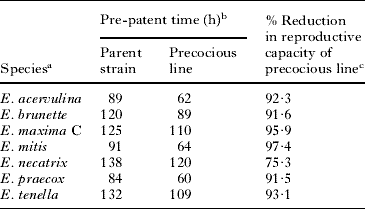
Table 1 shows the effect of selection for precocity on the reproductive capacity and pre-patent times of the 7 species of Eimeria. In most cases reproduction, compared with that of the parental strain, was reduced by over 90% and the pre-patent times were reduced between 18 to 31 h.
Effect of selection for precocious development on the prepatent time and oocyst reproduction
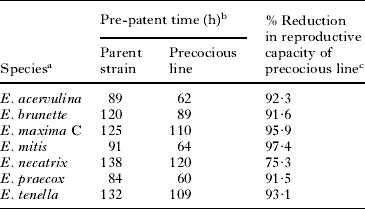
a The virulent parasites were the drug-sensitive Houghton (H) strains except for E. maxima C, the Chichester strain.
b The time taken to complete development in the intestine with detection of first new oocysts.
c Based on oocyst counts from chickens infected with 2×10² oocysts except for E. brunetti (1×10²).
DEVELOPMENTAL BASIS OF PRECOCIOUS DEVELOPMENT
The morphological and developmental bases for the phenotypes associated with precocity were elucidated from many detailed comparative histological studies of the development of each precocious line and the corresponding parent strain in the intestine. An additional benefit of these studies was that they also provided accurate descriptions of the asexual development of the wild-type parasites of some species as some previous work had been less than comprehensive.
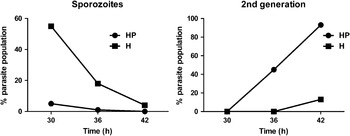
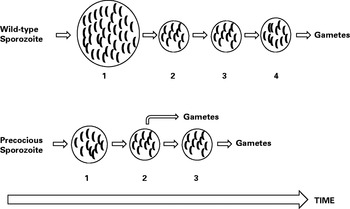
In the precocious lines, the events of sexual reproduction and oocyst formation appeared unaltered. However, asexual development was significantly different in all cases, and any of 3 major effects were observed for each species (McDonald and Shirley, Reference McDonald, Shirley, McDougald, Long and Joyner1985). Firstly, in 5 species the final 1 or 2 generations of schizogony were depleted. Secondly, in some species 1 or more generations of schizonts matured at a significantly faster rate than in the parent strain. An example, shown in Fig. 1, was the more rapid entry into development by the sporozoites of E. mitis HP compared to those of the parent H strain. At 30 h post-infection, 55% of the intracellular parasites of the H strain were still sporozoites whereas the majority of parasites of the precocious line had developed into immature schizonts by this time, with only 5% remaining as sporozoites. Partly as a consequence, second generation parasites appeared sooner in the precocious line. Thirdly, the schizonts of at least 1 generation in precocious lines of some species were distinctly smaller and had fewer merozoites compared with those of the wild-type strain. This phenotype was most evident with the second generation schizonts of E. tenella and E. necatrix that are responsible for most of the severe pathology associated with these species (McDonald and Shirley, Reference McDonald and Shirley1987). These smaller second generation schizonts of the precious lines also reached maturity faster than those of the parent strains. Interestingly, these were the only 2 species for which the final generation of schizonts of the precocious lines was not depleted or deleted. A histological study by Jeffers (Reference Jeffers1975) of the precocious lines developed from the Wis strain of E. tenella similarly showed that the Wis-F-125 line had smaller second generation schizonts that produced fewer merozoites. Remarkably, the hyper-attenuated Wis-F-96 line was found to lack second and third generation schizonts – which explained the exceptionally low reproductive capacity of this line (McDougald and Jeffers, Reference Jeffers1976). All 3 effects described above contributed to the decreased fecundity and pre-patent time of the precocious line of E. mitis (Fig. 2).
Differential counts, expressed as a percentage of the total number of parasites observed, of sporozoites and second generation asexual stages of Eimeria mitis H and HP in sections of gut taken from infected chickens at 6 h intervals between 30 h and 42 h post-infection. The latent period before transformation of sporozoites into trophozoites is shortened in the precocious line and parasites of the 2nd asexual generation appear earlier (based on data from McDonald and Shirley, Reference McDonald and Shirley1984).

Diagrammatic representation of the endogenous development of Eimeria mitis H and HP showing events that lead to decreases in reproductive capacity and pre-papatent time in the precocious line. Each generation of schizogony is represented by the numbers 1–4. Compared with the wild-type strain, the precocious first generation schizont took less time to mature (see Fig. 1) and the mature form was smaller and produced fewer merozoites. Gametes of the parent strain appeared to develop only from merozoites of fourth generation schizonts while precocious line gametes could develop from merozoites of the second or third generation schizonts (the majority). Few fourth generation schizonts were observed. (Based on data from McDonald and Shirley, Reference McDonald and Shirley1984; McDonald and Shirley, Reference McDonald, Shirley, McDougald, Long and Joyner1985.)

The finding that precocity was retained through serial passage of parasites without selection for early maturation of oocysts indicated that the trait was genetically stable. As further confirmation of genetic stability, co-infection of chickens with parasites defined by either precocious development or drug-resistance resulted in genetic recombination with the production of progeny oocysts characterized by traits for both precocious development and drug-resistance (Jeffers, Reference Jeffers1976; Sutton et al. Reference Sutton, Shirley and McDonald1986). In a recent study with E. necatrix, selection for late maturation of oocysts during serial passage led to an increase in reproductive potential that correlated with an increase in the size of the second generation schizont (Dong et al. Reference Dong, Suo, Wang and Teng2006). The complexity of the phenotypic effects associated with the endogenous phase of the life cycle giving rise to the trait of precocity suggests that numerous mutated genes may be involved but, to date, none has been identified. Since our early substantive work with chickens, precocious lines of eimerians from mammalian hosts (Pakandl and Jelinkova, Reference Pakandl and Jelinkova2006) and turkeys (Matsler and Chapman, Reference Matsler and Chapman2007) have now been derived – suggesting that abbreviated development may be established with Eimeria spp. from many host species.
FROM LABORATORY TO THE FARM
Extensive experimental studies were undertaken to measure the abilities of each precocious line, either singly or in combination, to protect chickens against challenge with virulent strains. Early floor pen trials demonstrated that chicks could be immunized effectively by infection with precocious lines (Shirley and Millard, Reference Shirley and Millard1986). Subsequent studies in the UK showed that vaccination of broiler (meat producing) birds with precocious lines was as effective as the anticoccidial drug monensin in protecting against coccidiosis (Evans et al. Reference Evans, Harding, Roberts, Shirley and Yvoré1989). Successful vaccination trials with broiler breeders and broiler chickens were carried out in a number of countries, including Italy (Govoni et al. Reference Govoni, Maestrini, Gobbi and Tonelli1987). An important feature of immunization with precocious lines was the presence of oocysts in faeces or litter (Bushell et al. Reference Bushell, Shirley and Bushell1992), a feature more usually associated with drug-resistance when chemotherapy was failing.
The first commercial vaccine comprising precocious lines, Paracox-8®, was launched in 1989 to protect breeding and laying flocks and it is now used worldwide. In 2000 a new vaccine, Paracox-5®, was introduced for the prevention of coccidiosis in broilers and the 2 products are currently estimated to protect about 1 billion chickens annually (Institute of Animal Health – http://www.iah.ac.uk/press_release/2008/2008_8.htm). Introduction of the Paracox-8® vaccine and the Livacox® vaccine in the early 1990s (Bedrnik, Reference Bedrnik1993; Shirley and Bedrnik, Reference Shirley and Bedrnik1997) led to many other similar products and in late 2008 the newest attenuated vaccine containing precocious lines was introduced. Whilst most efforts scientifically have been directed towards the derivation of further vaccines based on precocious lines, another form of vaccination has been introduced by Wallach and colleagues in which hens are immunized with gametocyte antigens to protect their chicks passively with parasite-specific antibodies transferred into egg yolk (Wallach, Reference Wallach1997).
FUTURE VACCINES
Vaccines against avian coccidiosis have been available for more than 50 years. The use of live attenuated vaccines based on precocious lines is highly effective, safe and obviates any requirement for attendant anticoccidial drug treatments. Nevertheless, the large-scale manufacture of live vaccines, especially attenuated vaccines, is expensive because oocysts usually have to be obtained from specified pathogen-free chickens, purified from faeces and formulated to high quality, possibly within a sterile medium, in specialized commercial facilities. A medium to long-term goal, therefore, is to develop a new generation of vaccine based upon recombinant antigens. A likely advantage of recombinant vaccines is that they should be relatively inexpensive to manufacture and have a longer shelf life than live vaccines. However, despite years of investigation to identify and characterize parasite antigens, no successful approaches to developing recombinant vaccines have been reported. Optimal progress towards novel vaccines will depend on a combination of a better understanding of the mechanisms of immunity to eimerian infections, selection of appropriate parasite antigens and identification of the best route of vaccine administration; each of these issues is discussed below.
Mechanisms of immunity
Novel approaches for design of vaccines may have to take into account detailed knowledge of the host-parasite interactions that lead to host resistance (Lillehoj et al. Reference Lillehoj, Kim, Keeler and Zhang2007). There has been considerable progress in elucidating host defensive mechanisms since the 1980s and much of the work has been done with the murine parasite, E. vermiformis. Studies have shown that immunity involves T cells (Rose and Hesketh, Reference Rose and Hesketh1986) and in a primary, but not secondary, infection, CD4+ T cells are required to control oocyst reproduction. The results of studies in which CD8+ T cells were depleted showed that these cells were not required for elimination of parasites during primary or secondary infection (Rose et al. Reference Rose, Joysey, Hesketh, Grencis and Wakelin1988, Reference Rose, Hesketh and Wakelin1992; Smith and Hayday, Reference Smith and Hayday1998). The cytokine interferon (IFN)-γ, produced mainly by T cells and NK cells, had an important role in immunity to a primary infection (Rose et al. Reference Rose, Wakelin and Hesketh1991a). In addition to its pro-inflammatory action, IFN-γ inhibited in vitro development of sporozoites in epithelial cells (Rose et al. Reference Rose, Smith and Wakelin1991b). B cells, and therefore antibodies, appeared to have a comparatively minor role in resistance as μMT−/− mice lacking these cells were infected only slightly more heavily than wild-type mice (Smith and Hayday, Reference Smith and Hayday1998). These findings indicate that elements of a Th1 cellular response often associated with immunity to intracellular pathogens are crucial for control of E. vermiformis infection. Some differences were observed in the nature of protective responses to other murine species of Eimeria, however. During secondary infection with E. pragensis, there was a clear requirement for CD8+ T cells for resistance (Rose et al. Reference Rose, Hesketh and Wakelin1992). Also, NK cells but not T cells were involved in control of a primary infection with E. papillata, although IFN-γ was required for early development of immunity (Schito et al. Reference Schito, Barta and Chobotar1996; Schito and Barta, Reference Schito and Barta1997).
Investigation of chicken immune responses to Eimeria has been more challenging both because of a more limited availability, or no availability of immunological reagents and transgenic gene knockout birds, respectively. Significantly, findings suggest that the protective role of CD4+ T cells may depend on the parasite species. Treatment of chickens with CD4+ T cell depleting antibodies increased the level of primary infection of E. tenella but did not influence the course of E. acrervulina infection (Trout and Lillehoj, Reference Trout and Lillehoj1996). Depletion of CD8+ T cells increased oocyst production of both species during secondary infection, thus showing these cells are necessary to prevent re-infection – although it is not known whether the protective effect involves cytokine activity or cytotoxicity. Although there is a strong parasite-specific antibody in response to infection, chickens made B cell-deficient (by bursectomy) were no more susceptible to a challenge infection of E. maxima than were controls, suggesting that antibodies are not necessary for elimination of the parasite (Rose and Hesketh, Reference Rose and Hesketh1979). Administration of recombinant IFN-γ to chickens during E. acervulina infection decreased both oocyst production and weight loss, indicating that the cytokine had an important protective role during infection (Lillehoj and Choi, Reference Lillehoj and Choi1998). However, the results of tissue-specific cDNA microarray analyses of the inflammatory response suggest that elements of both Th1 and Th2 are expressed during infection (Lillehoj et al. Reference Lillehoj, Kim, Keeler and Zhang2007). Such studies also indicate that there are variations in the composition and dynamics of the inflammatory responses to the parasite species, including expression of IFN-γ.
Studies from both mice and chickens suggest that the protective immune mechanisms may vary with species of parasite and that a multivalent subunit vaccine may be required to activate a broad range of immune effector mechanisms. Taking a wider perspective on vaccination, a successful vaccine may not necessarily need to stimulate the protective responses required to eliminate natural infection. For example, hepatitis B and measles vaccines protect by promoting production of high titres of antibodies whereas during a natural infection by these viruses, potent cell-mediated responses are essential and antibodies probably play a relatively minor role (Englar et al. Reference Engler, Dai, Sette, Hunziker, Reichen, Pichler and Cerny2001; Permar et al. Reference Permar, Klumpp, Mansfield, Carville, Gorgone, Lifton, Schmitz, Reimann, Polack, Griffin and Letvin2004).
Selection of antigens
Numerous antigens of Eimeria from the sporozoite, asexual developmental stages and gametocytes have been cloned and characterized (reviewed by Jenkins, Reference Jenkins1998; Vermeulen, Reference Vermeulen1998; Shirley et al. Reference Shirley, Smith and Tomley2005). Priming of chickens with antigens with, or without adjuvant, has usually provided at best moderate and inconsistent protection against challenge infection (Vermeulen, Reference Vermeulen1998; Jenkins, Reference Jenkins2001). Immunization with antigen DNA incorporated into either plasmid, virus or bacterial vectors may be more promising (Min et al. Reference Min, Lillehoj, Burnside, Weining, Staeheli and Zhu2002; Konjufca et al. Reference Konjufca, Wanda, Jenkins and Curtiss2006; Yang et al. Reference Yang, Li, Zhang, Zhao, Liu and Gong2008) and concurrent injection of cytokine and DNA-encoding parasite antigen could further improve the immunizing potential (Min et al. Reference Min, Lillehoj, Burnside, Weining, Staeheli and Zhu2002; Xu et al. Reference Xu, Song, Xu, Yan, Shah and Li2008). Most immunization studies have limited investigation to a single parasite species but current knowledge dictates that a vaccine must contain antigen(s) from each parasite species represented. Furthermore, components from more than one strain of Eimeria maxima may be required as there is often poor cross-immunity between isolates (Norton and Hein, Reference Norton and Hein1976; McDonald et al. Reference McDonald, Shirley and Bellatti1986b).
A basic problem in identifying antigens for vaccination is that Eimeria spp. are antigenically complex (McDonald et al. Reference McDonald, Wisher, Rose and Jeffers1988; Tomley, Reference Tomley1994) and it is unclear which antigens induce protective immunity during natural infection. T cells from birds infected with 1 species are activated equally by oocyst antigens of the homologous or different species (Prowse, Reference Prowse1991) and anti-eimerian antibodies often react with different species (Constantinoiu et al. Reference Constantinoiu, Lillehoj, Matsubayashi, Tani, Matsuda, Sasai and Baba2004). The evidence to date indicates wide sharing of T and B cell epitopes between parasite species and, because natural infection induces no cross-protection between species, it must be concluded that few antigens are relevant to the induction of protective immunity. A critical, but technically challenging, first step is to identify the antigens of the parasite that are recognized by the host as vital to the protective immune response.
A novel genetic approach is being applied to identify regions within the genome of the highly immunogenic species E. maxima which encode protective antigens (Blake et al. Reference Blake, Shirley and Smith2006). The methodology used to date has exploited a complete lack of cross-immunity between 2 strains of E. maxima (H and W), which were also susceptible and resistant, respectively, to the anticoccidial drug robenidine. Chickens were infected concurrently with the 2 strains to facilitate cross-fertilization of gametes and the progeny oocysts were then passed through chickens in the face of a double selection for resistance to robenidine (the drug was present in the feed) and complete immunity to the W strain (induced in the chickens previously by infection), i.e. selection was for ‘hybrid’ parasites. DNA from the parent strains and the selected parasites was characterized by the genome-wide fingerprinting technique of amplified fragment length polymorphisms (AFLP). Comparison of the relevant fingerprints made possible the identification of DNA markers critically associated with killing by either an anti-W strain protective immune response or killing by robenidine. The markers eliminated as a consequence of this novel type of immunological selection were found to be clustered within 4 distinct linkage groups and work is ongoing to determine definitively whether they are associated with regions of the E. maxima W strain genome which encode immunoprotective antigens (Blake et al. Reference Blake, Shirley and Smith2006).
The challenge of identifying relevant antigens, if approaches other than of the type described above are used, are likely to be further complicated by the possibility that immunoprotective antigens are expressed only during part of the endogenous development of the parasite. Studies have indicated that some life-cycle stages are more immunoprotective than others. In immune chickens, intracellular sporozoites from a challenge infection are subject to immunological attack and fail to grow (Horton-Smith and Pierce, Reference Horton-Smith and Pierce1963). However, sporozoites were reported not to induce protective immunity since chickens medicated with drugs that inhibited intracellular development of sporozoites without killing the parasites had no or only partial immunity to subsequent challenge with oocysts (Long and Millard, Reference Long and Millard1968; Jeffers and Long, Reference Jeffers and Long1985). Other studies suggested that, during infection, immunity was established mainly by asexual reproductive stages but sexual forms contribute little to development of host resistance (Rose, Reference Rose1967).
To investigate potential differences in the immunoprotective nature of the asexual stages of E. tenella, use was made of the Wis-F-96 precocious line that undergoes only the first of the 3 generations of schizogony (McDougald and Jeffers, Reference Jeffers1976). It was shown that after infections of equivalent magnitude of Wis-F-96 or the parent Wis strain, chickens primed with the precious line were more resistant to challenge infection with Wis than were birds primed with the parent strain (McDonald et al. Reference McDonald, Rose and Jeffers1986c). In a histological study of the caecum where E. tenella develops, it was shown that a primary infection with Wis-F-96 prevented further development of sporozoites from a subsequent challenge with Wis whereas second generation merozoites of Wis injected directly into the caecum developed normally (McDonald et al. Reference McDonald, Wisher, Rose and Jeffers1988). These results demonstrated that, qualitatively, first generation schizonts were more immunoprotective than second/third generation schizonts and, in addition, there was poor cross-immunity between the first and later generations of schizonts.
Seeking to explain those results, the antigenic composition of sporozoites, first generation and second generation merozoites was compared by Western blotting using sera from chickens infected by Wis or Wis-F-96 to detect antigens. The peptide patterns for first generation merozoites of Wis-F-96 and Wis were similar, demonstrating selection for precocity did not affect antigenic expression. Although some similarities were observed between the antigen profiles of the 3 invasive stages, significant differences were also evident (McDonald et al. Reference McDonald, Wisher, Rose and Jeffers1988). A subsequent, more detailed, analysis of the antigenic composition of the invasive stages of E. tenella demonstrated a lack of cross-reactive epitopes between sporozoites, first and second generation merozoites (Tomley, Reference Tomley1994). The significant antigenic modification that takes place during successive asexual generations is thought to help the parasite evade immune recognition whilst completing endogenous development. The totality of the findings suggests that recombinant vaccines may need to incorporate antigens that are present in different endogenous stages if candidate antigens that are ubiquitously expressed during development cannot be identified.
Route for antigen delivery
Vaccine-induced immunity should be strongest at the site of pathogen development and for Eimeria the mucosal surface has to respond rapidly and efficiently on exposure to infection. The function of the chicken mucosal immune system is not as well defined as that of mammals but is likely to be similar (Lillehoj and Trout, Reference Lillehoj and Trout1996). There are 3 compartments of the mucosal immune system: the epithelium which contains intraepithelial lymphocytes, the lamina propria beneath the epithelium which is rich in immune cells including lymphocytes and organized lymphoid structures such as Peyer's patches (PP) and lymphoid aggregates where initial priming of T and B cells occurs (Brisbin et al. Reference Brisbin, Gong and Sharif2008). Luminal antigens are constantly sampled by M cells in the epithelium overlying the organized lymphoid tissue and released from the basolateral membrane where they are taken up by antigen-presenting dendritic cells that stimulate adaptive immunity. Activated T and B cells migrate from the intestine into the blood and return to the intestine (or other mucosal sites) to reside in the immune effector sites, the lamina propria or epithelium. Studies of the population dynamics of blood and intestinal lymphocytes in the chicken suggest indirectly that such migration occurs during E. maxima infection (Rothwell et al. Reference Rothwell, Gramzinski, Rose and Kaiser1995). In mammals, the emergence of homing T cells from blood vessels into the lamina propria requires surface expression of a receptor for a gut-associated chemokine and an integrin that attaches strongly to a specific ligand on endothelial cells of intestinal venules (Holmgren and Czerkinsky, Reference Holmgren and Czerkinsky2005). By comparison, T cells activated in the periphery have poor expression of the mucosa-specific homing receptors (Mora et al. Reference Mora, Bono, Manjunath, Weninger, Cavanagh, Rosemblatt and Von Andrian2003). Hence, systemic vaccination, which has been commonly used in experimental Eimeria studies, may not be the ideal means of inducing immunity at the intestinal surface. An alternative route for vaccination could be in ovo (Ding et al. Reference Ding, Lillehoj, Dalloul, Min, Sato, Yasuda and Lillehoj2005) but this approach for delivery of an antigenically complex vaccine requires more research.
Antigen delivery systems
Assuming the mucosal route of vaccination is the one most likely to produce good immunization against Eimeria, a number of challenges remain to be resolved. Overall, a live, attenuated line of Eimeria is likely to be the ideal vector for delivering protective antigens. However, in considering a non-eimerian delivery system, the oral route may require the use of agents that protect against stomach acid and bacterial proteases in the gut lumen. More importantly, the complex mucosal immunoregulatory network that prevents inflammatory responses to harmless antigens such as food and commensal bacteria, termed oral tolerance, must be bypassed. In humans and mice regulatory T cells and a subpopulation of dendritic cells that produce anti-inflammatory cytokines, such as TGF-β or IL-10, probably play an important role in gut homeostasis (MacDonald and Monteleone, Reference MacDonald and Monteleone2005). Infectious organisms override homeostasis because they may be efficiently taken up at immune inductive sites such as Peyer's patches by M cells or they actively select M cells for attachment (Sicinski et al. Reference Sicinski, Rowinski, Warchol, Jarzabek, Gut, Szczygiel, Bielecki and Koch1990; Jones et al. Reference Jones, Ghori and Falkow1994). Sporozoites or merozoites of Cryptosporidium, an apicomplexan related to Eimeria that also infects enterocytes have been detected in Peyer's patches inside both M cells and macrophages/dendritic cells (Marcial and Madara, Reference Marcial and Madara1986). Whole organisms are also likely to have components with adjuvant activity that are able to activate the innate immune system (Neutra and Kozlowski, Reference Neutra and Kozlowski2006). Dendritic cells and macrophages (and other cell types) express Toll-like receptor (TLR) molecules that are important sensors of infection. TLRs signal for inflammation when they interact with a type of conserved molecular component of microbial pathogens such as bacterial lipopolysaccharide (TLR4) or flagellin (TLR5) (Medzhitov, Reference Medzhitov2007). The innate inflammatory immune responses initiated by TLRs can promote the development of adaptive immunity and TLR ligation is required for control of some protozoan infections, including orally induced infection by Toxoplasma gondii (Sukhumavasi et al. Reference Sukhumavasi, Egan, Warren, Taylor, Fox, Bzik and Denkers2008).
Mucosal vaccination with subunit antigenic material might be made effective, therefore, by formulating delivery systems that target mucosal inductive sites, perhaps by attachment to M cells or by providing stimulation of innate immune responses via TLRs. Incorporation of antigens or DNA into particles, vesicles or self-assembling viral cores designed to have one or both of these effects has been shown to induce strong mucosal immune responses; similarly, mucosal administration of TLR ligands and antigens together has boosted a local response to antigen because of the adjuvant effect induced by TLR activity (reviewed by Holmgren and Czerkinsky, Reference Holmgren and Czerkinsky2005; Neutra and Kozlowski, Reference Neutra and Kozlowski2006).
The problem of bypassing gut homeostasis in mucosal vaccination with non-living antigens is underlined by the fact that there are few oral vaccines licensed for human use and most of those are live/attenuated (Holmgren and Czerkinsky, Reference Holmgren and Czerkinsky2005). Oral tolerance may be less of a complicating factor if Eimeria vaccine antigens were expressed in live, attenuated viral or bacterial vectors. A recombinant fowlpox virus expressing an E. tenella gene has been reported (Yang et al. Reference Yang, Li, Zhang, Zhao, Liu and Gong2008). Some reports have described the cloning and expression of eimerian genes in intestinal bacterial species and that oral inoculation of the recombinant bacteria induced antigen-specific T and B cell responses (Lillehoj et al. Reference Lillehoj, Jenkins and Bacon1990; Pogonka et al. Reference Pogonka, Klotz, Kovacs and Lucius2003; Konjufca et al. Reference Konjufca, Wanda, Jenkins and Curtiss2006). Chickens inoculated orally with Escherichia coli or attenuated Salmonella enterica expressing the merozoite surface protein EAMZp250 of E. acervulina were partially protected against infection with this species (Lillehoj et al. Reference Lillehoj, Jenkins and Bacon1990; Konjufca et al. Reference Konjufca, Wanda, Jenkins and Curtiss2006). Fusion of EAMZp50 to a S. enterica Type 3 secretory system (T3SS) protein allowed the parasite protein to be delivered directly into host cell cytoplasm and this process boosted antigen-specific Th1 responses (Konjufca et al. Reference Konjufca, Wanda, Jenkins and Curtiss2006). In contrast, delivery of proteins to host cells via the S. enterica Type 2 secretory system (T2SS) induced both Th1 and Th2 responses and fusion of the E. tenella refractile body antigen SO7 with a T2SS protein induced stronger immunization than fusion with the T3SS protein (Konjufca et al. Reference Konjufca, Jenkins, Wang, Juarez-Rodriguez and Curtiss2008). This live vector antigen delivery system could provide potent immunization against Eimeria infection when combined with known protective antigens.
The ideal live vector for vaccination against coccidiosis might be an attenuated recombinant line of Eimeria expressing protective antigens of all species (Shirley et al. Reference Shirley, Smith and Tomley2005). Stable transfectants of other protozoa including apicomplexans such as T. gondii and Plasmodium spp. have been established for a number of years (Sibley et al. Reference Sibley, Messina and Niesman1994; van Dijk et al. Reference van Dijk, Waters and Janse1995). Transient transfection with Eimeria was demonstrated with E. tenella using the β-galactosidase gene linked to the microneme protein Etmic-1 and enzyme activity could be detected throughout the first generation of merogony in cell culture (Kelleher and Tomley, Reference Kelleher and Tomley1998). Recently, a stably transfected line of E. tenella expressing a fluorescent protein was generated that completed its development in chickens (Yan et al. Reference Yan, Liu, Shi, Hao, Tomley and Suo2008). The transfectant was attenuated and such an organism could be advantageous for the formulation of multivalent anti-Eimeria vaccines – but many technical and regulatory hurdles still have to be surmounted for expression of multiple foreign genes.
CONCLUSIONS
Eimeria spp. do not appear to have the sophisticated immuno-evasive strategies shown by other protozoan parasites that make control by immunization highly problematic. Indeed, immunization is straightforward and arises through a life cycle of several days (up to 12–14 days) that allows the host time to develop a durable protective immune response. The practical concept of mass vaccination by infection with non-attenuated parasites strains was established by the 1950s but the utility of vaccination was eclipsed completely by the advent of chemotherapy. However, the capacity of Eimeria to develop resistance to all anticoccidial drugs introduced by the poultry industry provided a major impetus for the development of a new generation of live, safe vaccines. The approach of selecting for precocious development of all avian species of Eimeria proved to be completely successful and delivered stably attenuated lines that were immunoprotective. Whilst the molecular basis of precocious development is not understood, the findings that some schizont stages were less numerous or deleted from the life cycle, continues to raise interesting questions about the regulation of parasite development, including the signals required for switching from asexual to sexual development.
Vaccines comprising precocious lines have been a significant commercial success but a large segment of the enormous broiler market still relies on anticoccidial drugs to control coccidiosis. The decades-long reliance upon chemotherapy by the intensive broiler sector may continue for the foreseeable future. Despite well documented acquired resistance by Eimeria spp. to all anticoccidial drugs, chemotherapy remains an effective control strategy. It is possible that drugs are functioning as ‘surrogate vaccines’ by allowing reduced numbers of parasites to establish infections and induce the necessary protective immune responses. The dependency on chemotherapy may be altered if the problem of drug resistance becomes further exacerbated or if legislation prevents the use of chemotherapy for control of disease prophylactically. The future may see the replacement of live vaccines with recombinant vaccines but numerous technical issues still remain to be tackled before the next generation of vaccines will appear. Moreover, consumer resistance to the release of genetically modified organisms into the environment could delay the development and/or use of live vectors for the delivery of new vaccines. The attenuated vaccines currently in use, including Paracox which derived from our work in the early 1980s, may therefore continue to be widely used for many more years.