



1 Introduction
In the Brunn–Minkowski theory of the Euclidean space
 $\mathbb {R}^n$
, the two classical inequalities which connect the volume of a convex body with that of its polar projection body are the Petty and Zhang projection inequalities (see, e.g., [Reference Lutwak26, Reference Zhang37]). The Petty projection inequality shows that among all convex bodies with the same volume, the ellipsoids have the largest volume of the polar projection body. The Zhang projection inequality shows that the simplices minimize the volume of the polar projection body. Petty projection inequalities have been extended to the
 $L_p$
Petty projection inequalities and Orlicz projection inequalities (see, e.g., [Reference Lutwak, Yang and Zhang27, Reference Lutwak, Yang and Zhang29, Reference Zhu39]). Moreover, the functional versions of the Petty projection inequality—the affine Pólya–Szegö inequality and the affine Sobolev inequality have been largely studied (see, e.g., [Reference Cianchi, Lutwak, Yang and Zhang11, Reference Lin20, Reference Lutwak, Yang and Zhang28, Reference Zhang38]).
Recently some researches on isoperimetry in the Euclidean space have been extended to spherical or hyperbolic space (see, e.g., [Reference Beckner2–Reference Besau and Werner4, Reference Bögelein, Duzaar and Fusco7, Reference Böröczky and Sagmeister8, Reference Dann, Kim and Yaskin12, Reference Gao, Hug and Schneider14, Reference Gromov and Milman16, Reference Hack and Pivovarov19, Reference Makowski31, Reference Wang and Xia35, Reference Yaskin36]). Besau and Werner [Reference Besau and Werner4, Reference Besau and Werner5] introduced the spherical convex floating body for a convex body on the Euclidean unit sphere and define a new spherical area measure—the floating area. We are convinced that the floating area will become a powerful tool in the spherical convex geometry. Besau et al. [Reference Besau, Hack, Pivovarov and Schuster3] introduced the spherical centroid body of a centrally symmetric convex body in the Euclidean unit sphere, studied a number of basic properties of spherical centroid bodies and proved a spherical analog of the classical polar Busemann–Petty centroid inequality. Gaoet al. [Reference Gao, Hug and Schneider14, Reference Hack and Pivovarov19] proved the Urysohn inequality and the Blaschke–Santaló inequality in the spherical space. Their arguments using two-point symmetrization are also applicable in the hyperbolic space which also yields the hyperbolic version of the Urysohn inequality. Later, Hack and Pivovarov proved a randomized version of the spherical and hyperbolic Urysohn-type inequalities. Wang and Xia [Reference Wang and Xia35] solved various isoperimetric problems for the quermassintegrals and the curvature integrals in the hyperbolic space
 $\mathbb {H}^n$
and established quite strong Alexandrov–Fenchel type inequalities.
In comparison with the Euclidean case, there are very few results and techniques available in spherical and hyperbolic space. In [Reference Gao, Hug and Schneider14], the authors use the two-point symmetrization procedure together with rearrangement inequalities in order to prove their result. In [Reference Besau, Hack, Pivovarov and Schuster3], the authors used a probabilistic approach to prove the spherical centroid inequality. In [Reference Wang and Xia35], the authors used quermassintegral-preserving curvature flows approach to solve the isoperimetric type problems in the hyperbolic space. It is well-known that Steiner symmetrization is a fundamental tool for attacking problems regarding isoperimetry and related geometric inequalities in the Euclidean space
 $\mathbb {R}^n$
(see, e.g., [Reference Bianchi, Gardner and Gronchi6, Reference Chlebík, Cianchi and Fusco9, Reference Cianchi and Fusco10]). In this article, we define the spherical and hyperbolic Steiner symmetrizations on
 $\mathbb {S}^n$
and
 $\mathbb {H}^n$
which preserve the property of star bodies, the volume invariance after a Steiner symmetrization and convergence of iterative Steiner symmetrizations. Using the spherical and hyperbolic Steiner symmetrizations, we prove the spherical projection inequality and hyperbolic projection inequality, respectively.
The spherical and hyperbolic projection body operators are dependent on the center chosen and is invariant only with respect to isometries of spherical space, respectively, hyperbolic space, that fix this center. In both cases, this group of isometries
 $\overline {\operatorname {O}}(n+1)$
is isomorphic to the orthogonal group
 $\mathrm {O}(n)$
. In contrast, the Euclidean projection body operator
 $\Pi $
does not depend on the origin and behaves affine equivalent, that is, if
 $K \subset \mathbb {R}^n$
is a convex body,
 $\phi \in \mathrm {GL}(n)$
and
 $x \in \mathbb {R}^n$
, then
 $$ \begin{align*}\Pi(\phi K+x)=|\operatorname{det}\phi|\phi^{-\top} \Pi K,\end{align*} $$
where
 $\phi ^{-\top }$
denotes the inverse transposition of
 $\phi $
. We also show that the notion of spherical and hyperbolic projection body is continuous with respect to the Hausdorff metric on star bodies with a fixed center. Another characteristic feature of the Euclidean projection body is that it is a Minkowski valuation (see M. Ludwig [Reference Ludwig24]). However, because there is no obvious analog to Minkowksi addition in spherical and hyperbolic space, it is not clear how such a property may apply to the spherical or hyperbolic projection body.
In this article, first we study the spherical projection body in spherical space, which is a natural analog of Petty projection body in the Euclidean space. Using the gnomonic projection from
 $\mathbb {S}^{n}$
onto
 $\mathbb {R}^n$
(see [Reference Ratcliffe32, Section 6.1]) and the definition of classical Euclidean Petty projection body, we define the spherical Petty projection body. Using the monotonic increasing property of the measures of the polar bodies of spherical projection bodies after performing a spherical Steiner symmetrization and the continuity of spherical projection operator with respect to spherical Hausdorff distance, we proved the spherical Petty projection inequality. Let
 $\mathcal {S}_B(\mathbb {S}_+^n)$
denote the set of spherical star bodies with respect to a spherical cap in
 $\mathbb {S}_+^n$
(see Definition 5). Let
 $\mathrm {\Pi }^{\circ }_{\mathbb S}(K)$
denote the spherical polar body of spherical projection body of K (see Definitions 3 10).
Theorem 1 If
 $K\in \mathcal {S}_B(\mathbb {S}_+^n)$
and
 $K^\bigstar $
is the spherical cap centered at
 $e_{n+1}$
with the same volume as K, then
 $$ \begin{align} \mathcal H^n\left(\mathrm{\Pi}^{\circ}_{\mathbb S}(K)\right)\leq \mathcal H^n\left(\mathrm{\Pi}^{\circ}_{\mathbb S}(K^\bigstar)\right), \end{align} $$
with equality if and only if
 $K=K^\bigstar $
.
In hyperbolic geometry, we will use the Poincaré ball model. In this model, the hyperbolic space
 $\mathbb {H}^n$
is identified with the open Euclidean unit ball
 $\mathbb {B}^n$
equipped with a certain metric. The Poincaré ball model can be obtained from the hyperboloid model of hyperbolic space via the stereographic projection (see [Reference Ratcliffe32, Section 4.5]. We use the stereographic projection instead of the gnomonic projection because stereographic projections can maintain hyperbolic convexity (see Section 2.3 for details). Similarly, we use the gnomonic projection instead of the stereographic projection in considering spherical projection bodies because gnomonic projections can preserve spherical convexity (see Section 2.2 for details).
In this article, in order to construct a map from the hyperboloid model of hyperbolic space to
 $\mathbb {R}^n$
, we introduce a transformation
 $\Phi $
from
 $\mathbb {B}^n$
to the Euclidean space
 $\mathbb {R}^n$
. Combining the Poincaré ball model and the transformation
 $\Phi $
, we define the transformation
 $\Phi _p$
from hyperbolic space
 $\mathbb {H}^n$
to
 $\mathbb {R}^n$
(see Section 4.1 for the details). Therefore, we can use Euclidean Steiner symmetrizations, Euclidean projection bodies and Euclidean polar bodies in
 $\mathbb {R}^n$
to define hyperbolic Steiner symmetrizations, hyperbolic projection bodies and hyperbolic polar bodies in
 $\mathbb {H}^n$
. Using the monotonic increasing property of the measure of the polar bodies of hyperbolic star bodies and the continuity of hyperbolic projection operator with respect to hyperbolic Hausdorff distance, we proved the hyperbolic Petty projection inequality. Let
 $\mathcal {S}_B(\mathbb {H}^n)$
denote the set of hyperbolic star bodies with respect to a hyperbolic ball in
 $\mathbb {H}^n$
(see Definition 8). Let
 $\mathrm {\Pi }^{\circ }_{\mathbb H}(K)$
denote the hyperbolic polar body of hyperbolic projection body of K (see Definitions 11 13).
Theorem 2 If
 $K\in \mathcal {S}_B(\mathbb {H}^n)$
and
 $K^\bigstar $
is the hyperbolic ball centered at
 $e_{n+1}$
with the same volume as K, then
 $$ \begin{align} \mathcal H^n\left(\mathrm{\Pi}^{\circ}_{\mathbb H}(K)\right)\leq \mathcal H^n\left(\mathrm{\Pi}_{\mathbb H}^{\circ}(K^\bigstar)\right), \end{align} $$
with equality if and only if
 $K=K^\bigstar $
.
In the proofs we rely, among other geometric observations in spherical space, respectively, hyperbolic space, on tools previously developed on the projection body of (Lipschitz) star bodies, see, for example, the work of the first author in [Reference Lin21], and an adaption of Euclidean Steiner symmetrization by rescaling on the fibers, respectively, radially, to preserve the spherical, respectively, hyperbolic volume.
Furthermore, we focus on a characteristic feature of the polar projection body which was first observed by Lutwak [Reference Lutwak25] and strengthened by Haberl and Schuster [Reference Haberl and Schuster18]. That is, its volume gives an isoperimetric bound for the surface area that is better than the classical isoperimetric inequality. Indeed, together with the Petty projection inequality, we have for an Euclidean convex body
 $K \subset \mathbb {R}^n$
, that
 $$ \begin{align} \left(\frac{\mathcal{H}^{n-1}(\partial K)}{\mathcal{H}^{n-1}\left(\partial B_o(1)\right)}\right)^{\frac{1}{n-1}} \geq\left(\frac{\mathcal{H}^n\left(\Pi^{\ast} K\right)}{\mathcal{H}^n\left(\Pi^{\ast} B_o(1)\right)}\right)^{-\frac{1}{n(n-1)}} \geq\left(\frac{\mathcal{H}^n(K)}{\mathcal{H}^n\left(B_o(1)\right)}\right)^{\frac{1}{n}}, \end{align} $$
where
 $B_o(1)$
is the Euclidean centered unit ball and
 $\Pi ^{\ast } K$
denotes the polar body of the projection body
 $\Pi K$
. Note that (3) is equivalent to
 $$ \begin{align} \mathcal{H}^n\left(\Pi^{\ast} B_{\partial K}\right) \leq \mathcal{H}^n\left(\Pi^{\ast} K\right) \leq \mathcal{H}^n\left(\Pi^{\ast} B_K\right), \end{align} $$
where
 $B_{\partial K}$
, respectively,
 $B_K$
, is a Euclidean ball with the same surface area, respectively, volume, as K.
In Theorems 1 and 2, we established isoperimetric inequalities for the notions of spherical and hyperbolic polar projection body that can be seen as an extension of the Petty projection inequality, that is, the second inequality in (4).
In Theorem 3 and Section 4.5, we attempt to also establish an analog of the first inequality of (4), we show that
 $$ \begin{align*}\operatorname{Vol}_n^{\dagger}\left(\Pi_{\dagger}^{\circ} K\right) \geq \operatorname{Vol}_n^{\dagger}\left(\Pi_{\dagger}^{\circ} B_{\partial K}\right), \end{align*} $$
where
 $B_{\partial K}$
is a geodesic ball with the same Euclidean surface area as K,
 $\operatorname {Vol}_n^{\dagger }$
denotes the Lebesgue measure and
 $\Pi _{\dagger }^{\circ }$
denotes the polar projection operator in spherical space,
 $\dagger =\mathbb {S}$
, respectively, hyperbolic space,
 $\dagger =\mathbb {H}$
. Note that this does not achieve the desired goal yet, that is, showing that the volume of the spherical, respectively, hyperbolic, polar projection body strengthens the isoperimetric inequality in spherical, respectively, hyperbolic space. For this, let
 $C_{\partial K}^{\dagger }$
be a geodesic ball with the same spherical, respectively, hyperbolic, surface area as K, we give the following conjecture.
Conjecture 1 Let K be a spherical, respectively, hyperbolic convex body with
 $e_{n+1}$
as its interior point. Then,
 $$ \begin{align} \operatorname{Vol}_n^{\dagger}\left(\Pi_{\dagger}^{\circ} K\right) \geq \operatorname{Vol}_n^{\dagger}\left(\Pi_{\dagger}^{\circ} C_{\partial K}^{\dagger}\right). \end{align} $$
2 Preliminaries
2.1 Basic facts from Euclidean convex geometry
We develop some notations and, for quick later references, list some basic facts about convex bodies. Good general references for the theory of convex bodies are provided by the books of Gardner [Reference Gardner15], Gruber [Reference Gruber17], Schneider [Reference Schneider33], and Artstein-Avidan et al. [Reference Artstein-Avidan, Giannopoulos and Milman1].
Let
 $\mathbb {R}^n$
denote n-dimensional Euclidean space. Let o denote the origin of
 $\mathbb {R}^n$
. Let
 $e_1,\ldots , e_n$
denote the standard orthonormal basis of
 $\mathbb {R}^n$
. Let
 $x \cdot y$
denote the Euclidean scalar product for
 $x,y\in \mathbb {R}^n$
. Let
 $\mathbb {R}^{n-1}$
denote the subspace of
 $\mathbb {R}^n$
, where the n-th component is
 $0$
, i.e.,
 $\mathbb {R}^{n-1}:=\{x\in \mathbb {R}^n,\;x\cdot e_n=0\}$
. Let
 $u^{\perp }$
denote the orthogonal complementary space of the unit vector
 $u\in S^{n-1}$
. Let
 $\mathbb {S}^{n-1}$
denote the set of unit vectors of
 $\mathbb {R}^n$
. Let
 $B_o(r)$
denote the closed ball centered at the origin o with radius r in
 $\mathbb {R}^n$
. Let
 $\mathcal {H}^k$
denote the k-dimensional Hausdorff measure. Let
 $\omega _n$
denote the volume of
 $B_o(1)$
, i.e.,
 $\omega _n:=\mathcal {H}^n(B_o(1))$
. A convex body K is a compact convex subset of
 $\mathbb {R}^n$
. The set of convex bodies in
 $\mathbb {R}^n$
is denoted by
 $\mathcal {K}\left (\mathbb {R}^n\right )$
. We denote by
 $\mathcal {K}_o\left (\mathbb {R}^n\right )$
the set of convex bodies that contain the origin in their interiors. Let
 $\|\cdot \|$
denote the Euclidean norm. For
 $K\in \mathcal {K}\left (\mathbb {R}^n\right )$
, K is uniquely determined by its support function
 $h(K,\cdot )$
defined by
 $$ \begin{align*}h(K,x):=\max \{x \cdot y: y \in K\}, \quad x \in \mathbb{R}^n. \end{align*} $$
The support function is homogeneous of degree
 $1$
, i.e.,
 $$ \begin{align} h(K,rx)=rh(K,x),\;\;\mathrm{for}\;r>0. \end{align} $$
For
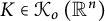 $K\in \mathcal {K}_o\left (\mathbb {R}^n\right )$
, its radial function is defined by
 $$ \begin{align} \rho(K,x):=\max\{r>0:\;rx\in K\}, \quad x \in \mathbb{R}^n\backslash\{o\}. \end{align} $$
The radial function is homogeneous of degree
 $-$
1, i.e.,
 $$ \begin{align} \rho(K,rx)=\frac{1}{r}\rho(K,x),\;\;\mathrm{for}\;r>0. \end{align} $$
A compact set
 $K\subset \mathbb {R}^n$
is a star-shaped set with respect to
 $z\in K$
if the intersection of every straight line through z with K is either a line segment or a single point set
 $\{z\}$
. Let
 $K\subset \mathbb {R}^n$
be a compact star shaped set with respect to
 $z\in K$
, the radial function
 $\rho _{z}(K,\cdot ):\mathbb {R}^n\backslash \{o\}\rightarrow \mathbb {R}$
is defined by
 $$ \begin{align} \rho_{z}(K,x):=\max\{r\geq0:\;z+rx\in K\}. \end{align} $$
If
 $\rho _{z}(K,\cdot )$
is strictly positive and continuous, then we call K a star body with respect to z, denotes the class of star bodies in
 $\mathbb {R}^n$
by
 $\mathcal {S}_z(\mathbb {R}^n)$
. If
 $K\subset \mathbb {R}^n$
is a star body with respect to each point of ball
 $B_o(r)$
, then we say K is a star body with respect to a ball. The class of star bodies with respect to ball
 $B_o(r)$
will be denoted by
 $\mathcal {S}_B(\mathbb {R}^n)$
. It is clear that
 $\mathcal {K}_o(\mathbb {R}^n)\subset \mathcal {S}_B(\mathbb {R}^n)$
, i.e., any convex body with the origin as its interior is a star body with respect to a ball. For
 $K\in \mathcal {S}_B(\mathbb {R}^n)$
, we have the following volume formula:
 $$ \begin{align} \mathcal{H}^n(K)=\frac{1}{n}\int_{\mathbb{S}^{n-1}}\rho^n(K,u)du \end{align} $$
and the surface area formula
 $$ \begin{align} \mathcal{H}^{n-1}(\partial K)=\int_{\mathbb{S}^{n-1}}\rho^{n-1}(K,u)\left[u\cdot\nu^K\left(\rho(K,u)u\right)\right]^{-1}du, \end{align} $$
where
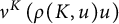 $\nu ^K\left (\rho (K,u)u\right )$
denotes the outer unit normal vector of K at the boundary point
 $\rho (K,u)u$
.
For
 $K\in \mathcal {S}_o\left (\mathbb {R}^n\right )$
, its polar body is defined by
 $$ \begin{align*}K^{\ast}:=\{y\in\mathbb{R}^n:\;y\cdot x\leq 1\;\;\mathrm{for\;any}\;x\in K\}.\end{align*} $$
It is well-known that if
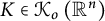 $K\in \mathcal {K}_o\left (\mathbb {R}^n\right )$
,
 $$ \begin{align} \left(K^{\ast}\right)^{\ast}=K. \end{align} $$
The support function and radial function of
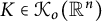 $K\in \mathcal {K}_o(\mathbb {R}^n)$
have the following relationship:
 $$ \begin{align} h(K,x)\rho\left(K^{\ast},x\right)=1,\;\;\;\;x\in\mathbb{R}^n\backslash\{o\}. \end{align} $$
The radial distance between
 $K, L\in \mathcal {S}_o(\mathbb {R}^n)$
is defined by
 $$ \begin{align} d_R(K,L):=\max_{u\in\mathbb{S}^{n-1}}\left|\rho(K,u)-\rho(L,u)\right|. \end{align} $$
The Hausdorff distance between the compact sets
 $K,L\subset \mathbb {R}^n$
is defined by
 $$ \begin{align} d_H(K,L):=\min\left\{r\geq 0:\;K\subset L+B_o(r),\;L\subset K+B_o(r)\right\}. \end{align} $$
For
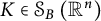 $K\in \mathcal {S}_B\left (\mathbb {R}^n\right )$
, its Petty projection body is defined with its support function:
 $$ \begin{align} h\left(\mathrm{\Pi}K,z\right):=\frac{1}{2}\int_{\partial K}\left|\nu^K(x)\cdot z\right|d\mathcal{H}^{n-1}(x), \end{align} $$
where
 $\partial K$
denotes the boundary of K,
 $\nu ^K(x)$
denotes the unit outer normal vector of K at the boundary point
 $x\in \partial K$
. The polar body of
 $\mathrm {\Pi }K$
will be denoted by
 $\mathrm {\Pi }^{\ast }K$
rather than
 $(\mathrm {\Pi }K)^{\ast }$
.
The following lemma shows that the Petty projection operator
 $\mathrm { \Pi }:\;\mathcal {S}_B\left (\mathbb {R}^n\right )\rightarrow \mathcal {K}_o(\mathbb {R}^n)$
is continuous when
 $K_i$
converges to
 $K_{\infty }$
in the Hausdorff distance.
Lemma 1 [Reference Lin21, Proposition 4.1]
Let
 $K_{\infty },K_i\in \mathcal {S}_B (\mathbb {R}^n)$
,
 $i\in \mathbb {N}$
. If
 $K_i\rightarrow K_{\infty }$
in the Hausdorff distance and
 $\mathcal {H}^{n-1}(\partial K_i)\rightarrow \mathcal {H}^{n-1}(\partial K_{\infty })$
, then
 $\mathrm {\Pi } K_i\rightarrow \mathrm {\Pi } K_{\infty }$
in the Hausdorff distance.
For
 $K\in \mathcal {S}_o\left (\mathbb {R}^n\right )$
, its Steiner symmetrization along the direction
 $u\in \mathbb {S}^{n-1}$
is defined by
 $$ \begin{align} S_uK:=\bigcup_{x'\in K|_{u^{\perp}}}\left\{x'+tu:\;t\in \left[-\frac{1}{2}\mathcal{H}^1(K_{u,x'}),\frac{1}{2}\mathcal{H}^1(K_{u,x'})\right]\right\}, \end{align} $$
where
 $u^{\perp }$
denotes the orthogonal complementary space of u, i.e.,
 $u^{\perp }:=\{z\in \mathbb {R}^n:\;z\cdot u=0\}$
;
 $K|_{u^{\perp }}$
denotes the orthogonal projection of K onto
 $u^{\perp }$
, i.e.,
 $$ \begin{align*}K|_{u^{\perp}}:=\{x'\in u^{\perp}:\;\mathrm{there\;exits\;some}\;r\in\mathbb{R}\;\mathrm{such\;that}\;x'+ru\in K\};\end{align*} $$
 $K_{u,x'}$
denotes the intersection of K and the straight line parallel to u and passing through point
 $x'$
, i.e.,
 $$ \begin{align*}K_{u,x'}:=\{x\in K:\;x=x'+ru,\;r\in\mathbb{R}\}.\end{align*} $$
For simplicity of notation, we write
 $SK$
,
 $K'$
, and
 $K_{x'}$
instead of
 $S_{e_n}K$
,
 $K|_{e_n^{\perp }}$
and
 $K_{e_n,x'}$
, respectively.
Let
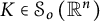 $K\in \mathcal {S}_o\left (\mathbb {R}^n\right )$
. Its symmetric rearrangement
 $K^{\bigstar }$
is the closed centered ball whose volume agrees with K,
 $$ \begin{align*}K^{\bigstar}:=\left\{x\in\mathbb{R}^n:\;\omega_n\|x\|^n\leq\mathcal{H}^n(K)\right\}.\end{align*} $$
The following lemma provides some properties on the Steiner symmetrizations of star bodies.
Lemma 2 [Reference Lin and Wu22, Lemma 5.1]
If
 $K\in \mathcal {S}_B(\mathbb {R}^n)$
, then
 $S_uK\in \mathcal {S}_B(\mathbb {R}^n)$
for every
 $u\in \mathbb {S}^{n-1}$
.
Lemma 3 [Reference Lin and Wu22, Theorem 2.2]
Let
 $K,K_i\in \mathcal {S}_B(\mathbb {R}^n)$
,
 $i\in \mathbb {N}$
. Then, the fact that
 $K_i$
converges to K in Hausdorff distance is equivalent to the fact that
 $K_i$
converges to K in radial distance.
Lemma 4 [Reference Lin and Wu22, Theorem 2.3]
If
 $K\in \mathcal {S}_B(\mathbb {R}^n)$
and T is a dense subset of
 $\mathbb {S}^{n-1}$
, then there is a sequence
 $\{u_i\}\subset T$
such that
 $K_i:=S_{u_i}\cdots S_{u_1}K$
converges to
 $K^{\bigstar }$
in radial distance.
The following lemma characterizes the structures of the boundaries of star bodies with respect to a ball.
Lemma 5 [Reference Lin and Xi23, Theorem 3.1]
Let
 $K\in \mathcal {S}_B(\mathbb {R}^n)$
. Then, for almost all
 $u \in \mathbb {S}^{n-1}$
, there is a sequence of disjoint open subsets
 $G_m \subset K^{\prime }$
, and two sequences of graph functions
 $f_{m,j}, g_{m,j}: G_m \rightarrow \mathbb {R},\;1\leq j\leq m,$
satisfying:
(i)
 $\bigcup _{m=1}^{\infty } G_m$
is open dense in
 $K^{\prime }$
, and
 $f_{m,1}<g_{m,1}<\cdots <f_{m,j}<g_{m,j}$
;
(ii) K has the representation (if we neglect an
 $\mathcal {H}^n$
-null set)
 $$ \begin{align*}K=\bigcup_{m=1}^{\infty} \bigcup_{\substack{x^{\prime} \in G_m \\ 1 \leq j \leq m}}\left\{(x',x_n):f_{m,j}(x')\leq x_n\leq g_{m,j}(x')\right\} \end{align*} $$
and
 $\partial K$
has the representation (if we neglect an
 $\mathcal {H}^{n-1}$
-null set)
 $$ \begin{align*}\partial K=\bigcup_{m=1}^{\infty} \bigcup_{j=1}^m\left\{\left(x^{\prime}, f_{m,j}\left(x^{\prime}\right)\right): x^{\prime} \in G_m\right\} \cup\left\{\left(x^{\prime}, g_{m,j}\left(x^{\prime}\right)\right): x^{\prime} \in G_m\right\}; \end{align*} $$
(iii)
 $f_{m,j}$
,
 $g_{m,j}$
are differentiable at each
 $x'\in G_m$
, and
 $$ \begin{align*}\nu^K(x',f_{m,j}(x'))=\frac{(\nabla f_{m,j}(x'),-1)}{\sqrt{1+\left|\nabla f_{m,j}(x')\right|{}^2}},\;\;\;\nu^K(x',g_{m,j}(x'))=\frac{(-\nabla g_{m,j}(x'),1)}{\sqrt{1+\left|\nabla g_{m,j}(x')\right|{}^2}}.\end{align*} $$
The following well-known fact, which is provided by Lutwaket al. [Reference Lutwak, Yang and Zhang29], establishes the relationship between Steiner symmetrizations and polar bodies.
Lemma 6 [Reference Lutwak, Yang and Zhang29, Lemma 1.1.]
For two convex bodies
 $K,L\in \mathcal {K}_o(\mathbb {R}^n)$
,
 $$ \begin{align*}S_{e_n}L^{\ast}\subset K^{\ast}\end{align*} $$
if and only if
 $$ \begin{align*}h(L,(z',t))=h(L,(z',-s))=1,\;\mathrm{with}\;t\neq -s\;\;\Longrightarrow\;\; h\left(K,\left(z',\frac{s+t}{2}\right)\right)\leq 1.\end{align*} $$
In addition, if
 $S_{e_n}L^{\ast }=K^{\ast }$
, then
 $h(K,(z',\frac {s+t}{2}))=1$
for any
 $(z',t),(z',-s)\in \mathbb {R}^{n-1}\times \mathbb {R}$
satisfying
 $t\neq -s$
and
 $h(L,(z',t))=h(L,(z',-s))=1$
.
Let
 $f:\mathbb {R}^n\rightarrow [0,+\infty )$
be a nonnegative measurable function that vanishes at infinity, in the sense that all its positive level sets have finite measure,
 $$ \begin{align*}\mathcal{H}^n\left(\{x:\;f(x)>t\}\right)<\infty,\;\;\mathrm{for\;all}\;t>0.\end{align*} $$
We define the symmetric decreasing rearrangement
 $f^{\bigstar }$
of f by symmetrizing its level sets,
 $$ \begin{align} f^{\bigstar}(x)=\int_0^{\infty}\chi_{\{f>t\}^{\bigstar}}(x)dt, \end{align} $$
where
 $\chi _E$
denote the characteristic function of
 $E\subset \mathbb {R}^n$
, i.e.,
 $$ \begin{align} \chi_E(x)=\left\{\begin{aligned} &1&&\mathrm{if}\;x\in E,\\ &0&&\mathrm{otherwise}. \end{aligned} \right. \end{align} $$
Lemma 7 (Hardy–Littlewood inequality)
If
 $f,g:\mathbb {R}^n\rightarrow [0,\infty )$
are nonnegative measurable functions that vanish at infinity, then
 $$ \begin{align} \int_{\mathbb{R}^n} f(x) g(x)dx \leq \int_{\mathbb{R}^n}f^{\bigstar}(x) g^{\bigstar}(x)dx \end{align} $$
in the sense that the left hand side is finite whenever the right hand side is finite.
2.2 Basic facts from Spherical convex geometry
Let us recall some facts about spherical convex geometry (see, e.g., [Reference Besau and Werner4, Reference Maehara and Martini30, Reference Ratcliffe32]). Let
 $\mathbb {R}^{n+1}$
denote
 $(n+1)$
-dimensional Euclidean space. Let
 $\mathbb {R}^n:=\left \{x \in \mathbb {R}^{n+1}: x\cdot e_{n+1}=0\right \}$
. Let o denote the origin of
 $\mathbb {R}^{n+1}$
. Let
 $e_1,\ldots , e_n,e_{n+1}$
denote the standard orthonormal basis of
 $\mathbb {R}^{n+1}$
. We denote the Euclidean unit sphere in
 $\mathbb {R}^{n+1}$
by
 $\mathbb {S}^n, n \geq 2$
. For
 $u\in \mathbb {S}^n$
, let
 $\mathbb {S}_u$
denote the set
 $\{v\in \mathbb {S}^n:\;v\cdot u=0\}$
. Let
 $\mathbb {S}_u^{+}$
denote the set
 $\{v\in \mathbb {S}^n:\;v\cdot u>0\}$
and
 $\mathbb {S}_u^{-}$
denote the set
 $\{v\in \mathbb {S}^n:\;v\cdot u<0\}$
. To simplify notation, we let
 $\mathbb {S}^{n-1}$
denote
 $\mathbb {S}_{e_{n+1}}$
and
 $\mathbb {S}^n_{\pm }$
denote
 $\mathbb {S}^{\pm }_{e_{n+1}}$
. A set
 $A \subseteq \mathbb {S}^n$
is called (spherical) convex if its radial extension
 $$ \begin{align*}\operatorname{rad} A=\left\{r v \in \mathbb{R}^{n+1}: r \geq 0 \text { and } v \in A\right\} \end{align*} $$
is convex in
 $\mathbb {R}^{n+1}$
. If
 $A \subseteq \mathbb {S}^n$
is convex, then
 $\operatorname {rad} A$
is a convex cone with o as its vertex in
 $\mathbb {R}^{n+1}$
. A closed convex subset of
 $\mathbb {S}^n$
is called a (spherical) convex body. The set of convex bodies is denoted by
 $\mathcal {K}\left (\mathbb {S}^n\right )$
. Furthermore, the set of convex bodies contained in
 $\mathbb {S}^n_+$
with
 $e_{n+1}$
as its interior point is denoted by
 $\mathcal {K}_o\left (\mathbb {S}_+^n\right )$
. And the set of convex bodies contained in
 $\mathbb {S}^n_-$
with
 $-e_{n+1}$
as its interior point is denoted by
 $\mathcal {K}_o\left (\mathbb {S}_-^n\right )$
.
The natural spherical distance
 $\hat {d}_s$
is given by
 $\hat {d}_s(u, v)=\arccos (u \cdot v)$
for
 $u, v \in \mathbb {S}^n$
. For spherical compact sets
 $K,L\subset \mathbb {S}^n$
, the spherical Hausdorff distance of K and L is defined by
 $$ \begin{align} \hat{d}_s(K,L):=\inf\left\{r>0:\;K\subseteq L_{r}\;\;\mathrm{and}\;\;L\subseteq K_r\right\}, \end{align} $$
where
 $L_r$
denotes the spherical parallel set of L, which is defined by
 $$ \begin{align*}L_r:=\{w\in\mathbb{S}^n:\;\mathrm{there\;exists}\;v\in L\;\mathrm{such\;that}\;\hat{d}_s(w,v)\leq r\}.\end{align*} $$
Let
 $B_s(\alpha )$
denote the spherical cap of radius
 $\alpha \in (0,\pi /2)$
and center
 $e_{n+1}$
in
 $\mathbb {S}^n$
, i.e.,
 $$ \begin{align*}B_s(\alpha):=\{v\in\mathbb{S}^n:\;\hat{d}_s(v,e_{n+1})\leq \alpha\}.\end{align*} $$
The convex hull
 $\operatorname {conv} A$
of
 $A \subseteq \mathbb {S}^n$
is the intersection of all convex bodies in
 $\mathbb {S}^n$
that contain A. The convex hull of two spherical convex bodies
 $K, L$
is denoted by
 $\operatorname {conv}(K, L)$
, i.e.,
 $$ \begin{align*}\operatorname{conv}(K, L):=\operatorname{conv}(K \cup L).\end{align*} $$
The segment spanned by two points
 $u, v \in \mathbb {S}^n, u \neq -v$
, is given by
 $\operatorname {conv}(u, v)=\operatorname {conv}(\{u\},\{v\})$
. A k-sphere S,
 $k \in \{0, \ldots , n\}$
, is the intersection of a
 $(k+1)$
-dimensional linear subspace of
 $\mathbb {R}^{n+1}$
with
 $\mathbb {S}^n$
. Let S be a k-sphere and let
 $K \in \mathcal {K}\left (\mathbb {S}^n\right )$
. Then, the spherical projection
 $K \mid S$
is defined by
 $$ \begin{align*}K \mid S:=\operatorname{conv}\left(S^{\circ},K\right) \cap S, \end{align*} $$
where
 $S^{\circ }:=\{w\in \mathbb {S}^n:\;w\cdot u=0\;\mathrm {for\;all}\;u\in S\}$
. The spherical projection of a point is given by
 $x\mid S:=\{x\}\mid S$
.
Definition 1 For
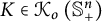 $K \in \mathcal {K}_o\left (\mathbb {S}_+^n\right )$
, the spherical support function
 $h(K, \cdot ): \mathbb {S}^{n-1} \rightarrow \left (0, \frac {{\pi }}{2}\right )$
of K is defined by
 $$ \begin{align} h_s(K, v)=\max \left\{ \operatorname{sgn}(v\cdot w)\hat{d}_s\left(e_{n+1}, w \mid \mathbb{S}_{e_{n+1}, v}^1\right): w \in K\right\},\;\;\;v\in\mathbb{S}^{n-1}, \end{align} $$
where
 $\mathbb {S}_{e_{n+1}, v}^1$
denotes the 1-sphere spanned by
 $e_{n+1}$
and v.
The intuitive interpretation of the spherical support function is as follows: If
 $v \in \mathbb {S}^{n-1}$
then the projection
 $K \mid \mathbb {S}_{e_{n+1}, v}^1$
is a spherical segment and the spherical support function measures the width along the direction v with respect to
 $e_{n+1}$
. We have
 $$ \begin{align*}K \mid \mathbb{S}_{e_{n+1}, v}^1=\left\{\cos (\alpha) e_{n+1}+\sin (\alpha) v: \alpha \in\left[-h(K,-v), h(K, v)\right]\right\}. \end{align*} $$
Definition 2 For
 $K\in \mathcal {K}_o(\mathbb {S}_+^n)$
, its spherical radial function is defined by
 $$ \begin{align} \rho_s(K,v):=\max\left\{\operatorname{sgn}(v\cdot w)\hat{d}_s\left(e_{n+1},w\right):w\in K\cap\mathbb{S}^1_{e_{n+1},v}\right\},\;\;\;v\in\mathbb{S}^{n-1}. \end{align} $$
Definition 3 For
 $K\in \mathcal {K}_o(\mathbb {S}_+^n)$
, its spherical polar body
 $K^{\circ }$
is defined by
 $$ \begin{align} K^{\circ}=\{v\in\mathbb{S}^n:\;v\cdot w\leq 0\;\;\mathrm{for\;all}\;w\in K\}. \end{align} $$
By the above definition, if
 $K\in \mathcal {K}_o(\mathbb {S}_+^n)$
, then
 $K^{\circ }\in \mathcal {K}_o(\mathbb {S}_-^n)$
. Moreover, the spherical polar body
 $K^{\circ }$
is the intersection of
 $\mathbb {S}^n$
and
 $\left (\operatorname {rad} A\right )^{\ast }$
, here
 $$ \begin{align*}\left(\operatorname{rad} A\right)^{\ast}:=\left\{z\in\mathbb{R}^{n+1}:\;z\cdot x\leq 0,\;x\in \operatorname{rad} A\right\}\end{align*} $$
denotes the polar of the corresponding convex cone
 $\operatorname {rad} A$
.
Definition 4 The gnomonic projection
 $g: \mathbb {S}^n_+ \rightarrow \mathbb {R}^n$
is defined by
 $$ \begin{align*}g(v):=\frac{v}{e_{n+1} \cdot v}-e_{n+1}. \end{align*} $$
The inverse gnomonic projection
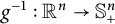 $g^{-1}: \mathbb {R}^n \rightarrow \mathbb {S}^n_+$
is defined by
 $$ \begin{align*}g^{-1}(x):=\frac{x+e_{n+1}}{\|x+e_{n+1}\|}.\end{align*} $$
By the definition of gnomonic projection of
 $K\in \mathcal {K}_o(\mathbb {S}_+^n)$
, the following equalities show the relations between spherical support function (spherical radial function) of K and the Euclidean support function (Euclidean radial function) of
 $g(K)$
:
 $$ \begin{align} h(g(K),v)=\tan h_s(K,v),\;\;\;v\in \mathbb{S}^{n-1}, \end{align} $$
 $$ \begin{align} \rho(g(K),v)=\tan \rho_s(K,v),\;\;\;v\in \mathbb{S}^{n-1}. \end{align} $$
Moreover, it is easy to prove that for
 $K\in \mathcal {K}_o(\mathbb {S}_+^n)$
,
 $$ \begin{align} g(K)^{\ast}=-g(-K^{\circ}). \end{align} $$
By (12) and (27), for
 $K\in \mathcal {K}_o(\mathbb {S}_+^n)$
, we have
 $$ \begin{align} \left(K^{\circ}\right)^{\circ}=K. \end{align} $$
 $$ \begin{align*}\tan h_s(K,v)=h(g(K),v)=\frac{1}{\rho(g(K)^{\ast},v)}=\frac{1}{\rho(g(-K^{\circ}),-v)}=\frac{1}{\tan \rho_s(-K^{\circ},-v)}.\end{align*} $$
Therefore, for
 $K\in \mathcal {K}_o(\mathbb {S}_+^n)$
and
 $v\in \mathbb {S}^{n-1}$
,
 $$ \begin{align} h_s(K,v)+\rho_s(-K^{\circ},-v)=\frac{{\pi}}{2}. \end{align} $$
By Definition 4 and the definitions of star bodies in
 $\mathbb {R}^n$
, we define spherical star bodies as follows.
Definition 5 For a spherical compact set
 $K\subset \mathbb {S}_+^n$
, if its gnomonic projection
 $g(K)$
is a star body with respect to o in
 $\mathbb {R}^n$
, then K is called a spherical star body with respect to
 $e_{n+1}$
. If
 $g(K)$
is a star body with respect to a ball
 $B_o(\tan \alpha )$
in
 $\mathbb {R}^n$
, then K is called a spherical star body with respect to a spherical cap
 $B_s(\alpha )$
.
The set of spherical star bodies with respect to
 $e_{n+1}$
is denoted by
 $\mathcal {S}_o(\mathbb {S}_+^n)$
. The set of spherical star bodies with respect to
 $B_s(\alpha )$
is denoted by
 $\mathcal {S}_B(\mathbb {S}_+^n)$
. Similarly,
 $\mathcal {K}_o(\mathbb {S}_+^n)\subset \mathcal {S}_B(\mathbb {S}_+^n)$
. For
 $K\in \mathcal {S}_o(\mathbb {S}_+^n)$
, its spherical radial function
 $\rho _K$
can be defined as in (23).
Definition 6 For
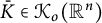 $\bar {K}\in \mathcal {K}_o(\mathbb {R}^n)$
, its spherical measure is defined by
 $$ \begin{align} \mu_{s,n}(\bar{K}):=\int_{\bar{K}}\left(1+\|x\|^2\right)^{-\frac{n+1}{2}}dx. \end{align} $$
By [Reference Besau, Hack, Pivovarov and Schuster3, Lemma 2.3], the spherical measure of
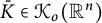 $\bar {K}\in \mathcal {K}_o(\mathbb {R}^n)$
equals the n-Hausdorff measure of its inverse gnomonic projection
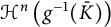 $\mathcal {H}^n\left (g^{-1}(\bar {K})\right )$
. Thus, for
 $K\in \mathcal {K}_o(\mathbb {S}_+^n)$
, we have
 $$ \begin{align} \mathcal{H}^n(K)=\mu_{s,n}(g(K)). \end{align} $$
Lemma 8 [Reference Schneider and Weil34, Lemma 6.5.1]
Let S be a k-sphere,
 $0 \leq k \leq n-1$
, and let
 $f: \mathbb {S}^n \rightarrow \mathbb {R}$
be a non-negative measurable function. Then,
 $$ \begin{align} \int_{\mathbb{S}^n} f(w) d w=\int_S \int_{\operatorname{conv}\left(S^{\circ}, v\right)} \sin \left(d_s\left(S^{\circ}, u\right)\right)^k f(u) d u d v. \end{align} $$
2.3 Basic facts from Hyperbolic convex geometry
Let us recall some facts about hyperbolic geometry (see, e.g., [Reference Ratcliffe32]). Recall that
 $\mathbb {R}^{n+1}=\mathbb {R}^n\times \mathbb {R},$
where
 $$ \begin{align*}\mathbb{R}^n:=\left\{x \in \mathbb{R}^{n+1}: x\cdot e_{n+1}=0\right\}.\end{align*} $$
In
 $\mathbb {R}^{n+1}$
, let
 $$ \begin{align*}\mathbb{H}^n:=\left\{(x,x_{n+1})\in\mathbb{R}^{n+1}:\;\|x\|^2-x^2_{n+1}=-1,\;x_{n+1}>0\right\}\end{align*} $$
denote the upper sheet of a two-sheet hyperboloid.
Definition 7 (Poincaré ball model)
Let
 $o^{\prime }:=-e_{n+1}$
. For any
 $\bar {x}:=(x,x_{n+1})\in \mathbb {H}^n$
, the Poincaré ball model projection point of
 $\bar {x}$
, denoted by
 $P(\bar {x})$
, is the intersection of the half-line
 $o'\bar {x}$
and
 $e_{n+1}^{\perp }$
. In the Poincaré ball model,
 $\mathbb {H}^n$
is identified with the following open unit ball equipped with a certain metric
 $$ \begin{align} \mathbb{B}^n:=\{(x,x_{n+1})\in\mathbb{R}^{n+1}:\;\|x\|<1,\;x_{n+1}=0\}. \end{align} $$
We call the projection
 $P:\;\mathbb {H}^n\rightarrow \mathbb {B}^n$
as Poincaré ball model projection. In the Poincaré ball model, the corresponding metric is
 $$ \begin{align} ds^2=4\frac{dx_1^2+\dots+dx_n^2}{\left(1-\left(x_1^2+\dots+x_n^2\right)\right)^2}. \end{align} $$
In this metric, geodesic segments are arcs of the circles orthogonal to the boundary of the ball
 $\mathbb {B}^n$
. If a segment passes through the origin, then the circle becomes a straight line. We say that a body
 $\bar {K}\subset \mathbb {B}^n$
is hyperbolic convex if it is convex with respect to the metric (34). The hyperbolic convexity means that for any two points x and y in
 $\bar {K}$
the geodesic segment connecting these two points is also in
 $\bar {K}$
.
For two compact sets
 $K,L\subset \mathbb {H}^n$
, their hyperbolic Hausdorff distance is defined by
 $$ \begin{align} d_h(K,L):=\inf\left\{r>0:\;K\subset L_{r},\;\;L\subset K_r\right\}, \end{align} $$
where
 $$ \begin{align*}K_r:=\{\bar{y}\in\mathbb{H}^n:\;\mathrm{there\;exits}\;\bar{x}\in K\;\mathrm{ such\;that}\;ds^2(P(\bar{x}),P(\bar{y}))\leq r^2\}.\end{align*} $$
Let
 $B_h(\alpha )\subset \mathbb {H}^n$
denote the hyperbolic ball centered at
 $e_{n+1}$
with radius
 $\alpha $
, i.e.,
 $$ \begin{align*}B_h(\alpha):=\left\{\bar{x}\in\mathbb{H}^n:\;ds^2\left(P(\bar{x}),o\right)\leq \alpha^2\right\}.\end{align*} $$
The volume element of the metric (34) equals
 $$ \begin{align} d\mu_{h,n}=2^n\frac{dx_1\cdots dx_n}{\left(1-(x_1^2+\cdots+x_n^2)\right)^n}=2^n\frac{dx}{\left(1-\|x\|^2\right)^n}. \end{align} $$
Therefore, for
 $\bar {K}\subset \mathbb {B}^n$
, the hyperbolic volume is then given by
 $$ \begin{align} \operatorname{hvol}_n(\bar{K})=\int_{\bar{K}}d\mu_{h,n}=2^n\int_{\bar{K}}\frac{dx}{\left(1-\|x\|^2\right)^n}. \end{align} $$
If
 $\bar {K}$
is a star body in
 $\mathbb {B}^n$
, we can write its hyperbolic volume in polar coordinates,
 $$ \begin{align} \operatorname{hvol}_n(\bar{K})=2^n\int_{\mathbb{S}^{n-1}}\int_{0}^{\rho_{\bar{K}}(u)}\frac{r^{n-1}}{\left(1-r^2\right)^n}drdu, \end{align} $$
where
 $\rho _{\bar {K}}$
denotes the radial function of
 $\bar {K}$
in
 $\mathbb {R}^n$
given in (7).
Definition 8 For
 $K\subset \mathbb {H}^n$
, if
 $P(K)$
is a star body with respect to the origin in
 $\mathbb {R}^n$
, then we call K is a hyperbolic star body with respect to
 $e_{n+1}$
. If
 $P(K)$
is a star body with respect to a ball
 $B_o(r)$
in
 $\mathbb {R}^n$
, then K is called as a hyperbolic star body with respect to some hyperbolic ball.
We denote the class of hyperbolic star bodies with respect to
 $e_{n+1}$
in
 $\mathbb {H}^n$
by
 $\mathcal {S}_o(\mathbb {H}^n)$
and denote the class of hyperbolic star bodies with respect to a hyperbolic ball by
 $\mathcal {S}_B(\mathbb {H}^n)$
.
3 Spherical projection body and Spherical projection inequality
3.1 Spherical Steiner symmetrization
In this section, we define the spherical Steiner symmetrization for spherical star bodies and study some of its fundamental properties. Without loss of generality, we only consider the Steiner symmetrization along the direction
 $e_n$
. If
 $K\in \mathcal {S}_B(\mathbb {S}_+^n)$
, then
 $g(K)\in \mathcal {S}_B(\mathbb {R}^n)$
. By Lemma 5, there is a sequence of disjoint open subsets
 $G_m \subset g(K)^{\prime }$
, and two sequences of graph functions
 $$ \begin{align*}f_{m,j}, g_{m,j}: G_m \rightarrow \mathbb{R},\;1\leq j\leq m, \end{align*} $$
satisfying (i)–(iii) in Lemma 5. In particular,
 $g(K)$
has the representation (if we neglect an
 $\mathcal {H}^n$
-null set)
 $$ \begin{align} g(K)=\bigcup_{m=1}^{\infty} \bigcup_{\substack{x^{\prime} \in G_m \\ 1 \leq j \leq m}}\left\{(x',x_n):f_{m,j}(x')\leq x_n\leq g_{m,j}(x')\right\}. \end{align} $$
By (17), the Euclidean Steiner symmetrization
 $Sg(K)$
of
 $g(K)$
along the direction
 $e_n$
(if we neglect an
 $\mathcal {H}^n$
-null set)
 $$ \begin{align} Sg(K)=\left\{(x',x_n)\in\mathbb{R}^n:\;\;x'\in \bigcup_{m=1}^{\infty}G_m,\;\;\underline{\varrho}(x')\leq x_n\leq\overline{\varrho}(x')\right\}, \end{align} $$
where for
 $x'\in G_m$
,
 $$ \begin{align} \overline{\varrho}(x')=\sum_{j=1}^{m}\frac{g_{m,j}(x')-f_{m,j}(x')}{2}=-\underline{\varrho}(x'). \end{align} $$
The following lemma shows that the spherical measure of
 $Sg(K)$
is not less than the spherical measure of
 $g(K)$
.
Lemma 9 For convex body
 $K\in \mathcal {K}_o(\mathbb {S}^n)$
, we have
 $$ \begin{align} \mu_{s,n}\left(Sg(K)\right)\geq \mu_{s,n}\left(g(K)\right), \end{align} $$
with the equality if and only if
 $Sg(K)=g(K)$
.
Proof By Fubini’s Theorem and the definition of spherical measure (30), we only need to prove that for any
 $x'\in g(K)|_{\mathbb {R}^{n-1}}$
,
 $$ \begin{align} \int_{(Sg(K))_{x'}}\left(1+\|x'\|^2+|x_n|^2\right)^{-\frac{n+1}{2}}dx_n\geq \int_{g(K)_{x'}}\left(1+\|x'\|^2+|x_n|^2\right)^{-\frac{n+1}{2}}dx_n. \end{align} $$
Let
 $$ \begin{align*}f_1(x_n):=\left(1+\|x'\|^2+|x_n|^2\right)^{-\frac{n+1}{2}},\;\;\;f_2(x_n):=\chi_{g(K)_{x'}}(x_n).\end{align*} $$
Then,
 $$ \begin{align*}f_1^{\bigstar}=f_1,\;\;\mathrm{and}\;\;f_2^{\bigstar}=\chi_{Sg(K)_{x'}},\end{align*} $$
where
 $f^{\bigstar }$
denotes the symmetric decreasing rearrangement of f (see (18) for specific definition).
By Hardy–Littlewood inequality (see Lemma 7), we have
 $$ \begin{align} &\int_{g(K)_{x'}}\left(1+\|x'\|^2+|x_n|^2\right)^{-\frac{n+1}{2}}dx_n\\ &=\int_{\mathbb{R}}f_1(x_n)f_2(x_n)dx_n\nonumber\\ &\leq\int_{\mathbb{R}}f^{\bigstar}_1(x_n)f^{\bigstar}_2(x_n)dx_n\nonumber\\ &=\int_{(Sg(K))_{x'}}\left(1+\|x'\|^2+|x_n|^2\right)^{-\frac{n+1}{2}}dx_n.\nonumber \end{align} $$
Moreover, since
 $f_1$
is an even nonnegative unimodal integrable function, the equality in (44) holds if and only if
 $g(K)_{x'}=Sg(K)_{x'}$
. Thus, the equality in (42) holds if and only if
 $Sg(K)=g(K)$
.
By Lemma 9,
 $\mu _{s,n}\left (Sg(K)\right )\geq \mu _{s,n}\left (g(K)\right )$
. Thus, there exists some real number
 $r_K\in (0,1]$
such that
 $$ \begin{align} \bar{S}g(K):=\left\{(x',x_n)\in\mathbb{R}^n:\;\;x'\in g(K)|_{\mathbb{R}^{n-1}},\;\;r_K\underline{\varrho}(x')\leq x_n\leq r_K\overline{\varrho}(x')\right\} \end{align} $$
satisfies
 $$ \begin{align} \mu_{s,n}\left(\bar{S}g(K)\right)=\mu_{s,n}\left(g(K)\right). \end{align} $$
Definition 9 For
 $K\in \mathcal {K}_o(\mathbb {S}^n)$
, its spherical Steiner symmetrization
 $\hat {S}_{e_n}K$
along the direction
 $e_n\in \mathbb {S}^{n-1}$
is defined by
 $$ \begin{align} \hat{S}_{e_n}(K):=g^{-1}\left(\bar{S}g(K)\right). \end{align} $$
For simplicity of notation, we write
 $\hat {S}K$
instead of
 $\hat {S}_{e_n}(K)$
. In Definition 9, g and
 $g^{-1}$
denote the gnomonic projection and the inverse gnomonic projection (see Definition 4). If
 $K\in \mathcal {K}_o(\mathbb {S}^n)$
, then
 $g(K)\in \mathcal {K}_o(\mathbb {R}^n)$
. Thus,
 $Sg(K)\in \mathcal {K}_o(\mathbb {R}^n)$
. By (45),
 $\bar {S}g(K)\in \mathcal {K}_o(\mathbb {R}^n)$
. Thus, by (47),
 $$ \begin{align} K\in\mathcal{K}_o(\mathbb{S}_+^n)\Longrightarrow\hat{S}K\in\mathcal{K}_o(\mathbb{S}_+^n). \end{align} $$
By Lemma 2, (45), (47) and the definition of spherical star bodies with respect to a spherical cap (see Definition 5),
 $$ \begin{align} K\in\mathcal{S}_B(\mathbb{S}_+^n)\Longrightarrow\hat{S}K\in\mathcal{S}_B(\mathbb{S}_+^n). \end{align} $$
By (31) and (46), the spherical Steiner symmetrization maintains the invariance of n-Hausdorff measure, i.e.,
 $$ \begin{align} \mathcal{H}^n(\hat{S}K)=\mathcal{H}^n(K). \end{align} $$
Similarly, for a compact set
 $K\subset \mathbb {S}^n$
, we define the spherical symmetric rearrangement
 $K^{\bigstar }$
as follows
 $$ \begin{align} K^{\bigstar}:=\left\{v\in\mathbb{S}^n:\;\hat{d}_s(v,e_{n+1})\leq \alpha,\;\;\mathcal{H}^n(K)=\mathcal{H}^n(B_s(\alpha))\right\}. \end{align} $$
Lemma 10 For
 $K\in \mathcal {S}_B(\mathbb {S}_+^n)$
, there exists a sequence of directions
 $\{u_i\}_{i=1}^{\infty }\subset \mathbb {S}^{n-1}$
such that the sequence of successive spherical Steiner symmetrizations of K converges to
 $K^{\bigstar }$
in spherical Hausdorff distance, i.e.,
 $$ \begin{align} \lim_{i\rightarrow\infty}d_s(\hat{S}_{u_i}\cdots\hat{S}_{u_1}(K),K^{\bigstar})=0. \end{align} $$
Proof By Lemma 4, there exists a sequence of directions
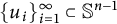 $\{u_i\}_{i=1}^{\infty }\subset \mathbb {S}^{n-1}$
such that
 $$ \begin{align} \lim_{i\rightarrow\infty}d_R(S_{u_i}\cdots S_{u_1}(g(K)),g(K)^{\bigstar})=0. \end{align} $$
Let
 $r_1\in (0,1]$
satisfy
 $$ \begin{align*}\mu_{s,n}\left(\bar{S}_{u_1,r_1}(g(K))\right)=\mathcal{H}^n(K),\end{align*} $$
where
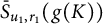 $\bar {S}_{u_1,r_1}(g(K))$
denotes the star body with the overgraph function on the direction
 $u_1$
 $$ \begin{align*}\overline{\varrho}_{u_1}\left(\bar{S}_{u_1,r_1}(g(K)),\cdot\right)=r_1\overline{\varrho}_{u_1}\left(S_{u_1}(g(K)),\cdot\right)\end{align*} $$
and the undergraph function on the direction
 $u_1$
 $$ \begin{align*}\underline{\varrho}_{u_1}\left(\bar{S}_{u_1,r_1}(g(K)),\cdot\right)=r_1\underline{\varrho}_{u_1}\left(S_{u_1}(g(K)),\cdot\right).\end{align*} $$
Let
 $r'\in (0,1]$
satisfy
 $$ \begin{align} \mu_{s,n}\left(\bar{S}_{u_1,r_1}(g(K))\right)=\mu_{s,n}\left(r'g(K)^{\bigstar}\right). \end{align} $$
Let
 $r_2\in (0,1]$
satisfy
 $$ \begin{align*}\mu_{s,n}\left(\bar{S}_{u_2,r_2}\left(g(\hat{S}_{u_1}(K))\right)\right)=\mathcal{H}^n(\hat{S}_{u_1}(K)).\end{align*} $$
Repeating the previous process, we can get a sequence of real numbers
 $\{r_i\}_{i=1}^{\infty }\subset (0,1]$
such that
 $$ \begin{align} \mu_{s,n}\left(\bar{S}_{u_i,r_i}\left(g\left(\hat{S}_{u_{i-1}}\cdots\hat{S}_{u_1}(K)\right)\right)\right) =\mathcal{H}^n\left(\hat{S}_{u_{i-1}}\cdots\hat{S}_{u_1}(K)\right). \end{align} $$
 $$ \begin{align} \lim_{i\rightarrow\infty}d_R\left(\bar{S}_{u_i,r_i}\cdots \bar{S}_{u_1,r_1}(g(K)),r'g(K)^{\bigstar}\right)=0. \end{align} $$
By the definition of spherical Steiner symmetrizations, we have
 $$ \begin{align} &\lim_{i\rightarrow\infty}d_s\left(\hat{S}_{u_i}\cdots \hat{S}_{u_1}(K),g^{-1}\left(r'g(K)^{\bigstar}\right)\right)\nonumber\\ &=\lim_{i\rightarrow\infty}d_s\left(g^{-1}\left(\bar{S}_{u_i,r_i}\left(g\left(\hat{S}_{u_{i-1}}\cdots\hat{S}_{u_1}(K)\right)\right)\right),g^{-1}\left(r'g(K)^{\bigstar}\right)\right)\nonumber\\ &\vdots\;\;\;\;\;\;\;\;\;\;\;\;\;\;\;\;\;\;\;\;\;\;\;\;\;\;\;\;\;\;\;\;\nonumber\\ &=\lim_{i\rightarrow\infty}d_s\left(g^{-1}\left(\bar{S}_{u_i,r_i}\cdots \bar{S}_{u_1,r_1}(g(K))\right),g^{-1}\left(r'g(K)^{\bigstar}\right)\right). \end{align} $$
By (56), (57) and the continuity of inverse gnomonic projection, we have
 $$ \begin{align} \lim_{i\rightarrow\infty}d_s\left(\hat{S}_{u_i}\cdots \hat{S}_{u_1}(K),g^{-1}\left(r'g(K)^{\bigstar}\right)\right)=0. \end{align} $$
Let
 $K^{\bigstar }=g^{-1}\left (r'g(K)^{\bigstar }\right )$
. The desired conclusion now follows from (58).
3.2 Spherical projection bodies
In this section, using the Euclidean projection bodies, we introduce the notion of spherical projection bodies and study some elementary properties.
Definition 10 For
 $K\in \mathcal {S}_B(\mathbb {S}_+^n)$
, its spherical projection body
 $\mathrm { \Pi }_{\mathbb {S}}(K)$
is defined by
 $$ \begin{align} \mathrm{\Pi}_{\mathbb{S}}K:=g^{-1}\left(\mathrm{\Pi}g(K)\right). \end{align} $$
By the definition of spherical projection body (59), (25), and (16), for
 $u\in \mathbb {S}^{n-1}$
,
 $$ \begin{align} \tan h_s\left(\mathrm{\Pi}_{\mathbb{S}}K,u\right)=\frac{1}{2}\int_{\partial g(K)}\left|u\cdot \nu^{g(K)}(y)\right|d\mathcal{H}^{n-1}(y). \end{align} $$
The following lemma shows that the spherical projection operator
 $\mathrm { \Pi }_{\mathbb {S}}:\;\mathcal {S}_B(\mathbb {S}_+^n)\rightarrow \mathcal {K}_o(\mathbb {S}^n)$
is continuous.
Lemma 11 For a sequence of spherical star bodies
 $\{K_i\}_{i=0}^{\infty }\subset \mathcal {S}_B(\mathbb {S}_+^n)$
, if
 $$ \begin{align} \lim_{i\rightarrow\infty}d_s(K_i,K_{\infty})=0, \end{align} $$
then
 $$ \begin{align} \lim_{i\rightarrow\infty}d_s(\mathrm{\Pi}_{\mathbb{S}}K_i,\mathrm{\Pi}_{\mathbb{S}}K_{\infty})=0. \end{align} $$
Proof By the continuity of gnomonic projection and (61), we have
 $$ \begin{align} \lim_{i\rightarrow\infty}d_H(g(K_i),g(K_{\infty}))=0. \end{align} $$
Since
 $\{K_i\}_{i=0}^{\infty }\subset \mathcal {S}_B(\mathbb {S}_+^n)$
,
 $g(K_i)\in \mathcal {S}_B(\mathbb {R}^n)$
. By Lemma 3 and (63),
 $g(K_i)$
converges to
 $g(K_{\infty })$
in radial distance. By (11) and Lemma 1, we have
 $$ \begin{align*}\lim_{i\rightarrow\infty}d_H\left(\mathrm{\Pi}(g(K_i)),\mathrm{\Pi}(g(K_{\infty}))\right)=0.\end{align*} $$
Thus, by the definition of spherical projection body and the continuity of gnomonic projection, we have
 $$ \begin{align*} \lim_{i\rightarrow\infty}d_s\left(\mathrm{\Pi}_{\mathbb{S}}K_i,\mathrm{ \Pi}_{\mathbb{S}}K_{\infty}\right)&=\lim_{i\rightarrow\infty}d_s\left(g^{-1}\left(\mathrm{\Pi}(g(K_i))\right),g^{-1}\left(\mathrm{ \Pi}(g(K_{\infty}))\right)\right)\\ &= \lim_{i\rightarrow\infty}d_H\left(\mathrm{\Pi}(g(K_i)),\mathrm{\Pi}(g(K_{\infty}))\right)\\ &=0. \end{align*} $$
This is the desired conclusion.
Let
 $\overline {\operatorname {O}}(n+1)$
denote the set of rotation transformations around the
 $x_{n+1}$
-axis in
 $\mathbb {R}^{n+1}$
. The following lemma demonstrates the rotation covariance of the spherical projection operator.
Lemma 12 Let
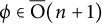 $\phi \in \overline {\operatorname {O}}(n+1)$
be a rotation transformation on
 $\mathbb {R}^{n+1}$
and
 $K\in \mathcal {S}_B(\mathbb {S}^n)$
. Then,
 $$ \begin{align} \mathrm{\Pi}_{\mathbb{S}}(\phi K)=\phi\mathrm{\Pi}_{\mathbb{S}}K. \end{align} $$
Proof For
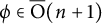 $\phi \in \overline {\operatorname {O}}(n+1)$
, there exists a rotation transformation
 $\bar {\phi }\in \operatorname {O}(n)$
on
 $\mathbb {R}^n$
such that
 $$ \begin{align} g(\phi K)=\bar{\phi}\left(g(K)\right). \end{align} $$
By [Reference Lin and Xi23, Lemma 6.4], we have
 $$ \begin{align} \mathrm{\Pi}\left(\bar{\phi}\left(g(K)\right)\right)=\bar{\phi}\mathrm{\Pi}\left(g(K)\right). \end{align} $$
Therefore,
 $$ \begin{align*} \mathrm{\Pi}_{\mathbb{S}}(\phi K) & =g^{-1}\left(\mathrm{\Pi}(g(\phi K))\right) \\ & =g^{-1}\left(\mathrm{\Pi}(\bar{\phi}g( K))\right) \\ &=g^{-1}\left(\bar{\phi}\mathrm{\Pi}(g( K))\right)=\phi g^{-1}\left(\mathrm{\Pi}(g( K))\right)=\phi\mathrm{\Pi}_{\mathbb{S}}K, \end{align*} $$
where first equality is due to (59), the second is due to (65), the third is due to (66), the fourth is due to (65) and the last equality is due to the definition of spherical projection body (59).
3.3 Spherical projection inequality
Lemma 13 Let
 $K\in \mathcal {S}_B(\mathbb {S}_+^n)$
. Then,
 $$ \begin{align} \mathcal{H}^n\left(\mathrm{\Pi}_{\mathbb{S}}^{\circ}\left(\hat{S}K\right)\right)\geq \mathcal{H}^n\left(\mathrm{ \Pi}_{\mathbb{S}}^{\circ}K\right), \end{align} $$
with equality if and only if
 $\hat {S}K=K$
.
Proof If
 $K\in \mathcal {S}_B(\mathbb {S}_+^n)$
, then
 $g(K)\in \mathcal {S}_B(\mathbb {R}^n)$
. For
 $g(K)$
, by Lemma 5, there is a sequence of disjoint open subsets
 $G_m \subset g(K)^{\prime }$
, and two sequences of graph functions
 $$ \begin{align*}f_{m,j}, g_{m,j}: G_m \rightarrow \mathbb{R},\;1\leq j\leq m, \end{align*} $$
satisfying (i)–(iii) in Lemma 5. In particular,
 $\partial g(K)$
has the representation (if we neglect an
 $\mathcal {H}^{n-1}$
-null set)
 $$ \begin{align*}\partial g(K)=\bigcup_{m=1}^{\infty} \bigcup_{j=1}^m\left\{\left(x^{\prime}, f_{m,j}\left(x^{\prime}\right)\right): x^{\prime} \in G_m\right\} \cup\left\{\left(x^{\prime}, g_{m,j}\left(x^{\prime}\right)\right): x^{\prime} \in G_m\right\}. \end{align*} $$
Let
 $(z',t),(z',-s)\in \partial \mathrm {\Pi }^{\ast }\left (g(K)\right )$
and
 $t\neq -s$
, s.t.,
 $$ \begin{align} h\left(\mathrm{\Pi}\left(g(K)\right),(z',t)\right)=1=h\left(\mathrm{\Pi}\left(g(K)\right),(z',-s)\right). \end{align} $$
By the definition of projection body (68), (16), and (iii) in Lemma 5, we have
 $$ \begin{align} 1&=h\left(\mathrm{\Pi}\left(g(K)\right),(z',t)\right)\\ &=\frac{1}{2}\int_{\partial g(K)}\left|(z',t)\cdot\nu^{g(K)}(x)\right|d\mathcal{H}^{n-1}(x)\nonumber\\ &=\frac{1}{2}\sum_{m=1}^{\infty}\sum_{j=1}^m\int_{\left\{(x',f_{m,j}(x')):\;x'\in G_m\right\}}\frac{\left|(z',t)\cdot\left(\nabla f_{m,j}(x'),-1\right)\right|}{\sqrt{1+\left|\nabla f_{m,j}(x')\right|{}^2}}d\mathcal{H}^{n-1}(x)\nonumber\\ & \quad +\frac{1}{2}\sum_{m=1}^{\infty}\sum_{j=1}^m\int_{\left\{(x',g_{m,j}(x')):\;x'\in G_m\right\}}\frac{\left|(z',t)\cdot\left(-\nabla g_{m,j}(x'),1\right)\right|}{\sqrt{1+\left|\nabla g_{m,j}(x')\right|{}^2}}d\mathcal{H}^{n-1}(x)\nonumber\\ &=\frac{1}{2}\sum_{m=1}^{\infty}\sum_{j=1}^m\int_{G_m}\left|(z',t)\cdot\left(\nabla f_{m,j}(x'),-1\right)\right|dx' \nonumber\\ &\quad +\frac{1}{2}\sum_{m=1}^{\infty}\sum_{j=1}^m\int_{G_m}\left|(z',t)\cdot\left(-\nabla g_{m,j}(x'),1\right)\right|dx'.\nonumber \end{align} $$
Similarly, we have
 $$ \begin{align} 1&=h\left(\mathrm{\Pi}\left(g(K)\right),(z',-s)\right)=\frac{1}{2}\sum_{m=1}^{\infty}\sum_{j=1}^m\int_{G_m}\left|(z',-s)\cdot\left(\nabla f_{m,j}(x'),-1\right)\right|dx' \\ &\quad +\frac{1}{2}\sum_{m=1}^{\infty}\sum_{j=1}^m\int_{G_m}\left|(z',-s)\cdot\left(-\nabla g_{m,j}(x'),1\right)\right|dx'.\nonumber \end{align} $$
Therefore, we have
 $$ \begin{align} &h\left(\mathrm{\Pi}\left(\bar{S}g(K)\right),\left(z',\frac{t+s}{2}\right)\right)\\ &=\frac{1}{2}\int_{K'}\left|\left(z',\frac{t+s}{2}\right)\cdot\left(-r_K\nabla\overline{\varrho}(x'),1\right)\right|dx'+\frac{1}{2}\int_{K'}\left|\left(z',\frac{t+s}{2}\right)\cdot\left(r_K\nabla\underline{\varrho}(x'),-1\right)\right|dx'\nonumber\\ &\leq\frac{1}{2}\int_{K'}\left|\left(z',\frac{t+s}{2}\right)\cdot\left(-\nabla\overline{\varrho}(x'),1\right)\right|dx'+\frac{1}{2}\int_{K'}\left|\left(z',\frac{t+s}{2}\right)\cdot\left(\nabla\underline{\varrho}(x'),-1\right)\right|dx'\nonumber\\ &=\frac{1}{2}\int_{K'}\left|\left(z',\frac{t+s}{2}\right)\cdot\left(-\sum_{j=1}^{m}\frac{\nabla g_{m,j}(x')-\nabla f_{m,j}(x')}{2},1\right)\right|dx' \nonumber\\ &\quad +\frac{1}{2}\int_{K'}\left|\left(z',\frac{t+s}{2}\right)\cdot\left(-\sum_{j=1}^{m}\frac{\nabla g_{m,j}(x')-\nabla f_{m,j}(x')}{2},-1\right)\right|dx'\nonumber\\ &\leq\frac{1}{4}\sum_{m=1}^{\infty}\sum_{j=1}^{m}\int_{G_m}\left|\left(z',t\right)\cdot\left(-\nabla g_{m,j}(x'),1\right)\right|dx' \nonumber\\ &\quad +\frac{1}{4}\sum_{m=1}^{\infty}\sum_{j=1}^{m}\int_{G_m}\left|\left(z',-s\right)\cdot\left(\nabla f_{m,j}(x'),-1\right)\right|dx'\nonumber\\ &\quad +\frac{1}{4}\sum_{m=1}^{\infty}\sum_{j=1}^{m}\int_{G_m}\left|\left(z',t\right)\cdot\left(\nabla f_{m,j}(x'),-1\right)\right|dx' \nonumber\\ &\quad +\frac{1}{4}\sum_{m=1}^{\infty}\sum_{j=1}^{m}\int_{G_m}\left|\left(z',-s\right)\cdot\left(-\nabla g_{m,j}(x'),1\right)\right|dx'\nonumber\\ &=\frac{1}{2}h\left(\mathrm{\Pi}(g(K)),(z',t)\right)+\frac{1}{2}h\left(\mathrm{\Pi}(g(K)),(z',-s)\right)=1,\nonumber \end{align} $$
where the first equality is due to (45) and the same reasoning process as (69), the first inequality is due to
 $r_K\leq 1$
and the monotonically increasing property of
 $|a+bt|+|a-bt|$
on
 $t>0$
for any
 $a,b\in \mathbb {R}$
, the second equality is due to (41), the second inequality is due to the triangle inequalities for absolute value functions, the last two equalities are due to (69) and (70).
 $$ \begin{align} S\mathrm{\Pi}^{\ast}\left(g(K)\right)\subseteq\mathrm{\Pi}^{\ast}\left(\bar{S}g(K)\right). \end{align} $$
By Lemma 9 and the above containment relationship, we have
 $$ \begin{align*}\mu_{s,n}\left(\mathrm{\Pi}^{\ast}\left(g(K)\right)\right)\leq \mu_{s,n}\left(S\mathrm{ \Pi}^{\ast}\left(g(K)\right)\right)\leq \mu_{s,n}\left(\mathrm{\Pi}^{\ast}\left(\bar{S}g(K)\right)\right).\end{align*} $$
By the above inequality, the definition of spherical projection body (59), the definition of spherical Steiner symmetrization (47) and (27), we have
 $$ \begin{align*}\mathcal{H}^n\left(\mathrm{\Pi}_{\mathbb{S}}^{\circ}(K)\right)\leq\mathcal{H}^n\left(\mathrm{ \Pi}_{\mathbb{S}}^{\circ}(\hat{S}K)\right).\end{align*} $$
If
 $\mathcal {H}^n\left (\mathrm {\Pi }_{\mathbb {S}}^{\circ }(K)\right )=\mathcal {H}^n\left (\mathrm { \Pi }_{\mathbb {S}}^{\circ }(\hat {S}K)\right )$
, then the equality in the first inequality of (71) is established. Thus, by the arbitrariness of
 $z'$
,
 $r_K=1$
. By Lemma 9,
 $Sg(K)=g(K)$
. Therefore,
 $\hat {S}K=K$
.
Proof of Theorem 1
By Lemma 10, there exists a sequence of directions
 $\{u_i\}_{i=1}^{\infty }$
such that
 $\hat {S}_{u_i}\ldots \hat {S}_{u_1}K$
converges to
 $K^{\bigstar }$
in spherical Hausdorff distance. By the continuity of spherical projection operator (see Lemma 11), we have
 $$ \begin{align} \lim_{i\rightarrow\infty}d_s\left(\mathrm{\Pi}_{\mathbb{S}}\left(\hat{S}_{u_i}\ldots\hat{S}_{u_1}K\right),\mathrm{ \Pi}_{\mathbb{S}}(K^\bigstar)\right)=0. \end{align} $$
By Lemma 13,
 $\mathcal {H}^n\left (\mathrm {\Pi }^{\circ }_{\mathbb {S}}\left (\hat {S}_{u_i}\ldots \hat {S}_{u_1}K\right )\right )$
is increasing with respect to i. Thus, by (73), we have
 $$ \begin{align} \mathcal{H}^n\left(\mathrm{\Pi}^{\circ}_{\mathbb{S}}(K)\right)\leq\mathcal{H}^n\left(\mathrm{ \Pi}^{\circ}_{\mathbb{S}}(K^{\bigstar})\right). \end{align} $$
If
 $K\neq K^\bigstar $
, then there exists some
 $u_o\in \mathbb {S}^{n-1}$
such that
 $\hat {S}_{u_o}(K)\neq K$
. By Lemma 13, we have
 $$ \begin{align} \mathcal{H}^n\left(\mathrm{\Pi}_{\mathbb{S}}^{\circ}(K)\right)<\mathcal{H}^n\left(\mathrm{ \Pi}_{\mathbb{S}}^{\circ}\left(\hat{S}_{u_o}(K)\right)\right). \end{align} $$
 $$ \begin{align*}\mathcal{H}^n\left(\mathrm{\Pi}_{\mathbb{S}}^{\circ}(K)\right)<\mathcal{H}^n\left(\mathrm{ \Pi}^{\circ}_{\mathbb{S}}(K^\bigstar)\right).\end{align*} $$
Therefore, the equality in (74) holds if and only if
 $K=K^\bigstar $
.
3.4 Spherical projection inequality and an inequality on surface areas
In this section, we shall prove that spherical projection inequality is stronger than an inequality on surface areas.
Let
 $$ \begin{align*}F_1(t):=\frac{{\pi}}{2}-\arctan t,\;\;\;t\in(0,\infty)\end{align*} $$
and
 $$ \begin{align*}F_2(s):=\int_{0}^{s}(\sin r)^{n-1}dr,\;\;\;s\in(0,\frac{{\pi}}{2}).\end{align*} $$
Let
 $F:=F_2\circ F_1$
be the composition function of
 $F_1$
and
 $F_2$
. It is easily to check that
 $F_1$
and
 $F_2$
are strictly convex functions,
 $F_2$
is strictly increasing and
 $F_1$
is strictly decreasing. Thus, F is strictly convex and strictly decreasing. Let
 $F^{-1}$
be the inverse function of F, then
 $F^{-1}$
is also strictly convex and strictly decreasing.
Theorem 3 Let
 $K\in \mathcal {S}_B(\mathbb {S}_+^n)$
and
 $c_o=\omega _{n-1}/(n\omega _n)$
. Then,
 $$ \begin{align}c_o\mathcal{H}^{n-1}\left(\partial g(K^\bigstar)\right)&=F^{-1}\left(\frac{1}{n\omega_n}\mathcal{H}^n\left(\mathrm{\Pi}^{\circ}_{\mathbb{S}}(K^\bigstar)\right)\right)\\&\leq F^{-1}\left(\frac{1}{n\omega_n}\mathcal{H}^n\left(\mathrm{\Pi}^{\circ}_{\mathbb{S}}(K)\right)\right)\leq c_o\mathcal{H}^{n-1}\left(\partial g(K)\right) .\nonumber\end{align} $$
Moreover,
 $\mathcal {H}^{n-1}\left (\partial g(K^\bigstar )\right )=\mathcal {H}^{n-1}\left (\partial g(K)\right )$
if and only if
 $K^\bigstar =K$
.
Proof For
 $K\in \mathcal {S}_B(\mathbb {S}_+^n)$
, by Lemma 8, (29), and (60),
 $$ \begin{align} \mathcal{H}^n\left(\mathrm{\Pi}^{\circ}_{\mathbb{S}}(K)\right)&=\mathcal{H}^n\left(-\mathrm{ \Pi}^{\circ}_{\mathbb{S}}(K)\right)\nonumber\\ &=\int_{\mathbb{S}^{n-1}}\int_{\operatorname{conv}(e_{n+1}, v)}\sin\left(\hat{d}_s\left(e_{n+1},u\right)\right)^{n-1}\chi_{-\mathrm{ \Pi}^{\circ}_{\mathbb{S}}(K)}(u)dudv\\ &=\int_{\mathbb{S}^{n-1}}\int_{0}^{\rho_s(-\mathrm{\Pi}^{\circ}_{\mathbb{S}}(K),v)}(\sin t)^{n-1}dtdv\nonumber\\ &=\int_{\mathbb{S}^{n-1}}\int_{0}^{\frac{{\pi}}{2}-h_s(\mathrm{\Pi}_{\mathbb{S}}(K),v)}(\sin t)^{n-1}dtdv\nonumber\\ &=\int_{\mathbb{S}^{n-1}}\int_{0}^{\frac{{\pi}}{2}-\arctan\left(\frac{1}{2}\int_{\partial g(K)}\left|v\cdot \nu^{g(K)}(y)\right|d\mathcal{H}^{n-1}(y)\right)}(\sin t)^{n-1}dtdv.\nonumber \end{align} $$
By (77), we have
 $$ \begin{align} \mathcal{H}^n\left(\mathrm{\Pi}^{\circ}_{\mathbb{S}}(K)\right)=\int_{\mathbb{S}^{n-1}}F\left(\frac{1}{2}\int_{\partial g(K)}\left|v\cdot \nu^{g(K)}(y)\right|d\mathcal{H}^{n-1}(y)\right)dv. \end{align} $$
By Theorem 1 and the strict decreasing and strictly convex properties of
 $F^{-1}$
,
 $$ \begin{align} F^{-1}\left(\frac{1}{n\omega_n}\mathcal{H}^n\left(\mathrm{\Pi}_{\mathbb{S}}^{\circ}(K^\bigstar)\right)\right)\leq F^{-1}\left(\frac{1}{n\omega_n}\mathcal{H}^n\left(\mathrm{\Pi}^{\circ}_{\mathbb{S}}(K)\right)\right). \end{align} $$
By Jensen’s inequality, (78) and Fubini’s Theorem, we have
 $$ \begin{align} F^{-1}\left(\frac{1}{n\omega_n}\mathcal{H}^n\left(\mathrm{\Pi}^{\circ}_{\mathbb{S}}(K)\right)\right)&\leq \frac{1}{n\omega_n}\int_{\mathbb{S}^{n-1}}\left(\frac{1}{2}\int_{\partial g(K)}\left|v\cdot \nu^{g(K)}(y)\right|d\mathcal{H}^{n-1}(y)\right)dv\nonumber\\ &=\frac{1}{2n\omega_n}\int_{\partial g(K)}\left(\int_{\mathbb{S}^{n-1}}\left|v\cdot \nu^{g(K)}(y)\right|dv\right)d\mathcal{H}^{n-1}(y)\nonumber\\ &=\frac{\omega_{n-1}}{n\omega_n}\mathcal{H}^{n-1}\left(\partial g(K)\right). \end{align} $$
Similarly, by the equality case of Jensen’s inequality, (78) and Fubini’s Theorem, we have
 $$ \begin{align} F^{-1}\left(\frac{1}{n\omega_n}\mathcal{H}^n\left(\mathrm{\Pi}^{\circ}_{\mathbb{S}}(K^\bigstar)\right)\right)&= \frac{1}{n\omega_n}\int_{\mathbb{S}^{n-1}}\left(\frac{1}{2}\int_{\partial g(K^\bigstar)}\left|v\cdot \nu^{g(K^\bigstar)}(y)\right|d\mathcal{H}^{n-1}(y)\right)dv\nonumber\\ &=\frac{1}{2n\omega_n}\int_{\partial g(K^\bigstar)}\left(\int_{\mathbb{S}^{n-1}}\left|v\cdot \nu^{g(K^\bigstar)}(y)\right|dv\right)d\mathcal{H}^{n-1}(y)\nonumber\\ &=\frac{\omega_{n-1}}{n\omega_n}\mathcal{H}^{n-1}\left(\partial g(K^\bigstar)\right). \end{align} $$
Note that the first equality of (81) is due to the fact that the following integral is a constant for any
 $v\in \mathbb {S}^{n-1}$
,
 $$ \begin{align*}\int_{\partial g(K^\bigstar)}\left|v\cdot \nu^{g(K^\bigstar)}(y)\right|d\mathcal{H}^{n-1}(y).\end{align*} $$
Then, the desired inequality follows from (79)–(81).
If
 $\mathcal {H}^{n-1}\left (\partial g(K^\bigstar )\right )=\mathcal {H}^{n-1}\left (\partial g(K)\right )$
, then by strict monotonicity of
 $F^{-1}$
and (76), we have
 $\mathcal {H}^n\left (\mathrm {\Pi }^{\circ }_{\mathbb {S}}(K^\bigstar )\right )=\mathcal {H}^n\left (\mathrm { \Pi }^{\circ }_{\mathbb {S}}(K)\right ).$
Thus, the equality case of Theorem 1 gives
 $K^\bigstar =K.$
4 Hyperbolic projection body and Hyperbolic projection inequality
4.1 Transformation
 $\Phi _p$
of Hyperbolic space

First, we introduce a transformation from the Poincaré ball model
 $\mathbb {B}^n$
onto
 $\mathbb {R}^n$
. Let
 $\Phi :\;\mathbb {B}^n\rightarrow \mathbb {R}^n$
be a transformation given by
 $$ \begin{align} y=\Phi(x):=\tan\left(2\arctan\|x\|\right)\frac{x}{\|x\|}=\frac{2x}{1-\|x\|^2}. \end{align} $$
Then, its inverse transformation
 $\Phi ^{-1}:\;\mathbb {R}^n\rightarrow \mathbb {B}^n$
is
 $$ \begin{align} x=\Phi^{-1}(y)=\frac{y}{1+\sqrt{1+\|y\|^2}}. \end{align} $$
Let
 $\Phi _p:=\Phi \circ P$
denote the composite of transformation
 $\Phi $
defined in (82) and the Poincaré ball model projection defined in Definition 7.
By (83), we have
 $$ \begin{align} dx_i=\frac{dy_i}{1+\sqrt{1+\|y\|^2}}-\frac{y_i(y\cdot dy)}{\left(1+\sqrt{1+\|y\|^2}\right)^2\sqrt{1+\|y\|^2}}. \end{align} $$
Combining (34), (83), and (84), let
 $|dx|^2:=dx_1^2+\cdots +dx_n^2$
, the metric in the Poincaré ball model
 $$ \begin{align} ds^2=4\frac{|dx|^2}{\left(1-\|x\|^2\right)^2} &=\sum_{i=1}^{n}\left(dy_i-\frac{y_i\left(y\cdot dy\right)}{\left(1+\sqrt{1+\|y\|^2}\right)\sqrt{1+\|y\|^2}}\right)^2\nonumber\\ &=|dy|^2-\frac{2\sqrt{1+\|y\|^2}+2+\|y\|^2}{\left(1+\sqrt{1+\|y\|^2}\right)^2(1+\|y\|^2)}\left(y\cdot dy\right)^2\nonumber\\ &=|dy|^2-\frac{\left(y\cdot dy\right)^2}{1+\|y\|^2}. \end{align} $$
By the above equality and the Cauchy–Schwarz inequality, we have
 $$ \begin{align} |dy|^2\geq ds^2\geq|dy|^2-\frac{\|y\|^2|dy|^2}{1+\|y\|^2}=\frac{|dy|^2}{1+\|y\|^2}. \end{align} $$
By (83) and the area formula (see [Reference Evans and Gariepy13, Theorem 3.8]), we have the volume element
 $$ \begin{align} dx:=\frac{1}{\sqrt{1+\|y\|^2}\left(1+\sqrt{1+\|y\|^2}\right)^n}dy. \end{align} $$
 $$ \begin{align} \frac{1-\|x\|^2}{2}=\frac{1}{\sqrt{1+\|y\|^2}+1}. \end{align} $$
Combining (36), (88), and (87) we obtain
 $$ \begin{align} d\mu_{h,n}=\frac{1}{\sqrt{1+\|y\|^2}}dy. \end{align} $$
Therefore, for
 $K\in \mathcal {S}_o(\mathbb {H}^n)$
,
 $$ \begin{align} \mu_{h,n}(K)=\int_{\Phi_p(K)}\frac{1}{\sqrt{1+\|y\|^2}}dy. \end{align} $$
Lemma 14 Let
 $K\in \mathcal {S}_o(\mathbb {H}^n)$
. Then,
 $$ \begin{align} \int_{S\Phi_p(K)}\frac{1}{\sqrt{1+\|y\|^2}}dy\geq\int_{\Phi_p(K)}\frac{1}{\sqrt{1+\|y\|^2}}dy, \end{align} $$
with equality if and only if
 $S\Phi _p(K)=\Phi _p(K)$
.
Proof By Fubini’s Theorem, we only need to prove that for any
 $y'\in \Phi _p(K)|_{\mathbb {R}^{n-1}}$
,
 $$ \begin{align} \int_{(S\Phi_p(K))_{y'}}\left(1+\|y'\|^2+|y_n|^2\right)^{-\frac{1}{2}}dy_n\geq \int_{(\Phi_p(K))_{y'}}\left(1+\|y'\|^2+|y_n|^2\right)^{-\frac{1}{2}}dy_n. \end{align} $$
Let
 $$ \begin{align*}f_1(y_n):=\left(1+\|y'\|^2+|y_n|^2\right)^{-\frac{1}{2}},\;\;\;f_2(y_n):=\chi_{(\Phi_p(K))_{y'}}(y_n).\end{align*} $$
Then,
 $$ \begin{align*}f_1^{\bigstar}=f_1,\;\;\mathrm{and}\;\;f_2^{\bigstar}=\chi_{(S\Phi_p(K))_{y'}},\end{align*} $$
where
 $f^{\bigstar }$
denotes the symmetric decreasing rearrangement of f (see (18) for specific definition).
By Hardy–Littlewood inequality (see Lemma 7), we have
 $$ \begin{align} &\int_{(\Phi_p(K))_{y'}}\left(1+\|y'\|^2+|y_n|^2\right)^{-\frac{1}{2}}dy_n\\ &=\int_{\mathbb{R}}f_1(y_n)f_2(y_n)dy_n\nonumber\\ &\leq\int_{\mathbb{R}}f^{\bigstar}_1(y_n)f^{\bigstar}_2(y_n)dy_n\nonumber\\ &=\int_{(S\Phi_p(K))_{y'}}\left(1+\|y'\|^2+|y_n|^2\right)^{-\frac{1}{2}}dy_n.\nonumber \end{align} $$
Moreover, since
 $f_1$
is an even nonnegative unimodal integrable function, the equality in (93) holds if and only if
 $(\Phi _p(K))_{y'}=(S\Phi _p(K))_{y'}$
. Thus, the equality in (91) holds if and only if
 $S\Phi _p(K)=\Phi _p(K)$
.
Lemma 15 For
 $K\subset \mathbb {H}^n$
,
 $K\in \mathcal {S}_o(\mathbb {H}^n)$
is equivalent to
 $\Phi _p(K)\in \mathcal {S}_o(\mathbb {R}^n)$
. Moreover,
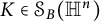 $K\in \mathcal {S}_B(\mathbb {H}^n)$
is equivalent to
 $\Phi _p(K)\in \mathcal {S}_B(\mathbb {R}^n)$
.
Proof By (82) and (83),
 $P(K)$
is a star-shaped set with respect to origin if and only if
 $\Phi _p(K)$
is a star-shaped set with respect to origin in
 $\mathbb {R}^n$
. Moreover, by (82) and (83), we have
 $$ \begin{align} \rho (\Phi_p(K),x)=\frac{2\rho(P(K),x)}{1-\|x\|^2\rho^2(P(K),x)},\;\;x\in\mathbb{R}^n\backslash\{o\} \end{align} $$
and
 $$ \begin{align} \rho(P(K),x)=\frac{\rho(\Phi_p(K),x)}{1+\sqrt{1+\|x\|^2\rho^2(\Phi_p(K),x)}},\;\;x\in\mathbb{R}^n\backslash\{o\}. \end{align} $$
Therefore,
 $\rho (P(K),\cdot )$
is strictly positive and continuous in
 $\mathbb {R}^n\backslash \{o\}$
if and only if
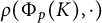 $\rho (\Phi _p(K),\cdot )$
is strictly positive and continuous in
 $\mathbb {R}^n\backslash \{o\}$
. Moreover, by (94) and (95),
 $\rho (P(K),\cdot )$
is locally Lipschitz continuous in
 $\mathbb {R}^n\backslash \{o\}$
if and only if
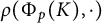 $\rho (\Phi _p(K),\cdot )$
is locally Lipschitz continuous in
 $\mathbb {R}^n\backslash \{o\}$
. By [Reference Lin and Wu22, Theorem 2.1], a Lipschitz star body (its radial function is locally Lipschitz continuous in
 $\mathbb {R}^n\backslash \{o\}$
) is a star body with respect to a ball and vice versa. This shows the desired conclusion.
Definition 11 For
 $K\in \mathcal {S}_o(\mathbb {H}^n)$
, its hyperbolic polar body
 $K^{\circ }$
is defined by
 $$ \begin{align} K^{\circ}:=\Phi_p^{-1}\left(\left(\Phi_p(K)\right)^{\ast}\right). \end{align} $$
By the above definition and Lemma 15, if
 $K\in \mathcal {S}_o(\mathbb {H}^n)$
, then
 $K^{\circ }\in \mathcal {S}_o(\mathbb {H}^n)$
.
4.2 Hyperbolic Steiner symmetrization
Definition 12 For
 $K\in \mathcal {S}_B(\mathbb {H}^n)$
, its hyperbolic Steiner symmetrization
 $\check {S}(K)$
is defined by
 $$ \begin{align} \check{S}(K):=\Phi_p^{-1}\left(r_KS\Phi_p(K)\right), \end{align} $$
where
 $r_K\in (0,1]$
satisfies
 $\mu _{h,n}\left (\check {S}(K)\right )=\mu _{h,n}(K)$
.
By [Reference Lin and Wu22, Lemma 5.1], if
 $\tilde {K}\in \mathcal {S}_B(\mathbb {R}^n)$
, then
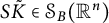 $S\tilde {K}\in \mathcal {S}_B(\mathbb {R}^n)$
. Moreover, it is clear that
 $rS\tilde {K}\in \mathcal {S}_B(\mathbb {R}^n)$
for
 $r\in (0,1]$
. Thus, the hyperbolic Steiner symmetrization maintains the property of star bodies, i.e., if
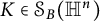 $K\in \mathcal {S}_B(\mathbb {H}^n)$
, then
 $\check {S}(K)\in \mathcal {S}_B(\mathbb {H}^n)$
. Moreover, by Definition 12, the hyperbolic Steiner symmetrization maintains the invariance of
 $\mu _{h,n}$
measure.
Similarly, for compact set
 $K\in \mathbb {H}^n$
, we define the hyperbolic symmetric rearrangement
 $K^{\bigstar }$
as following:
 $$ \begin{align} K^{\bigstar}:=\left\{v\in\mathbb{H}^n:\;ds^2(P(v),o)\leq \alpha^2,\;\;\mu_{h,n}(K)=\mu_{h,n}(B_h(\alpha))\right\}. \end{align} $$
Next, we prove the convergence of hyperbolic Steiner symmetrizations.
Lemma 16 For any
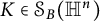 $K\in \mathcal {S}_B(\mathbb {H}^n)$
, there exists a sequence of directions
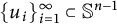 $\{u_i\}_{i=1}^{\infty }\subset \mathbb {S}^{n-1}$
such that
 $$ \begin{align} \lim_{i\rightarrow\infty}d_h\left(\check{S}_{u_i}\cdots\check{S}_{u_1}(K),K^\bigstar\right)=0. \end{align} $$
Proof Since
 $K\in \mathcal {S}_B(\mathbb {H}^n)$
,
 $\Phi _p(K)\in \mathcal {S}_B(\mathbb {R}^n)$
. By [Reference Lin21, Theorem 3.1], for the compact set
 $\Phi _p(K)$
, there exists a sequence of directions
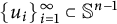 $\{u_i\}_{i=1}^{\infty }\subset \mathbb {S}^{n-1}$
and a ball
 $B(r_o)\subset \mathbb {R}^n$
with the same volume as
 $\Phi _p(K)$
such that
 $$ \begin{align} \lim_{i\rightarrow\infty}d_H\left(S_{u_i}\cdots S_{u_1}\Phi_p(K),B(r_o)\right)=0. \end{align} $$
Let
 $r_1\in (0,1]$
satisfy
 $$ \begin{align*}\Phi_p^{-1}\left(r_1S_{u_1}\Phi_p(K)\right)=\check{S}_{u_1}(K).\end{align*} $$
Let
 $r_2\in (0,1]$
satisfy
 $$ \begin{align*}\Phi_p^{-1}\left(r_2S_{u_2}\Phi_p(\check{S}_{u_1}(K))\right)=\check{S}_{u_2}\check{S}_{u_1}(K).\end{align*} $$
Repeating the previous argument, we get a sequence of positive real numbers
 $\{r_i\}_{i=1}^{\infty }$
satisfying
 $r_i\in (0,1]$
and
 $$ \begin{align} \Phi_p^{-1}\left(r_iS_{u_i}\Phi_p(\check{S}_{u_{i-1}}\cdots\check{S}_{u_1}(K))\right)=\check{S}_{u_i}\check{S}_{u_{i-1}}\cdots\check{S}_{u_1}(K). \end{align} $$
Let
 $\bar {r}:=\lim _{i\rightarrow \infty }(r_ir_{i-1}\cdots r_1)$
, by (101), (86), and (100),
 $$ \begin{align*} &\lim_{i\rightarrow\infty}d_h\left(\check{S}_{u_i}\cdots \check{S}_{u_1}(K),\Phi_p^{-1}\left(r_i\cdots r_1B(r_o)\right)\right)\nonumber\\ &=\lim_{i\rightarrow\infty}d_h\left(\Phi_p^{-1}\left(r_i\cdots r_1S_{u_i}\cdots S_{u_1}\Phi_p(K)\right),\Phi_p^{-1}\left(r_i\cdots r_1B(r_o)\right)\right)\nonumber\\ &\leq\lim_{i\rightarrow\infty}d_H\left(r_i\cdots r_1S_{u_i}\cdots S_{u_1}\Phi_p(K),r_i\cdots r_1B(r_o)\right)\nonumber\\ &=\bar{r}\lim_{i\rightarrow\infty}d_H\left(S_{u_i}\cdots S_{u_1}\Phi_p(K),B(r_o)\right)=0. \end{align*} $$
Since
 $\mu _{h,n}\left (\check {S}_{u_i}\ldots \check {S}_{u_1}(K)\right )=\mu _{h,n}(K)$
for any
 $i\in \mathbb {N}$
,
 $K^\bigstar =\Phi _p^{-1}\left (\bar {r}B(r_o)\right )$
. This completes the proof.
4.3 Hyperbolic projection body
Definition 13 For
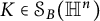 $K\in \mathcal {S}_B(\mathbb {H}^n)$
, its hyperbolic projection body
 $\mathrm { \Pi }_{\mathbb {H}}(K)$
is defined by
 $$ \begin{align} \mathrm{\Pi}_{\mathbb{H}}(K):=\Phi^{-1}_p\left(\mathrm{\Pi} \left(\Phi_p(K)\right)\right). \end{align} $$
By (90),
 $$ \begin{align} \mu_{h,n}\left(\mathrm{\Pi}_{\mathbb{H}}(K)\right)=\int_{\mathrm{\Pi} \left(\Phi_p(K)\right)}\frac{1}{\sqrt{1+\|y\|^2}}dy=\int_{\mathbb{S}^{n-1}}\int_o^{\rho_{\mathrm{\Pi} \left(\Phi_p(K)\right)}(u)}\frac{r^{n-1}}{\sqrt{1+r^2}}drdu. \end{align} $$
Next, we show that the hyperbolic projection operator
 $\mathcal {S}_B(\mathbb {H}^n)\rightarrow \mathcal {S}_B(\mathbb {H}^n)$
is continuous.
Lemma 17 For
 $K_{\infty },K_i\in \mathcal {S}_B(\mathbb {H}^n)$
,
 $i=0,1,2,\dots $
, if
 $$ \begin{align} \lim_{i\rightarrow\infty}d_h\left(K_i,K_{\infty}\right)=0, \end{align} $$
then
 $$ \begin{align} \lim_{i\rightarrow\infty}d_h\left(\mathrm{\Pi}_{\mathbb{H}}(K_i),\mathrm{\Pi}_{\mathbb{H}}(K_{\infty})\right)=0. \end{align} $$
Proof By the relation between
 $ds^2$
and
 $|dy|^2$
(see (86)), if (104) holds, then
 $$ \begin{align*}\lim_{i\rightarrow\infty}d_H\left(\Phi_p(K_i),\Phi_p(K_{\infty})\right)=0.\end{align*} $$
By [Reference Lin and Wu22, Theorem 2.2] and the above equality,
 $\Phi _p(K_i)$
converges to
 $\Phi _p(K_{\infty })$
in radial distance. Thus, by (11), their surface areas satisfy
 $$ \begin{align*}\lim_{i\rightarrow\infty}\mathcal{H}^n\left(\partial \Phi_p(K_i)\right)=\mathcal{H}^n\left(\partial \Phi_p(K_{\infty})\right).\end{align*} $$
By the above equality and the continuity of projection operator (see [Reference Lin21, Proposition 4.1]), we have
 $$ \begin{align} \lim_{i\rightarrow\infty}d_H\left(\mathrm{\Pi}\left(\Phi_p(K_i)\right),\mathrm{\Pi}\left(\Phi_p(K_{\infty})\right)\right)=0. \end{align} $$
 $$ \begin{align*} \lim_{i\rightarrow\infty}d_h\left(\mathrm{\Pi}_{\mathbb{H}}(K_i),\mathrm{ \Pi}_{\mathbb{H}}(K_{\infty})\right)&=\lim_{i\rightarrow\infty}d_h\left(\Phi_p^{-1}\left(\mathrm{ \Pi}\left(\Phi_p(K_i)\right)\right),\Phi_p^{-1}\left(\mathrm{\Pi}\left(\Phi_p(K_{\infty})\right)\right)\right)\nonumber\\ &\leq \lim_{i\rightarrow\infty}d_H\left(\mathrm{\Pi}\left(\Phi_p(K_i)\right),\mathrm{\Pi}\left(\Phi_p(K_{\infty})\right)\right)=0. \end{align*} $$
This completes the proof.
The following lemma shows that the rotation invariance of the hyperbolic projection operator.
Lemma 18 If
 $K\in \mathcal {S}_B(\mathbb {H}^n)$
and
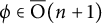 $\phi \in \overline {\mathrm {O}}(n+1)$
, then
 $$ \begin{align} \mathrm{\Pi}_{\mathbb{H}}(\phi K)=\phi\mathrm{\Pi}_{\mathbb{H}}(K). \end{align} $$
Proof For
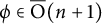 $\phi \in \overline {\mathrm {O}}(n+1)$
, there exists a rotation transformation
 $\bar {\phi }\in \mathrm {O}(n)$
in
 $\mathbb {R}^n$
such that
 $$ \begin{align*}\Phi_p(\phi(K))=\bar{\phi}\left(\Phi_p(K)\right).\end{align*} $$
By the definition of hyperbolic projection body (102) and the affine invariance of Euclidean projection body on Lipschitz star bodies (see [Reference Lin and Xi23, Lemma 6.4]), we have
 $$ \begin{align*} \mathrm{\Pi}_{\mathbb{H}}(\phi K)&=\Phi_p^{-1}\left(\mathrm{\Pi}\left(\Phi_p\left(\phi K\right)\right)\right)=\Phi_p^{-1}\left(\mathrm{ \Pi}\left(\bar{\phi}\Phi_p\left( K\right)\right)\right)\nonumber\\ &=\Phi_p^{-1}\left(\bar{\phi}\mathrm{\Pi}\left(\Phi_p\left( K\right)\right)\right) =\phi\Phi_p^{-1}\left(\mathrm{\Pi}\left(\Phi_p\left( K\right)\right)\right) =\phi\mathrm{\Pi}_{\mathbb{H}}(K). \end{align*} $$
This completes the proof.
4.4 Hyperbolic projection inequality
Lemma 19 For
 $K\in \mathcal {S}_B(\mathbb {H}^n)$
, we have
 $$ \begin{align} \mu_{h,n}\left(\mathrm{\Pi}^{\circ}_{\mathbb{H}}(K)\right)\leq \mu_{h,n}\left(\mathrm{\Pi}^{\circ}_{\mathbb{H}}(\check{S}K)\right), \end{align} $$
with equality if and only if
 $K=\check {S}K$
.
Proof By Lemma 15, if
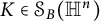 $K\in \mathcal {S}_B(\mathbb {H}^n)$
, then
 $\Phi _p(K)\in \mathcal {S}_B(\mathbb {R}^n)$
. By [Reference Lin and Xi23, Theorem 7.1],
 $$ \begin{align} S\mathrm{\Pi}^{\ast}\left(\Phi_p(K)\right)\subset\mathrm{\Pi}^{\ast}\left(S\Phi_p(K)\right). \end{align} $$
Therefore,
 $$ \begin{align} \mu_{h,n}\left(\mathrm{\Pi}^{\circ}_{\mathbb{H}}(\check{S}K)\right)&=\int_{\Phi_p\left(\mathrm{ \Pi}^{\circ}_{\mathbb{H}}(\check{S}K)\right)}\frac{1}{\sqrt{1+\|y\|^2}}dy=\int_{\mathrm{ \Pi}^{\ast}\left(r_KS\Phi_p(K)\right)}\frac{1}{\sqrt{1+\|y\|^2}}dy\nonumber\\ &\geq\int_{\mathrm{\Pi}^{\ast}\left(S\Phi_p(K)\right)}\frac{1}{\sqrt{1+\|y\|^2}}dy\geq\int_{S\mathrm{ \Pi}^{\ast}\left(\Phi_p(K)\right)}\frac{1}{\sqrt{1+\|y\|^2}}dy\nonumber\\ &\geq\int_{\mathrm{\Pi}^{\ast}\left(\Phi_p(K)\right)}\frac{1}{\sqrt{1+\|y\|^2}}dy=\mu_{h,n}\left(\mathrm{ \Pi}^{\circ}_{\mathbb{H}}(K)\right), \end{align} $$
where the first equality is from (89), the second equality from (96), (102), and (97), the first inequality from
 $r_K\in (0,1]$
, the second inequality from (109), the third inequality from (91) and the last equality is from (89) and (102).
If the equality in (108) holds, then the equality in the first inequality of (110) holds. This implies
 $r_K=1$
. By the sufficient and necessary conditions of the equality holds in (91),
 $S\Phi _p(K)=\Phi _p(K)$
. Thus,
 $K=\check {S}K$
.
Proof of Theorem 2
By the convergence of hyperbolic Steiner symmetrizations (see Lemma 16), for
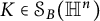 $K\in \mathcal {S}_B(\mathbb {H}^n)$
, there exists a sequence of directions
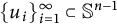 $\{u_i\}_{i=1}^{\infty }\subset \mathbb {S}^{n-1}$
such that the iterative hyperbolic Steiner symmetriztions
 $\check {S}_{u_i}\ldots \check {S}_{u_1}K$
converge to
 $K^\bigstar $
in hyperbolic Hausdorff distance. Then, by the continuity of hyperbolic projection operator (see Lemma 17), the sequence of the hyperbolic projection bodies
 $\mathrm {\Pi }_{\mathbb {H}}\left (\check {S}_{u_i}\ldots \check {S}_{u_1}K\right )$
converge to
 $\mathrm { \Pi }_{\mathbb {H}}\left (K^\bigstar \right )$
in hyperbolic Hausdorff distance. By the monotonically increasing property of
 $\mu _{h,n}\left (\mathrm {\Pi }_{\mathbb {H}}^{\circ }(K)\right )$
with respect to hyperbolic Steiner symmetrization (see Lemma 19), we have
 $$ \begin{align} \mu_{h,n}\left(\mathrm{\Pi}_{\mathbb{H}}^{\circ}(K)\right)\leq\mu_{h,n}\left(\mathrm{\Pi}_{\mathbb{H}}^{\circ}(K^\bigstar)\right). \end{align} $$
If there exists
 $u\in \mathbb {S}^{n-1}$
such that
 $K\neq \check {S}_uK$
, then by Lemma 19,
 $\mu _{h,n}\left (\mathrm { \Pi }^{\circ }_{\mathbb {H}}(K)\right )<\mu _{h,n}\left (\mathrm {\Pi }^{\circ }_{\mathbb {H}}(\check {S}_uK)\right )$
. By (111) and the above inequality,
 $\mu _{h,n}\left (\mathrm {\Pi }^{\circ }_{\mathbb {H}}(K)\right )<\mu _{h,n}\left (\mathrm {\Pi }_{\mathbb {H}}^{\circ }(K^\bigstar \right )$
. Therefore, if the equality in (111) holds, then for any direction
 $u\in \mathbb {S}^{n-1}$
,
 $K=\check {S}_uK$
. By the arbitrariness of
 $u\in \mathbb {S}^{n-1}$
,
 $K=K^\bigstar $
.
4.5 Hyperbolic projection inequality and isoperimetric inequality on
$\mathbb {H}^n$

In this section, we show that the hyperbolic projection inequality is stronger than the hyperbolic isoperimetric inequality with respect to the transformation
 $\Phi _p$
.
On the one hand,
 $$ \begin{align} \mu_{h,n}\left(\mathrm{\Pi}_{\mathbb{H}}^{\circ}(K)\right)&=\mu_{h,n}\left(\Phi^{-1}_p\left(\left(\Phi_p\left(\mathrm{ \Pi}_{\mathbb{H}}(K)\right)\right)^{\ast}\right)\right)=\mu_{h,n}\left(\Phi^{-1}_p\left(\left(\mathrm{ \Pi}\Phi_p(K)\right)^{\ast}\right)\right)\\ &=\int_{\mathrm{\Pi}^{\ast}\left(\Phi_p(K)\right)}\frac{1}{\sqrt{1+\|y\|^2}}dy=\int_{\mathbb{S}^{n-1}}\int_{0}^{1/h\left(\mathrm{ \Pi}\left(\Phi_p(K)\right),u\right)}\frac{r^{n-1}}{\sqrt{1+r^2}}drdu,\nonumber \end{align} $$
where the first equality is from the definition of hyperbolic polar body (96), the second equality from the definition of hyperbolic projection body (102), the third from (89) and the last equality from (103) and (13). Let
 $G_1(t):=\frac {1}{t},\;\;\;t>0$
, then
 $G_1$
is a strictly decreasing convex function. Let
 $$ \begin{align*}G_2(s):=\int_{0}^{s}\frac{r^{n-1}}{\sqrt{1+r^2}}dr,\;\;\;s>0,\end{align*} $$
then
 $G_2$
is a strictly increasing convex function. Thus, the composite function
 $G:=G_2\circ G_1$
is a strictly decreasing convex function. Then, its inverse function
 $G^{-1}$
is also strictly decreasing convex function. Therefore, by (112), Jensen’s inequality, (16) and Fubini’s Theorem,
 $$ \begin{align} G^{-1}\left(\frac{1}{n\omega_n}\mu_{h,n}\left(\mathrm{\Pi}_{\mathbb{H}}^{\circ}(K)\right)\right) &=G^{-1}\left(\frac{1}{n\omega_n}\int_{\mathbb{S}^{n-1}}\int_{0}^{h^{-1}(\mathrm{ \Pi}\left(\Phi_p(K)\right),u)}\frac{r^{n-1}}{\sqrt{1+r^2}}drdu\right)\\ &=G^{-1}\left(\frac{1}{n\omega_n}\int_{\mathbb{S}^{n-1}}G\left(h\left(\mathrm{ \Pi}\left(\Phi_p(K)\right),u\right)\right)du\right)\nonumber\\ &\leq\frac{1}{n\omega_n}\int_{\mathbb{S}^{n-1}}h\left(\mathrm{\Pi}\left(\Phi_p(K)\right),u\right)du\nonumber\\ &=\frac{1}{2n\omega_n}\int_{\mathbb{S}^{n-1}}\left(\int_{\partial\Phi_p(K)}\left|u\cdot\nu^{\Phi_p(K)}(x)\right|d\mathcal{H}^{n-1}(x)\right)du\nonumber\\ &=\frac{1}{2n\omega_n}\int_{\partial\Phi_p(K)}\left(\int_{\mathbb{S}^{n-1}}\left|u\cdot\nu^{\Phi_p(K)}(x)\right|du\right)d\mathcal{H}^{n-1}(x)\nonumber\\ &=\frac{\omega_{n-1}}{n\omega_n}\mathcal{H}^{n-1}\left(\partial\Phi_p(K)\right).\nonumber \end{align} $$
On the other hand, the same reasoning applies to
 $K^\bigstar $
, the only difference being the equality in Jensen’s inequality, we have
 $$ \begin{align} G^{-1}\left(\frac{1}{n\omega_n}\mu_{h,n}\left(\mathrm{ \Pi}_{\mathbb{H}}^{\circ}(K^\bigstar)\right)\right)=\frac{\omega_{n-1}}{n\omega_n}\mathcal{H}^{n-1}\left(\partial\Phi_p(K^\bigstar)\right). \end{align} $$
Let
 $c_o:=\omega _{n-1}/(n\omega _n)$
. By (2), (113), (114), and the monotonicity of
 $G^{-1}$
,
 $$ \begin{align*} c_o\mathcal{H}^{n-1}\left(\partial\Phi_p(K^\bigstar)\right) &=G^{-1}\left(\frac{1}{n\omega_n}\mu_{h,n}\left(\mathrm{ \Pi}_{\mathbb{H}}^{\circ}(K^\bigstar)\right)\right) \\ &\leq G^{-1}\left(\frac{1}{n\omega_n}\mu_{h,n}\left(\mathrm{ \Pi}_{\mathbb{H}}^{\circ}(K)\right)\right)\leq c_o\mathcal{H}^{n-1}\left(\partial\Phi_p(K)\right). \end{align*} $$
Therefore, hyperbolic projection inequality is stronger than the hyperbolic isoperimetric inequality on transformation
 $\Phi _h$
.
Acknowledgements
The authors are grateful to the referee for many suggested improvements and for the thoughtful and careful reading given to the original draft of this article.



