INTRODUCTION
In populations in which size or canopy hierarchies develop, one-sided asymmetric competition for light (Weiner Reference WEINER1990) occurs often, because light comes directionally from above so that tall plants can shade shorter plants, but not vice versa (Kikuzawa Reference KIKUZAWA1999). However, the capacity of plants to manage competitive stress is higher than expected. Indeed, most can change their growth strategy by allocating most of their photosynthetic gain into growing taller rather than into increasing in diameter or forming new branches, leaves or flowers (Yang & Midmore Reference YANG and MIDMORE2005). These changes in growth strategies, or plastic responses to shade, can retard the development of size hierarchies in the population and impede the suppression of shorter individuals by their taller neighbours under conditions of low light availability (Gilbert et al. Reference GILBERT, JARVIS and SMITH2001, Schmitt & Wulff Reference SCHMITT and WULFF1993). Changes in growth strategies often appear in the understorey of forests (Kikuzawa & Umeki Reference KIKUZAWA and UMEKI1996), and, in the tropics, they are especially common in fast-growing woody species (Condit et al. Reference CONDIT, HUBBELL and FOSTER1993, Popma et al. Reference POPMA, BONGERS, MARTÍNEZ-RAMOS and VENEKLAAS1988). Studies on the effects of competition for light on height and diameter growth rates have been carried out for valuable timber species (Brown et al. Reference BROWN, DOLEY and KEENAN2004, Hummel Reference HUMMEL2000). Indeed, little quantitative field information is available for pioneer trees (Davies Reference DAVIES2001), despite some information on responses to nutrient availability (Lawrence Reference LAWRENCE2003, Nussbaum et al. Reference NUSSBAUM, ANDERSON and SPENCER1995, Stuhrmann et al. Reference STUHRMANN, BERGMANN and ZECH1994, Turner Reference TURNER1991).
Trema micrantha (L.) Blume (Ulmaceae) is a neotropical pioneer tree (Yesson et al. Reference YESSON, RUSSELL, PARRISH, DALLING and GARWOOD2004), commonly found in degraded areas such as deforested lands (Campanello et al. Reference CAMPANELLO, GATTI, ARES, MONTTI and GOLDSTEIN2007, Cavelier et al. Reference CAVELIER, AIDE, SANTOS, EUSSE and DUPUY1998, d'Oliveira Reference D'OLIVEIRA2000, Hooper et al. Reference HOOPER, LEGENDRE and CONDIT2004), abandoned fields and pastures (Kammesheidt Reference KAMMESHEIDT1998, van Breugel Reference VAN BREUGEL2007), mining areas (Rodrigues et al. Reference RODRIGUES, MARTINS and DE BARROS2004), disturbed forests (Álvarez-Aquino et al. Reference ÁLVAREZ-AQUINO, WILLIAMS-LINERA and NEWTON2005, Pascarella Reference PASCARELLA1997), and landslides (Garwood Reference GARWOOD1985, Guariguata Reference GUARIGUATA1990). Trema micrantha is mostly found on heavily disrupted soils (Kwit et al. Reference KWIT, PLATT and SLATER2000) and can rapidly colonize new open sites, becoming dominant during the early years of succession (Brokaw Reference BROKAW1987, Denslow Reference DENSLOW1987). As a fast-growing species (Condit et al. Reference CONDIT, HUBBELL and FOSTER1993), it usually develops a dense canopy that attenuates large oscillations in soil temperature (Vázquez-Yanes Reference VÁZQUEZ-YANES1998). Trema micrantha also has high transpiration rates, which increase the relative humidity of the air (Alexandre Reference ALEXANDRE1991). Its rapid growth, coupled with high leaf turnover rates, produces an abundant leaf litter that increases soil moisture, soil organic matter and soil nutrient concentrations (Botelho et al. Reference BOTELHO, DAVIDE and ROCHA-FARIA1996). Trees of this species also promote avian seed dispersal of other species by attracting birds from nearby forests (McClanahan & Wolfe Reference McCLANAHAN and WOLFE1993). For all the above-mentioned reasons, T. micrantha has a strong potential for promoting the establishment of late-successional species in degraded areas (Vázquez-Yanes Reference VÁZQUEZ-YANES1998).
Although T. micrantha is generally considered a light-demanding species that is not able to survive in the understorey of mature forests (Brokaw Reference BROKAW1987, Pearson et al. Reference PEARSON, BURSLEM, GOERIZ and DALLING2003), some authors have recently suggested that it can survive in partially shaded environments such as treefall gaps (Silvera et al. Reference SILVERA, SKILLMAN and DALLING2003) or even under the canopy of other trees (de Souza & Válio Reference DE SOUZA and VÁLIO2001). The present study was carried out in a large and abiotically heterogeneous landslide in Nicaragua. In this area, changes in plant community features (e.g. species richness and composition), and characteristics of each pioneer species (e.g. mean height and per cent cover), were studied in 28 permanent plots during the first 4 y after disturbance (Velázquez & Gómez-Sal Reference VELÁZQUEZ and GÓMEZ-SAL2008, in press). Trema micrantha was abundant in every year of the study period and was present in all zones of the landslide, but it was particularly dominant in the more fertile and geomorphologically stable depositional zones, with a large number of seedlings growing under the dense canopies of these areas (Velázquez & Gómez-Sal Reference VELÁZQUEZ and GÓMEZ-SAL2008). During the study period, some of these seedlings died, but others grew in height. In the less stable and fertile erosional zones, there were no trees, but a layer of short and medium-tall T. micrantha individuals. Collectively, the evidence suggests that in the depositional zones of the landslide (but not in the other zones) T. micrantha populations exhibited intraspecific competition and plastic responses to it (Velázquez Reference VELÁZQUEZ2007).
Our main objective was to study the development of canopy hierarchies and intraspecific competition, and the existence of different growth strategies within the T. micrantha populations of the different landslide zones. We addressed the following hypotheses in this study: (1) The shortest individuals in the T. micrantha populations of the depositional zones will be the most affected by mortality, and this will be caused by one-sided, asymmetric competition for light. (2) The shortest individuals will exhibit different growth strategies in the different zones of the landslide, and there will be plastic responses to competitive stress by the shortest individuals of the depositional zones.
METHODS
Study area
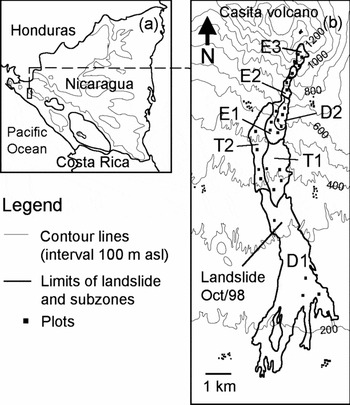
The study area was a landslide on the Casita Volcano (12° 41′N; 85° 57′W), which is part of the Maribios volcanic range in western Nicaragua (Figure 1a). The landslide, which was triggered by an exceptional rainfall event (500 mm in 24 h) on 30 October 1998, during Hurricane Mitch, formed an enormous lahar at mid-slope (Kerle Reference KERLE2002). With an altitudinal range of 150–1350 m asl, and an area of 11.2 km2, the landslide on Casita Volcano is much larger than others studied in Central America and the Caribbean region and it is surrounded by a heterogeneous landscape (Velázquez & Gómez-Sal Reference VELÁZQUEZ and GÓMEZ-SAL2007). The area is dominated by tropical dry forests (Murphy & Lugo Reference MURPHY, LUGO, Bullock, Mooney and Medina1995), however, it is densely populated and local ecosystems have been considerably reduced and transformed by the effects of human activities such as hunting, resource extraction, burning and clearing of vegetation, and urban sprawl (Gillespie et al. Reference GILLESPIE, GRIJALVA and FARRIS2000).
Study area: location within Nicaragua (a), landslide on Casita Volcano (b) showing contour lines, the seven subzones based on abiotic heterogeneity (fertility and geomorphologic stability) and landscape context: erosional (E1, E2, E3), transitional (T1 and T2) and depositional (D1 and D2); and the location of sampling plots in which Trema micrantha populations were studied.

The pioneer communities that developed during the last years of the study period in each landslide zone were very different (Velázquez & Gómez-Sal Reference VELÁZQUEZ and GÓMEZ-SAL2008, in press). In general terms, the more fertile and geomorphologically stable depositional zones were dominated by 5–10-m-tall T. micrantha and Muntingia calabura trees forming dense canopies. Under these canopies, seedlings of T. micrantha, Muntingia calabura and other trees such as Guazuma ulmifolia, Maclura tinctorea, Heliocarpus appendiculatus and Enterolobium cyclocarpum appeared, but those of T. micrantha were particularly abundant (Velázquez Reference VELÁZQUEZ2007). The less fertile and stable erosional zones were colonized by a sparse cover of shrubs (e.g. Melanthera nivea, Pluchea carolinensis and Wigandia urens), graminoids (e.g. Sporobolus indicus) and nitrogen-fixing forbs such as Clitoria ternatea. The transitional zones had a dense shrubland dominated by woody species (e.g. Desmodium nicaraguense and Indigofera guatemalensis), annual forbs (e.g. Tithonia rotundifolia, Calopogonium mucunoides and Stizolobium pruriens) and perennial grasses such as Hyparrhenia rufa.
Field sampling
In 1999, three major zones (erosional, transitional, and depositional) were identified in the landslide. They reflected, respectively, the initiation, transport and deposition zones in landslides based on geomorphological criteria (Martin et al. Reference MARTIN, ROOD, SCHWAB and CHURCH2002). The erosional zones (E), where the landslide began, were the steepest areas. The transitional zones (T) were the moderately steep areas where the landslide mass flowed and eventually settled, and the depositional zones (D) were nearly flat areas where the landslide mass settled. In the erosional zones, the agricultural and forest soils were completely removed by the landslide, but they remained unaltered throughout the depositional zones, and in small patches within the transitional zones. Based on vegetation adjacent to the landslide we identified three subzones in the erosional zones (E1, E2 and E3) and two in the transitional (T1 and T2) and in the depositional zones (D1 and D2) (Figure 1b). E1 and D2 had shaded coffee plantations along their eastern border; E2 and T1 had tropical dry forests along their edges; E3 was enclosed by tropical dry forests that had plant species of cloud forest origin; and cultivated lands were dominant beyond the western border of T2 and along the edges of D1.
To document vegetation recovery in each subzone of the landslide, we collected data in three consecutive surveys following the disturbance; 2000, 2001 and 2002. In 2000, in each of the seven subzones, a permanent 10 × 10-m plot was established randomly and, in 2001, an additional three plots were added in each subzone. Thus, sampling was carried out in seven plots in 2000 and in 28 plots in both 2001 and 2002.
In each year, within each permanent plot, we measured the number of individuals, mean height (m) and cover (%) of each woody species (Velázquez & Gómez-Sal Reference VELÁZQUEZ and GÓMEZ-SAL2008), and in four 1-m2 quadrats within the plots, the number, cover (%) and average height (m) of each herbaceous species (Velázquez & Gómez-Sal in press). Each T. micrantha individual was recorded and tagged (307 individuals in total). Stem height (H) to the nearest 0.05 m was determined using a measuring tape and a clinometer (Mueller-Dombois & Ellenberg Reference MUELLER-DOMBOIS and ELLENBERG1974). Stem diameter (D) to the nearest 0.05 cm was measured with a caliper at a height of 10 cm above ground level. The vertical projection of the crown (m2) of each T. micrantha individual was also measured, and afterwards the mean total canopy cover of this species was calculated per subzone and for each year of the study.
In 2002, in each permanent plot, we recorded abiotic factors such as elevation (m asl), slope (%), stone cover (%), mean diameter of stones (cm), concentrations of available NO3, P, and K (ppm), and proportions of sand, silt and clay in substrates. To measure concentrations of available NO3, P, and K, we used a LaMotte soil test kit (La Motte, Chesterton, Maryland, USA) applied to a composite soil sample formed by three 200-g subsamples which were collected from each plot at a depth of 40 cm. To determine the proportion of sand, silt, and clay, 200-g soil samples were dried and sieved. Human-induced disturbances occurred in D1, T1 and T2 between 2001 and 2002. These disturbances involved the widespread removal of pioneer trees that grew after the landslide (clearcutting), and fires lit by peasants nearby, which expanded into the landslide (Velázquez & Gómez-Sal Reference VELÁZQUEZ and GÓMEZ-SAL2007). Species taxonomy and nomenclature follow Stevens et al. (Reference STEVENS, ULLOA-ULLOA, POOL and MONTIEL2001).
Data analysis
To characterize subzones and determine whether there were significant differences in abiotic factors and total canopy cover, Kruskal–Wallis and post hoc Mann–Whitney U tests were carried out. The most relevant structural characteristics of Trema micrantha populations in each subzone were also determined. These include the Importance value (relative density + relative cover/2; Kent & Coker Reference KENT and COKER1992) of Trema micrantha divided by the Importance value of the other woody species; the number of live stems; the number of dead stems; mean stem diameter; mean stem height and maximum stem diameter.
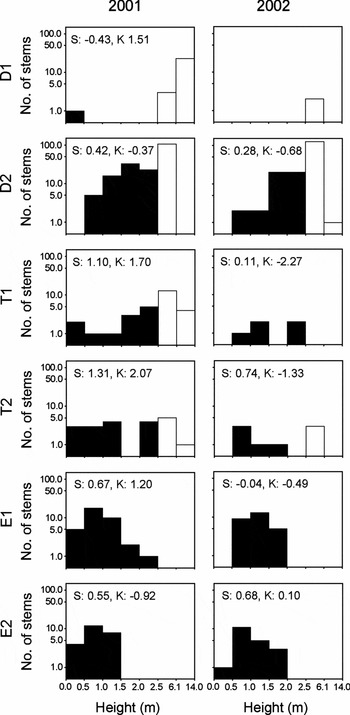
Canopy hierarchies and one-sided competition may be occurring if the frequency distribution of heights changes from L-shaped (large positive values of skewness and kurtosis) to bimodal (large negative values of kurtosis) (Nagashima & Terashima Reference NAGASHIMA and TERASHIMA1995). Therefore, in order to determine whether mortality was more important for the shortest stems than for others, and whether one-sided competition occurred, changes in the frequency distributions of height and diameter were studied in the different subzones. Frequency histograms and skewness and kurtosis of frequency distributions of height and diameter were analysed in T. micrantha populations. To determine equal-class frequency histograms (Ford Reference FORD1975) in all subzones, a K-means clustering method (Bishop Reference BISHOP1995) was used to obtain major-width classes or groups based on height and diameter. The K-means clustering that maximized the initial between-cluster distances generated three height-based groups: 0.0–2.5 m (short stems), 2.5–6.1 m (medium-tall stems), and 6.1–14.0 m (tall stems), and three diameter-based groups: 0.0–3.2 cm (thin stems), 3.2–7.6 cm (medium-diameter stems) and 7.6–24 cm (thick stems). The thick-stemmed group consisted of a large number of individuals that had diameters between 7.6 and 15.7 cm, and a rare individual that had a diameter of 24 cm. Short and thin stems are important in assessing one-sided competition and were particularly abundant; therefore, several minor-width classes were considered within them. Five and four minor-width classes were obtained for the short (0.0–0.5 m, 0.5–1.0 m, 1.0–1.5 m, 1.5–2.0 m, 2.0–2.5 m), and for the thin (0.0–1.0 cm, 1.0–2.0 cm, 2.0–3.0 cm, 3.0–3.2 cm) stems, respectively.
To detect changes in growth strategies and the existence of plastic responses to competition for light, we examined the changes in allometric relationships between size (height and diameter) of the short stems that appeared in 2001 and survived to 2002 (either as short or medium-tall stems). With this purpose, regression lines between height and diameter were fitted. To verify if short stems exhibited different growth strategies in the different zones of the landslide, we performed a one-way ANOVA test between the height-diameter growth ratios (H : D ratios) of the short stems for the period 2001–2002 and the landslide zones as dependent and independent variables, respectively. H : D ratios are determined by allocation patterns (Deleuze & Houllier Reference DELEUZE and HOULLIER1997), and are widely accepted as a measure of the growth strategy of plants (Thornley Reference THORNLEY1999). The H:D ratios of short stems were calculated using the equation

where ΔH (01–02) and ΔD (01–02) are, respectively, the increases in height and diameter between 2001 and 2002, H 02 and H 01 are the stem heights in 2002 and 2001, and D 02 and D 01 are the stem diameters in 2002 and 2001. To analyse the relationship between changes in H : D ratios and environmental factors throughout the landslide, mean H : D ratios per plot were calculated. Linear regressions between mean H : D ratios per plot and each environmental factor were fitted and a stepwise multiple regression for them by all environmental factors was carried out. When appropriate, variables were transformed to eliminate the effects of differences in dimensions and to achieve normality, homoscedasticity and linearity, and eliminated to avoid colinearity. When using multiple tests, significance levels were adjusted by performing a sequential Rice's correction for α = 0.05. The significance level for inclusion/removal of variables in the stepwise multiple regression was set at β = ± 0.20 (Zar Reference ZAR1999). All analyses were performed using STATISTICA 6.1 software.
RESULTS
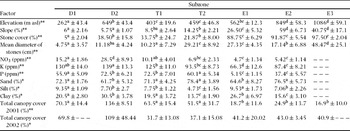
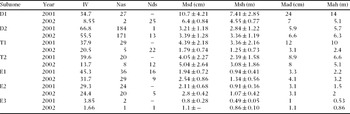
The different subzones of the landslide were well differentiated by elevation, steepness of slope, amount of stone cover, and soil nutrient concentrations (Table 1). D2 had the mildest slope and the highest nutrient concentrations of all seven subzones. In this subzone, total canopy cover was also the highest. It reached values > 100% because of overlapping tree crowns (E. Velázquez, pers. obs.), which indicates that light availability was lower in the understorey than in the canopy of these pioneer forests. As T. micrantha stems were absent from most plots in 2000, the most important results were those based on data from 2001 and 2002. The most relevant structural characteristics of T. micrantha populations in the different subzones of the landslide are summarized in Table 2. Trema micrantha had Importance values > 40% in the D2 subzone in 2001 and 2002. Importance values were similarly high in the E1 subzone in 2001. The number of live stems was high in D2, E1 and E2 and extremely low in E3 in 2001 and 2002. The number of dead stems in 2002 was high in D1, T1 and T2 due to the effects of human disturbances (fire and clearcutting), which destroyed a large number of individuals. In D2, the high standard deviations of mean stem height in 2001 and 2002 indicate the existence of a wide range of sizes among individuals. D1 had maximum values of stem diameter and height in 2001, but these values sharply decreased between 2001 and 2002 due to the removal of the biggest individuals by clearcutting. A similar pattern occurred in T1 and T2 due to the effect of fire.
Characteristics of the different subzones of the landslide on Casita Volcano (Nicaragua) in which Trema micrantha populations were studied, based on abiotic factors and total canopy cover. Letters D, T and E refer to Depositional, Transitional and Erosional zones, respectively. Asterisks indicate the statistical significance of each factor in the Kruskal–Wallis test. H > χ2 with P < 0.001 (**) and P < 0.05 (*). Mean ± SD are shown. Values in the same row followed by the same superscript letter are not significantly different at P < 0.05 according to the Mann–Whitney U test.

Relevant structural characteristics of Trema micrantha populations in the subzones of the landslide on Casita Volcano, Nicaragua, in 2001 and 2002. IV is the Importance value of Trema micrantha divided by the Importance value of the other woody species; Nas is the Number of live stems; Nds is the Number of dead stems; Msd is the Mean stem diameter; Msh is the Mean stem height; Mad is the Maximum stem diameter; Mah is the Maximum stem height. Mean ± SD are shown for Mean stem diameter and Maximum stem height.

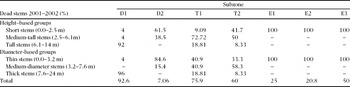
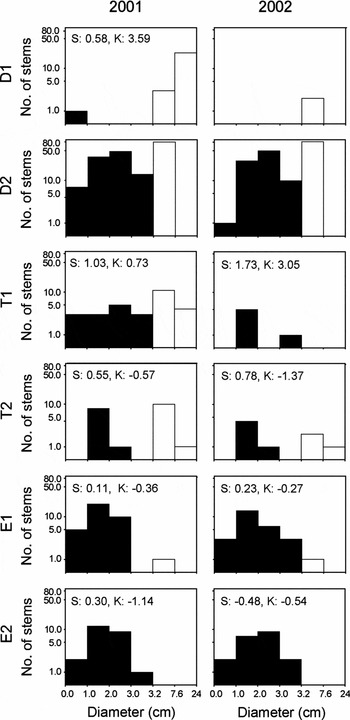
Analyses of temporal changes in the frequency distributions of stem heights showed different patterns among the different subzones of the landslide (Figure 2). In D2, over the two years, the frequency of short stems decreased significantly, particularly within the four shortest classes (0–0.5, 0.5–1, 1–1.5 and 1.5–2 m), the frequency of medium-tall stems increased, and tall stems appeared (Figure 2). Short and medium-tall stems were mainly affected by mortality, but the proportion of total dead stems was low (Table 3). In the erosional subzones, only short stems of T. micrantha were present. Within that group, the frequencies of the shortest classes (0–0.5 and 0.5–1 m in E1, 0–0.5, 0.5–1 and 1–1.5 m in E2, and 0–0.5 m in E3) decreased, whereas those of the tallest (1–1.5, 1.5–2 m in E1, 1.5–2 m in E2, and 0.5–1 m in E3) increased. Short stems were disproportionately affected by mortality and the proportion of total dead stems was high (Table 3). In the transitional subzones and in D1, the frequencies of all of the groups decreased significantly, and tall stems disappeared in 2002. The distributions were strongly positively skewed in most of the subzones, although skewness decreased and, in E1, became negative. In all of the subzones, with the exception of E2, the degree of kurtosis changed toward strongly negative values, which indicates that frequency distributions of stem height changed from L-shaped to bimodal. Analyses of temporal changes in the frequency distributions of stem diameters showed similar patterns among the different subzones of the landslide (Figure 3). In D2, the frequency of thin stems decreased and that of medium-diameter stems increased between 2001 and 2002. In the erosional subzones, the frequencies of stems in the lowest classes in the thin-stemmed group decreased, the frequencies in highest classes increased, and the frequencies of medium-diameter stems remained unchanged. In the transitional subzones, the frequencies of all of the classes decreased.
Changes in equal-class frequency histograms, skewness and kurtosis of the frequency distributions of height of Trema micrantha individuals in the subzones of the landslide on Casita Volcano, Nicaragua. Black bars represent the number of stems in the five height classes defined for short stems (0–0.5 m, 0.5–1 m, 1–1.5 m, 1.5–2 m, 2–2.5 m) and white bars represent the number of stems within the classes defined for the medium-tall (2.5–6.1 m) and tall (6.1–14 m) stems. The values of skewness (S) and kurtosis (K) of the frequency distributions are indicated in the upper-left corner of each box where applicable.

Proportion of dead stems of Trema micrantha within the height- and diameter-based groups of stems generated by the K-means clustering, in the subzones of the landslide on Casita Volcano, Nicaragua, between 2001 and 2002. Total proportion of dead stems of T. micrantha, between 2001 and 2002.

Equal-class frequency histograms, skewness, and kurtosis of the frequency distributions of diameter of Trema micrantha individuals in the subzones of the landslide on Casita Volcano, Nicaragua. Black bars represent the number of stems in the four minor-width classes defined for thin stems (0–1 cm, 1–2 cm, 2–3 cm, 3–3.2 cm), and white bars represent the number of stems within the classes defined for medium-diameter (3.2–7.6 cm) and thick stems (7.6–24 cm). The values of skewness (S) and kurtosis (K) of the frequency distributions are presented in the upper-left corner of each box.

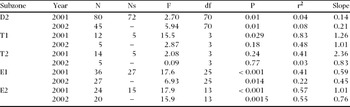
Regression models of allometric relationships indicated significant positive correlations between stem diameter and height in D2, E1 and E2, in both 2001 and 2002 (Table 4), however, diameter contributed much more to the variation in height in E1 and E2, than it did in D2 (Figure 4). The slope of regression line increased from 2001 to 2002 in D2 and decreased in E1 and E2 (Table 4, Figure 4), and the number of short stems decreased in D2 (Table 4). Correlation coefficients reported by most of the linear regressions were low. Regression lines were not fitted to the data from the D1, T1, T2 and E3 subzones because of the small number of short stems present in 2001 that survived to 2002. H:D ratios of the short stems were higher in the depositional (D2) than in the erosional (E1 and E2) zones, and their values differed significantly between these two zones (ANOVA, F1 = 14.2, P < 0.001).
Allometric relationships between stem height and diameter (both log-transformed) of Trema micrantha individuals in the D2, E1 and E2 subzones of the landslide on Casita Volcano, Nicaragua, in 2001 and 2002. White and black dots indicate the height and diameter of stems in 2001 and 2002, respectively. Thin and thick lines denote the fitted regression lines for 2001 and 2002, respectively.

Parameter estimates for the linear regressions between height and diameter (both log-transformed), of the short stems of Trema micrantha, in the subzones of the landslide on Casita Volcano, Nicaragua. Regressions were not performed on data from the D1 and E3 subzones because of the absence or scarcity of short stems. N is the Number of short stems; Ns is the Number of short stems in 2001 that survived in 2002.

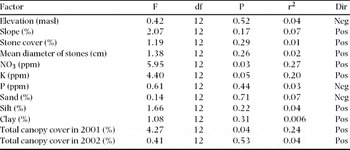
Mean H : D ratios were calculated only in 14 plots in which there were short stems present in 2001 that survived to 2002; E1a, E1b, E1c, E1d, E2a, E2b, E2c, D2a, D2b, D2c, D2d, T1b, T1c and T2a. Linear regressions between them and environmental factors revealed that NO3 and K concentrations, and total canopy cover in 2001 were significantly correlated with mean H : D ratios (Table 5). The stepwise multiple regression was carried out for elevation (m asl), slope (%), stone cover (%), concentration of available NO3 (ppm), proportion of silt and total canopy cover in 2001. The only environmental factor significantly correlated with mean H : D ratios was concentration of NO3 (F1,12 = 5.92, P < 0.05, r2 = +0.33).
Parameter estimates for the linear regressions between the mean H : D ratios of the short stems of Trema micrantha populations and values of environmental factors, per plot, in the subzones of the landslide on Casita Volcano, Nicaragua.

DISCUSSION
The high mortality of T. micrantha stems caused by human-induced disturbances in D1, T1 and T2 subzones prevented us from studying the development of canopy hierarchies and the existence of different growth strategies in the populations of this species in these three subzones. However, the pronounced changes detected in the frequency distributions of size and in the allometric relationships between height and diameter in the populations of T. micrantha in D2, E1 and E2, do answer the hypotheses posed in this study. In D2 in 2001, T. micrantha populations exhibited an L-shaped distribution. Short stems were much more abundant than medium-tall stems, and two distinct canopy- or size-hierarchies (understorey and overstorey) developed. In 2002, the frequency distributions of T. micrantha populations were markedly bimodal and medium-tall stems were dominant over short stems, which implies the manifestation of one-sided competition for light (Kikuzawa & Umeki Reference KIKUZAWA and UMEKI1996, Nagashima & Terashima Reference NAGASHIMA and TERASHIMA1995).
Between 2001 and 2002, frequency of medium-tall stems increased and frequency of short stems decreased. However, short stems were not disproportionately affected by mortality and their height experienced a large increase relative to diameter (high H : D ratios). This means that they developed plastic responses to one-sided competition for light. Thus, in the understorey, most seedlings and saplings might have allocated more of their resources into increasing stem length rather than into increasing diameter or forming new branches, leaves, or flowers. In short order, those short stems developed into medium-tall stems (but, not necessarily into medium-diameter stems), which allowed them to compete better for light and increase their likelihood of survival. Growth of T. micrantha seedlings in height and diameter under different irradiances has been studied using artificial shading in a greenhouse (Válio Reference VÁLIO2001), and under natural shade in the field (de Souza & Válio Reference DE SOUZA and VÁLIO2001). According to Válio (Reference VÁLIO2001), growth of seedlings in height was severely reduced by the low-irradiance treatments, but in those in which irradiance was reduced to about 10% (similar to conditions under the canopy of D2), they continued growing, investing in stem elongation to the detriment of other parts of the plant. In the experiments of de Souza & Válio (Reference DE SOUZA and VÁLIO2001), T. micrantha exhibited a low percentage of seedling survival in the understorey, but a long mean time until seedling death. Our results corroborate these findings and suggest that, as with other tropical pioneer species such as Amphitecna tuxtlensis and Pseudolmedia oxyphyllaria (Popma et al. Reference POPMA, BONGERS, MARTÍNEZ-RAMOS and VENEKLAAS1988), T. micrantha exhibits a complex growth response to low light availability which may allow it to survive in the understorey of forests.
In E1 and E2, only short stems were present in both 2001 and 2002, and canopy hierarchies did not develop. Between 2001 and 2002, the shorter short-stemmed individuals grew slowly in height (low H:D ratios), the frequencies of the taller short-stemmed individuals increased slightly, and in E1 and E3, stem diameter increased more than did stem height. In 2002, in E1, medium-diameter stems, but not medium-tall stems, were present. In addition, short stems had longer branches in the erosional than in the depositional zones (E. Velázquez, pers. obs.). These results suggest that, unlike individuals in D2, T. micrantha individuals in the erosional subzones allocated resources mainly to survival and maintenance (growth in diameter) rather than to stem elongation (growth in height). Experiments on performance of seedlings of tropical pioneer species in soils with different nutrient concentrations have shown lower growth in height when nutrient availability is low (Lawrence Reference LAWRENCE2003, Nussbaum et al. Reference NUSSBAUM, ANDERSON and SPENCER1995, Stuhrmann et al. Reference STUHRMANN, BERGMANN and ZECH1994). Maximum heights of T. micrantha individuals that were the first to colonize the depositional zones in our landslide (14 m; Table 2) were similar to those of T. micrantha individuals reported in treefall gaps in Panama (up to 7 m growth in height in 1 y, Brokaw Reference BROKAW1987). In contrast, T. micrantha stems in the erosional zones only achieved maximum heights of 3.2 m (Table 2). These differences imply that, although T. micrantha prefers disrupted soils of large gaps, as found on the landslide, its growth in height is low in areas in which soil has been entirely removed and bedrock is exposed, as in erosional subzones. In these areas, T. micrantha establishes, but it develops a different growth strategy, increasing its diameter more than its height. This compensatory growth differentiates T. micrantha from Trema tomentosa (Turner Reference TURNER1991) and other tropical pioneer trees such as Macaranga hypoleuca and M. gigantea (Nussbaum et al. Reference NUSSBAUM, ANDERSON and SPENCER1995), and Gmelina arborea (Stuhrmann et al. Reference STUHRMANN, BERGMANN and ZECH1994), which show lower growth in diameter in nutrient-deficient soils. This could explain the high abundance of T. micrantha in extremely infertile substrates (Kwit et al. Reference KWIT, PLATT and SLATER2000).
Summarizing, in the depositional subzones, with high nutrient concentrations and total canopy cover, canopy hierarchies developed and frequency distributions of heights and diameters changed from L-shaped to bimodal. Asymmetric competition for light occurred and some short stems died, but most survived increasing their H : D ratios, which indicates the existence of plastic responses to low light availability. In contrast, in the erosional subzones, with low nutrient concentrations and total canopy cover, canopy hierarchies did not develop and only short stems were present. The shortest died, and those that survived, had lower H : D ratios. Our results showed significant and positive correlations between stem diameter and height. However, it is important to highlight the low correlation coefficients in the regression models of allometric relationships. This indicates that equations fitted had a low predictive power and do not allow the estimation of a change in stem for a unit change in diameter in D2, E1 and E3.
On the other hand, available nutrient concentrations and total canopy cover in 2001 were significantly correlated to changes in mean H : D ratios per plot according to the fitted linear regressions, but concentration of NO3 was the only significant environmental factor included in the stepwise multiple regression model. These findings indicate that, although both nutrient and light availability determine the development of different growth strategies across the landslide subzones, NO3 concentration plays the most important role. In a study performed within a larger area in Borneo to examine mortality and growth of several co-occurring species of pioneer trees of the genus Macaranga (Davies Reference DAVIES2001), light availability and soil texture had the most significant effect on growth strategies among species. The higher relevance of available nutrient concentrations on growth strategies of T. micrantha individuals within our study area is probably due to the existence of strong variations in fertility between the different zones of the landslide on Casita Volcano (Velázquez & Gómez-Sal Reference VELÁZQUEZ and GÓMEZ-SAL2008).
Our study proves that T. micrantha develops different growth strategies in the different areas of the landslide, which suggests it can allocate resources to growth and survival differently depending on light availability and soil fertility. Therefore, this is not only a light-demanding pioneer tree with preference for large gaps and disturbed soils, but a highly versatile species capable of dealing with fertile and partially shaded environments such as those in small gaps and secondary forests. This has important implications for restoration practitioners in terms of the use of T. micrantha in a much broader range of habitats than are usually considered. However, further research is needed in the field to better understand the performance of T. micrantha under different conditions of light and nutrient availability, and improve the use of this promising species for restoration of tropical degraded lands.
ACKNOWLEDGEMENTS
This research was part of the collaborative program between the Universidad de Alcalá and the Universidad Nacional Autónoma de Nicaragua-León, and supported by a grant from the Third Scientific Research and Technological Innovation Program of the Regional Authority of Madrid. In the Universidad Nacional Autónoma de Nicaragua-León, Pedrarias Dávila gave us invaluable advice and was extremely helpful in fieldwork planning. We are also very grateful to the Sevilla family in the community of Pikín Guerrero, for supporting accommodation and fieldwork. We acknowledge Miguel A. Zavala, Lawrence R. Walker and two anonymous reviewers for their comments on the earlier versions of the manuscript, and to Lucía Gálvez for improving the English.