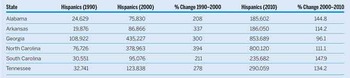
While the national black Footnote 1 population has remained relatively stable for several decades, the Latino immigrant and native-born population in recent decades has skyrocketed, spurring questions of how Latinos compare to and are received by African Americans (US Census Bureau 2010a). Most of what we know about the political implications of immigration centers on Latinos’ assimilation behavior as well as their political identity, political attitudes, and voting behavior (Abrajano and Alvarez Reference Abrajano and Michael Alvarez2010; Fraga et al. Reference Fraga, Garcia, Hero, Jones-Correa, Martinez-Ebers and Segura2010; Ramirez Reference Ramirez2013). Although there is some research on non-Latino views about immigration, most studies explore attitudes at the national level, largely ignoring blacks’ immigration stances in the South. Yet, from 1990 to 2000, the US region that experienced the largest growth in the Latino population was the South (Kochhar, Suro, and Tafoya Reference Kochhar, Suro and Tafoya2005). Furthermore, from 2000 to 2010, the Latino population grew significantly in the South with a 57% increase in its Latino population—four times the increase in the total population of the South (US Census Bureau 2010a). Table 1 shows that from 1990 to 2000, the Latino population in six southern states (i.e., Alabama, Arkansas, Georgia, North Carolina, South Carolina, and Tennessee) grew by more than 200%. From 2000 to 2010, all six states saw an increase in growth of Latinos (although not as extensive as in the previous decade) by more than 96% (Kochhar, Suro, and Tafoya Reference Kochhar, Suro and Tafoya2005).
Growth of the Hispanic Population in The South in 1990, 2000, and 2010

Sources: The Hispanic Population: 2000 Census Briefs and The Hispanic Population: 2010 Census Briefs.
In addition to Latinos, African Americans have established a solid presence in the South. Their residence in the South originates many decades ago, when slavery was prevalent in this country. Their presence remains solid, with the latest census report stating that the black population has the highest concentration in the South: 105 Southern counties have a black population of 50% or higher (US Census Bureau 2010b). Thus, analyzing Southern blacks’ dispositions toward immigration and immigrants is essential to understanding current race relations in the region.
Although research focused on the effects of economic self-interest has made significant headway in explaining the immigration attitudes of blacks, it does not provide a clear understanding of the relationship between discrimination and powerlessness and these attitudes. Do blacks who feel limited in power think differently about immigration and immigrants than those who do not? Do blacks who experience discrimination and who feel that their group has been discriminated against regard immigration and immigrants differently than those who do not perceive and experience discrimination? To what extent does experienced discrimination and feelings of racial alienation (i.e., perceived discrimination and powerlessness) structure black dispositions toward immigration and immigrants? Relying primarily on the 2012 American National Election Study (ANES), this article thoroughly addresses these questions, as well as the considerable gaps in understanding overall race relations in the South.
PERCEPTIONS OF DISCRIMINATION AND FEELINGS OF POWERLESSNESS
Most scholarly efforts to explain African American attitudes toward Latinos and immigration fail to examine directly the effect of racial alienation. Yet, this article contends that along with the leading determinants of black attitudes, the underlying factor that drives Southern black immigration attitudes and attitudes about Latinos is racial alienation, as measured by perceptions of discrimination and feelings of powerlessness (Hutchings et al. Reference Hutchings, Wong, Jackson, Brown, Charles, Gerken and Kang2011). Blumer (Reference Blumer1958) argued in a theory that he coined the “group-position theory” that individuals place their racial or ethnic group in a category and others into distinct classifications. When whites feel that their clout and position are infringed on by blacks, they respond negatively to blacks. Bobo and Hutchings (Reference Bobo and Hutchings1996) extended Blumer’s (Reference Blumer1958) group position theory with a modified group position theory, positing that the more minorities feel powerless and disenfranchised from society, the more they feel that other groups are a competitive racial threat to their own group’s social position. This article builds on Bobo and Hutchings’ theory and contends that what is really at the heart of Southern blacks’ attitudes toward immigration and immigrants is not necessarily their economic self-interest but rather feelings of powerlessness and experiences and perceptions of discrimination. Relative to other US regions, the South has a rigid racial hierarchy that generates significant disparities in social, political, and economic opportunities between its white and African American residents (Key Reference Key1949; McClain et al. Reference McClain, Lyle, Carter, DeFrancesco Soto, Lackey and Davenport Cotton2007). Given their comparable socioeconomic status, immigrants in the South (e.g., Latinos) often reside near and work alongside blacks (McClain et al. Reference McClain, Lyle, Carter, DeFrancesco Soto, Lackey and Davenport Cotton2007; McDermott Reference McDermott, Telles, Sawyer and Rivera-Salgado2011). Thus, when Southern blacks are powerless and disadvantaged and sense that their group is being alienated, they are less predisposed to favor increased immigration and potential rivals such as immigrants.
This article builds on Bobo and Hutchings’ theory and contends that what is really at the heart of Southern blacks’ attitudes toward immigration and immigrants is not necessarily their economic self-interest but rather feelings of powerlessness and experiences and perceptions of discrimination.
Perceptions of Discrimination
We have a limited understanding of the extent that perceptions of discrimination can drive black attitudes toward immigration and Latinos. In a study of black immigration attitudes in South Carolina, McDermott (Reference McDermott, Telles, Sawyer and Rivera-Salgado2011) suspects that difference in class within the black community shapes attitudes toward Latinos because working-class and upper-middle-class blacks adopt a more negative outlook toward Latinos than lower-middle-class blacks. She emphasize that a primary reason for these differences in attitudes is perceived discrimination. Whereas working-class and upper-middle-class blacks feel that they and their community are disadvantaged in the face of a new group, the black lower-middle class viewed Latinos as the vehicle to succeed in their careers by learning Spanish and befriending Latino coworkers. Bobo and Hutchings (Reference Bobo and Hutchings1996) directly examine the relationship between perceiving disadvantage and blacks’ attitudes toward Latinos in Los Angeles. In support of their racial alienation theory, they find that blacks who feel that they are alienated (including feeling that those of their race have not been given a fair chance to succeed) perceive greater competition with Latinos. Thus, based on these findings, we hypothesize:
Discrimination Hypothesis: Southern blacks who encounter discrimination and sense that their group is discriminated against are more likely to adopt unfavorable views toward immigration and immigrants than those who do not perceive and experience discrimination.
Feelings of Powerlessness
In addition to discrimination, we contend that feelings of a loss in social and political power influence black attitudes toward immigration. Although some may regard perceptions of discrimination and feelings of powerlessness as addressing a similar concept, there are several reasons why they are two separate measures of racial alienation in this study. To feel discriminated against does not necessarily mean that one feels powerless and vice versa. Statistical support for the creation of two separate measures is provided later in this article. Moreover, our racial alienation measures compare to those of Hutchings et al. (Reference Hutchings, Wong, Jackson, Brown, Charles, Gerken and Kang2011), who treat perceived discrimination and opportunity structure as two distinct measures of racial alienation.
A few studies emphasize that feeling powerless structures black racial attitudes. McClain et al. (Reference McClain, Lyle, Carter, DeFrancesco Soto, Lackey and Davenport Cotton2007) also discuss the idea that blacks’ sense of power shapes their attitudes toward Latinos and immigration in their hypothesis that blacks in the South perceive a greater economic threat from Latinos than whites in the region. A main justification for these disparities is that there remain profound differences in opportunities for political, employment, and overall economic advancement between blacks and whites in the South, given that race has historically defined Southern blacks’ daily experiences and life chances (McClain et al. Reference McClain, Lyle, Carter, DeFrancesco Soto, Lackey and Davenport Cotton2007). Bobo and Hutchings (Reference Bobo and Hutchings1996) directly examine the relationship between feelings of powerlessness and blacks’ views of Latinos. In line with their extended group position theory, the authors conclude that blacks who feel alienated (such as feeling that blacks have not gotten what they deserve) sense greater rivalry with Latinos. Hutchings et al. (Reference Hutchings, Wong, Jackson, Brown, Charles, Gerken and Kang2011) replicate many of the analyses in Bobo and Hutchings’ (Reference Bobo and Hutchings1996) study and find support for the ability of powerlessness to structure blacks’ attitudes toward Latinos.
This article further develops Bobo and Hutchings’ (Reference Bobo and Hutchings1996) racial alienation hypothesis and posits that Southern African Americans’ views of immigration and immigrants greatly involve their perception of their social and political power. These findings and arguments lead us to the following hypothesis:
Power Hypothesis: Southern blacks who sense that they have limited power are more likely to regard immigration and immigrants unfavorably than those who perceive that they have power.
DATA AND MEASURES
The goal of this article is to understand the effects of discrimination (perceived and experienced) and feelings of powerlessness on Southern blacks’ views toward immigration and immigrants, even when controlling for leading determinants of black attitudes. Unlike numerous existing studies, this study relies on comprehensive data from the 2012 ANES to provide a more systematic analysis of blacks’ dispositions. The 2012 dataset is ideal for several reasons. Unlike several surveys used in previous studies of black immigration attitudes, the 2012 ANES is a national survey with large samples of whites (n = 3,495), blacks (n = 1,016), and Latinos (n = 1,007). Survey respondents from four major US regions were interviewed, which allowed us to examine the effect of residing in the South (1,040 respondents) on racial dispositions. Another benefit of using 2012 ANES data is that this survey explores a variety of topics that are central to predicting and analyzing black attitudes. The black sample in all of the analyses was weighted to be proportionate to the African American population in the United States.
Dependent Variables
The dependent variables in the analyses examine African Americans’ attitudes toward immigration and immigrants. The immigration stances of individuals are analyzed with a question that assesses blacks’ support for increasing immigration and another that assesses their belief that immigration will take jobs away from them. The question that examines individuals’ support for immigration is: “Do you think the number of immigrants from foreign countries who are permitted to come to the United States to live should be increased a lot, increased a little, left the same as it is now, decreased a little or decreased a lot?” Determining whether respondents think that immigration poses an employment threat to them is analyzed by asking: “How likely is it that recent immigration levels will take jobs away from people already here?” Individuals’ view toward immigrants is analyzed with a feeling thermometer question of Hispanics (“How would you rate Hispanics?”) and another of illegal immigrants (“How would you rate illegal immigrants?”). Consistent with the immigration attitudes literature (Diamond Reference Diamond1998; Espenshade and Hempstead Reference Espenshade and Hempstead1996; Hopkins Reference Hopkins2010), we regard these as confident measures that broadly capture many of the current concerns of individuals regarding immigration and immigrants. Responses to the increasing immigration question were coded on a five-point scale in which 0 denotes “decrease immigration a lot” and 4 denotes “increase immigration a lot.” The employment-threat question was coded on a scale from 0 (“not at all likely that immigration takes jobs”) to 3 (“extremely likely”). Regarding the variables that analyzed individuals’ attitudes toward immigrants, both the Hispanic and illegal immigration feeling-thermometer scales ranged from 0 (“very cold or unfavorable feeling”) to 100 (“very warm or favorable feeling”).
Independent Variables: Discrimination and Powerlessness
The primary independent variables that we include in our models are ones that measure discrimination (experienced and perceived) and perceived powerlessness. We regard discrimination and powerlessness as two separate measures. In addition to the theoretical assertions expressed previously, we find empirical support for their individuality since the correlation coefficients between the individual discrimination and powerlessness measures do not exceed 0.5. Furthermore, Cronbach’s alpha coefficients reveal that combining them as one measure is not appropriate.
The 2012 ANES include several variables that tap into blacks’ experiences with discrimination and their sense of power. Unlike most extant research, our study employs measures that assess individuals’ perceived and experienced discrimination. The variable that examines experienced discrimination is based on individuals’ response to a question assessing how much discrimination they have encountered. The perceived measures included the belief that (1) blacks are discriminated against as a group, and (2) African Americans have experienced discrimination in the past. The second measure is an additive scale composed of two variables: the belief that blacks have gotten less than they deserve and that slavery and discrimination have prevented blacks from improving their economic situation. Footnote 2 This variable allow us to gauge the extent that blacks feel they have been shunned by society. Footnote 3
Our analyses also include two measures of powerlessness. One measure of feelings of powerlessness is perceptions of political power. This variable is an additive index of blacks’ belief that public officials do not care what they think and that they do not have a say in what government does. Footnote 4 The other power variable examines individuals’ views regarding African Americans’ influence in US politics.
In addition to discrimination and powerlessness measures, we include leading determinants of blacks’ immigration attitudes and other independent variables in the data analyses. As discussed in previous research, blacks’ perceptions of Latinos and immigration may be structured by negative stereotypes of Latinos (McClain et al. Reference McClain, Lyle, Carter, DeFrancesco Soto, Lackey and Davenport Cotton2007) and economic self-interest (Citrin et al. Reference Citrin, Green, Muste and Wong1997; Gay Reference Gay2006; McClain et al. Reference McClain, Lyle, Carter, DeFrancesco Soto, Lackey and Davenport Cotton2007; Nteta Reference Nteta2013). We control for the effects of these variables in our models to gauge the impact of discrimination and perceived power on blacks’ dispositions toward immigration and immigrants. Moreover, our analyses included several common control variables that measure political and demographic attributes and region. The coding of these variables is in the online appendix to this article.
Interestingly, African Americans who perceive and experience discrimination are more supportive of the idea that immigration takes jobs away from Americans.
EMPIRICAL RESULTS
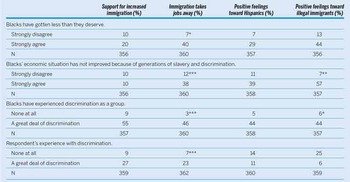
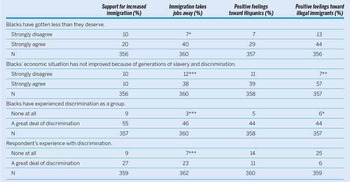
Do Southern blacks who have experienced discrimination and who feel that their group has been discriminated against regard immigration and immigrants differently than those who have not been discriminated against? Do Southern blacks who feel limited in power think about immigration and immigrants differently than those who do not? To address these two questions, we compare African Americans’ support for immigration and their perceptions of immigrants by their perceptions of racial alienation. The results presented in table 2 reveal that blacks who perceive discrimination against blacks (i.e., by not giving them what they deserve and slavery and discrimination against the group as a whole) are more supportive of increasing immigration, Hispanics, and illegal immigrants than those who do not. Interestingly, African Americans who perceive and experience discrimination are more supportive of the idea that immigration takes jobs away from Americans. Chi-square tests of independence Footnote 5 reveal that there are considerable differences in perceiving that immigrants take jobs across all of the discrimination measures presented in table 2.
Southern African Americans’ Attitudes toward Immigration and Immigrants by Experienced and Perceived Discrimination
Source: 2012 American National Election Study.
Notes: Most columns do not equal 100% due to rounding and because only responses to the extreme values of the discrimination measures are reported.
*p < 0.10 level; **p < 0.05 level; ***p < 0.01 level.
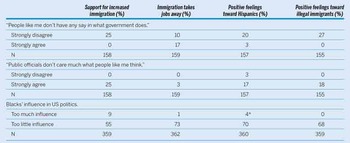
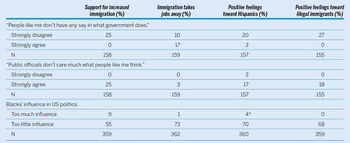
We also examine Southern blacks’ dispositions toward immigration and immigrants based on their sense of power. The results presented in table 3 reveal that African Americans who sense that government does not care about what they think and that blacks as a group have little influence in politics are more supportive of immigrants and immigration, as well as inclined to believe that immigration takes jobs away. Interestingly, blacks who believe that they have no say in government does are less supportive of Hispanics and illegal immigrants than blacks who believe that they do have a say. Chi-squared tests of independence Footnote 6 do not reveal that there are significant differences in support for immigration and immigrant groups by blacks’ perception of their individual political clout as well as those of blacks as a group. Overall, the findings presented in tables 2 and 3 suggest that experienced and perceived discrimination (although not necessarily feelings of powerlessness) influence blacks’ dispositions toward immigration and immigrants.
Southern African Americans’ Attitudes toward Immigration and Immigrants by Perceptions of Power
Source: 2012 American National Election Study.
Notes: Most columns do not equal 100% due to rounding and because only responses to the extreme values of the discrimination measures are reported.
*p < 0.10 level; **p < 0.05 level; ***p < 0.01 level.
The next step in our data analyses is to examine the extent that experienced discrimination and feelings of racial alienation structure Southern blacks’ dispositions toward immigration and immigrants. We specify multivariate models that include independent variables as leading determinants (as dictated by extant research) of blacks’ racial and immigration attitudes, as well as measures for political and demographic characteristics. Because the dependent variables that assess immigration attitudes are measured on four- and five-point ordered scales, we rely on ordered logit as the appropriate estimation procedure. Since the variables that measure attitudes toward immigrants range from 0 to 100, we rely on OLS regression as the appropriate estimation procedure. Due to space limitations, the results of our multivariate models are presented in tables 1 and 2 of the online appendix. Footnote 7 , Footnote 8 The discussion of our analyses begins with Southern blacks’ stances on immigration and then proceeds to their favorability of Hispanics and illegal immigrants.
Southern blacks are more likely to favor Hispanics if they perceive that African Americans as a group have limited political clout.
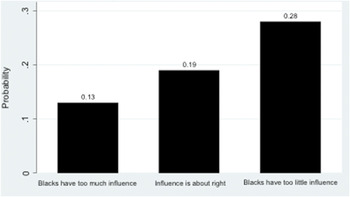
Our analyses of the impact of experienced, perceived discrimination and powerlessness on Southern blacks’ support for increased immigration and their belief that immigration takes jobs away reveal some interesting findings. Whereas experienced and perceived discrimination do not have a significant effect on Southern blacks’ immigration attitudes, we find robust support for our Power Hypothesis. Perceiving limited to no political power increases the likelihood that Southern blacks believe that immigrants pose an economic threat. Figure 1 presents a more complete illustration of this finding. Southern blacks who perceive that African Americans have too little political influence are much more likely to believe that immigrants take jobs than those who sense that blacks have too much or an adequate amount of political clout. The results in appendix table 1 (available online) also reveal some support for economic self-interest theories: that is, perceiving that the national economy is improving is negatively related to Southern blacks’ belief that immigration takes jobs away from Americans.
Probability of Southern Blacks’ Belief that Immigrants Take Jobs by Perceived Political Influence of Blacks
Source: Author’s calculations using 2012 ANES data.

To what extent does experienced discrimination and feelings of racial alienation shape African Americans’ perceptions of immigrants? Our analyses (presented in appendix table 2) yield some results that support our hypotheses. Although perceived discrimination measures do not seem to influence Southern blacks’ views of Hispanics and illegal immigrants, experienced discrimination and perceived powerlessness do structure African Americans’ dispositions toward immigrants. In accordance with our Discrimination Hypothesis, African Americans in the South who encounter discrimination are less likely to favor Hispanics than those who have not experienced discrimination. Interestingly, African Americans’ perception of blacks’ political influence in the United States has a statistically significant effect on their views toward Hispanics and illegal immigrants—but in the opposite direction than we expected. Southern blacks are more likely to favor Hispanics if they perceive that African Americans as a group have limited political clout. Furthermore, believing that blacks have limited political influence is positively related to Southern blacks’ favorability of illegal immigrants. A possible explanation for these findings is that blacks in the South regard Hispanics as having minority status (i.e., a shared history of de jure and de facto discrimination) with African Americans (Sanchez Reference Sanchez2008, 438). Therefore, when they feel that their group has limited political opportunities, they are more likely to have affinity with other minority groups such as Hispanics and illegal immigrants. However, once Southern African Americans actually experience discrimination, they feel racially alienated and are more inclined to regard Hispanics and illegal immigrants as a threat, viewing them negatively. These perplexing findings also suggest that Southern blacks distinguish discrimination against blacks from personal experiences with discrimination. Correlation analyses between measures of discrimination against blacks and personal discrimination experiences provide support for this assertion. Footnote 9 These explanations and findings are supported by our focus group findings of African Americans in New Orleans (Bingham and Wilkinson Reference Bingham and Wilkinson2010). Interestingly, leading predictors of black immigration attitudes (including economic self-interest measures) do not have a statistically significant effect on Southern blacks’ dispositions toward Hispanics and illegal immigrants.
DISCUSSION AND CONCLUSION
This article addresses a considerable gap in our understanding of Southern blacks’ perceptions of immigrants by building on Bobo and Hutchings’ (Reference Bobo and Hutchings1996) modified group position theory or racial alienation hypothesis and arguing that what is at the center of Southern blacks’ views toward immigration and immigrants is experienced, perceived discrimination and feelings of powerlessness. Our analyses reveal several interesting trends that advance our understanding of how Southern blacks regard immigration. Blacks who feel limited in political influence and who perceive discrimination against blacks as a group regard immigrants and immigration differently than those who do not. Even when accounting for leading determinants of blacks’ immigration attitudes, Southern blacks’ sense of political power and experienced discrimination play a key role in shaping their views toward immigration and immigrant groups. When blacks feel politically powerless, they are more likely to regard immigrants as economic threats; further, experiencing discrimination is negatively related to Southern blacks’ favorable feelings toward Hispanics. Moreover, our findings suggest that Southern blacks distinguish discrimination against blacks as a group from personal discrimination.
Although this article does not provide all of the answers regarding what drives Southern blacks’ immigration attitudes, our analyses make an essential contribution to the literature on immigration and race relations in the South. While it has been documented that economic self-interest drives blacks’ attitudes toward immigrants and immigration, there is less knowledge as to the effect of how blacks’ perception of their own social, political power shape their attitudes toward the immigration of a group that is significantly shaping the United States (and particularly the South) socially, politically, and economically. Southern blacks are aware of the racialized social structure that exists in this country, and their perception of their place in this hierarchy impacts how they regard the immigration of a minority group that is gaining sociopolitical clout. Examining not only the economic and social status of individuals but also Southern blacks’ interpretations of their own social, political power (which is not always stagnant) and actual experiences with discrimination is critical to uncovering attitudes toward immigrants who are significantly changing the United States. The recent influx of Latinos in the Southern region of the United States where a significant number of African Americans reside sheds light on the importance of continuing to study racial attitudes between immigrants and African Americans.