Elaborately constructed temple pyramids situated within large public plazas appeared across the southern Maya Lowlands during the Middle Preclassic period (1000/900–300 BC; Doyle Reference Doyle2017; Inomata et al. Reference Inomata, Daniela Triadan, Castillo and Yonenobu2013, Reference Inomata, Triadan, Vázquez López, Fernandez-Diaz, Omori, Méndez Bauer, Hernández, Beach, Cagnato, Aoyama and Nasu2020; Powis et al. Reference Powis, Micheletti, Crow, Skaggs, Stanchly, Cartagena and Powis2019), serving as a location of community gatherings (Doyle Reference Doyle2012). These permanent masonry structures required intensive planning and large-scale resource mobilization (including labor), suggesting their construction under a centralized authority (Chase and Chase Reference Chase, Chase, Freidel, Chase, Dowd and Murdock2017:59; Laporte and Fialko Reference Laporte and Fialko1995). A common type of Middle Preclassic monumental construction was the E-Group assemblage. Numerous studies from the Petén, Guatemala, have documented these architectural complexes and their orientations (see Aimers and Rice Reference Aimers and Rice2006; Doyle Reference Doyle2017; Freidel et al. Reference Freidel, Chase, Dowd and Murdock2017), with the archetype at Uaxactun aligned to view the sunrise during the solstices and equinoxes (Blom Reference Blom1924:60; Ricketson Reference Ricketson1928). Typical Uaxactun-style E-Groups include a large radial (four-sided, square) platform on the west side of an open plaza, with staircases on the four cardinal directions. To the east was a longer north-to-south platform with three superstructures.
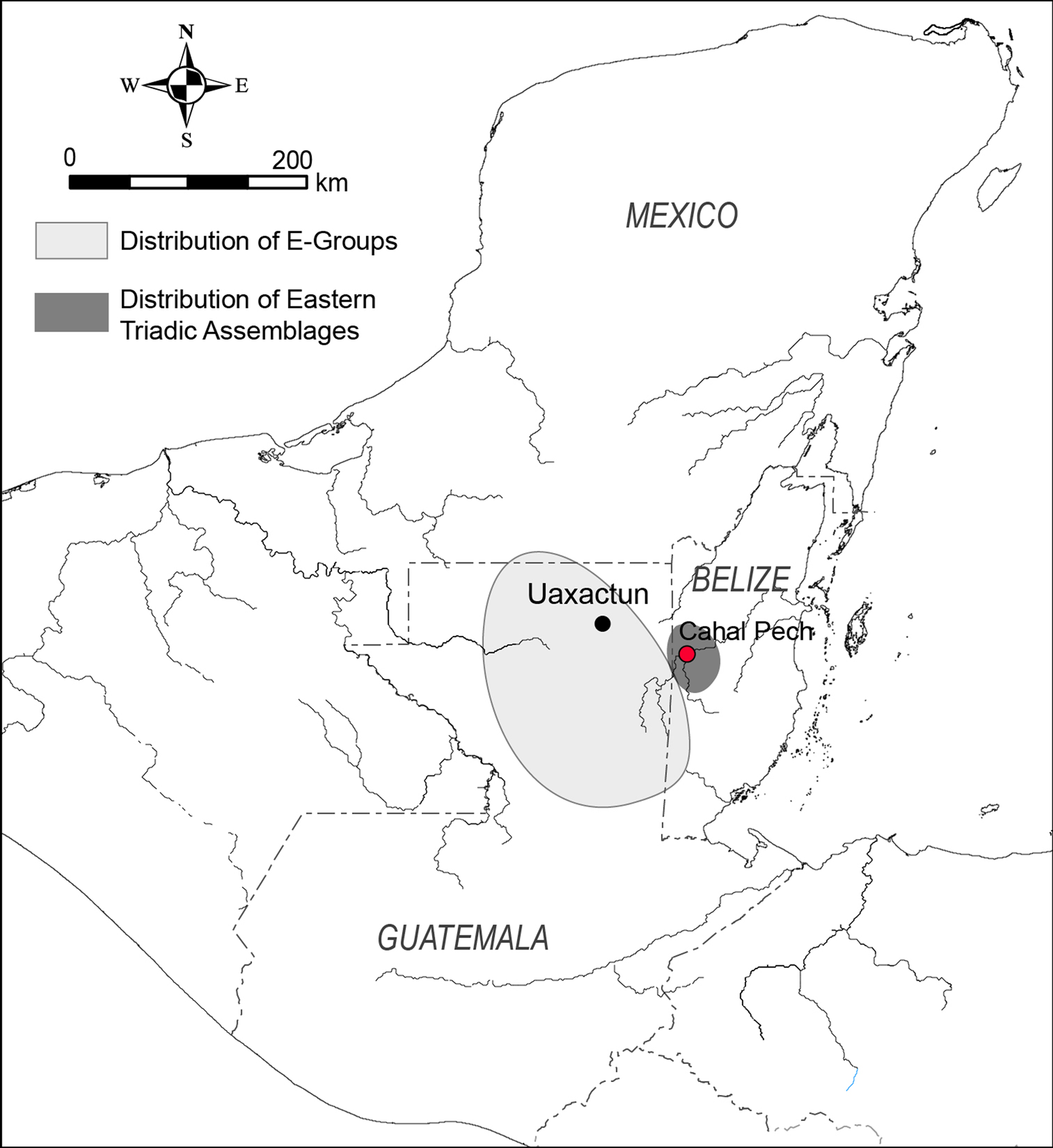
In the Belize River Valley of western Belize (Figure 1), archaeologists have suggested that late Middle Preclassic (700–300 BC) monumental architecture is different from that in the Petén (Aimers and Rice Reference Aimers and Rice2006:86; Awe et al. Reference Awe, Hoggarth, Aimers, Freidel, Chase, Dowd and Murdock2017). Whereas Uaxactun-style E-Groups are common in the Petén, for example, they are less widespread in western Belize. Instead, morphologically distinct architectural groups referred to as Eastern Triadic Assemblages dominate public plazas at Belize Valley sites (Awe et al. Reference Awe, Hoggarth, Aimers, Freidel, Chase, Dowd and Murdock2017). Eastern Triadic Assemblages have three freestanding structures on the eastern side of the plaza, typically without an associated western building. Instead, a tall central structure is flanked by shorter northern and southern buildings, each with its own construction history (Awe et al. Reference Awe, Hoggarth, Aimers, Freidel, Chase, Dowd and Murdock2017).
Map of Maya Lowlands with distribution of E-Groups and Eastern Triadic Assemblages.

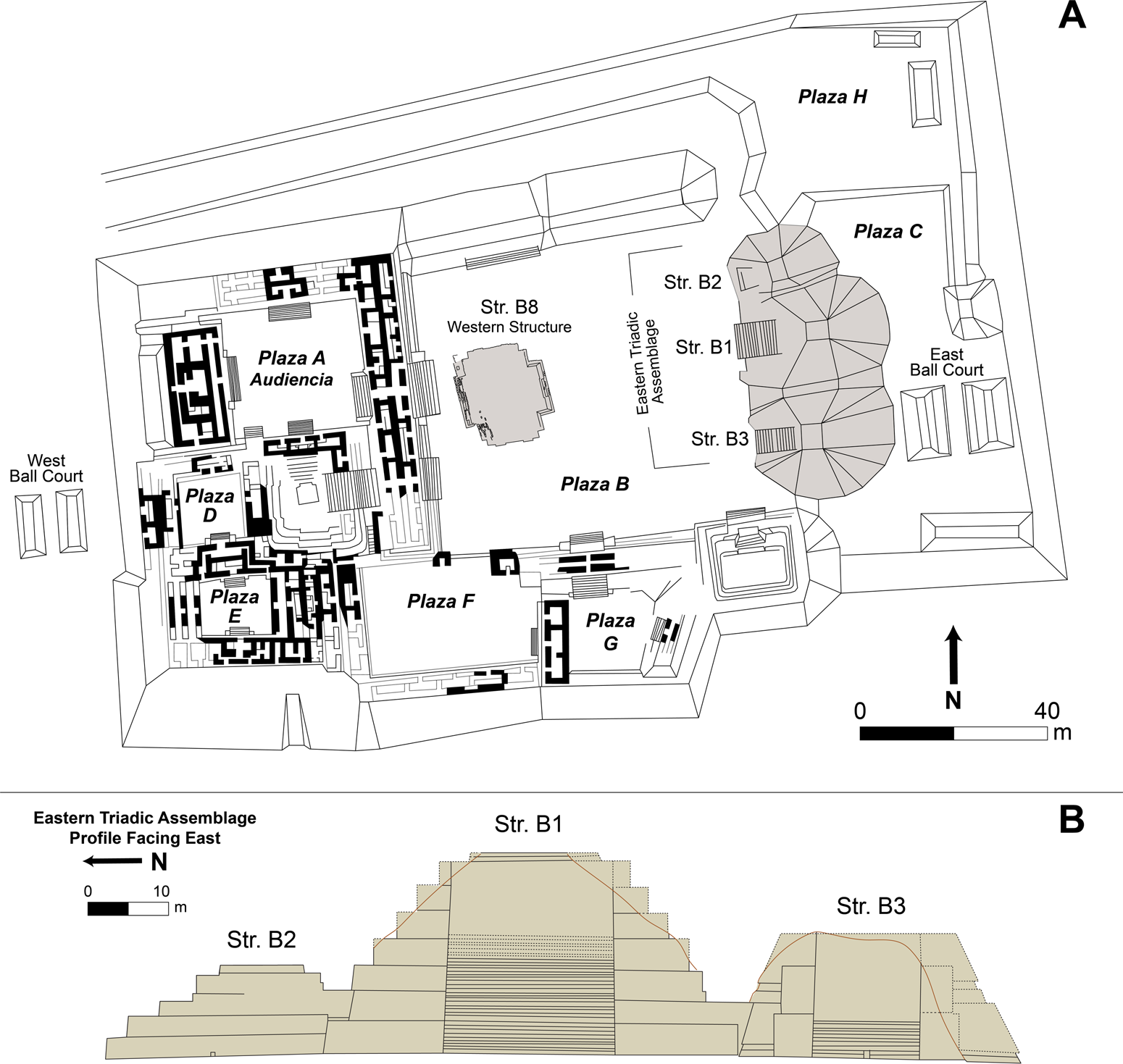
Investigations by the Belize Valley Archaeological Reconnaissance (BVAR) Project at Cahal Pech, Belize, noted that the earliest phases of the site's Eastern Triadic Assemblage date to the Middle Preclassic (Figure 2). The limited extent of excavations, however, precluded an accurate functional assessment of the buildings’ earliest construction phases. Excavations of later Late Preclassic and Classic architectural phases indicate that the Triadic Assemblage became the site's elite mortuary shrine, when a total of 13 royal burials were sequentially deposited in Structure B1, with an additional six burials placed in the two flanking structures (Awe Reference Awe2013).
Cahal Pech epicenter showing (A) Eastern Triadic Assemblage and Structure B8, and (B) profile of the Classic period Eastern Triadic Assemblage.

Recent excavations in Plaza B at Cahal Pech uncovered a large Middle Preclassic building below the plaza that we identified as the western radial pyramid of a Uaxactun-style E-Group. This recent discovery indicates that elements of the Uaxactun-style building plan may be more common in the Belize Valley than previously believed, and that monumental buildings played an important role in community life at Cahal Pech by the Middle Preclassic. We also suggest that the shift from an E-Group to an Eastern Triadic Assemblage likely reflects changes in sociopolitical and dynastic rulership patterns during the transition into the Classic period.
E-Group Excavations in Plaza B
Excavations conducted by the BVAR Project from 2017 to 2019 exposed the western structure of an E-Group at Cahal Pech. This previously unidentified building, designated as Structure B8, represents the largest, most elaborate Middle Preclassic construction yet documented at the site (Ebert Reference Ebert2018; Ebert et al. Reference Ebert, McGee, Dudash and Porter2019). Previous excavations provided limited exposures of Preclassic structures within the Cahal Pech epicenter, including low platforms constructed out of one or two courses of cut limestone blocks (Awe Reference Awe1992; Peniche May Reference Peniche May2016). The initial 2017 excavations of Structure B8 (20 m2) encountered a centrally located stairway on the western side of the building, as well as a flanking stairside-outset to the south (Figure 3). The centerline of the western stairway aligned with the Structure B1 centerline, the central structure of the Eastern Triadic Assemblage located 45 m to the east, indicating an association between the buildings.
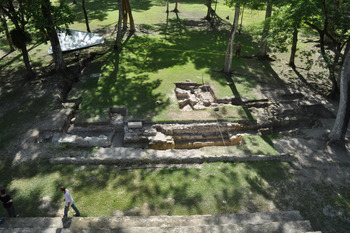
Exposed architecture of Structure B8/2nd (west façade), with earlier construction phases exposed in middle. (Color online)

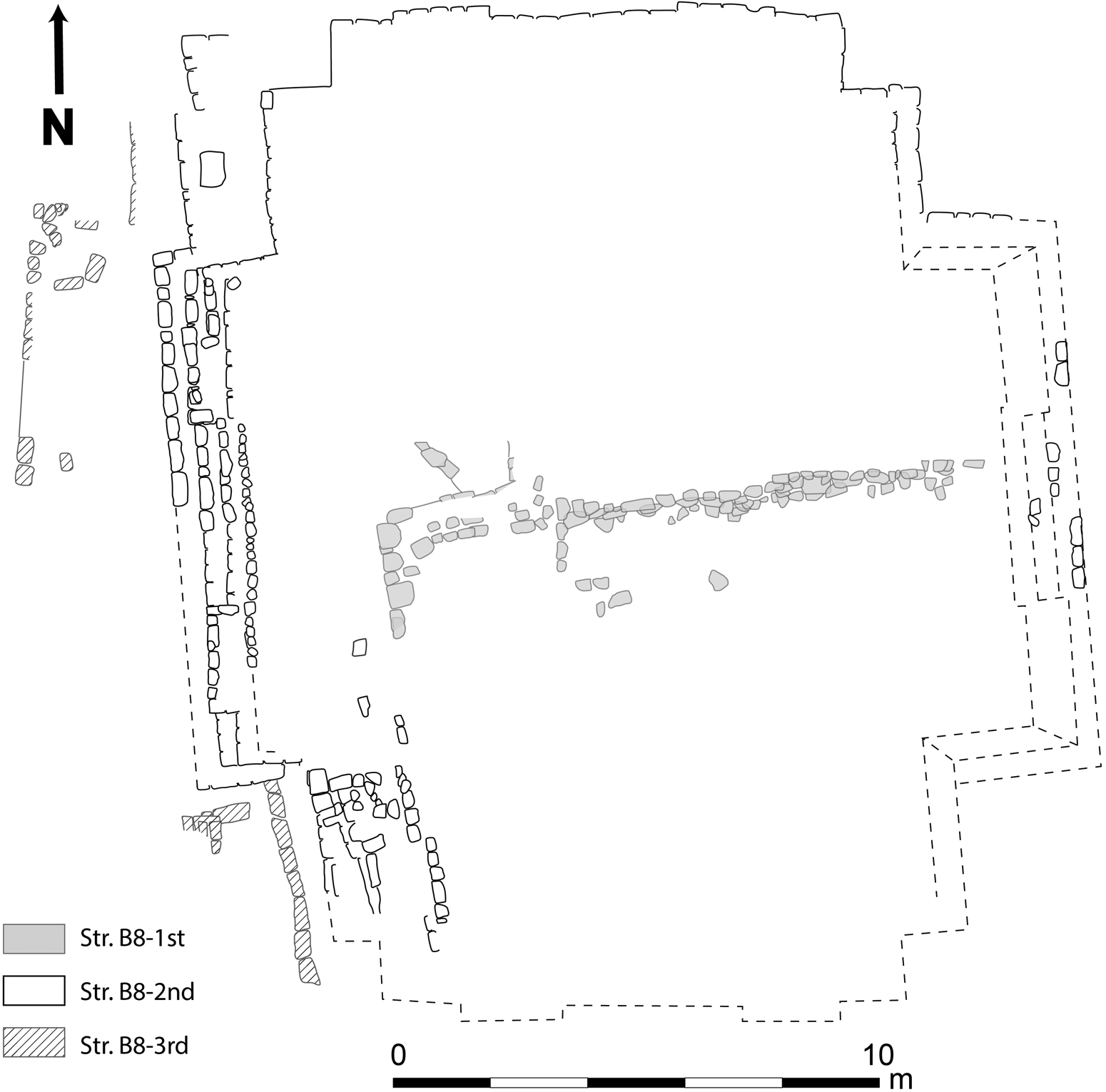
Horizontal excavations in 2018 and 2019 (115 m2) continued exposing Structure B8 to determine its dimensions and function. The west façade was completely exposed, measuring 20 m north to south (Figure 4). Although the southern extent of the west façade was poorly preserved, the north side was intact. This part of the building was composed of three to five courses of cut stone blocks and measured approximately 1.5 m tall. The northern façade of Structure B8 was also well preserved, measuring approximately 12.5 m in length. The 2019 excavations revealed that the eastern façade of the structure was very poorly preserved, though it may have originally had a central stairway. It also appears that Structure B8 was taller than it currently stands. The presence of megalithic blocks on top of intact architecture suggests that the upper section of the structure was torn down and used as fill to facilitate expansion of Plaza B in the Late Preclassic, similar to other E-Group construction histories in the Petén, such as at San Bartolo (Saturno et al. Reference Saturno, Beltrán, Rossi, Freidel, Chase, Dowd and Murdock2017). This partial destruction of Structure B8 also explains the poor preservation of the building's eastern side.
Plan map of Structure B8 excavations.

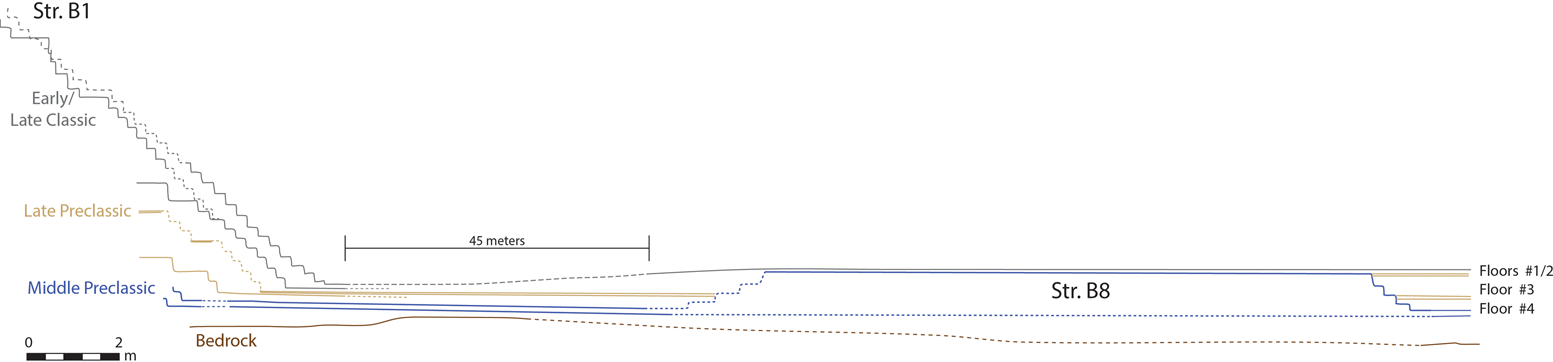
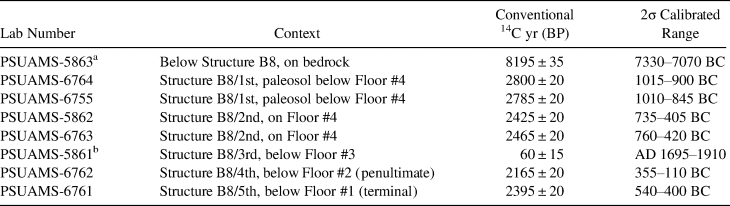
AMS 14C dating provides a precise chronology for the five construction phases of Structure B8 (Table 1 and Figure 5; see Ebert et al. Reference Ebert, McGee, Dudash and Porter2019). Because no primary deposits, such as caches or burials, were encountered during excavations, charcoal samples were collected from fill inside the platform and analyzed at the Penn State Radiocarbon Facility (Ebert and McGee Reference Ebert and McGee2020:8). Although the earliest date, which was sampled on top of the bedrock (PSUAMS-5863), is too early for the context, dates for Structure B8/1st indicate initial construction after 1000 cal BC, consistent with construction histories for other Preclassic buildings at Cahal Pech. Dates indicate that Structure B8/2nd, the most substantial phase of construction, occurred between ~735 and 405 cal BC. High frequencies of Middle Preclassic Mars Orange sherds, along with a few Early Preclassic (1200–900 cal BC) Cunil sherds in the building's fill, are consistent with these dates. The structure underwent subsequent modifications after this time, but dates for Structure B8/3rd–5th are more difficult to determine. These contexts are just below the modern ground surface at Cahal Pech, an archaeological park with heavy foot traffic, and they have experienced considerable bioturbation resulting in contextual mixing. Very few Late Preclassic sherds were recovered from excavations, however, suggesting that its construction had likely ceased by this time.
Plaza B profile showing associations between Middle Preclassic components of Structure B1 and Structure B8. (Color online)

AMS Radiocarbon Dates from Structure B8 Excavations.

a Date too early for the context.
b Date too late for the context.
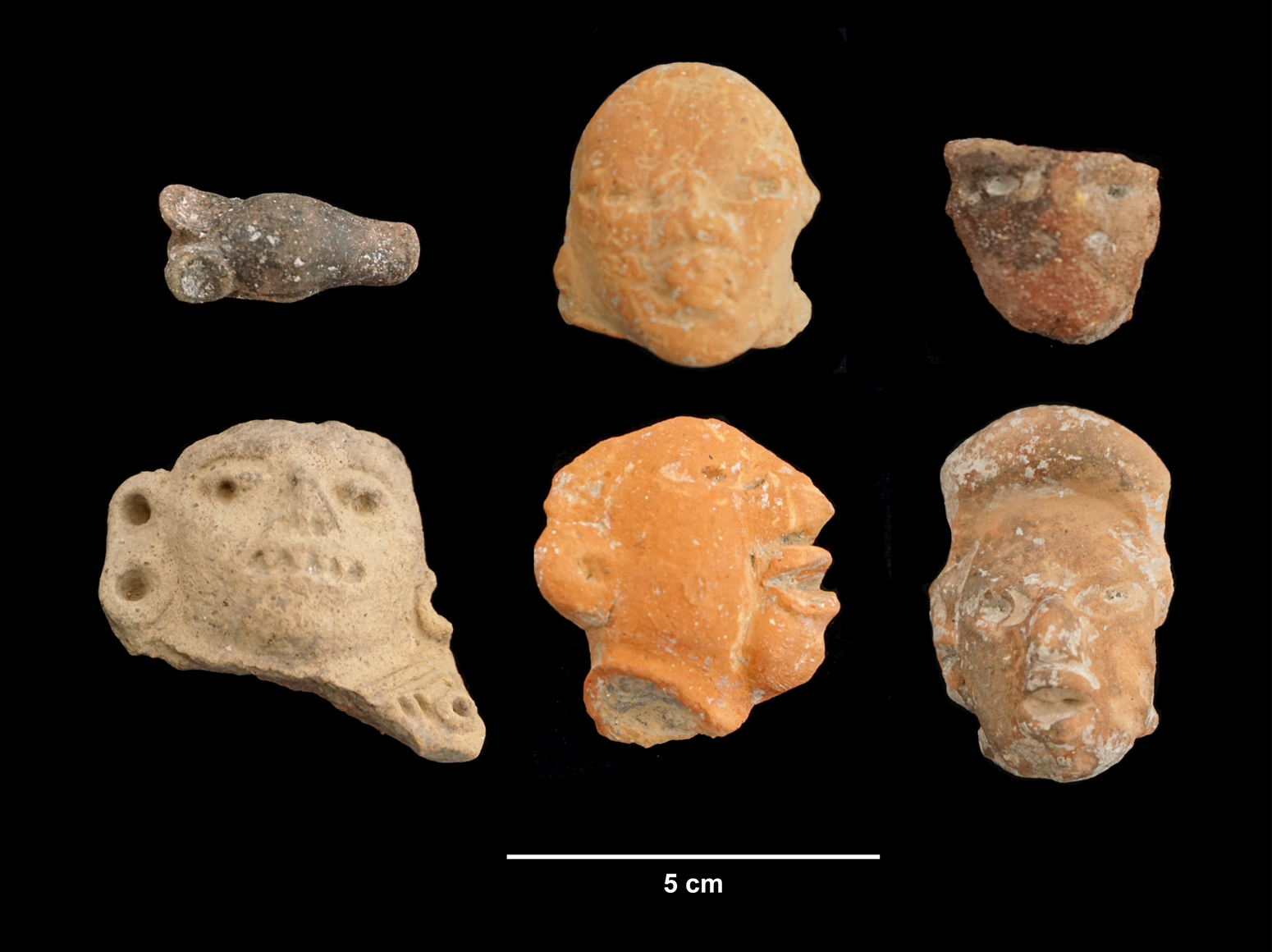
The Middle Preclassic artifact assemblage, associated with Structure B8/2nd, includes figurines and lithic materials and faunal remains indicative of local craft production. A total of 32 figurine fragments, including zoomorphic figures and human heads, torsos, and other appendages, were recovered, the majority resembling Mars Orange pastes (Figure 5). High frequencies of chert microdrills (n = 396) made from burin spalls modified into bi-tipped tools were also recovered; they were previously identified as part of the tool kit for marine shell bead production in the Belize Valley (e.g., Hohmann et al. Reference Hohmann, Powis, Healy, Kathryn Brown and Bey2018:133). Finished shell beads (n = 29) in different stages of the production sequence were also found in association with Structure B8, as well as more than 300 pieces of micro-debitage and unshaped shell fragments with drilled holes (Figure 6). Shell artifacts include Caribbean Sea species Lobatus gigas (Queen conch) and Strombus alatus (Florida fighting conch; Chrissina Burke, personal communication 2019). Because of the high frequencies of these artifacts, we suggest that the location of the building may have been used as a shell bead production site.
Examples of figurines from Structure B8. (Color online)

Discussion and Conclusions
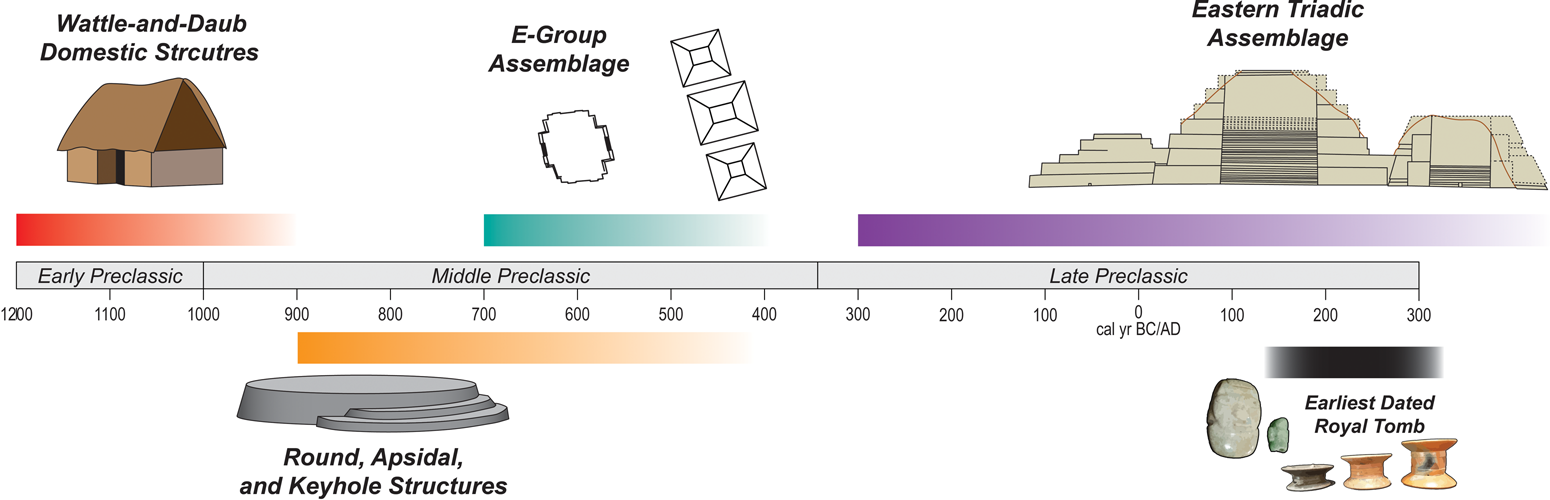
Before our 2017 excavations, little was known about the presence, let alone the form or function, of any Middle Preclassic platform on the far west side of Plaza B at Cahal Pech. Based on results from the 2017–2019 field seasons, we hypothesize that Structure B8 functioned as the western structure of a Uaxactun-style E-Group, which complemented an eastern component of the assemblage deeply buried below the site's Classic period Triadic Assemblage. Documentation of Structure B8, along with previous excavation data, allows us to create a precise chronology for the development of monumentality at Cahal Pech (Figure 7). The earliest architecture at Cahal Pech (Cunil ceramic phase) consisted of a series of superimposed living surfaces composed of tamped earth floors supporting wattle-and-daub superstructures (Awe Reference Awe1992; Peniche May Reference Peniche May2016). These domestic buildings were radiocarbon dated to ~1200–1000 cal BC (Ebert et al. Reference Ebert, May, Culleton, Awe and Kennett2017).
Chronology for monumentality at Cahal Pech. (Color online)

Public buildings replaced small domestic structures beginning around 900 cal BC, when the Middle Preclassic inhabitants of Cahal Pech invested in the construction of formal masonry buildings. Excavations and 14C dating document the construction of larger temple structures by 750 cal BC (Ebert et al. Reference Ebert, May, Culleton, Awe and Kennett2017). Relative ceramic dates place the first architectural phase of Structure B1 (the central structure of the eastern shrine) to this time (Awe et al. Reference Awe, Hoggarth, Aimers, Freidel, Chase, Dowd and Murdock2017). This is also when the initial construction of Structure B8 began, suggesting that the buildings were built concurrently as a single assemblage. In addition, the presence of this building indicates that elements of Uaxatun-style E-Group architecture, including radial western platforms, were more widespread in the Belize Valley than previously thought, indicating significant connections with neighboring subregions of the Maya Lowlands.
At the beginning of the Late Preclassic, Plaza B was expanded. It is at this time when we suggest that the focus shifted from the E-Group assemblage to the Eastern Triadic Assemblage on the east side of Plaza B, resulting in the partial destruction and interment of Structure B8. In addition to the reorganization of public architecture at Cahal Pech, other artifacts recovered in association with Structure B8 reflect changes in social and community organization from the Middle to Late Preclassic. Figurines become less common during the Late Preclassic (Peniche May et al. Reference Peniche May, DeLance and Awe2018) and were replaced by large stucco masks and monuments that were placed in front of temple structures. These shifts are contemporaneous with the construction of the largest monumental buildings at Cahal Pech, suggesting that elites began to use art and architecture to publicly manifest and display their more elevated status in the society. Therefore, architectural shifts in the Late Preclassic are likely linked to the formalization of dynastic rulership, when communally oriented ritual space was replaced by an elite shrine (Eastern Triadic Assemblage) and by buildings demarcating private elite space (Brown Reference Brown, Freidel, Chase, Dowd and Murdock2017). Direct dating of the earliest royal burial at Cahal Pech suggests these changes were firmly in place by at least ~cal AD 150–300 (Novotny et al. Reference Novotny, Awe, Santasillia and Knudson2018). Excavations of Middle Preclassic monumental buildings, like Structure B8, aid in documenting the origins of monumentality and its relationship with the development of dynastic traditions. Future excavations will systematically target additional components of Cahal Pech's E-Group to document its construction history more precisely.
Acknowledgments
The 2017–2019 Cahal Pech excavations were conducted with permission from the Belize Institute of Archaeology and were made possible by the invaluable assistance of Lewis Adib, Eric Carbajal, Krystal Dudash, Mairi Iko, Kenney Mendez, Horace “Alex” Smith, Cole Towers, Jules Towers, John Waight, and BVAR students. Financial support was provided by the Rust Family Foundation and the Tilden Family Foundation.
Data Availability Statement
Open-access published field reports (2017–2019 field seasons) can be found at https://www.bvar.org/publications. Original field notes, drawings, and photographs are curated by BVAR and available on request.