




No CrossRef data available.
Article contents
- Abstract
- WHY IS THE GREAT BALLCOURT SO LARGE?
- MIXTECA-PUEBLA INVESTITURE RITUALS
- INVESTITURE AT CHICHEN
- PRESENTATION OF POWER OBJECTS
- THE CHICHEN “EFFIGY”
- INVESTITURE RITUALS DEPICTED IN THE NORTH TEMPLE
- EVENTS NOT DEPICTED IN THE NORTH TEMPLE
- POLITICAL ORGANIZATION AT CHICHEN
- CONCLUSIONS
- RESUMEN
- ACKNOWLEDGMENTS
- References
ON THE POLITICAL ORGANIZATION OF CHICHEN ITZA
Published online by Cambridge University Press: 01 July 2004
Article contents
- Abstract
- WHY IS THE GREAT BALLCOURT SO LARGE?
- MIXTECA-PUEBLA INVESTITURE RITUALS
- INVESTITURE AT CHICHEN
- PRESENTATION OF POWER OBJECTS
- THE CHICHEN “EFFIGY”
- INVESTITURE RITUALS DEPICTED IN THE NORTH TEMPLE
- EVENTS NOT DEPICTED IN THE NORTH TEMPLE
- POLITICAL ORGANIZATION AT CHICHEN
- CONCLUSIONS
- RESUMEN
- ACKNOWLEDGMENTS
- References
Abstract
This paper argues that what we and others have termed a “cult of Quetzalcoatl” is more properly viewed as a set of imagery, beliefs, and practices associated with an ideology of leadership. Examination of the architecture and iconography of Chichen Itza and related sites with feathered serpent iconography suggests that these practices were similarly structured and played a similar role in many of Mesoamerica's Tollans, specifically in the investiture of client elites. Many of the structures of the Gran Nivelación of Chichen Itza, particularly the Great Ballcourt, were the loci of such rituals of investiture, especially its military aspect. This common ritual structure supports the idea that Quetzalcoatl may have been central to institutions unifying Mesoamerica from the time of Teotihuacan onward, if not earlier.
Information
- Type
- Research Article
- Information
- Copyright
- © 2004 Cambridge University Press
And when they arrived/Before the lord/Nacxit was the name of the great lord/The sole judge/Of a huge jurisdiction/And it was he who gave out the signs of authority/All the insignia [Edmonson 1971:LL:7280–7285].
The whole alleged story of the Toltecs is merely an euhemerized myth, and they are as pure creations of the fancy as the giants and fairies of mediaeval romance. They have no business in the pages of sober history [Brinton 1885:11].
As with so many aspects of this most atypical of Maya sites, the political organization of Chichen Itza has long been a subject of contention. The controversy can arguably be traced to our earliest source on the topic, Bishop Diego de Landa, whose narrative includes two quite different accounts of the origin of Chichen. The first concerns the story of three brothers who, coming from the west, founded many of the temples of the town and were “very religious and chaste.” Ultimately one brother left or died, after which the behavior of the other two degenerated to the point that they were eventually put to death (Landa 1978:12; Tozzer 1941:19, 177). Immediately following is a quite different account, attributing the establishment and rulership of the city to K′uk′ulkan, the Yucatec equivalent of Quetzalcoatl. K′uk′ulkan likewise came from the west and was revered “for being a great statesman, which can be seen in the order that he created in Yucatán after the death of the lords to mitigate the dissension in the land caused by their deaths” (Landa 1978:13).
These two stories foreshadow the extremes of modern scholarly opinion, from those who maintain Chichen was governed by a monarchy to those favoring councilor rule. Holders of the former point of view cite the numerous stories concerning the valorous captain K′ak′ u Pakal in López Cogolludo (1957:I:196), several Relaciones de Yucatán (Garza et al. 1983:I:181, 199, 215, 269, 305), and the Chilam Balam of Chumayel (e.g., Edmonson 1986:l. 298). The discovery of this name in the inscriptions of Chichen by David Kelley (1968) indicated that later sources may have preserved garbled fragments of the life of an actual leader of Chichen at its apogee or, perhaps, those of a later eponymous warrior. K′ak′ u Pakal is arguably the most prominent individual mentioned in the hieroglyphic texts of Chichen, further supporting centralized rule. Others in this camp would agree with Bartolomé de Las Casas's comments concerning Cholula, where he argued that rule by council would have been too unwieldy and divisive for so large a community (Las Casas 1979:178).
For those at the opposite extreme, the story of the three brothers is suggestive of the rule of mul tepal (“joint rule”) at the Late Postclassic site of Mayapan. They note the absence of any clear depictions of a paramount in the public art of Chichen, as well as the lack of conventional dynastic history in its inscriptions, both in strong contrast to the southern lowlands. This perspective received epigraphic support in the 1980s from an interpretation of the yitah glyph. Commonly placed between two individuals at Chichen, it was initially interpreted as “brother” or “sibling” (David Stuart, as quoted in Schele and Freidel 1990:449, Note 55; Schele 1989). Krochock (Krochock and Freidel 1994) and especially Linda Schele and David Freidel argue that this essentially confirmed Landa's first account.
Like the conqueror kings in the southern lowlands, the Itza lords sought to break out of the limitations imposed by many small, competing realms. The way they accomplished this was to forge a conquest state and hegemonic empire with its capital, Chichen Itza, in the center of the north. This city witnessed the birth of a social and political order based upon a new principle of governance, mul tepal, “joint rule” [Schele and Freidel 1990:348].
Stephen Houston, John Robertson, and David Stuart have since rejected this interpretation of the yitah glyph, suggesting instead that it has the general sense of “witnessing” or “overseeing,” and have argued that many of the individuals mentioned in the Chichen texts are in fact deities (Houston 2000:177; Houston et al. 2000:335; Stuart 2000:483, 508, Note 12; Stuart et al. 1999:196–198). Furthermore, the evidence for mul tepal at Mayapan is also suspect, since the earliest accounts speak of Mayapan as a monarchy (Ringle and Bey 2001:273–275; see also Jones 1998:104–105). Thus, relationships between the individuals at Chichen must once again be questioned. Nevertheless, the unusual emphasis on assemblies and processions at Chichen demands explanation.
Although agreeing that Chichen was the start of a “new order,” Charles Lincoln (1988, 1990, 1994) has staked out a quite different position in claiming evidence for dual leadership at Chichen. Following up on a pattern first noticed by Eduard Seler (1998 [1904]; see also Miller 1977), Lincoln based his structuralist interpretation of Chichen on several depictions of paired, opposing figures (“Captain Serpent” and “Captain Sun Disk”) in some of the most prominent locations of “New” Chichen, including the lintel and murals of the Upper Temple of the Jaguars (Maudslay's Temple A; UTJ), the reliefs of the Lower Temple of the Jaguars (Maudslay's Temple B; LTJ), the lintels of the Castillo, and the Temple of the Wall Panel. The paired figures (Figure 1a), one in a sun disk and the other surrounded by a feathered serpent, Lincoln believes, may be further identified with the Hero Twins, with the later Aztec pairing of Quetzalcoatl and Tezcatlipoca, but most particularly with K′uk′ulcan and K′ak′u Pakal (following a passage in López Cogolludo 1957:I; 196–197).

Lintel of the UTJ (Maudslay 1974:III:Plate 35; underside from Seler 1998[1904]:VI:Figure 121b).
Lincoln emphatically argued for the local origin for Chichen's social order and iconography:
[T]he cultural and social formations at Chichen Itza are entirely indigenous to Yucatan, and in no way reflect invasions, migrations, or one-way diffusions from Central Mexico…. The data … support the proposition that, in fact, Tula, El Tajín, Xochicalco, Mitla, and other Highland sites could have participated with Chichen Itza in an archaeological “horizon” or interaction sphere where material goods and significant ideas were exchanged on a regular and continuing basis [Lincoln 1988].
In similar fashion, the discussions of the Great Ballcourt at Chichen by Schele, Freidel, Ruth Krochock, and Peter Mathews are at pains to establish the essential “Maya-ness” of its symbolism (Freidel et al. 1993; Krochock and Freidel 1994; Schele and Freidel 1990; Schele and Mathews 1998), providing a valuable corrective to earlier emphases on external influence. But while acknowledging iconographic references to other parts of Mesoamerica, they leave the reasons behind these allusions largely unexplored.
A related problem concerns the extent of Chichen's political influence. Before the 1990s, a number of scholars argued that Chichen dominated the entire peninsula during the Early Postclassic, perhaps through the conquest and destruction of the Terminal Classic cities of the north. Because Chichen's apogee is now widely believed to have been earlier, between roughly a.d. 800 and a.d. 1050, and because archaeological evidence for Itza presence elsewhere on the peninsula is generally rather slight, a much reduced role for Chichen in the events of the period is now espoused by some workers in the region. For instance, in the nearby center of Ek Balam, about 52 km from Chichen, only a handful of the nearly 300,000 sherds belonged to the Itza production sphere (Bey et al. 1998).
Recently we (Ringle et al. 1998) have revived the possibility that a state cult devoted to Quetzalcoatl may have been the basis for the iconographic allusions just mentioned, a cult with strong ties to militarism, long-distance trade, and perhaps pilgrimage. We argued that certain Epiclassic cities, particularly Cholula, El Tajín, Xochicalco, and Chichen Itza, were major cult centers, and that the cult may have been an emergent institution cross-cutting traditional political and ethnic boundaries (see also López Austin and López Luján 2000:68). Participation in the cult fostered the import of elite goods of various sorts and provided a network of potential military allies. In more recent work, we have traced out the southern extension of this route (Ringle 1999) and discussed the question of Tula's relationship with Chichen (Bey and Ringle 2000).
Shortly after our original publication, Alfredo López Austin and Leonardo López Lujan (1999, 2000) published an excellent study with many points in common with our own but also suggesting important new avenues for investigation. One important point they raise is the political context of what they refer to as the Zuyuan tradition. As Susan Gillespie (1989:177) notes, “[T]he relationship linking Quetzalcoatl to the legitimation of kingship and to ennobling Toltecs was not confined to Aztec culture but was a more generalized Mesoamerican phenomenon.” This tradition can be characterized by “the rule of one or more sovereigns who embodied the force of the Feathered Serpent god … ; the consecration of royal power by means of a ceremony officiated in sanctuaries identified with the mythical place of origin; and a specific, common cult that held the different military orders together.” (López Austin and López Luján 2000:68). Although their focus is primarily on the hermeneutics of the mythic and ethnohistorical tradition, and although the model presented later differs significantly in specifics, we are clearly moving in the same general direction.
In this essay, I demonstrate how the political structure of Chichen Itza may be illuminated by striking a middle ground between the interpretive polarities mentioned earlier. It is my contention that discussions of Itza (and Toltec) power have been unduly unidimensional, emphasizing military conquest to the virtual exclusion of other possibilities. My views have been particularly influenced by ethnohistorical descriptions of Cholula, the center of Quetzalcoatl worship during the Postclassic period and perhaps much earlier. One of Cholula's key sources of power was authority over rituals of legitimation, as is clearly stated by the sixteenth-century chronicler Gabriel de Rojas (1927 [1581]) in a passage with direct relevance to Chichen:
[T]hese two [the aquiach and tlalquiach] were the ones that governed all the republic and from this religion [of Quetzalcoatl] came the captains named by the (a)quiach and tlalquiach when they happened to war with their neighbors, just as these two priests were preeminent in confirming in office all the governors and kings of this New Spain. Thus, these kings or chiefs [from outside Cholula], in inheriting a kingdom or principality, would come to this city to pay homage to the idol of this Quetzalcoatl, to whom they offered rich feathers, blankets, gold, and precious stones and other things of value, and having made offerings, they were put in a small room dedicated to this purpose in which the two highest priests marked them by piercing the ears, the nostrils, or the lower lip, depending on the kingdom, and they returned to their lands. And because of such things they were given credit and were respected by these lords. So that they might be respected by these lords, five indios from the priesthood also accompanied them home [Rojas 1927 (1581):161; my translation].
As Michael Lind (1992) points out in an unpublished paper, and as will be discussed later, Cholula's ritual authority and political influence extended over a far wider field than did its zone of direct political control. It is not accidental, therefore, that some of the earliest historians drew explicit comparisons between the Holy Roman Empire and Cholula.
A very similar role is attributed to “Tulan” in several of the Quiche and Cakchiquel chronicles (Carmack 1968). In these stories, the original migrants stop at (or return to) Tulan to receive insignias of rule from a leader called Nacxit, a Nahuatl name for Quetzalcoatl also mentioned in the Books of Chilam Balam as a leader of both Chichen and Mayapan. Adrián Recinos et al. (1953:221), Robert Carmack (1968, 1973), and John Fox (1987:19), among others, have suggested that the Chontalpa, Mayapan, or Chichen Itza may be the referent, despite chronological difficulties with the last and the consistent description of Tulan as east and over the water from the Quiche heartland. Yet two virtually identical passages from the Relación de Tekanto y Tipikan and the Relación de Izamal y Santa María provide a striking complement to the highland chronicles:
At one time all this land was under the dominion of a lord residing in the ancient city of Chichen Itza, to whom all the lords of this province were tributaries, and even beyond it. From Mexico, Guatemala, and Chiapas and other provinces they sent them presents as a mark of peace and friendship…. The tribute they each paid was a chicken and some honey and some pieces of cloth (?), a small amount of clothing, but they personally served the lords in wars when requested [Garza et al. 1983:I:305–306; my translation].1
Postclassic highland groups may have made visits to a post-fluorescent Chichen Itza. Another possibility is that Cotzumalhuapa is the area identified as “Guatemala,” since artifacts from that area found their way into the Sacred Cenote (Coggins and Shane 1984:Number 39). In any case, the ritual patterns may well derive historically from Chichen.
Also of great importance are the emblems and rituals signifying Toltec rulership listed in several of the highland chronicles. Client elites underwent the same nose-piercing rite mentioned earlier; others will be mentioned later.
Obviously, the demonstration of a common organization to these centers would considerably strengthen the hypothesis of a Quetzalcoatl cult. The section below will argue that such similarities can be seen in investiture rituals—that is, confirmation rituals by an overlord of lesser individuals not necessarily from the same community. These rituals are central to interpreting “New” Chichen, that part of Chichen's public architecture built on an extensive artificial terrace (the Gran Nivelación) and formerly thought to reflect its Toltec occupation (“Toltec” in the sense of being directly derived from Tula, Hidalgo, during the Early Postclassic). In contrast, I believe that the strong iconographic parallels between the Chichen rites and those mentioned in ethnohistorical sources and in the codices from the Mixteca-Puebla area are equally, if not more, important. Furthermore, several buildings of the Gran Nivelación can plausibly be linked to stations in such rites. Since the integration of several distinct cultural traditions within the cult probably demanded considerable assimilation of local ideologies, and since my examples extend over roughly 1,300 years, it may be expected that these rituals are by no means identical. Nevertheless, the parallels are sufficiently strong to see a common thread linking these major centers, a commonality I would attribute to the paramount role played by the Quetzalcoatl priesthood in the governance of these centers and to the centrality of Quetzalcoatl in Mesoamerican ideologies of rulership.
One obvious difficulty is that, although Mixteca-Puebla codices claim to represent events of the ninth and tenth centuries, several Late Postclassic anachronisms may have crept in. Thus, any similarities we may point to may be due less to shared Epiclassic practices than to later Postclassic Central Mexican influence (true also for the Quiche accounts). Given the scarcity of Epiclassic archaeological evidence from Cholula and the Mixteca, it is difficult to allay these doubts, but a third putative cult center provides some contemporary support: El Tajín, Veracruz. Earlier scholars noted resemblances between the sculptures of the South Ballcourt and Chichen's Great Ballcourt, but Rex Koontz's (1994) pioneering study is the first to provide a coherent interpretive framework for the major sculpture of El Tajín.2
Koontz's study relies on Michael Kampen's (1972) drawings of the El Tajín reliefs. Since then, Patricia Castillo Peña (1995) has published a more complete corpus supplying details missing in Kampen's drawings, although it omits a few important monuments not currently at Tajín. Ladrón de Guevara (1999) also provides a number of important observations.
WHY IS THE GREAT BALLCOURT SO LARGE?
One objection to Lincoln's theory of dual rule is that, while in some cases “Captain Sun Disk” and “Captain Serpent” are paired, in many more cases several figures are accompanied by feathered serpents. As will be seen, Quetzalcoatl infused every aspect of Chichen's leadership, so that on one level it is impossible to speak of a secular aspect to its government. Membership in this order is the essential message of accompanying feathered serpents. Furthermore, it will be demonstrated that the story told on the walls of the Great Ballcourt, Chichen Itza, Structure 2D1 (GBC), concerns a paradigmatic investiture into the order. Thus, rather than a god, the youthful “Captain Feathered Serpent” of the UTJ lintel is instead this initiate. And, as will be discussed, here he faces not a ruler but a solar deity or, as Schele and Mathews (1998) have argued, some sort of ancestral figure. On other occasions, images of this deity probably represent battle standards or banners, but he is not to be considered a mortal actor.
With regard to investiture, one image from the Great Ballcourt is particularly striking. There, at the terminus of the north–south axis of what is undoubtedly one of the most important structures at Chichen (and the largest ballcourt in Mesoamerica), lies the North Temple of the Great Ballcourt, Chichen Itza, Mausdlay's Temple C (NT; Figure 2), a building whose interior was entirely covered by reliefs.3
There is no canonical set of drawings of the North Temple. Adela Breton (1917) published drawings and tracings made on photos of some sections of the reliefs. Unpublished colored versions are in the collections of the Bristol Museum and Art Gallery (Sue Giles, personal communication 2003). Ignacio Marquina (1964:Plates 439–441) published a set of drawings of the north wall and vault by Fernández. Wren (in Wren and Schmidt 1991) published another, more complete set of all surviving fragments. Schele's drawings (in Freidel et al. 1993 and Schele and Mathews 1998) reproduce some of Wren's but seem to rely on Fernández for the north wall and vault. All of these differ in important details.

Map of the Great Ballcourt (Breton 1917:Plate I, after Maudslay 1974:III:Plate 26).

Relief, north wall of the NT (Wren and Schmidt 1991:Figure 9.8; drawing by Linnea Wren).
The entire Great Ballcourt, I would argue, owed its monumentality precisely to the role it played in investiture rituals and possibly was less a functioning court than an immense effigy of one, as its impossibly high ballcourt rings might suggest. It was, in effect, a large arena for legitimating leaders who were not necessarily local. Although Maya rulers frequently identify themselves as ballplayers, a specific role for the ballgame in Maya accession rites is not attested (but see Smith et al. 2005). To understand why an investiture scene was placed within the GBC we must instead turn to the traditions mentioned earlier, beginning with the Mixteca-Puebla region. Although Wren (1994) argues that the reliefs find general parallels in Aztec investiture rituals, much more specific parallels can be identified in manuscripts from the Puebla-Tlaxcala area, as well as in the Mixtec codices, the subjects of which had very clear political ties to Cholula (Byland and Pohl 1994:138–151). This is not to deny Wren's point. Rather, it is to suggest that all of these rites reflect a broader tradition of kingship of which the Aztecs were only a late manifestation.
MIXTECA-PUEBLA INVESTITURE RITUALS
Versions of these investiture rites are illustrated in the Historia Tolteca-Chichimeca, in the Mixtec codices (particularly events in the life of Lord 8 Deer “Jaguar Claw”; Table 1), but their most extensive treatment can be found on Folios 29–46 of the Codex Borgia. Eduard Seler (1963 [1904]:II:Chapter 13, esp. 9–10) interpreted this section of the Codex Borgia as an allegory of the “experiences” of the planet Venus, much as the motions of that body were personified in the life of Topiltzin Quetzalcoatl. In Seler's (1963 [1904]:10) view, Folio 29 depicts the death of the Morning Star; Folios 30–32, its voyage through the Underworld to its eventual emergence in the west; Folios 33–38, Venus's path through the evening sky in the footsteps of the sun; Folios 39–40, its second descent into the earth; Folios 40–44, the subsequent voyage through the subterranean world; and Folios 45–46, its re-emergence with the sun in the east.
Parallels between accession events

In contrast, Bruce Byland and John Pohl (1994:151–160; Byland 1993:xxiii–xxvi) present considerable evidence that Folios 35–46 are on one level a schematic for accession or investiture rituals involving a circuit among the several structures of a ceremonial precinct. As evidence that these were “real world” rites, they convincingly point to parallels in the events leading to 8 Deer's assumption of power in the Codex Nuttall (Byland and Pohl 1994:157–159). The events include: (a) the bringing of a sacred bundle out of the Temple of Heaven; (b) the playing of a ritual ballgame; (c) the opening of the sacred bundle; (d) a sacrifice of the sun; (e) a journey across a body of water; (f) fire drilling; (g) visit to five sacred directional trees; and (h) spear/arrow sacrifice. Others may be suggested, such as bathing and/or sweatbath rituals, acts of human sacrifice, and tzompantli rituals.
Rather than identifying the Codex Borgia protagonist as Quetzalcoatl, Byland and Pohl prefer the more neutral name of “Stripe Eye” for the protagonist (Figure 4) and restrict themselves to that part taking place in the terrestrial sphere (Folios 33–46), although they extend this section as far as Folio 52.
The angular black stripe … is a variant of the facial painting of Quetzalcoatl. Seler (1904–1909) noted that this character is the subject of a continuous story that runs through this [Folio 36] and the next nine pages of the codex. Seler identified Stripe Eye as Quetzalcoatl, failing to recognize that he was different from other Quetzalcoatl figures in the passage. While it is indeed possible that he is meant to represent Quetzalcoatl, the nature of his behavior also suggests that he is the idealized king of this ceremonial center [Byland 1993:xxiv].
Nevertheless, the formal parallels between the Underworld (Folios 29–32) and Terrestrial (Folios 33–46) sections are undeniable, as Byland and Pohl recognize. Especially prominent is the device of organizing events within elaborate rectangular enclosures, each connected to the next by a figure emerging through the midsection of a tzitzimitl-like reclining figure.

(a) “Stripe Eye,” Codex Borgia, Folio 35 (Diáz and Rodgers 1993); (b) “Red Mouth,” Codex Borgia, Folio 46 (Diáz and Rodgers 1993).
In my view, the interpretation of the Terrestrial section can be fruitfully extended by linking it to the Underworld section. Although most recent commentators have not followed Seler's astral interpretation, his core observation of the centrality of Quetzalcoatl to the entire passage remains valid. I believe that the events of the two sections ultimately trace a theme of death and rebirth with direct application to the body of the ruler, precisely because Quetzalcoatl embodied kingship and the ruler was himself an avatar of Quetzalcoatl. Thus, on one level, this section of the Codex Borgia is a paradigmatic explanation of the mystery of divine kingship, reconciling human mortality with the persistence of that office through the reincarnation of the spirit of kingship in successive rulers.
Seler (1963 [1904]:10) identified the inaugural central image of Folio 29 (Figure 5) as a funerary basin bearing the mounded ashes of the deceased Morning Star. From the black mass of ashes a number of serpents with Ehecatl heads emerge bearing stars on their bodies. Above the mass of ashes is a skeletal figure whose torso is covered by four black bows and on whose head is the headdress of Tlahuizcalpantecuhtli, the lord of the Morning Star and an aspect of Quetzalcoatl. The whole, Seler believed, could be interpreted as a mortuary bundle. Although the facial paint and headdress differ from most of the examples of Quetzalcoatl or Tlahuizcalpantecuhtli (cf. Spranz 1982:144–149, 249–253), these differences can be attributed to the mortuary context, for later in the section (Folios 41, 42, and 45) we see skeletal figures very similar to the one on Folio 29, with similar facial markings, but now with red and white body paint and undoubted Quetzalcoatl/Tlahuizcalpantecuhtli costume elements such as the conical hat, the Quetzalcoatl neck ornament, and the horizontal paired sashes in the usual colors. Therefore, I believe that Seler was correct in identifying the mass on page 29 as a mortuary bundle with Quetzalcoatl associations, with the caveat that it is also to be taken as a (paradigmatic) royal burial.

Possible mortuary bundle, Codex Borgia, Folio 29 (Anders et al. 1993:193).
But, as Byland and Pohl note, there are several other Quetzalcoatl figures in Folios 29–46 (Figure 6). It might also be objected that Stripe Eye does not appear at all in the Underworld section, only appearing on Folio 35 and after. But examination of the common structural position of these figures indicates their homology, since each exits from the split torso of a tzitzimitl-like figure, marking the transition from enclosure to enclosure. All can be shown to be versions of Quetzalcoatl, and rather than being distinct actors, they probably represent various stages in the death and regeneration of that deity.

Avatars of Quetzalcoatl, Codex Borgia, Folios 29–46 (Diáaz and Rodgers 1993).
Particularly important is the figure culminating the Underworld series on Folio 32 and the terrestrial section on Folio 46, where he appears twice. This figure, whom I shall refer to as “Red Mouth,” is marked by a vertical tan band across the front of the face with black paint behind and red coloring around the mouth. He is without doubt an avatar of Quetzalcoatl (cf. Figure 6; Codex Borgia, Folios 9, 62). Significantly, several Mixtec leaders, including Lords 9 Wind, 12 Wind, and 8 Deer, employ identical face paint (e.g., Nuttall 1975:Folios 15, 19, 76), suggesting they are in some sense embodiments of Quetzalcoatl. As Byland and Pohl (1994:160) suggest, in going through a similar set of trials in the Codex Nuttall, 8 Deer is “emulating the activities of the culture hero 9 Wind Flint Helmet in his original sacred founding and distribution of the land.” Furthermore, Red Mouth's birth-like emergence from twin flint blades and from the flint-blade heart of the striped individual in the center of Folio 32 recalls 9 Wind-Quetzalcoatl's birth from a flint blade on Codex Vindobonensis, Folio 49.
One final structural parallel links the Underworld and Terrestrial sections, and that is the strong graphic resemblance between the emanations (decomposition?) of the mortuary bundle and those resulting from the opening of the sacred bundle on Folio 36 (Figure 7). The “ashes” of the first and the black cloud of the second are marked by identical black spirals and semicircles and by star markings. Ehecatl serpents emitting ehecatl figures issue from both, and both initiate the series of passages from enclosure to enclosure (the series appears to be interrupted by “background” terrestrial preparations on Folios 33–35). This suggests that the ritual bundle symbolically functioned as the medium conveying the spirit of kingship from the dead king's body to his successor and may even have contained ashes of the dead incumbent.

Opening of the ritual bundle, Codex Borgia, Folio 36 (Anders et al. 1993:213; compare with Figure 5).
INVESTITURE AT CHICHEN
The regeneration of leadership via the spirit Quetzalcoatl is the grand overarching theme of the Great Ballcourt and associated structures of the Gran Nivelación, Chichen Itza (Figure 8). In this program, investiture is the central ritual for instilling that spirit within the body of the new leader. (Perhaps this is the sense of Landa's comments concerning K′uk′ulkan's mediatory role on the death of lords quoted earlier.) In the NT, this passage from death to rebirth through succession is played out on the south and north walls. The partially preserved scene on its south vault (Figure 9b) shows an extended body—in my view, the deceased incumbent—laid out on a platform and clad in a shirt marked by crossed bones. Another section depicts what may be mortuary priests, also clad in skirts with crossed bones and facing a central feature that unfortunately has been lost. Loose blocks (Figure 9a) from the vault depict dancing skeletal figures (possibly even ballplayers), so there is little doubt that this side concerns funerary rituals.

Location of jaguar thrones, stone cists, benches, and chacmools within the Gran Nivelacion, Chichen Itza. Data from Acosta 1954; Bolles 1977; Breton 1917; Desmond and Messenger 1988; Maudslay 1974:II; Morris et al. 1931; Ruppert 1943, 1952). Base map from Ruppert 1943:Figure 1. Scale is in meters.

Relief fragments, south vault of NT (Wren and Schmidt 1991:Figures 9.6, 9.7; drawing by Linnea Wren).
In contrast, the north side (Figures 3 and 10) marks events in the land of the living. The activities framing investiture are depicted on the north vault and side walls of the NT, while the investiture itself occupies the entire north wall of the chamber. Extended corpses in Register 1 of the east wall and in the top register of the north vault may link these events to the funerary rituals of the south vault. But a more significant reference to death and regeneration is the recumbent individual lying below the investiture scene. This figure is similarly posed in the basal register of several compositions throughout the Great Ballcourt (Figure 11), always with a serpent, or pair of serpents, and often feathered, issuing from his midsection. Placement in the basal register in most compositions at Chichen indicates an otherworld location, so this figure is undoubtedly a supernatural or ancestor of some sort.

Versions of the relief on the north vault of NT: (a) Marquina 1964:Photographs 440–441 (drawing by Miguel Angel Fernández); (b) Wren and Schmidt 1991:Figure 9.9 (drawing by Linnea Wren); (c) Schele and Mathews 1998:Figure 6.51 (drawing by Linda Schele).

The recumbent deity figure of the Great Ballcourt, Chichen Itza: (a) Basal register, east wall, UTJ (Coggins and Shane 1984:Figure 17); (b) basal register, west wall, UTJ (Coggins and Shane 1984:Figure 19); (c) NT column (Schele and Mathews 1998:Figure 6.49); (d) South Temple of the Great Ballcourt, Chichen Itza (Maudslay's Temple B) west and east door jambs (Schele and Mathews 1998:Figure 6.42, left); (d) basal register, north wall of the NT (Schele and Mathews 1998:Figure 6.51).
This figure was identified as Chalchiutlicue by Seler (1998 [1904]:105) and as an Earth Goddess by Clemency Coggins (Coggins and Shane 1984:160) and Karl Taube (1994:216). Linda Schele and Peter Mathews (1998:236) argue that it is instead the male Maize God. It also seems to resemble the reclining tzitzimime of the Codex Borgia, from whose midsections Quetzalcoatl emerges in the investiture sequence. I believe that he is male, however, because kilts are frequently worn by male figures at Chichen. Two of the surviving seated “priests” of the Temple of the Chac Mool wear exactly the kilts worn by the recumbent figures at the base of the North Temple north column (Tozzer 1957:Figure 671). The NT figure's dress or long tunic consists of small circular plaques, each with a smaller plaque at the center. A similar jacket is worn by the figure standing above the empty jaguar throne, the figure about to be inaugurated into office. The supine figure, therefore, is perhaps identifiable as the deceased Quetzalcoatl or deceased king-as-Quetzalcoatl.
There is thus a double reference to kingly resurrection. The standing figure is the mortal successor to his deceased predecessor on the south vault, but he also, by virtue of his costume, marks the resurrection of the recumbent figure in the lower register. The vehicle and spirit of that transformation is Quetzalcoatl, just as in the Codex Borgia sequence, but here in the form of feathered serpents linking the otherworld with the investiture scene. In the mortal realm, the feathered serpents curling behind the figures sanctioning accession characterize the nature of the political transaction. In short, although outwardly very different, the intent of both this scene and the Codex Borgia passage is to provide a rationale for the re-embodiment of divine kingship through the agency of Quetzalcoatl.
PRESENTATION OF POWER OBJECTS
Among Mesoamerican peoples, costume was of importance not only as a mark of social rank and office, but also as a means of channeling spirit into the particular configurations traditionally identified as deities (Townsend 1979:30–32). The attributes of Quetzalcoatl have been ably discussed elsewhere (e.g., Sahagún 1993; Spranz 1982). In this section, I will focus on those objects associated with transitional “man-gods” related to Quetzalcoatl in the Mixtec codices and then on the objects presented to cult initiates in various chronicles of the Quiche Maya. As the quotation at the beginning of this paper indicates, these were essential insignias of power.
Two passages illustrate the reception of objects, the first by Lord 9 Wind in primordial times (Codex Vindobonensis, Folio 48 [Anders et al. 1992b]) and then by the closely related Lord 12 Wind in heaven (Nuttall 1975:Folios 18, 19b) before his descent to found the dynasty of Tilantongo (Figure 12). In the former case, the objects presented to Lord 9 Wind in heaven include a jacket or tunic, darts and atlatl, shell and conch ornaments, a neck ornament, his buccal “duck” mask, a “porkpie” hat, feather bracelets, and his curved stick (Anders et al. 1992b:92–93). Four other temples associated with power objects are among the gifts: the objects are the sacred bundle, the Xipe staff, a conch shell, and the staff of Venus. The Codex Nuttall account is more abbreviated and includes the staff of Venus, a tobacco/incense pouch, the Xipe staff, shield and darts, a fire-drilling kit, and a temple. On 19b it also appears that he has donned a special tunic or jacket.

Presentation of power objects to Mixtec Quetzalcoatl avatars: (a) to Lord 9 Wind, Codex Vindobonensis, Folio 48 (Anders et al. 1992b); (b) to Lord 12 Wind, Codex Nuttall, Folio 19a (Anders et al. 1992a).
Insignia specifically associated in “Toltec” investiture rites by Nacxit are listed in at least five places in the Quiche/Cakchiquel native histories and are notably similar to the Mixtec power objects. One example may suffice:
Then they gathered together for Balam C′onaché the canopy of quetzal plume, the green canopy, the tiger throne, the throne of the jaguar, the flute, the drum, the black and yellow stones, the deer head and deer hooves, the phalanges of the eagle and jaguar, the conch, the tobacco bag, the heron feathers, the buzzard tail feathers, the bracelet, the braids (plaits), the mushroom stone, all the insignias of lordship where amassed and brought for those who had gone to where the sun rises. “That they might be elected our lords, as an insignia” was said to the messengers [Carmack and Mondloch 1983:183; my translation].
Mentioned elsewhere as insignias are weapons and the staff of office. As related in the Annals of the Cakchiquels, “When we [the Quichean ancestors] arrived at the gates of Tulan, we received a red stick which was our staff,” a staff that was later used to miraculously part the sea in the Titles of Totonicapan account (Recinos et al. 1953:55, 170). A staff also appears as a mark of office on the NT, where it is held by the figure immediately to the left of the empty jaguar throne, and on the LTJ relief. In fact, Breton's colored version of the LTJ relief shows the staff held by the right figure was colored red (from a photo of the original provided by Sue Giles). These are probably also related to the staffs and batons of authority at El Tajín and in the Mixtec sources.
Various items of clothing, such as “mantas” and sashes, were also significant gifts in Quichean investiture rituals, echoing the jackets presented to 9 Wind and 12 Wind in the Codex Nuttall and Codex Vindobonensis and those worn by the recumbent figure and the initiate on the NT. Painted examples of this jacket from the UTJ indicate that the tunic is white in color with green central elements, perhaps jade disks or beads, recalling the shell-plaque jackets recently unearthed at Teotihuacan and Tula (e.g., López Luján et al. 1995:Plate 77), as well as those worn by sculptured Toltec warriors. At El Tajín, in addition to a staff, the initiate receives a distinctive cloth neck sash in the frieze of the central EdC column (Castillo Peña 1995:Number 17), the column most concerned with investiture. A similar sash is borne by the figure in the lower left corner of the segment of the LTJ shown in Figure 14a; as will be shown later, he is standing behind the probable initiate.
Another particularly important power object is the (battle) standard. At Chichen, some depictions of the solar deity may instead be battle standards, particularly in the murals of the UTJ. I suggest that the image of the solar deity surrounded by feathered serpents at the top of the NT frieze (Figure 3, Register D) is another example, placed here because it is one of the power objects being presented to the initiate, along with the jaguar throne, the staff, the rubber ball, weapons, a headdress, and tunic. The presentation of the shell bracelet of the Quiche lists may be illustrated in the small hut in the lower right corner.
Examination of the NT feathered serpent medallion shows that the heads extend downward to form what I would argue is the base of the standard. If a standard it be, it is extremely like those of El Tajín, where Koontz (1994:139–148, 174–177) has identified two characteristic types: a two-headed serpent staff and a mirror bordered by two intertwined feathered serpents (Figure 13a–e). Iconographically, they are essentially variants on the same theme. He suggests that one example of the latter type, a panel from Edificio 4 (Figure 13a), may in reality have been set horizontally to serve as a standard support. Within sculptural space, however, these twin-serpent medallions are set upright as medallions behind thrones (Figure 13d–e) or between seated individuals (Figure 13b). Two of the serpent medallions surround a petalled motif related to the war-serpent/mirror iconographic complex elaborated by Taube (1992); similar examples may be found from Chichen.

The El Tajín twin-serpent banner: (a) Castillo Peña 1995:Number 059; (b) Castillo Peña 1995:Number 062; (c) Castillo Peña 1995:Number 029; (d) Castillo Peña 1995:Number 034; (e) Castillo Peña 1995:Number 184; (f) central medallion, NT, Chichen Itza (Wren and Schmidt 1991:Figure 9.8); (g) Structure 2D2 tzompantli ring, Chichen Itza (Salazar O. 1952:Plate 1).

The Chichen “effigy”: (a) portion of second register, LTJ (Maudslay 1974:III:Plate 49); (b) detail of (a) (Maudslay 1974:III:Plate 51c); (c) gold mask from the Sacred Cenote (Tozzer 1957:Figure 216); (d) TW mural fragment (Morris et al. 1931:Plate 145).
Sometimes a human figure may substitute for the mirror. Within examples c–e (and possibly b) are individuals seated on thrones and, indeed, Koontz associates the Edificio 4 panel with one stage of the Tajín accession ritual,4
Koontz (1994:146) argues that the initiate is the figure immediately to the right of the throne. In view of the North Temple panel, I would argue that the throne here has been left vacant intentionally. The attendants would thus form a neat group of four, as is common in the Mixtec codices.
A possible archaeological example of such a banner is a ring excavated from the Chichen tzompantli bearing twin feathered serpents on each side (Figure 13g). It is usually identified as a ballcourt ring; Ponciano Salazar O. (1952:39–40) indicates that it was without a tenon and that stucco adhering to one section indicated it had been set upright as an “altar.” This strongly suggests that the ring was instead intended as a free-standing sculpture of a banner much like the Tajín medallions.
But probably the most important object involved in investiture rituals is the ritual bundle. Usually, such bundles contained various objects of power, but in some cases the bundled body itself performed that function. As mentioned earlier, in the Codex Borgia, the latter sort of bundle is the critical nexus between the Underworld and the Terrestrial planes and between the dead king and his successor. Indeed, after death, kings often became important bundles with oracular powers, as in the case of 9 Wind (e.g., Nuttall 1975:Folios 13, 42). Bundles, probably of the former type, appear also in the EdC friezes of El Tajín (e.g., Castillo Peña 1995:Numbers 14, 17), and several of the Quiche chronicles mention that a bundle was one of the most important objects obtained in Tulan (Titulo Coyoi [Carmack 1973:288 and 310, Note 22]).
Although Chichen may have been this Tulan, bundles are not directly represented at the site. Instead, some of the objects of power mentioned earlier were probably stored in a hamper rather than a bundle. This container is depicted in the frieze of the Lower Temple of the Jaguars (LTJ, Figure 14a); its unusual surface texture marks it as basketry, perhaps lined with cloth and akin to the wicker hampers called petlacallin or petlacacalli used to store the ritual paraphernalia of Aztec emperors. Sahagún (1950–1982:8:28) states: “[There were] chests for the devices, in which were kept all which have been described: a large basket case in which were kept the green stone lip plugs, the gold ear plugs, the golden necklaces, the wigs, the masks, the golden reed serpent…. [There were] a basket for the mirror, a basket for the comb; and a rubber hammer with which the two-toned drum was sounded.” Baskets also were used as tribute receptacles. Fray Diego Durán (1994:359–360), describing the annual presentation of tribute to Ahuitzotl, indicates that the gathered goods were stored in the petaca, “which means ‘treasury,’ where tribute and wealth in general were kept.”
Indeed, this scene can be interpreted as one of tribute presentation and may well have taken place before the LTJ, given the jaguar throne placed in its doorway. But the enormous feathered serpent curling behind it recalls the equally impressive Ehecatl serpent surging from the bundle across Folios 35–36 of the Codex Borgia and through whose body Stripe Eye passes. I would thus suggest that the basket is instead a container for powerful items of dress, such as those Sahagún mentions, and that the feathered serpent represents the power of such objects to transform the initiate into the office associated with these rites. (Note that the serpent wears the peaked xiuhtzon headband worn by many of the Chichen warriors and in later times by Aztec rulers.)
THE CHICHEN “EFFIGY”
The gaze of the warriors occupying all five registers of the LTJ frieze is directed toward the bizarre figure standing just behind the basket in the second (B) register (Figure 14a, b). Wavy rays or flames emanate from his body, and he is clothed like the ballplayers lining the alley friezes. His face has feathered-serpent eyebrows and Tlaloc “goggles,” linking him to Quetzalcoatl as well as to Tlaloc, features better seen in a gold facial mask from the Sacred Cenote (Figure 14c). The effigy also has two large golden disks on his head. Seler (1990 [1898]:208; 1998 [1904]:99) identified this figure as an “idol,” “mummy,” or “puppet” (at least in translation), and I believe that it is in fact some sort of effigy—or, at least, a deity impersonator—since the Temple of the Warriors, Chichen Itza, Structure 2D8 (TW) mural (Figure 14d) seems to show it actively participating in a sacrificial scene. The fact that a painted version of this effigy, also emitting wavy rays (and arrows), occupied the center of the UTJ mural indicates it was a figure of primary importance at Chichen (Figure 26b).
It is intriguing that the topmost scene (Figure 15c) of the frieze of the central pillar of the EdC, El Tajín, has a similarly effigy or deity impersonator as one stage of its investiture process (Koontz 1994) and that this pillar was placed in the portico to what is identified as a royal palace by the Tajín project (Ladrón de Guevara 1999). Here the central protagonist of these scenes, 13 Rabbit, stands cross-armed before this effigy in a gesture of homage or submission. The effigy carries a folded length of cloth that Koontz (1994:73–76) has suggested is the sash of rulership born by a similar figure on the two terminal (central) panels of the SBC narrative, just as the putative initiate in the LTJ also receives objects of power.

(a) Detail, El Tajín NBC, Panel 1 (Castillo Peña 1995:Number 017); (b) Castillo Peña 1995:Number 091; (c) effigy detail, El Tajín, EdC, Columna Central, E (Castillo Peña 1995:Number 017; Ladrón de Guevara 1999:77); (d) column base, South Temple of the Great Ballcourt, Chichen Itza (Maudslay's Temple B), Great Ballcourt, Chichen Itza (Tozzer 1957:318); (e) column base, Temple of the Warriors, Chichen Itza (Tozzer 1957:317); (f) detail, Codex Borgia, Folio 35 (Diáz and Rodgers 1993).
There are further similarities between the Tajín and Chichen effigies. Both are clad in ballcourt gear: The Tajín effigy wears the kneepads and perhaps the kilt of ballplayers; the Chichen figure wears the costume of the ballplayers on the alley reliefs. Second, both brandish axes or curved sticks (Figures 14d, 15c). Third, each of these figures can in some way be associated with Quetzalcoatl. The Chichen effigy has feathered serpents around his eyes and sometimes his mouth, while large feathered serpents curl behind him in the LTJ and the UTJ. The Tajín effigy can be linked to Quetzalcoatl through its resemblance to the “descending deities” placed in the friezes above the SBC panels, which in turn resemble the crouching figures in the War Serpent costume frequently found at the base of columns or reliefs at Chichen (Figure 15d, e). The crouching War Serpent figures (sometimes identified as tlahuizcalpantecuhtli or the “man-serpent-bird”) are linked to Quetzalcoatl military imagery throughout Mesoamerica (Taube 1992). Ellen Spinden (1933), Koontz (1994), and Sara Ladrón de Guevara (1999) have made a convincing case that the descending gods at Tajín, both in zoomorphic and human form, were the local representation of Quetzalcoatl. Alfred Tozzer (1957:Figures 323–333, especially 325) implicitly recognized the similarity between these two, but another frieze segment provides firmer evidence (Castillo Peña 1995:Number 91). Like the Chichen figures, this example (Figure 15b) has its hands in a crouching position. Above the emerging head, two eyes and a portion of the snout are visible, strongly suggestive of the war-serpent headdress. This is confirmed by the bifurcated tongue issuing from the face, one of the invariant attributes of the War Serpent monster/snake at Chichen. Finally, Tozzer's example (Number 225, cf. Castillo Peña 1995:Number 060) seems to be emerging from a flower or petaled mirror, much as Quetzalcoatl does at Teotihuacan and elsewhere (cf. Taube 1992). Frieze 91, in contrast, has petaled shields with crossed and plaited spears at their centers, features again allied with war symbolism at Chichen.
The facial features of the Tajín effigy closely resemble this upper descending creature, especially the treatment of the eye. Both possess “deity eyebrows,” which Ladrón de Guevara (1999:49) has identified as a mark of supernaturals at Tajín. More important, the mouth of the effigy is triangular in shape, very much like the descending figure over the central panels of the SBC and elsewhere. It is difficult to say whether the effigies are images of Quetzalcoatl or aspects of that deity, or whether they simply partake of the influence of the feathered serpent. Clearly, the treatment of the eyes of the Chichen effigies and effigy mask also suggest the involvement of Tlaloc, and indeed Koontz (1994:81, Figure 4.40) points out the close relationship between the “descending deity” and Tlaloc at Tajín. But as noted in an earlier paper (Ringle et al. 1998), Tlaloc is an inseparable component of the Quetzalcoatl complex, as can be seen in several of the crouching figures who also wear Tlaloc “goggles.” One of the UTJ atlantean supports also has similar features and costume elements (Figure 16). The facial decoration of this recalls a serpent mask (coaxayacatl) associated with Topiltzin Quetzalcoatl in Durán (Figure 16c); it also recalls the Tlaloc imagery of the gold cenote mask. Finally, in Codex Borgia, Folio 34, the ritual bundle is retrieved from a deity who also has Tlaloc-like eye goggles, although he is clearly not Tlaloc. He resides in a temple with night markings surmounted by a feather-tailed “night” serpent.

Atlantean figures with facial similarities to the “effigy”: (a) UTJ Atlantean figure (Schele and Mathews 1998:Figure 6.39.6); (b) UTJ Atlantean figure (Schele and Mathews 1998:Figure 6.39.14); (c) facial details of (b) (Tozzer 1957:Figure 214); (d) Topiltzin Quetzalcoatl (Folio 228r of Durán's manuscript, reproduced in Nicholson 2000:Color Plate 9).

Relief from the alley of the Great Ballcourt, Chichen Itza, west side, central panel (Tozzer 1957:Figure 474, after Marquina 1964:Plate 266).
In this respect, one further parallel needs to be mentioned, and that is the second head on the facade of the Temple of the Feathered Serpent at Teotihuacan (Figure 27c). As Saburo Sugiyama (1989) and Taube (1992) have noted, this is actually a military headdress—the “mosaic war serpent,” as Taube has dubbed it. For our purposes, it is worth noting that both the Teotihuacan headdress and the Chichen effigy share two circular ornaments in the forehead, as well as Tlaloc “goggles” around the eyes. There thus seems to be a cluster of features linking the effigies to militaristic aspects of the cult of Quetzalcoatl.
In all three cases, a deity or deity effigy with Tlaloc traits conveys objects of ritual power. Furthermore, the transmission of these objects is associated with Quetzalcoatl in a very central way, probably because these objects are the vehicles by which divine leadership is transmitted to the new incumbent. In the Codex Borgia and at Chichen, this association is marked by the emergence of the feathered serpent from a container; at Tajín, on the SBC, it is marked by the placement of the descending Quetzalcoatl over both central panels. (A skeletal or zoomorphic version of this figure appears over the end panels, but there he is in humanized form and has the sash of rulership entwined about his arms.)
The question remains as to which figure of the LTJ is to be identified as the initiate. I believe he is the figure immediately behind the effigy. This individual bears no gifts or offerings; neither is he armed. Instead, he carries only the long staff or baton of office. More important, he wears a distinctive beaded, turban-like headdress with a short curving projection at the front. In better-preserved examples, this is clearly a snake, so I shall refer to this as the “serpent-turban.” Figures wearing this headdress are central to several of the ritual scenes on the NT north vault (as will be discussed later), occur on both door jambs of the NT, the ballcourt stone, and on most, if not all, of the ballcourt panels. In my opinion, all of these are but a single person at different stages of investiture, culminating in the final scene on the north wall of the NT.
The narrative link between the NT and the LTJ is further reinforced by the appearance of the two figures facing the effigy in the LTJ on the columns and jambs of the NT (Schele and Mathews 1998:251). Although differing in headdress styles, these figures wear unusually long necklaces with a face pendant, the only figures to do so. The identity of the pairs is confirmed by the glyphs associated with each: One pair has a RE-like glyph with an interior curl, the other the so-called knot glyph, probably an ollin equivalent. The only difference appears to be the coefficient of the latter. On the NT it is five; the bar below the glyph on the LTJ has several decorative curls that may or may not be numerical. However, given the costume similarities, it seems highly likely that the two figures are identical.5
The figures also differ in their headdresses. The LTJ 5 “knot” figure wears a zoomorphic headdress, but the foreknot of hair above the zoomorph indicates that it is a variant of Chac. The NT figure wears a version of the flat-brimmed hat that Taube (1994) also associates with Chac. Therefore, the two are symbolically equivalent.
INVESTITURE RITUALS DEPICTED IN THE NORTH TEMPLE
The events prior to investiture depicted in the Codex Borgia and in the Mixtec codices find a counterpart in the friezes of the north vault of the NT and on its east and west walls. Alternatively, some events can be associated with structures of the Gran Nivelación and, in the best of circumstances, both. I will discuss in detail these events, their possible architectural correlates, and their parallels elsewhere.
The Ballgame
Given the architectural setting of the NT, the ballgame is obviously an important stage of the postulated investiture rituals, but the point is explicitly made by reliefs along the ballcourt benches specifically tying the ballgame to the narrative involving the figure with the serpent-turban. In both of the central reliefs, he stands at the head of the team to the right of the ball and just behind the central decapitated figure (Figure 17).6
The northwestern and southwestern corner panels of the GBC alley are too poorly preserved to determine whether this figure occupies a similar position there. In the southeastern panel, he is second to a figure with a projecting jester god headdress. He is also clearly not the first figure in the northeastern panel (Robertson 1995:Rubbing 15355).
Details of the ballplayers' costumes, such as the use of palmas, suggest parallels with the Gulf Coast, but much stronger ties can be identified. As has been noted several times (e.g., Ringle et al. 1998:Figure 15), the decapitated victims of the Chichen ballcourt and the east wall of the NT (Figure 18) have direct parallels in sculptures from El Aparicio and El Tajín. Both El Tajín and Chichen are cities of many ballcourts (seventeen to date in the former), and as with Chichen, investiture narratives are embedded within ballcourt architecture while themselves incorporating ballcourt imagery. At El Tajín, ballgame activities are depicted most prominently on the NBC and SBC and on the pillars of the EdC. At both sites, the game itself is only obliquely referred to, since most references are to events before or after the actual game. Koontz (1994) argues that with respect to the SBC, the ceremony terminates with the presentation of power objects by a Tlaloc-like deity or deity impersonator on its central panels. Jürgen Brüggemann's conclusions about the SBC are also very similar to my own concerning the GBC. The SBC, larger than the other courts and with a much greater investment in sculpture, also differed architecturally in lacking a talud, “lo que hace suponer que la cancha de este juego de pelota tenía una función más bien ceremonial y no práctica para realizar el juego” (Brüggemann et al. 1993:90).

Ballcourt scene on the east wall, NT, Great Ballcourt: (a) Breton 1917:Figure 7; (b) Wren and Schmidt 1991:Figure 9.11; drawing by Linnea Wren.
With regard to the EdC friezes, a very striking example of the similarity between investiture ceremonies at Tajín and Chichen occurs in Register B of the north column, where the ruler being inaugurated is seated in a scaffold throne while being presented with a necklace, a sash or feather ornament, and beads. Just to the left of the throne is a ballgame ball (Figure 19a). In precisely the same manner (except that no initiate is depicted), a ball lies beside the empty jaguar throne of the NT north wall relief, again in the middle of a procession of figures (Figure 19b). If the ballcourt relief is indeed part of the initiation ritual at Chichen, the head from the hapless ballplayer there may be the counterpart of the decapitated head just below the Tajín throne.

Thrones and ballgame balls: (a) Edificio de las Columnas, Register B, North Column (Castillo Peña 1995:Number 20); (b) North wall, NT, Chichen Itza (Wren and Schmidt 1991:Figure 9.8; drawing by Linnea Wren).
Within the Mixteca-Puebla tradition, evidence for the ballgame in the investiture events of the Codex Borgia was noted earlier. Near the end of the Codex Nuttall, just after an important visit to a solar deity, Lord 8 Deer plays an important ballgame with Lord 4 Jaguar, a figure important in legitimizing Lord 8 Deer as a “Toltec” lord, as discussed at greater length later in relation to the nose-piercing ceremony (Figure 20a). Archaeologically, Byland and Pohl (1994) discuss the presence of courts in Mixteca sites, but unfortunately we possess no similar evidence from Cholula—not surprising, given the destruction visited on the site. A ballcourt does appear on Folio 16v of the Historia Tolteca-Chichimeca, however, below a large composite Tollan-Chollan glyph (Figure 20b). The context of this game is that the Toltecs had journeyed from Cholula to Chicomoztoc to beseech the aid of Chichimec warriors and were now returning to formally initiate their new allies. The game is being contested between Quauhtliztac and Apanecatl (Kirchhoff et al. 1976:162), as is made explicit on Folio 21v (§221): “Apanecatl, Cuitliz and Quauhtliztac worshiped the gods of the ballcourt of the naualli, there they played, there they were playing.” As Paul Kirchhoff and colleagues explain (1976:172:Note 2), “[T]hese three individuals are Tolteca-Chichimeca from Cholula, who accompanied Icxicohuatl and Quetzalteueyac in their journey to Chicomoztoc.” This scene immediately follows the nose-piercing ceremony performed by Icxicohuatl and Quetzalteueyac on Folio 21r and textually on 21v. Thus, here again the ballgame is associated with the investiture of secondary lords, with mythic/supernatural journeys, and, as will be seen later, with nose piercing.

(a) Ballgame between Lords 4 Jaguar (dressed as Mixcoatl/Camaxtli) and 8 Deer following their meeting with the solar deity 1 Death, Codex Nuttall, Folio 80 (Anders et al. 1992a); (b) ballcourt scene, Historia Tolteca-Chichimeca, Folio 16v (Kirchhoff et al. 1976).
The North Vault Relief
The relief on the north vault (Figure 10) is divided into two registers and several vignettes. The figure with the serpent-turban is prominent in those scenes to the left of center. He is seen in the top register before a tree, before a large phallus effigy, and then in front of a dog. Next to the dog is a scene involving three figures, possibly ballplayers, though none is clearly the initiate. Below he carries an offering to a large body of water, probably a cenote, and then undergoes nose piercing (possibly also repeated in the lower register of the west wall). Finally, he appears in an elaborate bird costume in the third register of the west wall and perhaps below, although the identifying details are eroded. It is striking that no clear example of this figure occurs to the east (right) of center, including the east wall, though the figures are worn and the drawings disagree. A possible exception might be the figure stooping over a corpse lying before a house in the upper register of the north vault.
The Cenote
Beginning at the lower left, the figure with the serpent-turban and a companion make an offering at the edge of what is undoubtedly a cenote, most likely the Great Cenote, as Wren (1994) has also suggested. (The small birds flying above the water are probably the swallows that inhabit most cenotes of Yucatan.) A tree with zoomorphic roots grows on the opposite side of the opening. Although the Great Cenote might be considered to lie beyond the Gran Nivelación, it is linked to it by Sacbe 1. In fact, this sacbe is in effect a prolongation of the plaza because the wall that surrounds the Gran Nivelación also extends northward along its edges, terminating in feathered serpent heads on either side (Pérez de Heredia Puente 1998). This indicates that the wall was a coatepantli, similar to those of Tula and Tenochtitlan, its twin serpents enclosing the Gran Nivelación much as they surrounded the chief standard of the Itza.
Although for obvious reasons cenotes do not figure in the other sources, several of the figures in the codices are either immersed in water or visit figures in watery underworld locations. Lord 8 Deer crosses a large body of water to reach the land of the Sun God in his quest for power, while earlier lords frequently consulted underwater oracles (Nuttall 1975:Folios 15–18, 73–80). Bodies of water are depicted in association with ceremonial acts of unclear meaning on Codex Borgia, Folios 38 and 42. At Tajín, the two central panels of the SBC narrative feature architectural enclosures or tanks filled with water or perhaps pulque (Wilkerson 1991), both of which also have trees behind them. The action taking place in both panels seems to involve the transferral of power objects in the form of a sash, a straight baton, and an S-shaped scepter. In the north-central panel, a reclining chacmool-like figure lies on the waters of one building (it is perhaps worth noting that a chacmool figure apparently once stood at the entrance to Sacbe 1 of Chichen). On the south-central panel, a squatting figure like the principal seated figure of the south panel commits penis autosacrifice, the blood from which flows downward into the tank toward a figure with a fish headdress. Although the details are not well understood, Koontz (1994:Chapter 4) is probably correct in identifying these as the culmination of the investiture ceremonies depicted on the other panels of the SBC.
Nose Piercing
In the following scene on the NT vault, the figure wearing the serpent-turban has his nose pierced (Figure 21a, b). Several authors have compared this scene with the nose-piercing ceremony depicted on Codex Nuttall, Folio 52 and Codex Colombino, Folio 13 (Figure 21c) in which the particular nose ornament marks the recipient as a “Toltec.” In Codex Nuttall, Lord 8 Deer's nose piercing is overseen by Lord 4 Jaguar, mentioned earlier as Lord 8 Deer's companion and ally in his supernatural campaign. Lord 4 Jaguar is also instrumental in helping Lord 8 Deer obtain a sacred bundle just before the perforation ceremony. In view of Rojas's account of the role of nose piercing at Cholula, it is highly significant that Lord 4 Jaguar appears to have strong links both to a “place of reeds” and to the deity Camaxtli/Mixcoatl. Byland and Pohl (1994:142) propose that he is somehow related to the Chichimec alliance of Cholula, Tlaxcala, and other nearby areas, and is thus performing in exactly the sort of confirmatory role mentioned by Rojas.

(a) Nose piercing, north vault of the NT (Wren and Schmidt 1991:Figure 9.8); (b) same illustration by Miguel Angel Fernçndez (Marquina 1964:Foto 439); (c) nose piercing in the Codex Nuttall, Folio 52 (Anders et al. 1992a); (d) nose piercing in the Historia Tolteca Chichimeca, Folio 21r (Kirchhoff et al. 1976).
From the Cholula area itself, this ceremony appears in the Historia Tolteca-Chichimeca (Figure 21d) as well as in Rojas's narrative. In the former, one of the Chichimec Toltecs undergoes nose piercing while another awaits an incision for a lip ornament. In this text and in the Mapa de Cuautinchan 2 (Kirchhoff et al. 1976:181), the deed takes place in an enclosure or building with four entrances. At first glance, there appears to be no explicit parallel with the nose-piercing ceremony in the Codex Borgia, but on Folio 44 (Figure 22) eagles and jaguars nip at the noses of xiucoatl-clad individuals within an enclosure that also has four entrances. This suggestion that the jaguar and eagle warrior sodalities assumed responsibility for this ritual is supported by information from the Historia Tolteca-Chichimeca (Kirchhoff et al. 1976:Folio 20v, §217) indicating that jaguar and eagle bone perforators were employed in such ceremonies. To my knowledge, no indication of nose or lip piercing has yet been found at El Tajín, however.

Nose piercing in the Codex Borgia, Folio 44 (Anders et al. 1993:235).
Given the strong association of warrior sodalities with this rite, nose piercing may have been carried out at Chichen on the radial platform 2D3 on whose tableros are opposed reliefs of eagles and jaguars (Figure 23). Although the basal platform has four stairways, each with feathered-serpent balustrades, we unfortunately know nothing of what originally surmounted it. Le Plongeon's “excavations” were sufficiently destructive that later Jorge Acosta (1954:36) was unable to determine whether it had a superstructure or not. Le Plongeon also unearthed a chacmool sculpture, a jaguar relief, and a stone cist from within the structure (Desmond and Messenger 1988:32–35; Maudslay 1974:III:Plate 52c) that suggest it was one of the ritual stations. Alternatively, the Castillo and the Osario, the only structures that clearly have four radial doorways, may have been the locus of these events.

Reliefs from Structure 2D3 (Temple of the Jaguars and Eagles), Chichen Itza (photograph by the author).
Water Rituals
To the right of the nose-piercing ceremony is what appears to be a large enclosure in which two people face each other. The figure on the right actually seems to be seated on the side of the enclosure, but neither appears to wear the serpent-turban. Although some sort of ritual bath would seem to be the most likely action, a steam bath may also be a possibility. If so, the best known sweatbath at Chichen, 3E3, is some distance from the Gran Nivelación, but it is possible that the small temple 1D1 at the edge of the Great Cenote may have been a sweat bath in view of its curious architecture (Ruppert 1952:6, 80–83).
Ritual baths and sweat baths are common in the Mixtec codices and those of the Borgia group. On Codex Borgia, Folio 38, Stripe Eye, after emerging from the bundle serpent's mouth, is bathed by a Tlaloc impersonator pouring water from a Tlaloc vessel. Vapor seems to rise from Stripe Eye's body up to a temple presided over by Tepeyolotl or his impersonator. This seems to initiate a series of other rituals involving the latter. On Folio 42, a black-painted deity meets with two underwater deities, one of whom has a gift of ears of corn, possibly those carried by a similar black-painted figure on the bottom of Folio 43. These meetings are reminiscent of similar meetings with supernaturals in the Mixtec codices, such as Codex Nuttall, Folios 15–18. It should also be noted that a ceremonial bath cemented the union of 12 Wind and 3 Flint on Codex Nuttall, Folio 19, a marriage that in some way laid the foundation for the dynasties of Tilantongo.
Bird Dances
In another of the initiation stages, the man with the serpent-turban appears dressed in a bird costume (Figure 24a, b). In the lower row of the first register of the west wall, he kneels before a bowl and a tree; a small dog squats behind him. The tree before which the lower figure kneels is marked with a zoomorphic base, suggesting it may be a world tree (another lies immediately above it). In the second register above, he is in a dancing posture before two seated individuals. Unfortunately, in neither case can the type of bird be determined. However, the scene spills over into the lower register of the north wall, where two additional winged figures face toward the west wall. One of them does have a headdress that appears to be some type of raptor, and he is in a dancing or ballplaying pose. Behind him is another figure in a bird costume who holds a cloth draped over his arm and a small object in his hand, perhaps “power” objects such as the sash and nose jewel.

(a) Bird costumes on the west wall, NT, Chichen Itza (left: Breton 1917:Plate 4; right: Wren and Schmidt 1991:Figure 9.10, drawn by Linnea Wren); (b) blowgun scene and man in bird costume, El Tajín, EdC, Columna Central, H (Castillo Peña 1995:Number 018; Ladrón de Guevara 1999:77); (c) man in bird costume, El Tajín, southwest panel, SBC (Castillo Peña 1995:Number 053).
Bird dances do not appear in the Mixteca-Puebla sources but do appear in two places at El Tajín, on the EdC and in the SBC (Figure 24c, d; Koontz 1994:65–69, 132–134). The latter scene occupies the bottom frieze of the central column where an individual appears dressed as a bird of some sort, perhaps a macaw but also possibly a raptor. It has several points in common with the Chichen scene. First, another, smaller individual in a bird suit offers an object to the larger figure. Second, dogs appear in both scenes. And finally, the trees in both have zoomorphic bases.
Accompanying the Tajín scene is that of a figure with a long, rod-like implement standing before a tree with a bird in its branches. Koontz (1994:130–132) suggests that the rod is a blowgun and thus that the scene is a reference to a story similar to that of 7 Macaw in the Popol Vuh and on Classic Maya ceramics. As he also notes, an undoubted blowgun scene occurs in the right upper register of the NT north vault, but whether it is directed at a bird and whether it involves the initiate is debatable (compare the NT versions, Figure 24a, b). This scene is also at some distance from the bird dancers. However, an enormous bird perches in the first tree on the west wall below which the bird-man in the serpent-turban kneels. It is now rather eroded and is much clearer in Breton's rendering of the scene. Whether these two scenes are cognate remains to be proved.
The Chichen ritual more likely reflects eagle military symbolism and human sacrifice. Gold disks K–M and P (Lothrop 1952) from the Sacred Cenote show warriors elaborately garbed in eagle warrior costumes, often in the process of capturing or killing an enemy. The elaborate scene on Disk G shows a flying “Toltec” eagle warrior descending from the heavens to attack enemy canoes. These themes may be reflected in the other Tajín bird relief, on the southwest panel of the SBC, which seems clearly to depict a raptor. Given the two flanking musicians, the scene most probably involves a dance, but the prone individual before him may be a sacrificial victim.
The Upper Register
Three other vignettes involving the man in the serpent-turban can be found in the left upper register. Here, however, the direction appears to be opposite to that of the lower register. He first appears speaking to a pair of canids. Following that, he performs autosacrifice before a large phallus effigy, perhaps also accompanied by ear bloodletting. In the final scene, at the extreme left, he speaks before a tree. His speech scroll appears ornamented with jade beads, perhaps indicating song or oratory. The only one of these actions that finds clear parallels elsewhere is penis sacrifice, already discussed in connection with the south-central panel of the Tajín SBC. A similar action occurs on the South Column of the EdC South Column (Figure 25; Ladrón de Guevara 1999:91). Both events occur in contexts involving the transfer of power objects during the course of investiture.

Penis sacrifice in investiture rites: (a) North vault, NT, Chichen Itza (Wren and Schmidt 1991:Figure 9.9); (b) El Tajín, south central panel, SBC (Castillo Peña 1995:Number 057); (c) El Tajín, EdC, Columna Sur, K (Ladrón de Guevara 1999:78, after Castillo Peña 1995:Number 001); (d) Codex Borgia, Folios 35 and 41 (Anders et al. 1993:211, 228).
EVENTS NOT DEPICTED IN THE NORTH TEMPLE
Meeting with Solar Deities
As noted earlier, Byland and Pohl point to solar sacrifice as one of the initiation stages of the Mixteca-Puebla tradition. Solar deities of various sorts are sacrificed by Stripe Eye on Codex Borgia, Folios 40 and 43 (and 44?), but at Chichen the association of the solar deity with sacrifice is indirect. Probably the most famous image of heart sacrifice at Chichen is found on the west wall of the inner sanctum of the UTJ, just below the carved lintel depicting the solar deity (Coggins and Shane 1984:Figure 19). More broadly, the dominant concern of the UTJ is warfare, both in its murals and on its jambs. Given the frequent association of solar deities with warfare and heart sacrifice, a general association between the two can be drawn, but the sun itself is not sacrificed at Chichen.
However, consultations with and sacrifices before solar-related deities in their respective temples are also important in the Codex Borgia (Folios 34, 37, 40, 42). Likewise, the culmination of Lord 8 Deer's supernatural journey is a meeting with the solar deity (Nuttall 1975:Folios 75–79). If we accept Lord 8 Deer as an earthly representative of Quetzalcoatl, as his face paint would indicate, an implication of these scenes is that Quetzalcoatl and the solar deity are related in some fundamental fashion, since a meeting with a solar deity forms part of 8 Deer's quest, just as meetings with and sacrifice of the sun are necessary to the eventual success and emergence of Quetzalcoatl in the Codex Borgia.
These parallels provide the basis for the reinterpretation of the “Captain Sun Disk–Captain Serpent” dyad of the UTJ lintel (Figure 1) as instead representing a meeting between the initiate and the solar deity. In fact, the several supposed examples of the dyad identified by Seler, Arthur Miller, and Charles Lincoln are in fact three individuals: the solar deity, the effigy, and the initiate. The principal composition axes of the UTJ (front to back) and the LTJ (top to bottom) both show the initiate between the solar deity and the effigy, just as the many TW columns show warriors framed between an upper panel containing a sun deity and a lower panel depicting the crouching war serpent associated with Quetzalcoatl (Figure 39).
Although some scholars (e.g., Miller 1977:209, Schele and Mathews 1998:233) claim that the central rear (east) mural of the UTJ is an even more explicit pairing of “Captain Serpent” and “Captain Sun Disk,” careful examination reveals otherwise. Coggins (Coggins and Shane 1984:160) rightly noted the unequal size of the figures in the mural and differences in costume of the supposed “Captain Sun Disk” with other examples. Comparison of this mural with the UTJ table-bench top confirms these reservations; both these scenes instead depict a meeting between the initiate and the effigy figure (Figure 26). (Although fragmented, the effigy on the bench can be identified by the feathered serpent curling behind him, his upper arm padding, and his beard.) The initiate wears a similar headdress of green feathers in both scenes, consisting of an upright corona topped by a taller bunch of drooping feathers, and in both his posture is subservient to the effigy. The sun diadem worn by the mural initiate may be the result of his meeting with the solar diety depicted on the lintels.

(a) Table bench from the UTJ (Schele and Mathews 1998:Figure 6.36b); (b) mural on east wall, UTJ (Coggins and Shane 1984:Figure 17).
Once this is realized, interaction of the initiate with the solar deity and the Quetzalcoatl effigy can be seen to differ radically. The remoteness of the solar deity from his surroundings is emphasized by the medallion surrounding him, suggesting he is not a “real-world” actor. This is confirmed by the small waterlily-monster masks on the UTJ lintels, indicating that his meeting with the initiate takes place in a watery otherworld location. And although he often occurs at or near the center of the battle scenes in the UTJ murals, he never actually engages other figures. On the west wall, his medallion is perched right above another important standard, consisting of two white flags rising from a feather tuft, suggesting that in these murals the sun medallion is in fact a banner or standard.
In contrast, the effigy usually appears to be located in “real” space. Although Schele and Mathews (1998:233) suggest that the two figures in the east UTJ mural are perched on a scaffold, as if both were effigies, I would suggest instead that the yellow bars are supports of exactly the sort of table bench that fronted the mural, thus accounting for the scene on the top of the UTJ table. Similarly, the effigy stands among the figures of the LTJ scene and is the principal sacrificer on a mural fragment from the TW (Figure 14d).
Thus, rather than being a key piece of evidence for dual rule at Chichen, the organization of the UTJ strongly suggests that the culmination of investiture involved Quetzalcoatl alone, although with an important meeting with the solar deity along the way. In this respect, the pathway is again like that of the Lord 8 Deer and Stripe Eye in the Mixteca-Puebla tradition, who, garbed in Quetzalcoatl insignia, also meet with solar deities in otherworld localities (across a body of water for Lord 8 Deer).
With reference to real-world events, the pairing of the solar deity standard and the effigy suggests that the ideology of warfare at Chichen involved both deities, as the TW columns indicate. This is further supported by a comment of Diego López Cogolludo regarding Chichen Itza:
They venerated an idol of one who had been a great captain among them, called K′uK′ulkan, and one of another that they pretended brought a shield of fire to battle with which he defended himself, called K′ak′ u Pakal, “Gaze of Fire.” During wars four captains carried an idol, whose name was Ah Chuy K′ak′, who was the god of their battles. They had as a god Quetzalcoatl of Cholula, whom they called K′uk′ulkan, according to what Padre Torquemada states [López Cogolludo 1957:IV:4:196–197; my translation].
Given this evidence, the effigy of the LTJ and UTJ might therefore be the “idol” of K′uk′ulkan/Quetzalcoatl. Alfredo Barrera Vásquez (1980:147) argues that chuy is a misspelled ch'uy, meaning either “hanging/suspended” or “hawk”; thus, the war “idol” would be something like “Descending Fire” or “Fire Hawk,” consistent with the imagery of the solar deity. This figure may be depicted on a mural from Mayapan recently discovered by Carlos Peraza L., which shows a descending god within a solar cartouche (personal observation).
Fire-Drilling Rituals
A fire-drilling ritual performed on a sacrificial victim culminates the Codex Borgia investiture section (Figure 27b). Here the rites are clearly tied to Quetzalcoatl, since the protagonist is Red Mouth, who kindles the fire on the breast of a victim dressed in a red Xiuhcoatl costume. (Xiuhcoatl costumes are frequently worn by individuals affiliated with the militaristic aspect of Quetzalcoatl [Taube 1992], both here and in the Mixtec tradition.) Framing this scene is the presentation and then seating of Tezcatlipoca (left) and Red Mouth (right) on jaguar-skin thrones.

Fire-drilling scenes: (a) panels from the Venus Temple (2D4), Chichen Itza (Seler 1998 [1904]:VI:126, Figures 241–243); (b) Codex Borgia, Folio 46 detail (Anders et al. 1993:242); (c) Codex Nuttall, Folio 78 (Anders et al. 1992a); (d) Codex Vindobonensis, Folio 32 (Anders et al. 1992b).
Such fire-drilling rituals were of primary importance to cultures of the central highlands, yet they are infrequently depicted in the public art of the southern Maya Lowlands. Most discussions of fire-drilling assume the close linkage of this practice with the completion of the fifty-two–year Calendar Round, as in the Aztec tradition, yet despite the hundreds of Maya dates we possess, I am unaware of any evidence indicating that the end (or beginning) of the Calendar Round was ever cause for particular celebration. In the Mixteca-Puebla tradition, however, fire drilling was employed primarily to mark foundation events, of both places and dynasties.7
Both traditions seem to have been in use in Late Postclassic Cholula. Rojas's (1927:162) narrative states: “They also had an order and law that every 53 [sic] years, a particular number that they had among themselves for counting their annals and births, people came from all the towns whose lords were confirmed here, to pay tribute at the temple to which they offered feathers, blankets, gold, silver, and precious stones and the other sorts of riches that they had among themselves.” However, in the Historia Tolteca-Chichimeca, only two fire-drilling rites are depicted, one in Chicomostoc before the peregrination and the second by Moquihuix on Folio 33r, apparently as a founding event.
At Chichen, we have two types of unequivocal evidence for the importance of fire drilling. The first is the hieroglyphic band from the Casa Colorada (Kelley 1982), which mentions a series of related fire-drilling episodes. Although the circumstances and purpose of those events are murky, the fact that the associated dates are separated by a matter of months suggest they were not part of Calendar Round celebrations. The second piece of evidence for fire-drilling is the iconography of the Platform of the Cones, Structure 2D4, Seler's Mausoleum 3 (Venus Platform). Seler (1990:211–212) claimed that the Mexican year sign, the star glyph, and the bundles on the tableros of the Venus Platform (Figure 27a) argue for its use in celebrating the 2,920-day commensurate Venus-Solar cycle. Coggins (1987:476, 1989:272–273) and Taube (1992:184–187, 2000:293–294) argued instead that these were conventional markers of Calendar Round completion, as in the Central Mexican tradition, and Coggins specifically associates such rites with radial pyramids at Seibal and Chichen Itza.
While this may be true, it leaves certain aspects of the evidence unexplained. As mentioned, the fire-drilling dates we do have are idiosyncratic and may mark some sort of founding or commemorative act, as in the Mixteca-Puebla documents. Second, the iconography of the Venus Platform (Structure 2D4) shows an overwhelming emphasis on Quetzalcoatl (after all, Le Plongeon found 12 feathered serpent heads cached within the platform),8
These feathered-serpent heads (Maudslay 1974:III:Plate 53) recall the numerous Ehecatl snakes emerging from the sacred bundle on Codex Borgia, Folio 36.
A fire-drill ritual is not explicitly portrayed at El Tajín, but Koontz (1994:168–173) and Ladrón de Guevara (1999:79) note the appearance of bundled torches in the uppermost register of the north column, EdC. A similar torch is also held by the right attendant to the empty throne depicted on the Structure 4 panel (Figure 13a). They suggest that these faggots are suggestive of those used in fire rituals in the Codex Borbonicus. Since these scenes are part of an investiture sequence, this interpretation is congenial to the argument, but unfortunately it is not clear that these torches were involved in calendrical ceremonies, especially in the absence of fire drills.
Tzompantlis
On Codex Borgia, Folio 45, following the nose-piercing event and preceding the fire-drill event, a Tlahuizcalpantecuhtli figure dances atop a tzompantli (Figure 28). Surrounding this are four small temples, each containing Red Mouth. Although the tzompantli was probably used in many rituals, its use in investiture events in the Codex Borgia is noteworthy. In similar fashion, the Chichen tzompantli (Structure 2D2, Seler's Mausoleum 2, Maudslay's Structure 12) also lies near the structures hypothetically involved with nose piercing and fire drilling and, like them, is decorated with feathered-serpent balustrades and cornices. Finally, as Peter Schmidt (personal communication 2002) has noted, its size is greatly exaggerated and in this respect is similar to the Great Ballcourt. Perhaps it functioned in part as a dance platform for such rites, as the Codex Borgia figure suggests. This building also had sculpture cached within. Acosta (1954:33) found a chacmool stylistically very close to that from the Platform of the Jaguar and Eagles as well as a reused “ballcourt ring” decorated with intertwined feathered serpents.

Tzompantli scene, Codex Borgia, Folio 45 (Anders et al. 1993:240).
POLITICAL ORGANIZATION AT CHICHEN
Given this evidence for investiture, what was the nature of the political body sanctioning rulers in office? As public expressions of official ideology, the highly narrative reliefs and murals of Chichen might be expected to offer some resolution to this question, but as of yet they have proven remarkably resistant to interpretation. Part of the problem, in my view, is that we have been insufficiently sensitive to the contexts of such art. The art associated with particular groups or buildings may reflect only a subset of the overall political makeup of the site. For instance, the processions of the Mercado bench, associated with a gallery-patio structure, are quite different from those on the benches of the TW, perhaps reflecting differences in the activities carried out in these two structures.
In contrast, the north and northwest benches of the TW are nearly identical, as first noted by Charlot (Figure 29; Morris et al. 1931:326–340). He pointed out that in both cases the order of “warrior” figures along the front of the daises is very similar, those to the left being relatively standard in costume, those to the right much more heterogeneous. (Only the figures on the left wear back mirrors, for instance.) Parallels extend even to the placement of individual figures (Morris et al. 1931:337–338): a pair of “god impersonators” leads a procession of six “warriors” along each side of both benches, where once again the figures to the right of center are more varied. Snake-turbaned figures occur several times in both, mostly on the right side, in keeping with the association of this headdress with “outside” groups elsewhere on the Gran Nivelación. Here their placement suggests relatively modest status since pairs of turbaned figures terminate both right-hand processions on the sides of the benches (following Charlot's [Morris et al. 1931:328] restoration of the damaged east side of the north bench). This pattern is disrupted by two figures with snake-turbans on the extreme left end of the front of the north dais, however, although they both have feathered serpents behind them and twin feather ornaments that the other pairs do not.

Daises of the northwest and north colonnades, Chichen Itza (Morris et al. 1931:Plates 124, 126, 128, Figure 257, respectively).
This pattern of “Toltec” costumes in opposition to more heterogeneously clad warriors is paralleled in several other reliefs. On the NT, the figures in Register B show exactly this pattern, except that the sides are reversed. Note, too, that in Register C, the two seated groups are distinguished by their headgear, with the turbaned individuals being on the same side as the heterogeneously dress group below. In the LTJ, this division is reflected along the vertical axis, with the “Toltec” costumes being placed in the top registers, while those in the bottom two registers display a wide variety of garb. In no case can this be reduced to a “Maya-Toltec” opposition, however, since on the north and northeast colonnade benches, virtually all of the figures stand in front of curling feathered serpents. Similarly, on the LTJ “Toltec” insignias such as butterfly pendants and eagle feather ornaments occur sporadically among the figures of the lowest two registers. Two figures in the lowest register of the end wall even wear feathered-serpent costumes. The seated individuals to the left in Register C of the NT also are the only seated lords to wear butterfly pendants.
The painted processions on the benches of the Temple of the Chac Mool (TCM) show yet a different pattern. As reconstructed by Ann Morris (Figure 30; Morris et al. 1931:367–381), the benches bore eight persons along the longest part of each side bench, four others in the “L” adjacent to it, and disparate images in the section closest to and facing the central table throne. The north side shows a series of warriors seated on jaguar thrones9
Since the Quiche chronicles mention the reception of both jaguar and puma thrones in Tulan, those in the Temple of the Chac Mool may be the latter, perhaps signaling a lower rank.

Plan of the Temple of Chac Mool, Chichen Itza (after Morris et al. 1931:Figures 147, 170).
Although much of the north side was dismantled in antiquity, this same dichotomy is also visible in the sculptured columns supporting the temple (Figure 30), although here the contrast is along an inner–outer axis. All three extant columns in the outer room depict warriors, while the three remaining columns in the interior room all bear “priests,” “patriarchs,” or “god impersonators,” with one possible exception. In contrast to the uniform costumes of the seated warriors along the bench of the inner room, the warriors on the outer columns show the same diversity of costume as the reliefs mentioned earlier. In fact, two wear the serpent-turban. Within the inner sanctuary, the pier figures appear also to be divided about the central axis, the “priests” being confined to the single remaining pier of the north side of the room (Column 4) and the “god impersonators” and “patriarchs” to the south. In addition to costume, these two groups differ in that the “priests” all bear bowls with offerings, perhaps of incense or tamales, while those to the south all hold staffs of various sorts. The only exception to this pattern is the east figure of Pier 4, who appears to be a warrior and for whom I can offer no explanation.
These patterns allow no easy interpretation, as virtually all commentators have recognized. The most parsimonious explanation of the contrast between uniformly garbed warriors and others more idiosyncratically clothed would be that the uniformly clad warriors reflect the elite forces of Quetzalcoatl resident within Chichen Itza, while the others are warriors allied to Chichen. The scatter of emblems associated with the cult of Quetzalcoatl among the latter group would therefore reflect their initiation into, and sanction by, the central leadership of Chichen. As noted, the latter groups tend to be placed in positions of lesser prestige within relief sculptures and in architectural space.
The benches of the Temple of the Chac Mool suggest a further division within the ranks of the Chichen cult leadership between “priests” and “warriors,” a duality of leadership perhaps symbolized by the ubiquitous paired feathered serpents. In certain examples, the serpents differ iconographically. Seler (1998 [1904]:101, 113) first drew attention to several warriors accompanied by a serpent whose body was decorated with scrolls rather than feathers, a serpent he therefore identified as Mixcoatl or “cloud serpent” (Figure 31a–c). Seler noted four occurrences of this serpent: the LTJ, the southwest mural of the UTJ, a jamb from the Castillo, and the table bench from the UTJ. The last is a doubtful identification, but the standing warrior just to the right of center in Register D of the NT is clearly another example (Figure 31b). This warrior seems to be a counterpart to the seated figure with a conventional feathered serpent in Register C of the NT and to the feathered serpent warrior(s) of the UTJ (Figure 31d). From his position in these reliefs, the “cloud serpent” warrior would seem to head up the warriors clothed in typical “Toltec” regalia in the upper registers of the NT and LTJ, and perhaps thus those on the north bench of the TCM. This same pairing is also symbolically represented by intertwined feathered and cloud serpents along the balustrades of the Osario, as revealed by their recent consolidation by Peter Schmidt (Schmidt 1998:33, 37).

Cloud serpents: (a) LTJ Registers D and E (Maudslay 1974:III:Plate 50); (b) detail, NT rear wall (Wren and Schmidt 1991:Figure 9.8; drawing by Linnea Wren); (c) detail, UTJ southwest mural, upper right (Seler 1998 [1904]: Figure 216); (d) feathered serpent warrior companion to (c) (Seler 1998 [1904]:Figure 215).
A “cloud serpent” deity patron does not necessarily conflict with an overall identification of the military with Quetzalcoatl, since Mixcoatl is closely associated with Tlahuizcalpantecuhtli, the “Venus-as-Morning-Star” aspect of Quetzalcoatl. Mixcoatl also reinforces the Puebla-Tlaxcala-Mixteca associations of the cult, since that deity was often conflated with Camaxtli, the patron deity of the Tlaxcaltecans and, according to several sources, the “Chichimec hunters.” Camaxtli had few worshipers in the Basin of Mexico (Byland and Pohl 1994:145; Durán 1971:141), but there was a large statue of him in Cholula, perhaps because Quetzalcoatl is identified as the son of Camaxtli/Mixcoatl in several sources (e.g., Muñoz Camargo 1998:84, §49). More to the point, Lord 4 Jaguar, the emissary conferring legitimacy on Lord 8 Deer and perhaps also a resident of Cholula, bears several insignias associating him with Mixcoatl/Camaxtli (Byland and Pohl 1994:142, 145; Figure 20b). Schmidt (1999:426, 432, figures) published an extraordinary stucco-covered bowl from the Sacred Centote bearing figures who are stylistically Northern Maya but at least some of whom have Mixteca-Puebla facial decoration, in particular the two illustrated on page 426. The individual to the left has the facial paint of “Red Mouth,” mentioned earlier as an avatar of Quetzalcoatl, while the other has the facial paint of Camaxtli.
With regard to that segment depicted on the south bench of the TCM, it is unfortunate that we do not have the northern column from the inner chamber, but those that survive parallel the south bench in terms of the number of types. A total of five “god impersonators” and three “priests” are represented on each, although patriarch 6N may be priest. The “God Impersonators” cannot simply be priests, however, since a pair of these figures head groups of warriors on each of the side reliefs of the north and northwest colonnade benches (Figure 29) and are usually armed on the TCM columns. On the south-bench mural, these individuals carry elongated versions of the “maniken scepter” but on occasion also carry staffs remarkably like the “staff of Xipe” in the Mixtec codices. Similar figures also occur on the lower register of the LTJ processions. It is unclear at this point how these individuals fit into the hierarchy or where they were housed, but their varying representations suggest that it may eventually be possible to determine ranks within this half of the leadership.
Thrones
The furniture of the Chac Mool bench murals provides further insight into investiture rituals. The “priestly” figures to the right are all seated on blocks or cushions upholstered with jaguar skin, the usual seat of nobles in the Mixtec codices, while the warriors on the left all are seated on jaguar thrones (see note 9). The latter is often the throne of kingship at southern lowland sites such as Tikal, Palenque, Copan, and Piedras Negras (Kowalski 1987:234–236). Several archaeological examples have been found at Chichen, including the sanctuary of the sub-Castillo, in front of the Lower Temple of the Jaguars, at the base of the front stairway of the Monjas (Bolles 1977:230), and from a “mound west of Ball Court” (Morris et al. 1931:Figure 270). It is particularly unfortunate that we do not know the original location of this last throne, but the NT is a possibility. Le Plongeon also unearthed a “reclining jaguar” panel from within the Structure 2D3, Seler's Mausoleum 1, Maudslay's Structure 13 (Platform of the Jaguars and Eagles) that may make the same iconographic reference.
The NT relief suggests that the jaguar throne marked the office associated with investiture, as is supported by the placement of jaguar thrones at some of the putative stations in those rites. Although this office was clearly of exceptional importance, the TCM north bench mural, showing a column of warriors seated on identical jaguar thrones, suggests it was not that of paramount, although it probably was numbered among the ranks or titles held by an overlord.10
At Uxmal, a jaguar throne is placed at the center of a radial platform in front of the House of the Governors (Kowalski 1987:Figure 16). Alberto Ruz Lhuillier (1954:50) unearthed fragments of another jaguar, perhaps a throne but unfortunately not illustrated, in the middle of the Nunnery Quadrangle plaza on top of a small adoratorio. An image of a jaguar throne is placed below the middle example of a series of sculptured huts located above the doorways of the North Building. Although this facade is much damaged, Kowalski (1987:236) and Schele and Mathews (1998:270–271) suggest that originally there were more of these over the other doors, but early photos of the facade of this building indicate that at least one of the doors lacked such a jaguar.
Although a jaguar throne is located within the innermost sanctuary of the Castillo-sub, jaguar thrones often appear to have been placed to maximize public visibility, as were the jaguar thrones from Uxmal. This is clearly the case with the LTJ example, which is placed in the doorway of the outer room, and probably the one from Las Monjas, which rested either at the foot or summit of the platform stairway. The open-air placement of a jaguar throne is actually depicted on a mural fragment from Area 25 of the TW, where the throne is placed at the summit of a stairway leading up a stepped platform, “the only example of a pyramid without a surmounting temple” (Figure 32a; Morris et al. 1931:II:Plate 151). One type of public event possibly conducted on these thrones is indicated by several associated mural fragments depicting “tribute” offerings (Morris et al. 1931:II:Plates 151, 154a,b). As we have observed elsewhere (Ringle and Bey 2001), jaguar thrones and tribute presentation also may be associated on the LTJ relief. However, tribute payment may have been secondary to the role of such seats as stations during investiture rituals, similar to the offerings made before the “idol” of Quetzalcoatl during ancient investiture rites at Cholula (Rojas 1927 [1581]).

(a) Jaguar throne on a platform, Area 25 Mural, TW (Morris et al. 1931:Plate 151); (b) jaguar with k'awil glyph, bodega, Chichen Itza (courtesy Peter Schmidt).
The Chac Mool bench mural and the NT relief suggest that jaguar thrones were especially associated with a military office, as do the flint knives painted on the facade of the TW 25 mural fragment (Figure 32a). Another Area 25 mural fragment depicts a battle standard (Morris et al. 1931:II:Plate 154d). A panel depicting a headless jaguar, possibly an image of a jaguar throne, in the bodega of Chichen is of crucial importance in this regard (Figure 32b). According to Schmidt (1998:336), these come from Structure 3D5/D6. The body of this jaguar is marked with a single k′awil glyph (another example not illustrated has both an ahaw and a k′awil glyph). The significance of this is that the k′awil glyph also follows the name of Chichen's most famous warrior, K′ak′u Pakal, as well as a few other individuals. Although I formerly interpreted k′awil to be a patronym (Ringle 1990), I now believe that its isolated occurrence on the jaguars demonstrate that it was most probably a military title or office, perhaps related to the k′awil titles of southern lowland rulers.11
Some epigraphers prefer to see k'awil as part of the extended name of Pakal, “Fire is the Shield of K'awil.” A rapid survey of Pakal's name glyphs at Chichen indicates that roughly 45% lack the k'awil component, suggesting that it is instead an optional title.
But more important, the placement and depictions of jaguar thrones indicate that the investiture rites specifically concerned the office of k′awil, probably the supreme military leader of a community. The multiple thrones in the TW I would therefore be interpreted as depicting war leaders of this rank not only from Chichen, but also from polities that had sought legitimation from Chichen and owed it fealty. In fact, jaguar and puma thrones are listed among the insignias given to client elites of Tulan in the Quiche chronicles El título de Totonicapán (Carmack and Mondloch 1983) and Título C′oyoi (Carmack 1973:295)
The emblem of the god k′awil, the smoking celt or tube projecting from his forehead, suggests further parallels with the leadership of El Tajín, Cholula, and the Mixteca. At El Tajín, Koontz (1994) has argued, scenes on the friezes of the Edificio de las Columnas depict accession rites of an individual named 13 Rabbit, a clear a war leader. As H. David Tuggle (1968) and Koontz have noted, he is marked by a distinctive head ornament consisting of a long projecting tube from which feathers or cloth strips hang, perhaps representing smoke (Figure 33). John Machado (2000:Chapter 3) has identified this same forehead motif, which he terms the “plumed cranial staff,” on the central zoomorph of the Structure I murals of El Tajín, which he argues is the Tajín maize deity. He further notes its occurrence on carved Rio Blanco pottery from southern Veracruz and as a forehead ornament of Late Classic Maya depictions of the Maize God, God K, God L, and certain rulers, such as Yax Pasaj of Copan. He notes that most depictions of rulers show them as deceased, while at Tajín it is clearly an ornament presented to a person on accession. It is interesting, given arguments to be presented later, that Machado (2000:58) also argues that the architecture of Structure I has strong Teotihuacan affinities, since this may mark it as a station in accession ceremonies. (Structure J may be another, since its main portal is shaped in the form of a ballcourt.)

(a) Chichen k'awil glyph (Four Lintels 1, drawing by Ruth Krochock), 13 Rabbit on the Edificio de las Columnas, El Tajín; (b) Castillo Peña 1995:Number 020; (c) Castillo Peña 1995:Number 020; (d) Castillo Peña 1995:Number 011, forehead ornaments in the Codex Nuttall; (e) Lord 12 Wind, Codex Nuttall, Folio 19; (f) Lord 8 Deer with “sun diadem,” Codex Nuttall, Folio 77; (g) Lord 8 Deer with curved variant, Codex Nuttall, Folio 83.
The parallel with the Cholulan tlalchiyach, one of the supreme leaders of the city, is also striking. As is shown on Folios 7v, 8v, and 9v of the Historia Tolteca Chicimeca (Kirchhoff et al. 1976; Figure 34), he is identified by a tube that extends from his forehead, which emits a dark substance. Although Kirchhoff and colleagues (1976:149–150, Note 2) tentatively suggest this may be a representation of a drain or irrigation pipe, it seems more likely to be the smoking-tube emblem of k′awil. Finally, Lord 12 Wind, who descends from heaven as a dynasty founder on Codex Nuttall, Folios 18–19, is also marked by a forehead-smoke element. Lord 8 Deer, among several others, acquires the so-called sun jewel as one of his costume elements. Possibly, the curled elements of this may refer to the same office (see Figure 33e–g for both).

Glyphs for achiyach and tlalchiyach in the Historia Tolteca Chicimeca, Folios 7v–10r (Kirchhoff et al. 1976).
Three sources—the Historia Tolteca Chichimeca (Kirchhoff et al. 1976), the Descripción de Cholula (Rojas 1927 [1581]), and Diego Muñoz Camargo's Historia de Tlaxcala (1998)—provide information concerning the tlalchiyach/tlalquiach and his companion, the aquiach, a pair of Quetzalcoatl priests who ruled ancient Cholula and were also its military leaders (Rojas 1927 [1581]:160). Although this system was functioning at contact, the Historia Tolteca-Chichimeca states several times that it extended back to “Olmeca” or pre-Toltec times (Kirchhoff et al. 1976:Folio 5v:143, Folio 8v:149), a period most authorities equate with the Epiclassic.
Their full titles were the tlalchiyach cauhtli tizacozque and the aqui(y)ach cauhtli amapane, respectively. Kirchhoff and colleageus (1976:149, Note 2) translate the former title as the “achcautli of the earth/beads of clay” and the latter as the “achcautli of on high/paper banners” and discuss their respective glyphs on Folios 7v, 8v, and 9v of the Historia Tolteca-Chichimeca (Figure 34). The emblem of the achiyach is a paper banner and a rain-like image, perhaps marking him as a representative of the rain deity. Folios 7v and 9v indicate the achiyach resided in the tlachiualtepetl or Great Pyramid of Cholula (cf. Folios 7v and 9v) and so was the main spiritual authority, though he also had a residence bordering the main square of Cholula (Folios 26v–27r).12
Rojas (1927:160) seems to indicate that both had offices in the later Temple of Quetzalcoatl: “These two Indians were in the greatest of the temples that this town had that was called Queçalcoat.”
The Upper Temple of the Jaguars
The suggestion that the GBC hosted the investiture of the k′awil helps illuminate the role played by the Upper Temple of the Jaguars (UTJ) in these ceremonies. The architecture of this building shows great similarity to several “serpent-column temples” bordering the eastern edges of the Gran Nivelación, particularly the Temples of the Warriors, Little Tables, Big Tables, and the Chac Mool (Kubler 1982). Traits distinguishing these temples include upright feathered-serpent columns at the main portal, inner benches with atlantean supports, and chacmool figures. Because of their proximity, George Kubler (1982:99) suggested that the Chac Mool, Little Tables, and Warriors temples were successive versions that “all served the same purpose at different times and as replacements for one another.” This certainly seems to have been the case for the Chac Mool and Warriors temples.
Although Kubler saw the UTJ as “expanding the serpent-column rule from an older axis to a newer one dominated by the ballcourt and using it as a platform” (Kubler 1982:99), I would argue instead that it served to represent that sector of Chichen's leadership lodged in the TW during investiture rituals. The UTJ seems to be related to one particular rank or segment of warriors whose emblem is the twin heron-feather hair ornament. (With two exceptions, all also sport “pillbox” hats, the exceptions having the triangular xiuhtzon.) All of the jamb figures of the UTJ have this ornament (Figure 35), as do all the figures facing the Sun Disk figure on the three carved faces of the inner lintel (Figure 1a). Heron-feather ornaments also occur only in the upper registers of the NT and LTJ, further suggesting it was the distinct rank or segment of warriors under the leadership of the “Mixcoatl” figure. (It will be remembered that heron feathers were among the objects given to initiates in the Quiche chronicles.) In the UTJ, the only person lacking this ornament is the figure to the left on the table bench carving (Figure 26a) who, if he is indeed the initiate, may not as yet have received this ornament. In fact, twin heron feathers appear to float just above his head to the right, perhaps in the process of being conveyed by whatever once occupied the upper left corner.

Plan of the UTJ, showing the location of jambs and piers (line drawings from Seler 1998 [1904]; rubbings from Robertson 1995).
Station Caches
Additional indications of the primarily military orientation of investiture rituals, as well as the relatedness of structures hypothesized to belong to the ritual circuit, are the types of furniture and caches found within these structures. Figure 8 shows the distribution of some of these artifacts, among which seats are prominent. As has been discussed, jaguar thrones were one of these artifacts, being found or depicted on the Castillo, the NT, and the Lower Temple of the Jaguars (though not a throne, the Platform of the Jaguars and Eagles had a large slab bearing a reclining jaguar). Chacmool figures are also associated with many of these stations, including the entrance to the Great Cenote at the juncture of Sacbe 1 and the Gran Nivelación.
Significantly, the North Temple (Breton 1917:188), the Venus Platform (Desmond and Messenger 1988:Chapter 11), the Platform of Jaguars and Eagles (Maudslay 1974:II:Plate 52c; Salisbury 1877, quoting Le Plongeon), the Temple of Chac Mool (Morris et al. 1931), and the Castillo (Erosa Peniche 1939) all were marked by caches of large stone cylindrical cists. In those found intact (including similar examples from Tula), the contents were predominately military. Most prominent are “Toltec” back mirrors (tezcacuitlapilli), which both by virtue of the costume with which they are associated and the Quetzalcoatl mosaics with which they are inlaid are logically linked to the initiation rituals putatively conducted on these structures. (It will be remembered that back mirrors are also prominent costume elements of warrior processions on the columns of the EdC, El Tajín.) The association between the back mirror and investiture is confirmed by the burned back mirror found on the back of the jaguar throne from the Castillo substructure (Erosa Peniche 1939:248, Figures 12, 14). Other objects within these cists include flint blades and jades of the type we (Ringle et al. 1998) have associated with Quetzalcoatl (e.g., Marquina 1964:Photographs 424–428). In the newly discovered cache from Tula mentioned earlier, a shell tunic was cached along with a back mirror. In addition to being part of the “Toltec” costume, it may also be related to the tunics presented to Quetzalcoatl or by Nacxit. Now we can more specifically associate all these objects with the office of the Quetzalcoatl war leader, the k′awil, or his equivalent.
The North Temple and Headdresses
The NT rear-wall relief provides a distillation of these themes and can be summarized as the presentation of a set of power objects to the initiate by various segments of the Chichen polity. The complex scene of the rear wall is divided into three horizontal rows of figures above the basal register containing the recumbent deity (Figure 3). As mentioned earlier, the empty jaguar throne is placed directly above this figure in the first register, together with a diverse series of warriors. Directly above, in Register C, stands the figure about to be invested in office. He faces a seated figure, possibly bearded, wearing the twin heron-feather headdress and from behind whom a feathered serpent rises. Above this, a row of armed warriors flanks the solar deity standard. To the right of this standard is a standing warrior much like the others except that he has a large cloud serpent curling behind him. The figure facing him on the other side of the medallion will be discussed later. The arrangement of the warriors behind these last two figures is nearly symmetrical: two figures in tall upright feathered bonnets followed by a figure with a simple twin eagle ornament followed by another with the tall feather bonnet.
But how is this scene to be read? One possibility is that this wall depicts a single event whose perspective has been flattened, Egyptian-style, because of the lack of formal divisions among the three horizontal lines of figures. Because of the general similarity of clothing in the upper and lower registers, one could argue that these two rows frame a central scene focusing on the standing figure. An alternative reading, favored here, is that three sequential acts are depicted, each occupying one row of the rear wall. One reason for believing this is that, while the multiregister scene of the LTJ is united by a common focal point in the second register (the effigy), the gaze of each participant in the NT frieze is directed toward the central point of his respective register. Most important, the gaze and speech scroll of the solar diety is directed at the Register D individual just to his right rather than toward the standing individual of Register C.
The figure in Register D attracting the gaze of the solar deity is marked by a series of wavy rays or flames (the rays emanate vertically from his headdress and, in Breton's drawing, from behind him, as well). Such rays also emanate from behind the standing figure in Register C. As mentioned earlier, such rays occur most prominently behind the effigy figure of the LTJ and UTJ. In this relief, the flames may suggest the absorption of the powers of the effigy by the figures of Registers C and D. Given that they are the only two individuals so marked in this relief, and given that they both face individuals with large curling serpents behind them, it would appear that these registers involve the same individual in different costumes facing the leaders of the two main divisions of the Quetzalcoatl leadership.13
It is interesting that in the UTJ southwest mural (Coggins and Shane 1984:Figure 19, Figures 31c, d) the individuals marked by “flames” have either prominent green feathered or white “cloud” serpents curling behind them, complementing the pattern seen here.
The upper row (Register D) would seem to represent investiture by the warrior sodality, led by the figure with a cloud serpent behind him and wearing the twin heron-feather hair ornament. The initiate on the right also wears this ornament, and even the sun deity in the medallion has exchanged his customary diadem for heron feathers. All this suggests the involvement of the UTJ warrior sodality/segment, where this ornament and the solar deity figure so prominently. Register C marks investiture by the division led by the seated individual backed by a true feathered serpent. He also sports the twin heron-feather ornament. Register C is also marked by a distinctive set of headdresses and postures. The seated figures of Register C are unarmed and are sitting on cushions, recalling the TCM south bench, but otherwise differ in costume specifics. Despite this, I believe they represent the consultative body associated with the feathered serpent leader.
Apparently, two groups are represented in Register C, the group on the right wearing a headdress with tall upright feathers and the group on the left a banded turban. This contrast may reflect a further subdivision of the Register C group, the left half possibly being an outside group of similar rank from the initiate's polity. The main reasons for believing this are that the warriors below in Register B-left are more heterogeneously clad than those to the right, and because the turban headdress is fairly consistently placed in positions of lesser prestige elsewhere in the Gran Nivelación.
Given that headgear was a central means of signaling rank and office, the headdress of the standing figure of Register C is of greatest interest. The major sets of drawings disagree on the style of headdress worn by this figure (Figure 36), however, and unfortunately the original is no longer available for inspection. Wren's drawing shows it with a version of the “serpent-turban” headdress. Schele (in Freidel et al. 1993:Figure 8:32), following Fernández (in Marquina 1964:Láminas 439–441), shows an odd helmet-like hat with no known correlates. The earliest drawing (Breton 1917:Plate III) is of great value because it was traced over a photograph of the relief (an unadorned photograph also accompanies the article). From these it seems that later drawings are incorrect and that the headdress, instead, consists of a crown of tall, upright feathers.

Central scene on the north wall, NT, Great Ballcourt, Chichen Itza: (a) Adela Breton, unpublished drawing (courtesy Bristol Museums and Art Gallery); (b) Marquina 1964:Photograph 439 (drawing by Miguel Angel Fernández); (c) Schele and Mathews 1998:Figure 6.51; (d) Wren and Schmidt 1991:Figure 9.8.
Two things can be said of this hat. First, it strongly resembles the hats of the seated individuals to the right of the initiate, paralleling his reception of the twin-heron-feather ornament in the register above. Second, this hat has a wider significance as a war bonnet—specifically of the war cult associated with Quetzalcoatl. It is the hat worn by the caryatids of the Temple of Tlahuizcalpantecuhtli at Tula, and I would argue that it is also represented on the frieze of the miniature temple of Atetelco, Teotihuacan (Figure 37a). Among the Aztecs, a very similar headdress was called the quetzalapanecayotl or the quetzalquatlamoyaolli (Figure 37b). The last is specifically identified as a military headdress by Sahagún (1993:Folio 73v), but little more information is provided. The first is a headdress associated with Topiltzin Quetzalcoatl in what I would argue is his war costume and is similar to the headdress worn by the initiate on the UTJ table bench (Figure 26a).

Investiture headdresses: (a) detail, Atetelco shrine, Teotihuacan (Miller 1973:Figure 345); (b) quetzalapanecayotl headdress (Sahagún 1993:Folio 73v); (c) feathered serpent and headdress, west building of the Nunnery, Uxmal (Schele and Mathews 1998:Figure 7.36); (d) Temple of the Feathered Serpent, Teotihuacan (Coggins 1993:Figure 1); (e) full-figured example, jade from Sacred Cenote, Chichen Itza (Proskouriakoff 1974:Plate 78a).
Closer to home, the headdress is found floating above the tails of the feathered serpents on the facade of the west building the Nunnery, Uxmal (Figure 37b). Schele and Mathews (1998:283–284) make the important observation that this recalls the iconography of the Temple of the Feathered Serpent at Teotihuacan, where a mosaic monster head floats above the body of the feathered serpent, a head that both Sugiyama (1989) and Taube (1992) identified as a headdress in other contexts (Figure 37c). Both associate the headdress with militarism. Taube specifically identifies the mosaic snake as a precursor to the Aztec xiuhcoatl. The importance here is that the Uxmal headdress seems to be a cognate of the headdress worn by the NT figure. This flat-brimmed hat is also worn by Lord “Chac” of Uxmal on Stelae 11 and 14. Furthermore, the “headdress-on-feathered serpent” motif can now be seen simply to be the metonymic form of the more common “warrior-on-feathered serpent” motif seen at Chichen, Tula, Cacaxtla, and elsewhere (Figure 37e).
Another object associated with “Toltec” investiture on this same building of the Nunnery is the multitiered feathered object placed directly above the central doorway (Figure 38a). Although Schele and Mathews (1998:282) characterize this as a palanquin, a much more likely identification may be found in the Quiche lists of the objects provided to initiates in “Tulan” (Carmack 1968). Virtually all begin with a couplet pairing a canopy (muh) and throne (q'alibal) as the first objects provided. Various sources mention that the canopy of the highest ruler had four tiers, the next highest three, etc. (Carmack 1973:325–326, Note 109; Recinos et al. 1953:177–178). The Uxmal example appears to have three, supporting the idea that lesser leaders were being invested here, as well. Around the top is a band with three faces—the same faces that characterize the headbands of many chiefs of the southern lowlands (Figure 38b). Below this canopy is a throne, on which stands a small pawatun sculpture. Although Schele and Mathews (1998:282) identify this as the main figure of this composition, given the spacing of the canopy above, it is much more likely that it is part of the throne, and that statues were rotated into the space depending on the initiate.

(a) Detail of the central doorway, west building, Nunnery, Uxmal, showing canopy (Schele and Mathews 1998:Figure 7.36); (b) canopy detail (photograph by the author).

Column 55, northwest colonnade, Chichen Itza. Note images of solar deity and crouching Quetzalcoatl-associated figure framing warrior (Morris et al. 1931:Figure 305a).
The essential homology of the political organization of the two centers is suggested by the similarity between the plan and iconography of the Nunnery with that of the Temple of the Chac Mool. The TCM north bench, with its warriors seated on feline thrones, parallels the east building of the Nunnery, with its warrior owls, while the seated “priests” of the TCM south bench corresponds to the west building of the Nunnery, where investiture took place and where Quetzalcoatl imagery is most prominent. The TCM table bench would therefore align with the north building of the Nunnery, the probable building of the paramount, given its sculptured jaguar thrones and its greater height. Finally, external affiliates are represented by the TCM anteroom piers and the small sculptured houses above the doors of the south building of the Nunnery. All of this suggests that Uxmal was another Yucatecan Tollan in direct competition with Chichen Itza (for an alternative view, see Stanton and Gallareta 2001).
Ethnohistorical Analogies
Fragmentary descriptions of governments in some way oriented around Quetzalcoatl can be found in ethnohistorical accounts of Cholula, Tula, Tenochtitlan, and Noh Peten. The form of government prevailing in Cholula (Table 2) seems to provide the closest historical analogy to that governing Epiclassic Chichen Itza. As Rojas stated in the passage quoted earlier, the tlalquiyach and the aquiyach, the two leaders of the city, were named from the Quetzalcoatl priesthood, the cadre that monopolized political power in the city. Several other accounts of Cholula's internal organization exist, however, and provide somewhat conflicting information. Lind (1992) has recently attempt to rationalize this information with what we know of Cholula's larger political role.
Traits of the major ruling segments of Cholula

Lind's major point is that Cholula functioned both as the capital of a political entity, the kingdom of Cholula, covering some 800 km2, and as the seat of the cult of Quetzalcoatl. In the latter capacity, it provided dynastic legitimation to leaders from a much wider region who were only loosely beholden politically to Cholula in any direct sense. Nevertheless, Cholula was often compelled to act militarily in this latter capacity, so that it was far from being a strictly symbolic authority. Indeed, the elite jaguar and eagle knights were recruited from the ranks of Quetzalcoatl priests.
Leadership of the local kingdom was provided by a “Capitán General” assisted by a council of six nobles (Torquemada 1986:I:282). As Lind (1992) noted, the absence of priestly titles associated with these individuals suggests that they were secular leaders. These nobles were apparently representatives of the six known districts of the city, each of which in turn controlled a portion of the kingdom (Lind 1992). Both Rojas (1927:162) and the Historia Tolteca-Chichimeca (Kirchhoff et al. 1976:Folios 26v–27r) indicate that their residences bordered the Great Square, as did the Xiuhcalli, or “Turquoise House,” across the way. This was evidently a council house for the six councillors and contained seats for each flanking a central rectangular table or bench.
If this model has any application to Chichen, it should alert us to the possibility that the reliefs of the Gran Nivelación most probably would refer to that segment of the government headed by the Quetzalcoatl priesthood, while the “local” secular administration may have been centered elsewhere, perhaps in “Old” Chichen. But again, if the model of Cholula is applicable, the two branches interdigitated, since representatives of the former sat with and counseled the “local” leadership and presumably also confirmed them in office.
Tula, Tenochtitlan, Peten Itza, and Dual Rule
Little information has survived concerning the specifics of political organization at Tula, Hidalgo, but among the stories concerning Topiltizin are several suggesting that the term Quetzalcoatl referred to an office rather than a particular individual. As Kirchhoff (1955:165) noted, the Spanish version of the Historia General indicates that Huemac and Quetzalcoatl were contemporaries fulfilling dual positions at Tollan: “Y el Huémac, que era señor de los toltecas en lo temporal, porque el dicho Quetzalcóatl era como sacerdote y no tenía hijos” (Sahagún 1979:197). The Memorial Breve of Chimalpahin simply indicates that Huemac and Quetzalcoatl ruled at the same time (Kirchhoff 1955:183). An alternative version of the story in the Anales de Cuautitlan places Topiltzin and Huemac at opposite extremes of the Tollan dynastic line. According to this version, after the inauguration of Huemac as atecpanecatl, “they went to Xicocotl and got a high priest, whose name was Cuauhtli. Then they came back and set him up on the mat and throne of Quetzalcoatl. Thus he was made his successor, he became the Quetzalcoatl of Tollan: it was he who became priest, succeeding Huemac. Indeed, he became Quetzalcoatl” (Bierhorst 1992:38).14
The question is somewhat complicated because Cuauhtli is stated as having succeeded Huemac to this office because of the deceptions of Tezcatlipoca. However, the chronology indicates that Huemac continued as ruler for some time after Cuauhtli's installation, so a dual office seems a likely interpretation.
Despite disagreement on historical particulars, these accounts do agree that at Tula authority was split between a temporal and sacerdotal ruler, the latter of whom at least had the title of Quetzalcoatl. Most accounts do indicate that Tula had a “king,” however, suggesting the supremacy of the temporal office. Kirchhoff (1955:184) interpreted the Anales account as indicating that Huemac was originally the Quetzalcoatl priest but, having married, moved to become the civic leader, suggesting that the priesthood could at least on occasion become the path to political leadership (for a contrasting critical view of these sources, see Gillespie 1989:Chapter 6).
Turning to the Mexica case, Henry Nicholson (1978:297; 2000; 2001:xlvii) has persistently argued that the emperors of Mexico were viewed as lineal descendants of Topiltzin Quetzalcoatl. Miguel Acosta Saignes (1946:172–173) made much the same point, quoting a speech given by Nezahualcoyotl to Tizoc on his enthronement: “From today forward, lord - he said - you occupy the throne, the seat that Ce Acatl and Nacxitl Quetzalcoatl first placed” (Alvarado Tezozomoc 1987:439; see parallel version in Durán 1994:298). Nicholson (1978:294, 297) noted that a 1566 letter from Xaltocan indicates that Moctezuma I was a direct descendant of Huemac and that the Juan Cano genealogy places Moctezuma II as the twenty-seventh in a direct line of successors to the throne of Topiltzin. This identification can also be seen in sculpture and funerary rites. Rulers such as Ahuitzotl depicted themselves in the familiar pose of “Toltec” warriors with feathered serpents curling behind them (e.g., the Acuecuexcatl stone). Alvarado Tezozomoc (1987:455) notes that at death Tizoc was clothed as Quetzalcoatl: “habiendo cantado delante de él, volvieron a descomponerlo para adornarlo de los vestidos que llaman de Quetzalcoatl y antes le embijaron con color negro del humo de la marmajita y en lugar de corona le pusieron una guirnalda que llaman ocelocopilli.” Similarly, the image of the dead king Axayacatl was clothed in four costumes, one of which was that of Quetzalcoatl (Durán 1994:294).
Although it did not have the direct political influence of the priests of Cholula, the Aztec religious hierarchy was also under the direction of a pair of high priests collectively bearing the title Quetzalcoa, or successors of Quetzalcoatl (Acosta Saignes 1946:155; Sahagún 1950–1982:III:69–70). The two priests, the Quetzalcoatl Totec Tlamacazqui and the (Quetzalcoatl) Tlaloc Totec Tlamacazqui, presided over the cults of Huitzilopochtli and Tlaloc, respectively. The title tlamacazqui is also associated with Topiltzin Quetzalcoatl in the Anales de Cuautitlan (Ce Acatl Quetzalcoatl Tlamacazqui). Although the dedication of the Quetzalcoatl Totec to Huitzilopochtli would seem to be yet another example of the systematic replacement of Quetzalcoatl by Huitzilopochtli in Mexica ideology, the titles do suggest that the origins of the Mexica priesthood lay within the “Toltec” tradition of a dual priesthood, a tradition flexible enough successfully to incorporate local deities within its overall framework.
Of the two priests, the Quetzalcoatl Totec Tlamacazqui seems to have been pre-eminent (Acosta Saignes 1946:158). He also presided over the calmecacs of Tenochtitlan, a primary place for the worship of Quetzalcoatl (Acosta Saignes 1946:191; Sahagún 1950–1982:I:218). Doubtless, this relates in part to Quetzalcoatl's role as patron of learning and the arts, but since the calmecac was also the primary training center for the future political and religious leaders of the realm, the calmecac was directly responsible for the reproduction of the spirit of Quetzalcoatl as a patron of rulership.
The quetzalcoa also bore the title of achcauhtli or achcautli, Quetzalcoatl Totec especially for his role in directing the kindling of the New Fire (Acosta Saignes 1946:157–158). Although it was the title of certain secular officials, as well, it has already been demonstrated that the achcautli occurs in the titles of both Quetzalcoatl priests of Cholula. This title also appears far afield among the seventeenth-century Itza (Jones 1998). The nobility of the towns surrounding Lake Peten Itza claimed descent from the leading families of Mayapan and Chichen Itza (Jones 1998:11); thus, the realm may have preserved some remnants of the internal organization of its parent polities.
Unfortunately, little information has survived concerning the religion of the Peten Itza, so the extent to which Quetzalcoatl/K′uk′ulkan was a significant deity there is unknown. However, the two leaders of Noh Peten both were both named Kan Ek′ (“Serpent Star” or “Sky Star”) and had been for many generations (Jones 1998:80). Jones attributes the name's persistence to the continued marriage between a Kan matriline and an Ek′ patriline. He also suggests that K′awil may have been another royal matriline among the Itzas, although he notes that it occurs only twice in his sources, “both of whom were heads of Itza towns” (Jones 1998:81).
In my view, given the close semantic similarity between Kan Ek′ and Quetzalcoatl, both it and K′awil are better interpreted as titles or ritual names within the Quetzalcoatl hierarchy, much like the “Nacxit” name adopted by several distinct historical figures. Schele and Mathews (1998:244–245) have noted that one of the warriors on a pier from the South Temple of the Great Ballcourt is marked as kan ek′. As for k′ awil, its appearance among the leaders of subsidiary Itza towns would fulfill exactly the sort of role hypothesized for the k′ awils of the Chichen polity.
Like Cholula, Peten Itza was governed by two councils. One council, apparently the more powerful of the two, consisted of pairs of provincial governors from the four major seats, plus a pair from the capital Noh Peten. Jones (1998:60–107) suggests that each pair may represent one of the quadrants into which the kingdom was said to have been divided, with the final dominant pair being the actual leaders of the kingdom, Ajaw Kan Ek′ and AjK′in Kan Ek′.
The high priest meant that he and his cousin [Kan Ek′] shared a single political persona by virtue of the fact that their fathers were brothers. That is, these two men ruled jointly as a single person: one primarily in the realm of political affairs and the other in the complementary but by no means separate realm of the supernatural [Jones 1998:94].
Although ostensibly equals, the former was the political leader and the Ajk'in in the supreme religious figure.
The other, less powerful council consisted of 13 or 14 individuals, perhaps town leaders, with the title Ach Kat. Jones interprets this as a modified form of achcauhtli and suggests that it may be of Central Mexican origin:
Rudolph van Zantwijk has described the Achcacauhtin of central Mexico as “military chiefs or commanders of medium- to large-sized calpollis,” localized communities with common lands and ceremonial center. According to Sahagún, there were six of these on the ruling council of Tenochtitlan [Jones 1998:87–88].
This is probably true, but the Ach Katob may also be derived from the highland achcautli title associated with the Quetzalcoatl priesthood of Tenochtitlan and Cholula.
At any rate, the composition of these two councils strongly recalls the structure of Cholulan administration. In both, the more prestigious council was composed of representatives from the principal quadrants of the city and acted in matters of foreign policy, while the lesser council was charged with the internal affairs of the immediate kingdom and was composed of representatives from the principal residential barrios. In both, dual leadership further penetrated the more prestigious council, since in both cases they were directed by two leaders with closely related titles, one of whom was more of a temporal leader while the other specialized in the direction of the religious hierarchy. It is tempting to see this very structure in the assemblies of Chichen, with the TCM murals reflecting the dual composition of the more prestigious body, which then itself is often contrasted with more heterogeneous columns of warriors who may therefore represent a second council.
CONCLUSIONS
Three broad themes have been treated in this paper. First, the worship of Quetzalcoatl owed its importance to a long-lived and widespread tradition of Mesoamerican leadership, one symbolized by the feathered serpent and his avatars and rooted in various recentered Tollans. The second point, in support of an overall argument concerning Quetzalcoatl cult centers outlined earlier (Ringle et al. 1998), is that the ceremonial cores of certain large cult centers functioned in part as arenas for the investiture of leaders wishing to attach themselves to the cult. In the cases that have come down to us, such rituals appear to have followed similar scripts, and they chiefly concern military leaders. Thus, investiture became a means of forging a loose but extensive network of political alliances expressed through religious hegemony. Such networks were not exclusive to the Quetzalcoatl network, but clearly that network was much more extensive and long-lived. Quetzalcoatl cannot simply be identified as a dynastic patron, however, since my third concern has been to demonstrate that rulership of cult centers was often subdivided in fairly consistent ways, often involving some permutation of dual rulership, either of the polity as a whole or just of the priesthood. In the case of the priesthood, another secular branch might be added, although it, too, was often somehow incorporated within the cult.
Returning to the question of centralism posed at the beginning of this article, this analysis suggests that all three models (monarchical, councilor, and dual rule) are in some measure correct for Chichen Itza. Because the contexts in which politico-religious imagery occurred varied significantly, support for each position can be found. Yet each position is only partially true. Councils were certainly a central feature of the rulership of Chichen but were probably under the direction of a central leader or a pair of leaders. Dualism was also present, but it was expressed asymmetrically, with the political leader having primacy as a war captain. And the paramount does not seem to have enjoyed the autocratic powers characteristic of the southern lowlands dynasts.
If correct, this model also has implications for how we conceptualize Chichen within the wider arena of northern Yucatan. There has been a significant discrepancy between textual evidence for Itza control over the majority of the peninsula and archaeological evidence for this presence. As is well known, Sotuta ceramics are present in only minor quantities outside the immediate vicinity of Chichen, while characteristic architectural forms such as the gallery-patio, colonnaded hall, and serpent temple are confined to Chichen. Finally, Chichen is not significantly larger than several other major centers of Yucatan, and it may be doubted whether it could have dominated them all. Chichen seems to have coexisted for some time with its near neighbor Ek Balam, in fact. The alternative, that Chichen directed a hegemonic “empire,” seems more likely, but again this has usually been conceptualized in strictly military terms. Militarism infuses virtually every aspect of the iconography of Chichen, but it does little to explain the peculiar urban form that Chichen assumed. It also does not address the reasons why non–Maya ties are so strong (unless some form of invasion by “Mexicans” or “Toltecs” is accepted).
If this model of political organization is correct, the conferral of legitimacy may explain the regard in which Chichen was held in historical sources, the inordinate size claimed for its “empire,” and the distinctive form of its urban layout. If legitimacy was conveyed through the cult of Quetzalcoatl, foreign ties are also explained. Certainly, Chichen's prestige must have depended on its military prowess, but rather than viewing Itza warfare as a single monolithic force, it is more likely that Chichen would have intervened in factional disputes as an interested party, much as Cholula did within its realm. As with Cholula, direct control over the petty kings it legitimized may have been tenuous or nonexistent, yet cult sanctions may have formed the basis for a powerful network of potential military alliances. The prestation of elite valuables such as those that found their way into the Great Cenote must have provided tangible support for these ties and hence been a significant stimulus to Chichen's engagement in Mesoamerican trade.
Itza, Toltec, Teotihuacan, and perhaps Olmec influence abroad are in many ways similar archaeological problems. Foreign influence is manifested primarily in elite culture (and only aspects of that), while domestically local traditions predominate. What at first appear to be foreign products frequently turn out to be local imitations. Often, foreign presence is of relatively short duration and spatially restricted, rarely sizeable enough to warrant identifying it as enclaves. And with the possible exception of Teotihuacan, the claimed area of influence seems far too large to have been administered, much less conquered, by these cities. A model holding that certain major sites acted as centers of legitimation for large hinterlands throughout much of Mesoamerican prehistory may be an attractive alternative to explanations based on trade, military conquest, or elite emulation.
It is likely that the evolution and expansion of the Teotihuacan state provided an early, if not initial, template for this form of control. At Teotihuacan itself, the Ciudadela and the Temple of the Feathered Serpent provide a likely setting for investiture. Sugiyama interprets the Temple of the Feathered Serpent as the “original sanctuary dedicated to the Feathered Serpent in Teotihuacan” and says that the headdress “may have been a symbolic expression of the religious and political power of a dominant institution associated with the Ciudadela.”
All these iconographic data support the possibility that a religious, political, or social institution with a close relation to the cult of a Feathered Serpent God ruled in Teotihuacan. It also seems that such a social unit with military aspects originated at the Temple of Quetzalcoatl at an earlier period in the city's long history…. The figures with the feathered serpent may have represented a symbolic deity, ruler, or people from various social units, not necessarily affiliated with the Ciudadela, in different periods [Sugiyama 1989:73].
This quote nicely encapsulates one of the overall points of this paper: that Quetzalcoatl informed a tradition of military leadership beginning at least as early as the Ciudadela and persisting until the Conquest, albeit in modified form or forms. But in my view, the headdresses adorning its facade are primarily emblems of the military rank to be assumed by initiates and only by extension are references to warfare. To me, this better explains the essentially theatrical arrangement of the Ciudadela. Noteworthy, too, is the low radial platform near the center of the plaza, where the initiate may have had his nose pierced, been crowned, or simply was presented to the public.
Previous scholars have argued that the two compounds flanking the north and south sides of the Pyramid of Quetzalcoatl may have formed a “palace” complex (see overviews in Cowgill 1983, 1997:151–152), their placement leading some to suggest possible dual rulership (see Pasztory 1988:57). The virtual identity of these palaces was confirmed by Instituto Nacional de Antropología e Historia excavations in the 1980s (Figure 40) but also showed that the plan of the two compounds remained largely unaltered for nearly 350 years after their initial construction during the Miccaotli and Early Tlamimilolpa phases, something that George Cowgill (1983:322) notes is unlikely to have resulted from their occupation by successive ambitious monarchs. But if the Ciudadela in fact was the Early Classic investiture court of the Quetzalcoatl cult, the twin compounds may instead reflect the dual organization of its priesthood. In fact, the excavators of one of these compounds concluded that the “majority of the architectonic elements combined with the severe rigidity of its floor plan, fortify the hypothesis that it was a center of basically religious functions, whose occupants possibly received as tribute sumptuary items and sustenance” (Jarquín Pacheco and Martínez Vargas 1982:123). It was also sacked. Whether this priesthood also constituted the political leadership of Teotihuacan, in whole or in part, for some or all of its duration, remains to be determined.

Plan of the Temple of the Feathered Serpent, Teotihuacan (Cabrera Castro 1992:Figure 1).
This process of religio-political legitimation can also be seen in what David Stuart (2000), following Coggins (1975) and Proskouriakoff (1993), has referred to as “the arrival of strangers,” the journeys of Early Classic Teotihuacanos abroad to found dynasties at Tikal, Copan, and elsewhere in the lowlands, or perhaps in some cases journeys by local elites in the opposite direction. Siyah K′ak is generally considered the bearer of Teotihuacan legitimacy to Takal, but did not himself take the throne. Rather, his young son Yax Nuun Ayin became king soon after, and in this respect the grave good of his tomb (Burial 10) are revealing. Certain Teotihuacan-style pots depict individuals wearing the “War Serpent” headdress (Culbert 1993:Figures 15–17). Two other Manik pots from PD. 50 (Culbert 1993:Figure 128), thought to be from about the same time as Burial 10, support this claim. The first (Culbert 1993:Figure 128a) depicts what may be a visitation by Teotihucan Toltecs to legitimize a local ruler. The second depicts twin feathered serpents very much like those from the Techinantitla murals of Teotihucan. Thus, I think we can be somewhat more specific about what the “arrival of strangers” signified: it was the bringing of the early cult of Quetzalcoatl with its associated warrior imagery to Tikal and Copan as a means of legitimizing local leadership. A similar act of Tollan legitimation may eventually prove to be the subject of the Lápida de Bazán at Monte Alban.
After the fall of Teotihuacan, references to the ceremonial complex continue to be made throughout wider Mesoamerica, as, for instance, at Piedras Negras (Stone 1989). Although they are probably in some measure commemorative, I would argue that such symbols are better seen as marks of a tradition that had become recentered and revivified. During the Epiclassic, especially, it would seem that multiple centers claimed the role of Tollan, although perhaps Cholula was supreme among them.15
The Quiche chronicles also support the existence of multiple Tulans. The Annals of the Cakchiquels (Recinos et al. 1953:45) mention four concurrent Tulans, although Recinos failed to accept this at face value. Also, the story of Qocaib and Qocavib, the sons of the primordial leader Balam-Qitzé, relates that one went to the eastern Tulan, the other to the western (Recinos et al. 1953:176).
Rites of investiture would have been highly public events. The court before the EdC is by far the largest courtyard area at Tajín (García Payón 1954), just as any action before the LTJ would have been visible throughout the greater part of the Gran Nivelación. Cowgill (1983:322) notes that virtually the entire population of Teotihuacan could have been accommodated within the plaza of the Ciudadela; indeed, its placement “almost invites” public access. At Xochicalco, the Temple of the Plumed Serpent, which is also surrounded by an extensive plaza, may well have been its seat of investiture. Both Janet Berlo (1989) and Kenneth Hirth (1989) have argued that the figures on the tablero and upper facade are accompanied by toponyms. Rather than conquests, however, the posture and costume of these individuals strongly suggest that they were either members of Xochicalco's Quetzalcoatl sodality, had been invested there, or both.
The presentation of tribute before an “idol” in the Relación de Cholula (quoted earlier) may refer to the same ceremony. During the Epiclassic period, the investiture arena of Cholula may have been the Stage 3B Patio of the Altars, given the organization of space there, the mat symbols on the facade of the pyramid at this stage, and the “altars” decorated with Veracruz-style scrolls (for dating, see McCafferty 1996). The feathered serpents decorating the edge of Altar 2 may thus identify it as a table bench associated with these rites. And although space precludes greater elaboration, if the patterns at Chichen are any guide, initiation rituals at Tula probably took place within the structures of the main plaza, particularly the central room of the Palacio Quemado.
For whatever reasons, during the Postclassic period the Topiltzin-Quetzalcoatl version of the story took on overriding importance, perhaps because the expansion of the Mexica empire resulted in the suppression of competing narratives. Although Nicholson (2001) favors some residue of historicity in the story of Topiltzin Quetzalcoatl, Gillespie (1989) has brilliantly argued that it is of post-Conquest date and provided grounds for equating Topiltzin, the two Moctezumas, and Cortes. The story of Topiltzin's defeat and regeneration was intended to provide a precedent for an anticipated revitalization movement that would result in the expulsion of the Spanish (Gillespie 1989:201).
Whereas Gillespie sees Quetzalcoatl primarily as a boundary figure at the beginning and end of cyclical historical periods, I would lay stress on the persistent importance of Quetzalcoatl throughout the relevant dynasties. The association of Quetzalcoatl with the beginning of dynasties has less to do with later revisionism than with the importance accorded the first infusion of Toltec legitimacy. And although Quetzalcoatl is certainly important as a founder, and perhaps ender, of dynasties, this same cyclical drama was re-enacted each time a ruler died and was replaced. Although I do not dispute Gillespie's analysis of Topiltzin, I would argue that he must be seen against the backdrop of many such semi-divine founders. Conflation of divinity and mortal humanity was part of the process of king-making, and thus Topiltzin Quetzalcoatl was a type not unfamiliar to Mesoamericans. What is significant about his story is the recentering of the cult of Quetzalcoatl within a new Tollan and, by founding a new dynasty, provision for its continuance. But by the time of Topiltzin—as, I hope, this study demonstrates—this was already an old story.
RESUMEN
El presente trabajo mantiene que lo que nosotros y otros han identificado como un “culto de Quetzalcoatl” se ve de manera más apropiada como un conjunto de imágenes, creencias y costumbres asociado con una ideología de liderazgo. El estudio de la arquitectura e iconografía de Chichen Itza y otros sitios con iconografía de la serpiente emplumada sugiere que estas prácticas fueron estructuradas en una manera similar y tuvieron un papel parecido en muchos de los Tollanes de Mesoamérica, en especial en la investidura de elites clientistas. Muchas de las estructuras de la Gran Nivelación de Chichen Itza, en particular el Gran Juego de Pelota, eran los lugares de estos rituales de investidura, especialmente su aspecto militar. Esta estructura comun sostiene la idea que el dios Quetzalcoatl pudo tener un papel central en una institución que unificó mesoamérica desde la época de Teotihuacan en adelante, sino antes.
ACKNOWLEDGMENTS
This paper is an outgrowth of research outlined in Ringle et al. (1998). A preliminary version was presented at the 2000 meetings of the Society for American Archaeology. I thank Clemency Coggins for providing a number of extremely helpful suggestions for an earlier version of this paper; George Bey for a thorough critique; Peter Schmidt for permission to illustrate unpublished sculpture; and to Susan Giles of the Bristol Museum and Art Gallery for information concerning Adela Breton's illustrations of the North Temple. Thanks also to the reviewers of this paper, Robert Carmack, Rex Koontz, and Marilyn Masson for their comments and forbearance. This paper is dedicated to the memory of Munro S. Edmonson.
References
REFERENCES
Acosta, Jorge R.
1954
Exploraciones arqueológicas efectuadas en Chichén
Itzá, Yuc.: 1951.
Anales del Instituto Nacional de Antropología e Historia
VI:27–40.Google Scholar
Acosta Saignes, Miguel
1946
Los Teopixque.
Revista méxicana de estudios históricos
8:147–206.Google Scholar
Alvarado Tezozomoc, Hernando
1987
Crónica mexicana, edited by
Manuel Orozco y Berra.
Editorial Porrua, SA,
Mexico City.
Anders, Ferdinand,
Maarten Jansen, and
Gabina Aurora Pérez Jiménez
1992a
Crónica Mixteca: Libro explicativo del llamado Códice
Zouche-Nuttall.
Códices Mexicanos, II, edited by
Ferdinand Anders,
Maarten Jansen, and
Luis Reyes García.
Akademische Druck- und Verlagsanstalt/Sociedad Estatal Quinto
Centenario/Fondo de Cultura Económica,
Mexico City.
Anders, Ferdinand,
Maarten Jansen, and
Gabina Aurora Pérez Jiménez
1992b
Origen e historia de los reyes Mixtecos: Libro explicativo del
llamado Códice Vindobonensis.
Códices Mexicanos, I. Akademische Druck- und
Verlagsanstalt/Sociedad Estatal Quinto Centenario/Fondo de Cultura
Económica,
Vienna and Mexico City.
Anders, Ferdinand,
Maarten Jansen, and
Luis Reyes García
1993
Los Templos del Cielo y de la Oscuridad: Libro explicativo del
llamado Códice Borgia.
Códices Mexicanos, V. Akademische Druck- und
Verlagsanstalt/Sociedad Estatal Quinto Centenario/Fondo de Cultura
Económica,
Mexico City.
Barrera Vásquez, Alfredo
(director)
1980
Diccionario Maya Cordemex.
Ediciones Cordemex,
Mérida, Mexico.
Berlo, Janet Catherine
1989
Early Writing in Central Mexico:
In Tlilli, in Tlapalli Before
A.D. 1000. In
Mesoamerica After the Decline of Teotihuacan, A.D. 700–900,
edited by
Richard A. Diehl and
Janet C. Berlo, pp.
19–48.
Dumbarton Oaks,
Washington, DC.
Bey, George J., III, and
William M. Ringle
2000
From the Bottom Up: The Timing of the Tula-Chichen Itzá
Exchange. Paper presented at the colloquium “Rethinking Chichen
Itzá, Tula, and Tollan,” organized by Jeffrey Quilter,
Jeff Kowalski, and Cynthia Kristan-Graham.
Dumbarton Oaks,
Washington, DC.
Bey, George J., III,
Tara M. Bond,
William M. Ringle,
Craig A. Hanson,
Charles W. Houck, and
Carlos Peraza Lope
1998
The Ceramic Chronology of Ek Balam, Yucatan, Mexico.
Ancient Mesoamerica
9:101–120.Google Scholar
Bierhorst, John (editor and translator)
1992
History and Mythology of the Aztecs: The Codex Chimalpopoca.
University of Arizona Press,
Tucson.
Bolles, John S.
1977
Las Monjas.
University of Oklahoma Press,
Norman.
Boone, Elizabeth Hill
2000
Stories in Red and Black: Pictorial Histories of the Aztecs and
Mixtecs.
University of Texas Press,
Austin.
Breton, Adela C.
1917
Preliminary Study of the North Building (Chamber C), Great Ball
Court, Chich′en Itzá, Yucatan.
XIX International Congress of Americanists,
1915:187–194.
Washington, DC.
Brinton, Daniel G.
1885
The Annals of the Cakchiquels.
Brinton's Library of Aboriginal American Literature, Vol.
VI.
Philadelphia.
Brüggemann, Jürgen,
Sara Ladrón de Guevara, and
Juan Sanchéz Bonilla
1993
Tajín.
El Equilibrista/Citibank,
Mexico City.
Byland, Bruce E.
1993
Introduction and Commentary. In
The Codex Borgia,
by Gisele Díaz and Alan Rodgers, pp.
xiii–xxxii.
Dover Publications,
New York.
Byland, Bruce E., and
John M. D. Pohl
1994
In the Realm of 8 Deer: The Archaeology of the Mixtec Codices.
University of Oklahoma Press,
Norman.
Cabrera Castro, Rubén
1992
A Survey of Recently Excavated Murals at Teotihuacan. In
Art, Ideology, and the City of Teotihuacan, edited by
Janet C. Berlo, pp.
113–128.
Dumbarton Oaks,
Washington, DC.
Carmack, Robert M.
1968
Toltec Influence on the Postclassic Culture History of Highland
Guatemala. In
Archaeological Studies in Middle America, pp.
49–92.
Middle American Research Institute Publication 26.
Middle American Research Institute, Tulane University,
New Orleans.
Carmack, Robert M.
1973
Quichean Civilization: The Ethnohistoric, Ethnographic and
Archaeological Sources.
University of California Press,
Berkeley.
Carmack, Robert M., and
James L. Mondloch
1983
El Título de Totonicapán: Texto, traducción y
comentario.
Fuentes para el estudio de la cultura maya 3.
Universidad Nacional Autónoma de México, Instituto de
Investigaciones Filológicas, Centro de Estudios Mayas,
Mexico.
Castillo Peña, Patricia
1995
La expresión simbólica del Tajín.
Colección Científica, Serie Arqueología.
Instituto Nacional de Antropología e Historia,
Mexico City.
Coggins, Clemency C.
1975
Painting and Drawing Styles at Tikal: An Historial and Iconographic
Reconstruction.
PhD dissertation,
Department of Anthropology, Harvard University,
Cambridge, MA.
University Microfilms,
Ann Arbor, MI,
No. 76-3783.
Coggins, Clemency C.
1987
New Fire at Chichen Itza. In
Memorias del Primer Coloquio Internacional de Mayistas, pp.
427–484.
Universidad Nacional Autónoma de México,
Mexico City.
Coggins, Clemency C.
1989
A New Sun at Chichen Itza. In
World Archaeoastronomy, edited by
Anthony F. Aveni, pp.
260–275.
Cambridge University Press,
New York.
Coggins, Clemency C.
1993
The Age of Teotihuacan and Its Mission Abroad. In
Teotihuacan: Art from the City of the Gods, edited by
Kathleen Berrin and
Esther Pasztory, pp.
141–155.
Thames and Hudson,
New York.
Coggins, Clemency C., and
Orrin C. Shane III
1984
Cenote of Sacrifice: Maya Treasures from the Sacred Well at Chichen
Itza.
University of Texas Press,
Austin.
Cowgill, George L.
1983
Rulership and the Ciudadela: Political Inferences from Teotihuacan
Architecture. In
Civilization in the Ancient Americas, edited by
Richard M. Leventhal and
Alan L. Kolata, pp.
313–343.
University of New Mexico Press,
Albuquerque.
Cowgill, George L.
1997
State and Society at Teotihuacan, Mexico.
Annual Review of Anthropology
26:129–161.Google Scholar
Culbert, T. Patrick
1993
The Ceramics of Tikal: Vessels from the Burials, Caches, and
Problematical Deposits.
Tikal Report No. 25, Part A, edited by
William R. Coe and
William A. Haviland.
University Museum, University of Pennsylvania,
Philadelphia.
Desmond, Lawrence G., and
Phyllis M. Messenger
1988
A Dream of Maya: Augustus and Alice Le Plongeon in
Nineteenth-Century Yucatan.
University of New Mexico Press,
Albuquerque.
Diáz, Gisele, and
Alan Rodgers
1993
The Codex Borgia.
Dover Publications,
New York.
Durán, Fray Diego
1971
Book of the Gods and Rites and the Ancient Calendar,
translated and edited by
Doris Heyden.
University of Oklahoma Press,
Norman.
Durán, Fray Diego
1994
The History of the Indies of New Spain, translated and edited by
Doris Heyden.
University of Oklahoma Press,
Norman.
Edmonson, Munro S.
1971
The Book of Counsel: The Popol Vuh of the Quiché Maya of
Guatemala.
Middle American Research Institute Publication 35.
Tulane University,
New Orleans.
Edmonson, Munro S.
1986
Heaven Born Merida and Its Destiny: The Book of Chilam Balam of
Chumayel.
University of Texas Press,
Austin.
Erosa Peniche, José A.
1939
Descubrimientos y exploración arqueológica de la
subestructura del Castillo en Chichén Itzá.
Actas del la Primera Sesión del XXVII Congreso Internacional
de Americanistas
II:229–248.Google Scholar
Fox, John W.
1987
Maya Postclassic State Formation: Segmentary Lineage Migration in
Advancing Frontiers.
Cambridge University Press,
New York.
Freidel, David,
Linda Schele, and
Joy Parker
1993
Maya Cosmos: Three Thousand Years on the Shaman's Path.
William Morrow,
New York.
García Payón, José
1954
El Tajín. Descripción y comentarios.
Universidad Veracruzana
3:18–63.Google Scholar
Garza, Mercedes de la,
Ana Luisa Izquierdo, and
Ma. Del Carmen León y Tolita Figueroa
1983
Relaciones histórico-geográficas de la
gobernación de Yucatán: Mérida, Valladolid y
Tabasco.
Instituto de Investigaciones Filológicas, Centro de Estudios
Mayas. 2 vols.
Universidad Nacional Autónoma de México,
Mexico.
Gillespie, Susan D.
1989
The Aztec Kings: The Construction of Rulership in Mexica History.
University of Arizona Press,
Tucson.
Hirth, Kenneth G.
1989
Militarism and Social Organization at Xochicalco, Morelos. In
Mesoamerica After the Decline of Teotihuacan, A.D. 700–900,
edited by
Richard A. Diehl and
Janet C. Berlo, pp.
69–82.
Dumbarton Oaks,
Washington, DC.
Houston, Stephen D.
2000
Into the Minds of Ancients: Advances in Maya Glyph Studies.
Journal of World Prehistory
14:121–201.Google Scholar
Houston, Stephen D.,
John Robertson, and
David Stuart
2000
The Language of Classic Maya Inscriptions.
Current Anthropology
41:321–356.Google Scholar
Jarquín Pacheco, Ana Maria, and
Enrique Martínez Vargas
1982
Las Excavaciones en el conjunto 1D. In
Memoria del Proyecto Arqueológico Teotihuacan 80–82,
Volumen 1, edited by
Ruben Cabrera Castro,
Ignacio Rodríquez G., and
Noel Morelos G., pp.
89–126.
Colección Científica 132.
Instituto Nacional de Antropología e Historia,
Mexico City.
Jones, Grant D.
1998
The Conquest of the Last Maya Kingdom.
Stanford University Press,
Stanford, CA.
Kampen, Michael E.
1972
The Sculpture of Tajín, Veracruz, Mexico.
University of Florida Press,
Gainesville.
Kelley, David H.
1982
Notes on Puuc Inscriptions and History.
Supplement to The Puuc: New Perspectives, edited by
Lawrence Mills.
Central College,
Pella, IA.
Kirchhoff, Paul
1955
Quetzalcoatl, Huemac y el fin de Tula.
Cuadernos americanos
14:163–196.Google Scholar
Kirchhoff, Paul,
Guemes Odena, and
Luis Reyes García
1976
Historia Tolteca-Chichimeca.
Instituto Nacional de Antropología,
Mexico City.
Koontz, Rex A.
1994
The Iconography of El Tajín, Veracrux, Mexico.
Unpublished Ph.D. dissertation,
Department of Art History, University of Texas, Austin.
Kowalski, Jeff K.
1987
The House of the Governor.
University of Oklahoma Press,
Norman.
Krochock, Ruth J., and
David A. Freidel
1994
Ballcourts and the Evolution of Political Rhetoric at
Chichén Itzá. In
Hidden Among the Hills, edited by
Hanns J. Prem, pp.
359–375.
Acta Mesoamericana, Vol. 7.
Verlag Von Flemming,
Möckmühl.
Kubler, George
1982
Serpent and Atlantean Columns: Symbols of Maya-Toltec Polity.
Journal of the Society of Architectural Historians
XLI:93–115.Google Scholar
Ladrón de Guevara, Sara
1999
Imagen y pensamiento en El Tajín.
Universidad Veracruzana/Instituto Nacional de
Antropología e Historia,
Mexico City.
Landa, Diego de
1978
Relación de las Cosas de Yucatán.
Editorial Porrua, SA,
Mexico City.
Las Casas, Bartolomé de
1979
Los indios de México y Nueva España:
Antología, edited by
Edmundo O'Gorman.
Editorial Porrua, SA,
Mexico City.
Lincoln, Charles E.
1988
Dual Kingship at Chichen Itza.
Paper presented at the 53rd Annual Meeting of the Society for
American Archaeology,
Phoenix.
Lincoln, Charles E.
1990
Ethnicity and Social Organization at Chichen Itza, Yucatan, Mexico.
Unpublished Ph.D. dissertation,
Department of Anthropology, Harvard University,
Cambridge, MA.
Lincoln, Charles E.
1994
Structural and Philological Evidence for Divine Kingship at
Chichén Itzá, Yucatan, México. In
Hidden Among the Hills, edited by
Hanns J. Prem, pp.
164–196.
Acta Mesoamericana, Vol. 7.
Verlag Von Flemming,
Möckmühl.
Lind, Michael
1992
The Great City Square: Government in Ancient Cholula.
Unpublished ms. in possession of the author.
López Austin, Alfredo, and
Leonardo López Luján
1999
Mito y realidad de Zuyuá.
El Colegio de México/Fondo de Cultura Económica,
Mexico City.
López Austin, Alfredo, and
Leonardo López Luján
2000
The Myth and Reality of Zuyua: The Feathered Serpent and
Mesoamerican Transformations from the Classic to the Postclassic. In
Mesoamerica's Classic Heritage: From Teotihuacan to the
Aztecs, edited by
Davíd Carrasco,
Lindsay Jones, and
Scott Sessions, pp.
21–84.
University Press of Colorado,
Boulder.
López Cogolludo, Diego
1957
Historia de Yucatán, edited by
J.I. Rubio Mañe.
Colección de Grandes Crónicas Mexicanas, 3.
Editorial Academia Literaria,
Mexico.
López Luján, Leonardo,
Robert H. Cobean T., and
Alba Guadalupe Mastache F.
1995
Xochicalco y Tula.
Jaca Books/Conacultura,
Mexico City.
Lothrop, Samuel K.
1952
Metals from the Cenote of Sacrifice, Chichen Itza, Yucatan. Memoirs of
the Peabody Museum of Archaeology and Ethnology, Vol. 10, No. 2.
Harvard University,
Cambridge, MA.
Machado, John L., Jr.
2000
The Structure “I” Murals of El Tajín: Standing
at the Edge of the Underworld.
Unpublished master's thesis,
Department of Art and Art History, University of Texas, Austin.
Marquina, Ignacio
1964
Arquitectura prehispánica.
Instituto Nacional de Antropología e
Historia/Secretaría de Educación Pública,
Mexico City.
Maudslay, Alfred P.
1974
Biologia Centrali-Americana. Archaeology.
Milpatron Publishing,
New York.
McCafferty, Geoffrey G.
1996
Reinterpreting the Great Pyramid of Cholula, Mexico.
Ancient Mesoamerica
7:1–17.Google Scholar
Miller, Arthur G.
1973
The Mural Painting of Teotihuacan.
Dumbarton Oaks,
Washington, DC.
Miller, Arthur G.
1977
“Captains of the Itza”: Unpublished Mural Evidence
from Chichén Itzá. In
Social Process in Maya Prehistory, edited by
Norman Hammond, pp.
197–226.
Academic Press,
New York.
Morris, Earl H.,
Jean Charlot, and
Ann A. Morris
1931
The Temple of the Warriors at Chichen Itzá, Yucatan.
Carnegie Institution of Washington, Publication 406, Parts 1 and
2.
Washington,
DC.
Muñoz Camargo, Diego
1998
Historia de Tlaxcala (Ms. 210 de la Biblioteca Nacional de
París).
Universidad Autónoma de Tlaxcala/Gobierno del Estado de
Tlaxcala,
Tlaxcala.
Nicholson, Henry B.
1978
Western Mesoamerica: A.D. 900–1520. In
Chronologies in New World Archaeology, edited by
R.E. Taylor and
Clement W. Meighan, pp.
285–329.
Academic Press,
New York.
Nicholson, Henry B.
2000
The Iconography of the Feathered Serpent in Late Postclassic
Central Mexico. In
Mesoamerica's Classic Heritage: From Teotihuacan to the
Aztecs, edited by
Davíd Carrasco,
Lindsay Jones, and
Scott Sessions, pp.
145–164.
University Press of Colorado,
Boulder.
Nicholson, Henry B.
2001
Topiltzin Quetzalcoatl: The Once and Future Lord of the Toltecs.
University Press of Colorado,
Boulder.
Nuttall, Zelia
1975
The Codex Nuttall: A Picture Manuscript from Ancient Mexico.
Dover Books,
New York.
Pasztory, Esther
1988
A Reinterpretation of Teotihuacan and Its Mural Painting
Tradition. In
Feathered Serpents and Flowering Trees: Reconstructing the Murals
of Teotihuacan, edited by
Kathleen Berrin, pp.
45–77.
Fine Arts Museum of San Francisco.
Pérez de Heredia Puente, Eduardo
1998
Datos recientes sobre la cerámica de Chichén
Itzá.
Los Investigadores de la cultura maya
6:271–287.
Universidad Autónoma de Campeche.Google Scholar
Proskouriakoff, Tatiana
1974
Jades from the Cenote of Sacrifice, Chichen Itza, Yucatan.
Memoirs of the Peabody Museum of Archaeology and Ethnology, Vol.
10, No. 1.
Harvard University,
Cambridge, MA.
Proskouriakoff, Tatiana
1993
Maya History, edited by Rosemary Joyce.
University of Texas Press,
Austin.
Recinos, Adrián,
Delia Goetz, and
Dionisio José Chonay
1953
The Annals of the Cakchiquels: Title of the Lords of
Totonicapán.
University of Oklahoma Press,
Norman.
Ringle, William M.
1990
Who Was Who in Ninth-Century Chichen Itza.
Ancient Mesoamerica
1:233–243.Google Scholar
Ringle, William M.
1999
The Southern Cult: Feathered Serpents of the Pacific Coast.
Paper presented at the 64th Annual Meeting of the Society for
American Archaeology, Chicago.
Ringle, William M., and
George J. Bey III
2001
Post-Classic and Terminal Classic Courts of the Northern Maya
Lowlands. In
Royal Courts of the Ancient Maya. Volume 2: Data and Case Studies,
edited by
Takeshi Inomata and
Stephen D. Houston, pp.
266–307.
Westview Press,
Boulder, CO.
Ringle, William M.,
Tomás Gallareta Negrón, and
George J. Bey III
1998
The Return of Quetzalcoatl: Evidence for the Spread of a World
Religion During the Epiclassic Period.
Ancient Mesoamerica
9:183–232.Google Scholar
Robertson, Merle Greene
1995
Merle Greene Robertson's Rubbings of Maya Sculpture.
CD-ROM set.
Pre-Columbian Art Research Institute,
San Francisco.
Rojas, Gabriel de
1927
Relación de Cholula.
Revista méxicana de estudios históricos
1:158–169.Google Scholar
Ruppert, Karl
1943
The Mercado, Chichen Itza, Yucatan.
Contributions to American Anthropology and History, No. 43.
Carnegie Institution of Washington, Publication 546.
Carnegie Institution of Washington,
Washington, DC.
Ruppert, Karl
1952
Chichen Itza: Architectural Notes and Plans.
Carnegie Institution of Washington, Publication 595.
Carnegie Institution of Washington,
Washington, DC.
Ruz Lhuillier, Alberto
1954
Uxmal: Temporada de trabajos 1951–1952.
Anales del Instituto Nacional de Antropología e Historia
VI:49–67.Google Scholar
Sahagún, Bernardino de
1950–1982
Florentine Codex: General History of the Things of New Spain,
edited by
Arthur J.O. Anderson and
Charles E. Dibble.
Monographs of the School of American Research, No. 14.
School of American Research,
Santa Fe, and
University of Utah,
Salt Lake City.
Sahagún, Bernardino de
1979
Historia general de las cosas de Nueva España, edited by
Angel M. Garibay K.
Editorial Porrua, SA,
Mexico City.
Sahagún, Bernardino de
1993
Primeros Memoriales: Facsimile Edition.
University of Oklahoma Press,
Norman.
Salisbury, Stephen, Jr.
1877
Dr. Le Plongeon in Yucatan.
Proceedings of the American Antiquarian Society
69:70–119.Google Scholar
Schele, Linda
1989
Brotherhood in Ancient Maya Kingship.
Paper prepared for the conference New Interpretations of Maya
Writing and Iconography,
Albany, NY.
Schele, Linda, and
David Freidel
1990
A Forest of Kings: The Untold Story of the Ancient Maya.
William Morrow,
New York.
Schele, Linda, and
Peter Mathews
1998
The Code of Kings.
Scribner,
New York.
Schmidt, Peter J.
1998
Chichén Itzá: los contactos con el centro de
México y la transición al periodo
Posclásico. In
Los Mayas, edited by
Peter J. Schmidt,
Mercedes de la Garza, and
Enrique Nalda, pp.
426–449.
Conaculta Instituto Nacional de Antropología e Historia,
Mexico City.
Schmidt, Peter J.
1999
Chichén Itzá. Resultados y proyectos nuevos.
Arqueología Mexicana
VII(37):32–39.Google Scholar
Seler, Eduard
1963
Comentarios al Códice Borgia.
2 vols.
Fondo de Cultura Económica,
Mexico City.
Seler, Eduard
1990
Quetzalcoatl-Kukulcan in Yucatan. In
Collected Works in Mesoamerican Linguistics and Archaeology, Vol.
1, edited by
J.E. Thompson,
Francis B. Richardson, and
Frank E. Comparato, pp.
198–218.
Labyrinthos,
Culver City, CA.
Seler, Eduard
1998
The Ruins of Chichen Itza in Yucatan. In
Collected Works in Mesoamerican Linguistics and Archaeology, Vol.
6, edited by
J.E. Thompson,
Francis B. Richardson, and
Frank E. Comparato, pp.
41–165.
Labyrinthos,
Culver City, CA.
Smith, J. Gregory,
William M. Ringle, and
Tara M. Bond-Freeman
2005
Political Organization in the Late/Terminal Classic Northern
Lowlands: Insight From Ichmul de Morley, Yucatán, Mexico. In
Lifeways in the Lowlands: New Approaches to Maya Archaeology,
edited by
Bethany Morrison and
Jennifer Mathews.
University of Arizona Press,
Albuquerque,
in press.
Spinden, Ellen S.
1933
The Place of Tajín in Totonac Archaeology.
American Anthropologist
35:225–270.Google Scholar
Spranz, Bodo
1982
Los dioses en los codices mexicanos del grupo Borgia.
Fondo de Cultura Económica,
Mexico City.
Stanton, Travis W., and
Tomás Gallareta Negrón
2001
Warefare, Ceramic Economy, and the Itza: A Reconsideration of the
Itza Polity in Ancient Yucatan.
Ancient Mesoamerica
12:229–246.Google Scholar
Stone, Andrea
1989
Disconnection, Foreign Insignia, and Political Expansion:
Teotihuacan and the Warrior Stelae of Piedras Negras. In
Mesoamerica After the Decline of Teotihuacan, A.D. 700–900,
edited by
Richard A. Diehl and
Janet C. Berlo, pp.
153–172.
Dumbarton Oaks,
Washington, DC.
Stuart, David
2000
The Arrival of Strangers: Teotihuacan and Tollan in Classic Maya.
In
Mesoamerica's Classic Heritage: From Teotihuacan to the
Aztecs, edited by
Davíd Carrasco,
Lindsay Jones, and
Scott Sessions, pp.
465–513.
University Press of Colorado,
Boulder.
Stuart, David,
Stephen D. Houston, and
John Robertson
1999
Classic Mayan Language and Classic Maya Gods. In
Proceedings of the Maya Hieroglyphic Workshop, March
13–14, 1999.
University of Texas,
Austin.
Sugiyama, Saburo
1989
Iconographic Interpretations of the Temple of Quetzalcoatl at
Teotihuacan.
Mexicon
11:68–74.Google Scholar
Taube, Karl A.
1992
The Temple of Quetzalcoatl and the Cult of Sacred War at
Teotihuacan.
RES
21:53–87.Google Scholar
Taube, Karl A.
1994
The Iconography of Toltec Period Chichen Itza. In
Hidden Among the Hills, edited by
Hanns J. Prem, pp.
212–246.
Acta Mesoamericana, Vol. 7.
Verlag Von Flemming,
Möckmühl.
Taube, Karl A.
2000
The Turquoise Hearth: Fire, Self-Sacrifice, and the Central
Mexican Cult of War. In
Mesoamerica's Classic Heritage: From Teotihuacan to the
Aztecs, edited by
David Carrasco,
Lindsay Jones, and
Scott Sessions, pp.
269–340.
University of Colorado Press,
Boulder.
Torquemada, Juan de
1986
Monarquia Indiana, edited by
Miguel Leon Portilla.
Editorial Porrua, SA,
Mexico City.
Townsend, Richard F.
1979
State and Cosmos in the Art of Tenochtitlan.
Studies in Pre-Columbian Art and Archaeology, No. 20.
Dumbarton Oaks,
Washington, DC.
Tozzer, Alfred M.
1941
Landa's Relación de las cosas de Yucatán.
Papers of the Peabody Museum of American Archaeology and
Ethnology, Vol. XVIII.
Harvard University,
Cambridge, MA.
Tozzer, Alfred M.
1957
Chichen Itza and Its Cenote of Sacrifice: A Comparative Study of
Contemporaneous Maya and Toltec.
Memoirs of the Peabody Museum of Archaeology and Ethnology, Vols.
11 and 12.
Harvard University,
Cambridge, MA.
Wilkerson, S. Jeffrey
1991
And Then They Were Sacrificed: The Ritual Ballgame of Northeastern
Mesoamerica Through Time and Space. In
The Mesoamerican Ballgame, edited by
Vernon L. Scarborough and
David R. Wilcox, pp.
45–72.
University of Arizona Press,
Tucson.
Wren, Linnea H.
1994
Ceremonialism in the Reliefs of the North Temple, Chichén
Itzá. In
Seventh Palenque Round Table, 1989, edited by
Virginia Miller and
Merle Greene Robertson, pp.
25–31.
Pre-Columbian Art Research Institute,
San Francisco.
Wren, Linnea H., and
Peter Schmidt
1991
Elite Interaction During the Terminal Classic Period: New Evidence
from Chichen Itza. In
Classic Maya Political History: Hieroglyphic and Archaeological
Evidence, edited by
T. Patrick Culbert, pp.
199–225.
School of American Research,
Albuquerque, and Cambridge University Press,
Cambridge.
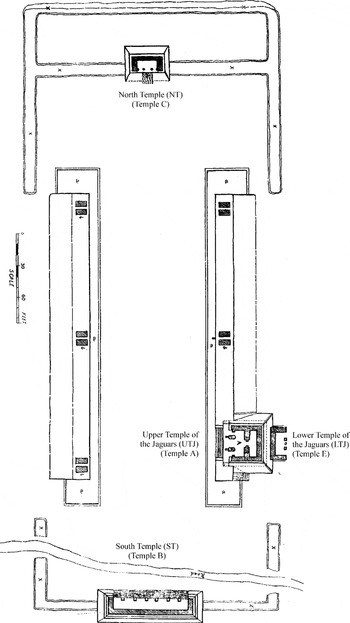
Map of the Great Ballcourt (Breton 1917:Plate I, after Maudslay 1974:III:Plate 26).
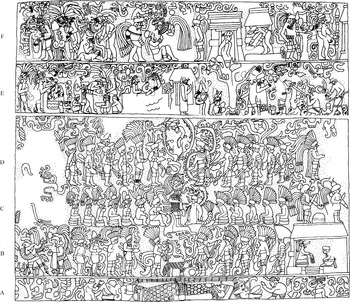
Relief, north wall of the NT (Wren and Schmidt 1991:Figure 9.8; drawing by Linnea Wren).
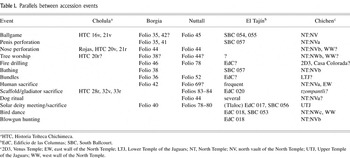
Parallels between accession events
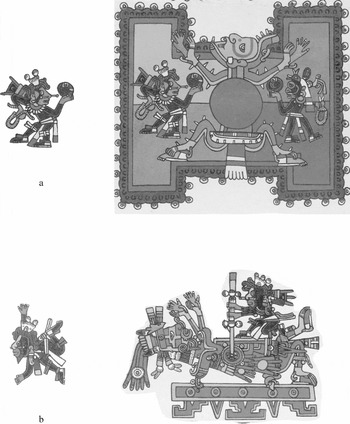
(a) “Stripe Eye,” Codex Borgia, Folio 35 (Diáz and Rodgers 1993); (b) “Red Mouth,” Codex Borgia, Folio 46 (Diáz and Rodgers 1993).
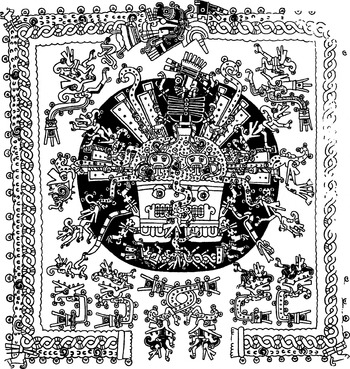
Possible mortuary bundle, Codex Borgia, Folio 29 (Anders et al. 1993:193).
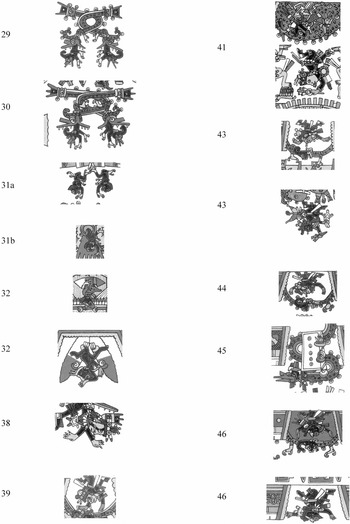
Avatars of Quetzalcoatl, Codex Borgia, Folios 29–46 (Diáaz and Rodgers 1993).
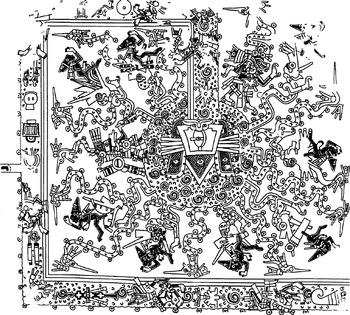
Opening of the ritual bundle, Codex Borgia, Folio 36 (Anders et al. 1993:213; compare with Figure 5).
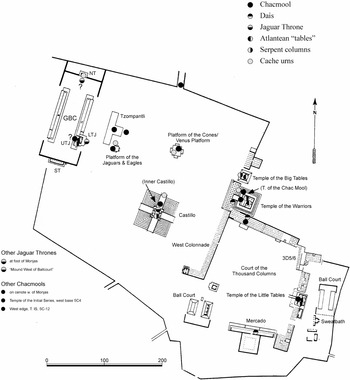
Location of jaguar thrones, stone cists, benches, and chacmools within the Gran Nivelacion, Chichen Itza. Data from Acosta 1954; Bolles 1977; Breton 1917; Desmond and Messenger 1988; Maudslay 1974:II; Morris et al. 1931; Ruppert 1943, 1952). Base map from Ruppert 1943:Figure 1. Scale is in meters.
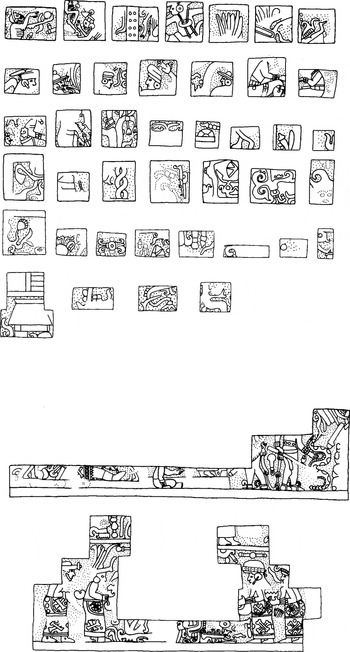
Relief fragments, south vault of NT (Wren and Schmidt 1991:Figures 9.6, 9.7; drawing by Linnea Wren).
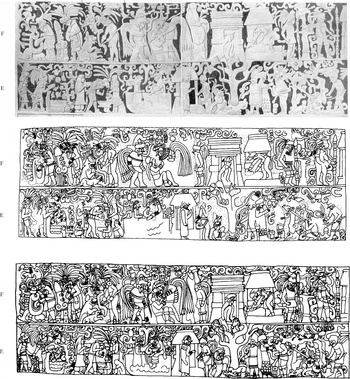
Versions of the relief on the north vault of NT: (a) Marquina 1964:Photographs 440–441 (drawing by Miguel Angel Fernández); (b) Wren and Schmidt 1991:Figure 9.9 (drawing by Linnea Wren); (c) Schele and Mathews 1998:Figure 6.51 (drawing by Linda Schele).
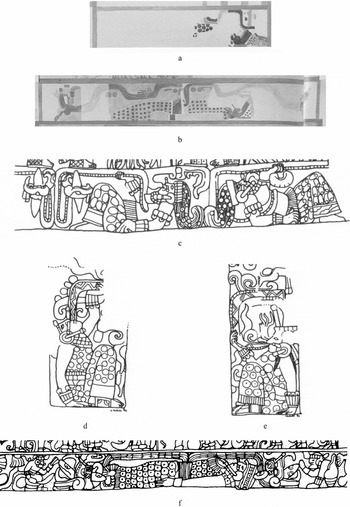
The recumbent deity figure of the Great Ballcourt, Chichen Itza: (a) Basal register, east wall, UTJ (Coggins and Shane 1984:Figure 17); (b) basal register, west wall, UTJ (Coggins and Shane 1984:Figure 19); (c) NT column (Schele and Mathews 1998:Figure 6.49); (d) South Temple of the Great Ballcourt, Chichen Itza (Maudslay's Temple B) west and east door jambs (Schele and Mathews 1998:Figure 6.42, left); (d) basal register, north wall of the NT (Schele and Mathews 1998:Figure 6.51).
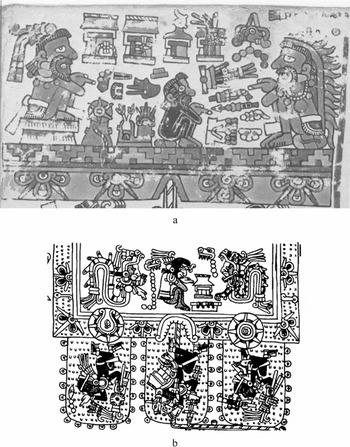
Presentation of power objects to Mixtec Quetzalcoatl avatars: (a) to Lord 9 Wind, Codex Vindobonensis, Folio 48 (Anders et al. 1992b); (b) to Lord 12 Wind, Codex Nuttall, Folio 19a (Anders et al. 1992a).
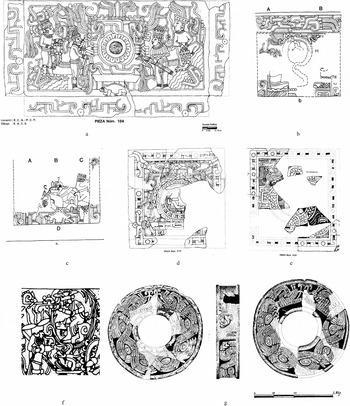
The El Tajín twin-serpent banner: (a) Castillo Peña 1995:Number 059; (b) Castillo Peña 1995:Number 062; (c) Castillo Peña 1995:Number 029; (d) Castillo Peña 1995:Number 034; (e) Castillo Peña 1995:Number 184; (f) central medallion, NT, Chichen Itza (Wren and Schmidt 1991:Figure 9.8); (g) Structure 2D2 tzompantli ring, Chichen Itza (Salazar O. 1952:Plate 1).
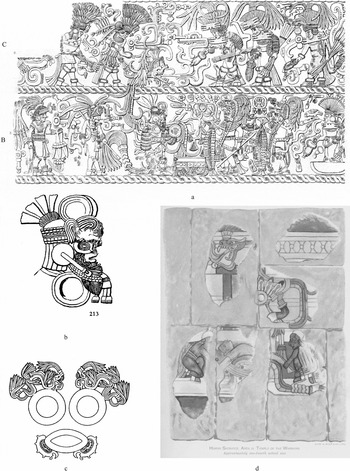
The Chichen “effigy”: (a) portion of second register, LTJ (Maudslay 1974:III:Plate 49); (b) detail of (a) (Maudslay 1974:III:Plate 51c); (c) gold mask from the Sacred Cenote (Tozzer 1957:Figure 216); (d) TW mural fragment (Morris et al. 1931:Plate 145).
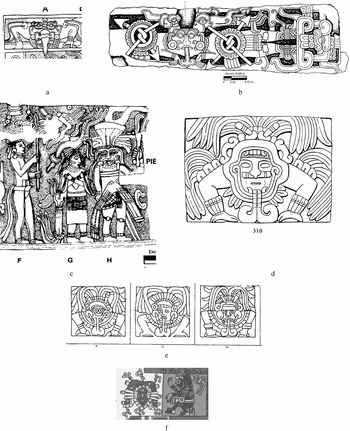
(a) Detail, El Tajín NBC, Panel 1 (Castillo Peña 1995:Number 017); (b) Castillo Peña 1995:Number 091; (c) effigy detail, El Tajín, EdC, Columna Central, E (Castillo Peña 1995:Number 017; Ladrón de Guevara 1999:77); (d) column base, South Temple of the Great Ballcourt, Chichen Itza (Maudslay's Temple B), Great Ballcourt, Chichen Itza (Tozzer 1957:318); (e) column base, Temple of the Warriors, Chichen Itza (Tozzer 1957:317); (f) detail, Codex Borgia, Folio 35 (Diáz and Rodgers 1993).
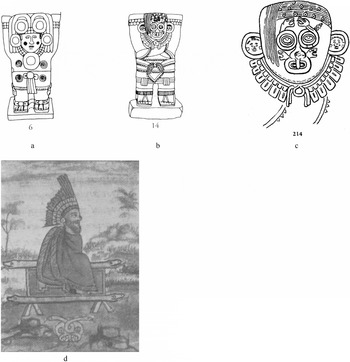
Atlantean figures with facial similarities to the “effigy”: (a) UTJ Atlantean figure (Schele and Mathews 1998:Figure 6.39.6); (b) UTJ Atlantean figure (Schele and Mathews 1998:Figure 6.39.14); (c) facial details of (b) (Tozzer 1957:Figure 214); (d) Topiltzin Quetzalcoatl (Folio 228r of Durán's manuscript, reproduced in Nicholson 2000:Color Plate 9).
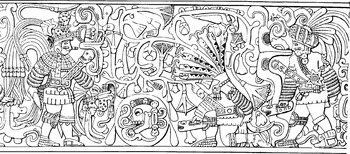
Relief from the alley of the Great Ballcourt, Chichen Itza, west side, central panel (Tozzer 1957:Figure 474, after Marquina 1964:Plate 266).
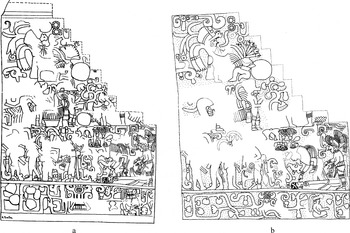
Ballcourt scene on the east wall, NT, Great Ballcourt: (a) Breton 1917:Figure 7; (b) Wren and Schmidt 1991:Figure 9.11; drawing by Linnea Wren.
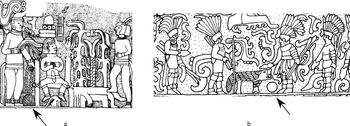
Thrones and ballgame balls: (a) Edificio de las Columnas, Register B, North Column (Castillo Peña 1995:Number 20); (b) North wall, NT, Chichen Itza (Wren and Schmidt 1991:Figure 9.8; drawing by Linnea Wren).
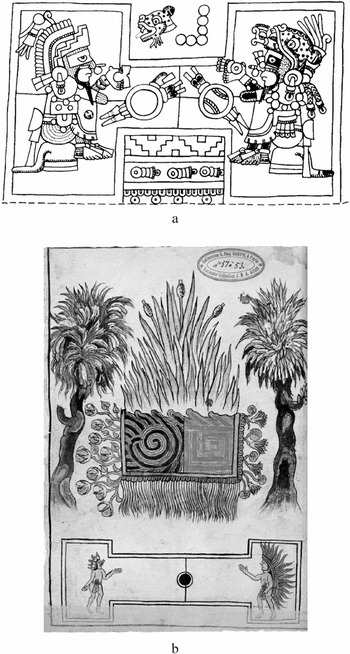
(a) Ballgame between Lords 4 Jaguar (dressed as Mixcoatl/Camaxtli) and 8 Deer following their meeting with the solar deity 1 Death, Codex Nuttall, Folio 80 (Anders et al. 1992a); (b) ballcourt scene, Historia Tolteca-Chichimeca, Folio 16v (Kirchhoff et al. 1976).
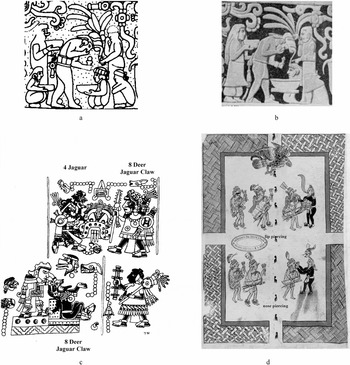
(a) Nose piercing, north vault of the NT (Wren and Schmidt 1991:Figure 9.8); (b) same illustration by Miguel Angel Fernçndez (Marquina 1964:Foto 439); (c) nose piercing in the Codex Nuttall, Folio 52 (Anders et al. 1992a); (d) nose piercing in the Historia Tolteca Chichimeca, Folio 21r (Kirchhoff et al. 1976).
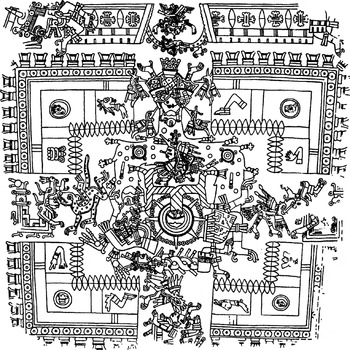
Nose piercing in the Codex Borgia, Folio 44 (Anders et al. 1993:235).
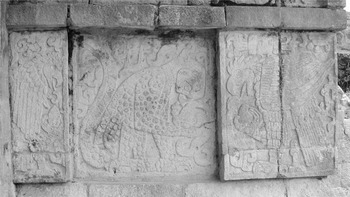
Reliefs from Structure 2D3 (Temple of the Jaguars and Eagles), Chichen Itza (photograph by the author).
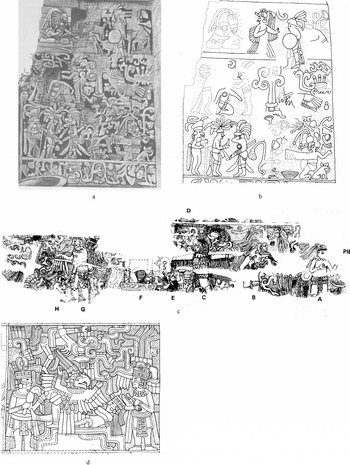
(a) Bird costumes on the west wall, NT, Chichen Itza (left: Breton 1917:Plate 4; right: Wren and Schmidt 1991:Figure 9.10, drawn by Linnea Wren); (b) blowgun scene and man in bird costume, El Tajín, EdC, Columna Central, H (Castillo Peña 1995:Number 018; Ladrón de Guevara 1999:77); (c) man in bird costume, El Tajín, southwest panel, SBC (Castillo Peña 1995:Number 053).
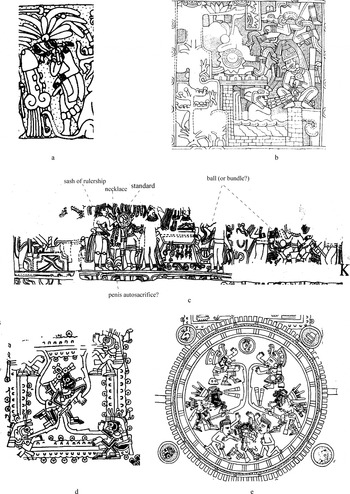
Penis sacrifice in investiture rites: (a) North vault, NT, Chichen Itza (Wren and Schmidt 1991:Figure 9.9); (b) El Tajín, south central panel, SBC (Castillo Peña 1995:Number 057); (c) El Tajín, EdC, Columna Sur, K (Ladrón de Guevara 1999:78, after Castillo Peña 1995:Number 001); (d) Codex Borgia, Folios 35 and 41 (Anders et al. 1993:211, 228).

(a) Table bench from the UTJ (Schele and Mathews 1998:Figure 6.36b); (b) mural on east wall, UTJ (Coggins and Shane 1984:Figure 17).
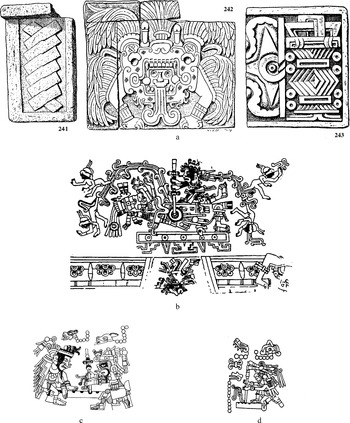
Fire-drilling scenes: (a) panels from the Venus Temple (2D4), Chichen Itza (Seler 1998 [1904]:VI:126, Figures 241–243); (b) Codex Borgia, Folio 46 detail (Anders et al. 1993:242); (c) Codex Nuttall, Folio 78 (Anders et al. 1992a); (d) Codex Vindobonensis, Folio 32 (Anders et al. 1992b).
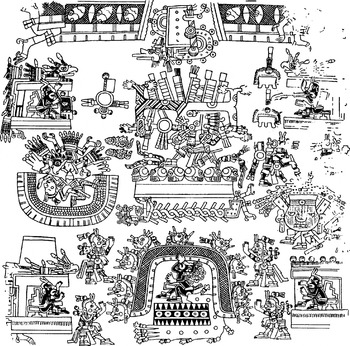
Tzompantli scene, Codex Borgia, Folio 45 (Anders et al. 1993:240).
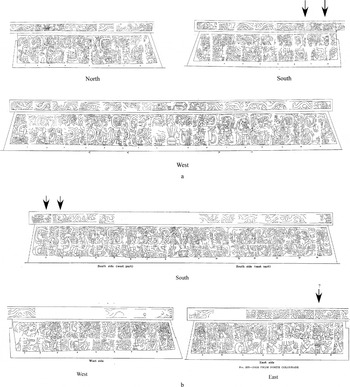
Daises of the northwest and north colonnades, Chichen Itza (Morris et al. 1931:Plates 124, 126, 128, Figure 257, respectively).
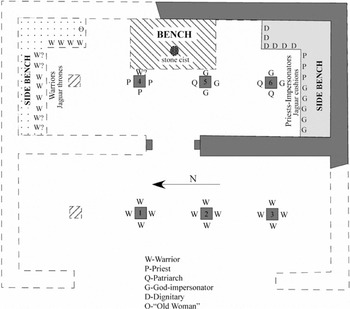
Plan of the Temple of Chac Mool, Chichen Itza (after Morris et al. 1931:Figures 147, 170).
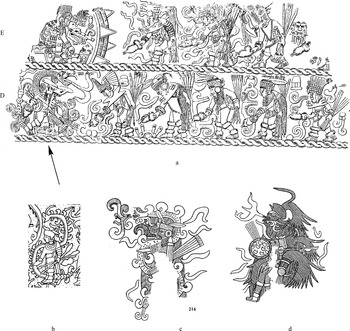
Cloud serpents: (a) LTJ Registers D and E (Maudslay 1974:III:Plate 50); (b) detail, NT rear wall (Wren and Schmidt 1991:Figure 9.8; drawing by Linnea Wren); (c) detail, UTJ southwest mural, upper right (Seler 1998 [1904]: Figure 216); (d) feathered serpent warrior companion to (c) (Seler 1998 [1904]:Figure 215).
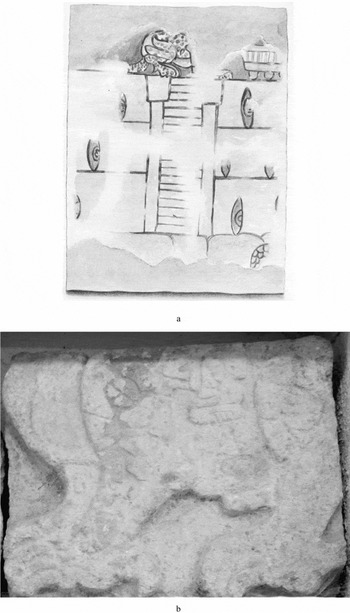
(a) Jaguar throne on a platform, Area 25 Mural, TW (Morris et al. 1931:Plate 151); (b) jaguar with k'awil glyph, bodega, Chichen Itza (courtesy Peter Schmidt).
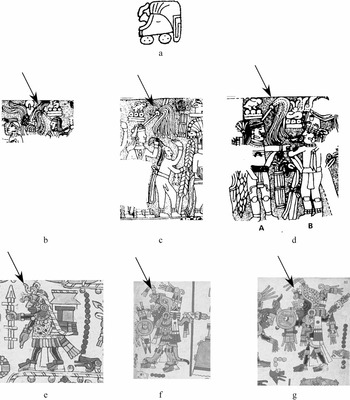
(a) Chichen k'awil glyph (Four Lintels 1, drawing by Ruth Krochock), 13 Rabbit on the Edificio de las Columnas, El Tajín; (b) Castillo Peña 1995:Number 020; (c) Castillo Peña 1995:Number 020; (d) Castillo Peña 1995:Number 011, forehead ornaments in the Codex Nuttall; (e) Lord 12 Wind, Codex Nuttall, Folio 19; (f) Lord 8 Deer with “sun diadem,” Codex Nuttall, Folio 77; (g) Lord 8 Deer with curved variant, Codex Nuttall, Folio 83.
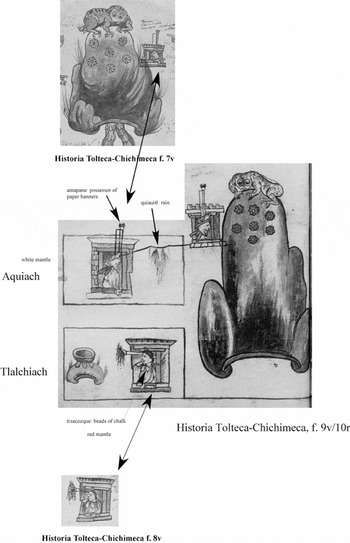
Glyphs for achiyach and tlalchiyach in the Historia Tolteca Chicimeca, Folios 7v–10r (Kirchhoff et al. 1976).
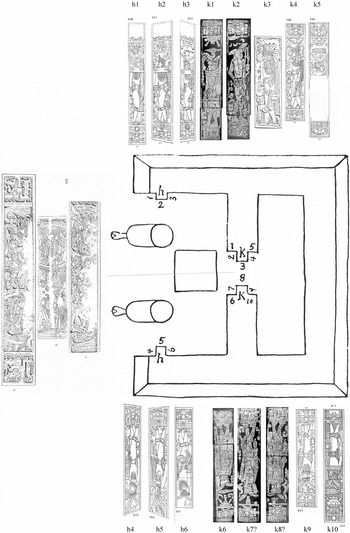
Plan of the UTJ, showing the location of jambs and piers (line drawings from Seler 1998 [1904]; rubbings from Robertson 1995).
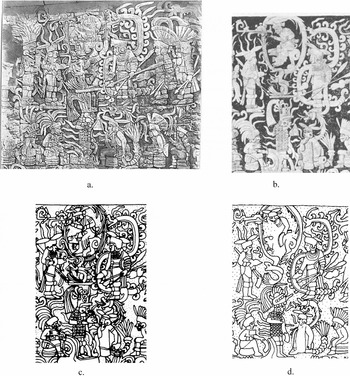
Central scene on the north wall, NT, Great Ballcourt, Chichen Itza: (a) Adela Breton, unpublished drawing (courtesy Bristol Museums and Art Gallery); (b) Marquina 1964:Photograph 439 (drawing by Miguel Angel Fernández); (c) Schele and Mathews 1998:Figure 6.51; (d) Wren and Schmidt 1991:Figure 9.8.
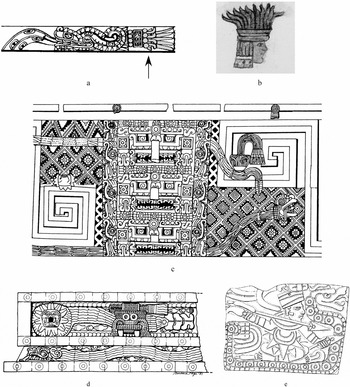
Investiture headdresses: (a) detail, Atetelco shrine, Teotihuacan (Miller 1973:Figure 345); (b) quetzalapanecayotl headdress (Sahagún 1993:Folio 73v); (c) feathered serpent and headdress, west building of the Nunnery, Uxmal (Schele and Mathews 1998:Figure 7.36); (d) Temple of the Feathered Serpent, Teotihuacan (Coggins 1993:Figure 1); (e) full-figured example, jade from Sacred Cenote, Chichen Itza (Proskouriakoff 1974:Plate 78a).
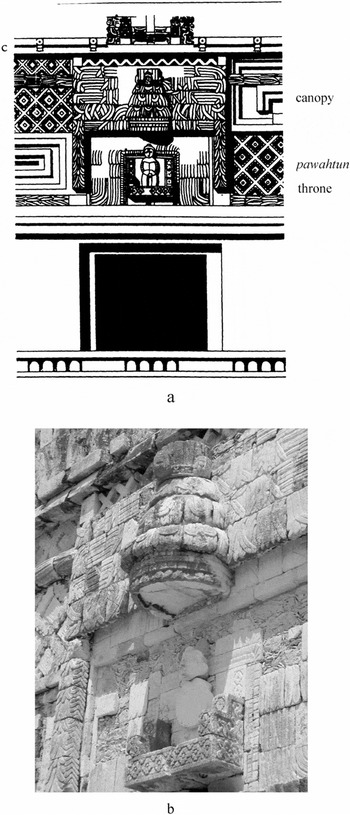
(a) Detail of the central doorway, west building, Nunnery, Uxmal, showing canopy (Schele and Mathews 1998:Figure 7.36); (b) canopy detail (photograph by the author).
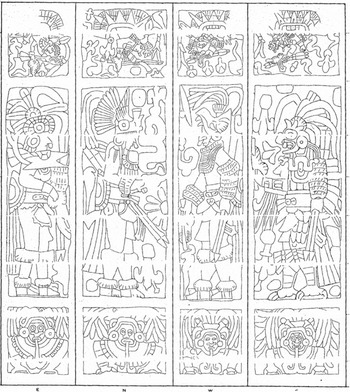
Column 55, northwest colonnade, Chichen Itza. Note images of solar deity and crouching Quetzalcoatl-associated figure framing warrior (Morris et al. 1931:Figure 305a).
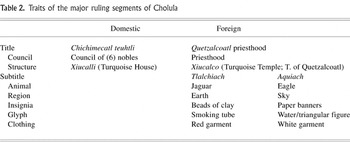
Traits of the major ruling segments of Cholula

Plan of the Temple of the Feathered Serpent, Teotihuacan (Cabrera Castro 1992:Figure 1).
 You have
Access
- 46
- Cited by