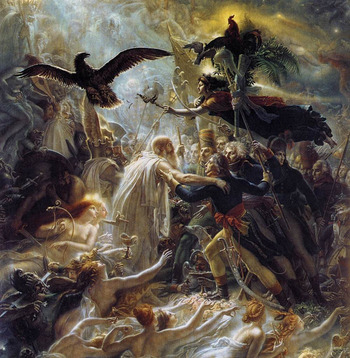
Residing on their clouds, the legendary third-century bard, Ossian, and his ancestors admire Napoleon and his brave warriors ‘liberating the earth’. Fantastical scenes like the one in this poem were common in political art in early nineteenth-century France. They were crafted to pay tribute to the political achievements of France's new ruler, Napoleon, and capitalised on his enthusiasm for James Macpherson's ‘translations’ of the epic poems of Ossian.Footnote 2 This particular panegyric was written to applaud two of Napoleon's 1802 victories: securing peace with Britain in the Treaty of Amiens and winning the support of the Tribunat and Corps législatif in his bid to become ‘Consul for life’.Footnote 3 The Ossianic Heavens are also depicted in Anne-Louis Girodet's painting L'apothéose des héros français (1802), where an old, blind Ossian and his ancestors welcome French military heroes in the afterlife (Fig. 1). Literary scholar Tili Boon Cuillé and art historian George Levitine have argued that the symbolic content of this painting celebrated the settlement of two major conflicts in 1801: the Treaty of Lunéville, ending the hostilities with Austria, and the Concordat with Pope Pius VII, which restored the relationship between France and the Roman Catholic Church.Footnote 4
Anne-Louis Girodet de Roucy-Troison, L'apothéose des héros français morts pour la Patrie pendant la guerre de Liberté (1802) (Musée nationale de Malmaison et Bois-Préau). (colour online)

In 1804, the Ossianic Heavens were presented once again to Parisian audiences in Jean-François Le Sueur's opera Ossian ou les bardes. Whereas Ossian had mostly been depicted as an old, blind man reciting the bards’ epic histories, the opera, in contrast, shows him as a youthful warrior liberating his fellow bards and fiancée Rosmala from their Scandinavian oppressors. During this endeavour, Ossian finds himself imprisoned in Act IV dreaming of being welcomed in the bardic afterlife. The Opéra's artists had spared no effort in making this the most astonishing scene possible. Le Sueur had requested twelve harps – in addition to a full orchestra – to accompany the songs and dances of the celestial bards.Footnote 5 Onstage, a large number of forces personified Ossian's ancestors: forty-five singers, sixty-six dancers and several supernumeraries.Footnote 6 They were majestically clad in white tunics and fur cloaks, with swords and shields at their sides, and ‘silver crowns of immortality’ on their heads.Footnote 7 The sets were larger and more complex than any created in recent memory, consisting of numerous movable cloud panels that were lifted one by one to reveal a three-tiered, thirty-eight-foot-high celestial palace.Footnote 8 An impressive visual effect was produced towards the end of the scene: as in a vision, Ossian's tomb suddenly appeared to the side of the palace and was surrounded by Rosmala and her companions lamenting the hero's passing with dramatic gestures.Footnote 9 The score specified that the tomb was to become visible ‘behind a light and transparent gauze, which softens and distances the objects’ to emphasise its dreamlike character.Footnote 10 Critics waxed lyrical about the entire scene. The Journal de commerce described it as ‘an absolute fairy tale’, and the literary journal Mercure de France called it ‘a ravishing novelty’.Footnote 11 The Gazette nationale even boasted that ‘scenic illusion and theatrical magic cannot go any further than in this dream scene’.Footnote 12
Like other contemporary depictions of the bardic Heavens, Ossian's dream seems emblematic of government-sanctioned art in the Napoleonic era. Using spectacular artistic means, it celebrated the ruler's literary taste. And, as musicologist David Charlton and Tili Boon Cuillé have pointed out, it contains elements that praise his reconciliation with the Catholic Church in 1801.Footnote 13 Simultaneously, it conveyed a clear patriotic message: the dream praised the military valour of young men who die defending their country. Ossian's opening night, moreover, marked an important political occasion: it was the first work to premiere at the Opéra after Napoleon had become ‘Emperor of the French’, and the government had provided generous financial funds so that the production's splendour would properly celebrate this occasion.Footnote 14 At the second performance, Napoleon publicly endorsed the opera by calling Le Sueur into his box and later rewarded him with a golden snuffbox and a knight's medal of the Légion d'honneur.Footnote 15
Because of the momentous political significance of Ossian's premiere, the opera is often trivialised in music scholarship as little more than a pièce de circonstance. In larger histories of French opera by scholars such as Vincent Giroud and Winton Dean, Ossian is characterised as emblematic of a ‘new’ operatic style befitting the First Empire: a work full of flamboyant visual effects that openly glorifies the sovereign.Footnote 16 Such a characterisation is further supported in the two detailed studies of operatic life in early nineteenth-century Paris that concentrate on Napoleon's (and by extension the government's) control over and use of the Opéra: Rüdiger Hillmer's Die napoleonische Theaterpolitik (1999) and David Chaillou's Napoléon à l'Opéra (2004).Footnote 17 Because of this characterisation, opera production under Napoleon is typically considered a conservative return to ancien régime aesthetics and inconsequential to larger nineteenth-century artistic and especially musical developments.
Nonetheless, a handful of musicologists have been eager to establish the importance of Ossian in developments towards French grand opéra and Richard Wagner's music dramas. Manuela Jahrmärker, for example, has argued that the treatment of the bards in this opera prefigures that of historical societies in grand opéra: the bards are an integral rather than auxiliary part of the action and are represented as a fully developed society with its own traditions, belief systems and political struggles.Footnote 18 According to David Charlton and Jean Mongrédien, the opera's esoteric symbolism, religious ritual and new mythological universe are suggestive of Wagner's Ring des Nibelungen and Parsifal.Footnote 19Ossian has also been studied in relation to the origins of the Gesamtkunstwerk. The detailed coordination between music and visual elements prescribed in the printed score led Aubrey Garlington to proclaim that in Ossian Le Sueur achieved a ‘synthesis of the arts’, by fusing ‘harmony, stage action, machinery, local colour, instrumentation, and above all melody … into a coherent, cohesive unity, in which no one genre will dominate’.Footnote 20 While inviting us to look more broadly at Ossian's position in nineteenth-century opera history – a welcome move after dismissals of the opera as mere propaganda – these discussions have often sidelined the relation between the artists’ aesthetic choices and the opera's political content. Mongrédien even seemed keen to dissociate the work from its political baggage by emphasising that neither Napoleon nor his political achievements could have inspired Le Sueur's opera since it had already been conceived in 1795 as an opéra comique for the Théâtre Feydeau.Footnote 21
This article shows that the political situation in France around 1800 was in fact an important catalyst for the aesthetic choices made at the Opéra and in Jean-François Le Sueur's Ossian. In particular, I argue that processes of post-Revolutionary nation-building were the foundation for the Opéra's endeavours to restore its political and artistic prestige as ‘an Académie that unites all the arts’. Macpherson's poems offered a particularly potent subject to buttress these goals: as I will discuss, the Ossianic bards had become important to the nation's identity in the 1790s when they were adopted as long-forgotten forefathers of the French. Bringing this ‘historical’ bardic society to life through a meticulous coordination of the operatic arts was believed to make audience members feel as if part of the ‘historical’ world on stage. Thus, the production could elicit experiences of historical continuity and unity with a long-forgotten French past – experiences that, according to historian Benedict Anderson, were vital to the development of nineteenth-century nationalisms.Footnote 22Ossian demonstrates that concerns about operatic aesthetics in early nineteenth-century France went beyond local praise for one of Napoleon's triumphs; instead, they were inextricably intertwined with broad political questions about the role of the arts in processes of French identity formation.
‘An académie that unites all the arts’
The decade following the French Revolution turned out to be one of the most challenging periods for the Opéra. While ballet enjoyed a surge in popularity and artistic efflorescence, audiences’ enthusiasm for opera plummeted.Footnote 23 New works failed to win favour, and instead the tragédies lyriques of Christoph Willibald von Gluck and his contemporaries were endlessly repeated, creating a wistful nostalgia for the ‘golden age’ of the 1770s and 1780s.Footnote 24 Meanwhile, competition with other theatres increased as Paris saw an explosion in theatrical activity after the freedom unleashed by the Le Chapelier laws of 1791.Footnote 25 This competition came especially from Parisian opéra comique theatres, which successfully attracted large audiences; the Théâtre Feydeau in particular rivalled the Opéra with its spectacular productions praised for their ‘union of distinguished artists’ and the ‘cooperation of all their forces to create grand works’.Footnote 26
The critics’ praise for the ‘union’ and ‘cooperation’ at the Feydeau may well have been perceived as a genuine threat to the Opéra, whose advocates boasted about its distinctive artistic identity as ‘an Académie that unites all the arts, a spectacle unique in Europe’.Footnote 27 Creating an institution that would combine poetry, music, dance and painting had served to legitimise the Opéra's foundation in 1669 as an academy for perfecting French arts.Footnote 28 Yet, sociologist Victoria Johnson has argued that this feature was highlighted again in the 1790s, when the Opéra was in danger of being demolished as a royalist symbol; now, it was used to prove that the institution was not just an extension of the court, but an emblem of French artistic prowess that added to the political prestige of the nation.Footnote 29 As a consequence, the Opéra's management sought ways to strengthen this artistic identity, aspiring not just to perfect each art, but also to facilitate an unparalleled coordination between them.
This aspiration lay at the root of some of the extensive reforms at the Opéra in 1798, which focused on creating a more collaborative artistic environment.Footnote 30 The directors even proposed to pay dancers as much as singers, hoping they would better ‘unite’ their forces in performance (this rule was short lived, though, because of the singers’ outrage that their wages had historically been much higher).Footnote 31 A more effective measure was the creation of the maître de la scène, whose task was to secure a greater congruity between the performers and their gestures. According to the statutes, the maître de la scène would indicate the movements for all singers, and consult with the chorus master, ballet master and principal singers to ensure that all movements followed the ‘intentions of the poem’ – this also suggests that the goal was to establish a uniform interpretation guided by the libretto text and translated into performers’ bodily movements.Footnote 32
The establishment of a jury de l'art was another successful accomplishment of the 1798 reforms. This jury was to decide which libretti should be recommended for performance to circumvent an administrator's incompetence or personal favouritism.Footnote 33 This procedure was not entirely new. During the early 1780s, judging libretti had been one of the multiple duties of the Opéra's committee, a group of eight artist employees of the Opéra who theoretically governed the theatre until about 1789.Footnote 34 Yet, as musicologist Solveig Serre notes, the committee did not include a literary specialist, which led them at times to invite an outside person, Jean-Baptiste-Antoine Suard, to assist with libretto evaluations.Footnote 35 Yet some authors were able to bypass this system and the committees’ (sometimes flawed) procedures and decisions drew widespread complaints.Footnote 36 The jury de l'art proposed in 1798 had the advantage of being created specifically to evaluate a libretto as the basis for a work that united the arts. Moreover, the envisioned composition of the jury was remarkably versatile and inclusive:
For the economic aspect, it will include administrators; for the mise en scène, the two designers of costumes and sets; for the performance, the three directors of singing, dance and the orchestra; for judgements about the poetry, two men of letters; for the structure of the work, two composers; and for recording the minutes of the meeting, a librettist as permanent secretary who also has a vote.Footnote 37
The jury that eventually emerged in the October 1798 statutes only encompassed ‘one administrator, two men of letters, two composers, two directors (of singing and the orchestra), and two artists of the theatre (de facto male principal singers)’.Footnote 38 Nevertheless, its changing configuration over the following years indicates an ongoing interest in a more holistic approach to opera, where each art is considered integral to the work. From 1801 onwards, the accountant, the ballet master, the head machinist and the head of set design were all invited to attend in an advisory capacity.Footnote 39 And, in 1804, a proposal to give the maître de la scène and the ballet master voting rights was considered by the Opéra's management.Footnote 40
This more holistic attention to the work can be seen as resulting from what French theatre scholar Pierre Frantz has called the ‘tableau aesthetic’, which developed out of a more general growth in the appreciation of theatre's visual aspects during the eighteenth century.Footnote 41 Denis Diderot was one of its standard bearers; he compared theatre to a series of animated paintings, and declared that the visual, bodily performance of actors was equally important as – if not more powerful than – the text in arousing or ‘moving’ the audience emotionally.Footnote 42 This aesthetic was perhaps most conspicuously on display at the boulevard theatres, in their ever more popular melodramas and pantomime pieces, as well as in the grand-scale, immersive Revolutionary festivals of the 1790s.Footnote 43 Still, the Opéra also partook in this development. From the mid-eighteenth century onwards, both the theatre's management and the critics started to publish articles acclaiming the efforts of the choreographer, set designer and machinist.Footnote 44
Another intrinsic quality of the tableau aesthetic was its heightened attention to the representation of historical subject matters and their couleur locale. According to Frantz, this attention was part of a historiographical trend that understood societies as products of their temporal and spatial environments and thus had implications for theatrical verisimilitude.Footnote 45 While the term couleur locale originated in seventeenth-century pictorial criticism, it was used by critics from the 1780s onwards to evaluate whether a plot's specific time and place were satisfactorily communicated through sets, costumes, libretto and music.Footnote 46 As I will discuss later, detailed attention to couleur locale became an integral part of Le Sueur's theories on uniting the arts in Ossian. Yet first it is necessary to establish the importance of the Ossianic bards to the Opéra's mission of proving its utility as a national theatre.
Uniting past and present
In addition to buttressing its artistic identity as the theatre that unites all the arts, the Opéra's function as a national rather than just royal theatre also hinged on the educational value of the plots. Educating audiences had always been one of theatre's (and thus opera's) many functions, but after the Revolution, governments actively encouraged theatres to stage pieces capable of instilling Republican values, as scholars such as literary historian Mark Darlow have noted.Footnote 47 Darlow has argued that this had a profound effect on the repertoire of the Opéra, which during the Reign of Terror (1792–4) became conspicuously patriotic, often by bringing recent revolutionary events onto the stage.Footnote 48 After the fall of Robespierre in 1794, patriotic pieces did not vanish from the Opéra's stage, but they more often appeared in an allegorical or historical guise, for instance in plots set in ancient Greece or Rome – places that had long been part of France's genealogical histories.Footnote 49
Still, Romans and Greeks were not the only people that cropped up in national genealogies; by the 1790s, they had been joined by the Ossianic bards. However, the French interest in Macpherson's translations of the supposedly ‘primitive’ third-century bardic epics predates their incorporation in genealogical narratives; already in the 1760s, they had been enthusiastically welcomed in France as writers were looking for an ‘antidote to the artificiality of eighteenth-century French poetry’.Footnote 50 Part of the poems’ success was attributable to the fact that Ossianic culture fitted well with contemporary interests in the ‘noble savage à la Rousseau’ and literary sentimentalism.Footnote 51 Then, towards the end of the century, these poems started to play a more specific cultural role in what literary scholar Deirdre Dawson has described as a search for ‘a distinctive linguistic and cultural ancestor that was indigenous to the soil of France’.Footnote 52 These ancestors were the Gauls, who had supposedly wandered out to regions such as Scotland after the Roman invasions.Footnote 53 As a result, Macpherson's Ossianic translations were hailed as windows onto primitive French poetry and became important primary sources in studies of the language and culture of the Gauls and Celts. So, it does not come as a surprise that when, in March 1805, the new Académie des études celtiques was inaugurated, its secretary thanked Macpherson for having promoted the study of ‘Celtic poetry and traditions’.Footnote 54
This interest in Gaulish and Ossianic ancestry encompassed both an earnest historical curiosity and a more mythological strand. The activities of the Académie des études celtiques are generally considered to have laid the foundation for fields such as ethnography and anthropology in France.Footnote 55 Nonetheless, several early studies also displayed elements of historical revisionism or myth-making, especially when their authors were eager to establish links with contemporary French society. The French officer and antiquarian Théophile Malo Corret de la Tour d'Auvergne, for instance, claimed in his Origines gauloises (1796) that the Gaulish language and the Erse and Gaelic of the Ossianic poems had a common ancestor in Celto-Breton – a language he saw as the principal predecessor not only of French, but also of all European and Asian languages.Footnote 56
Corret de la Tour d'Auvergne's linguistic link between past and present exemplifies how nineteenth-century genealogies functioned in the formation of national identities in France around 1800. After the French Revolution, such identities increasingly depended on what Benedict Anderson has called ‘imaginary communities’ that privileged horizontal bonds between its members rather than the hierarchically ordained system of the ancien régime.Footnote 57 When construing the history of their nation, these communities relied on stories that articulated historical unity and continuity, especially in situations where this connection with the past had been lost.Footnote 58 The turn-of-the-century rise of Celtomania in France was one of the ways in which both intellectuals and the government sought to recover this long-lost past.
This identification with Celtic and Ossianic cultures was also encouraged by Napoleon himself. He not only supported the establishment of the Académie des études celtique, but he had also welcomed paintings for his residence at Malmaison that emphasised the link between an Ossianic past and the present of Napoleonic France. One of these was Girodet's aforementioned L'apothéose des héros français (Fig. 1).Footnote 59 To celebrate Napoleon's successes symbolically, Girodet evoked a ‘historical’ Gaulish people by dressing his bards in furs and Celtic-looking arms and armour – this was a significant departure from other Ossianic paintings where garments more closely resembled ancient Roman gear.Footnote 60 Simultaneously, the present is brought into the picture because Ossian is portrayed receiving thirteen identifiable military heroes who had died recently in the French Revolutionary wars.Footnote 61 Rather appropriately, one of these heroes was the aforementioned Corret de la Tour d'Auvergne. A similar strategy to link past and present is employed in the panegyric quoted at the start of this article, where the Ossianic ancestors are looking down upon their descendants.
Creating such a link may seem much harder in theatrical productions, especially considering contemporary notions of verisimilitude and historicist representation, for they demanded that the onstage world was depicted as visibly (and sometimes audibly) different from the present. Still, a link between the historical world on stage and the present is guaranteed by the simple reality of theatrical representation, of making something present again in performance. Yet there is more, claimed Joseph Bonet de Treiches, who had been the Opéra's director since 1799 (with some interruptions). In his publication De l'Opéra en l'an XII (1803), he explained that the theatre's ability to unite all the arts was crucial to bringing the past back to life in an uncannily potent and faithful manner. In this respect, he believed the Opéra to surpass all other theatres as well as the art of painting. Discussing Antonio Sacchini's Œdipe à Colonne (1786), the most performed opera of the Napoleonic era, he claimed that ‘it is not an image of Athens, coldly represented on a canvas, that the spectator admires in Œdipe. It is Athens itself, its temples, palaces, king, people, customs, celebrations and pleasures.’Footnote 62 Then he continued by highlighting how each of the arts aided in reviving this ancient city.Footnote 63
Bonet's comparison of opera with painting is illuminating. In contemporary theatre and salon milieus, it was thought that re-enacting a painting, creating a so-called tableau vivant, could increase the educational value of the original visual representation.Footnote 64 The Opéra itself had also partaken in this trend; for instance, the oath scene in the Act II finale of Bernardo Porta's Les Horaces (1800) was designed to recreate Jacques-Louis David's Le serment des Horaces (1785) – a painting that had acquired a strong Republican significance because of its portrayal of brotherhood.Footnote 65 Thus it was a logical step for Bonet to credit the Opéra's tableaux, whether bringing an existing painting to life or not, with eliciting such ‘magical effects’ that ‘moved’ audiences and made them ‘identify’ with the facts and fictions recorded by the ancient Greek and Roman writers.Footnote 66 He even boasted that the vivid impressions left by theatrical representations would be a better school for the French youth than the collèges. Thus, he attempted to claim a central place for theatre and opera (especially when it sought a meticulous coordination between the arts) in the education of patriotic and loyal subjects – a topic that was particularly dear to Napoleon who reformed the entire secondary school system to this end.Footnote 67
Ossian: ‘a monument of genius’
Bonet may have had Le Sueur's Ossian in mind as one of the productions that would realise both the artistic and the political goals of his operatic vision. In late 1803, when he penned De l'Opéra, this work had been in production for at least two years, and he expressed the hope that the success of this ‘monument of genius … will honour French creative prowess and reinvigorate the prestige of this theatre’.Footnote 68 As Le Sueur was trying to secure the performance of Ossian, he indeed appealed to the Opéra's management, promising a work that would highlight the theatre's ability to unite the arts. And as I will discuss later, he would exploit this ability to create an overwhelming effect in the work's most instructive scene: the dream scene.
Le Sueur's operatic aesthetics as presented in the lengthy Lettre en réponse à Guillard of 1801 foregrounded the need for the union of the arts.Footnote 69 Early on in the essay, he played up this unique characteristic of the Opéra's productions. With his fondness for capitalisation, he proclaimed that ‘only in Paris can one truly see a theatre that UNITES ALL THE FINE ARTS, a MAGICAL SPECTACLE because of its effects, THE GRAND OPERA’.Footnote 70 The Lettre contains several passages that witness his commitment to uniting the arts. He suggested that the Opéra should emulate the coordination between music and bodily movement achieved at the Opéra-Comique, probably referring to the Théâtre Feydeau where he had experienced his first operatic successes in the 1790s. In this theatre, he said, ‘expressive singing [was] united with all the means of tragic pantomime, always in coordination, always in perfect simultaneity with the mimetic indications of the orchestra’.Footnote 71 He also pleaded for the importance of music and sets in conveying couleur locale. Talking more specifically about La mort d'Adam, another work of his in rehearsal at the Opéra, he declared ‘it is necessary that the sets (even when very simple) and the exposition [prelude] transport the listener to a site and to an age where he might himself be able to desire and demand the songs of the first age of men’.Footnote 72 This emphasis on the union of the arts was perhaps necessary to convince the Opéra's management that, despite his reputation as first and foremost an opéra comique composer, his works would be a success at the Opéra.Footnote 73 After all, Ossian had initially been conceived for the Théâtre Feydeau; its production had allegedly reached the final rehearsal stages when its premiere was cancelled following the bankruptcy of Charles-Barnabé Sageret, the Feydeau's director.Footnote 74 Still, Le Sueur used the Lettre to contend that his principal artistic ambition to unite the arts would make his operas the perfect vehicles to revitalise the prestige of the Opéra – an opinion later shared by the Opéra's director Bonet as well, as mentioned earlier.Footnote 75
Even though the Lettre focuses on La mort d'Adam, Le Sueur's aesthetic programme was first fully realised in the production of Ossian. The three extant manuscript libretti for Ossian written between 1798 and 1803 bear out Le Sueur's aesthetic ideas: they provide ample information about how the different arts were to contribute to the work's performance. The manuscripts are full of lengthy descriptions of costumes, pantomimic scenes and striking theatrical effects, such as the detonation of a bridge and the dream scene.Footnote 76 From the very beginning, each version also shows the authors’ detailed attention to Ossianic couleur locale. The opening scene is conjured up with myriad details calling for dark, mountainous forests in the background and, for the front of the stage, an ancient building with armour, harps and other bardic instruments displayed on its walls. Two of the libretti even specify that the sets should depict the renowned cave of Fingal, a cave discovered in Scotland in 1782 where Ossian's father supposedly hid from his enemies. These descriptions far exceeded the customary length and detail found in other opera manuscripts and in the surviving printed libretti of Ossian's two librettists, Paul Palat Dercy and Jean-Marie Deschamps.Footnote 77 Therefore, these libretti suggest a changing attitude to how composer and librettist were to create an opera: they were no longer to treat the staging as ancillary to a self-sustaining score, but should consider the visual aspects of staging as essential elements of their own conception. None of the libretti is in Le Sueur's hand; still, the composer's attention to staging details in his annotations in the oldest libretto, and the aesthetic programme set out in the Lettre, indicate that he was an important influence on the emergence of this attitude.
With their conspicuous integration of text, character movement, and set and costume design, the manuscript libretti of Ossian appealed to the diverse team of artists in the Opéra's new jury de l'art. The jury's first report concluded that it offered ‘beautiful spectacle, and … much action, felicitous oppositions, and moving situations’.Footnote 78 The second report even indicated that the libretto promised sufficient musical and visual spectacle to mask its literary deficiencies; they declared that ‘this work's success will primarily depend on the musicians and the set designers … it has to be considered a rich and brilliant pantomime explained in a few words’.Footnote 79 Confirmation from the jury that the literary flaws of a libretto would be redeemed by the spectacle may seem surprising.Footnote 80 Yet such reports indicate that even the literary jury considered these libretti as representations of future performances. Moreover, they show that Ossian was considered a suitable vehicle to exploit the theatre's supposedly unique ability to unite the arts and hence restore its reputation as Bonet and others hoped.
Staging a new genealogy
Le Sueur's emphasis on coordinating the arts and couleur locale in Ossian was also linked to the new place of the bards in French genealogies. Like several of his contemporaries, the composer believed them to be French ancestors.Footnote 81 He even went so far as to suggest a link between the bards’ epic recitations and French opera:
The poems of Ossian, like those of all ancient bards, were made of simple measured verses without rhythm or rhyme. … the bards kept rhyme and rhythm – corresponding to the combination of long and short [syllables] – for the lyric pieces with which they interspersed their works at every page. In these places, they introduced regular songs, airs that they supported with a continuous accompaniment of their harps, to interrupt their narrative and grab the attention of their spectators. These narratives may have resembled our modern recitative.Footnote 82
This excerpt underscores that Le Sueur actively participated in creating the genealogical narratives that had fuelled turn-of-the-century Ossianism; he pointed to an alternative genealogy of opera as native to France (instead of Ancient Greece or Renaissance Italy).
The composer made these genealogical claims in the ‘Essai historique sur les bardes, leurs mœurs et leurs coutumes’ (‘Historical Essay on the Bards, their Morals and Customs’), a document written between 1801 and 1804 in which he compiled historical information on the Ossianic bards. The ‘Essai’ was presented as crucial to the staging of Ossian and its couleur locale: its first page specified that this was ‘a report on the practices, opinions, celebrations, and costumes of the people with whom [the bards] live to inform the morals, costumes, celebrations, pantomimes, and sets that are to be followed in the opera of Ossian’.Footnote 83 With this specification, Le Sueur may have sought to underline the historical legitimacy of the essay (and by extension of Ossian's staging), for it mirrored titles found in contemporary studies of historical societies.Footnote 84
The content of the ‘Essai’ is furthermore a testimony to Le Sueur's investment in historical precision: it comprises quotations of Macpherson's works and of their accompanying historical commentaries, most prominently Hugh Blair's Critical Dissertation on the Poems of Ossian (1761), and the introductions to the Italian translation by Melchiorre Cesarotti (1773) and the French one of Pierre Letourneur (1777). In a few instances, Le Sueur even supported his description of bardic life with quotes ascribed to contemporaries of the ancient bards such as the first-century Roman poet and historian Lucan (39–65).Footnote 85 Much of this information was cited to underscore the historicity of certain plot events and set and costume descriptions in Ossian.
Yet Le Sueur did not limit himself to researching plot and visual elements; he also attempted to reconstruct a historical, third-century bardic sound. Some kind of Ossianic couleur locale had already been experimented with in turn-of-the-century romances inspired by Macpherson's poems: they usually featured a harp accompaniment as in Étienne Nicholas Méhul's ‘Oscar et Dermide’.Footnote 86 Le Sueur readily exploited this customary association by requesting twelve harps in his score, specifying that they ‘dominate the orchestra and reproduce the effect of the hundred harps of Selma’ – referencing a performance practice described by Macpherson.Footnote 87 This indication signals that the composer's main goal was reconstructing the bards’ musical customs and that he was less concerned with communicating the sombre atmosphere of the poems’ tenebrous Scottish setting (as was probably Méhul's aim when he omitted the high strings in his Ossianic opera of 1806, Uthal).Footnote 88
In the absence of sources featuring third-century bardic music, Le Sueur used insights from eighteenth-century theories and philosophies on the origins of language and music to reconstruct their melodies and harmonies. Among these were Esteban de Arteaga's Le rivoluzioni del teatro musicale italiano (1783–8) and especially, as David Charlton has noted, Jean-Jacques Rousseau's Essai sur l'origine des langues (1781) and Dictionnaire de musique (1768).Footnote 89 Following these sources, Le Sueur assumed that the bards’ music must have been based on imitation: it had developed out of their earliest form of language, which had in turn emerged from a tonal and rhythmic copying of sounds and images in nature.Footnote 90 Their melodies, the composer decided, would thus have been characterised by an ‘expressive nature and sublime simplicity’. Harmony, in contrast, was a secondary element, which served largely to support the words’ meanings.Footnote 91 According to the composer, ‘abstract’ music and complicated harmonic structures were to be avoided, for they signalled a culture that was becoming ‘scientific’ and distant from nature.Footnote 92 Thus, while Le Sueur's thorough investment in recreating bardic music was unprecedented for the time, his method was one borrowed from the older philosophe tradition: he assumed that the origins of language and music could be recovered through philosophical research rather than empirical ethnography, for instance, of Scottish folk music.Footnote 93
Le Sueur's imitation-based conception of bardic music inspired an intricate connection between text, music and image in the opening chorus of Ossian. The verses themselves are already replete with nature descriptions:
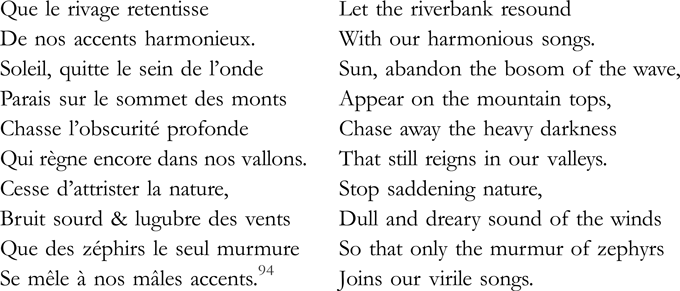
Many of these environmental elements can be found in the actual descriptions of the sets. The river is described as located at the back of the stage and bordered with rocks, which would enable the ‘harmonious songs’ to ‘resound’.Footnote 95 The mountains over which the sun was to appear were visible in the background. The stage was dark to communicate that ‘it is not yet day’, and thus create the right light effect for the performance of this chorus.Footnote 96
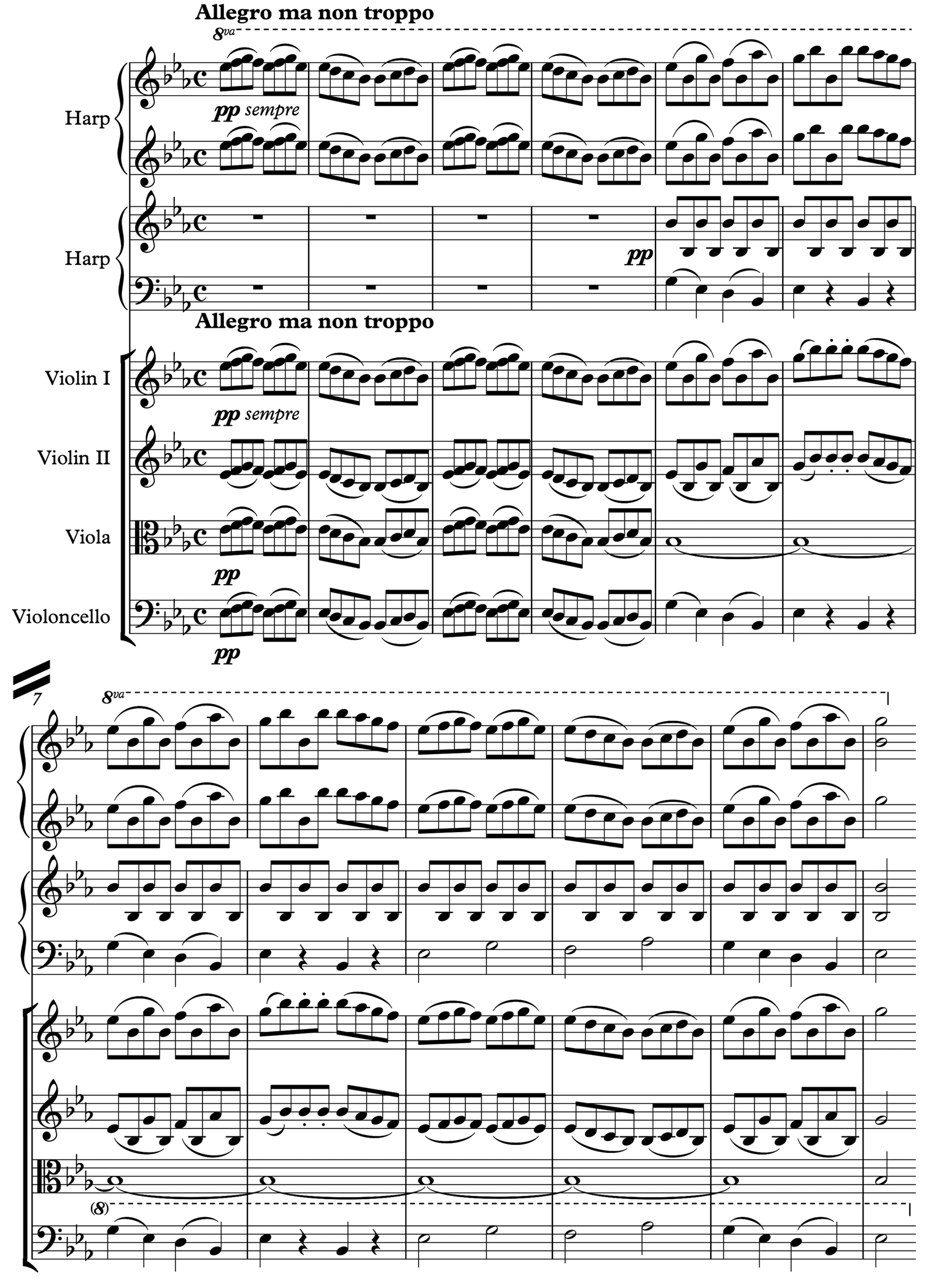
The musical setting of the chorus (see Ex. 1) features the customary characteristics of ‘primitive’ song: it has a small vocal range, syllabic setting, predominantly homophonic textures and static harmonic structures.Footnote 97 An element that seems directly derived from the composer's belief that bardic music originated in the imitation of nature is the peculiar emphasis on text painting. The riverbank resounded as the chorus echoed its musical phrase twice, with decreasing dynamics (bb. 1–8). The sun appearing on the top of the waves can be perceived in the movement to G in the alto, first harp and woodwinds over the oscillating patterns in the other voices (b. 10), while the sky's clarity resulting from the chasing away of darkness is represented by the sudden reduction of the full orchestra to a unisono line in the high strings and voices (b. 13).Footnote 98 The contours of the ensuing syncopated rhythms look like valleys (bb. 20–3), and the fast swell to fortissimo and then sudden drop to pianissimo in the string tremolos resemble the winds’ dull and dreary sounds (bb. 25, 29). Suspensions in the soprano line, traditionally used to represent sadness, suitably accompany the verse ‘cesse d'attrister la nature’ (bb. 25–31). The ‘zéphirs’ seem to be imitated in the harp arpeggios (bb. 32–3), and their murmuring may have prompted the indication ‘sotto voce’ for the chorus (b. 32). Finally, the assumed virility of the song is emphasised by the spiccato notes, accents and the request to sing with a ‘full voice’ (bb. 36–8).
‘Le Chant de la nuit, Chant de Selma’ (‘Song of the night, song of Selma’): the opening chorus of Jean-François Le Sueur's Ossian.

With the integration of text, music and staging in the opening chorus, Le Sueur may earnestly have intended to recreate a historically researched version of ancient bardic music. Nevertheless, it is likely no accident that this integration also highlighted the Opéra's unique artistic prowess at uniting all the arts. Moreover, by suggesting a similarity and possible genealogical link between Ossianic recitation and French opera as based in the coordination of the arts, his opera firmly positioned itself within post-Revolutionary attempts to claim Ossian as a French ancestor.
The dream scene's political programme
Reimagining the artistic genealogy of French opera was only one aspect of Ossian's engagement with post-Revolutionary nation-building; several links created between past and present specifically concern the political situation in France around 1800. As mentioned, David Charlton and Tili Boon Cuillé have pointed out that the libretto contains clear references to Napoleon's attempts to restore peace with the Roman Catholic Church.Footnote 99 This is especially noticeable in the addition of a religious dimension to the conflict between the bards and Scandinavians, who imposed their cult of Odin – a dimension completely absent from Macpherson's Ossianic world and the earlier opéra comique version of Ossian.Footnote 100 Moreover, in a passage added to the final version of the opera's finale, a conspicuous connection is made to the Concordat of 1801: it prophesies that a ruler will arise who ‘will cherish the religion that one tried to take away from us’, a reference found only in the final printed version of the libretto.Footnote 101
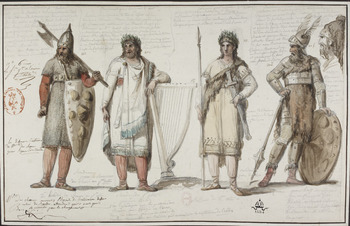
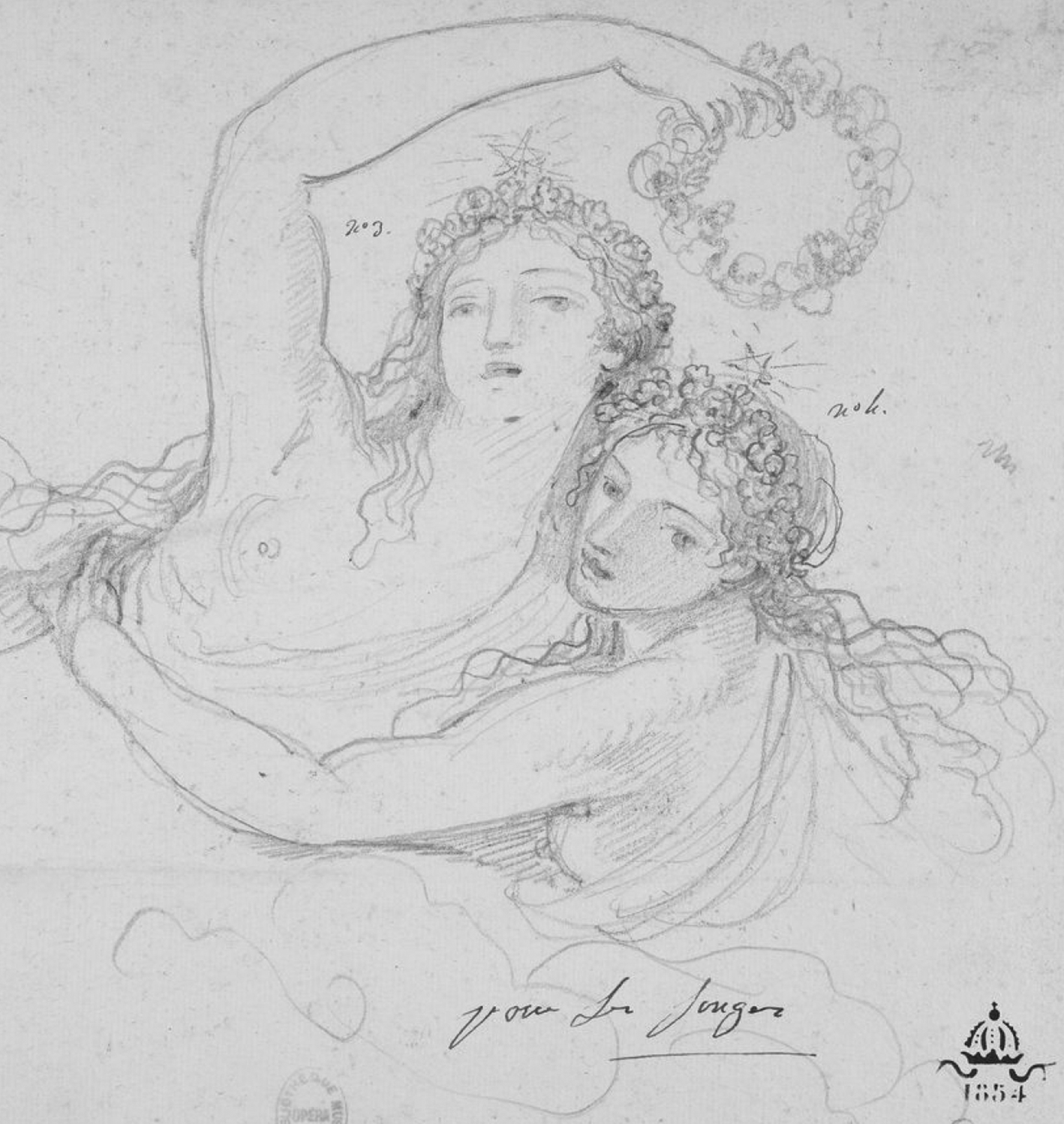
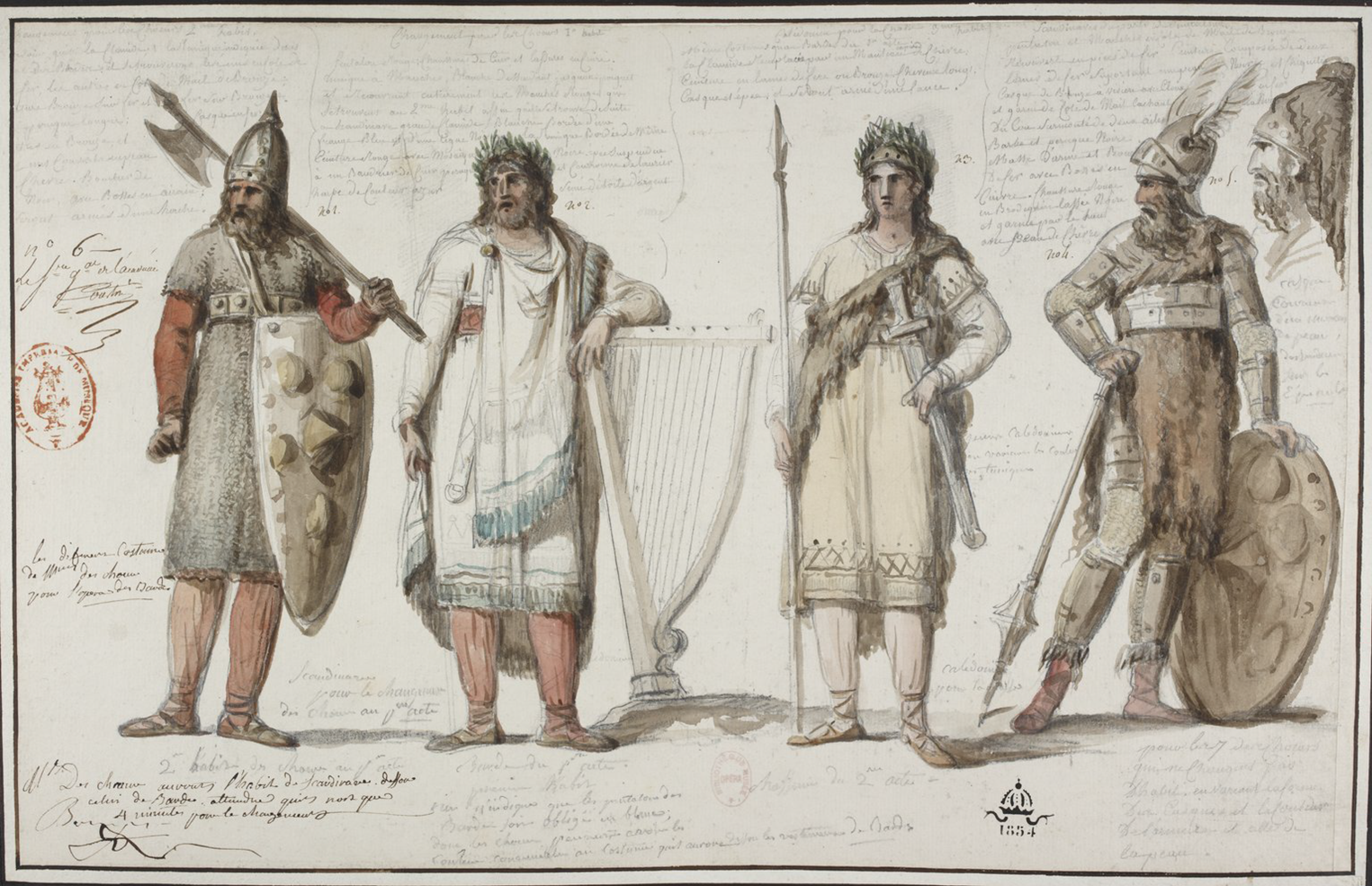
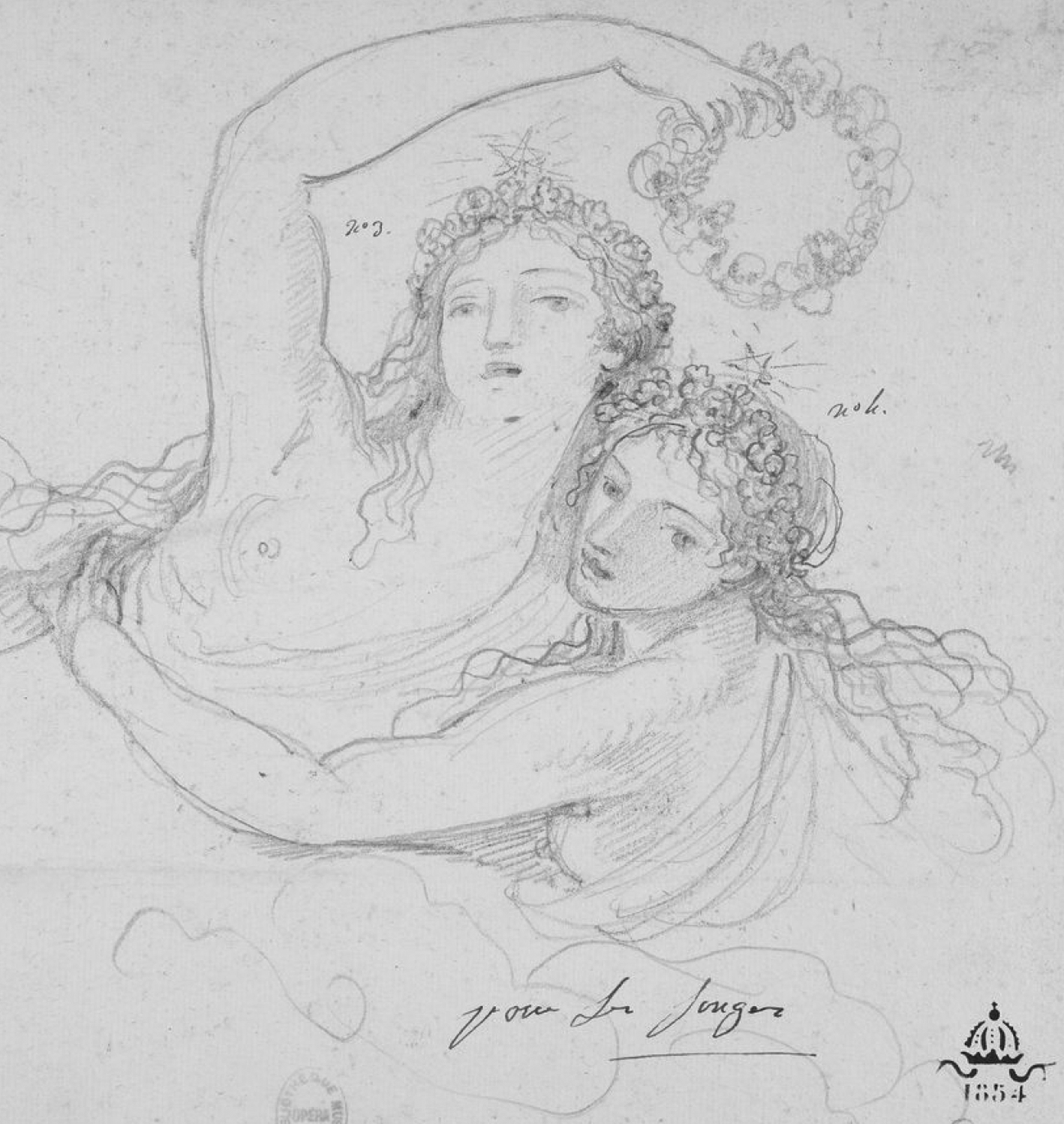
In this respect, the opera resembles Girodet's L'apothéose des héros français, which is thought to celebrate the same event. Resemblances between the painting and the opera are found not only on the thematic level, but also in the visual depiction. Charlton remarks that the dream scene and painting are both illuminated by meteors.Footnote 102 This can be understood as a clear reference to Napoleon, who had famously proclaimed in a text on happiness presented at the Academy of Lyon in 1791 that ‘men of genius are meteors destined to burn to enlighten their era’.Footnote 103 Moreover, Girodet and Jean-Simon Berthélémy, Ossian's costume designer, both attempted to give the characters a ‘bardic’ appearance by including Celtic-looking armour and garments (see Fig. 2).Footnote 104 One particular sketch of Berthélémy, marked ‘for the dream’, also shows two women whose body postures and hair are reminiscent of the female figures in the painting (see Fig. 3). There is evidence that the resemblance was more than a coincidence. Sometime after L'apothéose des héros français had been exhibited at the Salon in 1802, Bonet asked the Opéra's artists to redesign the sets, costumes and machines for Ossian to reflect in a more suitable manner the grand nature of Le Sueur's composition.Footnote 105 The elaborate new designs required the Opéra to engage several more painters, and Girodet's name appeared on a few documents in their studios from October 1803.Footnote 106 He may thus have been one of the extra painters hired to get the sets ready in time.
These sketches show the use of furs and Celtic gear to convey couleur locale in the costumes for the bards and the Scandinavians in Ossian (Jean-Simon Berthélémy, Costume Designs; Paris, Bibliothèque-musée de l'Opéra). (colour online)
This sketch for Le Sueur's Ossian titled ‘For the Dream’ shows two figures in postures and gear similar to that of the women in Girodet's L'apothéose des héros français. The inclusion of half-naked figures and their dynamic poses are quite unusual for costume designs at the Opéra (Jean-Simon Berthélémy, Costume Designs; Paris, Bibliothèque-musée de l'Opéra).
Given that the dream scene thus takes on some characteristics of a tableau vivant, it is not surprising that it was also the opera's most didactic part. Like the painting, it conspicuously promotes patriotic martyrdom – a message undoubtedly useful to a government that depended on military victories for its legitimacy and thus sent millions of young Frenchmen to their early graves.Footnote 107 The chorus that opens and closes the scene clearly proclaims this message:

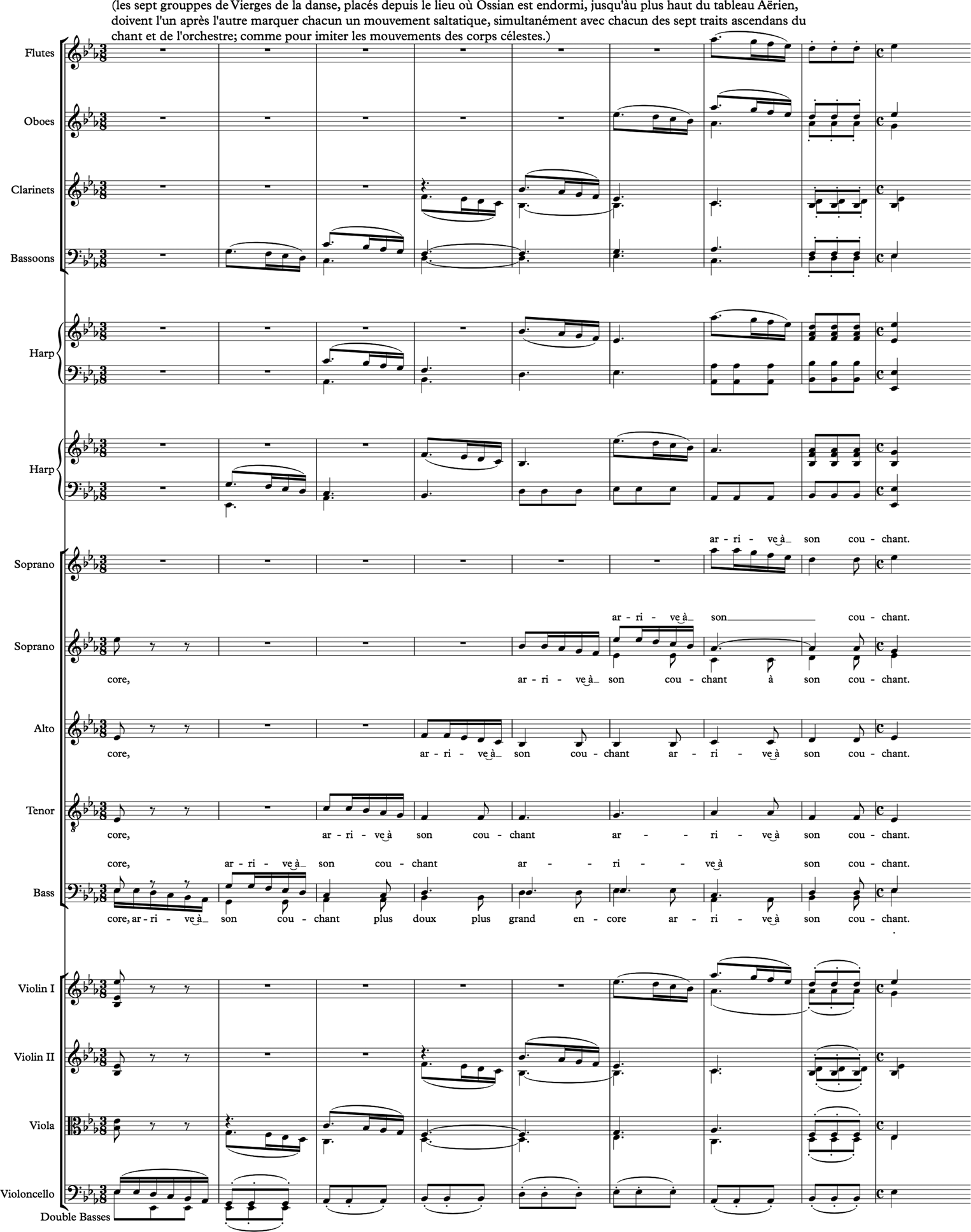
As mentioned in the introduction, the Opéra's artists had joined forces to create a scene that conspicuously showed off the coordination between the different arts and thus would bring this message to life. The choreographer, Pierre Gardel, had arranged the performers according to height – with the taller ones at the front and the shorter at the back. In so doing, his choreography supported the suggestion of greater depth achieved through the accelerated perspective in the painted backdrops.Footnote 109 In the printed score, Le Sueur requested meticulous audio-visual coordination: numerous scene descriptions detailed the general synchronisation of musical passages with the unveiling of each new part of the aerial palace, and the tight synchronisation of musical motifs with the movement of individual singers and dancers. In a section where the choir prophesies Ossian's glorious future before he arrives at the grave like a shining star, the composer indicated that the gestures of seven groups of celestial virgins should be coordinated with the seven imitative entrances of the choir (see Ex. 2). He also created the impression musically that this scene was set apart from the opera's plot reality by composing out a transition to and from the dream: pianissimo unison harp and string figuration accompanies the appearance of the cloud panels that mark the passage to and from the Ossianic Heavens (see Ex. 3). These sounds had specific significance in the Ossianic world: harp tones, when elicited by natural phenomena such as wind, were considered to symbolise the ancestors’ voices. In the context of the aforementioned writings of Bonet and Le Sueur, at least one reason for this meticulous coordination between the arts would have been to give the dream the heightened potential to ‘transport’ audiences and thereby have an educational impact.
The scene indication above the score specifies that ‘the seven groups of virgins from among the dancers that are positioned between the place where Ossian sleeps and the highest level of the aerial tableau have to make an acrobatic movement one after the other simultaneous with each of the ascending figures in the choir and the orchestra as if they are imitating the movements of the heavenly bodies’. This excerpt comes from the end of the dream, just before an abbreviated version of the opening chorus returns to close the scene.

This harp and string figuration marks the transition to and from the dream in Act IV of Le Sueur's Ossian. This excerpt is taken from the opening, but it returns almost identically at the end of the dream.
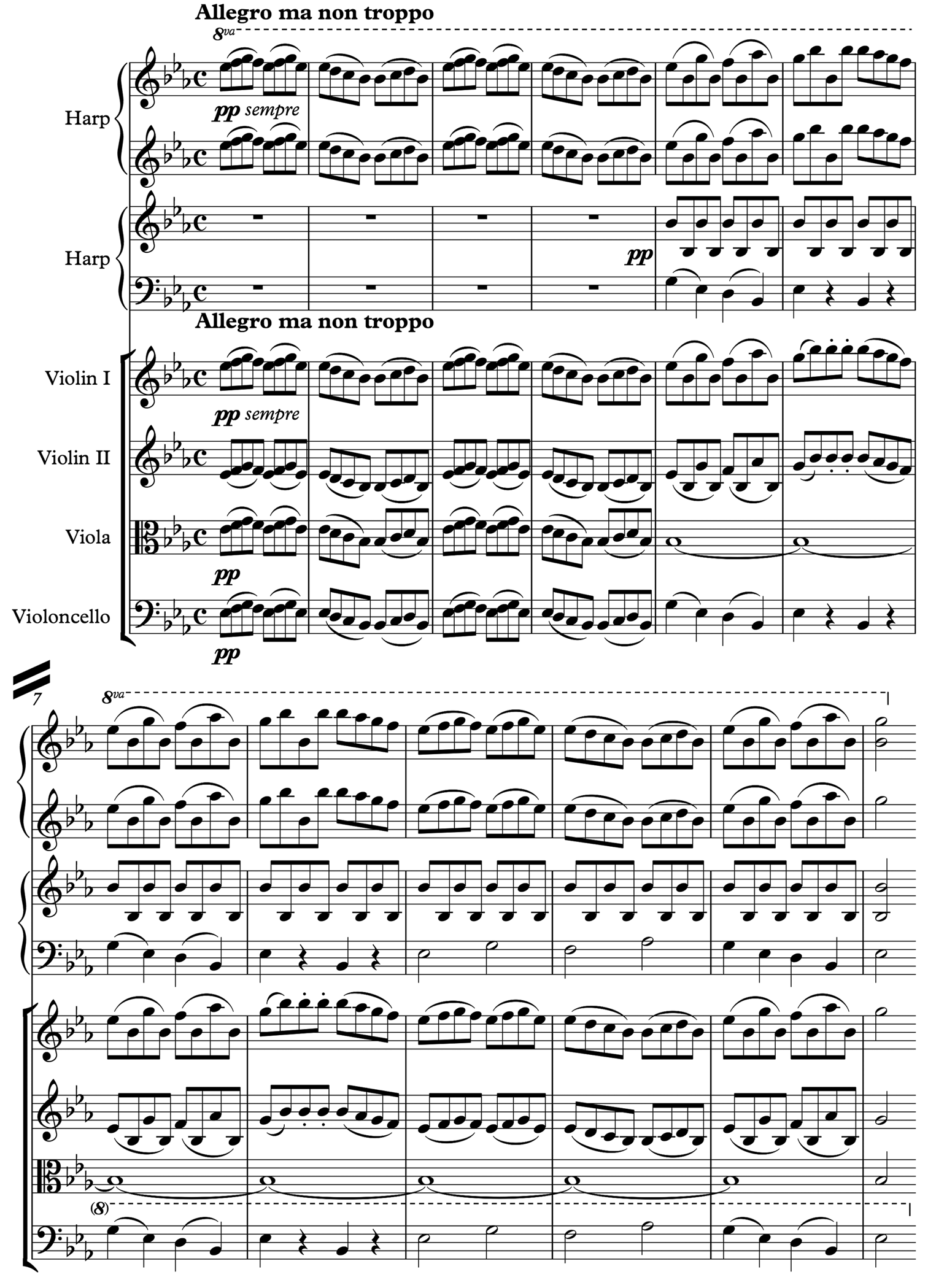
The scene's instructive message would likely have been strengthened further by similarities with celebrations of patriotic martyrdom in the Revolutionary festivals. The scene had, for instance, elements in common with the civic festival organised in 1793 to inaugurate the busts of the Revolutionary ‘martyrs’ Jean-Paul Marat and Louis-Michel le Peletier.Footnote 110 On that occasion, the Opéra had been transformed into a ‘temple of arts and liberty’ and the use of the priests’ chorus from Gluck's Alceste had given the event a religious aura – an aura that can also be perceived in the music for the bardic heavens in Le Sueur's opera, which included a cappella choral sections, modally inflected melodies and plagal cadences.Footnote 111 In both instances, the choreographer Gardel had made use of ‘young virgins in white tunics’ descending steps and honouring the deceased patriotic heroes by strewing garlands around them. More generally, the dream shared with Republican festivals the focus on the how civic duties were interwoven with domestic ones: Ossian's heroism is depicted as important for the flourishing of bardic society and the happiness of his loved ones. Towards the end of the dream scene, Rosmala is shown in tears on Ossian's grave, singing a melody from her Act II love duet, but now lamenting his death and her imprisonment by the enemy.Footnote 112 As historian James Livesey has argued, showing how domestic and civil duties were intertwined had been especially characteristic of festivals organised after the Reign of Terror because such a linkage was thought to increase the festivals’ potential for eliciting strong emotional responses.Footnote 113
Reviewers did not openly comment on Ossian's political message nor on any similarity with Revolutionary festivals. Even acknowledgements that the premiere's timing was related to the recent proclamation of the First Empire were scarce.Footnote 114 The absence of such information is to be expected; such remarks may either have been too obvious or they may have made the article susceptible to censorship. Yet the press reception did nurture the suggestion of a link between Macpherson's bards and France's Gaulish ancestors. The critic of the Courrier des spectacles was one of many to precede his review with a brief tribute to Ossianic culture and its military valour.Footnote 115 He made a direct connection with French genealogies when claiming that Charlemagne – considered the first ‘French King’ – had attempted to preserve the slowly disappearing bardic culture by putting its heroic epics in writing. And he repeated the contention attributed to Madame de Staël that Ossian should be considered the ‘Homer of the North’.Footnote 116
At least one critic suggested that the staging of the dream had meant that audiences could ‘identify’ with the Ossianic world, and he attributed this effect to the overwhelming impact of the union of the arts:
Because of the enchantment the spectator experiences, he believes he lives in the real Elysée, or rather, the illusion submits his mind to the mythology of the Caledonians. He believes himself admitted among the heroes and immortal bards, and participates with them in the delights that intoxicate them … [The choreographer Pierre Gardel] makes us experience how much power the arts have over our souls; how much their union fills all our senses with ravishing sensations; how much they bring us close to the Divinity.Footnote 117
The critics thus partook in the wider discourse that gave pride of place to France's Gaulish roots. By suggesting that the opera had created a palpable link between past and present, they contributed to the transformation of the nation's conception of its identity.Footnote 118 This new genealogy would live on despite the dwindling belief in the authenticity of Macpherson's ‘translation’. It was further propagated in the continuation of Celtomania and the veneration of Vercingetorix, the Gaulish chieftain famous for his brave attempts to halt Caesar's legions – a more historically accurate replacement for Ossian.Footnote 119
Nation-building and opera's union of the arts
The analysis of Le Sueur's Ossian highlights that the Opéra's early nineteenth-century emphasis on the union of the arts was neither a mere artistic aspiration nor specifically tied to Napoleon's aesthetic preferences. It was connected to contemporary considerations about opera's role in processes of nation-building. This connection between aesthetics and politics was not exclusive to the staging of Ossian; it became an important topic in debates on theatrical illusion as suggested in the writings of Jacques-François-Louis Grobert.
Grobert worked his way up in Napoleon's army, becoming war commissioner and assistant inspector of journals.Footnote 120 He was also an inventor and highly interested in all kinds of theatrical events.Footnote 121 In 1802, he wrote an essay entitled Des fêtes publiques chez les modernes (‘On Modern Public Festivals’), where he argued that festivals were useful tools to create communal excitement and cohesion among its diverse audiences.Footnote 122 In order to do so, it was necessary to create an overpowering event in which all elements were designed specifically to celebrate a nation's victories and moral values – whether the architecture, costumes, decorations; the theatre and firework displays; or the balls, music performances and horse races. He put these principles into practice in a design for Napoleon's coronation festivities.Footnote 123 He also tried his hand at theatre itself: his La bataille des pyramides premiered at the Théâtre de la Porte Saint-Martin in 1803. This opéra-mélodrame sought to bring this famous episode of the Egyptian campaign (1798–9) back to life by combining text, music and spectacular sets and costumes. It was openly propagandistic and at least in part aimed at enticing young men to enlist.Footnote 124
The publication, however, that most meticulously engaged with theatrical production was a treatise tellingly titled De l'exécution dramatique considérée dans ses rapports avec le matériel de la salle et de la scène (‘On Theatrical Production Considered in Relation to the Material Conditions of the Auditorium and the Stage’).Footnote 125 This work details how the conditions for a most engaging performance can be created. In line with long-standing concerns about verisimilitude, he favoured three-dimensional sets over perspective paintings, for the latter were realistic only from a few seats in the hall.Footnote 126 A specific reference to Ossian is made when he discusses the problem of using accelerated perspective in the backdrops. He lauded Gardel's ordering of the performers according to height to retain the perspectival effect, but complained that it had not been matched by the costumes, whose colour should grow dimmer the farther the figures are placed from the spectator.Footnote 127 This was not the only element in the treatise that suggests a connection to Ossian's dream scene. Grobert argued that rather than a changement à vue (an open set change with the curtain raised), which made the spectator shift from appreciating the drama to admiring the machinists’ technical skills, it would be better to maintain the dramatic illusion by changing the sets behind cloud panels.Footnote 128 He preferred cloud panels over a drawn curtain, because this image was more conducive to the illusion of being transported from one place to another. Grobert was interested not only in what happened on stage, but also, as announced in the title, in how the conditions in the auditorium would influence the operatic experience. Therefore, he proposed hiding the orchestra in the wings, darkening the auditorium and creating a new architectural layout that made the theatre's ceiling into an ‘acoustic mirror’ so that every word and sound would be heard equally well in every seat – a rather modern idea.Footnote 129
Even though Grobert's treatise seems to limit itself to aesthetic issues, traces of his ideas on the political utility of festivals are discernible. For instance, he shows an interest in making theatre and opera accessible and enjoyable for larger and more diverse audiences: he championed an enlargement of the ‘paradis’ for spectators buying the cheapest tickets, and the new layout would also ensure that all these spectators heard (if not always saw) the performance equally well. While the treatise does not overtly claim that improved operatic illusion would enhance theatre's didactic function, the dedication reveals that political education through theatre was a likely motivation for his theories. Grobert dedicated De l'exécution dramatique to Jean-Jacques-Régis de Cambacérès, Napoleon's Arch-Chancellor, and asked him to champion his improvements. His rationale was that the state would benefit from the advancement of the arts, and thus should also take part in bringing it about.Footnote 130
Some of Grobert's measures to improve theatrical illusion uncannily prefigure those of Wagner, in that their primary goal is to eliminate all elements that could divert the audience's attention from the onstage drama. While it is unlikely that Wagner knew of Grobert's work, the treatise did spark considerable conversation in the following years. It was reviewed in the press, government officials discussed the possibilities for building new theatres that implemented his proposals in 1809 and 1810, and the members of the Institut de France debated his treatise extensively as late as 1816.Footnote 131 The surviving paper trail provides no solid evidence that either Grobert's or Le Sueur's theories had a direct impact on later practices and theories about uniting the arts in opera and their concomitant interest in producing overwhelming, absorbing performances.
Nevertheless, the dream scene became a point of comparison and emulation for years to come. Le Sueur himself, for instance, sought to surpass its opulence in the final apotheosis of his La mort d'Adam (1809), which in turn became the blueprint for the finale in Rodolphe Kreuzer's La mort d'Abel (1810).Footnote 132 Reference to these apotheoses were made as late as 1827, when parts of their sets were reused in the finale of Gioachino Rossini's Moïse.Footnote 133 And, in 1893 – long after Ossian's last performance on 8 October 1817 – French theatre historian Germain Bapst asserted in his Histoire du théâtre that ‘its mise en scène had seemed marvellous to its contemporary audience; it denoted not only a great effort, but a noticeable step forward in the art of making theatre’.Footnote 134
The fame of such spectacular scenes cemented much of the Opéra's international prestige in the nineteenth century, allowing it to attract international audiences and composers alike. They also elicited Wagner's famous diatribe against French opera in Oper und Drama, but scholars have increasingly recognised the importance of the Paris Opéra as a source for his aesthetic theories and practices.Footnote 135 This article has provided ideological reasons for similarities scholars have noted between Wagner's works and early nineteenth-century French operas such as Ossian by framing the Opéra's early nineteenth-century emphasis on ‘uniting all the arts’ in the context of the search for a French national opera. Yet, perhaps more importantly, I hope to have shown that acknowledging the political messages in Ossian does not preclude recognising its aesthetic merit. In fact, political and aesthetic importance are inextricably intertwined: thanks to the political utility attached to Ossian's artistic conception and its content, the Opéra was provided with sufficient governmental funds to execute its aesthetic programme in a successful manner and the opera achieved fame as ‘a noticeable step forward in the art of making theatre’.
While I have framed Ossian in turn-of-the-nineteenth-century processes of nation-building, some caution is warranted when labelling Ossian a national opera. The Opéra's international outlook was at least as important as its function as a national theatre: it sought to exhibit to international audiences French artistic prowess and identity in its productions. This double function is also reflected in the nationalist narratives of Napoleonic France: they straddled Enlightenment (and imperialist) aspirations to universalise the (French) ideal and search for specifically French roots. In other words, such narratives sought to create greater national cohesion as well as international acclaim.
This polarity between universalising tendencies and particularity is reflected in Le Sueur's operatic aesthetics. While he sought to recreate a specific ‘historical’ and French past in Ossian, his approach to reconstructing the bards’ ancient music was based largely on philosophical inquiries into the universal origins of language and music. This approach contrasted with the ethnographic methods of studying the third-century Ossianic bards inspired by Macpherson's publications.Footnote 136 Le Sueur's emphasis on universalism is in line with contemporary ideological discourse, which had its roots in Enlightenment thought. Yet, it was now taken up by the Revolutionary and Napoleonic governments as justification for their wars, which purportedly aimed to roll out newly discovered universal forms of sovereignty across the oppressed nations.Footnote 137 Thus, Napoleon could be lauded in the opening panegyric as the ‘liberating hero of an oppressed earth’. Le Sueur's particular Enlightenment-inspired musical search for universalism sets his Ossian apart from later nineteenth-century national opera: the emergent fields of folkloric and ethnographic studies would more often provide materials for ‘national’ musical styles that focused on a nation's particularity and distinctiveness.