In sugar beet cultivation, weed control is essential to achieve high yields, because competition with weeds for light, water and nutrients reduces yield and quality (Schweizer Reference Schweizer1981 and Reference Schweizer1983). Further negative impacts of weeds are harvest difficulties caused by weed residues, enhanced future weed infestation by increasing the seed bank in the soil, and co-hosting of insects and diseases (Cioni and Maines Reference Cioni and Maines2011; Petersen Reference Petersen2004). As the early development of young sugar beet plants is slow, and competitiveness with fast growing weeds is low, weed control must take place at early growth stages of the beet (May and Wilson Reference May and Wilson2006). Chemical weed control requires a precise application timing of herbicides starting at the cotyledon stage of the weeds (May and Wilson Reference May and Wilson2006).
Currently, three to five active ingredients (ai) with reduced dosages (relative to authorized application rate) are applied per treatment in sugar beet cultivation in Germany. On average, 3.5 treatments are necessary until competitiveness of sugar beet plants is high enough to suppress weed growth (Vasel et al. Reference Vasel, Ladewig and Märländer2012). Plants usually absorb ai via roots and/or foliage. Herbicides that are taken up via roots and/or hypocotyl soon after germination can decelerate further weed emergence. This time delay is hereinafter referred to as soil activity. Continuous decrease of soil activity and further germination of weeds necessitate repeated treatments (Andr et al. Reference Andr, Hejnák, Jursík and Fendrychová2014). The treatment interval depends on the duration of soil activity, which is influenced by environment and herbicide properties (Andr et al. Reference Andr, Hejnák, Jursík and Fendrychová2014). The intervals usually vary between 5 (Cioni and Maines Reference Cioni and Maines2011) and 14 d (Petersen Reference Petersen2004). In the 1980s, the described weed control strategy was enhanced. The benefit was a reduction of about two-thirds in applied ai, and fewer PRE applications compared to the former strategy (May and Wilson, Reference May and Wilson2006), but this was the last basic advancement, and no new ai have been registered since (Petersen Reference Petersen2004). Parallel to the current weed control strategy, a shift to a higher infestation with difficult-to-control weeds like common lambsquarters, wild chamomile, and catchweed bedstraw (Galium aparine L.) occurred (Vasel et al. Reference Vasel, Ladewig and Märländer2012). Furthermore, the risk of resistant weed species increases by consistent use of the same chemical products (Heap Reference Heap2013).
A possible improvement is using herbicide-tolerant crops. One approach was the use of genetic modification by insertion of relevant genes into sugar beet crops. This was developed and introduced in North America in the early 2000s (Beckie and Hall Reference Beckie and Hall2014). Due to political reasons, this technology is not available in the European Union (Tencalla Reference Tencalla2006). Genotypes that are non-sensitive to acetolactate synthase (ALS)-inhibiting herbicides could be a further option. This trait can naturally occur in crops and was conventionally selected for sunflowers and rapeseed, and both crops are grown in Europe today (Lamichhane et al. Reference Lamichhane, Devos, Beckie, Owen, Tillie, Messéan and Kudsk2016). Sugar beet is naturally sensitive to ALS-inhibiting herbicides, and triflusulfuron-methyl is the only ai of this mode of action that is registered for weed control in sugar beet cultivation (Wittenbach et al. Reference Wittenbach, Koeppe, Lichtner, Zimmermann and Reiser1994). Cultivars that are non-sensitive to the ALS-inhibitors foramsulfuron (FSN) and thiencarbazone-methyl (TCM) of the complementary herbicide Conviso® are currently under development (KWS SAAT SE 2015). In the following, the herbicide is referred to as ‘F/T’. F/T contains 50 g FSN L−1 and 30 g TCM L−1. FSN belongs to the sulfonylureas and TCM to the sulfonyl-amino-carbonyl-triazolinones. FSN is absorbed through foliage, TCM is mainly absorbed by roots, and both ai are transported in the xylem and phloem. F/T is formulated as an oily dispersion.
In Central Europe, the spectrum of weeds in maize cultivation is similar to that in sugar beet cultivation (de Mol et al. Reference de Mol, von Redwitz and Gerowitt2015). Both FSN and TCM are registered in maize cultivation, where only two applications of TCM are necessary to control weeds (Pannacci and Onofri Reference Pannacci and Onofri2016; Sulewska et al. Reference Sulewska, Koziara, Smiatacz, Szymanska and Panasiewicz2012). The utilization of F/T on sugar beet could thus improve efficacy and reduce the number of herbicide applications due to a longer lasting soil activity. Nevertheless, in the case of intensive use of ALS inhibitors as the only mode of action, the possibility of increasing development of ALS-resistant weeds has to be considered.
Flexibility of application timing and efficacy increase by using F/T (Wendt et al. Reference Wendt, Wegener, Ladewig and Märländer2016). However, there are no data on the effect of environment and dosage on the duration of soil activity of F/T or on the duration itself. To assess whether the utilization of F/T would prolong the interval between herbicide treatments in sugar beet cultivation, data on the duration of soil activity of F/T are necessary. A comparison of F/T with classic herbicides was not intended due to the high workload connected with the scope of the present study. Data for classic herbicides are available from the literature (e.g., Janaki et al. Reference Janaki, Rathika, Chinnusamy and Prabhakaran2013; Kucharski and Sadowski Reference Kucharski and Sadowski2009).
The data by other authors on FSN and TCM in maize cultivation do not describe the duration of soil activity of F/T in detail (Pannacci and Onofri Reference Pannacci and Onofri2016; Sulewska et al. Reference Sulewska, Koziara, Smiatacz, Szymanska and Panasiewicz2012). Performance of F/T regarding dosage and environmental effects, and furthermore, the soil activity against different weed species, is unknown. The aim of the present study was thus to evaluate the influence of environment and dosage on soil activity and maximum duration of F/T. A field trial series was conducted in northern Germany in 2013 and 2014, with three sites each year (six environments), where different weed species but no sugar beets were sown.
Materials and Methods
Field Trials
Four field trials were located near Göttingen, Germany (Table 1), three on loamy soils (Göttingen in 2013, Göttingen in 2014, and Niedernjesa in 2014) and one on clay soil (Angerstein in 2013). Two were located on sandy soils near Hanover (Schwüblingsen in 2013, Schwüblingsen in 2014). The trial sites represent typical environments for sugar beet cultivation covering soil and climatic differences that can be found in Central Europe.
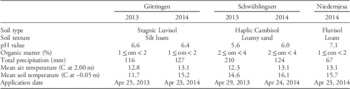
Environmental attributes of trial sites and dates of herbicide application in 2013 and 2014 in Germany. Weather conditions from April 20 to May 31 of each year correspond to the period of weed sowing. Angerstein 2013 was canceled due to too low weed densities.

Abbreviations: OM, organic matter
Soil was prepared in a typical manner for sugar beet cultivation. The fields near Göttingen were plowed in autumn, and the fields near Hanover were tilled with a cultivator in spring. Five days after application of F/T, the following weed species common in sugar beet cultivation (Vasel et al. Reference Vasel, Ladewig and Märländer2012) were sown, at different dates: redroot pigweed (Amaranthus retroflexus L.), rapeseed, common lambsquarters, wild chamomile, blackgrass, and barnyardgrass.
Herbicide Application
The herbicide was applied in parallel strips with dosages of 0 (untreated check), 25+25, 37.5+22.5 and 50+30 g FSN+g TCM ha−1. The strips were randomized in four replications per environment (Figure 1). The treated strips extended the entire width of the area prepared for the subsequent sowing of the weeds. Application was carried out with a pneumatic plot sprayer (Schachtner PSG, nozzle type air induced, low pressure, flat fan 110 02, water volume 200 L ha−1, pressure 250 kPa, velocity 4.5 km h−1) with an effective spraying width of 1.8 m.
Field trial design to assess duration of soil activity of foramsulfuron (FSN) plus thiencarbazone-methyl (TCM) against important weed species typical of sugar beet cultivation. Different numbers indicate different sowing times after application of foramsulfuron plus thiencarbazone-methyl; different capital letters indicate different weed species, Roman numerals indicate replications. Sowing times and weed species were randomized in each environment.

Weed Sowing and Assessments
Herbicide strips were divided into four blocks to sow weeds at four different times. Weeds (no sugar beet) were sown during the usual time of sugar beet sowing (end of April) at 5, 10, 15, and 20 d after application (DAA). In 2014, a fifth sowing time (40 DAA) was added, because residual soil activity was found to last longer than 20 DAA in 2013. Altogether, one plot included one sowing time, one dosage, and the six weed species. The weed seeds (purchased from Herbiseed, Mire Lane West End, Twyford, RG10 0NJ, England) were drilled at right angles to the application direction in parallel rows with a distance between the rows of 20 cm (Figure 1) with a Sembdner GSD sowing machine (SEMBDNER Maschinenbau GmbH, Liebigstrasse 16, 82256 Fürstenfeldbruck, Germany).
Each sowing unit of the drilling machine was set to the specific optimum seeding rate and sowing depth of each species (Nichols et al. Reference Nichols, Verhulst, Cox and Govaerts2015) and adapted to soil conditions to ensure drilling into a humid soil horizon. The sowing depths were 1.0 to 2.0 cm for redroot pigweed, 1.0 to 2.0 cm for rapeseed, 0.5 to 1.5 cm for common lambsquarters, 0.0 to 0.5 cm for wild chamomile, 1.0 to 2.0 cm for blackgrass, and 1.0 to 2.0 cm for barnyardgrass.
The seeding rates were set to achieve a plant density of 50 growing plants per meter within a row. The specific germination rates were tested in the greenhouse before sowing by planting 100 seeds of each weed species in pots filled with sterilized standard soil mixture (75% sandy clay and 25% sand). Day/night temperatures were 22/18 C with a period of 12 h (Christ et al. Reference Christ, Märländer and Varrelmann2011).
In the plots, the arrangement of the weed species was randomized among sowing times. Sowing times and herbicide strips were also randomized (Figure 1). Due to technical reasons, weed species were not randomized between replications and herbicide dosages.
Soil activity of F/T was evaluated by assessing percent control of each weed species related to the untreated check. Weed coverage as plant density (emerged plants per meter seeded) and plant growth (estimated biomass and development stage) were visually assessed in each plot for each sowing time using the method described by the European and Mediterranean Plant Protection Organization (2007). Consequently, lower weed coverage in the treated plots indicated better weed control and thus higher soil activity. Weed control was graded from 0% to 100% in two assessments at 35 and 55 d after application. In 2014, the newly introduced fifth sowing time (40 DAA) could thus not be evaluated at the first assessment.
At Angerstein in 2013, the evaluation of weed control was not possible, because very low soil moisture caused poor plant density. As redroot pigweed had a poor plant density at every environment, no data for this weed are available. At Göttingen in 2013, blackgrass had not yet emerged at the first assessment.
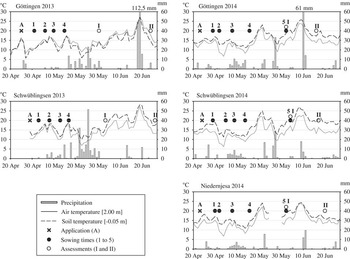
Air and soil temperature, precipitation, air humidity, wind direction and wind speed were recorded by weather stations at each site (Figure 2). Actual weather conditions during applications were additionally recorded.
Weather conditions in five environments in 2013 and 2014 in Germany, from April 20 to June 27, including average daytime temperature (C) and precipitation (mm). Dots indicate sowing times of weed species.

Statistical Analysis
The statistical analysis was carried out with the statistics program SAS®, version 9.4 (SAS Institute Inc., Cary, NC, USA). The data were tested for variance homogeneity and normal distribution. Due to the use of relative figures, the data were altered by an angular transformation (EPPO 2013). All tables and figures include the original data.
Data were subject to analysis of variance using PROC MIXED, and a multiple post-hoc Tukey test (P≤0.05) was applied to compare parameter means. The untreated checks were excluded from the analysis, because values in these plots were generally zero. The influence of weed species on weed control could not be assessed in this analysis due to the missing randomization of the weeds (Figure 1). Replications at each environment were thus averaged, and environments were set as replications in a second ANOVA. The fifth sowing time (40 DAA) was excluded from the evaluation due to the missing values in 2013.
Results and Discussion
Factors Affecting Soil Activity
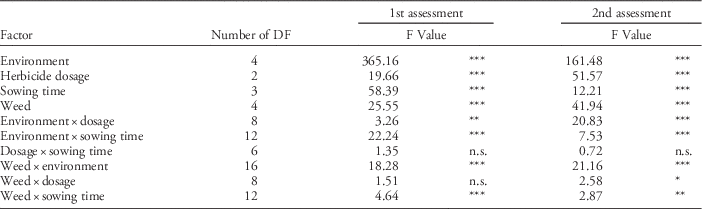
Weed control was influenced by environment, herbicide dosage, sowing time, and weed species, and their interactions, at both assessment dates (Table 2). At the first assessment, environment and sowing time had the strongest influence on weed control, and at the second assessment, environment and dosage had the strongest influence on weed control.
Factors influencing relative weed coverage of five weed species (rapeseed, common lambsquarters, wild chamomile, blackgrass, and barnyardgrass) treated with different dosages of foramsulfuron plus thiencarbazone-methyl prior to sowing in five field trials in 2013 and 2014 in Germany. First assessment was at 35 days after application. Second assessment was at 55 days after application. (*, **, and ***: significant at P ≤0.05, P ≤0.001, and P≤0.0001; DF: degrees of freedom; n.s.: not significant)

Environment
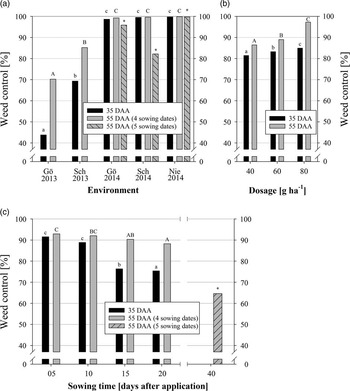
The lower weed control at the first assessment (35 DAA) compared to the second assessment (55 DAA) (Figure 3) was caused by the exponential weed growth in the untreated checks in comparison to the treated plots as described before (Jursik et al. Reference Jursik, Holec, Soukup and Venclová2008). Therefore, differences in weed control between untreated and treated plots were smaller in the earlier assessments.
Mean relative weed control (%) of five weed species treated with foramsulfuron plus thiencarbazone-methyl prior to emergence, as influenced by a) environment, b) dosage, and c) sowing time. Assessments were at 35 and 55 days after application (DAA) for four sowing dates (5, 10, 15, and 20 DAA) and were at 55 DAA for five sowing dates (5, 10, 15, 20, and 40 DAA) (2014 only). The five sowing times are summarized in a) and c) (5 to 40 DAA). Significant differences among environments, dosages, and sowing times are indicated by different small letters for the 35 DAA assessment and by different capital letters for the 55 DAA assessment (Tukey, P≤0.05), n=16–20. *=statistical evaluation not possible due to missing values in 2013. Gö: Göttingen; Sch: Schwüblingsen; Nie: Niedernjesa.

Nevertheless, weed control differed significantly among environments at both assessments (Figure 3a). Weed control was significantly lower in 2013 than it was in 2014, and it was lower at Göttingen in 2013 than it was at Schwüblingsen in 2013. In 2014, no significant differences in weed control among environments occurred until 20 DAA.
The strong year effect was most likely caused by temperature differences. Soil and air temperatures were about 1 C higher in 2014 than they were in 2013 (Table 1). In particular, soil temperatures until 15 DAA were about 2 C higher in 2014 than they were in 2013. This probably caused enhanced soil activity of F/T in 2014 compared that in 2013. Plant availability of herbicides, including sulfonylureas, is also increased by increasing temperature (Eleftherohorinos et al, Reference Eleftherohorinos, Dhima and Vasilakoglou2004), resulting in higher uptake and metabolism (Kudsk and Kristensen Reference Kudsk and Kristensen1992). In 2013, the low soil temperature of about 7 C two days after application at Göttingen (Figure 2) may have reduced soil activity there compared to the soil activity at Schwüblingsen.
Differences in soil moisture also affect weed control. The first step in the degradation of sulfonylurea is hydrolysis, followed by (less effective) microbial degradation (Grey and McCullough Reference Grey and McCullough2012). Furthermore, increased soil moisture has been shown to enhance the degradation of herbicides such as sulfometuron-methyl (sulfonylurea) and isoxaflutole (cyclopropylisoxazole) (Anderson and Dulka Reference Anderson and Dulka1985; Taylor-Lovell et al. Reference Taylor-Lovell, Sims and Wax2002) due to decreased sorption, increased bioavailability, and faster diffusion kinetics and transport (Cupples et al. Reference Cupples, Sims, Hultgren and Hart2000). However, different rainfall patterns hardly explain the lower weed control rates in 2013 compared to those in 2014, as neither hydrolysis nor leaching out of the germination zone seem likely to have occurred during the first 19 to 20 DAA at Göttingen or Schwüblingsen in 2013 (Sondhia Reference Sondhia2009; Stewart et al. Reference Stewart, Soltani, Nurse, Hamill and Sikkema2012). In 2014, significant environmental differences were found in the 55 DAA assessment when the latest sowing date (40 DAA) was included. The precipitation data show that leaching of the ai out of the germination zone of the weeds due to heavy rainfall is unlikely for the first three sowing dates, 5 to 15 DAA (Figure 2). After the 4th sowing at 20 DAA, heavy rainfall events within one day (30 to 35 DAA) at Göttingen and Schwüblingsen in 2014 could have caused leaching at these sites, whereas this is less likely for Niedernjesa. Later than 20 DAA, leaching seems likely, but this is also related to degradation over the time. In consequence, leaching was just one factor for the reduced control of the weeds sown at 40 DAA. At Niedernjesa in 2014, leaching was unlikely due to the soil texture and the relatively low precipitation (Sondhia Reference Sondhia2009; Stewart et al. Reference Stewart, Soltani, Nurse, Hamill and Sikkema2012).
By contrast, the higher precipitation of 210 mm at Schwüblingsen in 2013 (Table 1) in comparison to 116 mm at Göttingen in 2013 could have enhanced soil activity at this environment. In studies by Stewart et al. (Reference Stewart, Nurse, Hamill and Sikkema2010, Reference Stewart, Soltani, Nurse, Hamill and Sikkema2012), efficacy of soil-active herbicides was increased by increasing soil moisture, due to the faster absorption of ai by weed seeds. This effect most likely outbalanced the aforementioned effect of faster degradation at increased soil moisture. Furthermore, plant availability was presumably higher at Schwüblingsen due to the lower soil pH of 5.6 (Table 1), compared to the availability at Göttingen, which had a pH of 6.6, because plant availability of TCM increases at lower soil pH, whereas degradation of FSN and TCM is not influenced by the soil pH (Szmigielski et al. Reference Szmigielski, Schoenau, Johnson, Holm and Sapsford2012). Although FSN and TCM adsorb weakly to soil (Grey and McCullough Reference Grey and McCullough2012), soil activity of F/T may have been higher at Schwüblingsen, which has sandy soil, than it was at Göttingen, where the clay content of the soil was higher (Barriuso and Calvet Reference Barriuso and Calvet1992; Villaverde et al. Reference Villaverde, Kah and Brown2008). All of the factors that influence weed control interact, and it is difficult to quantify the importance of every factor. Furthermore, this might be of particular relevance concerning soil organic matter, which was highest at Schwüblingsen, necessitating further studies.
Dosage
High herbicide dosages are often necessary to achieve adequate weed control (Talgre et al. Reference Talgre, Lauringson and Koppel2008). In the present study, weed control significantly increased with increasing herbicide dosage (Figure 3b), as also shown in earlier studies for both PRE and POST application of herbicides (Raimondi et al. Reference Raimondi, Oliveira, Constantin, Rios, Gemelli and Raimondi2015). This is mainly due to a higher amount of ai in the plant tissue per unit weight at higher dosages (Schuster et al. Reference Schuster, Shoup and Al-Khatib2007).
Sowing Time
Weed control significantly decreased with later sowing times, being less distinctive in the second assessment than it was in the first assessment (Figure 3c). This decrease can be explained by several interacting factors, such as soil binding, leaching, and degradation. As discussed above, leaching was not likely until 20 DAA, and decreasing soil activity of the herbicide was presumably caused by degradation of the ai related to temperature (Sarmah and Sabadie Reference Sarmah and Sabadie2002). Due to the significant decrease of weed control between 10 and 15 DAA at the first assessment, maximum duration of soil activity of F/T can be expected around this time. This is in line with studies indicating that the degradation of FSN in soil (at 20 C) occurs at 1.5 to 12.7 d (Haas Reference Haas2001), and that the degradation of TCM in soil occurs at 3.2 to 53.2 d (EFSA 2013). The DT50 (period for 50% dissipation) by hydrolysis (at 25 C) is 3.7 to 132.0 d and 50.0 to 153.0 d for FSN and TCM, respectively (BVL 2009, 2010). Due to the different responses of the weed species to the application of F/T, and the interactions of environment and dosage influencing soil activity, a more detailed evaluation of weed species and environments is given.
Maximum Duration of Soil Activity
In the present study, the mean weed control rate significantly decreased between the second and third sowing time (10 and 15 DAA) for all weed species (except wild chamomile) at the first assessment (Figure 4a). Differences in control among the weed species rarely occurred. Only the control of common lambsquarters and wild chamomile decreased more slowly than the control of the other weeds, but there was a strong environmental effect. In the 2014 trials, weed control hardly differed among the 5 to 20 DAA sowing times in the first assessment. In the second assessment, weed control was considerably lower in the plots sown 40 DAA than it was in the plots with earlier sowing times (Figure 4b).
Relative weed coverage rate (%) of five weed species treated with foramsulfuron plus thiencarbazone-methyl prior to emergence (mean of dosages: 0.50, 0.75, 1.00 L ha−1) as affected by sowing time and environment. Non-treated check was set as 100. Assessments made a) 35 days and b) 55 days after application. Different letters indicate significant differences among sowing times (Tukey, P≤0.05), n=12. Barnyardgrass sown 20 days after application had not yet emerged at the time of the first assessment at Göttingen in 2013. The fifth sowing time (40 days after application) only took place in trials in 2014.

At Göttingen in 2013, the control of all weeds decreased almost constantly in comparison to that at Schwüblingsen in 2013, where a stronger decrease occurred at 15 DAA. At Göttingen in 2013, only low and constant precipitation of about 6.9 mm occurred between the sowing times (between May 6 and 13; 10 and 18 DAA) (Figure 2). Furthermore, temperatures were constant, between 15 and 17 C. Presumably, degradation of the ai was also constant, and soil activity against weeds decreased continuously. In contrast, after a period with low precipitation of only 6.6 mm before the second sowing time (10 DAA), 19.2 mm of rain fell between May 7 and 13 (8 and 15 DAA) at Schwüblingsen in 2013. In a study by Graebing et al. (Reference Greabing, Frank and Chib2003), environmental factors (temperature and soil moisture) were constant and degradation of herbicides also remained constant. Saha and Kulshrestha (Reference Saha and Kulshrestha2002) found that the degradation rate of sulfosulfuron was nearly constant between 10 and 25 C. Furthermore, the degradation rate of prosulfuron markedly increased after rewetting a dry soil 17 d after application (Hultgren et al. Reference Hultgren, Hudson and Sims2002). As discussed above, the soil activity was not reduced by leaching in the 2013 trials (Sondhia Reference Sondhia2009; Stewart et al. Reference Stewart, Soltani, Nurse, Hamill and Sikkema2012). Especially at Schwüblingsen in 2013, the high precipitation from 30 to 35 DAA caused fast dissipation by leaching and hydrolysis, leading to the significant decrease in weed control at this site.
In 2014, the control of all weeds did not decrease until 20 DAA in any environment (Figure 4). Regarding the DT50 values of soil degradation of FSN and TCM being more than 50 d, soil activity lasting longer than 20 d with high weed control is possible depending on the weather conditions, which differed between years. In previous studies, the half-lives of sulfonylurea herbicides ranged from days to months, depending on factors like pH-value and temperature (Grey and McCullough Reference Grey and McCullough2012). The strongest influence on the duration of soil activity of F/T in our study was thus caused by environment. Soil activity lasted 10 to 15 d in 2013, and longer than 20 d in 2014. For currently used herbicides, duration of soil activity against weeds was indicated at 5 to 14 d (Cioni and Maines Reference Cioni and Maines2011; Petersen Reference Petersen2004), which is shorter than the estimated soil activity of F/T. Further studies including classic herbicides could prove whether this implies a longer duration of soil activity of F/T.
Outlook
As the duration of soil activity of F/T was more than 10 to 20 DAA, the treatment interval between two applications in practical weed control could be prolonged, and the number of herbicide treatments might decrease in comparison with classic herbicides. A further aspect of evaluating weed control systems is application timing, which was determined by Wendt et al. (Reference Wendt, Wegener, Ladewig and Märländer2016) showed that 4- to 6-leaf stage of common lambsquarter is limiting when 25+15 g FSN+TCM ha−1 are applied, complementing the present data on duration of soil activity. Basic determinations and further studies comparing efficacy and selectivity of F/T to classic herbicides are necessary to specify possibilities and limits of the system. Field trials in further Central European environments could be conducted to broaden the data on environmental effects. As the number of weed species resistant to ALS-inhibiting herbicides has increased during the last two decades (Heap Reference Heap2013), weed and crop rotation–specific weed resistance management is essential.
Acknowledgments
The authors thank Kerstin Steil, Udo Curdt, and Cord Buhre for technical assistance, and Melanie Hauer for critical review of the manuscript. They also thank Bayer CropScience AG for financial support.