INTRODUCTION
The family Centrolophidae, commonly known as medusafish, contains seven genera (Centrolophus Lacépède Reference Lacépède1802, Hyperoglyphe Günther Reference Günther1859, Icichthys Jordan & Gilbert Reference Jordan and Gilbert1880, Psenopsis Gill Reference Gill1862, Schedophilus Cocco Reference Cocco1839, Seriolella Guichenot Reference Guichenot and Gay1848 and Tubbia Whitley, Reference Whitley1943) and about thirty-one valid species (Eschmeyer & Fong, Reference Eschmeyer and Fong2014). These fish are distributed worldwide in all seas except most of the mid-Indian and mid-Pacific Oceans (Nelson, Reference Nelson2006). In the eastern Pacific region eight species of centrolophids have been previously recorded: Icichthys australis Haedrich, Reference Haedrich1966, from Chile (Nakamura et al., Reference Nakamura, Inada, Takeda and Hatanaka1986; Pequeño, Reference Pequeño1989); Icichthys lockingtoni Jordan & Gilbert, Reference Jordan and Gilbert1880, from Canada (McAllister, Reference McAllister1990) and the United States of America (Jordan & Gilbert, Reference Jordan and Gilbert1880; Eschmeyer & Herald, Reference Eschmeyer and Herald1983; Mecklenburg et al., Reference Mecklenburg, Mecklenburg and Thorsteinson2002); Schedophilus haedrichi Chirichigno, Reference Chirichigno1973, from the Revillagigedo Islands, Mexico (Robertson & Allen, Reference Robertson and Allen2008), Colombia (Tobón-López & Rubio, Reference Tobón-López and Rubio2008; Tobón-López et al., Reference Tobón-López and Rubio2008), Ecuador (Jiménez-Prado & Béarez, Reference Jiménez-Prado and Béarez2004) and Peru (Chirichigno, Reference Chirichigno1973; Chirichigno & Vélez, Reference Chirichigno and Vélez1998; Shimazaki, Reference Shimazaki, Nakaya, Yabe, Imamura, Romero and Yoshida2009); Schedophilus huttoni (Waite, 1910) from Chile (Pequeño, Reference Pequeño1989); Seriolella caerulea Guichenot, Reference Guichenot and Gay1848, from Chile (Guichenot, Reference Guichenot and Gay1848; Nakamura et al., Reference Nakamura, Inada, Takeda and Hatanaka1986; Pequeño, Reference Pequeño1989); Seriolella porosa Guichenot, Reference Guichenot and Gay1848, from Peru (Chirichigno & Vélez, Reference Chirichigno and Vélez1998) and Chile (Guichenot, Reference Guichenot and Gay1848; Nakamura et al., Reference Nakamura, Inada, Takeda and Hatanaka1986; Pequeño, Reference Pequeño1989); Seriolella punctata (Forster, Reference Forster, Bloch and Schneider1801), from Chile (Pequeño, Reference Pequeño1989); and Seriolella violacea Guichenot, Reference Guichenot and Gay1848, from the Galapagos Islands (Grove & Lavenberg, Reference Grove and Lavenberg1997; McCosker & Rosenblatt Reference McCosker and Rosenblatt2010), Peru (Chirichigno & Vélez, Reference Chirichigno and Vélez1998) and Chile (Guichenot, Reference Guichenot and Gay1848; Pequeño, Reference Pequeño1989).
In this paper, the Mocosa ruff, Schedophilus haedrichi, is reported for the first time from Costa Rican waters on the basis of a single specimen (208 mm in standard length). This specimen, captured on 20 July 2004 near Isla del Caño, Puntarenas, Costa Rica, Pacific Ocean, at a depth of 295–350 m, represents a north-west range extension of about 750 km on the known distribution of the species. The previous north-westernmost record for this species in the region, excluding records from the Revillagigedo Islands, Mexico (Robertson & Allen, Reference Robertson and Allen2008), was off Jurubidá, Colombia (no specific coordinates are provided; see Tobón-López & Rubio (Reference Tobón-López and Rubio2008) and Tobón-López et al. (Reference Tobón-López, Rubio and Giraldo2008) for details). A brief description of the specimen as well as comparative morphometric data and distributional information are proposed.
MATERIALS AND METHODS
Specimen examined was deposited at the fish collection of the Museo de Zoología of the Universidad de Costa Rica (UCR 2676–003). Counts and measurements (Table 1) were taken on the left side of the specimen and follow the criteria of Chirichigno (Reference Chirichigno1973). Measurements were made using calipers to the nearest tenth millimetre (mm). Comparative information was obtained from Chirichigno (Reference Chirichigno1973), Robertson & Allen (Reference Robertson and Allen2008), Tobón-López & Rubio (Reference Tobón-López and Rubio2008) and Shimazaki (Reference Shimazaki, Nakaya, Yabe, Imamura, Romero and Yoshida2009).
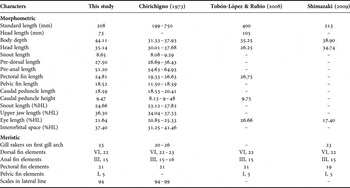
Morphometric and meristic data of Schedophilus haedrichi from Costa Rica (UCR 2676–003) and comparative material (data from Chirichigno (Reference Chirichigno1973); Tobón-López & Rubio (Reference Tobón-López and Rubio2008); Shimazaki (Reference Shimazaki, Nakaya, Yabe, Imamura, Romero and Yoshida2009)). Morphometric data expressed as percentages of standard length, except when noted as percentages of head length (HL). Measurements unavailable are represented with an en-dash (–).

RESULTS
SYSTEMATICS
Order PERCIFORMES
Family CENTROLOPHIDAE
Genus Schedophilus Cocco, Reference Cocco1839
Schedophilus haedrichi Chirichigno, Reference Chirichigno1973
(Figures 1–2)
DESCRIPTION
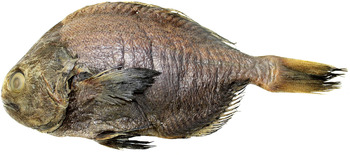
Morphometric and meristic data are given in Table 1. The specimen has a body relatively deep, moderately elongate and compressed; head broad, relatively deep; snout blunt; mouth large; jaws with one row of small conical teeth; palate toothless; eyes relatively large, with a poorly developed fatty ring; preopercle with twelve prominent spines; opercle thin, with two flat spines; scales small, smooth, easily shed, covering bases of dorsal and anal fins; lateral line arched, straightens out over anal fin; pelvic fins located under the base of pectoral fins, connected to belly by a membrane; a single dorsal fin with weak spines graduating to the rays and originating before pectoral fin insertion; anal fin originating under rear half of dorsal fin; bases of dorsal and anal fins fleshy; and caudal fin forked.
The body of the specimen kept in 70% solution of ethyl alcohol is dark grey with purple reflections, darker in the ventral and cephalic regions. The distal portion of the paired fins is black with the proximal portion paler. The dorsal, anal and caudal fins are pale grey with the distal margins black.
DISCUSSION
The data from the specimen of S. haedrichi herein described are in agreement with the size, body proportions and counts reported by other authors who systematically described this species (Chirichigno, Reference Chirichigno1973; Tobón-López & Rubio, Reference Tobón-López and Rubio2008; Shimazaki, Reference Shimazaki, Nakaya, Yabe, Imamura, Romero and Yoshida2009).
The only anatomical feature that differs significantly from these authors is the body depth (44.11% of standard length vs 31.33–38.90% of standard length). Robertson & Allen (Reference Robertson and Allen2008), however, report, for this species, body depths greater than 35% of standard length, consistent with what was observed in the specimen herein described.
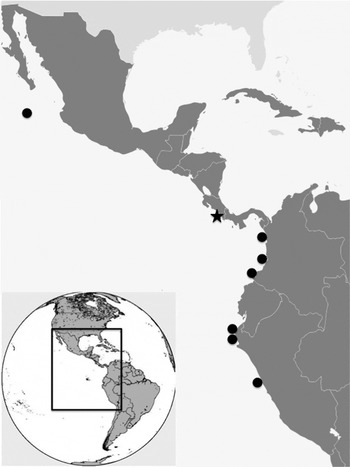
This species has been previously recorded in the Revillagigedo Islands, Mexico (Robertson & Allen, Reference Robertson and Allen2008), Colombia (Tobón-López & Rubio, Reference Tobón-López and Rubio2008; Tobón-López et al., Reference Tobón-López and Rubio2008), Ecuador (Jiménez-Prado & Béarez, Reference Jiménez-Prado and Béarez2004) and Peru (Chirichigno, Reference Chirichigno1973; Chirichigno & Vélez, Reference Chirichigno and Vélez1998; Shimazaki, Reference Shimazaki, Nakaya, Yabe, Imamura, Romero and Yoshida2009) (see Figure 2). The discovery of this specimen in Costa Rican waters increases the knowledge about our marine ichthyofauna and provides evidence of a broader distributional pattern for this species in the eastern Pacific region.
Schedophilus haedrichi, 208 mm standard length (UCR 2676–003) caught off Costa Rica (8°20′5.0028″N 83°16′39.3456″W).

Records of Schedophilus haedrichi in the eastern Pacific; star indicates the present record (8°20′5.0028″N 83°16′39.3456″W), circles indicate previous literature (Chirichigno, Reference Chirichigno1973: 3°53.6′S 81°03′W; 3°53′S 81°05.9′W; 5°02′S 81°07′W; 5°25′S 81°24′W; 10°13′S 78°23′W; Jiménez-Prado & Béarez, Reference Jiménez-Prado and Béarez2004: no specific coordinates are provided, marks placed by approximation; Tobón-López & Rubio, Reference Tobón-López and Rubio2008: no specific coordinates are provided, marks placed by approximation; Shimazaki, Reference Shimazaki, Nakaya, Yabe, Imamura, Romero and Yoshida2009: no specific coordinates are provided, marks placed by approximation) and museum records (data from http://www.gbif.org).

Being collected at relatively great depths, the biology of S. haedrichi is poorly known, due almost certainly to the relatively low number of captures. At the present time, according to Chirichigno (Reference Chirichigno1973), Tobón-López & Rubio (Reference Tobón-López and Rubio2008), Tobón-López et al. (Reference Tobón-López, Rubio and Giraldo2008), Shimazaki (Reference Shimazaki, Nakaya, Yabe, Imamura, Romero and Yoshida2009), FishBase (Froese & Pauly, Reference Froese and Pauly2013), the Global Biodiversity Information Facility (GBIF: http://www.gbif.org/) and the FishNet2 (http://fishnet2.net/) online data bases, a small number of caught specimens of S. haedrichi are known (only about 10); most of them collected in Peruvian waters (see Figure 2). The expansion of fisheries into deeper waters and the development of new fisheries for new deep-water target species in the region (see Wehrtmann & Nielsen-Muñoz (Reference Wehrtmann and Nielsen-Muñoz2009) for an overview), will likely bring with them new captures of unexpected species. As a result, some fish being currently considered as rare, such as the one reported here, might be common or abundant at certain depths or habitats. All of these facts probably account for the apparent infrequency and irregular patchy distribution of S. haedrichi.
ACKNOWLEDGEMENTS
The author is grateful to William A. Bussing, Myrna I. López, Ana Rosa Ramírez and the authorities of the Museo de Zoología of the Universidad de Costa Rica for encouragement and facilities, and to Mario Espinoza for donating the specimen.