Introduction
Alzheimer’s disease (AD) is characterized by progressive impairment of memory and other mental functions affecting the execution of activities of daily living (McKhann et al., Reference McKhann, Drachman, Folstein, Katzman, Price and Stadlan1984; Weintraub, Wicklund & Salmon, Reference Weintraub, Wicklund and Salmon2012). Difficulties experienced by persons with AD include medication management, which is also one of the main domains of care supported by family caregivers in the home environment (Brodaty & Green, Reference Brodaty and Green2002; Fortinsky, Reference Fortinsky2001; Gillespie, Mullan & Harrison, Reference Gillespie, Mullan and Harrison2014; While, Duane, Beanland & Koch, Reference While, Duane, Beanland and Koch2013). More than 54% of caregivers of people with dementia support medication management (Gillespie et al., Reference Gillespie, Mullan and Harrison2014). Managing medication is complex and involves several tasks, such as handling and differentiating between multiple pills, following specific schedules, identifying side effects, and managing prescriptions. This role is crucial considering that medication non-adherence can have serious consequences, including poor health outcomes, unnecessary diagnostic and therapeutic measures, hospitalizations, and admission to a nursing home (Col, Fanale & Kronholm, Reference Col, Fanale and Kronholm1990; Kuzuya et al., Reference Kuzuya, Hirakawa, Suzuki, Iwata, Enoki, Hasegawa and Iguchi2008). Unlike health professionals, caregivers have no training and face many challenges that make their role difficult (Gillespie et al., Reference Gillespie, Mullan and Harrison2014). Caregivers need to manage a high and varying number of daily medication intakes and prescription duration (Smith, Francis, Gray, Denham & Graffy, Reference Smith, Francis, Gray, Denham and Graffy2003; While et al., Reference While, Duane, Beanland and Koch2013). They also have to develop their own strategies to remember when to give a specific medication with limited indications on the pill bottles and not a lot more from the prescriber (Gillespie et al., Reference Gillespie, Mullan and Harrison2014). The lack of support and the complexity of the task may easily lead to burden for family caregivers (Poland et al., Reference Poland, Mapes, Pinnock, Katona, Sorensen, Fox and Maidment2014).
People with dementia have a strong desire to maintain independence in their daily activities in order to stay at home as long as possible (Roger, Reference Roger2008). Technologies, in particular eMMDs, have the potential to increase the independence of individuals with cognitive impairments and reduce the assistance needed from caregivers. Indeed, eMMDs are designed to support basic operations such as classifying pills, issuing reminders when to take the medication, providing cues to select the right medication in the pill box, and remotely tracking medication adherence (Paterson, Kinnear, Bond & McKinstry, Reference Paterson, Kinnear, Bond and McKinstry2017). Despite their relevance, the use of eMMDs by individuals with cognitive impairments and their family caregivers has not received much attention in the literature.
Several studies suggest that individuals in the early stages of AD can learn/relearn various daily life activities if appropriate methods are used (Clare & Jones, Reference Clare and Jones2008; de Werd, Boelen, Rikkert & Kessels, Reference de Werd, Boelen, Rikkert and Kessels2013; Thivierge, Simard, Jean & Grandmaison, Reference Thivierge, Simard, Jean and Grandmaison2008; Wilson, Baddeley, Evans & Shiel, Reference Wilson, Baddeley, Evans and Shiel1994). Errorless learning methods are particularly useful in facilitating learning for persons with AD because they avoid exposing the person to wrong answers. There are three specific subtypes of errorless learning methods, the errorless learning method (named after the general method) (Baddeley & Wilson, Reference Baddeley and Wilson1994), spaced retrieval (Camp, Reference Camp, Gilmore, Whitehouse and Wykle1989; Camp, Foss, Stevens & O’Hanlon, Reference Camp, Foss, Stevens and O’Hanlon1996) and vanishing cues (Glisky, Schacter & Tulving, Reference Glisky, Schacter and Tulving1986). Errorless learning consists of exposing the person exclusively to the correct answer to avoid eliciting impaired episodic memory. With spaced retrieval, information is provided to the person who is asked to repeat it immediately, then again at gradually increasing intervals. Finally, with vanishing cues method, the assistance offered is gradually reduced by giving less and less informative cues until the person is completely independent. A common feature of these methods is that the correct information can be given verbally or the person is guided physically with tactile prompts to execute each action in learning a skill (Haskins, Cicerone & Trexler, Reference Haskins, Cicerone and Trexler2012).
Various studies have used one or many of these errorless learning methods with persons with AD to optimize the use of external aids, such as calendars, to-do lists, mobile phones, electronic organizers, pen-and-paper organizers, radio tapes, and voice messaging technologies (Bier et al., Reference Bier, Provencher, Gagnon, Van der Linden, Adam and Desrosiers2008; Camp et al., Reference Camp, Foss, Stevens and O’Hanlon1996; Imbeault et al., Reference Imbeault, Bier, Pigot, Gagnon, Marcotte, Fulop and Giroux2013; Lekeu, Wojtasik, Van der Linden & Salmon, Reference Lekeu, Wojtasik, Van der Linden and Salmon2002; Quittre, Adam, Olivier & Salmon, Reference Quittre, Adam, Olivier, Salmon, Adam, Allain, Aubin and Coyette2009; Rouleau et al., Reference Rouleau, Imbeault, Denault, Briere, Laflamme and Lefebvre2006; Thivierge et al., Reference Thivierge, Simard, Jean and Grandmaison2008). These studies showed that persons with AD can learn how to use external aids to access specific information. However, none of them examined how technologies can support daily life activities involving several procedural steps such as medication management.
Implementing assistive technologies in a person’s home environment is complex (Molin, Pettersson, Jonsson & Keijer, Reference Molin, Pettersson, Jonsson and Keijer2007; Robinson et al., Reference Robinson, Hutchings, Corner, Finch, Hughes, Brittain and Bond2007; Starkhammar & Nygård, Reference Starkhammar and Nygård2008), and most studies involved caregivers as primary users of technologies (Bartfai & Boman, Reference Bartfai and Boman2014; Rosenberg, Kottorp & Nygård, Reference Rosenberg, Kottorp and Nygård2012). Currently, there are few studies looking at assistive technologies used by persons with AD and the interventions used are not detailed. In addition, no studies have focused specifically on the use of eMMDs by persons with AD. To date, the main gaps to be addressed are to detail interventions adapted to the cognitive capacities of persons with AD, and to understand how they can be used to train them in using technologies such as eMMDs to support their daily life.
The overall objective of this study was thus to develop and assess the appropriateness of an intervention protocol, incorporating specific learning strategies that engage persons with early-stage AD and their caregivers in managing medication at home with an eMMD. In our study, appropriateness refers to the characteristics of the intervention perceived as being suitable, useful and relevant prior to adoption (Proctor et al., Reference Proctor, Silmere, Raghavan, Hovmand, Aarons, Bunger and Hensley2011).
Method
Study design
This user-centered development study was informed by a purposive sample representing the intervention’s potential end users (Dabbs et al., Reference Dabbs, Myers, Mc Curry, Dunbar-Jacob, Hawkins, Begey and Dew2009), that is, persons with early-stage AD, family caregivers and clinicians. The study was carried out in three steps. Step 1 involved all end users and aimed at understanding their needs. Using interviews, it explored medication management challenges, perceived usefulness of the eMMD, and perceived usefulness of the errorless training strategies. In Step 2, the eMMD intervention protocol was developed by our team, based on key considerations evidenced by Step 1 and international standards for reporting interventions (Hoffmann et al., Reference Hoffmann, Glasziou, Boutron, Milne, Perera, Moher and Johnston2014). Step 3 involved the same clinicians as in Step 1 to evaluate the appropriateness of the eMMD intervention protocol for clinical use. This study was approved by the Ethics Committee of the Institut universitaire de Gériatrie de Montréal.
Participants
Three participants from each category of end users were recruited, that is, three dyads of persons with AD and their family caregiver, and three clinicians. The persons with AD had to be at least 65 years of age, have a problem with medication management, and have been diagnosed with probable early-stage AD. Exclusion criteria were to have another type of dementia or non-compensated hearing/vision problems or to be known for problems with drug or alcohol use which can affect mental functions such as memory. Family caregivers had to provide persons with AD at least 4 hours of assistance per week, be directly involved in medication management, and not have cognitive disorders themselves. Persons with AD and their family caregivers were recruited at the cognition outpatient clinic of the Institut universitaire de gériatrie de Montréal. Clinicians were occupational therapists with at least 10 years of experience, not related to the persons with AD and their caregivers. Training on activities of daily living falls within the area of expertise of these professionals (de Werd et al., Reference de Werd, Boelen, Rikkert and Kessels2013; Laver et al., Reference Laver, Cumming, Dyer, Agar, Anstey, Beattie and Crotty2017). They were recruited at three centres providing in-home rehabilitation services for individuals with cognitive disorders. The participants included two men and one woman (78, 80, and 85 years) who had been diagnosed with early-stage AD, their family caregivers (two women and one man of respectively 74, 75, and 78 years), and three occupational therapists (women with 23, 18, and 13 years of practice).
eMMD description
eMMDs are electronic medication dispensers with a reminder system. The model presented to the participants included a 28-compartment dispenser (9” x 9”) covered by a membrane equipped with sensors that recorded the time each compartment was opened. Visual cues and audio alarms alert the person when it is time to take the medication and identify from which compartment it must be taken. All data are uploadable to a secure Internet server and the system can calculate an adherence ratio (number of pills taken/number of pills prescribed). In normal use, the pharmacist is responsible for programming the device and preparing the medication as prescribed by the primary care physician. Data pertaining to medication management (time of opening, number of reminders, errors, and omissions) can be sent by email or text message to a person designated by the user (caregiver and/or clinician).
Development and assessment of the intervention protocol
Understanding end users’ needs (Step 1)
Procedure
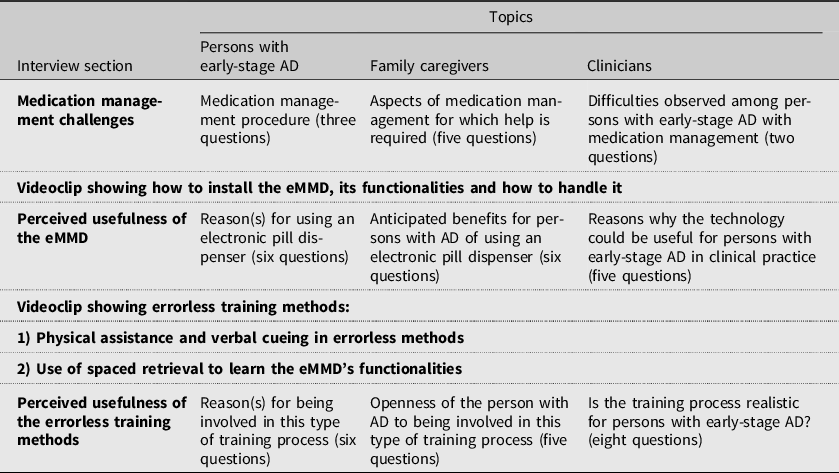
The first step involved all end users and aimed to understand their needs and challenges related to medication management and to explore the appropriateness of the eMMD to address them. Individual semi-structured interviews were held with persons with AD separate from their caregivers. Participants saw a videoclip of the features described later in this section, followed by an offline manipulation of the device. Interviews started with open-ended general questions about medication management challenges. Then participants watched a first videoclip showing use of the electronic pill dispenser. They were invited to handle it and were then asked how the eMMD could help them with medication management. The last part of the meeting explored their perception of the errorless training methods with a second videoclip showing a person participating in an intervention using these training methods. After watching the videoclip, a series of questions explored the participants’ willingness to be involved in such training strategies. Table 1 shows the interview structure and topics covered, with samples of questions asked during the interviews.
Interview structure and topics covered

Analysis
All interviews were audiotaped and transcribed verbatim followed by a content analysis (Cavanagh, Reference Cavanagh1997). Answers to the questions were grouped by interview section and category of participants (persons with AD, family caregivers, and clinicians) by the first author. Mains ideas were discussed with the co-authors and a summary was written. It was used as a guide for the development of the intervention protocol.
Development of the intervention protocol (Step 2)
The intervention protocol was first structured according to the Template for Intervention Description and Replication (TIDieR) Checklist and Guide (Hoffmann et al., Reference Hoffmann, Glasziou, Boutron, Milne, Perera, Moher and Johnston2014), to ensure that all relevant elements were covered. The TIDieR is a 12-item tool for reporting interventions that can be reliably replicated in clinical practice and assessed in research trials. Our study used nine of the items, that is, brief name, why, what (materials), what (procedures), who provided, how, where, when and how much, and tailoring. Three items relevant for reporting intervention in studies were not applicable (modifications, how well the intervention was planned, and how well the intervention was delivered).
Second, the protocol integrated the evidence gathered at Step 1 as well as theoretical sources. To support the sequence of steps, the intervention was anchored to the three-stage behavioral approach for individuals with cognitive impairment described by Sohlberg and Mateer (Reference Sohlberg and Mateer1989). The description of the intervention procedures to obtain the desired behavioral change also integrated errorless learning methods (Baddeley & Wilson, Reference Baddeley and Wilson1994; Camp, Bird & Cherry, Reference Camp, Bird, Cherry, Hill, Backman and Stigsdotter-Neely2000; Fontaine, Reference Fontaine1996). The number and intensity of intervention sessions were estimated by reviewing existing practices using the same approach with similar populations (Haskins et al., Reference Haskins, Cicerone and Trexler2012). Specifications concerning the expertise required to deliver the intervention and disciplinary background were based on a critical examination of existing interventions conducted with individuals with dementia (Imbeault et al., Reference Imbeault, Bier, Pigot, Gagnon, Marcotte, Fulop and Giroux2013; Lancioni et al., Reference Lancioni, Singh, O’Reilly, Sigafoos, Pangrazio, Megna and Minervini2009; Lekeu et al., Reference Lekeu, Wojtasik, Van der Linden and Salmon2002; O’Neill et al., Reference O’Neill, Mason, Parente, Donnelly, Nugent, McClean and Craig2011; Oriani et al., Reference Oriani, Moniz-Cook, Binetti, Zanieri, Frisoni, Geroldi and Zanetti2003; Perilli et al., Reference Perilli, Lancioni, Laporta, Paparella, Caffo, Singh and Oliva2013). This step resulted in the construction of a prototype of the protocol based on intervention strategies tailored to the cognitive abilities of persons with AD.
Perceived appropriateness of the intervention protocol (Step 3)
Procedure
This step of the study involved the three clinicians and used an iterative process. The clinicians received the experimental version of the intervention protocol by email and were asked to review it for content and structure and to evaluate how it could be used in their daily practice based on the demonstrations in the videoclips. They were encouraged to test it with colleagues or clients without further training. A month later, the clinicians were asked for their suggestions and questions in a semi-structured interview.
Analysis
The first author produced a synthesis of each interview to capture the main ideas related to the intervention protocol’s content and structure. The modifications requested by the clinicians were identified and used to build the second version of the intervention protocol. The second version of the protocol was then resubmitted to the clinicians by email to ensure that the changes made reflected the desired modifications. The clinicians were then asked to send their written comments and suggestions, which were also discussed on the phone to make sure their meaning was understood. A second series of modifications was made to produce the final version of the intervention protocol, which was unanimously approved after the clinicians read it for the third time with no other suggestions from the clinicians.
Results
Understanding end users’ needs
Understanding end users’ needs involved exploring how the tasks were currently performed, perceptions about the new technology and, by extension, perceptions related to learning how to use the new technology (Dabbs et al., Reference Dabbs, Myers, Mc Curry, Dunbar-Jacob, Hawkins, Begey and Dew2009). A variety of medication management challenges and compensatory strategies were mentioned as we explored how the tasks were currently performed. Three medication management challenges were consistently named by clinicians and caregivers: difficulty remembering ‘when’, ‘which medication’ to take, and ‘whether or not’ it had actually been taken. Persons with AD, on the other hand, reported that apart from some rare omissions, taking their medication was not challenging. This was well illustrated by the first person with AD interviewed: ‘Hmmm… my husband is annoying, he’s always checking up on me for no reason, because I rarely forget’. Strategies used by caregivers to compensate for difficulties included verbal reminders and standard pill dispensers. Additional strategies described by clinicians were task adaptation (establishing regular routines) and provision of external support (calendars, written reminders, and repetition of information by caregivers).
When we explored the participants’ perceptions of the eMMD, a number of advantages and disadvantages were raised. Both clinicians and family caregivers said the eMMD had interesting potential to compensate for difficulties with managing medication. Among its functionalities, the alarm was identified as the main advantage since it reminds persons with AD to take their medication, a responsibility normally assumed by family caregivers. The caregivers realized that the alarm would allow them to go out more since the reminder would go off in their absence. The second caregiver said: ‘when I go to my woodlot, I’m always limited in time, with this device, I could leave for a lot longer’. Clinicians viewed the alarm as a way to relieve family caregivers of some of the stress related to medication management since they could leave to the pill dispenser the task of reminding the person. The second clinician mentioned: ‘This alarm is even better than human memory!’ In addition, the green light was considered a convenient way to identify which compartment to open.
Clinicians and family caregivers both liked the option of receiving data remotely because of the freedom it could give these caregivers. For their part, persons with AD identified some options as convenient without further elaboration. However, all the participants thought the size of the technology was a weakness since no one could imagine taking a device of that size outside the home. Furthermore, all the clinicians wondered about the utility of the eMMD for pharmaceutical forms other than tablets, since patches are commonly prescribed for persons with AD. In short, the various alerts were appreciated while the size and limited pharmaceutical forms were disadvantages.
There was a lot of interest in learning how to use this new technology, particularly the errorless training methods shown in the videoclips. Family caregivers were relieved to learn that, by using the right strategies, individuals with AD could still learn. They envisioned some long-term benefits, making it easier not only to take medication but also to learn other routine tasks. This idea was well illustrated by the third caregiver: ‘It’s really encouraging to know that he can still learn, I could probably use it to help with other everyday things’. Being involved full-time with persons with AD, they found the training provided by a clinician reassuring in helping them with this learning. As for the three persons with AD, they said they were impressed to know that they could still learn. One of their reasons for getting involved in this process was the idea of having a weekly visit. One participant mentioned: ‘For sure I would love it, having visitors is a welcomed distraction’. Furthermore, all the clinicians knew that learning was possible despite the presence of cognitive disorders. However, two of the clinicians had never used errorless methods since they did not have enough practical knowledge. One concern common to all three clinicians was the time spent on training. The second clinicians said: ‘It’s really interesting, but I don’t know how feasible it is, because there is never have enough time to do everything!’ In the end, training was viewed favorably by the family caregivers, persons with AD and clinicians, but obstacles raised included the lack of know-how and time required.
Perceived appropriateness of the intervention protocol
The intervention protocol developed at step 2 that was presented to the three clinicians was divided into two main sections. In the first section, information about AD and its cognitive impacts, as well as how the disease affects medication management were presented. The electronic pill dispenser and how it works was also described. In the second section, the basic principles of errorless learning methods were introduced, followed by the detailed description of the procedures. The clinicians commented on the structure and content of this version of the intervention protocol.
Structure
Regarding the structure of the intervention protocol, the clinicians’ wanted to be driven right into the procedures and have access to the theoretical details at the end of the intervention protocol as they would only read it as needed. Therefore, they suggested to move the first section on AD and how it affects medication management to the end. They also suggested subdividing the content differently with two additional sections. One focusing specifically on the cognitive profile of individuals with mild AD that could benefit from this intervention, and the other one describing the eMMD.
Content
After reading the first version of the intervention protocol, all the clinicians were delighted with this new intervention protocol but emphasized the need for a more detailed step-by-step description of the intervention. Indeed, they all considered the description of the intervention to be crucial. Clinicians were also concerned about the time needed to assimilate the intervention and be able to integrate it into their practice. A detailed description would reduce the time and effort needed. They requested more information about how to obtain the eMMD, how to establish communications with drugstores, and how to install the eMMD. They also felt that a synthesis at the end of each section would be useful. In the theoretical concepts section, they mentioned that having concrete examples would help them understand complex concepts. All these suggestions were included in the final version.
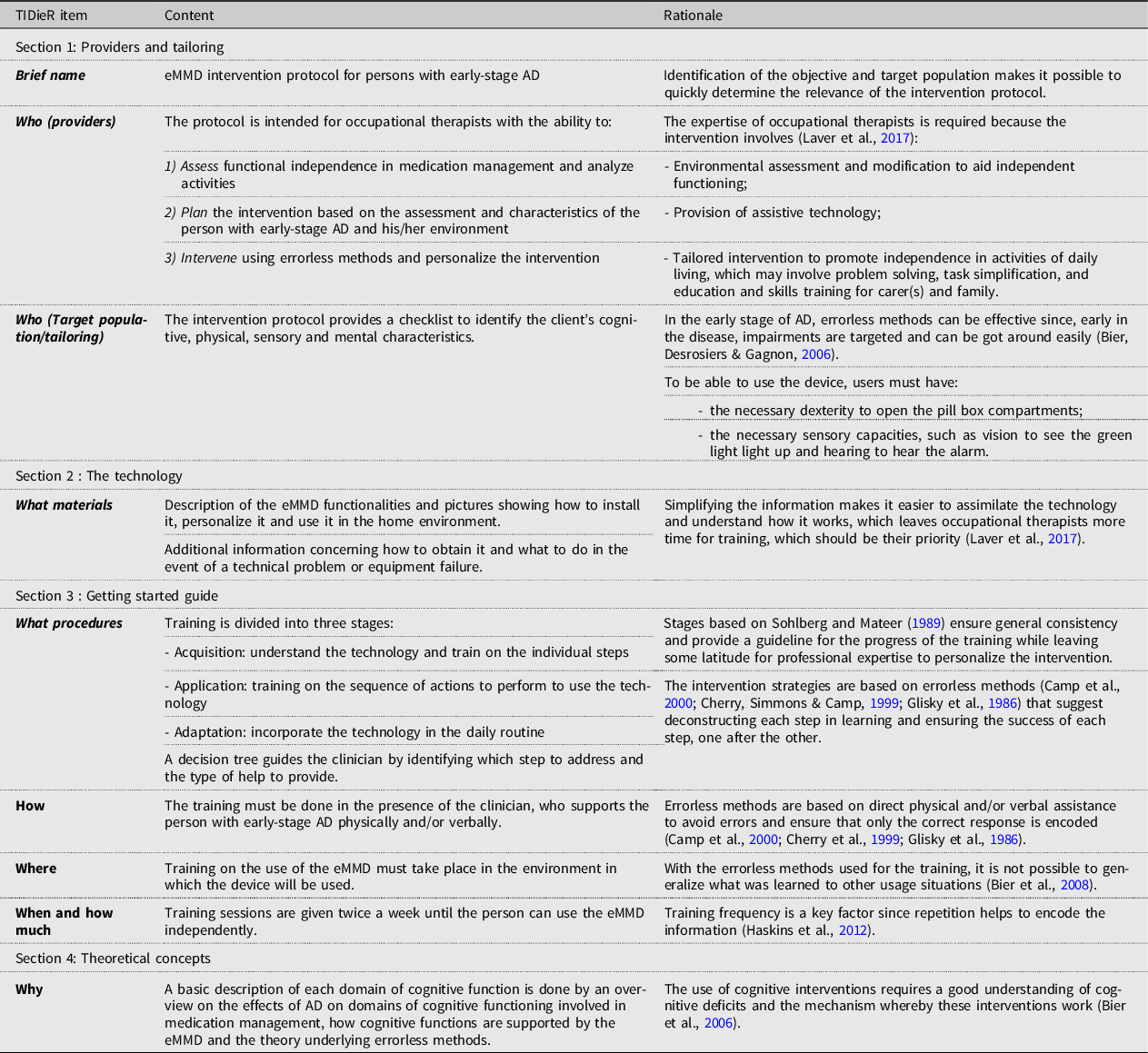
The final intervention protocol version was divided into four main sections. The first section describes the skills required by health professionals to provide the intervention and the cognitive, physical, sensory, and mental characteristics of clients who can benefit from it. In the second section, the technology features of the eMMD are fully described along with the complete operating instructions and how to obtain the device. The third section provides the detailed step-by-step instructions, including decision trees to support clinicians throughout the training. Finally, the last section provides key concepts about AD, its cognitive impacts, and how it affects medication management. It demystifies cognitive impairments of persons with AD and how the functionalities of the eMMD can support these impairments. Table 2 presents in detail the content and rationale of the final version of the intervention protocol in relation with each item of the TIDieR.
Content and rationale of the final intervention protocol

Discussion
The overall objective of this study was to understand end users’ needs in order to develop and validate a detailed intervention protocol incorporating specific learning strategies to teach persons with early-stage AD how to use an eMMD. The study resulted in the creation of a detailed intervention protocol adapted to the clinical reality, thus filling a gap reported in the rehabilitation research literature concerning the lack of specifications related to interventions (Dijkers, Hart, Tsaousides, Whyte & Zanca, Reference Dijkers, Hart, Tsaousides, Whyte and Zanca2014; Fuhrer, Reference Fuhrer2003; Lenker & Paquet, Reference Lenker and Paquet2004).
Understanding end users’ needs
Three groups of participants were directly involved in the study. Their perceptions about medication management and technology varied with the aspects addressed. For example, clinicians, and family caregivers identified the same issues experienced by persons with AD with respect to remembering and identifying which medication to take. However, the group of persons with AD did not feel concerned about these aspects. This could be because denial is a typical symptom found in early-stage AD (Kaasalainen et al., Reference Kaasalainen, Dolovich, Papaioannou, Holbrook, Lau, Ploeg and Emily2011; Mokhtari et al., Reference Mokhtari, Aloulou, Tiberghien, Biswas, Racoceanu and Yap2012). On the other hand, there was a consensus regarding the functionalities of the eMMD. This result is in line with the study of Cahill, Macijauskiene, Nygård, Faulkner, and Hagen (Reference Cahill, Macijauskiene, Nygård, Faulkner and Hagen2007), where the use of the technology was seen as fostering the functional autonomy of the person with AD and enhancing the family caregiver’s quality of life. Finally, the training methods for using the eMMD were perceived positively by all three groups of participants, although they differed with regard to the perceived time to invest in training. These results diverge from what Thivierge, Jean and Simard (Reference Thivierge, Jean and Simard2014) reported on a program aimed at relearning instrumental activities of daily living with people with mild AD. While in our study, persons with AD and their family caregivers did not see any disadvantage related to investing the time required to do the training, Thivierge et al. (Reference Thivierge, Jean and Simard2014) found that some eligible candidates rejected the program because of the high number of assessments and training sessions or because of the length of their study. On the other hand, the clinicians in our study viewed the time required by the training as a major barrier, which is consistent with a study by de Werd, Boelen, Rikkert and Kessels (Reference de Werd, Boelen, Rikkert and Kessels2015). In their nationwide survey, 45 health professionals from various disciplines were questioned about their interest in and the feasibility of using errorless methods with individuals with dementia; 67% considered these methods too time-consuming (de Werd et al., Reference de Werd, Boelen, Rikkert and Kessels2015). The time that needs to be invested in the intervention to allow persons with AD learn to use an eMMD will have to be clarified by future studies by examining the number of training sessions required. Moreover, it would be interesting to explore if the intervention could be managed by a variety of health care professionals and thus better accommodate to the reality of professionals’ schedules. By applying the intervention by different professionals, the time to be spent by each might more realistic fit into their overloaded schedules. For instance, it would be useful to consider how the intervention could be integrated in a multidisciplinary intervention plan.
Development of the intervention protocol
The method used to develop the intervention protocol should foster adoption by clinicians. First, development of the intervention used evidence-based knowledge mobilization principles. The development of the protocol was discussed in a two-way process with clinicians, who had a direct impact on its content and structure in order to transform the first theoretical version into a protocol adapted to their clinical reality. According to Chagnon and Gervais (Reference Chagnon and Gervais2011), this iterative process enhances relevance, applicability and appropriate presentation of the knowledge generated (Chagnon & Gervais, Reference Chagnon and Gervais2011), and also facilitates management (Proctor, Powell & McMillen, Reference Proctor, Powell and McMillen2013). Involving end users from the start of knowledge conception maximizes the likelihood of success over the longer term when implementing the intervention in health professionals’ practice (Dabbs et al., Reference Dabbs, Myers, Mc Curry, Dunbar-Jacob, Hawkins, Begey and Dew2009).
Next, using the TIDiER ensured that the description of the intervention was detailed enough to be able to replicate it in clinical practice and to compare across studies (Hoffmann et al., Reference Hoffmann, Glasziou, Boutron, Milne, Perera, Moher and Johnston2014). This directly meets the need identified by de Werd et al. (Reference de Werd, Boelen, Rikkert and Kessels2013) to have access in geriatric practice to studies specifically describing the methods used, the intensity and duration of training, clients’ pathology, and other factors that could affect learning. Also, adherence to a detailed intervention protocol is known to improve the quality and consistency of care (Hubbard et al., Reference Hubbard, Harris, Kilkenny, Faux, Pollack and Cadilhac2012). Laver et al. (Reference Laver, Cumming, Dyer, Agar, Anstey, Beattie and Crotty2017) also noted that the characteristics of the most effective interventions in dementia care include symptom- specific training, a client-centered approach, and communication strategies directed at patients and family caregivers. All these elements are covered by TIDieR criteria. At this time, studies examining the effectiveness of interventions involving the use of technology by persons with AD have shown variable results (Imbeault et al., Reference Imbeault, Bier, Pigot, Gagnon, Marcotte, Fulop and Giroux2013; Lancioni et al., Reference Lancioni, Singh, O’Reilly, Sigafoos, Pangrazio, Megna and Minervini2009; Lekeu et al., Reference Lekeu, Wojtasik, Van der Linden and Salmon2002; O’Neill et al., Reference O’Neill, Mason, Parente, Donnelly, Nugent, McClean and Craig2011; Oriani et al., Reference Oriani, Moniz-Cook, Binetti, Zanieri, Frisoni, Geroldi and Zanetti2003; Perilli et al., Reference Perilli, Lancioni, Laporta, Paparella, Caffo, Singh and Oliva2013). These results can hardly be compared since little detail on the intervention protocols is provided. A deliverable of our study is a detailed intervention that can be replicated in clinical practice and thus will allow to compare results from one study to another.
Strengths and limitations
This study has various strengths. The development of the intervention protocol was based not only on theoretical concepts, such as learning methods tailored to the cognitive profile of individuals with cognitive disorders, but also on the perception of various stakeholders concerning medication management, technology and learning methods. With our methodological approach, we were able to incorporate practical elements to provide clinicians with a tailored tool and present the theory in a way that made it meaningful and was adapted to their clinical reality. In addition, the involvement of persons with AD, as a group of participants, is innovative. To our knowledge, no previous study directly involved individuals with dementia at such an early stage in the development of an intervention.
As for limitations, the three groups of participants were exposed to simulations with the eMMD to capture user needs and appropriateness of the intervention protocol. The actual application of the intervention protocol, in controlled conditions and later on in the in the real life context of persons with AD are needed to reach a high level of evidence (Schulz et al., Reference Schulz, Wahl, Matthews, De Vito Dabbs, Beach and Czaja2015). This will give persons with AD a more concrete view of the usefulness of the technology in their daily lives and enable them to make a fairer assessment. Finally, a small number of participants were involved in this first development stage and they were all from the same area. Nevertheless, answers within the three groups of participants were generally along the same lines. For future development stages, larger scale studies with more participants will be needed.
Conclusion
eMMDs could potentially address difficulties encountered by persons with AD in medication management. However, this technology must be associated with training tailored to their cognitive capacities so they can learn how to use it and incorporate it in their routine. This study resulted in the development of a structured training intervention protocol, incorporating evidence-based data concerning the best methods for persons with AD to learn how to use technology. It established strong foundations to understand how persons with AD can incorporate eMMDs in their daily lives. In the next development stage, future studies will need to use this intervention in a real home rehabilitation context. Among other things, this will clarify the final elements of the TIDieR related to evaluation of adherence and fidelity; modifications, how well the intervention was planned, and how well the intervention was delivered.
Acknowledgments
The authors would like to thank all the participants for their expertise, Sainte-Dorothée medical clinic in Laval for the recruitment, and DOmedic who donated eMMDs to the study participants.
Financial support
This work was supported by the Fonds de recherche du Québec- Santé (M.T., grant numbers #31518), (C.A., salary award #32998).
Conflict of interest
Myriam Tellier has no conflicts of interest to disclose. Claudine Auger has no conflicts of interest to disclose. Louise Demers has no conflicts of interest to disclose.
Ethical Standards
The authors assert that all procedures contributing to this work comply with the ethical standards of the relevant national and institutional committees on human experimentation and with the Helsinki Declaration of 1975, as revised in 2008.