



Introduction
Land plants have evolved an extremely diverse array of reproductive strategies, from mosses that release spores directly into the environment to flowering plants whose reproduction is tightly controlled through complex floral morphologies and intricate interactions with pollinators (e.g., Harder and Johnson Reference Harder and Johnson2009; Endress Reference Endress2016). This diversity ultimately reflects fundamental differences among plant groups in how their gametes move through the environment and how individual plants control that movement. At the broadest level, the history of land plant reproduction can be thought of as a series of structural and developmental innovations that changed how gamete transfer occurs and what types of plant structures are involved in this process. For example, with the evolution of seeds (Chaloner and Pettitt Reference Chaloner and Pettitt1987; Gerrienne et al. Reference Gerrienne, Meyer-Berthaud, Fairon-Demaret, Streel and Steemans2004; Prestiani and Gerrienne Reference Prestianni and Gerrienne2010), sperm release and transfer no longer occurred in the open environment but rather on specialized plant structures.
The earliest widely accepted land plant fossils occur in the Middle Ordovician and consist of spores (Wellman et al. Reference Wellman, Osterloff and Mohiuddin2003; Rubinstein et al. Reference Rubinstein, Gerrienne, de la Puente, Astini and Steemans2010), which are haploid reproductive propagules that germinate and develop into the gamete-producing phase of the plant life cycle, the gametophyte. The gametophyte in early land plants was likely the dominant life-cycle phase (Boyce Reference Boyce2008) and would have ultimately produced male and female gametes in response to environmental and hormonal cues (Atallah and Banks Reference Atallah and Banks2015; Hornych et al. Reference Hornych, Testo, Sessa, Watkins, Campany, Pittermann and Ekrt2021). The diploid life-cycle phase, called the sporophyte, produced spores by meiosis but would otherwise have had little involvement in the production or union of gametes. The release of gametes into the environment by an independent gametophyte phase remains widespread today in bryophytes and free-sporing vascular plants such as ferns and horsetails (Duckett and Duckett Reference Duckett and Duckett1980; Atallah and Banks Reference Atallah and Banks2015; Haig Reference Haig2016), but a long-recognized pattern in plant evolution is the reduction and marginalization of gametophytes in some clades (Bower Reference Bower1890; Kenrick and Crane Reference Kenrick and Crane1997; Gerrienne and Gonez Reference Gerrienne and Gonez2011; Ligrone et al. Reference Ligrone, Duckett and Renzaglia2012). In seed plants like conifers and flowering plants, for example, dedicated female gametophytes (contained within ovules) have no independent existence and are retained on much larger and ecologically dominant sporophytes, whereas dedicated male gametophytes (contained in pollen) are transferred from one conspecific sporophyte to another. Relative to the ancestral condition of land plants, these sporophytes have much greater control over the production, dispersal, and union of gametes than the gametophytes.
This fundamental shift in reproductive biology occurred during the Devonian as part of a broader taxonomic, morphological, and ecological radiation of vascular plants (Bateman et al. Reference Bateman, Crane, DiMichele, Kenrick, Rowe, Speck and Stein1998; Gensel and Edwards Reference Gensel and Edwards2001). The evolution of heterospory, which we use broadly here to mean the production of multiple spore size classes by a single species (for a detailed discussion of the term, see Bateman and DiMichele Reference Bateman and DiMichele1994), is widely regarded as the first step in this process (Qiu et al. Reference Qiu, Taylor and McManus2012; Petersen and Burd Reference Petersen and Burd2017). Heterospory contrasts with homospory, or the production of a single spore size class, which is the pleisiomorphic condition in land plant reproductive biology. Broadly speaking, heterospory allows the sporophyte to exercise a degree of control over reproduction, because spore size is generally correlated with gametophyte sex expression; small spores (microspores) tend to produce male gametophytes, whereas large spores (megaspores) tend to produce either bisexual or female gametophytes (Tryon Reference Tryon1964; Duckett and Pang Reference Duckett and Pang1984; DiMichele et al. Reference DiMichele, Davis and Olmstead1989). This functional difference is further enhanced in most heterosporous lineages by an endosporic pattern of gametophyte development, here used in the sense of DiMichele et al. (Reference DiMichele, Davis and Olmstead1989), meaning that gametophytes reach sexual maturity entirely inside the spore wall (the term may also be used in a broader sense to describe gametophytes that undergo cell division before germination; Schuette and Renzaglia Reference Schuette and Renzaglia2010). Endospory contrasts with exospory, in which gametophytes mature outside the spore wall. Because endosporic gametophytes do not grow beyond the dimensions of the spore, they are dependent on resources provided by the sporophyte via allocation to spore size. Spore size therefore determines the resources available for gametophyte growth and gamete production. Young sporophytes are also dependent on these same resources, because they are nutritionally dependent on these restricted gametophytes until they develop sufficient photosynthetic tissue. In extant taxa at least, endosporic heterospory results in strict gametophyte unisexuality based on spore size, thus allowing the parent sporophyte to dictate both sex expression and resource allocation to offspring (Bateman and DiMichele Reference Bateman and DiMichele1994).
The evolution of heterospory is therefore a major innovation in plant evolutionary history and has been reviewed from a variety of theoretical, ecological, and paleontological perspectives (Pettitt Reference Pettitt1970; Duckett and Pang Reference Duckett and Pang1984; Haig and Westoby Reference Haig and Westoby1988; Bateman and DiMichele Reference Bateman and DiMichele1994; Qiu et al. Reference Qiu, Taylor and McManus2012; Petersen and Burd Reference Petersen and Burd2017). Our goal here is not to provide another detailed review, but rather to explore the factors that may have led to the widespread evolution of heterospory during one uniquely important time interval in its history: the Devonian. The Devonian includes both the first appearance of the trait in the Emsian (408–393 Ma; Andrews et al. Reference Andrews, Gensel and Forbes1974; Bonacorsi et al. Reference Bonacorsi, Gensel, Hueber, Wellman and Leslie2020, Reference Bonacorsi, Gensel, Hueber and Leslie2021) and its appearance across multiple plant lineages during the Middle Devonian (Bateman and DiMichele Reference Bateman and DiMichele1994). We ask the basic question of why heterospory became widespread during this roughly 20 Myr time interval, a period that contains perhaps half of all origins of heterospory. What we present is primarily a perspective and a hypothesis on the evolution of heterospory in the Paleozoic, but we also use new data compilations from fossil and extant plants to make a broader argument regarding spore size distributions, the evolution of plant reproductive strategies, and how they may be linked to major changes in physical environments.
This paper is divided into four parts. We first summarize heterosporous taxa from the Early Devonian through the Mississippian to provide a basic paleontological framework and timescale for readers who are not paleobotanists. We then discuss the broader biological and ecological consequences of evolving the two key components of nearly all heterosporous plants: large spore size and endospory. We argue that spores larger than 100 μm in diameter are increasingly difficult to disperse, whereas endosporic spores smaller than 200 μm in diameter are increasingly unlikely to contain the necessary resources for initial sporophyte growth, a combination that imposes significant barriers to the evolution of heterospory. We next return to the paleontological record and discuss why lineages may have been uniquely able to cross these barriers during the Devonian, ultimately suggesting that changes in depositional environments related to the radiation of land plants (Davies and Gibling Reference Davies and Gibling2010a, Reference Davies and Gibling2010b; Gibling and Davies Reference Gibling and Davies2012; McMahon and Davies Reference McMahon and Davies2018) increased habitats where the dispersal of large spores could more readily occur. Finally, we summarize our arguments and propose a potential empirical approach to explore whether the appearance of heterospory was primarily due to the lifting of an ecological filter, as we suggest, or was instead the result of a unique selective regime in the Middle Devonian where larger spores held a competitive advantage (e.g., Petersen and Burd Reference Petersen and Burd2017).
The Evolution of Heterospory in the Devonian
Unlike the evolution of seeds, which appears to have happened once, heterospory has evolved in many plant lineages (Bateman and DiMichele Reference Bateman and DiMichele1994). The exact number of origins is difficult to precisely determine, because phylogenetic relationships among extinct and extant plant groups are not well resolved, but a compilation of heterosporous taxa (from Tryon and Lugardon Reference Tryon and Lugardon1991; Bateman and DiMichele Reference Bateman and DiMichele1994; Taylor et al. Reference Taylor, Taylor and Krings2009) combined with existing phylogenetic analyses of early plants (Kenrick and Crane Reference Kenrick and Crane1997; Cascales-Miñana et al. Reference Cascales-Miñana, Steemans, Servais, Lepot and Gerrienne2019; Wang et al. Reference Wang, Hilton, Pfefferkorn, Wang, Zhang, Bek, Pšenička, Seyfullah and Dilcher2021) suggests between 8 and 17 times, with the most likely number at the lower end of that range (Fig. 1). Most of these origins (75% by our count; Fig. 1) occurred between the end of the Early Devonian (early Emsian Stage; ~405 Ma) and the mid-Mississippian (Visean Stage; 347–330 Ma), a relatively narrow interval relative to land plant history in total.
Heterosporous taxa or lineages in the fossil record and their potential phylogenetic relationships. Black bars indicate known fossil ranges and numbers represent a tally of independent origins of heterospory from oldest to youngest, with pink indicating the minimum number of origins and black the maximum. Arrows indicate that the lineage continues beyond the time frame shown in the figure; Cecropsis is Pennsylvanian, Noeggerathiales are Pennsylvanian–Permian, heterosporous Equisetales are Pennsylvanian, and heterosporous Filicales appear in the Late Jurassic. Putative phylogenetic relationships are based on Kenrick and Crane (Reference Kenrick and Crane1997), Cascales-Miñana et al. (Reference Cascales-Miñana, Steemans, Servais, Lepot and Gerrienne2019), and Wang et al. (Reference Wang, Hilton, Pfefferkorn, Wang, Zhang, Bek, Pšenička, Seyfullah and Dilcher2021), and major lineages or taxa mentioned in the main text are labeled on the tree. An asterisk next to the label indicates a taxon with variable spore sizes rather than a strictly bimodal size distribution. “Enigmophyton” is given in quotation marks because this reproductive structure was only tentatively associated with Enigmophyton foliage. Particularly uncertain or unresolved relationships are indicated by dashed lines. Exact divergence ages among major clades are largely arbitrary and intended only for visualization purposes. The gray box indicates the late Early to Middle Devonian (LEMD) time frame discussed throughout the main text. Lock, Lockhovian; Prag, Pragian; Eifel, Eifelian; Givet, Givetian.

The first known taxa with variable spore sizes date to the early Emsian (~408–400 Ma; Fig. 1); these include Chaleuria (Andrews et al. Reference Andrews, Gensel and Forbes1974), a taxon of uncertain relationships (although it is likely a stem euphyllophyte, the broader clade to which extant ferns, horsetails, and seed plants belong), and Omniastrobus (Bonacorsi et al. Reference Bonacorsi, Gensel, Hueber, Wellman and Leslie2020, Reference Bonacorsi, Gensel, Hueber and Leslie2021), a probable lycophyte that is either related to the enigmatic Barinophytales (Brauer Reference Brauer1980, Reference Brauer1981) or the broader zosterophyll group that Barinophytales are likely nested within (Kenrick and Crane Reference Kenrick and Crane1997). Both Chaleuria and Omniastrobus produced large spores for their time (up to 150 and 280 μm, respectively; Bonacorsi et al. Reference Bonacorsi, Gensel, Hueber and Leslie2021), and those of Omniastrobus also show an unusually wide size range that we interpreted as an intermediate state between homospory and heterospory (Bonacorsi et al. Reference Bonacorsi, Gensel, Hueber, Wellman and Leslie2020). After a gap in the Eifelian (this stage is poorly sampled for land plants; Berry and Fairon-Demaret Reference Berry, Fairon-Demaret, Gensel and Edwards2001), several heterosporous lineages appear abruptly in the Givetian (387.7–382.7 Ma; Fig. 1). Among lycophytes, these include the first appearance of heterosporous lycopsids (e.g., Longostachys, Mixostrobilus, Yuguangia; Senkevitsch et al. Reference Senkevitsch, Jurina and Arkhangelskaya1993; Cai and Chen Reference Cai and Chen1996; Hao et al. Reference Hao, Xue, Wang and Liu2007) and reproductive structures from Spitsbergen tentatively associated with Enigmophyton leaves (Høeg Reference Høeg1942). We regard these latter structures as probable lycophytes due to their close morphological similarity with Barinophytales strobili, and we think it unlikely that they were produced by the Enigmophyton plant. But regardless of the affinities of this plant, heterospory must have evolved at least twice in lycophytes, given that it is a derived feature of the lycopsid clade (Bateman Reference Bateman1992; Kenrick and Crane Reference Kenrick and Crane1997), and barinophytes show a unique form in which microspores and megaspores are produced within the same sporangium (Brauer Reference Brauer1980, Reference Brauer1981). Among euphyllophytes, Givetian heterosporous taxa include several likely members of the, the broader clade to which extant seed plants belong (Fig. 1). Heterosporous lignophytes in the Middle Devonian include archaeopterid progymnosperms (e.g., Svalbardia/Archaeopteris; Krassilov et al. Reference Krassilov, Raskatova and Istchenko1987) and possible stem seed plants Runcaria (Gerrienne et al. Reference Gerrienne, Meyer-Berthaud, Fairon-Demaret, Streel and Steemans2004) and Spermasporites (Marshall and Hemsley Reference Marshall and Hemsley2003). The precise patterns of heterospory (i.e., the specific arrangements of microspores and megaspores within sporangia) are quite different among these taxa and may be evidence of separate origins, although a recent phylogenetic analysis (Wang et al. Reference Wang, Hilton, Pfefferkorn, Wang, Zhang, Bek, Pšenička, Seyfullah and Dilcher2021) supports a common origin of heterospory among lignophytes (Fig. 1).
In the Late Devonian, heterospory may have evolved independently in the Frasnian taxon Sphinxiocarpon, although this may alternatively represent an unusual heterosporous lycopsid (Xu et al. Reference Xu, Zong and Wang2012; Fig. 1). The first demonstrably heterosporous Barinophytales (Barinophyton richardonsii; Pettitt Reference Pettitt1965) occur in the Frasnian (Fig. 1), although the group is likely to have evolved heterospory earlier (e.g., Omniastrobus, Enigmophyton). The earliest seed plants (e.g., Elkinsia, Moresnetia, Archaesperma; Prestianni and Gerrienne Reference Prestianni and Gerrienne2010) appear in the Famennian, although again, they are likely to have inherited heterospory. In the Mississippian, heterospory evolved independently in the sphenophyte lineage (the broader group that includes modern horsetails) by the late Tournasian (Bateman Reference Bateman1991), and in stauropterids (an early “fern” group of uncertain relationships; Surange Reference Surange1952) by the late Visean (Asbian–Brigantian; 336–330 Ma). A heterospory-like spore size distribution akin to that of Omniastrobus is also found in the middle Tournasian–Visean lignophyte genus Protopitys (Smith Reference Smith1962; Decombeix et al. Reference Decombeix, Galtier and Prestianni2015; Fig. 1), which may represent an independent origin or preserve an early state in the evolution of heterosporous archaeopterid progymnosperms (Wang et al. Reference Wang, Hilton, Pfefferkorn, Wang, Zhang, Bek, Pšenička, Seyfullah and Dilcher2021).
Following the Mississippian, heterospory probably only evolved two more times. Two unambiguous origins of heterospory occur among filicalean ferns, once around the Late Jurassic with the appearance of the Salviniales clade (Yamada and Kato Reference Yamada and Kato2002) and once more in the Cenozoic with extant species Pteris platyzomopsis (formerly Platyzoma; Tryon Reference Tryon1964). Two late Paleozoic lignophyte groups are also heterosporous, the Pennsylvanian taxon Cecropsis (Stubblefield and Rothwell Reference Stubblefield and Rothwell1989) and the Pennsylvanian–Permian Noeggerathiales (Wang et al. Reference Wang, Hilton, Pfefferkorn, Wang, Zhang, Bek, Pšenička, Seyfullah and Dilcher2021), but they probably reflect shared ancestry with other heterosporous progymnosperms (Fig. 1). In total then, heterospory evolved between 6 and 13 times from the Emsian through the Mississippian, including 4–7 times during the 24 Myr period from the start of the Emsian to the end of the Givetian (Fig. 1). This latter time interval, which we refer to throughout the rest of the paper as the late Early through Middle Devonian (LEMD), therefore represents the highest concentration of heterospory origins in the history of land plants.
Consequences of Evolving Heterospory
Heterospory has historically been seen as advantageous because it enforces outcrossing (Kar and Dilcher Reference Kar and Dilcher2002; Qiu et al. Reference Qiu, Taylor and McManus2012), although gametophyte behavior in homosporous plants is complex and unisexual systems can occur in bryophytes and vascular plants without obvious differences in spore morphology (Duckett and Duckett Reference Duckett and Duckett1980; Taylor et al. Reference Taylor, Kerp and Hass H2005; Haig Reference Haig2016). Alternatively, models have suggested that heterospory can be a better division of resources (Haig and Westoby Reference Haig and Westoby1988; see following section) or that it produces favorable mating dynamics because uneven propagule size favors encounters between sperm and eggs (reviewed in Petersen and Burd Reference Petersen and Burd2017). Bateman and DiMichele (Reference Bateman and DiMichele1994) suggest that the advantage of heterospory is that it unifies two previously independent life-cycle phases under the control of the sporophyte.
But regardless of the benefits heterospory might ultimately confer on any given lineage, an understanding of why it appeared in the Devonian requires a discussion of the likely biological consequences for lineages evolving either of its two key component traits: large spore size and endospory. In the following section, we discuss some of the limitations that these traits should impose on reproductive biology. Using theoretical considerations and compilations of fossil and extant spore sizes, we argue that these limitations combine to make reproductive strategies using spores between 100 and 200 μm in diameter less likely to be successful in producing and dispersing offspring than those with other spore sizes, creating significant functional and ecological barriers to the evolution of heterospory.
Large Spore Size
The most widely discussed conceptual model for the evolution of heterospory (Haig and Westoby Reference Haig and Westoby1988) envisions that increasing spore size in homosporous plants is the first step in its evolution. Under this model, plants that invest in larger spores gain a fitness benefit by providing greater nutritional resources to growing gametophytes. The evolution of still larger spore sizes confers diminishing fitness returns, however, and at some point, species that divide resources into a few especially large, well-provisioned female spores and many smaller, more easily dispersed male spores (i.e., heterosporous species) will outcompete lineages with uniform intermediate-sized spores (Haig and Westoby Reference Haig and Westoby1988).
If producing increasingly large spores in homosporous taxa was the key step in the evolution of heterospory, it would necessarily have had important implications for reproductive biology. In particular, evolving larger spores should severely decrease total spore production. Increasing spore diameter results in a rapid order of magnitude decline in spores per sporangium (Fig. 2A), particularly as spores increase to around 100 μm in diameter. Here we estimated spore production by dividing sporangium volume by an idealized spherical spore of varying diameter (assuming 50% of total volume was occupied by spore tissue, but the exact value matters little for order of magnitude calculations). In keeping with our focus on Devonian taxa, possible sporangium volumes were based on the minimum, maximum, interquartile range, and median values of measured Devonian sporangia (data from Bonacorsi and Leslie Reference Bonacorsi and Leslie2019). Decreased production could be offset by increases in sporangium volume and/or total sporangia per plant, but variability in both is limited by inherited growth patterns and branching architecture, which are correlated with sporangium size and arrangement (Bonacorsi and Leslie Reference Bonacorsi and Leslie2019). In the Devonian in particular, sporangium volume is not particularly variable within lineages (Bonacorsi and Leslie Reference Bonacorsi and Leslie2019).
Hypothetical spore production and empirical spore size distributions as a function of spore diameter. A, Log number of estimated spores produced per sporangium at increasing spore diameters based on Devonian sporangium minimum and maximum (dashed lines), 25%–75% quantiles (solid lines), and median (heavy solid line) estimated volumes. Sporangium volume limits are derived from Bonacorsi and Leslie (Reference Bonacorsi and Leslie2019), and spore production was calculated by dividing sporangium volume by idealized spore volume from diameters ranging from 10 to 400 microns. B, Observed distribution of spore/microspore diameters among bryophyte, homosporous vascular plant species, and heterosporous vascular plant species (excluding pollen). Sources for data given in the Appendix.

Another, more commonly discussed consequence of evolving large spores is decreased dispersal potential. Settling velocity increases with the square of the radius for smaller spores where Stoke's law is applicable (<100 μm in diameter) and continues to rise (albeit less rapidly) for larger spores as well (Hemsley et al. Reference Hemsley, Scott, Collinson, Kurmann and Hemsley1999). For free-sporing taxa, which primarily depend on wind dispersal, the high settling velocities of large spores limit their dispersal potential by reducing the amount of time that they fall through the air and therefore the amount of time that air currents can blow them away from parent plants. These aerodynamic considerations led Hemsley et al. (Reference Hemsley, Scott, Collinson, Kurmann and Hemsley1999) to propose a functional cutoff for effective dispersal by wind at spore diameters of around 120 μm.
Taken together, physical limitations on the production and dispersal of large spores likely explain the decreasing abundance of species with spores (or microspores in heterosporous taxa) greater than 50 μm in diameter, and especially those with spores greater than 100 μm (Fig. 2B; sources given in the Appendix). This size distribution is widespread (Fig. 3); the spores of bryophytes, the spores of various vascular plant groups, and the microspores of free-sporing heterosporous vascular plants all rarely exceed 120 μm in diameter regardless of their evolutionary relationships or ecological strategies. It is important to note that large spores above 120 μm can and do occur in these groups, but their rarity suggests that they represent specialized strategies that are successful only in specific environmental and ecological circumstances.
Spore size ranges from taxa across vascular plant lineages. Phylogenetic relationships are tentative and based on previous cladistic studies of fossil plants (Kenrick and Crane Reference Kenrick and Crane1997) combined with molecular studies of extant land plants (Leebens-Mack et al. Reference Leebens-Mack, Barker, Carpenter, Deyholos, Gitzendanner, Graham, Grosse, Li, Melkonian, Mirarab and Porsch2019); depicted branch lengths are arbitrary. Data from lignophytes include only free-sporing species. Colored bars represent size variation in spores, microspores, and megaspores recorded from individual taxa. “Intermediate spore” refers to two taxa (Omniastrobus and Protopitys) that display a broad multipeaked size distribution potentially intermediate between homospory and heterospory. The lower panel displays a histogram of average and minimum sizes for megaspores that are known to be endosporic, including extant taxa and some extinct lycopsids. Note that both spores/microspores and megaspores rarely occupy sizes between 100 and 200 microns in diameter (shown on both panels by dashed lines). Sources for spore size ranges given in the Appendix.

Endospory
An alternative theory for the evolution of heterospory proposes that endospory is the key trait because it directly links spore size with gametophyte growth and fitness (DiMichele et al. Reference DiMichele, Davis and Olmstead1989). Nearly all gametophyte growth in homosporous plants occurs after they germinate from the spore and begin photosynthesizing (or taking nutrients from endophytic fungi), so their development and reproductive success is only indirectly linked with spore size through its effects on initial growth rate and sex hormone expression (Schedlbauer Reference Schedlbauer1976; Ganger and Sturey Reference Ganger and Sturey2012). In plants with endosporic gametophyte maturation, in contrast, gametophyte development and future sporophyte provisioning depend directly on initial spore size; increased investment by parent plants in larger megaspores will translate into more resources available for young sporophyte growth. DiMichele et al. (Reference DiMichele, Davis and Olmstead1989) suggest that endospory should then appear first, with large spores evolving subsequently.
But a consequence of endosporic development is that spores cannot be too small, because a certain absolute spore size will be necessary to provide enough carbon for sporophyte growth before initial leaf development (DiMichele et al. Reference DiMichele, Davis and Olmstead1989). Empirically, this threshold appears to occur at diameters of around 150–200 μm (Petersen and Burd Reference Petersen and Burd2017); among extant taxa where endospory is known for certain, average megaspore diameters of less than 200 μm are rare (Fig. 3), and none are known below 150 μm. Intraspecific variation in megaspore size does occasionally result in smaller sizes (Fig. 3), but the behavior of unusually small megaspores is not always known, and they may not produce viable gametophytes (Duerden Reference Duerden1929). Interestingly, orchid species, which like all seed plants produce endosporic megaspores, cross this putative size threshold, and some species produce embryos considerably smaller than 150 μm in diameter (Arditti and Ghani Reference Arditti and Ghani2000). These exceptions seem only to prove the rule, however, because orchid seedlings require additional nutrient and carbon input from endophytic fungi in order to germinate (Rasmussen Reference Rasmussen1995). Although bacterial symbionts occur in young sporophytes of the heterosporous fern Azolla (Peters and Perkins Reference Peters and Perkins1993), we are not aware of instances in which symbiotic fungi are essential for spore germination itself, suggesting that initial resources from the spore are necessary for sporophyte growth in endosporic heterosporous taxa.
We suggest that the physical, biological, and ecological consequences of large spores and endospory combine to make homosporous reproductive strategies with spores in the 100–200 μm size range disadvantageous under most circumstances. These effects should substantially lower the probability that heterospory will evolve in any given community, as lineages in the early stages of evolving heterospory would need to produce spores too big to be easily dispersed but too small to effectively provision offspring. It is noteworthy in this context that a diameter of 200 μm is widely used in paleobotanical literature for defining megaspores, although this value is often considered arbitrary (Chaloner Reference Chaloner1967; Turnau and Karczewska Reference Turnau and Karczewska1987). We suggest, however, that it approximates the physical and ecological limitations described earlier; around this value, spores become generally capable of provisioning offspring and thus functioning as endosporic megaspores.
Were Barriers to the Evolution of Heterospory Lower in the Devonian?
With a basic understanding of the potential functional and ecological difficulties in transitioning from homospory to heterospory, we can now return to the Paleozoic and ask if there were unique aspects of the LEMD time interval that may have alleviated these barriers. Here we identify and discuss several of the most notable biological and environmental aspects of the LEMD that might relate to evolution of heterospory, including plant diversification, major increases in plant size, changes in the complexity of plant communities, and shifts in depositional environments.
Plant Diversification
A null possibility is that there is nothing inherently special about the LEMD with regard to heterospory; it was simply an interval when major plant lineages were diversifying and a fraction of them evolved heterospory. In this case, the specific ecological circumstances leading to heterospory were and always have been uncommon, but there were simply more potential lineages available in the Devonian than before. If this was the entire explanation, however, we might expect the appearance of heterospory to be more gradual and match the taxonomic diversification of plants. For example, earlier Devonian communities contained considerable taxonomic and reproductive diversity (at least in terms of morphology; Hao and Gensel Reference Hao, Gensel, Gensel and Edwards2001; Edwards and Li Reference Edwards and Li2018), and lycophytes in particular have been diverse from the late Silurian onward (Kotyk et al. Reference Kotyk, Basinger, Gensel and de Freitas2002; Cascales-Miñana et al. Reference Cascales-Miñana and Meyer-Berthaud2015). Quantitative compilations of macrofossil genera also suggest that the largest initial rises in taxonomic diversity occurred before heterospory (from the Lochkovian through the Emsian), although spore diversity does show a substantial increase up to and across the LEMD (Knoll et al. Reference Knoll, Niklas, Gensel and Tiffney1984; Cascales-Minana Reference Cascales-Miñana2016).
Increase in Plant Size and Complexity
If there were truly unique biological features of the LEMD, increases in plant height, branch size, and branching complexity are some of the most notable, and these changes offer conceivable ways of alleviating difficulties in dispersing large spores. Taller plants can place sporangia at a greater height, increasing the total distance that spores (even large ones) fall and thus increasing their dispersal potential. Larger plants are likely to produce more sporangia than smaller plants, offsetting losses in total production resulting from larger spores. Larger plants also generally have larger, thicker branches capable of producing and supporting large sporangia, which could again offset limitations to spore production related to large spore size.
Compilations of Devonian fossil taxa, however, do not obviously suggest that increases in plant size or branching habit are correlated with larger spores. Sporangium size in Devonian taxa generally does not increase through time; in fact, it decreases in euphyllophytes during the LEMD (Bonacorsi and Leslie Reference Bonacorsi and Leslie2019). Devonian homosporous plants with known in situ spores do show a weak positive correlation between maximum recorded stem diameter and average spore diameter (R 2 = 0.19; p < 0.001 using a linear regression from data in Bonacorsi and Leslie [Reference Bonacorsi and Leslie2019] and Bonacorsi et al. [Reference Bonacorsi, Gensel, Hueber and Leslie2021]), but this association is largely driven by differences between early plants like cooksonioids (which have very small axes and small spores; see Boyce Reference Boyce2008) and later taxa. Within both lycophytes and euphyllophytes through the Givetian, there is no significant correlation (p = 0.16 and 0.25, respectively) between spore size and the largest known axis of their parent plants (Fig. 4). These results should be treated with caution, of course; there are relatively few taxa with known in situ spores and fewer still for which substantial portions of their vegetative bodies have been preserved. And even when large branches are known, the complete plant almost never is, so the largest preserved axes may not be representative of their actual size or height. With these caveats in mind, there is nonetheless little direct evidence that large spores or heterospory specifically occurs in bigger Devonian plants.
Spore diameter as a function of maximum stem diameter in fossil taxa with preserved spores from the late Silurian through the Middle Devonian. Maximum stem diameter, shown on a logarithmic scale, refers to the largest recorded stem associated with fertile sporangia, although it may not reflect the largest axis in the living plant if preservation is incomplete. “Early lineages” refers to early polysporangiophytes including cooksonioids and rhyniophytes. Data from Bonacorsi and Leslie (Reference Bonacorsi and Leslie2019).

The Rise of Forests
Concomitant with increases in sporophyte size, the first forests with large trees appear from the Eifelian through the Givetian (Stein et al. Reference Stein, Berry, Hernick and Mannolini2012, Reference Stein, Berry, Morris, Hernick, Mannolini, Ver Straeten, Landing, Marshall, Wellman, Beerling and Leake2020; Giesen and Berry Reference Giesen and Berry2013). These early forests could be complex communities, with plants from multiple lineages occupying distinct ecological roles. For example, the in situ Givetian forest from Gilboa, New York, includes tall, densely packed cladoxylopsid trees (a euphyllophyte lineage of uncertain relationships), small understory lycopsid trees, and scrambling lignophyte vines on the forest floor (Stein et al. Reference Stein, Berry, Hernick and Mannolini2012). Petersen and Burd (Reference Petersen and Burd2017) suggested that the emergence of such dense, complex plant communities might have led to the evolution of heterospory, because large spores allow parent plants to directly invest resources in sporophytes. Such investment should be advantageous by providing young sporophytes with resources needed to survive in competitive and light-limited environments early in their growth, analogous to large seeds in closed-canopy modern forests. Dense forests may then shift the spore fitness landscape toward optima at larger sizes, and heterospory could emerge in lineages following the Haig and Westoby model (Reference Haig and Westoby1988).
A relationship between megaspore size and forest structure has been observed in the extant heterosporous lycopsid Selaginella (Petersen and Burd Reference Petersen and Burd2018), but the role of early forests as a driver for the initial evolution of large spore sizes and heterospory is debatable. The first appearance of heterospory (or heterospory-like size distributions) in two unrelated lineages in the early Emsian substantially predates forest ecosystems; the tallest contemporary plants (e.g., Pertica) were a meter or somewhat more in height (Kasper and Andrews Reference Kasper and Andrews1972). Earlier terrestrial ecosystems in the Lochkovian and Pragian may also have been competitive places; well-preserved communities such as the Rhynie Chert record dense patches of plants whose sporophytes and gametophytes would have competed for space and nutrients (Taylor et al. Reference Taylor, Kerp and Hass H2005, Reference Taylor, Taylor and Krings2009). Even after forests with tall trees emerged by the Givetian (Stein et al. Reference Stein, Berry, Hernick and Mannolini2012, Reference Stein, Berry, Morris, Hernick, Mannolini, Ver Straeten, Landing, Marshall, Wellman, Beerling and Leake2020), they were unlikely to be comparable to modern ones in terms of canopy structure and light regime. Laminate leaves are not known from trees in the earliest forests, which instead used ramified systems of photosynthetic branches to capture light (Stein et al. Reference Stein, Mannolini, Hernick, Landing and Berry2007; Giesen and Berry Reference Giesen and Berry2013). Laminate leaves are notable features of at least some arborescent lineages after the Givetian, particularly Archaeopteris, but Givetian members produced highly dissected, filiform leaves (Jurina and Raskatova Reference Jurina and Raskatova2014). It is of course difficult to know the exact light and nutrient regimes of Middle Devonian forest floors, but deeply shaded angiosperm-dominated forests of today are almost certainly not good analogues for these ecosystems.
Sedimentological Changes
Work over the past decade (Davies and Gibling Reference Davies and Gibling2010a, Reference Davies and Gibling2010b; Gibling and Davies Reference Gibling and Davies2012; Gibling et al. Reference Gibling, Davies, Falcon-Lang, Bashforth, DiMichele, Rygel and Ielpi2014; McMahon and Davies Reference McMahon and Davies2018) has linked the radiation of vascular plants to major changes in sedimentary environments. In particular, the spread of larger and more deeply rooted plants is thought to have profoundly altered terrestrial deposition patterns during the Devonian by trapping sediments and stabilizing riverbanks, leading to an increase in preserved mudrock (McMahon and Davies Reference McMahon and Davies2018) and more abundant meandering river systems with widespread floodplain facies (Davies and Gibling Reference Davies and Gibling2010b). A rapid increase in plant size and rooting depth (Algeo and Scheckler Reference Algeo and Scheckler1998; Elick et al. Reference Elick, Driese and Mora1998; Matsunaga and Tomescu Reference Matsunaga and Tomescu2016; Xue et al. Reference Xue, Deng, Huang, Huang, Benton, Cui, Wang, Liu, Shen, Basinger and Hao2016; Stein et al. Reference Stein, Berry, Morris, Hernick, Mannolini, Ver Straeten, Landing, Marshall, Wellman, Beerling and Leake2020) is nearly synchronous with the LEMD (slightly predating it, beginning in the Pragian) and hints at a relationship among structural innovations in plant bodies, changes in sedimentation patterns, and the appearance of heterospory. But is there any specific reason to think that changes in depositional environment could play a role in spore size evolution?
A potential link may occur via wetland habitats, which are associated with heterosporous lineages (Bateman and DiMichele Reference Bateman and DiMichele1994; Kar and Dilcher Reference Kar and Dilcher2002) and appear to have increased over the LEMD based on the temporal occurrence of coal deposits (Kennedy et al. Reference Kennedy, Gibling, Eble, Gastaldo, Gensel, Werner-Zwanziger and Wilson2013). The general association between wetlands and heterospory is likely due to water alleviating dispersal limitation; large spores are more easily dispersed by water than wind, and standing water may also allow free-swimming gametes produced by the gametophytes of large endosporic spores to travel farther (Bateman and DiMichele Reference Bateman and DiMichele1994). Wetland environments should then weaken the previously discussed selective filter against the evolution of large spore sizes. Consistent with this idea, many living and extinct plants with large spores are either aquatic or found in periodically inundated habitats, including heterosporous lycopsids (Isoetes, extinct Lepidodendrales) and filicalean ferns (Salviniales) and the few extant homosporous ferns with notably large spores (Ceratopteris). The ecological importance of heterosporous lineages is also related to the prevalence of wetlands; heterosporous lycopsids (Lepidodendrales) and horsetails (Calamitales) were major components of Carboniferous coal swamps (Taylor et al. Reference Taylor, Taylor and Krings2009), and their abundance (along with the presence of other heterosporous lineages such as Noeggerathialeans) declined with the collapse of these ecosystems in the early Permian (DiMichele et al. Reference DiMichele, Pfefferkorn and Gastaldo2001, Reference DiMichele, Tabor, Chaney and Nelson2006). Interestingly, one living heterosporous lineage that does not consistently inhabit wetlands, the lycopsid Selaginella, has evolved multiple dispersal mechanisms that are unique among free-sporing plants, including subclades that actively eject megaspores and others that fling entire microsporangia away from the parent plant (Koller and Scheckler Reference Koller and Scheckler1986; Schneller and Kessler Reference Schneller and Kessler2020).
The appearance and spread of coal deposits during the LEMD, which typically form via accumulations of undecomposed plant matter in waterlogged environments, provide some geologic evidence that the abundance of wetlands increased in conjunction with the evolution of heterospory. Although coal-like deposits can be produced by aggregations of spores, cuticle, or algal remains outside wetlands, palynological and lithological evidence for coaly shales and coals formed from in situ accumulations of vascular plant matter (Kennedy et al. Reference Kennedy, Gibling, Eble, Gastaldo, Gensel, Werner-Zwanziger and Wilson2013; Marshall et al. Reference Marshall, Tel'nova and Berry2019) is essentially synchronous with the appearance of heterospory. The first such coaly shales are found in the Pragian-age Val d'Amour and Emsian-age Campbellton Formations of New Brunswick (Kennedy et al. Reference Kennedy, Gibling, Eble, Gastaldo, Gensel, Werner-Zwanziger and Wilson2013), the latter of which also contains the earliest known heterosporous taxa Chaleuria and Omniastrobus (although these taxa themselves are not associated with coals). By the end of the Givetian, paleoequatorial coals were widespread (Kennedy et al. Reference Kennedy, Gibling, Eble, Gastaldo, Gensel, Werner-Zwanziger and Wilson2013; Marshall et al. Reference Marshall, Tel'nova and Berry2019). Given that not all wetlands form coals, only those with minimal clastic input, the spread of coal deposits is suggestive of a general increase in wetland environments. The absence of coals earlier in the Devonian was presumably not due to the absence of plant biomass, as substantial prior diversity is known (Knoll et al. Reference Knoll, Niklas, Gensel and Tiffney1984; Cascales-Miñana Reference Cascales-Miñana2016). And although Early Devonian plants were small, that itself should not preclude coal formation under the right physical conditions; Sphagnum moss in high-latitude peat bogs stores a substantial portion of modern terrestrial carbon (Gorham Reference Gorham1991; Fenner and Freeman Reference Fenner and Freeman2020).
We suggest instead that the appearance of coals may reflect major changes in depositional patterns (Davies and Gibling Reference Davies and Gibling2010a; Gibling and Davies Reference Gibling and Davies2012; Gibling et al. Reference Gibling, Davies, Falcon-Lang, Bashforth, DiMichele, Rygel and Ielpi2014) that created more opportunities for plant organic matter to accumulate. Specifically, an increase in floodplains and floodplain lakes with ponded, muddy sediments could potentially result in more extensive and stable wetland habitats relative to earlier, braided river-type depositional systems with constantly migrating channels. Recent modeling work (Brückner et al. Reference Brückner, Mcmahon and Kleinhans2021) suggests that the transition from small plants with shallow roots to large deeply rooted trees, a change characteristic of the LEMD, has a strong effect on sedimentary environments by stabilizing channels, increasing mud capture, and increasing the area colonized by plants. Although early plants must have always been associated with at least occasionally wet environments because their gametes needed to swim through films of water, more extensive or more stable wetlands may have created new opportunities for reproductive strategies based on larger spores, particularly those in the 100–200 μm range that are crucial for the evolution of heterospory but are least likely to be successful in most circumstances.
The temporal association among heterospory, coals, and sedimentation patterns is intriguing, although wetlands are unlikely to entirely explain shifts in spore sizes over the LEMD. Early coals are dominated by lycopsids (Marshall et al. Reference Marshall, Tel'nova and Berry2019), so direct links between wetland formation and the evolution of heterospory may be most applicable to this lineage. In contrast, early steps in the evolution of heterospory in the progymnosperm Archaeopteris have been documented in Givetian lakes from semiarid environments (Marshall Reference Marshall1996), and the putative stem seed plant Spermasporites megaspores are likewise not found in wetland settings (Marshall and Hemsley Reference Marshall and Hemsley2003). Among extant plants, it should also be noted that lineages with large spores are not exclusively found in wetlands; bryophyte taxa with large spores above 100 μm (e.g., Archidium, Lorentiziella, some Ricca species) may occur as ephemeral taxa in seasonally dry areas (Herrnstadt et al. Reference Herrnstadt, Heyn and Crosby1980; Frahm Reference Frahm, Porembski and Barthlott2000; Larraín et al. Reference Larraín, Fife and Atala2017), and the “incipiently” heterosporous fern Pteris platyzomopsis (formerly Platyzoma; Tryon Reference Tryon1964) also occurs in habitats that may be only temporarily flooded. It is conceivable that in highly variable, seasonally dry environments, large spores would confer an advantage by enabling more rapid gametophyte establishment and growth, although this needs further exploration. But perhaps what plants in wetlands and those surrounding semiarid riverbeds share are ecological circumstances where dispersing large spores is not a problem, either because they have permanent or seasonal water flows to move them or because the plants are ephemeral and essentially recolonize the same place repeatedly without relying on spore dispersal. Indeed, many large-spored bryophytes are cleistogamous and release spores only upon decomposition of the parent thallus and sporophyte (Pagan Reference Pagan1932; Bischler and Jovet-Ast Reference Bischler and Jovet-Ast1981; Frahm Reference Frahm, Porembski and Barthlott2000). The link to sedimentation patterns and spore size in the Devonian may therefore extend beyond wetlands: as deeply rooted plants increased the diversity of terrestrial depositional environments, from lakes to floodplains to meandering rivers, ecological opportunities for successful reproduction using large spores simply increased.
Discussion
The time interval from the Emsian to the Givetian has long been considered crucial for the evolution of plant vegetative bodies, encompassing the origins of wood (Gerrienne et al. Reference Gerrienne, Gensel, Strullu-Derrien, Lardeux, Steemans and Prestianni2011; Hoffman and Tomescu Reference Hoffman and Tomescu2013), arborescence (Stein et al. Reference Stein, Mannolini, Hernick, Landing and Berry2007; Xu et al. Reference Xu, Berry, Stein, Wang, Tang and Fu2017), and deep roots (Stein et al. Reference Stein, Berry, Morris, Hernick, Mannolini, Ver Straeten, Landing, Marshall, Wellman, Beerling and Leake2020). But contemporary reproductive innovations were also profound and rapid, from the origins of heterospory (Bonacorsi et al. Reference Bonacorsi, Gensel, Hueber, Wellman and Leslie2020) to the appearance of derived heterosporous strategies close to that of the seed habit (Li et al. Reference Li, Hilton and Hemsley1997; Marshall and Hemsley Reference Marshall and Hemsley2003; Gerrienne et al. Reference Gerrienne, Meyer-Berthaud, Fairon-Demaret, Streel and Steemans2004). It is, of course, difficult to disentangle the factors that may have contributed to these innovations; depositional environment, plant size, and ecosystem structure are all potentially related through linked feedbacks (Gibling and Davies Reference Gibling and Davies2012; Morris et al. Reference Morris, Leake, Stein, Berry, Marshall, Wellman, Milton, Hillier, Mannolini, Quirk and Beerling2015), and these interactions all occurred in the context of changing climate, as oxygen isotopes suggest a drop in global temperatures during the LEMD relative to earlier and later in the Devonian (Joachimski et al. Reference Joachimski, Breisig, Buggisch, Talent, Mawson, Gereke, Morrow, Day and Weddige2009). Nevertheless, we suggest that the correlation between spore size and certain habitats, particularly wetlands, offers one way to approach the sudden appearance of heterospory between 400 and 385 Ma. Simply put, we suggest that heterospory evolved repeatedly during this time interval because it was more likely to do so relative to earlier periods; changes in sedimentation created more diverse fluviolacustrine depositional settings, particularly wetland habitats, leading to a greater variety of plant ecological strategies.
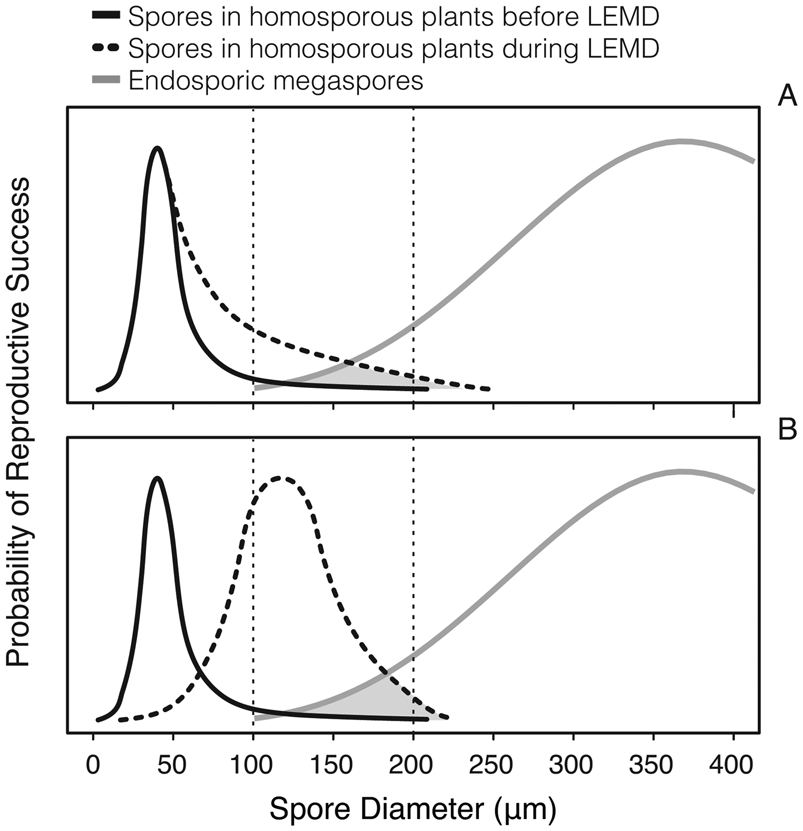
In this interpretation, what was unique about the LEMD was not that large spores conferred a specific fitness benefit relative to small spores, but rather that the overall range of spore sizes likely to produce successful offspring broadened as ecosystems became more physically and ecologically heterogeneous and there were more circumstances where dispersal limitation was less important. As larger spores between 100 and 200 μm in diameter appeared in plant lineages, even if simply through a random walk process, endospory would be much more likely to emerge as a possible gametophyte growth strategy (Fig. 5A). It is important to note here that we are not attempting to explain heterospory evolution in any one lineage; the selective pathways through which larger spores and heterospory emerged could still be explained through resource allocation models (Haig and Westoby Reference Haig and Westoby1988), mate-encounter models (Lehtonen and Kokko Reference Lehtonen and Kokko2011; Petersen and Burd Reference Petersen and Burd2017), or some other model entirely. But building on the ideas of Bateman and DiMichele (Reference Bateman and DiMichele1994), we suggest that such mechanisms became more relevant to reproductive evolution during the LEMD as a primary ecological filter against producing large spores was relaxed.
Different scenarios for the evolution of endosporic heterospory in the Devonian. Curves represent hypothetical global probability distributions for successful reproductive strategies at given spore sizes across all habitats; they are largely based on current size spore distributions. In (A), ecosystem changes during the late Early through Middle Devonian (LEMD) increase the probability of successful strategies in homosporous plants that produce larger spores by reducing dispersal limitation in some habitats. This shift increases the area of overlap between the probability distributions (light gray) of large spores from homosporous plants with exosporic gametophyte growth and endosporic megaspores, making the evolution of endosporic heterospory more likely. In (B), ecosystem changes during the LEMD specifically result in higher fitness for large spores from homosporous plants, shifting the entire probability distribution and increasing areas of overlap with endosporic megaspores. The probability distribution for endosporic megaspores does not shift at any point, because it is based on minimum resources necessary for initial sporophyte growth, which is assumed to be invariant through time.
But if the LEMD marks the initial rise of diverse depositional settings, plant habitats, and reproductive strategies, why did heterospory virtually stop evolving (Fig. 1) after the early Mississippian? Floodplains and wetlands certainly remained important environments during the Carboniferous, yet the abundance of intermediate-sized spores appears to have declined by the Pennsylvanian (Chaloner Reference Chaloner1967). This pattern likely reflects existing heterosporous groups occupying the niche spaces where the evolution of heterospory was most likely to occur (Bateman and DiMichele Reference Bateman and DiMichele1994). The general lack of heterospory origins after the Carboniferous may also reflect the dominance of one specialized heterosporous clade, seed plants, which replaced free-sporing plants as primary components of wetland ecosystems following the climate-driven collapse of equatorial Pennsylvanian coal swamps (DiMichele et al. Reference DiMichele, Pfefferkorn and Gastaldo2001, Reference DiMichele, Tabor, Chaney and Nelson2006). For example, heterosporous lycopsids continued to exist after the Paleozoic, but as increasingly minor components of seed plant–dominated ecosystems (later forms reviewed in Pigg Reference Pigg2001), and ecological opportunities for new heterosporous lineages were likely reduced (although they obviously did occur, as shown by the evolution of very specialized heterosporous filicalean ferns in the Mesozoic; Lupia et al. Reference Lupia, Schneider, Moeser, Pryer and Crane2000; Yamada and Kato Reference Yamada and Kato2002; Hermsen et al. Reference Hermsen, Jud, De Benedetti and Gandolfo2019).
Our interpretation of the evolution of heterospory during the LEMD predicts a distinctive size signature in the fossil record; spore sizes during the Devonian should show characteristics of a passive trend wherein maximum diameter and variance increase but median diameter remains roughly similar (McShea Reference McShea1994; Fig. 5A). In contrast, if larger spores did conifer a unique fitness benefit in Middle Devonian ecosystems, perhaps caused by the emergence of dense forests with tall trees (Petersen and Burd Reference Petersen and Burd2017), we might expect a directed trend with increases in minimum, maximum, and median diameter (Fig. 5B). Among in situ spores (those found in macrofossil sporangia), average size does appear to increase during the LEMD (Bonacorsi et al. Reference Bonacorsi, Gensel, Hueber and Leslie2021; see Fig. 5), but this is largely due to differences between some of the earliest plant groups, such as cooksonioids and rhyniophytes, and later lineages. Within lycophytes and euphyllophytes, for example, there is no clear increase with time (p = 0.33 and 0.57, respectively, for a linear regression of spore diameter and age using data from Bonacorsi et al. [Reference Bonacorsi, Gensel, Hueber and Leslie2021]), although the total number of known taxa is low, and thus the significance of these patterns is questionable.
The record of dispersed spore assemblages offers a more complete, or at least more data-rich, picture of spore size evolution during the Devonian, but here again the record appears ambiguous. A classic compilation of dispersed spore taxa (Chaloner Reference Chaloner1967) appears to show a gradual increase in maximum size with little median change from the Emsian through the Frasnian, but changes in minimum spore size are difficult to assess from the data as presented. Regional studies of dispersed spores sometimes show evidence of a shift in the overall spore size distribution toward larger spore diameter, but localities of a similar age can vary (Richardson Reference Richardson1967). Such variation among assemblages is expected, given that they sample different habitats or groups of habitats, but a broader compilation and analysis of palynofloras could be used to examine patterns across local, regional, and global assemblages and specifically test for passive versus active trends. A simple interpretation of our proposed scenario for heterospory evolution, for example, would predict a global increase in the frequency of assemblages with a longer tail of intermediate-size spores in the 100–200 μm range during the LEMD, rather than a more consistent increase in mean and minimum sizes across assemblages (Fig. 5).
Although the evolution of heterospory has been discussed by authors from many perspectives (e.g., Chaloner Reference Chaloner1967; Pettitt Reference Pettitt1970; Brauer Reference Brauer1981; Bateman and DiMichele Reference Bateman and DiMichele1994; Marshall and Hemsley Reference Marshall and Hemsley2003; Petersen and Burd Reference Petersen and Burd2017), this study is the first to our knowledge that attempts to explain the exact timing and tempo of its evolution in the Devonian through major changes in the physical environment. Regardless of the ultimate advantages that heterospory might confer or the specific selective regimes that result in its evolution, we argue that the key to understanding its appearance is identifying the circumstances in which spores in the 100–200 μm diameter range are likely to be successful. We suggest that basic changes in sedimentation over the Devonian increased these circumstances by creating more diverse and heterogenous depositional environments inhabited by plants, particularly wetland habitats where heterospory is often found in later time periods. If even partially correct, this idea provides a new ecological explanation for the increase in reproductive diversity during a relatively brief interval in the Devonian and links reproductive innovations to major changes in plant vegetative bodies such as the emergence of arborescence and deep roots.
Acknowledgments
We thank W. DiMichele and two anonymous reviewers for their comments and suggestions.
Appendix: Spore Size Sources
Data on Devonian spore size and axis diameters (used in Figs. 3, 4) can be found on Dryad (doi: 10.5061/dryad.pzgmsbcnh) and are taken from the following references, which provide full citations to source literature:
Bonacorsi, N. K., and A. B. Leslie. 2019. Sporangium position, branching architecture, and the evolution of reproductive morphology in Devonian plants. International Journal of Plant Sciences 180:493–503.
Bonacorsi, N. K., P. G. Gensel, F. M. Hueber, and A. B. Leslie. 2021. Omniastrobus gen. nov., an Emsian plant with implications for the evolution of heterospory in the Early Devonian. International Journal of Plant Sciences 182:198–209, with full references provided.
Other fossil and extant spore size data (used in Fig. 3) can be found on Dryad (doi: 10.5061/dryad.pzgmsbcnh) and derive from the following references:
Balme, B. E. 1995. Fossil in situ spores and pollen grains: an annotated catalogue. Review of Palaeobotany and Palynology 87:81–323.
Batten, D.J., M. E. Collinson, and A. P. Brain. 2011. Megaspores and microspores of the extant and Paleogene marsileaceous fern Regnellidium and Cretaceous Molaspora: evolutionary and phytogeographic implications. International Journal of Plant Sciences 172:1087–1100.
Bauer, D. S., J. Prado, M. Trovo, A. I. Coan, T. Stutzel, and C. Schulz. 2016. Megaspore investigations of Selaginella species from São Paulo, Brazil. American Fern Journal 106:55–86.
Duckett, J. G. 1970. Spore size in the genus Equisetum. New Phytologist 69:333–246.
Erdtman, G. 1965. Pollen and spore morphology—plant taxonomy: Gymnospermae, Bryophyta (Text): an introduction to palynology. III. Almquist & Wiksell, Stockholm.
Johnson, D. M. 1986. Systematics of the New World species of Marsilea (Marsileaceae). Systematic Botany Monographs 11:1–87.
Knox, E. M. 1950. The spores of Lycopodium, Phylloglossum, Selaginella and Isoetes and their value in the study of microfossils of Paleozoic age. Transactions of the Botanical Society of Edinburgh 35:209–357.
Korall, P., and W. A. Taylor. Megaspore morphology in the Selaginellaceae in a phylogenetic context: a study of the megaspore surface and wall structure using scanning electron microscopy. Grana 45:22–60.
Kott, L., and D. M. Britton. 1983. Spore morphology and taxonomy of Isoetes in northeastern North America. Canadian Journal of Botany 61:3140–3163.
Large, M. E., and J. E. Braggins. 1989. An assessment of characters of taxonomic significance in the genus Pilularia (Marsiliaceae): with particular reference to P. americana, P. novae-hollandiae, and P. novae-zelandiae. New Zealand Journal of Botany 27:481–486.
Lloyd, R. M. 1974. Systematics of the genus Ceratopteris Brongn. (Parkeriaceae) II. Taxonomy. Brittonia 26:139–160.
Nakamura, J., and T. Shibasaki. 1959. Diagnostic characters of fern spores. I: Ophioglossaceae, Helminthostachyaceae and Osmundaceae. Research Reports of the Kochi University 8:1–11.
Pfeiffer, N. E. 1922. Monograph of the Isoetaceae. Annals of the Missouri Botanical Garden 9:79–233.
Singh, S. K., B. B. Yadav, M. Srivastava, P. K. Shukla, and G. K. Srivastava. 2014. Micro-morphology of Selaginella megaspores from India. Grana 53:197–220.
Singh, S. K., N. K. Dubey, and G. K. Srivastava. 2016. The microspore morphology of some species of Selaginella (Selaginellaceae) from India. Palynology 40:216–229.
Tryon, A. F. 1949. Spores of the genus Selaginella in North America north of Mexico. Annals of the Missouri Botanical Garden 36:413–431.
Tryon, A. F. Reference Tryon1964. Platyzoma—a Queensland fern with incipient heterospory. American Journal of Botany 51:939–942.
Tryon, A. F., and B. Lugardon. 1991. Spores of the Pteridophyta: surface, wall structure, and diversity based on electron microscope studies. Springer Verlag, New York.



