




No CrossRef data available.
Article contents
The sequential cueing effect in children's speech production
Published online by Cambridge University Press: 03 May 2005
Abstract
This article investigated the development of phonological encoding in speech production by examining the production of reiterant two-word sequences varying in phonological similarity. Two groups of typically developing children and a group of college-aged adults participated. Both groups of children produced target words with longer durations when they were preceded by words sharing initial consonant–vowel (CV) sequences than when preceded by phonologically unrelated words or words sharing vowel–consonant (VC) sequences. For adults, the duration of target words was shorter when they were preceded by words sharing final VC sequences than in the other conditions. The developmental decrease in the influence of CV-related prime words on target-word duration may be related to changes in the level of activation of lexical items during speech production. Developmental changes in the influence of VC-related prime words are less clear, but may be due to age-group specific behavior in the production of identical sequences of words.
Information
- Type
- Articles
- Information
- Copyright
- © 2005 Cambridge University Press
Children's early speech production differs considerably from that of adults. Young children possess a limited repertoire of segments and syllable shapes. As a consequence, children's first words are coarse approximations of the target forms. They typically are characterized by systematic additions, deletions, and substitutions relative to adults' productions. Throughout the preschool and early elementary school years, these differences decline. Eventually, accurate phoneme production is mastered and children produce words that adults identify as matching the target forms. It is generally thought that this is the point at which a child has acquired the phonology of the ambient language.
In contrast, a great deal of evidence suggests that children's phonologies continue to develop and mature beyond the point when they produce words that match adult targets. Acoustic studies of children's speech that is perceived to be correct have shown that speech–motor control continues to develop after phoneme accuracy is mastered. A variety of studies have shown that the temporal and spectral characteristics of children's speech, as well as variability in these measures, continue to develop throughout childhood and adolescence (e.g., Kent & Forner, 1980; Lee, Potamianos, & Narayanan, 1999; Munson, 2004; Nittrouer, 1995; Smith, 1978; Smith, Kenney, & Hussein, 1996). In general, the duration of children's speech declines throughout childhood. In addition, intraspeaker variability in a variety of temporal and spectral measures declines throughout childhood, with some measures not achieving adultlike values until late adolescence.
Most of the studies of children's speech development have either examined naturally produced speech or utilized simple naming, reading, or repetition tasks. Although these tasks provide a wealth of data regarding children's error patterns and the acoustic characteristics of their speech, they are limited in that only indirect conclusions can be drawn from them regarding developmental changes in the nature of phonological representations. For example, Vihman and Velleman (1989) used consistency of error patterns in one child's early speech to draw conclusions about changes in the degree of segmental detail in the child's phonological representations. Stemberger (1989) used naturalistic speech error data in children to draw conclusions about developmental changes in phonological processing.
Other studies used experimental paradigms to examine the development of phonological representations. A recent series of studies (Beckman & Edwards, 2000; Edwards, Beckman, & Munson, 2004; Munson, 2001; Munson, Edwards, & Beckman, in press) used nonword repetition to examine developmental changes in phonological representations. In these studies, children were found to repeat nonword-embedded diphone sequences that occur in many real words (i.e., sequences like /ft/, which occurs in words like fifty, after, and fifteen) more accurately, more quickly, and less variably than they produced phonetically matched sequences that occur in relatively few words (i.e., sequences like /fk/, which does not occur in any words in databases of words that are presumed to be familiar to young children, i.e., Moe, Hopkins, & Rush, 1982). Adults showed a smaller or absent effect, depending on the study and the dependent measure.
These studies proposed that phonological development involves the gradual refinement of lexical representations. In these models, children's early implicit knowledge of the segmental structure of language is heavily biased by their knowledge of the distributional properties of sounds in the lexicon. That is, children's productive knowledge of the sound /f/ in early development is heavily biased by their knowledge that /f/ is far more likely to occur before /t/ than /k/ in words that the child hears and says. As a consequence, children do not have access to representations of phonemes that are robustly abstracted away from the lexical items in which they occur. When children are required to utter a nonword, they are most successful at doing so when they can utilize a production scheme from a lexical item already in memory. When such a scheme is not available, their productions are less accurate, slower, and more variable. One of these studies (Edwards et al., 2004) found that an estimate of vocabulary size was the best predictor of the difference in accuracy between frequently and infrequently occurring sequences of phonemes. Children with larger vocabularies showed a smaller effect of phonotactic probability on repetition than children with smaller vocabularies. Another study showed the relationship between nonword repetition and vocabulary size to be significant even when the effects of age, speech perception ability, and real-word speech production ability were controlled (Munson et al., in press). These results support a model of development in which children's knowledge of the segmental structure of language gradually increases as children learn more lexical items. Importantly, these developmental changes in the amount of detail in phonological representations are not related systematically to accuracy of phoneme production in a single-word naming task: within the group of older children, age-related declines in the phonotactic probability effects were found even though the children in this group produced the same phonemes accurately in real words almost uniformly.
A smaller body of research has utilized real-time processing tasks to study the development of phonological processing. Again, these studies suggest that phonological processing continues to develop after phoneme production has been mastered. For example, two recent studies used the picture–word interference task (Schriefers, Meyer, & Levelt, 1990) to study developmental changes in phonological processing. In this paradigm, participants are presented with a picture and a spoken word. The spoken word is presented either prior to, concurrent with, or after the onset of the picture display. The phonological similarity between the picture's name and the spoken word is varied. In general, studies of adults using this paradigm have found faster naming times when the spoken word and the picture name are phonologically similar than when they are unrelated. The facilitative priming effect is greatest when the spoken word is presented after the onset of the picture display, presumably because this is the point at which individuals have completed lexical access and are forming a phonological plan to produce the picture's name.
Brooks and MacWhinney (2000) used the picture–word interference paradigm to study the development of phonological processing in 5-, 7-, and 9-year-old children and adults. These authors found that spoken words sharing the syllable onset with the picture's name speeded naming latencies relative to a condition in which a phonologically unrelated word was presented. This effect was significant for all age groups when the spoken word was presented concurrent with or 150 ms after the onset of the picture display. When the spoken words rhymed with the picture's names, facilitative effects were found for only the two youngest groups of children at the same spoken-word onset times. A second recent study by Jerger, Martin, and Damian (2002) examined picture–word interference in 5- to 7-year-old children and teenagers. They found a facilitative effect of presenting the initial CV of a picture's name 150 ms prior to, concurrent with, or 150 ms after the onset of the picture display, relative to two other conditions: one in which a nonspeech auditory stimulus was presented, and one in which phonologically unrelated CV stimuli were presented. The size of this effect was comparable in both groups of participants. Together, these studies suggest that phonological processing changes throughout early childhood. Specifically, the developmental decrease in importance of the rime and increase in the importance of the onset suggest that children gradually learn to access subparts of words to form plans for speech production rapidly.
This article expands on this line of research by examining developmental changes in phonological processing experimentally. It differs from previous research in that it utilizes a measure of phonological processing that is presumed to index the relationship between lexical activation and phonological encoding during speech production. The specific experimental paradigm is a reiterant speech task adapted from Sevald and Dell (1994). They studied the rate of production of reiterant sequences of consonant–vowel–consonant (CVC) words (i.e., multiple repetitions of sequences like cab cat). They found that rate of production is affected by the phonological similarity of the items being repeated. Specifically, target words were produced more slowly when they were preceded by prime words sharing initial consonants and CV sequences (e.g., cab cat) than when they were preceded by identical CVC sequences (e.g., cat cat) or unrelated sequences (e.g., sun cat). Target words were produced more quickly when preceded by prime words sharing final consonants or VC sequences (e.g., bit cat) than when preceded by words sharing entire CVC sequences or unrelated sequences. This finding was replicated by O'Seaghdha and Marin (2000), who demonstrated that the inhibition associated with onset consonants is limited to spoken language and does not occur when the phonological priming is orthographic.
Sevald and Dell's (1994) findings suggest that final consonants facilitate fluent production of subsequent words containing the same consonants in the same word position, whereas initial consonants inhibit production of subsequent words containing the same consonants in the same word position. Sevald and Dell interpreted these findings in a new model of speech production, which they call the sequential cueing model. The sequential cueing model is an extension of earlier models of the control of complex movements (Rosenbaum, Weber, Hazlett, & Hindorff, 1986). These models posit that people's movements are more rapid and fluent when they can reuse movement patterns that have been recently activated. Sevald and Dell's sequential cueing model involves the sequential activation of lexical items and the phonological units that comprise them. Speech production begins when lexical items are activated, presumably because higher level conceptual representations have been activated. Lexical items in turn activate representations of the phonemes that comprise them. Phonemes within words are activated sequentially, rather than simultaneously. Activation decays gradually: an individual phoneme or lexical item may remain partially activated after it has been produced. As in other models (e.g., Pisoni et al., 1985), phonemes are associated with all of the words in the lexicon that contain them. When phonological units become activated, they send activation back to all of the lexical items that contain them. These lexical items in turn activate all of the phonemes that comprise them. The activation of a phonological unit is presumed to be monotonically related to the input that it receives: when a lexical item sends activation to a phonological unit that retains activation from a prior production, that unit will become more activated than a unit that has not retained residual activation. In speech production, the phonemes that receive the strongest activation from lexical items are eventually sent to a production plan.
When a word is preceded by a CV-related prime, the prime word remains partially activated when the target word is activated. The target word sends activation to its component phonemes, including those shared by the recently activated CV-related prime word. The prime word in turn activates its component phonemes. These phonemes compete for the relevant slots in the production plan. In particular, the discrepant final phonemes compete for the final consonant position of the CVC word frame. This competition slows production of the word.
Competition does not occur when CVC words are preceded by a VC-related prime. In this case, the phonemes comprising the VC-related prime retain activation as the target word is articulated. These phonological units receive additional activation when they are reactivated by the target word. This increased activation speeds their production; hence, words that are preceded by VC primes are produced more quickly than in an unrelated-prime condition.
This study uses a reiterant speech task similar to that used by Sevald and Dell (1994) to assess developmental changes in the activation of lexical items and phonological units in speech production. This research differs from previous research in a number of ways. First, it differs from previous research on phonological priming in speech production in that the dependent measure is target-word duration rather than speech rate. Previous research utilizing the reiterant-speech task has measured average speech rate of multiple repetitions of the entire prime-plus-target sequence. In these studies, prime words and target words have been fully cross-classified in a stimulus set, so that the prime word for some trials also served as the target word in other trials. Consequently, the number of stimuli in these studies has been large. By measuring only the target word, the current study does not have the constraint of having to cross-classify the primes and targets, meaning that a smaller, more age-appropriate stimulus set could be designed. Second, this research differs from previous research on phonological processing in children (i.e., Brooks & MacWhinney, 2000) in that the dependent variable is production time, rather than production-onset latency.
We make two predictions. The first is that, consistent with prior research, adults should show facilitation in the VC-related context and competition in the CV-related context. Unlike Sevald and Dell (1994), this study utilized production-time measures rather than mean production rate. Hence, we predict that there should be longer target-word durations in the CV-related context than in the unrelated context. Target-word durations should be shorter in the VC-related context than in the unrelated context. The second prediction relates to developmental differences. Previous research has argued that robust, autonomous phonemic representations emerge in development and are related to children's vocabulary growth (Edwards et al., 2004; Munson et al., in press). Moreover, research utilizing the picture–word interference task has shown that the ability to utilize phonemes to create plans for speech production increases with development (Brooks & MacWhinney, 2000). Presumably, these phoneme representations would be similar to the phoneme representations in Sevald and Dell's model. It follows, then, that children would show smaller CV inhibition and VC facilitation effects than adults. These hypotheses were tested in an acoustic study of children and adult's production of reiterant two-word sequences.
METHODS
Participants
Thirty monolingual English-speaking children participated in this experiment. Children in the younger group (n=15) had a mean age of 4 years, 2 months (4;2, SD=9 months). Children in the older group (n=15) had a mean age of 7;2 (SD=9 months). Children completed the Goldman–Fristoe Test of Articulation—2 (GFTA-2; Goldman & Fristoe, 2000) and the Expressive Vocabulary Test (EVT; Williams, 1997) as screening measures of their articulation and language. No child received a score of less than 85 on either measure, indicating performance greater than 1 standard deviation below the mean of the normative sample of children in their age range. The younger children had a mean EVT standard score of 114 (SD=12); the older children had a mean score of 109 (SD=11). This difference was not significant. The younger children had a mean GFTA-2 standard score of 114 (SD=11); the mean score for the older children was 103 (SD=7). This difference was significant, F (1,30) = 9, p < .01. This difference, however, may be spurious. Older children demonstrate a much smaller range of raw scores than younger children on the GFTA-2. Consequently, older children with perfect raw scores on the GFTA-2 receive a standard score that is considerably lower than the standard score for a younger child with perfect performance. Children's phonetic repertoires varied. Children had between zero and five phonemes consistently in error. Children's residual errors were either single-feature substitution errors (i.e., f/θ, b/v) or /r/ distortions (e.g., age-appropriate misarticulations of /r/ that were perceptually distinct from /w/). Children were rewarded with stickers for their participation. Children passed a hearing screening at 20 dB HL bilaterally at 0.5, 1, 2, and 4 kHz (American National Standards Institute, 1989). In addition, 15 adults participated. These participants were native speakers of English, with no history of speech, language, or hearing disorders. These adults were members of the University of Minnesota community; they completed this task as part of their participation in a larger study on phonological priming in adults' speech production. The adults did not complete the EVT or GFTA-2.
Stimuli
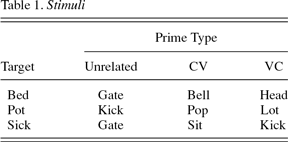
Twelve stimulus pairs were created by crossing three target words with four primes. The three target words were sick, pot, and bed. These words were chosen because they contain phonemes that vary in place of articulation and voicing, and vowels that differ in height and backness. The three nonidentical prime conditions are listed in Table 1. In the unrelated condition, words were preceded by a word sharing no phonemes. In the CVC-related condition, not shown in Table 1, words were preceded by an identical prime. In the CV-related condition, words were preceded by a prime sharing an initial CV sequence. In the VC-related condition, words were preceded by a prime sharing the final VC sequence. All of the words were presumed to be familiar to young children, based on their inclusion in Moe et al.'s (1982) corpus. Pairs of words were chosen to be equally semantically unrelated, to remove any potential influence of semantic priming. This was confirmed by having three naïve adults rate the similarity in meaning of the two words on a 5-point equal-interval scale. There were no appreciable differences in semantic relatedness judgments across the three nonidentical prime categories.

To ensure that a consistent model was provided to each participant, prerecorded production prompts were used to elicit productions. We used prerecorded prompts rather than live voice because of previous findings that children repeat more acoustic–phonetic detail in real-word repetition tasks than adults (Ryalls & Pisoni, 1997). These production prompts were created by having a phonetically trained adult male (the first author) utter each of the target and prime words in isolation. The final consonants in all three words were released. These were recorded using an AKG C420 head-mounted microphone attached to a Roland VS-890 digital workstation through a Rolls phantom power source. A 44.1 kHz sampling rate and 16-bit quantization were used. The larger digital file was divided into individual files containing each word. The peak amplitude of each word was normalized. The isolated word files were concatenated into 15 different production-prompt files. That is, the target word in each of the production-prompt files was identical. Thus, any difference in target-word articulation could not be attributed to differences in the stimuli. Each file contained four repetitions of the prime-plus-target word sequence. Each of the words was produced with approximately equal stress. The prime and target words were separated by an interval of 250 ms; the two-word sequences were separated from one another by an interval of 1000 ms.
Data collection
Data collection took place in a quiet room at the child's day-care center or in the author's research laboratory. Children were instructed that they would hear a series of words and that they should repeat them as fast as they could without making a mistake. A three-part training protocol was used. First, the experimenter modeled the task by producing four rapid consecutive repetitions of the sequence sock shoe. Second, the child repeated the experimenter's live-voice production of two sequences. Children were instructed to produce at least four repetitions of the target sequences of words as quickly as possible. Finally, the child repeated three digitized sequences not included in the experiment. During the training phase, children were given feedback on their rate of speech and their accuracy.
During the last training phase and the entire experimental phase, stimuli were output from a Dell Pentium III laptop computer through Audix powered speakers. The concatenated speech files were played at a level of approximately 65 dB SPL, as calibrated prior to the experiment using the slow, dB-A scale of a portable sound level meter located approximately 2 feet from the speakers (i.e., at the approximate location of the participant's head during the experiment). After children finished all of their repetitions of a sequence of words, they were presented with a reinforcement picture of an unfamiliar cartoon animal on the computer screen. The experimental phase included three filler items in addition to the 12 experimental items.
Speech was recorded directly on to the hard drive of the same laptop, using a table-mounted microphone (Sony ECM 220t) placed approximately 15 cm from the participant's mouth. Speech was digitized at a sampling rate of 22.05 kHz with 16-bit quantization and low-pass filtered at 11.025 kHz to prevent aliasing.
Analysis
Tokens produced disfluently, with an error, or in the presence of background noise were removed from the analysis. In addition, target words that were preceded by an erroneously produced prime word were removed from the analysis. These were distributed approximately evenly among the targets, prime conditions, and age groups. This finding is somewhat remarkable, given that Sevald and Dell (1994) found a higher error rate in the onset-related and CV-related contexts than in other contexts. However, the overall complexity of their task was greater than that used in this experiment. In many of their trials, all four words differed (i.e., sequences like pit tuck tin puck), whereas the current experiment used simpler sequences in which the words were either identical (i.e., sick sick sick sick), or alternated (i.e., sit sick sit sick). The range of usable tokens ranged from 51 to the full set of 60 per participant.
The duration of each of the remaining target words was measured using the Praat signal-processing program (Boersma & Weenink, 2002). For each child, a label file was created marking the onset and offset of each target word in the different prime contexts. Conventional criteria were used to label the onset and offset of the target words. For the target word sick, the onset was defined as the onset of the high-frequency aperiodic noise of the initial /s/; the offset was defined as the offset of the release of the final /k/, or, if the /k/ was unreleased, the cessation of voicing in the vowel. For the target word pot, the onset was defined as the burst for the initial /p/; the offset was defined as the offset of the release of the final /t/, or, if the /t/ was unreleased, the cessation of voicing in the vowel. For the target word bed, the onset was defined as the onset of low-frequency prevoicing, or, if prevoicing was absent, the burst for the initial /b/. The offset was defined as the offset of the release of the final /d/, or, if the /d/ was unreleased, the cessation of the voicing in the vowel. The participants almost always produced released final consonants in the target words across the different contexts. This is consistent with previous research (Goldinger, 2000; Ryalls & Pisoni, 1997) showing that children and adults repeat a great deal of allophonic detail in repetition tasks. This consistent final consonant release minimized the extent to which differences in allophone-level articulation (i.e., released vs. unreleased final consonants) affected duration measures. Reliability was calculated by having the experimenter relabel 8.3% of the data (one sequence per participant, chosen at random) approximately 2 months after the original measurements were made. The mean absolute difference in target-word duration between the original measurements and the second measurements was 11 ms (SD=12 ms); differences for individual tokens ranged from −28 ms to 22 ms. Custom-written scripts extracted and logged the target-word durations automatically. For each child, the mean value of the three target words in the different prime contexts was calculated. Finally, the mean of these three values was taken and used as the dependent measure in all statistical analyses.
RESULTS
Group differences
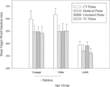
A two-factor (4 Prime Type × 3 Group) mixed-model analysis of variance was used to examine the influence of prime type (the within-subjects factor) and age group (the between-subjects factor) on mean target-word duration. A significant main effect of age was found, F (2,42) = 4.3, p < .05, partial η2 = .17. Pooled across the four conditions, adults produced target words with shorter durations than either group of children, who did not differ from one another (M = 460 ms, SD = 91 ms for the younger children; M = 466 ms, SD = 105 ms for the older children; M = 380 ms, SD = 64 ms for adults). This finding is consistent with previous research on speech–sound development, which found age-related declines in phoneme and word duration (e.g., Kent & Forner, 1980). In addition, a significant main effect of prime type was found, F (3,126) = 17.0, p < .01, partial η2 = .29. Finally, a significant age group by prime type interaction was found, F (6,126) = 2.5, p < .05, partial η2 = .11. This interaction is illustrated by the differences in bar heights in Figure 1.

The mean target-word duration in the CV-related, VC-related, and unrelated prime contexts. Error bars represent 1 standard error of measurement
Figure 1 shows that both groups of children produced longer target words when they were preceded by primes sharing CV sequences than when they were preceded by unrelated primes, identical primes, or primes sharing VC sequences. In contrast, adults produced target words preceded by VC-related primes with shorter durations than in the unrelated or CV-related contexts. Target words in the VC-related prime context were not significantly different from those produced in the identical-prime context.
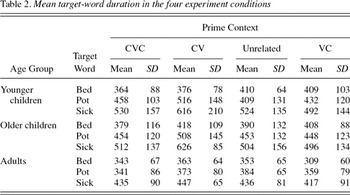
Three tests of significant main effects confirmed that prime type had a significant influence on target-word duration in the three age groups (Table 2). A significant relationship was found for the younger group of children, F (2,28) = 5, p < .05, partial η2 = .47. Post hoc tests indicated that target words were produced with longer durations when preceded by a CV-related prime than by a VC-related or unrelated prime. A significant relationship was also found for the older group of children, F (2,28) = 12.2, p < .01, partial η2 = .63. As with the younger children, post hoc tests indicated that target words were produced with longer durations when preceded by a CV-related prime than by a VC-related or unrelated prime. Finally, a significant relationship was found for the adults, F (2,28) = 16.5, p < .01, partial η2 = .54. For the adults, post hoc tests indicated that target words were produced with significantly shorter durations when preceded by VC-related primes than by CV-related or unrelated primes.

One potential interpretation of the interaction between age and prime type is that the children were simply producing an exaggerated difference in final consonants of the target words in the CV-related condition. That is, the children were producing more perceptually distinct minimal pairs in the CV-related condition than the adults, so that the target word and the prime word would be maximally perceptually distinct. This contrasts with the prediction that they would produce longer target-word durations overall, as would be predicted if the effect were due to a more global inhibitory process.
This potential explanation is contrary to previous research on children's speech production. If children were producing an exaggerated difference between the prime and the target, this would suggest that they were more sensitive to listeners' perceived need for a perceptually distinct prime/target pairs than the adult participants. However, a wealth of evidence suggests that children are less sensitive to listeners' needs than adults (e.g., Goffman, Schwartz, & Marton, 1996). Thus, it seems unlikely that the children, but not the adults, would produce an exaggerated difference between the prime word and the target word.
If the age-related decline in CV inhibition were due to children producing an exaggerated difference in final consonant duration of the target words in the CV-related condition, then we would predict that the rime would comprise a greater proportion of the stimulus duration in that context relative to the unrelated context. If, however, the CV inhibition were related to a more global slowing of production, then we would expect the proportions to be similar across the prime categories.
To examine this question, we calculated the proportion of each response comprising the rime. In this analysis, the onset (/s/, /p/, or /b/) and rime (/Ik/, /αt/, /εd/) durations were measured separately for each target word in the unrelated context and the CV-related context. For each token, we calculated the proportion of total duration of the responses comprised by the rime. In this analysis, the three target words were measured separately, as there are large differences in the intrinsic duration of the onset consonants. Standard segmentation criteria were used to segment the onset from the rime. A subset of 20 stimuli was measured a second time to ensure reliability. Differences between the first and second measurements ranged from −17 to 12 ms; average absolute difference was 10 ms.
Because the dependent measure in this analysis was a ratio, the nonparametric Wilcoxon signed ranks test was used to assess statistical significance. This test does not allow for the examination of multifactoral data. Therefore, the ratio for each target word was submitted to a Wilcoxon signed ranks test, and the three age groups were examined separately. The total number of Wilcoxon tests was 9. The Bonferroni-corrected alpha level used to judge the significance of each test was .006 (.05/9).
None of the nine Wilcoxon tests revealed a significant effect of prime-type on the proportion of response duration comprised of the rime. The absolute z values associated with the nine tests ranged from 0.317 to 1.477; the associated p values ranged from .75 to .14. In the unrelated context, the average proportion of response duration comprising the [Ik] portion of sick was 0.74 for young children, 0.75 for the older children, and 0.69 for adults; in the CV-related context it was 0.76 for young children, 0.75 for older children, and 0.70 for adults. In the unrelated context, the average proportion of response duration comprising the [εd] portion of bed was 0.85 for young children, 0.84 for the older children, and 0.84 for adults; in the CV-related context it was 0.80 for young children, 0.84 for older children, and 0.80 for adults. In the unrelated context, the average proportion of response duration comprising the [αt] portion of pot was 0.92 for young children, 0.95 for the older children, and 0.94 for adults; in the CV-related context it was 0.91 for young children, 0.90 for older children, and 0.92 for adults.
Recall that these data are average ratios, rather than absolute durations. Thus, they remove the differences in overall duration that occurred as a function of prime type and age group. These data suggest the increased response durations seen in children's production of the target words in the CV-related prime context do not appear to be due to their selectively exaggerating production of the target words' final consonants to make them more distinct from the final consonants of the prime words.
Relationships with age, vocabulary size, and articulation
The second analysis focused on relationships between the magnitude of the CV inhibition/VC facilitation effects and other measures of the participants' speech and language ability. In this analysis, we hypothesized that children with larger vocabularies would evidence greater priming than children with smaller vocabularies, as these children's larger vocabularies would facilitate the emergence of robustly abstracted representations of phonemes that could be used to form production plans. Previous research showed that children with larger vocabularies evidence greater productive control over phoneme production than children with smaller vocabularies (Edwards et al., 2004; Munson et al., in press). In addition, we examined correlations with standard scores on the GFTA-2, to examine whether developmental changes in phonological priming were related to increases in articulatory accuracy. That is, we hypothesized that children with greater articulatory accuracy would show more adultlike patterns of phonological facilitation and competition. This analysis included only on the two groups of children; the adults in the study did not complete the EVT or the GFTA-2.
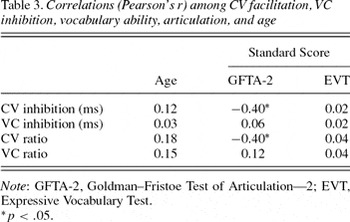
Simple correlations (Pearson's r) were calculated between the two standardized test measures, the EVT and the GFTA-2, and four measures of CV inhibition and VC facilitation. The first measures were raw differences scores, expressed in milliseconds. The CV-inhibition difference score was calculated by subtracting the mean target-word duration in the unrelated-prime condition from the mean value in the CV-related prime condition. For this measure, higher values indicated more CV inhibition. The VC-facilitation difference score was calculated by subtracting the mean target-word duration in the unrelated-prime condition from the mean value in the VC-related condition. For this measure, lower values indicated greater VC facilitation. A second set of ratio measures was also calculated. The first ratio was calculated by dividing the mean target-word duration in the CV-related prime context by the mean target-word duration in the unrelated-prime context. The second ratio was calculated by dividing the mean target-word duration in the VC-related prime context by the mean target-word duration in the unrelated-prime context. Again, higher measures for the CV ratio indicated greater competition, and lower measures for the VC ratio indicated greater facilitation.
The correlation coefficients can be found in Table 3. In addition to the EVT and the GFTA-2, Table 3 includes correlations between the priming measures and age. Consistent with the analyses of variance, neither the facilitation nor the competition measures were significantly correlated with age. Both groups of children demonstrated similar levels of competition and facilitation in the analysis of variance. Contrary to predictions, no relationships were found between the measures of facilitation/inhibition and the standardized measure of vocabulary, the EVT.

Significant correlations were found between measures of CV-inhibition and standard scores on the GFTA-2. This was true for both the difference score and the ratio measure of CV inhibition. The correlation coefficients were negative: children with higher standard scores on the GFTA-2 showed smaller inhibition effects. As mentioned above, the two age groups had different GFTA-2 standard scores. However, the correlations between CV-inhibition measures and GFTA-2 scores were significant even when the effect of age was partialed out (partial r = -.41, p < .05 for raw CV-inhibition, partial r = -.38, p < .05 for the CV ratio).
The results of the correlation analyses were contrary to predictions: children's vocabulary sizes did not predict the magnitude of either the CV-inhibition or the VC-facilitation effects. Rather, the results suggest that the CV-inhibition effect is related to articulatory ability. Children with more accurate production of phonemes in real words, evidenced by higher GFTA-2 standard scores, show a smaller inhibitory effect of a prior CV-related word on target-word production. This finding is discussed below.
GENERAL DISCUSSION
Summary
The purpose of this study was to examine developmental changes in phonological processing in preschool children, early elementary school-aged children, and adults, using a phonological priming task. Both groups of children were found to produce longer target CVC words when they were preceded by a prime that shared the initial CV sequence than when preceded by a phonologically unrelated CVC word. Adults were found to produce shorter target CVC words when they were preceded by a prime that shared the final VC sequence. In the group of children, a measure of articulatory accuracy predicted the magnitude of the CV inhibition effect: children with higher standard scores on the GFTA-2 showed smaller CV-inhibition effects than children with lower scores. Within the group of children, the CV-inhibition effect was unrelated to vocabulary size and age.
The results of this study have a number of important implications. The first is that the magnitude of priming, as indexed by the partial η2 measure, is essentially equal across the three age groups, contrary to our hypothesis. Approximately 47% of variance in target word duration was accounted for by prime type in the youngest group of children, 63% in older children, and 54% in adults. Despite the similarly sized priming effects, striking asymmetries were found between adults and children. A developmental decrease was found for CV inhibition, and a developmental increase was found for VC facilitation.
The achievement of adultlike patterns of CV inhibition and VC facilitation must occur later in development than the range observed in this study. That is, even the oldest children in this study differed from adults. Although phoneme production accuracy is generally complete by age 7, many aspects of speech production continue to change throughout adolescence (Kent & Forner, 1980; Lee et al., 1999). Thus, the finding that 7-year-old children did not yet demonstrate adultlike patterns of facilitation and inhibition is consistent with this previous research and suggests that phonological processing is subject to a protracted developmental time course.
In contrast to previous research, adults' production of target words did not differ in the CV-related and -unrelated conditions. In previous studies, this condition has been shown to slow the rate of production in adults. In those studies, rate of production has been measured by calculating the mean duration of both the prime and target word. Thus, the rate measure encompasses the duration of the prime word, the duration of the target word, and the duration of any pauses between them. These designs require that prime words and target words be cross-classified, so that the prime word in one stimulus also serves as the target word in another stimulus. This ensures that speech-rate differences across conditions are not due to spurious differences in the duration of prime words. This also increases the size of the stimulus set. In this study, we measured target-word durations in different prime contexts. This allowed us to relax the cross-classification requirement and to design a smaller, more age-appropriate stimulus set. The differences between the current results and previous studies may be due to the different dependent measures that were examined. However, when compared to the CVC-related condition, adults' production of target words was significantly slower, t (14) = 2.92, p < .01. Adults' productions of CVC words preceded by a CV-related prime were an average of 24 ms longer than their production of those words were when they were preceded by an identical prime. Thus, even using mean target-word duration as the dependent measure, some evidence of CV inhibition was found in adults. Future research should compare the two dependent measures in adults, to examine the locus of the CV-inhibition effect. It is important to point out that the developmental decrease in CV-related inhibition was found regardless of whether the target words preceded by CV-related primes were compared to those preceded by identical primes or unrelated primes, although the effect size was larger for the latter comparison.
Another unexpected finding in this study was the lack of identity priming in children. Identity priming refers to the processing benefit of having a prime that is identical to the target stimulus. Adults showed clear evidence of identity priming: target-word durations were significantly shorter in the CVC-related condition than in the unrelated condition, t (14) = −2.38, p < .05. However, neither group of children showed this pattern (t < 1, p > .05, for both groups of children). The reason for this developmental asymmetry is less clear. Again, the difference may be due to the dependent measures that were used: identity priming may manifest itself in the durations of interresponse intervals rather than target-word duration in children. Alternatively, the difference may have been due to children using different strategies in the CVC-related condition relative to the other conditions. We observed informally that all three groups of participants produced regular prosodic variation during most conditions in the reiterant speech task, with emphasis placed on the target word (i.e., sit SICK sit SICK). Adults generally demonstrated this pattern for the CVC-related condition; both groups of children generally did not. In this condition, children generally produced a long train of words with emphasis on the first word (i.e., SICK sick sick sick), and productions slowed and decreased in intensity toward the end of the train. The lack of identity priming in children may relate to the specific strategy they used in this experimental condition.
The age-related differences in CV-related inhibition may be related to differences in the degree of activation of lexical representations during speech production. In the sequential cueing model (Sevald & Dell, 1994), plans for speech production are created through a multistep process involving the sequential activation of words and phonemes. Differences between children and adults' production can be accounted for if we assume that the rates of decay for lexical items changes during development. We hypothesize that, in speech production, children's lexical items decay more slowly than adults' do. It follows from this assumption that the prime word would retain more activation during children's production of a target word than in adults' productions, due to the slower decay rates associated with children's lexical items. Children's more activated target words in turn activate the phonemes that comprise them more than in adults' productions. The net result is that the two candidate final consonants are closer in activation in the case of children's productions than in adults'; hence, the children would show greater competition than adults in CV-related contexts. When a target CVC word is preceded by a VC-related prime, more time has passed between the articulation of the prime word and the articulation of the phonemes in the target word that are shared by the prime word, relative to the condition in which the word is preceded by a CV-related prime. Thus, we presume that the prime words would have decayed to approximately equal levels in both adults and children when they share a VC sequence with the target word.
This account of the developmental differences is consistent with other studies of children's lexical and phonological representations. Some researchers have hypothesized that young children's knowledge of and productive control over phonemes is heavily tied to their knowledge of the patterns in which these sounds occur in lexical items (e.g., Edwards et al., 2004; Munson et al., in press). In these models, representations of phonological units are presumed to emerge and become increasingly more robust throughout development, as children learn new lexical items and organize them systematically. A model in which children's lexical items retain more activation than adults' is consistent with the hypothesis that early phonological organization is lexically based.
The developmental changes in VC-related facilitation are less clear. As Figure 1 shows, the differences between the three groups were due to two factors. First, the adults produced words with shorter overall durations than children. Second, adults showed longer productions in the unrelated-prime condition than in the identical-prime and VC-related prime conditions, whereas children did not. This may be related to developmental changes in whatever mechanism underlies VC-related priming, much as we propose the developmental changes in CV-related inhibition are related to changes in the degree of activation of lexical items during speech production. However, the possibility exists that the developmental increase in VC-related facilitation is due to group differences in production of reiterant sequences in the identical prime context, as described above. Future research will resolve this issue by examining developmental changes in production of reiterant sequences with similar prosodic patterns. A finding of developmental decreases in VC-related facilitation in prosodically equivalent sequences would suggest that it represents a change in phonological processing that warrants a theoretical interpretation, rather than a simple change in performance on the reiterant speech task.
The original intent of this study was to examine the developmental time course of phonological processing in speech production. Previous research has shown that phonological processing continues to develop beyond the point at which phoneme production has been mastered. Indeed, this was shown in the current study, in which the oldest group of children still did not demonstrate adultlike patterns of production in the reiterant-speech task. This might suggest that real-time phonological processing develops somewhat independently from the processes that underlie accurate phoneme production.
However, there is some evidence that phoneme production accuracy and phonological processing might have a causal relationship in development. Brooks and MacWhinney (2000) argued that developmental decreases in the influence of rimes in the picture–word interference task were associated with the development of fluent plans for speech production. Aitchison and Chiat (1981) and Vihman (1981) argued that developmental changes in the rate of onset- and rime-related speech errors index the development of adultlike processing and storage mechanisms in children's lexicons.
There was some evidence in the current study that phoneme-production accuracy and phonological processing are related: performance on the reiterant speech task was correlated with a measure of articulatory accuracy in children. That is, children who had more accurate phoneme production on a standardized test also showed less CV inhibition. Future research should compare children's production on the reiterant speech task with other measures of phonological processing and phoneme production. The results of such research would provide information about the extent to which the development of accurate phoneme production is driven by developmental changes in phonological processing.
ACKNOWLEDGMENTS
Molly Babel is currently affiliated with the Department of Linguistics, University of California, Berkeley. This research was supported by a New Investigator Award from the American Speech–Language–Hearing Foundation to the first author; by a Grant-in-Aid of Research, Scholarship, and Artistry from the University of Minnesota Graduate School to the first author, by an Undergraduate Research Partnership Program Grant from the University of Minnesota College of Liberal Arts awarded jointly to the authors, and by NIH Grant R03 DC005702 to the first author. The authors thank Shayla Manthei and Cyndie Swenson for assistance with data collection. Portions of this research were presented at the 2003 meeting of the Society for Research on Child Development. The authors gratefully acknowledge audiences at that conference for their helpful comments and feedback. In addition, the authors thank Mary Beckman, Jan Edwards, Julia Evans, Kathryn Kohnert, and Jennifer Windsor for comments on this research.
References
Aitchison J., &
Chiat S.
1981.
Natural phonology or natural memory? The interaction between phonological processes and recall mechanisms.
Language and Speech,
24,
311–
326.Google Scholar
American National Standards Institute.
1989.
Specifications for Audiometers.
Washington, DC:
Author.
Beckman M. &
Edwards J.
2000.
Lexical frequency effects on young children's imitative productions.
In J. Pierrehumbert &
M. Broe (Eds.),
Papers in Laboratory Phonology 5.
Cambridge:
Cambridge University Press.
Boersma P., &
Weenink D.
2002.
Praat 4.0.7 [Computer Software].
Institute of Phonetic Sciences,
Amsterdam.
Brooks P., &
MacWhinney B.
2000.
Phonological priming in children's picture naming.
Journal of Child Language,
27,
335–
366.Google Scholar
Edwards J.,
Beckman M., &
Munson B.
2004.
The interaction between vocabulary size and phonotactic probability effects on children's production accuracy and fluency in novel word repetition.
Journal of Speech, Language, and Hearing Research,
47,
421–
436.Google Scholar
Goffman L.,
Schwartz R., &
Marton K.
1996.
Information level and young children's phonological accuracy.
Journal of Child Language,
23,
337–
347.Google Scholar
Goldinger S.
2000.
The role of perceptual episodes in lexical processing.
In A. Cutler,
J. M. McQueen, &
R. Zondervan (Eds.),
Proceedings of SWAP (spoken word access processes)
(pp. 155–
159).
Nijmegen:
Max Plank Institute for Psycholinguistics.
Goldman R., &
Fristoe M.
2000.
The Goldman–Fristoe Test of Articulation—2.
Austin, TX:
Pro-Ed.
Kent R., &
Forner L.
1980.
Speech segment durations in sentence recitations by children and adults.
Journal of Phonetics,
8,
157–
168.Google Scholar
Jerger S.,
Martin R., &
Damian M.
2002.
Semantic and phonological influences on picture naming by children and teenagers.
Journal of Memory and Language,
47,
229–
249.Google Scholar
Lee S.,
Potamianos A., &
Naryanan S.
1999.
Acoustics of children's speech: Developmental changes of temporal and spectral parameters.
Journal of the Acoustical Society of America,
105,
1455–
1468.Google Scholar
Moe S.,
Hopkins M. &
Rush L.
1982.
A vocabulary of first-grade children.
Springfield, IL:
Thomas.
Munson B.
2001.
Phonological pattern frequency and speech production in adults and children.
Journal of Speech, Language, and Hearing Research,
44,
778–
792.Google Scholar
Munson B.
2004.
Variability in /s/ production in children and adults: Evidence from dynamic measures of spectral mean.
Journal of Speech, Language, and Hearing Research,
47,
58–
69.Google Scholar
Munson B.,
Edwards J., &
Beckman M. (in press).
Relationships between nonword repetition accuracy and other measures of linguistic development in children with phonological disorders.
Journal of Speech, Language, and Hearing Research.
Nittrouer S.
1995.
Children learn separate aspects of speech production at different rates: Evidence from spectral moments.
Journal of the Acoustical Society of America,
97,
520–
530.Google Scholar
O'Seaghdha P., &
Marin J.
2000.
Phonological competition and cooperation in form-related priming: sequential and non-sequential processes in word production.
Journal of Experimental Psychology: Human Perception and Performance,
26,
57–
73.Google Scholar
Pisoni D.,
Nusbaum H.,
Luce P., &
Slowiacek L.
1985.
Speech perception, word recognition, and the structure of the lexicon.
Speech Communication,
4,
75–
95.Google Scholar
Rosenbaum D.,
Weber R.,
Hazelett W., &
Hindorff V.
1986.
The parameter remapping effect in human performance: evidence from tongue twisters and finger fumblers.
Journal of Memory and Language,
25,
710–
725.Google Scholar
Ryalls B., &
Pisoni D.
1997.
The effect of talker variability on word recognition in preschool children.
Developmental Psychology,
33,
441–
452.Google Scholar
Schriefers H.,
Meyer A., &
Levelt W.
1990.
Exploring the time course of lexical access in language production: picture-word interference studies.
Journal of Memory and Language,
29,
86–
102.Google Scholar
Sevald C., &
Dell G.
1994.
The sequential cueing effect in speech production.
Cognition,
53,
91–
127.Google Scholar
Smith B.
1978.
Temporal aspects of English speech production: A developmental perspective.
Journal of Phonetics,
6,
37–
67.Google Scholar
Smith B.,
Kenney M. K., &
Hussein S.
1996.
A longitudinal study of duration and temporal variability in children's speech production.
Journal of the Acoustical Society of America,
99,
2344–
2349.Google Scholar
Stemberger J.
1989.
Speech errors in early child language production.
Journal of Memory and Language,
28,
164–
188.Google Scholar
Vihman M.
1981.
Phonology and the development of the lexicon: evidence from children's errors.
Journal of Child Language,
9,
249–
253.Google Scholar
Vihman M., &
Velleman S.
1989.
Phonological reorganization: a case study.
Language and Speech,
32,
149–
170.Google Scholar
Williams K.
1997.
Expressive Vocabulary Test.
Circle Pines, MN:
American Guidance Services.
Stimuli
The mean target-word duration in the CV-related, VC-related, and unrelated prime contexts. Error bars represent 1 standard error of measurement
Mean target-word duration in the four experiment conditions
Correlations (Pearson's r) among CV facilitation, VC inhibition, vocabulary ability, articulation, and age
 You have
Access
- 3
- Cited by