George Hearst knew that the Democratic Party nomination for governor in 1882 would be an expensive proposition, but the mining tycoon was prepared to spend recklessly to get there. For years he had generously funneled money to Democratic Party clubs, candidates, and campaigns. In 1880 he took possession of the San Francisco Examiner to sing his praises from one end of the state to the other. The former state assemblyman ingratiated himself with the new leader of the San Francisco Democracy, Christopher Buckley. When the convention opened, Hearst hosted a hospitality suite where he dispensed liquor, cigars, and attention on a horde of delegates and their hangers-on. No knowledgeable observer could have been surprised to see the San Francisco multimillionaire leading the pack when the balloting commenced. With a half-dozen competitors in the field, however, Hearst fell short of the necessary majority to clinch the prize.Footnote 2
A classic “dark horse” candidate emerged as Hearst's main rival. General George Stoneman's office-holding experience amounted to two years as one of the state's three railroad commissioners. The fact that Stoneman was a West Point graduate and his rival only semiliterate did not seem to matter to anybody in particular. Stoneman had no ready fortune to dole out to friends and supporters for “election expenses.” Even the Democrats in Los Angeles, the Civil War veteran's hometown, appeared unimpressed. Stoneman's gubernatorial candidacy “cut but a very small figure” in the county convention's deliberations, according to the Los Angeles Times. To be sure, a resolution endorsed Stoneman's favorite son status, but it stopped short of instructing its state delegation to stand by him from first to last. Instead, the convention incongruously affirmed that its representatives were going to the state convention “unhampered, and without instructions.” Only nine of Los Angeles County's fifteen delegates voted for Stoneman on the first ballot. The former Union cavalry commander did little to counter a reputation for being aloof and obstinate. Unlike the gregarious Hearst, when Stoneman arrived at the state convention he promptly sequestered himself in his room to drink brandy with an old friend “whilst the boys were waiting for him.”Footnote 3
Nevertheless, with every roll call Stoneman's strength grew. For many delegates it was sufficient that Stoneman was not Hearst. For weeks past, newspapers in the rural parts of the state had expressed reservations about the Democratic Party's chief patron, especially his association with Buckley and the San Francisco Democracy. Hearst's energetic campaign for the gubernatorial slot had also rendered him unfit in the eyes of some. One damning charge alleged that Hearst intended to pack the convention with his minions. “In the most obtrusive and obnoxious manner [Hearst's friends] have made and proclaimed a strictly ‘moneyed fight,’” decried one rural Democratic newspaper. “To conduct and manage it they have selected disreputable agents; men of malodorous reputation and proverbiably [sic] unscrupulous practices. Democrats of high character and social standing, who have rendered eminent service to the party have been catechized by an obnoxious autocrat and denied the privilege of going to the state convention because they would not pledge themselves to Hearst, while vile creatures from the slums were substituted because they were ready to make this or any other pledge.” After fourteen ballots, the San Francisco mining millionaire relinquished the gubernatorial nomination to the railroad commissioner from Los Angeles. Hearst promptly complied with convention protocol by appearing before the body to assure them that he, his newspaper, and his millions could still be counted on in the general election. However, he could not resist taking a final swipe at his critics by admonishing the assembly, “I do not intend that my money shall drive me out of the Democratic Party.”Footnote 4
Stoneman followed Hearst to the podium. In keeping with custom, he disavowed any intention of making any long, prepared remarks. “My experience in life is that four politicians out of five ruin themselves by talking or writing.” Stoneman then gave further credence to this adage in a long-winded address. Their newly minted nominee “is not a man of great personal magneticism,” one Democratic paper confessed. “When he makes a speech he talks slowly and deliberately like an orthodox parson,” a reporter observed. Another Democratic paper hoped that no one would ask Stoneman to make any more speeches: “About four such efforts as he made on his nomination at San Jose would rupture the party.” Luckily for Stoneman and the Democrats, he was not called upon to make a vigorous canvas of the state; in November the general landed safely in the gubernatorial chair. Governor Stoneman would prove “an unfortunately weak and senseless person,” in the opinion of his campaign manager. When 1886 rolled around, the governor expressed interest in a renomination, but he could not generate enough support to so much as get his name put in contention.Footnote 5
Many historians would regard the rapid rise and demise of George Stoneman as emblematic of the political culture of the “party period” (circa 1838–1900). Democrats, Whigs, and Republicans desired to adorn their tickets with the names of persons who could best unite the faithful and poll the full party vote. Party harmony often required passing over prominent political leaders however well qualified. Nominating conventions often turned to lesser public figures who had neither the record nor the visibility to offend anyone. New Jersey reformer George Record had many opportunities to witness this weeding-out process. In 1898 he summarized the conversation inside the typical smoke-filled room: “The average set of politicians who run a convention sit down in a room and they say ‘Shall we nominate So and So?’ ‘Oh, he has got too many enemies.’ And one after another the names are checked off because they have got some personality and individuality, as a rule, and finally they select some dummy who is not known, who has created no antagonism and is just a negative character.” Many contemporaries shared Record's dismissive assessment of the nominating practices of their day.Footnote 6 This indictment of the political process has made its way into current-day historical accounts deploring the nineteenth century's lackluster political leadership. Other historians contend that the nominating convention put the needs of the party first and selected standard bearers more representative of the party's voting base, who often turned out to be the “available man.”Footnote 7
Portraying the nominating practices of the party period as a quest for the “lowest common denominator,” however, paints the process with too broad a brush. In their heyday, Republican and Democratic conventions posted prominent “hands off” signs to ward off aspiring officeholders. The highly decentralized and multi-tiered delegate selection procedure made it difficult for candidates to influence the outcome outside their local political base. Custom accorded wide discretion to a respected body of party representatives responsible for framing a platform and agreeing on a slate of nominees for state or local office. Amid the controlled chaos of the convention, the delegates could be influenced by an assortment of factors beyond a candidate's ability or acceptability. They sought a fair division of the spoils of office through a balanced ticket. The oft-cited principle of “rotation in office” similarly required that the perks of office be widely shared. A candidate's fate could also turn on deals or “trades” worked out among rival delegations. The convention system took little official notice of the political hopefuls waiting anxiously in the wings. The press and the public still scorned flagrantly ambitious office seekers, a legacy of the early republic. A candidate who failed to keep his distance could be accused of tinkering with the nomination machinery and become his own worst enemy.
As current scholarly opinion has it, all this changed once the direct primary put an end to the nominating convention. California empowered voters to select their parties' nominees in 1909, about the same time as most other states. Transferring authority for drawing up the ticket from the party organization to the party-in-the-electorate allowed the major parties' office-holding or office-seeking class to gain the upper hand in the nominating process and in party affairs in general. A new breed of elective office seekers more practiced in the arts of self promotion thrived while party unity suffered. Primary voters were less concerned with fostering harmony or carefully doling out political loaves and fishes. They responded instead to Madison Avenue advertising techniques, doting on a candidate's image and downplaying partisan appeals. Very soon a “politics of personality” dominated the general election as well. Citizens arrived at the polls in November to “vote the man, not the party.” A party-centered political system gave way to a candidate-centered one that remains a hallmark of American politics. Political scientist Austin Ranney classified the direct primary “the most radical of all party reforms” undertaken during the Progressive Era or after.Footnote 8
My own research into nominating practices in California and other western and northern states around 1900 leads to a different conclusion.Footnote 9 The candidate-centered campaign preceded the direct primary rather than the other way around. The reform represented an accommodation to a nominating process already highjacked by a cohort of hyperactive office seekers personified by George Hearst. Later gubernatorial candidates pursued their parties' nomination in a similarly aggressive manner and were more likely to be rewarded for their efforts. They were aided by an assortment of state laws bringing more order to the delegate selection process, while curtailing the influence of local political cliques. The expectation that candidates should maintain a low profile had dissipated by 1900. Securing a nomination required more visibility during and even before the convention got down to business. Aspiring governors made their candidacies the focus of their parties' primaries and conventions. Delegates who had been accorded some measure of independence and discretion were reduced to pawns. State regulation of political parties paved the way for the “hustling candidate,” but the impact of state regulation of the parties was felt well before progressives mounted a crusade for the direct primary.
The present essay builds on my previous studies by offering an in-depth analysis of the evolution of nominating procedures and campaign practices in California in the Gilded Age and Progressive Era. The Golden State contains an unusually rich vein of primary source material bearing on candidates, caucuses, and conventions. The greater abundance of source material resulted partly from the four-year terms state officials served. State conventions were consequently more infrequent and attracted more attention than in other states where governors enjoyed only a two-year stay in office. The San Francisco Examiner and the Los Angeles Times offered broad bipartisan coverage of both ends of the state. The newspapers contained a more detailed accounting of convention proceedings than what was available in most states. This has permitted a quantitative analysis of convention roll calls that reveals the candidates' tightening grip over the proceedings. The numerous manuscript collections found at the state's major repositories reveal the private solicitations, negotiations, and practical political considerations of surreptitiously campaigning for a Democratic or Republican nomination for a statewide office. In short, California's value as a case study rests on the sizeable body of documentation of party nomination practices covering the years when these operated largely beyond government oversight.
It will be conceded at the outset that California has historically been more susceptible to the charms of chronic office seekers. Scholars have suggested that political parties in the western states failed to sink deep roots into the electorate and the electoral infrastructure, leaving more room for political entrepreneurs to assert themselves.Footnote 10 Even under the convention system, candidates in California enjoyed a level of visibility unknown in most states. Whereas in other states gubernatorial candidates commonly stayed away from the convention, for example, California's Democratic and Republican parties required that all prospective nominees address their nominating bodies to endorse the platform. (One wag suggested that candidates before the 1886 Republican State Convention “be required to sing a song and dance a jig.”Footnote 11) In later years the nation's first professional campaign management firm opened for business in San Francisco. Whitaker and Baxter, like other campaign consultant agencies, worked for individual candidates, not parties. The state's cross-filing system even allowed Republican and Democratic incumbents to run in the opposition parties' primaries—and win.Footnote 12 California has surely been in the vanguard in the movement toward a candidate-centered electoral environment. The changes responsible for the rise of the hustling candidate manifested themselves there earlier than in most places, but the institutional forces at work undermining the party organization and elevating its office-seeking class were the same.
Democrats and Republicans of the Gilded Age were no less ambitious to sit in Congress or preside over the governor's mansion than modern-day partisans. The road to public office almost certainly ran through a major party nominating convention, but the pathway was neither smooth nor straight. The most vexing stumbling block confronting the ambitious office seeker was the long, drawn-out, and complicated delegate selection process. A variety of factors rooted in local political conditions determined who would be attending a state convention. A viable candidate could rely on his friends and neighbors to pack his county's delegation on his behalf, but he could exert little influence outside his home base. Many delegates evinced an independent streak that frustrated the ambitious office seeker's efforts to manipulate the process. The need for a “balanced ticket” and the complicated arithmetic of “trading” on offices might also keep someone off the ticket despite his qualifications, popularity, or hustle. Hoary republican principles furthermore placed expectations on candidates to mask their ambition behind a facade of disinterestedness when it came to prominent public offices. The astute office seeker maintained a low profile when party honors were the prerogative of party organizations scattered among a plethora of autonomous, localized partisan bodies.
A would-be governor occupied an awkward position during the early weeks and months of the nominating season. Raw political ambition was still a vice in the eyes of many nineteenth-century Americans. They deemed it unseemly for candidates for major offices—governor, justice of the Supreme Court, and even Congress—to solicit support from the public. “The cardinal principle of true reform in politics,” California's Workingmen's Party affirmed in 1879, “is that the office shall seek the man and not the man the office.”Footnote 13 Ideally, it was the convention's function to seek out worthy men to enter public service. An avid pursuit of elective office betrayed a deplorable lack of public virtue. One might suppose that the prejudice against campaigning for a party nomination made few demands of a candidate's time or money. However, the ordeal of conspicuously not running for office presented complications of its own. How was a man too virtuous to ask for an elected post supposed to make his availability known?
An aspirant for a statewide office in California sought to distance himself from the fray by ostensibly placing his candidacy “in the hands of his friends.” Meanwhile, he made frequent trips to the post office. He corresponded with politicos around the state to make sure that they were aware of his interest in advancement. His letters encouraged friends to run as delegates or to identify likely members of the state delegation, especially anyone who might be influenced by a friendly letter or two. Governor George C. Pardee mailed out hundreds of such letters to politicians around the state just weeks before the Republican State Convention of 1906. The state's chief executive demurely appealed for support or at least for some intelligence on the local situation. “If the Napa County Republicans, including yourself, think the present governor of California has done well enough to warrant his renomination at the coming Republican State Convention (and I hope they do think so), do they think hard enough to say so at their county convention? And will they send a delegation to the State Convention to help renominate him?”Footnote 14 Pardee's diffident tone and use of the third person betrays a discomfort with the awkward task of appealing for support, a discomfort that was shared by many of his peers.
With enough letters in circulation, an individual might see his name appear on the short list of men spoken of in public forums in connection with a given office. Editors, politicians, and county conventions “boomed” a favorite son through editorials, statements, and resolutions. The newspapers that participated in these exercises commonly expected some recompense from the candidates for unspecified “expenses.”Footnote 15 Political decorum further required that interested parties not blatantly interfere in the delegate selection process. An outright scramble for delegates undermined the image of the convention as a deliberative body that sought the most qualified candidates. A truly worthy candidate would not need to advertise himself and would not stoop to manipulate the process to serve his interests. It was not old-fashioned republican virtue, however, that kept most candidates at home as the convention neared; the highly decentralized character of political parties during the Gilded Age precluded candidates from exercising much influence outside their own county's delegation.
The convoluted, multi-tiered delegate selection process insulated the state convention from candidate control and allowed the delegates a wide scope of action. Most state delegates during the 1880s were chosen in county conventions composed of delegates who themselves had been selected by voters convening in caucuses or primaries. The county conventions that appointed state delegates might be one of several such bodies called into being during an election year. In most cases the same county convention selected all the delegates to state, legislative, and other nominating bodies. It might also designate the parties' favorites for county and municipal offices. Local Democratic or Republican clubs played a key role in drawing up the slates of prospective delegates. If there was competition for a spot in the county convention, it was likely related to a contest for control of local offices. The county convention commonly chose to parcel out seats to the state convention to its constituent parts (townships and wards), which named the state delegates. For most members of the county convention, the composition of the state delegation was a matter of secondary importance. George Stoneman failed to generate much enthusiasm among delegates at the Los Angeles Democratic County Convention in 1882 because they had been elected in a vigorously contested primary where control of a local judgeship was the deciding issue. No viable candidate could fail to have the endorsement of his own county's delegation. “Every man's strength begins with his home strength,” opined a railroad lobbyist. “He must have his county or he has nothing.”Footnote 16 However, politicians from outside localities could expect scant consideration.
Voters in some of the larger cities chose their state delegates in a more formal process that resembled an election, but the results rarely amounted to a ringing endorsement of any candidate. Prior to the convening of the urban caucus—or primary—an informal gathering or club meeting came up with the names of possible delegates. The Republicans of Los Angeles called a mass meeting in 1882 to draw up a list of state delegates to be voted on at the next day's primary; 146 men attended. San Francisco Democrats reorganized their faction-ridden party into forty-seven geographically based clubs in 1882 and arranged for each club to elect a handful of state delegates.Footnote 17 The selection of state delegates by the rank and file did not guarantee that the process would be competitive. Politicians regarded the prospect of a contest for convention seats as inconducive to party unity. Party-run primaries were poorly administered affairs leading to complaints about irregularities or outright fraud that robbed the process of legitimacy. Local political elites preferred a “small” and “select” body of regulars to attend their caucuses and primaries. They often did a poor job of advertising these functions, and it was through their control of the dates, times, and locations of primaries and caucuses that the local organization maintained control over the process.Footnote 18 Even so, to guard against a punishing political donnybrook, local leaders and factions preferred to present a single slate to the voters. The appearance of a rival slate was to be deplored. The Los Angeles Times congratulated the city's Republicans for pulling off their primary practically devoid of contests in 1882, thereby ensuring a united front for the fall campaign.Footnote 19
Even when a primary afforded the voter some options in his choice of representative at the county or state convention, it was rarely clear where any prospective delegate stood with respect to candidacies or causes. “The voting on Saturday was blind,” observed the San Francisco Call of the city's Republican primaries of 1886. “Not one voter in ten knew what he was trying to accomplish or knew if he was voting in a way to accomplish any purpose he might entertain . . . . No one knew how his voting one way or another would affect the senatorial ambitions of [Morris M.] Estee or [George C.] Perkins, or any of the gubernatorial aspirants.” Discussion or even identification of the men after party honors did not get much play in the press. The convention system discouraged voters from troubling themselves about the composition of the ticket. The rank and file were assured that they needed only to send reputable Democrats or Republicans to the respective nominating bodies. “Elect the best men in each precinct and see that they attend the convention in person,” the Mountain Democrat advised its readers, “and we will see honest delegates to the state convention, and a county ticket that will be elected from top to bottom.”Footnote 20 Given the lack of choices afforded them when they showed up for a primary, voter participation in the delegate selection process was understandably low.Footnote 21
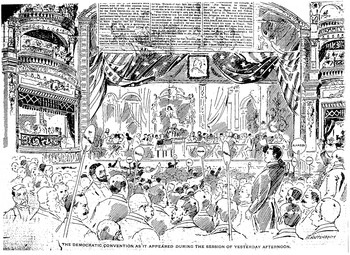
California's Democratic State Convention in 1894 met in San Francisco's Baldwin Theater. Reporters and convention officials occupied the stage, and the 661 delegates took up most of the seats or milled about in the aisles and foyer. There was not much remaining room for the spectators, who included many women in the “dress circles” in the boxes and balconies. San Francisco Examiner, August 22, 1894, 2.

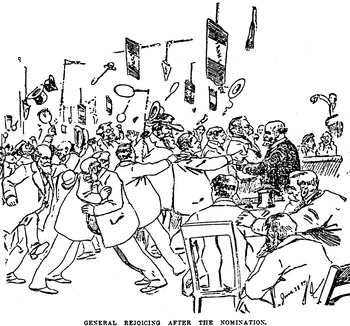
California Republicans celebrate after nominating Morris M. Estee in 1894. A spirited contest for governor was a state convocation's high point. At the moment of victory, elated delegates tossed hats, canes, and fans into the air. The normally noisy and ill-organized assembly briefly became even more raucous and chaotic. San Francisco Chronicle, June 22, 1894, 1.

So little competition, controversy, or interest attended the nominating process that some localities dispensed with caucuses and county conventions altogether. Rural residents were loath to travel all the way to town for a meeting. The Marin County Journal urged the Republican County Committee to appoint the state delegates rather than call a county convention in 1882. Farmers had enough to occupy their time during the summer months, and it was too early to nominate for county offices. Moreover, the paper pointed out, “We have no special fight on the state ticket, that is our party is not committed to any aspirant for governor or any other office. All we want is a delegation of clear headed, honest Republicans, who will go unpledged, and do the best that the situation offers.” The paper later assured its readers that the “sterling” delegation appointed by the county committee would go to the state convention “entirely untrammeled.” “No candidate was recommended to them by the Committee for any office, no candidate was even named during the Committee's deliberations.”Footnote 22
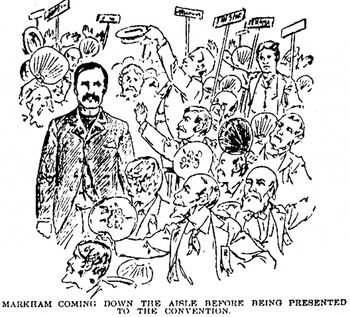
After he clinched the Republican gubernatorial nomination in 1890, Henry Markham made the requisite march to the podium to address the delegates. He briefly thanked the delegates for his support and pledged to do his best in the coming campaign. Nominees' acceptance speeches were usually not long-winded affairs. The convention still had several more state offices to fill, and candidates were not supposed to be the center of attention in a party forum. Despite the raucous celebrations, nominating conventions were business-like affairs with a minimum of pre-planned stagecraft. San Francisco Examiner, August 14, 1890, 3.

The local party organization's near total control of the nominating process, combined with the habitually low voter turnout, ensured that the results would almost certainly be to the party's liking. When all else failed, it would be frequently charged, the party establishment was not above intimidation and fraud.Footnote 23 Prospective nominees in the 1880s who hoped to see some of their friends in the delegation were not in a position to do much about the matter. In their home delegation they might expect to carry some influence, but in places where they were viewed as outsiders their wishes would scarcely be consulted. Confronting the local party establishment by entering a competing slate of delegates was a losing proposition. Candidates could only hope to influence matters after the selection of the state delegates. Candidates and their surrogates implored or negotiated with individual delegates and their leaders through the mail or in private conferences at the convention. So long as the Democratic and Republican parties remained “network[s] of local party organizations” instead of “nationalized party organizations,” aspirants for higher office had to curry favor with the delegates.
Candidates often discovered to their dismay that the actions of the county conventions were moot. Many delegates gained access to the convention floor through the back door. Although most delegates were appointed just days prior to the state convention, a remarkably large number failed to show up. About one in six of the delegates at Republican and Democratic state conventions in the late nineteenth century were not the person designated by the local party apparatus.Footnote 24 Standard practice in the 1880s authorized absentees to appoint their replacements. In the days before the state convention, prominent Democrats and Republicans hunted up credentials especially from delegations representing some of the state's more remote regions. The widespread use of proxies offended some. The Los Angeles Times demanded in 1894 that the practice be banned in that it “denies the popular will and cheats the voters.” However, inside the convention hall the presence of delegates carrying other men's credentials occasioned no real concern. It was a source of some amusement when a well-known San Francisco politician's friends saluted him as “the gentleman from Alpine.”Footnote 25 The parties' liberal policy on proxies ensured that prominent or well-connected Democrats or Republicans could always find a place for themselves within a delegation. Proxies voted as they pleased and exercised an influence on the convention's deliberations—making motions or speeches—that far exceeded their numbers. The prominent politician with a proxy in his pocket rarely wore any man's collar; he was one more intervening variable operating outside the vexed office seeker's control.
When the state convention got down to framing the ticket, a candidate's best-laid plans and schemes could also fall victim to the exigencies of a balanced ticket. Conventions carefully framed their state ticket to ensure that all elements of the party received recognition. A broadly representative slate ensured that everyone had some incentive to work hard on election day. In the 1880s, California's parties defined their constituencies mostly in geographical terms.Footnote 26 To ensure that all elements of the party felt represented, no county or region, aside from populous San Francisco, could expect more than one spot on the state ticket. Hence, the success of one candidate doomed the chances of others from the same county or perhaps nearby even if they pursued different state offices. If a candidate had any hope of landing a nomination, his first priority was to crush the political aspirations of any other office seekers in his county.Footnote 27 Each time the state convention filled a spot on the slate, a candidate's odds for securing one of the remaining slots altered markedly.
Amid the convention's turmoil, deals or logrolling arrangements among the delegates often sealed the candidate's fate. Journalists and politicians identified “trading delegations” from certain counties eager to nail down a place on the ticket for one of their own. They proposed to swap votes with other delegations that were pressing candidates for a different office: if you vote for our man, we will vote for yours. Vote trading was widely deplored as a political tactic, but all conceded it was a common and effective strategy. “In the past,” wrote the political reporter for the Examiner in 1902, “a great deal has been accomplished [for gubernatorial candidates] by deft manipulation in making up the slate. That is where the practical politician does his best work.”Footnote 28 The task of delivering the goods put a candidate's support from his home delegation fully to the test. It was one thing to ask friends and neighbors to endorse your candidacy for a given office. It was something else to induce them to honor agreements that dictated how they were to vote on various other offices. Some delegates bristled at any suggestion that they take orders from above, but others understood that this was the best way to secure party honors for one of their own. Trading on offices represented another challenge to the aspiring public servant, however qualified, determined, wealthy, or popular he might be. Owing to the accidents of geography and the need for a balanced ticket, a candidate might not be quite the right fit for a given combination or “programme.”
The convention system posed special perils for incumbents. Party organs and organizations professed a disdain for “chronic office holders” dating back to Jacksonian times. The California League of Republican Clubs endorsed the principle of term limits to avoid the creation of “an aristocracy of officialism.” The press condemned Governor Henry T. Gage for neglecting his official duties in 1902 while he rushed around southern California trying to shore up support for his renomination.Footnote 29 No institution was better designed to bust up monopolies of elective office holders than a nominating body teeming with willing substitutes. Conventions also contained a fair share of disappointed office seekers itching to get even with an ungrateful office holder. With few exceptions, California's nine elected state officials in the 1880s served their four-year terms and were not renominated. Most did not seek a second term, and only about half of those who put their names in contention again met with success in 1882 and 1886. Convention delegates enforced the rule of rotation in office as another tactic to better distribute the spoils of office among their worthy brethren.
The dynamics of the nomination process during the party period partially insulated the proceedings from the machinations of ambitious office seekers. The multilayered system was too complicated to be easily manipulated in any man's interest. Many if not most delegates went to the state conventions unpledged. The presence of proxies and the informal rules bearing on the balanced ticket further frustrated candidates for governor or comptroller. The most a candidate might hope to accomplish was to have his home county delegation instructed to make him their first and last choice when the balloting commenced. Even then, many objected to the practice of county conventions telling their state delegations how to vote. It violated the independent judgment that many party representatives regarded as their prerogative. The Los Angeles Democratic County Convention denounced an effort to instruct its delegation in 1886 as “undemocratic.” “If we can't trust the best delegates we select, let us send none. The delegates should be free.” The authority of a county convention to tie its delegates' hands was in dispute. The 1882 Alameda County Democratic Convention told its state delegates to cast their votes for Stoneman. During the roll call a member of the delegation insisted on his right to register another choice for governor; a vote by the full convention affirmed that the dissenting delegate should be allowed to vote as he pleased. The decision to scratch the “unit rule” gratified the San Francisco Examiner: “That rule cannot be carried out except by disregarding the rights of minorities. It has nothing to recommend it, and will probably not be heard of again in our conventions.”Footnote 30 The unit rule was not going away, however, and neither was the ambitious office seeker.
As the nineteenth century drew to a close, California's state nominating conventions began losing their autonomy. The independence exhibited by the delegates during the 1880s was reined in, tarnishing the convention's reputation as a deliberative body. Party representatives came under pressure to surrender their judgment in the interests of a gubernatorial candidate. The latter took a more active role in amassing support before and during the parties' formal gathering. Broader state regulation of political parties was mainly responsible for these changes. The reforms wrested control of the nominating process from local party organizations and made it easier for candidates to get their names before the voters in state-run primaries. Gubernatorial aspirants could now elect a slate of delegates pledged to stand by them to the bitter end. Candidate domination of the nominating process would ultimately induce California's major parties to scrap the convention and turn to the direct primary.
The heightened visibility of office seekers inside the state convention was one harbinger of change. Candidates of the 1880s stayed in their hotel rooms offering hospitality and conferring with other leaders. Their counterparts in the 1890s broke out of their elegant suites and started cruising the hallways to buttonhole delegates. Supporters circulated cards and fliers at the convention affirming a political hopeful's suitability for a given office or more rarely—and controversially—casting aspersions on his rivals. The San Francisco Examiner recoiled at the brazen behavior of one Republican gubernatorial aspirant in 1886: “[John F.] Swift left his rooms last night and for hours made his canvass in the hall and doorways of the Neadeau House. His eagerness for the coveted nomination is so marked, and his way of canvassing for votes so unprecedented that old time Republicans, who prefer to see a candidate for the Governorship act with some dignity, are openly expressing disgust at the manner in which Swift is conducting himself.” Unfortunately for Swift's opponents, not enough disgusted, “old time Republicans” showed up at the convention hall the next day to deprive him of the nomination. Later aspirants for state office adopted Swift's more proactive stance, even if some of the more seasoned politicos remained in denial. Two-time Republican gubernatorial nominee Morris M. Estee professed to be clueless regarding the circumstances surrounding his candidacy in 1894. “So far as I know, it was brought about by my friends in the country,” he assured one reporter. “I did not seek to be a candidate of our party at this time nor have I endeavored in the slightest degree, directly or indirectly, to influence the Republicans of any county in this state to select delegates in my favor …. I shall do nothing to secure the nomination.”Footnote 31 Estee delivered these remarks standing in the foyer of the convention's main hotel where he devoted the day to shaking hands with the delegates and other party luminaries.
State regulation of party nominating procedures played a crucial role in abetting the machinations of the ambitious office seeker. New regulations undermined the ability of local party organizations to fend off the advances of the hustling candidate. The state convention retained its formal nominating authority, but a new set of laws enacted between 1895 and 1901 disrupted the old ways of doing business in several important respects.Footnote 32 First, the county convention was cut out of the process with the stipulation that state delegates from the state's dozen largest cities be elected by the voters in the primaries. This removed a layer of decision making and drew candidates for state office and the voters one step closer. An 1899 statute permitted lists of delegates to be grouped and identified on the ballot as pledged to a specific candidate. Candidates could field slates of loyal delegates and campaign to get them elected. Other laws set a uniform date and time for the primaries and stipulated that the voting places be publicized in advance. The parties' rank and file now knew when and where to vote, denying the local organization one of its key techniques for keeping the circle of decision makers relatively small. State officials replaced the local party organization in its supervision of the voting process, using the same equipment and procedures as the general election. The cumulative effect of these changes measurably enhanced the prospects of an outsider capturing a county delegation. A prominent public figure running for a state office had one further not inconsiderable advantage over an unpledged slate of local notables on primary day. Democrats and Republicans showed up at the polls eager to express a preference on the state's next chief executive; they hardly cared who got to attend the state convention.
Importantly, these laws appeared at a time when the networks of Republican and Democratic clubs that upheld the local party organizations had passed their prime. The high point of the partisan club culture in California was reached when these localized bodies merged into their state and national affiliates: the League of Republican Clubs formed in 1887; the Iroquois State League of Democratic Clubs appeared a year later.Footnote 33 Some historians attribute the decline of the political clubs to changing campaign tactics associated with the general election. The mobilization or “hurrah” campaigns of the Gilded Age required large contingents of partisans to march in parades, get out the vote, and pass out ballots at the polls. The educational campaigns appearing in the 1890s relied more heavily on literature in making the party's case to a less reliably partisan electorate. Consequently, it is suggested, the major parties had little need for the trouble and expense of fielding an army of enthusiastic Democrats or Republicans every election.Footnote 34
Whatever role changing campaign tactics may have played in the party organization's near demise after 1900, scholars ought not to overlook the impact of state regulation of party nominating practices. The broad effect of these measures curtailed the influence of the local affiliates, almost rendering them superfluous. As elsewhere the process began in California with the introduction of the official ballot in 1891. Now the state—not the local party organizations—took responsibility for preparing and distributing the ballots on election day.Footnote 35 In the aftermath of the so-called Australian Ballot, California's political clubs began to exhibit signs of atrophy.Footnote 36 The raft of legislation soon to follow aiming at party nominating procedures had a similar effect. The political clubs that had played a leading role in arranging and attending the caucuses and primaries watched as the state usurped another of their duties. The shift to the educational or advertising campaign may have been prompted by the party organization's diminished clout, rather than the other way around.
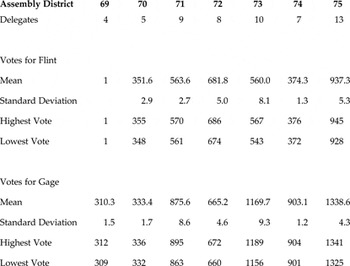
As local political establishments relinquished control over the nomination process, the candidates began openly vying for control of delegations around the state. The shape of things to come came into focus in the Los Angeles Republican primary of 1902. Governor Henry Gage hoped his home county would stand by him as he battled against state senator Thomas Flint Jr. of distant San Benito County. Republicans approaching the polls on primary day were offered pasters with alternative lists of delegates identified as backing Gage or Flint. Most voters based their choice of state delegates strictly on where they stood on the gubernatorial contest. The election returns for the city's seven assembly districts—each of which elected a slate of four to thirteen state delegates—make this clear. Table 1 reports the mean vote for both candidates' delegates in each of Los Angeles's seven assembly districts, along with the standard deviations and the vote totals for the most and least popular delegate. The tiny size of the standard deviation (relative to the mean) indicates near uniformity in the vote for the Gage or Flint delegates from district to district.Footnote 37 The personal popularity or stature of the prospective delegates availed them little. Even in the most intensely competitive districts—the 70th and the 72nd—all the winning delegates hailed from the same slate. Outsider Flint's ability to elect a full roster of supporters in these assembly districts in the home county of an incumbent governor attested to the integrity of the voting process. It also testified to the diminished clout of the Republican establishment in Los Angeles.
Electoral Statistics for Los Angeles Republican Primary of 1902 by Assembly District

Source: Los Angeles Times, Aug. 13, 1902, 2.
During the 1890s, gubernatorial candidates converted the delegate selection process into a personal plebiscite in many places. State Treasurer J. R. McDonald epitomized the more proactive candidate of the mid 1890s: “Everyone has known that I am an aspirant for Governor. I have made my canvas in the San Joaquin Valley and the southern portion of the State. In some of the counties I know that entire delegations could not have been elected had they not been pledged to me.” The candidates who enlisted delegates to run on their slates put a premium on loyalty. Governor George C. Pardee emphasized this point in his correspondence with a political lieutenant recruiting delegates to be voted on at the Republican primaries in 1906: “It might be well to get together lists of reliable men in each district, who will ‘make good’ and ‘stay put’…. Everybody who goes on the delegation should understand that he must ‘programme’ for the head of the ticket clear down the line.”Footnote 38 As gubernatorial candidates hogged the limelight, politicians running for other state offices found it harder drawing attention to themselves. The voters who showed up at the caucuses and primaries desired to send a state delegation committed to one of the much-talked-about gubernatorial prospects. The San Francisco Examiner noted that the 1902 Republican state convention “was made up, compacted and organized wholly on the question, ‘Who will be the nominee for governor?’”Footnote 39
As the influence of the party's office seekers expanded in all directions, there was less room for the uncommitted delegates. The Examiner recorded the fate of one such headstrong Republican in 1902. “In Santa Clara Valley, when they are talking about first class Republicans they are very apt to have O. A. Hale in mind.” Hale, the biggest store keeper in San Jose, had been a fixture of state conventions for many years. “Mr. Hale likes to go to state conventions. He likes to meet his friends and neighbors from different parts of the state there, and he thinks it is a good thing for a man with large business interests to take a hand in shaping the politics of the state.” In 1902, however, Hale learned that he would have to abide by the unit rule whereby his vote would be cast as determined by a majority of the delegation. “In that case,” Hale informed Republican officials, “you had better send a proxy instead of a man. If I go to the convention I will vote for whom I please.” Hale opted instead to run in the primary at the head of an unpledged roster of delegates, but he lost to a slate backing a gubernatorial candidate.Footnote 40 Hale still managed to get inside the convention with a proxy, but prominent politicians increasingly found this avenue cut off as well. State laws disallowed delegates elected under the primary law from handing their credentials over to whomever they pleased. An absent delegate's vote had to be cast as dictated by the delegation as a whole.Footnote 41
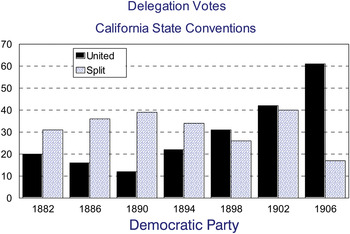
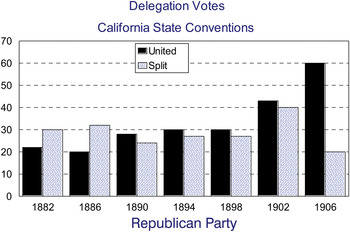
Convention roll calls indicate that independent-minded delegates elsewhere met with a similar ultimatum. Candidates increasingly resorted to the unit rule to leverage majority control of a delegation to capture its full vote. Graph 1 documents the number of counties or assembly districts that either voted unanimously or divided their vote on the gubernatorial choice at each Democratic state convention.Footnote 42 Between 1882 and 1894, the majority of county delegations divided their gubernatorial vote between two or more gubernatorial candidates. Starting in 1898, by contrast, counties or assembly districtsFootnote 43 voting for a single candidate outnumbered those that splintered their vote. A similar pattern unfolds when attention shifts to the Republicans. (See graph 2.)Footnote 44 Most G.O.P. delegations divided their votes among the gubernatorial aspirants in 1882 and 1886 but not thereafter. Candidates lorded over the delegates either by electing the whole slate or by using their support among the delegation's majority to control the minority.
Sources: San Francisco Examiner, June 24, 1882, 3; Sept. 4, 1886, 1; Aug. 21, 1890, 4; Aug. 25, 1894, 2; Aug. 18, 1898, 2; Sept. 4, 1902, 4; Sept. 12, 1906, 3.

Sources: San Francisco Examiner, Sept. 3, 1882, 8; Aug. 14, 1890, 3; Aug. 24, 1898, 4; Aug. 28, 1902, 2; Sept. 6, 1906, 3; Morning Call, Sept. 3, 1882, 8; San Francisco Chronicle, June 22, 1894, 1.

A few delegates resented the effort to muzzle them with the unit rule. “It is shocking and astonishing to me,” complained a Democratic delegate in 1898. “No delegation can bind me to vote against my convictions and my principles.” But such protests were rare after 1900. Most delegates understood the terms of their service before they set foot inside the convention hall. The independent-minded delegate had been upheld as a paragon of civic virtue prior to 1890. Thereafter, political observers characterized delegates who could not act in unison as ineffectual rather than statesmanlike. The Examiner, the same newspaper that had deplored the existence of the unit rule in 1882, portrayed a divided delegation in a very different light twelve years later: “The eminent statesmen in the Los Angeles delegation, each one of whom is a caucus unto himself, are the laughing stock of the convention, occupying the position so long and ludicrously filled by Alameda.”Footnote 45 Because the Los Angeles delegation refused to work together, the only spot on the ticket they could secure was that of lieutenant governor—because nobody else wanted it.
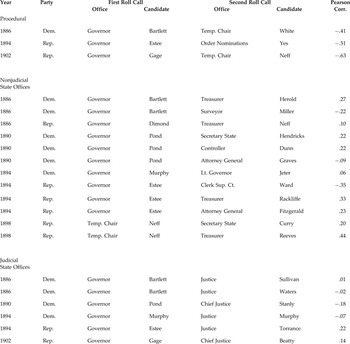
Further evidence of candidate control of the nominating process surfaces with the appearance of voting blocs on crucial convention roll calls. Table 2 uses Pearson correlations, pairing a delegation's vote for governor with other roll calls dealing with key procedural issues or the selection of lesser state officials. Procedural votes taken in advance of the nominating speeches might involve the selection of a temporary chair of the convention or the order of business. Political observers often interpreted these preliminary roll calls as early indicators of support for rival gubernatorial candidates, who were presumed to have some stake in the outcome. Table 2 reveals a relationship between how the counties voted on their gubernatorial choice and their position on procedural matters. The correlations ranged between -.41 to -.63 (explaining 16–37 percent of the variance), and most importantly, the association was growing stronger over time.Footnote 46 The higher correlations indicate that supporters of a leading gubernatorial candidate voted alike on important matters of convention protocol. When the analysis tracks votes on governor and those on lesser, nonjudicial state offices, the results are not as compelling, but here too the relationship strengthened as time passed.Footnote 47 The correlations are modest in the 1886 and 1890 conventions of both parties. The 1894 and 1898 Republican conventions manifest a closer fit between the votes for governor paired with other state offices. Roll calls for state judges, on the other hand, do not align themselves with those for governor. It was commonly remarked that the judiciary was above politics, and the low correlations may indicate that delegates acted on that principle.Footnote 48 Gubernatorial candidates and their handlers assembled voting blocs among the delegates that they could rely on for trades or for favorable action on procedural decisions from the floor. Here is yet more evidence of growing candidate domination over the nominating process.
Pearson Correlations on Roll Call Votes in California State Conventions

Sources: San Francisco Examiner, Sept. 1, 1886, 1; Sept 3, 1886, 1–3; Sept. 4, 1886, 1; Sept. 5, 1886, 2; Aug. 21, 1890, 4; Aug. 22, 1890, 2; Aug. 23, 1890, 2–3; June 21, 1894, 2–3; Aug. 25, 1894, 2; Aug. 24, 1898, 4; Aug. 26, 1902, 5; Aug. 28, 1902, 2; Morning Call (San Francisco), Aug. 28, 1886, 1; San Francisco Chronicle, Aug. 25, 1898, 4; Los Angeles Times, Aug. 28, 1902, 4.
By 1898 many political observers understood that the nominating convention in California no longer operated as it had in the not-too-distant past. Newspapers increasingly decried the presence of a “programme” in state conventions, whereby a body of delegates voting in lockstep set the agenda and rammed through a pre-arranged slate of nominees.Footnote 49 Charges of “boss rule” were rife. Partisan newspapers typically described the opposition's nominating conclaves as under the thumb of some Democratic or Republican potentate. San Francisco's “blind boss,” Christopher Buckley, allegedly pulled the strings at Democratic gatherings during the 1880s; Daniel M. Burns was said to perform a similar role at Republican functions between 1890 and 1902.Footnote 50 Modern scholarship tends to view party leaders of the time not as arrogant autocrats but as crafty power brokers.Footnote 51 The evidence from California's state conventions tends to support this latter interpretation. Buckley could not control the votes of most members of the San Francisco delegation and did a poor job of picking winners. Burns was the consummate deal maker, but his skills came into play at the convention—after the delegates had been selected— rather than before. The presence of trading delegations and the growing popularity of the unit rule made Burns's job all the easier if not essential.Footnote 52 The specter of “bossism” was exaggerated, but conventions had achieved a level of efficiency not usually associated with the democratic process.
The key change undermining the convention's institutional role came not from the bosses but from state laws that sharply curtailed the power of local party organizations when it came to selecting delegates. In urban areas in particular after 1898, the primary was no longer an insider affair. With the aid of an increasingly independent press, candidates could take their case to the voters to convert whatever popular support they had into loyal delegates. Primaries in the major cities emerged as the decisive battlegrounds for contesting a gubernatorial nomination. More and more delegates represented a candidate rather than their local political establishment. The convention was not yet superfluous, but its days as an independent, truly deliberative body were in the past.
California's candidates for office and the delegates who nominated them occupied opposite ends of a political seesaw. The ascent of the one entailed the descent of the other. During the party period the men who attended the state convention exercised wide discretion in singling out the parties' standard bearers. They might genuinely hope to see a local favorite land a place on the ticket, but they resisted efforts to lock in their vote with the unit rule or through trades. Their presence at the state convention reflected their popularity in party circles back in their township or ward. Ambitious office seekers could exert some influence over their home county's delegation, mostly by eliminating local competitors for party honors. Outside their bailiwicks candidates possessed less pull so long as the informal delegate selection apparatus was in the hands of multitudinous local party organizations. A millionaire with his newspaper or a popular incumbent had to appeal to a body of local political notables with their own ambitions and their own ideas concerning whose name would best embellish the ticket back home.
In the last decade of the nineteenth century, however, candidates for elective office, governors in particular, brandished unprecedented influence in party affairs. State regulation of the party primary enhanced the visibility and authority of candidates for major state offices at the expense of men running as delegates or for lesser state offices. The networks of political clubs that formerly controlled local party affairs entered a state of decay, thanks mainly to a government arrogating many of their functions. Provisions authorizing voters to elect the state delegates, rather than the county convention, removed a layer separating the electorate from the office seekers. The state-administered indirect primary made it easier for candidates to get their names and their delegates before the voters. Convention roll calls revealed a new level of coordination or control over the nominating machinery. The growing tendency for delegations to invoke the unit rule and to vote as a bloc in the interests of a gubernatorial candidate presaged the demise of the independent-minded delegate of old. Now the nonpartisan press depicted convention delegates at all levels as underlings. How was it possible, asked a reporter watching the delegates at the Republican State Convention in 1898, “for men of fair standing in the community, of independent judgment in their own affairs, men who would resent the slightest interference with individual rights, commercially or socially, nevertheless [to] attend a convention pledged to do whatever is marked out for them to perform, to vote without reference to their individual preferences, and to execute, with their fellows political maneuvers, the extent or object of which they seem utterly unable to comprehend?”Footnote 53
The rise of the hustling candidate ensured a smooth transition from the indirect to the direct primary. Nominations by the electorate would not be viewed as all that radical a departure when gubernatorial candidates already fielded rival slates of delegates in elections supervised by the state. The only novel features of the law extended the principle of direct nominations to rural areas and to lesser state offices. Potential lieutenant governors or state treasurers could now mount their own electoral campaigns instead of standing on the sidelines watching the gubernatorial candidates elect all the delegates. Both of California's major party state conventions endorsed the principle of direct nominations in 1906, a rare example of political bodies deciding to put themselves out of business.Footnote 54 The bill establishing a direct primary sailed through both houses of the Republican-dominated legislature with little controversy in 1909.Footnote 55 Moreover, Republicans and Democrats understood that state regulation of political parties offered a degree of protection. Legislators liked the proviso prohibiting candidates who lost in the primary from running for the same office in the general election. A reporter milling about the state capitol on the day the bill was passed noted that the more legislators studied the matter, the more they liked it: “The general comment today was that a law of this kind would work to the serious disadvantage of good government leagues and other political sideshows not classed among the regular parties.”Footnote 56
The analysis here has centered on statewide offices and overlooked important developments at the other end of the political spectrum. Gubernatorial aspirants exhibited more aggressive electioneering tactics only after these techniques had become commonplace in races farther down the ticket. When local offices were at stake, candidates sought to influence the county convention by stirring up support at the grass roots. Because voters had more leverage when it came to selecting local candidates (they elected the delegates who selected the nominees), this class of office seekers expended more time and resources ingratiating themselves with the public. They resorted to tactics that some self-respecting gubernatorial candidates might consider undignified. The local Democratic newspaper in rural Tulare County sported fifteen small ads in 1886 from individuals running for sheriff, auditor, assemblyman, and superintendant of schools. The need to build grassroots support became paramount once local party organizations began hosting their own direct primaries during the 1890s. Starting in 1894 Republicans in Orange County arranged for the voters to select their nominees for local offices. As primary day approached eight years later, the Los Angeles Times noted the toll it was taking on would be state legislators and county clerks: “Some of the candidates have been compelled to be in their buggies almost day and night for the past week.”Footnote 57 Prospective governors took longer to warm to the idea of hobnobbing with the rank and file partly because the state convention was too far removed from the parties' electoral base. When new laws mandated that state delegates from urban areas be elected by the voters, gubernatorial candidates took heed. The indefatigable vote getters who captured the gubernatorial prize in later years (most famously Hiram Johnson in 1910) followed a path blazed by local office seekers long before.Footnote 58
California was hardly unique in formulating a more candidate-focused nominating process. Most northern states enacted legislation stipulating greater government oversight of party nominating procedures around the same time. The first wave of legislation appeared in the 1880s to counter vote fraud in the primaries. Statutes regulating voting procedures soon followed. Whenever state delegates were elected by the people under a state-administered indirect primary, the “self-advertised” candidate soon followed. During the Progressive Era, a number of charismatic gubernatorial figures did an end run around their party organizations by tapping grass roots support in Michigan (Hazen S. Pingree), New Jersey (Leon Abbett), Illinois (John P. Altgeld), and, of course, Wisconsin (Robert M. La Follette).Footnote 59 The progressive movement heralded the arrival of this new strain of elective officeholders who had cultivated support among the party-in-the-electorate rather than with the decaying party organization.
The direct primary would prove to be one of many electoral reforms that served the interest of the parties' office holders. In this respect, the fate of the convention system resembled that of the Constitution's ingeniously devised electoral college. Here was another body of wise men entrusted to recruit worthy men to public service. Still, the framers compromised the independence of the electors almost from the start, and the college eventually became little more than a very imperfect mechanism for apportioning the popular vote.Footnote 60 A century later a recurrent theme in the electoral reforms of the Progressive Era was to “cut out the middleman” between the candidate and the voters. The Australian Ballot did away with the ticket peddlers who staffed the polls on election day. The state-run indirect and direct primaries sidelined local partisan clubs that had selected the delegates. The Seventeenth Amendment denied legislators a role in appointing U.S. senators. These internal attacks on the party organizations met with little resistance, given their weak and ephemeral status in the American party system. Gerrymandering, franking privileges, casework, video feeds, and other aspects of the “constant campaign” later served to protect incumbents from the vicissitudes of the electoral marketplace. Rates of incumbency rose while party organizations and partisanship waned during the century that followed.Footnote 61
For some decades historians and political scientists have speculated on the factors responsible for the demise of the party period. The usual suspects have included reformers, frustrated capitalists, and a burgeoning culture of consumption.Footnote 62 Remarkably little attention has focused on the one group that stood the most to gain under the new regime and who crafted and passed the laws in the first place. “The major political party is the creature of the politicians, the ambitious office seeker and office holder,” writes political scientist John H. Aldrich. “They have created and maintained, used or abused, reformed or ignored the political party when doing so has furthered their goals and ambitions.”Footnote 63 The fate of the convention system stands as one more example of the enduring power of the party-in-office to bend the electoral process to its will.