INTRODUCTION
The parasitic protozoan Toxoplasma gondii infects a wide range of hosts worldwide, including all endothermic vertebrates (Dubey and Beattie, Reference Dubey and Beattie1988; Tenter et al. Reference Tenter, Heckeroth and Weiss2000; Hill and Dubey, Reference Hill and Dubey2002). Felids are the only known definitive host of T. gondii (see Miller et al. Reference Miller, Frenkel and Dubey1972; Dubey, Reference Dubey1998) and excrete environmentally resistant oocysts in their feces (Dubey et al. Reference Dubey, Felix and Kwok2010). Zoonotic infection occurs following ingestion of sporulated oocysts from the environment, contaminated water or food (Tenter et al. Reference Tenter, Heckeroth and Weiss2000; Fayer et al. Reference Fayer, Dubey and Lindsay2004), or ingestion of bradyzoites (tissue cysts) in meat (Dubey, Reference Dubey1998; Hill et al. Reference Hill, Chirukandoth, Dubey, Lunney and Gamble2006) but not fish (Zhang et al. Reference Zhang, Yang, Wang, Tao, Xu, Yan, Song and Li2014). Toxoplasma gondii can also be spread congenitally (Hill et al. Reference Hill, Chirukandoth, Dubey, Lunney and Gamble2006), leading to ocular lesions (Couvreur and Desmonts, Reference Couvreur and Desmonts1962) and, in some cases, miscarriage (Flatt and Shetty, Reference Flatt and Shetty2013). The parasite is notorious because of its ability to manipulate host behaviour, resulting in increased predation of infected rodents by the definitive host (Webster, Reference Webster2007; Hari Dass and Vyas, Reference Hari Dass and Vyas2014). It is unclear whether infection with T. gondii changes specific behaviours in wildlife, but increased risk-taking behaviour may occur, with Hollings et al. (Reference Hollings, Jones, Mooney and McCallum2013) finding that road-kill marsupials were more likely to be infected than those culled in control programmes.
Domestic cats can release on average 84 million oocysts up to a month after initial infection (Dubey and Beattie, Reference Dubey and Beattie1988; Dabritz et al. Reference Dabritz, Miller, Atwill, Gardner, Leutenegger, Melli and Conrad2007). Oocysts are the only environmentally infective stage of T. gondii and are resilient, resulting in local ‘hot spots’ of the transmissible stage in the environment (Fayer et al. Reference Fayer, Dubey and Lindsay2004). Unsurprisingly, wildlife in areas with high cat density is subject to increased T. gondii infection risk (Hollings et al. Reference Hollings, Jones, Mooney and McCallum2013). Spatial variation in abiotic conditions is also likely to drive differences in the distribution of T. gondii oocysts, affecting host exposure. Resistance of oocysts to short periods of drying and freezing (Kuticic and Wikerhauser, Reference Kuticic and Wikerhauser1994; Frenkel, Reference Frenkel, Ambroise-Thomas and Peterse2000), due to the physiochemistry of their bilayered wall, enhances their survival (Dumètre et al. Reference Dumètre, Dubey, Ferguson, Bongrand, Azas and Puech2013). Sporulation of oocysts is inhibited below −6 °C (Dumètre and Dardé, Reference Dumètre and Dardé2003), but at 25 °C they remain viable in water for over 200 days (Dubey, Reference Dubey1998). Generally, infection of wildlife is associated with mild, moist environments experiencing infrequent periods of freezing (Dubey and Beattie, Reference Dubey and Beattie1988; Afonso et al. Reference Afonso, Germain, Poulle, Ruette, Devillard, Say, Villena, Aubert and Gilot-Fromont2013; Sevila et al. Reference Sevila, Richomme, Hoste, Candela, Gilot-Fromont, Rodolakis, Cebe, Picot, Merlot and Verheyden2014).
Inter-annual variation in T. gondii infection is associated with climatic variation; very dry, hot summers or very cold winters result in low oocyst survival, thus reducing the risk of infection (Tizard et al. Reference Tizard, Fish and Quinn1976; Simon et al. Reference Simon, Chambellant, Ward, Simard, Proulx, Levesque, Bigras-Poulin, Rousseau and Ogden2011; Gilot-Fromont et al. Reference Gilot-Fromont, Lélu, Dardé, Richomme, Aubert, Afonso, Mercier, Gotteland, Villena and Djurković Djaković2012; Gotteland et al. Reference Gotteland, McFerrin, Zhao, Gilot-Fromont and Lélu2014). High seroprevalence is associated with high farm densities and high numbers of European wild and domestic cats (Afonso et al. Reference Afonso, Germain, Poulle, Ruette, Devillard, Say, Villena, Aubert and Gilot-Fromont2013; Gotteland et al. Reference Gotteland, McFerrin, Zhao, Gilot-Fromont and Lélu2014). Agricultural practices may facilitate parasite transmission between domestic livestock and wildlife (Rosenthal, Reference Rosenthal2009) due to irrigation of soils and soil disturbance by livestock, which increases parasite survival and distribution (Lehmann et al. Reference Lehmann, Graham, Dahl, Sreekumar, Launer, Corn, Gamble and Dubey2003). It seems intuitive that oocysts, which can survive for over a year in the soil (Frenkel and Dubey, Reference Frenkel and Dubey1973), will eventually be washed into freshwater and marine habitats by run-off from land (Fayer et al. Reference Fayer, Dubey and Lindsay2004; Dabritz et al. Reference Dabritz, Miller, Atwill, Gardner, Leutenegger, Melli and Conrad2007; Jones and Dubey, Reference Jones and Dubey2010). There is some evidence for T. gondii infection in marine animals (e.g. sea otters, Cole et al. Reference Cole, Lindsay, Howe, Roderick, Dubey, Thomas and Baeten2000; striped dolphins, Di Guardo et al. Reference Di Guardo, Proietto, Di Francesco, Marsilio, Zaccaroni, Scaravelli, Mignone, Garibaldi, Kennedy, Forster, Iulini, Bozzetta and Casalone2010; and British marine mammals, Forman et al. Reference Forman, West, Francis and Guy2009). Despite this, little research has been undertaken on freshwater systems and how land cover affects the risk of infection.
Eurasian otters (Lutra lutra) have a widespread distribution, covering parts of Europe, Asia and Africa (Corbett, Reference Corbett1966). Wild otters that utilize freshwater, marine and terrestrial habitats can be considered a sentinel for naturally acquired T. gondii infection (Chadwick et al. Reference Chadwick, Cable, Chinchen, Francis, Guy, Kean, Paul, Perkins, Sherrard-Smith, Wilkinson and Forman2013). The aim of the current study was to investigate whether T. gondii seroprevalence in otters is associated with abiotic (meteorological factors and land cover) and biotic (host age, sex and cause of death) factors. Specifically, it is hypothesized that higher infection levels in otters will be evident in: (1) areas with mild temperatures, because the viability of oocysts in the environment will be prolonged; (2) areas dominated by arable land, due to increased oocyst dispersal; and (3) road-killed animals compared with those dying from natural causes due to increased risk-taking behaviour.
MATERIALS AND METHODS
Sample collection
Eurasian otters (88·9% road kill) reported in England and Wales by members of the public were collected by environmental organizations and sent to the national monitoring programme at Cardiff University Otter Project along with location data. Grid references, maps and site descriptions are supplied, and are cross-referenced to validate locations. Carcasses were stored at −18 °C and thawed 48 h prior to necropsy (see Simpson, Reference Simpson2000). In total, the current study analysed data from 659 otter cadavers collected 2004–2010, including 271 samples analysed previously by Chadwick et al. (Reference Chadwick, Cable, Chinchen, Francis, Guy, Kean, Paul, Perkins, Sherrard-Smith, Wilkinson and Forman2013). Blood samples were collected from the thoracic cavity during necropsy by submerging a 1·5 mL eppendorf in the pooled (unclotted) blood and stored at −18 °C prior to analysis.
Sabin–Feldman cytoplasm-modifying dye test for detection of T. gondii antibodies
Blood samples were defrosted, centrifuged and the Sabin–Feldman cytoplasm-modifying dye test (Sabin and Feldman, Reference Sabin and Feldman1948) applied to detect T. gondii antibodies, at the Public Health Wales Toxoplasma Reference Unit, Swansea. In brief, live T. gondii and accessory factor (human seronegative serum samples) were added to serial dilutions of the otter blood samples and incubated at 36–38 °C for 60 min, to encourage complement-mediated killing of T. gondii. Methylene blue was then added for 5 min. Living cells, which took up the dye and unstained cells, were identified using an inverted microscope (Leitz Diavert, ×32 objective and ×40 eyepiece magnification). The endpoint titre of each serum sample was determined when ca. 50% unstained (dead) T. gondii cells were counted in a serial dilution. When the dyed cells were difficult to identify or showed a prozone phenomenon (a false negative due to high titres; Dzbeński and Zielińska, Reference Dzbeński and Zielińska1976), the test was repeated. A titre of 1/8, ⩾4 international units mL−1 compared with the WHO international Toxoplasma control serum containing 1000 international units mL−1, was considered indicative of infection. For one sample, the Sabin–Feldman dye test result was ambiguous and this was removed from the dataset. Here, prevalence refers to the percentage of seropositive hosts and, therefore, includes current and/or past infection in individuals.
Climate and land cover
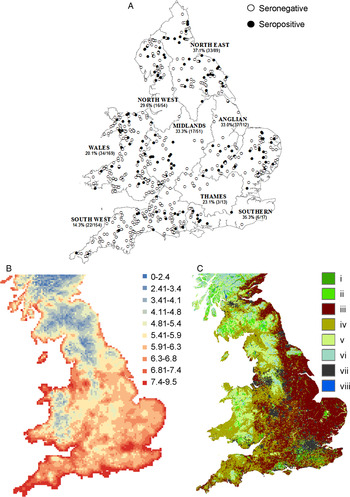
The distribution of the 659 otter mortality sites was plotted using ArcMap GIS (version 9.2) and each location assigned to one of eight regions based on groups of river catchments (Fig. 1). Otters have home ranges up to 40 km (Kruuk, Reference Kruuk2006). In order to estimate climate and land cover at a scale appropriate to otter range, ArcMap GIS was used to collate data from within a circular area 20 km in radius, centred on each otter mortality location (after Chadwick et al. Reference Chadwick, Simpson, Nicholls and Slater2011).
(A) Seroprevalence of Toxoplasma gondii in Eurasian otters (Lutra lutra) from England and Wales. Seropositive otters are shown as black circles and seronegative otters as white circles. The percentage of T. gondii seropositive otters is indicated for each of eight regions (N = 659); (B) long-term average minimum temperature data (°C; 1981–2006) from UK climate projections (UKCIP09); (C) land cover for England and Wales based on digital spatial data licensed from the Centre for Ecology and Hydrology, ©NERC (CEH Land cover 2000; Fuller et al. Reference Fuller, Smith, Sanderson, Hill and Thomson2002). (i) Broad-leaved/mixed woodland; (ii) coniferous woodland; (iii) arable and horticulture; (iv) improved grassland; (v) semi-natural grassland; (vi) mountain, heath and bog; (vii) built-up areas and gardens; (viii) standing open water.

Long-term average climatic data (1981–2006) from UK climate projections were used to map spatial variation in climate (UKCIP09; Perry and Hollis, Reference Perry and Hollis2005) specifically: average minimum temperature (°C), average days of ground frost and average rainfall (mm), at a 5 km2 resolution. These meteorological variables were selected as they are known to affect survival of oocysts in the environment (Dubey and Beattie, Reference Dubey and Beattie1988; Dubey, Reference Dubey1998; Dumètre and Dardé, Reference Dumètre and Dardé2003). For climatic variables, the mean value was calculated within each 20 km radius area.
Data from the Countryside Information Services (www.ceh.ac.uk/products/software/cehsoftware-cis.htm) were used to map percentage cover of arable land, broadleaf woodland, coniferous woodland, improved grassland, semi-natural grassland, upland and built-up areas, at a 1 km2 resolution, based on digital spatial data licensed from the Centre for Ecology and Hydrology, NERC (CEH Land cover 2000; Fuller et al. Reference Fuller, Smith, Sanderson, Hill and Thomson2002). For land cover, if an otter ranging region (20 km radius) had one land cover type >50% of the area, this was nominated as the dominant land cover; if no single land cover formed >50% of the area, the area was classified as mixed. Other potentially important environmental characteristics were omitted due to data deficiency (cat density) or high levels of spatiotemporal variation (in-stream river characteristics).
Biotic associations
A range of data were collected at post-mortem, including age–class (juvenile, sub-adult, adult), sex, cause of death, body length and body weight. Five individuals from the study group could not be sexed due to extensive damage to the carcass. Although month and year of death were collected, they were not used in statistical modelling due to uncertainties regarding date of infection and date of death.
Cause of death was categorized as road traffic accident (RTA) or non-RTA. Further subdivisions of the latter were considered (namely bite wounds, blow to head, drowned, emaciated, infection, snared, shot); but small samples sizes precluded more detailed analysis. Size and reproductive indicators were used to categorize otters by age–class, as juvenile (females <2·1 kg, males <3 kg), sub-adult (females ⩾2·1 kg with no sign of reproductive activity, males ⩾3 kg with a baculum <60 mm in length) or adult (females with signs of reproductive activity, males with baculum ⩾60 mm).
Statistical analyses
All statistical analyses were performed in R (version 3.2.3; R development Core Team, 2015). A generalized linear model with a binomial error distribution was fitted to the T. gondii prevalence data, to examine the probability of T. gondii infection of otters using meteorological data (25-year mean annual: minimum temperature, ground frost days, rainfall), land cover type (arable land, semi-natural grassland, improved grassland and mixed), biotic data (otter age–class, length and sex), cause of death and region, as explanatory variables. The interaction term sex:age was also included in order to test whether age differences varied with sex or vice versa. All terms were included in the original model (Akaike Information Criterion, AIC i ) with one term removed at a time (AIC b ), using the drop1 function in R, which employs the AIC method to identify the best fitting and most efficient model (Thomas et al. Reference Thomas, Vaughan and Lello2013). Variables were excluded from the final model when the difference between AIC b and AIC i was greater than two (Thomas et al. Reference Thomas, Vaughan and Lello2013). The final model used average minimum temperature, land cover, age and sex to explain variation in the probability of an otter being infected with T. gondii. The distribution of deviance residuals was examined to check for lack of fit. Other typical model checking procedures (such as overdispersion) are not valid for Bernoulli GLMs (Thomas et al. Reference Thomas, Vaughan and Lello2013).
Spatial analysis (SaTScan, version 9.1.1; Bernoulli model) was used to identify clustering between T. gondii prevalence in otters and the location and time that the otter was found dead. SaTScan employs centroids that are distributed across the region of interest (England and Wales), to compare the observed number of cases (T. gondii-positive otters) to the expected number of cases, if they were randomly distributed, using a likelihood ratio test (Kulldorff, Reference Kulldorff1997, Kulldorff et al. Reference Kulldorff, Athas, Feurer, Miller and Key1998). In the absence of knowledge on specific otter territories and to provide a sufficient scale, the mean x and y national grid reference coordinates for the counties in England and Wales were used to describe the centroids for analysis.
RESULTS
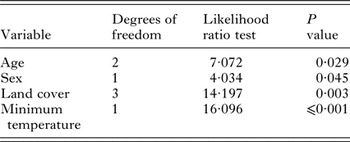
Toxoplasma gondii antibodies were present in 25·5% (168/659) of otters, with infections widely distributed across England and Wales (Fig. 1). Both abiotic and biotic variables explained significant variation in the prevalence of T. gondii (Table 1)
Variables explaining Toxoplasma gondii seroprevalence in Eurasian otter (Lutra lutra)

.
Climate and land cover
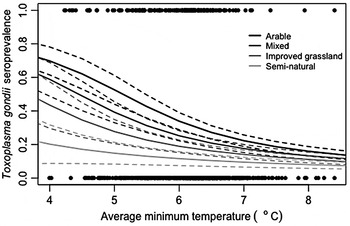
There was a negative association between annual minimum temperature and T. gondii infection status [z 1,646 = −3·88, P ⩽ 0·001, where z is the test statistic (in this case the Wald statistic, which is the regression coefficient divided by its standard error)], such that probability of infection reduces with increased average minimum temperature (Fig. 2). In areas with primarily arable land, primarily the East, otters were more likely to be seropositive than in areas dominated by improved grassland (z 3,646 = 2·35, P = 0·019) or semi-natural grassland (z 3,646 = 1·99, P = 0·047). Although marginally non-significant, otters were less likely to be infected with T. gondii in areas with mixed land cover, than those found in areas with predominantly arable land (z 3,646 = 1·95, P = 0·052). There was no significant difference between improved grassland, semi-natural grassland or mixed land cover (P > 0·05). Although the interaction term temperature:land cover was non-significant, model predictions suggest that where average minimum temperatures were high (8 °C), the probability of infection was low across all land covers, whereas at low minimum temperatures (4 °C), probability differed between land covers, with probabilities in arable > mixed > improved > semi-natural. Where sex, age and temperature are controlled in the model to predict probabilities for male otters, at an average minimum temperature of 6 °C, the relative probabilities of seropositivity is 0·426 ± 0·051 in arable land, compared with 0·252 ± 0·030 in mixed, 0·189 ± 0·038 improved grassland and 0·116 ± 0·042 semi-natural land (Fig. 2). There was no significant association of T. gondii prevalence with number of ground frost days or rainfall (P > 0·05).
Model predictions to show the probability of a Toxoplasma gondii infection in adult, male Eurasian otters (Lutra lutra) for different land uses (arable, mixed, improved grassland and semi-natural) as a function of average minimum temperature (°C).

There was no significant clustering, either spatially or temporally. Although seroprevalence was higher in the North East, Anglian and Southern Regions than the Welsh, North West and South West Region (Fig. 1), model outputs indicate no significant differences between regions, suggesting that climate and land cover differences adequately explain regional variation.
Biotic associations
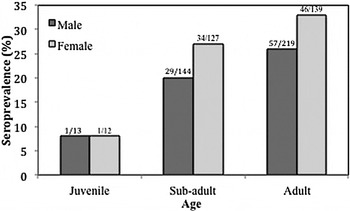
Seroprevalence increased with age; juveniles (8%; N = 25), sub-adults (23·3%; N = 271) and adults (28·7%; N = 358; Fig. 3; P = 0·021). There was a significant difference in seroprevalence of T. gondii between the sexes; females were more likely to be infected than males (difference in probability of infection = 0·4 ± 0·2; z 1,646 = 2·02, P = 0·044). There was no significant age:sex interaction, i.e. the effect of age did not differ between the sexes and no significant effect of length or cause of death.
Toxoplasma gondii seroprevalence in Eurasian otters (Lutra lutra) from England and Wales. The percentage of T. gondii seropositive otters within each age–class for both males (dark bars) and females (shaded bars). Five individuals could not be sexed due to the extent of their injuries and were removed. Numbers of seropositive/total number of individuals in each group are shown in parentheses.

DISCUSSION
This study examined the seroprevalence of Toxoplasma gondii in the Eurasian otter (L. lutra) in relation to climate, land cover and biotic variables across England and Wales. It is the only study to have examined such associations in a semi-aquatic species, which might be considered at particular risk from infection, due to exposure to oocysts both on land, and oocysts accumulating and dispersed in water systems. Dispersal of oocysts in water might be expected to confound spatial variation of the parasite, particularly in aquatic or semi-aquatic hosts. Despite this, the current study shows that spatial variation in T. gondii distribution can be explained by average annual minimum temperature and land cover (see Gotteland et al. Reference Gotteland, McFerrin, Zhao, Gilot-Fromont and Lélu2014).
Cold climates have been linked with decreased seroprevalence of T. gondii, due to reduced oocyst viability and risk of infection (Dubey et al. Reference Dubey, Miller and Frenkel1970; Frenkel and Dubey, Reference Frenkel and Dubey1973; Dumètre and Dardé, Reference Dumètre and Dardé2003). In the UK, this may explain low T. gondii seroprevalence in humans from Scotland (Food Standard Agency, 2012). The current study excluded Scotland however, due to lack of samples, and showed no association between days of ground frost and seroprevalence. This could be because minimum temperatures in England and Wales are not low enough to significantly reduce viability. Conversely, we found a negative association between temperature and seroprevalence, such that areas with higher temperatures had a lower probability of infection (contradicting hypothesis 1). This may reflect a reduction in viability due to high summer temperatures, as suggested by Gilot-Fromont et al. (Reference Gilot-Fromont, Lélu, Dardé, Richomme, Aubert, Afonso, Mercier, Gotteland, Villena and Djurković Djaković2012).
Areas of arable land (primarily in the East of England) had relatively high seroprevalence (see also Chadwick et al. Reference Chadwick, Cable, Chinchen, Francis, Guy, Kean, Paul, Perkins, Sherrard-Smith, Wilkinson and Forman2013) supporting hypothesis 2. Arable land in the UK is primarily in areas with relatively low rainfall, which is partially alleviated through irrigation (Environment Agency, 2009). Surface run-off tends to be high in arable areas, due to a combination of land drainage, low levels of soil organic matter and altered soil structure (Environment Agency, 2009). This may increase the number of oocysts being washed into water, potentially increasing the infection risk to otters. A link to high surface run-off is supported by Shapiro et al. (Reference Shapiro, Conrad, Mazet, Wallender, Miller and Largier2010); they used surrogate T. gondii oocysts (autofluorescent, carboxylate-modified polystyrene microspheres) to show that after a period of dry weather, the first heavy rainfall, which caused the ground to become saturated led to overland run-off ‘flushing’ oocysts from land to freshwater and into the ocean. Increased seroprevalence in arable areas might also reflect a correlation between land-use and cat density (e.g. related to high numbers of farm cats around grain stores), but there are insufficient data on either domestic or feral cat numbers in the UK to test this hypothesis.
Toxoplasma gondii is notorious for its role as a host manipulator, with infected rodents and even primates becoming more risk-taking and active (Webster, Reference Webster2007; Poirotte et al. Reference Poirotte, Kappeler, Ngoubangoye, Bourgeois, Moussodji and Charpentier2016). In humans, T. gondii infection has been associated with increased suicide attempts (Pederson et al. Reference Pederson, Preben, Norgaard-Pederson and Postolache2012) and increased likelihood of being involved in a RTA (Flegr et al. Reference Flegr, Klose, Novotná, Berenreitterová and Havlícek2009). More recently, though, Sugden et al. (Reference Sugden, Moffitt, Pinto, Poulton, Williams and Caspi2016) argue that there is limited evidence that T. gondii in humans is related to poor impulse control, increased risk of personality aberrations or neurological impairment. For wildlife, it is difficult to quantify ‘risky’ behaviour, specifically whether road crossing is a perceived risk for an otter. More generally, regardless of infection status, there are behavioural traits associated with wildlife and road crossing. For example, badgers are less likely to cross roads where there are high volumes of traffic (Clarke et al. Reference Clarke, White and Harris1998) and smaller mammals tend to avoid roads (McGregor et al. Reference McGregor, Bender and Fahrig2008). In the current study, cause of death was not associated with T. gondii seroprevalence (contradicting hypothesis 3). In contrast, Hollings et al. (Reference Hollings, Jones, Mooney and McCallum2013) found significantly higher seroprevalence in road kill compared with culled animals. Possibly, our analysis was limited by the relatively small sample size of non-road-kill samples (11 infected and 47 uninfected individuals) and wide variation in cause of death within our non-RTA group.
The current study shows that the seroprevalence of T. gondii in the Eurasian otter (25·5%, 168/659) was lower than previously reported for this host (39·5%, 108/271, Chadwick et al. Reference Chadwick, Cable, Chinchen, Francis, Guy, Kean, Paul, Perkins, Sherrard-Smith, Wilkinson and Forman2013; 100%, 6/6, Sobrino et al. Reference Sobrino, Cabezón, Millán, Pabón, Arnal, Luco, Gortázar, Dubey and Almeria2007): probably a reflection of our increased statistical power with the larger sample size. The method used to identify the presence of antibodies determines whether an individual has become infected during its lifetime (e.g. Sobrino et al. Reference Sobrino, Cabezón, Millán, Pabón, Arnal, Luco, Gortázar, Dubey and Almeria2007; Richomme et al. Reference Richomme, Afonso, Tolon, Ducrot, Halos, Alliot, Perret, Thomas, Boireau and Gilot-Fromont2010). Toxoplasma gondii seroprevalence in otters increased with age, presumably a reflection of cumulative exposure to T. gondii with time, and corroborates the findings of previous research (wild carnivores, Sobrino et al. Reference Sobrino, Cabezón, Millán, Pabón, Arnal, Luco, Gortázar, Dubey and Almeria2007; mink, Sepúlveda et al. Reference Sepúlveda, Mu, Rosenfeld, Jara, Pelican and Hill2011; otters, Chadwick et al. Reference Chadwick, Cable, Chinchen, Francis, Guy, Kean, Paul, Perkins, Sherrard-Smith, Wilkinson and Forman2013; and wild boar, Richomme et al. Reference Richomme, Afonso, Tolon, Ducrot, Halos, Alliot, Perret, Thomas, Boireau and Gilot-Fromont2010). Higher seroprevalence in females contrasts with previous reports, which found no significant difference with sex (Eurasian otters, Sobrino et al. Reference Sobrino, Cabezón, Millán, Pabón, Arnal, Luco, Gortázar, Dubey and Almeria2007; mink, Sepúlveda et al. Reference Sepúlveda, Mu, Rosenfeld, Jara, Pelican and Hill2011) and is surprising, given both the larger home range of males (Kruuk, Reference Kruuk2006; potentially increasing exposure risk) and a general trend towards greater male susceptibility to infectious diseases (e.g. Zuk and McKean, Reference Zuk and McKean1996; Stoehr and Kokko, Reference Stoehr and Kokko2006). In cats, prey composition influences T. gondii infection risk (Afonso et al. Reference Afonso, Thulliez, Pontier and Gilot-Fromont2007). Otters are largely piscivorous but do occasionally take mammals or birds (e.g. Blanco-Garrido et al. Reference Blanco-Garrido, Prenda and Narvaez2008). Variations in land-use, climate and geographical location may impact on the availability or preference for particular prey, affecting the risk of acquiring the infection via tissues cysts. Sexual differentiation in otter diet, combined with spatial variation in prey availability, may contribute to sex and spatial differences in risk of infection.
This study concludes that T. gondii seroprevalence in the Eurasian otter was associated with climatic, land cover and biotic factors in England and Wales. Probability of infection was extremely low in warmer areas, across habitats, perhaps relating to low summer survival of oocysts. The highest risk of infection was in arable areas, which may reflect greater oocyst transport with run-off. Developing our understanding of spatial variation in infection risk and its drivers has clear implications for exposure risk in other species, including humans.
ACKNOWLEDGEMENTS
Members of the public reported otter carcasses, and collection coordinated by the Environment Agency (EA), UK. The authors appreciate the help of three anonymous reviewers as these helped improve the manuscript.
FINANCIAL SUPPORT
Cardiff University Otter Project was funded by the Environment Agency and Natural Resources Wales, with additional contributions made by the Somerset Otter Group.