Introduction
In 2013, 44 million people worldwide lived with dementia and this number is expected to rise to 76 million in 2030 and 135 million in 2050 (Alzheimer's Disease International, 2013). In the early stages of the disease people may experience an “informational and support gap.” Medical components of care such as diagnostic tests and prescribing medications are generally delivered adequately, but the counseling and educational aspects of living with dementia are often neglected (Mountain, Reference Mountain2006; Mountain and Craig, Reference Mountain and Craig2012) or seen as not feasible for people with dementia (Martin et al., Reference Martin, Turner, Wallace, Choudhry and Bradbury2012). As a result, meaningful life roles are lost and the quality of life deteriorates. Self-management can be defined as: “an individual's ability to manage the symptoms, treatment, physical and psychological consequences, and life style changes inherent to living with a chronic condition” (Barlow et al., Reference Barlow, Wright, Sheasby, Turner and Hainsworth2002). Dealing with the loss of memory and other abilities requires self-management skills that deteriorate in people with dementia at the same time because of the disease itself (Mountain, Reference Mountain2006). People with dementia therefore need self-management support to be able to carry on living and potentially delay further progression of losses (Quinn et al., Reference Quinn, Toms, Anderson and Clare2015). That the support received is not always satisfactory is demonstrated by the unmet needs people with dementia (and carers) experience regarding, for example, memory, psychological distress, social contact/company, and meaningful activities (Van der Roest et al., Reference Van der Roest2009; Castillo et al., Reference Castillo, Woods and Orrell2010; Reference Castillo, Woods and Orrell2013; Black et al., Reference Black, Johnston, Rabins, Morrison, Lyketsos and Samus2013). Recently, it has been acknowledged that in case of elderly people living with a chronic condition, healthcare should focus more on empowering people in their personal strength and abilities rather than focusing on deficits (Huber et al., Reference Huber2011; Martin et al., Reference Martin, Turner, Wallace, Choudhry and Bradbury2012).
Technology potentially can support people in their ability to manage life despite chronic diseases (Huber et al., Reference Huber2011). It is generally expected that eHealth can stimulate self-management among users and cut healthcare costs (Krijgsman et al., Reference Krijgsman, Bie de, Burghouts, Cath, Gennip van and Friele2013). EHealth is defined as: “the deployment of information and communication technologies (ICT) to support or improve health and healthcare” (Krijgsman et al., Reference Krijgsman, Klein and Wolterink2012). The development of eHealth resulted in the availability of new applications (apps) in the field of health and social care (Marceglia et al., Reference Marceglia, Bonacina, Zaccaria, Pagliari and Pinciroli2012). In the case of the early stages of dementia, information and communication technology may compensate for some of the cognitive losses and offer functional support. A Pictoplanner for example, can help to structure the day and prompt behavior for people who are no longer able to get through the day independently (Kerkhof et al., Reference Kerkhof, den Ouden, Ben Allouch, Soeteman, Scholten and Willems2016).
Touch screen devices, such as tablets, provide a good interface for eHealth purposes, they are user-friendly, and the development of apps for these tablets is relatively simple. Based on the first positive results with tablets in the elderly care (Stunnenberg and Adriaansen, Reference Stunnenberg and Adriaansen2015), healthcare organizations have become interested to extend the use of tablets to specific target groups, such as people with dementia. Because of its intuitive interface, the tablet and its apps may be useful in supporting self-management (Upton et al., Reference Upton, Upton, Jones, Jutlla and Brooker2011; Marceglia et al., Reference Marceglia, Bonacina, Zaccaria, Pagliari and Pinciroli2012), although people with dementia will need support to learn how to use the touch screen and its applications (Dröes et al., Reference Dröes, Bentvelzen, Meiland, Graig, Mulvenna and Nugent2010a; Upton et al., Reference Upton, Upton, Jones, Jutlla and Brooker2011; Meiland et al., Reference Meiland2012; Lim et al., Reference Lim, Wallace, Luszcz and Reynolds2013, Nijhof et al., Reference Nijhof, van Gemert-Pijnen, Burns and Seydel2013; Groenewoud and de Lange, Reference Groenewoud and de Lange2014; Kerkhof et al., Reference Kerkhof, Rabiee and Willems2015).
Three case-studies involving nine participants with mild cognitive impairment (MCI) and mild dementia living at home, demonstrated that people with MCI and mild dementia were able to learn to use the tablet and its apps, and that it had a positive influence on their self-confidence and involvement in society (Bello et al., Reference Bello, Bouwmeester and Westerik2013; Meussen et al., Reference Meussen, Wensink, Bannink, Nagtzaam and Steghuis2014; Vegterlo et al., Reference Vegterlo, Folkers, van der Zee and Grunder2014). Self-confidence or self-efficacy is an important basis for self-management abilities (Quinn et al., Reference Quinn, Toms, Anderson and Clare2015). Several, mainly qualitative, studies showed that people with dementia who used touch screen technology and its applications, evaluated it as user-friendly and experienced it as valuable (Riley et al., Reference Riley, Alm and Newell2009; Astell et al., Reference Astell, Ellis, Bernardi, Alm, Dye, Gowans and Campbell2010; Upton et al., Reference Upton, Upton, Jones, Jutlla and Brooker2011; Meiland et al., Reference Meiland2012; Leuty et al., Reference Leuty, Boger, Young, Hoey and Mihailidis2013; Lim et al., Reference Lim, Wallace, Luszcz and Reynolds2013; Nijhof et al., Reference Nijhof, van Gemert-Pijnen, Burns and Seydel2013; Pringle and Somerville, Reference Pringle and Somerville2013; Groenewoud and de Lange, Reference Groenewoud and de Lange2014; Kerkhof et al., Reference Kerkhof, Rabiee and Willems2015; Astell et al., Reference Astell, Joddrell, Groenewoud, de Lange, Goumans, Cordia and Schikhof2016).
Existing apps, and apps specifically developed for people with dementia, could support the five targets of self-management identified by Martin et al., (Reference Martin, Turner, Wallace and Bradbury2013), i.e. (1) relationship with family/friend/carer e.g. CIRCA (Astell et al., Reference Astell, Ellis, Bernardi, Alm, Dye, Gowans and Campbell2010) and apps to provide care at a distance e.g. the PAL4 dementia system (Nijhof et al., Reference Nijhof, van Gemert-Pijnen, Burns and Seydel2013); (2) maintaining an active lifestyle e.g. the TalkMeHome Service (Nauta et al., Reference Nauta, Brangert, Roest, Janssen and Hettinga2013); (3) psychological well-being e.g. apps for leisure activities (Smith and Mountain, Reference Smith and Mountain2012), such as music (Riley et al., Reference Riley, Alm and Newell2009), reminiscence (Pringle and Somerville, Reference Pringle and Somerville2013), art (Leuty et al., Reference Leuty, Boger, Young, Hoey and Mihailidis2013), gaming (Groenewoud and de Lange, Reference Groenewoud and de Lange2014; Astell et al., Reference Astell, Joddrell, Groenewoud, de Lange, Goumans, Cordia and Schikhof2016); (4) techniques to cope with memory losses e.g. the COGKNOW Day Navigator (Meiland et al., Reference Meiland2012) and the Pictoplanner (Kerkhof et al., Reference Kerkhof, den Ouden, Ben Allouch, Soeteman, Scholten and Willems2016); and (5) information about dementia e.g. the PAL4-dementia system (Nijhof et al., Reference Nijhof, van Gemert-Pijnen, Burns and Seydel2013).
Self-management in the context of dementia refers to dealing with, and adapting to, the changes dementia brings in the person's life, and preserving a good quality of life (Dröes et al., Reference Dröes, van der Roest, van Mierlo and Meiland2011a; Reference Dröes, Van Mierlo, Van der Roest and Meiland2010b). Apps to support self-management should therefore not be limited to compensation for deficits, but also promote meaningful positive experiences (Martin et al., Reference Martin, Turner, Wallace, Choudhry and Bradbury2012). Engaging people with dementia in meaningful activities which are still possible by stimulating the use of remaining capacities and compensating for deficits will contribute to their quality of life (Graff et al., Reference Graff, Vernooij-Dassen, Thijssen, Dekker, Hoefnagels and Rikkert2006a; Vernooij-Dassen, Reference Vernooij-Dassen2007; Kielhofner, Reference Kielhofner2008). Meaningful activities can be defined as: “the spectrum of occupations a person performs in his or her everyday life and that are perceived as significant to the person” (Phinney et al., Reference Phinney, Chaudhury and O'connor2007). For people with dementia in particular, activities are expected to be meaningful when they result in: experiencing pleasure and enjoyment; feelings of connection and belonging; and retaining a sense of autonomy and personal identity (Phinney et al., Reference Phinney, Chaudhury and O'connor2007). Meaningful activities have a specific value for an individual person and can be all types of daily activities in the areas of self-management, household, or leisure activities (Graff et al., Reference Graff, van Melick, Thijssen, Verstraten and Zajec2010). Thus, most apps mentioned above could also be of benefit to stimulate meaningful activities in people with dementia.
When introducing the tablet to people with dementia, it is important to take into account some specific preconditions, e.g. related to their cognitive decline and context. Careful consideration is required to select usable apps for the target group. Usable refers to the extent to which an app is useful, user-friendly, easy to learn, and satisfying (Lund, Reference Lund2001). The present study intends to develop a person-centered tablet program that will help individual people with dementia and their carers to select and use apps for self-management and meaningful activities that match their needs, wishes, and functional abilities. An individual-based approach is necessary because what activities are meaningful or supportive for self-management is different for each person. The person-centered tablet program will consist of:
-
1. a requirements-based assessment tool to select usable apps that match the individual needs, wishes, and functional abilities of people with dementia;
-
2. a training for people with dementia to learn how to use the tablet; and
-
3. a training for professionals and informal carers (including volunteers) to support/coach people with dementia in using the tablet.
The expected results of this person-centered tablet program for self-management and meaningful activities is to improve their self-management ability of people with dementia and to promote their engagement in meaningful activities and participation in daily and social life. It is expected that the program will contribute to the quality of life of people with dementia and their carers.
Methods
Design
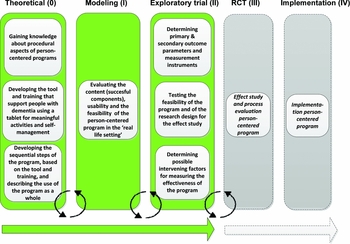
As the person-centered tablet program can be viewed as a complex intervention, we will use the Medical Research Council (MRC) framework for the development and evaluation of complex interventions to better define the problem/needs the program is directed at, how to model the intervention, and to prepare and execute the evaluation in an exploratory trial (Campbell et al., Reference Campbell2000; Reference Campbell2007). This paper describes the methods used in these first three phases of the MRC framework (Figure 1) i.e.: the preclinical or theoretical phase (0); the modeling phase (I) and the exploratory trial (II).
First phases of development and testing of a person-centered tablet program according to the MRC framework.

In the theoretical phase, an explorative study will be done to develop, or adapt existing tools and training for the person-centered tablet program. Next, in the modeling phase, the successful components of the program, the usability and feasibility of the program will be explored and evaluated. In an exploratory trial, the intervention and the measurement instruments will then be pilot-tested on feasibility, and the intervening factors for measuring the effectiveness of the program will be evaluated. Mixed methods, i.e. both qualitative and quantitative research methods, will be used for designing and evaluating the program. After these three phases are concluded, the effect of the program can be evaluated in an RCT (phase III) and, when effective, the program can be further implemented (phase IV). The execution of the RCT and (possible) further implementation are beyond the scope of the present study.
Below, the aim, research questions, methods, analysis strategies, and expected results are outlined for each phase. The rationale of the study will be described in the first phase. According to the MRC framework, the progression from one phase to another, especially in the first three phases, may not be linear but can be conducted in an iterative process (Campbell et al., Reference Campbell2000; Campbell et al., Reference Campbell2007; Craig et al., Reference Craig, Dieppe, Macintyre, Michie, Nazareth and Petticrew2013), i.e. return to an earlier phase of the development e.g. from the modeling phase back to the theoretical phase, or from the exploratory trial back to the modeling phase, based on feedback or new information collected in a later phase. This provides the possibility to constantly optimize the person-centered tablet program, i.e. to adjust it to the needs of users and their context. Using “participatory designs”, user needs are inventoried and integrated in the person-centered tablet program (Steen et al., Reference Steen, Kuijt-Evers and Klok2007; Meiland et al., Reference Meiland2010; Pratesi et al., Reference Pratesi, Sixsmith and Woolrych2013). In all phases of the development of the program, we will involve users, i.e. clients and carers, by means of individual interviews, workshops, focus groups, and case studies. In the end, the intervention will be offered to community-dwelling people with mild dementia. The MMSE score (Folstein et al., Reference Folstein, Folstein and McHugh1975) in combination with the Global Deterioration Scale (Reisberg et al., Reference Reisberg, Ferris, de Leon and Crook1982) will be used to determine the sample and people with mild dementia with scores for cognitive functioning between 18 and 24 (MMSE) and stage 4 (GDS) will be included in the modeling phase and exploratory trial. In addition to people with mild dementia, people with mild cognitive decline or MCI could be included in the theoretical phase (MMSE 24–27 and GDS stages 2 or 3) of the development of the tool for selecting usable apps as representatives for the future needs and wishes of people with mild dementia (de Boer et al., Reference De Boer, Hertogh, Dröes, Riphagen, Jonker and Eefsting2007). In this phase, people will be individually (apart from carers) involved fulfilling the roles as informants and advisors (Abma and Broerse, Reference Abma and Broerse2007). In the modeling phase and exploratory trial they will be involved as dyads fulfilling the roles as informants and research subjects (Abma and Broerse, Reference Abma and Broerse2007). However, to gain a comprehensive insight into their needs, (group) interviews in these phases will be conducted with persons with dementia apart from informal carers as we know that the needs reported by persons with dementia can differ from those mentioned (about the person with dementia) by carers (Van der Roest et al., Reference Van der Roest2009; Black et al., Reference Black, Johnston, Rabins, Morrison, Lyketsos and Samus2013; Castillo et al., Reference Castillo, Woods and Orrell2013). Because we only include community-dwelling participants, the recruitment will take places via health and homecare organizations, day centers, and meeting centers for people with dementia and their informal carers.
Ethical considerations
The Medical Ethics Committee of the VU University Medical Center in Amsterdam approved the study protocol. The ethical principles; respect for autonomy, beneficence, non-maleficence, and justice (Haigh, Reference Haigh, Watson, McKenna, Cowman and Keady2008) will be taken into account during recruitment, data collection, analysis, and reporting. During all the phases special attention will be paid to the informed consent of people with dementia by performing an on-going consent procedure in order to ensure that participation is voluntarily (Murphy et al., Reference Murphy, Jordan, Hunter, Cooney and Casey2015). Furthermore, strategies for the meaningful inclusion of people with dementia such as, creating a safe environment, spending time by getting to know them, emphasizing the importance of their participation, and recognizing signs of discomfort, will be taken into consideration (Murphy et al., Reference Murphy, Jordan, Hunter, Cooney and Casey2015).
Methods of Preclinical or theoretical phase (phase 0)
The aim of the theoretical phase is to explore relevant theory that will guide the best choice of intervention (Campbell et al., Reference Campbell2000). The following research questions will be addressed in this phase:
-
1. What are important procedural aspects (e.g. recruitment, inclusion, process and effect evaluation, and implementation issues) of person-centered programs for people with dementia to take into account in the development of the person-centered tablet program?
-
2. What needs, wishes, and abilities of people with dementia should be taken into account when selecting usable apps on the tablet with regard to self-management and meaningful activities?
-
3. How to design and develop a requirements-based assessment tool for usable apps with regard to self-management and meaningful activities that matches with the individual needs, wishes and abilities of people with dementia?
-
4. What training or coaching intervention(s) on how to use the tablet and its applications is/are most appropriate and/or effective for people with dementia and informal and professional carers?
-
i. Rationale and methods related to procedural aspects of person-centered programs (question 1):
In recent decades psychosocial interventions are promoted to improve the quality of life of people with dementia (Moniz-Cook et al., Reference Moniz-Cook, Vernooij-Dassen, Woods and Orrell2011). Many of these interventions have been shown to be effective (Olazaran et al., Reference Olazaran2010; Dröes et al., Reference Dröes, Van Mierlo, Van der Roest and Meiland2010b; Vernooij-Dassen et al., Reference Vernooij-Dassen, Vasse, Zuidema, Cohen-Mansfield and Moyle2010; Dröes et al., Reference Dröes, van der Roest, van Mierlo and Meiland2011a). However, psychosocial interventions that are tailored to specific needs, wishes, and abilities of people with dementia and their carers are more beneficial than non-tailored interventions, and their use and development should therefore be stimulated (O'Connor et al., Reference O'Connor, Ames, Gardner and King2009; Vernooij-Dassen et al., Reference Vernooij-Dassen, Vasse, Zuidema, Cohen-Mansfield and Moyle2010; Dröes et al., Reference Dröes, van der Roest, van Mierlo and Meiland2011a). Moreover, in a review on psychological interventions in dementia it is found that personalized dyadic programs are effective (Van't Leven et al., Reference Van't Leven, Prick, Groenewoud, Roelofs, de Lange and Pot2013). This development of tailored interventions is in accordance with the principles of person-centered care (Kitwood, Reference Kitwood1997; Brooker, Reference Brooker2003). In this study, existing person-centered psychosocial interventions (Testad et al., Reference Testad2014) and programs that focuses on both the person with dementia and their informal carer (Graff et al., Reference Graff, Vernooij-Dassen, Thijssen, Dekker, Hoefnagels and Rikkert2006a; Gitlin et al., Reference Gitlin, Winter, Burke, Chernett, Dennis and Hauck2008; Graff et al., Reference Graff, van Melick, Thijssen, Verstraten and Zajec2010; Dröes et al., Reference Dröes, Meiland, Schmitz and Van Tilburg2011b) will be explored, and an additional literature study will be performed to gain knowledge about the procedural aspects of these interventions.
-
ii. Rationale and methods for assessing the individual needs, wishes and abilities of people with dementia (question 2):
Due to the wide variety of available and limited apps specifically developed for people with dementia (Smith and Mountain, Reference Smith and Mountain2012) careful consideration is required to select usable apps for people with dementia. It is therefore essential to develop a requirements-based assessment tool that will help people select usable apps in the domains of self-management and meaningful activities. Although there are several studies done and underway that focus on identifying usable apps for people with dementia (Upton et al., Reference Upton, Upton, Jones, Jutlla and Brooker2011, Groenewoud and de Lange, Reference Groenewoud and de Lange2014, Astell et al., Reference Astell, Joddrell, Groenewoud, de Lange, Goumans, Cordia and Schikhof2016), there is no tool available specifically for people with dementia yet. The tool has to match individual needs, wishes and abilities of people with dementia to important features of apps so that tailored apps can be selected. To develop this tool it is important to get an understanding of the needs, wishes, and abilities of people with dementia with regard to their choice and use of apps so that user requirements for the tool can be identified.
To ensure that the desired activities in the context of self-management and meaningful activities of people with dementia are adequately identified and supportive, the methodology of the OPHI-II-NL will be applied (Baaijen et al., Reference Baaijen, Boon and Tichelaar2008; Graff et al., Reference Graff, van Melick, Thijssen, Verstraten and Zajec2010). The OPHI-II-NL is a narrative interview that focuses on the identification of meaningful activities and the experiences of these activities in the past, the present, and what this means for the future. To get a comprehensive understanding of individual needs, wishes, and experiences as well as capabilities, despite existing impairments, two focus groups with people with mild dementia and two focus groups with informal carers will be conducted, based on the OPHI-II-NL interview (Graff et al., Reference Graff, Vernooij-Dassen, Zajec, Olde-Rikkert, Hoefnagels and Dekker2006b; Baaijen et al., Reference Baaijen, Boon and Tichelaar2008; Graff et al., Reference Graff, van Melick, Thijssen, Verstraten and Zajec2010). This will help to gain insight into the target group relevant self-management activities and other meaningful activities, so that user requirements for the tool to select apps can be identified.
In addition, two focus groups sessions with people with cognitive decline, MCI and mild dementia and two focus groups sessions with informal carers, with a two weeks period in between, will take place to explore their needs, wishes, and abilities in their current use of apps and new introduced apps. To avoid embarrassment among participants due to memory problems, participants will be asked to bring their tablet to capture experiences while using different kind of apps. As a result, additional user requirements with regard to the use of apps can be identified and user requirements with regard to choices of apps can be complemented.
An inductive content analysis, based on principles of grounded theory (Corbin and Strauss, Reference Corbin and Strauss2008), will be performed on the verbatim transcriptions of the focus groups. The procedure of “open coding”, “axial coding,” and “selective coding” will be performed to identify themes with regard to choices and use of apps of people with dementia. Based on these findings user requirements for the tool will be listed. These requirements are expected to contribute to the selection of the best usable apps for people with dementia, attunable to their individual needs, wishes, and abilities
-
iii. Rationale and methods related to the design and development of a requirements-based assessment tool (question 3):
After the identification of user requirements, the tool will be designed and developed in close cooperation with the users and other important stakeholders such as formal carers and experts (designers, developers and researchers) to ensure its user-friendliness. Inspired by the work of Nijland, (Reference Nijland2011), van Gemert-Pijnen et al., (Reference Van Gemert-Pijnen2011), Span et al., (Reference Span2014) three iterations will take place whereby the users will be invited in several rounds to test whether the prototypes match with their expectations.
First, focus group sessions with people with cognitive decline, MCI and mild dementia and sessions with informal carers and sessions with formal carers will take place. Mock-ups will be created and discussed with the users and the first prototype will be refined (Nijland, Reference Nijland2011; Span et al., Reference Span2014). Secondly, based on the feedback of the mock-ups, the first interactive prototype will be built and tested in a cognitive walkthrough session with experts (designers, developers, and researchers) (Nijland, Reference Nijland2011; Span et al., Reference Span2014). The participants will test the tool and perform tasks in a think aloud session (Hak et al., Reference Hak, van der Veer and Jansen2008) to identify potential usability problems (Nijland, Reference Nijland2011; Span et al., Reference Span2014). Third, based on the results of the cognitive walkthrough, we will test the usability with an adapted prototype aiming at a further refinement of the tool and to make the tool ready to use it in the next phase (modeling) of the study (Span et al., Reference Span2014). The quality of the tool will be assessed with the help of Three-Step Test-Interviews (TSTI) first with people with cognitive decline and MCI and later on with people with mild dementia and interviews with informal and formal carers. The TSTI consists of three steps: respondent-driven, observation of response behavior including “say aloud what you think”; interviewer-driven, retrieval of additional data by follow-up probing aimed at remedying gaps in observational data and validation by interviewer-driven debriefing aimed at eliciting experiences and opinions (Hak et al., Reference Hak, van der Veer and Jansen2008).
During the three iterations a deductive content analysis, based on the framework analysis (Ritchie and Spencer, Reference Ritchie, Spencer, Bryman and Burgess1994), will be performed on the verbatim transcriptions of the focus groups sessions, the cognitive walkthrough session and the interviews. Main themes will be identified with regard to three quality levels of the design: system quality (user-friendly and safe), content quality (understandable and meaningful) and service quality (adequately) (Nijland, Reference Nijland2011; van Gemert-Pijnen et al., Reference Van Gemert-Pijnen2011; Span et al., Reference Span2014).
-
iv. Rationale and research methods related to the training and coaching interventions (question 4):
After the selection of usable apps, people with dementia will be taught to use the tablet and apps. Training or coaching interventions are defined as: any strategy or rehabilitation technique that stimulates the procedural (implicit) memory and that explicitly targets the use of the tablet and its applications by individuals with dementia. Progress has been made in the field of successful training or coaching interventions for people with dementia, for example: Errorless Learning (EL), Errorful Learning (EF), Space Retrieval Training (SRT), and Method of Vanishing Cues (MVC) (Clare, Reference Clare2008). However, the findings of previous reviews on cognitive interventions for people with dementia (Clare and Jones, Reference Clare and Jones2008; Hopper et al., Reference Hopper2013; Oren et al., Reference Oren, Willerton and Small2014) provide insufficient information to determine what training or coaching intervention(s) is/are most effective for people with dementia to learn how to use the tablet and its applications. Most reviews concentrate on cognitive stimulation in general which aims to improve cognition, behavior and quality of life, and on cognitive training which aims to improve the performance on specific cognitive tasks (Clare, Reference Clare2008). However, from the perspective of developing a training or coaching intervention, we are particularly interested in how to teach people with dementia new skills rather than to improve their cognitive performance. Kessels and Banningh (Reference Kessels and Joosten-Weyn Banningh2008) describe that new skills can be taught to people with dementia via their implicit memory. Our research question therefore, better fits the scope of cognitive rehabilitation (Clare, Reference Clare2008). Within this concept, individually designed compensatory interventions are aimed at addressing specific practical difficulties with daily activities, identified by the person with dementia and/or the family carer, that are relevant to everyday life and are related in some way to cognitive impairment. The overall aim is to support aspects of everyday functioning and well-being by compensating for disabilities (Clare, Reference Clare2008). Teaching people with dementia to use the tablet and its applications by means of a person-centered program is in line with the rehabilitation concept.
It is necessary to investigate what training or coaching intervention(s) is/are most effective to support the procedural (implicit) memory in learning new skills. A systematic literature review will be conducted to explore the effectiveness of such training or coaching interventions. A systematic search of the literature will be performed in the electronic databases PubMed, PsycINFO, and Cinahl. An independent assessment of the methodological quality of the included articles based on appropriate guidelines (Higgins and Green, Reference Higgins and Green2011) will be performed by two researchers. How to summarize the results depends on the variation of the included studies. A quantitative analysis (statistical pooling of results) is possible depending on the level of homogeneity. If there is too much variation a qualitative analysis can be conducted. In any case, the most important characteristics of the studies will be described including: the authors of the study; the aim of the study; characteristics of the population; research method and the outcome (primary and secondary outcome parameters and follow-up time).
This phase will result in a theoretical framework for the person-centered tablet program and its sequential steps. The program as a whole will be described and this will result in a digital practical manual/guide for person-centered use of the tablet and its apps. This forms the basis for the next phase.
Methods of modeling phase (phase I)
The aim of this phase is to evaluate the content, usability, and feasibility of the person-centered tablet program in the “real life setting”. The following research questions are addressed in this phase:
-
1. What are the experiences of people with dementia and their carers with the content of the person-centered tablet program (successful components)?
-
2. How do people with dementia and carers appreciate the usability of the person-centered tablet program?
-
3. Is the person-centered tablet program feasible in practice?
A pilot with case studies will be conducted in a “real life setting” with the objective of comparing cases of participants with mild dementia (n = 5) to gain insight into the experiences with the content of the program, and to identify, based on these experiences, the most important and successful components of the program; the usability of the program; and the feasibility of the program. With regard to the feasibility of the program it is important to explore the facilitating and impeding factors in the execution of the program: what works/does not work in practice (practical applicability). We furthermore want to gain knowledge about any important adaptations necessary to make the program fit for different contexts and to explore the mechanism of how the program brings change (Moore et al., Reference Moore2015).
For this study, primarily qualitative research methods will be used, as most of the research questions require an in-depth understanding. Various data sources: documents, interviews, (participant) observation of behavior of people with mild dementia and their carers will be used to get this in-depth understanding of the situation/context. The case-study method is used to understand complex social phenomena influencing the usability of the program and will allow the researchers to observe the holistic meaningful characteristics of real-life events, such as the context in which behaviors take place (Yin, Reference Yin2003). The case studies will be divided into three phases (Graff et al., Reference Graff, Vernooij-Dassen, Zajec, Olde-Rikkert, Hoefnagels and Dekker2006b): (i) the situation before the start of using the person-centered tablet program; (ii) the process of using the person-centered tablet program; (iii) the situation at the end of the intervention.
In addition, quantitative research methods will be used to get additional information from the cases, such as: background characteristics (like age, gender, type, and stage of dementia, tablet experience), context characteristics (living alone or together, support from informal carers), and user behavior characteristics in relation to the intervention (amount of time interacting with the tablet and its apps, amount of time needing support by carers, kind of apps used). This information is necessary to gain insight into the characteristics of the research population and the way they use the tablet, and to take these characteristics into account in the next phase of the MRC framework: the exploratory trial. Furthermore, the Use questionnaire (Lund, Reference Lund2001) will be used to collect additional quantitative data about the usability of the person-centered tablet program. This questionnaire consists of four topics regarding usefulness, ease of use (user-friendliness), ease of learning, and satisfaction (Lund, Reference Lund2001).
An inductive content analysis, based on principles of grounded theory (Corbin and Strauss, Reference Corbin and Strauss2008), will be performed to identify successful components, usability, and feasibility of the program. Characteristics of the study population and data about the usability of the program will be analyzed by means of descriptive statistics (means and standard deviations for interval variables, and numbers and percentages for nominal and ordinal data).
The outcomes of this phase are used to refine the person-centered tablet program and identify the most important and successful components of the program. Furthermore, the conditions that have to be met for adequate application of the program and the practical difficulties/consequences of the program will become evident. All together this will provide insight into the feasibility of the program. A higher feasibility will contribute to more treatment fidelity in case the program effectiveness is tested in an RCT (Vernooij-Dassen and Moniz-Cook, Reference Vernooij-Dassen and Moniz-Cook2014). Low treatment fidelity (or implementation error) refers to the circumstance that the application of the intervention differs considerably from the original plan. This is a serious threat to the validity of the study when investigating the effectiveness of psychosocial interventions for people with dementia (Vernooij-Dassen and Moniz-Cook, Reference Vernooij-Dassen and Moniz-Cook2014).
Methods of exploratory trial (phase II)
The aim of this phase is to determine the primary and secondary outcome parameters and the instruments to measure these outcome parameters, as well as to test the feasibility of the intervention and the research design for a future RCT. The following research questions will be addressed in this phase:
-
1. Which primary and secondary outcome parameters are suitable to measure the effect of the person-centered tablet program and which measuring instruments are suitable to measure the selected primary and secondary outcome parameters?
-
2. What is the feasibility of the person-centered tablet program and what factors can potentially influence the effect and implementation of the program from the perspective of the client (background, context, and user behavior characteristics of the intervention), carers (adherence, treatment fidelity), and organization prerequisites (shared vision, readiness for change, financial aspects).
-
3. Is the research design for the RCT feasible with regard to: the recruitment of respondents, inclusion criteria, the burden on the participants (in relation to the number of measuring instruments, duration of the tests), “sensitivity to change” of the instruments for this target group, the expected size of effects of this program, the identification of potential subgroups for subgroup-analysis in the RCT, etc.?
In the exploratory randomized trial, the person-centered tablet program will be offered to people with mild dementia (n = 12) and their carers (n = 12) to test the feasibility of the program and to collect practical information which can be applied in a future RCT in phase III. In addition, a control group will be used which will be offered care as usual. In this phase a combination of quantitative and qualitative research methods will be used.
Based on the knowledge gathered in the preceding phases and on an additional literature search with regard to relevant measuring instruments, the primary and secondary outcome parameters and measuring instruments will be selected for the effect study. Obviously, instruments specifically applicable for this target group will be used in this phase. Potential primary outcome parameters for people with dementia are sense of self-efficacy, self-confidence, self-management ability, engagement in meaningful activities, and participation in daily and social activities. Potential secondary outcome parameters are quality of life of people with dementia and their carers and sense of competence of informal carers.
The results from the theoretical and modeling phase will both provide information about the amount of time required to demonstrate effects of the intervention. Three assessments of participants are planned, at baseline (T0), directly after the program has been offered (T1), and at follow-up (T2) (time depends on information from theoretical and modeling phase). MMSE (Folstein et al., Reference Folstein, Folstein and McHugh1975) will be administered at baseline to measure the severity of cognitive impairment.
Information will be collected with regard to: available number of eligible participants, willingness of participants to participate, and cooperation of professionals to identify and recruit participants, drop-out rates, and compliance with the intervention and completion of questionnaires, standard deviation of change in the outcome measures and effect sizes which can be used in the power calculation of the RCT, time investment of participants, time needed to collect and analyze the data.
Alongside this pilot-testing of the research design a qualitative process evaluation will be performed. Interviews with people with mild dementia and their carers will take place aiming to:
-
1. Determine factors that may influence the effect of the program on the client, carer, and organization level. This information will be useful to gain insight into important additional preconditions when performing an RCT.
-
2. Gain insight into possible barriers and facilitators for implementation.
-
3. Gain insight into the feasibility of the tailor-made program.
-
4. Gain insight into the context of the intervention and how this may influence the implementation and the intervention effect.
To guarantee the internal validity, we will analyze the process data before analyzing the effects (Leontjevas et al., Reference Leontjevas, Gerritsen, Smalbrugge, Teerenstra, Vernooij-Dassen and Koopmans2013). A deductive content analysis, based on the framework analysis (Ritchie and Spencer, Reference Ritchie, Spencer, Bryman and Burgess1994), will be performed to analyze the findings from the process evaluation, as we are particularly interested in the above-mentioned topics. Baseline characteristics of the participants will be analyzed by means of descriptive statistics (percentages for nominal variables and means and standard deviations for interval variables). To test the differences between the groups on the outcome measures, depending on whether the data meet the assumption of a normal distribution, either analysis of covariance (ANCOVA) or a Mann–Whitney U test will be conducted.
The results of this exploratory trial phase are selection of the primary and secondary outcome parameters and measuring instruments, a description of the intervention and prerequisites for implementation, and the research design for a definite RCT.
Discussion
It is generally assumed that people with dementia are not capable, or will have much difficulty, learning how to use new technologies, because they are complicated to operate and especially older people will not have been familiar with them before the onset of dementia (Orpwood et al., Reference Orpwood2010; Naumann et al., Reference Naumann, Hurtienne, Göllner, Langdon and Clarkson2011). Several studies conducted in the last decade; however, showed that people with mild dementia are able to learn how to use everyday technologies and new technologies, such as smartphones and a digital organizer (Lekeu et al., Reference Lekeu, Wojtasik, Van der Linden and Salmon2002; Thivierge et al., Reference Thivierge, Simard, Jean and Grandmaison2008; Imbeault et al., Reference Imbeault2014). Smith and Mountain (Reference Smith and Mountain2012) argue that when people with dementia integrate the use of tablets in their daily lives, this will help focus on intact abilities instead of the constant attention to deficits, and this may also counteract the stigmatization of people with dementia regarding their incapacity to use technology and ICT.
The deployment of tablets for the use in everyday life is increasing among older people to approximately 56% of the total elderly population (GfK, 2014). As in several other European countries, the Dutch government further stimulates this development through the implementation of eHealth services (Krijgsman et al., Reference Krijgsman, Bie de, Burghouts, Cath, Gennip van and Friele2013). For example, health and social care organizations in some cases offer tablets to their customers to promote eHealth services in practice e.g. care at a distance. Hence, in line with these developments, the number of people with mild dementia who use, or are willing to learn how to use, the tablet and its apps can also be expected to increase, especially because it may offer the potential to engage in enjoyable social and leisure time activities, enabling feelings of inclusivity (Smith and Mountain, Reference Smith and Mountain2012).
We will develop a person-centered tablet program to support people with mild dementia in the effective use of the tablet for self-management and meaningful activities. Our expectation is that it can improve, among other things, the self-management ability, engagement in meaningful activities, and the quality of life of people with dementia (and their carers). Because of the complex nature of this new intervention we will develop and evaluate the feasibility of this program according to the MRC framework for complex interventions. The iterative process of this framework, in especially the first three phases, will make it possible to constantly optimize the person-centered tablet program according to the needs of users and its practical feasibility, and this will contribute to a tailored and easy-to-implement intervention. In addition, this study will prepare for a methodologically sound RCT to be conducted after this study (Campbell et al., Reference Campbell2000; Campbell et al., Reference Campbell2007).
To date, systematic research regarding technological applications for people with dementia is very limited. The majority of the studies included small samples, and focused primarily on development rather than evaluation (Riley et al., Reference Riley, Alm and Newell2009; Astell et al., Reference Astell, Ellis, Bernardi, Alm, Dye, Gowans and Campbell2010; Meiland et al., Reference Meiland2012; Leuty et al., Reference Leuty, Boger, Young, Hoey and Mihailidis2013; Nijhof et al., Reference Nijhof, van Gemert-Pijnen, Burns and Seydel2013; Pringle and Somerville, Reference Pringle and Somerville2013; Kerkhof et al., Reference Kerkhof, Rabiee and Willems2015). Large-scale studies and RCTs, preferably in “real-life settings”, are necessary to stimulate the further development and use of touch screen technology for people with dementia. We therefore plan to conduct an RCT after the present modeling and exploratory study in order to investigate the effectiveness of the intervention. This will contribute to the further acceptance and dissemination of touch screen technology among this target group.
It is important to take into account some potential threats while performing the development and feasibility study. First, the current availability of sufficient apps for meaningful activities and self-management that match the individual needs, wishes, and abilities of people with dementia may be limited. Although an explorative search of the current supply resulted in enough variation of apps in several areas of self-management and meaningful activities, the extent to which these apps are usable will depend on the person's cognitive deficits. On the other hand, there is a growing number of projects that may result in the identification and development of usable apps for people with dementia. For example, the project In Touch (Groenewoud and de Lange, Reference Groenewoud and de Lange2014; Astell et al., Reference Astell, Joddrell, Groenewoud, de Lange, Goumans, Cordia and Schikhof2016) which focuses on the identification and development of happy games for people with dementia (see www.actodementia.com), and the project Memory apps for dementia, in association with the University of Worcester, and Alive which also inventoried usable apps for people with dementia (Upton et al., Reference Upton, Upton, Jones, Jutlla and Brooker2011) (see http://memoryappsfordementia.org.uk/).
A second potential risk is that independent use of the tablet may be difficult for people with dementia and consequently may lead to new demands placed on their informal and professional carers (e.g. those working in day care centers or meeting centers for people with dementia and their carers). This could increase their burden instead of relieving it. The iterative process of the MRC framework and the involvement of users in all phases of development will allow us to identify such consequences at an early stage and to find practical solutions.
Third, investigating the conditions for performing an RCT after this project requires that several methodological threats are taken into account: insufficient recruitment of people with dementia in the experimental and control group may result in insufficient statistical power to test differences between groups; and the burden as a result of participating in the research may be a motive to withdraw from the study or result in low treatment fidelity. To prevent recruitment problems, preparatory actions are required to identify health and social care organizations that already use this kind of eHealth services for their clients in practice. Also, optimal transfer of knowledge about the new person-centered tablet program is essential. Actions to decrease the burden for participants and to increase treatment fidelity will be explored in the modeling and the exploratory trial phases of our study by means of process analysis. The identification of practical difficulties in these phases will help to design the evaluation study and to develop a dedicated user-oriented implementation strategy (Vernooij-Dassen and Moniz-Cook, Reference Vernooij-Dassen and Moniz-Cook2014). The importance of “hand in hand” technological development and implementation strategies is also acknowledged by (Kerkhof et al., Reference Kerkhof, den Ouden, Ben Allouch, Soeteman, Scholten and Willems2016), who developed a memory application to support the independence of clients with dementia or intellectual disabilities.
Finally, tailoring the intervention to needs, wishes, and abilities of individual clients, which is the core of a person-centered approach, may threaten the standard conditions for testing an intervention in an RCT. To gain insight into the effects of the intervention in subgroups that differ on background, context characteristics, and user behavior characteristics, subgroup-analyses will be performed. Which subgroup-analyses may be appropriate will be determined in the exploratory trial.
By developing the person-centered tablet program in a user-centered and iterative way, taking into account the existing theoretical knowledge, and by testing its feasibility in practice, we expect to deliver a well-defined intervention to promote the use of apps for self-management and meaningful activities by people with dementia. When proven effective in the RCT, this person-centered tablet program can be implemented as a new service in dementia care.
Conflict of interest declaration
None.
Description of authors’ roles
All authors contributed to the study design. Y.J.F. Kerkhof wrote the initial draft of the paper. Y.J.F. Kerkhof, M.J.L. Graff, H.M. de Vocht and R.M. Dröes designed the study and all authors including A. Bergsma participated as assessors in the review process and critically reviewed the paper.