Introduction
The family Capillariidae includes numerous species of nematodes parasitizing a wide range of domestic and wild animals worldwide (Read, Reference Read1949; Moravec, Reference Moravec2001; Spratt, Reference Spratt2006; San Martín-Órdenes, Reference San Martín-Órdenes2009). Representatives of this family have been cited as parasites of the alimentary canal, respiratory system, urinary and genital tract and subcutaneous tissues of various vertebrates, including humans (Read, Reference Read1949; Anderson, Reference Anderson2000; Moravec, Reference Moravec2000; Spratt, Reference Spratt2006). Many species of this family are zoonotic, mostly with low specificity at host level but high specificity regarding their location in the host (Read, Reference Read1949; Moravec, Reference Moravec2001; San Martín-Órdenes, Reference San Martín-Órdenes2009). The family includes Calodium hepaticum, which causes liver illness, Paracapillaria philippinensis, which causes intestinal capillariosis, and Eucoleus aerophilus, a parasite of the respiratory system (Galvão, Reference Galvão1981; Cross, Reference Cross1992; Moravec, Reference Moravec2001; San Martín-Órdenes, Reference San Martín-Órdenes2009; Fuehrer et al., Reference Fuehrer, Igel and Auer2011; Traversa et al., Reference Traversa, Di Cesare, Lia, Castagna, Meloni, Heine, Strube, Milillo, Otranto, Meckes and Schaper2011).
The taxonomy of capillariids is difficult to address due to insufficient knowledge about their morphology and life cycles (Read, Reference Read1949; Butterworth & Beverly-Burton, Reference Butterworth and Beverly-Burton1980; Moravec, Reference Moravec1982; Anderson, Reference Anderson2000; Spratt, Reference Spratt2006). The large number of species belonging to this family explains the large number of species not yet identified or incorrectly cited (Butterworth & Beverly-Burton, Reference Butterworth and Beverly-Burton1980). There are different views on the taxonomy of capillariids. Here, we followed the system proposed by Moravec (Reference Moravec1982).
Capillariid eggs have been found in human coprolites and latrine sediments from archaeological sites in the Old World (Bouchet et al., Reference Bouchet, Harter and Le Bailly2003; Dittmar & Teejen, Reference Dittmar and Teejen2003; Fernandes et al., Reference Fernandes, Ferreira, Gonçalves, Bouchet, Klein, Iguchi, Sianto and Araújo2005). In Patagonia, eggs compatible with different species of capillariids (Fugassa et al., Reference Fugassa, Taglioretti, Gonçalves, Araújo, Sardella and Denegri2008a), and numerous eggs of nematodes with similar morphology attributable to the same capillariid species, have been found in coprolites from a wide range of hosts (Fugassa et al., Reference Fugassa, Denegri, Sardella, Araújo, Guichón, Martínez, Civalero and Aschero2006, 2008a, b; Fugassa, Reference Fugassa2007; Taglioretti et al., Reference Taglioretti, Fugassa and Sardella2009; Sardella et al., Reference Sardella, Fugassa, Rindel and Goñi2010; Beltrame et al., Reference Beltrame, Fugassa and Sardella2010, Reference Beltrame, Fugassa, Sardella, Civalero and Aschero2011).
The aim of this study was to determine whether eggs from capillariids with similar morphology found both in raptor pellets and in coprolites of different hosts with different dietary habits, collected from archaeological sites of Patagonia, belong to the same species. For this purpose, eggs were biometrically analysed and the life cycles of known capillariids were taken into account.
Materials and methods
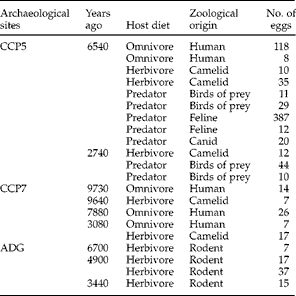
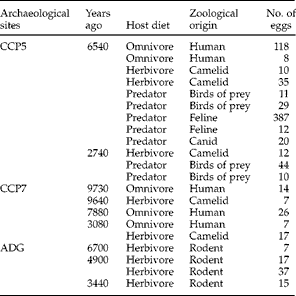
Samples originated from different stratigraphic levels dated from the Pleistocene–Holocene transition to the late Holocene (from 9730 to 2740 radiocarbon years before present (bp)). Coprolites were collected from the archaeological sites Cerro Casa de Piedra, caves 5 and 7 (CCP5 and CCP7), and Alero Destacamento Guardaparque (ADG), located in Perito Moreno National Park, Santa Cruz, Argentina (table 1). A total of 21 coprolite samples (12 collected from CCP5, 5 from CCP7 and 4 from ADG) were examined. For palaeoparasitological analysis, coprolites were rehydrated with 0.5% trisodium phosphate (Callen & Cameron, Reference Callen and Cameron1960) and processed by spontaneous sedimentation (Lutz, Reference Lutz1919).
Coprolite samples from archaeological sites in Alero Destacamento Guardaparque (ADG), Cerro Casa de Piedra, caves 5 and 7 (CCP5 and CCP7), relative to date, host diet, zoological origin and number of eggs per sample.
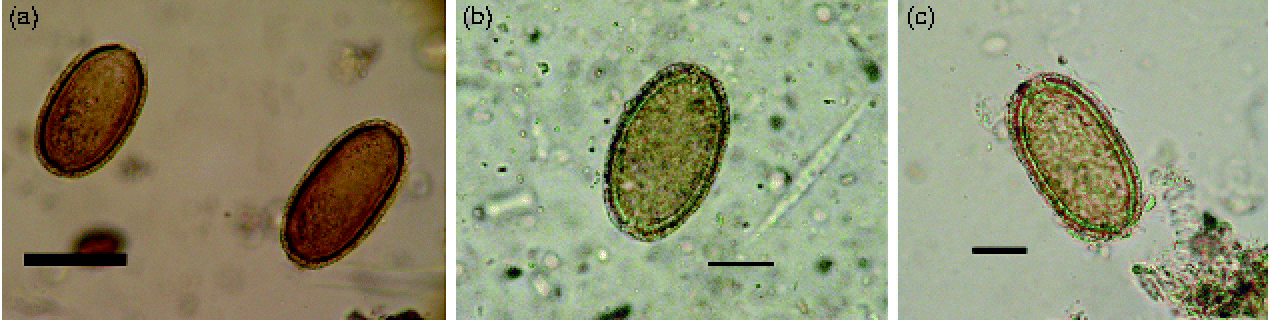
Thick-walled eggs with uncleaved content attributable to capillariids (N= 843) were found in coprolites of humans, rodents, felines, canids and camelids, as well as in pellets of regurgitation of birds of prey (fig. 1). The morphology and sculpture of the eggshell was similar in all eggs examined.
(colour online) Capillariid eggs from (a) feline, (b) rodent and (c) camelid hosts. Scale bars: (a) = 40 μm, (b) and (c) = 20 μm.

Biometric analysis of capillariid eggs
Three different researchers took measurements of the eggs. Therefore, to test the reliability of these measurements, biometric variables (length and width) of 15 eggs of Calodium sp. measured by each of the three observers were analysed using repeated measures multivariate analysis of variance (MANOVA) (Potvin & Schutz, Reference Potvin and Schutz2000).
The number of eggs found per sample was highly variable (table 1). Therefore, to obtain a balanced design for subsequent morphometric analysis, even in samples in which the number of eggs was over 20, we selected only 20 eggs by simple random sampling without replacement. We also tested whether subsamples were representative of the original sample. To this end, we obtained ten random subsamples (20 eggs each) from a single sample, and tested whether there were significant differences in the mean and the standard deviation of the egg biometric variables by permutational MANOVA (PERMANOVA) and permutational analysis of multivariate dispersions (PERMDISP) (Anderson, Reference Anderson2001, Reference Anderson2006) using the R software version 2.13.1 (R Development Core Team, 2011).
Morphometric analyses of eggs were undertaken to determine, first, whether there was any variation in the biometry of eggs through a time scale. Eggs found in rodent coprolites collected from different layers from ADG were selected and biometric variables were subjected to PERMANOVA, considering the radiocarbon age as a factor. Second, any variation in egg biometry, relative to the zoological origin of coprolites, host diet and samples from collecting sites, was analysed using a nested PERMANOVA. This involved (a) selecting samples from CCP5 dated from 6540 years bp, in which factors considered were diet, zoological origin and samples from collecting sites; (b) taking into account all samples belonging to different archaeological sites, in which factors considered were the same as in the previous case; and (c) determining whether there were any differences in the biometry of eggs on a spatial scale where all samples from all sites were considered in the analysis and the factor selected was the archaeological site.
Results
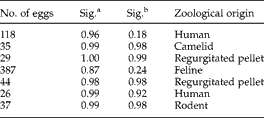
The repeated measures MANOVA applied detected no significant differences between the biometric variables (length, width) measured by the three different observers (Pillai's trace = 0.118, P= 0.542). Random subsamples were representative of the original samples, because neither the dispersion nor the average of ten subsamples considered from each sample showed significant differences (table 2).
Random sampling without replacement of capillariid eggs from archaeological samples in which the number of eggs found was over 20.
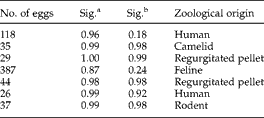
Sig.a: P value of permutational multivariate analysis of variance (PERMANOVA); Sig.b: P value of permutational analysis of multivariate dispersions (PERMDISP).
Descriptive statistics of capillariid egg morphometry according to host diet, zoological origin of samples, collecting site and time period are shown in table 3. The sizes of eggs from a sample of 843 ranged between 55 and 77.5 μm in length (mode = 65 μm) and between 35 and 45 μm in width (mode = 40 μm). Average sizes were 66.1 μm in length and 38.9 μm in width.
Morphometrics (μm) of capillariid eggs, relative to host diet and zoological origin of the samples, in sites ADG (Alero Destacamento Guardaparque), CCP5 (Cerro Casa de Piedra cave 5) and CCP7 (Cerro Casa de Piedra cave 7) and at time period corresponding to the archaeological site ADG.

SD, Standard deviation; H, herbivore; O, omnivore; P, predator; Hu, human; Can, canid; Ro, rodent; Br, birds of prey, Ca, camelid; Fe, feline.
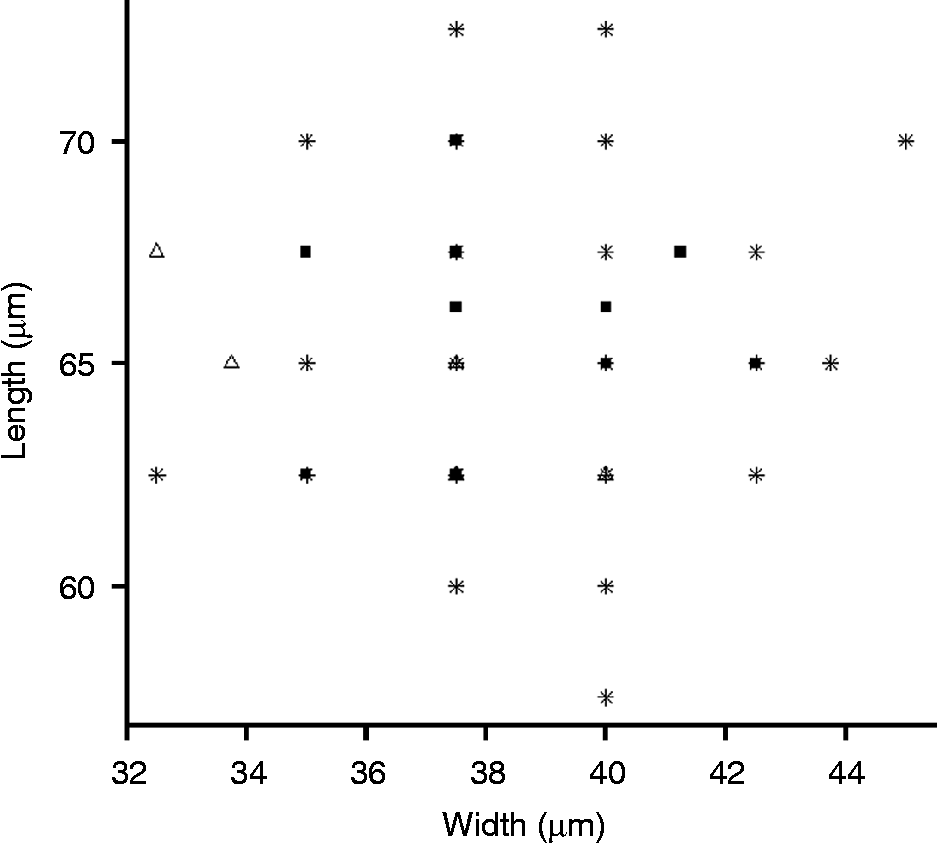
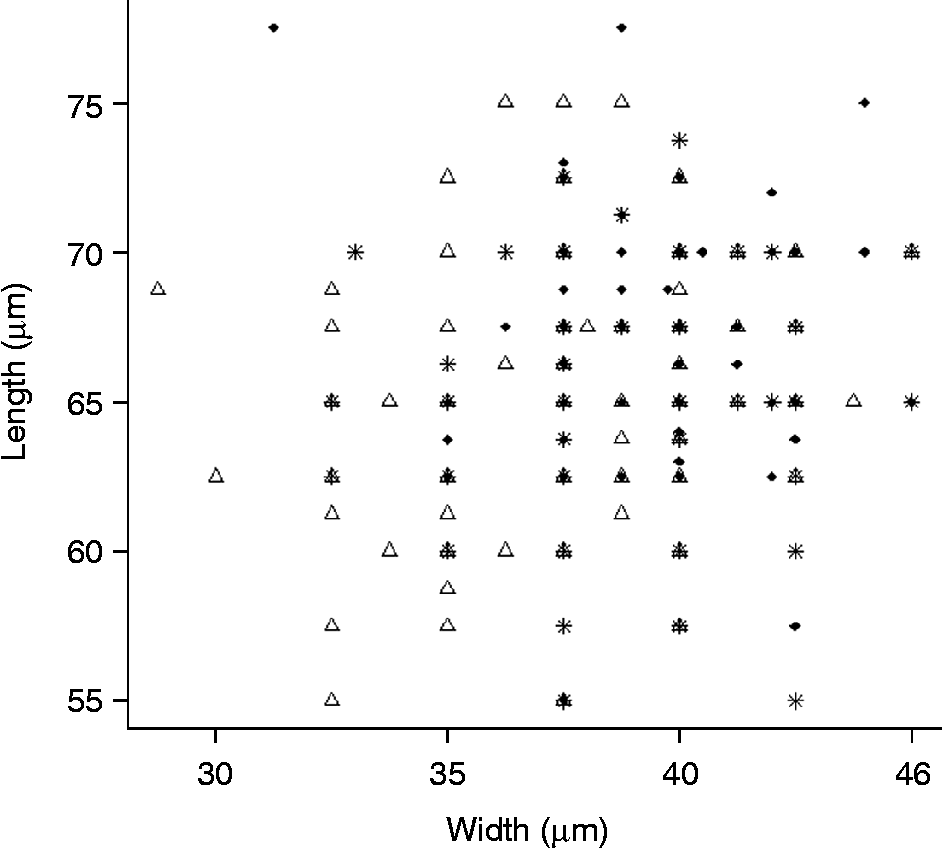
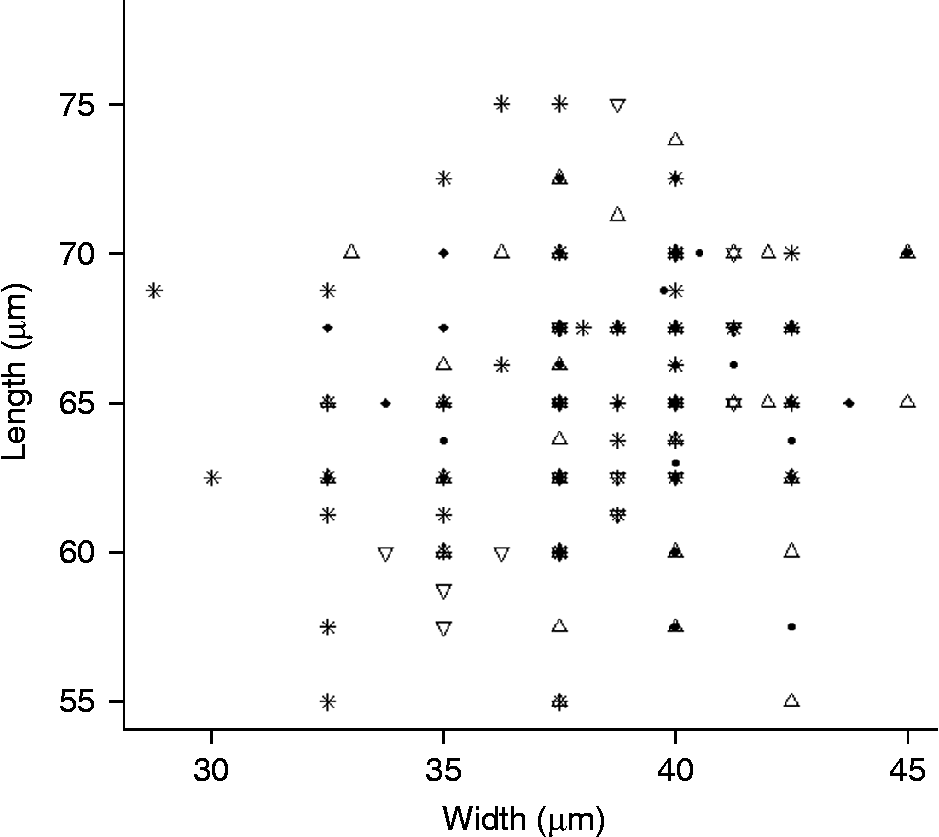
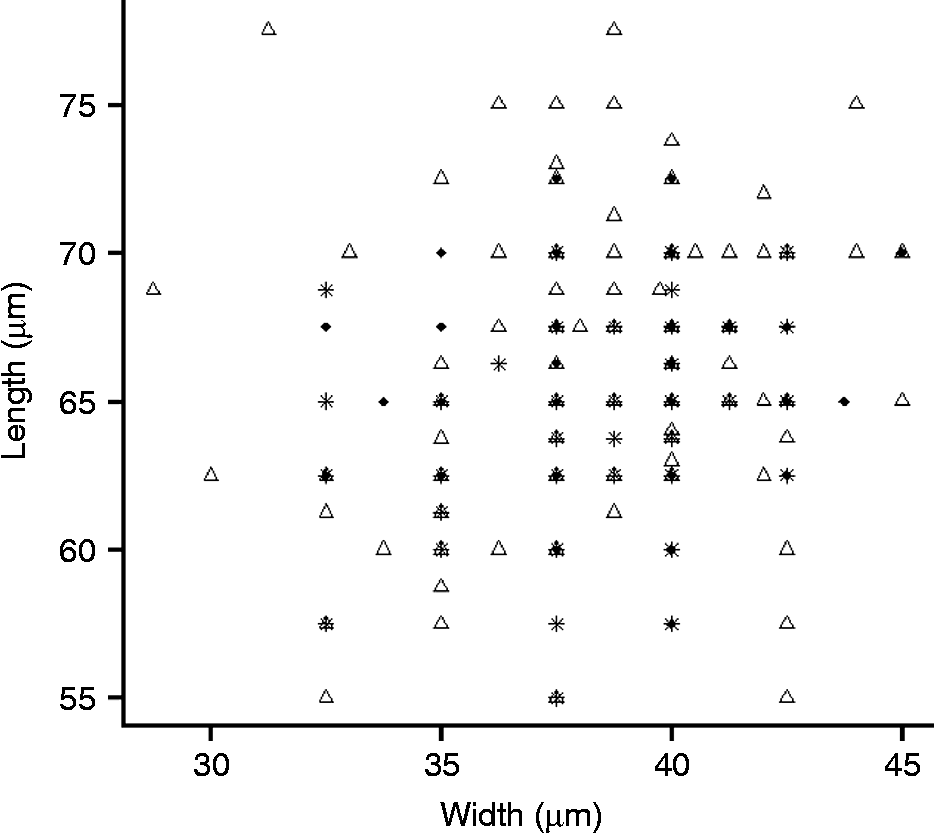
No significant differences (P= 0.66) were found in the biometric characteristics of the capillariid eggs present in rodents from the archaeological site ADG as a function of time (fig. 2). In addition, neither the different diets (P= 0.25) nor the zoological origin of coprolites (P= 0.58) led to significant differences in the biometry of eggs when eggs recovered from samples dated 6540 years bp from CCP5 were analysed statistically. Similarly, when capillariid eggs collected from all samples belonging to the different archaeological sites were analysed as a whole, no significant difference according to the host diet was found (P pooled = 0.19; because of the lack of evidence to refuse the null hypothesis related to the zoological origin of coprolites and because the variance of the zoological origin of samples was negative, this term was removed from the model by pooling it, as suggested by Anderson, Reference Anderson2001) (fig. 3). Nor was a significant difference found for the zoological origin of the samples (P= 0.84) (fig. 4). In addition, no significant differences were found in the biometry of eggs according to the collecting site (P= 0.67) (fig. 5).
Dispersion of biometric variables of capillariid eggs from rodents belonging to ADG as a function of time: *, 4900 years bp; ■, 3400 years bp; △, 6700 years bp.
Dispersion of biometric variables of capillariid eggs relative to host diet: ♦, predator; *, herbivore and △, omnivore.
Dispersion of biometric variables of capillariid eggs relative to the origin of samples: *, human; ●, feline; △, camelid; ○, pellet of bird of prey; ♦, rodent; and ▿, canid.
Dispersion of biometric variables in terms of space (archaeological sites): △, CCP5; *, CCP7; and ●, ADG.
Discussion
The study of the morphology and morphometry of nematode eggs is a useful tool to identify intestinal parasites (Benbrook & Sloss, 1965; Confalonieri et al., Reference Confalonieri, Ribeiro, Ferreira and Araújo1985). The structure and ornamentation of the outer layer of the eggshell of capillariids are very often typical of each species and can be used as a taxonomic key (Moravec & Fajer-Avila, 2000; Moravec, Reference Moravec2001; Carballo & Navone, Reference Carballo and Navone2007).
Eggs used for this kind of study should be fully developed, or at least at the same stage of development, because the morphology of mature eggs differs from that of immature ones (Moravec & Fajer-Avila, 2000; Moravec, Reference Moravec2001), and although there is sometimes interspecific differentiation in egg size, this feature usually varies considerably, and may thus be considered as a complementary specific characteristic (Moravec, Reference Moravec2001).
Additional data to distinguish capillariid species and genera involve geographical distribution, organ preference and range of definitive hosts, since capillariids exhibit a high degree of organ specificity (Moravec & Fajer-Avila, 2000; Moravec, Reference Moravec2001). However, molecular studies carried out by Zhu et al. (Reference Zhu, Spratt, Beveridge, Haycock and Gasser2000) suggest that host and tissue specificity of the examined species of Capillaria sensu lato were highly variable.
Eggs examined had similar shape, size and superficial structure, regardless of zoological origin of coprolites, host diet, spatial and temporal origin, and were attributed to an unidentified species of capillariid.
Because of their shape and general structure, eggs found in the present study resemble those of Paracapillaria malayensis and Capillostrongyloides arapaimae, differing from the former mainly in the polar plug, more irregular sculpture, size and host range (Moravec et al., Reference Moravec, Modrý and Jirků2007), and from the latter in the superficial net-like sculpture, size and host range (Santos et al., Reference Santos, Moravec and Venturieri2008). Additionally, egg shape and ornamentation are similar to those of eggs belonging to the genus Calodium, including C. hepaticum. The size range of eggs found in the present study includes the average size for C. hepaticum eggs reported by Carvalho-Costa et al. (Reference Carvalho-Costa, Silva, Souza, Moreira, Souza, Valverde, Jaeger, Martins, Meneses, Araújo and Bóia2009) from stool examination (60 μm in length by 37.5 μm in width), but the average size for the present study exceeds that previously cited.
It is worth mentioning that most researchers have reported egg sizes from eggs collected from the liver, and although there is discrepancy in the biometry, eggs from various hosts overlap in their size range. Freeman & Wright (Reference Freeman and Wright1960) occasionally found larger atypical eggs up to 69 by 35 μm, with an unusually thick outer shell. However, representatives of the genus Calodium are located in host tissues, not usually in intestines, and are sometimes released into the environment via faeces (Anderson, Reference Anderson2000; Moravec, Reference Moravec2001). Calodium hepaticum eggs can be found in faeces of carnivores that have eaten parasitized prey, indicating parasitism in transit (Freeman & Wright, Reference Freeman and Wright1960; Farhang-Azad, Reference Farhang-Azad1977; Camargo et al., Reference Camargo, Camargo, Sousa Vera, Tarique Crispim Barreto, Tourinho and Souza2010; Li et al., Reference Li, Yang and Wang2010; Fuehrer et al., Reference Fuehrer, Igel and Auer2011). However, because of the life cycle of C. hepaticum, the probability of finding eggs in faeces of herbivores, as in the case of camelids, by accidental ingestion of non-embryonated eggs, is negligible. Experiments carried out by Freeman & Wright (Reference Freeman and Wright1960) revealed that only a small percentage of non-embryonated eggs of C. hepaticum provided orally to rodents were collected from faeces. Thus, although eggs studied here are morphologically attributable to C. hepaticum, their location in the host does not correspond to this species. Whereas capillariids inhabiting the gut release their eggs in the environment along with faeces and exhibit a high degree of specificity in function of the organ where they are located (Moravec, Reference Moravec2001), eggs found in this study could correspond to a capillariid of intestinal or stomach location in the host, not yet identified.
Current capillariids of intestinal and/or stomach location in mammals include the genera Baruscapillaria, Eucoleus, Pterothominx, Aonchoteca and Capillaria (Moravec, Reference Moravec2001). Because of their location in hosts, eggs found here could belong to any of these genera; however, none of these representatives has eggs morphologically similar to the ones found in this study.
Based on the results previously stated, we propose that during the Holocene in Patagonia, there was some parasite of the genus Calodium not yet identified, of intestinal or stomach location. In general, contact-transmitted parasites are expected to be more host-specific than parasites acquired via ingestion (Poulin et al., Reference Poulin, Krasnov, Moran, Morand, Krasnov and Poulin2006). Although this parasite was found in a wide range of hosts, this is not necessarily indicative that the parasite had infected all of them. In the cases of predators or omnivores, such as felines, birds of prey or humans, the presence of these capillariid eggs in coprolites or regurgitated pellets could be the result of parasitism in transit by the ingestion of infected prey. Moravec (Reference Moravec2001) suggested that paratenic hosts can occur in the life cycle of capillarids. Nevertheless, there is no doubt that humans and animals were an important component of the epidemiological scenario for this unidentified capillariid, since soils of caves were contaminated with these eggs by direct release of eggs by definitive hosts, decomposition of infected hosts, or release of eggs through the faeces of hosts in transit. Both human and animal populations were exposed to this parasite during the Holocene in the study area. This may indicate its possible zoonotic role.
Caves, attracting successive use by diverse organisms, functioned as centres of dispersion for this parasite (Fugassa & Barberena, Reference Fugassa and Barberena2006; Fugassa et al., Reference Fugassa, Beltrame, Bayer and Sardella2009). Although archaeological sites of Patagonia might not have been occupied simultaneously by animals and humans, eggs of capillariids such as C. hepaticum are very resistant and can remain viable in the environment at room temperature for up to 25 months (Luttermoser, Reference Luttermoser1938; Galvão, Reference Galvão1981).
Because of the large number of species belonging to the family Capillariidae, the taxonomic confusion and the numerous reports of species not yet identified or incorrectly cited, this study highlights the importance of biometric analysis as a potential tool to identify eggs of these nematodes collected from both archaeological and current samples.
Acknowledgements
The present study was funded by grants from Consejo Nacional de Investigaciones Científicas y Técnicas (PIP 090/11), Universidad Nacional de Mar del Plata (EXA438/10) and Fondo para la Investigación Científica y Tecnológica (PICT 1576/07), Argentina.