During the past decade, several natural disasters have occurred in China, including the Wenchuan earthquake in 2008 (8.0 on the Richter scale), the Yushu earthquake in 2010 (7.1 on the Richter scale), the Ya’an earthquake in 2012 (6.5 on the Richter scale), and the Ludian earthquake in 2014 (6.5 on the Richter scale). In response, the Chinese government has increased its concern for public health in postdisaster areas and has provided sufficient funding to improve the medical services of local hospitals. Additionally, the government has attempted to promote public health in the earthquake-stricken areas.Reference Li and Yu 1 , Reference Zhao, Dai and Wang 2 Since 2007, the Chinese government has launched the Health Promoting Lifestyle to increase public health awareness and to encourage healthy lifestyles,Reference Dong and Zhu 3 and in 2013 proposed to implement the Health Promoting Lifestyle in all provinces, especially in disaster areas.Reference Zhang 4 It is an important task to strengthen health education and to promote healthy lifestyles among victims after disasters.Reference Zhao, Liu and Yang 5 , Reference Li and Yu 6 Health promotion is a concept defined as a “multidimensional pattern of self-initiated actions and perceptions that serve to maintain or enhance the level of wellness and self-actualization” (Ottawa Charter).Reference Walker, Sechrist and Pender 7 This concept helps to reduce the occurrence of disease and lower the death rate, thus contributing to improved health status.Reference Ay, Yanikkerem and Çalim 8 , Reference Lee, Cheng and Fung 9 Several studies in China have shown that the poor health of medical providers is not only harmful to themselves but may also affect the quality of medical care and service in hospitals and patient rehabilitation facilities. Moreover, the poor health of medical providers also undermines the implementation of national health policies and health care reforms.Reference Li, Wang and Sun 10 - Reference Dong and Zhu 12 Thus, health care workers play an important role in the Health Promoting Lifestyle among the public; they not only intervene in health promotion but are also its target.Reference Zhang, Hong and Han 13
Nevertheless, whether health care workers tend to adopt healthy lifestyles and have a positive attitude towards health promotion in postdisaster areas remains unclear. Existing research illustrates that health care workers performing rescue tasks in large-scale disasters undergo substantial pressure, assume heavy workloads, and work long hours. Disaster conditions also challenge their physical and mental endurance.Reference Norris, Friedman and Watson 14 Health care workers may have increased risks of posttraumatic distress due to their work. For example, Shrestha reported that health workers working in the Nepal earthquake of 2015 were at a significantly higher risk of developing posttraumatic stress disorder (PTSD). The overall prevalence rates of PTSD were 21.9% and 17.1% using cutoff scores and diagnostic criteria, respectively.Reference Shrestha 15 A study by Oglodek showed that 40% of medical rescuers experiencing PTSD reported that the dissociation was caused by the death of a patient being rescued.Reference Oglodek and Araszkiewicz 16 Additionally, Yu et al. reported that during the Wenchuan earthquake in 2008, more than 50% of medical staff demonstrated several of the following signs of stress: grief, fear, depression, anxiety, fatigue, headache, and dizziness.Reference Cui, Yang and Wang 17 Therefore, the health quality of health care workers after disasters is a significant issue.Reference Norris, Friedman and Watson 14 , Reference Benedek, Fullerton and Ursano 18
To our knowledge, data regarding how medical staffs promote healthy lifestyles after a disaster are very scarce. Existing research does not include any systematic study on healthy lifestyle promotion on China’s mainland,Reference Yuan 19 and the research on health care workers mainly focuses on general hospitals.Reference Peng, Li and Liu 20 We hypothesized that additional data could provide reliable empirical evidence for health promotion among health care workers and the public in postdisaster areas. The primary goal of this study was to determine whether health care workers followed healthier lifestyles than individuals with other occupations living in the same area after a disaster. The secondary goal was to identify occupation-related risk factors that could affect healthy lifestyles in a postdisaster area.
METHODS
Study Design and Setting
This study was conducted in August 2016 and explored the differences in health-promoting lifestyles between health care workers and non–health care workers in the postdisaster area of Zhaotong, a medium-sized city located in southwestern China that has experienced several natural disasters in the past 5 years. For example, the region was hit by the Yilang earthquake (5.7 on the Richter scale) in 2012 and the Ludian earthquake (6.5 on the Richter scale) in 2014 and had a major flood in 2016. The best local hospital is the First People’s Hospital of Zhaotong City, which is responsible for rescue and inpatient treatment.
The study was approved by the Ethics Committee of Sichuan University in Chengdu, China (2016), and was performed in accordance with the Declaration of Helsinki, a set of ethical norms regarding human experimentation developed for the medical community by the World Medical Association.
The study adopted a cross-sectional research method with convenience sampling. The sample was chosen to represent a variety of occupations in Zhaotong City. The demographic data, including age, gender, ethnic group, education, chronic disease, marital status, and income, were collected by self-report; the data on the Health-Promoting Lifestyle Profile (HPLP) II questionnaire were collected through face-to-face interviews conducted by trained college students from Sichuan University, who received training in group discussions and standardized data collection procedures. The interviewer described the study’s aim and importance, and all participants provided informed consent prior to completing the questionnaire. During the interview and data collection process, there was strict confidentiality.
Participants
This study was performed using the HPLP-II on 1230 participants engaged in different occupations, including those from 2 factories, 2 government offices, 3 communities, and 1 hospital. A total of 1230 questionnaires were returned, and those questionnaires with missing information (121, 9.8%) were excluded. Thus, this study recruited 1109 eligible participants, including health care workers (261, 23.5%), public employees (546, 49.2%), office workers (112, 11%), students (134, 12.1%), and farmers (56, 5.1%). The selected participants were 17 to 70 years old and met the following inclusion criteria: (1) they lived in the same area (Zhaotong City) for more than 1 year, (2) they had experienced at least 1 local disaster, and (3) they were not pregnant or lactating (for female participants).
Measures
The HPLP questionnaire is widely used at present.Reference Walker, Sechrist and Pender 21 The HPLP-II is an upgraded version of the HPLP that has been applied extensively to health promotion research and has been demonstrated to have sufficient validity and reliability in exploring the determinants and actual state of a health-promoting lifestyle.Reference Ay, Yanikkerem and Çalim 8 , Reference Hidalgo, Mielke and Parra 22 In China, Lee et al. reported a Cronbach’s alpha of 0.91 for the Chinese version of the HPLP-II.Reference Lee, Cheng and Fung 23 The HPLP-II includes 52 items scored on a Likert-type scale, and the responses range from 1 (never) to 4 (routinely). The scale consists of 6 subscales, including nutrition, interpersonal relations, and stress management, among others. A self-reported questionnaire was used to measure the frequency of health-promoting behaviors.
Statistical Analysis
All participant data were anonymous, in accordance with the Declaration of Helsinki. The data were analyzed using the Social Sciences (SPSS) for Windows (version 16.0) (IBM, Chicago, IL). Results of descriptive analyses are presented as central tendencies for continuous variables and frequencies for categorical variables.
The Mann-Whitney U test and the chi-square test were used to compare differences in the characteristics of the 2 groups (health care workers and non–health care workers). A multivariable linear regression analysis was conducted to identify the predictors of the 6 components of the HPLP-II (dependent variables). Additionally, multivariate logistic regression models were used to examine whether the health care occupation increased the odds of engagement in the HPLP-II. The respondents were grouped according to those who reported a healthy lifestyle often or routinely, with scores >2.5, and those who reported responses of never or sometimes, with scores ≤2.5. All 6 models included the following as independent variables: occupation type (health care workers or non–health care workers), age, gender, education, nationality, chronic disease, marital status, and income. In all tests, the coefficient values, odds ratios (OR), and 95% confidence intervals (CI) were used to quantify correlation strength. The statistical significance was set at P<.05.
RESULTS
Comparison of Demographic Characteristics Between the 2 Groups
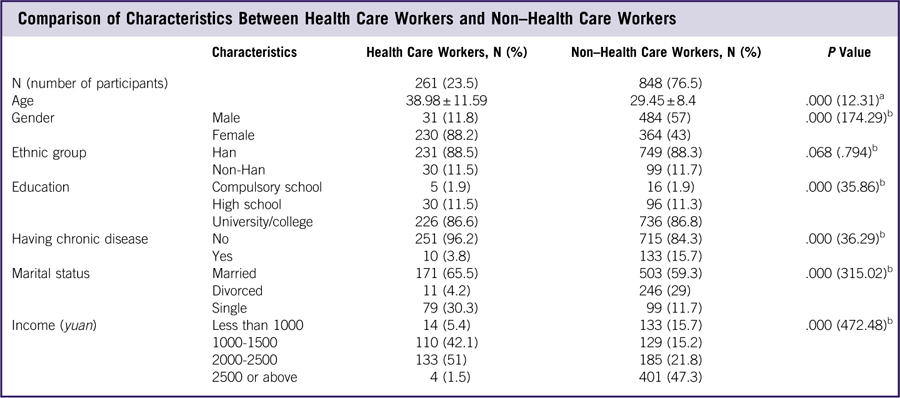
The differences in the demographic characteristics between health care workers (261) and non–health care workers (848) are summarized in Table 1. The 2 groups did not differ significantly in ethnic composition but differed significantly in age, gender, education, family status, chronic disease, and income. The average age of health care workers was higher than that of non–health care workers (38.98±11.59 years versus 29.45±8.4 years, P=.001). There were more women among health care workers (88.2%) than among non–health care workers (43%). Higher education levels were found among health care workers than among non–health care workers (87.4% versus 86.8%, P=.001). The rate of those who do not suffer from chronic diseases in health care workers was lower than that of other workers (3.9% versus 15.7%, P=.001). The data also indicated that more health care workers than non–health care workers were married (64.3% versus 43.6%, P=.001). The proportion of health care workers earning more than 2500 yuan per month was lower than that of their non–health care counterparts (1.6% versus 47.3%, P=.001).
Comparison of Characteristics Between Health Care Workers and Non–Health Care Workers

a Mann-Whitney U test
b Chi-square test
Effects of Occupation on Health-Promoting Lifestyles
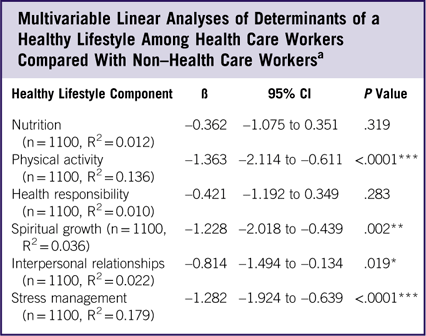
The results of the multivariate linear analyses are summarized in Table 2. Health care workers reported less physical activity (ß=−1.363, P<.0001), less spiritual growth (ß=−1.228, P=.002), worse interpersonal relationships (ß=−0.814, P =.019), and worse stress management (ß=−1.282, P<.0001) than did workers with other occupations. However, no statistically significant differences were found between groups with regard to nutrition (ß=−0.362, P=.319) or health responsibility (ß=−0.421, P=.283).
Multivariable Linear Analyses of Determinants of a Healthy Lifestyle Among Health Care Workers Compared With Non–Health Care WorkersFootnote a

a Independent variables included in the model: age, gender, education, ethnic group, marital status, income, and occupation. * (P<.05), ** (P<.01), and *** (P<.001) indicate significant correlations between health-promoting lifestyle profiles and the health care occupation.
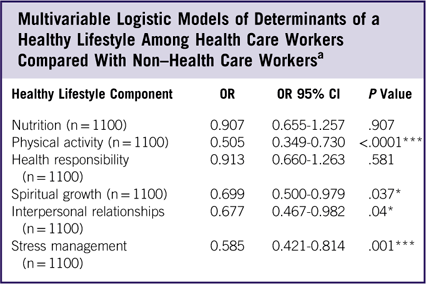
Similar results were found in the multivariable logistic models (Table 3). The health care occupation decreased the odds of engaging in physical activity (OR, 0.505; 95% CI, 0.349-0.730), experiencing spiritual growth (OR, 0.699; 95% CI, 0.500-0.979), and having good interpersonal relationships (OR, 0.677; 95% CI, 0.467-0.982) and appropriate stress management (OR, 0.585; 95% CI, 0.421-0.814). However, the occupation of health care did not affect the odds of good nutrition (OR, 0.907; 95% CI, 0.655-1.257) or health responsibility (OR, 0.913; 95% CI, 0.660-1.263).
Multivariable Logistic Models of Determinants of a Healthy Lifestyle Among Health Care Workers Compared With Non–Health Care WorkersFootnote a

a Respondents who reported that they adopted a healthy lifestyle often or routinely versus never or sometimes. Independent variables in the model included the following: age, gender, education, nationality, chronic disease, marital status, income, and occupation. * (P<.05), ** (P<.01), and *** (P<.001) indicate significant correlations between health-promoting lifestyle profiles and the health care occupation.
DISCUSSION
This is a comprehensive survey of healthy lifestyles in a postdisaster area in China. We found that health care workers had worse stress management, lower physical activity levels, worse spiritual growth, and worse interpersonal relationships than did individuals in other occupations.
Stress Management and Physical Activity
The effect of occupation on stress management and physical activity of health care workers was extremely prominent in our study. We found that health care workers participated in lower levels of physical activity than non–health care workers, which is similar to the findings of studies on health care workers in hospitals.Reference Zhang, Wei and Fukumoto 24 , Reference Gupta and Fan 25 Physicians and nurses reported a lack of time for exercise due to heavy workloads and rotating shifts.Reference Gupta and Fan 25 However, other studies of physical activity patterns have reported more frequent exercise among medical staff than among workers in other occupations.Reference Pojednic, Polak and Arnstein 26 , Reference Profis and Simontuval 27 In our study, the participants in the postdisaster area had heavy workloads, including both routine work and postdisaster recovery. This may be partly because the Chinese government provided policy support and funds to reconstruct local hospital and medical facilities,Reference Li and Yu 1 equipping the hospitals with the latest technology that expanded the scope of medical services and increased the number of patients. On one hand, such measures certainly facilitated postdisaster recovery. On the other, however, those inevitably increased the workload and work time for medical staff. A study by Yu et al. found that 73.7% of nurses had no legal holidays after a disaster, and 84.4% of nurses thought that their current workload exceeded that before the disaster.Reference Yu, He and Liu 28 Thus, it may be reasonable to assume that these health care workers were too busy with training to have time for physical activity. Nonetheless, our assumption that health care workers are engaged in less physical activity due to a lack of time following a disaster is yet to be confirmed. Future in-depth studies may be warranted to explore this issue. Moreover, future health interventions in postdisaster areas may be needed to enhance the physical activity of health care workers to improve their health.
Our finding showed that health care workers exhibited worse stress management than did individuals in other occupations, which is inconsistent with results of other studies. For example, Maya et al. found no differences between medical staff members and individuals in other occupations in stress management abilities.Reference Profis and Simontuval 27 Nevertheless, such results are consistent with our expectations. Several factors may have contributed to the poorer stress management of health care workers. Previous studiesReference Yu, He and Liu 28 , Reference Ansoleaga 29 have reported that medical staff have poor stress management because they lack either the time and tools to manage stress or social and occupational support networks. In addition, studies in China have also demonstrated that health care workers experience increased pressure after disasters.Reference Zhao, Dai and Wang 2 , Reference Dong and Zhu 3 , Reference Yu, He and Liu 28 As a matter of fact, both the government and the public are focused on the wounded after disasters; hospitals may be extremely strained and overburdened and have to devote a considerable amount of time and effort to provide psychological rehabilitation and other services in addition to routine medical care for the wounded. Meanwhile, these hospitals have to receive journalists and well-intentioned visitors providing material donations, which may well disrupt the routine of medical care. Furthermore, medical staff members have to be cautious during these visits to avoid criticism and social discontent. Another type of pressure is personal pressure. Health care workers experience emotional and physical issues after disasters, including powerlessness, a sense of uncertainty, fatigue, insomnia, and pain.Reference Norris, Friedman and Watson 14 , Reference Yu, He and Liu 28 Additionally, medical staff members experience stress associated with learning a new technology and accepting professional training.Reference Zhao, Dai and Wang 2 , Reference Yueh-Chi and Liu 30 It appears that health care workers usually encounter these stresses and challenges during the postdisaster reconstruction stage. As a result, further studies may explore whether the increase in pressure leads to poor stress management skills among health care workers in postdisaster areas.
Interpersonal Relationships and Spiritual Growth
We found that health care workers had worse interpersonal relationships and spiritual growth than workers with other occupations. Several factors may have contributed to these results. First, health care workers may not have the time or energy to build relationships because they have to deal with issues such as employee diversity, status differences, and heavy workloads.Reference Wright 31 Second, burnout is common among medical staff, with prevalence rates ranging from 30% to 78%. Burnout can result in emotional exhaustion and depersonalized feelings towards patients and coworkers.Reference Doolittle, Windish and Seelig 32 , Reference Calandra and Pulvirenti 33 Previous studies have shown that increasing the spirituality of the medical staff is correlated with less burnout.Reference Doolittle, Windish and Seelig 32 Medical rescuers suffer from physical and spiritual exhaustion and tend to have poor spiritual growth after a disaster.Reference Calandra and Pulvirenti 33 Moreover, many studies have concluded that spirituality is essential to the interaction of the organization with its employees, customers, and communities.Reference Graber and Johnson 34 In the past decade, strained physician-patient relationships have been a major concern in China.Reference Feng 35 Patients have a higher level of legal awareness of their rights and will complain if they are unsatisfied with medical services after a disaster.Reference Yueh-Chi and Liu 30 Overall, qualitative and quantitative research in the future may be required in order to profile, in a more accurate manner, health care workers’ interpersonal relationships and spiritual growth following a disaster and to identify causes for their behaviors and perceptions.
Nutrition and Health Responsibility
Our study showed no differences between health care workers and non–health care workers in terms of nutrition or health responsibility. Previous studies have shown that health care workers exhibit greater health responsibility and healthier lifestyles to ensure that they are considered to be professional by their patients.Reference Profis and Simontuval 27 , Reference Noblet and Rodwell 36 However, other studies have found that physicians do not maintain a healthy diet because they believe that they can protect themselves from disease by using their professional knowledge.Reference Noblet and Rodwell 36 Different research contexts may have led to these conflicting conclusions. In our study, the low predictive power of the multivariable models containing 2 components suggests that other independent variables not assessed in this study may have also influenced these components; thus, these variables should be identified in future studies.
Study Limitations and Strengths
The study has some limitations. Our results should be generalized with caution to other countries with different cultural backgrounds because this was a cross-sectional study. Additionally, our sample may not be representative enough in that the health care workers were not subdivided as doctors, nurses, and administrative workers due to the limited sample size.
Despite these limitations, our study is the first of its kind in China to compare the healthy lifestyle profiles of health care workers to those of workers in other occupations in a postdisaster area. Our findings will contribute to the design of evidence-based interventions on health-promoting lifestyles of health care workers in postdisaster areas.
CONCLUSIONS
After a disaster, health care workers do not have healthier lifestyles than individuals in other occupations. Moreover, employment in health care decreased the odds of having appropriate levels of physical activity, stress management, interpersonal relationships, and spiritual growth. These findings provide baseline data that may be useful for designing health-promoting behavior programs. Future research among health care workers and workers in other occupations should explore the reasons for such differences and the obstacles that affect healthy lifestyles. In addition, if we expect to advocate health-promoting lifestyles among the public, it may be a promising strategy to first improve the lifestyles of health care workers.
Acknowledgements
We thank Nursing Supervisor Guichuang Liu of Zhaotong Hospital and her assistants for all their help. We thank all of the participants and administrators of the selected units for their help in data collection. We also thank Professor Dongtao Lin of Sichuan University for copy editing the manuscript.