Introduction
Density functional theory (DFT) implementationsReference Kohn and Sham1–Reference Blum, Gehrke, Hanke, Havu, Havu, Ren, Reuter and Scheffler7 offer a reasonable compromise between cost and accuracy in ab initio materials science calculations,Reference Haas, Tran and Blaha8 stimulating rapid development of automated frameworks and corresponding data repositories. Prominent examples include the Automatic Flow Framework for Materials Discovery (AFLOW),Reference Curtarolo, Setyawan, Hart, Jahnátek, Chepulskii, Taylor, Wang, Xue, Yang, Levy, Mehl, Stokes, Demchenko and Morgan9–Reference Supka, Lyons, Liyanage, D’Amico, Al Rahal Al Orabi, Mahatara, Gopal, Toher, Ceresoli, Calzolari, Curtarolo, Buongiorno Nardelli and Fornari12 Novel Materials Discovery Laboratory (NOMAD),Reference Scheffler and Draxl13 Materials Project,Reference Jain, Ong, Hautier, Chen, Richards, Dacek, Cholia, Gunter, Skinner, Ceder and Persson14 Open Quantum Materials Database (OQMD),Reference Saal, Kirklin, Aykol, Meredig and Wolverton15 Computational Materials Repository and its associated scripting interface Atomic Simulation Environment (ASE),Reference Landis, Hummelshøj, Nestorov, Greeley, Dułak, Bligaard, Nørskov and Jacobsen16 and Automated Interactive Infrastructure and Database for Computational Science (AiiDA).Reference Pizzi, Cepellotti, Sabatini, Marzari and Kozinsky17 Such repositories house an abundance of materials data. For instance, the AFLOW.org database contains more than 1.8 million compounds, each characterized by about 100 different properties.Reference Calderon, Plata, Toher, Oses, Levy, Fornari, Natan, Mehl, Hart, Buongiorno Nardelli and Curtarolo11,Reference Curtarolo, Setyawan, Wang, Xue, Yang, Taylor, Nelson, Hart, Sanvito, Buongiorno Nardelli, Mingo and Levy18–Reference Rose, Toher, Gossett, Oses, Buongiorno Nardelli, Fornari and Curtarolo20 Investigations employing this data have not only led to advancements in modeling electronics,Reference Yang, Setyawan, Wang, Buongiorno Nardelli and Curtarolo21–Reference Ceder, Chiang, Sadoway, Aydinol, Jang and Huang24 thermoelectrics,Reference van Roekeghem, Carrete, Oses, Curtarolo and Mingo25,Reference Legrain, Carrete, van Roekeghem, Curtarolo and Mingo26 superalloys,Reference Nyshadham, Oses, Hansen, Takeuchi, Curtarolo and Hart27 and metallic glasses,Reference Perim, Lee, Liu, Toher, Gong, Li, Simmons, Levy, Vlassak, Schroers and Curtarolo28 but also the synthesis of new materials: for example, two new magnets, Co2MnTi and Mn2PtPd, which are the first discovered by computational approaches.Reference Sanvito, Oses, Xue, Tiwari, Zic, Archer, Tozman, Venkatesan, Coey and Curtarolo29
Further advancements and discoveries are contingent on continued development and expansion of these materials repositories. New entries are generated both by (1) calculating the properties of previously observed compounds from sources such as the Inorganic Crystal Structure Database,Reference Bergerhoff, Hundt, Sievers and Brown30 and (2) decorating structural prototypesReference Mehl, Hicks, Toher, Levy, Hanson, Hart and Curtarolo31—populating crystal sites of existing structures with atoms of different elements—to predict new materials. Accurate computation of materials properties—including electronic, magnetic, chemical, crystallographic, thermomechanical, and thermodynamic features—demands a combination of reliable calculation parameters/thresholdsReference Calderon, Plata, Toher, Oses, Levy, Fornari, Natan, Mehl, Hart, Buongiorno Nardelli and Curtarolo11 and robust algorithms that scale with the size/diversity of the database. For example, convenient definitions for the primitive cell representationReference Curtarolo, Setyawan, Hart, Jahnátek, Chepulskii, Taylor, Wang, Xue, Yang, Levy, Mehl, Stokes, Demchenko and Morgan9 and high-symmetry Brillouin zone pathReference Setyawan and Curtarolo10 have optimized and standardized electronic structure calculations. Careful treatment of spatial tolerance and proper validation schemes have finally enabled accurate and fully autonomous determination of the complete symmetry profile of crystals,Reference Hicks, Oses, Gossett, Gomez, Taylor, Toher, Mehl, Levy and Curtarolo32 which is essential for elasticityReference Toher, Oses, Plata, Hicks, Rose, Levy, de Jong, Asta, Fornari, Buongiorno Nardelli and Curtarolo33 and phononReference Curtarolo, Setyawan, Hart, Jahnátek, Chepulskii, Taylor, Wang, Xue, Yang, Levy, Mehl, Stokes, Demchenko and Morgan9,Reference Nath, Plata, Usanmaz, Al Rahal Al Orabi, Fornari, Buongiorno Nardelli, Toher and Curtarolo34–Reference Plata, Nath, Usanmaz, Carrete, Toher, de Jong, Asta, Fornari, Buongiorno Nardelli and Curtarolo36 calculations.
Beyond descriptions of simple crystals, exploration of complex propertiesReference Toher, Oses, Plata, Hicks, Rose, Levy, de Jong, Asta, Fornari, Buongiorno Nardelli and Curtarolo33,Reference Toher, Plata, Levy, de Jong, Asta, Buongiorno Nardelli and Curtarolo37 and materialsReference Perim, Lee, Liu, Toher, Gong, Li, Simmons, Levy, Vlassak, Schroers and Curtarolo28,Reference Yang, Oses and Curtarolo38 typically warrants advanced (and expensive) characterization techniques.Reference Hedin39–Reference Jiang, Gomez-Abal, Rinke and Scheffler41 Fortunately, state-of-the-art workflowsReference Toher, Oses, Plata, Hicks, Rose, Levy, de Jong, Asta, Fornari, Buongiorno Nardelli and Curtarolo33,Reference Toher, Plata, Levy, de Jong, Asta, Buongiorno Nardelli and Curtarolo37,Reference Yang, Oses and Curtarolo38 and careful descriptor developmentReference Perim, Lee, Liu, Toher, Gong, Li, Simmons, Levy, Vlassak, Schroers and Curtarolo28 have enabled experimentally validated modeling within a DFT framework. The combination of plentiful and diverse materials dataReference Calderon, Plata, Toher, Oses, Levy, Fornari, Natan, Mehl, Hart, Buongiorno Nardelli and Curtarolo11,Reference Curtarolo, Setyawan, Wang, Xue, Yang, Taylor, Nelson, Hart, Sanvito, Buongiorno Nardelli, Mingo and Levy18–Reference Rose, Toher, Gossett, Oses, Buongiorno Nardelli, Fornari and Curtarolo20 and its programmatic accessibilityReference Taylor, Rose, Toher, Levy, Yang, Buongiorno Nardelli and Curtarolo19,Reference Rose, Toher, Gossett, Oses, Buongiorno Nardelli, Fornari and Curtarolo20 justify the application of data-mining techniques. These methods can quantitatively resolve subtle trends and correlations among materials and their properties,Reference Isayev, Fourches, Muratov, Oses, Rasch, Tropsha and Curtarolo22,Reference Isayev, Oses, Toher, Gossett, Curtarolo and Tropsha23,Reference van Roekeghem, Carrete, Oses, Curtarolo and Mingo25,Reference Legrain, Carrete, van Roekeghem, Curtarolo and Mingo26,Reference Ghiringhelli, Vybiral, Levchenko, Draxl and Scheffler42,Reference Ouyang, Curtarolo, Ahmetcik, Scheffler and Ghiringhelli43 as well as motivate the formulation of novel property descriptors.Reference Perim, Lee, Liu, Toher, Gong, Li, Simmons, Levy, Vlassak, Schroers and Curtarolo28,Reference Lederer, Toher, Vecchio and Curtarolo44 These “black-box” models, for which the learned, internal logic is largely obfuscated, are surprisingly accurate and quite valuable, particularly when few practical alternative modeling schemes exist—as is the case for predicting superconducting critical temperatures.Reference Isayev, Fourches, Muratov, Oses, Rasch, Tropsha and Curtarolo22,Reference Stanev, Oses, Kusne, Rodriguez, Paglione, Curtarolo and Takeuchi45
Ultimately, the power in machine learning (ML) lies in the speed of its predictions, which outpaces DFT calculations by orders of magnitude.Reference Smith, Isayev and Roitberg46 Given that the number of currently characterized materials pales in comparison to the full space of hypothetical structures, methods to filter/screen the most interesting candidate materialsReference Walsh47—powered by ML models—will undoubtedly become integral to future materials discovery workflows.
Thermodynamic formability modeling
Prediction of phase diagrams
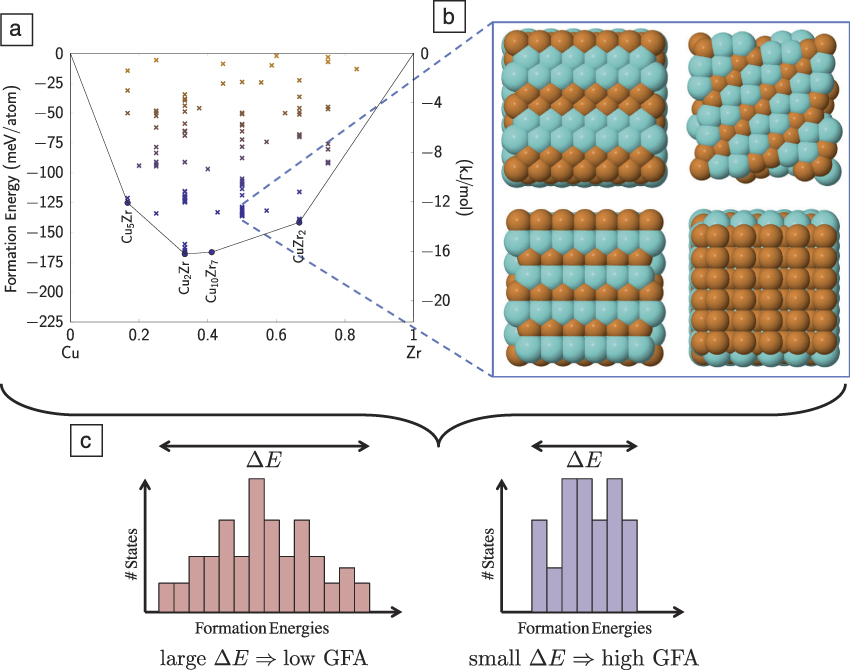
Descriptions of thermodynamic stability and structural/chemical disorder are resolved through statistical analyses of aggregate sets of structures. Thermodynamic stability largely governs synthesizability, which can be determined by an analysis of how structures of similar compositions compete energetically (i.e., determination of the minimum Gibbs free energy surface). The procedure is algorithmically equivalent to finding the lower-half convex hull of all the relative free-energy minima,Reference Curtarolo, Morgan and Ceder48 as illustrated by the series of connected tie lines in Figure 1a. Composition and energy information from relevant AFLOW.org calculations are plotted, and the phases defining the minimum energy surface are identified.Reference Barber, Dobkin and Huhdanpaa49 Assuming sufficient sampling, the ground-state structures on the minimum energy surface form the low-temperature phase diagram.Reference Hart, Curtarolo, Massalski and Levy50
Descriptor for glass-forming ability (GFA). The GFA of metal-alloy systems can be predicted from the spread of formation energies of relevant ordered structures. Different structural phases with similar energies compete against each other during solidification, frustrating crystallization and promoting glass formation. A broad distribution of energies implies a low GFA, while a narrow distribution indicates a high GFA. (a) Energy-composition plot of CuZr. The series of connected tie lines define the minimum energy surface (convex hull).Reference Oses, Gossett, Hicks, Rose, Mehl, Perim, Takeuchi, Sanvito, Scheffler, Lederer, Levy, Toher and Curtarolo51 (b) An illustration of distinct structural phases (with composition Cu0.5Zr0.5) that are very close in energy, causing frustration during solidification. (c) Illustrations of two examples of energy distributions characterizing low and high GFA, respectively.Reference Perim, Lee, Liu, Toher, Gong, Li, Simmons, Levy, Vlassak, Schroers and Curtarolo28

The convex hull construction offers a wealth of related thermodynamic properties. For near-hull structures (entries close to the tie lines), the energetic distance from the minimum energy surface is treated as a metric for synthesizability, as only small perturbations in temperature or pressure may be needed for it to be realized. In fact, this distance is equivalent to the amount of energy driving the decomposition of an unstable state to a linear combination of nearby ground-state structures. A similar distance—that of a stable phase from the pseudo-hull formed by neglecting that phase—quantifies the impact of a structure on the minimum energy surface and characterizes the robustness of stable structures (i.e., the stability criterion).Reference Sanvito, Oses, Xue, Tiwari, Zic, Archer, Tozman, Venkatesan, Coey and Curtarolo29,Reference Oses, Gossett, Hicks, Rose, Mehl, Perim, Takeuchi, Sanvito, Scheffler, Lederer, Levy, Toher and Curtarolo51
AFLOW offers a module for autonomous calculation of the convex hull, which retrieves the set of relevant structure calculations from the repositoryReference Taylor, Rose, Toher, Levy, Yang, Buongiorno Nardelli and Curtarolo19,Reference Rose, Toher, Gossett, Oses, Buongiorno Nardelli, Fornari and Curtarolo20 and delivers a thorough thermodynamic characterization for each.Reference Oses, Gossett, Hicks, Rose, Mehl, Perim, Takeuchi, Sanvito, Scheffler, Lederer, Levy, Toher and Curtarolo51 Filtering schemes based on these thermodynamic properties, including the stability criterion and tie-line construction, played key roles in the discovery of new magnetsReference Sanvito, Oses, Xue, Tiwari, Zic, Archer, Tozman, Venkatesan, Coey and Curtarolo29 and in modeling superalloys.Reference Nyshadham, Oses, Hansen, Takeuchi, Curtarolo and Hart27 The module powers an online web application for enhanced visualization of two-/three-dimensional hulls (available at www.aflow.org/aflow-chull).
Modeling disordered materials
Incorporating the effects of disorder is a necessary, albeit difficult, step in materials modeling. Not only is disorder intrinsic to all materials, but it also offers a route to enhanced and even otherwise inaccessible functionality. Disordered materials range from chemically disordered high-entropy materials and solid solutions, in which sites on a periodic crystal lattice are randomly occupied, to structurally disordered amorphous glasses exhibiting no crystalline periodicity. Materials such as high-entropy alloysReference Gao, Yeh, Liaw and Zhang52,Reference Senkov, Miller, Miracle and Woodward53 containing four to five metallic elements in equicomposition are currently being investigated for their enhanced thermomechanical properties,Reference Lim54–Reference Li, Pradeep, Deng, Raabe and Tasan58 and have also been reported to display superconductivity.Reference von Rohr, Winiarski, Tao, Klimczuk and Cava59 Research interest has recently expanded beyond metallic alloys to include high-entropy ceramics such as entropy stabilized oxidesReference Rost, Sachet, Borman, Moballegh, Dickey, Hou, Jones, Curtarolo and Maria60,Reference Rak, Rost, Lim, Sarker, Toher, Curtarolo, Maria and Brenner61 and high-entropy borides,Reference Gild, Zhang, Harrington, Jiang, Hu, Quinn, Mellor, Zhou, Vecchio and Luo62 which display promising behavior including colossal dielectric constantsReference Bérardan, Franger, Dragoe, Meena and Dragoe63 and superionic conductivity.Reference Bérardan, Franger, Meena and Dragoe64
Ab initio modeling of chemical/substitutional disorder—including vacancies and random site occupations—is a notoriously formidable problem, since it results in systems that cannot be described directly by a single unit cell with periodic boundary conditions. Rigorous statistical treatment of chemical disorder leverages a set of representative ordered supercells in thermodynamic competition. System-wide properties are resolved through ensemble averages of these supercells. This approach has been implemented in AFLOW for autonomous characterization,Reference Yang, Oses and Curtarolo38 and successfully validated for a number of technologically significant systems, including a zinc chalcogenide (ZnS1−xSex), a wide-gap oxide semiconductor (MgxZn1−xO), and an iron alloy (Fe1−xCux), recovering characteristic trends as a function of composition and offering additional insight into underlying physical mechanisms. The module determines the smallest superlattice size that accommodates the required stoichiometry to within a user-defined tolerance, and then generates the corresponding superlattices using Hermite Normal Form matrices.Reference Hart and Forcade65 All allowed decoration permutations are considered for each superlattice variant, generating the full set of possible supercell configurations. Degeneracies are rapidly identified by comparing approximate structure energies calculated with the Universal Force Field method.Reference Rappe, Casewit, Colwell, Goddard and Skiff66 Only unique supercells are individually characterized using standard ab initio packages.Reference Kohn and Sham1–Reference Blum, Gehrke, Hanke, Havu, Havu, Ren, Reuter and Scheffler7 The ensemble average values of properties such as the electronic bandgap, density of states, and the magnetic moment—weighted according to a Boltzmann distribution for a particular temperature—are then calculated to resolve the behavior of the disordered material.
Metallic glasses lack an ordered lattice and associated defects, which endow them with a unique combination of superb mechanical propertiesReference Chen, Ketkaew, Liu, Ojeda Mota, O’Brien, da Silva and Schroers67 and plastic-like processability,Reference Schroers and Paton68–Reference Kaltenboeck, Demetriou, Roberts and Johnson70 and render them of great interest for several potential commercial and industrial applications.Reference Schroers71–Reference Ashby and Greer73 To predict the glass-forming ability (GFA) of metal-alloy systems,Reference Perim, Lee, Liu, Toher, Gong, Li, Simmons, Levy, Vlassak, Schroers and Curtarolo28 statistical approaches have been employed that blend the concept of thermodynamically competing ordered structures with the large quantities of precalculated data available in the AFLOW.org repository. The proposed physical mechanism is that ordered phases, which have similar energies, but are structurally distinct, compete against each other during solidification, frustrating crystal nucleation and thus promoting glass formation, as illustrated in Figure 1. The energy distribution of the different structures can be considered as forming a thermodynamic density of states (Figure 1c). A narrow distribution indicates a high GFA, while a wider distribution implies a low GFA. Atomic environmentReference Daams and Villars74,Reference Daams, van Vucht and Villars75 comparisons determine the similarity of ordered crystalline phases, enabling the formulation of a quantitative descriptor that can be applied to the entire AFLOW.org database. The different structures are weighted according to a Boltzmann distribution to create the GFA descriptor. The model is found to successfully predict 73% of the glass-forming compositions for a set of 16 experimentally well-characterized alloy systems, and also indicates that about 17% of binary-alloy systems should be capable of glassification. By exploiting the precalculated data in the AFLOW.org repository, this model can be leveraged to rapidly predict GFA as a function of composition for thousands of alloy systems, demonstrating the power of applying intelligently constructed descriptors to computational materials data.
The AFLOW formation energy data is also employed to train cluster expansion models to compute the energies of multicomponent alloys,Reference van de Walle76 which can be combined with thermodynamic modeling to predict the order–disorder transition temperature for solid solutions in high-entropy alloys.Reference Lederer, Toher, Vecchio and Curtarolo44 Order–disorder transitions in the form of spinodal decomposition have also been proposed as a mechanism to (1) embed topologically protected conducting interface states in an insulating matrixReference Usanmaz, Nath, Toher, Plata, Friedrich, Fornari, Buongiorno Nardelli and Curtarolo77 and (2) self-assemble nanostructures (such as thermoelectric devicesReference Usanmaz, Nath, Plata, Hart, Takeuchi, Buongiorno Nardelli, Fornari and Curtarolo78). The boundaries between different layers act as phonon scatterers, suppressing thermal conductivity and thus improving efficiency.
Exploiting ML algorithms
Model development
ML is rapidly emerging as a powerful tool for computational materials design.Reference Ghiringhelli, Vybiral, Levchenko, Draxl and Scheffler42,Reference Bhadeshia79–Reference Gómez-Bombarelli, Aguilera-Iparraguirre, Hirzel, Duvenaud, Maclaurin, Blood-Forsythe, Chae, Einzinger, Ha, Wu, Markopoulos, Jeon, Kang, Miyazaki, Numata, Kim, Huang, Hong, Baldo, Adams and Aspuru-Guzik81 Given sufficient training data, algorithms such as neural networks,Reference Sumpter and Noid82 random forests,Reference Breiman83 gradient boosting decision trees,Reference Friedman84 and support vector machinesReference Cortes and Vapnik85 can learn to (1) identify the structures that are thermodynamically accessible for a given compositionReference Ghiringhelli, Vybiral, Levchenko, Draxl and Scheffler42 and (2) accurately predict materials properties, such as the electronic bandgap,Reference Isayev, Oses, Toher, Gossett, Curtarolo and Tropsha23 elastic moduli,Reference Isayev, Oses, Toher, Gossett, Curtarolo and Tropsha23,Reference de Jong, Chen, Notestine, Persson, Ceder, Jain, Asta and Gamst86 vibrational energies,Reference Legrain, Carrete, van Roekeghem, Curtarolo and Mingo26 and lattice thermal conductivity.Reference Carrete, Li, Mingo, Wang and Curtarolo87
The successful training of ML models depends on the set of features characterizing the material (i.e., the set of descriptors that form the feature vector).Reference Ghiringhelli, Vybiral, Levchenko, Draxl and Scheffler42 Optimal descriptors are resolved by exploring different linear and nonlinear combinations of properties, and extracting the most efficient feature vector via compressive sensing.Reference Ouyang, Curtarolo, Ahmetcik, Scheffler and Ghiringhelli43 Compressive sensing finds a sparse solution to the equations mapping the set of observable materials properties to the large set of possible test features—effectively reducing the dimensionality of the problem. The algorithm also filters for physically meaningful combinations of properties, based on dimensional analysis, to maximize interpretability of the final descriptor set.
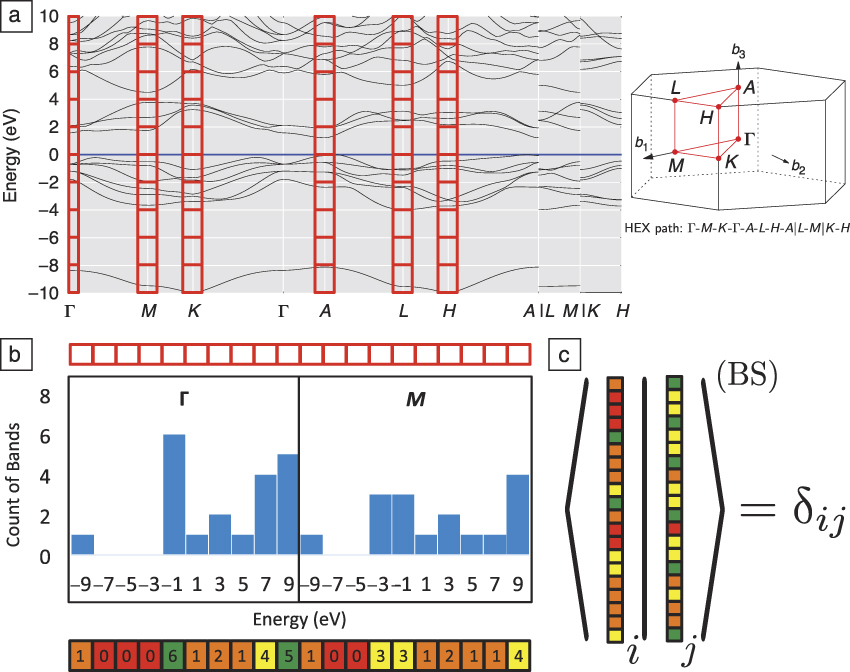
Several different ML frameworks are leveraging data from the AFLOW.org repository. The materials fingerprinting modelReference Isayev, Fourches, Muratov, Oses, Rasch, Tropsha and Curtarolo22 codifies aspects of the electronic structureReference Setyawan and Curtarolo10 to serve as unique markers for each material. In particular, the number of bands that intersect high-symmetry Brillouin zone points at discretized energy values form the band-structure fingerprint (illustrated in Figure 2), while simple discretization of the density of states form the density of states fingerprint. The Tanimoto coefficient—a distance metricReference Bajusz, Rácz and Héberger88—between fingerprint vectors quantifies the similarity of the electronic structure between different materials. These fingerprints are employed for the construction of networks (i.e., materials cartography),Reference Isayev, Fourches, Muratov, Oses, Rasch, Tropsha and Curtarolo22 where materials are represented by nodes and similarity correlates with relative positioning. When applied to compounds in the Inorganic Crystal Structure Database, significant clustering and structure can be identified for these networks, particularly with respect to material complexity (binaries versus ternaries), type (metal versus insulator), and, surprisingly, superconducting critical temperature—a particularly elusive phenomenon in which the driving mechanisms are still hotly contested.Reference Isayev, Fourches, Muratov, Oses, Rasch, Tropsha and Curtarolo22
Construction of electronic structure fingerprints. (a) The density of electronic states in certain energy ranges at the high-symmetry points of the Brillouin zone (b) form a fingerprint for the structure. (c) The fingerprints for different materials are then compared to quantify their similarity. Note: BS, band structure.Reference Isayev, Fourches, Muratov, Oses, Rasch, Tropsha and Curtarolo22

In the case of high-temperature superconductors, significant clustering suggests strong correlations among the electronic structure of these materials; although, as expected, these features alone are not enough to quantitatively resolve critical temperatures. Indeed, modeling improves with integration of more experimental observationsReference Stanev, Oses, Kusne, Rodriguez, Paglione, Curtarolo and Takeuchi45,89 and properties, such as structural features and partial charges.Reference Henkelman, Arnaldsson and Jónsson90 Incorporating additional relevant and physically meaningful training data, such as phonon spectra, should offer an applicability domain expansion and higher-fidelity predictions.
Thermomechanical properties calculated using the elastic constantsReference Toher, Oses, Plata, Hicks, Rose, Levy, de Jong, Asta, Fornari, Buongiorno Nardelli and Curtarolo33 and Debye–GrüneisenReference Toher, Plata, Levy, de Jong, Asta, Buongiorno Nardelli and Curtarolo37 modules of AFLOW have been employed to train a gradient boosting decision trees frameworkReference Isayev, Oses, Toher, Gossett, Curtarolo and Tropsha23 to predict quantities such as the bulk and shear modulus, Debye temperature, and heat capacity. Indicative of its versatility, the same modelReference Isayev, Oses, Toher, Gossett, Curtarolo and Tropsha23 has also been trained on AFLOW electronic structure data to classify materials as metals or insulators, and to predict the electronic bandgap for compounds identified as nonmetals. Model development is based on a fragment construction approach: each crystal is represented by a graph where nodes are decorated with corresponding atomic properties and connectivity is dictated by distance and the geometry of the local environment (Voronoi polyhedra adjacency). Path and circular fragments—representative of linear geometry and coordination polyhedra within the crystal—form the basis for feature development. To train the models, the gradient boosting decision tree algorithm is employed, which amalgamates a series of weak, easily constructed prediction rules to resolve a single, highly predictive function.
The resulting models have been thoroughly validated with simulated and real test sets, showing predictive metrics at 90% or higher against existing calculated and experimental measurements. Beyond property value prediction, feature-importance analyses of the models recover meaningful ways to tune the bandgap and Debye temperature, offering practical design rules for device engineering. The development of such models achieves the greatest impact on thermomechanical properties, where characterizations demand many single ab initio calculations, and thus presents a substantial boost in prediction speed at a fraction of the resources.
Workflow integration
ML approaches are expected to become indispensable in two specific scenarios: prediction of complex properties and screening of large sets of materials. Unfortunately, widespread exploitation of ML techniques in materials science has been hindered by the difficulty of setting up and interfacing the models with materials design infrastructures. To streamline this process, the AFLOW-ML APIReference Gossett, Toher, Oses, Isayev, Legrain, Rose, Zurek, Carrete, Mingo, Tropsha and Curtarolo91 has been created to provide programmatic access to the ML models described in References 23 and 26, with plans to extend it with additional models as they are developed. By posting a structure file to the API, users can retrieve ML predictions of thermal, mechanical, and electronic properties in the JavaScript Object Notation (JSON) data format.Reference Crockford92 In this way, all technical details of the ML algorithms are abstracted away, rendering a simple interface no more complicated than that of a standard API. This procedure can be easily incorporated into materials design workflows, due to its use of ubiquitous HTTP commands, along with the JSON format that is easily interpreted by a wide range of modern programming languages.
Source code and online forum
Since 2018, the AFLOW software (V3.1.204) has been made available for download/redistribution under the terms of the GNU License, http://www.gnu.org/licenses. The source code/license/readme files can be found at www.aflow.org/src/aflow. Though some of the aforementioned modules are conveniently interfaced through the website, only the executable offers full and unabridged functionality. Additionally, the Forum (www.aflow.org/forum) advertises updates and new functionality, and hosts discussion boards for registered members to post questions.
Conclusion
Broad-scale thermodynamic formability modeling and exploitation of ML algorithms are the current frontiers in computational materials design. Recent progress in these fields has been enabled by large, programmatically accessible materials databases generated by automated computational infrastructure. Ensembles of ordered phases are being successfully employed to (1) construct phase diagrams and (2) formulate descriptors and models to predict the formation and properties of disordered materials. ML models have the potential to rapidly accelerate materials design as tools for predicting properties and identifying subtle/hidden trends—thus leading to enhanced understanding of the physical mechanisms underlying materials behavior.
Acknowledgments
We thank E. Perim, Y. Lederer, O. Levy, O. Isayev, A. Tropsha, N. Mingo, J. Carrete, J.J. Vlassak, J. Schroers, D. Hicks, and E. Gossett for insightful discussions. C.O. acknowledges support from the NSF Graduate Research Fellowship No. DGF1106401. S.C. acknowledges support by the Alexander von Humboldt Foundation.

Corey Oses is a doctoral candidate in the Department of Mechanical Engineering and Materials Science at Duke University, and a National Science Foundation Graduate Fellow. He received his BS degree in applied and engineering physics from Cornell University in 2013. His research includes design of data-driven thermodynamic descriptors for magnetic and disordered materials and the development of autonomous frameworks for chemical and crystallographic materials properties. Oses can be reached by email at corey.oses@duke.edu and corey.oses@gmail.com.

Cormac Toher is an assistant research professor in the Department of Mechanical Engineering and Materials Science at Duke University, and a member of the Center for Materials Genomics. He received his PhD degree in physics from Trinity College Dublin, Ireland, in 2008. His research includes the automation of calculations of the thermal and mechanical properties of materials, the development of descriptors for the formation and stability of disordered materials, and the development of machine-learning algorithms trained on computational materials science data. Toher can be reached by email at cormac.toher@duke.edu and toherc@gmail.com.

Stefano Curtarolo has been on the faculty of materials science, physics, and chemistry at Duke University, since receiving his PhD degree in materials science from the Massachusetts Institute of Technology in 2003. His research interests focus on the interface between fundamental and applied materials science: disordered materials (glasses and high-entropy systems), super high-temperature structural materials, automatic materials discovery, magnetic/vibrational states of materials, thermal conductivity, and thermoelectric properties of advanced energy systems. He is a Fellow of the American Physical Society and the Institute of Physics. He is a recipient of research awards from IUPAP, DOD, NSF, and the Alexander von Humboldt Foundation. He is the founder of the AFLOW.org consortium. Curtarolo can be reached by email at stefano@duke.edu.