In the present study, we asked the question: how do bilingual children process compound words in their two languages? Research on bilingual processing of compounds provides a special perspective for testing the models in the two seemingly independent fields: bilingual lexicon and compound processing. There is an ongoing debate in the area of compound processing as to whether and how compound words are decomposed into their constituents (e.g., Libben, Reference Libben1998; Libben, Gibson, Yoon, & Sandra, Reference Libben, Gibson, Yoon and Sandra2003; Sandra, Reference Sandra1990; Zwitserlood, Reference Zwitserlood1994). Results from previous studies have provided converging evidence that the constituent morphemes are activated in compound processing among adults (e.g., de Jong, Feldman, Schreuder, Pastizzo, & Baayen, Reference de Jong, Feldman, Schreuder, Pastizzo and Baayen2002; Jarema, Busson, Nikolova, Tsapkini, & Libben, Reference Jarema, Busson, Nikolova, Tsapkini and Libben1999; Kehayia et al., Reference Kehayia, Jarema, Tsapkini, Perlak, Ralli and Kadzielawa1999; Libben et al., Reference Libben, Gibson, Yoon and Sandra2003; Zwitserlood, Reference Zwitserlood1994); however, only a few studies have investigated how children process compound words (e.g., Nicoladis, Reference Nicoladis2002, Reference Nicoladis2003, Reference Nicoladis, Libben and Jarema2006). Our study examined whether bilingual children decompose compound words into constituent morphemes in their two languages.
The role of semantic transparency is another key issue in the area of compound processing (e.g., Libben, Reference Libben1998; Libben et al., Reference Libben, Gibson, Yoon and Sandra2003; Sandra, Reference Sandra1990; Zwitserlood, Reference Zwitserlood1994). Semantic transparency refers to the consistency between the meaning of a compound word and its constituent morphemes. For example, class and room in classroom are transparent constituents from which one can easily infer the meaning of classroom, but dog in hotdog is opaque, and one cannot infer the meaning of hotdog directly from dog. Sandra (Reference Sandra1990) investigated the effect of semantic transparency in Dutch speakers via a semantic priming paradigm. Results showed that semantic associates of constituents primed only semantically transparent compounds (e.g., death primed birthday), but not the opaque compounds (e.g., bread did not prime butterfly). Sandra suggested that the constituents of semantically opaque compounds are therefore not activated. The semantic-priming paradigm used by Sandra was criticized by later researchers. For example, Libben (Reference Libben1998) argued that both transparent and opaque compounds are processed through a morphological-decomposition procedure at the lexical form level. The absence of a semantic-priming effect for opaque words was due to the lack of connections between opaque compounds and their constituents at the semantic level. For example, the opaque compound hogwash activates the lexical representations of hogwash, hog, and wash. The lexical representation of hogwash is connected to its semantic representation as a whole word, but there are presumably no connections between the lexical representation of hogwash and the semantic representations of hog and wash. Even though the activation of hog and wash at the lexical level would activate their semantic representations as well, their connections with hogwash would be indirect. This argument has been supported in a number of studies (e.g., Libben et al., Reference Libben, Gibson, Yoon and Sandra2003; Zwitserlood, Reference Zwitserlood1994).
Zwitserlood (Reference Zwitserlood1994) conducted two experiments to investigate the role of semantic transparency in Dutch. In the first partial priming experiment, the first and second constituent morphemes were primed by compound words (e.g., KERK and ORGEL primed by kerkorgel). Priming effects were found for transparent (TT, e.g., kerkorgel [church organ] whose meaning is related to both kerk [church] and orgel [organ]), partially opaque (TO, e.g., drankorgel [drunkard] whose meaning is only related to the first constituent drank [drink]) and fully opaque compounds (OO, e.g., klokhuis [core of an apple] whose meaning is not related to either klok [clock] or huis [house]). In the second immediate semantic priming experiment, the words semantically associated with the constituent morphemes were primed by transparent, partially opaque and fully opaque compounds. The semantic priming effect was found for only fully transparent (TT, e.g., PRIESTER was primed by kerkorgel) and partially transparent compounds (TO and OT, e.g., BIER was primed by drankorgel), but not for fully opaque compounds (OO, e.g., TIJD was not primed by klokhuis). The constituent priming effects in the first experiment suggest that even fully opaque compounds can be decomposed at the lexical form level. In the second experiment the failure of finding semantic priming effects of fully opaque compounds suggested that in the processing of fully opaque compounds, the semantic representations of their constituents are not activated. Taken together, their findings suggested that fully opaque compounds are decomposed at the lexical form level but are not connected to the semantic representations of their constituents.
Libben et al. (Reference Libben, Gibson, Yoon and Sandra2003) investigated constituent activation of the four types of compounds (TT, OT, TO, and OO). In their Experiment 1, there were two conditions. In one condition, the compounds were presented normally (i.e., hogwash). In the other condition, compounds were presented as two separate words (e.g., hogwash → hog wash). The researchers reasoned that if a compound is processed as a whole instead of being decomposed, the split condition should have negative impact on the target compound identification (i.e., the split cost). Their results showed that the response times for the compounds with opaque elements including TO, OT, and OO compounds were slower than those for TT compounds in the split condition. In both normal and split conditions, the reaction times of TO and OO compounds were slower than OT and TT compounds. These results suggest that the split cost was higher for the compounds with opaque heads (i.e., a weaker effect of decomposition) than those with transparent heads. Given the importance of semantic transparency in compound processing, we examined the effect of semantic transparency in bilingual compound processing.
When it comes to the models of bilingual lexicon, one question of debate is: how lexical forms, especially in the second language (L2), are mapped to their respective meanings. Potter, So, Von Eckardt, and Feldman (Reference Potter, So, Von Eckardt and Feldman1984) proposed two alternative models: word association and concept mediation. According to the word association model (see Figure 1a), there are no direct links between L2 words and semantic representations. Concepts of the L2 words are mediated by their translation equivalents in the first language (L1). Note that the word association model assumes that the concepts are common to both L1 and L2. According to the concept mediation model (see Figure 1b), L2 words are connected to their meanings directly, without the activation of their translation equivalents in L1. Potter et al. (Reference Potter, So, Von Eckardt and Feldman1984) tested the two models by comparing bilinguals’ performance on a translation task from L1 to L2 and a picture-naming task in L2. The word association model hypothesizes that translation from L1 to L2 is faster than naming a picture in L2. Because there is a direct link between L1 and L2 words, translation from L1 to L2 does not need to activate the shared meanings of those words. By contrast, to name a picture in L2, one needs to go through the link from the concept to L1 word, and then go through the link from the L1 word to L2 word. The concept mediation model hypothesizes that performance of the two tasks is similar: because both the L1 translation and the L2 word need to be mediated by the concept. Participants showed similar performance on a translation task and a picture-naming task, which is consistent with the concept association model.
(a) Word association model, (b) concept mediation model, and (c) revised hierarchical model.

Potter et al. (Reference Potter, So, Von Eckardt and Feldman1984) also found similar results for both proficient and less proficient L2 learners. The effect of language proficiency was, however, shown in other studies (e.g., Chen & Ho, Reference Chen and Ho1986; Chen & Leung, 1989; Kroll & Curlely Reference Kroll, Curley, Gruneberg, Morris and Sykes1988). Kroll and Curley (Reference Kroll, Curley, Gruneberg, Morris and Sykes1988), for example, tested beginning learners with very low L2 proficiency and found that translation was faster than picture naming for beginning learners. To accommodate the role of language proficiency, Kroll and Stewart (Reference Kroll and Stewart1994) proposed and tested the revised hierarchical model (RHM; see Figure 1c). This model takes into consideration the nature of both word association and concept mediation in bilingual lexicon. In order to acquire the meaning of a new word in L2, language learners must depend on the translation equivalent of the word in their L1. Thus, there is a strong lexical link mapping L2 to L1 and a weak link mapping L1 to L2. Initially, there is no link between L2 and concepts, but a link begins to develop with increasing L2 proficiency. The strength of links becomes more balanced when L2 proficiency improves. The RHM was supported by studies that showed a faster translation from L2 to L1 than from L1 to L2 in the beginning L2 learners (Kroll & Stewart, Reference Kroll and Stewart1994; Sholl, Shankaranarayanan, & Kroll, Reference Sholl, Sankaranarayanan and Kroll1995; Talams, Kroll, & Dufour, 1999). The hypotheses of the RHM were originally based on adult L2 learners who have fully mastered their L1. In the present study, we examined whether the hypotheses of the revised hierarchical model can be generalized to bilingual children whose L1 is still developing.
The present study investigated compound processing in young Chinese–English bilingual speakers. We were interested in addressing the issues of compound decomposition and cross-language activation in bilingual lexical judgment. All of the three bilingual lexicon models (word association, concept mediation, and RHM) hypothesized cross-language lexical activation. The lexical representation of L1 and L2 words are interconnected. In the present study, we addressed the cross-language lexical activation via manipulating the lexical status of the compounds in one language and those of the translation equivalents in the other language. The effect of the lexical status of the translated compounds on lexical judgment of the compounds in the target language is referred to as the effect of lexicality. This lexicality effect can be considered as evidence of cross-language lexical activation.
Given the low level of reading proficiency in this group of children, an auditory lexical decision task was employed. There are three specific research questions. (a) When children process compounds in one language, is their performance affected by the lexical status of the translated compounds in the other language? (b) How does semantic transparency affect this cross-language activation? In other words, how does semantic transparency interact with the effect of lexicality of the translated compounds? (c) Does this cross-language activation differ between bilingual children who are more proficient in their L2 and those who are less proficient?
Given the difference between semantically transparent and semantically opaque compounds in terms of the relationship between the meanings of constituent morphemes and the meanings of whole compounds, we hypothesize that semantic transparency will have an effect on the lexical processing of compounds. Children will have better performance on transparent compared to opaque compounds. Based on the previous evidence that both transparent and opaque compounds are decomposed at the lexical form level (e.g., Libben et al., Reference Libben, Gibson, Yoon and Sandra2003; Sandra, Reference Sandra1990; Zwitserlood, Reference Zwitserlood1994), we hypothesize that the lexical status of translated compounds affects the response accuracy of children's lexical judgment on both transparent and opaque compounds. Both word association model and concept mediation model predict that there will be lexicality effect of translated compounds and semantic transparency effect.
According to RHM (Kroll & Stewart, Reference Kroll and Stewart1994), the strength of the link between L1 and L2 is altered with the increasing level of L2 proficiency. The model predicts that the asymmetry of links between L1 and L2 lexical form representations is more profound for less proficient L2 learners than for proficient bilinguals.
METHOD
Participants
The participants were Grade 2 and Grade 3 Chinese immigrant children from the Washington, DC, metropolitan area. One hundred forty-five children completed the experiment. The data for five subjects were deleted because of low response accuracy for fillers. The cutoff point was 0.5, which was the chance level.
The parents were asked to fill out a short questionnaire requesting basic demographic information and family language and literacy experiences. Almost 90% of the children were born in the United States, 7% in China, and the rest in other countries. Most of the children (78%) learned Chinese first, some (18%) learned English first, and others (4%) learned the two languages simultaneously. Most (89%) spoke both Chinese and English at home, 8% spoke only English at home, and 3% spoke only Chinese at home. On average, they spoke English 60% of the time and Chinese 40% of the time. About 77% of the parents spoke both Chinese and English at home. About 23% of the parents spoke only Chinese at home. On average, they spoke English 23% of the time and Chinese 77% of the time. About 72% of the families engaged in Chinese literacy activities at home, and 96% of the parents believed that learning Chinese was important for the children. We decided that for this group of bilingual children, Chinese was considered as their L1 and English as their L2 because the majority learned Chinese first and the parents of the children also spoke Chinese most of the time. Clearly, this group of children was more balanced in English and Chinese in terms of the exposure and language use at home than immigrant children who arrive in the United States at an older age.
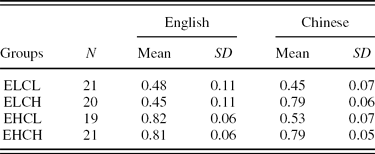
To take into account children's proficiency in both L1 and L2, we divided them into four groups. A modified version of the Peabody Picture Vocabulary Test—Third Edition (Dunn & Dunn, Reference Dunn and Dunn1997), which has been served as the index of English proficiency in previous research (e.g., Nicoladis, Reference Nicoladis2003, Reference Nicoladis, Libben and Jarema2006), was used as a measure of oral vocabulary. A translated version of the Peabody Picture Vocabulary Test—Third Edition was used to test Chinese language proficiency. Children were divided into four groups, based on their oral vocabulary scores: both low; English low, Chinese high; English high, Chinese low; and both high. To sharpen language-proficiency differences among the groups, the participants whose oral vocabulary scores fell into the midrange of either language were not included in the analyses. In order to divide the participants into four groups of approximately equal sample size, the cutoff points were based on the distribution of the scores. A child was classified as having low proficiency in one language if his/her oral vocabulary score for that language was lower than 0.60 and classified as having high proficiency if the oral vocabulary score was higher than 0.73. As a result, the data for 81 children were included for subsequent analyses of variance (ANOVAs). Table 1 summarizes the means of English and Chinese oral vocabulary tests for each group. The high-proficiency groups and the low-proficiency groups were statistically different from each other on their scores of the oral vocabulary tests of the corresponding languages. For example, the mean English oral vocabulary scores of both the high group and the English high, Chinese low group were significantly higher than those of the English low, Chinese high and both low groups (all ps < .01).
Sample sizes, means, and standard deviations of English and Chinese oral vocabulary tests for each group
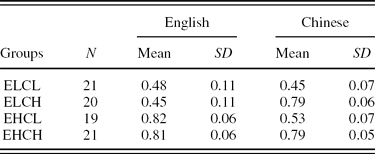
Note: ELCL, English low and Chinese low; ELCH, English low and Chinese high; EHCL, English high and Chinese low; EHCH, English high and Chinese high.
Design and materials
A 2 (Semantic Transparency in the Target Language: transparent/opaque) × 2 (Lexicality of the Translated Compounds in the Nontarget Language: real word/nonword) × 4 (Language Proficiency in L1 and L2: both high; English low, Chinese high; English high, Chinese low; both low) design was employed. Sixteen transparent and 16 opaque compound words in English and Chinese were used as test items. All the compound words contained two free morphemes as constituents, which mapped to the desired translations in the other language.
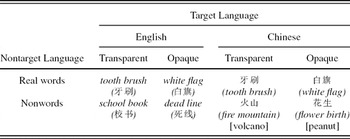
The combination of the translated constituents formed a translated compound in the nontarget language: either a real word or nonword. The transparent and opaque compounds were divided into two equal-size groups, depending on the lexicality of their translated compounds in the nontarget language (see Table 2 for sample items and Appendix A for a complete list of the items). Four types of stimuli were constructed: transparent real word (TR, e.g., tooth brush/牙 刷, a real word in Chinese), transparent nonword (TN, e.g., school book/校 书, a nonword in Chinese), opaque real word (OR, e.g., white flag/白 旗, a real word in Chinese) and opaque nonword (ON, e.g., dead line/死 线, a nonword in Chinese). Thirty-two compound nonwords in each language were used as fillers. The fillers were pseudocompounds constructed by randomly combining two free morphemes, such as eye hand and 校 刷 (school brush). If the combination of two morphemes happened to be a real word, it was substituted by another one. The purpose of the fillers was to make the number of positive responses equal to the number of negative responses. Note that the meanings of the real translated compounds in the nontarget language were same as the compounds in the target language. Therefore, the consistency between the meanings of the translated constituents and the meanings of the translated compounds in the nontarget language was same as in the target language. In addition, the concepts underlying the compound stimuli were common to both Chinese and English.
Sample items

Note: The top entries in the target language denote test items in the target language. Each Chinese character/English word in parentheses is the translation equivalent of a corresponding constituent at the same position (e.g., 牙 is the translation equivalent of tooth; both words are the first constituents in the compounds). The meanings of Chinese compound words are listed in brackets.
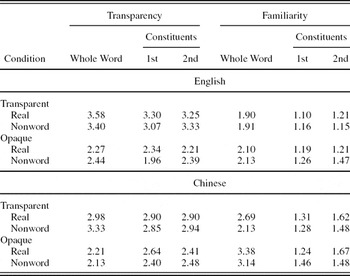
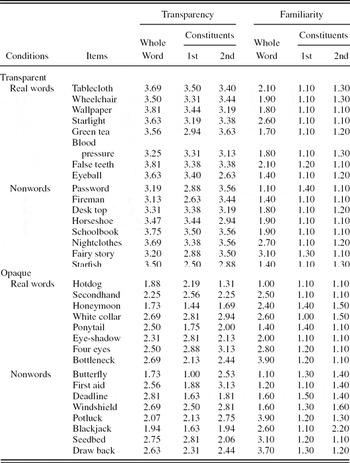
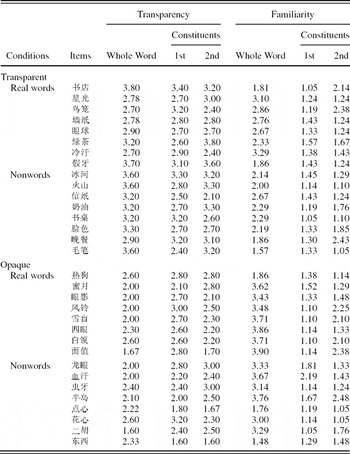
Based on the lexical status of the translated compounds, an initial list of items was selected (60 for English, 58 for Chinese). To determine whether bilingual children consider the items as semantically transparent or semantically opaque compounds, two groups of Chinese–English bilingual children rated the items for transparency in Chinese and English. Those children were enrolled in two fourth-grade classes at the same weekend Chinese heritage language school as the formal participants. Sixteen children from one class rated the English items and 12 children from the other class rated the Chinese items. The rating task was performed in groups. The children heard the words from a CD player and rated each compound in terms of the extent to which its meaning was predictable from the meanings of its parts. A 4-point rating scale was employed, in which the choices ranged from very unpredictable to very predictable. To determine the semantic transparency of the two constituents in each compound word, after completing the rating task of the whole compound words, the children were asked to rate each constituent in each compound in terms of the extent to which the underlined constituent morpheme retained its meaning in the compound word. A 4-point rating scale was employed, in which the choices ranged from loses all of its meaning to retains all of its meaning. Table 3 shows the results of the transparency rating task. On average, both the constituents had the same transparency status as the whole words. Two or three items in each cell had one constituent whose transparency was slightly different from the whole word. The ratings of those constituents were more than 1 standard deviation but less than 3 standard deviations away from the cell mean. Because of children's limited vocabulary, it was difficult to find very many compound words whose constituents had the same transparency as the whole word; thus, to maintain the sample size, items with uneven transparency were not eliminated from the analyses. To reduce any potential confounding effect, such items were evenly distributed across the different conditions.
Average level of transparency and familiarity for four conditions

It is possible that children’ familiarity with the compound words affects their lexical judgment. Therefore, children's familiarity with those items was rated by two fourth-grade classes of Chinese–English bilingual children from the same Chinese language school. These children did not participate in the aforementioned transparency rating task. Ten children from one class rated the English items and 21 children from the other class rated the Chinese items. Both entire compound words and their constituents were rated in terms of how common or rare the children considered them using a 5-point scale ranging from 1 = I have heard from it many times before to 5 = I have never heard from it before. Table 3 shows the results of the familiarity rating task. Ideally, the familiarity levels would be the same across all four conditions. According to the rating results, familiarity with the four conditions was successfully matched only in English, not in Chinese. To compensate for the failure to control for familiarity, post hoc analyses, with familiarity as a control variable, were conducted.
Based on the rating results of the familiarity and transparency rating tasks, 32 items were selected for each language. A post hoc survey was conducted to ascertain whether the constituents of the compound words in the target language could be translated into the desired translation in the nontarget language. A group of Chinese–English bilingual adults who resided in the United States translated the constituents of the items from the target language to the nontarget language. Fifteen participants translated from Chinese to English; 12 different participants translated from English to Chinese. Two items from each language were excluded from the analyses, because fewer than 30% of the participants translated the items into the desired translation. For example, the translation of bottle neck is 瓶 颈, which is a real word in Chinese. Therefore, 颈 is the desired translation of neck. However, neck can also be translated as 脖, which is a synonym of 颈. Because 颈 is more infrequently used than 脖 in spoken Chinese, most of the participants translated neck as 脖 and only 17% of them translated it as 颈; therefore, 颈 is not the preferred translation of neck. Because 瓶 and 脖 cannot form a real compound word in Chinese, bottle neck was excluded from the analyses.
Note that previous studies used visual stimuli of compounds (e.g., Libben et al., Reference Libben, Gibson, Yoon and Sandra2003; Sandra, Reference Sandra1990; Zwitserlood, Reference Zwitserlood1994). The present study, however, used auditory stimuli for two reasons. First, the children's reading proficiency is lower than their oral language proficiency in both languages. Using auditory stimuli gives us more freedom to choose stimuli. Second, in written form there may be a space or hyphen between the two constituent morphemes in English compounds; however, there is always a space between the two morphemes in a Chinese compound. The potential confound due to such visual difference could be eliminated by using auditory stimuli.
Procedure
The children decided whether a word they heard from a CD player was real or not by circling a happy face for a real word or a sad face for a nonword. Whole classes were tested in small groups. Every three to six children were assigned a tester who monitored children's responses to ensure all the instructions were understood. This small group paper–pencil test provided a friendly environment for administering a cognitive task to young children. The English target language and Chinese target language tasks were conducted in two separate sections. The interval between the two sections was 1 week. Children were recruited from eight classes. The order of the language being tested was counterbalanced across the classes. The test of language proficiency was modified for group testing. After hearing a word from the CD player, the children circled a picture that best corresponded to the word in an array of four pictures.
Internal consistency reliabilities of the Chinese and English lexical decision tasks were 0.70 and 0.71, respectively. Reliabilities of the language proficiency tasks were 0.81 for English and 0.68 for Chinese.
Results
Four main results were found:
1. Transparency of compounds affected response accuracy in English L2.
2. The lexicality of translated compounds in the nontarget language Chinese affected response accuracy on both transparent and opaque words in the target language English.
3. There was no interaction between semantic transparency and the lexicality of translated compounds.
4. Response patterns were similar across groups with different levels of language proficiency.
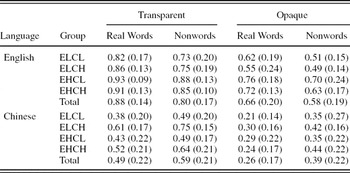
One item, which was 2 standard deviations away from the cell mean, was deleted from the analyses in each language. The accuracy of the children's responses is displayed in Table 4. A 2 (Semantic Transparency in the Target Language: transparent/opaque) × 2 (Lexicality of the Translated Compounds in the Nontarget Language: real word/nonword) × 4 (Language Proficiency Groups: both low; English low, Chinese high; English high, Chinese low; and both high) ANOVA was performed on accuracy for each language. In the subject analysis (F 1), semantic transparency and lexicality were within-participant factors and language proficiency was a between-participant factor. In the item analysis (F 2), semantic transparency and lexicality were the between-subject factors and language proficiency was a within-subject factor.
Mean accuracies (SDs) of lexical responses

Note: ELCL, English low and Chinese low; ELCH, English low and Chinese high; EHCL, English high and Chinese low; EHCH, English high and Chinese high.
When tested in English, the ANOVA showed a significant main effect of transparency, F 1 (1, 77) = 224.85, p < .01; F 2 (1, 25) = 7.92, p < .01. On average, children judged transparent items more accurately than opaque items. There was a significant main effect of language proficiency, F 1 (3, 77) = 9.54, p < .01; F 2 (3, 75) = 15.46, p < .01. The main effect of lexicality of translated compounds in the nontarget language (Chinese) was significant in the subject analysis F 1 (1, 77) = 27.76, p < .01, but not in the item analysis, F 2 (1, 25) = 1.10, p = .30. The three-way interaction was not significant (both Fs < 1). The two-way interaction between transparency and lexicality and between lexicality and language proficiency were not significant (Fs < 1). The two-way interaction between transparency and language proficiency was marginally significant in the subject analysis, F 1 (3, 77) = 2.63, p = .058, but not in the item analysis, F 2 (3, 75) = 1.45, p = .24.
To further control for the potential effect of familiarity, familiarity was entered as a covariant variable in item analysis. After controlling for familiarity, the main effect of transparency was still significant, F 2 (1, 24) = 20.07, p < .01, but the main effect of lexicality now became significant, F 2 (1, 24) = 4.39, p = .047. The main effect of language proficiency and the interaction between transparency and language proficiency disappeared (Fs < 1).
When tested in Chinese, the ANOVA showed a significant main effect of transparency, F 1 (1, 77) = 138.27, p < .01; F 2 (1, 25) = 12.98, p < .01, and a significant main effect of language proficiency, F 1 (3, 77) = 5.99, p < .01; F 2 (3, 75) = 10.80, p < .01. The main effect of lexicality of the translated compounds in the nontarget language (English) was significant in the subject analysis, F 1 (1, 77) = 43.52, p < .01, and was marginally significant in the item analysis, F 2 (1, 25) = 3.94, p = .058. The three-way interaction was not significant, both Fs < 1. The two-way interaction between transparency and lexicality was not significant (both Fs < 1) nor was the two-way interaction between lexicality and language proficiency, F 1 (3, 77) = 1.48, p = .23; F 2 < 1. The two-way interaction between transparency and language proficiency was significant in the subject analysis, F 1 (3, 77) = 5.23, p < .01, but not in the item analysis (F 2 < 1). After controlling for familiarity in the item analysis, the main effects of transparency and lexicality, as well as the interaction between transparency and language proficiency, disappeared (Fs < 1).
DISCUSSION
Our findings together provided evidence to support compound decomposition for English. As expected, children were more accurate when judging semantically transparent words. When the target language was English L2, the main effect of semantic transparency remained significant after controlling for familiarity; this finding helped exclude the confounding effect of familiarity. The difference between transparent words and opaque words was whether the meanings of the constituent morphemes contributed to the meaning of the whole compound. When considered as whole compound words, transparent words and opaque words were the same in terms of familiarity. If both transparent words and opaque words were processed as whole words and were not decomposed into their constituent morphemes, response accuracy for the transparent words should be the same as that of opaque words. The transparency effect suggests that the semantic representations of the compounds are activated when children make lexical judgments in English L2. The lexical-decision task itself did not require the activation of semantic representations. The task required participants only to judge whether or not a word was real. Participants can base their decisions on the lexical form or the semantic form or both. Because transparent and opaque compounds differ only at the semantic level, the transparency effect suggests that the semantic information on the constituent morphemes is automatically activated in making lexical judgment.
Although the transparency effect provided evidence of compound decomposition for semantically transparent words when English was the target language, it was uncertain whether semantically opaque words were also decomposed. There are two possible interpretations. The first is that opaque compound words were not decomposed into their constituents, but were, rather, processed as whole words (e.g., Sandra, Reference Sandra1990). The second interpretation is that both opaque compounds and transparent compounds were decomposed at the lexical form level, but only for transparent compounds their constituents were activated at the semantic level (e.g., Libben, Reference Libben1998). According to the first interpretation, opaque compounds were processed as whole words, and their constituent morphemes were not activated at all. This interpretation could be excluded by the lexicality effect found when English was the target language. Response accuracy for both transparent compounds and opaque compounds in English was affected by the lexicality of the translated compounds in the nontarget language Chinese. The cross-language effect of the translated compounds indicated that both the constituent morphemes in English and their translation equivalents in the nontarget language Chinese were activated. The second interpretation, on the other hand, could explain both the lexicality effect of the nontarget language Chinese and the transparency effect in English. Both transparent words and opaque words were decomposed at the lexical form level and both were affected by the lexicality of the translated compounds. The activation of the semantic representations of the transparent constituents in the target language English resulted in higher accuracy in lexical judgments for transparent compounds than that for opaque compounds.
We suggest that the transparency effect when English was the target language is most likely to stem from children's familiarity with English. It was obvious that the bilingual children had higher familiarity with English compounds compared to Chinese compounds used in the experiment (e.g., the average familiarity rating of the compounds at the whole word level was 2.01 for English and 2.83 for Chinese, respectively, where 1 = most familiar and 5 = the least). The bilingual children also performed more accurately in lexical judgments on English compounds compared to Chinese ones. It seems that although most children learned Chinese as their first language, they have better knowledge about the English compounds than Chinese ones. The children's better familiarity with English compounds facilitated their access to the semantic information of the compounds, resulting in more accurate performance on transparent compounds in comparison to opaque compounds. This may also help to explain why the transparency effect was not significant when Chinese was the target language, given that the children were less familiar with the Chinese compounds.
It is important to note that there seems to be some limitation in the applicability of the existing adult bilingual lexicon models to bilingual children. The adult L2 learners have obviously mastered their L1 when they begin to learn L2; in contrast, the bilingual children learn L2 before they have mastered their L1. Although Chinese is considered most of the children's L1, because it is the language they learn at home before they are introduced to English, it appears that English becomes their dominant language once they enter elementary school. Given their better knowledge in English L2, the bilingual children may have access to the semantic/conceptual information directly when processing English L2 words. Thus, the word association model, in which the link between L2 words and the concepts is missing may not be applicable to the bilingual children in the present study. The strong link between L1 words and the concepts in all the three bilingual lexicon models (the word association, concept mediation, and revised hierarchical model) may need to be modified, taking into account the varying L1 proficiency level of the bilingual children.
The lexicality effect of the nontarget language Chinese suggests that at least there is a cross-language activation of the translated constituent morphemes at the lexical form level. It seems to be an unlikely effect given that Chinese was the bilingual children's weak language. The lexicality effect of the nontarget language English was not significant after controlling for familiarity when Chinese was the target language, even though the bilingual children had better familiarity with English compounds. One possible interpretation is based on the unique property of the Chinese language and writing system; that is, Chinese is a morphosyllabic system in which each morpheme maps onto one syllable and one character. The clear syllable boundary between morphemes may make the individual morphemes more distinct compared to the English language and writing system. This distinctiveness of the Chinese morphemes may facilitate access to the translated Chinese morphemes; hence, a stronger lexicality effect when Chinese was the nontarget language.
In the present study, we also investigated the effect of language proficiency. Contrary to the prediction of RHM, language proficiency did not affect the way bilingual children process compound words in either L1 or L2. Neither the three-way interaction among the three factors (i.e., language proficiency, lexicality, and semantic transparency) nor the two-way interaction between language proficiency and lexicality was significant. Only a main effect of language proficiency was found when Chinese was the target language. This result suggests that more proficient children were better in making lexical judgments than less proficient children in Chinese. However, the lexicality of translated compounds in the nontarget language did not differentially affect children with different levels of language proficiency in either Chinese or English. Response patterns were similar across proficiency groups; all groups of different language proficiency levels activated the translation equivalents in Chinese L1 to aid their lexical judgment in English L2. One possible explanation of the discrepancy between the results obtained by the present study and previous studies that showed the effect of language proficiency was because the participants in the present study are different from those in the previous studies. The results of previous studies came from adult learners of L2 instead of bilingual children. In contrast to adults, children might be less sensitive than adults to conceptual information, because their conceptual representations were still developing in both L1 and L2. Furthermore, the lexical decision task in the present study is a paper and pencil task. Most of previous studies on adults used online priming paradigm. Thus, the children population and the paper and pencil lexical decision task in the present study might have contributed to the different patterns of results.
The accuracy rates for the opaque Chinese compounds were below chance level (about 26% for opaque real words [OR] and 39% for opaque nonwords [ON]). We suggest that this could be because children's familiarity ratings of the opaque Chinese whole compounds were relatively low (about 3.38 and 3.14 for OR and ON items, respectively, on a scale of 5, where 5 indicated that the children had never heard about the word). However, the familiarity ratings of the constituent morphemes of the opaque Chinese compounds were below 2, suggesting that children were relatively more familiar with the constituents than the whole words. It is therefore possible that when making a lexical judgment, children may try to find out the meanings of an unfamiliar compound by combining the meanings of the constituent morphemes. When they failed to do so in the case of an unfamiliar opaque compound, they were more likely to judge it as a nonword instead of a real word. When the target language was English, the accuracy rates of the TR and OR items were higher than the TN and ON items. When the target language was Chinese, however, an opposite pattern was shown. We suggest that this could be a result of unmatched familiarity across conditions when Chinese was the target language. The children were less familiar with the TR and OR items than the TN and ON items (the familiarity ratings were 2.69, 3.38, 2.13, and 3.14, respectively), hence, more errors in the real word condition.
In summary, our results showed that when English was the target language both transparent compounds and opaque compounds are decomposed into their constituent morphemes at the lexical form level, only the semantic representations of transparent constituents were activated. The translation equivalents of both transparent and opaque constituents are activated in the nontarget language Chinese at the lexical form level. There is a greater cross-language effect from Chinese to English than from English to Chinese probably due to the facilitation from the distinctive syllable boundary between morphemes in Chinese. Contrary to the RHM, the bilingual children's response pattern does not change as language proficiency increases in English L2.
APPENDIX A
Experimental items
English experimental items and rating results of items

Chinese experimental items and rating results of items