Introduction
Lac is the only commercial resin of animal origin and is a natural polymer derived from the resinous secretions of specialized epidermal glands distributed throughout the body surface of phytosuccivorous lac insects (Hemiptera: Coccoidea: Tachardiidae ( = Kerridae)). The resinous covering of lac not only protects the insects but also fixes them to the twig, facilitating their sedentary and phytophagous mode of nutrition. The Indian lac insect, Kerria lacca (Kerr) is the principal species used for lac production in India, which is the global leader in lac production.
The constituent acids of lac resin fall under two categories: (i) hydroxy fatty acids, principally aleuritic acid (9,10,16-trihydroxyhexadecanoic acid), and (ii) hydroxy sesquiterpenic acids having the rare cedrene skeleton (Prasad, Reference Prasad, Baboo and Goswami2010). Other constituent acids that have been isolated from lac resin are butolic, shellolic, epishellolic, laksholic, epilaksholic, laccijalaric, laccishellolic, laccilaksholic, epilaccishellolic and epilaccilaksholic acids. It has been suggested that pure lac resin of molecular weight 2194 g/mol (Prasad, Reference Prasad, Baboo and Goswami2010) is made up of aleuritic acid and terpenic acids (jalaric/laccijalaric acid and derived dicarboxylic acids) at a ratio of 1:1. Among the four terpenic acids, there are three jalaric/epishellolic acids and one laccijalaric/epilaccishellolic acid (Singh et al., Reference Singh, Upadhye, Mhaskar, Sukh, Pol and Naik1974). The present study is the first attempt made to understand possible pathways related to the biosynthesis of complex lac resin and the genes involved. The genetics of lac biosynthesis is still unexplored and needs to be paid more attention to identify the genes involved and to deduce the biosynthetic pathway.
Biosynthesis of lac resin
Sesquiterpene biosynthesis
A number of different sesquiterpene compounds have been identified across a wide range of taxa with a variety of biological roles. The sesquiterpene diversity in biological systems arises via two ways: (i) the biosynthetic sequence involved in the assembly of the 15-carbon sesquiterpene backbone and (ii) the variation in the addition of functional groups and substituents (Chappell and Coates, Reference Chappell, Coates, Townsend and Ebizuka2010).
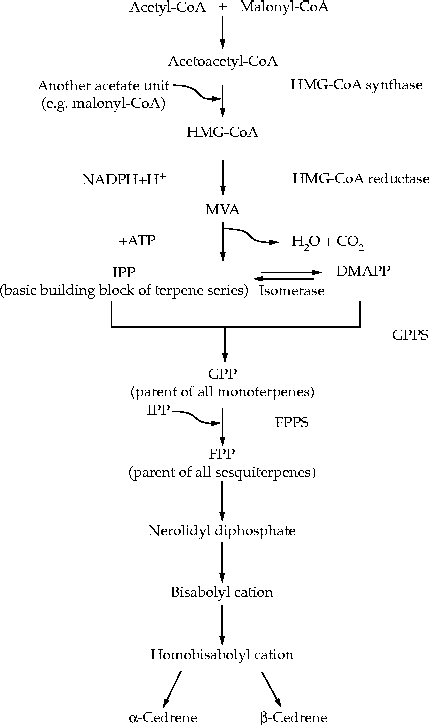
Sesquiterpene biosynthesis in lac insects has hitherto been unexplored, but it is probably similar to that reported in other insects. As has been described previously, the insects synthesize terpenes in the cytosol through the mevalonic acid (MVA) pathway or the HMG-CoA reductase pathway (Bede et al., Reference Bede, Teal, Goodman and Tobe2001). In the first step, acetate (as a coenzyme A thioester) and malonate react to give acetoacetate, which is common in the biosynthesis of fatty acids also. Another acetate unit (as malonate) is added via an aldol condensation involving β-hydroxy-β-methylglutaryl coenzyme A (HMG-CoA) synthase enzyme to give HMG-CoA. Upon catalysis by HMG-CoA reductase, this is reduced by NADPH to MVA in the rate-determining step that builds up the terpenes. MVA is converted into pyrophosphate and then decarboxylated with simultaneous loss of hydroxyl to give isopentenyl pyrophosphate (IPP). IPP is the basic building block of the terpene series, but one more reaction, involving isomerase enzyme, is required to yield dimethylallyl pyrophosphate (DMAPP), the starting unit for terpenes. The combination of IPP and DMAPP on prenyltransferase gives geranyl pyrophosphate (GPP), which is the precursor of all monoterpenes. The addition of another IPP to GPP by prenyltransferase, in the same way, gives farnesyl pyrophosphate (FPP), the precursor of all sesquiterpenes (Liang et al., Reference Liang, Ko and Wang2002; Morgan, Reference Morgan2010).
Cedrene ring production in lac insects probably involves the conversion of FPP into nerolidyl diphosphate (Fig. 1), which upon ring closure gives rise to bisabolyl cation. Bisabolyl cation via homobisabolyl cation forms α- or β-cedrene, as in the scheme proposed by Hong and Tantillo (Reference Hong and Tantillo2009). In Juniperus (Cupressaceae) trees, which produce α-cedrene and cedrol, the cedrenes are, however, derived from FPP via linalyl pyrophosphate (Morgan, Reference Morgan2010).
Proposed pathway for the biosynthesis of sesquiterpenes in lac insects. HMG-CoA, β-hydroxy-β-methylglutaryl coenzyme A; MVA, mevalonic acid; IPP, isopentenyl pyrophosphate; DMAPP, dimethylallyl pyrophosphate; GPPS, geranyl pyrophosphate synthase; GPP, geranyl pyrophosphate; FPPS, farnesyl pyrophosphate synthase; FPP, farnesyl pyrophosphate.

Aleuritic acid biosynthesis
Aleuritic acid is a unique acid with two hydroxyl groups on the adjacent carbon atoms. The biosynthesis of the basic compound, hexadecanoic acid, is envisaged to occur through a multistep elongation process through catalysis by fatty acid synthase, the ubiquitous and key enzyme in fatty acid synthesis in all biological systems (Hamilton, Reference Hamilton, Dijkstra, Hamilton and Hamm2008). The elongated chain of hexadecanoic acid is hydroxylated to yield aleuritic acid. It has been suggested that in the biosynthesis of plant cutins cytochrome P450 catalyses in-chain hydroxylation reactions of fatty acids; examples are 16-hydroxypalmitic acid and 9,16- and 1,16-hydroxypalmitic acids. The hydroxylase enzyme responsible for P450-dependent in-chain hydroxylation was first reported in Helianthus tuberosus tuber (Cabello-Hurtado et al., Reference Cabello-Hurtado, Batard, Salaün, Durst, Pinot and Werck-Reichhart1998).
The fatty acids of cutins include ω-monohydroxy acids, 9 (or 10),16-dihydroxyhexadecanoic acid (and analogous C18 acids), 9,10,18-trihydroxyoctadecanoic acid, and occasionally related fatty acids with epoxy or keto groups in central positions, e.g. 9,10-epoxy,18-hydroxyoctadecanoate. The biosynthesis of mono-, di- or trihydroxyl acids involves the addition of a hydroxyl group at or close to the terminal carbon atom of an existing fatty acid, which is catalysed by cytochrome P450-dependent fatty acid hydroxylases. P450 monooxygenases, apart from forming the hydroxylation products, also lead to the conversion of unsaturated fatty acids into epoxides (Laethem et al., Reference Laethem, Balazy, Falck, Laethem and Koop1993, Reference Laethem, Balazy and Koop1996; Oliw, Reference Oliw1994; Blée, Reference Blée, Kuo and Gardner2005).
The monooxygenase catalytic function of cytochrome P450, as observed in plant cutin monomer formation, helps in understanding the hydroxylation of hexadecanoic acid at C9, C10 and C16 positions in lac insects (Fig. 2). Hopefully, the systematic cloning of such enzymes of lac insects will unravel the role of cytochrome P450-dependent hydroxylases in the future.
Structural representation of the proposed P450-dependent hydroxylation of aleuritic acid.

Materials and methods
To identify the genes involved in resin biosynthesis, the Indian lac insect, K. lacca lacca f. rangeeni, cultured and maintained in the Field Gene Bank at the National Lac Insect Germplasm Centre (NATLIGEC) of the Indian Institute of Natural Resins and Gums, Ranchi, India (23°19′51″N and 85°22′18″E; elevation ~634 m; average temperature ~27 °C), was used.
Insect material and DNA isolation
The lac insect cultures were maintained on a common lac host Flemingia macrophylla (Leguminosae) under potted conditions. The cultures were kept enclosed in synthetic mesh sleeves (60 mesh) to protect the lac insects from parasites and predators. The cultures were regularly sprayed with a fungicide (carbendazim, 0.01%) to maintain the cultures clean. Mature female insects aged 4 months (rangeeni) were collected and kept in 100% ethanol for 48 h at room temperature to dissolve the resinous covering, followed by cleaning with a sable hairbrush under a stereo zoom microscope. About 50–60 mg of cleaned insects were weighed and kept at − 80 °C overnight prior to genomic DNA isolation. Genomic DNA was isolated using the HiPurA™ Insect DNA Purification Kit (HiMedia Laboratories, Mumbai, India).
Polymerase chain reaction (PCR) product amplification and sequencing
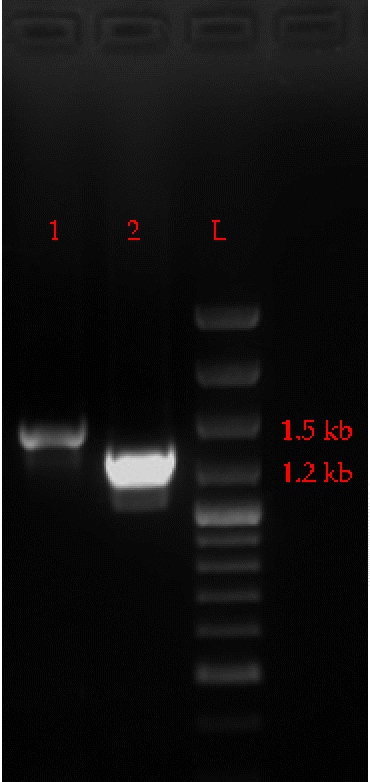
Prenyltransferase and cytochrome P450 sequences were amplified by PCRs from the whole genomic DNA of insects using forward primer PRT_F: 5′-ATGGATATATTGAGAAATTTGCG-3′ and reverse primer PRT_R: 5′-TTCAACGGTTTCTACAGCAT-3′ for prenyltransferase and primers Cyt450_F: 5′-TGTTGGCGTTCTTTCACGACCA-3′ and Cyt450_R: 5′-CGAATGGCTCCCAATTGTGGGCA-3′ for cytochrome P450 partial sequences. The PCRs were carried out using 50 μl reaction mixtures containing 40 ng of template DNA, 1X Taq buffer (100 mm Tris–HCl (pH 8.8), 500 mm KCl, and 0.8% (v/v) Nonidet P40; Thermo Scientific, Waltham, MA, USA), 2.0 mm MgCl2 (Thermo Scientific), 0.2 mm of each dNTP (Affymetrix USB, Cleveland, Ohio, USA), 10 pm of each primer, and three units of Taq DNA polymerase (Thermo Scientific). The PCRs were carried out under the following cycling conditions: initial denaturation of the template DNA at 95 °C for 5 min followed by 35 cycles programmed for denaturation step at 95 °C for 30 s, primer annealing step at specific temperatures (45 °C for PRT primers and 49 °C for Cyt450 primers) for 30 s, and DNA extension step at 72 °C for 1 min. The final extension of the PCR products (Fig. 3) was carried out at 72 °C for 10 min.
(colour online) Gel photograph of the polymerase chain reaction products showing 1.5 kb fragment size of prenyltransferase and 1.2 kb fragment size of cytochrome P450.

Both the PCR products along with GeneRuler 100 bp Plus (Thermo Scientific) were analysed on 1% agarose gel (containing ethidium bromide 0.5 μg/ml), prepared with 0.5 × TBE buffer (45 mm Tris–borate and 1.0 mm EDTA (pH 8.0)), and electrophoresed in 0.5 × TBE at 4 V/cm for 2 h. These PCR products were gel-purified, and sequencing was carried out in both directions. To verify sequence quality, the analyses were carried out using Sequence Scanner v1.0, and good-quality sequences having at least 20 QV (quality value) scores were subsequently aligned using EMBOSS (European Molecular Biology Open Software Suite) Needle (Rice et al., Reference Rice, Longden and Bleasby2000), the online pairwise sequence alignment tool using default parameter values.
Database search
The nucleotide sequences of prenyltransferase and cytochrome P450 were analysed using the nucleotide–nucleotide basic local alignment search tool (BLASTn) and Conserved Domains Search tool available at the National Center for Biotechnology Information (NCBI) website.
Insect collection and protein isolation
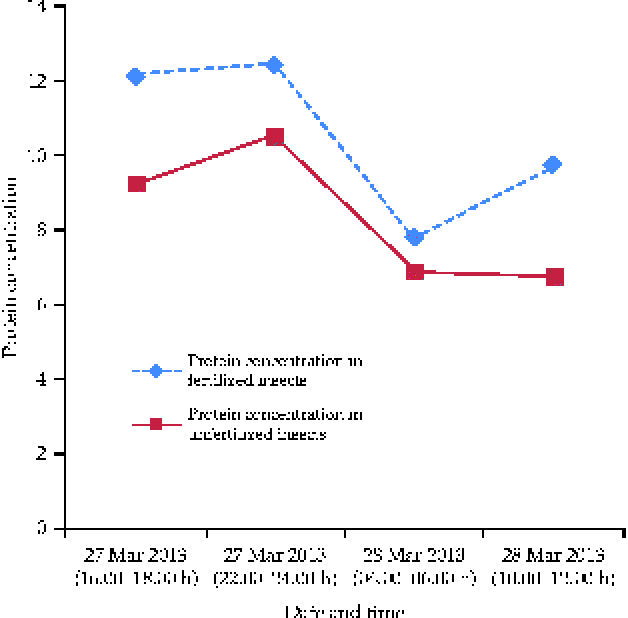
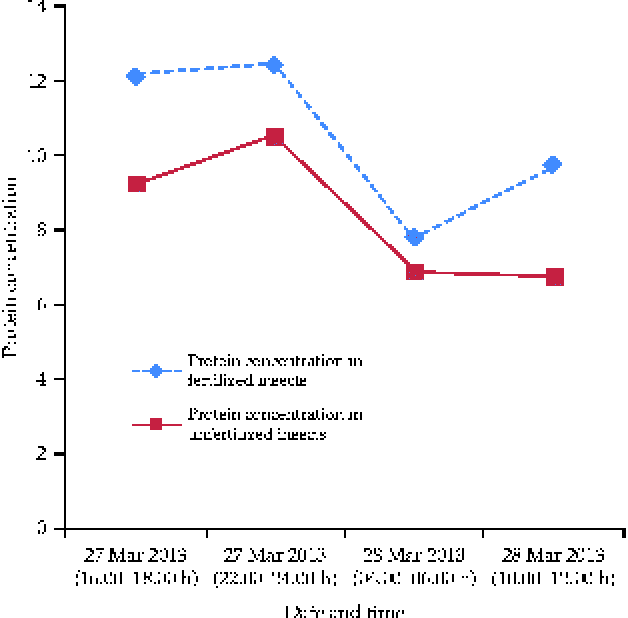
The males were removed from the lac insect colonies, cultured on plants as described above, after the differentiation of sexes, allowing a pure culture of females to develop. A control pot was left with unfertilized females, whereas in the test pot, males were introduced to facilitate mating and fertilization. (The rate of resin secretion increases sharply after fertilization. Thus, fertilized and unfertilized females differ in the rate of resin secretion, enabling comparison.) After a month, fertilized and unfertilized female insect samples were collected at different time points and total proteins were isolated using the Insect cell Protein Extraction Reagent, I-PER (Thermo Scientific) (Fig. 4). Insects (~50 mg) were directly collected in the I-PER solution and homogenized using a micro-pestle. The manufacturer's protocol was followed for the remaining steps. Protein concentration estimation was carried out following Lowry's method (Lowry et al., Reference Lowry, Rosebrough, Farr and Randall1951). The diurnal pattern of resin secretion was also studied by hourly examination of female insects under a stereomicroscope during the active resin secretion phase to correlate it with concomitant protein concentration variation.
Graphical representation of the total protein concentrations in fertilized and unfertilized female lac insects at various time points.
Results
PCR product amplification, DNA sequencing and analysis
Using target gene-specific primers, DNA fragments of approximately 1.5 and 1.2 kb fragments of prenyltransferase and cytochrome P450, respectively, were amplified by PCRs from total genomic DNA of K. lacca, while these were not amplified in the negative control (without template) PCR.
Both the PCR products were sequenced and trimmed, and good-quality sequences having at least 20 QVs were used for the BLASTn analysis. One of the nucleotide sequences exhibited 70% identity with the predicted mRNA sequence of Bombus impatiens protein farnesyltransferase/geranylgeranyltransferase type-1 subunit α-like. Another sequence was also found to exhibit 70% identity with the predicted mRNA sequence of Acyrthosiphon pisum probable cytochrome P450 303a1-like. The conserved domain search of the two sequences also demonstrated similarity to the protein prenyltransferase α subunit repeat and the conserved domain of p450 superfamily, respectively. The former and latter sequences were submitted to the GenBank, and the accession numbers are KF463151 and KF463153, respectively (see Appendix 1 for sequences of protein prenyltransferase α subunit and cytochrome P450).
Protein concentrations in relation to resin secretion
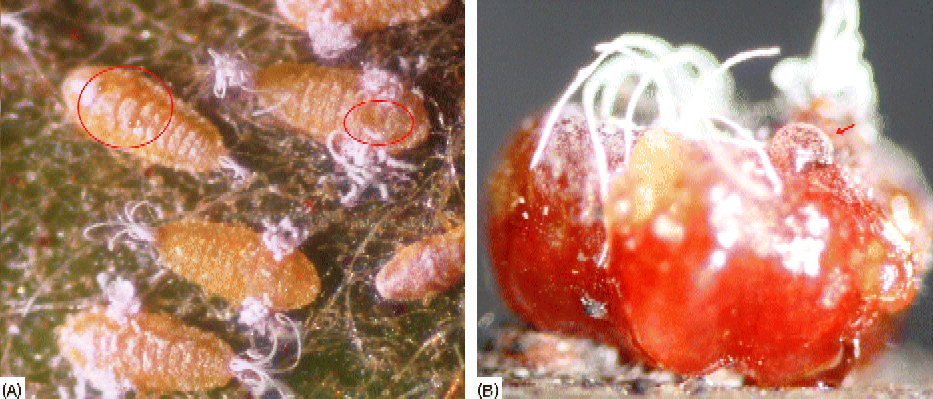
Protein concentrations in fertilized female insects were higher than those in the unfertilized ones (Fig. 4), which could explain that fertilization leads to various metabolic changes as a result of embryonic development and other developmental changes such as increased resin secretion. Microscopic observations of crawlers after settlement and immature female insects (Fig. 5) revealed that resin biosynthesis is comparatively higher during 04.00–06.00 h than at any other time point during the 24-h cycle. This is also evident from protein concentration estimation at different time points, which reveals that the proteins and enzymes required for resin biosynthesis are being synthesized throughout the day, but the concentrations are significantly higher only during 22.00–24.00 h, i.e. the period just before increased resin production.
(colour online) Microscopic images of resin secretion: (A) crawlers soon after settlement on a twig and (B) a female lac insect. The resin is secreted slowly and continuously in the form of droplets (shown as encircled areas in (A) and by an arrow in image (B)); peak secretion occurs early in the morning.
Discussion
Lac insects are phloem feeders; the phloem sap is rich in sugars but low in amino acids. The insects thus feed more to fulfil their nutritional requirements. The excess sugars, as a result of their feeding, are actively excreted during the feeding phase as ‘honeydew’. Lac insects utilize the rich sugars in their diet to their structural advantage. Sucrose is obtained from a diet mainly in the form of disaccharide (Vashishtha et al., Reference Vashishtha, Rathi, Kaushik, Sharma and Lakhanpaul2013). Sucrose, apart from many cellular functions, is used by lac insects for the biosynthesis of lac. Sucrose metabolism yields acetyl-CoA, a precursor molecule for the formation of both the components of lac resin, i.e. fatty acids and terpenic acids. The diurnal rhythm of honeydew excretion may also exhibit a significant relationship with the rhythmic secretion of lac resin. In Coccus hesperidum (Hemiptera: Coccidae), honeydew excretion is at its peak during the night and is so till the early-morning hours, whereas a decrease in excretion is observed during the day, with the minimum occurring at noon (Golan, Reference Golan2008). Although the diurnal pattern of honeydew excretion in lac insects is unknown, the striking similarity between resin secretion in lac insects and honeydew excretion in C. hesperidum (maximum secretion of both occurs early in the morning) points to the need to study diurnal honeydew excretion in relation to resin secretion.
This study proposes a logical pathway for the biosynthesis of lac resin and identifies two envisaged genes involved in this multistep process. As the lac resin is a unique product of lac insects, its biosynthetic pathway is also expected to involve some unique steps. Further investigations into lac insects' genome and transcriptome are needed to obtain more information about the number of genes and the mechanisms involved in lac biosynthesis; they may also provide novel alternatives for its commercial production.
Acknowledgements
The authors cordially thank Dr K. Mukhopadhyay, B.I.T. Mesra, for his valuable advice, encouragement and all-time support. They also thank Mr Parvez Ansari and Mr Bandhnu Oraon for their technical assistance.
Appendix 1: Sequences
Partial sequence of protein prenyltransferase α subunit Kerria Line LIK0010_C (accession no.: KF463153)
GATGATTTTTAATTGAATAGTCACAGATTTTTTCGTTAAAAAAAATGGATGATAATAGTTCAGATGAAAATAGCGTAGAAGAGTGGATTCTGTACAAAAATCGTCCTGAATGGAAAGATATTGAATCGATACCACAGGATGATGGTCCTTATCCAGTAGTATCTATAAATTATTCAGAACGGTGTATGTAAAAATTACCTTTGATGATTTTCTATTTTGGTTTTGTATTTATATCATTTGTAATTTTTGTTAAATCATTAGATAGTGATGTTTTTAATTATTTTCGCGGGGTAGTTGCAAAAAATGAAAAATCTATTAGAGTATTGATGTTATGCAGAGATGCATTAACTTTAAGTCCAGCAAACTATACTGTTTGGCAGTACAGGTACAAAAATATGAAAAATTAAAAATGCTATGTAATATTTTAAAATCTGAGTATATTATTAAACCTATGTAAATAATAATTAAAAGTTTTATTCGGCAGACGACTGGTTTTAAAACATTTGAATAGTGATTTAAAAGAAGAATTAGAATACGTAGCAGATGTAATAAGCAATCATTCAAAAAATTACCAAGTGTGGTTAGAAAAATTTGTTTTTAAATATTGGGAGTATAACTTTATCATTATTTTTCAAATTATTAATCATGAAATGTTTTATAGGCATCATAGACGAGTAATTATTGAGTGGTATGGTGACGCTACTAATGAACTTGCATTTACCGAACAAATGCTTCAAATAGACGCCAAAAATTATCATGCCTGGCAATATCGTCAATGGGTACTTACAACTTTTAAGTACGTTTTTATATAGCTTGAATATAATTATCAGCGTATTTTTTAGATTCAAATATTGGTTTCTATTTCTGAACAGATGTTTTCAAAATGAATTAGCTTTTGTCAATGAAATGTTAAAAAATGATGTGCGAAATAATTCTGTTTGGAATCATAGATATTTTATTTTAAACATATCCGAAGAAGGATTTTCTTCGAGAATAATTTCTGAAGAAATAAATTATATAATTGATAAATTACAAATTTGTCTTAATAATGAAAGTGTGTGGAATTATCTCAGAGGGTAAAAATTTTATGGTTTTATTTCATCATTTTAGTAACTATTTAAAATTTTTCTTCCTAATAAAAATCTCATTCGTAATTTTTCGGTT
Partial sequence of cytochrome P450 Kerria Line Lik0010_C (accession no.: KF463151)
TTCGTTGTACCTCCGGATGTAGCAACATATACAAAAAACCAAAACCTAAAGATTTACTTGTGGTTTCTGAACCAGCCATAAACATGTCCATACAAATAGCTAAAAGTTGGGATTCTATAAAATTAATCGTTTTATATTAAAAATTTTAACGTAGTTTTGCTGCTAAATTAAAATTTATTTAAATAAATTATTATACCAGAAAAACTAGGTTTTTTTTCCTGTGAATGTAACATTTCTAAATAAACATCCATTAAATCTCGTGGTGAATTAAGTTTAAACGTATCTTTATGATTATCTAATTCTTCCTGCAATAAAATTAAAATTTATAAAAACGAACAAATAATGTAACGAACTATACCATCTATTGTAAAATATCGAAAACTTGCCTTCAAGAATTTCCATACACGTTGATGTATGGACATAAACTGTTTATAACCAGATTTTTCTGGAGCTACATAACGCAAAAATGGAAACTGGCTAAAAAGCGCTCCAACCATATCAATACTAGCAAACAGTTCAGTTAATAATGACTGCAATGTTTTTAATTCACCATCATCTGGACTGTAGCGTATACTTGCTAACATAGACCACAATGTATTTAGAACATAAACACTGAATGCATCTCTCATAGGAACAATAGTTCCTTTGATTCCATTCACAGTAAGTTCTTCTGTTATAAGCTTATTACTAAACATGTTAACCAACTGAGCTGCTTCTGCTTCTACTAATTCTGACATGGTTTTTTTGCCGAAACCAAATTCTCTTAAATACGCATAACGAATCGTCGTTGCTCTTGCCAAAATTCTTCATCTGTCAATAGTAACCCTGTCAACATTTAATTTATACATGTTTTTCTATGAAAAATTAATCTCGAAATAATTTATTTCGTAATTTTGTTTTTTAACTTAATAATAAATAAATTAAAAAAATATAAGAAAGAAATTAAAAACAACAAATGTTTTATAATTTACTAAGTTTAATAATACGTATATTCATAATAGACTAAATACCTCTTCTAATACCCCATGTTCGAGTTTCATAAAATGGTCCTTGAGGTCGTCCATCTAATTCTTCTTTAGTAAGCATTTCTTTAATTGCTGCGTAATCATAACATACTACTTGTCTATCTTTTCCAATACGTAAACCAATAACTGGTCCATAAACACGAGCTAACTCAGCAGTCGCTTTGTACAGATAACCTGTTCGGTT