1. Introduction
Setting the stage for the study of Markov decision processes over continuous state spaces requires several mathematical ingredients. In turn, this branch of Computer Science is a rich source of appealing research questions in Mathematics, with the plus of having a well-motivated origin.
In our case of interest, that of labelled Markov processes (LMP) Desharnais (Reference Desharnais1999); Desharnais et al. (Reference Desharnais, Edalat and Panangaden2002), defining appropriate notions of behavioral equivalences and working with them involves a non-negligible amount of descriptive set theory Kechris (Reference Kechris1994) and measure theory, and with the latter come many “pathologies” related to nonmeasurable sets. This is then reflected in the fact that many notions of bisimilarity which coincide when the state space is “regular” turn out to be different. One early example is provided by Sánchez Terraf (Reference Sánchez Terraf2011), where it is shown that event bisimilarity Danos et al. (Reference Danos, Desharnais, Laviolette and Panangaden2006) does not coincide with the more traditionally minded notion of state bisimilarity.
It was also shown in Sánchez Terraf (Reference Sánchez Terraf2011) that bisimilarities do not not interact in a predictable manner with direct sums, and thus the question whether two states are deemed equivalent might depend on the context in which they are inserted. Therefore, one is naturally led to a subdivision of the existing notions of bisimulations into two categories: those that relate two states of a single process (“internal” bisimulations) and those relating two states of different processes (“external” ones).
G. Bacci’s dissertation Bacci (Reference Bacci2013) provides an adequate notion of external (state) bisimilarity, in the sense that it does not depend on some previous internal definition and thus it does not rely on sums. One of our contributions concerns the generalization of this external notion to nondeterministic LMP (NLMP) D’Argenio et al. (Reference D’Argenio, Sánchez Terraf and Wolovick2009, Reference D’Argenio, Wolovick, Sánchez Terraf and Celayes2012), and presenting external versions of event and “hit” bisimilarities as well.
Our main results show that several notions of external bisimilarity appearing in the literature: coalgebraic bisimilarity, the one given by sums, and that originating in Bacci (Reference Bacci2013), are pairwise different in general. Moreover, we show that the third one differs from the one defined using spans. It is to be noted that all LMP counterexamples used in this paper have separable state spaces, and hence they can be regarded as subsets of the real line with the trace of the Borel
 $\sigma$
-algebra. Aside from these negative results, we show that a bisimilarity relation proposed by Panangaden Panangaden (Reference Panangaden2009) by using direct sums coincides with event bisimilarity.
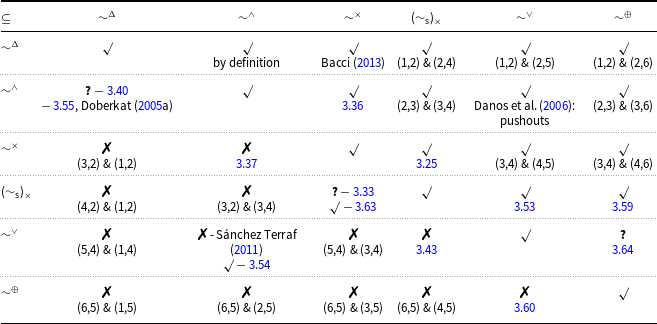
The next section reviews some prerequisites, and Section 3.1 recalls the original definitions of bisimulations for LMP and how they behave for the example from Sánchez Terraf (Reference Sánchez Terraf2011) and, in particular, the interaction with zigzag morphisms. Section 3.2 introduces Bacci’s external bisimulation and some results concerning its interaction with internal state bisimilarity on a sum; several questions on diverse transitivity situations are addressed there. We treat categorical bisimulations next, considering spans and coalgebraic bisimilarity in Section 3.3, and cospans in Section 3.4, where a brief study of LMP quotients and finality takes place. Other notions based on sums are studied in Section 3.5, Panangaden’s one in particular. Section 3.6 summarizes our current knowledge in Table 1, and Section 4 is devoted to NLMP, where we provide a notion of external event bisimilarity for them and generalize the game-theoretic characterization of state bisimilarity obtained in Clerc et al. (Reference Clerc, Fijalkow, Klin and Panangaden2019) to those processes. We offer some concluding remarks in Section 5.
2. Preliminaries
Let
 $R$
be a binary relation on a set
 $S$
. We say that
 $X \subseteq S$
is
 $R$
-closed if
 \begin{equation*} \{s\in S \mid \exists x\in X \; (x\mathrel {R}s \vee s\mathrel {R}x)\} \subseteq X. \end{equation*}
If
 $\Gamma \subseteq \mathcal {P}(S)$
is a set of subsets of
 $S$
, we denote by
 $\Gamma (R)$
the family of all
 $R$
-closed sets that are elements of
 $\Gamma$
. We can think of
 $\Gamma (\!\cdot\!)$
as an operator that maps relations to subfamilies of
 $\mathcal {P}(S)$
. We highlight the particular case when
 $\Gamma$
is the
 $\sigma$
-algebra of a measurable space
 $(S,\Sigma )$
and note that in such a situation
 $\Sigma (R)$
is always a sub-
 $\sigma$
-algebra of
 $\Sigma$
.
Another operator that will be important in this work (which goes in the opposite direction) is the one which associates with each family
 $\Lambda \subseteq \mathcal {P}(S)$
a relation
 $\mathcal {R}(\Lambda )$
on
 $S$
, defined by:
 \begin{equation*} (s,t) \in \mathcal {R}(\Lambda ) \text { if and only if } \forall A \in \Lambda \ (s \in A \Leftrightarrow t \in A). \end{equation*}
This relation associates points that belong to exactly the same sets in
 $\Lambda$
. We note that it is always an equivalence relation, regardless of the conditions on
 $\Lambda$
.
We construe the “disjoint union”
 $S\oplus S'$
of two sets as the tagged union
 $(S\times \{0\})\cup (S'\times \{1\})$
, and we have the obvious inclusion functions
 $\textrm {inl} : S\to S\oplus S'$
and
 $\textrm {inr} : S' \to S\oplus S'$
. If
 $R$
is now a binary relation on
 $S\oplus S'$
, its restriction to
 $S$
is defined as:
 \begin{equation*} R\upharpoonright S \mathrel {\mathop :}= \{ (s_1,s_2) \in S \mid \textrm {inl}(s_1) \mathrel {R} \textrm {inl}(s_2) \}. \end{equation*}
If
 $\Gamma$
is a family of subsets of
 $T$
where
 $S\subseteq T$
, its restriction is defined as
 $\Gamma \upharpoonright S \mathrel {\mathop :}= \{Q\cap S \mid Q\in \Gamma \}$
. With a slight abuse of notation, if
 $\Gamma \subseteq \mathcal {P}(S\oplus S')$
, we set
 $\Gamma \upharpoonright S \mathrel {\mathop :}= \{\textrm {inl}^{-1}[Q] \mid Q\in \Gamma \}$
.
The sum of two measurable spaces
 $(S,\Sigma )$
and
 $(S',\Sigma ')$
is
 $(S\oplus S',\Sigma \oplus \Sigma ')$
, with the following abuse of notation:
 $\Sigma \oplus \Sigma '\mathrel {\mathop :}=\{ Q\oplus Q'\mid Q \in \Sigma, \ Q'\in \Sigma '\}$
. We have the following result on restriction of relations on sums that do not correlate elements in different components.
Lemma 2.1.
Let
 $(S,\Sigma )$
and
 $(S',\Sigma ')$
be measurable spaces. If
 $R$
is a binary relation such that
 $R\subseteq \textrm {inl}(S)^2 \cup \textrm {inr}(S')^2$
, then
 $(\Sigma \oplus \Sigma ')(R)\upharpoonright S=\Sigma (R\upharpoonright S)$
.
The set of subprobability measures over a measurable space
 $(S,\Sigma )$
will be denoted by
 $\Delta (S)$
. If
 $R$
is a relation on
 $S$
, its lifting
 $\bar {R}$
to
 $\Delta (S)$
is the equivalence relation given by:
 \begin{equation} \mu \mathrel {\bar {R}} \mu ' \iff \forall Q\in \Sigma (R) \; \mu (Q)=\mu '(Q). \end{equation}
For any topological space,
 $\mathcal {B}(X)$
denotes the Borel
 $\sigma$
-algebra of
 $X$
; for any
 $V\subseteq X$
,
 $\mathcal {B}(X)_V$
will stand for
 $\sigma (\mathcal {B}(X) \cup \{V \})$
, the smallest
 $\sigma$
-algebra containing
 $V$
and the open sets of
 $X$
. We reserve
 $I$
for the open interval
 $(0,1)$
. Also, we will use the following notation for standard measures and functions:
 $\mathfrak {m}$
will denote the Lebesgue measure on
 $I$
restricted to the Borel sets;
 $\delta _s(\!\cdot\!)$
will denote the Dirac measure with point mass at
 $x$
, and
 $\chi _{A}(\!\cdot\!)$
will be the characteristic function of the set
 $A$
.
The set of nonnegative integers will be denoted by
 $\omega$
.
3. Labelled Markov Processes
Definition 3.1. A Markov kernel on a measurable space
 $(S,\Sigma )$
is a function
 $\tau :S\times \Sigma \rightarrow [0,1]$
such that, for each fixed
 $s \in S$
,
 $\tau (s,\cdot ):\Sigma \rightarrow [0,1]$
is a subprobability measure, and for each fixed set
 $X \in \Sigma$
,
 $\tau (\cdot, X):S \rightarrow [0,1]$
is a
 $(\Sigma, \mathcal {B}([0,1]))$
-measurable function.
These kernels will be interpreted as transition functions in the processes defined below. Let
 $L$
be any countable set.
Definition 3.2. A labelled Markov process, or LMP, with label set
 $L$
, is a triple
 $\mathbb {S}=(S,\Sigma, \{\tau _a \mid a\in L \})$
, where
 $S$
is a set, whose elements are called states,
 $\Sigma$
is a
 $\sigma$
-algebra on
 $S$
, and for all
 $a\in L$
,
 $\tau _a:S \times \Sigma \rightarrow [0,1]$
is a Markov kernel.
A pointed LMP is a tuple
 $(S,s,\Sigma, \{\tau _a \mid a\in L \})$
where
 $s\in S$
is called the initial state.
The elements of
 $L$
are also called actions. Since
 $L$
is mostly fixed throughout each argument, we also write
 $\{\tau _a \}_a$
instead of
 $\{\tau _a \mid a\in L \}$
.
These processes were introduced by Desharnais et al. (Reference Desharnais, Edalat and Panangaden1998),Desharnais (Reference Desharnais1999), and Desharnais et al. (Reference Desharnais, Edalat and Panangaden2002) as a generalization to continuous spaces of (discrete) probabilistic transition systems. The operation of an LMP is summarized as follows: at any given moment, the system is in a state
 $s\in S$
and, depending on its interaction with the environment through the labels in
 $L$
, it makes a transition to a new state according to a probability law (given by the kernels). The term “Markov” in the name of these processes refers to the fact that transitions are governed by the current state of the system, not its past history.
Example 3.3. The following LMP
 $\mathbb {U}$
(called
 $\textbf{S}_{\textbf{3}}$
in Sánchez Terraf (Reference Sánchez Terraf2011)) motivated our finer classification of bisimilarities.
Let
 $V$
be a Lebesgue nonmeasurable subset of
 $I$
. By Łoś and Marczewski (Reference Łoś and Marczewski1949, Thms. 1–4) (or alternatively, Terraf (Reference Sánchez Terraf2011, Cor. 11)), there exist two extensions
 $\mathfrak {m}_0$
and
 $\mathfrak {m}_1$
of
 $\mathfrak {m}$
to
 $\mathcal {B}(I)_V$
such that
 $\mathfrak {m}_0(V)\neq \mathfrak {m}_1(V)$
. Also, for
 $q\in I\cap \mathbb {Q}$
define
 $B_q \mathrel {\mathop :}= (0,q)$
; hence,
 $\{B_q\mid q\in I \cap \mathbb {Q}\}$
is a countable generating family of
 $\mathcal {B}(I)$
.
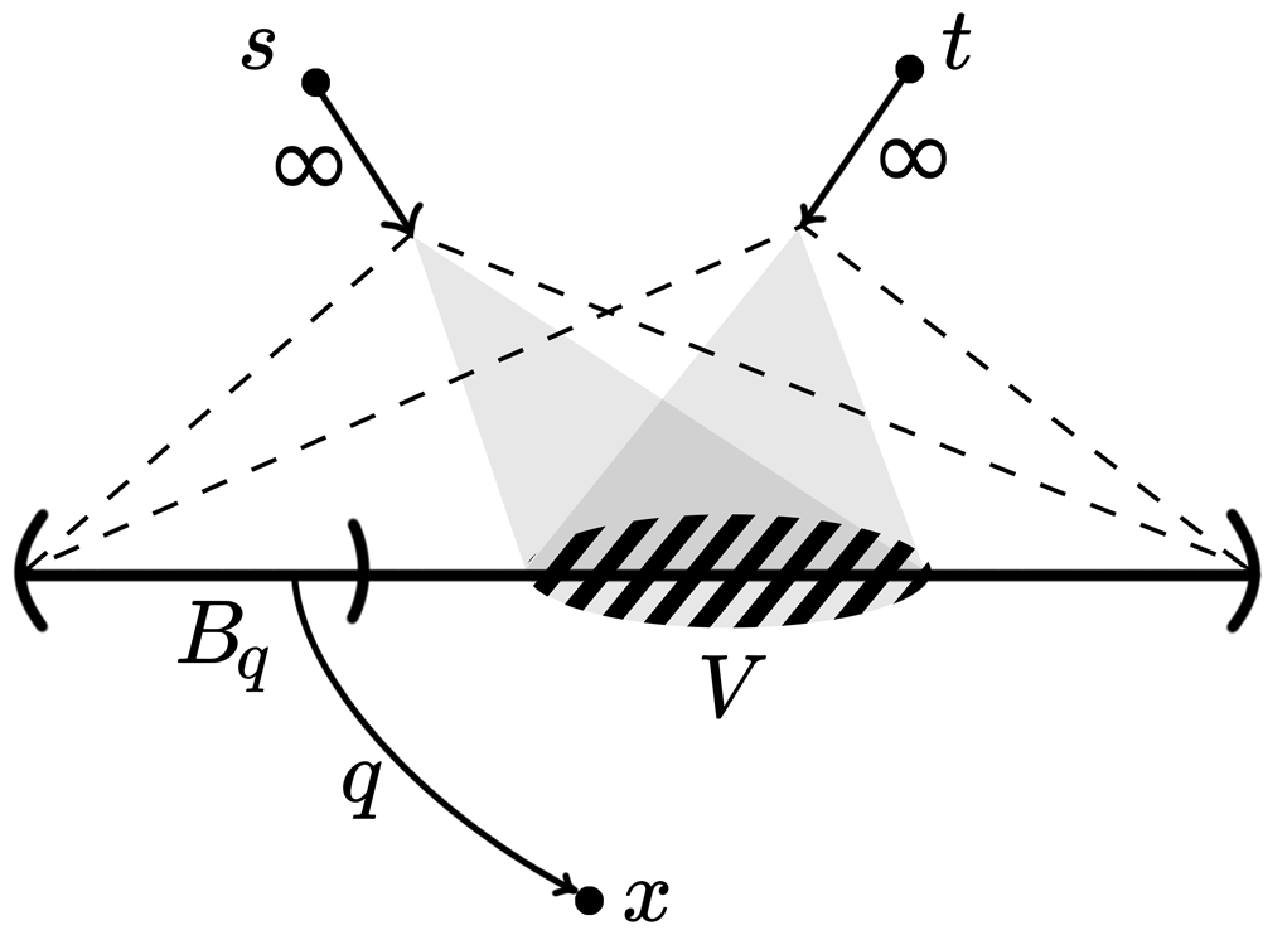
The LMP
 $\mathbb {U}$
.

Let
 $s,t,x \notin I$
be mutually distinct; we may view
 $\mathfrak {m}_0$
and
 $\mathfrak {m}_1$
as measures defined on the sum
 $I \oplus \{s,t,x \}$
, supported on
 $I$
. The label set will be
 $L\mathrel {\mathop :}= (I \cap \mathbb {Q})\cup \{\infty \}$
. Now define
 $\mathbb {U}=(U,\Upsilon, \{\tau _a \mid a\in L \})$
such that
 \begin{align*} (U,\Upsilon )& \mathrel {\mathop :}= (I \oplus \{s,t,x \},\mathcal {B}(I)_V\oplus \mathcal {P}(\{s,t,x \})), \\ \tau _q(r,A) &\mathrel {\mathop :}= \chi _{B_q}(r)\cdot \delta _x(A),\\ \tau _\infty (r,A)&\mathrel {\mathop :}= \chi _{\{s \}}(r)\cdot \mathfrak {m}_0(A)+\chi _{\{t \}}(r)\cdot \mathfrak {m}_1(A) \end{align*}
when
 $q\in I\cap \mathbb {Q}$
and
 $A\in \Upsilon$
; we have omitted the injection maps into the sum to make notation lighter. This defines an LMP (see Moroni and Sánchez Terraf (Reference Moroni and Sánchez Terraf2023) for further discussion).
The dynamics of this process goes intuitively as follows: the states
 $s$
and
 $t$
can only make an
 $\infty$
-labelled transition to a “uniformly distributed” state in
 $I$
, but they disagree on the probability of reaching
 $V\subseteq I$
. Then, each point of
 $B_q\subseteq I$
can make a
 $q$
-transition to
 $x$
. Finally,
 $x$
can make no transition at all (see Figure 1).
LMPs form a category
 $\textbf {LMP}$
whose morphisms are given by the following definition.
Definition 3.4. A zigzag morphism
 $f$
between two LMPs
 $\mathbb {S}$
and
 $\mathbb {S}'$
is a measurable map
 $f:S\to {S}'$
satisfying
 \begin{equation*} \forall a \in L, s \in S, B \in \Sigma ' \ \ \tau _a(s,f^{-1}[B])=\tau '_{\!\!a}(f(s),B). \end{equation*}
For pointed LMP, we also require that
 $f$
preserves the initial state.
3.1 Internal bisimulations
3.1.1 State bisimulations and zigzags
Definition 3.5. Given an LMP
 $\mathbb {S}=(S,\Sigma, \{\tau _a \mid a\in L \})$
, an (internal) state bisimulation
 $R$
in
 $\mathbb {S}$
is a binary relation on
 $S$
such that if
 $s\mathrel {R}t$
, then for all
 $C \in \Sigma (R)$
, it holds that
 \begin{equation*}\forall a\in L \; \tau _a(s,C)=\tau _a(t,C).\end{equation*}
We say that
 $s$
and
 $t$
are state bisimilar, denoted as
 $s\sim _{\textsf {s},\mathbb {S}} t$
, if there exists a state bisimulation
 $R$
such that
 $s\mathrel {R}t$
.
We will often drop the subscript
 $\mathbb {S}$
and simply write
 $s\sim _{\textsf {s}} t$
if there is no need for clarification. We have the following well-known result:
Proposition 3.6.
The union of a family of state bisimulations is also a state bisimulation. Hence,
 $\sim _{\textsf {s}}$
is a state bisimulation.
Example 3.7 (State bisimilarity in Example 3.3). We reproduce part of the proof from Terraf (Reference Sánchez Terraf2011), Thm. 15) showing that state bisimilarity on
 $\mathbb {U}$
is the identity. It is straightforward to verify that
 $\{x \}$
must be an equivalence class of
 $\sim _{\textsf {s}}$
(and hence it belongs to
 $\Sigma (\sim _{\textsf {s}})$
): for any other state
 $r\in \mathbb {U}$
, there exists
 $l\in L$
such that
 $\tau _l(r,U)= 1$
but
 $\tau _l(x,U)=0$
(and
 $U$
is obviously
 $\sim _{\textsf {s}}$
-closed). Now, take
 $y\neq z\in I$
; let us show that
 $y$
and
 $z$
cannot be related by
 $\sim _{\textsf {s}}$
. Since
 $\{B_q\mid q\in I\cap \mathbb {Q}\}$
generates
 $\mathcal {B}(I)$
, there exists
 $a\in I\cap \mathbb {Q}\subseteq L$
such that
 $B_a$
separates
 $y$
from
 $z$
. Without loss of generality, we can assume that
 $\{y,z \}\cap B_a=\{y \}$
. Then
 $\tau _a(y,\{x \})=1$
, but
 $\tau _a(z,\{x \})=0$
. We conclude that
 $\sim _{\textsf {s}}$
restricted to
 $I\cup \{x \}$
is the identity relation, and (in particular)
 $V\subseteq I$
is
 $\sim _{\textsf {s}}$
-closed. Finally, we observe that
 $\tau _\infty (s,V)\neq \tau _\infty (t,V)$
, and therefore
 $s$
and
 $t$
are not state bisimilar.
Lemma 3.8.
Let
 $f:\mathbb {S}\to \mathbb {S'}$
be a zigzag morphism. If
 $s\sim _{\textsf {s}} t$
in
 $\mathbb {S}$
, then
 $f(s)\sim _{\textsf {s}} f(t)$
in
 $\mathbb {S'}$
.
Proof.
Let
 $R$
be a bisimulation such that
 $s\mathrel {R}t$
; it suffices to show that
 $R'\mathrel {\mathop :}= f[R]=\{(f(x),f(y))\mid x\mathrel {R}y\}$
is a bisimulation on
 $\mathbb {S'}$
. Suppose that
 $f(x)\mathrel {R'}f(y)$
with
 $x\mathrel {R} y$
, and let
 $A\in \Sigma '$
be a
 $R'$
-closed set. We want to verify that
 $\tau _a'(f(x),A)=\tau _a(x,f^{-1}[A])$
is equal to
 $\tau _a'(f(y),A)=\tau _a(y,f^{-1}[A])$
. For this, it suffices to see that
 $f^{-1}[A]\in \Sigma (R)$
since
 $x\sim _{\textsf {s}} y$
. The measurability is immediate. We verify that
 $f^{-1}[A]$
is
 $R$
-closed: let
 $w\in f^{-1}[A]$
and
 $z\in S$
such that
 $w\mathrel {R}z$
; since
 $f(w)\mathrel {R'} f(z)$
,
 $f(w)\in A$
, and
 $A$
is
 $R'$
-closed, we conclude that
 $f(z)\in A$
, that is,
 $z\in f^{-1}[A]$
. The case
 $z\mathrel {R}w$
is similar.
Example 3.9. The converse of Lemma 3.8 is not true: Consider the identity function
 $\textrm {id}:\mathbb {U}\to \mathbb {U}_B$
where
 $\mathbb {U}_B\mathrel {\mathop :}= (U,\mathcal {B}(I)\oplus \mathcal {P}(\{ s,t,x \}),\{ \tau _a \}_a)$
. Let
 $\Sigma$
be the
 $\sigma$
-algebra of
 $\mathbb {U}_B$
. We see that such a function is measurable since
 $\Sigma \subseteq \Upsilon$
and it clearly satisfies the zigzag condition. However, in
 $\mathbb {U}_B$
, we have
 $s\sim _{\textsf {s}} t$
as the nonmeasurable Lebesgue set
 $V$
is not available to distinguish them, whereas
 $s \nsim _{\textsf {s}} t$
in
 $\mathbb {U}$
.
3.1.2 Direct sums
Definition 3.10. Given two LMPs
 $\mathbb {S}$
and
 $\mathbb {S}'$
, the direct sum LMP
 $\mathbb {S}\oplus \mathbb {S'}$
has the sum of measurable spaces
 $(S\oplus S',\Sigma \oplus \Sigma ')$
as underlying measurable space, and Markov kernels:
 \begin{align*} \tau _a^\oplus (\textrm {inl}(x),A\oplus A') &\mathrel {\mathop :}= \tau _a(x,A) && x\in S,\\ \tau _a^\oplus (\textrm {inr}(x),A\oplus A') &\mathrel {\mathop :}= \tau _a(x,A') && x\in S'. \end{align*}
The above construction corresponds to the categorical coproduct or sum in the category
 $\textbf {LMP}$
. It is straightforward from the definition that the following equivalence holds:
 \begin{align} \tau _a(s,A)= \tau '_{\!\!a}(s',A') \iff \tau ^{\oplus }_a(\textrm {inl}(s),A\oplus A') = \tau ^{\oplus }_a(\textrm {inr}(s'),A\oplus A'). \end{align}
If
 $R\subseteq S\times S$
, we can “lift” it to relations
 $R_l$
and
 $R_r$
on
 $S\oplus S'$
and
 $S'\oplus S$
, respectively, as follows:
 \begin{equation} R_l\mathrel {\mathop :}= \{(\textrm {inl}(s),\textrm {inl}(t))\mid s\mathrel {R}t \},\qquad R_r\mathrel {\mathop :}= \{(\textrm {inr}(s),\textrm {inr}(t))\mid s\mathrel {R}t \}. \end{equation}
It is easy to verify that if
 $R$
is a state bisimulation on
 $\mathbb {S}$
, then
 $R_l$
is a state bisimulation on
 $\mathbb {S}\oplus \mathbb {S'}$
. This only depends on the fact that
 $(\Sigma \oplus \Sigma ')(R)\upharpoonright S=\Sigma (R)$
(see Lemma 2.1). Additionally, note that this implies that state bisimilarity on the sum of two LMPs restricted to a summand is not smaller than the original bisimilarity on the latter.
As a warm-up for its future use in defining external bisimulations, we will consider the case of equal summands and relate state bisimilarity on
 $\mathbb {S}\oplus \mathbb {S}$
to state bisimilarity on
 $\mathbb {S}$
. In this setting, we can lift a relation
 $R$
on
 $S$
in various ways: to the left summand as
 $R_l$
above, to the right, in a crossed manner, or completely. We will focus on the latter case. If
 $R\subseteq S\times S$
, we define the following binary relation
 $R^+$
on
 $S\oplus S$
(i.e.,
 $R^+ \subseteq (S\oplus S)\times (S\oplus S)$
):
 \begin{equation} u \mathrel {R^+} v \iff \exists s,t\in S,\ s \mathrel {R} t \land u\in \{\textrm {inl}(s),\textrm {inr}(s) \} \land v\in \{\textrm {inl}(t),\textrm {inr}(t) \} \end{equation}
Note that
 $R^+$
is an equivalence relation if and only if
 $R$
is.
Lemma 3.11.
Let
 $R \subseteq S\times S$
.
-
1.
 $A\subseteq S$
is
$R$
-closed if and only if
$A\oplus A$
is
$R^+$
-closed. Additionally, every
$R^+$
-closed set is of this form.
-
2.
$R \subseteq S\times S$
is a state bisimulation on
$\mathbb {S}$
if and only if
$R^+$
is a state bisimulation on
$\mathbb {S}\oplus \mathbb {S}$
.


We have the following (unsurprising) characterization: state bisimilarity on the sum
 $\mathbb {S}\oplus \mathbb {S}$
is the complete lifting of bisimilarity on
 $\mathbb {S}$
. For this, we use the following auxiliary result.
Lemma 3.12.
 ${\sim }_{\textsf {s}, \mathbb {S}\oplus \mathbb {S}}\upharpoonright S = {\sim }_{\textsf {s}, \mathbb {S}}$
.
Proof.
We are considering the “leftmost” copy of
 $S$
, and hence the lhs equals
 $\{(x,y)\mid \textrm {inl}(x)\sim _{\textsf {s}, \mathbb {S}\oplus \mathbb {S}} \textrm {inl}(y) \}$
. For
 $(\!\subseteq\!)$
, it suffices to show that
 ${\sim }_{\textsf {s}, \mathbb {S}\oplus \mathbb {S}} \upharpoonright S$
is a state bisimulation on
 $\mathbb {S}$
. Let
 $(x,y)\in {\sim }_{\textsf {s}, \mathbb {S}\oplus \mathbb {S}} \upharpoonright S$
and
 $A\in \Sigma ({\sim }_{\textsf {s}, \mathbb {S}\oplus \mathbb {S}} \upharpoonright S)$
. First, we prove that
 $A\oplus A$
is
 ${\sim }_{\textsf {s}, \mathbb {S}\oplus \mathbb {S}}$
-closed (we already know it is measurable). Assume
 $u\in A\oplus A$
and
 $u\sim _{\textsf {s}, \mathbb {S}\oplus \mathbb {S}} v$
. Choose
 $s,t\in S$
such that
 $u\in \{\textrm {inl}(s),\textrm {inr}(s) \}$
and
 $v\in \{\textrm {inl}(t),\textrm {inr}(t) \}$
. Then, we have
 \begin{equation*} \textrm {inl}(s)\sim _{\textsf {s}, \mathbb {S}\oplus \mathbb {S}} u\sim _{\textsf {s}, \mathbb {S}\oplus \mathbb {S}} v\sim _{\textsf {s}, \mathbb {S}\oplus \mathbb {S}} \textrm {inl}(t), \end{equation*}
where the relations in both extremes hold since
 $(\textrm {id}_S)^+$
is a bisimulation. Therefore, by transitivity of state bisimilarity, we conclude
 $(s,t)\in {\sim }_{\textsf {s}, \mathbb {S}\oplus \mathbb {S}} \upharpoonright S$
. Since
 $A$
is closed for
 ${\sim }_{\textsf {s}, \mathbb {S}\oplus \mathbb {S}} \upharpoonright S$
, we obtain
 $t\in A$
; hence,
 $v\in A\oplus A$
and it is
 ${\sim }_{\textsf {s}, \mathbb {S}\oplus \mathbb {S}}$
-closed. We have
 \begin{equation*} \tau _a(x,A) =\tau _a^\oplus (\textrm {inl}(x),A\oplus A) =\tau _a^\oplus (\textrm {inl}(y),A\oplus A) =\tau _a(y,A). \end{equation*}
For
 $(\supseteq )$
, recall that
 $(\sim _{\textsf {s}})_l$
is a state bisimulation on
 $\mathbb {S}\oplus \mathbb {S}$
.
Proposition 3.13.
 ${\sim }_{\textsf {s}, \mathbb {S}\oplus \mathbb {S}} = ({\sim }_{\textsf {s}})^+$
.


3.1.3 A review of logic and event bisimulation
In Desharnais (Reference Desharnais1999), it was shown that for an LMP over an analytic state space, two states are bisimilar if and only if they satisfy exactly the same formulas of the following simple modal logic
 $\mathcal {L}$
:
 \begin{equation} \top \mid \varphi _1 \wedge \varphi _2 \mid \langle a \rangle _{\gt q}\varphi . \end{equation}
Given an LMP
 $\mathbb {S}$
, the semantics
 ${[\![ \varphi ]\!]}_{\mathbb {S}}$
is the set of states of
 $\mathbb {S}$
for which the formula holds. For instance,
 $[\![ \langle a \rangle _{\gt q}\varphi ]\!]$
can be recursively defined to be the set
 $\{s\in S\mid \tau _a(s,{[\![ \varphi ]\!]}) \gt q \}$
. These validity sets are measurable and preserved by zigzag morphisms, as shown in the following lemma (see (Desharnais et al. (Reference Desharnais, Edalat and Panangaden2002), Prop. 9.2) for a slightly more general statement):
Lemma 3.14.
If
 $f:\mathbb {S}\to \mathbb {S}'$
is a zigzag morphism, then for any formula
 $\varphi \in \mathcal {L}$
, we have
 $f^{-1}[{[\![ \varphi ]\!]}_{\mathbb {S}'}] = {[\![ \varphi ]\!]}_{\mathbb {S}}$
. Consequently,
 $s$
satisfies
 $\varphi$
in
 $\mathbb {S}$
if and only if
 $f(s)$
satisfies
 $\varphi$
in
 $\mathbb {S}'$
.
In other words, the truth value of these formulas is preserved under zigzag morphisms.
In Danos et al. (Reference Danos, Desharnais, Laviolette and Panangaden2006), a new notion of “event” bisimulation is introduced, which shifts the focus from equivalence relations to the measurable structure of the LMP. In the same work, it is proved that the bisimilarity associated with this new concept is characterized by the logic
 $\mathcal {L}$
, and this holds for Markov processes defined on general measurable spaces. The following is the central concept in this type of bisimulations.
Definition 3.15. Let
 $\mathbb {S}=(S,\Sigma, \{\tau _a \mid a\in L\})$
be an LMP, and let
 $\Lambda \subseteq \Sigma$
. We say that
 $\Lambda$
is stable with respect to
 $\mathbb {S}$
if for all
 $A \in \Lambda$
,
 $r \in [0,1]\cap \mathbb {Q}$
,
 $a \in L$
, it holds that
 $\{s\in S \mid \tau _a(s,A)\gt r\} \in \Lambda$
.
Definition 3.16 ((Danos et al. (Reference Danos, Desharnais, Laviolette and Panangaden2006), Def. 4.3)). Let
 $\mathbb {S}=(S,\Sigma, \{\tau _a \mid a\in L \})$
be an LMP. A relation
 $R$
on
 $S$
will be an (internal) event bisimulation if there exists a stable sub-
 $\sigma$
-algebra
 $\Lambda \subseteq \Sigma$
such that
 $R=\mathcal {R}(\Lambda )$
.
Two states
 $s$
and
 $t$
of an LMP are event bisimilar, denoted as
 $s\sim _{\textsf {e},\mathbb {S}} t$
(or
 $s\sim _{\textsf {e}} t$
), if there exists an event bisimulation
 $R$
such that
 $s\mathrel {R}t$
.
From Definition 3.15, we can quickly deduce that the union and intersection of stable families are stable. The next theorem identifies the smallest stable
 $\sigma$
-algebra. Let
 $[\![ \mathcal {L} ]\!]$
denote
 $\{{[\![ \varphi ]\!]} \mid \varphi \in \mathcal {L} \}$
.
Theorem 3.17 ((Danos et al. (Reference Danos, Desharnais, Laviolette and Panangaden2006), Prop. 5.5)). Given an LMP
 $(S,\Sigma, \{\tau _a \mid a\in L \})$
,
 $\sigma ({[\![ \mathcal {L} ]\!]})$
is the smallest stable
 $\sigma$
-algebra contained in
 $\Sigma$
.
Corollary 3.18.
 $\mathcal {L}$
characterizes event bisimilarity, that is,
 ${\sim _{\textsf {e}}}=\mathcal {R}({[\![ \mathcal {L} ]\!]})$
.
3.2 External bisimulation
Up to this point, we have worked with bisimulations defined as relations within a single LMP or underlying space. Now we are interested in the case where we have two LMPs,
 $\mathbb {S}$
and
 $\mathbb {S}'$
, and we want bisimulations between states of the respective processes.
G. Bacci’s PhD thesis (Bacci, Reference Bacci2013, Sect. 5.1) introduces a definition of bisimulation between states of generalized Markov processes, that is, processes where
 $\tau _a(s,\cdot )$
is a general measure on
 $(S,\Sigma )$
rather than a subprobability measure. This definition of bisimulation is similar to the internal one, but it requires the analogous concept of an “
 $R$
-closed pair” when
 $R\subseteq S\times S'$
is a relation between two possibly different sets.
Definition 3.19. Let
 $R\subseteq S\times S'$
be a relation, and let
 $A\subseteq S$
and
 $A'\subseteq S'$
. The pair
 $(A,A')$
is called
 $R$
-closed pair if
 $R\cap (A\times S') = R\cap (S\times A')$
.
We denote with
 $R[A]$
the set
 $\{s'\in S' \mid \exists x\in A: x\mathrel {R}s'\}$
(the states in
 $S'$
related to some state in
 $A$
). Similarly,
 $R^{-1}[A']$
is defined as
 $\{s\in S \mid \exists x'\in A': s\mathrel {R}x'\}$
. The following lemma gives us a reformulation of the definition of
 $R$
-closed pairs, as well as a basic closure property it satisfies.
Lemma 3.20.
-
1. The following are equivalent:
-
•
$(A,A')$
is an
$R$
-closed pair;
-
•
$R[A]\subseteq A'$
and
$R^{-1}[A']\subseteq A$
; -
•
$\forall (s,s')\in R: s\in A \Leftrightarrow s'\in A'$
.
-
-
2. The family of
$R$
-closed pairs is closed under complementation and arbitrary unions and intersections in coordinates.
-
3. If
$R_0\subseteq R_1$
, then every
$R_1$
-closed pair is also
$R_0$
-closed.


When the two sets are equal, the notions of
 $R$
-closed pair and
 $R$
-closed set coincide in the following sense.
Lemma 3.21.
If
 $R\subseteq S\times S$
, the following statements hold:
-
1.
$A$
is
$R$
-closed if and only if
$(A,A)$
is an
$R$
-closed pair.
-
2. If
$R$
is reflexive and
$(A,A')$
is an
$R$
-closed pair, then
$A=A'$
.


If we have measurable spaces
 $(S,\Sigma )$
and
 $(S',\Sigma ')$
, we say that
 $(A,A')$
is a measurable pair if
 $A\in \Sigma$
and
 $A'\in \Sigma '$
.
Definition 3.22 ((Bacci (Reference Bacci2013), Def. 5.1.5)). An external bisimulation (or
 $\times$
-bisimulation) between two LMPs
 $\mathbb {S}$
and
 $\mathbb {S}'$
is a relation
 $R\subseteq S\times S'$
such that if
 $s\mathrel {R}s'$
and
 $(A,A')$
is a
 $R$
-closed measurable pair, then
 \begin{equation*} \forall a\in L \; \tau _a(s,A)=\tau _a'(s',A').\end{equation*}
Two states
 $s\in S$
and
 $s'\in S'$
are externally bisimilar, denoted by
 $s \sim ^{\times }_{\mathbb {S},\mathbb {S'}} s'$
, if there exists an external bisimulation relating them. Two pointed LMPs are externally bisimilar if their initial states are externally bisimilar.
Whenever possible, we simplify the notation and write
 $\sim ^{\times }$
when the processes are understood from the context.
To take advantage of the information we have collected about internal bisimulations, we can consider relations between
 $\mathbb {S}$
and
 $\mathbb {S}'$
as relations on
 $\mathbb {S}\oplus \mathbb {S}'$
. The following proposition proves that there is a correspondence between
 $\times$
-bisimulations and internal bisimulations in the sum, as long as the latter are reduced to subsets of the product
 $S\times S'$
. We can specify this with the following notation: given a relation
 $R$
on the sum
 $S\oplus S'$
, we define its descent:
 \begin{equation} R_\times \mathrel {\mathop :}= \{(s,s')\mid \textrm {inl}(s) \mathrel {R} \textrm {inr}(s')\}\subseteq S\times S'. \end{equation}
If now
 $R\subseteq S\times S'$
, we can lift it to a relation on
 $S\oplus S'$
as follows:
 \begin{equation*} \widehat {R}\mathrel {\mathop :}= \{(\textrm {inl}(s),\textrm {inr}(s'))\mid s\mathrel {R} s'\} \subseteq (S\oplus S')\times (S\oplus S'). \end{equation*}
Proposition 3.23.
-
1. Let
$R$
be a relation on
$S\oplus S'$
. If
$A\oplus A'$
is
$R$
-closed, then the pair
$(A,A')$
is
$R_\times$
-closed. Conversely, if
$R\subseteq S\times S'$
and the pair
$(A,A')$
is
$R$
-closed, then
$A\oplus A'$
is
$\widehat {R}$
-closed.
-
2. If
$R\subseteq S\times S'$
is a
$\times$
-bisimulation, then
$\widehat {R}$
is an internal bisimulation on
$\mathbb {S}\oplus \mathbb {S'}$
. Conversely, if
$R$
is an internal bisimulation on
$\mathbb {S}\oplus \mathbb {S'}$
such that
$R\subseteq \widehat {R_\times }$
, then
$R_\times$
is a
$\times$
-bisimulation.


The hypothesis
 $R\subseteq \widehat {R_\times }$
in the second item is another way of stating that
 $R$
does not relate points within the same summand.
As we intended, we can now leverage this correspondence (modulo types) and deduce properties of external bisimulations using the known information about internal ones. For example, we have an alternative proof of (Bacci, Reference Bacci2013, Prop. 5.1.7):
Corollary 3.24.
The union of a family of
 $\times$
-bisimulations is a
 $\times$
-bisimulation. In particular,
 $\sim ^\times$
is.
Proof.
Given a family
 $\mathcal {F}$
of
 $\times$
-bisimulations between
 $\mathbb {S}$
and
 $\mathbb {S}'$
, by Proposition 3.23(2), we only need to verify that
 $\bigcup \{\widehat {R}\mid R\in \mathcal {F}\}$
is an internal bisimulation on
 $\mathbb {S}\oplus \mathbb {S}'$
that only relates states in separate processes. This is straightforward from Proposition 3.6 and the definition of
 $\widehat {R}$
.
We will use
 $(\sim _{\textsf {s}})_\times$
as an abbreviation of
 $(\sim _{\textsf {s},\mathbb {S}\oplus \mathbb {S}'})_\times$
.
Corollary 3.25.
 ${\sim }^\times \subseteq ({\sim }_{\textsf {s}})_\times$
.
This Corollary allows us to obtain an external version of Lemma 3.8:
Proposition 3.26.
Assume two zigzag morphisms
 $\mathbb {S} \xrightarrow {f} \mathbb {T} \xleftarrow {g} \mathbb {S}'$
,
 $s\in \mathbb {S}$
,
 $s'\in \mathbb {S}'$
, and
 $s\sim ^\times s'$
. Then,
 $f(s) \sim _{\textsf {s},\mathbb {T}} g(s')$
.
Proof.
Consider the diagram
 $\mathbb {S} \xrightarrow {\textrm {inl}} \mathbb {S}\oplus \mathbb {S}' \xleftarrow {\textrm {inr}} \mathbb {S}'$
in
 $\textbf {LMP}$
and recall that this is the coproduct of
 $\mathbb {S}$
and
 $\mathbb {S}'$
in this category. Thus, we know that there exists a morphism
 $\alpha : \mathbb {S}\oplus \mathbb {S}' \to \mathbb {T}$
such that
 $\alpha \circ \textrm {inl}=f$
and
 $\alpha \circ \textrm {inr} = g$
. By Corollary 3.25,
 $s\sim ^\times s'$
implies
 $\textrm {inl}(s)\sim _{\textsf {s},\mathbb {S}\oplus \mathbb {S}'} \textrm {inr}(s')$
, and Lemma 3.8 guarantees that
 $f(s)= \alpha (\textrm {inl}(s))\sim _{\textsf {s},\mathbb {T}} \alpha (\textrm {inr}(s'))=g(s')$
.
The question of whether
 $({\sim }_{\textsf {s}})_\times \subseteq {\sim }^\times$
will resurface in a different context later on.
In the case where
 $\mathbb {S}=\mathbb {S}'$
, we can directly compare external and internal bisimulations because they are of the same type. In this situation, Lemma 3.21 guarantees that every
 $\times$
-bisimulation is an internal bisimulation, and both concepts coincide for reflexive relations.
Proposition 3.27.
If
 $\mathbb {S}=\mathbb {S}'$
, the equalities
 ${\sim ^\times }={\sim _{\textsf {s}}} = ({\sim }_{\textsf {s}})_\times$
hold.
Proof.
As
 $\sim _{\textsf {s}}$
is an equivalence relation, it is also a
 $\times$
-bisimulation; therefore,
 ${\sim _{\textsf {s}}}\subseteq {\sim ^\times }$
. For the converse inclusion, the
 $\times$
-bisimulation
 $\sim ^\times$
is also an internal bisimulation and thus included in
 $\sim _{\textsf {s}}$
. The last equality follows from Proposition 3.13 and the identity
 ${\sim }_{\textsf {s}} = (({\sim _{\textsf {s}}})^+)_\times$
.
An immediate consequence is that in this case of a single process,
 $\sim ^\times$
is an equivalence relation (Bacci et al., Reference Bacci, Bacci, Larsen and Mardare2014, Thm. 8). This information, combined with that provided by Lemma 3.11 and Proposition 3.23, when specialized to the case
 $\mathbb {S}=\mathbb {S}'$
, shows that there are no major differences between internal, external, and internal-in-sum bisimulations, as long as they meet some straightforward regularity conditions. Remember that every state bisimulation on an LMP
 $\mathbb {S}$
is included in a state bisimulation that is also an equivalence relation (Danos et al., Reference Danos, Desharnais, Laviolette and Panangaden2006, Prop. 4.12).
We comment briefly on zigzag morphisms here. As expected, these functions provide a way to obtain external bisimulations.
Lemma 3.28.
If
 $f:\mathbb {S}\to \mathbb {S'}$
is a zigzag morphism, then
 $\textrm {graph}(f)=\{(s,f(s))\mid s \in S\}$
is a
 $\times$
-bisimulation. Conversely, if
 $f$
is a measurable, surjective function, and
 $\textrm {graph}(f)$
is a
 $\times$
-bisimulation, then
 $f$
is a zigzag morphism.
With this lemma, we recover the following result from (Desharnais, Reference Desharnais1999, Prop. 3.5.3), where it is stated in a slightly different way involving “
 $\oplus$
-bisimulations,” to be reviewed in Section 3.5.
Corollary 3.29.
If
 $f:\mathbb {S}\to \mathbb {S'}$
is a zigzag morphism, then
 $s\sim ^{\times }f(s)$
.
3.2.1 Mutual transitivities
The question about transitivity for different notions of bisimilarity is not generally a straightforward one. For example, in the case of internal bisimulation of pointed LMPs as in Desharnais (Reference Desharnais1999), a logical characterization in analytic spaces is provided, which solves this question. In Panangaden (Reference Panangaden2009, Prop. 7.12), a proof of transitivity is given for the modified definition of
 $\oplus$
-bisimilarity that we will see in Section 3.5. For the categorical definitions that we will see in Section 3.3, the same question requires highly technical tools to be answered only in certain cases.
We can ask a more general question about the relationship between one notion of bisimulation and the composition of potentially different ones. The first known fact of this sort involving external bisimilarity concerns the “
 $z$
-closure” of a relation. A relation
 $R\subseteq S\times S'$
is
 $z$
-closed if, for all
 $x,y\in S$
and
 $x',y'\in S'$
,
 $(x,x'),(y,x'),(y,y')\in R \implies (x,y')\in R$
. The
 $z$
-closure of a relation is the smallest
 $z$
-closed relation that contains it. In Bacci (Reference Bacci2013, Lem. 5.3.5), it is proven that if
 $R$
is a
 $\times$
-bisimulation between
 $\mathbb {S}$
and
 $\mathbb {S}'$
, then its
 $z$
-closure is also a
 $\times$
-bisimulation. From this, it can be deduced that
 $\sim ^\times$
is
 $z$
-closed: if
 $x\sim ^\times x'$
,
 $y\sim ^\times x'$
, and
 $y\sim ^\times y'$
, then
 $x\sim ^\times y'$
.
One interesting question regarding transitivity involves three LMPs, as in the following statement:
 \begin{equation} s \sim ^\times _{\mathbb {S}_0,\mathbb {S}_1} s' \;\wedge \; s'\sim ^\times _{\mathbb {S}_1,\mathbb {S}_2} s'' \implies s\sim ^\times _{\mathbb {S}_0,\mathbb {S}_2} s''. \end{equation}
The structures defined in Sánchez Terraf (Reference Sánchez Terraf2011, Exm. 1) provide a counterexample to (7). We reproduce it below with some modifications in the notation, as it will be useful on other occasions.
Example 3.30. We consider the LMP
 $\mathbb {U}$
from Example 3.3 and the following modifications:
 \begin{align*} \mathbb {U}_s&=(U\setminus \{t\},\Upsilon \upharpoonright (U\setminus \{t\}),\{\tau _a\mid a\in L\}), \\ \mathbb {U}_t&=(U\setminus \{s\},\Upsilon \upharpoonright (U\setminus \{s\}),\{\tau _a\mid a\in L\}),\\ \mathbb {T}'&=((U\setminus \{s,t\})\cup \{t'\},\sigma (\mathcal {B}(I)\cup \mathcal {P}(\{t',x\})),\{\bar {\tau }_a\mid a\in L\}). \end{align*}
Here, we understand that the kernels in
 $\mathbb {U}_s$
and
 $\mathbb {U}_t$
are the appropriate restrictions. The kernels
 $\bar {\tau }_a$
coincide with
 $\tau _a$
if
 $a\in I\cap \mathbb {Q}$
, and for
 $E\in \sigma (\mathcal {B}(I)\cup \mathcal {P}(\{t',x\}))$
,
 \begin{equation*}\bar {\tau }_\infty (t',E)= \mathfrak {m}(E), \qquad \bar {\tau }_\infty (r,E)= 0 \text { for } r\neq t'.\end{equation*}
The fact that the nonmeasurable set
 $V$
is not available in
 $\mathbb {T}'$
allows for the bisimilarity
 $s\sim ^\times _{\mathbb {U}_s,\mathbb {T}'} t'$
. Additionally, it is clear that
 $t'\sim ^\times _{\mathbb {T}',\mathbb {U}_t} t$
. However,
 $s \nsim ^\times _{\mathbb {U}_s,\mathbb {U}_t} t$
. If they were bisimilar,
 $\textrm {inl}(s)$
and
 $\textrm {inr}(t)$
would be state bisimilar in
 $\mathbb {U}_s\oplus \mathbb {U}_t$
, and the proof that they are not closely resembles the one given in Example 3.7, where the state bisimilarity is explicitly calculated.
If two LMPs coincide in the implication (7), we know that
 $\sim _{\textsf {s},\mathbb {S}}$
and
 $\sim ^\times _{\mathbb {S},\mathbb {S}}$
coincide; therefore, the question can be understood as a connection between the internal bisimilarity on one of them and the external bisimilarity between the two. If
 $\mathbb {S}_0=\mathbb {S}_2$
, we obtain the implication
 $x\sim ^\times x' \; \wedge \; y\sim ^\times x' \implies x\sim _{\textsf {s}} y$
. It is not hard to see that this particular case also fails; a counterexample involves the LMP
 $\mathbb {U}_B$
(Example 3.9) obtained by modifying the
 $\sigma$
-algebra of
 $\mathbb {U}$
and allowing only Borel sets in the interval. Between
 $\mathbb {U}$
and
 $\mathbb {U}_B$
, it holds that
 $s\sim ^\times s$
and
 $t\sim ^\times s$
, but
 $s \nsim _{\textsf {s}} t$
in
 $\mathbb {U}$
. The failure of this property is reasonable because an external bisimulation does not impose conditions on what happens within one of the two LMPs.
The third type of transitivity corresponds to the case
 $\mathbb {S}_0=\mathbb {S}_1$
, namely,
Question 3.31.
 $y\sim _{\textsf {s}} x \; \wedge \; x\sim ^\times x'\implies y\sim ^\times x'$
.
One attempt to prove such a property proceeds by considering the direct sum
 $\mathbb {S}\oplus \mathbb {S}'$
. According to Proposition 3.23(2),
 $\widehat {{\sim }^\times }$
is an internal state bisimulation on
 $\mathbb {S}\oplus \mathbb {S}'$
. On the other hand, we recall that the left lift
 $(\sim _{\textsf {s},\mathbb {S}})_l$
is also a state bisimulation on
 $\mathbb {S}\oplus \mathbb {S}'$
. Furthermore, it is easy to see that the smallest equivalence relation containing these two internal bisimulations is an internal bisimulation too. We could conclude the proof if we show that its descent is a
 $\times$
-bisimulation. However, the following example serves to discard the possibility of proving that if
 $R$
is an internal bisimulation on
 $\mathbb {S} \oplus \mathbb {S}'$
, then
 $R_\times$
is a
 $\times$
-bisimulation.
Example 3.32. Let
 $\mathbb {S}$
be the discrete process consisting of two states,
 $x$
and
 $y$
, with a single transition from
 $x$
to
 $y$
with probability 1. Let
 $\mathbb {S}'$
be a copy of
 $\mathbb {S}$
with an additional third isolated state. These processes can be represented as in the diagrams:
 \begin{equation*} \begin{array}{rcrr} \mathbb {S}: & x \longrightarrow y & \mathbb {S}': & x' \longrightarrow y'\\ & & & z' \end{array} \end{equation*}
Consider the following relation
 $R$
on
 $S\oplus S'$
and its descent
 $R_\times$
:
 \begin{align*} R &= \{(\textrm {inl}(x),\textrm {inr}(x')), (\textrm {inl}(y),\textrm {inr}(z')), (\textrm {inr}(y'),\textrm {inr}(z'))\}, \\ R_\times &= \{(x,x'), (y,z')\}. \end{align*}
Then,
 $R$
is an internal bisimulation on
 $\mathbb {S}\oplus \mathbb {S}'$
, since the only nontrivial
 $R$
-closed sets are
 $\{\textrm {inl}(x), \textrm {inr}(x')\}$
and
 $\{ \textrm {inl}(y), \textrm {inr}(y'), \textrm {inr}(z')\}$
. However,
 $R_\times$
is not a
 $\times$
-bisimulation between
 $\mathbb {S}$
and
 $\mathbb {S}'$
, because the pair
 $(\varnothing, \{y'\})$
is
 $R$
-closed measurable, but
 $\tau (x,\varnothing )= 0\neq 1 = \tau '(x',\{y'\})$
.
Note that in this example, the relation
 $R$
is not an equivalence relation. This raises the following question:
Question 3.33.
Suppose
 $R$
is an equivalence and an internal bisimulation on the sum. Does there exist a
 $\times$
-bisimulation that contains
 $R_\times$
By Proposition 3.23(2), we already know that for bisimulations of the correct type in the sum (which are not equivalence relations), the answer is positive. The question now is whether we still have this property for richer relations. In the particular case of
 $R={\sim }_{\textsf {s},\mathbb {S}\oplus \mathbb {S}'}$
, by Corollary 3.25, we know that
 $({\sim }_{\textsf {s},\mathbb {S}\oplus \mathbb {S}'})_\times = ({\sim }_{\textsf {s}})_\times \supseteq {\sim }^\times$
. Therefore, each of the following statements are equivalent to a positive answer to Question 3.33:
-
1. There is a
$\times$
-bisimulation that contains
$({\sim }_{\textsf {s}})_\times$
; -
2.
$({\sim }_{\textsf {s}})_\times = {\sim ^\times }$
; -
3.
$\widehat {({\sim }_{\textsf {s}})_\times }$
is a state bisimulation on
$\mathbb {S}\oplus \mathbb {S}'$
.


Proposition 3.34.
Let
 $\mathbb {S}$
and
 $\mathbb {S}'$
be two LMPs such that
 $({\sim }_{\textsf {s}})_\times = {\sim ^\times }$
. If
 $R\subseteq S\times S$
is a state equivalence, and
 $R'\subseteq S\times S'$
is a
 $\times$
-bisimulation, then
 $R\circ R' \subseteq {\sim ^\times }$
, where
 $s\mathrel {R\circ R'}s' \iff \exists t\in S$
 $(s\mathrel {R} t \,\wedge \, t\mathrel {R'}s')$
. As a consequence, the transitivity of Question 3.31 holds.
Corollary 3.63 states a particular case where the equality
 $({\sim }_{\textsf {s}})_\times = {\sim }^\times$
holds.
We conclude this section with a brief comment on the possibility of defining a processes “generated from a state.” Suppose we have a single LMP
 $\mathbb {S}$
and two states
 $s_0,s_1\in S$
such that
 $s_0\sim _{\textsf {s}} s_1$
. Our motivation lies in obtaining two LMPs
 $\mathbb {S}_0$
and
 $\mathbb {S}_1$
such that
 $s_0\in S_0$
,
 $s_1\in S_1$
, and
 $s_0\sim ^\times s_1$
. One trivial way to achieve this, as a consequence of Lemma 3.21, is to duplicate the LMP
 $\mathbb {S}$
. With this approach, the contexts of those states are exactly the same as before. A less trivial approach is to try to “minimize” the context of a state
 $s$
by defining an LMP generated by it. If
 $X_s$
were the base space of such an LMP, we would be interested in ensuring that it satisfies the following properties:
-
1.
$s\in X_s$
; -
2. The probability of each trace starting in
$s$
does not decrease in comparison with the original LMP; -
3. What remains outside
$X_s$
must be irrelevant, that is,
$\tau _a(r,S\smallsetminus X_s)=0$
for all
$a\in L$
and
$r\in X_s$
.


We cannot define
 $X_s$
as a
 $\subseteq$
-minimal set for these properties because oftentimes arbitrary points can be removed without modifying probabilities (e.g., when all measures are continuous). Thus, we can use a less strict concept of a sub-LMP, defined as follows: given
 $B\subseteq S$
which is a thick subset of all the measure spaces
 $(S,\Sigma, \tau _a(x,\cdot ))$
(cf. (Moroni (Reference Moroni2022), Prop. 4.34)), we define the process
 $\mathbb {S}\upharpoonright B = (B,\Sigma \upharpoonright B,\{\tau _a\upharpoonright _{B\times \Sigma \upharpoonright B}\mid a\in L\})$
. Thickness ensures that a sub-LMP containing
 $s$
will include all the relevant probabilistic information. This way, Item 3 above is guaranteed whenever
 $X_s\mathrel {\mathop :}= B$
is measurable. However, even with this idea, it may happen that
 $s,t \in S$
are state bisimilar in
 $\mathbb {S}$
, but they are not related by any external bisimulation between the respective generated LMPs. A case of this will be shown in Example 3.37 in the next section.
3.3
$\wedge$
-bisimulations and coalgebraic bisimilarity

3.3.1 Categorical bisimilarity
A span between two objects
 $X, Y$
in a category
 $\textbf {C}$
consists of a third object
 $Z$
and two morphisms
 $f:Z\to X$
and
 $g:Z\to Y$
; we will gather all of its components into a tuple as in
 $(Z,f,g)$
This serves as a generalization of a binary relation
 $Z$
, thought of as a diagram
 $X \xleftarrow {\pi _X} Z \xrightarrow {\pi _Y} Y$
in the category
 $\textbf {Set}$
(a “jointly monic span”), and it can be used to give a more general categorical definition of bisimulation. Dually, a cospan between
 $U$
and
 $V$
consists of an object
 $W$
and two morphisms with the same codomain
 $j:U \to W$
and
 $k:V\to W$
.
Definition 3.35. A categorical bisimulation (or
 $\wedge$
-bisimulation) between two LMPs
 $\mathbb {S}$
and
 $\mathbb {S}'$
is a span
 $(\mathbb {T},f,g)$
in the category
 $\textbf {LMP}$
. We say that
 $s\in S$
and
 $s'\in S'$
are
 $\wedge$
-bisimilar if there exists a span
 $(\mathbb {T},f,g)$
such that
 $f(t)=s$
and
 $g(t)=s'$
for some
 $t$
in
 $T$
. In such case, we write
 $s\sim ^{\wedge } s'$
.
This definition is presented in Blute et al. (Reference Blute, Desharnais, Edalat and Panangaden1997), where zigzag morphisms include the surjectivity condition, which we omit in this work.
The following result indicates that the existence of a span allows us to generate an external state bisimulation.
Proposition 3.36.
If there is a span
 $\mathbb {S} \xleftarrow {f} \mathbb {W} \xrightarrow {g} \mathbb {S'}$
, then for every
 $w\in W$
,
 $f(w)\sim ^{\times } g(w)$
.
Proof.
It is easy to see that the relation
 $R=\{(s,s')\mid \exists w\in W \; s=f(w) \wedge s'=g(w)\}=\{(f(w),g(w))\mid w\in W\} =(f\times g)[W] \subseteq S\times S'$
is a
 $\times$
-bisimulation.
The proof of this proposition generalizes the first part of Lemma 3.28, and if we focus on states, it means that
 ${\sim }^\wedge \subseteq {\sim }^\times$
. Additionally, it also shows a case where the transitivity (7) holds:
 $f(w)\sim ^\times w\sim ^\times g(w)\implies f(w)\sim ^\times g(w)$
.
The following example shows that the converse is not true in the following sense: there can be two LMPs in which each state from the first is externally bisimilar to one from the second and vice versa, yet no span exists that preserves that relation.
Example 3.37. We revisit the LMP
 $\mathbb {U}$
and the modifications of Example 3.30. In the LMPs
 $\mathbb {U}_s$
and
 $\mathbb {U}_t\oplus \mathbb {T'}$
, every element of the first is externally bisimilar to one from the second and vice versa. Indeed, the relation
 $R$
that identifies the states
 $s$
,
 $t$
, and
 $t'$
and also identifies the three copies of each state in
 $\mathbb {U}_s$
and
 $\mathbb {U}_t\oplus \mathbb {T'}$
is a bisimulation relation on the sum, as proven in Sánchez Terraf (Reference Sánchez Terraf2011, Exm. 1). Moreover, it is the bisimilarity
 $\sim _{\textsf {s}, \mathbb {U}_s\oplus (\mathbb {U}_t\oplus \mathbb {T}')}$
, and by Corollary 3.63, its descend to
 $\mathbb {U}_s \times (\mathbb {U}_t\oplus \mathbb {T'})$
is the external bisimilarity. However, we will prove that there is no span
 $\mathbb {U}_s \xleftarrow {f} \mathbb {W} \xrightarrow {g} \mathbb {U}_t\oplus \mathbb {T'}$
such that
 $f(w_0)=s$
and
 $g(w_0)=t$
for some
 $w_0$
in
 $W$
.
Assume, in search of a contradiction, that such a span exists and define
 $\bar {W}\mathrel {\mathop :}= W\setminus g^{-1}[T']$
and the sub-LMP
 $\bar {\mathbb {W}}\mathrel {\mathop :}= (\bar {W},\Sigma _W\upharpoonright {\bar {W}}, \{\tau ^W_a\upharpoonright _{\bar {W}\times \Sigma _W\upharpoonright {\bar {W}}}\})$
. We can then restrict the morphisms and consider
 $f\upharpoonright _{\bar {W}}:\bar {W}\to \mathbb {U}_s$
and
 $g\upharpoonright _{\bar {W}}\;:\;\bar {W}\to \mathbb {U}_t$
. We will prove that these restrictions are also zigzag morphisms. Their measurability follows from the fact that
 $\bar {W}$
is measurable. Now, let us verify that
 $f\upharpoonright _{\bar {W}}$
is zigzag: if
 $A\subseteq \mathbb {U}_s$
is measurable, and
 $\bar {w}\in \bar {W}$
, we want to show that
 $\tau ^W_a(\bar {w},f^{-1}[A]) = \tau ^W_a(\bar {w},(f\upharpoonright _{\bar {W}})^{-1}[A])$
. We write
 $f^{-1}[A] = (f^{-1}[A]\cap \bar {W})\cup (f^{-1}[A]\cap g^{-1}[T']) = (f\upharpoonright _{\bar {W}})^{-1}[A]\cup (f^{-1}[A]\cap g^{-1}[T'])$
. Since
 $f^{-1}[A]\cap g^{-1} [T']\subseteq g^{-1}[T']$
and
 $g(\bar {w})\notin T'$
, we have
 $\tau ^W_a(\bar {w},f^{-1}[A]\cap g^{-1}[T'])\leq \tau ^W_a(\bar {w},g^{-1}[T']) =\tau _a(g(\bar {w}),T')=0$
. Hence,
 $\tau _a(f\upharpoonright _{\bar {W}}(\bar {w}),A) =\tau _a(f(\bar {w}),A)= \tau ^W_a(\bar {w},f^{-1}[A]) = \tau ^W_a(\bar {w},(f\upharpoonright _{\bar {W}})^{-1}[A])$
, and this proves that
 $f\upharpoonright _{\bar {W}}$
is zigzag.
The case for
 $g\upharpoonright _{\bar {W}}$
is a bit simpler: if
 $B\subseteq \mathbb {U}_t$
is measurable, then
 $g^{-1}[B] =(g\upharpoonright _{\bar {W}})^{-1}[B]$
and thus
 \begin{equation*}\tau _a(g\upharpoonright _{\bar {W}}(\bar {w}),B) = \tau _a(g(\bar {w}),B) = \tau ^W_a(\bar {w},g^{-1}[B]) = \tau ^W_a(\bar {w},(g\upharpoonright _{\bar {W}})^{-1}[B]),\end{equation*}
proving that this restriction is also zigzag.
We have constructed a span
 $\mathbb {U}_s \xleftarrow {f\upharpoonright _{\bar {W}}} \mathbb {\bar {W}} \xrightarrow {g\upharpoonright _{\bar {W}}} \mathbb {U}_t$
such that
 $f\upharpoonright _{\bar {W}}(w_0)=s$
and
 $g\upharpoonright _{\bar {W}}(w_0)=t$
. However, this is not possible because Proposition 3.36 would imply that
 $s\sim ^\times t$
, which contradicts what we observed in Example 3.30.
3.3.2 Coalgebraic bisimilarity
A stronger version of
 $\wedge$
-bisimilarity can be defined by appealing to coalgebraic concepts. LMPs can be presented as coalgebras for the
 $\textbf {Meas}$
-endofunctor
 $\Delta ^L$
(a power of the Giry (Reference Giry1981)) defined on objects as the measurable space:
 \begin{equation*} \Delta ^L (S,\Sigma ) \mathrel {\mathop :}= (\{ \theta \mid \theta : L \to \Delta (S) \}, \Delta ^L(\Sigma )) \end{equation*}
where
 $\Delta ^L(\Sigma )$
is the initial
 $\sigma$
-algebra for the family of maps:
 \begin{equation*} \{ \theta \mapsto \theta (a)(E) \mid E\in \Sigma, \; a\in L \}. \end{equation*}
In this setting, an LMP
 $(S,\Sigma, \{\tau _a \}_a)$
corresponds to the coalgebra structure
 $\tau : (S,\Sigma ) \to \Delta ^L (S,\Sigma )$
given by
 $\tau (a)(Q) \mathrel {\mathop :}= \tau _a(Q)$
for
 $a\in L$
and
 $Q\in \Sigma$
. Hence, zigzag morphisms correspond mutatis mutandis to those of
 $\Delta ^L$
-coalgebras.
The definition of bisimulation between coalgebras was introduced by Aczel and Mendler (Reference Aczel, Mendler, Pitt, Rydeheard, Dybjer, Pitts and Poigné1989) and adapted to our context of interest by de Vink and Rutten (Reference de Vink and Rutten1997).
Definition 3.38. A coalgebraic bisimulation or
 $\Delta$
-bisimulation between two
 $\Delta ^L$
-coalgebras
 $\mathbb {S}$
and
 $\mathbb {S}'$
is a relation
 $R\subseteq S\times S'$
such that there exists a structure of
 $\Delta ^L$
-coalgebra
 $\gamma :R\to \Delta ^L(R)$
that makes the projections
 $\pi :R\to S$
and
 $\pi ':R\to S'$
coalgebra morphisms, that is, it makes the following diagram commute:
We say that
 $s\in S$
and
 $s'\in S'$
are
 $\Delta$
-bisimilar if there exists a
 $\Delta$
-bisimulation
 $R$
such that
 $s\mathrel {R} s'$
. We denote this as
 $s\sim ^{\Delta } s'$
.
It is clear that
 ${\sim }^\Delta \subseteq {\sim }^\wedge$
since a coalgebraic bisimulation is a particular case of a span in which a relation has an LMP structure and the projections are zigzag morphisms. Proposition 3.36 showed that
 ${\sim }^\wedge \subseteq {\sim }^\times$
, and therefore, we have
 ${\sim }^\Delta \subseteq {\sim }^\wedge \subseteq {\sim }^\times$
(Bacci (Reference Bacci2013, Prop. 5.2.4) gives a direct proof of
 ${\sim }^\Delta \subseteq {\sim }^\times$
).
In Bacci et al. (Reference Bacci, Bacci, Larsen and Mardare2014, Thm. 16), it is stated that
 $\sim ^\times$
and
 $\sim ^{\Delta }$
are equivalent. To show this, the authors argue that every external bisimulation is also coalgebraic, first describing in Proposition 13 (op.cit.) a technical procedure to construct a measure
 $\mu \wedge \nu$
on a subset
 $R$
of product of two measure spaces
 $(X,\mu )$
and
 $(Y,\nu )$
As Gburek already observed in 2016 Gburek (Reference Gburek2016), Proposition 13 does not hold in general, but he proves it in the case of
 $R$
being a countably separated “quasi-equivalence” (a
 $z$
-transitive relation
 $R\subseteq X\times Y$
that projects surjectively onto
 $X$
and
 $Y$
) with
 $X$
and
 $Y$
Polish.
Next, we offer a counterexample to the Proposition for a quasi-equivalence
 $R$
when
 $Y$
is not Polish.
Example 3.39. Recall that
 $I=(0,1)$
. Consider the measurable space
 $X=(I, \mathcal {B}(I)_V)$
equipped with
 $\mu \mathrel {\mathop :}= \mathfrak {m}_0$
, and
 $Y=(I,\mathcal {B}(I)_V) \oplus (I, \mathcal {B}(I))$
equipped with
 $\nu \mathrel {\mathop :}= \mathfrak {m}_1$
supported on
 $I\oplus \varnothing$
. Without loss of generality, assume that
 $\mathfrak {m}_0(V)\lt \mathfrak {m}_1(V)$
. Let
 $R\mathrel {\mathop :}= \{(a,\textrm {inl}(a))\mid a\in I\}\cup \{(a,\textrm {inr}(a))\mid a\in I\}$
(
 $R$
is the union of the two “diagonals”) and let
 $\pi _X:R\to X$
and
 $\pi _Y:R\to Y$
be the canonical projections. Observe that for every
 $E$
and
 $F$
in the respective
 $\sigma$
-algebras, the implication
 \begin{equation} \pi _X^{-1}[E] =\pi _Y^{-1}[F] \implies \mu (E)=\nu (F) \end{equation}
holds: if the antecedent is true, the definition of
 $R$
implies that
 $F=E\oplus E$
; in addition, the second summand of
 $Y$
forces
 $E$
to be Borel. Bacci et al. (Reference Bacci, Bacci, Larsen and Mardare2014, Prop. 13) states that under (8), there should exist a measure
 $\mu \wedge \nu$
such that
 $(\mu \wedge \nu )(\pi _X^{-1}[V]) = \mu (V)$
and
 $(\mu \wedge \nu )(\pi _Y^{-1}[V\oplus \varnothing ]) = \nu (V\oplus \varnothing )$
. Hence,
 \begin{equation*} (\mu \wedge \nu )(\pi _X^{-1}[V])=\mathfrak {m}_0(V)\lt \mathfrak {m}_1(V) = (\mu \wedge \nu )(\pi _Y^{-1}[V\oplus \varnothing ]). \end{equation*}
But
 $\pi _Y^{-1}[V\oplus \varnothing ] \subseteq \pi _X^{-1}[V]$
, leading to a contradiction.
In any case, Bacci et al. (Reference Bacci, Bacci, Larsen and Mardare2014, Thm. 16) does not hold since Example 3.37 shows
 $ {\sim }^\times \nsubseteq {\sim }^\Delta$
. Nevertheless, the question about the equivalence between the bisimilarities
 $\sim ^\Delta$
and
 $\sim ^\wedge$
remains.
Question 3.40.
Does
 ${\sim }^\wedge \subseteq {\sim }^\Delta$
hold? In other words, if two states are bisimilar via a span, does a
 $\Delta$
-bisimulation also exist that relates them?
An antecedent to this question can be found in de Vink and Rutten (Reference de Vink and Rutten1997, Thm. 5.8), where it is proven that for LMP in the category of ultrametric spaces with expansive maps, every
 $\times$
-bisimulation that admits a Borel decomposition is also a
 $\Delta$
-bisimulation. However, this condition seems to be too restrictive.
Given a span
 $(\mathbb {T},f,g)$
, we could ask about the possibility of constructing a coalgebraic bisimulation that includes
 $(f\times g)[T]$
. However, this might be too much to ask for, as the question of whether
 ${\sim }^\wedge \subseteq {\sim }^\Delta$
does not necessarily imply that the same relation attests
 $\wedge$
-bisimilarity.
With this in mind, let us consider a very simple particular case where the answer to Question 3.40 is positive. We recall that if
 $(X,\Sigma _X)$
is a measurable space and
 $h:X\to Y$
, then
 $\Sigma _Y=\{B\subseteq Y\mid h^{-1}[B]\in \Sigma _X\}$
is the largest
 $\sigma$
-algebra on
 $Y$
that makes
 $h$
measurable. This is called the final
 $\sigma$
-algebra with respect to
 $h$
.
Proposition 3.41.
Let
 $\mathbb {S}\leftarrow \mathbb {T} \rightarrow \mathbb {S}'$
be a monic span. Then the relation
 $R\mathrel {\mathop :}= (f\times g)[T]$
with the final
 $\sigma$
-algebra with respect to
 $f\times g$
,
 $\Sigma _R$
, is an LMP if we define
 $\tau _a((f(t),g(t)),Q)\mathrel {\mathop :}= \tau _a^{\mathbb {T}}(t,(f\times g)^{-1}[Q])$
.
Proof.
Since
 $\textbf {Set}$
has products, the injectivity of the span is equivalent to requiring
 $f\times g:T\to S\times S'$
to be injective. Thanks to this,
 $\tau _a$
is well defined. For a fixed
 $r=(f(t),g(t))$
,
 $\tau _a(r,\cdot )$
is a subprobability measure. If we fix
 $Q\in \Sigma _R$
,
 \begin{align*} \tau _a(\cdot, Q)^{-1}[(0,q)] &= \{(f(t),g(t))\in R\mid \tau _a((f(t),g(t)),Q)\lt q\} \\ & = \{(f(t),g(t))\in R\mid \tau _a^{\mathbb {T}}(t,(f\times g)^{-1}[Q])\lt q\} \\ &= (f\times g)[\{t\in T\mid \tau _a^{\mathbb {T}}(t,(f\times g)^{-1}[Q])\lt q\}]. \end{align*}
Given that
 $f\times g$
is injective, we have
 $(f\times g)^{-1}[(f\times g)[C]]=C$
for any set
 $C$
. Hence, by the definition of
 $\Sigma _R$
,
 $(f\times g)[\{t\in T\mid \tau _a^{\mathbb {T}}(t,(f\times g)^{-1}[Q])\lt q \}]\in \Sigma _R$
and we conclude that
 $\tau _a(\cdot, Q)$
is measurable.
This result is quite weak, as a monic span in
 $\textbf {Set}$
is (isomorphic to) a relation. Thus, the assumptions practically require a coalgebraic bisimulation. However, it does provide some insight when attempting to find a counterexample to Question 3.40: avoid considering injective spans (and therefore neither of the morphisms can be injective).
In Sokolova (Reference Sokolova2005), properties of coalgebraic bisimulation are listed (with proofs in Rutten (Reference Rutten2000)). The functors used there possess a particular property: they preserve weak pullbacks, or weakly preserve pullbacks. The second condition is weaker than the first, but both are equivalent if the category has pullbacks. The pullback of a cospan between two objects is a span between the same objects completing the diagram to form a commutative square, while also satisfying a universal property. The dual concept is that of a pushout. A weak pullback completes the commutative square without uniqueness in the universal property, and a semi-pullback only completes the commutative square. The importance of a functor preserving these constructions in some manner lies in the fact that bisimulations between their coalgebras exhibit good properties (Viglizzo, Reference Viglizzo2005, p.10). At the end of next Section 3.4, we will resume the discussion of the relationship between categorical and coalgebraic bisimilarity, since it also involves the bisimilarity defined in terms of cospans.
3.4
$\vee$
-bisimulations

We will now address event bisimulations in a categorical context. In Corollary 3.18, we stated the logical characterization of event bisimilarity via the modal logic
 $\mathcal {L}$
. Based on Lemma 3.14, we can conclude that if
 $f$
and
 $g$
form a span of zigzag morphisms, then
 $f(w)$
and
 $g(w)$
satisfy the same formulas of
 $\mathcal {L}$
. Similarly, if
 $j$
and
 $k$
now form a cospan of zigzag morphisms and
 $j(s) = k(s')$
, then
 $s$
and
 $s'$
are logically equivalent. It is noteworthy that logical equivalence allows for an external perspective and behaves like an equivalence relation, whereas event bisimilarity as a sub-
 $\sigma$
-algebra is internal to the LMP.
Cospans are an appropriate categorical representation of equivalence relations; in this direction, Danos et al. (Reference Danos, Desharnais, Laviolette and Panangaden2006) indicates that event bisimilarity corresponds to surjective zigzag cospans in the category
 $\textbf {LMP}$
. An advantage of this approach is that the transitivity of bisimilarity using cospans follows directly due to the existence of pushouts in
 $\textbf {LMP}$
(which are essentially pushouts in
 $\textbf {Meas}$
). The following definition is adapted from Danos et al. (Reference Danos, Desharnais, Laviolette and Panangaden2006, Def. 6.2) to our context.
Definition 3.42. An external event bisimulation between
 $\mathbb {S}$
and
 $\mathbb {S'}$
is a cospan of surjections to some object
 $\mathbb {T}$
in the category of coalgebras. We will say that
 $s$
and
 $s'$
are
 $\vee$
-bisimilar if there exists a cospan of morphisms
 $(\mathbb {T},f,g)$
such that
 $f(s) = g(s')$
. In this case, we write
 $s \sim ^{\vee } s'$
.
Example 3.43. The function
 $\textrm {swap}:\mathbb {U}\to \mathbb {U}_B$
(see Example 3.9) that maps
 $s\mapsto t$
and
 $t\mapsto s$
(and is the identity on the rest) is zigzag. Therefore,
 $\mathbb {U} \xrightarrow {\textrm {id}} \mathbb {U}_B \xleftarrow {\textrm {swap}} \mathbb {U}$
is a cospan that witnesses
 $s\sim ^\vee t$
.
Proposition 3.44.
If
 $s \sim ^\vee s'$
, then they are (internally) event bisimilar in
 $\mathbb {S}\oplus \mathbb {S}'$
.
Proof.
Given a cospan
 $(\mathbb {T},f,g)$
such that
 $f(s)=g(s')$
, we must prove that there exists a stable
 $\sigma$
-algebra
 $\Lambda$
in
 $\mathbb {S}\oplus \mathbb {S}'$
such that
 $\textrm {inl}(s)\mathrel {\mathcal {R}(\Lambda )}\textrm {inr}(s')$
. Let
 $\mathcal {F}=\{f^{-1}[A]\oplus g^{-1}[A]\mid A\in \Sigma _T\}$
. Using the fact that
 $f$
and
 $g$
are zigzag, it can be observed that for any
 $A\in \Sigma _T$
,
 \begin{equation*} \{r\in S\oplus S'\mid \tau ^\oplus _a(r,f^{-1}[A]\oplus g^{-1}[A])\lt q\} = f^{-1}[B]\oplus g^{-1}[B] \end{equation*}
where
 $B=\{t\in T\mid \tau ^{\mathbb {T}}_a(t,A)\lt q\}$
. Consequently,
 $\mathcal {F}$
is stable and also forms a
 $\pi$
-system. By Danos et al. (Reference Danos, Desharnais, Laviolette and Panangaden2006, Lem. 5.4), the
 $\sigma$
-algebra generated by a stable
 $\pi$
-system is also stable. Therefore,
 $\Lambda \mathrel {\mathop :}= \sigma (\mathcal {F})$
is stable. Finally, we note that
 \begin{equation*} \textrm {inl}(s)\mathrel {\mathcal {R}(\Lambda )} \textrm {inr}(s') \Leftrightarrow \textrm {inl}(s)\mathrel {\mathcal {R}(\mathcal {F})} \textrm {inr}(s') \Leftrightarrow \forall A\in \Sigma _T,\,(f(s)\in A\Leftrightarrow g(s')\in A), \end{equation*}
which is true by definition of
 $\mathcal {F}$
.
Actually, the surjectivity condition required by Definition 3.42 was not used in the previous proof. Furthermore, this requirement is an obstacle for the comparison between that definition and logical equivalence. Consider the following finite LMPs:
We note that the sets
 $\{ s_1,s_2,s'_{\!\!1} \}$
,
 $\{ s_3,s'_{\!\!3} \}$
, and
 $\{ s'_{\!\!4} \}$
are classes of logical equivalence in the sum
 $\mathbb {S}\oplus \mathbb {S}'$
(the algebra generated by these sets is stable), and zigzag morphisms must preserve this property. Therefore, if
 $f:\mathbb {S}\to \mathbb {T}$
and
 $g:\mathbb {S'}\to \mathbb {T}$
are zigzag, then
 $g(s'_{\!\!4})\notin \textrm {Im}(f)$
, and thus
 $f$
cannot be surjective.
3.4.1 Quotients and finality
The converse to Proposition 3.44 also holds, but in order to prove it we need to construct a “quotient” of sorts, we will state most of the auxiliary results about it without proof.
For an LMP
 $\mathbb {S}=(S,\Sigma, \{\tau _a \}_a)$
and
 $\Lambda$
a stable sub-
 $\sigma$
-algebra, consider the projection
 $\pi : S \to S/\mathcal {R}(\Lambda )$
. We can endow
 $S/\mathcal {R}(\Lambda )$
with the following
 $\sigma$
-algebra and kernels:
 \begin{equation*} \Lambda /\mathcal {R}(\Lambda )\mathrel {\mathop :}= \{\pi [Q] \mid Q\in \Lambda \}, \qquad \bar {\tau }_a(\pi (s),Q')\mathrel {\mathop :}=\tau _a(s,\pi ^{-1}[Q']), \end{equation*}
where
 $s\in S$
and
 $Q' \in \Lambda /\mathcal {R}(\Lambda )$
. These kernels are well defined and then
 \begin{equation*} \mathbb {S}/\Lambda \mathrel {\mathop :}= (S/\mathcal {R}(\Lambda ),\Lambda /\mathcal {R}(\Lambda ),\{\bar {\tau }_a \}_a) \end{equation*}
is an LMP and the canonical projection
 $\pi :\mathbb {S}\to \mathbb {S}/\Lambda$
is upgraded to a zigzag morphism. An antecedent of this construction is Doberkat (Reference Doberkat2005b), where the whole setting is restricted to analytic state spaces and countably generated
 $\Lambda$
.
It is to be noted that this is not a quotient “over
 $\textbf {Set}$
,” but it will be shown to be one “over
 $\textbf {Meas}$
,” since it is an instance of the following particular case of (Dubuc and Español (Reference Dubuc and Español2006), Def. 2.9):
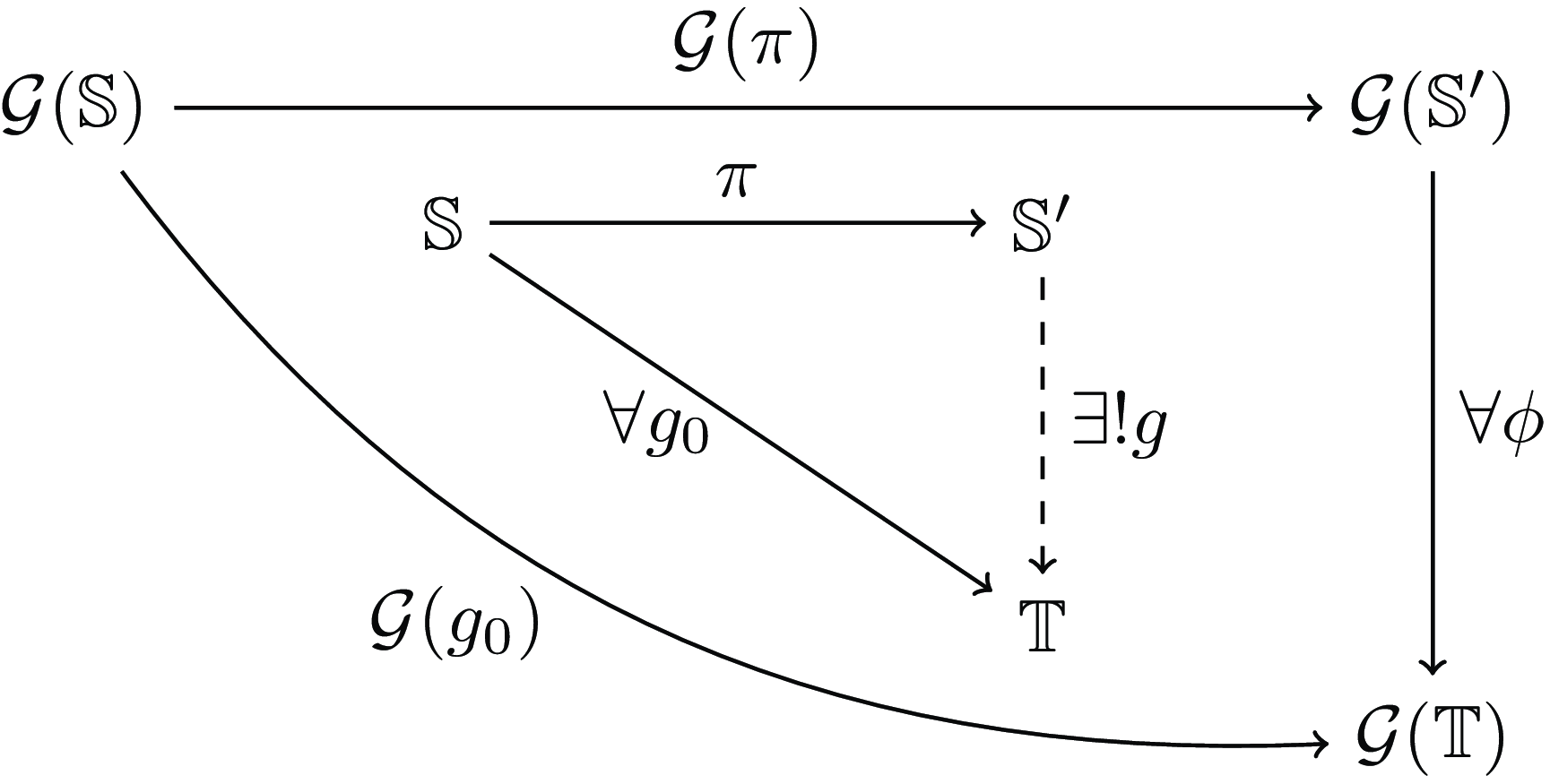
Definition 3.45. Let
 $\mathcal {U} : \textbf {T} \to \textbf {S}$
be a functor,
 $\mathbb {X}_0,\mathbb {X}\in \textbf {T}$
and
 $f_0: \mathbb {X}_0 \to \mathbb {X}$
. The morphism
 $f_0$
is
 $\mathcal {U}$
-final if for any
 $g_0 : \mathbb {X}_0 \to \mathbb {Y}$
in
 $\textbf {T}$
and arrow
 $\phi : \mathcal {U}(\mathbb {X}) \to \mathcal {U}(\mathbb {Y})$
in
 $\textbf {S}$
such that
 $\mathcal {U}(g_0)=\phi \circ \mathcal {U}(f_0)$
, there exists a unique
 $g : \mathbb {X} \to \mathbb {Y}$
such that
 $\mathcal {U}(g)=\phi$
and
 $g \circ f_0 = g_0$
.
For the rest of this section, let
 $\mathcal {G}$
and
 $\mathcal {V}$
be the forgetful functors from
 $\textbf {LMP}$
to
 $\textbf {Meas}$
and from
 $\textbf {LMP}$
to
 $\textbf {Set}$
, respectively. Next, we will briefly discuss
 $\mathcal {G}$
- and
 $\mathcal {V}$
-finality of zigzag morphisms.
Lemma 3.46.
Every surjective zigzag
 $\pi :\mathbb {S}\to \mathbb {S}'$
is
 $\mathcal {G}$
-final.
Proof.
Let
 $g_0:\mathbb {S}\to \mathbb {T}$
be a zigzag morphism and
 $\phi :\mathcal {G}(\mathbb {S}') \to \mathcal {G}(\mathbb {T})$
a measurable map such that
 $\mathcal {G}(g_0)=\phi \circ \mathcal {G}(\pi )$
. We complete the diagram in Figure 2 by defining
 $g:\mathbb {S}' \to \mathbb {T}$
by
 $g(\pi (s))=g_0(s)$
. To check well-definedness, assume that
 $\pi (s)=\pi (s')$
, which is the same as
 $\mathcal {G}(\pi )(s)=\mathcal {G}(\pi )(s')$
. By applying
 $\phi$
, we have
 $\mathcal {G}(g_0)(s)=\mathcal {G}(g_0)(s')$
by hypothesis, which is again the same as
 $g_0(s)=g_0(s')$
. As
 $g$
and
 $\phi$
coincide as maps between sets,
 $g$
is measurable. Let
 $B\subseteq T$
be measurable, then
 \begin{multline*} \tau _a^{\mathbb {T}}(g(\pi (s)),B)= \tau _a^{\mathbb {T}}(g_0(s),B) = \tau _a^{\mathbb {S}}(s,g_0^{-1}[B]) =\\ = \tau _a^{\mathbb {S}}(s,\pi ^{-1}[g^{-1}[B]]) = \tau _a^{\mathbb {S}'}(\pi (s),g^{-1}[B]). \end{multline*}
This proves that
 $g$
is zigzag. As
 $\mathcal {G}$
is faithful,
 $g$
is unique.
The projection
 $\pi$
is
 $(\textbf {LMP}\to \textbf {Meas})$
-final.

This result slightly strengthens the idea proposed in the last paragraph (Danos et al. (Reference Danos, Desharnais, Laviolette and Panangaden2006), Sect. 6), where epi-mono factorizations of zigzag morphisms are discussed. As it is expected, not all epimorphims behave as in other more structured categories:
Example 3.47. The map
 $\pi :\mathbb {S}\to \mathbb {S}/\Lambda$
may not be
 $\mathcal {V}$
-final. Take
 $\mathbb {S}\mathrel {\mathop :}= \mathbb {U}$
,
 $\Lambda \mathrel {\mathop :}= \mathcal {B}(I)\oplus \mathcal {P}(\{ s,t,x \})$
, the zigzag
 $\textrm {id}:\mathbb {U}\to \mathbb {U}$
, and the function
 $\phi :U/\mathcal {R}(\Lambda ) \to U$
given by
 $\phi (\pi (s))=s$
(this is well defined since
 $\mathcal {R}(\Lambda )$
is the identity relation). Then there is no measurable
 $g:\mathbb {U}/\Lambda \to \mathbb {U}$
such that
 $\textrm {id}=g\circ \pi$
and
 $\mathcal {V}(g)=\phi$
.
Since this
 $\mathbb {U}/\Lambda$
is isomorphic to
 $\mathbb {U}_B$
from Example 3.9, we have obtained that the identity morphism
 $\mathbb {U}\to \mathbb {U}_B$
is
 $\mathcal {G}$
-final but not
 $\mathcal {V}$
-final.
We will need the following basic result for studying
 $\mathcal {V}$
-finality:
Lemma 3.48 ((Danos et al. (Reference Danos, Desharnais, Laviolette and Panangaden2006), Lem. 4.5)). If
 $\pi : \mathbb {S} \to \mathbb {S}'$
is zigzag morphism, then
 $\{ \pi ^{-1}[Q] \mid Q \text { measurable in }\mathbb {S}' \}$
is a stable sub-
 $\sigma$
-algebra of
 $\Sigma$
.
Theorem 3.49.
Let
 $\pi : \mathbb {S} \to \mathbb {S}'$
be a surjective zigzag morphism,
 $R\mathrel {\mathop :}= \{ (s,t) \mid \pi (s) = \pi (t)\}$
be its kernel, and
 $\Lambda \mathrel {\mathop :}= \{ \pi ^{-1}[Q] \mid Q \text { measurable in }\mathbb {S}' \}$
. The following are equivalent:
-
1.
$\pi$
is
$\mathcal {V}$
-final.
-
2.
$\Lambda$
is the greatest stable sub-
$\sigma$
-algebra of
$\Sigma (R)$
.


Proof.
For 1
 $\Rightarrow$
2, first note that
 $\Lambda$
consists of
 $R$
-closed subsets by construction and it is stable by Lemma 3.48.
Assume
 $\Lambda _*$
is a stable sub-
 $\sigma$
-algebra of
 $\Sigma (R)$
. It follows that
 $R\subseteq \mathcal {R}(\Lambda _*)$
and there is a canonical map
 $\phi : \mathcal {V}(\mathbb {S}') \to \mathcal {V}(\mathbb {S}/\Lambda _*)$
satisfying
 $\phi \circ \mathcal {V}(\pi ) = \mathcal {V}(\pi _*)$
, where
 $\pi _* : \mathbb {S} \to \mathbb {S}/\Lambda _*$
is the projection zigzag. By considering
 $g_0$
in Figure 2 to be
 $\pi _*$
, there must exist a zigzag
 $g:\mathbb {S}' \to \mathbb {S}/\Lambda _*$
with
 $\mathcal {V}(g) =\phi$
making the diagram commute. We show that every
 $A\in \Lambda _*$
belongs to
 $\Lambda$
. Note that
 $A = \pi _*^{-1}[\pi _*[A]] =\pi ^{-1}[g^{-1}[\pi _*[A]]]$
; since
 $A\in \Lambda _*$
,
 $\pi _*[A]$
is measurable and one can take
 $Q\mathrel {\mathop :}= g^{-1}[\pi _*[A]]$
in the definition of
 $\Lambda$
.
For 2
 $\Rightarrow$
1, let
 $g_0:\mathbb {S}\to \mathbb {T}$
be a zigzag morphism and
 $\phi :\mathcal {V}(\mathbb {S}') \to \mathcal {V}(\mathbb {T})$
a map such that
 $\mathcal {V}(g_0)=\phi \circ \mathcal {V}(\pi )$
. Analogous to the proof of Lemma 3.46, let
 $g:\mathbb {S}' \to \mathbb {T}$
be given by
 $g(\pi (s))=g_0(s)$
. By Lemma 3.48,
 $\Theta \mathrel {\mathop :}= \{ g_0^{-1}[C] \mid C \text { measurable in }\mathbb {T} \}$
is stable. Since
 $ g_0^{-1}[C] = \pi ^{-1}[g^{-1}[C]]$
,
 $\Theta \subseteq \Sigma (R)$
and hence
 $\Theta \subseteq \Lambda$
by maximality.
We only have to check that
 $g$
is measurable. Take
 $B\subseteq T$
measurable; it is enough to show that
 $g^{-1}[B] = \pi [A]$
for some
 $A\in \Lambda$
. We choose
 $A\mathrel {\mathop :}= g_0^{-1}[B] \in \Theta \subseteq \Lambda$
. Hence,
 $\pi [A] = \pi [g_0^{-1}[B]] = \pi [\pi ^{-1}[g^{-1}[B]]] = g^{-1}[B]$
, by surjectivity of
 $\pi$
.
We immediately obtain:
Corollary 3.50.
Let
 $\Lambda \subseteq \Sigma$
be a stable
 $\sigma$
-algebra. The following are equivalent:
-
1.
$\pi :\mathbb {S} \to \mathbb {S}/\Lambda$
is
$\mathcal {V}$
-final.
-
2.
$\Lambda$
is the greatest stable sub-
$\sigma$
-algebra of
$\Sigma (\mathcal {R}(\Lambda ))$
.


In particular, if we alter the domain of the projection and view it as a function
 $\pi :(S,\Lambda, \{\tau _a\}_a) \to \mathbb {S}/\Lambda$
, we will always get a
 $\mathcal {V}$
-final morphism. A sufficient condition that appears in many contexts for
 $\mathcal {V}$
-finality (i.e., it implies the second item of Corollary 3.50) is
 $\Lambda =\Sigma (\mathcal {R}(\Lambda ))$
; we do not know if it is necessary.
Back to our discussion of bisimilarities, we can show:
Theorem 3.51.
The relation
 $\sim ^\vee$
coincides with the restriction of event bisimilarity on
 $\mathbb {S}\oplus \mathbb {S}'$
to
 $\textrm {inl}[S] \times \textrm {inr}[S']$
.
Proof.
The (
 $\Rightarrow$
) direction is Proposition 3.44. For (
 $\Leftarrow$
), assume
 $\textrm {inl}(s)$
and
 $\textrm {inr}(s')$
are event bisimilar in
 $\mathbb {S}\oplus \mathbb {S}'$
. Let
 $\Lambda$
be a stable
 $\sigma$
-algebra on
 $\mathbb {S}\oplus \mathbb {S}'$
such that
 $\textrm {inl}(s)\mathrel {\mathcal {R}(\Lambda )}\textrm {inr}(s')$
. Then,
 \begin{equation*}\mathbb {S} \xrightarrow {\pi \circ \, \textrm {inl}} (\mathbb {S}\oplus \mathbb {S}')/\Lambda \xleftarrow {\pi \circ \, \textrm {inr}} \mathbb {S}' \end{equation*}
is a cospan of zigzags witnessing
 $s\sim ^\vee s'$
.
Validity sets of formulas are preserved under sum, so we can conclude that
Corollary 3.52. External event bisimilarity coincides with logical equivalence.
Since internal bisimilarity implies event bisimilarity, we then have:
Corollary 3.53.
 $s \mathrel {(\sim _{\textsf {s}})}_\times s'$
implies
 $s\sim ^\vee s'$
.
3.4.2 From
$\vee$
to
$\wedge$
and coalgebraic bisimilarity


From Danos et al. (Reference Danos, Desharnais, Laviolette and Panangaden2006), we know that every span of LMP can be completed to a commutative square, and hence
 ${\sim ^\wedge } \subseteq {\sim ^\vee }$
holds in general. Whenever cospans can be completed to square, we have the reverse inclusion.
Lemma 3.54.
For every category of LMP having semi-pullbacks,
 ${\sim ^\wedge } = {\sim ^\vee }$
.
The hypothesis does not hold in general as it was shown in Sánchez Terraf (Reference Sánchez Terraf2011, Thm. 12). Nevertheless, a fair amout of research has been directed to the recovery of semi-pullbacks by considering LMP over better behaved spaces. An important antecedent is Edalat (Reference Edalat1999), which deals with LMP over analytic spaces with universally measurable transitions. Recall that Desharnais (Reference Desharnais1999) introduced generalized LMP to take advantage of this result. These are analogous to LMP with an analytic state space, but the functions
 $\tau _a(\cdot, A)$
are only required to be universally measurable for each
 $A\in \Sigma$
.
Later, it was proved that the category of LMP over analytic spaces has semi-pullbacks (more precisely, for the category of stochastic relations over analytic spaces), and furthermore, the upper vertex of the required span can be chosen to be Polish (Doberkat (Reference Doberkat2005a), Thm. 5.2).
The most recent results in this direction ensure the existence of semi-pullbacks for LMP over separable metrizable spaces where
 $\tau _a(s,\cdot )$
is a Radon measure for each
 $s$
and
 $a$
(Pachl and Sánchez Terraf (Reference Pachl and Sánchez Terraf2021), Thm. 5.1) and, in particular, for LMP over universally measurable separable spaces (Pachl and Sánchez Terraf (Reference Pachl and Sánchez Terraf2021), Thm. 5.3).
It can be checked from the proofs in Pachl and Sánchez Terraf (Reference Pachl and Sánchez Terraf2021) that the semi-pullbacks constructed in each case turn out to be pullbacks in
 $\textbf {Set}$
and therefore they are relations. We conclude:
Theorem 3.55.
Coalgebraic bisimilarity
 $\sim ^\Delta$
, external event bisimilarity
 $\sim ^\vee$
, and hence also categorical bisimilarity
 $\sim ^\wedge$
are all the same on the categories of LMP over:
-
1. universally measurable separable spaces;
-
2. coanalytic sets; and
-
3. Doberkat (Reference Doberkat2005a) analytic sets.
3.5 External bisimilarities based on sums
Now in the general setting of two possibly different LMP
 $\mathbb {S}$
and
 $\mathbb {S}'$
, one possibility is the approach taken in Desharnais (Reference Desharnais1999, Def. 3.5.1). We adapt the name of the bisimulation defined there to our purposes.
Definition 3.56. An
 $\oplus$
-bisimulation (read “oplus bisimulation”) between
 $\mathbb {S}$
and
 $\mathbb {S'}$
is an equivalence relation
 $R$
on
 $S\oplus S'$
such that for
 $s \in S$
and
 $s' \in S'$
with
 $\textrm {inl}(s)\mathrel {R}\textrm {inr}(s')$
, and for every
 $A\oplus A'\in (\Sigma \oplus \Sigma ')(R)$
, the following holds:
 \begin{equation*} \forall a\in L \; \tau _a(s,A)=\tau _a'(s',A').\end{equation*}
We mentioned that the interest in defining an external state bisimulation
 $R$
is to detect two bisimilar states, one in each process. The above definition takes this premise to the extreme: it does not impose any conditions on the Markov kernel values for pairs of states in the same process; the only requirement is that the relation is an equivalence. This is unfortunate because, for instance, such a relation restricted to the first space could identify points that are not
 $R$
-related to any other in the second space. In an extreme case,
 $R$
could be the union of two equivalence relations, one in each process.
Based on the definition of
 $\tau ^\oplus$
and the equivalence (2), we can see that the condition for being an
 $\oplus$
-bisimulation is the same as that of internal bisimulations in
 $\mathbb {S}\oplus \mathbb {S}'$
, except that it applies to fewer pairs. From this, we immediately deduce the following straightforward result.
Lemma 3.57.
If
 $R$
is an internal bisimulation on the sum
 $\mathbb {S}\oplus \mathbb {S'}$
and is an equivalence relation, then it is an
 $\oplus$
-bisimulation between
 $\mathbb {S}$
and
 $\mathbb {S'}$
.
In particular, this implies that state bisimilarity on
 $\mathbb {S}\oplus \mathbb {S'}$
is an
 $\oplus$
-bisimulation. On the other hand, considering the observation following Definition 3.56, it is clear that not every
 $\oplus$
-bisimulation
 $R$
is an internal bisimulation on
 $\mathbb {S}\oplus \mathbb {S'}$
. For example, the relation
 $R=\textrm {id}_{U\oplus U}\cup \{(\textrm {inl}(s),\textrm {inl}(t)),(\textrm {inl}(t),\textrm {inl}(s))\}$
is an
 $\oplus$
-bisimulation between
 $\mathbb {U}$
and
 $\mathbb {U}$
, but this relation is not an internal bisimulation in
 $\mathbb {U}\oplus \mathbb {U}$
because
 $V\oplus \varnothing$
is
 $R$
-closed. Furthermore, it cannot be contained in any internal bisimulation on the sum, as shown in Proposition 3.13.
We complete Definition 3.56 with the corresponding bisimilarity. Instead of defining it as a relation on the sum, to facilitate comparisons with other bisimilarity relations, we will define it as follows:
Definition 3.58. If
 $s\in S$
and
 $s'\in S'$
, we will say that
 $s\sim ^\oplus s'$
if there exists an
 $\oplus$
-bisimulation
 $R$
between
 $\mathbb {S}$
and
 $\mathbb {S'}$
such that
 $(\textrm {inl}(s),\textrm {inr}(s'))\in R$
.
This way,
 ${\sim ^\oplus }\subseteq S\times S'$
, and therefore it cannot be an
 $\oplus$
-bisimulation. Note that in the definition, we state that two states can be
 $\oplus$
-bisimilar only if they are in different summands.
It is worth noting that if
 $R$
is an
 $\oplus$
-bisimulation, then its descent (6)
 $R_\times$
is a subset of
 ${\sim }^\oplus$
. If we write
 $T$
to be the union of all
 $\oplus$
-bisimulations (which is the usual way to define bisimilarity), then it follows that
 $T_\times ={\sim }^\oplus$
.
From this, we can conclude a simple consequence of the previous Lemma 3.57:
Corollary 3.59.
 $({\sim }_{\textsf {s}})_\times \subseteq {\sim }^\oplus$
.
The reverse inclusion does not hold. Following Lemma 3.57, we have given an example showing that not every
 $\oplus$
-bisimulation is an internal bisimulation on
 $\mathbb {S}\oplus \mathbb {S'}$
. We will see in the next example that we can also have an
 $\oplus$
-bisimulation
 $R$
between
 $\mathbb {S}$
and
 $\mathbb {S'}$
such that
 $R_\times$
cannot be included in any
 $\times$
-bisimulation. In particular,
 $R\cap (\textrm {inl}[S]\times \textrm {inr}[S'])$
does not lie within any internal bisimulation on the sum.
Example 3.60. Consider
 $\mathbb {U}_B$
from Example 3.9 and versions of
 $(\mathbb {U}_B)_s$
and
 $(\mathbb {U}_B)_t$
(cfr. Example 3.30) where the
 $\infty$
-label kernels have been replaced by
 \begin{equation*} \begin{aligned} \tau ^{(\mathbb {U}_B)_s}_\infty (r,A)&\mathrel {\mathop :}= \chi _{\{s \}}(r)\cdot \mathfrak {m}(A), \\ \tau ^{(\mathbb {U}_B)_t}_\infty (r,A)&\mathrel {\mathop :}= \chi _{\{t \}}(r)\cdot \bigl ( \tfrac {1}{2} \cdot \delta _{\frac {1}{4}}(A\cap (0,\tfrac {1}{2})) + \mathfrak {m}(A\cap [\tfrac {1}{2},1))\bigr ). \end{aligned} \end{equation*}
First, let us show that
 $s$
and
 $t$
are not logically equivalent. Note that
 $\forall q\in I\cap \mathbb {Q} \, {[\![ {\langle q \rangle }_{\geq 1}\top ]\!]} = B_q$
. For any
 $q\in I\cap \mathbb {Q}$
such that
 $q\lt \frac {1}{4}$
, a state
 $r$
satisfies
 ${\langle \infty \rangle }_{\geq q}{\langle q \rangle }_{\geq 1}\top$
if and only if
 $\tau _\infty (r,B_q)\geq q$
. Given that
 $\tau ^{(\mathbb {U}_B)_s}_\infty (s,B_q)=q$
and
 $\tau ^{(\mathbb {U}_B)_t}_\infty (t,B_q)=0$
, we can distinguish
 $s$
and
 $t$
with a formula.
Now, take any non-Borel
 $D \subseteq (\frac {1}{2},1)$
. Let
 $R$
be the equivalence relation on the sum
 $(\mathbb {U}_B)_s \oplus (\mathbb {U}_B)_t$
whose equivalence classes are
 $\{\textrm {inl}(s),\textrm {inr}(t)\}$
,
 $\{ \textrm {inl}(r),\textrm {inr}(r)\}$
with
 $r\in D\cup \{x\}$
,
 $\{\textrm {inl}(r)\mid r\in I\smallsetminus D \}$
, and
 $\{\textrm {inr}(r)\mid r\in I\smallsetminus D\}$
. That is,
 $R$
identifies
 $s$
and
 $t$
, each point in
 $D\cup \{x\}$
with its copy on the other process, and clusters each copy of the set
 $I\smallsetminus D$
independently. We will show that
 $R$
is an
 $\oplus$
-bisimulation.
Let
 $A$
be an
 $R$
-closed measurable set. Proving that the
 $\oplus$
-bisimulation definition holds for pairs
 $(\textrm {inl}(r),\textrm {inr}(r))$
is direct, as
 $\textrm {inl}(x)\in A \iff \textrm {inr}(x)\in A$
is true.
For
 $(\textrm {inl}(s),\textrm {inr}(t))$
, we need to show that
 $\tau _\infty ^\oplus (\textrm {inl}(s),A) = \tau _\infty ^\oplus (\textrm {inr}(t),A)$
. If
 $A$
has empty intersection with
 $I\smallsetminus D\oplus I\smallsetminus D$
, it is of the form
 $B\oplus B$
with
 $B$
Borel measurable and the conclusion holds.
Otherwise, and without loss of generality,
 $\textrm {inl}(r)\in A$
for some
 $r\in I\smallsetminus D$
. Then
 $\textrm {inl}[I\smallsetminus D]\subseteq A$
. Note also that
 $\textrm {inr}[(A\cap \textrm {inl}[D])\upharpoonright (\mathbb {U}_B)_s] = A \cap \textrm {inr}[D]$
. Moreover, given that
 $A\cap \textrm {inl}[I]$
is Borel, it must be the case that
 $A\cap \textrm {inl}[D]$
is not in
 $\mathcal {B}(I)$
, otherwise
 $D$
would be Borel. Therefore,
 $A\cap \textrm {inr}[D] \subsetneq A \cap \textrm {inr}[I]$
and finally
 $\textrm {inr}[I\smallsetminus D]\subseteq A$
.
Hence,
 $A\cap (I\oplus I)$
can only be of the form
 $B\oplus B$
where
 $B$
is a Borel subset of
 $I$
satisfying
 $B\subset D$
or
 $I\smallsetminus D \subset B$
. As a consequence, the required measures coincide.
Note that all cases have been considered, as an
 $\oplus$
-bisimulation only requires checking states in different summands. Thus, the relation
 $R$
witnesses that
 $s\sim ^\oplus t$
. In summary,
 ${\sim }^\oplus \nsubseteq {\sim }^\vee$
.
Using this Example and Corollary 3.53, we conclude that
 ${\sim }^\oplus \nsubseteq ({\sim }_{\textsf {s}})_\times$
. Moreover, Corollary 3.25 then implies that
 ${\sim }^\oplus \nsubseteq {\sim }^\times$
.
Next, we will explore a connection between
 $\oplus$
- and
 $\times$
-bisimulations. Corollaries 3.59 and 3.25 indicate that
 ${\sim }^\times \subseteq ({\sim }_{\textsf {s}})_\times \subseteq {\sim }^\oplus$
. We observe that in Example 3.60, the equivalence relation there is not measurable. In the following, we will give sufficient measurability conditions for
 $R_\times$
to be an
 $\times$
-bisimulation whenever
 $R$
is an
 $\oplus$
-bisimulation.
The following concept will be useful: a pair
 $(A,A')$
is saturated if
 $R[A]=A'$
and
 $A=R^{-1}[A']$
.
Lemma 3.61.
Let
 $R$
be an
 $\oplus$
-bisimulation between
 $\mathbb {S}$
and
 $\mathbb {S'}$
.
-
1. If
$(A,A')$
is a
$R_\times$
-saturated pair, then
$A\oplus A'$
is
$R$
-closed.
-
2. If
$\textrm {dom}(R_\times )\in \Sigma$
, then
$\forall s\in \textrm {dom}(R_\times )\; \forall a\in L \; \tau _a(s,S\smallsetminus \textrm {dom}(R_\times ))=0$
.


Proof.
For the first part, let
 $x\in A$
and consider the case
 $\textrm {inl}(x)\mathrel {R}\textrm {inr}(y)$
. Since
 $R_\times [A]\subseteq A'$
, we have
 $y\in A'$
. Now suppose
 $\textrm {inl}(x)\mathrel {R}\textrm {inl}(y)$
. Since
 $(A,A')$
is saturated, there exists
 $x'\in A'$
such that
 $x\mathrel {R_\times } x'$
. Hence,
 $\textrm {inl}(x)\mathrel {R} \textrm {inr}(x')$
. Since
 $R$
is an equivalence relation, we have
 $\textrm {inl}(y)\mathrel {R} \textrm {inr}(x')$
, and as
 $(R_\times )^{-1}[A']\subseteq A$
, we conclude that
 $y\in A$
. The case for
 $x$
such that
 $\textrm {inr}(x)\mathrel {R}z$
for some
 $z$
is similar.
For the second item, we first prove that
 $S_{\textrm {anti}}\mathrel {\mathop :}= (S\smallsetminus \textrm {dom}(R_\times ))\oplus \varnothing$
is
 $R$
-closed: let
 $\textrm {inl}(x)\in S_{\textrm {anti}}$
and assume that
 $\textrm {inl}(x)\mathrel {R} z$
for some
 $z$
. Then, there exists
 $y$
such that
 $z=\textrm {inl}(y)$
. Otherwise, we would immediately have
 $x\in \textrm {dom}(R_\times )$
. Now, by way of contradiction, assume
 $y\in \textrm {dom}(R_\times )$
. Then there exists
 $y'\in \textrm {img}(R_\times )$
such that
 $y\mathrel {R_\times } y'$
. Consequently,
 $\textrm {inl}(y)\mathrel {R} \textrm {inr}(y')$
, and by transitivity of
 $R$
, we have
 $\textrm {inl}(x)\mathrel {R}\textrm {inr}(y')$
. Thus,
 $x\in \textrm {dom}(R_\times )$
, which is a contradiction.
Now, consider
 $s'\in \textrm {img}(R_\times )$
such that
 $s\mathrel {R_\times } s'$
. Since
 $S_{\textrm {anti}}$
is
 $R$
-closed and measurable, for all
 $a\in L$
, we conclude
 \begin{equation*} \tau _a(s,S\smallsetminus \textrm {dom}(R_\times )) = \tau _a^\oplus (\textrm {inl}(s),S_{\textrm {anti}}) = \tau _a^\oplus (\textrm {inr}(s'),S_{\textrm {anti}}) = \tau '_{\!\!a}(s',\varnothing ) = 0. \end{equation*}
Proposition 3.62.
Let
 $R$
be an
 $\oplus$
-bisimulation between
 $\mathbb {S}$
and
 $\mathbb {S'}$
such that
 $\textrm {dom}(R_\times )\in \Sigma$
and
 $\textrm {img}(R_\times )\in \Sigma '$
, then
 $R_\times$
is a
 $\times$
-bisimulation.
Proof.
First, we note that
 $(\textrm {dom}(R_\times ),\textrm {img}(R_\times ))$
is a
 $R_\times$
-saturated pair. If
 $(s,s')\in R_\times$
, by Lemma 3.61(1), we have
 $\tau _a(s,\textrm {dom}(R_\times )) = \tau '_{\!\!a}(s',\textrm {img}(R_\times ))$
. We use this equality along with the fact that
 $S\oplus S'$
is
 $R$
-closed and Lemma 3.61(2) to calculate
 $\tau '_{\!\!a}(s',S'\smallsetminus \textrm {img}(R_\times ))= \tau '_{\!\!a}(s',S')-\tau '_{\!\!a}(s',\textrm {img}(R_\times ) = \tau _a(s,S)-\tau _a(s,\textrm {dom}(R_\times )) = \tau _a(s,S\smallsetminus \textrm {dom}(R_\times ))=0$
.
Now, let
 $(A,A')$
be a
 $R_\times$
-closed measurable pair. We write
 \begin{align*} A &= (A\cap \textrm {dom}(R_\times )) \cup (A\smallsetminus \textrm {dom}(R_\times )) = \mathrel {\mathop :} A_{\textrm {sat}}\cup A_{\textrm {anti}},\\ A' &= (A'\cap \textrm {img}(R_\times )) \cup (A'\smallsetminus \textrm {img}(R_\times )) = \mathrel {\mathop :} A'_{\textrm {sat}}\cup A'_{\textrm {anti}}. \end{align*}
We observe that
 $(A_{\textrm {sat}},A'_{\!\!\textrm {sat}})$
is a
 $R_\times$
-saturated measurable pair,
 $A_{\textrm {anti}}\subseteq S\smallsetminus \textrm {dom}(R_\times )$
, and
 $A'_{\!\textrm {anti}}\subseteq S'\smallsetminus \textrm {img}(R_\times )$
. Therefore,
 $\tau _a(s,A_{\textrm {sat}})= \tau '_{\!\!a}(s',A'_{\!\!\textrm {sat}})$
;
 $\tau _a(s,A_{\textrm {anti}})\leq \tau _a(s,S\smallsetminus \textrm {dom}(R_\times ))=0$
, and
 $\tau '_{\!\!a}(s',A'_{\!\!\textrm {anti}})\leq \tau '_{\!\!a}(s',S'\smallsetminus \textrm {img}(R_\times ))=0$
. Hence,
 \begin{align*} \tau _a(s,A) &= \tau _a(s,A_{\textrm {sat}})+ \tau _a(s,A_{\textrm {anti}}) = \tau _a(s',A'_{\!\!\textrm {sat}}) + 0 \\ &= \tau '_{\!\!a}(s',A'_{\!\!\textrm {sat}}) + \tau '_{\!\!a}(s',A'_{\!\!\textrm {anti}}) = \tau _a(s',A'). \end{align*}
Corollary 3.63.
If
 $\textrm {dom}(({\sim }_{\textsf {s}})_\times )\in \Sigma$
and
 $\textrm {img}(({\sim }_{\textsf {s}})_\times )\in \Sigma '$
, then
 $({\sim }_{\textsf {s}})_\times = {\sim ^\times }$
.
Proposition 3.62 also gives some insight about logical equivalence versus
 $\oplus$
-bisimulation. Notice that in
 $\mathbb {U}_s\oplus \mathbb {U}_t$
, the logical equivalence cannot be an
 $\oplus$
-bisimulation, since
 $s$
and
 $t$
are externally bisimilar. In spite of this, the following question remains.
Question 3.64.
If two states satisfy the same formulas, are they related by some
 $\oplus$
-bisimulation?
Another discussion that arises with the
 $\oplus$
-bisimulation approach is that in the case of
 $\mathbb {S}=\mathbb {S}'$
, we would like to reconcile this definition with that of internal state bisimulations. However, we cannot make a direct comparison since by definition
 $\oplus$
-bisimulations are equivalences on
 $S\oplus S$
, and hence subsets of
 $(S\oplus S)\times (S\oplus S)$
; in contrast, internal bisimulations are relations on
 $S$
, that is, subsets of
 $S\times S$
. We highlight this difference by stating that these concepts have different “type.”
We can make a statement in one direction: by Lemma 3.11(2), we know that if
 $R\subseteq S\times S$
is an internal state bisimulation and an equivalence relation, then
 $R^+$
is an internal bisimulation on
 $\mathbb {S}\oplus \mathbb {S}$
and an equivalence relation. By Lemma 3.57,
 $R^+$
is also a
 $\oplus$
-bisimulation between
 $\mathbb {S}$
and
 $\mathbb {S}$
. In the case of
 ${\sim }_{\textsf {s}}$
, Proposition 3.13 even tells us that
 ${\sim }_{\textsf {s}} = (({\sim _{\textsf {s}}})^+)_\times = ({\sim }_{\textsf {s},\mathbb {S}\oplus \mathbb {S}})_\times =(\sim _{\textsf {s}})_\times \subseteq {\sim }^\oplus$
.
3.5.1 From
$\oplus$
-bisimilarity to events

In Panangaden (Reference Panangaden2009, Def. 7.2), a different definition of
 $\oplus$
-bisimulation is presented. In this variation, the equivalence relation is not required to be within the sum
 $S \oplus S'$
, but rather within a possibly larger process of which
 $\mathbb {S}$
and
 $\mathbb {S}'$
are direct summands. To provide clarity, we have rephrased this definition to explicitly specify the necessary inclusions.
Definition 3.65. Let
 $\mathbb {S}$
and
 $\mathbb {S}'$
be a pair of LMPs and
 $s\in S, s'\in S'$
. We say that
 $s$
and
 $s'$
are
 $\oplus _{\textrm {P}}$
-bisimilar if there is a process
 $\mathbb {W}$
and a state bisimulation equivalence on
 $(\mathbb {S}\oplus \mathbb {S}')\oplus \mathbb {W}$
relating
 $\textrm {inl}(\textrm {inl}(s))$
and
 $\textrm {inl}(\textrm {inr}(s'))$
.
In what follows we will show that this notion is the same as external event bisimilarity, that is,
 $\sim ^\vee$
.
Lemma 3.66.
Let
 $\mathbb {T}=(T,\Sigma, \{\tau _a\mid a\in L\})$
be an LMP, and consider the LMP
 $\mathbb {T}_{\textsf {e}}\mathrel {\mathop :}= (T,\sigma ({[\![ \mathcal {L} ]\!]}),\{\tau _a\mid a\in L\})$
. Then
 ${\sim _{{\textsf {e}},\mathbb {T}}} = {\sim _{{\textsf {e}},\mathbb {T}_{\textsf {e}}}} = {\sim _{\textsf {s},\mathbb {T}_{\textsf {e}}}}$
.
Proof.
For the first equality, we use the zigzag morphism
 $\textrm {id}:\mathbb {T}\to \mathbb {T}_{\textsf {e}}$
to obtain
 ${[\![ \mathcal {L} ]\!]}_{\mathbb {T}}= \textrm {id}^{-1}[{[\![ \mathcal {L} ]\!]}_{\mathbb {T}_{\textsf {e}}}] = {[\![ \mathcal {L} ]\!]}_{\mathbb {T}_{\textsf {e}}}$
. Thus, we have the identities
 ${\sim _{{\textsf {e}},\mathbb {T}}} = \mathcal {R}(\sigma ({[\![ \mathcal {L} ]\!]}_{\mathbb {T}})) = \mathcal {R}(\sigma ({[\![ \mathcal {L} ]\!]}_{\mathbb {T}_{\textsf {e}}}))= {\sim _{{\textsf {e}},\mathbb {T}_{\textsf {e}}}}$
.
For the last equality, we only have to show that
 $\sim _{{\textsf {e}},\mathbb {T}_{\textsf {e}}}$
is a state bisimulation in
 $\mathbb {T}_{\textsf {e}}$
. This is immediate from the equality
 $\sigma ({[\![ \mathcal {L} ]\!]}_{\mathbb {T}_{\textsf {e}}})=\sigma ({[\![ \mathcal {L} ]\!]}_{\mathbb {T}_{\textsf {e}}})(\sim _{{\textsf {e}},\mathbb {T}_{\textsf {e}}})$
.
The second equality can also be seen immediately since the Zhou filtration is monotone increasing from
 $\sigma ({[\![ \mathcal {L} ]\!]})$
to
 $\Sigma$
(Moroni and Sánchez Terraf (Reference Moroni and Sánchez Terraf2023), Figure 2). The same analysis shows that there are other
 $\sigma$
-algebras with this property.
Lemma 3.67.
Let
 $\mathbb {T}, \mathbb {T}'$
be LMPs and
 $x,y\in T'$
. If
 $x\sim _{*,\mathbb {T}'} y$
, then
 $\textrm {inr}(x)\sim _{*,\mathbb {T}\oplus \mathbb {T}'} \textrm {inr}(y)$
for
 $*\in \{\textsf {s},\textsf {e}\}$
.
Proof.
The inclusion of
 $\mathbb {T}'$
into
 $\mathbb {T}\oplus \mathbb {T}'$
is a zigzag. It follows that for all
 $z\in T'$
,
 $z$
, and
 $\textrm {inr}(z)$
are logically equivalent. Thus, the result for
 $\sim _{\textsf {e}}$
follows from the logical characterization of event bisimilarity and the transitivity of the logical equivalence.
In the case of state bisimilarity, we recall that the lift
 $R_r$
(3) of a state bisimulation
 $R$
in
 $\mathbb {T}'$
is a state bisimulation on
 $\mathbb {T}\oplus \mathbb {T}'$
.
Notice that in the case of event bisimilarity, the converse implication is also true.
Corollary 3.68.
If
 $i \sim _{{\textsf {e}},\mathbb {T}} x$
, then
 $\textrm {inl}(i),\textrm {inr}(i),\textrm {inl}(x)$
and
 $\textrm {inr}(x)$
are all in the same
 $(\sim _{\textsf {s},\mathbb {T}\oplus \mathbb {T}_{\textsf{e}}})$
-equivalence class.
Proof.
If
 $i \sim _{{\textsf {e}},\mathbb {T}} x$
, by Lemma 3.66, we have
 $i \sim _{\textsf {s},\mathbb {T}_{\textsf {e}}} x$
. Thanks to Lemma 3.67, we conclude
 $\textrm {inr}(i) \sim _{\textsf {s},\mathbb {T}\oplus \mathbb {T}_{\textsf {e}}} \textrm {inr}(x)$
. We now notice that the relation
 $\{(\textrm {inl}(t),\textrm {inr}(t))\mid t\in T\}$
in
 $\mathbb {T}\oplus \mathbb {T}_{\textsf {e}}$
is a state bisimulation as it is the lifting of the graph of the zigzag morphism
 $\textrm {id}:\mathbb {T}\to \mathbb {T}_{\textsf {e}}$
(Lemma 3.28 and Proposition 3.23(2)). From this and the fact that
 $\sim _{\textsf {s}, \mathbb {T}\oplus \mathbb {T}_{\textsf {e}}}$
is an equivalence, we have to the result.
Theorem 3.69.
 $s\sim ^\vee s'$
if and only if they are
 $\oplus _{\textsf {P}}$
-bisimilar.
Proof.
If
 $s\sim ^\vee s'$
, via Theorem3.51 we have that
 $s\sim _{{\textsf {e}},\mathbb {S}\oplus \mathbb {S}'} s'$
. Corollary 3.68 applied to
 $\mathbb {T}=\mathbb {S}\oplus \mathbb {S}'$
, says that they are state bisimilar in
 $(\mathbb {S}\oplus \mathbb {S}')\oplus (\mathbb {S}\oplus \mathbb {S}')_{\textsf {e}}$
(strictly speaking,
 $\textrm {inl}(\textrm {inl}(s)) \sim _{\textsf {s},(\mathbb {S}\oplus \mathbb {S}')\oplus (\mathbb {S}\oplus \mathbb {S}')_{\textsf {e}}} \textrm {inl}(\textrm {inr}(s'))$
). Then
 $s$
and
 $s'$
are
 $\oplus _{\textsf {P}}$
-bisimilar.
For the converse, if
 $s$
and
 $s'$
are
 $\oplus _{\textsf {P}}$
-bisimilar then
 $\textrm {inl}(s)$
and
 $\textrm {inr}(\textrm {inl}(s'))$
are state bisimilar in
 $\mathbb {S}\oplus (\mathbb {S}'\oplus \mathbb {W})$
for some
 $\mathbb {W}$
, and therefore also event bisimilar in that process. By Theorem3.51, this implies that there is a cospan
 $\mathbb {S}\rightarrow \mathbb {T} \leftarrow \mathbb {S}'\oplus \mathbb {W}$
which identifies
 $s$
and
 $\textrm {inl}(s')$
. Composing this cospan with the zigzag inclusion
 $\textrm {inl}:\mathbb {S}'\to \mathbb {S}'\oplus \mathbb {W}$
leads to
 $s\sim ^\vee s'$
.
3.6 Comparison of notions for LMP and related work
Table 1 summarizes the relationships between the different definitions of bisimilarity between two LMPs
 $\mathbb {S}$
and
 $\mathbb {S}'$
studied up to this point. The entry with indices
 $(i,j)$
contains the symbol ✓ if the bisimilarity corresponding to row
 $i$
is included in the bisimilarity of column
 $j$
; it contains the symbol ✗ when the inclusion fails; or ? with its obvious meaning. Each cell also includes an indication for the justification of each assertion, which may be a reference to a result, a word suggesting the answer, or a reference to another cell
 $(i,j)$
in the same table (
 $(2,5)$
corresponds to the cell
 ${\sim }^\wedge \subseteq {\sim }^\vee$
). Note that there are some double-symbol entries in the table, in which references are given for the known inclusions or their failures, either in the literature or as a result proved here.
Comparison between bisimilarity notions

It is worth noting that some of those results that follow “by transitivity” in our diagram have appeared in previous works, but not with the exact same statement, or only with a hint of proof – our generous sample of counterintuive examples ask for detailed proofs of all alleged results. For instance, cell
 $(2,4)$
is implicit in Danos et al. (Reference Danos, Desharnais, Laviolette and Panangaden2006, p.515), but in that paper, all zigzag morphisms are considered to be surjective. In the same direction,
 $(2,3)$
is somewhat implicit in the proof of
 $(1,3)$
from Bacci (Reference Bacci2013), but otherwise taken for granted. In any case, our Proposition 3.36 invoked for that proof is also new, in that it provides a “local” argument (which holds for each pair of states) and again does not require surjectivity. The weaker Lemma 3.28 also seems to be new (in this form); there are some antecedents to it in Doberkat and Sánchez Terraf (Reference Doberkat and Sánchez Terraf2017, Prop. 3.6, Thm. 4.5), but these only refer to internal notions and require symmetry of the bisimulation relation.
There are some relations between already known notions that do not appear in the table since they are actually equalities. For example, Theorem3.51 shows that
 $\sim ^\vee$
is the same as (internal) event bisimilarity in the sum; the same observations from the previous paragraph apply to this equality. The other notion we proved to be equal to
 $\sim ^\vee$
is Panangaden’s
 $\oplus _{\textrm {P}}$
-bisimilarity.
4. Nondeterministic Processes
NLMPs were introduced in D’Argenio et al. (Reference D’Argenio, Wolovick, Sánchez Terraf and Celayes2009) and Wolovick (Reference Wolovick2012) as an alternative to include internal nondeterminism in LMP. This is achieved by modifying the codomain of the transition functions, now denoted by
 $\textsf {T}_a$
, to return a measurable set of subprobability measures for each state, as opposed to an LMP where there is only one measure for each label. Formally, let
 $\Delta (\Sigma )$
be the smallest
 $\sigma$
-algebra that makes all the evaluation functions
 $\textrm {ev}_E:\Delta (S) \to [0,1]$
measurable with respect to
 $\mathcal {B}([0, 1])$
. Then the values of
 $\textsf {T}_a$
range over
 $\Delta (\Sigma )$
.
In the following, we will need some notation for certain prominent sets of measures: if
 $E\in \Sigma$
and
 ${ \bowtie } \in \{\lt, \leq, \gt, \geq \}$
,
 $\Delta ^{\bowtie q}(E)$
denotes the set
 $\{ \mu \in \Delta (S) \mid \mu (E)\bowtie q \}$
. The family
 $\mathcal {C}_0$
, consisting of all these sets for
 ${\bowtie } = {\gt }$
,
 $q\in \mathbb {Q}\cap [0,1]$
, and
 $E\in \Sigma$
, generates the
 $\sigma$
-algebra. In general, if
 $\Gamma \subseteq \Sigma$
,
 $\Delta (\Gamma )\mathrel {\mathop :}= \sigma ( \{\Delta ^{\gt q}(E)\mid E\in \Gamma \})$
.
The definition of
 $\textsf {T}_a$
also requires such transition functions to be measurable, but this first demands a
 $\sigma$
-algebra over the set
 $\Delta (\Sigma )$
.
Definition 4.1. Given a set
 $X$
and a family
 $\Gamma \subseteq \mathcal {P}(X)$
, the hit
 $\sigma$
-algebra
 $H(\Gamma )$
is the smallest
 $\sigma$
-algebra on
 $\Gamma$
that contains all sets
 $H_D\mathrel {\mathop :}= \{G\in \Gamma \mid G\cap D \neq \varnothing \}$
with
 $D \in \Gamma$
.
The candidate
 $\sigma$
-algebra on
 $\Delta (\Sigma )$
is then
 $H(\Delta (\Sigma ))$
. This choice is motivated by the need to have measurable validity sets for the formulas (5) of the modal logic
 $\mathcal {L}$
. In the case of a formula with modality
 $\langle a \rangle _{\bowtie \, q}$
, the standard semantics yields
 \begin{align*} {[\![ {\langle a \rangle _{\bowtie \, q}}\varphi ]\!]} & =\{s\in S\mid \exists \mu \in \textsf {T}_a(s)\; \mu ({[\![ \varphi ]\!]})\bowtie q\}\\ & =\{s\in S\mid \textsf {T}_a(s)\cap \Delta ^{\bowtie q}({[\![ \varphi ]\!]})\neq \varnothing \}\\ & =\textsf {T}_a^{-1}\bigl [\{D\in \Delta (\Sigma )\mid D\cap \Delta ^{\bowtie q}({[\![ \varphi ]\!]})\neq \varnothing \}\bigr ] =\textsf {T}_a^{-1}[H_{\Delta ^{\bowtie q}({[\![ \varphi ]\!]})}]. \end{align*}
Therefore, if
 $[\![ \varphi ]\!]$
is measurable, the measurability of
 $[\![ {\langle a \rangle _{\bowtie \, q}}\varphi ]\!]$
is guaranteed since then
 $H_{\Delta ^{\bowtie q}({[\![ \varphi ]\!]})}\in H(\Delta (\Sigma ))$
.
Definition 4.2. A nondeterministic labelled Markov process, or NLMP, is a structure
 $\mathbb {S} =(S,\Sigma, \{\textsf {T}_a\mid a\in L\})$
where
 $\Sigma$
is a
 $\sigma$
-algebra over the state set
 $S$
, and for each label
 $a\in L$
,
 $\textsf {T}_a:(S,\Sigma )\to (\Delta (\Sigma ),H(\Delta (\Sigma )))$
is measurable. We say that
 $\mathbb {S}$
is image-finite (countable) if all sets
 $\textsf {T}_a(s)$
are finite (countable). NLMPs that are not image-countable are called image-uncountable.
Originally, the definition of NLMP in D’Argenio et al. (Reference D’Argenio, Wolovick, Sánchez Terraf and Celayes2009) required that the measures be probabilities except that the null kernel
 $\tau _a(s,\cdot )=0$
was allowed in order to indicate that the action
 $a$
was rejected in state
 $s$
with certainty. In this work, we will continue working with subprobabilities to allow a smooth generalization of LMP.
Example 4.3 (LMP as NLMP). An LMP
 $\mathbb {S}$
can be seen as an NLMP without internal nondeterminism, that is, a process where
 $\textsf {T}_a(s)$
is a singleton for each
 $a\in L$
and
 $s\in S$
. The only requirement is that the sets
 $\{ \mu \}$
are measurable in
 $\Delta (S)$
, so
 $\textsf {T}_a(s)=\{\tau _a(s,\cdot )\}\in \Delta (\Sigma )$
. A sufficient condition is that
 $\Sigma$
is generated by a countable algebra. A modification of the proof of (D’Argenio et al. (Reference D’Argenio, Wolovick, Sánchez Terraf and Celayes2009), Lem. 3.1) using the Monotone Class Theorem provides a proof.
In D’Argenio et al. (Reference D’Argenio, Wolovick, Sánchez Terraf and Celayes2009, Reference D’Argenio, Sánchez Terraf and Wolovick2012), the following three notions of bisimulation are defined. The names are revised according to the newer Budde et al. (Reference Budde, D’Argenio, Terraf, Wolovick, Remke and Stoelinga2014). Recall the relation lifting defined by (1).
Definition 4.4.
-
1. A relation
$R \subseteq S\times S$
is a state bisimulation on an NLMP
$(S,\Sigma, \{\textsf {T}_a\mid a\in L\})$
if it is symmetric and for all
$a \in L$
,
$s\mathrel {R}t$
implies that for every
$\mu \in \textsf {T}_a(s)$
there exists
$\mu '\in \textsf {T}_a(t)$
such that
$\mu \mathrel {\bar {R}}\mu '$
. -
2. A relation
$R\subseteq S\times S$
is an hit bisimulation if it is symmetric and for all
$a\in L$
,
$s\mathrel {R}t$
implies
$\forall \xi \in \Delta (\Sigma (R))$
,
$\textsf {T}_a(s)\cap \xi \neq \varnothing \iff \textsf {T}_a(t)\cap \xi \neq \varnothing$
. -
3. An event bisimulation is a sub-
$\sigma$
-algebra
$\Lambda$
of
$\Sigma$
such that the map
$\textsf {T}_a: (S,\Lambda )\to (\Delta (\Sigma ),H(\Delta (\Lambda )))$
is measurable for each
$a\in L$
. We also say that a relation
$R$
is an event bisimulation if there is an event bisimulation
$\Lambda$
such that
$R=\mathcal {R}(\Lambda )$
.


We say that
 $s,t\in S$
are state (hit, event) bisimilar, denoted as
 $s\mathrel {\sim _{\textsf {s}}}t$
(
 $s\mathrel {\sim _{\textsf {h}}}t$
,
 $s\mathrel {\sim _{\textsf {e}}}t$
), if there is a state (hit, event) bisimulation
 $R$
such that
 $s\mathrel {R}t$
.
Note that all these notions of bisimulation/bisimilarity are defined with respect to a single NLMP, or, using the terminology for LMP, they are internal. Event bisimulation is a direct generalization of the same concept for LMP and best reflects the measurable structure of the base space. State bisimulation is the most faithful generalization of both probabilistic bisimulation by Larsen and Skou and the standard definition of bisimulation for nondeterministic processes (e.g., LTS). On the other hand, hit bisimilarity is an intermediate concept between the previous ones. It is generally finer than event bisimilarity but respects the measurable structure more than state bisimilarity. To ensure that
 $R$
is a hit bisimulation, it is required that the transition sets intersect the same
 $\bar {R}$
-closed sets of measures. This is a weaker requirement than that of state bisimulation. For further discussion on these notions, we refer to D’Argenio et al. (Reference D’Argenio, Sánchez Terraf and Wolovick2012).
Theorem 4.5 ((D’Argenio et al. (Reference D’Argenio, Sánchez Terraf and Wolovick2012), Thm. 5.6, Thm. 5.10)).
-
1. The inclusions
${\sim _{\textsf {s}}} \subseteq {\sim _{\textsf {h}}} \subseteq {\sim _{\textsf {e}}}$
hold, and both can be strict.
-
2. If
$\mathbb {S}$
is an image-finite NLMP over an analytic space, all bisimilarities coincide.


4.1 External bisimulations for NLMP
In this section, we provide external versions of all bisimulations in Definition 4.4. Given a relation
 $R \subseteq S \times S'$
, we reuse the Definition 3.19 of
 $R$
-closed pair and, for convenience, use the notation
 $\Sigma ^\times (R)$
for the family of
 $R$
-closed measurable pairs
 $(Q, Q')$
. We extend the definition of lift (1) to relations
 $R$
on
 $\Delta (S) \times \Delta (S')$
as follows:
 \begin{equation} \mu \mathrel {\bar {R}} \mu ' \iff \forall (Q, Q') \in \Sigma ^{\times }(R) \; \mu (Q) = \mu '(Q'). \end{equation}
We also use the analogous notation
 $\Delta (\Sigma )^\times (\bar {R})$
for the family of measurable pairs
 $(\Theta, \Theta ')$
that are
 $\bar {R}$
-closed.
Remark 4.6. By Lemma 3.21(2), if
 $\mathbb {S} = \mathbb {S'}$
and
 $R$
is reflexive, then
 $(Q, Q') \in \Sigma ^\times (R) \iff Q = Q' \in \Sigma (R)$
. Therefore, the liftings (1) and (9) essentially coincide (modulo the correspondence
 $x\longleftrightarrow (x,x)$
).
The following lemma states elementary properties of lifting relations and follows immediately from Lemma 3.20 and the definitions.
Lemma 4.7.
-
1. The family of
$\bar {R}$
-closed pairs is closed under coordinatewise complementation, and coordinatewise arbitrary unions and intersections.
-
2. If
$R \subseteq R'$
, then
$\bar {R} \subseteq \bar {R'}$
. -
3. If
$(Q, Q') \in \Sigma ^\times (R)$
, then
$(\Delta ^{\lt q}(Q), \Delta ^{\lt q}(Q')) \in \Delta (\Sigma )^\times (\bar {R})$
.


We also need the following construction for families of pairs:
Definition 4.8. Let
 $\mathcal {D} \subseteq \mathcal {P}(S) \times \mathcal {P}(S')$
be a family of pairs of sets. We define
 $\sigma ^\times (\mathcal {D})$
as the smallest family
 $\mathcal {F} \subseteq \mathcal {P}(S) \times \mathcal {P}(S')$
such that
-
1.
$\mathcal {D} \subseteq \mathcal {F}$
. -
2.
$(E,F) \in \mathcal {F} \implies (E^c,F^c) \in \mathcal {F}$
. -
3.
$\forall n \in \omega \; (E_n, F_n) \in \mathcal {F} \implies \textstyle(\bigcup _{n \in \omega } E_n, \bigcup _{n \in \omega } F_n) \in \mathcal {F}$
.


We call any non-empty subfamily
 $\mathcal {F}$
of
 $\mathcal {P}(S) \times \mathcal {P}(S')$
that satisfies conditions 2 and 3 a bi-
 $\sigma$
-algebra.
The projection of a bi-
 $\sigma$
-algebra onto either of its coordinates is a
 $\sigma$
-algebra.
Definition 4.9. If
 $(S,\Sigma )$
and
 $(S',\Sigma ')$
are measurable spaces and
 $\mathcal {D} \subseteq \Sigma \times \Sigma '$
, we define
 $\Delta ^\times (\mathcal {D}) \subseteq \mathcal {P}(\Delta (S)) \times \mathcal {P}(\Delta (S'))$
as
 \begin{equation*}\Delta ^\times (\mathcal {D}) \mathrel {\mathop :}= \sigma ^\times (\{(\Delta ^{\lt q}(Q), \Delta ^{\lt q}(Q')) \mid q \in \mathbb {Q}, (Q,Q') \in \mathcal {D}\}).\end{equation*}
Remark 4.10. Note that
 $\Delta ^\times (\mathcal {D}) \subseteq \Delta (\Sigma ) \times \Delta (\Sigma ')$
, since
 $\mathcal {F} = \Delta (\Sigma ) \times \Delta (\Sigma ')$
satisfies all the conditions in Definition 4.8.
Lemma 4.11.
If
 $(S,\Sigma ) = (S',\Sigma ')$
in Definition 4.9
, and
 $\mathcal {D} = \{(D,D) \mid D \in \mathcal {A}\}$
for some family
 $\mathcal {A} \subseteq \Sigma$
, then
 $\Delta ^\times (\mathcal {D}) = \{(\Theta, \Theta ) \mid \Theta \in \Delta (\mathcal {A})\}$
.
Proof.
 $(\!\subseteq\!)$
Let
 $\mathcal {F} = \{(\Theta, \Theta ) \in \Delta (\Sigma ) \times \Delta (\Sigma ) \mid \Theta \in \Delta (\mathcal {A})\}$
. We will show that
 $\Delta ^\times (\mathcal {D}) \subseteq \mathcal {F}$
. If
 $D \in \mathcal {A}$
, then
 $\Theta \mathrel {\mathop :}= \Delta ^{\lt q}(D) \in \Delta (\mathcal {A})$
. Therefore,
 \begin{equation*} \{(\Delta ^{\lt q}(D), \Delta ^{\lt q}(D)) \mid q \in \mathbb {Q}, \; (D,D) \in \mathcal {D}\} \subseteq \mathcal {F}. \end{equation*}
If
 $(\Theta, \Theta ), (\Theta _n,\Theta _n) \in \mathcal {F}$
, then
 $\Theta, \Theta _n \in \Delta (\mathcal {A})$
, and since this is a
 $\sigma$
-algebra, we have
 $\Theta ^c, \textstyle \bigcup _{n \in \omega } \Theta _n \in \Delta (\mathcal {A})$
. Hence,
 $(\Theta ^c, \Theta ^c), \textstyle (\bigcup _{n \in \omega } \Theta _n, \bigcup _{n \in \omega } \Theta _n) \in \mathcal {F}$
. We conclude that
 $\Delta ^\times (\mathcal {D}) \subseteq \mathcal {F}$
, as desired.
 $(\supseteq )$
Let
 $\mathcal {H} = \{\Theta \in \Delta (\Sigma ) \mid (\Theta, \Theta ) \in \Delta ^\times (\mathcal {D})\}$
. Since
 $\Delta ^\times (\mathcal {D})$
is closed under complement and countable unions in each coordinate,
 $\mathcal {H}$
is a
 $\sigma$
-algebra. Moreover, if
 $D \in \mathcal {A}$
, then
 $(\Delta ^{\lt q}(D), \Delta ^{\lt q}(D)) \in \Delta ^\times (\mathcal {D})$
for any
 $q \in \mathbb {Q}$
; hence,
 $\Delta ^{\lt q}(D) \in \mathcal {H}$
. It follows that
 $\Delta (\mathcal {A}) = \sigma (\{\Delta ^{\lt q}(D) \mid q \in \mathbb {Q}, \; D \in \mathcal {A}\}) \subseteq \mathcal {H}$
.
Corollary 4.12.
Let
 $R \subseteq S \times S$
be reflexive. Then
 $(\Theta, \Theta ') \in \Delta ^\times (\Sigma ^\times (R))$
if and only if
 $\Theta = \Theta ' \in \Delta (\Sigma (R))$
.
Proof.
By Remark 4.6,
 $\Sigma ^\times (R) = \{(Q,Q) \mid Q \in \Sigma (R)\}$
. We use Lemma 4.11 to obtain
 $\Delta ^\times (\Sigma ^\times (R)) = \{(\Theta, \Theta ) \mid \Theta \in \Delta (\Sigma (R))\}$
.
Another consequence of Lemma 4.11 is that if
 $\pi$
is any of the projections, then
 $\pi [\Delta ^\times (\{(D,D) \mid D \in \mathcal {A}\})] = \Delta (\mathcal {A}) = \Delta (\pi [\{(D,D) \mid D \in \mathcal {A}\}])$
. This fact holds in general, as shown in the following result that we prove for the projection
 $\pi$
on the first coordinate (it holds mutatis mutandis for the projection on the second coordinate).
Lemma 4.13.
If
 $\mathcal {D} \subseteq \Sigma \times \Sigma '$
, then
 $\pi [\Delta ^\times (\mathcal {D})] = \Delta (\pi [\mathcal {D}])$
.
Proof.
 $(\!\subseteq\!)$
Note that
 $\Delta (\pi [\mathcal {D}]) \times \Delta (\Sigma ')$
is a bi-
 $\sigma$
-algebra that contains the generators of
 $\Delta ^\times (\mathcal {D})$
. Therefore,
 $\Delta ^\times (\mathcal {D}) \subseteq \Delta (\pi [\mathcal {D}]) \times \Delta (\Sigma ')$
, and hence
 $\pi [\Delta ^\times (\mathcal {D})] \subseteq \Delta (\pi [\mathcal {D}])$
.
 $(\supseteq )$
We know that
 $\pi [\Delta ^\times (\mathcal {D})]$
is a
 $\sigma$
-algebra. If
 $Q \in \pi [\mathcal {D}]$
, then there exists
 $Q' \in \Sigma '$
such that
 $(Q,Q') \in \mathcal {D}$
. Consequently,
 $(\Delta ^{\lt q}(Q),\Delta ^{\lt q}(Q')) \in \Delta ^\times (\mathcal {D})$
, and therefore
 $\Delta ^{\lt q}(Q) \in \pi [\Delta ^\times (\mathcal {D})]$
. We conclude that
 $\Delta (\pi [\mathcal {D}]) \subseteq \pi [\Delta ^\times (\mathcal {D})]$
.
The following Lemma tells us that if
 $\mathcal {C}$
consists of measurable
 $R$
-closed pairs, then
 $\Delta ^\times (\mathcal {C})$
consists of
 $\Delta (\Sigma )$
-measurable
 $\bar {R}$
-closed pairs.
Lemma 4.14.
If
 $\mathcal {C}\subseteq \Sigma ^{\times }(R)$
, then
 $\Delta ^\times (\mathcal {C})\subseteq \Delta (\Sigma )^\times (\bar {R})$
.
Proof.
If
 $(Q,Q')$
is a measurable
 $R$
-closed pair, by Lemma 4.7(3),
 \begin{equation*} (\Delta ^{\lt q}(Q),\Delta ^{\lt q}(Q')) \in \Delta (\Sigma )^\times (\bar {R}). \end{equation*}
Additionally, by Lemma 4.7(1),
 $\Delta (\Sigma )^\times (\bar {R})$
is a bi-
 $\sigma$
-algebra. This shows that
 $\mathcal {F}\mathrel {\mathop :}= \Delta (\Sigma )^\times (\bar {R})$
satisfies the properties in Definition 4.8 for the generating family of
 $\Delta ^\times (\Sigma ^\times (R))$
. Consequently,
 $\Delta ^\times (\Sigma ^\times (R)) \subseteq \Delta (\Sigma )^\times (\bar {R})$
. If now
 $\mathcal {C}\subseteq \Sigma ^\times (R)$
, then the inclusions
 $\Delta ^\times (\mathcal {C}) \subseteq \Delta ^\times (\Sigma ^\times (R)) \subseteq \Delta (\Sigma )^\times (\bar {R})$
hold.
Using these concepts, we can propose the following definitions for bisimulations between two different NLMP.
Definition 4.15.
-
1. A relation
$R \subseteq S\times S'$
is an external state bisimulation if for every
$a \in L$
,
$s\mathrel {R}s'$
implies that for every
$\mu \in \textsf {T}_a(s)$
there exists
$\mu '\in \textsf {T}'_{\!\!a}(s')$
such that
$\mu \mathrel {\bar {R}}\mu '$
(“zig”) and for every
$\mu ' \in \textsf {T'}_a(s')$
there exists
$\mu \in \textsf {T}_a(s)$
such that
$\mu \mathrel {\bar {R}}\mu '$
(“zag”). -
2. A relation
$R\subseteq S\times S'$
is an external hit bisimulation if for every
$a\in L$
,
$s\mathrel {R}s'$
implies that for every pair
$(\Theta, \Theta ')\in \Delta ^\times (\Sigma ^{\times }(R))$
we have
$\textsf {T}_a(s)\cap \Theta \neq \varnothing \iff \textsf {T}_a(t)\cap \Theta '\neq \varnothing$
.


We will say that
 $s \in S, s'\in S'$
are ext-state bisimilar (ext-hit bisimilar), denoted as
 $s\sim _{\textsf {s}}^\times s'$
(
 $s\mathrel {\sim _{\textsf {h}}^\times }s'$
), if there exists an external state (hit) bisimulation
 $R$
such that
 $s\mathrel {R}s'$
.
Lemma 4.16.
If
 $\mathbb {S}=\mathbb {S}'$
, the external definitions of state and hit bisimulations coincide with the internal ones in the reflexive case.
Proof.
In the case of state bisimulations, Remark 4.6 proves that if
 $R$
is reflexive, then it is an external state bisimulation if and only if it is an internal state bisimulation.
Suppose that
 $R\subseteq S\times S$
and
 $s\mathrel {R} s'$
. If
 $R$
is an external hit bisimulation and
 $\Theta \in \Delta (\Sigma (R))$
, then
 $(\Theta, \Theta )\in \Delta ^\times (\Sigma ^\times (R))$
by Corollary 4.12. Therefore,
 $\textsf {T}_a(s)\cap \Theta \neq \varnothing \iff \textsf {T}_a(t)\cap \Theta \neq \varnothing$
. Conversely, if
 $R$
is an internal hit bisimulation and
 $(\Theta, \Theta ')\in \Delta ^\times (\Sigma ^\times (R))$
, then
 $\Theta =\Theta '\in \Delta (\Sigma (R))$
by the same Corollary, and it holds that
 $\textsf {T}_a(s)\cap \Theta \neq \varnothing \iff \textsf {T}_a(t)\cap \Theta '\neq \varnothing$
.
If an external state bisimulation
 $R$
in the previous lemma is not reflexive, it is straightforward to verify that
 $R\cup R^{-1}$
is an internal state bisimulation.
Proposition 4.17.
The union of an arbitrary family of external hit (state) bisimulations is an external hit (state) bisimulation. Therefore,
 $\sim _{\textsf {h}}^\times$
(
 $\sim _{\textsf {s}}^\times$
) is an external hit (state) bisimulation.
Proof.
Let
 $\{R_i\mid i\in I\}$
be a family of relations, and let
 $R = \bigcup \{R_i\mid i\in I\}$
. If
 $s\mathrel {R} s'$
, there exists
 $i\in I$
such that
 $s\mathrel {R_i}s'$
. Since
 $R_i\subseteq R$
, by Lemmas 3.20(3) and 4.7(2), we have:
-
1.
$\Sigma ^\times (R)\subseteq \Sigma ^\times (R_i)$
, and thus
$\Delta ^\times (\Sigma ^\times (R)) \subseteq \Delta ^\times (\Sigma ^\times (R_i))$
. -
2.
$\bar {R_i}\subseteq \bar {R}$
.


If
 $R_i$
is a hit bisimulation and
 $(\Theta, \Theta ')\in \Delta (\Sigma ^\times (R))$
, then by the first item above,
 $(\Theta, \Theta ')\in \Delta (\Sigma ^\times (R_i))$
, and we have
 $s\in \textsf {T}_a^{-1}[H_\Theta ]\iff s'\in \textsf {T}'_{\!\!a}\!^{-1}[H_{\Theta '}]$
.
If
 $R_i$
is a state bisimulation and
 $\mu \in \textsf {T}_a(s)$
, there exists
 $\mu '\in \textsf {T}'_{\!\!a}(s')$
such that
 $\mu \mathrel {\bar {R_i}}\mu '$
. By the second item above,
 $\mu \mathrel {\bar {R}}\mu '$
. The zag condition is analogous.
Lemma 4.18.
If
 $R$
is an external state bisimulation, then it is also an external hit bisimulation.
Proof.
Let
 $(s,s')\in R$
and
 $(\Theta, \Theta ')\in \Delta ^\times (\Sigma ^\times (R))$
. By Lemma 4.14,
 $(\Theta, \Theta ')$
is a
 $\bar {R}$
-closed measurable pair. If there exists
 $\mu \in \textsf {T}_a(s)$
such that
 $\mu \in \Theta$
, then since
 $R$
is a state bisimulation, there exists
 $\mu ' \in \textsf {T}'_{\!\!a}(s')$
such that
 $\mu \mathrel {\bar {R}}\mu '$
. Therefore,
 $\mu ' \in \textsf {T}'_{\!\!a}(s')\cap \Theta '$
. The converse implication follows by using the zag condition.
The following lemma indicates that the converse to Lemma 4.18 holds for image-countable NLMPs, just like in the internal case (D’Argenio et al. (Reference D’Argenio, Sánchez Terraf and Wolovick2012), Thm.4.5).
Lemma 4.19.
If
 $\mathbb {S}$
and
 $\mathbb {S'}$
are image-countable NLMPs, then every external hit bisimulation is also an external state bisimulation.
Proof.
Suppose that
 $R\subseteq S\times S'$
is an external hit bisimulation, and let
 $(s,t)\in R$
such that
 $s\nsim _{\textsf {s}}^\times t$
. Without loss of generality, we can assume that there exists
 $\mu \in \textsf {T}_a(s)$
such that for every
 $\mu '_{\!\!n}$
in an enumeration
 $\{ \mu '_{\!\!m} \}_{m\in \omega }$
of
 $\textsf {T}'_{\!\!a}(t)$
, there exist
 $q_n\in \mathbb {Q}$
,
 ${\bowtie _n}\in \{ \lt, \gt \}$
, and
 $(Q_n,Q'_{\!\!n})$
 $R$
-closed measurable pairs such that
 $\mu (Q_n)\bowtie _n q_n \bowtie _n \mu '_{\!\!n}(Q'_{\!\!n})$
. Let
 $\Theta \mathrel {\mathop :}= \bigcap \{\Delta ^{\bowtie _n q_n}(Q_n)\mid n\in \omega \}$
and
 $\Theta '\mathrel {\mathop :}= \bigcap \{\Delta ^{\bowtie _n q_n}(Q'_{\!\!n})\mid n\in \omega \}$
. Then
 $(\Theta, \Theta ')\in \Delta ^\times (\Sigma ^\times (R))$
. By construction,
 $\mu \in \Theta$
, and therefore
 $s\in \textsf {T}_a^{-1}[H_\Theta ]$
. However,
 $t\notin \textsf {T}'_{\!\!a}\!^{-1}[H_{\Theta '}]$
since for every
 $n\in \omega$
,
 $q_n\bowtie _n \mu '_{\!\!n}(Q'_{\!\!n})$
. This contradicts the assumption that
 $R$
is a hit bisimulation.
Corollary 4.20.
If
 $\mathbb {S}$
and
 $\mathbb {S'}$
are image-countable NLMPs and
 $s\nsim _{\textsf {s}}^\times t$
, then there exists a measurable
 $\sim _{\textsf {s}}^\times$
-closed pair
 $(C,C')$
such that
 $s\in C \iff t\notin C'$
.
Proof.
We construct
 $\Theta, \Theta '$
as in the proof of Lemma 4.19 for
 $R={\sim _{\textsf {s}}^\times }$
, and we define
 $(C,C')\mathrel {\mathop :}= (\textsf {T}_a^{-1}[H_\Theta ],\textsf {T}'_{\!\!a}\!^{-1}[H_{\Theta '}])$
. It is clear that this pair is measurable. To verify that it is also
 $\sim _{\textsf {s}}^\times$
-closed, we will use the second equivalence in Lemma 3.20(1). Note that, by Proposition 4.17 and Lemma 4.18,
 $\sim _{\textsf {s}}^\times$
is also a hit bisimulation. Therefore, for arbitrary
 $w$
and
 $z$
, if
 $w\sim _{\textsf {s}}^\times z$
, then
 $w\in \textsf {T}_a^{-1}[H_\Theta ]\iff z\in \textsf {T}'_{\!\!a}\!^{-1}[H_{\Theta '}]$
.
Finally, we present our version of external event bisimulations.
The motivation for the corresponding (internal) definition in LMP is to find the smallest
 $\sigma$
-algebra
 $\Lambda$
that preserves the LMP structure. However, in a single NLMP, this property is lost because the images of transition functions
 $\textsf {T}_a(s)$
might still be elements of
 $\Delta (\Sigma )$
and not
 $\Delta (\Lambda )$
. Nevertheless, stability still makes sense in the nondeterministic context.
Definition 4.21. We say that
 $\mathcal {C} \subseteq \Sigma \times \Sigma '$
is
 $\times$
-stable if it satisfies
 \begin{equation*}\forall a \in L \; \forall (\Theta, \Theta ') \in \Delta ^\times (\mathcal {C}) \; (\textsf {T}_a^{-1}[H_\Theta ],\textsf {T}_a'\!^{-1}[H_{\Theta '}]) \in \mathcal {C}.\end{equation*}
This definition extends its internal counterpart in the following sense:
Lemma 4.22.
-
1.
$\mathcal {C} \subseteq \Sigma$
is stable if and only if
$\tilde {\mathcal {C}}\mathrel {\mathop :}=\{(C,C)\mid C\in \mathcal {C}\}\subseteq \Sigma \times \Sigma$
is
$\times$
-stable.
-
2. If
$\mathcal {C} \subseteq \Sigma \times \Sigma '$
is a
$\times$
-stable bi-
$\sigma$
-algebra, then
$\pi [\mathcal {C}]$
and
$\pi '[\mathcal {C}]$
are stable
$\sigma$
-algebras.


Proof.
-
1. If
$(\Theta, \Theta ') \in \Delta ^\times (\tilde {\mathcal {C}})$
, by Lemma 4.11,
$\Theta = \Theta ' \in \Delta (\mathcal {C})$
. Since
$\mathcal {C}$
is stable, we have
$\textsf {T}_a^{-1}[H_\Theta ] \in \mathcal {C}$
. Consequently,
$(\textsf {T}_a^{-1}[H_\Theta ],\textsf {T}_a'\!^{-1}[H_{\Theta '}]) \in \tilde {\mathcal {C}}$
. -
2. We know that
$\pi [\mathcal {C}]$
and
$\pi '[\mathcal {C}]$
are
$\sigma$
-algebras. Let us prove that
$\pi [\mathcal {C}]$
is stable. Let
$\Theta \in \Delta (\pi [\mathcal {C}])$
. By Lemma 4.13,
$\Theta \in \pi [\Delta ^\times (\mathcal {C})]$
. Therefore, there exists
$\Theta ' \in \Sigma '$
such that
$(\Theta, \Theta ') \in \Delta ^\times (\mathcal {C})$
, and since
$\mathcal {C}$
is
$\times$
-stable, we have
$(\textsf {T}_a^{-1}[H_\Theta ],\textsf {T}'_{\!\!a}\!^{-1}[H_{\Theta '}]) \in \mathcal {C}$
. Hence,
$\textsf {T}_a^{-1}[H_\Theta ] \in \pi [\mathcal {C}]$
.


Proposition 4.23.
Let
 $R \subseteq S\times S'$
. Then,
 $R$
is an external hit bisimulation if and only if
 $\Sigma ^\times (R)$
is
 $\times$
-stable.
Proof. We have the equivalence
 \begin{multline*} \forall (s,s')\in R \; \bigl (\textsf {T}_a(s)\cap \Theta \neq \varnothing \Leftrightarrow \textsf {T}'_{\!\!a}(s')\cap \Theta ' \neq \varnothing \bigr ) \iff \\ \iff (\textsf {T}_a^{-1}[H_\Theta ],(\textsf {T}_a')^{-1}[H_{\Theta '}])\in \Sigma ^\times (R). \end{multline*}
Therefore, if
 $R$
is a hit bisimulation and
 $(\Theta, \Theta ')\in \Delta ^\times (\Sigma ^\times (R))$
, the forward direction shows that
 $\Sigma ^\times (R)$
is stable. Conversely, if
 $\Sigma ^\times (R)$
is stable, the backward direction proves that
 $R$
is a hit bisimulation.
Definition 4.24. If
 $\mathcal {D} \subseteq \mathcal {P}(S)\times \mathcal {P}(S')$
, we define a relation
 $\mathcal {R}^\times (\mathcal {D}) \subseteq S\times S'$
as:
 \begin{equation*} s\mathrel {\mathcal {R}^\times (\mathcal {D})} s' \iff \forall (Q,Q') \in \mathcal {D} \; (s\in Q \Leftrightarrow s'\in Q').\end{equation*}
Definition 4.25. A relation
 $R \subseteq S\times S'$
is an external event bisimulation if there exists a
 $\times$
-stable bi-
 $\sigma$
-algebra
 $\mathcal {D} \subseteq \Sigma \times \Sigma '$
such that
 $R = \mathcal {R}^\times (\mathcal {D})$
.
We finish this section by relating external hit and event bisimulations in analogous fashion to LMP (Danos et al. (Reference Danos, Desharnais, Laviolette and Panangaden2006), Prop. 4.12) and the internal NLMP notions (D’Argenio et al. (Reference D’Argenio, Sánchez Terraf and Wolovick2012), Lem. 4.2).
Lemma 4.26.
-
1.
$R \subseteq \mathcal {R}^\times (\Sigma ^\times (R))$
. -
2.
$\Sigma ^\times (R) = \Sigma ^\times (\mathcal {R}^\times (\Sigma ^\times (R)))$
.


Proof.
The first item follows directly from the definitions. For the second item, let us assume that
 $(Q,Q')\in \Sigma ^\times (R)$
and
 $z\mathrel {\mathcal {R}^\times (\Sigma ^\times (R))} w$
. By definition of
 $\mathcal {R}^\times$
, we have
 $z\in Q \iff w\in Q'$
. Therefore,
 $(Q,Q')$
is an
 $\mathcal {R}^\times (\Sigma ^\times (R))$
-closed pair, and we have the inclusion
 $\Sigma ^\times (R)\subseteq \Sigma ^\times (\mathcal {R}^\times (\Sigma ^\times (R)))$
. For the reverse inclusion, we use the first item and the antimonotonicity of
 $\Sigma ^\times$
given by Lemma 3.20(3).
Corollary 4.27.
If
 $R \subseteq S\times S'$
is an external hit bisimulation, then
 $\mathcal {R}^\times (\Sigma ^\times (R))$
is a hit bisimulation and an external event bisimulation.
Proof.
To verify that it is a hit bisimulation, we take
 $(s,s')\in \mathcal {R}^\times (\Sigma ^\times (R))$
and a pair
 $(\Theta, \Theta ')\in \Delta (\Sigma ^\times (\mathcal {R}^\times (\Sigma ^\times (R))))$
. By Lemma 4.26(2), we have
 $(\Theta, \Theta ')\in \Delta (\Sigma ^\times (R))$
and, since
 $R$
is a hit bisimulation,
 $s\in \textsf {T}_a^{-1}[H_\Theta ]\iff s'\in \textsf {T}'_{\!\!a}\!^{-1}[H_{\Theta '}]$
. Additionally, by Proposition 4.23,
 $\mathcal {R}^\times (\Sigma ^\times (R))$
is also an external event bisimulation.
4.2 Game characterization
A typical problem when working with bisimulations between processes is the question of characterizing bisimilarity in terms of games. For basic concepts of the type of games we are interested in, we refer to Kechris (Reference Kechris1994, Sect 20.A). In Clerc et al. (Reference Clerc, Fijalkow, Klin and Panangaden2019, p. 23), a game is presented to characterize state bisimilarity between two LMPs. Here, we adapt such a game to characterize external state bisimilarity between two NLMPs.
Fix two such processes
 $\mathbb {S}^0=(S^0,\Sigma ^0,\{\textsf {T}_a^0\mid a\in L \})$
and
 $\mathbb {S}^1=(S^1,\Sigma ^1,\{\textsf {T}_a^1\mid a\in L \})$
. The game begins with a pair of states
 $x_0^0\in S^0$
,
 $x_0^1\in S^1$
, and unfolds according to the following rules:
-
1. Spoiler plays a label
$a\in L$
, an index
$i\in \{ 0,1 \}$
, a measure
$\mu \in \textsf {T}_a^i(x_j^i)$
, fixes an enumeration
$\textsf {T}_a^{1-i}(x_j^{1-i})=\{ \mu '_{\!\!k} \mid k\in D \}$
, and for each
$k\in D$
a measurable pair
$(C_k,C'_{\!\!k})\in \Sigma ^i\times \Sigma ^{1-i}$
such that
$\forall k\in D, \; \mu (C_k)\neq \mu '_{\!\!k}(C'_{\!\!k})$
. -
2. Duplicator responds with states
$x_{j+1}^0\in S^0$
and
$x_{j+1}^1\in S^1$
and an
$k\in D$
$x_{j+1}^i\in C_k \iff x_{j+1}^{1-i}\notin C'_{\!\!k}$
. The game continues from
$(x_{j+1}^0,x_{j+1}^1)$
.


Duplicator wins if the game is infinite. If a player cannot respond to a move, they lose the game; hence if for some
 $j$
one and only one of the sets
 $\textsf {T}_a^0(x_j^0)$
and
 $\textsf {T}_a^1(x_j^1)$
is empty, Spoiler vacuously wins. On the other hand, Duplicator can win either by choosing states for which both transition sets are empty or satisfy
 $\mu (C)=\mu '(C')$
for all measures
 $\mu \in \textsf {T}_a^0(x^0_j)$
,
 $\mu '\in \textsf {T}_a^1(x^1_j)$
, and measurable pairs
 $(C,C')\in \Sigma ^0\times \Sigma ^1$
.
Duplicator’s moves correspond to pairs of states
 $(x_j^0,x_j^1)$
claimed to be ext-state bisimilar, while Spoiler attempts to show otherwise. Spoiler chooses a label
 $a$
and a possible behavior (i.e., a measure) such that no behavior of the other state associated with the same label can imitate it. The pairs of measurable sets
 $(C_k,C'_{\!\!k})$
, supposedly closed under bisimilarity, would testify to this difference in behavior. However, the reason for this discrepancy is not disputed by Duplicator, who claims that some pair
 $(C_k,C'_{\!\!k})$
is not closed under bisimilarity. For this purpose, Duplicator chooses two states
 $x_{j+1}^0\in S^0$
and
 $x_{j+1}^1\in S^1$
such that
 $x_{j+1}^0\in C_k \iff x_{j+1}^1\notin C'_{\!\!k}$
and claims that they are bisimilar.
The following lemma is an instance of the Gale–Stewart Theorem (Kechris (Reference Kechris1994, Thm. 20.1) on infinite games with open or closed payoff sets.
Lemma 4.28.
The game is determined for any initial position
 $(x_0^0,x_0^1)$
.
Proof.
The argument depends solely on the fact that Duplicator wins all infinite plays. Suppose Spoiler does not have a winning strategy. Then, for each of Spoiler’s possible first moves, there must exist a move
 $(x_1^0,x_1^1)$
by Duplicator such that Spoiler does not have a winning strategy in the game starting from
 $(x_1^0,x_1^1)$
. We repeat this argument to select a second move by Duplicator
 $(x_2^0,x_2^1)$
. Continuing in this way, we obtain a winning strategy for Duplicator since the play becomes infinite, and thus Duplicator wins the game.
Proposition 4.29.
Two states
 $x_0^0\in S^0$
and
 $x_0^1\in S^1$
are ext-state bisimilar if and only if Duplicator has a winning strategy in the game that starts from
 $(x_0^0,x_0^1)$
.
Proof.
 $(\Rightarrow )$
If Spoiler can carry out the first move, among their choice of measurable pairs
 $(C_k,C'_{\!\!k})$
there must be one that is not closed under external bisimilarity. Duplicator can then choose a pair of bisimilar states such that
 $x_1^0\in C_k \iff x_1^1\notin C'_{\!\!k}$
and repeat this strategy in each move.
 $(\Leftarrow )$
We show that
 $x_0^0\sim ^\times _{\textsf {s}} x_0^1$
. Let
 $R$
be the set of pairs
 $(x,y)\in S^0\times S^1$
for which Duplicator has a winning strategy in the game starting from
 $(x,y)$
. We prove that
 $R$
is an external bisimulation. By contradiction, suppose it is not. Without loss of generality, we can assume that there exists
 $(s,t)\in R$
such that
 $\textsf {T}_a^1(t) = \{ \mu '_{\!\!k} \mid k\in D \}$
is nonempty, and there exists
 $\mu \in \textsf {T}_a^0(s)$
such that for every
 $k \in D$
there exists an
 $R$
-closed measurable pair
 $(C_k,C'_{\!\!k})$
such that
 $\mu (C_k)\neq \mu '_{\!\!k}(C'_{\!\!k})$
.
We define
 $i=0, \mu, \{ (C_k,C'_{\!\!k})\mid k\in D \}$
as Spoiler’s first move. Regardless of the pair
 $(s',t')$
played by Duplicator, it must be the case that
 $(s',t')\notin R$
since
 $(C_k,C'_{\!\!k})$
is a closed pair for every
 $k$
and, by definition of Duplicator’s moves, there exists
 $K\in D$
such that
 $s'\in C_K \iff t'\notin C'_K$
. As the game is determined, Spoiler must have a winning strategy from
 $(s',t')$
. This defines a winning strategy for Spoiler from
 $(s, t)\in R$
, which is absurd. Therefore,
 $R$
is an external bisimulation.
For the case of internal bisimilarity, we can use the presented game with the assumption
 $\mathbb {S}^0=\mathbb {S}^1$
. In such a situation, Spoiler is forced to choose coinciding pairs
 $C=C'$
. Otherwise, Duplicator can select a pair
 $(x,x)$
for some
 $x$
such that
 $x\in C\iff x\notin C'$
and win the game. Therefore, if we work with a single NLMP, we can simplify the game to one where Spoiler chooses measurable sets
 $C_n$
(instead of pairs of measurable sets), and both games are equivalent. If the processes do not include nondeterminism, that is, they can be thought of as LMP, the resulting game in this case is identical to the game proposed in Clerc et al. (Reference Clerc, Fijalkow, Klin and Panangaden2019) since Spoiler’s move reduces to a label
 $a\in L$
and a measurable set
 $C\in \Sigma$
such that
 $\tau _a(x^0,C)\neq \tau _a(x^1,C)$
.
5. Conclusion
We have seen once more that the intrusion of measure-theoretic niceties complicate the existing panorama of behavioral equivalences. Even some of the non-implications have been recent (and belated) surprises for us: for an example, we had a wrong intuition that being a (pre)image of a zigzag morphism was one of the strongest possible connection between processes, but this is now easily refuted by Example 3.9.
The role of the direct sum in the study of bisimulations stays a bit unclear in the same setting, which is more evident by perusing our Table 1. We think that the historically early Definition 3.56 of
 $\oplus$
-bisimulation is ill-posed, in that it seems to allow much more room for irregularities than the rest of the notions studied. It is all the more reasonable that it has been practically abandoned. On the other hand, we can state that the operation of “adding a summand” makes a process smoother, ironing differences out and, in the extreme case, leaving just the coarser event/cospan/logical equivalence. Notice that if one is tempted to refine the
 $\oplus$
-bisimulation definition by introducing measurability constraints similar to those in Proposition 3.62, it would end up with external bisimulation. Also, Example 3.60 illustrates that in nonmeasurable scenarios, bisimilarity can become intricate.
We highlight that the most important question left open in this paper is whether coalgebraic bisimilarity coincides with the one using plain spans. More probability theory tools seem to be required to solve this problem.
Concerning NLMP, many questions remain. We were not able to provide game characterizations for none of the other bisimilarities (neither for LMP nor NLMP). Also, there is no appropriate coalgebraic presentation of NLMP. Their category was defined in Doberkat and Sánchez Terraf (Reference Doberkat and Sánchez Terraf2017), but the corresponding functor is not covariant: a new theory of “contra-coalgebras” might be needed for nondeterministic processes. We hope that some of these questions will be addressed in the future.
Acknowledgments
We warmly thank Giorgio Bacci for his recent comments on this manuscript and for making us aware of Gburek (Reference Gburek2016). We are very grateful to both anonymous referees for their detailed reading and many insightful comments. In particular, we are indebted to Referee 1 for a much simplified Example 3.32, and for making us realize that an argument involving Bernstein sets (related to Corollary 3.50) was flawed; also Referee 2’s observations helped us to streamline the discussion at the end of Section 3.4.