INTRODUCTION
Hanging from the ceiling of room 50b of the Paul and Jill Ruddock Gallery in the Medieval and Renaissance galleries at the Victoria and Albert Museum (V&A) is a rare Renaissance eastern Sicilian panel painted crucifix (fig 1).Footnote 1 This artefact belongs to a great tradition of crucifixes, among which are Cimabue’s Santa Croce and Giotto’s Florentine Trecento crosses – what Donal Cooper calls ‘the most problematic image for Latin Christendom in the later Middle Ages’.Footnote 2
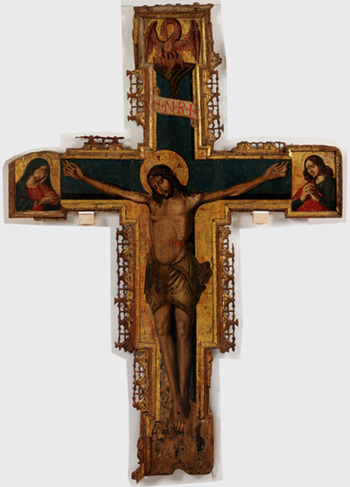
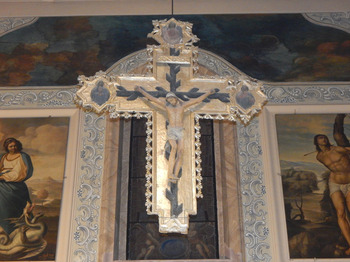
Antonio de Saliba, Painted Crucifix, 1508, panel, 220cm × 155cm, V&A. Photograph: © Victoria and Albert Museum, London.

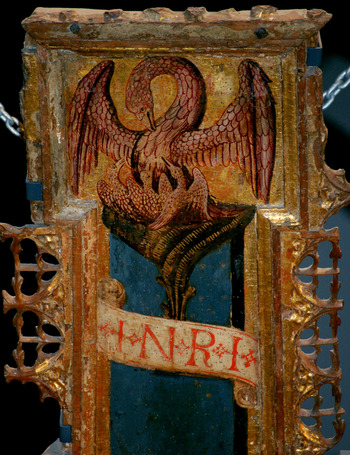
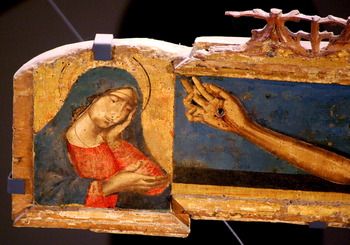
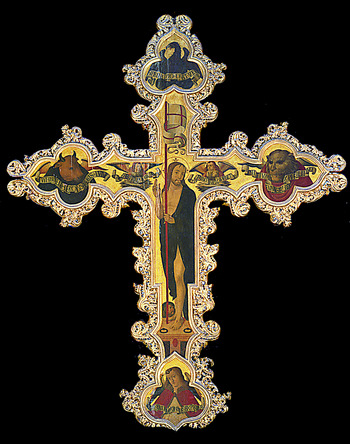
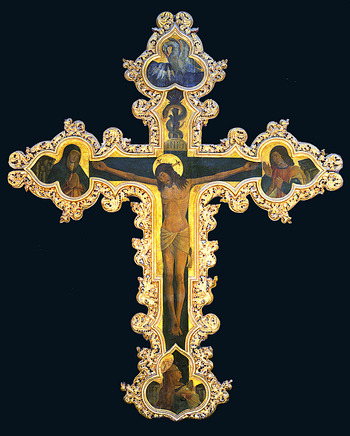
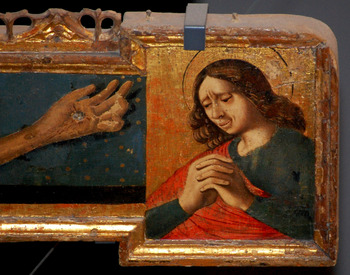
The V&A crucifix currently measures 220cm × 155cm and is 7cm deep at its thickest point.Footnote 3 It is painted on the front only and is composed of three panels: the long vertical axis that is widest at Christ’s torso, and two horizontal panels that form the cross’s transversal arms. On the long panel is the figure of the crucified Christ with his eyes closed; Christ is slightly off centre, with his head leaning to the left and his wounds amply visible. There are four terminals. Within the top terminal is a scroll with the acronym ‘INRI’, below which is the Eucharistic symbol of the pelican feeding its young by pecking at its breast (fig 2); in the bottom terminal is the Adam’s skull. In the lateral terminals is the dramatis personæ, both depicting sorrowing bust-length figures who were key witnesses to Christ’s crucifixion: on the left terminal is the Virgin (fig 3) and on the right terminal is St John the Evangelist (see fig 15). The background of the V&A crucifix is divided into two sections, with gilding on the vertical section below the transversal arm, while the upper section carries a seemingly original blue background that is enlivened by gilded dots that possibly imitate stars.Footnote 4 Its attribution to Antonio de Saliba is widely accepted.Footnote 5 Through a re-examination of this crucifix, this paper offers new insights into the artist’s oeuvre, the origin and date of the crucifix commission and the crucifix’s display in an eastern Sicilian church.
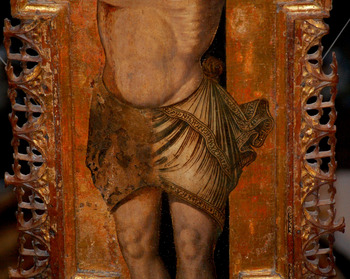
Detail of fig 1. Photograph: Donal Cooper.

Detail of fig 1. Photograph: Donal Cooper.

THE FORM OF THE PAINTED CRUCIFIX IN THE V&A
Painted crucifixes usually fall under the Christus triumphans (Christ triumphant) or the Christus patiens (suffering Christ) typologies. A third category, the Christus vivens (living Christ), has also been identified. The Christus patiens iconography originated by the ninth century in Byzantine art emphasising Christ’s agonies on the cross. It infiltrated Western art in the early thirteenth century due to an increased devotion to the crucified Christ – a devotion propagated by the Franciscans.Footnote 6 It was, in fact, the Franciscans who diffused the cult towards the crucifix in Sicily.Footnote 7 Hitherto, it was the Christus triumphans (Christ triumphant) imagery, which emphasises Christ’s divinity, that was favoured in the West as well as the Christus vivens (living Christ) iconography, which emphasises a suffering Christ prior to being pierced with the lance of Longinus.Footnote 8
The Christ in the V&A crucifix is a suffering figure, but not overtly so, since he is captured in the transitory moment between life and death, emphasising the end of his human suffering as he transitions into the divine realm. It belongs to the second great innovation that occurred in Italian crucifix imagery associated with Giotto’s 1288–9 Santa Maria Novella cross, which displays the transition to a more realistic rendering of the figure of Christ.Footnote 9 This fits in with the broader production of crucifixes in eastern Sicily, where the suffering of Christ was not as emphatic as on crucifixes that were produced in western Sicily.Footnote 10
In its traditional format and use of gold, the V&A painted crucifix adheres to a prototype that was widely used in Sicily. A blue background in the upper section of a crucifix occurs also in a contemporary crucifix by Salvo d’Antonio (doc. from 1493, d. pre-1526), a cousin of Antonio de Saliba and, like him, one of Antonello da Messina’s nephews.Footnote 11 Salvo d’Antonio’s painted crucifix was commissioned on 24 October 1502 for the church of San Filippo Siriaco, in Calatabiano, in the province of Catania. It was to cost 5 uncie (equivalent to 25 florinsFootnote 12) and was to be 10 palme high (since 1 palma is equivalent to 25.81cm, then the crucifix was to be c 258cm high).Footnote 13 Luckily, this crucifix survives, albeit with several abrasions and without its original framework, behind the high altar of the town’s eighteenth-century Chiesa Madre. Its current measurements (257cm × 207.3cm) match the contracted specifications. These measurements indicate that the dimensions identified in the contract did not include the intricate fretwork that presumably surrounded it.
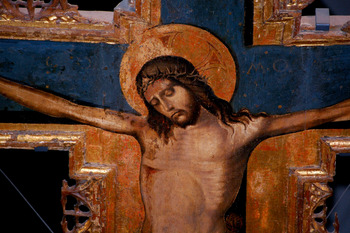
In the midst of the gilded dots on the background of the V&A crucifix are four faint letters that appear on either side of Christ’s head: ‘C O’ seem to feature on the left, while the more clearly visible ‘M O’ are on the right (fig 4).Footnote 14 Beneath the crucifix’s transversal arm, the longitudinal beam of the cross partly appears behind Christ’s back to the right of the crucifix and it also features behind his legs on the gilded background. It is concealed on the upper section by the celestial blue background. This same motif is an attribute of Salvo d’Antonio’s Calatabiano crucifix. The gilded background on the lower half, as well as the blue background with gilded dots, indicate the heavenly realm, while the use of gold harks back more forcefully to the medieval painted crucifix tradition. The blue background may have reflected the painted ceiling decoration in the churches that housed the crucifixes.
Detail of fig 1. Photograph: Donal Cooper.

Studying the V&A panel reveals flight holes from infestation and unfortunate areas of abrasions and paint loss, such as on the left side of Christ’s body, his forehead, the left side of the loin cloth, the blue background and the skull that appears at Christ’s feet. Moreover, much of the original gilding has been lost, resulting in a visible red bole. Several areas of overpainted sections are visible on close inspection. Losses are also evident on the carved openwork frame that once enlivened the entire perimeter of the crucifix, which C M Kauffmann, then assistant keeper of the Department of Paintings at the V&A, believed to be a later addition.Footnote 15 The fretwork is very much in line with other Sicilian frameworks in general and to those found on a surviving work by Antonio de Saliba in particular, as will be shown next.
The fretwork border
The V&A crucifix preserves some of the original gilded fretwork framing border. The cusped decoration of the crucifix appears to have been finely executed, with the more delicate outer sections having been largely lost over the years. It is inspired by stylised foliated motifs that originally adorned the entire perimeter of the crucifix including the terminals.Footnote 16 This is a rare example of such a wood-carved decoration to survive, not only in the Sicilian context.Footnote 17 Di Natale stated that among Sicilian painted crucifix examples, the late fifteenth-century example by Pietro Ruzzolone (act. 1484–1522) in Termini Imerese in western Sicily (province of Palermo, figs 5 and 6) is the only one that preserves its original ornate and gilded framework.
Pietro Ruzzolone, Painted Crucifix, 1484, front, Duomo, Termini Imerese. Photograph: Enzo Brai.

Pietro Ruzzolone, Painted Crucifix, 1484, back, Duomo, Termini Imerese. Photograph: Enzo Brai.

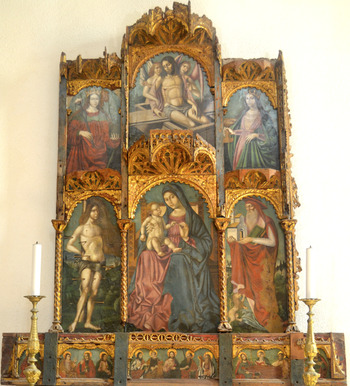
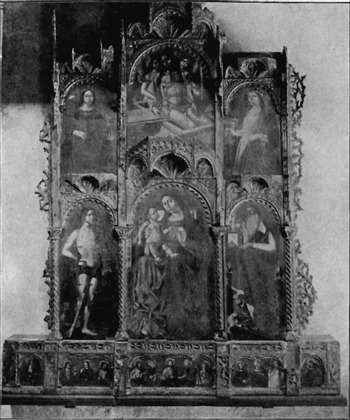
There are only two other paintings by Antonio de Saliba that preserve the original woodcarving. These are the documented 1503–4 Cathedral of Taormina polyptych (fig 7) that was executed by his father, the woodcarver Giovanni de Saliba (doc. 1461–d. c 1517?),Footnote 18 and the all’antica framework of the 1494 unified pala altarpiece in the Spoleto Pinacoteca that de Saliba produced for Gentile di Battista, who probably belonged to the Montesanto Vigi (province of Perugia) gentry.
Antonio de Saliba, Taormina polyptych, 1503–4, panel, c 300cm × 196cm, Cathedral of Taormina. Photograph: author.

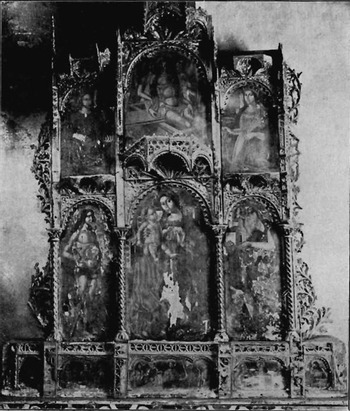
While the woodcarving on the Taormina polyptych survives in part, it fails to convey the original configuration since much of it has been lost, as is evident from pre- and post-restoration photographs published in 1924 (figs 8 and 9).Footnote 19 While there is no reason to believe that Giovanni de Saliba was responsible for the Spoleto woodcarving, it is tempting to question whether he was involved in the framework for the Limina crucifix. Antonio and Giovanni de Saliba’s professional collaboration is documented for sixteen years, between 12 August 1497 and 13 October 1513.Footnote 20 Since there is good reason to believe that Antonio de Saliba’s bottega must have operated much like a place where multiple services were offered in relation to the production of art works, this is a likely scenario, even though Giovanni’s name was not recorded in the 1508 contractual agreement with which this crucifix is being associated here.Footnote 21
Antonio de Saliba, Taormina polyptych before the restoration intervention. Image: Mauceri Reference Mauceri1924, 568.

Antonio de Saliba, Taormina polyptych after the restoration intervention. Image: Mauceri Reference Mauceri1924, 569.

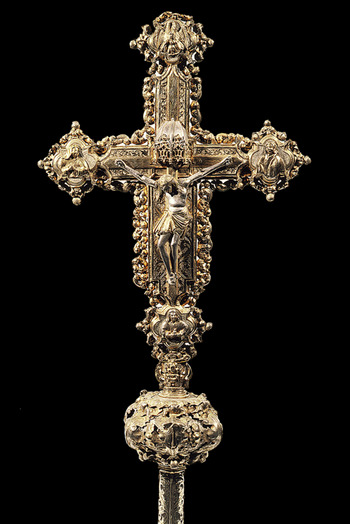
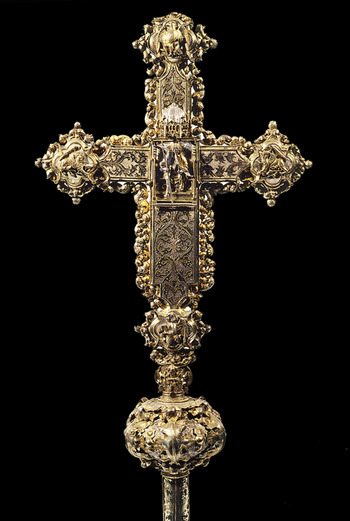
Giovanni – like the patrons who commissioned these paintings – may have been averse to incorporating the new type of all’antica elements into the frameworks he produced. As is evident in the Taormina polyptych, he preferred Late Gothic motifs, perhaps inspired by Catalan, Provençal, Burgundian and Flemish altarpieces that were imported to Sicily. There is also the possibility that the wood-carvings on the Taormina polyptych as well as the V&A crucifix were inspired by smaller imported works, such as silver crucifixes, just as was presumably the case for the ornate wood-carvings on the Sicilian processional gonfaloni, of which very few examples survive.Footnote 22 Di Natale has perceptively noted that the fretwork on Ruzzolone’s Termini Imerese crucifix reflects decorative elements that survive on silver crucifixes, for instance, the processional cross by an unknown silversmith dating to the earlier Quattrocento in the Museo Diocesano in Piazza Armerina (province of Enna, Sicily, figs 10 and 11).Footnote 23
Unknown Sicilian silversmith, Processional Cross, first half of the fifteenth century, front, Museo Diocesano, Piazza Armerina. Photograph: Enzo Brai.

Unknown Sicilian silversmith, Processional Cross, first half of the fifteenth century, back, Museo Diocesano, Piazza Armerina. Photograph: Enzo Brai.

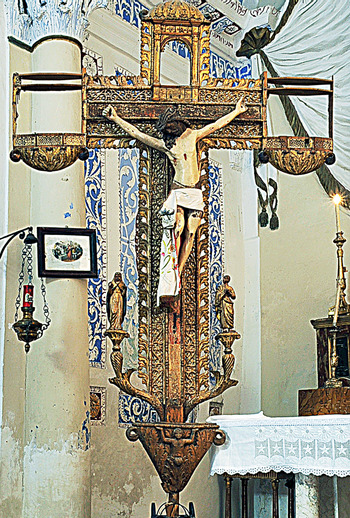
The fretwork decoration of the 1571 processional crucifix in the church of St Catherine in Cammarata, in the province of Agrigento (fig 12),Footnote 24 was executed by an unknown woodcarver. It harks back to Spanish examples and survives together with the sculpted figures of the Virgin and St John flanking the base of the Crucifix. That a crucifix executed in the second half of the sixteenth century is decorated with such a framing border is a further indication that there was still a demand among Sicilian patrons who were after a retardataire style of art work well into the sixteenth century. The fretwork on the V&A cross, however, is more reminiscent of the decoration on the more coeval fifteenth- or sixteenth-century crucifix in the parish church dedicated to St Margaret in the town of Santa Margherita, in the province of Messina (fig 13).Footnote 25 Although sculpted, like the V&A crucifix, the Santa Margherita crucifix has a framing border of wood-carved decoration of a Late Gothic stylised acanthus leaf decoration that goes around its perimeter and which survives almost in its entirety.
Unknown Sicilian woodcarver, Crucifix, 1571, church of St Catherine, Cammarata. Photograph: Enzo Brai.

Unknown Sicilian woodcarver, Crucifix, fifteenth or sixteenth century, church of St Margaret, Santa Margherita. Photograph: Don Dario Giardina.

ASSOCIATIONS WITH A KNOWN ANTONIO DE SALIBA COMMISSION
Although there are gaps in Messinese documentation, it is tempting to ask whether the V&A crucifix can be identified with any of the known crucifix commissions received by Antonio de Saliba described above. The dimensions of the London crucifix correspond to two of the documented painted crucifixes commissioned from him: the 1508 Limina crucifix, where the iconography is not documented,Footnote 26 and the second and larger of the crucifixes which the town of Saponara had contracted him to execute in 1534.
Caterina Ciolino did attempt to identify the extant crucifix with the larger crucifix commissioned from Antonio for Saponara.Footnote 27 However, the description stipulated in the 1534 contract does not tally with the V&A crucifix, since it was to depict an angel in the top terminal. The surviving crucifix portrays the pelican feeding its young.
With regard to proportions, the extant crucifix has the above-mentioned dimensions of 220cm × 155cm at its maximum height and width, respectively, while the 1508 contractual agreement requested it to be 207cm high (8 palme). As noted above, in the case of Salvo d’Antonio’s Calatabiano crucifix, the contracted dimensions may not have included the framework. This may account for the 13cm difference in height between the contracted dimensions in the 1508 document and the extant crucifix in question. For this and other reasons discussed here, in addition to the idiosyncrasies it shares with the Rabat Deposition that was commissioned in 1510 (fig 14), the V&A crucifix can be identified with the 1508 Limina commission.Footnote 28
Antonio de Saliba, Deposition, lime panel, c 1510–15, 111.5cm × 89cm, Church of Santa Maria di Gesù, Rabat, Malta. Photograph: Joe P Borg.

Di Marzo did not publish the transcribed document for the 1508 Limina crucifix commission perhaps because details were scanty and only related to the essential facts, omitting information on its iconography, its positioning and the church that would have housed it.Footnote 29 Antonio de Saliba’s crucifix conforms to the traditional iconography of Sicilian painted crucifixes with the crucified Christ as the central element, the pelican and the skull of Adam in the vertical terminals, the Virgin and St John in the horizontal terminals.Footnote 30 This may imply that such details would have been excluded from the 1508 contract since it was the prevailing iconography and therefore that it was expected to be portrayed in that manner.
V&A ACQUISITION AND HISTORY OF ATTRIBUTION
This crucifix was purchased by the V&A in 1895 and was traditionally believed to have formed the rood of the parish church of Hever, in Kent.Footnote 31 It was considered to be the work of an English artist and it was exhibited as such in the 1896 Society of Antiquaries of London ‘Exhibition of English Medieval Paintings and Illuminated Manuscripts’.Footnote 32 A critic who reviewed this exhibition for The Artist journal described this crucifix as ‘one of the most beautiful objects in the Library … painted rood from a church in Surrey [sic], in remarkably good condition … This is the finest rood of English medieval work we have ever seen’.Footnote 33 The next Proceedings of the Society of Antiquaries of London noted that the ‘painted rood of the fifteenth century from Hever, Kent. South Kensington Museum. … is now considered to be Italian’.Footnote 34 It was then exhibited as an Italian fourteenth-century work.Footnote 35 Such painted crucifixes were popular between the twelfth and the fourteenth centuries throughout the Italian peninsula, falling out of favour during the fifteenth century. However, their production in Sicily persisted well into the sixteenth century.Footnote 36
It was Dr Everett Fahy who perceptively associated the painting as being a late fifteenth-century Sicilian work ‘somewhat in the manner of Antonello da Messina’.Footnote 37 A cleaning intervention, which took place in 1968 under the direction of Mr H Rogers of the V&A’s Conservation Department, must have heightened Kaufmann’s interest in the artefact.Footnote 38 Kauffmann confirmed Fahy’s suggestion through a written correspondence held between 11 November 1968 and 25 January 1969 with Vincenzo Scuderi, superintendent for galleries and works of art for Sicily based in Palermo. In his reply, Scuderi declared that the painted crucifix ‘is certainly the work of a Sicilian artist of the late Quattrocento of the antonellian tradition’, and in the following sentences he suggested that it may be the work of a young Antonio de Saliba.Footnote 39 Based on this correspondence, Kauffmann first published the crucifix as a work by Antonio de Saliba later on in 1969.Footnote 40
Despite having been attributed to a known painter from Sicily for the last fifty years, it is peculiar that the V&A crucifix has been largely omitted from studies of eastern Sicilian Renaissance paintings, even those directly related to Antonio de Saliba.Footnote 41 Mauro Lucco discussed the painted crucifix in his 2011 Antonello monograph, where he tentatively, although not convincingly, attributed it to Salvo di Antonio.Footnote 42 Lucco’s attribution is likely to have been based on the similarities in the general appearance of the V&A crucifix to the Calatabiano crucifix.
THE ART-HISTORICAL CONTEXT
The great Antonello da Messina was a renowned Renaissance master who was active mainly in Messina. He travelled to Venice at some point in 1475, where he established a workshop and stayed until c mid-1476. Following Antonello’s untimely death in 1479, his son, Jacobello di Antonello (c 1454?–d. pre-1488?), led the Venetian workshop, having Antonio da Saliba, his cousin, as his apprentice at least for the first four years.Footnote 43 Studies on Antonello da Messina and the antonelliani are hindered by the fact that scholars rely on transcribed documents published principally by Gioacchino Di Marzo (1839–1916) and Gaetano La Corte Cailler (1874–1933) before the archives of Messina were largely obliterated by the 1908 earthquake.Footnote 44 While extremely useful, these documents are limited by the manner in which these researchers selected the archival material that they consulted, transcribed and eventually published, such as the dates they focused on, their selection of notaries and other such elements. This earthquake also destroyed works of art by Antonello da Messina and his followers that were displayed in Messina. The metropolitan city of Messina was the most important centre these masters must have produced paintings for, and the several works by Antonio and other antonelliani that survive stem from commissions that were destined for more provincial patrons in eastern Sicily, Calabria and Malta.
The published documentation reveals that Antonio de Saliba ran a substantial and busy workshop in Messina from c 1497 until at least 1534.Footnote 45 This Sicilian workshop was established following his presumed stay in Venice, where he undertook his four-year apprenticeship with Jacobello beginning in 1480 and where he remained active in the Veneto until the mid-1490s. Surviving works by de Saliba reveal that he was open to the latest Venetian artistic trends. While in Venice, Antonio also acquired an intimate knowledge of the paintings of Giovanni Bellini (c 1430–1516). The indications are that Antonio is highly likely to have served as assistant for Bellini for an unknown period of time.Footnote 46 However, on his return to Messina, the artist settled for a largely retardataire type of artistic production.
Finding himself back in Messina towards the end of the fifteenth century likely meant that de Saliba had to adapt to a presumably more conservative clientele than that known to him in Venice – which, it seems, he achieved successfully. This can be deduced from known records and surviving pictures, which reveal that his recorded production of wooden gonfaloni (or processional banners) and polyptychs – which may have been encased in elaborate Gothic frames – constituted the major part of his workshop production.Footnote 47 This artistic output is consistent with that which Antonello da Messina himself executed for his southern patrons.
It is unclear how, and why, Antonio de Saliba was not more enthusiastic about producing up-to-date works of art immediately upon his return to Messina. It is surprising, since he had painted the above mentioned Spoleto altarpiece on a unified field in Venice and he had looked carefully at Antonello’s San Cassiano altarpiece.Footnote 48 He may, however, have been discouraged by his southern patrons’ lack of vision and because of their conservative tastes.
Antonio de Saliba’s first known commission executed in Messina was a polyptych for the Franciscan Observant church of Santa Maria di Gesù in Catania. Four panels from this polyptych survive, including the central Madonna and Child Enthroned that is signed and dated 1497.Footnote 49 While two of these panels reveal that de Saliba was adopting Venetian compositional elements, he opted for the polyptych format that was the more established type of altarpiece in Sicily and which must have been his patrons’ specific request.Footnote 50 Thus, de Saliba’s reluctance to change may have had more to do with the insistence of his patrons rather than his own artistic choices. While it transpires that many of the antonelliani’s eastern Sicilian, Calabrian and Maltese patrons were somewhat unadventurous and certainly conservative in their choice of commissions, some of their contemporaries were informed patrons of the arts and open to new developments.Footnote 51
While polyptychs and gonfaloni were staples of Antonio de Saliba’s workshop, there was another format of painted panels requested from him: the painted crucifix. There are no known surviving painted crucifixes by Antonello da Messina. The transcribed documents do not record that Antonello ever received such a commission, although this does not exclude the possibility that he painted one. There are several records of painted crucifixes that were commissioned in Sicily in the second half of the fifteenth century and several that survive.Footnote 52 Antonello’s own brother-in-law, the painter Pietro Cuminella, received four commissions to paint crucifixes between 1493 and 1500.Footnote 53
From the mid-fifteenth to the mid-sixteenth century, several artists known as crocifissai flourished in Messina, emphasising the popularity of such crucifixes in eastern Sicily and Calabria.Footnote 54 Antonello Gagini (1478–1536) executed the extant mistura crucifix for Alcamo’s Basilica di Santa Maria Assunta or Chiesa Madre (province of Trapani) between 1519 and 1523. Gagini was asked for this to be similar to the crucifix in the Palermitan church of San Domenico by an unknown Messinese crocifissaio of the Matinati family who had settled in Palermo, Sicily.Footnote 55
Polidoro da Caravaggio (c 1499–c 1543), the Lombard artist who gravitated south and eventually settled in Messina in 1528, executed c 1530 a profusely gilded painted crucifix for the Knights of the Order of St John that survives Valletta’s St John’s co-Cathedral.Footnote 56 Therefore, while crucifixes were relatively conservative works for Antonio de Saliba to produce when set against a broader Italian context, their production in early sixteenth-century Sicily was not unique to his workshop.
There are four instances where painted crucifixes are known to have been commissioned from Antonello’s nephews. One of these is Salvo d’Antonio’s above-mentioned Calatabiano crucifix. Through the surviving documents, it is ascertained that Antonio de Saliba received three crucifix commissions: one on 16 August 1508 and two on 22 January 1534. The 1508 crucifix was commissioned on 15 August by Tommaso Lo Turco and his son from the village of Limina (province of Messina) for an agreed payment of 17 florins (equivalent to 3 uncie and 12 tareni).Footnote 57 It was to be 8 palme (c 207cm) high.Footnote 58 Unfortunately, the description of the requested iconography is not known since Di Marzo did not publish the full text of this now-lost document, perhaps because the contract was thin on detail.
The two other crucifixes were jointly commissioned in 1534 by the priests Antonio Mirino and Nicoletto Marraffa, both inhabitants of Saponara (province of Messina), which lies approximately 10km west of the city of Messina. Antonio de Saliba was to receive 13 uncie (equivalent to 65 florins) for the production of the panels, the woodcarving, as well as the paintings of the two crucifixes that were delivered on 21 September 1534, on which date de Saliba declared to have received the complete sum.
The first crucifix was to depict the crucified Christ with a pelican in the top terminal, the Virgin and St John respectively in the right and left terminals, and Adam’s skull at Christ’s feet. Moreover, on the back it was to portray the four Evangelists and the Paschal lamb with St Nicholas at the bottom. The painted sections were to have a gold background, and the whole was to be 3 × 2.5 palme large (c 77cm × 65cm). The second crucifix was to be 8 palme (c 206cm) high and proportionately wide. Similarly, it was specified that it had to have a gold background and to depict the crucified Christ, the Virgin and St John respectively on the horizontal terminals, an angel above and the ever-present Adam’s skull below.
The smaller dimensions of the first crucifix – less than half the size of the second – indicate that it must have served as a processional cross. Moreover, the inclusion of St Nicholas suggests that this crucifix was destined for the sixteenth-century Saponara Chiesa Madre dedicated to St Nicholas of Bari, Saponara’s patron saint. This indicates that both these crucifixes were commissioned for this same church, which was constructed in the early sixteenth century but which was substantially modified in subsequent centuries.Footnote 59
Among these four crucifixes commissioned from Salvo d’Antonio and Antonio de Saliba, one can gauge that the larger crucifixes commissioned from de Saliba – the Limina and the larger Saponara crucifix – were to be smaller in dimensions to that commissioned from Salvo d’Antonio for Calatabiano.Footnote 60 This may have been due to the function that these different crucifixes were to have, or to the size of the church that they were commissioned for.
Authorship and style
In the V&A cross, Christ’s physiognomy, the loin cloth and the shadow cast by Christ’s fingers feature some interesting passages. However, other painted sections are more crudely executed, which may be due to later interpolations or the intervention of more than one artist. It betrays some similarities to Salvo d’Antonio’s Calatabiano crucifix, with a similar, although not identical, shape and a gold background with blue in the transverse and top sections of the cross. This suggests that both these crucifixes rely on an older variant that was popular among eastern Sicilian patrons. Despite its bad state of preservation, the Calatabiano crucifix’s more refined quality can still be appreciated. In comparison, the London crucifix is characterised by a slightly more rigid execution of the figures, with Christ being painted with stiff and strongly delineated strokes, and it can be better associated with the oeuvre of Salvo’s cousin, Antonio de Saliba.
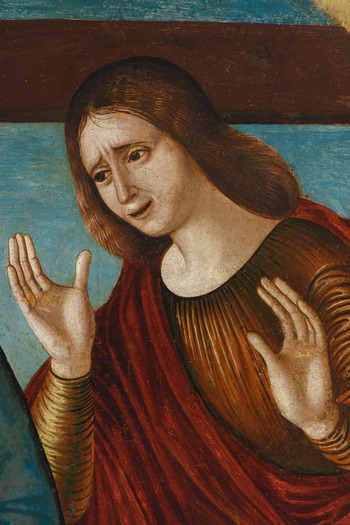
This was pointed out by Vincenzo Scuderi in his 1969 letter to Kauffmann, in which Scuderi highlighted similarities between the V&A crucifix and de Saliba’s 1515 Deposition panel in the Maltese Franciscan Observant church of Santa Maria di Gesù in Rabat (see fig 14).Footnote 61 In his letter, Scuderi remarked on the similitude being especially visible in the two figures of Christ and St John (figs 15 and 16), particularly in the latter, although the V&A St John is more laboured in its execution. Idiosyncrasies can be noted in the physiognomies and Christ’s loincloth that is executed in both instances with a calligraphic series of lines rather than angular folds. Moreover, the anatomy of Christ in both paintings is similar in depiction, such as the protruding ribs, the belly and knees (figs 17 and 18), which differ from those of Salvo’s Christ.
Detail of fig 1. Photograph: Donal Cooper.

Detail of fig 14. Photograph: Joe P Borg.

Detail of fig 1. Photograph: Donal Cooper.

Detail of fig 14. Photograph: Joe P Borg.

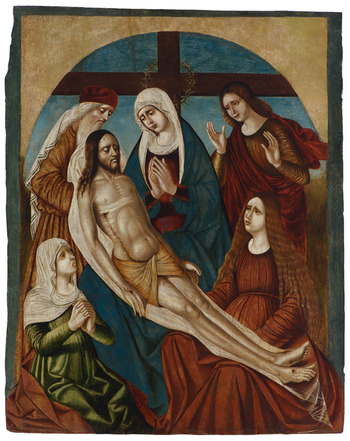
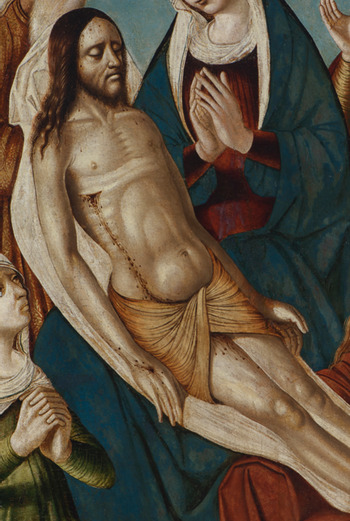
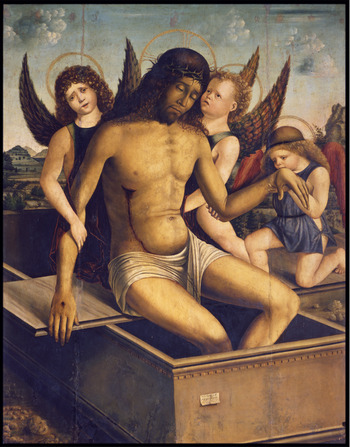
Other comparisons that can be drawn between the V&A crucified Christ and the known paintings by Antonio de Saliba include the signed Pietà by the artist in the Doge’s Palace, Venice, which must be an early work that de Saliba produced in the Lagoon city (fig 19).Footnote 62 While bearing in mind that the Pietà is the earliest and of better execution, there is a resemblance between the heads of the two figures of Christ (cf fig 4). The drop in quality visible in the three paintings suggests the involvement of bottega assistants in the later works produced in Messina.Footnote 63 Unfortunately, the names of any of de Saliba’s bottega assistants have not come down to us. It is therefore not possible to identify the person who was responsible for the execution of the other painted sections in these pictures.
Antonio de Saliba, Pietà, panel, c 1480s, c 131cm × 103.6cm, Sala del Consiglio dei Dieci, Doge’s Palace, Venice. Photograph: Google Arts and Culture https://cutt.ly/euSSLXD.

A close analysis of the Rabat Deposition that was diagnostically tested and conserved between 2013 and 2014 makes it possible to identify at least two hands at work on the painted sections. Antonio de Saliba’s intervention could be identified in the execution of the head of Christ, the figures of the Virgin, St John the Evangelist and St Joseph of Arimathea, while a bottega assistant could potentially have executed the rest including most of Christ’s figure.Footnote 64 The same artist who assisted de Saliba in the Rabat Deposition may have also been involved in the execution of sections of the painted sections of the V&A crucifix. The Limina crucifix commission, after all, only pre-dates the Rabat commission by two years.Footnote 65 However, since the V&A crucifix has not been diagnostically studied or recently conserved, this is difficult to ascertain. A proper analysis of the crucifix is hindered by abrasions that are amply visible on the figure of the Virgin, as well as possible overpaintings, such as on the figure of St John and Christ’s neck and torso.
There are several recorded instances relating to commissions that reached Antonello da Messina and his followers that stipulated that the newly commissioned art work should compete in beauty and workmanship with an existing one in another town, church or rival confraternity. In fact, in 1473, the Confraternita della Trinità of Randazzo (province of Catania) asked Antonello to produce a gonfalone that was to be similar, but better, than that in San Nicolò della Montagna (or Monte San Nicola, province of Messina), which may possibly be identified with that commissioned from Antonello in 1463.Footnote 66
Antonio also had similar requests for gonfaloni,Footnote 67 and the same clauses appeared in contracts for polyptych commissions. On 30 June 1526, Antonio agreed that his polyptych for the church of San Pancrazio in Taormina was to be similar to the one he himself had produced for the church of San Sebastiano, also in Taormina, in 1504.Footnote 68 The fact that these two Taormina commissions are separated by over two decades again points to a very conservative attitude among Antonio de Saliba’s patrons.
THE CRUCIFIX’S INTENDED USE AND LOCATION
The V&A painted crucifix is here being associated with Antonio de Saliba’s 1508 commission by Tommaso Lo Turco and his son, who were inhabitants of the village of Limina (province of Messina). Like de Saliba’s 1534 Saponara commission for the two crucifixes, this contract did not specify the town or the church that the cross was destined to adorn, nor its intended use. And, as must also have been the case with the Saponara commission, this crucifix must have been assigned for the town’s main church. Today Limina is still a small inland village in the Monte Peloritani mountain range in north-eastern Sicily.
The most important church in early sixteenth-century Limina was the medieval church dedicated to Santa Domenica, now the Chiesa Madre re-dedicated to St Sebastian, which was entirely rebuilt in the first half of the twentieth century. It lies in the highest region of this little town and is surrounded by narrow streets. This single-cell structure, with side altars on either side of its nave, has its main entrance on the east facing a square, and its external dimensions are of c 20m in length and 11m in width. A sculpted crucifix hangs behind the high altar.
Since the structure of Limina’s Chiesa Madre has been completely modified, there is little evidence for the original existence of screens. However, the small dimensions of the Limina church suggests that it may not have had a full tramezzo apparatus. This, therefore, presents a problem as to the exact positioning of de Saliba’s crucifix in the church that is not easy to resolve.
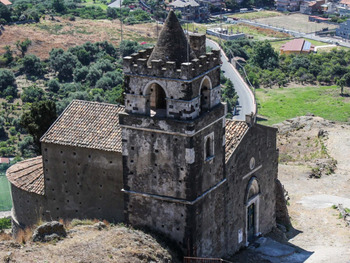
Salvo’s crucifix now hangs behind the high altar of Calatabiano’s eighteenth-century Chiesa Madre dedicated to the Annunciate Virgin. It was originally commissioned for the idyllically located Late Gothic church of San Filippo Siriaco (fig 20), which was constructed after 1484. This church is also known as the Chiesa del SS. Crocifisso due to the great cult towards this cross, a copy of which has been placed in its stead on the wall behind the high altar. The Calatabiano Chiesa del SS. Crocifisso is a single-cell structure that commands a prominent location at some distance from the town and which internally measures 13m in length and 8m in width.Footnote 69 The present Limina church is, at present, slightly longer than the Calatabiano church. The earlier structure may, however, have been built on a smaller footprint.
Chiesa del SS. Crocifisso (previously the church of San Filippo Siriaco), Calatabiano. Photograph: Google Maps, <shorturl.at/giksu>.

A permeable tramezzo screen is generally believed to have been a standard feature in most Italian late medieval churches, chapels and oratories, even though very few examples survive.Footnote 70 This screen would have been decorated with votive images and a central crucifix that was the ubiquitous and imposing feature of these screens commanding the attention of the devotees.Footnote 71 Most large-scale painted crucifixes were probably meant to be mounted and pitched forward as they hung over rood screens,Footnote 72 or perched on beams above the high altar.Footnote 73 This was also the case in Sicilian churches as late as the early sixteenth century.Footnote 74 This is exemplified by the crucifix mounted on a beam in the Chiesa Madre of Castelvetrano (province of Trapani). However, while acknowledging that very little specific information survives on the matter, it is reasonable to believe that Salvo d’Antonio and de Saliba’s early sixteenth-century crucifixes may have not fulfilled such a function in the eastern Sicilian churches that housed them.
Emanuele Zappasodi has recently identified a distinct context in which large-scale crucifixes were, in fact, not intended to be surmounted on tramezzo screens or on beams, but were intentionally displayed at close quarters within the female choir spaces of nunneries.Footnote 75 This is relevant to this study because it opens up the possibility that painted crucifixes, such as those at the V&A and Calatabiano, were similarly not intended for tramezzo screens. Although not specified in either of these contractual obligations, one must consider the possibility that Salvo d’Antonio’s Calatabiano and Antonio de Saliba’s Limina crucifixes were most probably never meant to be displayed from a tramezzo or beam. These crucifixes were always intended to be displayed behind high altars and not mounted on rood screens, just as smaller-scale crucifixes were displayed above altars elsewhere in Sicily and on mainland Italy.Footnote 76
The current location of Salvo’s crucifix and the display of its copy in the older church indicate that Salvo’s crucifix was commissioned to be venerated behind the high altar.Footnote 77 Since Salvo’s crucifix was requested to be 10 palme high and likely venerated behind the high altar, then de Saliba’s crucifix, that was to measure 8 palme in height, could easily have served the same purpose in Limina’s Chiesa Madre.
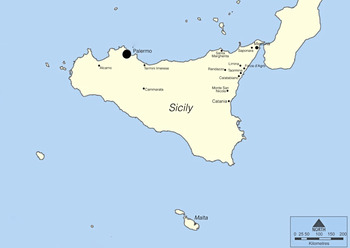
Salvo d’Antonio’s and Antonio de Saliba’s crucifixes must have been executed within the span of six years. It is probable that Antonio’s crucifix, therefore, could have been commissioned with the patron’s knowledge of Salvo d’Antonio’s Calatabiano cross and its location behind the high altar. When one considers that Limina and Calatabiano are only 23.6km distant from each other (fig 21), then de Saliba’s patrons are likely to have been aware of Salvo d’Antonio’s Calatabiano crucifix. Unfortunately, nothing else about Tommaso Lo Turco or his son is known in order to better assess the mechanics of this commission.
Map of Sicily and Malta. Diagram: author.

Crosses that hang behind altars instead of titular altarpieces remained a popular custom in eastern Sicily in subsequent centuries, which may distinctly reflect earlier practices. This confirms the desire to have crucifixes as the central devotion in these churches despite the churches being dedicated to other saints.Footnote 78
If the V&A and Calatabiano crucifixes were meant to be displayed behind the church’s main altar, then they present more diversity in display of the painted crucifix in the broader Italian context as well as that of eastern Sicily. This would also mean that these antonellian crucifixes were intended to be displayed at relatively close quarters and they were not meant to be seen from below, but in a direct and frontal manner.
CONCLUSION
While Antonio de Saliba is known to have lived and worked in Venice for about fifteen years as a young man, on his return to Messina he had to adjust the lessons he had learnt in Venice in order to satisfy the needs of a more conservative clientele. While he did attempt to bring some innovation to his compositions, beginning with his 1497 Catania Franciscan Observant altarpiece commission, his Messinese artistic production largely consisted of polyptychs and gonfaloni that were surrounded by elaborately carved Gothic-type frameworks. This is the same type of fretwork that adorns the V&A crucifix to this day, albeit with several losses. The polyptychs that de Saliba produced in Messina for eastern Sicilian, Calabrian and Maltese patrons differ from the unified pala altarpiece surrounded by an all’antica framework on the 1494 Spoleto altarpiece. Although not as talented and innovative as his uncle Antonello, de Saliba succeeded in establishing a Messinese workshop that was in demand for almost four decades, through which he disseminated a tradition that may have been desired by admirers of the late Antonello.
The V&A crucifix emerged from this eastern Sicilian artistic milieu – a milieu that was still highly linked to the Byzantine world and that harked back to a medieval tradition of gold backgrounds,Footnote 79 to which, after all, Antonello da Messina himself had adhered.Footnote 80 The majority of works by these Messinese artists in fact hail from provincial towns in eastern Sicily, such as Limina, since the 1908 earthquake obliterated not only Messina’s archives, but also the majority of the port town’s architectural monuments and works of art. Therefore, such anachronisms are to be expected more of provincial commissions than those produced for Messina, none of which are known to survive for comparison. This crucifix proves the extent of Antonio de Saliba and his Messina workshop’s adherence to Sicily’s traditional art and iconography. Works of art have also disappeared from these small towns, which means that de Saliba’s painted crucifix cannot be compared to any other contemporaneous art work in Limina from the same period since not much survives. Nonetheless, the architecture of the church itself indicates a modest community among whom were patrons who were aware of Antonio de Saliba’s lucrative Messinese bottega.
This painted crucifix is an early sixteenth-century Renaissance work of art that deserves recognition. Its proper analysis has been long overdue in Antonello studies, from which it is still unfortunately largely omitted.Footnote 81 The identification of the V&A painted crucifix with de Saliba’s known 1508 Limina commission adds to Antonio de Saliba’s documented and signed corpus of works and continues to enhance our understanding of his artistic identity. Moreover, this research has raised questions on the display of this crucifix in Limina’s main church that was dedicated to Santa Domenica, for which it is likely to have been a principal devotional image: prominently displayed on the wall behind the high altar. This thus challenges the conventional idea that large-scale painted crucifixes would necessarily have surmounted a tramezzo screen or beam, and that they could have been commissioned for an alternative arrangement within the church.
ACKNOWLEDGEMENTS
The author would like to thank Mario Buhagiar for exchanging ideas on the subject matter, Paul Williamson, Ana Debenedetti, Mark Evans, Zorian Clayton and Jennifer Wearden from the V&A for their assistance, Mariangela Orlando from the Biblioteca Provinciale dei Frati Minori Cappuccini at Messina, Charles Dalli (University of Malta), Maria Concetta di Natale (Università degli Studi di Palermo), Don Dario Giardina (Parish Priest, Santa Margherita), Salvatore Mosca and Victor Calleja. The author wishes to register her greatest debt of gratitude to Donal Cooper for his guidance and continuous support.
ABBREVIATIONS AND BIBLIOGRAPHY
Abbreviations
- ASM
-
Archivio di Stato, Messina
- SAL
-
Society of Antiquaries of London
- V&A
-
Victoria and Albert Museum, London