Introduction
Working carers of older people: a growing phenomenon within and outside Europe
The issue of reconciling paid work with informal care of older people with high support needs is of particular societal and political relevance across Europe, where an increasing number of older workers are providing support to their older relatives for extended periods of time (Dentiger and Clarkberg Reference Dentiger and Clarkberg2002; Mains, Fairchild and René Reference Mains, Fairchild and René2006). This is the result of three main, concomitant phenomena: the growth in the number of older people with high support needs; the tendency for retirement to be postponed, and the increasing female labour force participation. While the first trend is mainly based on demographic and epidemiological developments (European Commission 2008), the latter two tendencies represent, in most cases, the effect of national policies adopted to reform pension systems and to achieve higher employment rates, as promoted also by the European Council through the revised Lisbon agenda (Frerichs and Sporket Reference Frerichs and Sporket2007; Olofsson, Svensson and Kratz Reference Olofsson, Svensson and Kratz2007; Principi and Lamura Reference Principi and Lamura2007; Taylor Reference Taylor2007).
As a consequence, between 2000 and 2008 – i.e. before the recent world economic crisis started to hit the labour market – employment rates had grown remarkably among older workers of most European countries, jumping on average from 36.7 per cent to 45.6 per cent in the 27 European Union Member States (Eurostat 2011). With regard to working carers – i.e. employed persons providing care to a disabled older/adult relative at least once a week – in 2009 they represented 11 per cent of the male and 17 per cent of the female workforce (Anderson et al. Reference Anderson, Mikuliç, Vermeylen, Lyly-Yrjanainen and Zigante2009). These percentages rise as age increases, especially for women in the 50–59 age bracket. Figures for the United Kingdom (UK) show a clear trend towards an increase over time in the number of British working carers, who until recently accounted for 15 per cent of the workforce (Heitmueller Reference Heitmueller2007; Heitmueller and Inglis Reference Heitmueller and Inglis2007), compared to 11 per cent in the early years of the last decade (Arksey Reference Arksey2002). Similar trends have also been observed in the United States of America (USA), where estimates show that working carers of older people represent one-tenth of the whole workforce (Pitsenberger Reference Pitsenberger2006), and that over 40 per cent of all workers will be caring for an older person at some point in their lives (Beitman et al. Reference Beitman, Johnson, Clark, Highsmith, Burgess, Minor and Stir2004).
The challenge of reconciling paid work and informal elder care: evidence from the literature
The phase between the mid-forties to retirement is a complex stage of life, in which responsibilities at work tend to become higher, changes in health may increase the physical burden of work, and the provision of informal care to ageing parents often overlaps with other family obligations, such as the support provided to children and/or grandchildren (Evandrou, Glaser and Henz Reference Evandrou, Glaser and Henz2002; Henz Reference Henz2004; Raymo and Sweeney Reference Raymo and Sweeney2006). Therefore, even in countries with a particularly well-developed welfare system, such as for instance Sweden, the combined effect of the above-mentioned trends can raise widespread work–life balance difficulties for midlife family care-givers of older relatives (Johansson Reference Johansson2004).
The main findings on this issue emerging from previous studies show that reconciling work and care potentially has threefold interrelated negative consequences: on individual wellbeing, on work and on the care provided. Indeed, since care-giving and employment compete for midlife carers’ time, the attempt of reconciling these two activities, if not properly supported, can have negative effects on carers’ overall physical and psychological wellbeing (Arksey Reference Arksey2002; Colin Reid, Stajduhar and Chappell Reference Colin Reid, Stajduhar and Chappell2010; Dentiger and Clarkberg Reference Dentiger and Clarkberg2002; Gonzalez Reference Gonzalez2004; Ko, Aycock and Clark Reference Ko, Aycock and Clark2007; Raymo and Sweeney Reference Raymo and Sweeney2006; Spiess and Schneider Reference Spiess and Schneider2003).
The most common work restrictions experienced by family carers are a reduction in the number of working hours (usually achieved by means of a shift from a full-time to a part-time position), with little opportunity to return to the same level of work at the end of the caring episode; problems in career development; and giving up work, including options for early retirement (Burton et al. Reference Burton, Chen, Conti, Pransky and Edington2004; Carmichael and Charles Reference Carmichael and Charles1998; Covinsky et al. Reference Covinsky, Eng, Lui, Sands, Sehgal, Walter, Wieland, Eleazer and Yaffe2001; Heitmueller and Inglis Reference Heitmueller and Inglis2007; Henz Reference Henz2004; Pitsenberger Reference Pitsenberger2006; Spiess and Schneider Reference Spiess and Schneider2003), especially in the case of heavy care situations (Masuy Reference Masuy2009). Women are particularly penalised in employment, also in terms of both unstable career trajectories (also as a consequence of lower earnings compared to men) and less frequent training opportunities (Burton et al. Reference Burton, Chen, Conti, Pransky and Edington2004; Carmichael and Charles Reference Carmichael and Charles2003; Dentiger and Clarkberg Reference Dentiger and Clarkberg2002; Lyonette and Yardley Reference Lyonette and Yardley2006).
However, concomitant family and job demands can determine not only family-to-work conflicts but also work-to-family ones (Kubicek et al. Reference Kubicek, Korunka, Hoonakker and Raymo2010), and work may affect the care situation also in terms of a reduction in the likelihood of acting as carers for older parents with high support needs (Dautzenberg et al. Reference Dautzenberg, Diederiks, Philipsen, Stevens, Tan and Vernooij-Dassen2000).
Despite problems related to the reconciliation of work and care having been examined comparatively in the past (Lechner and Neal Reference Lechner and Neal1999; Martin-Matthews and Phillips Reference Martin-Matthews and Phillips2008; Phillips Reference Phillips1995), there are few sample-based comparative studies on this topic. At the European level, the only available comparative study focused on the association between changes in care-giving and changes in weekly hours worked by midlife women (Spiess and Schneider Reference Spiess and Schneider2003). According to this research, in Northern European countries (except Ireland), women seem to have a larger choice in this respect when deciding on the level and type of care they want to provide, while female carers in Southern Europe (and Ireland) report more difficulties in providing high levels of informal care while remaining active in the labour market.
Aims of the study and conceptual framework
On analysing previous studies targeting work restrictions by carers of older people, two main limits seem to emerge: (a) most studies have been single-country surveys, mainly in the USA and the UK, while almost no comparative data are available across Europe (Anderson Reference Anderson and Harper2004; Arksey Reference Arksey2002; Heitmueller Reference Heitmueller2007); (b) most investigations have been based on samples made of female carers only, in relation with the (correct) assumption that working women are more involved in caring for frail older people than their male counterparts (Beitman et al. Reference Beitman, Johnson, Clark, Highsmith, Burgess, Minor and Stir2004; Dentiger and Clarkberg Reference Dentiger and Clarkberg2002; Evandrou, Glaser and Henz Reference Evandrou, Glaser and Henz2002), thus leaving the reconciliation issue among working men under-investigated. This study aims to fill these gaps, having been conducted in six European countries and including both men and women. Moreover, given that most of the studies on work restrictions for family care-givers were carried out on employed carers, a further strength of this paper is that it also investigates non-employed carers. In fact, even non-working carers may experience some kind of work constraint (e.g. a forced exit from the labour market).
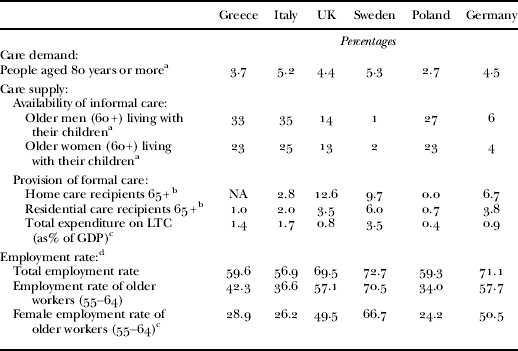
Care and work obligations may differ from country to country due to different welfare state characteristics: formal and informal care provision, culture, employment rates of women and men, etc. Welfare states representing the most relevant European regimes (Anttonen and Sipilä Reference Anttonen and Sipilä1996; Esping-Andersen Reference Esping-Andersen1990; Ferrara Reference Ferrara1996; Hoff and Hamblin Reference Hoff and Hamblin2011; Kautto Reference Kautto2002; Rostgaard Reference Rostgaard2002) were included in this study, characterised by significant differences both in terms of care demand–supply and employment rates (Table 1): the Scandinavian social democratic model (Sweden), showing high public investments in elder care, in combination with high employment rates; the liberal (UK) model, implying a broader role for private elder care providers and widespread support to working carers in a context of relatively high employment rates; the German conservative subsidiarity model, allocating primary caring responsibility to families, backed up, however, by a generous long-term care insurance scheme, and with rather high employment rates similarly to the UK; the Mediterranean family-based model (Italy and Greece), with limited public responsibilities for caring, a central role being played by kinship networks, in connection with low employment; and the transition model of post-communist societies such as Poland, resembling in many aspects that of family-based countries, however, with more severe financial constraints.
Main characteristics of elder care-work regimes in EUROFAMCARE countries

Notes: UK: United Kingdom. LTC: long-term care. GDP: Gross Domestic Product. NA: not available.
Sources: aHuber et al. (Reference Huber, Rodrigues, Hoffmann, Gasior and Marin2009; data refer to 2006); bHuber et al. (Reference Huber, Rodrigues, Hoffmann, Gasior and Marin2009; data for Italy: 2004; Germany, Poland and UK: 2006; Sweden: 2007); cEuropean Commission (2009; data for 2007); dEurostat (2011; data for 2010).
Given the diversity of welfare states, one may expect that in a given country (e.g. in Sweden) working carers’ work restrictions may be different from those experienced by working carers living in another country (e.g. in Italy). In light of this, the main aim of this study is to answer two main research questions (RQs): what are the main country and gender differences in the extent to which work restrictions are experienced by midlife family carers of older people (RQ1)?; linked to this, what are the main reasons for differences between countries (RQ2)?
For this purpose, a conceptual framework was employed in this study, based on the results of previous studies on work restrictions, indicating that these are represented by the composed effect of three interrelated domains: the socio-demographic characteristics of the individual; the intrinsic contents of the care-giving tasks; and the carer's position with regard to work.
Socio-demographic characteristics
Previous studies demonstrated that women in general are more likely to give up work because of caring commitments, and that daughters and daughters-in-law are more prone to reduce their working hours (Covinsky et al. Reference Covinsky, Eng, Lui, Sands, Sehgal, Walter, Wieland, Eleazer and Yaffe2001; Henz Reference Henz2004). Conversely, being married and not living with the cared-for person seem to protect carers from experiencing restrictions on work due to family care responsibilities (Covinsky et al. Reference Covinsky, Eng, Lui, Sands, Sehgal, Walter, Wieland, Eleazer and Yaffe2001; Evandrou, Glaser and Henz Reference Evandrou, Glaser and Henz2002; Heitmueller Reference Heitmueller2007; Henz Reference Henz2004).
Care-giving
Characteristics of the care-giving activity were found to be particularly important. For example, a high or increasing number of hours spent caring was found to have a strong negative impact on the carer's work situation (Masuy Reference Masuy2009), particularly in South European countries and Ireland (Spiess and Schneider Reference Spiess and Schneider2003). The high level of dependence of the older cared-for person and a prolonged care-giving situation were also indicators of restrictions on work (Covinsky et al. Reference Covinsky, Eng, Lui, Sands, Sehgal, Walter, Wieland, Eleazer and Yaffe2001; Henz Reference Henz2004). Furthermore, while concomitant caring for children might negatively impact on the work situation (Heitmueller Reference Heitmueller2007), the degree of informal support available is likely to represent an important mediator. A role may also be played by the elder's use of services, with some evidence that this might be associated with a reduction in the carer's working hours as a proxy indicator of the elder's higher support needs (Covinsky et al. Reference Covinsky, Eng, Lui, Sands, Sehgal, Walter, Wieland, Eleazer and Yaffe2001).
Work
Carers who are employed in the private sector or in less skilled and part-time work are more at risk of experiencing restrictions in their ability to work, due to the caring activities they perform (Henz Reference Henz2004; Masuy Reference Masuy2009; Spiess and Schneider Reference Spiess and Schneider2003).
In this paper, we report the effects of a set of indicators identified for each of these three domains on carers' work restrictions in different welfare regimes.
Method
Study design
Data were extracted from the database built by the EUROFAMCARE study (Services for Supporting Family Carers of Older People in Europe: Characteristics, Coverage and Usage), undertaken in 2004–05 in six European countries (Germany, Greece, Italy, Poland, Sweden and the UK) with approximately 6,000 family carers of relatives aged 65 or more (1,000 per country). The study employed a cross-sectional survey methodology. A standard evaluation protocol was agreed by the EUROFAMCARE partners to pursue comparability between national samples of different countries, by means of common guidelines on sampling and recruitment strategies (Öberg et al. Reference Öberg, Quattrini, Brown, Lüdecke, Prouskas, Synak, Lamura, Döhner and Kofhal2008). To ensure that the sample would reflect the variety of existing care-giving situations, a non-random sampling strategy resulting in a combination of judgemental and informed expert advice (Lonner and Berry Reference Lonner and Berry1986) was employed. Family carers were recruited through a saturation approach, based on a wide range of recruitment channels (i.e. door-to-door census, contacts through existing carer or older people organisations, advertisements, etc.), and interviewed face-to-face (Lamura et al. Reference Lamura, Mnich, Nolan, Wojszel, Krevers, Mestheneos and Döhner2008). Because of the unavailability of representative data on family carers of older people in the countries under investigation, and in order to verify its composition in terms of representativeness, in each country the sample was compared with external data on older people or carers in terms of existing national databases or studies, which are detailed in Öberg et al. (Reference Öberg, Quattrini, Brown, Lüdecke, Prouskas, Synak, Lamura, Döhner and Kofhal2008). For Greece no national studies were available for comparison, but comparisons with data from other countries indicated that the Greek sample was within the expected socio-demographic parameters. After this process, the sample was deemed to be in line with existing available data, and variation between countries as in line with the expected variation in the cultural, demographic and socio-economic situations in the six countries. For this reason, the sample was considered as robust for the analysis of caring situations (Öberg et al. Reference Öberg, Quattrini, Brown, Lüdecke, Prouskas, Synak, Lamura, Döhner and Kofhal2008).
Participants
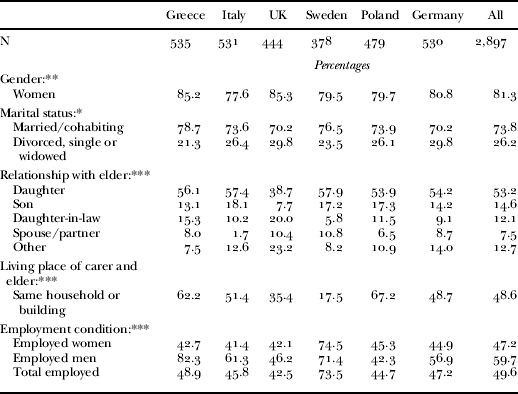
The definition of carer used in the study was: ‘someone who perceived himself/herself to be a carer and provided at least four hours of unpaid support per week (including organising support but excluding only financial support or companionship) to an over 65-year-old person living in the community or in a residential or long-term care setting’. For this study, only data referring to carers aged 45–64 were extracted from the original EUROFAMCARE database (see Table 2).
Sample composition
Significance levels: * p < 0.05, ** p < 0.01, *** p < 0.001. Chi-square test for association between countries and care-givers’ characteristics.
The sample of 2,897 carers (mean age 54.3) contained a higher proportion of women, the majority being represented by married daughters who cared for an older disabled parent. The British, Italian and Polish carers reported the lowest educational attainment. In Greece, Italy and Poland, most carers lived in the same household or building as the cared-for person. On the whole, the sample was comprised almost equally of employed and non-employed carers, with a rather high percentage of employed carers in Sweden. On average, more male carers were employed than women (but not in Sweden and Poland), their number being especially high in Greece and Sweden.
Measures for work restrictions
Four work restrictions experienced by the interviewed carers were investigated, by asking them: ‘Has caring for the elder caused any of the following restrictions to your working life or career?’ Working carers’ work restrictions were measured by investigating the answer, ‘I have had to reduce my working hours’ (Yes/No). Non-working carers' work restrictions were measured by investigating the answer, ‘I have had to give up work’ (Yes/No). All carers' work restrictions were measured by investigating the answers, ‘I can/could not develop my professional career or studies’ (Yes/No) and ‘I can/could work only occasionally’ (Yes/No).
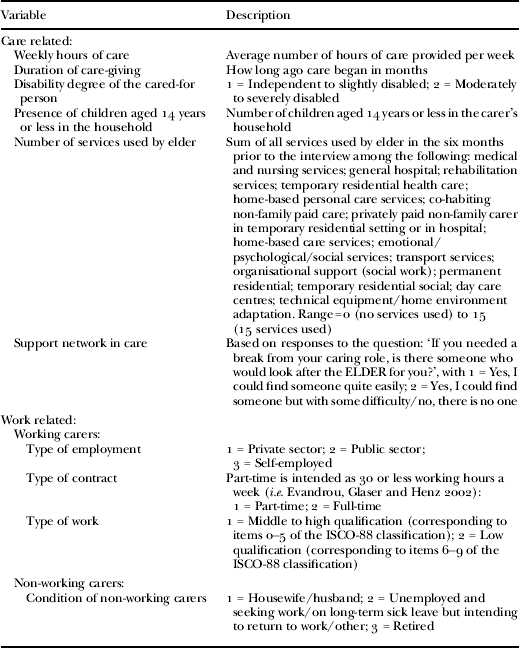
As independent factors, the work and care-related variables illustrated in the conceptual framework were employed in multivariate analyses, as described in Table 3, in addition to the socio-demographic variables as identified in Table 2. With regard to non-working carers, we controlled for their labour market position to explore possible differences between housewives, unemployed and retired people.
Description of the independent variables
Note: ISCO: International Standard Classification of Occupations.
Analyses
To test country and gender differences in the extent to which work restrictions are experienced by midlife family carers of older people, bivariate associations in work restrictions between countries (using chi-square to test for statistical significance) were performed for both men and women. Multivariate analyses were performed to test factors predicting work restrictions for family carers in different countries, aimed at identifying the best fitting and most parsimonious models to explain the relationship between each dependent (outcome) variable and independent (explanatory) variables. Since the observed outcome variables were binary events, multiple logistic regression analyses were undertaken. The goodness-of-fit of models was evaluated by the Hosmer-Lemshow test, which can be considered more robust than the traditional chi-square test, particularly if continuous variables in the model or the sample size are small. In each logistic regression analysis the independent variables were entered in a single step, using a direct model. The Wald statistic was applied to test the significance of individual logistic regression coefficients for each independent variable. A probability value less than 0.05 was considered statistically significant. Data were analysed with SPSS/Win program (version 17.0; SPSS Inc., Chicago, USA).
Results
Work restrictions across Europe
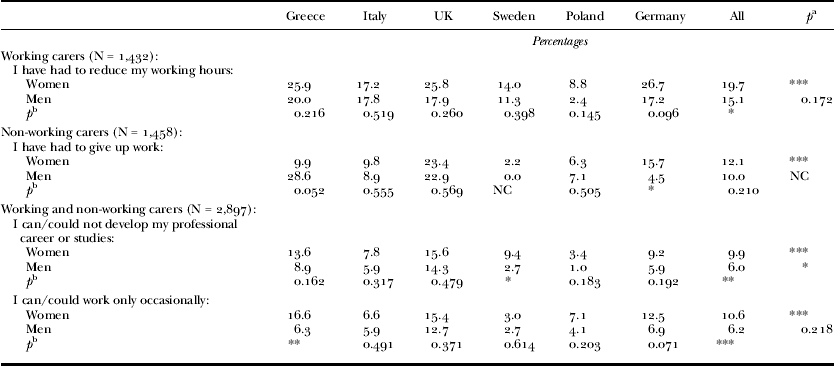
In terms of prevalence, work restrictions were more frequently experienced by carers in the UK, Greece and Germany, and to a lesser extent in Italy, Sweden and Poland (Table 4). The most common typology is the reduction of working hours, a phenomenon which is reported by over one-quarter of German, Greek and UK female working carers, while it is almost absent among Polish men (2.4%). As for the non-working carers, 12 per cent of women and 10 per cent of men have had to give up work. Work restrictions experienced by both working and non-working carers in the form of hindrances to career development (or studies) and to regular employment (i.e. allowing only occasional work), were experienced to a lesser extent.
Work restrictions by country and gender
Note: NC: not computable due to low frequencies.
Significance levels: * p ⩽ 0.05, ** p ⩽ 0.01, *** p ⩽ 0.001. aFor differences between countries; bfor country differences between genders (within a country).
On answering the first research question, focusing on country and gender differences, we found differences between countries for women in all investigated restrictions. On the whole, women experience more limitations in the UK, in Germany and Greece. Country differences regarding men were found only in terms of missed career development, with the UK's carers in particular experiencing this situation.
With respect to gender differences within countries, women in general were more penalised than men, but it is rather surprising that, all in all, differences are not as great as one might expect. In Italy, Poland and the UK, there are no gender differences for work restrictions due to family care duties. On the other hand, women are significantly restricted on work in the following countries for different reasons: in Greece, more female carers are forced to work on an occasional basis; in Sweden, they experience more difficulties in career development; and in Germany, they are more likely to be pushed out of the labour market.
Main explanatory factors for work restrictions in a cross-national perspective
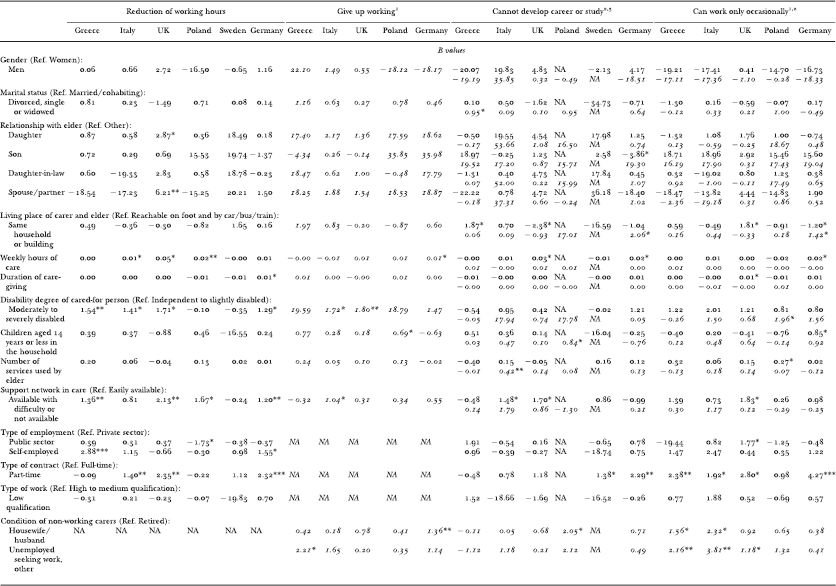
To address the second research question on the reasons for country differences while controlling for the other variables included in the model, country regressions for each kind of work restriction were undertaken, investigating independently both working and non-working carers. The limited number of Swedish and Polish carers experiencing some type of work restrictions prevented some analyses in these countries (Table 5). In the following section, the results are presented by work restriction across countries.
Explanatory variables for work restrictions: multiple logistic regression analyses
Reduction of working hours
The reduction in working hours caused by family caring responsibilities is apparently related to a minimal extent to personal-subjective characteristics of individuals. This appears to be a significant factor only in the UK, where daughters and partners are more likely to reduce their working hours because of caring responsibilities. Much more significant factors are represented by intrinsic aspects of care-giving, such as the older persons' high level of disability (which applies in all countries except Poland and Sweden), the high care intensity in terms of weekly hours (in Italy, Poland and the UK) or duration of the care-giving period (in Germany), as well as the absence of a good support network (although this does not occur in Italy and Sweden). Being a part-time worker also increases the likelihood for a carer to reduce the number of hours worked in several countries. In Germany and Greece, being self-employed correlates with a reduction of working hours, whereas in Poland, this is associated with being employed in a private company.
Withdrawal from the labour market
The carer's decision to withdraw from the labour force as a consequence of caring responsibilities appears to depend to a large extent on the older person's level of care needs. People caring for older relatives with higher support needs are more likely to withdraw from the labour market in Italy and the UK, with the lack of an adequate support network also being crucial in the former country. However, in Germany, giving up work is likely to happen when the number of hours spent caring increases, and in Poland, when people are multiple carers, i.e. also caring for children. Housewives and husbands in Germany, as well as unemployed people in Greece, are the groups most likely to give up work as a result of their caring responsibilities.
Missed career opportunities
Carers experience more frequently obstacles to career development and feel obliged to work only occasionally in association with specific socio-demographic factors, and in particular with the living place of carers and elders. With respect to the working carers' difficulty in developing a career, German sons report this restriction less frequently. Again in Germany, high-intensity care (in terms of hours) and having a part-time contract (the latter also in Sweden) correlate with fewer career opportunities. For non-working carers, cohabitation with the cared-for person is a significant factor in missing career opportunities in Germany and Greece, whereas in the UK, this restriction is felt more frequently by carers who live at some distance from the cared-for older person, spend a high number of hours caring and do not have a good support network (this also applies to Italy). Other important factors affecting carers out of the labour market are, in Greece being single, in Italy an intense use of services, whereas in Poland being a housewife and the concomitant care of children.
Occasional work
In most countries, the emergence of occasional work as a result of caring responsibilities is predicted, not surprisingly, by part-time work (except for Poland) and, in the UK, by working in the public sector. Being unemployed correlates with having to take up occasional work in the UK, Italy and Greece, and in the two latter countries also with being a housewife. Living with the older cared-for person increases the possibility of undertaking occasional work for employed carers in the UK and for German carers who are out of the labour market. German working carers are more likely to work occasionally when living at some distance from the cared-for person, caring for several hours per week and having concomitantly to take care of young children. British working carers and Polish non-working carers involved in long-term care-giving undertake more often than others occasional work, the latter especially in the case of high support needs by the cared-for elder. Polish working carers experience occasional employment if their older relatives use a high number of services, suggesting a condition of higher support needs by the cared-for older person.
Discussion
This paper provides evidence that restrictions in working life due to caring responsibilities are more frequently reported in the UK, Germany and Greece, less so in Italy, while in Poland and in Sweden, they are seldom reported. In the UK liberal model, work restrictions are widespread in a context of relatively high employment rates and a rather weak disposition among the population to care for older relatives (Eurobarometer 2007). Compared to other countries, services are available to support working carers but are costly when provided by private companies, with the burden of care falling on families rather than on the state (Yeandle Reference Yeandle and Crompton1999). Even the German conservative regime has relatively high employment rates, and the male breadwinner/female carer model implies considerable work restrictions for carers. The situation is different in Mediterranean countries, where the care of older people is culturally and institutionally managed to a large extent by the family, in a context of limited public responsibility and low employment rates. Nevertheless, more work restrictions were found in Greece than in Italy, which can be attributed to the lower state provision in Greece of care-related measures (e.g. care allowances) compared to Italy, where this financial support is very often used by families to hire (often on an undeclared basis) migrant care workers privately. The transition model of post-communist societies such as Poland (Hoff and Hamblin Reference Hoff and Hamblin2011) resembles to a large extent the Mediterranean pattern, even if characterised by stronger financial constraints. Nevertheless, Polish carers seldom experience work restrictions, given the large availability of informal care due to low employment rates and to the high value attached to intergenerational solidarity in this country, which counterbalances the shortage of public formal services and of dedicated economic resources. On the other hand, the Swedish social democratic model, characterised by generous welfare services and benefits (even if they are intended as a support to older persons rather than to family carers), demonstrates that high employment rates (as reflected also in our sample) can be sustained and reconciled with informal care tasks.
In all countries, the reduction of working hours represents the most widespread outcome for working carers (about one in five women report it in the overall sample). Nonetheless, a considerable number of carers are forced to give up work or to work only occasionally, whereas occasional work and problems in career development represent a less widespread restriction. Consistent with previous findings (e.g. Beitman et al. Reference Beitman, Johnson, Clark, Highsmith, Burgess, Minor and Stir2004; Dentiger and Clarkberg Reference Dentiger and Clarkberg2002; Evandrou, Glaser and Henz Reference Evandrou, Glaser and Henz2002; Lyonette and Yardley Reference Lyonette and Yardley2006), the sample composition of our study confirms that reconciling work and care is mostly a ‘female’ phenomenon. In addition, our study shows that on the whole, within countries, men generally experience restrictions to the same extent as women, and gender does not seem to play a major role in national multivariate analysis.
The analysis by country demonstrates that, in experiencing the two main restrictions (i.e. reduction of working hours and giving up work), socio-demographic characteristics were almost irrelevant in all countries, while care-related factors – and especially a high number of care hours, high support needs by the cared-for person and the absence of support networks – were all significant, thus supporting results from previous studies (e.g. Covinsky et al. Reference Covinsky, Eng, Lui, Sands, Sehgal, Walter, Wieland, Eleazer and Yaffe2001; Henz Reference Henz2004; Masuy Reference Masuy2009; Spiess and Schneider Reference Spiess and Schneider2003). In our study, other socio-demographic characteristics, such as, for example, the cohabitation with the older cared-for person, a factor that in other studies was found to be associated with the carers’ reduced employability, reflecting a stronger commitment to care-giving (Covinsky et al. Reference Covinsky, Eng, Lui, Sands, Sehgal, Walter, Wieland, Eleazer and Yaffe2001; Heitmueller Reference Heitmueller2007), seem to play an important role only in relation to the other two, less frequently experienced restrictions (i.e. lost career opportunities and occasional work). Furthermore, as already reported in the literature (e.g. Henz Reference Henz2004; Masuy Reference Masuy2009; Spiess and Schneider Reference Spiess and Schneider2003), carers working part-time are more at-risk of experiencing work restrictions. However, other aspects reported to be important by some previous studies (e.g. a low level of qualification or being married) emerged as less relevant in this study. To discuss some country differences in more detail, in the following we relate different work restrictions to country explanatory variables.
Reduction of working hours
With regards to factors affecting the reduction of working hours, intense care, in terms of weekly hours spent caring, seems to be less important in Greece and Germany, and this may be explained by the fact that in these countries carers use the reduction of working hours through self-employment as a way of organising their life commitments. Indeed, government policies do not seem to specifically address the needs of self-employed Greek carers. For instance, they cannot take advantage of the right to leave for family obligations, a measure which is available to employees (Mestheneos, Triantafillou and Kontouka Reference Mestheneos, Triantafillou and Kontouka2004). In Germany, the payment of contributions for the long-term care insurance (which is shared between employer and employee and is mandatory for both the public and private sectors) is only voluntary for the self-employed. This means that self-employed carers without a support network may prefer to reduce their working hours, rather than participating in the public insurance scheme.
Consistent with the findings reported by Masuy (Reference Masuy2009) on the factors affecting the decision of quitting paid work, in Poland workers employed in the private sector reduce their working hours, whereas public employees are more likely to deal with the situation leaving their working time unaffected. This can be explained by the specificity of the Polish private market, characterised by a predominance of small businesses, where employers are also self-employees, who in turn are very flexible with the working patterns and the amount of working hours of their employees with family care responsibilities.
Withdrawal from the labour market
A high number of weekly hours spent caring is a relevant factor for withdrawal from the labour market only in Germany where, in contrast to other countries, carers seem to find it difficult to manage high-intensity care by adjusting the amount of hours they work. Indeed, as a consequence of the male breadwinner/female carer model, German female carers appear to be relatively often forced to give up not only work, but even the idea of re-entering the labour market once the caring commitment is over. This might explain why, for example in contrast to Greek carers, German female carers consider themselves as housewives rather than unemployed. Not surprisingly, in a familistic country such as Poland, which is still characterised by a large number of multigenerational households, the ‘sandwich-condition’ of having a high number of children to care for within the family, in addition to caring for an older relative, often ends up with the decision of giving up work.
Missed career opportunities
Living with the older person reduces the difficulties in developing a career for working carers in the UK, a result which might be related to the greater difficulty they report in managing intensive care-giving (in terms of hours spent) for an older relative living far away, especially when they cannot count on a good support network. Support services do not always help in this respect (Covinsky et al. Reference Covinsky, Eng, Lui, Sands, Sehgal, Walter, Wieland, Eleazer and Yaffe2001). In Italy, for instance, access to services is rather difficult, and older people are usually unable to use them without the frequent help of their carers, a situation that might have, on the long run, a negative impact on the carers’ employment position. In Poland, having a large number of children in the family often represents an obstacle for those carers who are out of the labour market.
Occasional work
In the UK, live-in working carers who need to reconcile paid employment and unpaid care by working occasionally due to a lack of a support network are mainly public-sector workers. This might be due to the greater possibility to count on short-term contracts or care leaves in the public sector compared to the private one. In Germany, live-in carers who are outside the labour market appear to be more restricted in this respect. This might be related to the greater attachment to work of employed carers (who work more frequently and for a longer time) compared to carers out of the labour market, in this country.
Final remarks
This study provides evidence on the main gender and country differences in Europe concerning work restrictions for family carers, contributing to filling a gap in knowledge in a sensitive field, as recognised also by the European Commission, which has repeatedly invited European member states to reflect on new forms of leave to enhance the reconciliation of professional, private and family life (AGE 2008; Mestheneos and Triantafillou Reference Mestheneos and Triantafillou2005). Even if the problem of reconciling work and care certainly exists in Sweden too, our study seems to suggest that Sweden might play the role of benchmark for other welfare states in this respect, highlighting some critical points to be addressed through appropriate governmental policies in other countries. In the UK, some public measures originally aimed at providing support to carers might in the end have ambivalent effects on their labour market participation, as shown for instance by the Carer's Allowance, a means-tested benefit addressed to carers with low income, which can, however, prevent carers from working or working more hours. Thus, an in-depth, systematic review of carers’ benefits across Europe should be undertaken to identify how carers can be better supported (Arksey and Glendinning Reference Arksey and Glendinning2008). In Germany, the recent reform on care leaves was not unanimously welcomed by carers, as it is considered by many to be economically disadvantageous and too limited in its time coverage (TNS Infratest Sozialforschung 2011). As a consequence, the long-term care insurance scheme might soon require further adjustments, also to better support certain categories of workers (e.g. self-employed). To improve the work–care balance for Greek and Italian working carers, the familistic system should be integrated by the State through a stronger role in the provision of relevant services, like home and residential care, thus facilitating carers to remain in the labour market. This is true also for Poland where, however, working carers' problems are still not high on the political agenda, not only because few problems have so far been reported, but also because the governmental main challenge is currently focused on the attempt to increase the employment rate in general, and that of older workers in particular (Rogut, Piasecki and Pabiniak Reference Rogut, Piasecki and Pabiniak2007).
Limitations of the study
With regard to the limitations of this study, it should be pointed out that the EUROFAMCARE study – from whose database the data analysed here have been extracted – pursued the aim of ensuring a sample reflecting the variety of existing care-giving situations by means of a non-random (and non-homogeneous) sampling strategy. A possible solution to this inconvenience may be achieved by creating homogeneous clusters of sub-categories within each country, although this method would lead to a further reduction in the size of the sample. Therefore, a future follow-up study could be seen as a more effective – although certainly more time and resource consuming – way to overcome this dilemma. Such a step would furthermore allow for a better understanding of the ‘dynamics’ taking place within the care-giving process, rather than using cross-sectional data. A further limitation is represented by the rather low number of men in the studied sample. Nevertheless, we considered it important to include them in order to start contributing to fill in what can certainly be considered a major gap in this field, since most of the previous studies on the topic have focused on women only.
Despite these limitations, the findings presented here provide new. evidence on the topic under investigation, giving a crucial understanding of current cross-national variations in work restrictions experienced by midlife family carers at the European comparative level.
Acknowledgements
The EUROFAMCARE research project, on whose findings this article is based, was funded by the European Union under the 5th Framework Programme for Research, Technological Development and Demonstration, Key Action 6: The Ageing Population and Disabilities, 6.5: Health and Social Care Services to Older People (contract no. QLK6-CT-2002-02647; project's homepage: http://www.uke.uni-hamburg.de/extern/eurofamcare/). This paper was prepared on behalf of the EUROFAMCARE Group: Germany: Döhner, H. (co-ordinator), Kofahl, C., Lüdecke, D., Mnich, E., Kohler, S. (Hamburg) and Rothgang, H., Becker, R., Timm, A. (Bremen); Greece: Mestheneos, E., Triantafillou, J., Prouskas, C., Kontouka, S., Goltsi, V., Loukissis, A., Mestheneou, K.; Italy: Lamura, G., Balducci, C., Gianelli, M. V., Melchiorre, M. G., Polverini, F., Principi, A., Quattrini, S., Spazzafumo, L.; Poland: Bien, B., Wojszel, B., Synak, B., Czekanowski, P., Bledowski, P., Pedich, W., Sielawa, B., Rybaczuk, M.; Sweden: Öberg, B., Krevers, B., Johansson, S. L., Davidson, T.; UK: McKee, K., Nolan, M., Barber, L., Brown, J.; AGE-Platform (Brussels): Parent, A.-S., Patel, J., Dauréle, C.