I. INTRODUCTION
Sulfonated poly(ether ether ketone) (SPEEK), the most important sulfonated aromatic polymer (SAP), is widely considered as a promising polymer electrolyte for proton exchange membrane fuel cells (PEMFC) because of its many advantages such as a low cost, an easy availability, a sufficient proton conductivity, a low fuel permeability.Reference Higashihara, Matsumoto and Ueda1–Reference Kerres, Ullrich, Meier and Haring5 Like for Nafion membranes, the proton conductivity of SPEEK is water dependent and increases with the water content within the membrane.Reference Zawodzinski, Springer, Davcy, Valerie and Gottesfeld6, Reference Di Vona, Licoccia and Knauth7 However, the water is like a double-edged sword: on the one hand, a large water content can enable the microphase separation and thus the formation of nanochannels for proton transport; on the other hand, water can also deteriorate mechanical properties of SPEEK, especially for polymers with a high degree of sulfonation (DS).Reference Li, Zhang and Wang8 In addition, the rather harsh environment during PEMFC operation, combining strong acid and strong oxidizing or reducing conditions, and cyclic variations of temperature and humidity, can aggravate the degradation.Reference Hou, Di Vona and Knauth9–Reference Borup, Meyers, Pivovar, Kim, Mukundan, Garland, Myers, Wilson, Garzon, Wood, Zelenay, More, Stroh, Zawodzinski, Boncella, McGrath, Inaba, Miyatake, Hori, Ota, Ogumi, Miyata, Nishikata, Siroma, Uchimoto, Yasuda, Kimijima and Iwashita12 How to achieve a better compromise among the proton conductivity, mechanical and thermal stability remains therefore a big challenge.
Different strategies have been developed to solve this problem. First, reinforced materials, such as polytetrafluorethylene,Reference Mitov, Vogel, Roduner, Zhang, Zhu, Gogel, Jorissen, Hein, Xing, Schonberger and Kerres13, Reference Xing, Yi, Liu, Fu and Zhang14 inorganic carbon fibers,Reference Voss and Friedrich15 ceramic oxides,Reference Lai, Kuo, Huang and Chen16 or silanol moieties,Reference Di Vona, Marani, D’Ottavi, Trombetta, Traversa, Beurroies, Knauth and Licoccia17 were introduced into the polymer matrix to improve its mechanical, thermal, and structural stability. The stabilization effect can be owed to the reinforcement by additives and intermolecular interactions between the polymer and other components. Inter/intramolecular crosslinking of macromolecular chains is an alternative strategy.Reference Kerres18 The studies include ionic,Reference Gasa, Weiss and Shaw19, Reference Luu and Kim20 covalent,Reference Sgreccia, Khadhraoui, Bonis, Licoccia, Di Vona and Knauth21–Reference Zhou, Dominey, Rolland, Maynor, Pandya and Desimone24 or mixed ionic and covalent crosslinks.Reference Kerres25–Reference Chen, Zhang, Chen, Endo, Higa, Okamoto and Wang28 The formation of covalent crosslinks (XL) between macromolecular chains allows improving the resistance to solvents, the dimensional stability, and the mechanical strength, while maintaining a locally high density of functional groups, such as sulfonic acid groups.Reference Knauth, Hou, Bloch, Sgreccia and Di Vona29–Reference Marani, Di Vona, Traversa, Licoccia, Beurroies, Lewellyn and Knauth31 The possibility to perform a direct in situ XL reaction is an additional interesting feature to obtain stable long life membranes. The introduction of a certain number of covalent bonds between adjacent polymeric chains by thermal treatments of cast membranes is really economic. Due to its simplicity, this method is very suitable for a large-scale industrial production of crosslinked membranes because the procedure can be easily upscaled.
The temperature-promoted and solvent-assisted crosslinking of SPEEK membranes was achieved by electrophilic aromatic substitution reactions of sulfonic acid moieties with aromatic rings within the SPEEK matrix. An initial high ion exchange capacity (IEC) can guarantee enough –SO3H groups for proton transport, if the XL density is not too high and not too much –SO3H are affected during the crosslink reaction. As casting solvent, high boiling dimethyl sulfoxide (DMSO) plays an important role in thermal XL reactions because other casting solvents such as N-methylpyrrolidone and dimethylformamide disable the XL reaction under the same conditions.Reference Di Vona, Sgreccia, Licocccia, Alberti, Tortet and Knauth32 In this work, SPEEK membranes with high initial IEC were synthesized and thermally treated for different times (0–24 h). The obtained membranes were characterized in terms of high-resolution thermogravimetric analysis (TGA), mechanical tensile tests, dynamic mechanical analysis (DMA), and water uptake (WU) measurements. In addition, the effect of DMSO on WU, membrane swelling, and water diffusion coefficients was explored. The aim was to show that thermal treatments performed above 150 °C can significantly improve the thermal stability, hydration numbers, and mechanical properties. These results are of significant importance for the improvement of proton exchange membranes for fuel cells.
II. EXPERIMENTAL
A. Materials
Polyether–ether–ketone (PEEK; Victrex, Lancashire, UK, 450 P, MW = 38,300) and other chemicals (Aldrich, Milano, Italy) were reagent grade and were used as received.
B. Sample preparation
The synthesis of SPEEK with a DS in the range of 0.8–1.0 was already reported.Reference Di Vona, Sgreccia, Licocccia, Alberti, Tortet and Knauth32 SPEEK membranes were obtained by the dissolution of SPEEK powder (250 mg) in DMSO (30 mL); the resultant solution was stirred for 4 h, concentrated to 5 mL, and then cast onto a Petri dish at 120 °C for 24 h (first treatment). After cooling to room temperature, resulting membranes were peeled off. To evaluate the effect of the thermal treatment time on membrane properties, the membranes were heated at 180 °C for 3, 10, and 24 h (second treatment).
C. Sample characterization
1. High-resolution TGA
The thermal stability of membranes was evaluated between 30 and 650 °C by high-resolution TGA on a thermal analyzer (Q500; TA Instruments, Newcastle, DE) in platinum sample holders with about 7-mg sample. The maximum heating rate was 5 °C/min with sample purge (air) at 60 mL/min and balance purge (argon) at 40 mL/min.
2. Determination of IEC
The IEC (milliequivalents of sulfonic groups per gram of dry polymer) was determined by acid–base titrations. To eliminate DMSO and its decomposition products before the titration, the membranes were swelled in water at 100 °C for 5 h then treated with H2SO4 5 M at room temperature for 2 h and finally washed again in water. The titration was performed as follows: H-form samples with given dry weight were soaked in 1.5 M NaCl solutions overnight to exchange H+ with Na+; the protons were titrated with 0.020 M NaOH solutions. The IEC was calculated using the dry weight of the sample and the quantity of exchanged protons.
3. Mechanical tensile tests
Mechanical properties of samples were measured at ambient temperature and relative humidity (RH) (∼43%, measured by a humidity sensor) on an Adamel-Lhomargy tensile test machine (M250-2.5 CT; Lhomargy, Paris, France). Samples were cut into small pieces with 5 mm width and 25 mm length and their ends were hold with adhesive tape to optimize mechanical tests. The constant crosshead speed was about 5 mm/min during the test. To evaluate the effect of humidity on mechanical properties, samples were also tested under dry conditions, while keeping other conditions constant. In this case, samples were dried over P2O5 for 3 days before the test.
4. DMA
DMA was performed from 30 to 250 °C in air on a DMA 2980 dynamic mechanical analyzer (TA Instruments). Measurements were operated in air at a fixed frequency of 1 Hz with 0.05 N initial static force and oscillation amplitude of 10 μm. This last value was chosen to keep the linear viscoelastic response of samples during experiments. The storage (E′) and damping (Tan Delta) spectra versus temperature were obtained at 3 K/min. DMA analysis allows deriving the glass transition temperature of samples treated for different times at 180 °C.
5. Water vapor uptake measurements
The WU was measured by monitoring the weight of samples in water vapor with different activities at 25 °C. Water activities can be controlled in a closed vessel by gas phase equilibrium with P2O5 ( ) or different saturated solutions as listed in Table I.Reference Weast33 Measurements were made at the steady state (240 h) of stabilization. The saturation was achieved by mixing a large excess of each salt with deionized water.Reference Pollio, Kitic and Resnik34 Before the experiments, membranes were dried 240 h over P2O5 and a final measurement was made in presence of pure water.
Water activity of different saturated salt solutions at room temperature.Reference Weast33

Furthermore, water vapor sorption isotherms as function of time were recorded at ambient humidity. To probe the effect of DMSO, residual DMSO within SPEEK was removed by the following procedure: (i) heating in 1 M HNO3 at 100 °C for 2 h; (ii) rinsing with pure water several times; (iii) heating in pure water at 100 °C for 5 h; (iv) drying the sample in the oven at 120 °C for 15 h.
6. Proton conductivity measurements
The conductivity of membranes was measured as function of RH in a homemade apparatus by two-electrode impedance spectrometry, as described in Ref. Reference Knauth, Sgreccia, Donnadio, Casciola and Di Vona35. Commercial electrodes were used and the through-plane conductivity was obtained from the resistance of membranes and their thickness.
III. RESULTS AND DISCUSSION
A. High-resolution TGA
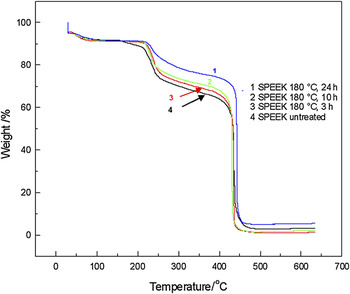
Figure 1 shows TGA curves of SPEEK heated at 180 °C for 0, 3, 10, and 24 h. The thermal stability of SPEEK increased with the thermal treatment time, and especially for SPEEK annealed for 24 h, the main chain decomposition temperature was higher than those of other samples, indicating that the degree of XL of SPEEK increased with the treatment time,Reference Knauth, Hou, Bloch, Sgreccia and Di Vona29 forming a more and more dense three-dimensional network.
TGA curves of SPEEK treated at 180 °C for 0, 3, 10, and 24 h.

The DS can be calculated by TGA from the weight loss, Δm, corresponding to desulfonation.Reference Knauth, Hou, Bloch, Sgreccia and Di Vona29 The DS can be calculated using the following Eq. (1)

where m is the mass of SPEEK, M(PEEK) is the molecular mass of the repeat unit of PEEK (288.7 g/mol), and M(SO3H) that of sulfonic acid groups (80.1 g/mol).
Furthermore, the degree of crosslinking (DXL) of SPEEK can be calculated by Eq. (2):
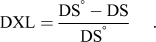
DS° and DS are the degrees of sulfonation of SPEEK before and after the crosslinking reaction, respectively.
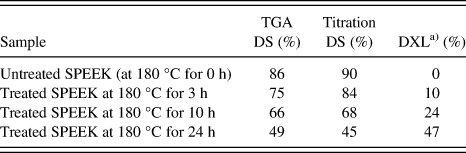
The calculated DS for different samples are reported together with those by acid–base titrations and with DXL in Table II. There is a good consistency between DS values from TGA and titration.
Calculated DS from TGA and titration and DXL.
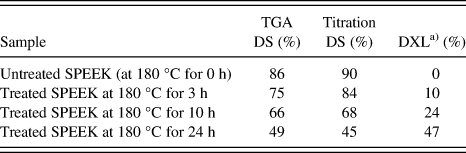
a) The average DS from TGA and titration is used for the calculation of DXL according to Eq. (2).
B. Mechanical tensile tests
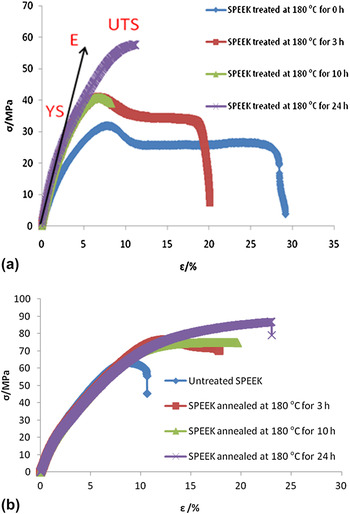
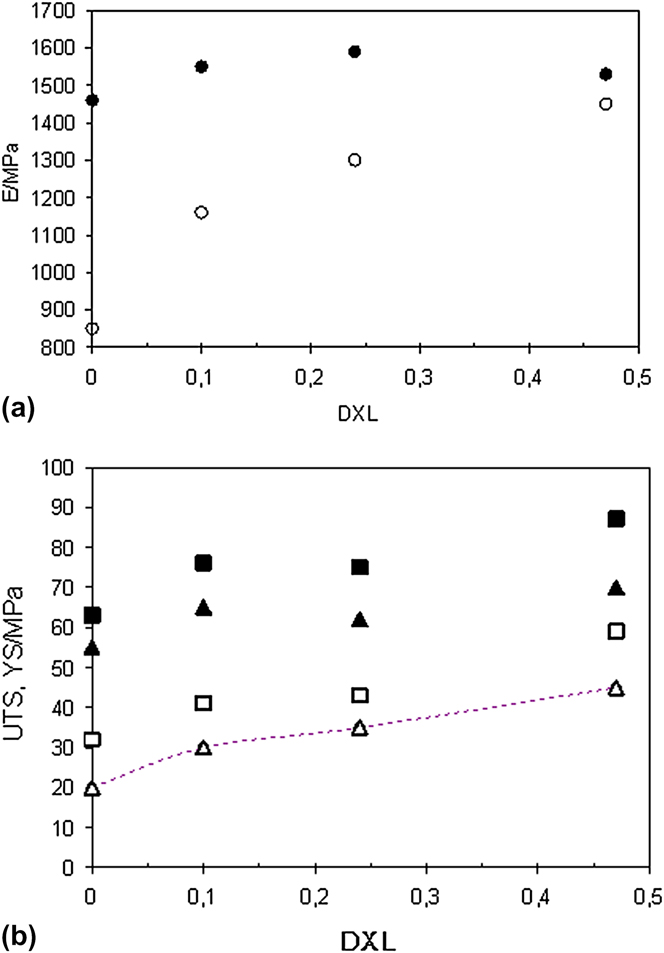
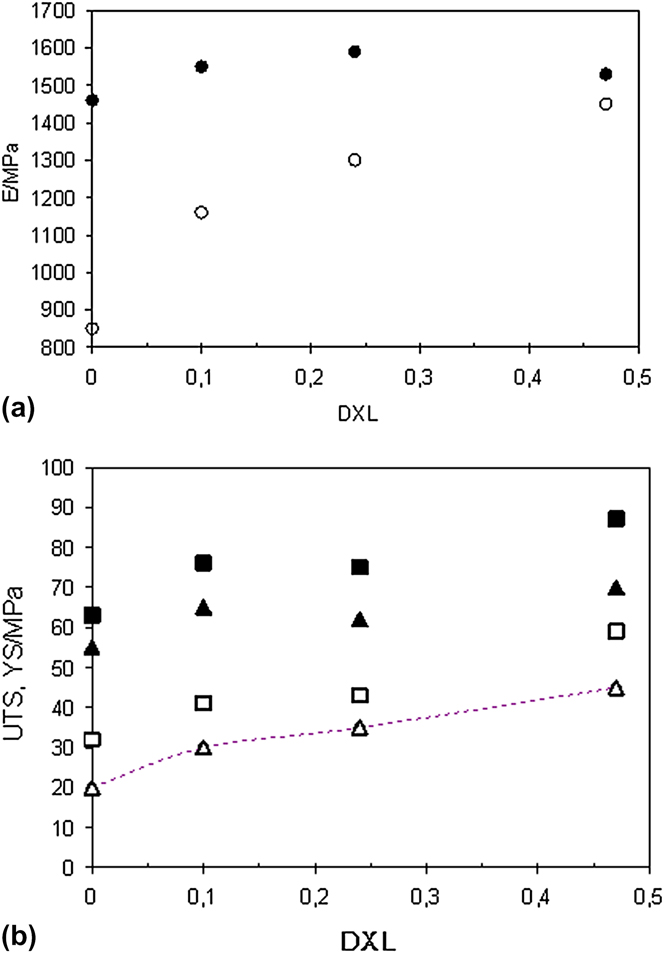
Typical stress–strain curves of SPEEK membranes treated at 180 °C for 0, 3, 10, and 24 h, recorded at ambient RH and 0% RH, are shown in Fig. 2. The corresponding mechanical properties [Young modulus, yield stress, ultimate tensile strength (UTS), and elongation at break] are listed in Table III and are plotted versus DXL in Fig. 3. The mechanical properties of samples increase with the treatment time. In the presence of water, the Young modulus increases from 850 to 1450 MPa with increasing DXL values. In dry conditions, the change is much smaller. In both cases, the Young modulus seems to reach a plateau value around 1450 MPa above DXL 0.3. This property reflects the stiffness of the polymer and explores low displacements on microscopic scale of bond lengths or bond angles, i.e., elastic deformation, and essentially weak bonds. In wet conditions, the presence of water between macromolecular chains reduces strongly the van der Waals bonds; the water molecules act as plasticizer. This is the reason of the much higher Young modulus in dry conditions. Increasing DXL reduces and fixes the mean distance between macromolecules. The reticulation restricts chains from sliding past one another and generates higher elasticity in amorphous polymers. The Young modulus increases thus strongly with increasing DXL in humid conditions.
Typical stress–strain curves of SPEEK treated at 180 °C for different times and different RH (a: ambient 43% RH; b: 0% RH).

Young modulus (E), yield strength (YS), and UTS as a function of DXL of SPEEK under 43% (empty dots) and 0% RH (solid dots).
Mechanical properties of SPEEK samples (E: elastic modulus).

The yield stress, the UTS, and the elongation at break reflect instead larger unrecoverable displacements (plastic deformation) along the chain length direction, generally corresponding to initial orientating movements of the polymer chains (yield stress) and final collapse of the original polymer microstructure (elongation at break). These properties probe the strong covalent bonds inside the macromolecules. The multidirectional extension of polymer chains corresponding to XL induced by the heat treatment leads to the formation of network structures and restricts the viscous flow. The effects of reticulation on mechanical properties of SPEEK are strongly influenced by the regularity of the network formed during heat treatments. A higher crosslinking leads to a significant increase of the yield stress and tensile strength by limiting the movement of chain segments and decreasing the flexibility. The stiffness or rigidity of polymers becomes higher and the elongation at break decreases. The network structure gives the polymer a high-dimensional stability and mechanical strength.
In humid atmosphere, the presence of water enlarges the distance between polymer chains reducing the interaction among them and thus the mechanical strength of the polymer (plasticizing effect). The yield stress and UTS are therefore consistently higher for the dry polymer. Inter- and intramolecular crosslinks lead to a significant improvement of properties in all cases as supplementary strong covalent bonds are formed. The satisfying mechanical properties indicate a promising potential for PEMFC application under high temperature and low RH conditions.
C. DMA
DMA curves (Fig. 4) allow determining storage modulus values through a large temperature range and glass transition temperatures (T g) of SPEEK polymers.Reference Sgreccia, Chailan, Khadhraoui, Di Vona and Knauth36 This technique can also give interesting qualitative information on crosslinking degree.
DMA results of SPEEK treated at 180 °C for 0, 3, 10, 24 h. (a) Storage modulus versus temperature and (b) T g versus temperature.

From a quantitative point of view, storage modulus values in the glassy state are consistent with the elastic modulus from tensile tests; the storage modulus of SPEEK increases with the treatment time at 180 °C, due to increasing DXL [Fig. 4(a)], as discussed previously. The α relaxation temperature obtained from the Tan δ peak maximum can be assimilated to the glass transition temperature T g. This temperature also increases with the annealing time due to a symmetry reduction by crosslinking [Fig. 4(b)].
From a qualitative point of view, one can note that during α relaxation, the decrease of storage modulus is inversely proportional to the treatment time. For uncrosslinked and low crosslinked SPEEK samples, this decrease is followed by an increase in the rubbery state. This increase is due to the sample stiffening with temperature, probably by crosslink reactions occurring with remaining –SO3H groups. During DMA experiments, samples are subjected simultaneously to high temperature (over 180 °C) and mechanical stress, which act as an accelerated thermal treatment. This phenomenon is similar to the well-known thermoset postreticulation commonly observed in DMA experiments. In addition and in agreement with previously results, the longest thermal treatment at 180 °C (24 h) seems to give the maximum crosslink since no storage modulus increase is observed in the rubbery state for this sample.
D. WU and effect of residual DMSO
The WU of membranes is an important property for fuel cell applications. The WU is defined as:
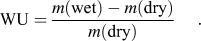
Here, m(wet) is the mass of the wet and m(dry) the mass of the dry membrane sample. The WU determination is not trivial because the membrane preparation and history play an important role. For example, the WU reported for XL sulfonated polyimide was higher than that before crosslinking, due to the large free space within the polymer matrix created by long chains of crosslinker molecules.Reference Park, Lee, Sohn, Lee, Freeman and Kim37
Our measurements were conducted for very long times (240 h) to achieve steady-state conditions because it was shown that very slow changes of conformations can modify the WU and lead to some of the unexplained divergences between literature data.Reference Alberti, Narducci and Sganappa38
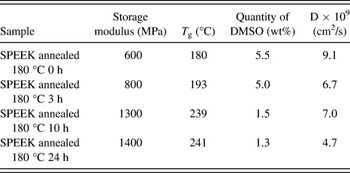
The measured WU is also very sensitive to the presence of residual DMSO in the membranes. Considering the high boiling point and the interaction of DMSO with –SO3H groups,Reference Alia, Edwards and Kiernan39 there is still residual DMSO within SPEEK even heated at 180 °C for some time.Reference Knauth, Hou, Bloch, Sgreccia and Di Vona29, Reference Di Vona, Sgreccia, Tamilvanan, Khadhraoui, Chassigneux and Knauth30 This is why we compared membranes with residual DMSO and those where the residue was completely and carefully removed by treatment in 1 M HNO3 and pure water at 100 °C. By comparing dry weights of SPEEK before and after this treatment, we could estimate the quantity of residual DMSO within SPEEK. The data listed in Table IV show that the amount of residual DMSO decreased with the annealing time. It is reasonable to infer that DMSO reduces the amount of absorbed water by obstructing the channels, and evidence of this hypothesis is provided in the following.
Storage modulus, glass transition temperature T g, quantity of residual DMSO, and chemical diffusion coefficients of water D.

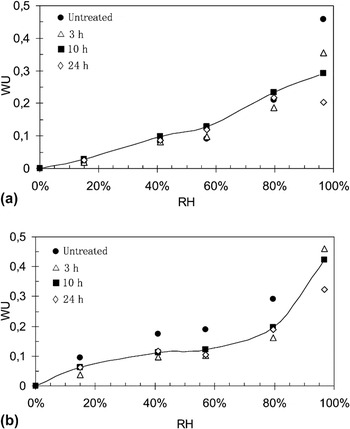
Figure 5 shows the water vapor uptake from ≈0%to 97% RH before and after the removal of residual DMSO. The water vapor uptake of all samples increased slowly at low and medium RH, while quickly at high RH, which corresponds to hydration and swelling of membranes, respectively.Reference Li, Zhao and Yang40 Though a sufficient WU at low RH is mandatory for proton conductivity, a too high WU at high RH must be avoided to limit membrane swelling. By comparing Figs. 5(a) and 5(b), the effect of residual DMSO on the water vapor uptake can be observed. At low and medium RH, treated SPEEK exhibited slightly higher water vapor uptakes than untreated SPEEK. The reason is the residual solvent within the membranes, considering that DMSO is an aprotic polar solvent with a strong affinity for water.Reference Knauth, Sgreccia, Donnadio, Casciola and Di Vona35 The low free space within untreated SPEEK, caused by the presence of DMSO interacting with –SO3H groups, limits the capacity to absorb water; this results in a lower WU than that without DMSO. The thermal treatment at 180 °C is accompanied by partial removal of DMSO by evaporation so that more free space is available for water. This leads to the apparently paradoxical result that the WU of treated membranes at low RH is higher than for untreated ones. After removal of residual DMSO, the water vapor uptake of treated SPEEK is lower than that of untreated SPEEK within the entire RH range, as expected [Fig. 5(b)]. The sample treated 3 h presents apparently the lowest WU at low RH; maybe some residual DMSO is trapped inside this membrane.
WU curves of SPEEK treated at 180 °C for 0, 3, 10, and 24 h as a function of RH (0–97%), (a) with residual DMSO and (b) without residual DMSO.

At low and medium RH, the effective water activity in the gas phase is low, and there is no strong thermodynamic driving force, which enables DMSO to escape into the gas phase from the membrane. At higher RH, the water activity in the vapor phase is larger, and larger chemical potential leads to extraction of DMSO into the vapor phase according to displacement of the equilibrium:

One can observe the onset of extraction around 50% RH in Fig. 5(a) by the sigmoidal shape of the curve. A second sigmoidal can then be observed at even higher RH, around 80% RH [Fig. 5(a)], which might correspond to less hydrophilic decomposition products of DMSO.Reference Bennet41 The release of free space allows subsequently a larger water sorption especially in untreated SPEEK membranes. At higher RH, the WU of all samples increased but much less for crosslinked membranes. The thermal treatment reduced always the amount of sorbed water inside membranes and, consequently, swelling problems at high RH.
From an applicative point of view, thermally treated membranes show an excellent combination of hydration properties: at low RH, they tend to absorb more water facilitating proton conduction, and at high RH, they absorb distinctly less water than untreated SPEEK, reducing thus significantly swelling problems.
E. Chemical water diffusion coefficient
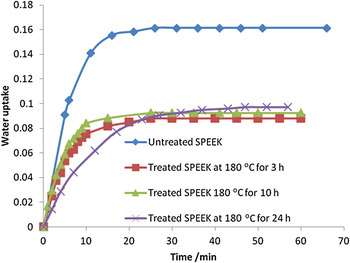
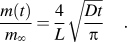
Isothermal water vapor sorption curves of dry samples as function of time at ambient RH are shown in Fig. 6. The untreated membrane shows a clearly higher WU than the treated ones. Chemical diffusion coefficients (D) of water in SPEEK can be calculated from an approximate solution of Fick’s second law according to the Eq. (3) when the ratio m(t)/m ∞ is less than 0.5Reference Di Vona, Sgreccia, Licoccia, Khadhroui, Denoyel and Knauth42:
WU of SPEEK without residual DMSO at ambient RH and temperature as a function of time.

In this equation, m(t) is the WU at time t, m ∞ the WU after reaching steady state, and L the thickness of SPEEK membranes. As reported in Table IV, the chemical water diffusion coefficient in SPEEK membrane decreased with the annealing time. An increasingly denser three-dimensional network induced by the XL reaction should be responsible for the decrease of D with the annealing time. The observed diffusion coefficients are consistent with the data previously measured for modified SPEEKs.Reference Di Vona, Sgreccia, Licoccia, Khadhroui, Denoyel and Knauth42, Reference Kreuer, Paddison, Spohr and Schuster43 A thermal treatment around 10 h seems to be a nice compromise between hydrolytic/thermal stability and a sufficiently high water diffusion coefficient that is correlated to proton conductivity.
F. Proton conductivity
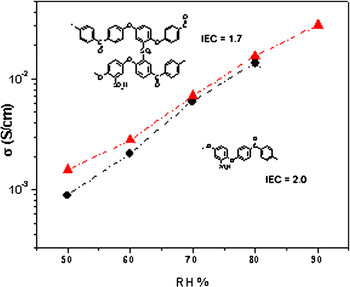
Figure 7 shows a typical comparison of proton conductivities of untreated and XL SPEEK membranes. There is a slight increase of proton conductivity of XL SPEEK at low RH, although the loss of some sulfonic acid groups by XL. Furthermore, the proton conductivity of untreated SPEEK is unstable above 80% RH. In contrary, the conductivity of XL membranes is stable and reaches interesting values for future fuel cell applications.
Proton conductivity of untreated SPEEK (IEC = 2 meq/g, black) and XL SPEEK (IEC = 1.7 meq/g, red, treated at 180 °C for 14 h) at 100 °C as function of RH.

IV. CONCLUSIONS
The mechanical, thermal, and swelling behavior of SPEEK membranes with a high initial DS treated at 180 °C for different times were evaluated. The DXL controlled by changing the heat treatment time, affected the membrane properties. In particular, an intermediate thermal treatment (10 h at 180 °C in our study) was able to provide a promising set of mechanical, thermal, and transport properties. The WU of membranes depends also on the amount of residual DMSO, but in any case, the swelling at high RH is reduced by crosslinking. These satisfying results imply that heat-induced and DMSO-assisted crosslinking is an effective strategy to improve the stability of SAP membranes for PEMFC application.
ACKNOWLEDGMENT
The EU-FP7 (FCH-JU) project “LoLiPEM—Long-life PEM-FCH&CHP systems at temperatures higher than 100 °C” (GA 245339) is gratefully acknowledged for cofunding this work.