Introduction
A growing number of studies have reported evidence of significant cognitive dysfunction in bipolar disorder (BD) (Robinson et al. Reference Robinson, Thompson, Gallagher, Goswami, Young, Ferrier and Moore2006; Kurtz & Gerraty, Reference Kurtz and Gerraty2009; Bourne et al. Reference Bourne, Aydemir, Balanzá-Martínez, Bora, Brissos, Cavanagh, Clark, Cubukcuoglu, Dias, Dittmann, Ferrier, Fleck, Frangou, Gallagher, Jones, Kieseppä, Martínez-Aran, Melle, Moore, Mur, Pfennig, Raust, Senturk, Simonsen, Smith, Soares, Soeiro-de-Souza, Stoddart, Sundet, Szöke, Thompson, Torrent, Zalla, Craddock, Andreassen, Leboyer, Vieta, Bauer, Worhunsky, Tzagarakis, Rogers, Geddes and Goodwin2013). The majority have focused on assessment during periods of euthymia, with relatively few examining the cognitive profile of bipolar depression. However, longitudinal analyses of symptom profiles in BD have demonstrated that individuals experience symptoms, predominantly depressive, around half the time they have the diagnosis (Judd et al. Reference Judd, Akiskal, Schettler, Endicott, Maser, Solomon, Leon, Rice and Keller2002). Further research during periods of symptomatic relapse is critical to fully characterize the cognitive profile of BD.
One area of cognition with particular implications for mood disorders, and bipolar depression specifically, is visuo-spatial memory. Numerous studies have described the neuroendocrine and neurobiological underpinnings of visuo-spatial memory processes, systems that overlap considerably with those commonly affected in mood disorders (Brown et al. Reference Brown, Rush and McEwen1999). For example, studies have reported alterations in the structure of the hippocampus in BD (Bertolino et al. Reference Bertolino, Frye, Callicott, Mattay, Rakow, Shelton-Repella, Post and Weinberger2003; Konradi et al. Reference Konradi, Zimmerman, Yang, Lohmann, Gresch, Pantazopoulos, Berretta and Heckers2011). Abnormal hypothalamic-pituitary-adrenal (HPA) axis function and consequent elevation of cortisol levels is also a well-replicated finding in BD (Watson et al. Reference Watson, Gallagher, Ritchie, Ferrier and Young2004; Gallagher et al. Reference Gallagher, Watson, Smith, Young and Ferrier2007) and is particularly marked in BD depression (Rybakowski & Twardowska, Reference Rybakowski and Twardowska1999). Research in animals (Steckler et al. Reference Steckler, Drinkenburg, Sahgal and Aggleton1998) and individuals with structural brain damage (Astur et al. Reference Astur, Taylor, Mamelak, Philpott and Sutherland2002; King et al. Reference King, Burgess, Hartley, Vargha-Khadem and O'Keefe2002) have demonstrated the role of the hippocampus in aspects of visuo-spatial memory processes (Bird & Burgess, Reference Bird and Burgess2008). Similarly elevation of the glucocorticoid, cortisol, has been shown to impair visuo-spatial memory processes (Young et al. Reference Young, Sahakian, Robbins and Cowen1999; Forget et al. Reference Forget, Lacroix and Cohen2002), through actions at the level of the hippocampus and temporal lobes (Forget et al. Reference Forget, Lacroix, Somma and Cohen2000). It has been demonstrated that administration of anti-glucocorticoid medication in bipolar depression reduces cortisol levels (Gallagher et al. Reference Gallagher, Watson, Dye, Young and Ferrier2008) and specifically improves visuo-spatial memory (Young et al. Reference Young, Gallagher, Watson, Del-Estal, Owen and Ferrier2004; Watson et al. Reference Watson, Gallagher, Porter, Smith, Herron, Bulmer, Young and Ferrier2012). Therefore, in addition to addressing the relative paucity of data in this area, developing an understanding of visuo-spatial memory in bipolar depression provides the opportunity to elucidate an important behavioural correlate of underlying neurobiological dysfunction.
A small number of studies examining cognition in bipolar depression have included assessment of aspects of visuo-spatial memory. While some have reported deficits in patients compared to controls (Martinez-Aran et al. Reference Martinez-Aran, Vieta, Reinares, Colom, Torrent, Sanchez-Moreno, Benabarre, Goikolea, Comes and Salamero2004; Rubinsztein et al. Reference Rubinsztein, Michael, Underwood, Tempest and Sahakian2006) others have found no differences (Sweeney et al. Reference Sweeney, Kmieca and Kupfer2000; Taylor Tavares et al. Reference Taylor Tavares, Clark, Cannon, Erickson, Drevets and Sahakian2007; Holmes et al. Reference Holmes, Erickson, Luckenbaugh, Drevets, Bain, Cannon, Snow, Sahakian, Manji and Zarate2008). One study by Gallagher et al. (Reference Gallagher, Gray, Watson, Young and Ferrier2014) that examined a broad range of cognitive processes in bipolar depression and matched controls demonstrated significant differences on a number of visuo-spatial memory tasks, including pattern and spatial recognition (from CANTAB), and forward and reverse spatial span (a CANTAB analogue to the Corsi block-tapping test of visuo-spatial short-term/working memory), visual pattern span (Della Sala et al. Reference Della Sala, Gray, Baddeley, Allamano and Wilson1999), and self-ordered pointing (McGonigle & Chalmers, Reference McGonigle and Chalmers2002). Interestingly, a recent study by Allen et al. (Reference Allen, Randall, Bello, Armstrong, Frantom, Cross and Kinney2010) sought to better understand such working-memory deficits in BD by conceptualizing them within a multicomponent working memory model (Baddeley & Hitch, Reference Baddeley, Hitch and Bower1974). While executive control of working memory was uniquely impaired in BD patients with a history of psychotic symptoms, the visuo-spatial working memory composite (comprising forward and reverse spatial span) was significantly impaired in BD patients irrespective of history of psychosis and was suggested to be a general marker of the disorder (Allen et al. Reference Allen, Randall, Bello, Armstrong, Frantom, Cross and Kinney2010). This is further supported by evidence of deficits in spatial span in unmedicated bipolar depressed patients, in the absence of differences in other visuo-spatial memory measures (Roiser et al. Reference Roiser, Cannon, Gandhi, Tavares, Erickson, Wood, Klaver, Clark, Zarate, Sahakian and Drevets2009).
It is important to note that visuo-spatial memory is a complex construct from which a number of dissociable processes have been identified. Therefore it may be desirable to adopt a more integrated approach, giving consideration to the interaction (and potential hierarchical organization) of cognitive processes, although few studies have done this within a mood disorders context. One aspect of visuo-spatial processing which, to date, has never been examined in depth in BD is object-location memory. In general terms, object-location memory enables us to remember the positions of objects within our environment. However, it is not a unitary construct, but can be fractionated into a number of components (Postma & de Haan, Reference Postma and de Haan1996; Postma et al. Reference Postma, Kessels and van Asselen2008). For example, it has been suggested that discrete functional dissociations exist between the processing of object identity, the processing of spatial location, and object-to-location binding (Postma et al. Reference Postma, Kessels, van Asselen and Allen2004, Reference Postma, Kessels and van Asselen2008). Evidence for these divisions has been accumulating from studies in a number of healthy and clinical populations, including localized brain injury (Postma & de Haan, Reference Postma and de Haan1996; Kessels et al. Reference Kessels, de Haan, Kappelle and Postma2001, Reference Kessels, Kappelle, de Haan and Postma2002b ). Comparisons are facilitated by the frequent use of the Objection Location Memory (OLM) paradigm (Kessels et al. Reference Kessels, Postma and de Haan1999), a computerized task which allows the precise assessment of these processes. Typically three task conditions are included – the reconstruction of positions only (POM; position-only memory), the placement of objects to remarked locations (OLB; object-location binding), and a final condition that purportedly integrates both processes, i.e. requires participants to locate individual objects into the frame (COM; the combined condition). Early work in healthy participants found that increases in set-size or concurrent verbal articulatory suppression impaired performance on OLB and COM processes, while POM was unaffected (Postma & de Haan, Reference Postma and de Haan1996; Kessels & Postma, Reference Kessels and Postma2002). Supporting this division, a double dissociation in these processes has been demonstrated in patients after tumour resection (Kessels et al. Reference Kessels, Postma, Kappelle and de Haan2000) and in patients with lesions following ischaemic stroke (Kessels et al. Reference Kessels, de Haan, Kappelle and Postma2002a ). It has also been reported that damage to the left hemisphere selectively impairs OLB processes, whereas right hemisphere damage impairs POM processes (Kessels et al. Reference Kessels, Kappelle, de Haan and Postma2002b ). This pattern has been found in patients following selective amygdalohippocampectomy (Kessels et al. Reference Kessels, Hendriks, Schouten, Van Asselen and Postma2004), although a meta-analysis of available studies revealed that hippocampal damage affected multiple aspects of spatial memory, with the largest effect on POM processes (Kessels et al. Reference Kessels, de Haan, Kappelle and Postma2001). While such profound structural impairment is not expected in BD, the use of this paradigm permits a more detailed characterization of the functional integrity of different visuo-spatial components, particularly with regard to process specificity.
The purpose of the present study was therefore to utilize the OLM paradigm to examine visuo-spatial memory in depressed bipolar patients and healthy matched controls. The ability of the paradigm to separate different components provides a novel method of fractionating such processes in BD. Due to the precise, metric nature of the POM condition (i.e. being devoid of object-identity relational cues), the inability to support the representation by verbal means, and the sensitivity to specific neurobiological disturbance, it was hypothesized that BD patients would show greater performance deficits in this process. A number of standardized neurocognitive measures were also included to profile broader cognitive functions, explore the relationship between these measures and components of the OLM paradigm, and characterize any differences between patients and controls.
Methods
Participants
Patients aged 18–65 years with a diagnosis of BD were recruited. Recruitment was part of an extended research programme into the effects of glucocorticoid receptor antagonists in bipolar depression (Watson et al. Reference Watson, Gallagher, Porter, Smith, Herron, Bulmer, Young and Ferrier2012; Gallagher et al. Reference Gallagher, Gray, Watson, Young and Ferrier2014). The data presented here relates to a subgroup of participants who completed the OLM paradigm.
Diagnosis was assessed by a psychiatrist using the Structured Clinical Interview for DSM-IV (SCID; First et al. Reference First, Spitzer, Williams and Gibbon1995). Illness characteristics, clinical ratings and medication history were determined using full history, medication review and standardized rating scales. Exclusion criteria included other current Axis-I disorders, and current substance dependence/abuse. Patients were only included if their medication had remained stable for at least 4 weeks. Healthy controls were recruited by advertisement and from hospital/university staff. All were physically healthy and had no personal/family history of psychiatric or neurological illness. After a complete description of the study, written informed consent was obtained from all participants. The study was approved by Newcastle and North Tyneside LREC.
Materials and procedures
OLM paradigm (Kessels et al. Reference Kessels, Postma and de Haan1999)
The programme presents stimulus arrays on a PC fitted with a touch-screen monitor. Each task condition consisted of one practice (containing only four objects/positions), followed by two trials from which the outcome measures are derived (calculated as a mean average).
First, participants completed control conditions which assessed object identity memory and visuo-spatial reconstruction. In the object identity condition, participants viewed 10 objects arranged in a grid for 30 s, and were instructed to remember and subsequently identify them from a set of 20 (10 that were presented, 10 distracters). In the visuo-spatial reconstruction condition, participants were presented with an array of 10 randomly distributed objects on the left of the screen. On the right of the screen, a blank array was presented (with the same objects shown in a random order on top of the screen). Participants were instructed to ‘drag-and-drop’ these into the array and arrange them as accurately as possible to match the arrangement on the left of the screen.
Following these control tasks, participants completed three experimental task conditions:
-
(i) Position-only memory (POM) – participants viewed an array containing 10 identical objects and were required to remember their precise locations. After 30 s the array disappeared and the objects appeared along the top of the screen. Participants were then required to move the objects and re-create the exact positions of the array.
-
(ii) Object-location binding (OLB) – participants viewed an array of 10 different objects and were required to remember where they were located within the frame. After 30 s the array disappeared and the objects appeared along the top of the screen. Participants were then required to move the objects into the frame and re-create the array, although the precise spatial locations that objects had occupied were indicated by pre-marked black dots.
-
(iii) Combined memory condition (COM) – this was identical to the OLB condition except for the relocation stage where there were no pre-marked black dots, i.e. participants were required to relocate the objects in the blank array.
Due to the nature of the task, different error scores are used for each condition. For the object-identity control and OLB conditions, percentage errors are recorded. For the remaining conditions, the mean deviation error (millimetres) is recorded between the original and relocated positions. However, in the case of the POM condition (where all objects are identical) it is impossible to specify which original location any given relocated object should be attributed to, therefore a ‘best-fit’ error is computed, based on the smallest distance error for the array as a whole.
Secondary neuropsychological tests
These included both pen-and-paper measures and computerized tests, including measures from CANTAB (Robbins et al. Reference Robbins, James, Owen, Sahakian, Lawrence, McInnes and Rabbitt1998; Sweeney et al. Reference Sweeney, Kmieca and Kupfer2000).
CANTAB Spatial Working Memory (SWM)
This self-ordered search task requires participants to search for hidden tokens within a spatial array. Over successive searches, participants must only continue to search locations where tokens have yet to be found (and avoid the locations where they have been found, which are recorded as ‘between search’ errors). ‘Within search’ errors are recorded in the event of returning to a location already searched within a given trial. A strategy measure is also derived.
CANTAB Spatial Recognition (SRec)
This memory task involves remembering the precise location of five squares, serially presented on the screen. Participants are then presented with pairs of squares and must identify the one that occupies one of the locations shown previously. Four blocks are completed and the percentage correct is recorded.
CANTAB Spatial Span and Reverse Spatial Span (SSp/rSSp)
These tests are analogous to the Corsi block-tapping task. For the SSp, an array of squares is presented on the screen and these sequentially change colour. Following this, the participant is instructed to duplicate the sequence. The rSSp is identical except the reversed sequence must be reproduced. The span attained is recorded.
Visual Patterns Test (VPT)
This visual memory test requires remembering and reproducing increasingly complex ‘checkerboard’ patterns (Della Sala et al. Reference Della Sala, Gray, Baddeley, Allamano and Wilson1999) which are presented for 3 s. The set-size achieved is recorded.
Pattern Recognition-modified (PRec-m)
This modified pattern recognition task was constructed to minimize ceiling effects in healthy controls. It is conceptually similar to the CANTAB PRec, except the patterns are more abstract (Vanderplas & Garvin, Reference Vanderplas and Garvin1959) and more closely matched to their distracter during the recognition phase. One set of 24 patterns was administered and the percentage correct recorded.
Self-Ordered Pointing Test (SOPT)
This test of visual working memory requires generation and monitoring of a sequence of responses (McGonigle & Chalmers, Reference McGonigle and Chalmers2002). Participants view an array of abstract patterns on the screen and must touch each pattern in any (self-determined) sequence. After every touch the patterns randomly switch positions. The version used consists of three trials at levels 4, 6, 8 and 10, with total errors recorded.
Rey-Auditory Verbal Learning Test (Rey-AVLT)
This verbal learning and memory task involves memory, immediate and delayed recall of a 15-item word list. It was administered according to standardized instructions (Lezak et al. Reference Lezak, Howieson and Loring2004).
Forward and Backward Digit Span (fDSp/bDSp)
This test of immediate verbal recall and working memory involves remembering and recalling a series of number strings, increasing in length. It was again administered according to standardized instructions (Lezak et al. Reference Lezak, Howieson and Loring2004).
Psychomotor/processing speed was assessed with the Digit Symbol Substitution Test (DSST) (Wechsler, Reference Wechsler1981) and the ‘speed of comprehension’ subtest of the Speed and Capacity of Language Processing (SCOLP) test (Baddeley et al. Reference Baddeley, Emslie and Nimmo-Smith1992).
Statistical analysis procedure
Statistical analyses were carried out using SPSS v. 17 (SPSS Inc., USA). Comparisons between groups were made using parametric or non-parametric analyses where appropriate. Due to the number of outcome measures available in the secondary test battery, multivariate analysis of covariance (MANCOVA) was used to test for an overall group difference between patients and control, before proceeding to assess individual measures. Effect-size estimates are presented as Cohen's d (Cohen, Reference Cohen1988). Correlation coefficients were compared using Fisher's r-to-z transformation. To assess the relationship between secondary cognitive measures and the OLM processes, a series of exploratory hierarchical linear regression analyses (entry method) were performed. To minimize the number of models, these focussed on identifying specific processes underpinning performance on OLM components, although additional confirmatory models are included to establish the effect of ‘order of entry’ of variables into each model.
Results
Subject demographics and clinical details
For some of the clinical or demographic details, data were missing or incomplete. The summary statistics here are reported for the remaining valid responses. For the main analyses, where these details were used as covariates, data were imputed using the mean of the respective group. No measure had data missing for more than two patients or controls. Twenty-five patients (n = 17 male) and 25 healthy controls (n = 19 male) took part in the study. The two groups were well matched by sex (χ 1 2 = 0.397, p = 0.529), age (BD: mean = 46.1 years, s.d. = 10.9; controls: mean = 44.2 years, s.d. = 15.1; t 48 = 0.515, p = 0.609), education (BD: mean = 13.9 years, s.d. = 2.5; controls: mean = 14.5 years, s.d. = 2.3; t 48 = −0.829, p = 0.411) and NART-estimated IQ (BD: mean = 110.9, s.d. = 9.9; controls: mean = 112.0, s.d. = 13.2; t 48 = −0.329, p = 0.744).
All bipolar patients fulfilled SCID criteria for current depressive episode (none with psychotic features). Patients had a median age of illness onset of 25 years (mean = 30.2, s.d. = 13.1) and a current median length of illness episode of 18 weeks (mean = 51, s.d. = 74). Twelve patients had previously attempted suicide and three had previously been treated with ECT (>7 years ago). The average number of hospitalizations in the group was 2.5 (range 0–8). Depressive symptoms had a mean score of 26 (s.d. = 8.5) on the Montgomery–Åsberg Depression Rating Scale (MADRS; Montgomery & Asberg, Reference Montgomery and Asberg1979) and 19 (s.d. = 4.4) on the Hamilton Depression Rating Scale (HAMD-17; Hamilton, Reference Hamilton1960). All patients were receiving medication at the time of testing: 21 were taking a mood stabilizer (of which n = 11 lithium), 17 were taking an antidepressant and 11 an antipsychotic.
OLM
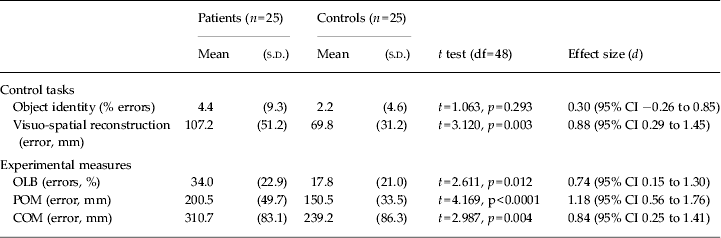
Group comparisons revealed significant differences on all three experimental measures, with medium effect sizes for OLB and COM, and a large effect for the POM measure (see Table 1). Examination of the control conditions indicated that, while performance of object identity memory did not differ significantly between groups, BD patients performed significantly worse at visuo-spatial reconstruction (VSR).
Object location memory data for patients and controls

OLB, Object-location binding; POM, position-only memory; COM, combined condition; CI, confidence interval.
Examination of the relationship between the three measures revealed that performance on the OLB and COM measures was significantly correlated for patients (r s = 0.521, p = 0.008) and controls (r s = 0.550, p = 0.004). However, there was no significant correlation between POM and either of these measures in patients (POM v. OLB: r s = 0.334, p = 0.103; POM v. COM: r s = 0.251, p = 0.227) or controls (POM v. OLB: r s = 0.085, p = 0.688; POM v. COM: r s = 0.192, p = 0.359).
Secondary neuropsychological tests
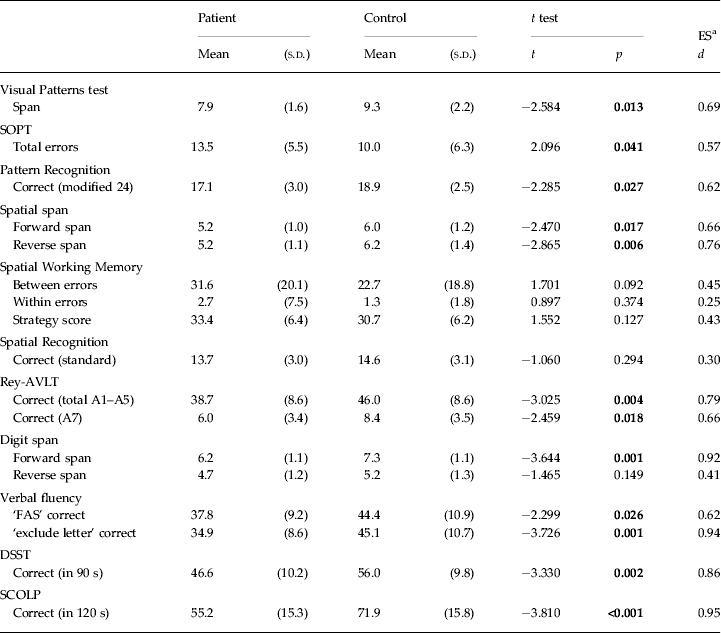
In line with our earlier study (Gallagher et al. Reference Gallagher, Gray, Watson, Young and Ferrier2014), prior to examining individual tests, the overall group difference was analysed using MANCOVA with NART and age as covariates. The MANCOVA revealed a significant main effect of group, with patients performing worse than controls (F 17,30 = 2.101, p = 0.024) (see Table 2). Examination of individual measures revealed performance decrements in bipolar patients across all domains. For spatial measures, poorer performance was observed in forward and reverse spatial span. For the visual memory measures, deficits were observed in the VPT and the more difficult variant of the pattern recognition test. Finally, of the verbal measures, deficits were observed in declarative learning and memory (Rey-AVLT), but not the delayed measure, verbal fluency and immediate memory (forward digit span). Medium effect sizes were present for most of these measures, although large effects were observed for psychomotor measures (DSST and SCOLP), forward digit span and verbal fluency (ELFT).
Secondary neurocognitive test performance for patient and controls

SOPT, Self-Ordered Pointing Test; AVLT, Auditory Verbal Learning Test; FAS, ‘FAS’ verbal fluency test; DSST, Digit Symbol Substitution Test; SCOLP, Speed and Capacity of Language Processing.
Bold denotes p<0.05.
a Effect sizes (ES) are Cohen's d, corrected so that positive values always represent impairment in patients compared to controls.
Relationship between OLM performance and secondary neuropsychological measures
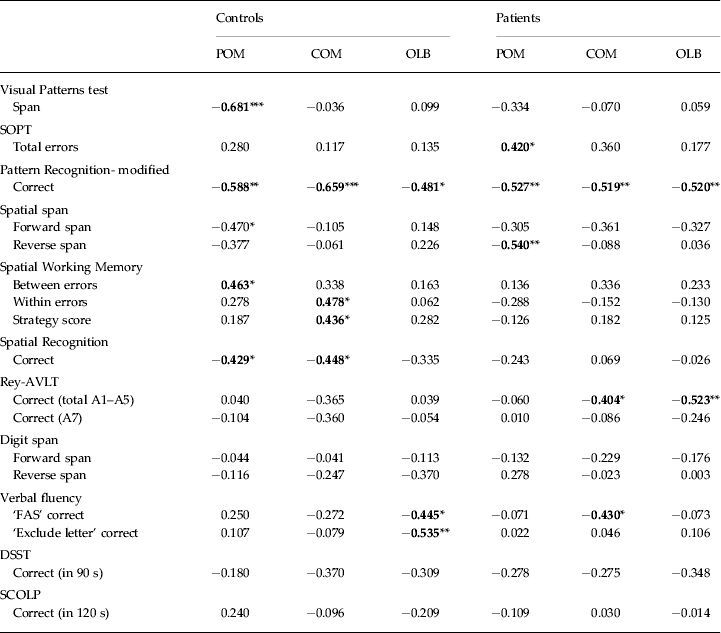
A correlation matrix was constructed for the three OLM outcome measures and the secondary neuropsychological measures (see Table 3). To account for monotonic relationships, Spearman correlations are reported. Overall a clearer relationship between the visuo-spatial measures and OLM measures was found in controls than patients, particularly with POM and COM. Correlations with OLB in controls were confined to pattern recognition and verbal fluency measures. In patients, with the exception of pattern recognition, the only significant correlations were between POM and SOPT and reverse spatial span. Interestingly, verbal declarative memory (Rey-AVLT; total A1–A5) in patients was significantly correlated with the two task indices where object identity was different (OLB and COM), but not POM while no such relationship was observed in controls. Comparing the coefficients of the OLM–Rey-AVLT correlations between patients and controls revealed that there was no significant difference for POM (z = 0.33, p = 0.741) or COM (z = −0.15, p = 0.881) measures, but the OLB correlation coefficient was significantly larger in patients than controls (z = −2.05, p = 0.040).
Correlation matrix for OLM outcome measures and secondary neuropsychological tests

POM, Position-only memory; COM, combined condition; OLB, object-location binding; SOPT, Self-Ordered Pointing Test; AVLT, Auditory Verbal Learning Test; FAS, ‘FAS’ verbal fluency test; DSST, Digit Symbol Substitution Test; SCOLP, Speed and Capacity of Language Processing.
Bold denotes significant correlations, p<0.05.
* p < 0.05, ** p < 0.01, *** p < 0.001 (two-tailed.)
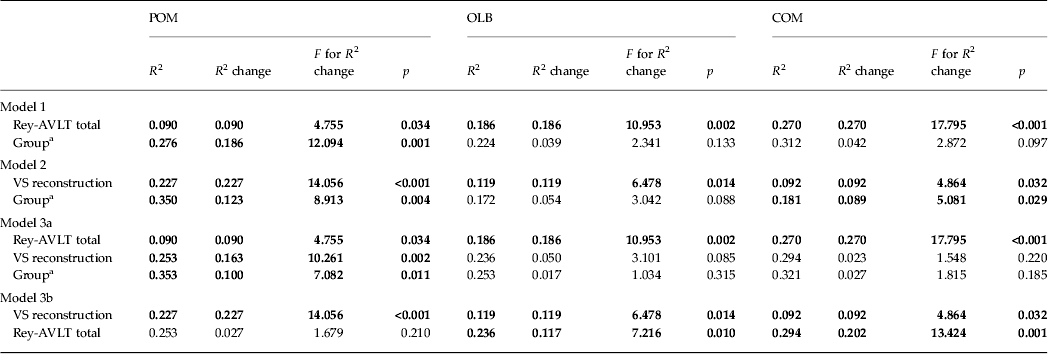
This observation of the significant relationship between verbal memory and OLB and COM processes is notable given their sensitivity to verbal articulatory interference (Postma & de Haan, Reference Postma and de Haan1996; Kessels & Postma, Reference Kessels and Postma2002). However, it is not clear why this relationship was not observed in controls. A series of hierarchical regression models were therefore applied to further explore this observation (Table 4).
Hierarchical regression models for object-location memory measures and verbal memory

POM, Position-only memory; OLB, object-location binding; COM, combined condition; AVLT, Auditory Verbal Learning Test; VS, visuo-spatial.
Bold denotes p<0.05.
a Bipolar depressed v. healthy controls.
For the POM process, when entered independently both the VSR control task and the Rey-AVLT explained significant variance (models 1 and 2). Inclusion of both measures into the same model was conditional on the order of entry (models 3a and b) – when VSR was entered first a significant 22.7% of the variance was explained, but the subsequent entry of the Rey-AVLT did not add further to this (<3%). In all models, the final entry of ‘group’ was significant.
For the OLB measure, entry of the Rey-AVLT first (model 3a) explained 18.6% of the variance, with VSR not significantly increasing this (5.0%). However, when entering VSR first, the subsequent addition of Rey-AVLT total produced a significant increase (11.7%) (model 3b). In the case of COM, the same pattern emerged, with entry of the Rey-AVLT first explaining 27.0% of the variance while the subsequent entry of VSR was not significant (2.3%). Entering VSR first explained 9.2% of the variance, with the subsequent entry of Rey-AVLT significantly increasing the proportion explained (20.2%). In all cases, the final entry of the group variable was not significant, explaining only an additional 1.7% and 2.7% of the variance respectively.
Confirmatory analyses
A final series of confirmatory analyses were performed to assess the specificity of the observed effects.
Specificity of the relationship between OLB and COM processes to verbal learning
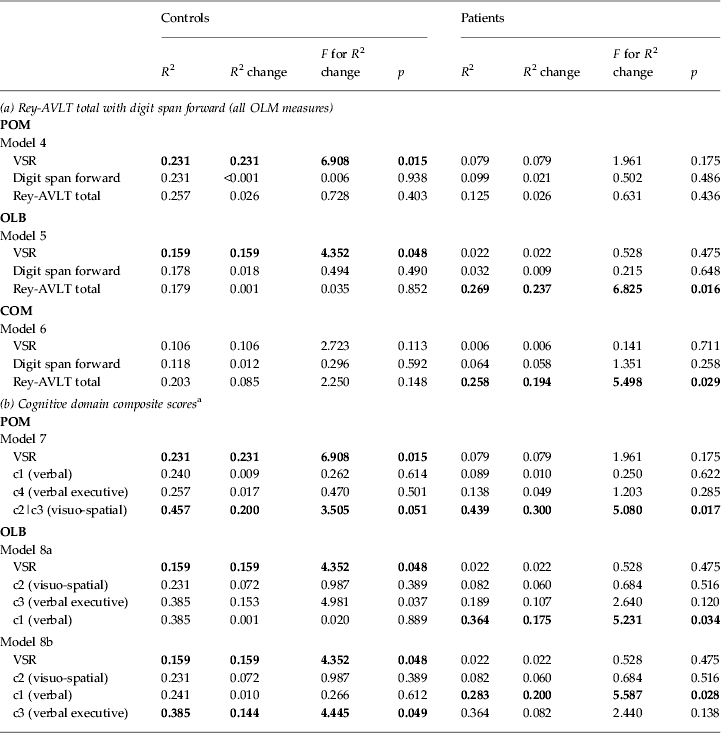
In order to examine the specificity of this effect to the individual groups, analyses were performed for each group independently (Table 5). This also established the specificity of the verbal contribution to OLM by comparing the variance explained by a short-term phonological measure (digit span forward) with the verbal learning measure (Rey-AVLT total). These two measures were added following the VSR control task. In bipolar patients, it was only the verbal learning measure which added a significant 19.4–23.7% variance to the OLB and COM models (models 4–6). In controls, entry of neither measure was significant.
Confirmatory analyses: Hierarchical regression comparison of (a) the Rey-AVLT total with digit span forward (all OLM measures) and (b) cognitive domain composite scores

AVLT, Auditory Verbal Learning Test; OLM, objection location memory (OLM) paradigm; POM, position-only memory; OLB, object-location binding; VSR, visuo-spatial recognition; COM, combined condition.
Bold denotes significant entry within the model, p<0.05.
a Composite scores derived from healthy controls in (Gallagher et al. Reference Gallagher, Gray, Watson, Young and Ferrier2014).
c1 (verbal): Composite 1, comprising of Rey-AVLT total, A7, recognition.
c2 (visuo-spatial): Composite 2, a composite of spatial working memory between errors, strategy; Self-Ordered Pointing Test; and Spatial span forward, reverse; Digit Symbol Substitution Test.
c3 (verbal executive): Composite 3, comprising of verbal fluency (‘FAS’ verbal fluency test and ‘Exclude letter’ verbal fluency test).
Relationship between broader neurocognitive composites and OLM processes
Finally, in order to examine the relationship between broader neurocognitive processes and the OLM measures, a final series of models utilized the neurocognitive composites derived in our earlier report (Gallagher et al. Reference Gallagher, Gray, Watson, Young and Ferrier2014). These measures are derived from the mean average z score of individual test scores loading onto that domain following principal components analysis (PCA), producing components of verbal memory processing, verbal executive function and visuo-spatial processing (Table 5).
For the POM measure, following inclusion of the VSR and then other composites, the final entry of the visuo-spatial composite explained an additional 30% of the variance in patients and 20% in controls (model 7). For the OLB measure, following initial inclusion of the VSR, it was the verbal executive composite that explained significant variance in controls, the final entry adding 14.4%. However, in patients, again it was only the verbal memory composite which added significant variance irrespective of the order of entry (models 8a and b). The analysis of the COM measure did not result in any significant steps (data not shown).
Discussion
The aim of the present study was to investigate OLM in depressed bipolar patients and healthy controls. We also sought to apply a secondary neurocognitive test battery to examine broader cognitive processes and explore their differential relationship with components of visuo-spatial memory derived from the OLM paradigm. Comparisons revealed significant differences on all three experimental OLM measures. However, subsequent exploration with hierarchical regression revealed that after accounting for visuo-spatial reconstruction, verbal learning explained significant variance in the binding/location processes where object-identity was included (OLB and COM) and accounted for the group difference. The group difference in precise positional memory remained intact. We then sought to explore if there were differences between BD and controls in these results. The strong association between verbal learning and binding/location processes where object-identity was included only occurred in the bipolar depressed group. The effect was also specific to verbal learning and did not extend to short-term ‘phonological’ processes. Finally, an analysis using PCA-defined composite cognitive scores confirmed a differential pattern between the groups for object-binding; the strongest relationship being with verbal memory in bipolar patients, but executive processes in controls. For precise spatial location, in both groups a strong relationship was observed solely with the visuo-spatial composite.
Postma and colleagues have previously proposed a model of object-location memory, involving three principal components: simple object recognition, spatial-location processing and object-to-location binding (Postma et al. Reference Postma, Kessels, van Asselen and Allen2004, Reference Postma, Kessels and van Asselen2008). They suggest that spatial-location processing depends on two possible positional codes: coordinate, involving a fine-grained metric code providing precise absolute location, and categorical, a coarse, more general position sense (e.g. items being left-right, above-below each other). This was developed from earlier work on the spatial relationships used in perception/visuo-spatial imagery (Kosslyn et al. Reference Kosslyn, Koenig, Barrett, Cave, Tang and Gabrieli1989) where it was argued that there was hemispheric specialization in the two processes – a relative right-hemisphere advantage for coordinate processes and a relative left-hemisphere advantage for categorical processes. This theoretical framework, applied to OLM processes (Postma & de Haan, Reference Postma and de Haan1996), therefore distinguishes categorical processing using pre-marked locations (binding objects to locations) from coordinate processing, involving relocation in free space (pure spatial location, devoid of object-identity cues). Evidence that such forms of visuo-spatial memory can be fractionated into functionally independent components with separable specific neural substrates has been demonstrated in patients with lateralized brain damage (Kessels et al. Reference Kessels, Kappelle, de Haan and Postma2002b ; van Asselen et al. Reference van Asselen, Kessels, Kappelle and Postma2008). This may offer one explanation for the pattern of results observed in the present study, with bipolar depressed patients exhibiting clear deficits in coordinate processing, but less so in categorical processes.
Task difficulty is not a likely explanation for these results, given that the most robust difference between the groups was for positional reconstruction rather than the condition which required both reconstruction and object-identity binding (i.e. the combined process). However, several possible interpretations should be considered. The relationship between verbal learning and binding/location processes where object-identity is included could be a consequence of overlap between the processes involved. Both language processing and the binding/relational aspect of memory for spatial arrays may involve a form of categorical processing (Kosslyn et al. Reference Kosslyn, Koenig, Barrett, Cave, Tang and Gabrieli1989; Parrot et al. Reference Parrot, Doyon, Demonet and Cardebat1999). This would explain the absence of group difference when verbal learning was accounted for, although not why this effect was greater in patients than controls. Alternatively, patients may preferentially apply a verbal strategy to encode items, while controls perceptually encode items – with either no or minimal support from other (verbal) processes. This is consistent with the observation that, when examined separately, a strong relationship between object-binding/location and verbal learning is found in patients. A final possibility is that patients have a visuo-spatial (perceptual) memory impairment, including an impairment of visuo-spatial coordinate processing, and therefore draw more on verbal/verbal-categorical processes to attempt to maintain or ‘cognitively scaffold’ performance. This is successful when such representations are amenable to this method of compensation (i.e. when objects are unique/nameable), but fails to support performance when only precise spatial representation is relevant.
Recently there has been increased interest in the similarities between the cognitive and neurobiological changes associated with ageing and those in BD (Rizzo et al. Reference Rizzo, Costa, Mansur, Swardfager, Belangero, Grassi-Oliveira, McIntyre, Bauer and Brietzke2014). Work on cognitive ageing has proposed that, as resources diminish, compensatory cognitive scaffolding (both functional and structural) can preserve functioning in some processes, in some individuals (Park & Reuter-Lorenz, Reference Park and Reuter-Lorenz2009). This has been described in both normal ageing (Cabeza et al. Reference Cabeza, Anderson, Locantore and McIntosh2002) and neurodegenerative disorders (Dagher et al. Reference Dagher, Owen, Boecker and Brooks2001). It is therefore possible that a similar process is occurring in BD. Other parallels have also been made, such as differences in the underlying cognitive factor structure between patients with bipolar depression and healthy controls (Gallagher et al. Reference Gallagher, Gray, Watson, Young and Ferrier2014). This resembles the dedifferentiation phenomena in ageing, where there is a reduction in specificity in cognition and previously functionally discrete processes become less differentiated through decline in neural connectivity (Dolcos et al. Reference Dolcos, Rice and Cabeza2002). The growing evidence of impaired white-matter integrity and connectivity in BD and those at high risk (Macritchie et al. Reference Macritchie, Lloyd, Bastin, Vasudev, Gallagher, Eyre, Marshall, Wardlaw, Ferrier, Moore and Young2010; Sprooten et al. Reference Sprooten, Sussmann, Clugston, Peel, McKirdy, Moorhead, Anderson, Shand, Giles, Bastin, Hall, Johnstone, Lawrie and McIntosh2011; Leow et al. Reference Leow, Ajilore, Zhan, Arienzo, GadElkarim, Zhang, Moody, Van Horn, Feusner, Kumar, Thompson and Altshuler2013; Sarrazin et al. Reference Sarrazin, Poupon, Linke, Wessa, Phillips, Delavest, Versace, Almeida, Guevara, Duclap, Duchesnay, Mangin, Le Dudal, Daban, Hamdani, D'Albis, Leboyer and Houenou2014) provides a clear neural underpinning, as it has in the ageing literature (Cabeza et al. Reference Cabeza, Anderson, Locantore and McIntosh2002; Park & Reuter-Lorenz, Reference Park and Reuter-Lorenz2009). Further investigation of cognitive scaffolding as well as establishing its relationship with underlying white-matter connectivity could offer important insight into cognitive function in BD, particularly in the understanding of inter-individual variation in performance.
The role of the prefrontal cortex (PFC) should also be examined. While structures like the hippocampus are strongly implicated in visuo-spatial memory, the PFC is known to be involved in spatial representation, especially working-memory processes (Funahashi, Reference Funahashi2013). Retention of exact spatial location is critically time-dependent, with a rapid decay function. Some distortions in precise location are evident after retention intervals in the order of hundreds of milliseconds or less (Werner & Diedrichsen, Reference Werner and Diedrichsen2002) and these distortions increase over time (Postma et al. Reference Postma, Huntjens, Meuwissen and Laeng2006). It could be argued that within a limited-capacity system, executive and attentional resources are required to accurately process and retrieve complex representations (Franconeri et al. Reference Franconeri, Alvarez and Cavanagh2013), cognitive resources that are compromised in bipolar depression (consistent with large impairments in processing speed, attention and fluency in this sample). This may provide explanation for the large deficits observed in precise spatial location in bipolar depression.
There are several limitations of the present study. Our sample size was relatively small, therefore some relationships may not have been observed within the regression models due to a lack of statistical power. However it should be noted that with n = 25 in each group the main contrasts had power of 80% to detect effect sizes of d > 0.8 at p = 0.05 and the observed profile of results should be interpreted in this context. All patients were taking psychotropic medication at the time of testing which may impact cognitive functioning, although some studies in BD have suggested that such effects are minimal (Goswami et al. Reference Goswami, Sharma, Varma, Gulrajani, Ferrier, Young, Gallagher, Thompson and Moore2009; Bourne et al. Reference Bourne, Aydemir, Balanzá-Martínez, Bora, Brissos, Cavanagh, Clark, Cubukcuoglu, Dias, Dittmann, Ferrier, Fleck, Frangou, Gallagher, Jones, Kieseppä, Martínez-Aran, Melle, Moore, Mur, Pfennig, Raust, Senturk, Simonsen, Smith, Soares, Soeiro-de-Souza, Stoddart, Sundet, Szöke, Thompson, Torrent, Zalla, Craddock, Andreassen, Leboyer, Vieta, Bauer, Worhunsky, Tzagarakis, Rogers, Geddes and Goodwin2013). While recent alcohol/drug abuse was an exclusion criteria, we did not exclude participants with a lifetime history. One previous study reported that deficits on a spatial delayed response test (SDRT; requiring participants to actively maintain spatial locations of varying set-sizes over a delay) were only found in schizophrenia and bipolar patients with a history of psychosis, but not those without (Glahn et al. Reference Glahn, Bearden, Cakir, Barrett, Najt, Monkul, Maples, Velligan and Soares2006). No patients in the present study had psychotic symptoms. The reason for this difference is unclear; it may be a result of the extent to which different visual, spatial or executive processes are engaged in the performance of these measures. However, there are fundamental task-related differences such as the SDRT using a maximum of five locations and performance assessed by recognition (same-different judgement) rather than reconstruction of the array.
Neurocognitive dysfunction is one of the most robust research findings in BD. However, this is often found at a group level only, with considerable inter-individual variation (Iverson et al. Reference Iverson, Brooks, Langenecker and Young2011; Gallagher et al. Reference Gallagher, Gray, Watson, Young and Ferrier2014). Although heterogeneity in clinical and illness features may contribute to this variability (Robinson & Ferrier, Reference Robinson and Ferrier2006), as hypothesized here, cognitive scaffolding may be an important and potentially clinically relevant individual difference. As the present study focussed on bipolar depression, it is important to ascertain if these findings are a state-related phenomenon or occur in areas other than visuo-spatial memory.
Acknowledgements
We are grateful to the participants who contributed to the research and to those clinicians involved in the wider research programme, including recruitment and screening: Stuart Watson, Nicol Ferrier, Allan Young, Niraj Ahuja, Sankalpa Basu, Jane Carlile, Louise Golightly, Thiyyancheri Harikumar, Patrick Keown, Samer Makhoul, Anuradha Menon, Gavin Mercer, Rajesh Nair, Bruce Owen, and Nanda Palanichamy. This work was supported by grant funding from the Stanley Medical Research Institute (REF: 03T-429) and the Medical Research Council (GU0401207). P.G. received Research Capability Funding support from the Northumberland, Tyne and Wear NHS Foundation Trust.
Declaration of Interest
None.