Introduction
It is well established that social experiences are fundamental for brain development. Experimental animal studies showed that social grouping influences brain structure, in particular brain weight and brain enzymes (Welch et al., Reference Welch, Brown, Welch and Lin1974). Socially stimulated animals also present larger dendritic arborization in the hippocampus and prefrontal cortex (Silva-Gomez et al., Reference Silva-Gomez, Rojas, Juarez and Flores2003). Furthermore, environmental enrichment studies have demonstrated that both intact rodents and brain-lesioned animals that had received social, motor, sensory and cognitive stimulation presented higher learning abilities (Petrosini et al, Reference Petrosini2009). In the same vein, human clinical studies have shown that social contacts and social support appear to be positive factors for recovery after brain damage. In the study by Glymour and colleagues (Reference Glymour, Weuve, Fay, Glass and Berkman2008), for instance, six months after stroke, subjects having rich social networks and efficient social support recovered cognitively better than those having poor social networks.
The question of whether rich social networks could help to reduce age-related cognitive decline has also received much interest. Cross-sectional studies investigating the relationships between social ties and cognition in the elderly showed that social functioning was positively correlated with cognitive performances (Seeman et al, Reference Seeman, Lusignolo, Albert and Berkman2001; Holtzman et al., Reference Holtzman, Rebok, Saczynski, Kouzis, Wilcox Doyle and Eaton2004; Krueger et al., Reference Krueger, Wilson, Kamenetsky, Barnes, Bienias and Bennett2009). Moreover, according to several longitudinal studies, rich social networks (Bassuk et al., Reference Bassuk, Glass and Berkman1999; Zunzunegui et al., Reference Zunzunegui, Alvarado, Del Ser and Otero2003; Holtzman et al., Reference Holtzman, Rebok, Saczynski, Kouzis, Wilcox Doyle and Eaton2004; Beland et al., Reference Beland, Zunzunegui, Alvarado, Otero and Del Ser2005), important engagement with relatives (Zunzunegui et al., Reference Zunzunegui, Alvarado, Del Ser and Otero2003; Beland et al., Reference Beland, Zunzunegui, Alvarado, Otero and Del Ser2005) and frequent participation in social activities (Zunzunegui et al., Reference Zunzunegui, Alvarado, Del Ser and Otero2003; Beland et al., Reference Beland, Zunzunegui, Alvarado, Otero and Del Ser2005; Barnes et al., Reference Barnes, Mendes de Leon, Wilson, Bienias, Evans and 2004; Ertel et al., Reference Ertel, Glymour and Berkman2008) appeared to be protective against cognitive decline.
However, despite the literature, it is difficult to draw a clear conclusion regarding the effect of social environment on age-related cognitive decline. Two studies provided contrasting results. In these studies, no significant association was found between social network and cognitive decline. Only emotional support (Seeman et al., Reference Seeman, Lusignolo, Albert and Berkman2001) and participation in social activities (Glei et al., Reference Glei, Landau, Goldman, Chuang, Rodriguez and Weinstein2005) predicted lower cognitive decline seven years later. In addition, most of the studies on social network and cognitive decline have important limitations. The most important one is a possible reverse causality making it difficult to determine cause and effect. Indeed, cognitive alteration together with behavioral disturbance such as apathy, one of the major behavioral disorders of Alzheimer's disease (AD), obviously induces a reduction of social contacts (Landes et al., Reference Landes, Sperry, Strauss and Geldmacher2001). An impoverished social network could thus be a marker of the early stages of psycho-behavioral dysfunction and could, therefore, be falsely interpreted as a risk factor of cognitive decline (Plassman et al., Reference Plassman, Williams, Burke, Holsinger and Benjamin2010). For this reason, cross-sectional studies may not be appropriate to investigate the relationship between social environment and cognitive decline. In addition, the study design should allow identification of those subjects engaged in a pathological aging process in order to exclude participants for whom impoverished social networks could be a consequence rather than a determinant of subsequent cognitive decline. In the available longitudinal studies of social network and cognitive decline, no clinical diagnosis of AD or related disorders is provided.
The aim of this study was to investigate the influence of social networks on age-related cognitive decline minimizing the possible reverse causality bias. We used the data of the PAQUID study, a large prospective study of cognitive and functional aging in France, which included an assessment of participants’ social networks at baseline. To better understand the influence of social networks on age-related cognitive decline, we took advantage of the long follow-up of this study in which detailed repeated assessments of participants’ cognitive abilities, along with clinical diagnosis of dementia throughout the 20-year follow-up, are available.
Methods
General study design
The PAQUID study is a prospective epidemiological study of cognitive and functional aging initiated in 1988. Community dwellers aged 65 years and over were randomly selected from the electoral rolls in two administrative areas in south-west France (Gironde, Dordogne). The methodology has been previously described in full (Dartigues et al., Reference Dartigues1992). The sample was representative in terms of age and sex of the elderly community dwellers of the area. Initially 3777 participants were included. All participants were evaluated at home by a trained psychologist at the initial visit (V0) and one (V1), three (V3), five (V5), eight (V8) ten (V10), thirteen (V13), fifteen (V15), seventeen (V17) and twenty years (V20) later. At each visit, a questionnaire collecting sociodemographic and medical data as well as a neuropsychological evaluation were proposed to participants.
Dementia cases
After the interview, the psychologist completed a criteria checklist for dementia diagnosis. Then, individuals suspected of having dementia were seen at home by a neurologist who confirmed or rejected the diagnosis. After that, a panel of specialized neurologists reviewed all dementia cases to identify potential etiology according to current diagnostic criteria for AD (McKhann et al., Reference McKhann, Drachman, Folstein, Katzman, Price and Stadian1984), vascular dementia (Román et al., Reference Román1993), fronto-temporal dementia (Lund and Manchester Groups, 1994), Lewy body disease (McKeith et al., Reference McKeith1996) and Parkinson dementia. In the present analysis, we studied the effect of social networks on changes in cognitive performances that are related to normal aging without any underlying neurodegenerative process. We therefore excluded from the analyses all the prevalent cases of dementia at V0 as well as the incident cases that were diagnosed throughout the study follow-up (i.e. between V1 and V20).
Cognitive performances
The following neuropsychological battery was administered to participants at each visit (except for the Digit Symbol Substitution Test, which was not administered at V3, and the Paired Associate Test at V3, V8 and V10).
• The Mini-Mental State Examination (MMSE; Folstein et al., Reference Folstein, Folstein and McHugh1975) measured global cognitive functioning abilities. The 30-item score was recorded.
• The Isaacs Set Test (IST; Isaacs and Kennie, Reference Isaacs and Kennie1973) measured semantic verbal fluency. Participants had to generate as many words as possible belonging to a specific semantic category in 15 seconds. Four categories (colors, animals, fruits and cities) were used. The total number of correct words named for the four categories was recorded.
• The Similarities Test (Wechsler, Reference Wechsler1981) measured abstract thinking. The psychologist named two things (e.g. an orange and a banana; a dog and a lion . . .) and the participant had to say in what way those two things are alike. The score for the first five pairs only was considered.
• The Wechsler Paired Associate Test (WPAT; Wechsler, Reference Wechsler1945) measured episodic memory and learning abilities. The psychologist named successively the ten word pairs (six forming semantically related pairs and the other four forming unrelated pairs). Afterwards, the psychologist gave the first word of the pair and the participant had to respond with the associated word. The number of word pairs recalled was recorded.
• The Digit Symbol Test (DSST; Wechsler, Reference Wechsler1981) was used to evaluate visual-perceptual speed. It consists of filling in blank squares with the symbol which is paired to the digit (from 1 to 9) above the square according to a code table displaying pairs of digits and symbols. The subject is instructed to fill in as many squares as possible in 90 seconds. The number of corrects symbols was recorded.
• The Benton Visual Retention Test in its multiple choice recognition form (BVRT; Benton, Reference Benton1965) was used to evaluate immediate visual memory. The participant was presented with a stimulus card displaying geometric figures for 10 seconds. Immediately after presentation, he/she was asked to choose the initial figure from four possibilities. The score for the 15 successive trials was recorded.
Tests scores assessed at the baseline screening visit were not considered because of the “first-passing effect” of neuropsychological evaluation previously described in the PAQUID cohort (Jacqmin-Gadda et al., Reference Jacqmin-Gadda, Fabrigoule, Commenges and Dartigues1997). Therefore, the scores considered to compute the model of cognitive performance decline were that assessed at the one-year visit (V1).
Social network measures
A composite index was calculated for each individual by summing up the following social network variables collected at the baseline visit (V0). Each dimension of the social network was analyzed as a binary variable:
• Size: number of people constituting the social network: 8 people or more (scored 1); fewer than 8 people (scored 0).
• Individual's satisfaction with his/her relationships: very satisfied (scored 1); poorly or not satisfied (scored 0).
• Perception of being understood by other people: Two categories were considered – feeling of being well understood (scored 1); feeling of being misunderstood (scored 0).
• Participation in social activities (participation in clubs or associations for elderly): participation in at least one social activity (scored 1); no participation in social activities (scored 0).
The social network score corresponded to the sum of each social network subscore, ranging from 0 (reflecting the poorest level of social network) to 4 (reflecting the highest level of social network).
Covariables
Several variables were considered as potential confounding factors and controlled for in the statistical analyses. The sociodemographic variables included sex, educational level (defined as a two-level variable: no diploma/primary diploma or more) and marital status. The other potential confounding factors considered were functional abilities assessed by the instrumental activities of daily living (IADL) scale (Lawton and Brody, Reference Lawton and Brody1969), depression and presence of chronic diseases including diabetes (diabetes diagnosis, medical diabetic diet or anti-diabetic medication), cardiovascular diseases (angina pectoris or myocardial infarction) and sequelae of stroke.
Statistical analysis
Linear mixed models (Laird and Ware, Reference Laird and Ware1982) were used to investigate (i) the relationship between the social network index and cognitive performances assessed by each of the five tests at baseline (tests scores estimated by the model at V0), and (ii) the association between the social network index and change in performances assessed by the different tests throughout the 20-year follow-up. All the analyses were adjusted for the potential confounding variables listed earlier. Analyses were performed using SAS version 9.1 (SAS Institute, Inc., Cary, NC).
Results
Sample characteristics
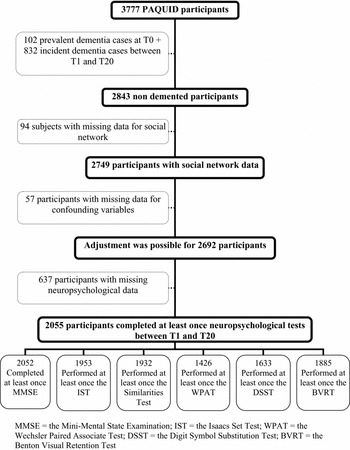
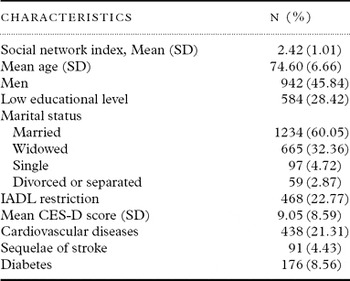
From the 3777 persons included at baseline, only the participants with at least one cognitive assessment between T1 and T20 were considered for this study. We excluded 102 prevalent cases of dementia at T0 and 832 incident cases of dementia (cases diagnosed between T1 and T20). In addition, 94 participants without social network information and 57 participants for whom one or more adjustment variables were missing were excluded. Figure 1 shows the selection of the study sample, which was composed of 2055 participants without dementia (942 men and 1113 women). The study sample characteristics are presented in Table 1. The mean age at baseline was 75 years (SD 6.7). Only 28.4% had a low level of education. The mean time of follow-up (between T0 and T20) was 9.20 years (SD 6.63). At baseline 22.8% of the individuals presented functional disability, 21.3% had an ischemic heart disease, 8.6% had diabetes and 4.4% had antecedent of stroke. The majority of participants were married (60%) or widowed (32%) and 8% were divorced or separated.
Selection of the study sample

Characteristics of the study sample (N = 2055)

SD = standard deviation; CES-D = Center of Epidemiologic Studies-Depression scale; IADL = Instrumental Activities of Daily Living scale.
Associations between social network index with baseline cognitive performances and rate of age-related decline in non-demented participants
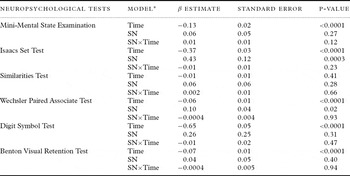
A linear mixed model was used to determine whether cognitive performances at baseline and rate of cognitive change throughout the follow-up were related to social network index. Linear mixed models were performed for each of the tests (MMSE, IST, Similarities Test, WPAT, DSST, and BVRT) adjusted for potential confounding factors. Results are presented in Table 2.
• MMSE: 2052 persons completed the MMSE at least once between T1 and T20. No association was found between the mean MMSE score at baseline and the social network index. The social network index was not associated with further rate of decline.
• IST: 1953 participants performed the IST at least once between T1 and T20. The mean IST score at baseline was significantly associated with the social network index (p = 0.0003), individuals with high social network index having better IST scores at baseline. However, there was no significant association with the rate of decline all along follow-up.
• The Similarities Test: 1932 participants performed the Similarities Test at least once between T1 and T20. The social network index was neither associated with the baseline performances nor with the rate of change in this test.
• WPAT: 1426 participants performed the WPAT at least once between T1 and T20. The social network index was associated with the baseline performances (p = 0.02), with individuals with a high social network index having better WPAT scores at baseline. However, no association was found with the rate of decline.
• DSST: 1633 participants performed the DSST at least once between T1 and T20. The social network index was neither associated with the baseline performances nor with the rate of change of performances.
• BVRT: 1885 participants performed the BVRT at least once between T1 and T20. The social network index was neither associated with the baseline performances nor with the rate of change of performances.
Association between Social Network Index at baseline and cognitive function scores over time, random-effect model

SN = Social Network.
*Model adjusted for age, sex, education, marital status, functional abilities, presence of chronic diseases and depression.
Association between social network index and age-related cognitive decline without excluding participants who developed dementia
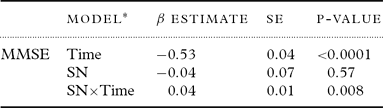
In this second step, we decided to apply the same methodological design as has been used in most of studies found in the literature. This involved examining the impact of social network on global cognition, including all participants irrespective of their dementia status. Of the 2956 participants, 2853 completed at least once MMSE between T1 and T20. A linear mixed model was used to determine whether social network was associated with global cognitive performances at baseline and rate of cognitive decline. After adjustment for various potential confounding factors (age, sex, education, marital status, functional abilities, presence of chronic diseases and depression), the social network index at baseline was significantly associated with the rate of decline (p = 0.008). Results are presented in Table 3.
Association between Social Network Index at baseline and MMSE score over time, random-effect model including all dementia cases

*Model adjusted for age, sex, education, marital status, functional abilities, presence of chronic diseases and depression.
MMSE = Mini-Mental State Examination; SN = Social Network; SE = standard error.
Discussion
In this prospective study of 2055 elderly participants we investigated the relationship between social functioning and cognitive change measured by different neuropsychological tests across a substantial follow-up period. After adjustment for key confounders (age, sex, education, marital status, autonomy and health conditions), we found that a rich social network was associated with better cognitive scores at baseline but had no impact on further age-related decline of performances. In other words, people having a richer social network presented higher baseline performances in language and memory tests; however, their performances declined to the same extent as that of participants with poorer social networks. This finding appears inconsistent with previous results. Barnes and colleagues (Reference Barnes, Mendes de Leon, Wilson, Bienias, Evans and 2004) found in a population-based study of 6102 elderly participants that individuals with rich social networks and important social engagements presented less cognitive decline over the following five years. Similar results have been reported by Ertel and colleagues (Reference Ertel, Glymour and Berkman2008) in a large cohort of 16,638 participants, in which higher social integration measured at baseline was associated with a slower rate of memory decline over six years, and by Hughes and colleagues (Reference Hughes, Andel, Small, Borenstein and Mortimer2008) who also demonstrated that positive perception of social networks was associated with better cognitive performances (speed, attention) and with slower memory decline.
In the same vein, several studies have shown that participants with severe disengagement (Bassuk et al., Reference Bassuk, Glass and Berkman1999), poor social networks and few social activities (Zunzunegui et al., Reference Zunzunegui, Alvarado, Del Ser and Otero2003; Holtzman et al., Reference Holtzman, Rebok, Saczynski, Kouzis, Wilcox Doyle and Eaton2004; Beland et al., Reference Beland, Zunzunegui, Alvarado, Otero and Del Ser2005) had an increased risk of subsequent cognitive decline. However, as outlined by several of these authors and many others (Pillai and Verghese, Reference Pillai and Verghese2009; Amieva et al., Reference Amieva, Stoykova, Matharan, Helmer, Antonucci and Dartigues2010), a major caveat of such studies is a possible reverse causality bias. Indeed, in all the studies cited below, because the diagnosis of dementia was not available during follow-up, we cannot exclude the possibility that a proportion of subjects included in the study sample presented abnormal cognitive decline. In this situation, the sense of causality between social networks integrity and cognitive decline is difficult to establish. It is now well established that dementia syndromes, and particularly AD, is preceded by a long pre-dementia phase during which cognitive deficits appear up to a decade before clinical diagnosis is possible and increase in a very long and progressive manner (Amieva et al., Reference Amieva2008). Although limited, such pre-clinical cognitive deficits are accompanied by subtle repercussions among which are slightly reduced abilities in ADLs (Amieva et al., Reference Amieva2008) and withdrawal from some social or leisure activities.
In a prospective clinical study involving 100 patients with confirmed AD at autopsy, Jost and Grossberg (Reference Jost and Grossberg1996) studied the time of onset of psychiatric symptoms and showed that social withdrawal was the earliest psychiatric symptom in the course of the disease preceding depression, agitation and psychotic symptoms. Therefore, if the subclinical disease process negatively affects social life, the inclusion of subjects undergoing abnormal cognitive aging in study samples could have contributed to evidence of significant associations between poor social networks and higher cognitive decline. The objective of the present study was to test the relationship between social networks and further cognitive decline by taking into account the possible reverse causality bias. For this, we conducted a first set of analyses in which participants who developed dementia over the 20-year follow up were excluded from the study sample. These analyses showed that social network was associated with better cognitive scores at baseline but not with further cognitive decline. To test the hypothesis that previously reported results may have been blurred by a possible reverse causality, we conducted another analysis in which participants who developed dementia during the study follow-up were not excluded from the sample. Interestingly, in this data set, a significant association of poor social network was found not only with baseline cognitive scores but also with further cognitive decline.
Therefore, the present results support the hypothesis that previous studies that suggest a positive impact of rich social networks on cognitive decline have used partially inappropriate designs that resulted in partially skewed conclusions. Findings similar to ours have been reported in a recent study. In a sample of 857 individuals from the Swedish Adoption/Twin Study of Aging, Sharp and colleagues (Reference Sharp, Reynolds, Pedersen and Gatz2010) examined the extent to which participants’ openness was related to cognitive performance at baseline and over a 10-year follow-up. As in our study, participants who received a diagnosis of dementia during the follow-up were excluded from the study sample. After adjustment for education, cardiovascular disease and functional abilities in ADL, the results showed that participants scoring highly on a scale assessing openness at baseline presented better cognitive performance in all cognitive domains evaluated (language, memory, visuospatial abilities, and processing speed); however, decline of cognitive performance over time was the same as that of the other participants.
Even though social network was not found to be protective of age-related cognitive decline, its association with the level of cognitive performance at a given time, as also evidenced by numerous other studies, shows that social life and cognitive functioning share important links. Cognitive functions – in particular, attention, executive processes, memory or language skills – are highly implicated in social functioning (Beauchamp and Anderson, Reference Beauchamp and Anderson2010). Moreover, social exchange seems to be an important factor influencing cognitive and affective development. Schoon and colleagues (Reference Schoon, Parsons, Rush and Law2010), in a cohort of 6941 participants, investigated the relationship between language skills in childhood (measured at age 5) and psychosocial functioning during adulthood (measured at age 34). After 29 years of follow-up, poor language skills in childhood were associated with socially unadapted behavior and mental health problems (depression and poor life satisfaction) in adulthood. All together, these results suggest that social functioning contributes to cognitive reserve, along with many other factors such as education, occupation or leisure activities, and may partly explain why rich social networks have been associated with reduced risk of dementia onset.
Conflict of interest
None.
Description of authors' roles
Ralitsa Stoykova and Hélène Amieva conceived and designed the study, interpreted the results, and drafted the paper; Fanny Matharan performed the statistical analysis and interpreted the results; Jean-François Dartigues developed the research design and critically revised the paper.
Acknowledgments
The PAQUID study was supported by grants from ARMA (Bordeaux); Caisse Nationale d'Assurance Maladie des Travailleurs Salariés (CNAMTS); Conseil Général de la Dordogne; Conseil Général de la Gironde; Conseil Régional d'Aquitaine; Fondation de France; France Alzheimer (Paris); GIS Longévité; Institut National de la Santé et de la Recherche Médicale (INSERM); Mutuelle Générale de l'Education Nationale (MGEN); Mutualité Sociale Agricole (MSA); NOVARTIS Pharma (France); and SCOR Insurance (France).