Introduction
Mosquitoes are responsible for the transmission of diverse pathogens, including Plasmodium parasites (which cause malaria), filarial parasites (which cause lymphatic filariasis) and arboviruses (e.g. dengue, yellow fever (YFV) and Rift Valley fever viruses). In several parts of Kenya, the presence of vectors known to transmit these pathogens coincides with high prevalence rates of the diseases they cause (Yuill, Reference Yuill1986; Mease et al., Reference Mease, Coldren, Musila, Prosser, Ogolla, Ofula, Schoepp, Rossi and Adungo2011; Lutomiah et al., Reference Lutomiah, Bast, Clark, Richardson, Yalwala, Oullo, Mutisya, Mulwa, Musila, Khamadi, Schnabel, Wurapa and Sang2013; Ochieng et al., Reference Ochieng, Lutomiah, Makio, Koka, Chepkorir, Yalwala, Mutisya, Musila, Khamadi, Richardson, Bast, Schnabel, Wurapa and Sang2013). Efforts to control mosquito-vectored pathogen transmission rely on vector control. Larval habitats play a significant role in the determination of larval densities, adult population sizes, species compositions, fitness, as well as competency to transmit particular pathogens (Le Menach et al., Reference Le Menach, McKenzie, Flahault and Smith2005; Mwangangi et al., Reference Mwangangi, Shililu, Muturi, Muriu, Jacob, Kabiru, Mbogo, Githure and Novak2010). For instance, aggregation of adult female mosquitoes around oviposition sites increases the risk of disease transmission to nearby susceptible hosts (Le Menach et al., Reference Le Menach, McKenzie, Flahault and Smith2005); therefore, targeting aquatic habitats and making them unsuitable for mosquito breeding, which is often referred to as larval source management, can lead to successful mitigation of disease transmission or circulation by reducing or eliminating their respective vectors. Fillinger et al. (Reference Fillinger, Ndenga, Githeko and Lindsay2009) demonstrated that combined control of larvae and adults of Anopheles gambiae using larvicides and insecticide-treated bed nets (ITNs), respectively, led to a significant decrease in vector numbers, which decreased malaria incidence in children by 56%, compared to a reduction of 31% when ITNs were used alone.
Biotic and abiotic factors in mosquito aquatic habitats affect mosquito larvae survival and abundance. Specifically, larval densities have been reported to depend on variables such as nitrogen content, temperature, pH, dissolved oxygen (DO), turbidity and salinity (Minakawa et al., Reference Minakawa, Mutero, Githure, Beier and Yan1999; Mwangangi et al., Reference Mwangangi, Muturi, Shililu, Muriu, Jacob, Kabiru, Mbogo, Githure and Novak2007; Mala and Irungu, Reference Mala and Irungu2011). Recent studies have reported that bacteria present in aquatic habitats also play an important role in the breeding behaviour of mosquitoes. Besides acting as a source of nutrition for larvae (Merritt et al., Reference Merritt, Dadd and Walker1992), bacteria influence oviposition behaviour of adults through the volatile compounds they produce during metabolic processes that break down complex organic compounds in water or sediments (Sumba et al., Reference Sumba, Guda, Deng, Hassanali, Beier and Knols2004; Ponnusamy et al., Reference Ponnusamy, Xu, Nojima, Wesson, Schal and Apperson2008). Some of the bacteria ingested by larvae are retained in the gut during metamorphosis and transmitted to the adult stage (Briones et al., Reference Briones, Shililu, Githure, Novak and Raskin2008; Engel and Moran, Reference Engel and Moran2013; Minard et al., Reference Minard, Tran, Raharimalala, Hellard, Ravelonandro, Mavingui and Valiente Moro2013). Such transmission is a common strategy in insects to maintain bacterial symbionts necessary for normal growth, immune response, and reproduction (Weiss et al., Reference Weiss, Wang and Aksoy2011; Reference Weiss, Maltz and Aksoy2012). Besides providing essential haemolytic enzymes for blood-meal digestion in female mosquitoes (Gaio et al., Reference Gaio, Gusmao, Santos, Berbert-Molina, Pimenta and Lemos2011), symbiotic bacteria can also contribute to host immunity by producing antibiotic and/or antifungal compounds, or by priming the mosquito's immune system (Dong et al., Reference Dong, Manfredini and Dimopoulos2009). Additionally, the lifespan and efficiency of infected Aedes aegypti to transmit dengue fever virus are reduced when artificially infected with Wolbachia bacteria obtained from Drosophila melanogaster (Hoffmann et al., Reference Hoffmann, Montgomery, Popovici, Iturbe-Ormaetxe, Johnson, Muzzi, Greenfield, Durkan, Leong, Dong, Cook, Axford, Callahan, Kenny, Omodei, McGraw, Ryan, Ritchie, Turelli and O'Neill2011; Walker et al., Reference Walker, Johnson, Moreira, Iturbe-Ormaetxe, Frentiu, McMeniman, Leong, Dong, Axford, Kriesner, Lloyd, Ritchie, O'Neill and Hoffmann2011; Yeap et al., Reference Yeap, Axford, Popovici, Endersby, Iturbe-Ormaetxe, Ritchie and Hoffmann2014).
Most ecological studies on mosquito larvae in East Africa have focused on Anopheles species because they are primary vectors of malaria. However, little is known about the larval ecology of mosquitoes from other genera, including Culex and Aedes, which are known to transmit arboviral pathogens. Due to the emergence and re-emergence of arboviruses, increasing knowledge of the ecology of their vectors is essential. In this study, we evaluated various environmental variables and microbial communities in aquatic habitats to identify both chemical parameters and bacterial community profiles of aquatic mosquito larval habitats that can be used as potential predictors of suitable mosquito breeding sites. We focused on three mosquito genera implicated in the transmission of malaria and arboviruses sampled from natural habitats in the Lake Victoria basin, an endemic region of these diseases.
Materials and methods
Study area
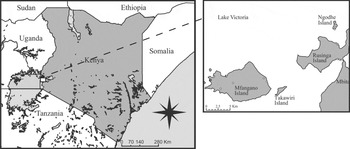
We collected mosquito larvae from three islands on the Kenyan side of Lake Victoria, namely Mfangano (~00°28'S, 34°1'E), Rusinga (00°24'S, 34°1'E) and Ngodhe (00°21'S, 34°11'E). These islands were selected based on their history of arbovirus circulation and varying physical features such as topography and vegetation cover, to study conditions of diverse aquatic habitats (lakeshores, discarded tyres, puddles, boats, swamp, river banks, ponds, drainage systems and rock pools). Ngodhe Island has a steep landscape compared to Rusinga that is relatively flat, whereas Mfangano has both flat and steep topologies.
The Lake Victoria basin is associated with the presence of O'nyong-nyong (ONNV), Usutu (USUV), Ndumu (NDUV), Zika (ZIKV) and Sindbis (SINV) arboviruses (Geser et al., Reference Geser, Henderson and Christensen1970; Ochieng et al., Reference Ochieng, Lutomiah, Makio, Koka, Chepkorir, Yalwala, Mutisya, Musila, Khamadi, Richardson, Bast, Schnabel, Wurapa and Sang2013), and climatic conditions that support a variety of mosquito species’ life cycles. Some of these mosquitoes, such as Ae. aegypti, Culex pipiens and An. gambiae, are competent vectors of Chikungunya (CHIKV), West Nile (WNV) and ONNV arboviruses, respectively (Weaver and Barrett, Reference Weaver and Barrett2004; Ochieng et al., Reference Ochieng, Lutomiah, Makio, Koka, Chepkorir, Yalwala, Mutisya, Musila, Khamadi, Richardson, Bast, Schnabel, Wurapa and Sang2013). In addition, the islands host a number of vertebrates such as bats, birds, reptiles, rodents and other wild animals that are potential reservoirs of arboviruses and blood meal hosts of mosquitoes. The interactions of these vertebrates with humans and the presence of vectors are conducive factors for virus transmission and circulation, as observed from serological surveys conducted on human populations living in the Lake Victoria basin (Mease et al., Reference Mease, Coldren, Musila, Prosser, Ogolla, Ofula, Schoepp, Rossi and Adungo2011). The islands were divided into sections from which 32 sites representative of the whole study area were selected for sampling (Fig. 1).
Map of the study sites on three Lake Victoria islands. Sampling sites are indicated with white dots on the inset map.

Mosquito sampling and identification
Sampling was done in November 2012 after a preliminary survey of the study site to map out potential sampling sites. Mosquito larvae and pupae were sampled by sweeping the dipper (Bioquip, USA) attached to a handle across the water surface until it was almost full. From each site, three dips (350 ml each) were collected giving a total of 1050 ml of water with larvae and/or pupae per site. Samples were transported to icipe laboratory in Nairobi, Kenya, in perforated plastic bottles labelled with sampling site names and dates. In the laboratory, they were reared in their habitat (water) using clean plastic troughs in cages until emergence. All larval instars were fed on ground Tetramin® fish food (Tetra, Germany). For optimal development, larvae were reared at 26–27 °C temperature and 80% relative humidity (Gerberg et al., Reference Gerberg, Barbard and Ward1994). The emerged mosquitoes were morphologically identified using taxonomic keys (Edwards, Reference Edwards1941; Gillies and Coetzee, Reference Gillies and Coetzee1987). DNA was extracted from one leg of selected mosquitoes using the hot sodium hydroxide and Tris (HotSHOT) DNA extraction protocol (Montero-Pau et al., Reference Montero-Pau, Gómez and Muñoz2008). Morphological identifications were verified on some of the samples by sequencing (Macrogen, Seoul, Korea) the mitochondrial cytochrome c oxidase subunit I (COI) gene amplified by PCR using LCO 1490 F and HCO 2198 R primers (Folmer et al., Reference Folmer, Black, Hoeh, Lutz and Vrijenhoek1994). Sequences were visually inspected and manually edited using Geneious version 6.1.6 (Biomatters, New Zealand; Available from http://www.geneious.com/). Similarity sequence searching of the non-redundant nucleotide database was performed using BLASTn (Altschul et al., Reference Altschul, Gish, Miller, Myers and Lipman1990) to confirm mosquito identification.
Variables associated with larval habitats
Water conductivity, specific conductivity, oxidation–reduction potential (ORP), resistivity, temperature, total dissolved solids (TDS), pH, nitrogen, ammonium, nitrate and salinity were measured on site using the YSI Professional Plus multiparameter water meter (YSI, USA). We collected 50 ml of water from the larval habitat sites for further measurement of free and total copper, phosphate, sulphate and fluoride ions using the YSI 9800 photometer (YSI, USA). These analyses were performed in the lab immediately after returning from the field to reduce any biases. Shading of a site was also recorded as total, partial or no shading. Data from the measuring devices were uploaded to a Microsoft Excel sheet via the YSI Data Manager software (YSI, USA).
Correlations between variables and the relative abundance (proportions) of mosquito larvae of each genus, as well as species within a single genus, found in the aquatic habitats were tested using redundancy analysis (RDA) with a scaling of 2 (correlation tri-plot) and Principal Components Analysis (PCA). Since the data were not normally distributed based on the Shapiro–Wilk test, we used non-parametric Spearman's rank correlation tests to determine whether correlations observed in the RDA correlation tri-plot were significant (α = 0.05). In addition, we conducted chi-square tests to determine shade preference of each genus and abundant species based on the presence or absence of shade (total, partial or no shading). These analyses were done using R 3.0.1 software (R Development Core Team, 2008).
Bacterial community profiling of larval habitats
Different genera of mosquito larvae have different foraging behaviour. Unlike Anopheles larvae that forage near the water−air interface, Aedes and Culex larvae forage below the water surface (Merritt et al., Reference Merritt, Dadd and Walker1992). Aquatic samples (mixture of water and sediment) were collected after mixing, to sample bacteria associated with each of the mosquito genera and species studied. Samples were labelled and transported in sterile tubes at 4 ºC to the field site laboratory in icipe-Mbita, where they were stored in liquid nitrogen for transport to the icipe laboratory in Nairobi for analyses.
Aquatic samples (mixtures of water and sediment) were analysed from 10 of the 32 larvae sampling sites for their bacterial community. Five additional sites, three from the mainland in Mbita and two from adjacent islands (Ringiti and Takawiri) that also had larvae, were included for comparison of bacteria variation between islands. Selection of the 15 sites for bacteria profiling was based on the species of mosquitoes these sites hosted, and the category of the site (i.e. if a site was located on the lakeshore, boat, abandoned tyre, rock pool, tree hole, etc.). The samples containing a mixture of water and sediment were centrifuged for 10 min at 12,000 g rotational centrifugal force (rcf). The supernatant was discarded and the pellet washed three times in phosphate buffered saline (PBS). Total genomic DNA was extracted from the samples using FastDNA® SPIN Kit for Soil (MP Biomedicals, CA, USA) following the manufacturer's instructions. The DNA samples were sent to an external service provider (Molecular Research LP, MR DNA, Shallowater, TX, USA) for bacterial tag-encoded 454 FLX amplicon pyrosequencing (bTEFAP) with 16S rRNA primers Gray28F (5′-GAGTTTGATCNTGGCTCA-3′) and Gray519R (5′-GTNTTACNGCGGCKGCTG-3′) (Lane, Reference Lane, Stackebrandt and Goodfellow1991; Turner et al., Reference Turner, Pryer, Miao and Palmer1999) targeting V1–V3 hypervariable regions. A sequencing library was generated through one-step PCR with 30 cycles, using a mixture of HotStar and HotStar HiFidelity Taq polymerases (Qiagen). Sequencing extended from Gray28F, using a Roche 454 FLX instrument with Titanium reagents and procedures described at Molecular Research LP (http://www.mrdnalab.com/).
Quality control and analysis of 454 reads was done in QIIME v.1.8.0 (Caporaso et al., Reference Caporaso, Kuczynski, Stombaugh, Bittinger, Bushman, Costello, Fierer, Peña, Goodrich, Gordon, Huttley, Kelley, Knights, Koenig, Ley, Lozupone, McDonald, Muegge, Pirrung, Reeder, Sevinsky, Turnbaugh, Walters, Widmann, Yatsunenko, Zaneveld and Knight2010). All low quality reads (cut-off = 25), sequences < 200 base pair (bp) and > 1000 bp, as well as reads containing homopolymer runs of > 6 bp were removed. High-quality reads were clustered into operational taxonomic units (OTUs) using a multiple OTU picking strategy with UCLUST and CD-HIT (Edgar Reference Edgar2010), with 97% similarity cut-offs and the RDP classifier (Wang et al., Reference Wang, Garrity, Tiedje and Cole2007) was used for taxonomic assignment. OTUs were combined at phylum level to display relative abundances at each site. The OTUs were rarified and alpha-diversity indices were computed. Beta-diversity analysis of bacteria was done using Bray–Curtis, Euclidean, unweighted and weighted UniFrac distance matrices. Mantel r statistic was used to compare if differences between these distance matrices were significant. Hierarchical clustering was generated to compare differences in microbial composition between sites associated with various species of mosquito larvae. Using non-parametric Analysis of Similarities (ANOSIM) and adonis, as implemented in QIIME v.1.8.0, we compared the bacteria compositions between sites containing and not containing the most commonly detected mosquito species, C. pipiens, using a weighted UniFrac distance matrix. In addition, a heatmap was generated to visualize bacteria classes and their relative abundance in habitats using R 3.0.1 software (R Development Core Team, 2008).
Results
Mosquito collection and distribution
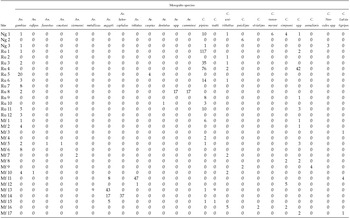
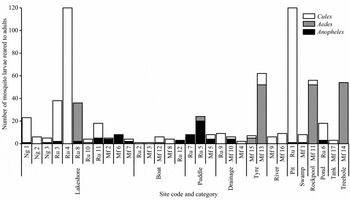
From the 32 sampling sites, 686 mosquito larvae belonging to three genera and 22 species were reared to adults. Eight species of Culex were the most abundant (60.1%), followed by seven Aedes species at 29.8%, and five Anopheles species at 10.1% of the collected larvae (Table 1). Culex was present in 81% of the 32 sampling sites, while Aedes were present in 25% of the sites and Anopheles in 50%. Culex and Aedes dominated Rusinga and Mfangano Islands, respectively, even though all three genera were present in both. Culex pipiens was present mainly at lakeshore sites and pits (holes dug by humans), while Ae. aegypti was the most present in ‘tyre sites’ (discarded vehicle tyres), rock pools and tree holes (Fig. 2). In addition, we observed that larval habitats of Anopheles and Culex were independent of shade (χ2 = 3.73, 2 d.f., P = 0.155, χ2 = 2.48, 2 d.f., P=0.290, respectively), while Aedes larval presence was strongly associated with shade (χ2 = 12.21, 2 d.f., P=0. 002). This trend was observed for the most abundant species within their respective genera: An. gambiae (χ2 = 2.95, d.f. = 2, P=0.228), C. pipiens (χ2 = 4.50, d.f. = 2, P = 0.105) and Ae. aegypti (χ2 = 22.74, d.f. = 2, P<0.001).
Mosquito species abundance in larval captures

Mf = Mfangano, Ng = Ngodhe, Ru = Rusinga.
Abundance of the three mosquito genera sampled from different larval habitats. In contrast to Aedes and Anopheles mosquitoes, which select larval habitats with specific physico-chemical parameters, Culex mosquito larvae have a broad distribution across most habitat categories. (Ng, Ngodhe Island; Ru, Rusinga Island; Mf, Mfangano Island).

Correlations between physico-chemical parameters and mosquito presence
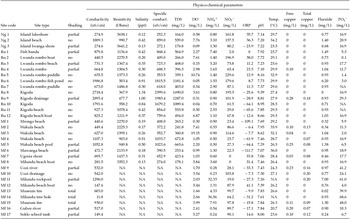
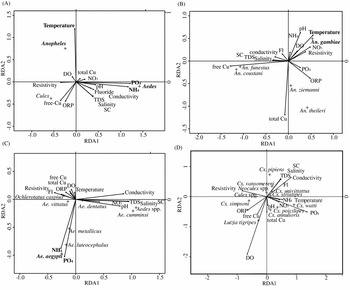
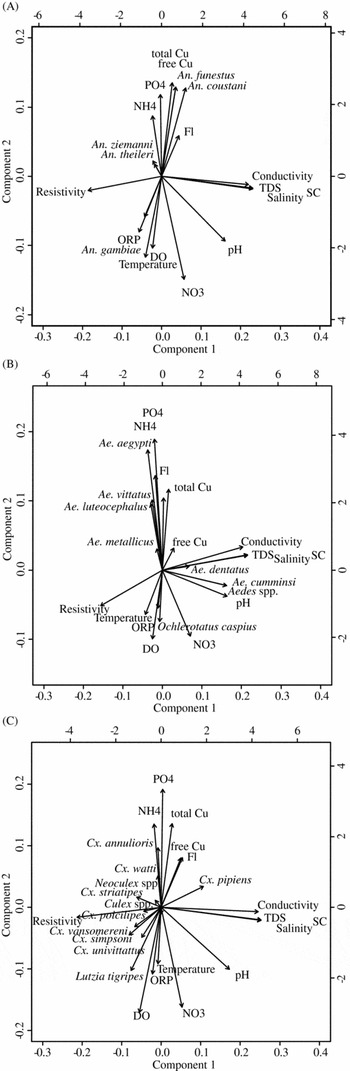
RDA was used to visualize the relationships between the investigated physico-chemical variables and the relative abundance of the three collected mosquito genera and species. To this aim, mosquito genera and species (dependent variables) (Table 1) were modelled as functions of temperature and chemical parameters (independent variables) (Table 2). Based on RDA analysis, larvae of each of the three genera occur in aquatic habitats with distinct parameters (angle between their vectors is between 90 and 270º) (Fig. 3A). Ammonium, fluoride, phosphate and conductivity showed positive correlations with each other and with Aedes, while nitrates, DO and temperature positively correlated with each other and Anopheles. Culex larvae showed a positive correlation with ORP and free copper (Fig. 3D). Further analyses with species sampled within the genera revealed the species responsible for trends observed for Aedes and Anopheles genera level but not Culex (Fig. 3B, C and D). Similar trends were obtained with PCA analysis (Fig. 4A–C).
Physico-chemical parameters of larval mosquito aquatic habitats

Mf = Mfangano, Ng = Ngodhe, Ru = Rusinga, specific conduct. = specific conductance, TDS = total dissolved salts, DO = dissolved oxygen, NH4 + = ammonium, NO3 − = nitrate, ORP = oxidation–reduction potential, Temp. = temperature, PO4 − = phosphate.
RDA correlation tri-plots between mosquito abundance proportion and measured physico-chemical parameters at the (a) genus level, and within (b) Anopheles, (c) Aedes and (d) Culex genera. Correlations between variables are indicated by the angle between their respective vectors. Variables with an acute angle between them have a positive correlation, while those with an angle of 90 or 270° have no correlation, and those with an oblique angle between them are negatively correlated. Matching colours indicate statistically significant correlations between specific mosquito genera and physico-chemical variables. (PO4 −, phosphate; NH4 +, ammonium; DO, dissolved oxygen; NO3 −, nitrate; Cu, copper; Fl, fluoride; ORP, oxidation–reduction potential; TDS, total dissolved solids).

Principal component analysis (PCA) of physico-chemical variables associated with proportions of (a) Anopheles, (b) Aedes and (c) Culex mosquito species larvae.

The most abundant species within their respective genera, An. gambiae (92.86%) and Ae. aegypti (35.44%), showed significant correlations with some of the variables. Although ammonium and phosphate, which showed positive correlations with some of the Aedes species and with each other in the RDA analysis (Fig. 3A and C), Spearman's correlations showed that they were significant predictors only of Ae. aegypti larval presence (ammonium: rS = 0.55, 30 d.f., P = 0.001; phosphate: rS = 0. 57, 30 d.f., P = 0.001). The presence of An. gambiae larvae, in turn, only correlated significantly with increasing temperatures (rS = 0.38, 30 d.f., P = 0.033), but not with DO (rS = −0.18, 30 d.f., P = 0.333) or nitrates (rS = 0.0038, 30 d.f., P = 0.983) as seen in the RDA (Fig. 3A and B). However, larval presence of either Culex genus or any of its species had no significant correlation with any of the variables investigated (Fig. 3A and D).
Bacterial community composition in mosquito larval habitats
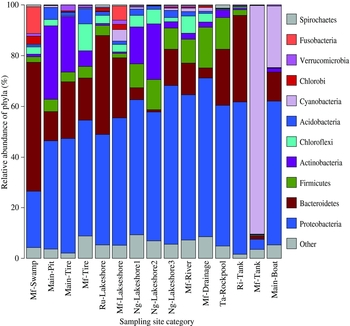
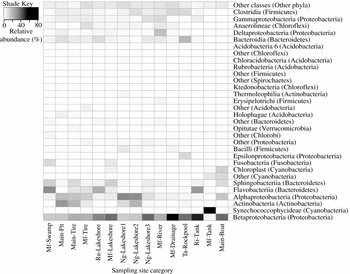
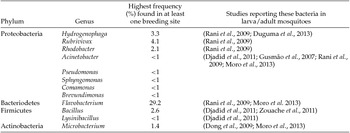
To determine whether bacterial composition could influence larval habitats, we profiled the bacteria present in sites hosting different mosquito species. In total, sequencing yielded 135,763 sequences, which were reduced to 110,822 after quality control (mean per sample = 7388.13). Across most sampling sites, Proteobacteria were the most abundant followed by Bacteriodetes, Firmicutes and Actinobacteria (Fig. 5). Some of the OTUs with a frequency of up to 9% could not be assigned into any of the existing phyla (Table S1, available online). At class level, however, variation in microbiota community was evident within similar and between dissimilar sites (Fig. 6). When OTUs were combined at the genus level, sequences clustered into 921 genera, only 107 of which showed abundances > 1% in at least one of the samples. Flavobacterium, Dechloromonas, Mycobacterium, Hydrogenophaga, Clostridium and Rubrivivax were some of the core genera present across most sites, but in varying proportions, even for sites of a similar category (lakeshore, tyre and tank). Some of these, as well as other bacteria genera found in breeding habitats, have been found in larvae and adult mosquito guts (Table 3).
Bacterial phyla present in mosquito breeding microhabitats: Relative abundance of bacterial phyla was assessed by 16S rRNA amplicon pyrosequencing. (Ta, Takawiri island; Ru, Rusinga Island; Mf, Mfangano Island; Ng, Ngodhe Island; Main, Mainland; Ri, Ringiti Island).

Heatmap of bacteria classes showing relative abundance of OTUs from particular classes of bacteria in sampled habitat categories. Even though a class may be present in all categories, abundance of that particular class varies within and between categories. Four of the major classes (alpha and beta-Proteobacteria, Flavobacteria and Actinobacteria) are present in varying frequencies within and between categories as seen in lakeshore, tyre and tank sites. The shade key represents frequency of particular OTUs relative to total bacteria diversity (Ta, Takawiri island; Ru, Rusinga Island; Mf, Mfangano Island; Ng, Ngodhe Island; Main, Mainland; Ri, Ringiti Island).

Bacteria present in breeding sites and reported in guts of larval and adult mosquitoes

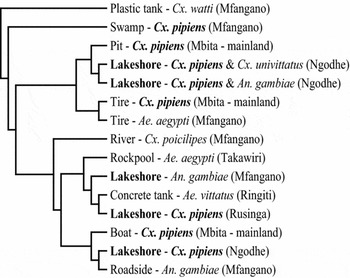
Since differences between distance matrices used were not significant, the weighted UniFrac distance matrix was used to compare microbiota composition between sites. Variations in microbial community composition were not attributable to site or location (island), as beta diversity analysis revealed no discernible patterns (Fig. 7). For the three collected mosquito species, abundance of a species at a site or its preference of the site could not be distinguished based on their microbiota profiles (Fig. 7). Accordingly, for the most commonly collected mosquito genus, Culex, analyses of similarity revealed no difference in bacterial community profiles between preferred and non-preferred sites (adonis, R2 = 0.08, 13 d.f., P = 0.307 and ANOSIM, R2 = 0.02, 13 d.f., P = 0.333).
Hierarchical UPGMA clustering of bacterial community profiles in mosquito larval habitats: Based on UniFrac beta-diversity metrics, bacterial community composition in sites is not influenced by its geographical location or site category. In addition, microbiota profiles in potential larvae habitats are not predictive of the mosquitoes’ breeding preferences.

Discussion
We investigated physico-chemical properties and microbial community profiles in larval habitats of medically relevant mosquitoes in the Lake Victoria basin. We collected larvae of three mosquito genera (Aedes, Anopheles and Culex) that have been implicated in pathogen transmission, and identified distinct parameters that can be used to predict the presence or absence of specific mosquito genera and species at potential larval habitats. While differences in microbiota composition present in different aquatic sites were not predictive of the presence or absence of larvae from any of the observed mosquito genera, our findings show that temperature and different chemical variables are associated with larval microhabitats of specific mosquito species.
Whereas aquatic microhabitats with higher temperatures were more likely to host An. gambiae mosquito larvae, higher ammonium and phosphate levels were predictive of the presence of Ae. aegypti mosquito larvae. These two species were the most abundant within their respective genera. However, we found no significant correlation of mosquito larvae of species within the Culex genus with any of the variables investigated, suggesting that species of this genus are less selective of breeding sites on the basis of particular chemical conditions within these aquatic habitats. Consistent with these findings, we also found Culex mosquito larvae in over 80% of the sites sampled, whereas Aedes and Anopheles mosquitoes were found at only 25 and 50% of the sampling sites, respectively. Birds, which are common and diverse in the Lake Victoria region (Bennun and Njoroge, Reference Bennun and Njoroge2000), have been identified as the predominant source of Culex mosquito bloodmeals in Mexico (Garcia-Rejon et al., Reference Garcia-Rejon, Blitvich, Farfan-Ale, Loroño-Pino, Chi Chim, Flores-Flores, Rosado-Paredes, Baak-Baak, Perez-Mutul, Suarez-Solis, Fernandez-Salas and Beaty2010), and in laboratory experiments (Richards et al., Reference Richards, Anderson and Yost2012). Nonetheless, a recent survey found that Culex mosquito populations in the Lake Victoria region are also supported by bloodmeals from diverse non-avian vertebrate species (Omondi et al., Reference Omondi, Masiga, Ajamma, Fielding, Njoroge and Villinger2015).
Our findings are consistent with previous studies demonstrating that An. gambiae larvae prefer moderate to high temperatures ranging from 28 to 32 °C (Bayoh and Lindsay, Reference Bayoh and Lindsay2003). We found larvae of this species in sites with temperatures of the same range, and sometimes as high as 35 °C. Anopheline mosquitoes are known to develop faster in transient sunlit pools than in shaded habitats (Wamae et al., Reference Wamae, Githeko, Menya and Takken2010). Despite their preference for high temperatures, we show that Anopheles can also breed in shaded habitats. Anopheles control efforts should, therefore, target not only unshaded habitats, but also partially and totally shaded sites. This will result in combined control for anopheline as well as culicine mosquitoes.
Whereas Ae. aegypti is associated with anthropophilic behaviour and life cycles, its genetic and behavioural traits can be much more diverse in sub-Saharan Africa where both domesticated strains (which oviposit in man-made breeding sites such as discarded tyres and vessels), and sylvatic (formosus) strains (that are known to oviposit in rock pools and tree holes), coexist (Powell and Tabachnick, Reference Powell and Tabachnick2013). Interestingly, in this study, ammonium and phosphate tended to be higher within habitats associated with both sylvatic Ae. aegypti (formosus) (i.e. rock pools, tree holes) and domestic (i.e. discarded tyres) populations (Powell and Tabachnick, Reference Powell and Tabachnick2013). Fertilizers containing ammonium and phosphorous were attractive to gravid female Ae. aegypti mosquitoes for oviposition (Darriet and Corbel, Reference Darriet and Corbel2008; Darriet et al., Reference Darriet, Zumbo, Corbel and Chandre2010), and use of such fertilizers to attract mosquitoes in conjunction with larvicides in potential domestic breeding sites can be used to increase larval control of Aedes mosquitoes (Darriet, Reference Darriet2015). Previous findings also showed significant general increase of anopheline and culicine mosquito larval populations with the use of inorganic nitrogen and ammonium sulphate fertilizers (Victor and Reuben, Reference Victor and Reuben2000; Mutero et al., Reference Mutero, Ng'ang'a, Wekoyela, Githure and Konradsen2004). These fertilizers enhance the growth of microbes that are a major source of nutrition for larvae (Merritt et al., Reference Merritt, Dadd and Walker1992), and also reduce turbidity, which encourages breeding of mosquitoes (Mutero et al., Reference Mutero, Ng'ang'a, Wekoyela, Githure and Konradsen2004). This suggests that continuous use of ammonium- and phosphate-rich fertilizers enhances multiplication of Ae. aegypti and thereby the transmission of Aedes-vectored arboviruses such as dengue and CHIKV.
Our findings show that mosquito larvae habitats are rich in bacterial diversity. Since bacteria act as sources of nutrition for larvae, adult female mosquitoes may select such sites for laying eggs to ensure enough food for their offspring once they hatch (Merritt et al., Reference Merritt, Dadd and Walker1992). As previously described (Ponnusamy et al., Reference Ponnusamy, Wesson, Arellano, Schal and Apperson2010; Djadid et al., Reference Djadid, Jazayeri, Raz, Favia, Ricci and Zakeri2011), we found that Proteobacteria, Firmicutes and Bacteriodetes were the major bacterial phyla present in mosquito larval habitats. However, we observed no correlation between bacterial communities and mosquito species present in larval habitats, which may, in part, account for the variations of mid-gut microbiota of mosquitoes of the same species captured from different sites (Osei-Poku et al., Reference Osei-Poku, Mbogo, Palmer and Jiggins2012).
Nonetheless, the pattern of bacterial community composition by phyla that we found at larval habitats overlaps with those that have been described in the mid-guts of adult mosquitoes (Wang et al., Reference Wang, Gilbreath, Kukutla, Yan and Xu2011). We found bacteria genera in larval habitats that have also been reported in the mid-guts of Anopheles adults and larvae, including Acinetobacter, Bacillus, Hydrogenophaga, Brevundimonas, Lysinibacillus, Sphingomonas, Comamonas and Pseudomonas (Gusmão et al., Reference Gusmão, Santos, Marini, Russo, Peixoto, Bacci, Berbert-Molina and Lemos2007; Rani et al., Reference Rani, Sharma, Rajagopal, Adak and Bhatnagar2009; Djadid et al., Reference Djadid, Jazayeri, Raz, Favia, Ricci and Zakeri2011; Duguma et al., Reference Duguma, Rugman-Jones, Kaufman, Hall, Neufeld, Stouthamer and Walton2013; Moro et al., Reference Moro, Tran, Raharimalala, Ravelonandro and Mavingui2013). We also identified Rubrivivax, Hydrogenophaga, Rhodobacter, Pseudomonas and Flavobacterium in larval habitats, which have been reported in Culex larvae (Duguma et al., Reference Duguma, Rugman-Jones, Kaufman, Hall, Neufeld, Stouthamer and Walton2013), as well as Acinetobacter, Pseudomonas and Bacillus found in adult Aedes mosquitoes (Zouache et al., Reference Zouache, Raharimalala, Raquin, Tran-Van, Raveloson, Ravelonandro and Mavingui2011; Moro et al., Reference Moro, Tran, Raharimalala, Ravelonandro and Mavingui2013). This finding suggests that larvae acquire these bacteria from the environment and transmit them to the adult stage, where they could be functioning as symbionts in mosquito nutrition or defence. Bacterial communities in Ae. aegypti’s mid-gut, including Bacillus (Djadid et al., Reference Djadid, Jazayeri, Raz, Favia, Ricci and Zakeri2011; Moro et al., Reference Moro, Tran, Raharimalala, Ravelonandro and Mavingui2013), have been shown to play a significant role in the insect's blood digestion as well as egg production (Gaio et al., Reference Gaio, Gusmao, Santos, Berbert-Molina, Pimenta and Lemos2011). In C. pipiens, a combination of Bacillus and Staphylococcus bacteria in the gut is necessary for the insect's fecundity (Fouda et al., Reference Fouda, Hassan, Al-Daly and Hammad2001). It has also been reported that antibiotic elimination of gut microbiota in An. gambiae increases their susceptibility to Plasmodium infection (Dong et al., Reference Dong, Manfredini and Dimopoulos2009), suggesting that gut bacteria, which may be acquired from larval habitats, could be playing a role in defence against pathogens.
Conclusion
We sampled high numbers of C. pipiens, C. univittatus, C. vansomereni, An. funestus and An. gambiae, which are known vectors of WNV, USUV, ONNV and SINV viruses, as well as Aedes species that can vector CHIKV, WNV, YFV and DENV viruses (Weaver and Barrett, Reference Weaver and Barrett2004; Ochieng et al., Reference Ochieng, Lutomiah, Makio, Koka, Chepkorir, Yalwala, Mutisya, Musila, Khamadi, Richardson, Bast, Schnabel, Wurapa and Sang2013). The Lake Victoria basin has a long history of these viruses, probably enhanced by the ability of these vectors to breed in a variety of habitats. Our results indicate that continued application of ammonium and phosphate rich fertilizers contributes to availability of favourable aquatic habitats. Hence, intensifying agriculture and climatic fluctuations may have a broad influence on disease transmission, which emphasizes the association between anthropomorphic activities and disease epidemiology.
Supplementary material
To view supplementary material for this article, please visit http://dx.doi.org/10.1017/S1742758416000096.
Acknowledgements
We thank members of the Martin Lüscher Emerging Infectious Diseases (ML-EID) laboratory at icipe and of the Insect Symbiosis Research Group at MPI-CE for their informative discussions on this study.