FOOD SECURITY: THE CHALLENGE
Although population growth in the developed nations has reached a plateau, no slowdown is predicted in the developing world until about 2050. At its 2009 World Food Summit, the United Nations Food and Agricultural Organisation recognized that agricultural output will need to increase by 70% by 2050 in order to feed the world's population, which is expected to exceed 9 billion in this timeframe (FAO 2009). It will be necessary to achieve this rapid and substantial increase in production from the same amount of agricultural land, or even less. As fossil fuels stocks continue to decline, there is additional pressure on land to supply not only our needs for food but also for energy and chemical feedstock. The global challenge is to develop sustainable systems to meet these demands each year from 1 year's worth of sunshine. Others, including members of the UK's Government Office for Science's Foresight Project on Global Food and Farming Futures have ably summarized the Food Security challenge (Godfray et al. Reference Godfray, Beddington, Crute, Haddad, Lawrence, Muir, Pretty, Robinson, Thomas and Toulmin2010).
The present review addresses the animal sector of the agri-food industry, noting past successes in delivering improved productivity to meet demand and the drivers of future demand. Predictions are offered of the means by which future demand for animal products can be met through a combination of continuing incremental improvements in productivity and the adoption of new technologies with the potential to deliver step changes in productivity.
THE DEMAND FOR ANIMAL PRODUCTS
There are many cultures, or individuals within cultures, who live relatively healthy lives consuming little or no animal protein and many would argue that the challenge of feeding the human population would best be met by reducing livestock production. Livestock themselves consume energy derived from plants that might otherwise be consumed directly by humans; although pigs, poultry and cultivated fish are the fastest growing sectors of livestock production, ruminant animals remain important. In traditional pasture grazing, they consume feed that would not be available to humans. This may become more important as more land becomes marginal for arable agriculture.
The demand for animal protein will probably continue to grow over the next 20 years, especially in developing countries as they become more affluent. There is little likelihood that vegan diets will be acceptable for many people or prevalent in the medium term, and the dairy and poultry (egg) sectors, which provide acceptable animal protein sources to vegetarians, especially the poultry sector, are currently highly dependent upon grain. It would be unwise to build strategies for achieving food security upon assumptions of altruistic or government-advised changes in eating behaviour. Efforts to encourage changes in eating habits on health grounds (and hence in terms of self-interest) have been largely unsuccessful, as the obesity epidemic testifies. Modest decreases in meat consumption in some developed countries will be more than outweighed by growth in demand in emerging economies and the developing world. Aside from the widespread and growing preference of affluent humans for animal protein, there is also the argument that not all land (or sea) is appropriate for the effective production of plants that can be consumed by humans.
The needs will vary between societies. The better off, often referred to as Western, will look not only to food as nutrition but also to contribute to a healthy and long life. The developing countries, where population numbers are still increasing, will look to agriculture as the primary source of essential food.
Thus, there is a need to plan for increased production of animal products. It is envisaged that the production of artificial meat in cell culture, so-called in vitro meat, will be feasible on an industrial scale in the future, but it is unlikely to compete with meat production from livestock for cost in the medium term, and livestock production will also remain a part of many cultures and sustainable environments for the foreseeable future. Therefore, in the face of climate change and competing demands on resources, the challenge will be to meet the demand for animal products from livestock production systems while at the same time reducing their environmental footprint. In essence, more and healthier animals are needed that make better use of feedstuffs while reducing the impact of waste products.
This ambitious agricultural landscape will require continued advances of traditional methods and approaches, such as husbandry and genetics, and the broad up-take of biotechnological solutions.
PAST SUCCESSES
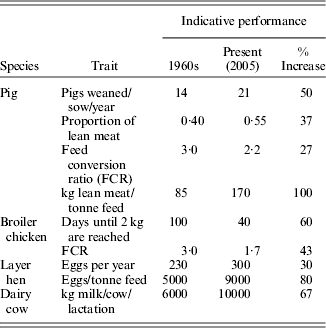
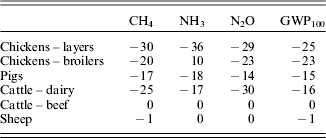
In the past 40+ years, there have been major productivity gains in dairy cattle, pigs and poultry (Table 1, Van der Steen et al. Reference Van Der Steen, Prall and Plastow2005). Perhaps surprisingly, given how much has been said about the environmental impact of livestock production (Steinfeld et al. Reference Steinfeld, Gerber, Wassenaar, Castel, Rosales and De Haan2006); there have also been significant reductions in the greenhouse gas emissions and global warming potential per tonne of animal product (Table 2). These gains have been achieved either through genetic improvement alone or in combination with better husbandry, nutrition and disease control. The dairy, pig and poultry sectors are highly structured with a small number of international companies controlling large proportions of the breeding and production. The sheep, goat and beef cattle sectors are less highly structured and for these species together with others (e.g. buffalo, deer, llama, alpaca and camel) there remains considerable scope for improvements in productivity. In contrast with land-based agriculture, fish domestication is in its early stages and there are likely to be potential productivity and feed efficiency gains to be had.
Improvements in livestock productivity over the past 40–50 years

Modified from van der Steen et al. (Reference Van Der Steen, Prall and Plastow2005).
% Change in greenhouse gas emissions and global warming potential achieved through genetic improvement (1988–2007)
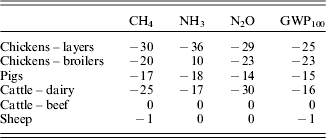
Sources: Project for DEFRA by Genesis Faraday Partnership and Cranfield University (AC0204).
ANIMAL AGRICULTURE
Future changes to agriculture may take three forms. Firstly, to meet the current growing demand, a rapid and sustainable increased production will occur over the next 10 years. Secondly, alternative uses of farm livestock and poultry will be developed and, thirdly, completely new approaches to food production will be implemented. The UK science-base is well placed to make significant contributions to all three phases.
Within an overarching aim of improving the sustainability of animal production systems, including minimizing their environmental footprint, there are three objectives that need to be addressed:
• To maximize the number of productive offspring per breeding male and female.
• To maximize the efficiency of converting feed (or solar energy) and water into useful animal product.
• To minimize waste and losses through infectious and metabolic disease and stress.
The scientific disciplines in biological sciences that are relevant to the research required to address these objectives include genetics, immunology, nutrition, physiology and reproductive biology. Cross-disciplinary working with scientists with skills in mathematics, physics and computing science will be required for effective research. While the UK animal science-base has strengths in genetics, genomics and disease research, including immunology, there is a shortage of skills and expertise in whole animal biology, including physiology, reproductive biology and nutrition.
Some of the major targets for the future of livestock production are to:
• Maximize the number of offspring produced by each female animal that are also fit for purpose.
• Minimize losses of production due to environmental variables including disease and stress.
• Maximize the welfare of the animals (at least in Western agriculture).
• Maximize the efficiency of energy utilization in the generation of animal protein.
• Minimize wastage of animal protein at every stage of production and utilization.
• Minimize the impact of livestock production on the environment in terms of both inputs and outputs.
• Add value to livestock by producing desirable outcomes in addition to food.
Possible ways in which these objectives could be achieved are examined in the following sections.
Maximize the number of offspring produced by each female animal that are also fit for purpose
There are three challenges – to increase total number of animals (in a global arena), to maximize development of appropriate phenotypes and to optimize sex bias to reflect animal usage.
Improved efficiency of animals will involve continued selection, based upon genome-wide selection using complete sequencing of genomes (Meuwissen et al. Reference Meuwissen, Hayes and Goddard2001; Green Reference Green2009; Hill Reference Hill2010; Meuwissen & Goddard Reference Meuwissen and Goddard2010). The prediction of the breeding value of high genetic merit sires will become more and more efficient as total genome sequencing is coupled with much more sophisticated progeny testing and tracking. In all major livestock, cloning of productive animals will also become possible and cheap, and will require careful management to ensure that there is sufficient variation in populations to mitigate catastrophic loss in a pandemic. Advances in systems biology, and knowledge from analysis of genotype–phenotype relationships will make such selection less empirical. Total genetic merit indices, which integrate genomic markers with multiple traits to maximize multiple desirable traits simultaneously (Coleman et al. Reference Coleman, Pierce, Berry, Brennan and Horan2009; Green Reference Green2009) will gain greater and greater predictive power.
Such genetic/genomic technologies will be applied to a number of issues that currently constrain livestock productivity. They will permit improved selection for new fecundity genes that will increase the numbers of offspring, especially in pigs, sheep and other production animals of more relevance to the developing world. An area of increasing importance is the link between maternal nutrition and stress and the productivity and fertility of offspring. Available evidence indicates this has an epigenetic basis, and in future it will be possible to mitigate the effects of maternal stress in the offspring through genetic selection for genes expressed in the mother, and through possible nutritional or other manipulation in the offspring. Multiple births, for example, twinning in cattle, can be a problem if the offspring are required for subsequent breeding. Infertile so-called freemartins commonly arise from placental anastomosis. Implanting genetically identical embryos by cloning or embryo splitting will most likely be applied to circumvent this problem.
Fertility is a significant issue for both the dairy and meat chicken industries. In the former, fertility has been declining by 1% per annum for several decades. If the decline in fertility associated with increases in milk yields arise entirely from a causal linkage between effects on milk yield and fertility, the effects would not be separated even by precision breeding. However, there is already reason to suggest that this is not the case, and fertility loss can be reversed through genome-wide selection on multiple traits, without completely compromising milk production (Coleman et al. Reference Coleman, Pierce, Berry, Brennan and Horan2009). Genetic gains will probably not compensate entirely for the fact that loss of body condition in animals that efficiently partition energy intake into milk rather than body maintenance renders them less fit to breed. The investment in the milking animal is significant – feeding from birth to puberty, through pregnancy and lactation. Solutions may be based upon deciding whether multiple lactations are required to secure an adequate return on this investment or whether an artificially prolonged single lactation could represent a better return.
In the broiler chicken and turkey sectors fertility is also a problem, which necessitates nutrient deprivation of broiler layers to achieve reasonable levels of egg production. This is a significant welfare issue; broiler breeders show clear evidence of physiological stress as well as an increased incidence of abnormal behaviours; they are essentially chronically hungry (Mench Reference Mench2002). It is possible that application of multiparameter genome-wide selection will be able to address this issue, allowing broiler layers themselves to contribute to meat, and to increase their effective egg production. This will generate very substantial increases in overall production as well as addressing current welfare concerns.
At least some of the gain in productivity of animals such as poultry has been at the expense of other losses; for example, through osteoporosis and ascites in layers and broilers, respectively. It is already known that some of these issues have a genetic basis that is amenable to further manipulation. It is also possible that a growing understanding of the avian and mammalian livestock immune systems will reveal a link between production traits and immune status that could lead to a compromise between the two, such that there is a trade-off between improved disease resistance and lowered production.
It is unlikely that existing genetic variation will continue to generate the rate of gain obtained in the past. It is very likely that genetically modified animals will be required and that they will be accepted. Transgenic Atlantic salmon expressing either the antifreeze protein of winter flounder, or the Chinook salmon growth hormone gene, are already on the way to the table, albeit with considerable opposition from environmental groups. Transgenesis to generate desired traits will certainly be possible, and is likely to be acceptable if the benefits to the consumer in terms of cost, health, animal welfare or environment are clear. Alternatives that may be acceptable more rapidly will also involve targeted or untargeted mutagenesis with new technologies such as zinc finger nucleases followed by conventional breeding and selection. This may circumvent some consumer objections to genetically modified animals, in that the animals will be no more genetically modified than the large majority of food crops. For example, in the case of control of ovulation in chickens and dairy cattle, increased knowledge of the control of ovulation will permit rational mutagenesis to improve fertility/fecundity and circumvent the fertility/production compromise. It will probably be possible to introduce into cattle, genetic variants that are known to improve fertility/fecundity in other species (such as the Booroola and Inverdale mutations in sheep).
In the short to medium term, understanding of the molecular basis of sex determination and technologies for sex selection will permit sex-biased production of offspring, ensuring that most beef cattle, meat sheep, pigs and broiler chickens born are male (and in the case of pigs, do not have boar taint), while layer chickens and dairy cattle are female. This change alone will generate increases in the overall efficiency of the livestock industries as required to meet increasing demand. Such selection will also increase the availability of multipurpose animals (e.g. dairy cattle with useful beef production).
A new era is being entered with regard to assisted reproduction through increased understanding of developmental biology, underpinning an ever-increasing technical ability to isolate and culture stem cells. Initially these technologies can be simply applied to maximize healthy birth rates. Looking over a 5–10 year window, with the advances in embryonic stem cells and induced pluripotent stem cell (iPS) technology that are currently underway (Martins-Taylor & Xu Reference Martins-Taylor and Xu2010), combined with controlled stem cell differentiation to produce germ cells in vitro (Aflatoonian & Moore Reference Aflatoonian and Moore2006), it is envisaged that in vitro sexual recombination will become feasible as a new way of generating genetic diversity. The easier stage, the production of male gametes in vitro combined with genome-wide selection, will massively accelerate the rate at which desirable traits could be propagated into livestock populations through artificial insemination. This is especially important in cattle and sheep, which have long generation times and small offspring number.
Minimize losses of production due to environmental variables including disease and stress and nutrition
It is already clear that animals vary in natural susceptibility to pathogens. Furthermore, as the climate changes, redistributing temperatures around the globe, livestock will be exposed to diseases and pests that have previously been geographically restricted and to which they have no intrinsic resistance. There are also clear genetic impacts on response to stress and aggressive behaviours. The availability of all the major livestock genomes has revealed that each species has an idiosyncratic immune system, and it is the genes and variants which are species-specific that also contribute most to variation within a species. Comparative genomics and genetics will give major insights into the molecular basis of disease susceptibility that will permit rationale selection.
Combinations of transgenesis and selective breeding will reduce these impacts. Major endemic diseases, as well as new diseases, may be mitigated by selection of resistant animals or by genetic modification. For example, the present authors are currently involved in efforts to generate trypanosome resistance in cattle, which would greatly reduce a major burden on beef and dairy production in East Africa. Similarly, many have shown that resistance to bovine TB has a heritable component, and this may be the basis for eradication of tuberculosis in the UK (Brotherstone et al. Reference Brotherstone, White, Coffey, Downs, Mitchell, Clifton-Hadley, More, Good and Woolliams2010) and of other major disease burdens in other countries. It does need to be recognized that, given the low fertility and long generation intervals of large livestock, the transmission of desirable disease-resistance traits into national herds will take many years unless the assisted reproductive technologies mentioned above can be applied to transmit through the male germ line. In the meantime, major advances in vaccine technologies, based upon knowledge of species-specific immune biology and including novel ideas like transgenic vaccinating plants, will likely reduce the impact of endemic diseases.
Maximize the welfare of the animals
The goals of animal genetic improvement are firmly grounded in the paradigm of animal production, which naturally refers to concepts of efficiency, productivity and quality. However, too often ignored in public discourse is the fact that sustainability and animal welfare are also central considerations in this paradigm. It is an inescapable principle that the maximization of productivity cannot be accomplished without minimizing the levels of animal stress. Furthermore, the definition of efficiency (product per unit input) requires sustainability.
Welfare priorities differ between societies and geographical areas. Compromises to animal well-being or sustainability may be more or less unacceptable to different cultures. For example, live animal exports remain an issue for countries such as the UK and Australia.
While some argue that selective breeding creates welfare problems, it is clear that welfare positive outcomes are possible with appropriate breeding objectives, including selection for enhanced disease resistance, for polled cattle, for reduced wool coverage in specific areas to reduce the risk of fly strike or for the reduction of boar taint in intact male pigs. There is also scope for selection for behaviour traits (such as reduced aggression). Although some argue that modifying animals' behaviours through selection is unethical, it is worth remembering that selection for behaviours such as docility and herdability has already occurred and was essential to the domestication of animals including cattle and pigs, which are potentially dangerous large animals. Gaining a greater understanding of the underlying mechanisms regulating behaviour in animals is essential to fully address the welfare agenda. There are ethical arguments for improving the environments in which animals are kept rather than selecting genotypes that can cope with and remain productive in production environments. In concert, there must be recognition by society that some degree of compromise may have to be reached between welfare aspirations and production demands.
An important advance that will occur will be the development of rational, quantifiable measurements of welfare to replace anthropomorphic and emotive measures favoured by some welfare advocates. It may well be that both animal welfare, and environmental impact, are best served by initiatives such as the so-called ‘battery’ dairy for 8000 cows proposed in Lincolnshire. Such intensive production facilities could release arable land, and will eventually be sited close to, or even within, urban environments.
Maximize the efficiency of energy utilization in the generation of animal protein
In contrast with the productivity gains in pigs and poultry, ruminants have lagged behind. There is a clear opportunity, as evidenced by genetic data in beef cattle breeds (Crowley et al. Reference Crowley, McGee, Kenny, Crews, Evans and Berry2010), that continued selection can improve feed conversion and any other trait of interest. Selection will be applied to animals to optimize their adaptation to particular feeds or environments. There are many successful precedents for selection of animals to deal with specific environments. In the US, the beefmaster cattle, derived from admixture of Hereford, Shorthorn and Brahman cattle were heavily selected on what has become known as the six essentials: weight, conformation, milking ability, fertility, hardiness and disposition. Similarly, in Australia, the Droughtmaster was selected for parasite resistance, heat tolerance, environmental adaptation, high fertility, calving ease, docility and excellent meat quality. With the increasing sophistication of genomics, such selection processes will be revisited to generate new ‘purpose-built’ breeds. For example, Hayes et al. (Reference Hayes, Bowman, Chamberlain, Savin, Van Tassell, Sonstegard and Goddard2009) recently examined the sensitivity of milk production to environmental conditions (weather) and thereby demonstrated the feasibility of selecting dairy peak sires whose daughters would be most productive at low levels of feeding. We will also be in a position to understand the mechanism, and maximize the benefits, of heterosis (hybrid vigour) in defined intercrosses, which are the mainstay of meat production in pigs, sheep and cattle.
An alternative approach to feed efficiency is already available in the form of additives and treatments, such as growth promoting steroid and protein hormones. There has been considerable opposition to such treatments as unnatural, and concerns have been expressed about residues in animal products, especially in the EU. Rational, evidence-based research into the level of such residues and the cost-benefit may be undertaken in the future. It is likely that, as with genetically modified organisms (GMO), the use of what might be called pharmacological approaches to improved production, such as steroids in finishing of beef cattle, and growth-promoting peptides such as growth hormone in dairy cattle and pigs, will be shown to be acceptable and safe to both the animals and humans who consume their meat, and there will be new alternative treatments identified that optimize performance.
Broadly speaking, other solutions to efficiency will involve improvement of production systems, feedstocks, animals and in the case of ruminants, microflora. Current use of grains and cereals (produced from quality arable land) to feed animals is inefficient and probably unsustainable, as it competes with alternative uses, including biofuels and direct nutrition of humans. However, the alternative of conventional grass feeding does not allow intensive animal production. New plant varieties may be bred that optimize the nutritional value attainable from more marginal land. These will include salt and drought-resistant varieties that can help to reverse desertification (especially in the face of climate change). New feeds, including forages, may include genetically modified plants with increased protein or carbohydrate content, or improved digestibility (e.g. by reducing the cellulose content). It may also include the creation of food from unconventional sources of carbon that would otherwise be wasted, such as wood pulp or fresh or saltwater algae. New feedstuffs will also address environmental impacts, as in the case of phytase feeding to pigs (which could be addressed in a genetically modified plant). It is likely that new feedstuffs will be designed to reduce greenhouse gas emission by ruminants (alongside manipulation of the rumen microflora).
A significant environmental issue in the case of ruminants is greenhouse gas production. New technologies will allow the mitigation of this issue through direct monitoring of rumen gas production, capture and manipulation of the gut micro-organisms to reduce methane production (e.g. methanophiles). This, in turn, will increase effective conversion of plant carbon, at worst directly into CO2, and at best, into energy available to the animal. On the host side, there is little doubt that the rumen microbiota and the host co-evolve and it is already known that animals that are more efficient produce less methane (Zhou et al. Reference Zhou, Hernandez-Sanabria and Guan2009). Mutation and selection for animals that have substantially reduced methane production by virtue of both further improvements in food efficiency and altered rumen environment are therefore possible future paths.
Minimize wastage of animal protein at every stage of production and utilization
Much of what has been described above addresses this issue. Specifically, feed conversion will continue to be optimized as well as bioprocessing steps in food production.
While in the UK and USA most food wastage occurs beyond the farm gate and post-processing (see Fig. 3 and citations in Godfray et al. Reference Godfray, Beddington, Crute, Haddad, Lawrence, Muir, Pretty, Robinson, Thomas and Toulmin2010), there remains scope to reduce waste earlier in the chain, for example, improving egg shell quality, reducing losses of carcasses condemned on the basis of infectious disease (especially zoonoses) or chemical residues and improving the colour stability of meat.
In many countries, animal (and human) waste is used as fertilizer, although there remain concerns about food safety as a consequence. Higher intensity farming practices/systems will allow more efficient collection of waste, and alternative uses of waste products, such as options for use as inputs for farmed microbial production systems and/or biogas production (the proposed 8000 cow dairy mentioned above can generate power for around 2000 homes).
Concerns about food safety and the BSE crisis have understandably inhibited previous procedures for capturing and recycling animal and food waste, such as feeding of swill to pigs or supplementing animal feed with rendered animal material. Beyond changes in behaviour of the food industry, retailers and the general public to reduce food wastage, imaginative yet safe systems are required to recycle biological material wasted/discarded throughout the food chain, from farm to fork.
Minimize the impact of livestock production on the environment in terms of both inputs and outputs
The so-called ‘long shadow’ of livestock production, comprising land degradation, climate change and air pollution, water shortage and pollution and loss of biodiversity, has been reviewed in detail in an FAO Report in 2006 (Steinfeld et al. Reference Steinfeld, Gerber, Wassenaar, Castel, Rosales and De Haan2006). This area is somewhat outside the present authors' expertise. Clearly, as the relative cost of meat escalates with demand, small-scale production will become more economically viable, and there will be a return to mixed farms in which waste from field crops is available as feed for animal production. There may be a move towards completely new production systems; for example vertical farms (http://www.verticalfarm.com, verified 28 September 2010) within cities and within multi-storey buildings, with solar capture and aeroponic or hydroponic plant growth and water recycled through the system. Such systems will also capture and recycle animal effluent liquids, solids, gases and even body heat and will address climate change indirectly by permitting grazing land to be returned to forest. A challenge for the future will be to identify and adapt animals to completely different artificial production environments, with implications of welfare and productivity. As discussed above, such ‘evolution’ is clearly possible; we might, for example, consider that smaller animals (small deer, goats or mini-pigs) could be adopted in such radical new productions systems.
Add value to livestock by producing desirable outcomes in addition to food
The production of value-added protein products such as biopharmaceuticals in milk and eggs is clearly already feasible. A new generation of nutriceuticals and oral-acting vaccines, that may be appropriate for both human and other animal consumption, may be possible. The idea of generating animals (using GMO, mutation and selection or novel feedstuffs) that have improved nutritional value (e.g. pigs with increased amounts of omega-3 fatty acids) is already upon us (Rothschild & Plastow Reference Rothschild and Plastow2008), and will probably be adopted more widely as the relative value of such products becomes more apparent to consumers. Sheep's wool could also be modified to produce fibres of greater value, and the production of desired biotechnology products in offal meats that are currently not used other than for rendering as animal feed may be possible.
CONCLUSION
Agricultural science has been enormously successful in providing an inexpensive supply of high-quality and safe foods to developed and developing nations. These advancements have largely come from the implementation of technologies which focus on efficient production and distribution systems, as well as the selective breeding and genetic improvement of cultured plants and animals. The global demand for animal products is also substantially growing, driven by a combination of population growth, urbanization and rising incomes.
Animal products contain concentrated sources of protein with amino acid compositions that complement those of cereal and other vegetable proteins. They also contribute to human intakes of calcium, iron, zinc and several B group vitamins. In developing countries, where diets are based on cereals or bulky root crops, eggs, meat and milk are critical for supplying energy in the form of fats. In addition, animal-derived foods contain compounds that actively promote long-term health. The present authors predict that the demand for animal protein will continue to grow over the next 20 years, and that the ever-increasing sophistication of animal genetics will continue to contribute to future agriculture and, although largely shunned to date, animal biotechnologies can and will provide many of the solutions for tomorrow's agriculture. There are significant politico-socio-economic barriers to be overcome, particularly in the EU, including the UK, before some of the biotechnological solutions, which the present authors consider essential to meet the demand for animal protein, are adopted. It is probable that these constraints will and must be overcome. It is worth recalling that artificial insemination, which is now commonplace not only in agriculture but also widely accepted in human medicine, was regarded initially as unacceptable (Foote Reference Foote2002).
What will constrain these efforts is investment. Large animal research is expensive. Over the past 20 years, there has been systematic underinvestment in the sector by governments all over the world, and expertise and infrastructure has declined (Green Reference Green2009). This is not a sector that can be left to industry investment. The applications of genomic selection require accurate phenotype determination from large numbers of animals. The profit margins for farming livestock at the individual farmer (or animal) level are small. Animals and genes cannot (and probably should not) be patented, so there is little room for very large industry players in the sector. Even in the poultry and pig breeding industries, where there is consolidation of the sector, the global players are dwarves compared to pharmaceutical companies. It is likely that the sustainable gains in productivity of livestock can be achieved within the next 20 years. They will only be achieved if governments recognise that the required research is ‘public good’, and re-enter and reengage with the livestock research sector with substantial investment.