


Introduction
In contemporary Iran, to be literate is to attend the dabestān. A new institution with an approximately hundred-year history, the name dabestān emerged, or more precisely was revived from old nomenclature, in the first Pahlavi period and was used to designate state-administrated primary education.Footnote 1 The pedagogical and disciplinary qualities associated with the dabestān preceded the Pahlavi dynasty, however; they dated back to about 1889 when the first new primary school opened in the city of Tabriz. Surprisingly perhaps, the dabestān was neither a direct colonial intervention nor a political project of the state in its origins—in contrast to much of Asia and Africa, new primary education in Iran began through the initiatives of lower-ranking ulema who later transformed into the new intellectuals of the Pahlavi period. In the late Qajar period, they, in alliance with individual courtiers of a reformist disposition, gathered around the cause of education reform. The reformists were motivated by an intellectual discourse that linked collective salvation to education reform, and did not benefit from an organized scheme by the Qajar court. A key agent of this reform was a lower-ranking ʿālim from the city of Tabriz by the name of Mīrzā Ḥasan Tabrīzī (later Mīrzā Ḥasan Rushdīyeh). A critical examination of his educational work allows me to trace the origins of the dabestān and make three major arguments. First, I emphasize its new character: the dabestān was different from the maktab that preceded it, in terms of spatial organization, demographics, curriculum, pedagogy, and discipline and punishment.Footnote 2 Rushdīyeh implemented new pedagogy in furtherance of mass, functional literacy, and also took an interest in the disciplinary power of modern life to manage teaching and learning. His new pedagogy and disciplines were inspired by his travels in the world surrounding Iran, Russian-administrated Armenia and Ottoman Beirut in particular. Second, I argue that the dabestān’s formation was not an amicable transition but a contested one. Reformers disputed with the pro-maktab ulema and conservative courtiers on the right manner of educating children—disputes that were to become violent and deadly at times. Third, I emphasize the intellectual initiative behind new education and a concurrent absence of an organized modernization program by Qajar political power. Political power did not organize primary schools as a state program. However, it aided, appropriated, or obstructed intellectual initiatives towards new education, and new schools were either facilitated or hampered depending on the turning tides of the Qajar court.
In English and Persian scholarship, we lack a substantial empirical history of Rushdīyeh’s new schools.Footnote 3 Drawing on previously unexamined sources, including his Iran and Ottoman diaries, the article examines Rushdīyeh’s educational work in the broader intellectual and political history of the period, including the history of the transition from the maktab to the dabestān.Footnote 4 Following Rushdīyeh inevitably brings the dabestān to the center of the narrative. However, unlike previous studies this article does not treat the dabestān as an “enlightened” successor to the “underdeveloped” maktab.Footnote 5 Rather, via a study of Rushdīyeh’s travels, pedagogy, and school administration, it attempts to explain, without modernist value-judgments, his break from the maktab.
My data is based on visits to several national and private archives. They include his diaries, letters to/from newly established Qajar ministries, school textbooks, and internal school documents on records like finances and daily schedule. In addition to Rushdīyeh-centered sources, I consulted memoirs by his contemporaries, Persian newspapers from the period, Persian-language secondary sources on the maktab, and Persian and English secondary literature on education reform in Iran and the surrounding world. Using as my central sources the diaries of Rushdīyeh is not without methodological challenges. In contested cases where other sources are unavailable for cross-reference and confirmation, we are left only with our skepticism as to whether Rushdīyeh’s account holds—this skepticism is particularly warranted as Rushdīyeh’s contemporary, Yaḥyā Dawlatābādī, regarded him as overestimating his role in educational (and we might add political) reform.Footnote 6 I therefore alert the reader to my skepticism when Rushdīyeh’s account cannot be confirmed. However, Rushdīyeh’s occasional pomp is not without justification either; as we shall see below, he pioneered the first new primary school in Iran and remained a consistent advocate of new education in turbulent times.
This article is written chronologically. It begins with Rushdīyeh’s own education as a child, and then examines the events that transformed his vocation from a local preacher to cosmopolitan educator, setting him on his Ottoman travels. It narrates his acquisition of new pedagogy in Beirut, after which he instituted new primary schools in Yerevan, Tabriz, Mashhad, and Tehran, with the aid of reformist allies. It discusses the opposition he faced from maktab custodians, and demonstrates the new qualities of the schools—in particular the use of disciplinary power in the management of teaching and learning, and the phonetic method for teaching the alphabet, which, in contrast to the maktab, generated rapid and functional literacy. It concludes with the last years of his educational activities in the two constitutional periods.
The Early Years
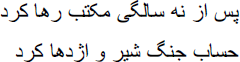
Available sources provide different dates for Rushdīyeh’s birth. Two family biographies provided the dates 27 March 1860 (5 Ramadan 1276 AH) and an unspecified day in 1851 (1267 AH).Footnote 7 Rushdīyeh himself recorded his birthday as 6 March 1862 (5 Ramadan 1278 AH).Footnote 8 Elsewhere in the diary, he implied that he was born in 1854.Footnote 9 The contradictions make the setting of an exact date difficult, but we do know that Mīrzā Ḥasan Tabrīzī (later Mīrzā Ḥasan Rushdīyeh) was born near the middle of the nineteenth century into a clerical family in the city of Tabriz. His forefathers had lived in Ṭālish, Gīlān. Once Ṭālish fell to the Afsharid king, Nadir Shah, the family was held captive until they fled to near Tabriz, where they settled.Footnote 10 Rushdīyeh’s childhood coincided with the rule of the fourth and longest-ruling Qajar king, Nāṣer al-Dīn Shāh. The Qajar monarchs shared their political power with the social and epistemic authority of the Shia ulema, a collective that had consolidated its power in the Safavid period and had become more secure under the more congenial rule of FatḥʿAli Shāh (d. 1834).Footnote 11 As epistemic authority, they operated the educational system that taught and schooled those across all social classes who chose to learn. Rushdīyeh’s father, a quietist (gūsheh‘nishīn) mujtahid by the name of Ākhūnd Mullāh Mehdī Tabrīzī, sent Rushdīyeh to a public maktab by the age of six—the maktab (short for maktabkhāneh, plural makātib) was the traditional institution of primary learning in Iran. Muslims used the term maktab in a number of contexts, but all in reference to knowledge production, teaching, and learning, including the place where children were educated.Footnote 12 The Persian variations on the Arabic word, maktab, were the maktabkhāneh, (a)dabestān, and, in some sources like Tārikh-e Bayhaqqī, dabīrestān.Footnote 13 Under the Reza Shah administration (1925–41), dabestān and dabīrestān came to designate primary and middle schooling respectively.Footnote 14 Despite terminological variations, Persian sources up until the end of the Qajar period generally referred to the space where children learned to read and write as the maktab. For example, the twelfth-century Persian poet, Nezāmī Ganjavī, describing the early development and childhood of Khusraw in Khusraw u Shīrīn, wrote:
In nineteenth-century Iran, three forms of makātib educated children: the sister-mullah maktab (makāteb-e ākhūnd bājī), the “public” maktab, and the “private” maktab for the children of prominent ulema and aristocracy.Footnote 16 Sister-mullahs, loosely comparable to teachers in English dame schools, were generally of limited learning and taught children aged four to seven in mixed-gender settings.Footnote 17 Yaḥyā Dawlatābādī (b. 27 December 1862) described them as women who were mostly in urban areas and their job was to nurse children either in their own homes or in the houses of elites (muḥtaramīn). He added that these “women could read simple expressions and had, based on religious belief, painstakingly acquired the Qurʿan, [while] most of them were unable to write, and [he] wasted away his life not knowing what he had learned from them.”Footnote 18 Sister-mullah maktab served anything between a few to over a hundred students, with more experienced students serving as aids to the teacher—for example, by teaching the alphabet (orally) to an incoming student. All ages and levels of learning assembled in the same room and received individualized instruction. The educational mission was to acquaint students with the alphabet, the Qurʿan, social etiquette, and Shariah obligations such as the performance of ablution and prayer. Writing was not part of the curriculum, and everything was taught orally. Material for writing was thus not made available to students. Each day, students gathered around the instructor in a simple, carpeted room as she lay against a large, hard pillow (tushakcheh) with a small table in front of her. Students were instructed to memorize their readings, kneel before the teacher’s desk, and repeat what they had committed to memory.Footnote 19 Rote memorization was the routine examination method in sister-mullah schools, as it was in their more elaborate counterparts, the public maktab. Students would either start their education at the public maktab, as Rushdīyeh had done, or would go there after some schooling in the sister-mullah schools. The public maktab met at mosques, shops (dukkān in the singular), and private homes. There, students would make the transition from oral learning to writing and benefit from a more comprehensive curriculum.Footnote 20 The textbooks children read were not authored by the teachers themselves or written specifically for children. They were fragments from existing texts or personal writings. Dawlatābādī recounts that their teacher would give them his own transactional writings (sanad-hā-ye muʿāmelātī) that he had produced for his patrons but were no longer needed.Footnote 21 Teachers at the public maktab were lower-ranking mullahs and although they were supposed to be more learned than their sister-mullah counterparts, modernist memoirs hold them in contempt; their teaching incompetence and harsh use of physical punishment are described—although some are praised. The reformer Ākhūndzādeh, for instance, praised his teacher Mullāh ʿAlī Asghar, because when the mullah taught him, his “hatred for reading was fully eliminated.”Footnote 22
Motivations for schooling were not uniform. Learning the Qurʿan was the primary reason for many parents who sent their children to school, especially those who came from more indigent ranks. Merchant families wanted their children to learn more, such as writing and basic math for everyday use—for instance, to take an accounting of family income and expenses. Some went to the maktab with the intention of becoming a madrasa student, and thus a mullah or a mujtahid. After the maktab, there was the possibility to study further and become a mullah in the locality.Footnote 23 Those with higher ambition would go to prominent centers like Najaf and study for many years to become a mujtahid. Aristocratic families (amīr, mustufī, and dīvānī) sent their children to private maktab, which was spatially and demographically segregated but had a pedagogy and curriculum similar to the public maktab. In the Qajar period, some parents hoped that after the private maktab their children would travel abroad to study new sciences.Footnote 24
At the maktab, the young Mīrzā Ḥasan displayed impressive abilities; the mullah therefore selected him as his aid (khalīfeh) so he could help other students.Footnote 25 His classmates met Rushdīyeh early in the morning and sought help with their subjects, in an attempt to mitigate the mullah’s frequent application of physical punishment due to their lack of comprehension.Footnote 26 Physical punishment was routinely applied without complaint from pupils’ parents. This practice instilled in the young Rushdīyeh an early dislike for the maktab, an aversion he shared with his intellectual contemporaries, including in newspaper articles that argued against the compatibility of physical discipline on the one hand, and good teaching and upbringing on the other.Footnote 27
From Local Preacher to Cosmopolitan Educator
Rushdīyeh studied at the maktab for five years and then continued his studies for another eleven in subjects such as fiqh until he gained the authority of a local preacher at the age of twenty-two (in 1882).Footnote 28 With his father’s permission, he became a preacher (vāʿeẓ) at the local Imāmzādeh mosque, named Charandāb. While preaching, his life trajectory changed after a supposed encounter with the crown prince (valī ʿahd), Muẓaffar al-Dīn Shāh. The crown prince liked to spend leisure time in a garden north of the capital and would occasionally choose Tabriz as his return route. When the prince was returning via Tabriz, he decided to visit the Imāmzādah where Rushdīyeh was preaching against the injustice of “the oppressor.” Upon seeing the crown prince, Rushdīyeh immediately changed the content of his speech, thinking to himself that he “must be the most hypocritical of people, that [in fear of] a certain oppressor he has abandoned the application of God’s command to him and has interrupted his speech to talk about something else.”Footnote 29 After this incident, Rushdīyeh left off preaching altogether for a brief period of solitude and inactivity, until, with parental permission, he decided to leave for a pilgrimage to Mashhad. Before going to Mashhad, Rushdīyeh went to Yerevan, Armenia and spent Ramadan there.Footnote 30 Prior to the nineteenth century, the Safavid dynasty controlled Yerevan. In 1828, the Qajars surrendered control to Russia, according to the Treaty of Turkomantchay. Iran’s past political power over Yerevan and the geographic proximity between Yerevan and Tabriz connected the two cities together, and many from Tabriz would reside or visit there.Footnote 31 While in Yerevan, Rushdīyeh reported that he was spending time in a public park (bāgh-e ʿumūmī) when he saw a door open. Several hundred students wearing hats and backpacks exited and dispersed in different directions. Two of them passed Rushdīyeh, and he heard them speaking in Turkish. Calling them over to inquire where it was that they were coming from, they replied: “we study.” The subjects they studied included Islamic jurisprudence. Rushdīyeh asked the children a few questions and was astonished at their level of comprehension—superior to what children of Tabriz would learn at the same age.Footnote 32 This raised Rushdīyeh’s curiosity, and he arranged a meeting with the teacher of religious sciences, Hājj Mullāh Bāqer Ākhūnd, with whom Rushdīyeh had previous acquaintance. Mullāh Bāqer had been a student of Rushdīyeh’s father for eight years prior to his residence in Yerevan. He informed Rushdīyeh of the children’s program, and although it remains unspecified in his diaries, it must presumably have included new pedagogy. Hearing of the school’s program, the former preacher found new inspiration and decided to act in “God’s path” and establish something comparable for the “children of Islam.” Mullāh Bāqer then advised Rushdīyeh that he must go through several steps: he must first acquire new pedagogical principles. Then he must receive a certificate from Russia’s teachers’ college, learn Russian, and become a Russian subject.Footnote 33 According to Russian regulations, he would then be permitted to teach Islamic subjects to Muslim children at public schools for one hour per week. Muslims, Rushdīyeh was then informed, were not permitted to institute independent schools in the city because Russian authorities wanted to keep Muslims mixing with non-Muslim students.Footnote 34 It appears these regulations were not fully enforced or that Rushdīyeh was able to receive exemption from them by instituting his school as one for foreign (Iranian) subjects, because when in 1884 he returned from his Ottoman travels he established a school exclusively for Iranian-Muslim children, and without meeting the specified conditions.
After this conversation, Rushdīyeh abandoned earlier plans to go to Najaf for further studies, and instead decided to acquire new pedagogy and turned to the reformist newspaper Akhtar for direction.Footnote 35Akhtar was a Persian-language paper edited and produced by exilic intellectuals in Istanbul and sent into Iran, where it had a sizable audience. The young Rushdīyeh had learned via the newspaper that in Tabriz each maktab would only produce one literate student for every ten it trained.Footnote 36 This was in sharp contrast to Europe, where almost all students would become literate.Footnote 37 Rushdīyeh’s aim was to find a teachers’ association that was suited to and accepted Muslim teachers and trained them in new pedagogical principles. He wrote to the editors of Akhtar with his query, and they informed him of a soon-to-be instituted association by the British in Cairo. Thereafter, Rushdīyeh set out on his Ottoman travels.Footnote 38
Iranian Educator in the Ottoman Center
Traveling via Tiflis, Rushdīyeh began with the capital, Istanbul. He journeyed to the Ottoman Empire in about 1882, thirteen years after an imperial decree on education reform.Footnote 39 Before this decree, education for Muslim subjects of the empire consisted of the sibyan mektebi (“Qurʿan school”) at the elementary level and madrassas at higher levels. Responsibility for providing education to children of common people was left not to the imperial center, but to persons within the community acting on their own initiative, as was the case in Qajar Iran. A typical sibyan mektebi consisted mostly of one room, which was often located in the vicinity of a mosque and directed by a member of the lower ulema, called hoca. Wealthy Muslims mainly founded these schools, and their maintenance was secured by religious foundations for public purposes (vakif), as well as by the weekly payments of parents to the hocas, and there is no evidence that these institutions were controlled or inspected by a central organ, but in many cases the donors monitored the qualifications of the hocas, such as ensuring that they were informed about fiqh and led a righteous life. As in Iran, Ottoman sibyan mektebi had a diverse student body all in the same room with varying ages and degrees of knowledge.Footnote 40 In 1869 an imperial decree on education, based on French models, attempted to modify the character of premodern education. Broadly, the decree provided for centralization, discipline, and compulsion in education for all subjects.Footnote 41 It attempted to undo the mixture of students, separating them based on age and knowledge under several tiers all the way from primary education to higher education. The primary level carried the same name of the sibyan maktabs but had to operate under new rules. In addition to being compulsory for all and under the general supervision of Istanbul, the sibyan was reserved for girls aged 6–10 and boys aged 7–11 with a duration of four years where the alphabet, among other subjects such as Ottoman history and the Qurʿan, was to be taught.Footnote 42 As was the case previously, non-Muslim communities would have their own religious instruction. The second tier was the rusdiye schools. Children would enroll at the rusdiye schools at age ten (girls) and eleven (boys), also for four years. They were to be introduced to “religious” subjects, Ottoman grammar, orthography and composition, Arabic and Persian through new methods, bookkeeping, arithmetic, drawing/drafting, introduction to geometry, general history and Ottoman history, geography, gymnastics, and the language commonly used in the school’s vicinity. Certain “motivated” students living in trade zones could also study French in their fourth year. Rushdīyeh’s assessment of the Ottoman schools he visited was mixed. He commended the children for their efforts, writing that they applied themselves to learning and all enjoyed their time at school. He opined that this was because of the teachers’ approach: they treated children with extraordinary compassion and kindness. However, his opinion was otherwise negative. He found the supposedly reformed schools of Istanbul to be in an inferior state. He found no principles of pedagogy for generating functional literacy.Footnote 43 This assessment was probably true in the context of Rushdīyeh’s interests, because early attempts at educational reform in the Ottoman Empire did not meet expected goals. For example, the intent of reformers was for children to acquire functional literacy at the sibyan level to spare the rusdiye schools this task. But in practice, many children would come to the rusdiye schools still illiterate.Footnote 44
The Baladīyeh school of Cairo
Having lost hope in the Ottoman center, Rushdīyeh traveled to Cairo. There, he visited the manager of the Persian-language Ḥikmat newspaper, Mīrzā Mehdī Khān Tabrīzī. He desired to be introduced to those known in the organization of schools and the arts of pedagogy. Mīrzā Mehdī Khān Tabrīzī took Rushdīyeh to what he claimed was the new, reputable Baladīyeh school the next day.Footnote 45 At the primary level, the school consisted of fourth through sixth grades. According to Rushdīyeh, children spent the first through third grades at the maktab (in Ottoman nomenclature sibyan mektebi and in Arabic kuttāb in the plural), after which they enrolled at the Baladīyeh.Footnote 46 The Iranian traveler soon learned that in terms of pedagogy, the Baladīyeh school was not terribly different from its maktab counterpart. Rushdīyeh thought instruction in the fourth grade was deficient. Most children, he wrote, had memorized prayers written in their textbook, but could not recognize the letters or read the prayers. Even though most of their texts had short vowels (mu‘arab būd), students were unable to read because of the teacher’s failure to teach the alphabet.Footnote 47 Rushdīyeh tried his luck with the sixth grade at the school as well. Students read a text on etiquette (akhlāq). Even with the use of short vowels, they made plenty of mistakes. The teacher did not seem to care, Rushdīyeh wrote, and incorrect reading and writing even at higher grades were thought to be how things were and always would be. In fact, one teacher told Rushdīyeh that children were “accustomed to” to incorrect writing.Footnote 48 What Rushdīyeh had failed to find at the Baladīyeh school, rapid and functional literacy, began to appear in Egypt a few decades after his visit. Egyptian schooling at the turn of the twentieth century was differentiated from previous educational projects in its unrelenting focus and success in achieving basic, functional literacy.Footnote 49 Rushdīyeh seemed to have recognized this change in his diaries at the time of its writing. Citing 1915 statistics on schools in Egypt, he wrote, “today [i.e. 1936], Egypt is known as the abode of knowledge.”Footnote 50
Overall, in Istanbul and Cairo Rushdīyeh learned nothing on principles of pedagogy. He thought that the children who do become literate and continue with their education achieve this only because of the mutual compassion between teachers and students.Footnote 51 The mutual compassion he saw during his Ottoman travels was absent in schools in Tabriz, and he adds that physical punishment and mutual enmity were the norms in his city.Footnote 52 As mentioned previously, in makātib of Tabriz and Qajar Iran more broadly physical punishment was routinely applied without complaint from parents. Popular idioms would even celebrate this practice:


Though corporeal punishment of children was an accepted fact of life, some restrictions did exist. According to one source, teachers would generally not punish children under the age of ten. In most cases, contact with head and face was to be avoided, although there are reports of children losing eyes or ears because of excessively hard punishment applied to their face and heads.Footnote 54 Students were beaten with thin pieces of wood, or were subjected to bastinado (falak)—being struck on their feet. Alternatively, children were imprisoned for brief durations in dark basements (sīyāh‘chāl) of the homes in which classes were held.Footnote 55 Punishment was sometimes gendered; pinching and inserting nails into skin were applied to girls only. A less physical method of punishment was for the teacher to join voices with students and curse the wrongdoer.Footnote 56 Iranian novelist Mu ḥ ammad ʿ Alī Jamālzādeh (b. 1892) recounted corporeal punishment in some detail in his memoirs. He wrote that the teacher would have the children recite the following: “I must say the tashdid roughly. I must recognize the hamza on alif as an alif. If I do not, I shall be hit on my palm and feet a hundred times to know it as such.”Footnote 57 He added:
From that very first day I set foot in the maktab, I was like a bird in a cage. My heartbeat had not slowed down yet, when the akhund, in enmity and anger … as if he had a prolonged grudge against me, an innocent child, asked my name. I said, with a shaky voice, “Sayyid Muhammad Ali.” He said to me, “Sayyid Muḥammad Ali, know that they call this place maktab. It’s not a place for fooling around or for playing. If you move an inch, I will put your nails on the bastinado … ” Hearing this, I became speechless; I lost my breath and began to cry.Footnote 58
Soon after this directive, Jamālzādeh was punished by bastinado for not understanding what homework was expected of him. “In that hour,” he wrote, “at once I became fearful and uninterested in knowledge, literacy, and writing.”Footnote 59 This lack of compassion was reciprocated by children, who would punish their teachers in calculated ways. Rushdīyeh wrote that a few of the makātib in Tabriz were known for students forming into a group, two or three times per year, to beat their teacher with his own stick. The animosity between teachers and children would go so far, he wrote, that children would bury a jar of explosives (bārūt) under the teacher’s seat, which would be set off in order to injure the teacher.Footnote 60 The Qajar diplomat and Rushdīyeh’s reformist rival in education reform, Mīrzā Mehdī Khān Mumtaḥin al-Dawleh, wrote that he was severely punished for another child’s inattention. In retaliation, the young Mumtaḥin al-Dawleh managed to purchase some fireworks. Before the teacher entered the room, he created a large hole (gudāl) under the teacher’s seat, hid the fireworks there and connected them to their head-string (fītīleh), which he had control over. When the teacher came in and was about to sit, Mumtaḥin al-Dawleh set it off, causing the teacher to be thrown upwards, hitting the ceiling and breaking his hand. The circle of violence continued, with the teacher punishing both children so severely that they attempted suicide—one by stabbing his stomach and the other by jumping off the balcony—but failed. Their failed attempt compelled their fathers to replace the ākhūnd with another teacher.Footnote 61 Rushdīyeh converged with his intellectual contemporaries in his conviction that corporal punishment is antithetical to learning. In Istanbul and Cairo, he had seen how the lack of punishment and mutual compassion enabled some learning even in the absence of principles of pedagogy. Not having found these principles, or, as he put it, not having found “the medicine for his sickness” in Cairo, Rushdīyeh set out for Beirut.Footnote 62
Principles of pedagogy in Beirut
Rushdīyeh spent two years (1882–84) in Beirut, where he acquired his new pedagogy, which he would then introduce to Muslim children in Armenia and Iran. In Beirut, Rushdīyeh met with a former acquaintance, Mīrzā Javād Khān, who was employed at the Iranian consulate (qunsūl). Mīrzā Javād Khān recommended a French-instituted school, which was established via local requests to train teachers for the reform of primary education.Footnote 63 Rushdīyeh did not seek foreign or missionary schools like the Alliance Française or their teachers in Iran, and instead looked to the Ottoman world. In fact, memoirs of Iranian educational activists, including Rushdīyeh, made no significant mention of missionary and foreign schools in Iran.Footnote 64 Rushdīyeh did not clarify why he went to the Ottoman world instead of seeking new pedagogy at Iran’s missionary schools. Based on our incomplete information about missionary schools around the year 1882, two reasons may be suggested.Footnote 65 First, these schools appeared to have primarily taught Christian subjects to Iranian Christians, and when Muslims enrolled, their curriculum was heavily focused on foreign languages and sciences, such as French language and literature.Footnote 66 It is not clear if, in the period at issue, these schools were teaching Persian or Arabic alphabet, language, literature, and Islamic subjects. Moreover, and perhaps more significantly, Rushdīyeh may have believed that association with missionary schools would imperil his already precarious plan to go against maktab education. Acquiring new pedagogy by Ottoman Muslims (even if mediated by the French) and for Muslims, without a missionary connection, was less of a liability.
Rushdīyeh did not seek mission educators in Iran or elsewhere, but he did receive the tutelage of French educators in a Beirut school intended for Muslim children. The school’s French director (raʾīs) was perplexed that locals needed instructions on how to teach their native (Arabic) alphabet. His hope was that when the French alphabet was taught to children, local teachers would gradually apply the same method to teaching the Arabic alphabet.Footnote 67 Appearing anti-colonial in his view, the director thought educating young children in a foreign language first would have a negative impact on their body (jism), soul (rūh), and manners (khulq).Footnote 68 Rushdīyeh told the director that he wanted to apply their methods to the teaching of the Arabic alphabet, and he was provided with a contract and an eight lira salary per month, subject to an increase.Footnote 69 Before the first day of instruction, the director conversed patiently with Rushdīyeh on the first-grade program and the principles of pedagogy. Rushdīyeh saw this opportunity as “God-sent,” although he was anxious as much of what heard was in French. Still, he was informed of what went on (presumably a translator was present).Footnote 70
On opening day, in addition to 700 students in other grades, thirty students aged between five and seven enrolled in the first grade.Footnote 71 The thirty students entered the classroom and took their seats (nīmkat) facing two blackboards, one of which had horizontal lines and the other slanted lines.Footnote 72 The boards were used for interactive teaching of the alphabet, not seen in the makātib of Tabriz. An English teacher speaking in Arabic taught the class. He had an understanding of pedagogy, Rushdīyeh wrote, and spoke simply and slowly.Footnote 73 On the first night of school activity, Rushdīyeh claimed to have suggested to the director that he teach the Arabic alphabet as follows: he wanted to teach one letter and its writing one day, and another letter the next, which students would then combine to create words that they would write and pronounce. The sounding of Arabic letters was crucial; Rushdīyeh thought that if they were sounded out and pronounced correctly, students would make no mistake in writing them. He intended to break up words into their sound constituents, so the child knew which letters were pronounced and how. The director and other teachers approved of this method, and informed Rushdīyeh about phonetic approaches to learning the French alphabet invented years before.Footnote 74 In this context, Rushdīyeh learned the effectiveness of teaching the Arabic alphabet phonetically as opposed to the name-based method used at the maktab. In the maktab, the alphabet was taught based on the names of the vowel and the letter. The word bār (meaning load), for example, was taught as follows: ب به صدای الفی با و به صدای جزمی ر میشود بار B by the sound of alif, bā, and by the silent r becomes bār. In contrast, the phonetic method approached the word based on how each individual letter sounded. The b sound combined with the ā sound becomes bā, combined with the r sound becomes bār ( ب-ا میشود با-ر-میشود بار).Footnote 75 Rushdīyeh wanted to change the maktab approach to the phonetic method he had learned (or, in his own estimation, discovered in conversation with the director). He believed that the phonetic teaching of the alphabet would enable rapid and functional literacy. This proved true, he wrote. In one week, five lessons were completed and students were able to break up a word, distinguish the sounds, and spell it when the word was read out clearly. Rushdīyeh then arranged a public exam for students in front of the director, other teachers, and guests that included the children’s parents and notables of the city, among them the modernist mufti Muḥammad ʿAbduh. They were to ask students to read and write any word from the following taught letters: ا ء د ذ ر ز و . On examination day, the attendees dictated certain words to students which they first pronounced and then wrote down, all correctly.Footnote 76 Rushdīyeh later became known for the phonetic method upon his return to Iran. The method was widely adopted, including in the emerging teachers’ colleges. Dawlatābādī, who was otherwise critical of Rushdīyeh’s claim to senior status in education reform, did concede that it was Rushdīyeh who pioneered the new, phonetic teaching of the alphabet.Footnote 77
Although Rushdīyeh was very much committed to the phonetic method of teaching the alphabet toward rapid literacy, he did not show an interest in changing the form of the Arabic-Persian script. Intellectual arguments that connected the alphabet to higher literacy, and, more broadly, to large-scale reform of society, were common in the late nineteenth century. The Georgia-based intellectual Mīrzā FatḥʿAlī Khān Ākhūnd’zādeh, who directed his critical energies towards Qajar Iran, was the most radical advocate of alphabet change, connecting its transformation to Iran’s salvation. Arguing that the Arabic script hinders literacy, thus obstructing the spread of new sciences and ideas, which in turn prevents large-scale reform, he invented a new script and presented it to a certain educational association (anjuman-e dānesh) in Istanbul, but it was never pursued seriously via either intellectual consensus or educational initiatives.Footnote 78 Newspapers too had occasional entries on the reformation of the “Islamic script,” arguing that the supposedly easier “Western script” was tied to the children’s effective learning and broader civilizational progress. Others tried to provide for the legitimacy of change in the so-called Islamic script from the perspective of Shariah, relying on the historical precedent of the Kufi script. The Qurʿan was initially committed to writing in this script, but the Abbasid official and calligrapher ibn Muqla, with juristic approval, changed the Kufi script to khaṭṭ-e naskh, from which many other calligraphic forms emerged. If the original script of the Qurʿan could change substantially, the argument went, so could the Arabic script.Footnote 79 Rushdīyeh did not share the same anxiety over the form of the script; nor did he, as far as our evidence suggests, partake in the conceptual debate. His concern was the manner in which the alphabet was taught and he believed sound-based teaching of the alphabet would enable early and functional literacy irrespective of what the script looked like.
As the term progressed, Rushdīyeh authored his own lessons, a practice that was entirely foreign to the maktab teachers who selected existing texts for children. In three months, he taught fifty lessons from his self-authored textbook, The Foundations of Learning (bedāyat al-tʿalīm).Footnote 80 After the program, students took three months off. Rushdīyeh took this time away from the school in the flower-filled Levant countryside, Mount Lebanon, along with the director and his family.Footnote 81 Rushdīyeh returned to teach functional literacy to elementary students and also added lessons from Sʿadī’s Gulistān. In one year, students read three chapters from Gulistān that included about a hundred stories. Rushdīyeh reports, probably with some exaggeration, that students memorized the stories, recited them from memory, and translated them from Persian into Arabic.Footnote 82 Once the year ended, Rushdīyeh asked for a “recommendation” (shahādat) from the director before his planned return to Iran. The director wrote one on his behalf stating that the Iranian educator entered the “dār al-muʿalimīn” in Beirut—which must be a reference to the French-run school and not a state-run teachers’ college comparable to those that gained prominence a few decades later—to learn principles of school management and pedagogy, that he spent two years there, and that he was qualified to manage a school at the elementary and middle levels.Footnote 83 Rushdīyeh intended to put his training and the new pedagogy into use upon his return to Tabriz, but fearing maktab opposition at home he first established a school in Yerevan.Footnote 84
The First Yerevan Schools
In about 1884, Rushdīyeh met with his brother Mīrzā Hājjī Aqā, who had moved to Yerevan where he led a simple life. Rushdīyeh sought his brother’s help in opening a school. Fearing communal opposition to the new-style education, Mīrzā Hājjī Aqā agreed reluctantly and began recruiting his connections to have their children study there. Meanwhile, Rushdīyeh sought permission for his educational enterprise not from Russian authorities but from the local Muslim judge (qādī). Mullāh Bāqer had advised him that he must visit the qādī, but refrain from informing him about the specifics of what he intended to do. Maintaining an air of innocence, Rushdīyeh submitted his request along with sweets, and obtained written permission to begin work.Footnote 85
Rushdīyeh combined reading with writing instruments from the first day of instruction—this puzzled the residents because the old maktab would teach students orally for five or six years before they had any engagement with the pen.Footnote 86 Rushdīyeh saw a link between literacy and directing children to write words from their mother tongue, which for the Iranian children at his school was the same Turkish as spoken in Tabriz.Footnote 87 Principals (mudīr in the singular) of other makātib complained to local authorities about the unconventional teaching of Turkish, saying that Rushdīyeh had been sent by the Ottomans to convert their children from Shia to Sunni Islam. City inspectors (muftishīn) thus came and saw that the writings were in Azeri Turkish and not Ottoman Turkish. One inspector, who appeared most senior in age, refused to side with the residents, telling them that they should thank Rushdīyeh as he was eliminating the need for government-operated and regulated schools—which were seen in many localities as intruding upon age-old ulema and communal ways of life. He thus wrote a report that would not alarm his superiors; but the local qādī had a different opinion. He sent an agent (maʾmūr) to inform Rushdīyeh that his teaching methods constituted innovation (bedʿat in Persian) under Islamic law and were thus illegal, telling the educator he must either teach according to old principles or close his school.Footnote 88 Thereafter, Rushdīyeh voluntarily closed his school but began to rent properties for new schools in adjacent lands. He hired teachers who had graduated from public Russian schools and asked them to teach in Turkish until he was able to hire Persian-speaking teachers and write textbooks in Persian, which along with Arabic were lettered languages in Iran where he intended to establish new schools. He employed his brother for religious studies, and, at his suggestion, named the new school “Rushdīyeh”—an Ottoman term (rusdiye) used for reformed middle schools of the tanzimat period—which Mīrzā Ḥasan Tabrīzī later adopted as his own surname. In contrast to the mixed maktab, the Rushdīyeh school had three separate grades and he provided students with leisure time in between classes. Rushdīyeh was careful not to provide his agitators with easy cause for attack. As it was considered unbelief (kufr) to ring a bell, he came up with poems that students would sing in a rhythm mimicking the music of the adhān, to declare the beginning or end of the period, and to implement order, for instance to alert students that the break was over and it was time to form a queue and return to class. Students would thus sing as follows: “whoever seeks knowledge and wisdom / know that it’s time for queues to be formed.”Footnote 89 The song substituted for the bell.
Rushdīyeh’s newly opened school increased its enrollment, which meant additional tuition fees. With the extra revenue, Rushdīyeh subsidized indigent children. The school became popular across the Caucasus, he wrote. Russian, Armenian, and Muslim parents visited and examined the program. They would test children’s learning during break times and were very pleased.Footnote 90 One day, Rushdīyeh wrote, the Russian science minister (vazīr-e ʿulūm) visited the school, the result of which was a personal invitation, with the carriage provided, to a nearby city for a meeting with the minister, during which he applauded Rushdīyeh’s pedagogical achievements.Footnote 91 Rushdīyeh spent long hours devising the curriculum and his passion took him all the way through the night until he heard the morning call to prayer. He authored two books in Turkish for teaching the alphabet, one designed for students and the other for teachers. The new textbook fanned fear in the community because of the use of the Turkish language. Just as reformers (mutejadedīn) praised him, so the “fanatics” (fanatik-hā) cursed him.Footnote 92 The textbooks’ publications costs were taken care of by the Russian minister of science. Furthermore, the minister is said to have ordered the Yerevan ministry representative to provide the school with operational support in the form of teachers in Russian language, mathematics, and natural sciences, as well as a hundred chairs and tables.Footnote 93 How the official support for what appears to have been a private school for Iranian Muslim subjects squared with the aforementioned Russian regulations is not clear. The curriculum consisted of Persian, Turkish, Arabic, Russian, literature (unspecified), Shariah obligations, geometry, algorithmic, geography, natural history, painting, and calligraphy.Footnote 94 The school operated successfully for three years. In the fourth year, Rushdīyeh began to implement measures that resembled new schools elsewhere and a modern disciplinary regime. He required students to wear uniforms, without which entry to the school was not permitted. The uniform included an Iranian hat, labbādeh, qabāy-e rāsteh, and low-heeled shoes.Footnote 95 When the school opened for the fourth year, 250 students wearing identical uniforms entered. Twenty indigent students were admitted for free, and the rest were asked to pay five menta (Russian currency) in tuition. After completion of the fifth year, fifty students received diplomas, either going in search of work or entering governmental schools in the disciplines of sciences, political science, medicine, engineering, crafts, and philosophy.Footnote 96 The practice of granting diplomas became standard at future Rushdīyeh schools, in contrast to the maktab, where no certificates or diplomas were awarded.
Nāṣer al-Dīn Shāh visits Yerevan
An important event took place at the end of the fifth year, when Nāṣer al-Dīn Shāh visited the school. From Rushdīyeh’s perspective, this visit was especially significant because his ultimate aim was to bring the new schools to Iran.Footnote 97 The king had decided to visit several regions in Iran and also took three trips to Europe, which he documented in his diaries. The end of the fifth school year coincided with Nāṣer al-Dīn Shāh’s third and last trip to Europe.Footnote 98 He was traveling through Yerevan on the way back to Tehran when he noticed the front steps of the Iranian school, which Rushdīyeh had decorated with an Iranian carpet, flags, and a picture of the shah.Footnote 99 This display was intended to lure the shah, and succeeded. Rushdīyeh explained to the king the school’s accomplishments in rapid, functional literacy and informed him of his wish for a comparable school to be instituted in Iran. Nāṣer al-Dīn Shāh then ordered Rushdīyeh to travel with his entourage and establish a school in Tabriz. A delighted Rushdīyeh did not hesitate and put his affairs in order, asking his brother to supervise the Yerevan school, and left for Tabriz with the shah. On their way to Tabriz, Nāṣer al-Dīn Shāh inquired more about the school and Rushdīyeh spoke at length of the benefits it would have for the people and polity of Iran. Once they reached Nakhchivan, a region between Yeravan and Tabriz, Rushdīyeh was left with the director of the post office (chapar‘khāneh). The director told the educator that he must stay until the shah left Tabriz for Tehran, and upon hearing this, Rushdīyeh realized his mistake. Reflecting back, he wrote:
It became apparent to me that when I was before the king as he was asking me about the impact the school would have, my inexperience and ignorance of the king caused me to describe its benefits at length, that indeed it won’t be long until, under his highness, the God’s shadow, schools would be instituted all over to liberate Iranians from ignorance, the masses would gain in knowledge and wisdom, learn of their rights, acquire profession and industry, possess wealth and property, each person acquiring, according to his or her ability, politeness and principles of good manners, free of need for police or city inspectors. Knowing their rights, as they do in civilized nations, they would gain in respect and salvation and be forever grateful to the king.Footnote 100
We do not have an account from Nāṣer al-Dīn Shāh’s perspective on what occurred between the two and why he left Rushdīyeh behind. But given the shah’s broader approach to reformist activities, Rushdīyeh’s belief that the reformist implications of his educational enterprise alarmed the shah is plausible. So much so that, if the diaries were true, the shah secured the closure of the Yerevan school. When Rushdīyeh returned, the school was closed and its properties were confiscated by an Iranian representative (kārguẕār) in Yerevan who presumably had authority over Iranian subjects there.Footnote 101 A distraught Rushdīyeh returned to his hometown of Tabriz. Although Nāṣer al-Dīn Shāh had opposed his educational mission, Rushdīyeh decided to act against the shah’s wishes. Remaining quiet about the shah’s disapproval, he began to pursue his original mission of educating Iranians in his hometown of Tabriz, instead of Tehran. Rushdīyeh opened the first school in rooms owned by a mosque in the Sheshgelān neighborhood, which he considered most prepared and least likely to declare someone an unbeliever for education reform, as “most [residents] were social elites [aʿyān] and well-educated.”Footnote 102 In the year 1889, a long-held vision turned into a reality.Footnote 103
The Tabriz Schools
Tabriz residents were informed about the new school by a public notice (iʿlān). The posting took note of the poor state of existing education, claiming that only three out of a hundred students were literate when they left the maktab, and that most children had a deep dislike of the maktabkhāneh. It stated Rushdīyeh’s teaching qualifications and the conditions for admission, which were more restrictive than the existing maktab system that opened its doors to students of different ages and abilities. Students had to be beginners and thus illiterate, and between the ages of seven and ten. Moreover, they had to meet certain health conditions, be free of balding, chickenpox, contagious diseases, and be circumcised (thus males). The tuition was between five qirān and one tuman per month—a clear departure from the old ways of the maktabkhāneh.Footnote 104 Unlike some of the prominent ulema, the mullahs who ran and taught at the maktab led simple lives. They would not charge a fee to students, or if they did it was on a “sliding scale” and as little as five to ten qirān. Instead of fixed tuition, teachers would receive gifts from the students’ families, which were given at the end of the year or when the student had finished reading the Qurʿan in its entirety. The gifts included foods, sweets, money, or wood intended for physical punishment.Footnote 105 The new curriculum and scheduling too were very different from what went on in the maktab. Under the old system, students went to school all year without a summer break. They attended the maktab from morning until evening without any short breaks, but had an extended period for lunch. Some went home to eat, while others brought their lunch with them. Students had days off on Fridays and on religious and Nawrūz (New Year) holidays. Moreover, school was not in session when certain women in the community gave birth, or when families left to spend time in their gardens and villages.Footnote 106 In contrast, Rushdīyeh held classes for 250 days and summers were free. Classes met for four hours per day with thirty-minute breaks between classes. The curriculum covered the following subjects, although not equally as more time was allotted to certain subjects: the phonetic alphabet in Azeri Turkish, reading in Turkish and Persian, grammar lessons in Turkish, Persian, and Arabic, Qurʿan, Islamic jurisprudence, arithmetic, oral history, geography based on the map of Tabriz, calligraphy, dictation in Persian, Turkish, and Arabic, drawing and painting, and physical wellbeing.Footnote 107 The curriculum differed from the maktab where students were taught, based on the teacher’s preference, some of the following: the alphabet, Qurʿanic readings, Shariah obligations, social etiquette literature, Arabic language, Persian literature, and Islamic and Iranian history, writing composition (tarassul), calligraphy (khaṭṭ), basic math, and sīyāq.Footnote 108 Local languages were generally not taught, and new sciences like physics and chemistry were not taught at all. Creative arts, with the exception of singing and poetry composition in a few schools, were not part of the curriculum.Footnote 109 Texts were not uniform and their selection depended on the instructors, but some were widely used in the subject of history; for example, the preferred text was Nāsikh al-tavārīkh, a Qajar-commissioned nine-volume text on world history authored by Muhammad Taqī Sipihr Kāshānī. The selected texts did not match the learning abilities of young students.Footnote 110 As we saw, Rushdīyeh attempted to distinguish his approach by authoring textbooks specifically intended for children.Footnote 111
The Tabriz school began its first day of instruction with roughly 150 students. Rushdīyeh began instruction, all the while seeking teachers and drafting textbooks. Meanwhile, he had to go against his critics. In Tabriz too, the custodians of the old maktab system and the ulema to whom the community had complained were putting up resistance against Rushdīyeh’s unfamiliar enterprise. In Yerevan, the teaching of Turkish led to charges of imposing Sunni over Shia Islam. In Tabriz, the charges were different. Public notices were posted claiming that the new teacher was an agent of American freemasons. Even though the Qurʿan was part of the curriculum, others claimed he was neglecting the Qurʿan in favor of Turkish.Footnote 112 Responding to these accusations, Rushdīyeh asked for the school to be allowed to reach its ninth-month anniversary, after which students would be publicly tested on their religious knowledge. When the public test was performed at a mosque and the students displayed superior comprehension of religious studies, the prayer leader (pīshnamāz), who appeared to have run out of options to condemn Rushdīyeh, cried that the extraordinary progress had only one explanation, that Satan was inspiring and dictating these children’s speech. The school must close, he said. Rushdīyeh responded to this, saying that these children must be compared to Jesus, instead, who spoke in the cradle inspired by the Holy Spirit. He asked the pīshnamāz that they speak further to resolve the misunderstanding, so as to reverse the ruling and not jeopardize the nation’s salvation, which for Rushdīyeh was firmly linked to functional literacy. Once the pīshnamāz heard the Jesus analogy, he said that Rushdīyeh was elevating children to the status of prophets, and refused any further discussion, declaring Rushdīyeh a bābī—an adherent of the messianic movement of bābīyat considered illegitimate by the Shia ulema. The pīshnamāz forbade future interactions by the community with the educator.Footnote 113
This compelled Rushdīyeh to close the Tabriz school.Footnote 114 Rushdīyeh then spoke to his sympathetic father, telling him that he could bear the burden of opposition, and that he would persist even if they hanged him and burned his body. His father advised him to be patient and provided his blessing; he then left Tabriz.Footnote 115 After a six-month visit to Yerevan and Mashhad, he returned to Tabriz and discovered that the pīshnamāz had died. This gave him the opportunity to open a school near the bazaar.Footnote 116 But opposition came anew: students (tullāb) of the Ṣādeqīyeh madrasa attempted to dismantle the school, engaging in acts of vandalism and threatening the school principal (mudīr). Rushdīyeh escaped to Mashhad and returned to Tabriz after a few months.Footnote 117 In the Charandāb neighborhood, whose residents “were all impoverished” and where he used to preach, he opened another school where admission for indigent children was free. Rushdīyeh enrolled 370 students and employed twelve teachers. Now, the managers of old makātib went after Rushdīyeh and warned his father that Rushdīyeh must close the school. He complied, leaving for Mashhad, but returning yet again.Footnote 118 To avoid another attack on his school, Rushdīyeh tried a new approach. He maintained his pedagogical principles but kept the spatial organization of the maktab intact. For instance, he had children sit on the ground as opposed to chairs and tables and avoided new subjects that were not taught at the maktab.Footnote 119 Nonetheless, students (tullāb) of the Ṣādeqīyeh madrasa that had vandalized the school before were agitated and Rushdīyeh left for Mashhad again, to return for a fifth time, reopening the school in the bazaar neighborhood.Footnote 120 Vandals attacked again, this time throwing a child down the stairs and killing him.Footnote 121
Seeing little hope of a stable enterprise in Tabriz, Rushdīyeh went to Mashhad, where he established the city’s first new school. Although the governor of Mashhad appeared supportive of Rushdīyeh, word of his new approach to primary schooling had reached Mashhad. Vandals were quick to act, attacking the school and breaking his hand.Footnote 122 Mashhad appeared no safer than Tabriz, so Rushdīyeh returned to Tabriz.Footnote 123 Prior opposition had made renting a place difficult, since landlords feared the destruction of their properties. Instead, Rushdīyeh sold a property he owned to a Qajar official, and bought a mosque across from the Dār ul-funūn of Tabriz. With permission from the ulema of Najaf, he repaired the mosque to create a space suitable for teaching children.Footnote 124 After two years of teaching, Rushdīyeh felt secure enough to hold a public examination. Local residents seemed very impressed by students’ progress, but they were interrupted by an attendee who complained that this rapid learning was dangerous, since it would distance children from religion.Footnote 125 A crowd of vandals from Aqā Sayyid Alī Aqā Yazdī’s mosque appeared with clubs and batons. Children and school staff left before the vandalism began, and Rushdīyeh escaped to the roof of the Dār ul-funūn building across from the school, where he stood watching, along with an aid (pīshkār) of the crown prince, Muẓaffar al-Dīn Shāh. The vandals threw a grenade inside the building, causing bricks to scatter around. Rushdīyeh laughed at this and the man accompanying him, bewildered, inquired about the cause of his laughter, to which he responded: “Each one of these bricks will become part of a school. I am laughing at that day, and I hope that I am alive to see it.”Footnote 126
A question deserving of consideration is why it was that new education, rapid literacy in particular, caused so much anxiety for certain ulema, and, by extension, their tullāb and the community. A careful study of ulema writing against new education, if available, would bring us closer to a more satisfactory response than simple ideological explanations that juxtapose (enlightened) modernism against traditional stagnation.Footnote 127 I make two initial suggestions as alternative hypotheses. The most immediate one is a material explanation, having to do with the ulema’s financial interest. In fact, this is how the reformer Yaḥyā Dawlatābādī saw it, writing that madrasa students (tullāb-e dīnī) opposed new education because the movement of the social elite’s children to the new schools meant loss of income for them.Footnote 128 The less obvious but I think more interesting explanation belongs not to the material realm but the realm of ideas. Rapid literacy for all meant that everyone had quick access to ‘ilm. There would arise the danger of the masses gaining the confidence to read and learn on their own. They would then do away with the guidance of the learned ulema, misread the text, and disseminate false knowledge in the community. In other words, mass illiterates guided to the truth by the learned ulema were preferable to mass literates (mis)reading on their own. This is a hypothesis that requires testing in a separate study. For now, we shall content ourselves with the observation that many among the ulema were adamantly opposed to mass and rapid literacy as advocated by educational reformers like Rushdīyeh and did not shy away from confrontation.
In Tehran, from Patronage to Exile
After this incident, a patient Rushdīyeh left for Mashhad again and returned after some time. Although Nāṣer al-Dīn Shāh had opposed his enterprise earlier, reformists within the Qajar court were increasingly sympathetic and extended their support for a new school. The Tabriz schools had received some support from the crown prince but more substantially from the soon-to-be prime minister, Amīn al-Dawleh.Footnote 129 The crown prince provided for some children’s tuition, and during his Azerbaijan stay Amīn al-Dawleh provided school supplies, clothes, and food to the students.Footnote 130 Going against convention, he also encouraged aristocratic families to remove their children from the private maktab and enroll them in the Rushdīyeh school. Mixing was not practiced previously, since the elite thought the public maktab would have a corrupting influence on their children’s etiquette. This perception of corruption turned on social class, not pedagogy or curriculum that were quite similar; the only difference was that private teachers generally had a higher level of learning and received more substantial pay.Footnote 131 When in 1897 Amīn al-Dawleh was appointed prime minister by the now king Muẓaffar al-Dīn Shāh, he became a committed patron of Rushdīyeh. He invited the educator to Tehran, where they established the capital’s first new primary school a year later in 1898 (Ramadan, 1315 AH).Footnote 132 Enrollment reached 200 students in the first few days, and in later years it was estimated at 270 to 330.Footnote 133 The student body was mixed: Amīn al-Dawleh enrolled forty orphans at the school and took care of their tuition, lunch, and uniforms. The rest were children of middling families (mutivasiṭīn) and the elites (aʿyān); the latter’s carriages would form a queue in the evenings to take their children back to their residences. These families paid anywhere between 15 qirān and 3 tuman in tuition, but also had to pay for the school-provided lunch.Footnote 134 According to one source, teacher-training courses were also provided at 25 qirān per class.Footnote 135 The school was composed of six grades, with nine classes in total, each having about 25–30 students. The curriculum included the study of the Qurʿan, Saʿdī’s Gulistān, ritual duties (Sharʿīyāt), calligraphy, dictation, ethics, fiqh, grammar, composition (tarassul), sīyāq, introduction to accounting (madkhal al-ḥisab), geography, history, Russian, and French. Some of these subjects, in the first grade in particular, were taught through textbooks written by Rushdīyeh himself.Footnote 136
Tehran reformists instituted several other new schools, and these were heavily enrolled.Footnote 137 Four months after the Rushdīyeh school, the Ebtedāyīeh school was established under the direction of Mukhbar al-Salṭaneh, grandson of Rezā Qolī Khān Hedāyat, who had returned from nine years of study in Berlin and in this period held posts in the telegraph office and Azerbaijan customs.Footnote 138 At the same time as Ebtedāyīeh, the ‘Elmīyeh school was instituted by Eḥteshām al-Salṭaneh, a Qajar courtier who served in several official positions. Two months after this pair, the Sharaf school was set up, and later in that same year of 1898 the Eftitāhīyeh and Muzaffarīyeh schools were instituted under the direction of two reformists, Mīrzā Maḥmūd Khān Meftāh al-Mulk and Hājj Shaykh Mehdī Kāshānī respectively. The Khiyrīyeh school was also established in 1898 and, under the direction of Hājj Shaykh Hādī Najmābādī, a prominent cleric and strong ally of Rushdīyeh, its purpose was to provide new schooling for orphans. In 1899, Dānesh, Adab, and Eslām schools were instituted as well as Sādāt under the direction of Dawlatābādī.Footnote 139 All these schools were connected to an organization that came to be known as the Education Association (anjuman-e maʿārif).Footnote 140 The Education Association was one of the earliest attempts to organize around the cause of education reform. Although certain courtiers were members and funded the association, it came into existence as a “bottom-up” intellectual effort and a reaction to the conservatism and perceived ineffectiveness of the official Science Ministry (vizārat-e ʿulūm).Footnote 141 In addition to instituting the aforementioned new Tehran schools, the Education Association was responsible for fundraising and financial administration of these schools.Footnote 142 Lack of uniformity and discipline in how primary schools operated was a common complaint among reformists, and the Education Association attempted to regulate them, by, for example, drafting a twenty-chapter bylaw on how the schools ought to operate.Footnote 143 Our sources conflict on the emphasis they give to Rushdīyeh’s centrality to the formation of this association. Family biographical sources claimed it came into formation under his leadership and its original name was the “Association of Rushdīyeh School’s Aiders” (anjuman-e emnā-ye madreseh-ye Rushdīyeh).Footnote 144 Rushdīyeh himself did not claim leadership in his diaries, and gave the impression that it was a collective effort.Footnote 145 Rushdīyeh’s contemporaries agreed. According to Dawlatābādī, Rushdīyeh, based on his Tabriz efforts and the sponsorship he had received from the prime minister, viewed himself as the foremost pioneer in new education when he entered Tehran. Dawlatābādī, however, saw Rushdīyeh as a player among many others in new education and in the association. He opined that many were in fact superior to him in their knowledge and experience.Footnote 146 Our sources converge on one point regarding the association: the first meeting took place on Rushdīyeh school premises in 1898, the same year the school opened.Footnote 147 The attendees were Rushdīyeh, the Qajar science minister, Neyr al-Mulk, Dawlatābādī, Eḥteshām al-Salṭaneh, Meftāh al-Mulk, Mumtaḥin al-Dawleh, and ʿAlī Khān Nāzim al-Dawleh.Footnote 148 Additional courtiers and intellectuals were invited and joined in future meetings.
Soon after the Education Association formed, discord broke out between Rushdīyeh and others on the right manner of operating new schools. Eḥteshām al-Salṭaneh became agitated with Rushdīyeh spending the association’s budget on daily school lunches and high salaries, and tried to limit and eliminate the lunches.Footnote 149 The collective decision of the association was to limit Rushdīyeh’s spending.Footnote 150 The meetings were also transferred from the Rushdīyeh school to the residence of Neyr al-Mulk.Footnote 151 Moreover, Eḥteshām al-Salṭaneh acted against Rushdīyeh by using his power as foreign minister to divert 2,000 tuman sent specifically to Rushdīyeh, adding it to the funds of the association.Footnote 152 Amīn al-Dawleh, though not resisting these decisions, remained supportive of Rushdīyeh until the very end of his service. Before leaving his post as prime minister, he provided the association as well as the science minister with a letter recommending that they treat him as superior with respect to affairs of primary education.Footnote 153
The real challenge in Tehran, however, did not come from Rushdīyeh’s reformist colleagues, but from Amīn al-Dawleh’s successor, Mīrzā ʿAlī-Aṣgar Khan Amīn-al-Sulṭān (later he was known as Atābak for the title of Atābak-e ʿAẓam conferred on him by the shah in December 1900).Footnote 154 The new minister ended court support for Rushdīyeh and withdrew funding from his school, which caused him to fall into debt.Footnote 155 Moreover, he took over the Education Association, placed it under the direction of the Science Ministry, and gradually purged it of reformists, including Rushdīyeh and his reformist rival Eḥteshām al-Salṭaneh, who was sent off on a mission to Kurdistan.Footnote 156 Atābak’s opposition to Rushdīyeh frightened elite parents, who withdrew them from the school.Footnote 157 Part of the reason for Atābak’s enmity with Rushdīyeh was the latter’s political activities for the constitutional cause and against the person of Atābak. Four of the school staff, including Shaykh Yaḥyā, teacher of grammar (naḥv) and logic and later editor-in-chief of Iran newspaper, had gathered after work and on school premises. With Rushdīyeh’s knowledge, they composed constitutionalist propaganda called night-letters (shabnāmeh) against Atābak’s premiership. Atābak traced this activity back to the Rushdīyeh school when the school’s nāzim had a falling out with Shaykh Yaḥyā and reported their activity. Atābak arranged for the “police” (nazmīyeh) to issue an order for the arrest of those involved. Two of the staff suspected of authoring night-letters were captured and imprisoned.Footnote 158 Another was struck on the head and his body was thrown onto the street from the school’s roof (it was also reported that he fled the police chase to the rooftop, and jumped, committing suicide).Footnote 159 Shaykh Yaḥyā was captured and exiled to Ardabīl. Rushdīyeh was more fortunate. He sought refuge with prominent cleric Shaykh Najmābādī, who had established the first new school for orphans. The cleric refused repeated requests from the court to send Rushdīyeh to Atābak.Footnote 160 Thereafter, Rushdīyeh left for Hajj, while his school continued to function.Footnote 161 Upon his return from Hajj, Atābak’s previous intimidation did not deter him from his political activities; he continued to produce and distribute night-letters. In response, Atābak decided to exile Rushdīyeh. The educator was informed about this decision through his court connections and fled to Qom, while Atābak forced the school’s closure.Footnote 162 While in Qom, Rushdīyeh was able to communicate with Muẓaffar al-Dīn Shāh by telegraph. The reform-friendly shah reportedly expressed concern about the educator’s absence from the capital, contrary to Atābak’s wishes, and demanded that he return. Rushdīyeh complied and reopened the school. A second exile attempt by Atābak, this time to Ardabil, failed when Rushdīyeh outmaneuvered the prime minister, again through communications with the shah.Footnote 163
Atābak’s efforts to exile Rushdīyeh thus failed twice. Still, Rushdīyeh’s fortunes turned to the worse. A few years before the constitutional order was issued by Muẓaffar al-Dīn Shāh, two of Rushdīyeh’s key supporters died: Amīn al-Dawleh and Shaykh Najmābādī.Footnote 164 Amīn al-Dawleh had willed his son, Muḥsen Khān Muʿīn al-Mulk, to continue the supervision of the Rushdīyeh school after his death. The son transferred the school to a property known as Amīn ad-Dawlah’s Ḥuseynīyeh, with the intention of constructing a new building.Footnote 165 Soon thereafter, Rushdīyeh found himself in conflict with Muʿīn al-Mulk, who was allegedly persuaded by Shaykh Yaḥyā to elevate him from the position of teacher to co-principal. Rushdīyeh refused to share his authority and left the pioneer school he had started when he first came to Tehran.Footnote 166 Rushdīyeh opened another school and simply called it maktab. The school carried on with new pedagogy and free admission for the poor, with enrollment reaching about a hundred students in the first month.Footnote 167
The second turn towards misfortune resulted from pressure by Atābak’s similarly anti-constitutionalist successor, ʿAyn al-Dawleh. The new prime minister became agitated with Rushdīyeh for his continued writing and distribution of night-letters, this time against his premiership. However, Rushdīyeh’s opposition to ʿAyn al-Dawleh was not simply something distributed in the secrecy of the night. It was communicated in a tense personal exchange between the two. Rushdīyeh informed the minister of the people’s dissatisfaction with him, and also suggested that he undertake financial reforms and fire the notoriously unpopular head of Iranian customs, the Belgian Joseph Naus.Footnote 168 A displeased ʿAyn al-Dawleh ordered the closure of the Rushdīyeh maktab, and, unlike Atābak before him, his attempt to exile the educator succeeded. He sent Rushdīyeh to Kalāt, Khurāsān shortly before the triumph of constitutionalism, along with fellow constitutionalist Majd al-Islām, the manager of the Adab newspaper.Footnote 169 Accompanied by a colonel (sarhang), they were taken to Kalāt, where they were received by Āsef al-Dawleh, who supervised them while in exile.Footnote 170 A few months later, a telegraph reached Kalāt that Muẓaffar al-Dīn Shāh had issued a constitutional order and the prisoners had to be released. Thus heartened, Rushdīyeh returned to Tehran and continued his educational activities. Starting in 1907, he briefly worked with a new school named Hayāt-e jāvīd, which the nascent Education Ministry instituted as an alternative to the American missionary school.Footnote 171 The constitutional order of affairs was soon put in a hiatus when the sympathetic king was replaced by his anti-constitutionalist son, Muḥammad ʿAlī Shāh. Rushdīyeh left Tehran, and attempted to organize against the shah from the northern provinces where the constitutionalists had gathered. In his diaries, he claimed a central role for himself in the organization that led to the restoration of the constitutional order, even claiming that he united nomads (īlāt) to rise against the anti-constitutionalist Rashid-Mulk, and persuaded commander Sipahdār to give up his alliance with ʿAyn al-Dawleh and the shah in favor of the constitutional cause.Footnote 172 In the interim constitutional period, Rushdīyeh became for the first time in his life primarily occupied with politics over education, although he did undertake a few educational activities in this period such as procurement of teachers for and revision to a program for a school in the city of Lankirān on the Caspian sea.Footnote 173
When the constitutional order was restored, Rushdīyeh continued his activities but now under the shadow of a new government that was attempting to regulate education and transform its spontaneous, bottom-up intellectual leadership into a project of the state.Footnote 174 Rushdīyeh accepted provincial assignments by the Education Ministry in Qazvīn in 1914 (1332 AH) and in Gīlān in 1918 (1336 AH).Footnote 175 Eventually, under the rule of Reza Shah, Rushdīyeh settled in Qom, where living costs were lower than Tehran. In 1926, Rushdīyeh asked Reza Shah’s American appointment to the Ministry of Finance, Arthur Millspaugh, to establish a bank to fund a proposed educational foundation in Tehran. Although Millspaugh was sympathetic, he denied the request because of its impracticality.Footnote 176 In the same year, Rushdīyeh also solicited a number of western companies for free supplies for his schools, such as typewriters, and all these requests were denied as well.Footnote 177 In 1936, with aid from the increasingly expanding Education Ministry, he established a primary school in Qom composed of six classes.Footnote 178 Rushdīyeh taught there in his old age, on one occasion even falling sick while teaching. He died in Qom in 1944.Footnote 179
Conclusion
Under Reza Shah’s rule, the dabestān became the normative institution of schooling in the nation with the gradual disappearance of the maktab in the second Pahlavi period. Political power appropriated what had begun as an intellectual project of new education. The Pahlavi state tasked itself with public education (tʿalīm va tarbīyat-i ʿumūmī) and the generation of mass, functional literacy.Footnote 180 Furthermore, the disciplinary order of education Rushdīyeh had introduced to Iran via French-instituted training in Beirut was intensified under Reza Shah; Rushdīyeh, who had instituted one of the first bylaws (niẓām‘nāmeh) for the uniform administration of primary schools, had to comply with new, expanding disciplinary regimes. A Ministry of Education report from 1932 listed forty rules (qavānīn) and bylaws, from those regulating minor affairs such as renewing teacher contracts to those on general affairs like teacher training or school administration, including orders (dastūr) on implementation of particular subjects such as physical wellbeing (varzish).Footnote 181 Similar to Rushdīyeh, the state drafted textbooks intended specifically for primary education.Footnote 182 Moreover, students were ordered according to their age, similar to Rushdīyeh schools, not in mixed-age settings as was the case with the maktab. The curriculum and schedule too resembled changes implemented by Rushdīyeh; for example, new subjects like physical wellbeing were included and the long break was scheduled for summer months. As with Rushdīyeh’s approach, the state schools required students to meet registration requirements and wear uniforms. Up to the fifth year boys uniformly wore shorts. Like Rushdīyeh, who emphasized examination to measure student performance, on functional literacy in particular, the Ministry of Education scheduled examinations for all students. The examination regulation of 1933 specified that a committee should be appointed for each school to supervise tests in the first six grades.Footnote 183 But the dabestān also broke from Rushdīyeh in certain respects. For example, it became more nationalistic and monolingual in character and Rushdīyeh’s practice of teaching students in their local languages like Turkish was eliminated. Despite praise for Pahlavi administration of education, Rushdīyeh was critical of the supposedly irreligious subjectivity produced by Reza Shah’s education policies.Footnote 184 In his diaries, he rebuked Iranian schools and students in the 1930s. Students, he claimed,
lack knowledge [and] are enemies of religion and religiosity … [t]heir knowledge rests on breaking from Arabs and Arabic; their names are devotees of homeland but their deeds produce harm for the same homeland and its inhabitants, outwardly they’re European-like but inwardly are simpletons … if they ask a student what is your religion, the student is either compelled to say I am without one or that I have this or that religion, which is anything but Islam.Footnote 185
The dabestān also gained favor with religious power and remained the normative institution under the Islamic Republic. A 1916 letter documented a conversation between the principal of a new school in Isfahan (the school was named Rushdīyeh) and a prominent mujtahid in the city of a more conservative disposition. He applauded the curriculum and approved of the school.Footnote 186 Despite some talk of reviving the institution of the maktab in the aftermath of the Iranian revolution of 1979, the dabestān remained firmly intact and a prerequisite to studies at the seminary (hawzeh). Rushdīyeh’s remark to Muẓaffar al-Dīn Shāh’s aid in Tabriz, that each brick from his school shattered by the pro-maktab vandals will one day be re-laid to become part of a new school proved true—the maktab was replaced by the dabestān.
 ssaseh-ye Intishārāt-e Amīr Kabīr,


