1 Introduction
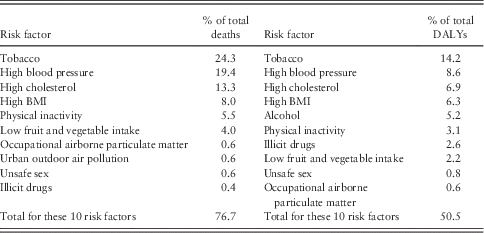
What richer countries used to call ‘diseases of affluence’ (Porter, Reference Porter2003), such as stroke, diabetes, cancer and heart disease, have become a global phenomenon. The incidence of diabetes alone has nearly doubled since 1980, rising from 4.7 to 8.5% in the adult population (WHO, 2016a). These diseases are caused by smoking, excessive alcohol consumption, over eating and lack of exercise. Are these private matters for individual autonomy in which the state has no business to interfere, or do public interests demand a community response? The question involves tensions between freedom and paternalism, liberty and equality, autonomy and citizenship which lie at the root of public health ethics. In the National Health Service (NHS), tobacco, physical inactivity, excess alcohol consumption and poor diet are estimated to account for around £9.4 billion in direct costs to the economy annually (Department of Health, 2010). The balance sheet of death and disability adjusted life years in the United Kingdom is explained in Table 1 (WHO, 2005).
Shares of total deaths and DALYs attributable to 10 leading risk factors.

Note: DALYs=disability adjusted life years; BMI=body mass index.
In addition, disease is distributed highly unevenly. Although aggregate standards of health continue to improve, health inequalities between rich and poor are increasing. Indeed, policies to reduce health inequality often benefit most those least in need of assistance. As the House of Commons Health Committee said in 2009:
Health in the UK is improving, but over the last ten years health inequalities between the social classes have widened – the gap has increased by 4% amongst men and by 11% amongst women… Inequalities have worsened not because the health of the poor is getting worse or even staying the same, but because the rate of gain amongst more advantaged groups (House of Commons, 2008–2009).Footnote 1
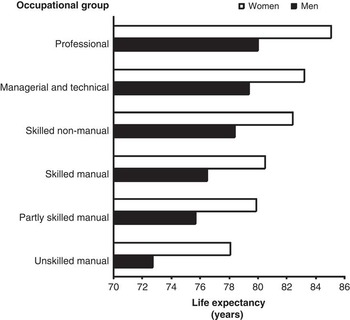
The disparities are described by the following graph (Organisation for Economic Co-operation and Development (OECD), 2009) (Figure 1).
Occupational group differences in life expectancy, England and Wales, 2002–2005

As in many industrialised countries, the most disadvantaged people in the United Kingdom suffer significantly higher levels of mortality and morbidity than wealthier people. “In the early 2000s, in England, people living in the poorest neighbourhoods could on average expect to die seven years earlier than people living in the richest neighbourhoods and spend far more of their lives with ill health” (National Audit Office, 2010–2011). If everyone’s health is getting better, does it matter if health inequality is getting worse (Mechanic, Reference Mechanic2010)? Rawls’ ‘difference principle’ appears to disregard considerable inequality so long as the worst off derive some benefit from the gains made by the wealthiest. “While many Rawlsians may hope and expect that the Difference Principle… will result in a decent minimum for the worst off, the achievement of that result is no part of its rationale” (Powers and Faden, Reference Powers and Faden2006: 31). Is this sufficient? Or do civilised societies have powerful interests in equality? We recognised the significance of the question in 1977 with the appointment of Sir Douglas Black to examine inequalities in health (Whitehead, Reference Whitehead1988), yet health disparities continue to widen (House of Commons, 2008–2009). In 2006, the European Charter on Counteracting Obesity (WHO, 2006) found, perhaps over-optimistically, that “[t]he obesity epidemic is reversible… Visible progress, especially relating to children and adolescents, should be achievable in most countries in the next 4–5 years and it should be possible to reverse the trend by 2015 at the latest”. Clearly, the problem has tenacious roots. Public information campaigns are helpful to some extent, but they benefit higher socio-economic groups most and are less effective in changing the behaviour of those for whom they are primarily intended (House of Commons, 2008–2009). Do these disparities reflect an autonomous right of people to live for today and disregard the future? Or does health inequality reflect a systemic inequity so that to compare ‘lifestyle’ with choosing a pair of flares or a striped shirt is wrong because health inequalities engage deeper issues of citizenship?
This is not just about bioethics; there is an economic imperative. The effects of vascular disease, including coronary heart disease, stroke, diabetes and kidney disease are linked by common risk factors such as obesity, physical inactivity, smoking, high blood pressure and glucose regulation. These currently burden over four million people in England with illness, cause 36% of deaths (170,000 a year in England) and are responsible for a fifth of all hospital admissions (House of Commons, 2008–2009).
In England, almost a quarter of adults and almost a sixth of children under the age of 11 are obese. It is predicted that by 2050, 60% of adult men, 50% of adult women and 25% of children may be obese… Around 58% of the incidences of type 2 diabetes, 21% of cases of heart disease and between 8% and 42% of cancers are attributable to excess body fat (NICE, 2011, 2).
Current investment in the NHS is about £120 billion. The government estimates that the costs of treating the various conditions arising from obesity will increase from £4.2 billion in 2007 to £9.7 billion by 2050 (imposing costs on the wider economy of £49.9 billion), during a period of time in which government income will not increase (Government Office for Science, 2013). The Office for Budget Responsibility forecasts that the economic consequences of our ageing population will render current patterns of public welfare spending ‘unsustainable’ as larger proportions of expenditure are required for age-related needs such as social care, pensions and health care. Assuming government revenues remain roughly stable as a share of national income, the additional demand for services will set public sector debt on an unmanageable upward trajectory (Office of Budget Responsibility, 2012: paras 48–50). Ethics aside, therefore, reasons of economics articulate the need to reduce the burden of chronic disease by investing in preventive care and health promotion. Yet, from the total invested in the NHS, we spend relatively little on public health.
Public health spending has doubled over the last seven years as a share of total health spending. It has increased to £4.7 billion (including pharmaceuticals but excluding secondary prevention) and £3.4 billion (excluding pharmaceuticals and secondary prevention), and the share of total health expenditure spent on public health and prevention in England had doubled over seven years to 3.6 per cent for 2006–07 (HMSO, 2009, Cm 7621: para 54).Footnote 2
Globally, it is estimated that the health care spending on diabetes more than tripled between 2003 and 2013, to around US $825 billion today (WHO, 2016a) and the upward trend is set to continue. The need for additional expenditure on health promotion and preventive care presents questions governments are loath to answer. For example, if expenditure on preventive health should expand, as a necessary investment in the future, will this require a commensurate contraction of resources for those with health care needs today? How should social and economic rights to equality of health interact with individual civil rights to be left alone? How should public policy regulate multinational producers whose commercial success depends so much on food and drink rich in sugar, salt and fat? And if we intend future generations of people to benefit from the health systems we enjoy today, what duties do we owe those yet to be born to preserve our current arrangements in a sustainable condition?
These questions do not attract much attention in health law and ethics. Medical ethics emphasises the rights of individuals in the doctor–patient relationship. Less attention is given to the institutional implications of public health ethics for freedom, or the need to reduce ‘avoidable’ diseases which disproportionately affect the lives of poorer people. As Daniels comments (Daniels, Reference Daniels2008: 81), “unfortunately… these questions have been almost totally ignored within the field of bioethics, as well as within ethics and political philosophy generally”.
Bioethics has been quick to focus on exotic new medical technologies and how they might affect our lives. It has paid considerable attention to the doctor-patient relationship and how changes in the health system affect it. With some significant exceptions, it has not looked ‘upstream’ from the point of view of the delivery of medical services to the role of the health care system in delivering improved population health. It has even more rarely looked further upstream to social arrangements that determine the health achievement of societies (Daniels et al., Reference Daniels, Kennedy and Kawachi2006: 64).
And as Martin and Coker observe: “Few health law programs have ventured into the obscure and unbounded terrain of public health law because of difficulties of knowing where to start, what to include, and what constitutes the essence of public health law” (Martin and Coker, Reference Martin and Coker2006: 81). Instead, bioethics has been overwhelmed by the individualistic priorities of medical ethics, i.e. medical negligence, informed consent and confidentiality (Dawson, Reference Dawson2010). This is fine so far as it goes – there is much merit in distinguishing the relative rights and duties of doctors and patients. But it goes nowhere near far enough. It ignores the concept of ‘public’ health ethics which describes a relationship between the individual and the state (Coggon, Reference Coggon2012) and a normative duty to promote health equality (Deaton, Reference Deaton2007; Dawson and Verweij, 2009). As the Marmot Review says:
Health inequalities are a matter of social justice… Inequalities are a matter of life and death, of health and sickness, of well-being and misery. The fact that in England today people from different socio-economic groups experience avoidable differences in health, well-being and length of life is, quite simply, unfair and unacceptable… (Marmot Review, 2010).
Discouraged, perhaps, by bioethics’ hesitancy in this field, governments struggle to respond to this challenge. What are the obstacles confronting a coherent response to the needs of public health today? When does government have a legitimate interest in my lifestyle? Should my freedom today ever be regulated to protect my autonomy tomorrow? How can individual rights be balanced with the public interest in a public health care system? With these questions in mind, we consider liberty and individual responsibility (Section 2), autonomy in community (Section 3), (Section 4) democratic autonomy and international commerce and (Section 5) communitarian autonomy and public health ethics. I argue that autonomy should embrace the wider social, political and commercial contexts in which people flourish and have regard to both the future interests of individuals themselves and the needs of the community as a whole.
2 Liberty and individual responsibility
Contemporary medical ethics, with its roots in the paradigm of liberal individualism, understand law’s primary purpose to be the promotion individual autonomy and minimal interference with self-determination. Government’s role is to facilitate, not interfere. Policies which restrict individual liberty are naturally subordinate to those which promote the right to be let alone. An ‘ideal type’ of autonomy is described by Isaiah Berlin when he says:
I wish my life and decision to depend on myself, not external forces of whatever kind. I wish to be the instrument of my own, not of other men’s acts of will. I wish to be subject, not object; to be moved by reasons, by conscious purposes, which are my own, not by causes which affect me, as it were, from outside… (Berlin, Reference Berlin1969: 123).
Echoeing J. S. Mill’s ‘harm’ principle, this emphasises a negative right, that the state has no business ‘nannying’ competent adults about their health and well-being. Autonomy respects agency, our capacity for control and our right to govern our destiny, free from paternalistic restraint. A modification of this approach, conceding the need for state ‘paternalism’ in a limited range of circumstances, supports government intervention when it addresses a failure of judgement by an individual in a way that furthers the individual’s own good (Le Grand and New, Reference Le Grand and New2016). On this basis, a case is made for restricting the right to smoke and to encourage investment in a pension, but there is clear hesitancy to take the matter further. Autonomy in this guise might accept that inequality often damages people’s health. Equally, however, it may also argue that, unless incompetent, individuals remain responsible for the consequences of their actions. Respect for capacity brings responsibility for untoward outcomes. If poor health status results from autonomous decision-making, then we may disentitle ourselves from the same rights of access to public health care as others; it would be pernicious to infantilise people by pretending they are not responsible for the consequences of their actions. Social policy, it may be argued, should educate and inform (such as by warnings on cigarettes and alcohol), but it should respect autonomy and the rights of individuals to decide for themselves how they live, the quality and, perhaps, the length of their lives. To do otherwise would permit doctors to assume disproportionate and unwarranted power over personal choices, which have nothing to do with clinicians (Epstein, Reference Epstein2004).
Support for this view, that those who suffer from diseases caused by their own ‘lifestyle’ should be responsible for their consequences, is available from Ronald Dworkin who distinguishes between ‘luck’ and ‘option’ egalitarianism, i.e. between diseases arising through ‘brute’ bad luck, and those caused by personal choices, or options. If we choose to act in ways that cause illness, individual rights to publicly funded welfare should be affected (Dworkin, Reference Dworkin2000). People should bear the consequences of the choices they make. The NHS Constitution adds further credibility when it states that “You should recognise that you can make a significant contribution to your own, and your family’s, good health and well-being, and take some personal responsibility for it” (NHS Constitution, 2015). Such an approach might seek to distinguish between, for example, the illnesses caused by congenital conditions such as asthma, type 1 diabetes and depression; and those that arise from lifestyle or personal behaviour, such as type 2 diabetes caused by obesity, lung cancer caused by smoking and cardiovascular disease caused by diet and lack of exercise (except, of course, that attributing exact cause in each is often impossible). Following Ronald Dworkin, whilst the first is a public responsibility, the latter may transfer as a private matter to individuals to resolve. In respect of ‘option’ diseases, perhaps ‘higher-risk’ patients should purchase additional health insurance, pay more for goods and services or suffer public shame (Singer, Reference Singer2015). Perhaps welfare benefits should be withdrawn for failure to accept treatment for drug or alcohol dependency (Hardin, Reference Hardin1993; Home Office, 2010), or access to health care could be restricted to those who achieve specific clinical preconditions for treatment (e.g. in respect of their weight, or cholesterol levels) (BBC, 2016). For example, West Virginia in the United States makes health care entitlements dependent on patients achieving specific clinical objectives (Patrick, Reference Patrick2008). Social welfare could be made dependent on ‘contractual’ agreements with individuals so as to focus public resources upon those who act responsibly by working hard to “re-enter society and… become useful, autonomous, and self-reliant…” (Veitch, Reference Veitch2011: 198, balancing this ‘exclusionary’ view of citizenship, with a more ‘inclusive’ vision promoting equality as a goal in itself). So too, the Welfare Reform Act 2007 may make Jobseekers Allowance conditional upon gaining work experience with employers, or working pro bono for community projects (Brown, Reference Brown2009).Footnote 3
But this ‘atomistic’ view, which demonises needy individuals, has severe limitations. Berlin was responding to the politics of intolerance and hostility of the Cold War; he was not making a plea for anarchy. As he explained, it is profoundly mistaken to pretend that autonomy permits people freedom to fulfil their lives without constraints: “the very concept of an ideal life, a life in which nothing of value need ever be lost or sacrificed, in which all rational… wishes must be capable of being truly satisfied… is not merely utopian, but incoherent. The need to choose, to sacrifice some ultimate values to others, turns out to be a permanent characteristic of the human predicament”. To promise autonomy, therefore, as if it is a ‘frictionless medium’ which lubricates human flourishing is “to dehumanize men, to turn them into the brainwashed, contented beings of Aldous Huxley’s celebrated totalitarian nightmare”. People must adjust between multiple choices both to accommodate their own aspirations in life and the legitimate needs of others.
[F]reedom is not the only value that can or should determine behavior… the issue is not one between negative freedom as an absolute value and other, inferior, values. It is far more complex and painful. One freedom may abort another; one freedom may obstruct or fail to create the conditions which make other freedoms, or a larger degree of freedom, of freedom for more persons, possible… But beyond all these there is an acuter issue: the paramount need to satisfy the claims of other, no less ultimate values: justice, happiness, love, the realization of capacities to create new things and experiences and ideas, the discovery of truth (Berlin, 1969: li–lvi).
This concedes the need for compromise amongst a range competing, yet incompatible legitimate demands. For example, we do not have unrestricted autonomy over our private wealth because it may be taxed to support publicly funded health care, education and transport services. We may not build on our private land because planning restrictions benefit everyone. We regulate our environment and health and safety, we protect employees from exploitative employers, tenants from exploitative landlords and consumers from exploitative contracts. By endorsing interventions of these kinds, Berlin rejected the notion that he was undermining government. His support for social and economic rights was based on “the ideal of social solidarity; the need to provide for the bodies and minds of as many humans as possible, and not only of members of a privileged class” (Berlin, 1969: liv). As Gray rightly observes, therefore “[a]utonomy is not a good that can be accorded priority over other values… Just as there are incompatible negative liberties, so there are rival autonomies” (Gray, Reference Gray2000).
3 Autonomy in community
In any case, the view of autonomy that seeks to maximise the moral force of individual volition by minimising the state’s responsibilities for equality, assumes a great deal about ‘free will’ that might be contested by psychologists (e.g. Freud and Marcuse), economists (e.g. Marx and Hayek) and political theorists (e.g. Hobbes and Rousseau) (Muller, Reference Muller2002). In truth, as Gerald Dworkin explains, the notion of autonomy is so elastic that it comfortably accommodates a wide range of differing relationships between the individual and society:
It is used sometimes as an equivalent of liberty (positive and negative in Berlin’s terminology), sometimes as equivalent to self-rule or sovereignty, sometimes as identical with freedom of the will. It is equated with dignity, integrity, individuality, independence, responsibility, and self-knowledge. It is identified with qualities of self-assertion, with critical reflection, with freedom from obligation, with absence of external causation, with knowledge of one’s own interests… About the only features held constant from one to another are that autonomy is a feature of persons and that it is a desirable quality to have (Dworkin, Reference Dworkin1988: 6 Le Grand and New, Reference Le Grand and New2016, categorising paternalism).
Whichever conception one prefers, individualistic claims for autonomy are unsatisfactory if they ‘decontextualise’ people from the community in which they live by removing their interest in society (McLean, Reference McLean2010). To explain autonomy in terms of ‘laissez-faire individualism’ wrongly judges personal responsibility in terms of the “unsituated and demonic character of classical rationality” (Hurley, Reference Hurley2011: 202). More helpful is the idea of ‘ecological rationality’ which recognises the exogenous forces that influence personal decision-making. It acknowledges how our environment shapes our behaviour, the heuristics and biases that bear on individual cognition and the various ‘nudges’ that influence rational choices. “Traditional liberalism tends to view government as the primary source of interference… Ecological liberalism should instead view government as having a counter-manipulative and positive role in the public ecology of responsibility” (Hurley, Reference Hurley2011: 209). Behavioural psychology might regard bioethics’ tendency to prioritise autonomy as an example of an analytical ‘framing’ of a concept in a way that nudges responses towards the ends it seeks to achieve (Kahneman, Reference Kahneman2011). To regard behaviour which arises from unconscious influences to be a strong expression of personal autonomy is absurd. Behaviour is heavily shaped by the habits of family and friends (Mulvaney-Day and Womack, Reference Mulvaney-Day and Womack2009). As the Marmot Review found:
health inequalities do not arise by chance, and they cannot be attributed simply to genetic makeup, ‘bad’ behaviour, or difficulties in access to medical care, important as these factors may be. Social and economic differences in health status reflect, and are caused by, social and economic inequalities in society… (Marmot Review, 2010).
Research published by the UK Cabinet Office supports precisely this analysis. Autonomy is not an especially persuasive explanation for the choices we make. By contrast, “[b]ehavioural approaches embody a line of thinking that moves from the idea of an autonomous individual making rational decisions to a ‘situated’ decision-maker, much of whose behaviour is automatic and influenced by their ‘choice environment’… What we eat, where we go, what we do – most of us are creatures of habit and, in a very general sense, the environment that we live in” (Dolan et al., Reference Dolan, Hallsworth, King and Vlav2010: 73). Penalising individuals within the luck/option dichotomy will often wrongly blame as ‘optional’, decisions which are predominantly caused by our situation and surroundings (Kahneman et al., Reference Kahneman, Slovic and Twersky1982). Autonomy is mistaken, therefore, if it assumes that the opportunities offered in life are equally available to everyone because health achievement is a good proxy measure of our capacity to choose our lifestyle; “smoking and other addictive behaviour can also be seen in terms of a generated ‘unfreedom’ to conquer the habit” (Sen, Reference Sen2006: 23).
More persuasive, therefore, are notions of principled autonomy which describe autonomy within a community of values on which we could all think and act: “Autonomy in thinking… is to conduct thinking… on principles on which all others… could also conduct their thinking. Autonomy in action is… to act on principles on which all others could act” (O’Neill, Reference O’Neill2002: 94). This could discount as autonomous, actions ‘all others’ would have to reject for contradicting their own rights and interests. Brazier agrees: “[u]nfettered, non-reflective choice, the satisfaction of preferences, is not, within such definitions, the essence of autonomy. Self-mastery and self-control entail the requirement at least to consider self-sacrifice. Responsibility for ‘free’ choices demands consideration of how those choices affect others” (Brazier, Reference Brazier2006: 400–401). Precisely this interpretation has been given to Mill’s defence of liberty (Powers, 2012) which Gostin develops as an argument for an ethics of ‘hard paternalism’ (Gostin and Gostin, Reference Gostin and Gostin2009). Autonomy in this political and relational sense expresses values of citizenship and reciprocity in the long term, which recognises the need for balance and compromise between incompatible claims. This lies at the heart of Sandell’s critique of Rawls’ individualistic, ‘veil of ignorance’ approach to justice (Sandell, Reference Sandell1998), i.e. that it is based on an untenable fiction of individuals agreeing about the benefits of living in ‘communities’ led by ‘governments’, about which, by definition, they can have little imagination. Ideas of freedom and ‘individuality’ only make sense in the context of ‘society’. Autonomy should also be interested in the position of disadvantaged communities and their capacity for self-determination. The focus is not simply ‘negative’, civil rights of freedom from interference, but on social and economic rights to equality and distributive justice as the source of flourishing communities.
The argument is not that individuals can have no responsibility for ‘lifestyle’, but other factors such as biological, cultural, psychological and environmental also play a significant role. For example, the luck/option theory would have to acknowledge the impact of environment on health status and discount from our responsibility for ‘option illness’ the brute bad luck arising from (say) discrimination from disability, age, race or sex (Nielsen et al., Reference Nielsen, Landes and Andersen2013). In reality, a fair and consistent process for conducting such an exercise would surely be implausible, because ‘bad luck’ and ‘option’ lie at the opposite extremes of a highly complex spectrum of causal interactions about which objective measurement is impossible (Schmidt, Reference Schmidt2009). Consider a woman addicted to glue vapour. She has three children all of whom have been taken into care. Two of them have suffered brain damage in utero caused by her addiction. She is expecting a fourth child but continues to inhale glue. There is concern that she will be likely to conceive further children and continue to expose herself and her children to serious risk. Should respect for ‘autonomy’ require us to refrain from interfering with her liberty to act in this way and to disregard the circumstances of her life, the interests of her children and her own, natural maternal concern?Footnote 4 A similar problem arose in Condliff v North Staffordshire PCT [2011]. The claimant suffered diabetes. He had a fear of needles which, over many years, had made it difficult to take insulin to control his condition. He developed a gross appetite, was unable to control his diet and became obese with a body mass index (BMI) of over 40 kg/m2. He became immobile and depressed. He suffered incontinence, but could not shower or dress himself and imposed stress on his wife on whom he was reliant for so much. He applied to the NHS for surgery to reduce the size of his stomach.Footnote 5 Had respect for Mr Condliff’s autonomy encouraged a state of personal dependency?
Does the ‘luck/option’ distinction assist us to understand Mr Condliff’s rights? Did his circumstances arise from his autonomous ‘option’, or his bad luck; was it chance or choice; genetic predisposition or personal volition? If each explanation plays a role, how should one be set off against the other? Or was his condition “the result of people responding normally to the obesogenic environments they find themselves in” (Swinburn et al., Reference Swinburn, Sacks, Hall, McPherson, Finegood, Moodie and Gortmaker2011)? The luck/option distinction succeeds in imposing a disproportionate burden on individuals only by disregarding the external influences of the social determinants of health. How would the luck/option distinction apply to people whose heart disease or Alzheimer’s disease in retirement was caused by their poor diet in childhood (Steen et al., Reference Steen, Terry, Rivera, Cannon, Neeley, Taveres and de la Monte2005; Friedman et al., Reference Friedman2012)? In any case, penalising individuals for ‘option’ illness may be morally repugnant for lacking in human compassion. “Most people do not insist, as a general matter, that someone who makes a bad decision thereby forfeits all claims to assistance… Such a policy would strike us as harsh, unforgiving, insensitive to context, and unduly moralistic” (Scheffler, Reference Scheffler2005): 15 2008, NICE’s Citizens’ Council broadly agreed that “NICE should not take into consideration whether or not a particular condition was self-induced. It was often impossible in an individual, to decide whether the condition was dependent on their own behaviour or not; and receiving NHS care should not depend on whether people ‘deserved’ it or not”. Gerald Dworkin also supports this view by arguing that the burdens of autonomy cannot be determined simply by focusing on the decision of single individuals at a single point in time. Instead, we should take a broader ‘lifetime’ view of autonomy by distinguishing between first-order (i.e. immediate) and second-order (longer-term) desires. He says:
To consider only the promotion or hindrance of first-order desires… is to ignore a crucial feature of persons, their ability to reflect upon and adopt attitudes toward their first order intentions… One may not just desire to smoke, but also desire that one may not have that desire… [Autonomy] evaluates a whole way of living one’s life and can only be assessed over extended portions of a person’s life… By exercising such a capacity, persons define their nature, give meaning and coherence to their lives, and take responsibility for the kind of person they are (Dworkin, Reference Dworkin1988: 15–20).
Clearly, this account of autonomy offers different responses to the cases discussed above. Rather than cloak the choices I happen to make today with dubious ethical significance, autonomy should perform a more profound role by adopting an ‘ecological’ approach to individuals in society by accommodating our needs and aspirations for tomorrow, including, perhaps, to health, happiness and security.
4 Democratic autonomy and international commerce
Does the allure of autonomy rest solely upon its ethical appeal, or are deeper forces at work inhibiting more systematic responses to concerns about inequality and opportunity? Put differently, how should autonomy respond to the systemic, global forces which exacerbate inequality and the prevalence of disease (Marmot Review, 2010; Picketty, Reference Picketty2014; Atkinson, Reference Atkinson2015)? During most of the 20th century, developed nations reduced social and economic inequality by investing in social welfare services too important to be left to private interests to provide. It was during this period, with the growth of concepts of public goods and services, that social and economic inequality was most significantly reduced (Polanyi, Reference Polanyi1957). After the mid 1990s, however, a strong belief developed that markets are best at promoting public interests. Competition between private interests, it was said, would naturally drive quality up and prices down – to the benefit of the public interest. Public corporations, it was said, cannot achieve this because they are more likely to be undermined by the ‘knavish’ self-interest of public servants (Le Grand, Reference Le Grand2006). Much better to have private investment where producers compete for the most efficient ways to respond to public demand. Ideally, therefore, the state should promote free markets and play a minimal supervisory role. Governments can ‘nudge’, but they should not directly presume to change individual behaviour (Thaler and Sunstein, Reference Thaler and Sunstein2009).
Milton Freidman expected the public to benefit from private competition (Friedman, Reference Friedman1970) as did Hayek who feared that “the prevailing belief in ‘social justice’ is at present probably the gravest threat to most other values of a free civilisation” (Hayek, Reference Hayek1976): 66–7 describes the confidence in private incentive as the most reliable servant of public interest. But this light-touch approach to market regulation has not traced the trajectory expected of it. The global financial crisis since 2007 demonstrates why private interests are not always trustworthy. On the contrary, the process creates its own, still more powerful and predatory ‘knaves’. As Stiglitz observes, “privatization gives rise to an unhealthy dynamic: the monopolist uses its profits to buy political influence, which extends and enhances its market power. Privatization can thus result in increased corruption in addition to a less competitive and overall less efficient economy” (Stiglitz, Reference Stiglitz2016: 194). By 2015, for example, fines for misconduct imposed on the banking sector exceeded $235 billion (International Business Times, 2015). Deregulated markets erode national political authority, widen social and economic inequality, and worsen standards of public health (Rodrik, Reference Rodrik2011; Stiglitz, Reference Stiglitz2013). The state’s power to redistribute wealth through welfare diminishes as does the proportion of employees’ wages relative to the employers’ overall income (Atkinson, Reference Atkinson2015; OECD, 2015). The consequence is not more autonomy, but greater economic and welfare dependency.
We have noted the correlation between social inequality and disease. The speed and spread of non-communicable diseases is described as a ‘neoliberal epidemic’ (Shrecker, Reference Shrecker2016; Shrecker and Bambra, Reference Shrecker and Bambra2016). Today, problems of global access to nutritious food are no longer about famine. They concern the costs of obesity upon individuals and governments (McKeon, Reference McKeon2015; NCD Risk Factor Collaboration, 2016; WHO, 2016a, 2016b), especially in poor and disadvantaged populations (WHO, 2008). Yet, this ‘night-watchman’ view of the state, implicitly endorsed by the classical narrative of autonomy, distances government from its citizens, diverts attention from the root causes of inequality and blames individuals when things go wrong. Young and under employed citizens of Southern Europe may say it has nothing to do with ethics or democracy. As states’ capacity to raise taxation falters – as the ‘tax state’ is replaced by the ‘debt state’ – government priorities adjust themselves to reassure international bondholders of their priority as the principal stakeholders in national wealth; or as Streek puts it, that marktvolk take priority over staatsvolk (Streek, Reference Streek2014). In this way, the state’s capacity to protect social welfare is subordinated to the need to promote corporate well-being (Mazzucato, Reference Mazzucato2013).
Democratic autonomy is further eroded by international economic law which restricts governments’ discretion to regulate the trade and investment of multinational corporate interests. Concern is expressed, for example, about pharmaceutical companies’ resistance to supply developing nations with medicines at affordable prices; destabilising speculation on the global food markets; and corporate resistance to measures to reduce consumption of tobacco, alcohol, sugar, fat and salt (Pogge et al., Reference Pogge, Rimmer and Rubenstein2010; McGrady, Reference McGrady2011). Oil and gas producers defend their pollution of the Amazonian rainforest. Mining investors in South Africa have been compensated following the Black Economic Empowerment Act 2003 for diminished profits. Although these disputes involve tension between public and private interests, they are often not heard in public courts. Instead, they may be referred to private arbitrators who comprehend the ‘private’ dimension of disputes, but are less familiar with the notion of public interest and the duties of government. As the European Commission complains: “… arbitral tribunals, in interpreting the investment agreements, have only considered the objective of protecting the economic interests of the investors and have not balanced it against the sovereign right of States to legislate in the public interest” (European Commission, 2015). Rules of precedent do not apply to promote consistency and cases determined in public courts against private investors may be appealed to private arbitrators for a different decision, from which there may be no right of appeal.Footnote 6 Doubt is expressed as to the capacity of private arbitrators to recognise and promote fundamental public interests (Kulick, Reference Kulick2012; Van Harten, Reference Van Harten2013). In this environment of trade and investment law too, therefore, systems which properly balance corporate and democratic authority are failing.
Globalisation requires a more far-reaching response to the governance of public interests. Little has been said about the idea of ‘corporate autonomy’ which permits transnational corporations so much freedom to promote their private interest indifferent to its impact on public interests. The UN’s Sustainable Development Goals contemplate considerable redistribution of global wealth and opportunity and a very different approach to the capacity of transnational corporations to promote their commercial interests in isolation from everything else. This suggests that rights of autonomy cannot be confined simply to the here and now without regard for the future. Autonomy needs an intergenerational component embracing the needs of those that follow us to enjoy sustainable lives, free from extreme hardship. This has implications for the ‘others’ to whom autonomy must have regard,Footnote 7 especially in respect of non-communicable diseases, the environment and biodiversity. The scale of corporate resistance to this profound public interest is illuminated in BAT, Philip Morris, JT, Gallagher and Imperial Tobacco v Secretary of State [2016] EWHC 1169, in which tobacco manufacturers challenged the UK government’s right to discourage cigarette smoking by regulating the markings on cigarette packaging. The manufacturers argued that the regulations were unlawful for restricting their right to exploit their intellectual property in trademarks. Green J summarised the nature of this claim as follows:
These arguments operate upon the premise that a trade mark proprietor cannot be prevented from using a trade mark at all even when it facilitates a health epidemic [40]… At base this point boils down to the correctness of the Claimants’ proposition that the essence or substance of their trademarks allows them to facilitate a health epidemic… and that since they are prevented from using their property rights to do this by the Regulations those measures are unlawful… [837].
Although the proposition was comprehensively rejected by the (public) court, the manufacturers announced their intention to appeal the decision and to private, World Trade Organisation arbitration (BAT, 2016). BAT articulates the version of autonomy, rejected by Isaiah Berlin, which claims private rights against public interests and challenges the democratic authority of governments to interfere. Similar resistance may be anticipated from the global food producers to the recommendations of the WHO that food and drink rich in fats, salts and sugar should be taxed at higher rates; that fresh fruit and vegetables should be subsidised; for greater engagement of government promoting healthier diets and physical activity (WHO, 2016b); and to ‘food sovereignty’ policies to promote local farming employment, improved nutrition and national democratic authority (McKeon, Reference McKeon2015). The UN Conference on Trade and Development recognises the need to modify the balance of power in global commerce and for better standards of corporate social responsibility. Equally, it expects resistance from both corporations and governments themselves, ‘racing to the bottom’ to create a corporate-friendly environment to entice large employers to move business onshore (UNCTAD, 2015).Footnote 8 The invisible hand of neoliberalism, with its emphasis on corporate autonomy, small government, low taxation and limited social welfare, obstructs the democratic capacity to promote equality.
5 Communitarian autonomy and public health ethics
Autonomy presented as a strong expression of individual rights has the allure of analytical clarity, but its attraction camouflages much that is hidden. Current conceptions of autonomy are troubled by asserting a positive role for health policy to change behaviour. As the statistics on non-communicable diseases testify, efforts to reduce health inequality over the past 40 years have failed. Bruce Jennings comments that:
… the culture of autonomy has created a strange chimera as its ideal: a freestanding individual for whom privacy and autonomy are sacred virtues, independent of his community, with almost unbridled authority over his actions and with no responsibility for its consequences. It has created a society of rights without duties or obligations; of authority without responsibility (Gaylin and Jennings, Reference Gaylin and Jennings2003: 203).
But it is not simply that personal autonomy encourages individuals to disregard society. The argument above is that corporate autonomy distances government from its responsibility to its citizens. Market fundamentalism challenges the capacity of national politics to regulate corporate interests and instead imposes the burden of responsibility upon individuals. By contrast, a communitarian response asks “what kind of community we want to live in and uses this, rather than individual welfare exclusively, as guidance in determining social policy” (Bayer et al., Reference Bayer, Gostin, Jennings and Steinbock2007: 20). Necessarily, the focus on community interests emphasises equality (alongside liberty) and government’s responsibility for ‘positive’, welfare rights (alongside negative ones), including an equal right to good health. Here, the starting point is not an autonomous individual behind a veil of ignorance, or a corporate entity promoting its own private interests, but with the civic responsibility of government. To Berlin’s two concepts of liberty, Jennings proposes a third civic freedom:
The third freedom (freedom through) is a warrant to live one’s life in one’s own way that results from embedding that way of life in a tradition, a civic life of shared purpose, and rooting that life in membership of a broader community. Just as there are kinds of practice or activity that by their very nature cannot be done alone, so there is a kind of freedom that subsists not in separation from others but through connection with them (Jennings, Reference Jennings2009: 130).
This helps too, provided the civic tradition embraces corporate responsibilities to foster analogous goals of equality and social cohesion. Some may say that government should get out of the way of market forces and community values (see generally Holland, Reference Holland2007). After all, who will set these ‘shared purposes’ and where is the balance between legitimate regulation and the freedom to be let alone (Herring, Reference Herring2016)? Certainly these are difficult questions, but if we concede that autonomy and paternalism co-exist on a spectrum which embraces broader political values, we may be content to give public interests greater prominence in promoting health and equality in the same way as we regulate trade, taxation and town planning (Wilkinson and Pickett, Reference Wilkinson and Pickett2010; Wilson, Reference Wilson2011).
This is where the tidiness of abstract theory ceases to assist the search for plausible solutions. How should public health policy-makers proceed when we move from the negative rights to be free from unwanted interference towards positive rights of equality and distributive justice? For example, when may policy to promote public health in the long-term impinge on my ‘lifestyle’ choices today, or restrict the rights of corporate interests to engage in ‘free’ trade? Sen usefully assists this debate by distinguishing two mechanisms for theorising about justice based on ‘ideal’ and ‘non-ideal’ approaches to theory. The first concerns models based on abstract, ideal theories founded on fundamental values, which he calls ‘transcendental institutionalism’ (Sen, Reference Sen2009: 5–12). In this camp, Sen places, for example, Hobbes, Rousseau, Locke, Kant, Rawls and Ronald Dworkin. Ideological adherence to neoliberal economics is a further example (see Rodrik, Reference Rodrik2011; Stiglitz, Reference Stiglitz2013; Kay, Reference Kay2015) of “abstraction away [ie] a technique in argumentation that ‘purifies’ thought by eradicating supposedly irrelevant, mundane, or trivial conceptual features to allow for clearer analysis” (Coggon, Reference Coggon2012: 210).
Autonomy presented in its decontextualised form enables ‘purists’ to marginalise the consequences of neoliberal economic policy for ordinary people in terms of unemployment, homelessness and economic dependency. And it encourages indifference to other aspects of civilised life such as dignity, equality and community. This creates an artificial normative framework better suited to “government within some alien place, reflective only of an incomplete picture of the important aspects of the society we live in” (Coggon, Reference Coggon2012: 213). Schneider calls this ‘hyper-rationalism’, in which facts are inferred without reliable supporting evidence and then interpreted within a synthetic analytical framework. This, he argues, characterises our analysis of autonomy in which we “discuss human behaviour without studying how people actually behave. It is the conceptualist’s revenge for the world’s complexity” (Schneider, Reference Schneider1998: xv). Sen, therefore, prefers to start from the world in which we live and to improve what we have today. He focuses on “actual realizations and accomplishments… including the kind of lives that people can actually lead…” (Sen, Reference Sen2009: 10). Amongst the ‘non-idealists’ Sen includes Adam Smith, Condorcet, Bentham, Marx and Mill. In place of theories based on abstract values, Sen favours practical choices and a framework for comparing actual outcomes which can accommodate ideas of ‘ecological rationality’, discussed above. The starting point is not the abstract, but the range of policy challenges, opportunities and limitations presented now. Powers and Faden make this point in respect of health inequalities, i.e. that health policy should be made by reference to actual institutions, social practices and their impact on different people and groups. In this ‘non-ideal’ theory, a fuller engagement with the human condition is crucial (Powers and Faden, Reference Powers and Faden2006). Communitarian ideas identify most closely with this approach in which non-ideal, consequentialist and practicable solutions work together with the limitations of politics and public institutions.
Public health ‘ethics’ are a good example of ‘non-ideal’ theory. Non-ideal reasoning is better equipped to accommodate the sometimes competing ‘ideals’ such as liberty and equality, autonomy and community, and public and private interests. For example, policy interventions aimed at individual behaviour range from passively monitoring current trends, to providing information and advice (i.e. on smoking and drinking), enabling and then guiding choice (e.g. in cigarette packaging), using tax incentives and disincentives to modify behaviour and ultimately of restricting and then eliminating choice (Nuffield Council on Bioethics, 2007: xix). Crucially, however, an over-emphasis on individual responsibility under-values the social and commercial determinants of inequality and dependency. Instead of starting with the individual, Daniels argues that community has the primary duty because “our social responsibilities to promote and protect health have priority over our individual responsibilities… We can and should specify what we owe each other… independently of assessing the consequences of individual choices that affect our health” (Daniels, Reference Daniels2011: 279). The point of reappraising autonomy is not to impose the burden of non-communicable diseases upon those least able to shoulder it. It is to encourage the development of systems of governance, nationally and internationally, to promote equality of people’s capabilities (Sen, Reference Sen2009). For example, if paternalism is to limit public policy to merely ‘nudging’ us towards healthier lives, it should be equally concerned to engage with the private, commercial forces nudging us towards ill health (Dolan et al., Reference Dolan, Hallsworth, King and Vlav2010). Accepting behavourial psychologists’ findings that we are constantly nudged from all directions, the question is not simply how governments should behave, it is which ‘nanny’ do we prefer – publicly accountable government or self-interested private corporations? Yet, by permitting the ‘nanny industry’ to dominate the debate, we impose vast personal and social cost on the community (Moore et al., Reference Moore, Yeatman and Davey2015).
The starting point, therefore, is not an abstract ethical principle; it is an acceptable balance of competing outcomes and aspirations. Suggestions for improving equality and a proper balance between public and private interests are wide-ranging. They include regional measures to reduce tax avoidance, increased wealth redistribution, Torbin taxes on asset transfers, social responsibilities of company directors, employees on company boards, international regulation of financial services, a Social Progress Index to replace GDP as a measure of national prosperity, restoration of trade union bargaining rights, public investment in capital projects, jurisdiction over global corporations and minimum standards of public services (see e.g. Sachs, Reference Sachs2011; Ruggie, Reference Ruggie2013; Atkinson, Reference Atkinson2015; Kay, Reference Kay2015; Stiglitz, Reference Stiglitz2016). The point is not to prefer some over others, but to ascertain the public goods and services that enable the common wealth to promote the common benefit – to rebalance the relationship between staatsvolk and marktvolk. Heller refers to the challenge as the “the tragedy of the anticommons”, in which property (tangible and intangible) is enclosed from public ownership and then misused by its private owners to expand inequality and disadvantage (Heller, in Bollier and Helfrich, Reference Bollier and Helfrich2013).Footnote 9 Whether national politics is capable of responding to this economic challenge is disputed. On the one hand, Picketty believes that “if we are to regain control of capitalism, we must bet everything on democracy…” (Picketty, Reference Picketty2014: 573). On the other, Rodrik doubts that democracy, nation states and global markets are capable of coexistence (Rodrik, Reference Rodrik2011). Traditional notions of liberal autonomy, which quietly nudge so many assumptions in this debate, hinder efforts at a solution.
Perhaps we are beginning to review bioethics’ fascination with the neoliberal paradigm of individualised autonomy where anxieties about the tyranny of medicine (Fitzpatrick, Reference Fitzpatrick2005) blind it to the tyranny of individualism (Shiell and Hawe, Reference Shiell and Hawe1996). Even the IMF is discussing whether neoliberalism has been ‘oversold’ (IMF, 2016) and the World Bank is concerned about “inequality and shared prosperity” (World Bank, 2016). Policy-makers may be encouraged that “bold moves by government that go against the grain of public opinion have been successful, not just in terms of affecting the behaviour, but also in shifting public opinion” (e.g. smoking bans) (Ipsos/MORI, 2012). Equally, while government acquiesces that it should “equip the citizen with an armoury of techniques to resist the influences that swirl around them” (Dolan et al., Reference Dolan, Hallsworth, King and Vlav2010: 73), multinational manufacturers, including agricultural, retailing and pharmaceutical interests, together with anxiety about ‘food fascism’ and ‘nannying’ the public, hold the focus of responsibility firmly on individual behaviour to stifle more systemic responses (Marmot, Reference Marmot2015). An ideological preference for free markets and small government has ‘captured’ debate in a way that is widening inequality, weakening democracy and damaging the health of billions of people (Stiglitz, Reference Stiglitz2013: Ch. 9; Kay, Reference Kay2015: Ch. 8). WHO’s estimates of the future expansion of the chronic diseases caused by obesity demonstrate how autonomy in its purified form is attractive only by ignoring its implications for economic and welfare dependency. A perfectly plausible, if contested, principle of bioethics has failed to differentiate itself from a partisan theory of politics which, itself, has become dominated by neoliberal approaches to economics. Some compare regulators’ inactivity in this field to ‘the rebirth of social Darwinism’ (Reich, Reference Reich2012: 70-104). Autonomy cannot be isolated from other important ethical values or the public interest. Non-ideal theory urges a practical and political view of what is feasible now and over time, without undue distortion by abstract ideologies which disempower governments and benefit the few. Without a paradigm shift in global responses to health inequality, the escalating costs of non-communicable disease will continue to blight the lives of increasing numbers of people and render public welfare systems unsustainable.
Acknowledgements
With the usual disclaimer, the author thanks Professors Richard Ashcroft, Margot Brazier and John Coggon, Dr Amanda Warren-Jones and his colleague Dr Stuart Lakin, for their helpful comments on earlier drafts of this article.