



Anthropogenic climate change and the interconnected environmental crises of pollution and biodiversity loss present an unprecedented threat to human health. 1 In addition to effects on physical health, there is mounting evidence demonstrating its effects on mental health. 2,Reference Romanello, Di Napoli, Drummond, Green, Kennard and Lampard3
Throughout the world, climate change policies have not yet explicitly included mental health concerns within their remit, but the need to do so is becoming increasingly apparent. Reference Mechelli, Viding, Fearon, McCrory, Patalay and Creswell4 At the same time, there is growing recognition of the relevance of a human rights framework to clinical and medico-legal matters in mental health. This is particularly so for disadvantaged groups such as minoritised ethnic groups, migrants, people from socioeconomically marginal communities, those with pre-existing mental illness and those vulnerable based on their gender and/or sexual orientation. For these groups, identities and systematic oppression form the context in which they experience mental ill health. 5
In this paper, we highlight the increasing consideration of climate change issues through rights-based legislation and jurisprudence in international organisations and courts. We explore how a new normative framework based on universal human rights principles is emerging to address climate change-induced health issues beyond the jurisdiction of the nation-state. We propose that a human rights-based approach allows mental health professionals to develop actionable intervention and advocacy strategies that recognise complex issues of climate injustice.
Climate change and mental health
It is essential that psychiatrists understand the effects of climate change on those who are directly affected and the second-order impacts that these effects may generate internationally across diverse population groups.
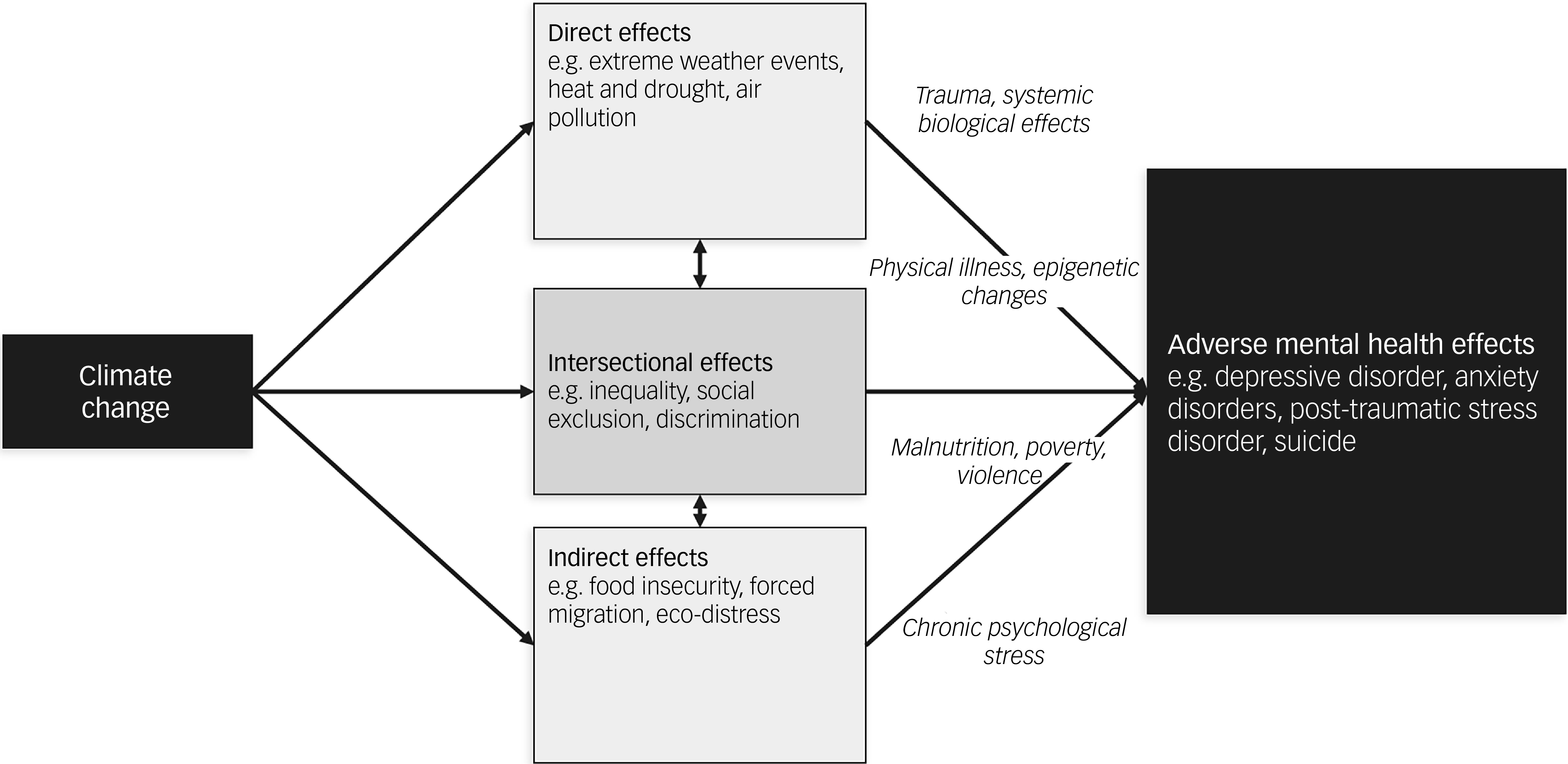
The relationship between climate change and mental health is complex and multifactorial but can be categorised into direct and indirect effects. Reference Walinski, Sander, Gerlinger, Clemens, Meyer-Lindenberg and Heinz6,Reference Hayes and Poland7 Following Heinz et al, Reference Heinz and Brandt8 we also include intersectional effects to highlight the importance of inequality in this relationship (Fig. 1). Marginalised groups are most vulnerable to these impacts. Reference Heinz and Brandt8,Reference Mahmood, Clery, Yang, Cao and Dykxhoorn9
Effect of climate change on mental health through various pathways.

Fig. 1 Long description
A diagram representing the effects of climate change on mental health. The diagram shows three main pathways: direct effects, intersectional effects, and indirect effects. Direct effects include extreme weather events, heat and drought, and air pollution, leading to trauma and systemic biological effects. Intersectional effects involve inequality, social exclusion, and discrimination, resulting in physical illness, epigenetic changes, malnutrition, poverty, and violence. Indirect effects encompass food insecurity, forced migration, and eco-distress, causing chronic psychological stress. All these pathways contribute to adverse mental health effects such as depressive disorder, anxiety disorders, post-traumatic stress disorder, and suicide.
Direct effects
Extreme weather events
Since the year 2000, there has been a steady rise in extreme weather events. This includes floods, storms, droughts and wildfires, with over 500 000 deaths and 3.9 billion people affected by these climate-related disasters. 10 It is predicted that such events will continue to increase in frequency and severity, in line with global ambient temperature increases. 2 In mental health, anxiety, depression and post-traumatic stress disorder (PTSD) are increasingly linked to extreme weather events. UK studies have shown that among flood survivors, the point prevalence of PTSD is between 30 and 36%, depression around 20% and anxiety 20–28%, with similar results observed internationally. Reference Walinski, Sander, Gerlinger, Clemens, Meyer-Lindenberg and Heinz6,Reference Dewi, Kasim, Sutarsa and Dykgraaf11–Reference Smyth, Graham, Vargas, Stanley, Aggio-Bruce and Miles13 Survivors of coastal storms also have elevated rates of these conditions, with studies showing a prevalence of almost 50% among those directly affected by Hurricane Katrina in 2006. Reference Walinski, Sander, Gerlinger, Clemens, Meyer-Lindenberg and Heinz6 Survivors of bushfires have also shown high levels of PTSD symptoms and long-lasting anxiety. Reference Walinski, Sander, Gerlinger, Clemens, Meyer-Lindenberg and Heinz6,12 Social and family effects, including deaths of family members, friends, houses burnt down or flooded, homelessness, being dispossessed, lack of employment, poverty and food insecurity, also affect the mental health of victims. Children and adolescents appear particularly vulnerable to mental health problems in the aftermath of related extreme weather events, with some studies finding associations extending as far as prenatal exposure and others noting an elevated risk of anxiety disorders in childhood survivors of bushfires 20 years later. Reference Walinski, Sander, Gerlinger, Clemens, Meyer-Lindenberg and Heinz6
The effects of extreme weather events are not limited to those directly exposed but also extend to secondary and systemic harm. Emergency workers are an at-risk group for trauma-associated conditions; studies found that after hurricanes, 20–49% of healthcare first responders met or exceeded cut-off scores for PTSD, while other studies reported rates of 10–20% among firefighters involved in wildfires. Reference Walinski, Sander, Gerlinger, Clemens, Meyer-Lindenberg and Heinz6 Similarly, elevated levels of PTSD are found among those living near areas damaged by storms who were not directly exposed. Reference Walinski, Sander, Gerlinger, Clemens, Meyer-Lindenberg and Heinz6 Furthermore, extreme weather events cause significant disruption to community resources and healthcare infrastructure, exacerbating predisposing vulnerabilities such as poverty and food insecurity, with further effects on the physical and mental health of those who rely on these systems for support. People with pre-existing mental health problems are particularly vulnerable due to their greater susceptibility to the effects of psychosocial stressors and reliance on extra support and may be at increased risk of direct harm if they cannot evacuate independently. Reference Walinski, Sander, Gerlinger, Clemens, Meyer-Lindenberg and Heinz6,Reference Dewi, Kasim, Sutarsa and Dykgraaf11
Air pollution
Industrial processes, wildfires and dust storms increase exposure to air pollution, while rising ambient temperatures can compound this through varying mechanisms, including the increase of ground-level pollutants. Reference Clayton and Crandon14 Poor air quality can directly contribute to inflammatory responses in the brain as well as secondary effects via pathways such as systemic inflammation, disruption to the gut microbiome and epigenetic changes. It is associated with increased rates of depression, schizophrenia and suicide. Reference Walinski, Sander, Gerlinger, Clemens, Meyer-Lindenberg and Heinz6,Reference Heo, Lee and Bell15,Reference Braithwaite, Zhang, Kirkbride, Osborn and Hayes16 Air pollution is also linked to physical health consequences, such as an increased risk of respiratory and cardiovascular disease, lung cancer and diabetes, Reference Romanello, Di Napoli, Drummond, Green, Kennard and Lampard3 which in turn impact on mental health. Reference Hayes and Poland7
Heat and drought
In the Northern hemisphere, 1 major European heatwave in 2003 resulted in over 72 000 deaths. 10 Some predict that around 400 million people in the Middle East will be exposed to extended 50°C heatwaves by 2100, Reference Almulhim, Alverio, Sharifi, Shaw, Huq and Mahmud17 effectively rendering certain areas of the world unfit for human habitation. There were 103 droughts in the Global South in 2021 alone, Reference Almulhim, Alverio, Sharifi, Shaw, Huq and Mahmud17 and roughly half of the world’s population experienced water shortages for at least part of the year. 2
One meta-analysis found a significant increase in mental health-related morbidity and mortality when mean temperatures exceeded the 95th percentile for 3 or more days, with a 2.2% increase in mortality and 0.9% increase in morbidity for every 1°C rise in temperature. Reference Liu, Varghese, Hansen, Xiang, Zhang and Dear18 Other analyses have likewise noted an increase in suicides during heatwaves, Reference Walinski, Sander, Gerlinger, Clemens, Meyer-Lindenberg and Heinz6,Reference Heo, Lee and Bell15 in-hospital admissions for psychosis and dementia, Reference Walinski, Sander, Gerlinger, Clemens, Meyer-Lindenberg and Heinz6 and in self-harm, aggression and domestic violence. Reference Smyth, Graham, Vargas, Stanley, Aggio-Bruce and Miles13,Reference Clayton and Crandon14
The impacts of droughts on mortality and wider morbidity are often poorly documented, as most tend to occur outside the ‘emergency phase’, due to the knock-on effects of malnutrition, disease and displacement. 10 Indirect mental health effects have been hypothesised through several pathways, including malnutrition, chronic psychological stress and economic precarity. Reference Walinski, Sander, Gerlinger, Clemens, Meyer-Lindenberg and Heinz6 Studies in Australia have shown a 26% higher likelihood of mental health problems among those exposed to drought, along with a 15% increase in suicide among middle-aged men, Reference Walinski, Sander, Gerlinger, Clemens, Meyer-Lindenberg and Heinz6 while other studies estimate that under extreme drought conditions, suicide rates among rural men could rise by up to 84%. Reference Smyth, Graham, Vargas, Stanley, Aggio-Bruce and Miles13
Indirect effects
Food insecurity
Climate change is slowing agricultural growth, particularly in low and middle latitudes. 2 Around 70% of agricultural land worldwide is vulnerable to changes in rainfall patterns, 10 while elevated temperatures can harm livestock and arable land, and rising sea levels can further reduce the availability of coastal land for agriculture. 2 This can dramatically curtail the economic prospects of farmers, acting as a stressor that can increase suicide rates. Reference Clayton and Crandon14 Higher ambient temperatures can also increase the proliferation of food-borne pathogens, thus complicating the safe storage and distribution of food, while increased atmospheric carbon dioxide concentrations can decrease nutrient density in some crop foods, leading to micronutrient deficiency. 2 These effects will likely be felt most acutely in the Global South. 2,Reference Almulhim, Alverio, Sharifi, Shaw, Huq and Mahmud17
Overall, it is predicted that between 8 million and 80 million additional people will be at risk of nutrition-related diseases by 2050. 2 Nutritional deficiency has numerous potential psychiatric consequences in adults, including fatigue, depression and psychosis, and an even greater impact on children’s mental health, since it can impair development, leading to long-term consequences. Reference Walinski, Sander, Gerlinger, Clemens, Meyer-Lindenberg and Heinz6,Reference Clayton and Crandon14 Food insecurity is well established as a risk and compounding factor for mental illness, with certain groups particularly vulnerable, including pregnant women, the elderly and those with pre-existing mental illnesses; there is also a notable association between food insecurity and intimate partner violence. Reference Walinski, Sander, Gerlinger, Clemens, Meyer-Lindenberg and Heinz6
Forced migration
Extreme weather events lead to temporary displacements, which may become indefinite without sufficient support for those who are affected. 2 Longer-term phenomena such as drought and land degradation further exacerbate displacement. Reference Almulhim, Alverio, Sharifi, Shaw, Huq and Mahmud17 Rising sea levels may eventually make migration inevitable in coastal areas such as the Pacific Islands. Reference Almulhim, Alverio, Sharifi, Shaw, Huq and Mahmud17
Involuntary migration has increased sharply in recent years, with an average of 20 million people displaced annually by extreme weather events. 2 An estimated 143 million people in the Global South will be displaced by the consequences of climate change by 2050. Reference Almulhim, Alverio, Sharifi, Shaw, Huq and Mahmud17 Climate migration often involves moving from rural to urban areas, placing additional strain on infrastructure and causing an overall deterioration in living standards. 2,Reference Walinski, Sander, Gerlinger, Clemens, Meyer-Lindenberg and Heinz6,Reference Almulhim, Alverio, Sharifi, Shaw, Huq and Mahmud17
Forced displacement has psychiatric consequences, including anxiety, PTSD, psychosis and suicide. Reference Walinski, Sander, Gerlinger, Clemens, Meyer-Lindenberg and Heinz6,12 Reported prevalences of PTSD in displaced populations range from 31.5 to 43.0%, Reference Perkins, Michalek, Dikomitis, Shergill and Mareschal19 with similarly elevated rates of depression and anxiety. Reference Smyth, Graham, Vargas, Stanley, Aggio-Bruce and Miles13,Reference Perkins, Michalek, Dikomitis, Shergill and Mareschal19 Such displacement also contributes to poverty, social isolation and wider destabilisation both in the home countries of the displaced and in the countries where they are seeking asylum. Reference Walinski, Sander, Gerlinger, Clemens, Meyer-Lindenberg and Heinz6,Reference Heinz and Brandt8,Reference Almulhim, Alverio, Sharifi, Shaw, Huq and Mahmud17
Eco-distress
Terms like eco-distress and climate anxiety have been used to describe the indirect mental health consequences of climate change, including anxiety, grief and anger in response to current impacts of climate change, uncertain future impacts and the lack of effective global mitigation. This distress impairs overall well-being and has been linked with insomnia, depression, anxiety, substance abuse and suicidal ideation. Reference Smyth, Graham, Vargas, Stanley, Aggio-Bruce and Miles13
Children and young people are predicted to be the generational cohort most impacted by both the direct and indirect effects of climate change. Reference Smyth, Graham, Vargas, Stanley, Aggio-Bruce and Miles13,Reference Boehme, Kinsman, Norrie, Tessier, Fleming and Asmundson20 One large international survey of young people aged 16–25 years found that more than half reported feelings of sadness, anxiety, helplessness, fear, anger and guilt in relation to climate change, with 55% agreeing with the statement ‘humanity is doomed’, and 45% reporting that their worries about climate change had a negative impact on their daily functioning. Reference Hickman, Marks, Pihkala, Clayton, Lewandowski and Mayall21 Functional impairment was significantly more frequent among young people surveyed in the Global South, rising to 74% of respondents from the Philippines and India, and 66% of those from Nigeria. Reference Hickman, Marks, Pihkala, Clayton, Lewandowski and Mayall21
Intersectional effects
The impacts of climate change on mental health are not evenly distributed. Reference Hayes and Poland7,Reference Heinz and Brandt8,Reference Mahmood, Clery, Yang, Cao and Dykxhoorn9 Marginalised and vulnerable populations, such as people with severe mental illness, children and young people, older people, women, Indigenous peoples, people of lower socioeconomic status and minoritised ethnic groups are disproportionately affected, compounding pre-existing mental health inequalities. Reference Romanello, Di Napoli, Drummond, Green, Kennard and Lampard3,Reference Heinz and Brandt8,Reference Smyth, Graham, Vargas, Stanley, Aggio-Bruce and Miles13,Reference Zhang, Braithwaite, Bhavsar and Das-Munshi22 Moreover, these groups are not homogenous and often overlap. Reference Hayes and Poland7 A recent systematic review found that vulnerable groups, such as those of low socioeconomic status, minoritised ethnic or racial groups, Indigenous groups and housing-insecure groups, experienced worse mental health outcomes following climate change events compared with other populations. Reference Mahmood, Clery, Yang, Cao and Dykxhoorn9 These outcomes included post-traumatic symptoms, depressive disorder, anxiety disorder and psychological distress. Reference Mahmood, Clery, Yang, Cao and Dykxhoorn9
Intersectional effects of climate change, proposed by Heinz, Reference Heinz and Brandt8 can be defined as the intersections between direct and indirect effects of climate change on mental health and different forms of vulnerability, with an emphasis on social inequality, exclusion and discrimination. Reference Heinz and Brandt8 For example, individuals of lower socioeconomic status are more likely to be exposed to extreme weather events such as extreme heat, are more likely to experience social isolation and discrimination and are more likely to have a pre-existing mental disorder. Reference Heinz and Brandt8 By undermining the socioeconomic determinants of health, climate change is expected to widen social, economic and demographic inequalities. Reference Hayes and Poland7,Reference Heinz and Brandt8
The concept of climate justice highlights a double injustice of climate change: populations most at risk from climate change are generally those least historically responsible for the greenhouse gas emissions that have caused climate change. Reference Zhang, Braithwaite, Bhavsar and Das-Munshi22 The unequal distribution of harm can only be properly understood by considering broader social, economic and political processes, as inequality and poverty are linked to colonialism, neoliberalism and structural racism. Reference Mechelli, Viding, Fearon, McCrory, Patalay and Creswell4,Reference Zhang, Braithwaite, Bhavsar and Das-Munshi22
Legislative developments
While multiple widely ratified international treaties have created a framework for addressing climate change, many states have been slow to implement them and compliance with the targets set out in these agreements carries no binding legal obligation. Reference Maljean-Dubois23 International bodies, including various United Nations agencies, are increasingly concerned with the health risks from climate change and the human rights implications, including the impact of climate change on mental health. Reference Morgera24 Other global bodies, such as the World Bank, have highlighted the disproportionate effects of climate change on vulnerable groups such as women, children, migrants and people experiencing poverty, Reference Hallegatte, Bangalore, Bonzanigo, Fay, Kane and Narloch25 while other aspects of the international justice system have been more conducive to this legal accountability. Reference Hickman, Marks, Pihkala, Clayton, Lewandowski and Mayall21
In Europe, on 9 April 2024, a single formation of the Grand Chamber of the European Court of Human Rights (ECHR) issued coordinated rulings for the first time in three cases concerning greenhouse gas emissions and the responsibility of individual states for curbing them: Verein KlimaSeniorinnen Schweiz v Switzerland, 26 Duarte Agostinho v 32 Member States 27 and Carême v France. 28
The Carême v France case was ruled inadmissible on a technicality, but the Duarte Agostinho case was invaluable in clarifying the issue of extraterritorial jurisdiction. It was brought by 6 Portuguese children and young people against Portugal, their home state and 32 other Council of Europe Member States. The applicants argued that all 33 respondent states had violated their human rights under the Convention by contributing to climate change and its impact. At least two of the children were said to have been ‘anxious and upset’ and to have suffered ‘adverse childhood experience’ caused by prolonged climate anxiety about the effect of the climate-related wildfires. They also experienced moral injury, caused by their awareness of the failure of those in authority to protect them. The Court reviewed its past case law extensively and declared all the previously accepted grounds for extraterritorial jurisdiction inapplicable.
By contrast, the case regarded worldwide as a landmark judgment is Verein KlimaSeniorinnen Schweiz v Switzerland. It was brought by a Swiss association, Verein KlimaSeniorinnen Schweiz, and four Swiss nationals. The applicants alleged European Convention on Human Rights violations under Articles 2, 6 and 8. A medical certificate confirmed that at least one applicant had suffered physically and psychologically during the heatwaves. The Court found that climate change had an adverse effect on the well-being of the applicants, thus indicating a link to mental health. It ruled that there had been violations of Articles 6 and 8 of the Convention, as the Swiss government had failed to take the necessary measures to tackle climate change and therefore not offered the necessary protection to its citizens from the effects of climate change. The Article 8 violation arose because this failure led to ‘actual interference with the applicant’s enjoyment of their private or family life’, reaching the requisite level of severity. The Court agreed that, as older women, the applicants were disproportionately vulnerable to the effects of climate change on their physical and mental health.
In its judgment, the Court engaged with major treaties, resolutions and agreements on climate change, such as the Aarhus Convention, United Nations (UN) and Council of Europe resolutions and reports by UN rapporteurs. In interpreting these, the Court identified Switzerland’s positive obligations under Article 8 in the context of climate change. It framed its judgment more in terms of protecting the rights of groups rather than individuals. Through its finding on Article 6, the right to a fair trial, it also demonstrated that procedural rights would play a significant role in future climate change litigation. Reference Demir29
Latin American countries have also been very active in framing climate change as a violation of human rights. Reference Tigre30 Environmental rights have been constitutionalised across Latin America, and judges can therefore interpret them to find remedies for climate-related claims. The greater challenge lies in enforcing existing laws. The American Convention on Human Rights guarantees a set of human rights that could be threatened by environmental harm, while the Escazú Agreement refers to ‘the rights of every person of present and future generations to live in a healthy environment and sustainable development’. Reference Tigre30 The Inter-American System of Human Rights has recognised the right to a healthy environment as ‘fundamental to the existence of humanity’. Specific cases have included issues such as air pollution and the protection of rainforests such as the Amazon.
Some Latin American countries, such as Ecuador and Bolivia, recognise the rights of nature as legally binding, so that any environmental legal provision must be interpreted in the way most favourable to nature. Many countries now account for intergenerational equity in climate litigation, including Colombia and Peru. In January 2023, Chile and Columbia approached the Inter-American Court of Human Rights to seek clarification about the responsibilities of the State concerning the human impacts of climate change. The Global Climate and Health Alliance, in response, listed the legal principles and duties that help address the intersection of climate change and health effects. Reference Benesch, Sergeeva, Wainstock and Miller31 There have also been other cases that the ECHR has heard before the landmark Verein KlimaSeniorinnen Schweiz v Switzerland judgment. Reference Tigre30
Courts have started recognising the significance of climate change in Sacchi et al v Argentina, Brazil, France, Germany and Turkey. The UN Committee on the Rights of the Child heard a complaint of 16 children concerning inaction on climate change, affecting their mental health and leading to climate anxiety. The complaint did not succeed on the grounds that domestic remedies had not been exhausted. However, the Committee found the children to be victims of possible rights violations. 33 In Duarte Agostinho, the applicants’ expert report on ‘climate anxiety’ was challenged on grounds that are directly relevant to psychiatrists. The Court pointed to the uncertainty around ‘climate anxiety’ being a diagnosable condition, the fact that the patients had not received anxiety- or depression-related treatment and that the report had been drafted without direct clinical evaluation. 27 Similar issues were significant to De Conto v Italy 34 and Uricchio v Italy 33 being declared inadmissible in May 2025. In the first case, medical reports did not make a link between the recording of an impulse control disorder, an eating disorder and symptoms of antisocial personality disorder and climate events such as the 2018 ‘Vaia Storm’. In the second case, medical reporting did not accompany claims about climate-related anxiety, disturbed sleep and post-flooding nightmares. Again, in Greenpeace Nordic and Others v. Norway, decided in October 2025, young activists described depression, climate anxiety and ‘climate sorrow’ as a form of grief, and the Court did not dismiss these as irrelevant. The issue was inadequate evidence. 36
Table 1 provides a précis of these cases in chronological order. These cases show that Courts are, in principle, willing to recognise climate change affecting mental health as a human rights concern. However, psychiatric evidence is falling short of the standards expected by the Court. This evidence needs to cover areas such as diagnosis, severity and causal attribution to the event. This is even more reason for psychiatrists to furnish well-reasoned and necessary scientific evidence to Courts across the world on the implications of climate change for mental health.
Chronological table of climate and environmental legal cases with psychiatric relevance

Table 1 Long description
The table has six columns: Case name and year, Jurisdiction and court, Summary, Psychiatric relevance, EDH. It contains 10 rows of data. Row 1: L C B v United Kingdom, European Court of Human Rights (ECtHR), Strasbourg, A woman claimed radiation exposure of father from which health risks might endanger her health. No violation of Article 2 was found since the domestic could not be confirmed. No psychiatric claims were involved. However, the case establishes new principles. States have an obligation to protect, including mental health risks, including from environmental risks can affect life and health, particularly in cases of State inaction, and that the legal interpretation has developed to recognize psychological suffering as an aspect of human rights. Row 2: Oneryildiz v Turkey, ECtHR, Strasbourg, A methane explosion in a landfill killed five people. The Court found Turkey had violated Articles 2 and 8 of the ECHR because it had ignored prevention measures in spite of awareness of risk to life. No psychiatric claims were involved. However, the case establishes new principles. States have an obligation to protect, including mental health risks, including from environmental risks can affect life and health, particularly in cases of State inaction, and that the legal interpretation has developed to recognize psychological suffering as an aspect of human rights. Row 3: Pulp Mills on the River Uruguay (Argentina v Uruguay), International Court of Justice (ICJ), The Hague, Argentina claimed Uruguay of going against international treaty by constructing pulp mills too close to the shared river. The Court found no substantive environmental violation. No psychiatric claims were involved. However, the case established an international precedent for the protection of the environment and human health from transboundary environmental change. This principle is now applicable to climate change. Row 4: Soczi & Ors v Argentina, Brazil, France and Turkey, UN Committee on the Rights of the Child (CRC), Geneva, Six children complained named Great Thunberg, accusing them of ignoring climate change and thereby violating their rights under the Convention on the Rights of the Child. The Committee found no violation because domestic remedies had not been exhausted. However, the Committee declared that States have an obligation to protect children from the adverse effects of climate change. Row 5: Verein Klimaseniorinnen Schweiz v Switzerland, ECtHR, Strasbourg, A group of older women in Switzerland’s inadequate climate action violated their rights under ECHR Articles 2, 6 and 8. The Court found that the applicants did not exhaust their domestic remedies and established that States are responsible for climate change protection. This case is the first to establish obligations on States to establish regulatory frameworks to protect individuals from the adverse effects of climate change. Row 6: Duarte Agostinho v Portugal and 32 Others, ECtHR, Strasbourg, Six Portuguese young citizens complained against 33 countries over inadequate climate action, which they argued had contributed to mental health problems. The case was declared inadmissible because domestic remedies had not been exhausted and because of the limits of extraterritorial jurisdiction. Row 7: Carême v France, ECtHR, Strasbourg, The former mayor of Grande-Synthe complained about inadequate action by the French government towards meeting its Paris Agreement targets. The case was declared inadmissible because the complainant did not have personal victim status. Row 8: De Corto v Italy and 32 Others, ECtHR, Strasbourg, A young woman complained that climate change-related events, specifically the 2018 Vasto Storm, had negatively impacted her mental health. The Court found that the applicant had not exhausted domestic remedies and declared the case inadmissible. Row 9: Unichico v Italy and 31 Others, ECtHR, Strasbourg, A young woman complained that climate change-related heat and flooding in southern Italy caused her anxiety, disturbed sleep and increased her risk of asthma attacks. The case was declared inadmissible because the applicant had not exhausted domestic remedies and because the Court found that the applicant had not suffered significant harm. Row 10: Greenpeace Nord and Others v Norway, ECtHR, Strasbourg, Six young Norwegian climate activists (NGOs) complained against Norway’s licensing of Arctic oil extraction. Individual applicants were denied standing. The Court found, but the Court emphasized that the applicants had not exhausted domestic remedies and that the case was inadmissible in the context of climate change. This implied a substantive and timely environmental impact. The Court also emphasized the importance of sustaining emissions from eventual combustion.
Cases are ordered chronologically by date of final decision.
Actionable changes by psychiatrists
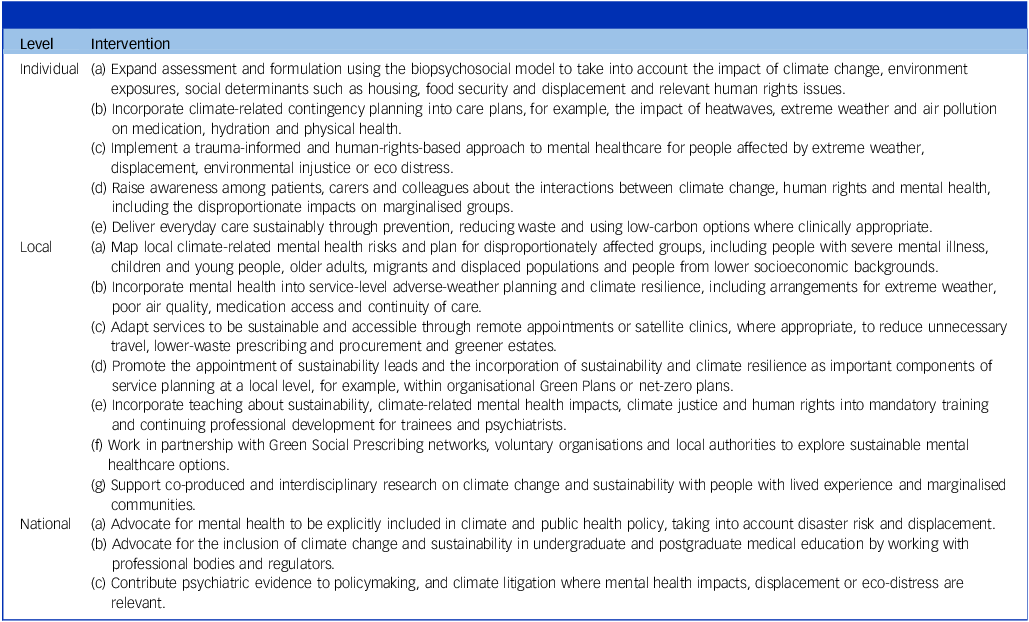
Psychiatrists can influence the nexus of mental health, sustainability and human rights through clinical practice, policy, research and education. These interventions are elaborated below and in Table 2.
-
(a) Clinical practice – Formulation, care planning and treatment should be adjusted to recognise the impact of climate change and related environmental factors on mental health. For example, proactive planning around medication and health needs during heatwaves can be incorporated into contingency care plans. Additionally, it is crucial that mental healthcare is practised in a sustainable way by following the principles of sustainable healthcare: focusing on prevention, empowering patients and carers to manage their own mental health, reducing wasteful activity and using low-carbon interventions. 35 The implementation of trauma-informed care, while not a specific response to climate change, may be particularly relevant and can be considered a form of secondary prevention, while some specific approaches such as Skills of Life Adjustment and Resilience (SOLAR) may have specific utility in the wake of natural disasters. Reference Clayton and Crandon14 These approaches can form part of a broader human-rights-based approach to mental health. 5
-
(b) Policy – To address the determinants and consequences of mental health problems related to climate change, cross-sectoral approaches beyond the clinical are required. 5 This can ultimately be considered a form of primary prevention. Psychiatrists should therefore advocate for environmentally sustainable practices in clinical settings, health education around the effects of climate change and the inclusion of mental health in climate resilience and disaster management plans, just as they might advocate on other matters of public mental health. 38 For example, this could include the increased use of satellite clinics or remote appointments, where appropriate, to reduce the need for patients to travel significant distances to attend appointments, and the reconfiguration of services to reduce the use of less sustainable intervention strategies. Advocating for legislative changes aligned with these agendas can drive the provision of appropriate services and foster cultural shifts and social transformation, 5 ultimately redressing historical and ongoing injustices that contribute to the vulnerability of current and future generations to climate change-related harms.
-
(c) Research and education – Psychiatrists can contribute to further research on the impacts of climate change on mental health and can educate about climate change, sustainability and human rights principles (and the links between these) within medical education and training programmes. Research into climate change and its consequences needs to be both interdisciplinary and co-produced, not just with those with lived experience of mental illness but also with researchers from the Global South and representatives of marginalised communities more generally.
The levels at which psychiatrists can influence practice

Table 2 Long description
A table with three columns and three rows detailing interventions for psychiatrists to influence mental health, sustainability, and human rights. The columns are labeled ‘Level’, ‘Intervention’, and ‘Description’. Row 1: Level, Individual; Intervention, Expand assessment and formulation using the biopsychosocial model to take into account the impact of climate change, environment exposures, social determinants such as housing, food security and displacement and relevant human rights issues; Description, Incorporate climate-related contingency planning into care plans, for example, the impact of heatwaves, extreme weather and air pollution on medication, hydration and physical health. Row 2: Level, Local; Intervention, Map local climate-related mental health risks and plan for disproportionately affected groups, including people with severe mental illness, children and young people, older adults, migrants and displaced populations and people from lower socioeconomic backgrounds; Description, Incorporate mental health into service-level adverse-weather planning and climate resilience, including arrangements for extreme weather, poor air quality, medication access and continuity of care. Row 3: Level, National; Intervention, Advocate for mental health to be explicitly included in climate and public health policy, taking into account disaster risk and displacement; Description, Advocate for the inclusion of climate change and sustainability in undergraduate and postgraduate medical education by working with professional bodies and regulators.
Work in these three broad areas can be done at three levels: individual, local and national. Table 2 describes examples of action at these three levels.
Implications for psychiatry
Several legal cases based on human rights are holding national governments accountable for not paying sufficient attention to climate change and resultant damage to population health, including mental health. The lens of human rights provides a useful way for psychiatrists to become more directly involved in matters concerning sustainability and climate change.
Author contributions
P.S., K.K., S.M., D.K., R.S. and A.S. helped to formulate the research question(s), and write the first draft. A.F. commented on the first draft and helped to finalise the paper to address the research questions.
Funding
This study received no specific grant from any funding agency, commercial or not-for-profit sectors.
Declaration of interest
P.S., A.S. and A.F. are members of the Special Committee on Human Rights of the Royal College of Psychiatrists. K.K., S.M. and D.K. are members of the Planetary Health and Sustainability Committee of the Royal College of Psychiatrists. R.S. has no interest to declare.




eLetters
No eLetters have been published for this article.